Senior Welder full preview

24 Welder Resume Examples That Got Jobs

OtterCV

Written by The OtterCV Team

Updated: 11/5/2025•8 min read

See all resume examples in this guide, or generate your own resume example with your personalized prompt

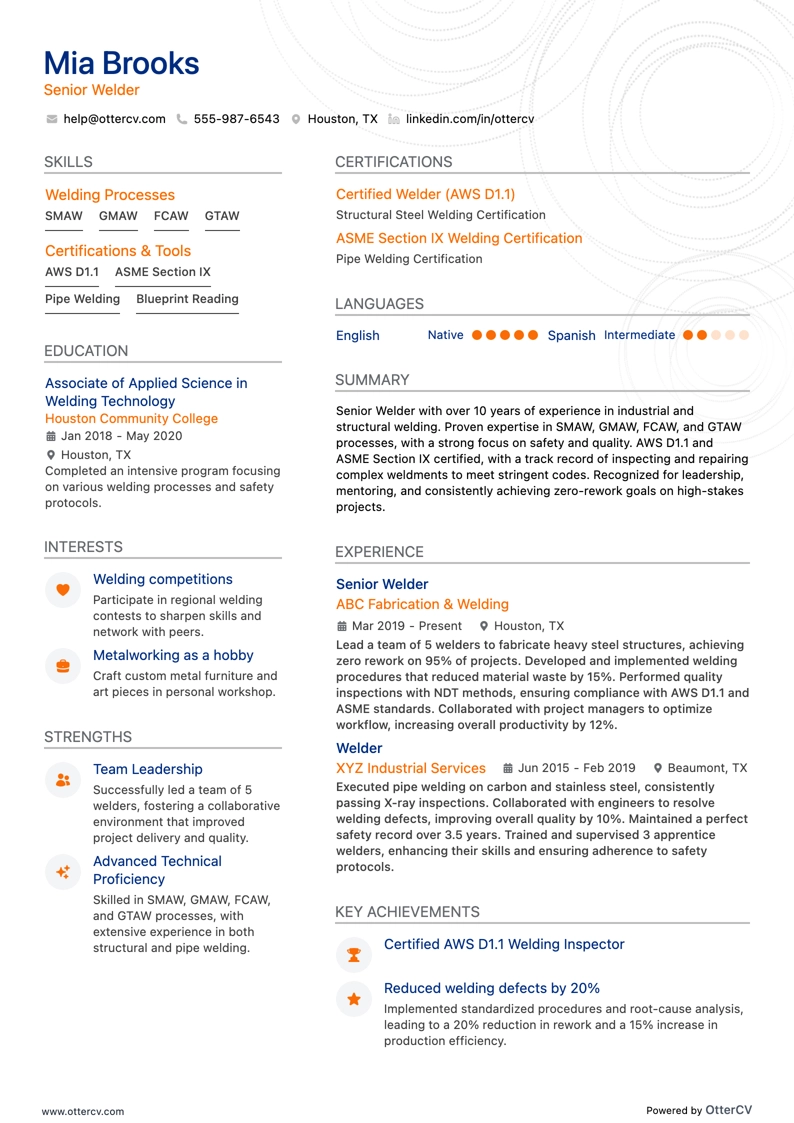
Senior Welder resume example

Senior Welder

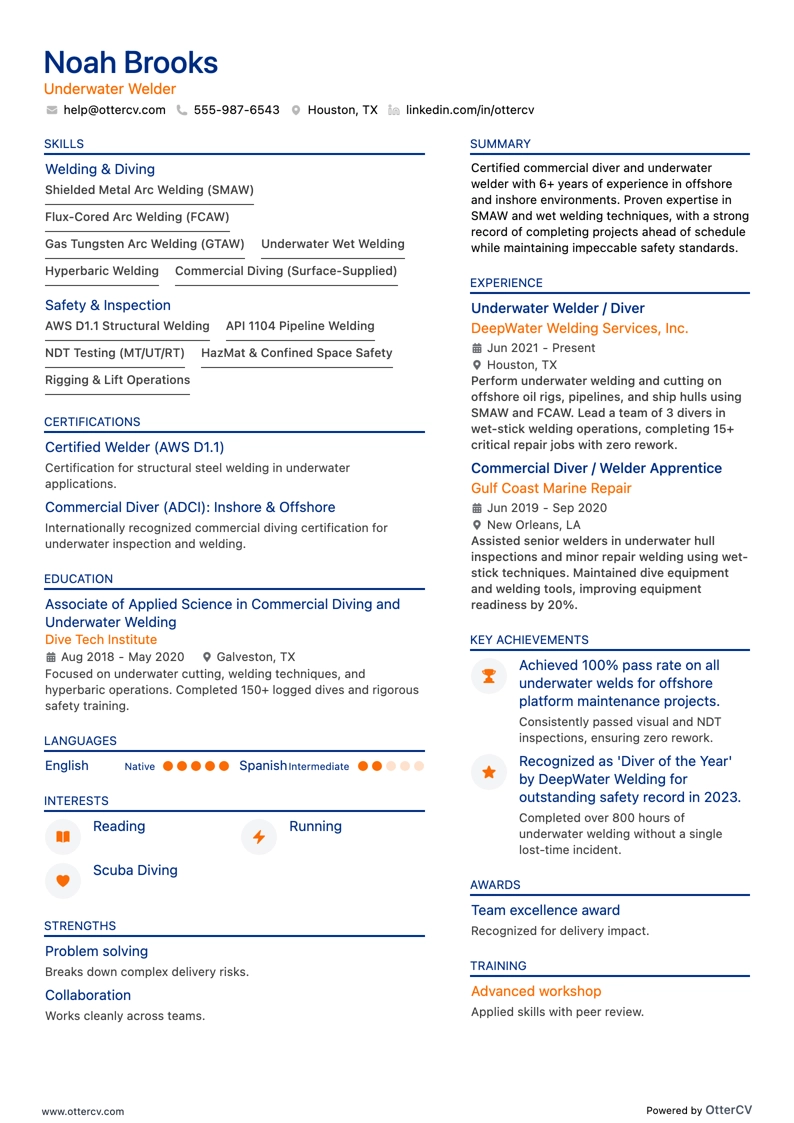
Underwater Welder resume example

Underwater Welder

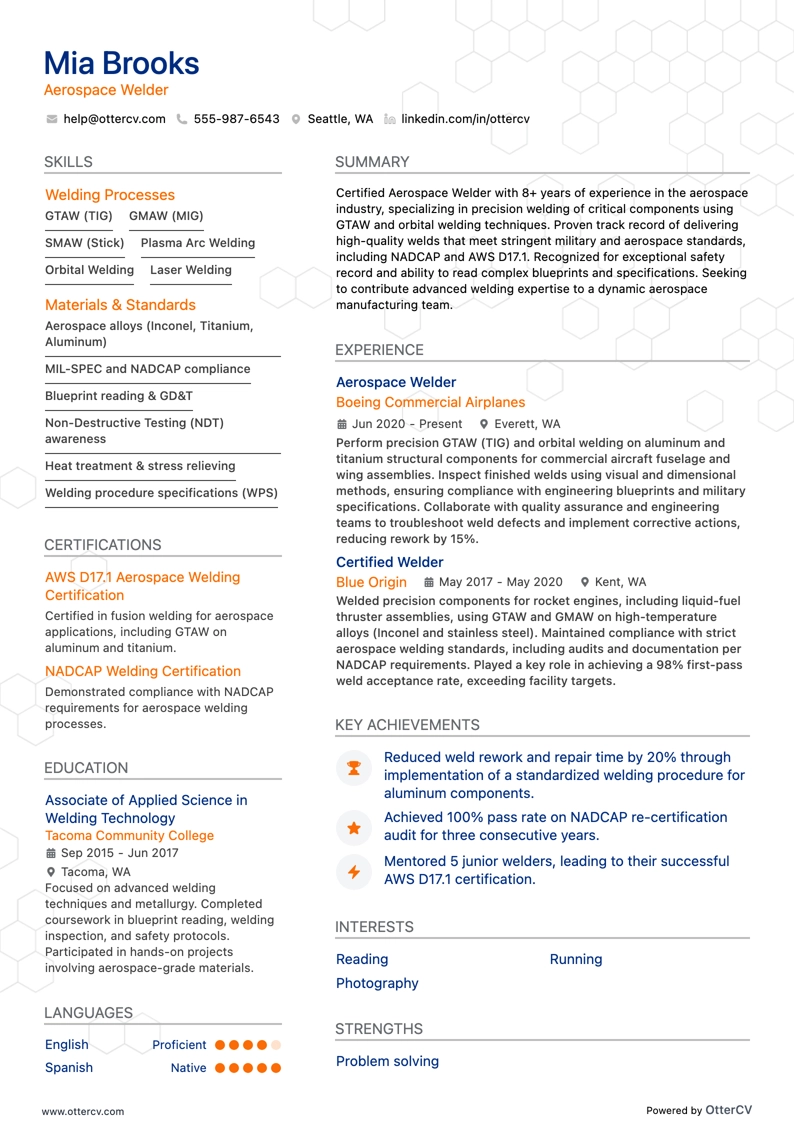
Aerospace Welder resume example

Aerospace Welder

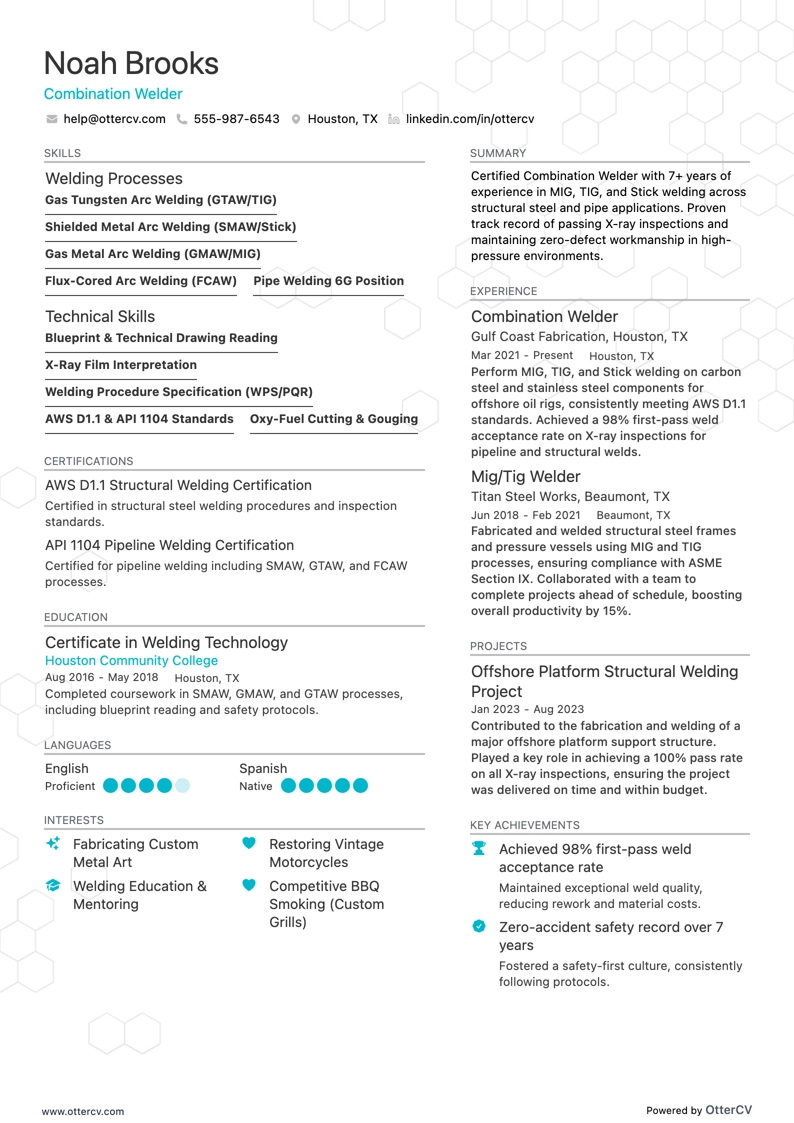
Combination Welder resume example

Combination Welder

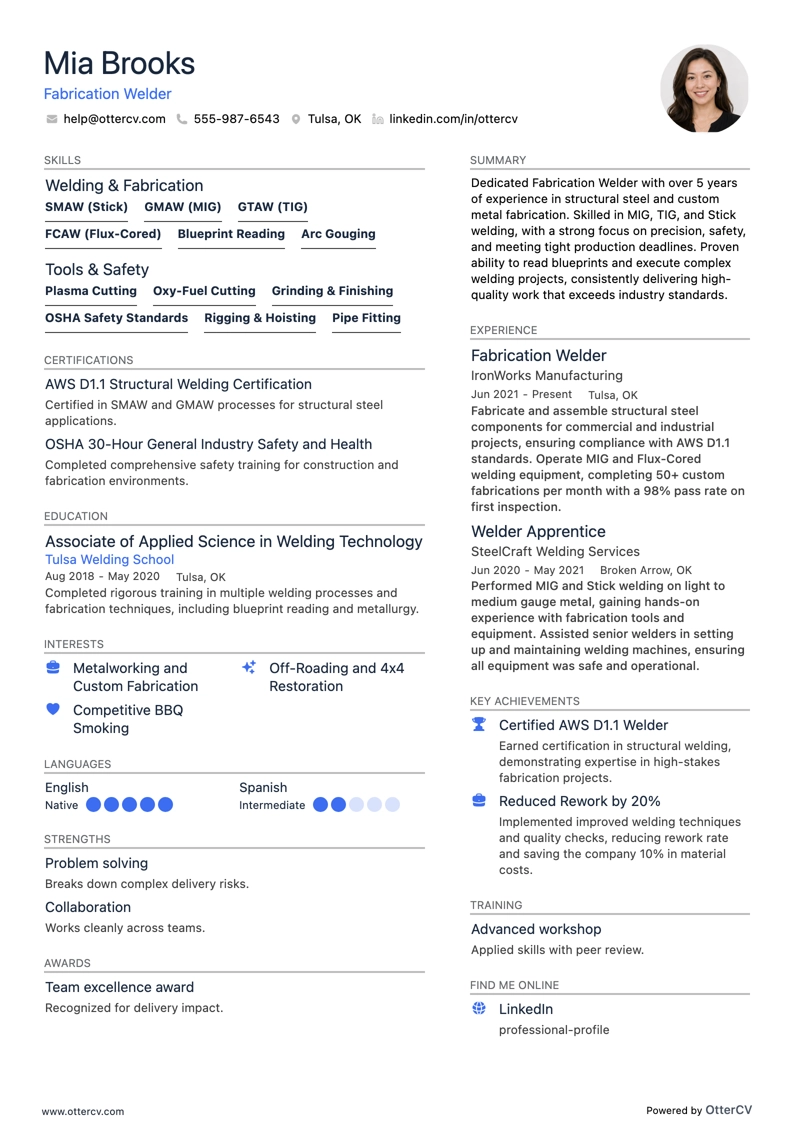
Fabrication Welder resume example

Fabrication Welder

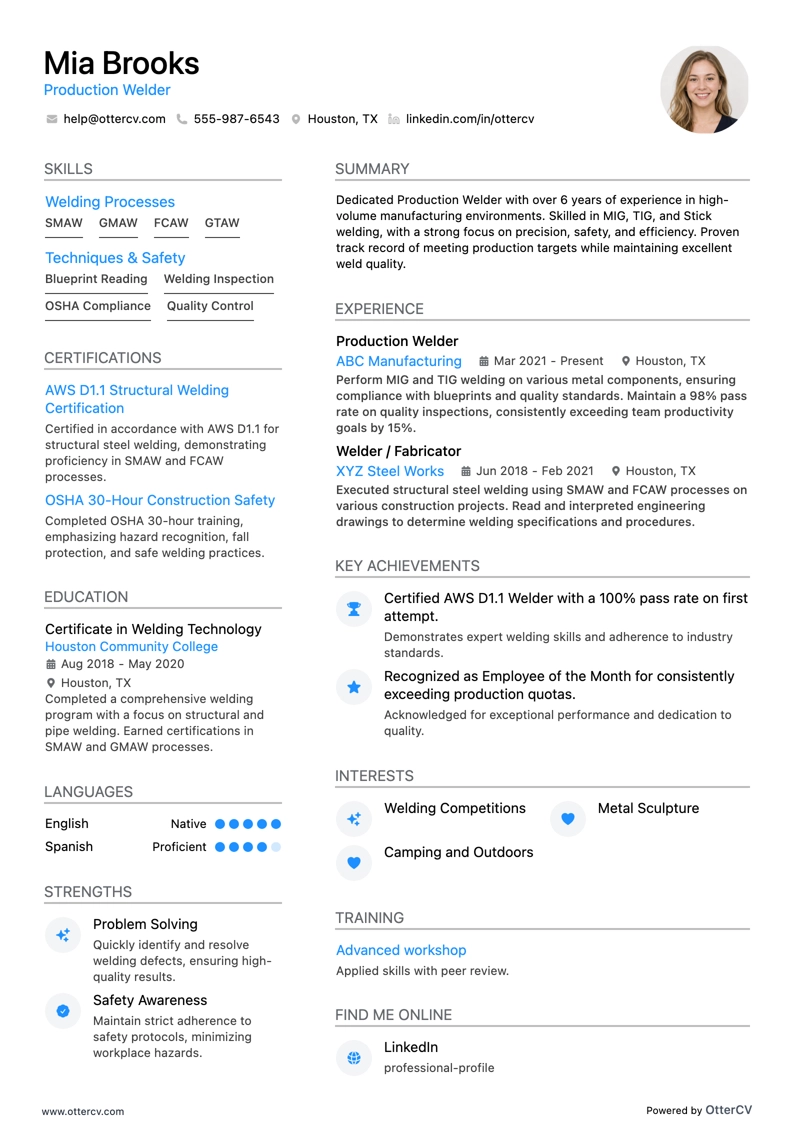
Production Welder resume example

Production Welder

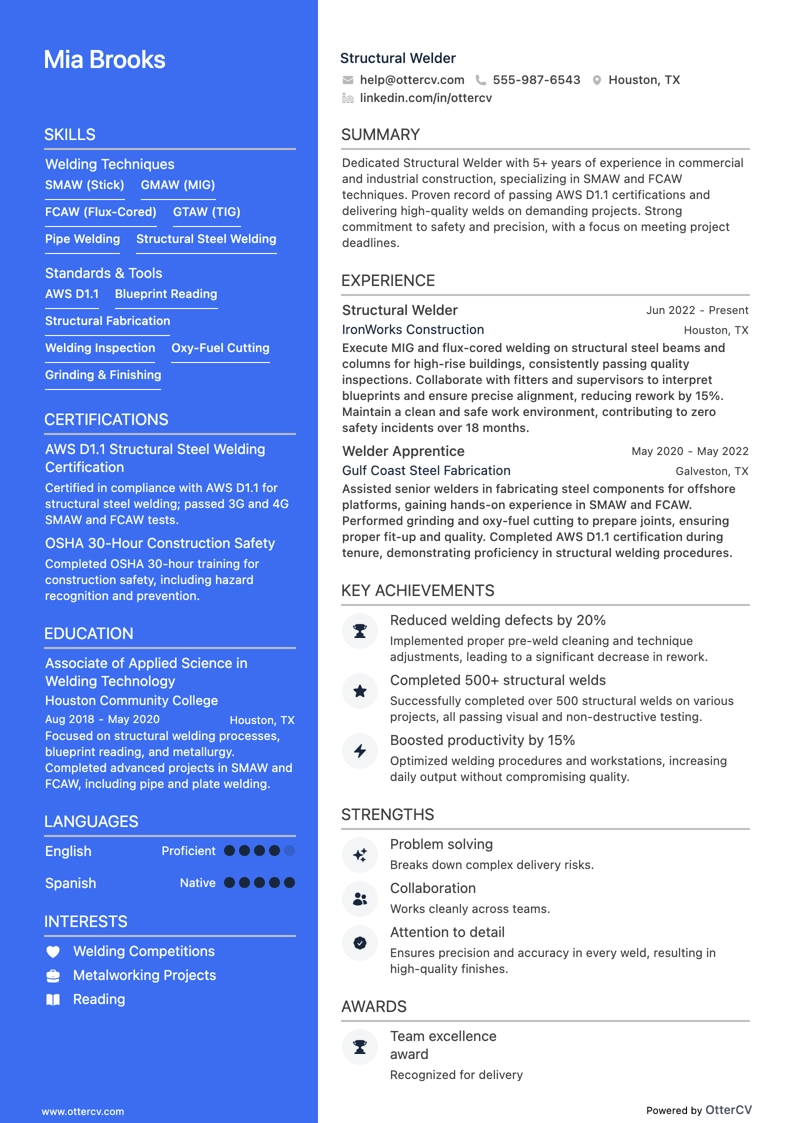
Structural Welder resume example

Structural Welder

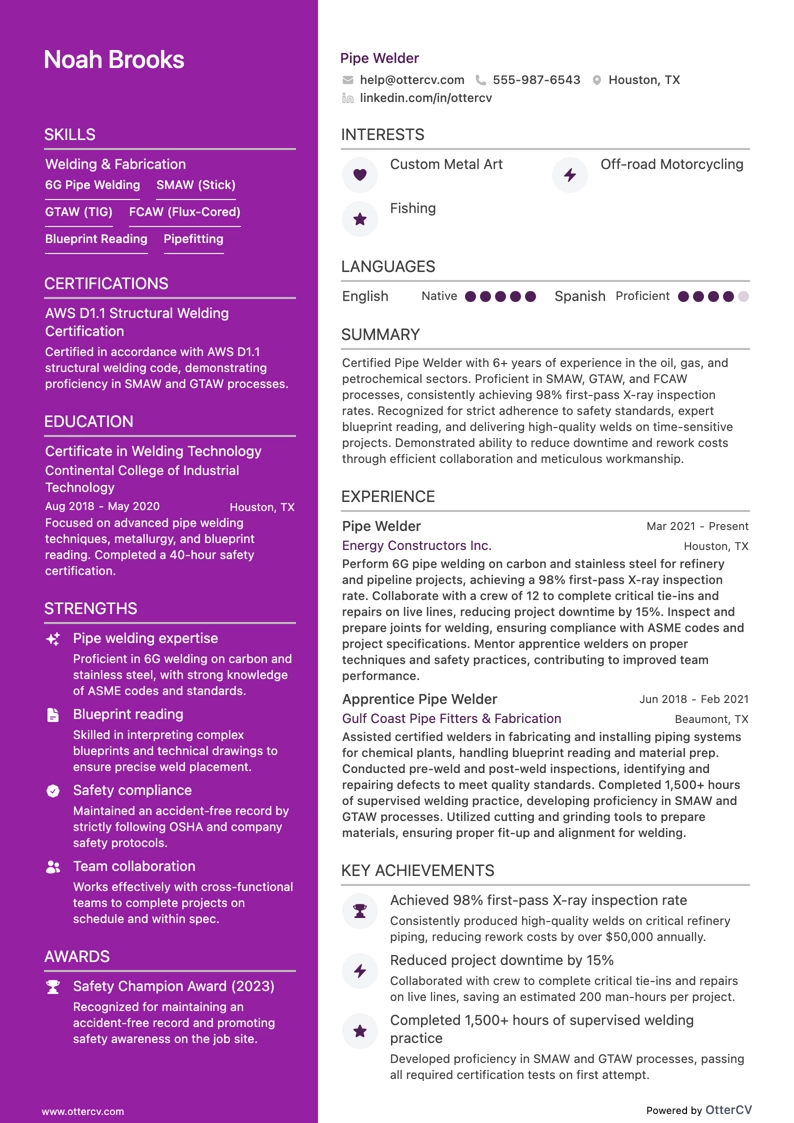
Pipe Welder resume example

Pipe Welder

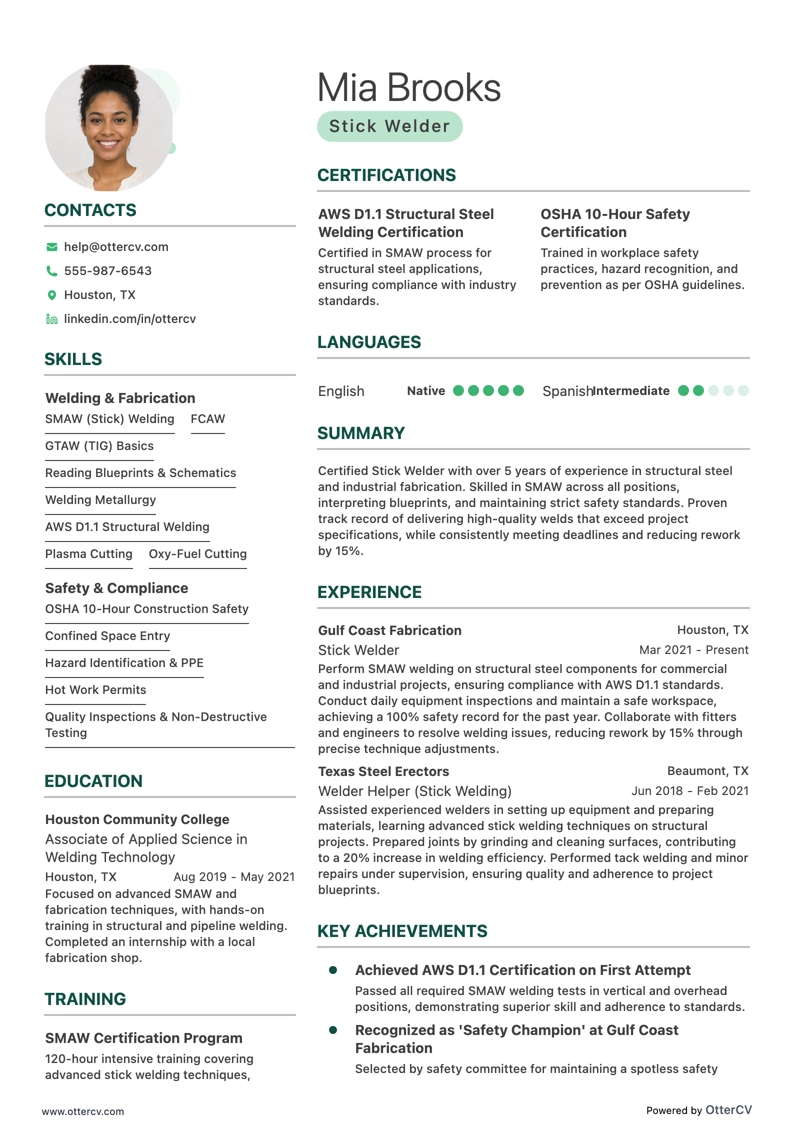
Stick Welder resume example

Stick Welder

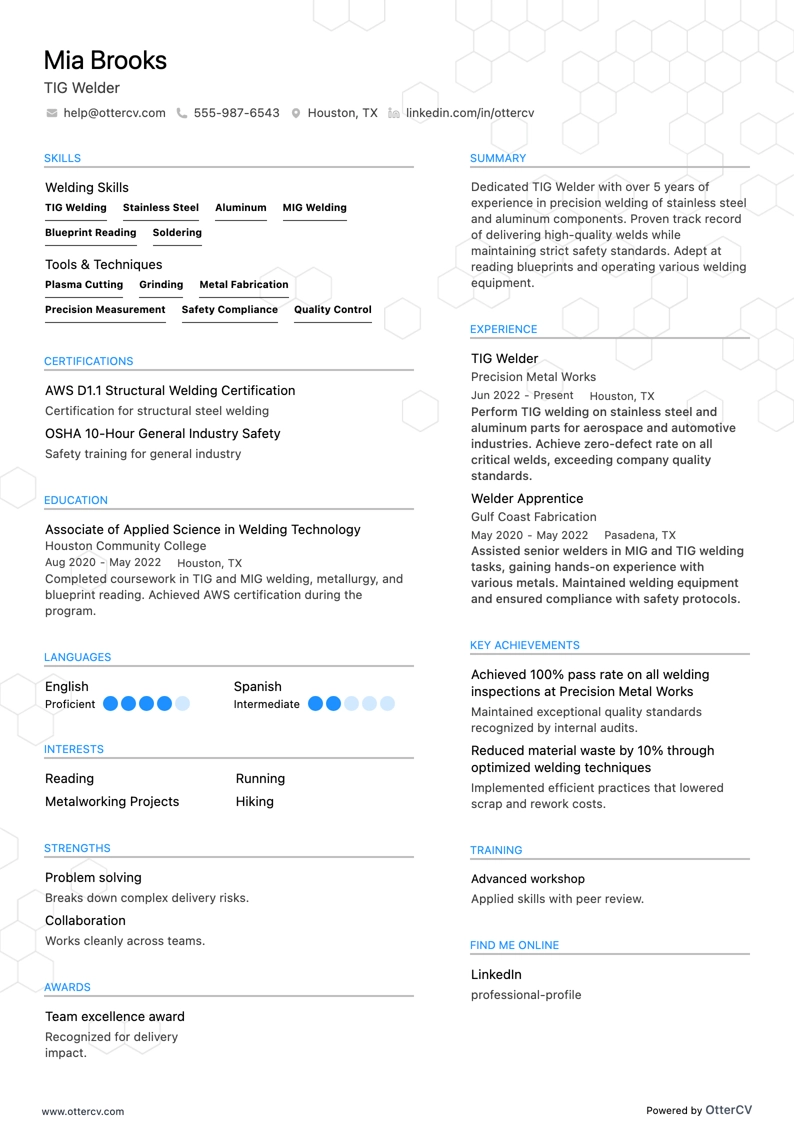
TIG Welder resume example

TIG Welder

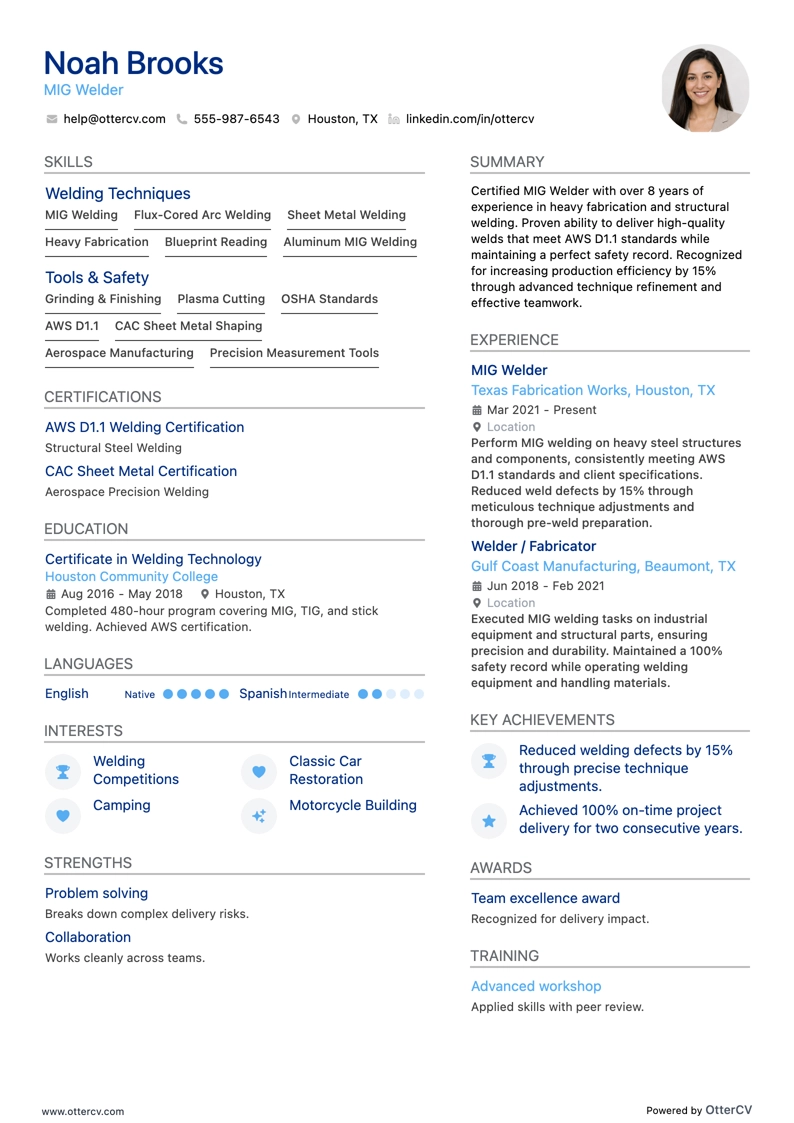
MIG Welder resume example

MIG Welder

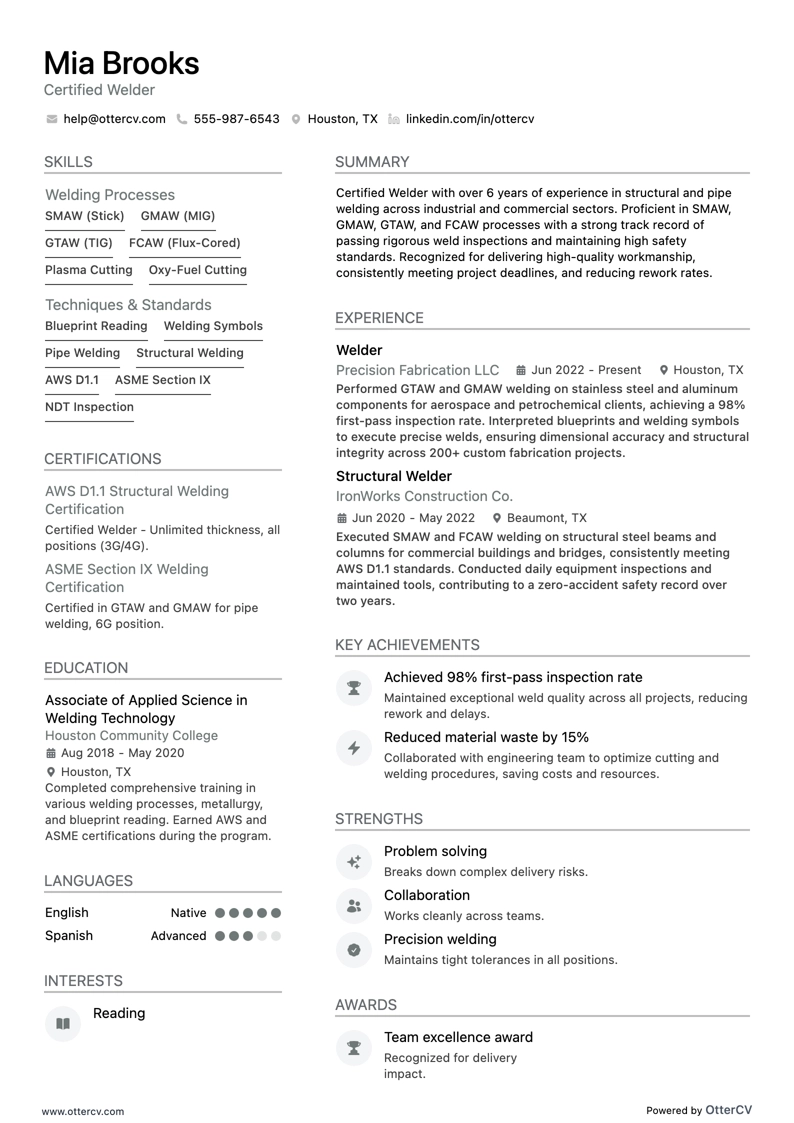
Welder resume example

Welder

Most welder resumes fail because they list equipment and routine tasks but leave out codes, joint types, and measurable results. That makes them harder to scan and more likely to be rejected by an ATS (applicant tracking system) in a crowded pipeline.

A strong resume shows what you delivered and how the work performed. If you're not sure where to start, learning how to write a resume from the ground up can help you avoid common mistakes. Highlight pass rates, rework reductions, weld inches completed per shift, on-time turnaround, and fewer defects on inspection. Include scope such as pipe diameter ranges, thickness, and code compliance.

Key takeaways

  • Quantify weld quality, throughput, and safety results instead of listing generic duties.

  • Match welding processes, codes, and materials to the language used in the job posting.

  • Use a reverse-chronological format for experienced welders and a hybrid format for career changers.

  • Place certifications like AWS or ASME where recruiters can see them within seconds.

  • Connect each listed skill to a measurable result in your experience bullets.

  • Trade school projects and apprenticeship hours count as valid resume evidence for entry-level candidates.

  • Echocv's bullet point generator helps turn vague task descriptions into recruiter-ready achievements.

Job market snapshot for welders

We analyzed 1,538 recent welder job ads across major US job boards to give you a quick view of top employers, industry demand, and the salary landscape.

What level of experience employers are looking for welders

Years of ExperiencePercentage found in job ads
1–2 years17.0% (261)
3–4 years8.1% (125)
5–6 years4.9% (75)
7–8 years0.7% (11)
10+ years2.5% (39)
Not specified65.8% (1012)

Welder ads by area of specialization (industry)

Industry (Area)Percentage found in job ads
Finance & Banking45.3% (697)
Healthcare20.4% (314)
Manufacturing17.8% (273)
Retail & E-commerce6.4% (99)
Energy3.4% (53)
Education2.1% (33)
Government2.0% (31)
Real Estate & Construction2.0% (30)

Top companies hiring welders

CompanyPercentage found in job ads
Sabre Industries1.8% (27)
General Dynamics1.6% (24)
Caterpillar1.5% (23)
REV Group1.4% (22)
Blue Origin1.4% (21)
Valmont Industries, Inc.1.4% (21)
EMCOR Group, Inc.1.2% (18)
Stevens Towing Co., Inc.1.2% (18)
Brown & Root1.0% (16)
Arcosa, Inc.1.0% (15)

Role overview stats

These tables outline the most common responsibilities and employment types for welder roles. Use them to align your resume with employer expectations and understand how the role is structured across the market.

Day-to-day activities and top responsibilities for a welder

ResponsibilityPercentage found in job ads
Welding64.2% (988)
Blueprints27.2% (419)
Mig welding20.9% (322)
Gmaw15.5% (238)
Hand tools15.1% (233)
Tig welding14.8% (227)
Blueprint reading14.0% (216)
Fabrication13.8% (213)
Tig11.7% (180)
Mig11.6% (178)
Smaw11.2% (173)
Gtaw10.9% (167)

How to format a welder resume

Recruiters reviewing welder resumes prioritize hands-on welding certifications (AWS, ASME), proficiency with specific welding processes (MIG, TIG, Stick, Flux-Core), and a consistent track record of producing quality work in demanding environments.

A clean reverse-chronological or hybrid format helps these signals—certifications, process expertise, and measurable production outcomes—surface quickly during both ATS parsing and manual review.

Choosing the right resume format is one of the most important decisions you’ll make before filling in any content.

I have significant experience as a welder—which format should I use?

I have significant experience as a welder—which format should I use?

Use a reverse-chronological format to show your progression across welding roles, increasingly complex projects, and specialized certifications.

  • Start with your most recent role and clearly define the scope of your work, including the types of welding performed, materials handled, industry context such as structural, pipeline, or aerospace, and team or shift size.
  • List the welding processes, equipment, and codes you are certified in, such as GMAW, GTAW, SMAW, FCAW, AWS D1.1, or ASME Section IX.
  • Quantify results related to production efficiency, weld quality, or safety performance.

Example bullet: “Completed 1,200+ structural steel welds per ASME Section IX and AWS D1.1 standards on a $4.2M commercial construction project, maintaining a 99.4% pass rate on radiographic and ultrasonic inspections.”

I'm junior or switching into a welding role—what format works best?

I'm junior or switching into a welding role—what format works best?

Use a hybrid resume format with a dedicated skills and certifications section above your work history so recruiters can quickly see your welding qualifications.

  • Place your welding certifications, processes, and technical skills, such as blueprint reading, fitting, and metallurgy basics, near the top of the resume.
  • Highlight trade school projects, apprenticeship hours, personal fabrication work, or hands-on experience from adjacent roles like metal fabrication, pipefitting, or maintenance.
  • Connect each skill or project to a specific action and a measurable or observable result.

Example scaffold: TIG welding proficiency → fabricated stainless steel food-grade piping assemblies during a 600-hour apprenticeship → all welds passed visual and dye-penetrant inspection on the first attempt.

Why not use a functional resume?

Why not use a functional resume?

A functional resume can hide the timeline and context of your welding experience, making it harder for hiring managers to evaluate where, when, and how you used your skills. That can raise red flags for jobs that rely on verifiable hands-on ability. Avoid this format unless you have no clearer way to present your qualifications.

  • A functional resume may be acceptable if you are moving into welding after a career change, have limited formal work history but relevant certifications and trade school credentials, or need to explain a significant employment gap. Even then, each skill should be connected to a specific project, training exercise, or measurable outcome.

What sections should go on a welder resume

With your format locked in, it’s time to fill each part of the page with the right resume sections.

Recruiters expect a welder resume to show clear qualifications, hands-on welding experience, and compliance with safety and quality standards. Understanding what to put on a resume helps ensure you do not overlook critical details.

Use this structure for maximum clarity:

  • Header
  • Summary
  • Experience
  • Skills
  • Projects
  • Education
  • Certifications
  • Optional sections: Awards, Leadership, Languages

Strong experience bullets should highlight measurable production output, weld quality results, safety performance, and the range of materials, processes, and codes you worked with.

Once you’ve organized your resume with the right core components, the next step is to write your welder resume experience section in a way that shows your impact on the job.

How to write your welder resume experience

The work experience section is where you prove you can deliver finished work, not just list daily tasks. Hiring managers reviewing welder resumes look for measurable outcomes, the specific welding processes and equipment you’ve used, and the real-world impact your work had on production timelines, structural integrity, or cost savings.

Each entry should include:

  • Job title
  • Company and location (or remote)
  • Dates of employment (month and year)

Add three to five concise bullet points that explain what you owned, how you executed the work, and the results you delivered:

  • Ownership scope: the types of welds, assemblies, structures, or production lines you were directly responsible for, including the materials, joint configurations, or project phases under your accountability as a welder.
  • Execution approach: the welding processes, equipment, and inspection methods you used to complete the work, such as MIG, TIG, stick, flux-cored arc welding, plasma cutting, or blueprint interpretation techniques.
  • Value improved: the specific gains your welding work created in areas such as weld quality, defect reduction, production throughput, rework rates, material waste, or compliance with code and safety standards.
  • Collaboration context: how you worked with fabricators, engineers, quality inspectors, project managers, or on-site construction teams to keep your output aligned with broader project requirements and deadlines.
  • Impact delivered: the tangible results your contributions produced, expressed through completed project scope, structural performance, schedule adherence, or cost outcomes rather than a simple list of duties.

Experience bullet formula

Experience bullet formula

Action verb + technology + what you built or fixed + measurable result

A welder experience example

Structural Welder (GMAW/FCAW)

IronPeak Fabrication | Tulsa, OK

2022–Present

Custom steel fabrication shop supporting industrial conveyors, platforms, and pipe racks for oil and gas and manufacturing clients.

  • Fabricated and welded ASTM A36 and A572 structural assemblies using GMAW and FCAW, improving first-pass inspection rates from 92% to 98% across 300+ welds per month.
  • Interpreted AWS D1.1 weld symbols and blueprints with engineering and quality teams, reducing rework hours by 25% through tighter fit-up tolerances and clearer joint prep requirements.
  • Set up and maintained Miller and Lincoln power sources, calibrated gas flow, and optimized WPS parameters, cutting weld time per assembly by 12% while meeting visual and bend-test standards.
  • Executed layout, fit-up, and tack sequences using fixtures, strongbacks, and precision measuring tools, decreasing distortion-related scrap by 18% on large frames over 20 feet.
  • Coordinated lift plans with riggers and supervisors and followed lockout-tagout (LOTO) and hot-work permitting, achieving zero recordable safety incidents over 2,000+ hours worked.

Now that you've seen what a strong experience section looks like, the next step is adjusting those details to fit the specific job you're applying for.

How to tailor your welder resume experience

Recruiters review your welder resume through both human screening and applicant tracking systems. Tailoring your resume to the job description improves your chances of getting through both.

Ways to tailor your welder experience:

  • Match the welding processes listed in the posting, such as MIG, TIG, SMAW, or FCAW.
  • Use the same materials named in the job description, such as carbon steel or aluminum.
  • Reference the codes and standards mentioned, such as AWS D1.1.
  • Include any certifications or licenses the employer requires.
  • Highlight relevant industry experience, such as structural, pipeline, or aerospace welding.
  • Reflect the quality or inspection methods listed, such as NDT or visual testing.
  • Use the same terminology for joint types, positions, or techniques included in the posting.
  • Emphasize safety compliance and PPE protocols when the employer prioritizes them.

Tailoring means aligning your real skills and accomplishments with what the employer is asking for, not stuffing in keywords where they don't belong.

Resume tailoring examples for welder

Job description excerptUntailoredTailored
Perform MIG and TIG welding on stainless steel and aluminum components per AWS D1.2 structural code; maintain weld rejection rate below 2%Performed various welding tasks on metal parts using different techniques.Executed MIG and TIG welds on stainless steel and aluminum structural components to AWS D1.2 code, maintaining a 1.4% weld rejection rate across 500+ joints.
Operate CNC plasma cutting tables and oxy-fuel torches to fabricate steel plate assemblies for heavy equipment frames; read and interpret blueprints and weld symbolsUsed cutting tools and welding equipment in a shop environment.Operated CNC plasma cutting tables and oxy-fuel torches to fabricate steel plate assemblies for heavy equipment frames, interpreting complex blueprints and AWS weld symbols daily.
Complete pipe welding (6G position) on carbon steel process piping for oil refinery shutdowns using SMAW and FCAW processes; pass 100% X-ray inspectionWelded pipes in industrial settings and passed quality checks.Welded carbon steel process piping in 6G position during oil refinery turnarounds using SMAW and FCAW, passing 100% X-ray inspection on all completed joints over three consecutive shutdowns.

Once you’ve aligned your experience with the role’s requirements, the next step is to quantify your welder achievements so employers can clearly see the impact of your work.

How to quantify your welder achievements

Quantifying your achievements helps show how your welding work improves quality, throughput, safety, and delivery. Focus on defect rates, weld strength test results, rework hours, production volume, scrap costs, and on-time completion across projects and shifts.

Quantifying examples for welder

MetricExample
Quality rateCut weld rework from 8% to 2% by tightening MIG parameters, improving fit-up checks, and standardizing WPS settings across two shifts.
ThroughputIncreased output from 18 to 26 assemblies per shift by staging materials, using pulse MIG for long runs, and reducing tool-change downtime.
ComplianceMaintained a 100% pass rate on AWS D1.1 visual inspections across 120 structural welds by following WPS, documenting heat input, and correcting joint prep.
Safety riskReduced hot-work incidents from four to zero over six months by enforcing fire-watch checklists and improving ventilation during FCAW operations.
Cost savingsLowered scrap costs by $9,500 per quarter by improving bevel prep tolerances and switching to calibrated fixtures for repeatable fit-up.

Once you’ve written strong bullet points for your experience section, use that same precision when presenting your hard and soft skills.

How to list your hard and soft skills on a welder resume

Your skills section helps recruiters and applicant tracking system (ATS) filters see that you can weld safely, meet code, and hit production targets. Balance hard skills, such as processes and inspection, with soft skills, such as shift handoffs and quality ownership.

Welder roles require a blend of:

  • Product strategy and discovery skills.
  • Data, analytics, and experimentation skills.
  • Delivery, execution, and go-to-market discipline.
  • Soft skills.

Your skills section should be:

  • Scannable through bullet-style grouping.
  • Relevant to the job post.
  • Backed by proof in your experience bullets.
  • Updated with current tools.

Place your skills section:

  • Above experience if you’re junior or switching careers.
  • Below experience if you’re mid/senior with strong achievements.

Hard skills

  • Performs gas metal arc welding (GMAW).
  • Performs gas tungsten arc welding (GTAW).
  • Performs shielded metal arc welding (SMAW).
  • Performs flux-cored arc welding (FCAW).
  • Reads blueprints and interprets weld symbols.
  • Works with welding procedure specifications (WPS).
  • Understands procedure qualification records (PQR).
  • Applies American Welding Society (AWS) codes.
  • Handles fit-up and tack welding.
  • Uses oxy-fuel cutting and plasma cutting.
  • Performs grinding, beveling, and joint preparation.
  • Conducts visual inspection using weld gauges.

Soft skills

  • Follow lockout-tagout routines.
  • Communicate weld parameters clearly.
  • Coordinate fit-up with fabricators.
  • Escalate defects quickly.
  • Prioritize safety over speed.
  • Maintain clean shift handoffs.
  • Read and confirm work orders.
  • Ask clarifying questions early.
  • Document rework and root causes.
  • Manage time across weld queues.
  • Stay focused in high-heat environments.
  • Take ownership of quality checks.

How to show your welder skills in context

Skills should not live only in a bulleted list on your resume. Explore resume skills examples to see how top candidates present their abilities effectively.

Your skills should be demonstrated in:

  • Your summary (high-level professional identity)
  • Your experience (proof through outcomes)

Here’s how that looks in practice.

Summary example

Senior TIG and MIG welder with 12 years of experience in aerospace fabrication. Skilled in blueprint interpretation, GMAW, and GTAW processes. Reduced rework rates by 30% through precision fitup techniques and consistent cross-team quality coordination.

  • Reflects senior-level expertise immediately
  • Names industry-relevant tools and processes
  • Includes a concrete, measurable outcome
  • Highlights collaboration as a soft skill

Experience example

Senior Structural Welder

Ironclad Fabrication Co. | Houston, TX

March 2018–August 2024

  • Welded structural steel assemblies using SMAW and FCAW, passing 98% of radiographic inspections over six years.
  • Collaborated with quality engineers to refine joint preparation procedures, reducing rework costs by 22%.
  • Trained four junior welders on AWS D1.1 code compliance, improving team first-pass weld acceptance by 15%.
  • Every bullet ties skills to measurable results.
  • Tools and methods appear naturally within achievements.

Once you’ve supported your welding skills with specific examples and results, the next step is to use that same approach when building a welder resume with no experience.

How do I write a welder resume with no experience

Even without full-time experience, you can still show that you’re ready for the job through:

  • Welding school lab assignments
  • Community college fabrication projects
  • Apprenticeship shadowing hours logged
  • Personal metalwork shop builds
  • Volunteer repairs for nonprofits
  • OSHA safety training certificates
  • Blueprint reading coursework projects
  • Weld tests with results

If you're starting from scratch, our guide on writing a resume without work experience explains how to highlight training, projects, and transferable skills effectively.

Focus on:

  • Welding processes used and settings
  • Blueprint symbols, fit-up, tolerances
  • Safety training and PPE compliance
  • Measurable quality and rework rate

Resume format tip for entry-level welder

Resume format tip for entry-level welder

Use a skills-based resume format because it puts welding processes, tools, and training ahead of work history. This helps recruiters quickly find evidence that you are job-ready.

Do the following:

  • Put certifications and training first.
  • List the welding processes you practiced.
  • Add the tools, machines, and gauges you used.
  • Describe projects with measurements and results.
  • Include weld test outcomes when available.

Example project bullet:

  • Completed eight MIG fillet weld coupons in welding school lab, set 18–19V and 250–275 IPM, passed visual inspection with zero porosity and no rework.

Even without hands-on work history, your education and training can show the foundational skills employers want, so it’s important to present them clearly.

How to list your education on a welder resume

Your education section helps hiring teams confirm you have the foundational knowledge needed for welding work. It also highlights the technical training and classroom skills relevant to a welder role.

Include:

  • Degree name
  • Institution
  • Location
  • Graduation year
  • Relevant coursework for junior or entry-level candidates
  • Honors and GPA if your GPA is 3.5 or higher

List only the graduation year, and leave out specific months or days to keep the section clean.

Here’s a strong education entry tailored to the welder role.

Example education entry

Associate of Applied Science in Welding Technology

Tulsa Welding School, Tulsa, OK

Graduated 2021

GPA: 3.7

  • Relevant coursework: Blueprint Reading, Shielded Metal Arc Welding, Gas Tungsten Arc Welding, Metallurgy Fundamentals
  • Honors: Dean's List, four consecutive semesters

How to list your certifications on a welder resume

Certifications show your commitment to learning, demonstrate proficiency with tools and processes, and confirm your relevance in the welding industry. They also help employers trust your skills before the weld test. Learn more about how to list certifications on your resume to maximize their impact.

Include the following details:

  • Certificate name
  • Issuing organization
  • Year
  • Optional: credential ID or URL
  • List certifications below education when your degree or training is more recent and directly matches the welder role.
  • List certifications above education when they are more recent, required for the job, or more relevant than your schooling.

Best certifications for your welder resume

  • American Welding Society Certified Welder.
  • American Welding Society Certified Welding Inspector.
  • American Welding Society Certified Welding Educator.
  • OSHA 10-Hour Construction Safety and Health.
  • NCCER Welding Level One.
  • API 1104 Pipeline Welding Qualification.
  • ASME Section IX Welder Performance Qualification.

Once your welding credentials are easy for employers to verify, use your welder resume summary to bring those qualifications to the top.

How to write your welder resume summary

Your resume summary is often the first part a recruiter reads. A strong summary quickly shows that you have the welding skills and hands-on experience the shop needs.

Keep it to three or four lines and include:

  • Your job title and total years of welding experience.
  • The industry or domain you have worked in, such as structural, pipe, or manufacturing.
  • Your core processes and certifications, such as MIG, TIG, stick, or AWS D1.1.
  • One or two measurable accomplishments from previous roles.
  • A practical soft skill connected to a real result, such as attention to detail reducing rework rates.

PRO TIP

At this stage, focus on the specific welding processes you know and any certifications you hold. Include early results, such as passing weld tests or helping reduce material waste.

Avoid vague claims like “hard worker” or “passionate about welding.” Recruiters look for proof, not promises.

Example summary for a welder

AWS-certified MIG and TIG welder with three years of experience in structural steel fabrication. Maintained a 98% weld pass rate across 200+ inspected joints. Known for precise blueprint interpretation and consistent adherence to schedules.

Now that your summary shows your welding expertise at a glance, make sure your header includes the contact details hiring managers need to reach you.

What to include in a welder resume header

A resume header includes your key contact details and role. It helps a welder appear in searches, build credibility, and move through recruiter screening more quickly.

Essential resume header elements

  • Full name
  • Tailored job title and headline
  • Location
  • Phone number
  • Professional email
  • GitHub link
  • Portfolio link
  • LinkedIn

A LinkedIn link helps recruiters verify your experience quickly and supports screening.

Do not include a photo on a welder resume unless the role is explicitly front-facing or appearance-dependent.

Match your header job title to the posting, and keep every link and contact detail current and easy to scan.

Example

Once your contact details and role focus are clearly presented at the top, you can strengthen the rest of your application with additional sections that add relevant context and show why you are a strong fit for a welder role.

Additional sections for welder resumes

Extra resume sections can help you stand out when your core qualifications are similar to those of other candidates. They highlight strengths that add credibility to your welding experience.

  • Certifications and licenses
  • Languages
  • Safety training and OSHA compliance
  • Professional affiliations (e.g., American Welding Society)
  • Hobbies and interests
  • Volunteer work

Once you’ve strengthened your resume with the right supporting sections, it’s worth pairing it with an equally strong cover letter.

Do welder resumes need a cover letter

A cover letter isn’t required for a welder, but it can help when the role is competitive or the employer expects one. If you’re unsure what a cover letter is or when to include one, it can make a difference when your resume needs added context or when you want to show a clear fit for the job.

Use a cover letter when it adds specific detail:

  • Explain role and team fit: Match your welding processes, shift readiness, and safety habits to the shop’s work and pace.
  • Highlight one or two relevant projects or outcomes: Name materials, positions, codes, and measurable results such as reduced rework or faster throughput.
  • Show understanding of the product, users, or business context: Connect your weld quality to end use, inspection requirements, and delivery deadlines.
  • Address career transitions or non-obvious experience: Tie related work to welding tasks, and explain gaps, new certifications, or a move between industries.

Even if you decide a cover letter will not add value, you can still strengthen your application. Next, consider how AI can help improve your welder resume.

Using AI to improve your welder resume

AI can improve your resume’s clarity, structure, and overall impact. It can tighten your wording and help highlight measurable results. But using it too much can quickly make your resume feel less authentic. Once your content is clear and tailored to the role, stop relying on AI. If you want to explore your options, see which AI is best for writing resumes before choosing a tool.

Here are 10 practical prompts you can copy and paste to improve specific parts of your welder resume:

  1. Strengthen summary: “Rewrite my welder resume summary to emphasize hands-on fabrication experience and relevant certifications in three concise sentences.”
  2. Quantify experience: “Add measurable results to these welder experience bullets, focusing on production output, weld quality rates, or project timelines.”
  3. Tighten bullet points: “Shorten each welder experience bullet to one line while keeping the core skill and achievement intact.”
  4. Align with job posting: “Compare my welder resume skills section to this job description and identify missing keywords I should add.”
  5. Improve skills section: “Organize my welder skills list into technical skills, safety certifications, and equipment proficiencies as three separate groups.”
  6. Refine certifications: “Reformat my welder certifications section so each entry includes certification name, issuing body, and expiration date.”
  7. Clarify project details: “Rewrite these welder project descriptions to clearly state materials used, welding processes applied, and final outcomes delivered.”
  8. Enhance education: “Improve my welder education section by highlighting relevant coursework, shop training hours, and technical credentials earned.”
  9. Remove filler language: “Identify and remove vague or generic phrases from my welder resume that don't demonstrate specific skills or results.”
  10. Fix action verbs: “Replace weak or repeated verbs in my welder experience bullets with precise action words tied to fabrication and welding tasks.”

Stop using AI once your resume sounds accurate, specific, and aligned with your real experience. AI should never invent experience or exaggerate claims—if it did not happen, it does not belong on your resume.
Conclusion

A strong welder resume shows measurable results, role-specific skills, and a clear structure. It highlights certifications, processes, and materials while proving impact with numbers such as weld volume, defect rates, and rework reductions.

Keep each section easy to scan, and align your experience with the welder role you want. This approach shows you are ready for today’s hiring market and the next wave of shop and field demands.

Welder resume examples

Explore additional Welder resume samples and guides and see what works for your level of experience or role.

By Experience

Senior Welder

Senior Welder resume preview

Welder resume examples

Explore additional Welder resume samples and guides and see what works for your level of experience or role.

By Role

Underwater Welder

Underwater Welder resume preview

Aerospace Welder

Aerospace Welder resume preview

Combination Welder

Combination Welder resume preview

Fabrication Welder

Fabrication Welder resume preview

Production Welder

Production Welder resume preview

Structural Welder

Structural Welder resume preview

Pipe Welder

Pipe Welder resume preview

Stick Welder

Stick Welder resume preview

TIG Welder

TIG Welder resume preview

MIG Welder

MIG Welder resume preview

Welder

Welder resume preview