How to quantify impact on your resume
What works in this example:
- Quantifies impact: “Cared for 500+ patients at the launch of a new pediatric hospital” gives hiring managers a clear picture of the candidate’s patient volume and pediatric care experience.
- Evidence of success: “Trained 35 nurses in MedSupply inventory software that reduced errors by 15%” shows measurable results with tools relevant to the target role.
- Industry skills: “Assessed individual patient needs and referred families to specialists in newborn care” demonstrates how the candidate applied their training on the job and what they can bring to a new employer.
Unlike permanent staff who can point to long-term projects or quality improvement initiatives, travel nurses may find it harder to show their impact in concrete terms.
Focus on achievements that demonstrate immediate results and rapid adaptability. Measurable outcomes help employers understand how you can contribute to their success.
When quantifying impact on your travel nurse resume, consider including:
- The number of states or countries where you’ve worked to show flexibility and adaptability across cultures and institutions.
- The number of assignments you have completed to show experience across medical teams and settings.
- The number of patients you managed daily or per shift to demonstrate workload capacity and composure under stress.
- The number of procedures or treatments you’ve performed to reflect hands-on experience and competence.
- The number of years or months spent in specialty areas to highlight expertise in specific fields.
- Any significant reduction in readmission rates under your care to demonstrate effectiveness and impact.
- Your quickest response time in emergency cases to show efficiency and sound judgment under pressure.
- A perfect attendance record, if applicable, to show reliability and dedication.
How do I write a travel nurse resume with no experience
If you’re changing careers or applying for your first travel nurse job, focus on experience outside your formal work history.
The best approach is to use a functional resume that focuses on transferable skills rather than direct experience, so employers can see how you’ve prepared for the role.
To write an effective entry-level travel nurse resume:
- Choose a functional resume layout
- Focus on transferable skills
- Present credentials and licenses clearly
- Tailor every section to fit your target job
Don’t pad your experience section with irrelevant jobs just to fill space. Include only roles that are relevant to your target position and emphasize transferable skills.
Travel nursing requires a broad, adaptable skill set, so many types of jobs can support your application. Previous healthcare roles can show medical training and clinical experience. Service jobs can demonstrate people skills. Consulting or management roles can also highlight experience with short-term assignments and travel.
How to list your hard and soft skills on your resume
Travel nurses are skilled medical professionals. You also need the interpersonal ability to provide compassionate care and the flexibility to relocate for weeks at a time.
Your resume should present your skills in two main categories.
Hard skills are the technical knowledge and abilities required to perform job duties, while soft skills are the interpersonal and communication skills needed to work effectively with others.
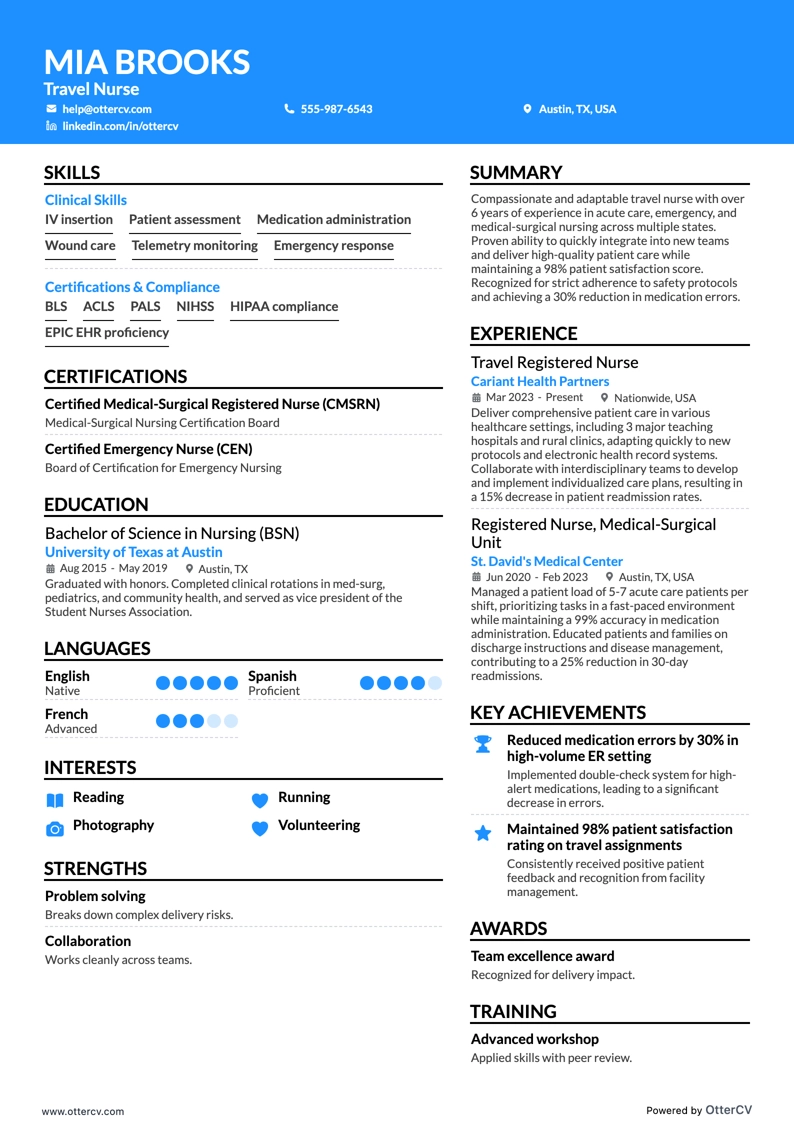
Hard skills are usually straightforward and can be presented in a simple list. Here is an example of hard skills on a travel nurse resume.