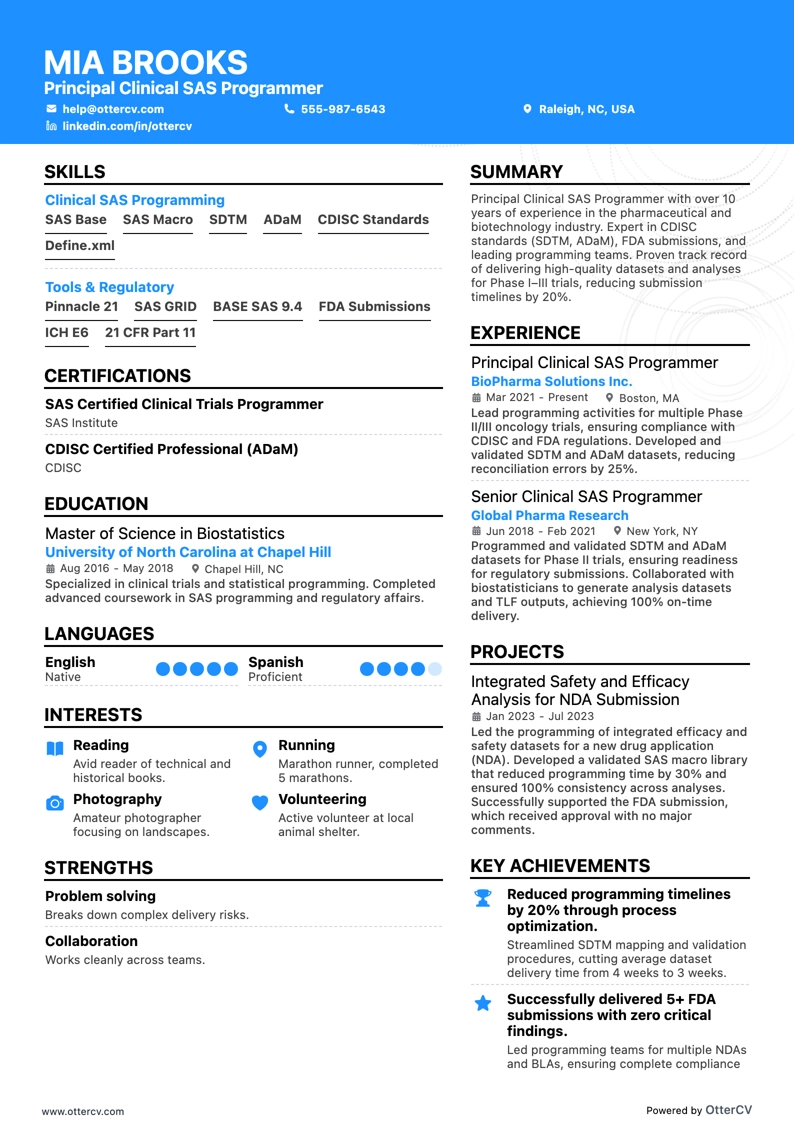
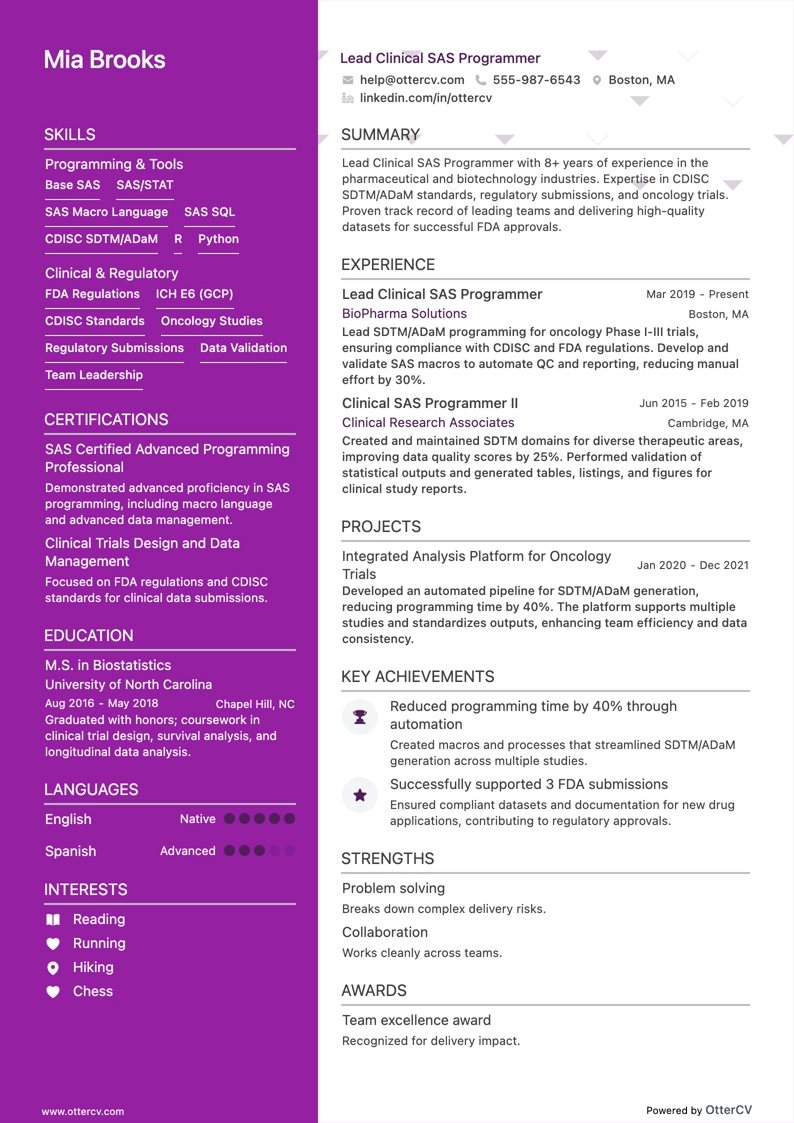
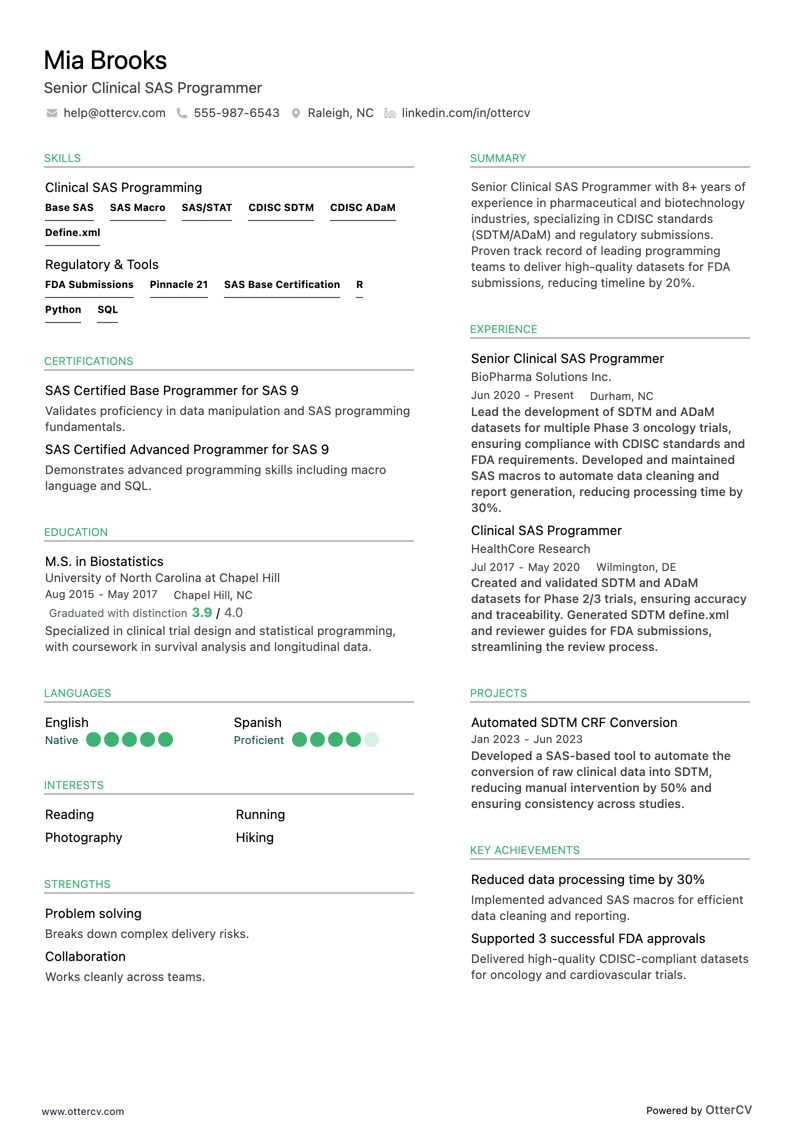
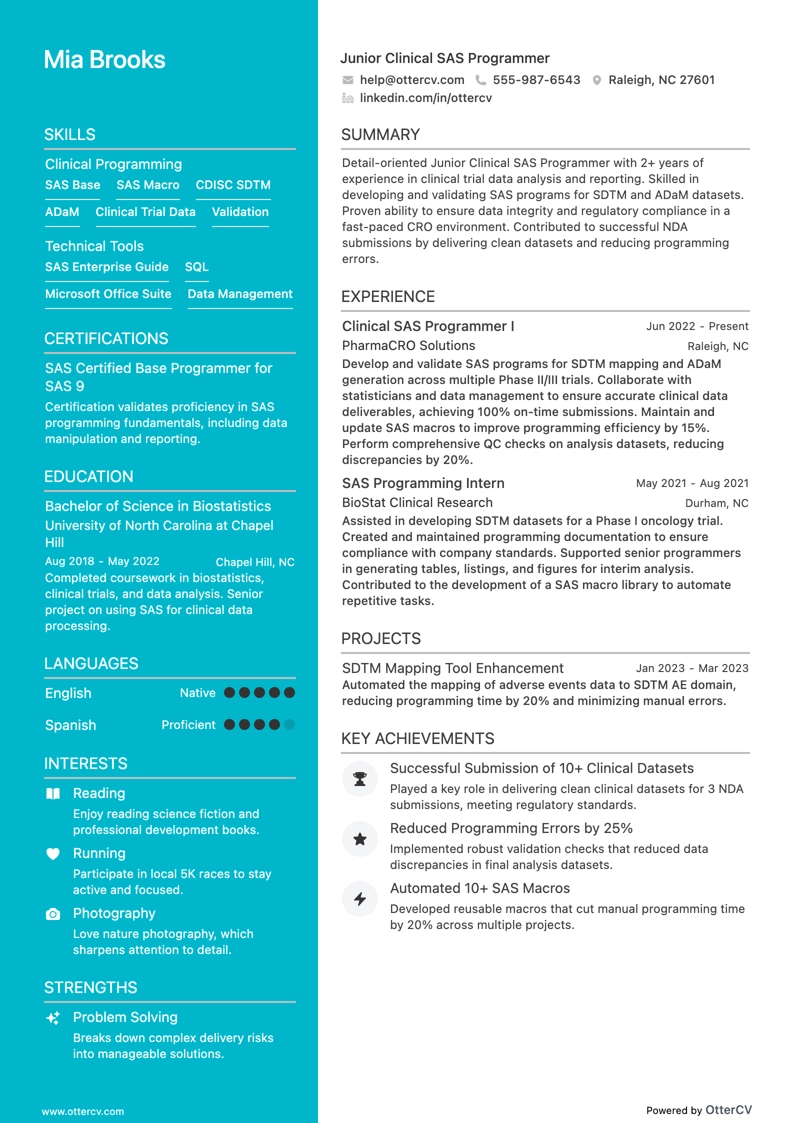
Principal Clinical SAS Programmer full preview

10 SAS Clinical Programmer Resume Examples

OtterCV

Written by The OtterCV Team

Updated: 9/14/2025•8 min read

See all resume examples in this guide, or generate your own resume example with your personalized prompt

Principal Clinical SAS Programmer resume example

Principal Clinical SAS Programmer

Lead Clinical SAS Programmer resume example

Lead Clinical SAS Programmer

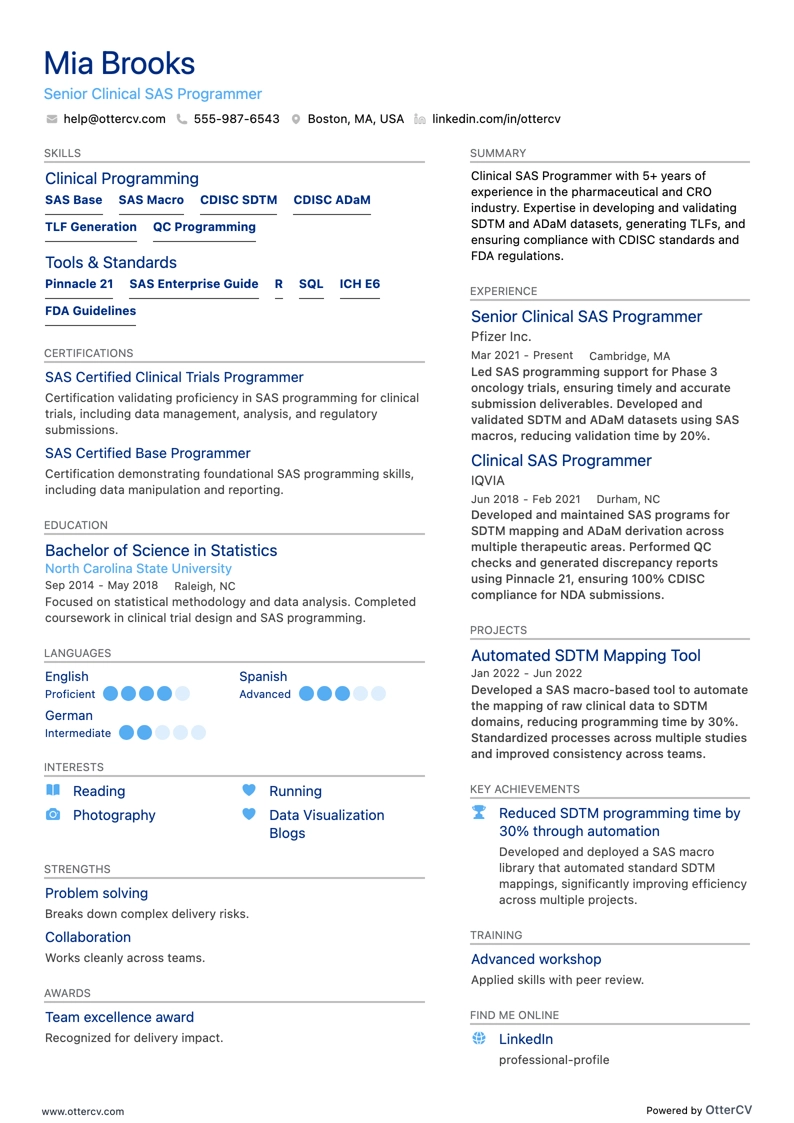
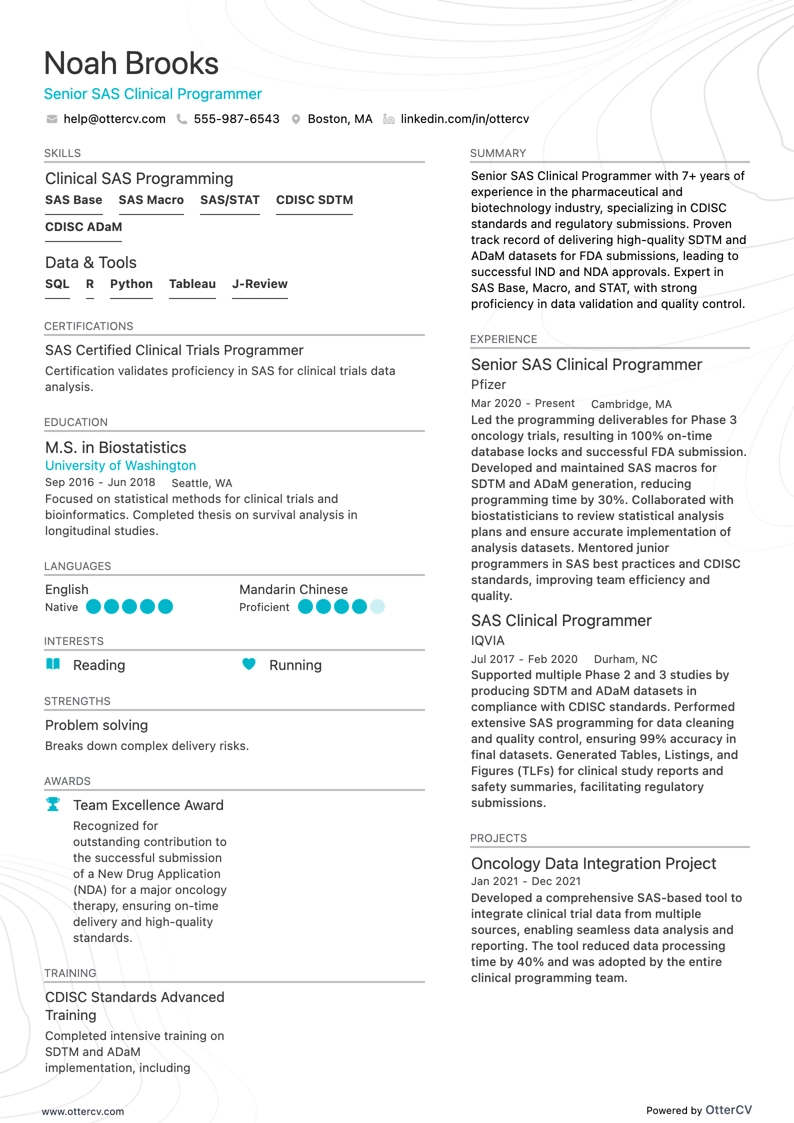
Senior Clinical SAS Programmer resume example

Senior Clinical SAS Programmer

Junior Clinical SAS Programmer resume example

Junior Clinical SAS Programmer

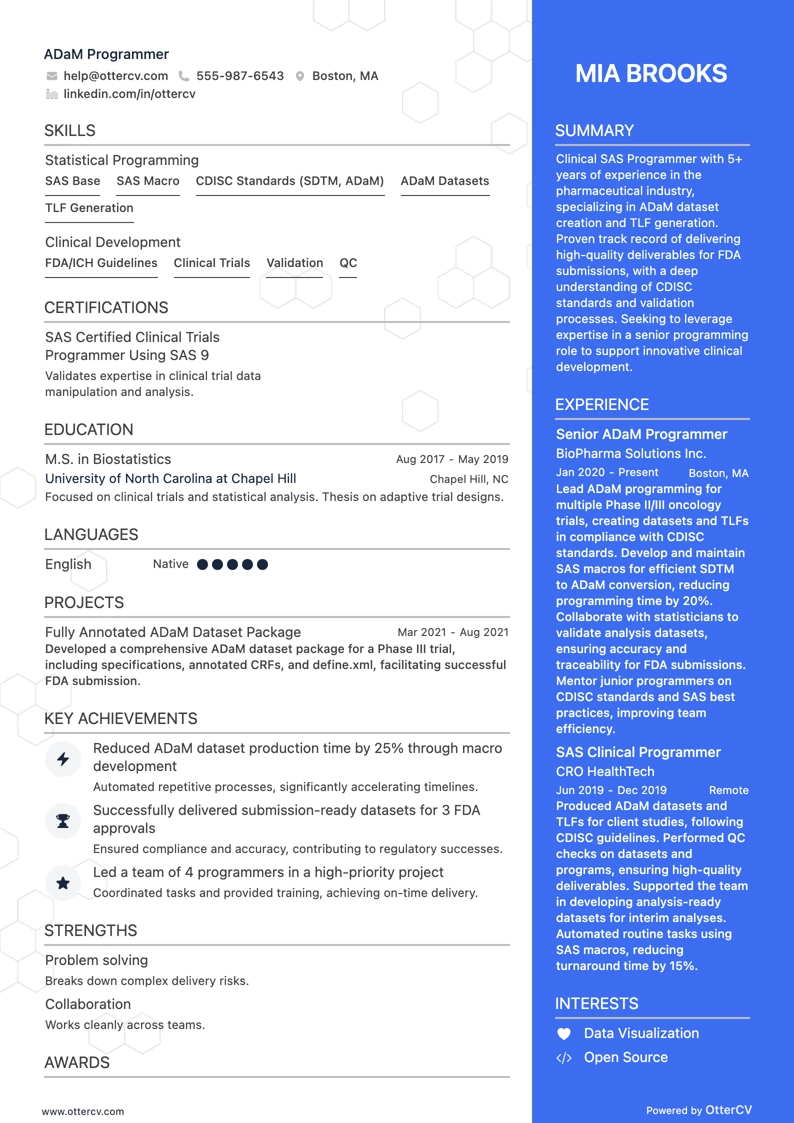
ADaM Programmer resume example

ADaM Programmer

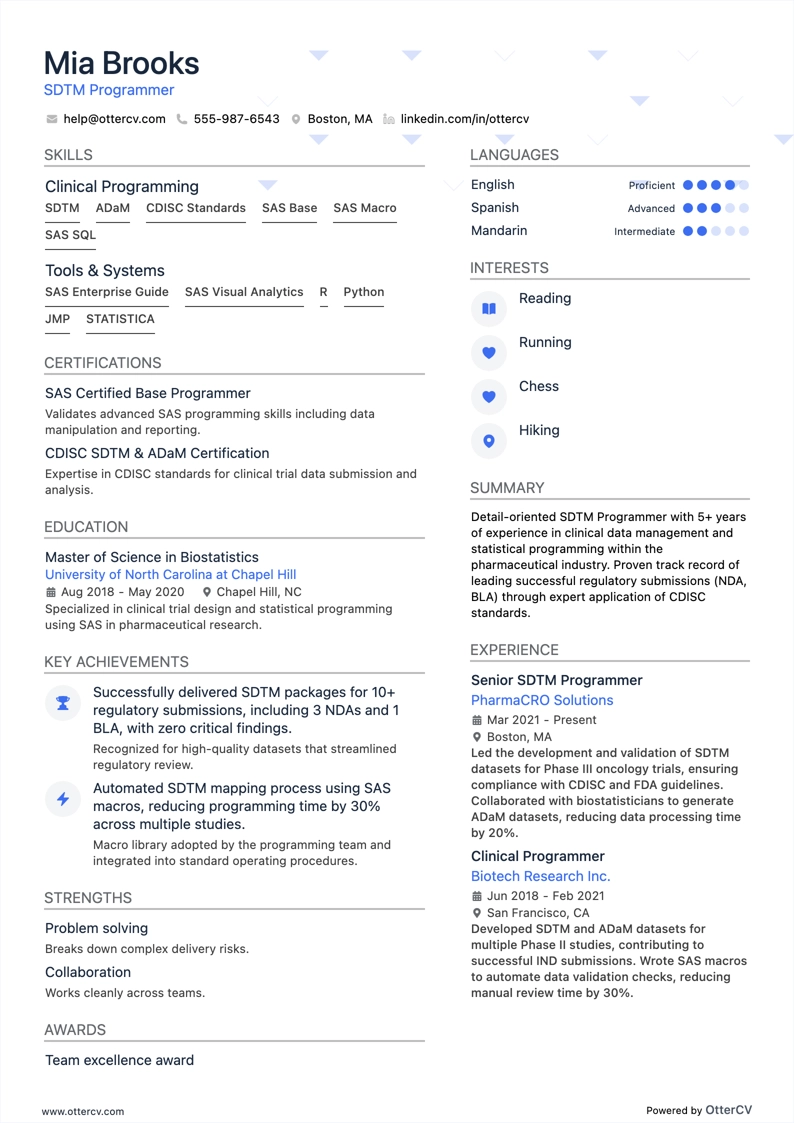
SDTM Programmer resume example

SDTM Programmer

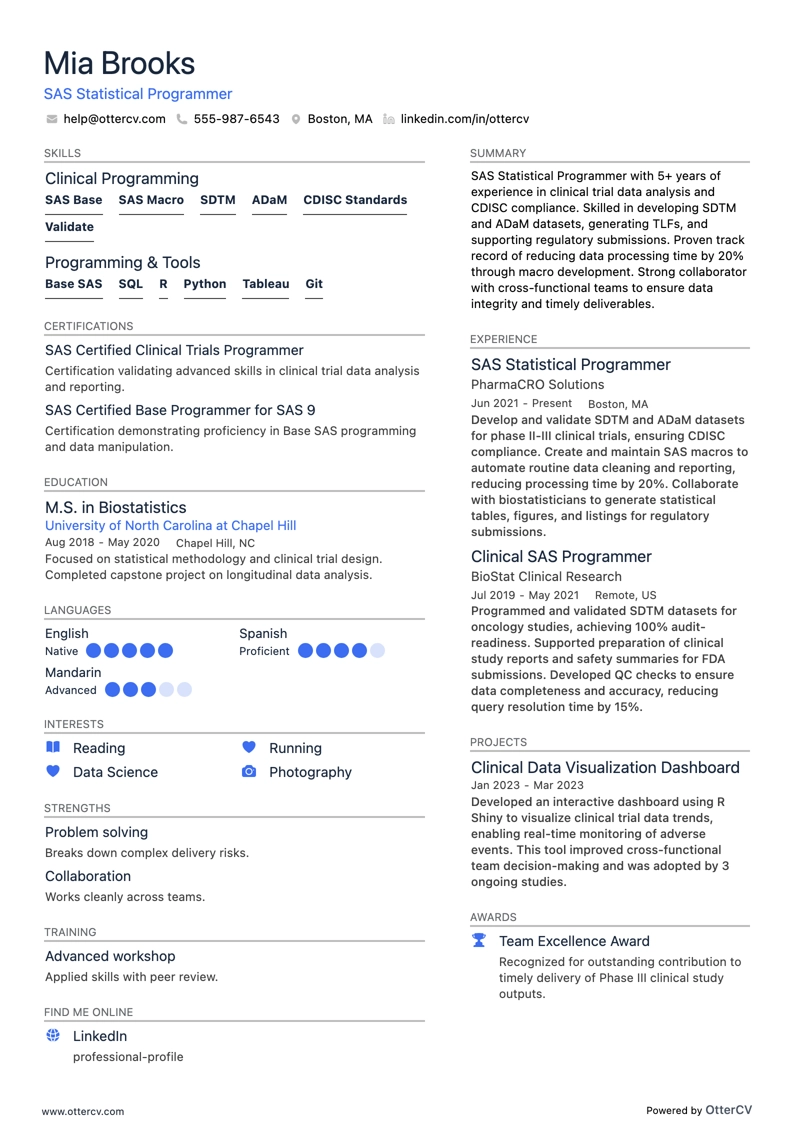
SAS Statistical Programmer resume example

SAS Statistical Programmer

Clinical Trial SAS Programmer resume example

Clinical Trial SAS Programmer

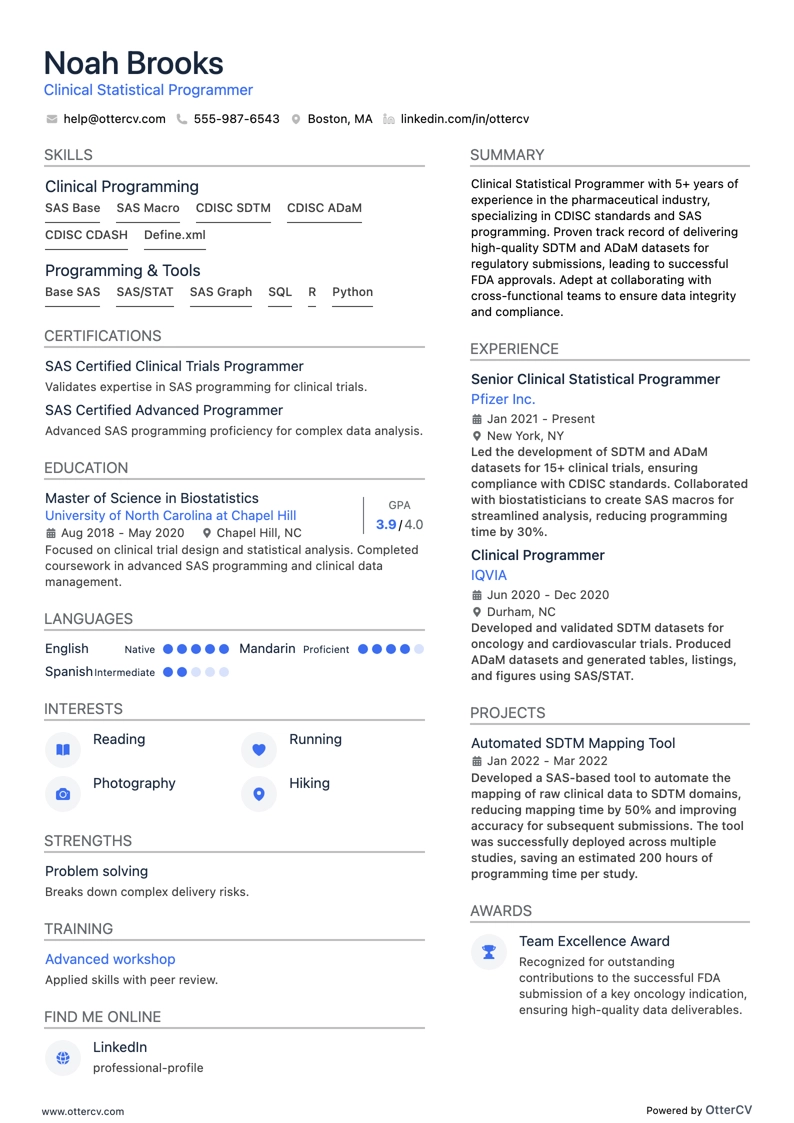
Clinical Statistical Programmer resume example

Clinical Statistical Programmer

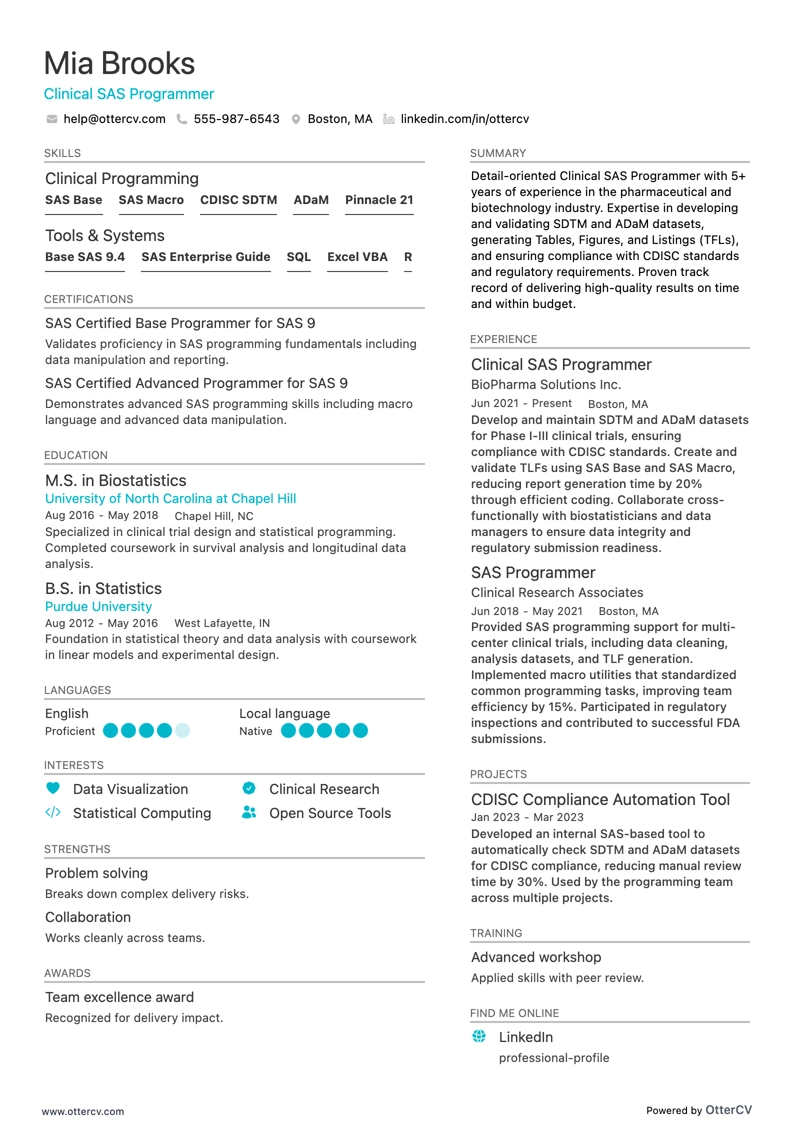
Clinical SAS Programmer resume example

Clinical SAS Programmer

SAS Clinical Programmer resume example

SAS Clinical Programmer

Many SAS clinical programmer resumes fail because they read like task logs and hide validation, traceability, and submission-ready evidence. This SAS clinical programmer resume guide is designed to help you pass ATS filters, recruiter skims, and strong competition. If you are unsure where to begin, start by learning how to write a resume that emphasizes outcomes instead of duties.

A strong resume focuses on results: how you improved data quality, shortened delivery timelines, and reduced rework. Highlight your SDTM and ADaM build scope, audit findings avoided, programming cycle time reduced, tables and listings delivered, and reviewer questions resolved.

Key takeaways

  • Quantify clinical programming outcomes in every bullet, including cycle time, error reduction, and submission milestones.

  • Match the exact SAS tools, CDISC standards, and trial phases from the job posting in your experience section.

  • Use a reverse-chronological format for senior roles, and a hybrid format for career switchers or junior candidates.

  • Pair each listed skill with a specific action and a measurable result to demonstrate applied competence.

  • Feature SDTM, ADaM, and TLF deliverables prominently, as recruiters and ATS filters prioritize these terms.

  • Build entry-level credibility with certification projects, coursework, and a GitHub portfolio of SAS code.

  • Use Echocv to turn routine programming tasks into recruiter-ready, metric-driven resume bullets faster.

How to format a SAS clinical programmer resume

Recruiters hiring for SAS clinical programmer roles look for clear evidence of SAS programming proficiency, including Base SAS, SAS/STAT, and SAS macros, along with familiarity with CDISC standards such as SDTM and ADaM. They also value hands-on experience producing tables, listings, and figures (TLFs) for regulatory submissions.

A clean, well-structured resume format helps these technical skills and your clinical trial experience stand out quickly during both automated screening and manual review.

I have significant experience in this role—which format should I use?

I have significant experience in this role—which format should I use?

Use the reverse-chronological format. It is the strongest choice for showing progressive SAS programming experience across clinical studies and therapeutic areas.

  • Lead each role entry with your scope: number of studies supported, phases (I–IV), team size, and regulatory submission involvement.
  • Highlight role-specific tools and standards up front, including SAS Base, SAS/STAT, SAS macros, CDISC SDTM/ADaM, PROC SQL, ODS, and platforms such as Pinnacle 21 or Define.xml.
  • Quantify outcomes tied to timelines, data quality, or submission readiness instead of listing routine tasks.

Example bullet: Developed and validated 120+ ADaM datasets and TLFs across three concurrent Phase III oncology trials, reducing QC cycle time by 30% and supporting on-time NDA submission to the FDA.

I'm junior or switching into this role—what format works best?

I'm junior or switching into this role—what format works best?

A hybrid resume format works best. It lets you lead with a dedicated technical skills section while still including a chronological work history that shows how you have applied those skills.

  • Place a prominent skills section near the top that lists SAS programming competencies such as Base SAS, SAS macros, PROC SQL, and ODS, along with CDISC standards and any relevant statistical or clinical data management tools.
  • Include academic projects, internships, or transitional experience, such as biostatistics coursework, SAS certification projects, or data analysis work in adjacent fields, as concrete evidence of capability.
  • Connect every listed skill to a specific action and a measurable or observable result to demonstrate applied competence.

Example scaffold: SAS macro development (skill) → built reusable macro library to automate SDTM mapping for demographic and adverse event domains (action) → cut dataset creation time by 40% across two Phase II study databases during a practicum project (result).

Why not use a functional resume?

Why not use a functional resume?

A functional resume removes the clinical trial context—such as study phases, therapeutic areas, and regulatory timelines—that hiring managers use to judge whether your SAS programming skills have been applied in real submission environments. Without that context, it becomes much harder for them to assess your readiness for the role.

A functional format may still be acceptable if you're moving from a non-clinical SAS role, such as finance or marketing analytics, or returning to work after a gap. Even then, each skill should be tied to specific projects, datasets, or measurable outcomes instead of being presented in isolation.

What sections should go on a SAS clinical programmer resume

With your resume structure and layout in place, the next step is choosing sections that clearly reinforce your qualifications as a SAS clinical programmer.

Recruiters expect a clean, compliance-focused resume that shows you can deliver validated clinical programming outputs in regulated environments. Knowing which resume sections to include, and in what order, helps ensure nothing important is missed.

Use this structure for maximum clarity:

  • Header
  • Summary
  • Experience
  • Skills
  • Projects
  • Education
  • Certifications
  • Optional sections: Publications, Research, Languages

Strong experience bullets should highlight the clinical deliverables you produced, the validation and compliance standards you met, and the measurable impact on timelines, data quality, and submission readiness.

Once you’ve organized your resume with the right core components, the next step is to write your SAS clinical programmer resume experience so each entry reinforces that structure with clear, role-specific impact.

How to write your SAS clinical programmer resume experience

Your work experience section should highlight the clinical programming work you’ve delivered, such as CDSC/ADaM datasets, validated SDTM mappings, and supported regulatory submissions, using the specific SAS tools and statistical methods behind each result. Hiring managers care more about measurable impact on data integrity, submission timelines, and regulatory compliance than routine task lists.

Each entry should include:

  • Job title
  • Company and location, or remote
  • Dates of employment, including month and year

Add three to five concise bullet points that show what you owned, how you executed the work, and what outcomes you delivered:

  • Ownership scope: the clinical studies, therapeutic areas, datasets, submission packages, or programming teams you were directly responsible for as a SAS clinical programmer.
  • Execution approach: the SAS procedures, macros, CDISC standards, data integration frameworks, or validation methods you used to build, test, and deliver analysis-ready datasets and outputs.
  • Value improved: the gains you created in data quality, programming efficiency, submission readiness, regulatory compliance, or error reduction across your deliverables.
  • Collaboration context: how you worked with biostatisticians, data managers, medical writers, regulatory affairs teams, or external CRO partners to align programming outputs with study protocols and reporting requirements.
  • Impact delivered: the results your work produced, such as submission milestones met, audit findings resolved, review cycles shortened, or portfolio-level contributions, instead of a summary of day-to-day programming tasks.

Experience bullet formula

Experience bullet formula

Action verb + technology + what you built or fixed + measurable result

A SAS clinical programmer experience example

SAS Clinical Programmer II

Apex Clinical Research | Remote

2022–Present

Mid-size contract research organization supporting Phase II–III oncology and immunology trials for global sponsors.

  • Programmed Study Data Tabulation Model (SDTM) and Analysis Data Model (ADaM) datasets in SAS 9.4 using Pinnacle 21 validation, reducing validation findings by 38% across three studies.
  • Automated Tables, Listings, and Figures (TLFs) with SAS macros and ODS RTF, shortening production cycle time from eight days to five days per interim analysis.
  • Developed Define-XML and annotated Case Report Form (CRF) traceability with SAS Clinical Standards Toolkit, resulting in zero critical issues in two consecutive sponsor audits.
  • Reconciled clinical and safety data using MedDRA and WHO Drug dictionaries and Data Clarification Forms (DCFs), lowering query rate by 22% and improving database lock readiness by two weeks.
  • Partnered with biostatisticians, data managers, and clinical operations to implement controlled terminology updates and derivation specifications, preventing three protocol deviation-related rework cycles.

Now that you've seen what a strong experience section looks like in practice, here's how to tailor yours to the specific SAS clinical programmer role you're targeting.

How to tailor your SAS clinical programmer resume experience

Recruiters review your SAS clinical programmer resume through both human screening and applicant tracking systems. Tailoring your resume to the job description helps your qualifications connect directly with what hiring teams prioritize.

Ways to tailor your SAS clinical programmer experience:

  • Match the SAS procedures and macros specifically mentioned in the job posting.
  • Mirror the exact clinical trial phases the employer highlights.
  • Align your CDISC standards experience with the listed SDTM or ADaM requirements.
  • Reflect the statistical reporting tools or outputs the role requires.
  • Include regulatory submission experience when the posting mentions FDA or EMA.
  • Use the same terminology for SOPs and programming workflows described in the posting.
  • Highlight therapeutic area knowledge that matches the employer's pipeline focus.
  • Emphasize the quality control and validation processes the job description prioritizes.

Tailoring means aligning your real accomplishments with the role's stated requirements, not forcing in keywords where they don't belong.

Resume tailoring examples for SAS clinical programmer

Job description excerptUntailoredTailored
Develop and validate SAS programs for SDTM and ADaM datasets in compliance with CDISC standards for Phase III oncology trials.Worked with SAS to create datasets for clinical studies.Developed and validated 50+ SAS programs generating SDTM and ADaM datasets under CDISC standards for two Phase III oncology trials, passing all FDA submission audits with zero critical findings.
Generate tables, listings, and figures (TLFs) using SAS/BASE, SAS/STAT, and SAS/GRAPH to support integrated summary of safety (ISS) and efficacy (ISE) submissions.Created reports and tables for clinical teams using SAS.Produced 120+ tables, listings, and figures using SAS/BASE, SAS/STAT, and SAS/GRAPH to support ISS and ISE submissions, reducing QC cycle time by 30% through reusable macro libraries.
Perform data integrity checks and write SAS macros to automate SDTM mapping across multiple therapeutic areas, including cardiovascular and immunology.Helped with data checks and some automation tasks in SAS.Built and maintained 15 SAS macros automating SDTM mapping and data integrity checks across four concurrent cardiovascular and immunology studies, cutting manual mapping effort by 40%.

Once you’ve aligned your experience with the role’s clinical programming needs, the next step is to quantify your SAS clinical programmer achievements so hiring teams can quickly see your impact.

How to quantify your SAS clinical programmer achievements

Quantifying your achievements shows that you improve study delivery, data quality, and regulatory readiness. Use numbers tied to cycle time, validation defects, SDTM and ADaM compliance, rework avoided, and the volume of outputs delivered across studies.

Quantifying examples for SAS clinical programmer

MetricExample
Delivery speedCut TLF delivery from twelve to seven business days by automating SAS macros and standardizing shells across three Phase III studies.
Data qualityReduced SDTM validation errors by 45% by resolving Pinnacle 21 findings and adding SAS checks for controlled terminology and key variables.
ThroughputGenerated 180+ TLFs and fifteen ADaM datasets per interim analysis using SAS and Git, meeting all four biweekly data cut deadlines.
Compliance readinessAchieved zero critical FDA submission findings by producing define.xml, reviewer's guides, and traceability from SDTM to ADaM to TLFs.
Rework reductionLowered post-QC rework by 30% by implementing double-programming standards and automated compare outputs in SAS for key endpoints.

How to list your hard and soft skills on a SAS clinical programmer resume

Once you’ve written strong experience bullets, present your hard and soft skills strategically so hiring managers can quickly understand your qualifications.

Your skills section should show that you can deliver compliant clinical datasets and outputs. Recruiters and ATS (applicant tracking systems) scan this section to confirm tool and domain fit, so focus on a hard-skill-heavy mix supported by targeted collaboration and soft skills.

SAS clinical programmer roles require a blend of:

  • Product strategy and discovery skills
  • Data, analytics, and experimentation skills
  • Delivery, execution, and go-to-market discipline
  • Soft skills

Your skills section should be:

  • Scannable, with bullet-style grouping
  • Relevant to the job post
  • Backed by proof in your experience bullets
  • Updated with current tools

Place your skills section:

  • Above your experience section if you’re junior or changing careers
  • Below your experience section if you’re mid-level or senior with strong achievements

Hard skills

  • Base SAS and SAS Macro.
  • SAS Clinical and SAS/STAT.
  • CDISC SDTM and ADaM.
  • Define-XML and Controlled Terminology.
  • TLF programming and QC.
  • Pinnacle 21 validation.
  • MedDRA and WHODrug coding support.
  • Oracle Clinical and Medidata Rave.
  • Clinical data review listings.
  • SQL and PROC SQL.
  • Git version control.
  • 21 CFR Part 11 compliance.

Soft skills

  • Translate SAP into clear specifications.
  • Clarify ambiguous requirements.
  • Partner with biostatistics and data management teams.
  • Document assumptions and decisions.
  • Prioritize programming deliverables.
  • Estimate effort and timelines.
  • Communicate status and risks early.
  • Resolve validation findings quickly.
  • Maintain audit-ready traceability.
  • Review code through peer feedback.
  • Coordinate across global teams.
  • Own quality through double-programming checks.

How to show your SAS clinical programmer skills in context

Skills should not appear only in a bulleted list on your resume. Review resume skills examples to see how strong candidates weave their competencies throughout the document.

Your skills should be visible in:

  • Your summary, which presents your high-level professional identity
  • Your experience, which proves your abilities through outcomes

Here is what that looks like in practice.

Summary example

Senior SAS clinical programmer with 10 years of experience in oncology trials. Built automated SDTM/ADaM workflows that reduced dataset delivery timelines by 35%. Skilled in CDISC standards, regulatory submissions, and cross-functional collaboration with biostatistics and data management teams.

  • Shows senior-level expertise right away
  • Mentions industry-standard tools and frameworks
  • Quantifies impact with a clear metric
  • Emphasizes collaboration as a soft skill

Experience example

Senior SAS Clinical Programmer

Parexel | Remote

June 2019–March 2024

  • Developed and validated 120+ SDTM and ADaM datasets across four Phase III oncology trials using SAS 9.4 and Base SAS macros.
  • Collaborated with biostatisticians and medical writers to produce TLFs, reducing review cycles by 25% through standardized macro libraries.
  • Led CDISC compliance audits for two FDA submissions, resolving 98% of define.xml discrepancies before the first regulatory review.
  • Every bullet includes a measurable outcome.
  • Tools and collaboration appear naturally in context.

Once you’ve shown your SAS clinical programmer capabilities through relevant projects and results, the next step is to apply that same approach to building a strong resume, even without formal experience.

How do I write a SAS clinical programmer resume with no experience

Even without full-time experience, you can show readiness by building a resume without work experience that highlights projects, coursework, and certifications.

  • Clinical trial datasets course projects
  • SAS Base certification practice work
  • CDISC SDTM mapping assignments
  • ADaM derivations in capstones
  • Mock TLFs using PROC REPORT
  • Data cleaning with SAS macros
  • GitHub portfolio of SAS code
  • Volunteer data work for researchers

Focus on demonstrating:

  • SDTM and ADaM deliverables
  • SAS code quality and validation
  • TLF production and QC
  • Clear documentation and traceability

Resume format tip for entry-level SAS clinical programmer

Resume format tip for entry-level SAS clinical programmer

Use a combination resume format that leads with projects, tools, and deliverables, then follows with education and any relevant work history.

  • Put SDTM, ADaM, and TLFs first.
  • Add a Projects section with metrics.
  • Name tools such as SAS, SQL, and Git.
  • Show QC methods and log checks.
  • Link to a GitHub code sample.

Example project bullet:

  • Built SDTM DM and AE from raw CSVs in SAS, applied controlled terminology, and reduced validation warnings by 40% through iterative log review and QC.

When hands-on experience is limited, your education section becomes one of the strongest ways to show relevant knowledge and qualifications.

How to list your education on a SAS clinical programmer resume

Your education section helps hiring teams confirm that you have the technical and analytical foundation needed. It also shows your readiness for SAS clinical programmer responsibilities in regulated environments.

Include:

  • Degree name
  • Institution
  • Location
  • Graduation year
  • Relevant coursework (for juniors or entry-level candidates)
  • Honors and GPA (if 3.5 or higher)

Skip the month and day—list only the graduation year.

Here’s a strong education entry tailored for a SAS clinical programmer resume:

Example education entry

Bachelor of Science in Biostatistics

University of North Carolina at Chapel Hill, Chapel Hill, NC

Graduated: 2021

GPA: 3.7/4.0

  • Relevant Coursework: Clinical Trial Design, SAS Programming for Health Sciences, Survival Analysis, Statistical Methods in Epidemiology
  • Honors: Dean's List (six semesters), Phi Beta Kappa Honor Society

How to list your certifications on a SAS clinical programmer resume

Certifications on your resume show your commitment to learning, confirm tool proficiency, and demonstrate industry relevance as a SAS clinical programmer. They also help recruiters validate your skills quickly.

Include the following details:

  • Certificate name
  • Issuing organization
  • Year
  • Optional: credential ID or URL
  • Place certifications below education if they are older, less relevant, or if you have a strong, recent degree for a SAS clinical programmer role.
  • Place certifications above education if they are recent, highly relevant, or required for the target SAS clinical programmer position.

Best certifications for your SAS clinical programmer resume

  • SAS Certified Specialist: Base Programming Using SAS 9.4.
  • SAS Certified Professional: Advanced Programming Using SAS 9.4.
  • SAS Certified Clinical Trials Programmer Using SAS 9.
  • Certified Clinical Research Associate (CCRA).
  • Certified Clinical Research Professional (CCRP).
  • CDISC Certified Professional (CDISC-CP).
  • Good Clinical Practice (GCP) Certification.

Once you’ve established credentials that validate your SAS clinical programming expertise, use your resume summary to present that value immediately.

How to write your SAS clinical programmer resume summary

Your resume summary is often the first thing a recruiter reads, so it should quickly show why you fit the role. A strong opening helps position you as a qualified SAS clinical programmer before the hiring manager reads further.

Keep it to three to four lines and include:

  • Your title and total years of SAS clinical programming experience.
  • The therapeutic areas or clinical trial phases you’ve worked in.
  • Core tools such as SAS Base, SAS/STAT, CDISC standards, SDTM, and ADaM.
  • One or two measurable results, such as timelines met or submissions supported.
  • Evidence of collaboration and attention to detail through real project outcomes.

PRO TIP

At the entry or mid level, focus on specific SAS skills, CDISC knowledge, and early contributions to clinical studies.

Avoid vague claims like "passionate team player" or "quick learner." Instead, name the tools you've used and the outputs you've delivered. Recruiters want proof of relevance, not motivation.

Example summary for a SAS clinical programmer

SAS clinical programmer with three years of experience developing SDTM and ADaM datasets for Phase II–III oncology trials. Delivered submission-ready outputs for two successful FDA filings using SAS Base and SAS/STAT.

Now that your summary highlights your strongest qualifications, make sure your header includes the essential contact and professional details recruiters need to reach you.

What to include in a SAS clinical programmer resume header

Your resume header presents your key identity and contact details, helping SAS clinical programmer candidates improve visibility, credibility, and recruiter screening speed.

Essential resume header elements

  • Full name
  • Tailored job title and headline
  • Location
  • Phone number
  • Professional email
  • GitHub link
  • Portfolio link
  • LinkedIn

A LinkedIn link helps recruiters verify your experience quickly and supports screening.

Do not include a photo on a SAS clinical programmer resume unless the role is explicitly front-facing or appearance-dependent.

Use a clear SAS clinical programmer title, keep links readable, and make sure your header details match your application and LinkedIn profile.

Example

Once your contact details and role identifiers are in place at the top of your resume, add targeted sections that strengthen your qualifications and make the document more complete.

Additional sections for SAS clinical programmer resumes

These extra sections can help you stand out when your core qualifications are similar to those of other candidates and you need clearer differentiation.

Focus on sections that support your clinical programming expertise, regulatory knowledge, or industry involvement:

  • Certifications (SAS Base, SAS Advanced, SAS Clinical Trials)
  • Publications and conference presentations
  • Professional affiliations (PharmaSUG, CDISC, DIA)
  • Languages
  • Continuing education and specialized training
  • Hobbies and interests
  • Volunteer experience in healthcare or data science

Once you've strengthened your resume with targeted additional sections, the next step is pairing it with a well-crafted cover letter to make an even stronger impression.

Do SAS clinical programmer resumes need a cover letter

A cover letter isn't required for a SAS clinical programmer, but it can help in competitive roles or when hiring teams expect one. It may also make a difference when your resume needs more context or you want to show a clear fit.

Use a cover letter to add details your resume can't:

  • Explain your fit for the role and team by matching your experience to the trial phase, therapeutic area, and standards the group uses.
  • Highlight one or two relevant projects or outcomes, such as faster table, listing, and figure delivery or cleaner ADaM and SDTM datasets.
  • Show you understand the product, users, or business context, including how outputs support clinical review, submissions, and audit readiness.
  • Address career transitions or less obvious experience by connecting transferable skills to SAS clinical programmer work and regulated workflows.

Using AI to improve your SAS clinical programmer resume

Even without relying on a cover letter for extra context, AI can help you strengthen your SAS clinical programmer resume and align it more closely with the role.

AI can improve your resume’s clarity, structure, and overall impact. It can help you find stronger phrasing and identify weak spots quickly. But overusing it can make your resume feel less authentic. Once your content is clear and aligned to the role, step away from AI assistance.

For specific prompt ideas, check out how ChatGPT can help with resume writing.

Here are 10 practical prompts to strengthen specific sections of your SAS clinical programmer resume:

Sharpen your summary

Sharpen your summary

Rewrite this resume summary for a SAS clinical programmer so it is concise, specific, and focused on clinical trial data expertise.

Quantify experience bullets

Quantify experience bullets

Add measurable outcomes to these experience bullet points for a SAS clinical programmer using metrics such as timelines, dataset counts, or error reduction.

Align skills section

Align skills section

Review this skills section and remove anything irrelevant to a SAS clinical programmer working in regulated pharmaceutical environments.

Strengthen action verbs

Strengthen action verbs

Replace weak or passive verbs in these SAS clinical programmer experience bullets with strong, specific action verbs.

Tailor to job posting

Tailor to job posting

Compare this SAS clinical programmer resume against the following job description and identify any missing keywords or requirements.

Clarify project descriptions

Clarify project descriptions

Rewrite these project descriptions so each one clearly states the SAS clinical programmer’s role, the tools used, and the deliverables produced.

Refine education details

Refine education details

Present the education section in a way that clearly supports a SAS clinical programmer career in clinical research.

Highlight certifications

Highlight certifications

Reorganize and prioritize these certifications on a SAS clinical programmer resume, placing the most industry-relevant credentials first.

Eliminate redundancy

Eliminate redundancy

Identify and remove repetitive phrasing throughout this SAS clinical programmer resume while preserving important details and context.

Improve CDISC references

Improve CDISC references

Review how CDISC standards such as SDTM and ADaM are mentioned in this SAS clinical programmer resume, and suggest clearer phrasing.

Conclusion

A strong SAS clinical programmer resume shows impact through measurable outcomes, role-specific skills, and a clear structure. It highlights study support results, programming accuracy, and delivery speed with metrics, while remaining easy to scan through consistent headings and targeted bullets.

This approach shows you can meet current expectations and adapt to near-future hiring needs. It signals that you can deliver reliable outputs, follow standards, and collaborate across clinical teams. Keep your resume focused, quantified, and well structured, and you will stay competitive.

SAS Clinical Programmer resume examples

Explore additional SAS Clinical Programmer resume samples and guides and see what works for your level of experience or role.

By Experience

Principal Clinical SAS Programmer

Principal Clinical SAS Programmer resume preview

Lead Clinical SAS Programmer

Lead Clinical SAS Programmer resume preview

Senior Clinical SAS Programmer

Senior Clinical SAS Programmer resume preview

Junior Clinical SAS Programmer

Junior Clinical SAS Programmer resume preview

SAS Clinical Programmer resume examples

Explore additional SAS Clinical Programmer resume samples and guides and see what works for your level of experience or role.

By Role

ADaM Programmer

ADaM Programmer resume preview

SDTM Programmer

SDTM Programmer resume preview

SAS Statistical Programmer

SAS Statistical Programmer resume preview

Clinical Trial SAS Programmer

Clinical Trial SAS Programmer resume preview

Clinical Statistical Programmer

Clinical Statistical Programmer resume preview

Clinical SAS Programmer

Clinical SAS Programmer resume preview

SAS Clinical Programmer

SAS Clinical Programmer resume preview