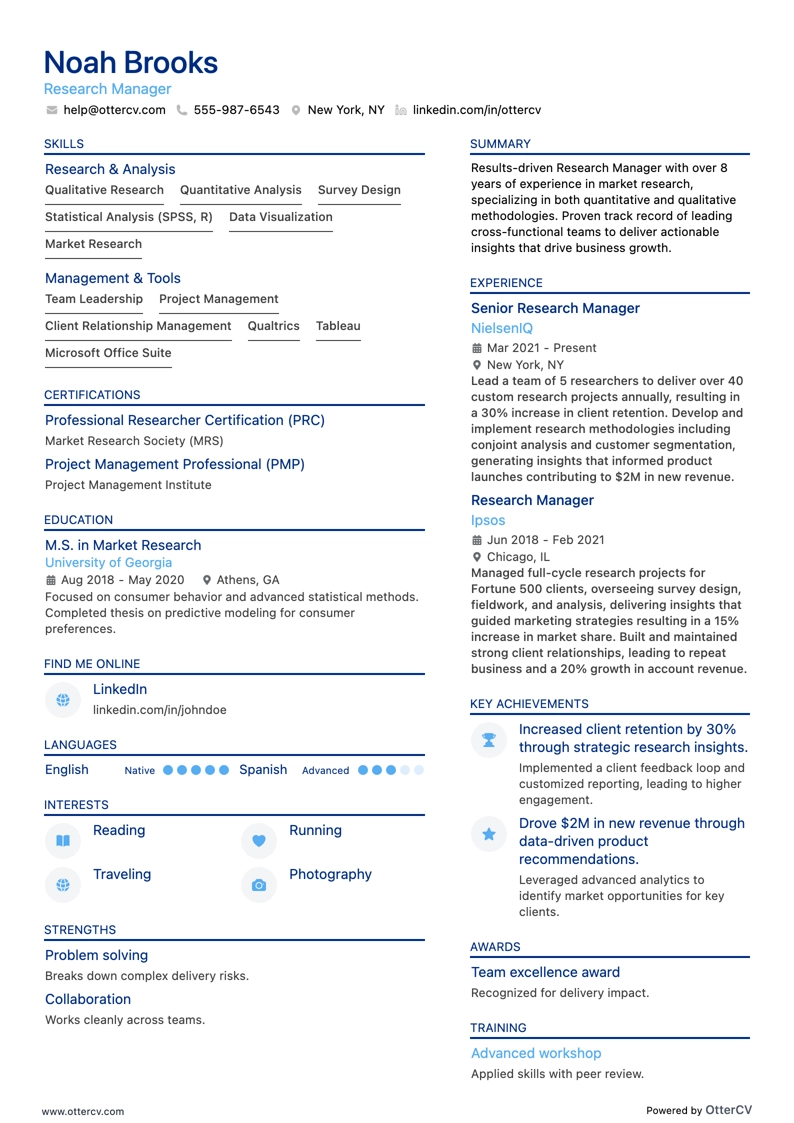
Principal Research Manager full preview

10 Research Manager Resume Examples

OtterCV

Written by The OtterCV Team

Updated: 10/23/2023•8 min read

See all resume examples in this guide, or generate your own resume example with your personalized prompt

Principal Research Manager resume example

Principal Research Manager

Lead Research Manager resume example

Lead Research Manager

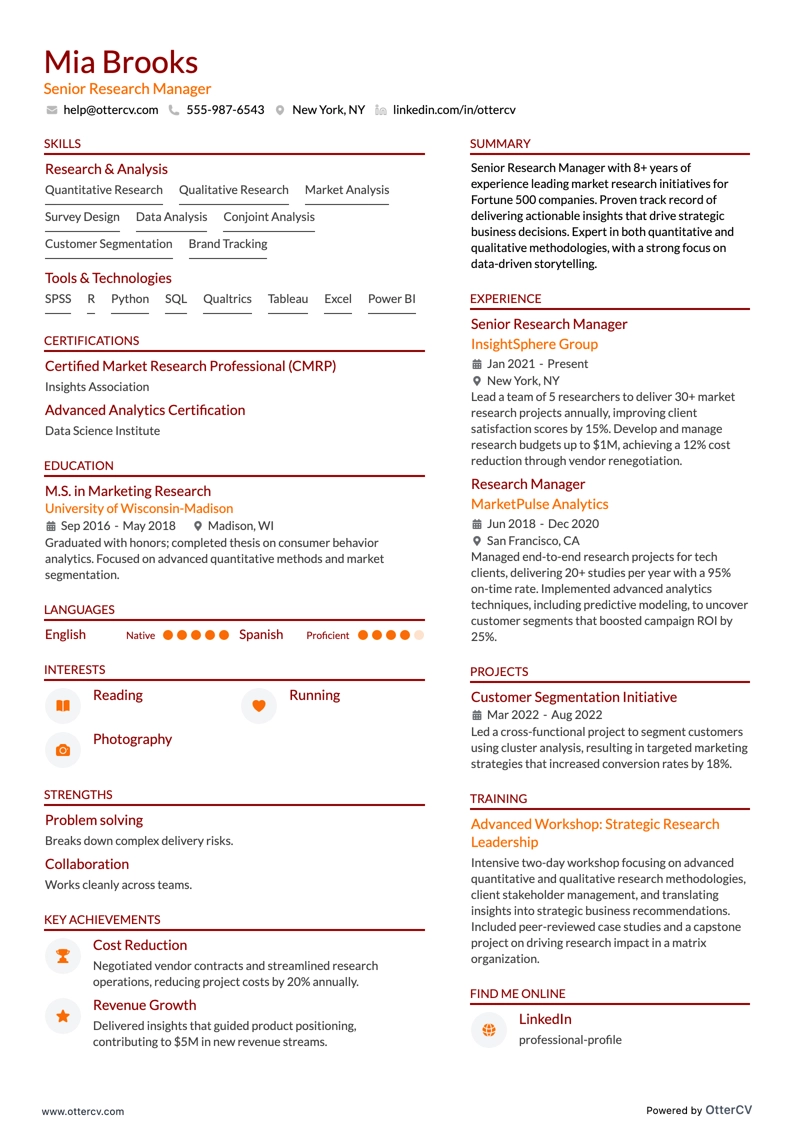
Senior Research Manager resume example

Senior Research Manager

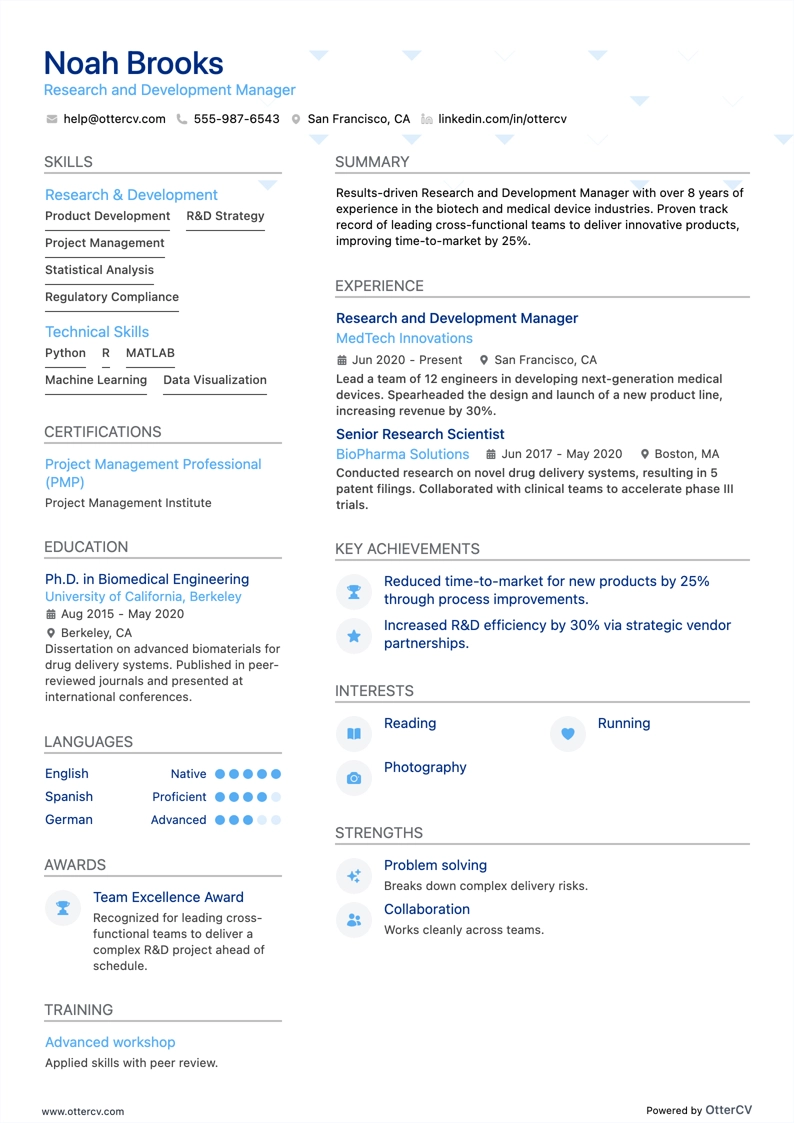
Research and Development Manager resume example

Research and Development Manager

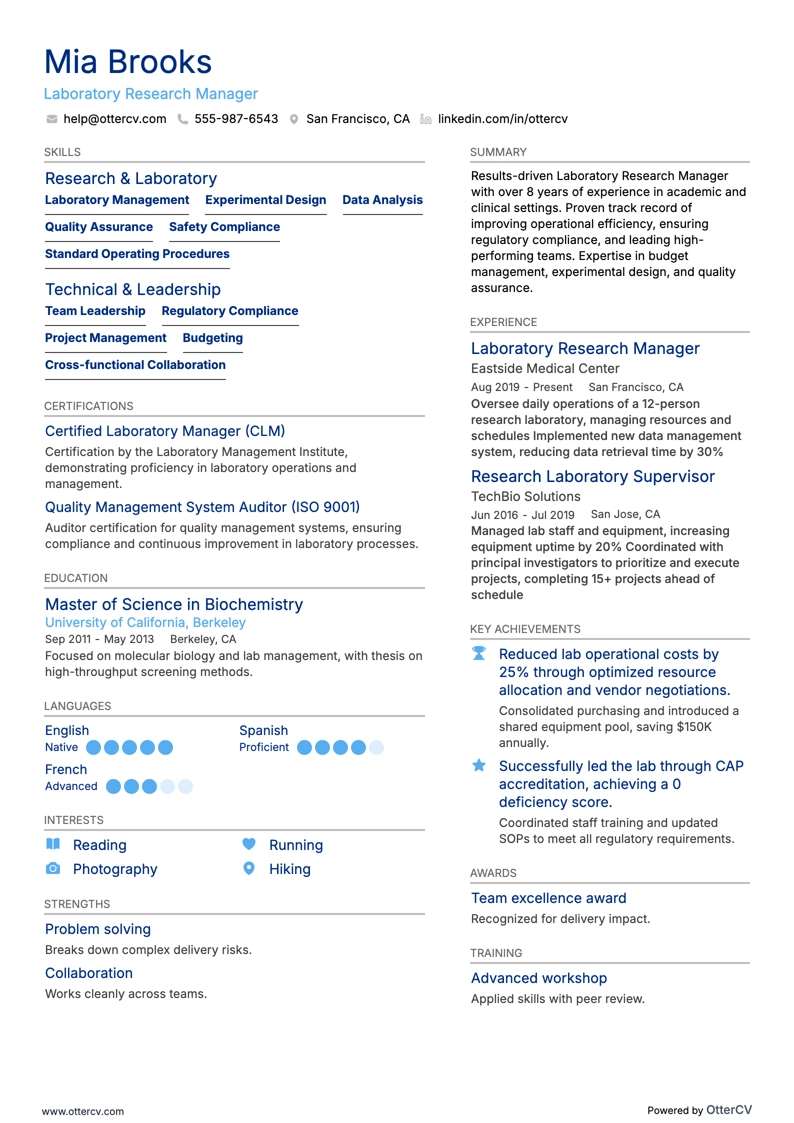
Laboratory Research Manager resume example

Laboratory Research Manager

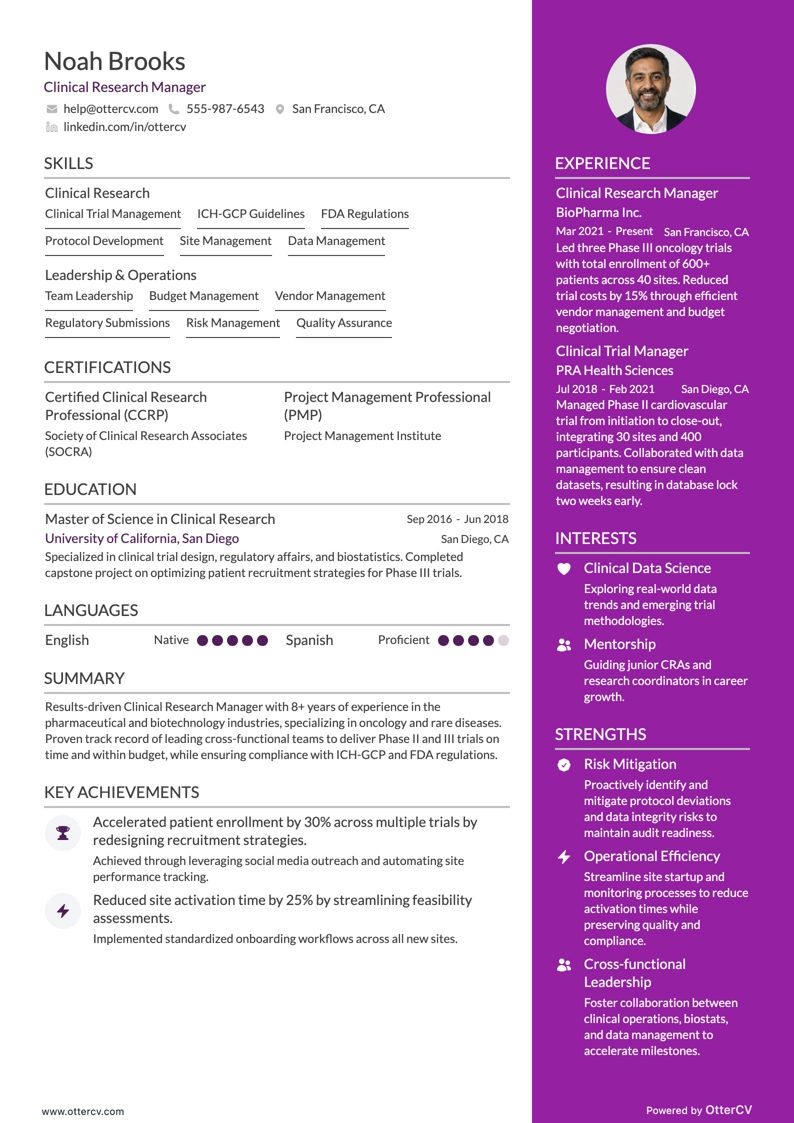
Clinical Research Manager resume example

Clinical Research Manager

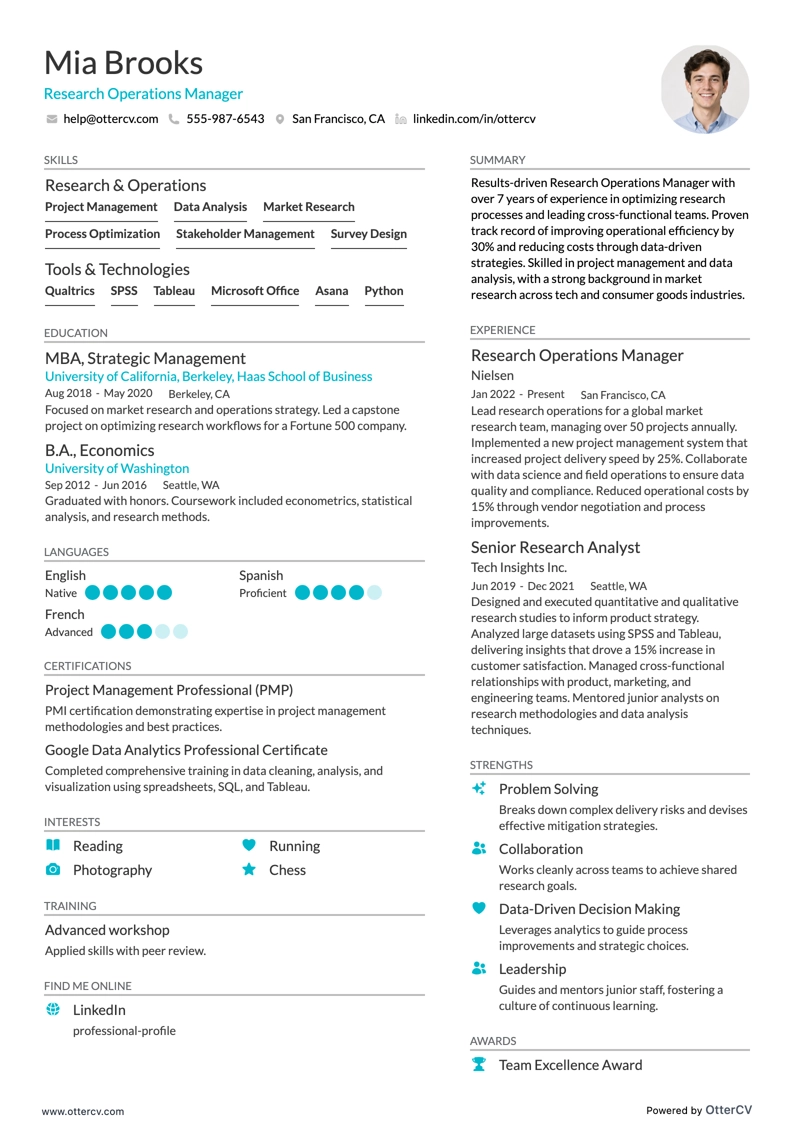
Research Operations Manager resume example

Research Operations Manager

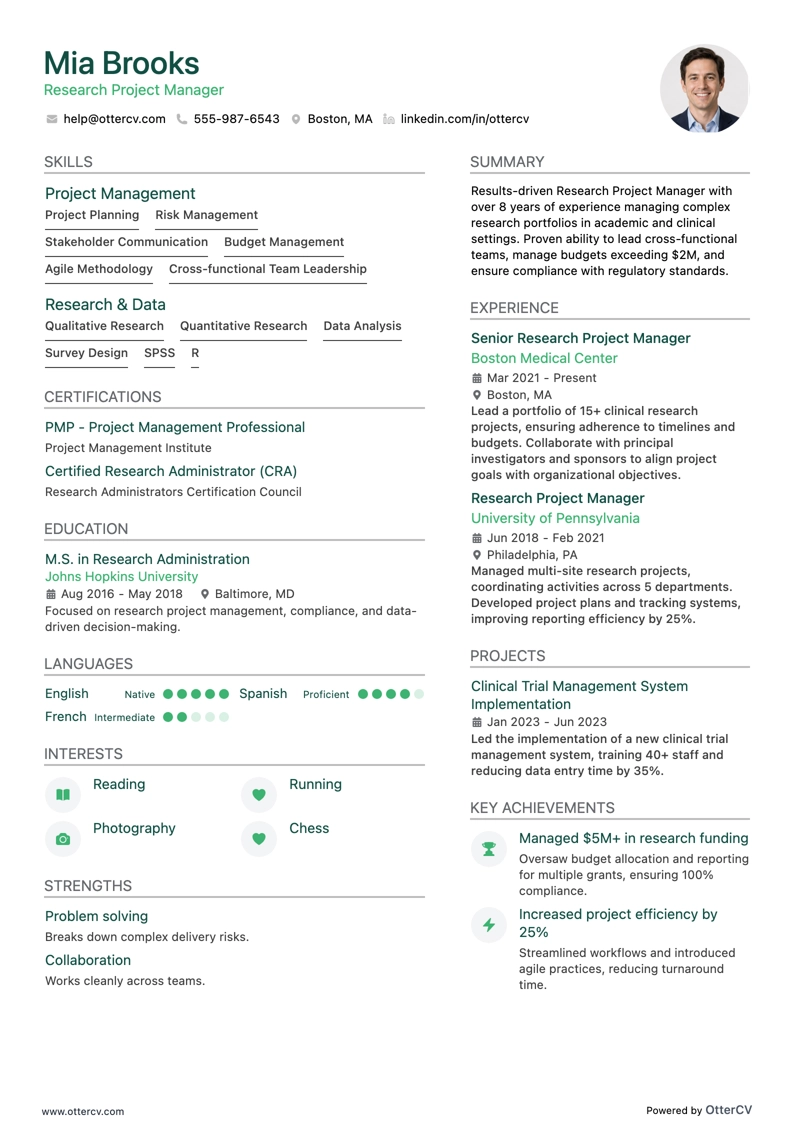
Research Project Manager resume example

Research Project Manager

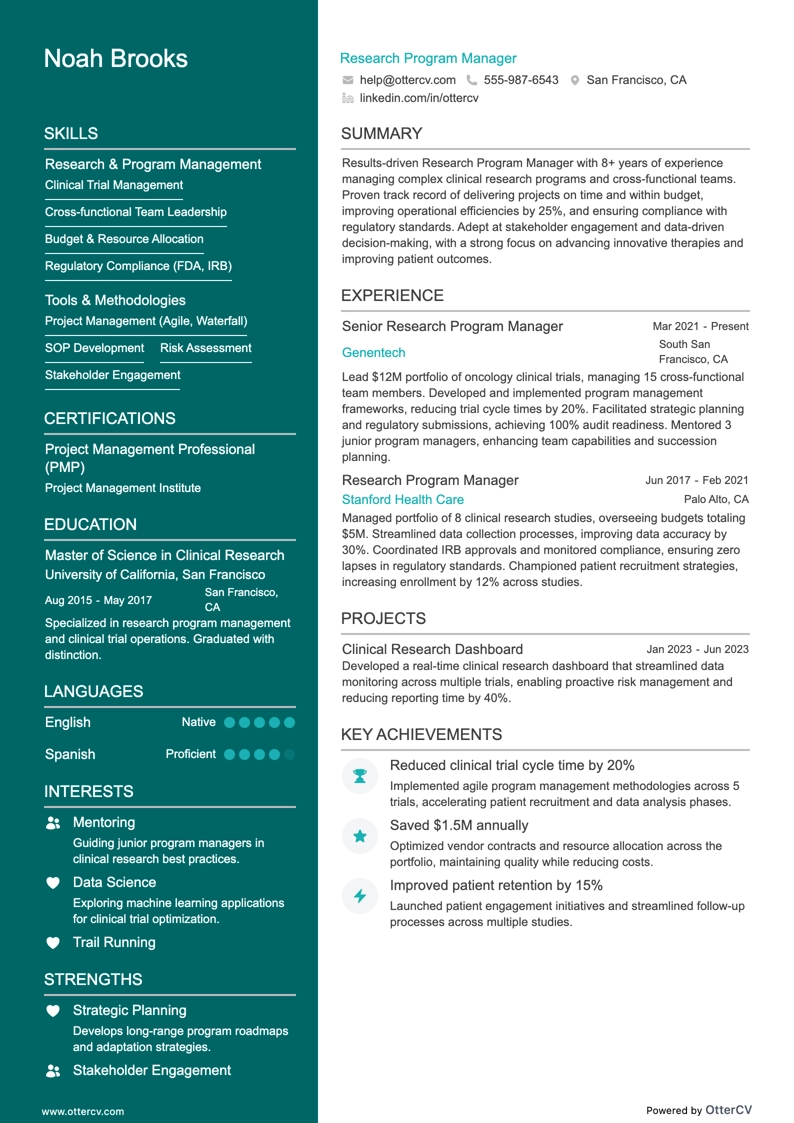
Research Program Manager resume example

Research Program Manager

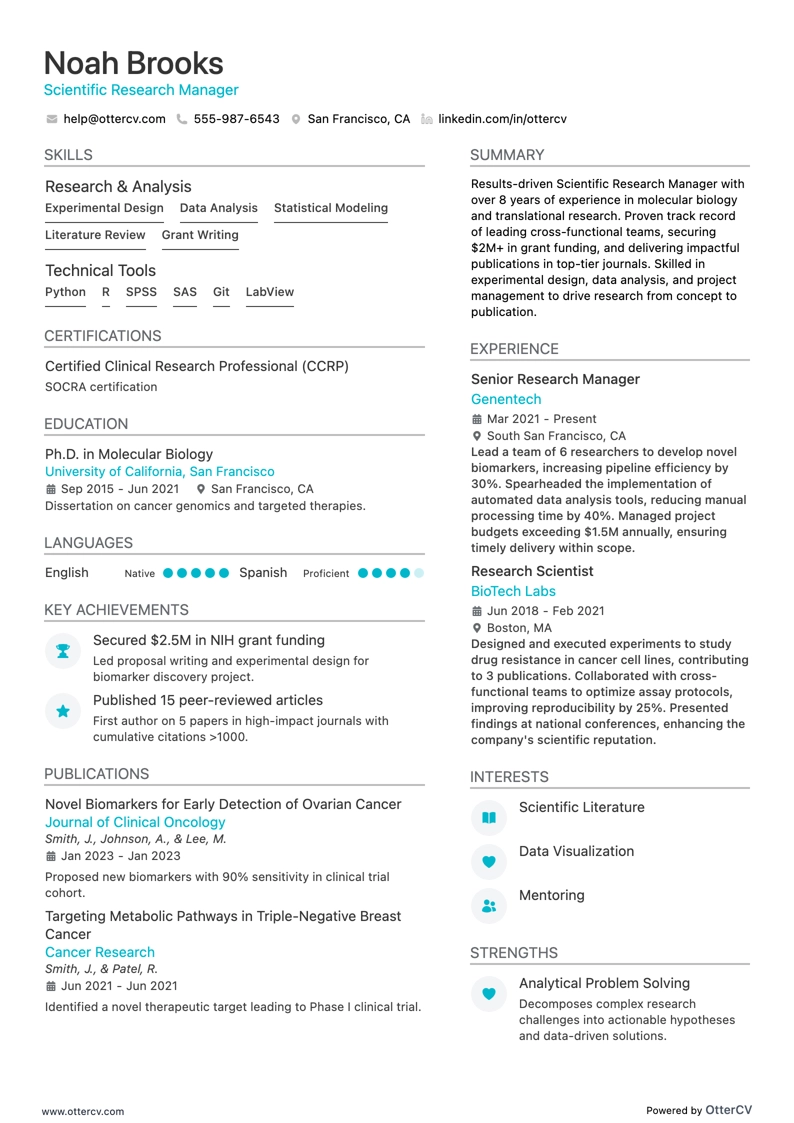
Scientific Research Manager resume example

Scientific Research Manager

Research Manager resume example

Research Manager

Research manager resumes often fall short because they read like project logs rather than decision documents. In ATS filters and quick recruiter scans, resumes that hide impact behind tools and task lists are easy to overlook in a crowded field.

A strong resume shows how you drove decisions and reduced risk. Knowing how to make your resume stand out starts with highlighting measurable impact: revenue influenced, adoption increased, time-to-decision shortened, studies delivered on schedule, confidence improved, and insights turned into product changes.

Key takeaways

  • Use a reverse-chronological format to show a clear progression in research leadership.

  • Quantify achievements with metrics such as cycle time, adoption rates, cost savings, and risk reduction.

  • Tailor each experience bullet to match the job posting’s tools, methods, and KPIs.

  • Show skills in context through your summary and experience, not only in a standalone skills list.

  • Start each bullet with ownership, execution approach, and measurable business impact.

  • Pair your resume with a cover letter when your fit needs added context or explanation.

  • Use Echocv to build and refine your resume faster while keeping each section focused and recruiter-ready.

Job market snapshot for research managers

We analyzed 193 recent research manager job ads across major US job boards to provide a quick view of employer expectations, industry demand, and experience requirements.

What level of experience employers are looking for research managers

Years of ExperiencePercentage found in job ads
1–2 years2.1% (4)
3–4 years3.1% (6)
5–6 years22.3% (43)
7–8 years5.2% (10)
9–10 years5.7% (11)
10+ years4.7% (9)
Not specified61.7% (119)

Research manager ads by area of specialization (industry)

Industry (Area)Percentage found in job ads
Retail & E-commerce44.6% (86)
Healthcare27.5% (53)
Finance & Banking14.0% (27)
Education11.4% (22)

Top companies hiring research managers

CompanyPercentage found in job ads
Deloitte28.5% (55)
Ipsos14.0% (27)
Savills plc13.5% (26)
Google LLC6.2% (12)

Role overview stats

These tables outline the most common responsibilities and employment types for research manager roles. Use them to align your resume with employer expectations and understand how the role is structured across the market.

Day-to-day activities and top responsibilities for a research manager

ResponsibilityPercentage found in job ads
Project management41.5% (80)
Data analysis38.9% (75)
Survey design25.4% (49)
Case study development23.8% (46)
Research23.8% (46)
Microsoft office20.2% (39)
Tableau16.1% (31)
Presentation skills15.5% (30)
Adobe creative suite14.0% (27)
Spss14.0% (27)
Alteryx13.5% (26)
Costar13.5% (26)

Type of employment (remote vs on-site vs hybrid)

Employment typePercentage found in job ads
On-site67.4% (130)
Hybrid25.4% (49)
Remote7.3% (14)

How to format a research manager resume

Recruiters reviewing research manager candidates look for clear evidence of leadership scope, cross-functional coordination, and the ability to turn research findings into strategic business decisions. A reverse-chronological format highlights these strengths right away by showing a clear progression of increasing responsibility, making it the strongest choice for this role.

I have significant experience in this role—which format should I use?

I have significant experience in this role—which format should I use?

Use a reverse-chronological format. It is the clearest way to show your progression into research leadership and the growing scope of your decision-making authority.

  • Lead with your most senior role and define the scope of each position, including team size, budget ownership, cross-departmental influence, and stakeholder reporting lines.
  • Highlight domain expertise and tools central to research management, such as research design frameworks, statistical platforms like SPSS, R, and Python, IRB compliance, and market research suites such as Qualtrics and Tableau.
  • Quantify outcomes tied to business impact, including cost savings from optimized research processes, revenue influenced by research-driven product decisions, or improvements in time to insight.

Example: “Directed a 14-person research team across three product verticals, delivering consumer insights that informed a go-to-market strategy generating $8.2M in first-year revenue.”

Why hybrid and functional resumes don't work for senior roles

Why hybrid and functional resumes don't work for senior roles

Hybrid resume formats can weaken your leadership story by separating key competencies from the operational context that gives them meaning. That makes it harder for reviewers to understand how your accountability and decision ownership developed over time. Functional formats create an even bigger problem: they hide career progression, remove the timeline of expanding leadership scope, and turn measurable impact into disconnected skill claims that carry less credibility at the management level.

If you have three or more years of research management experience, avoid both formats. They can make your candidacy less competitive than applicants who show a clear, linear record of advancement. Choosing the right resume layout helps hiring teams immediately see your progression and leadership scope.

  • A functional format may be acceptable only if you're moving into research management from a senior individual contributor research role, have a significant employment gap, or are combining experience from contract or consulting engagements. Even then, every listed skill should be tied to a specific project, team outcome, or measurable result.
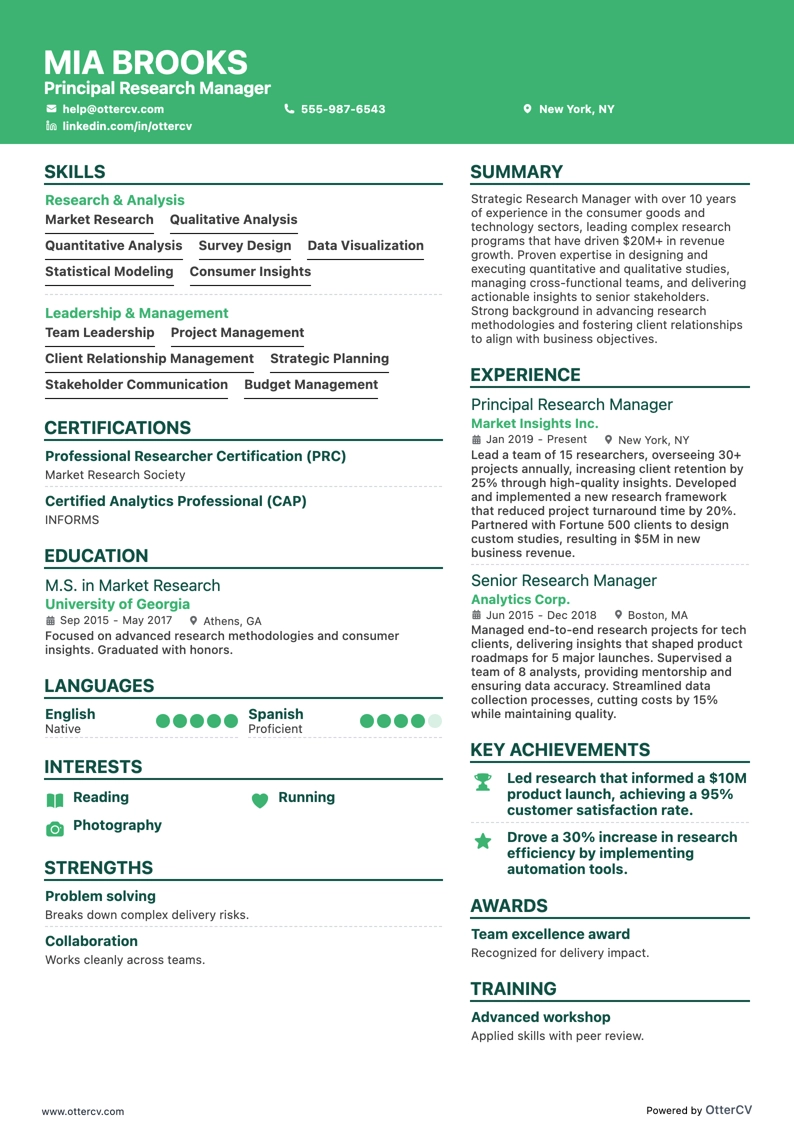
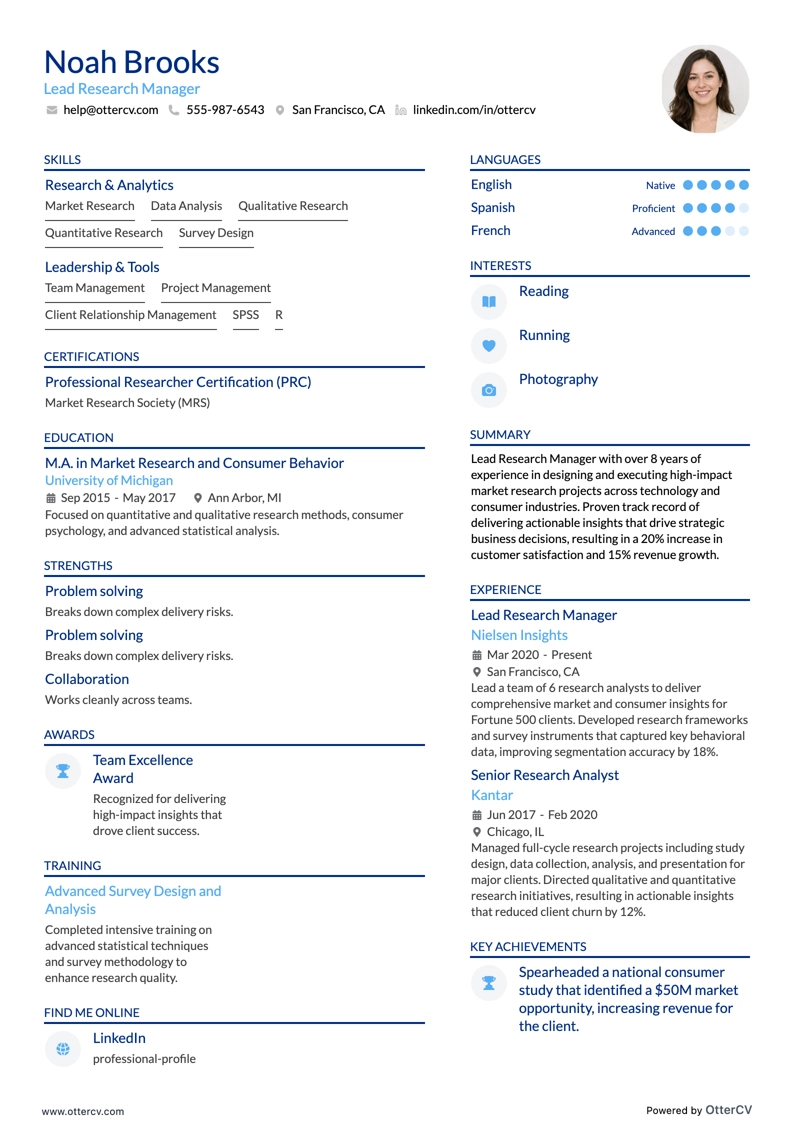
Once you have a clean, readable format, the next step is deciding which sections to include and how to organize them for maximum impact.

What sections should go on a research manager resume

Recruiters expect a complete, easy-to-scan resume that shows you can lead research programs and deliver measurable outcomes. Understanding which resume sections to include helps you present your qualifications clearly.

Use this structure for maximum clarity:

  • Header
  • Summary
  • Experience
  • Skills
  • Projects
  • Education
  • Certifications
  • Optional sections: Publications, Awards, Leadership

Your experience bullets should emphasize research impact, decision outcomes, program scope, stakeholder alignment, and measurable results.

Once you’ve organized the key resume components, the next step is to write your research manager resume experience so it aligns with those elements and supports your overall application.

How to write your research manager resume experience

The experience section is where you show that you can lead research initiatives from design through delivery, using relevant methodologies, analytical tools, and stakeholder management to produce actionable insights. Hiring managers care more about demonstrated impact—studies that shaped strategy, improved decision-making, or drove measurable business outcomes—than descriptive task lists.

Each entry should include:

  • Job title
  • Company and location (or remote)
  • Dates of employment (month and year)

Add three to five concise bullet points that explain what you owned, how you executed the work, and what outcomes you delivered:

  • Ownership scope: the research programs, portfolios, teams, methodologies, or knowledge systems you were directly accountable for as a research manager.
  • Execution approach: the qualitative and quantitative research methods, analytical frameworks, data platforms, or synthesis techniques you used to generate insights and guide strategic decisions.
  • Value improved: changes to research quality, insight turnaround time, data reliability, methodological rigor, participant accessibility, or organizational risk that resulted from your leadership.
  • Collaboration context: how you partnered with product, engineering, marketing, clinical, academic, or executive stakeholders to align research priorities with broader organizational goals.
  • Impact delivered: outcomes expressed through research-driven strategy shifts, product pivots, policy changes, funding secured, or business decisions influenced—framed as results rather than activities.

Experience bullet formula

Experience bullet formula

Use this structure for experience bullets: action verb + technology + what you built or fixed + measurable result.

A research manager experience example

Research Manager, Product Insights

AtlasPay | Remote

2021–Present

B2B payments platform serving 120,000 small businesses across the US, processing $8B+ in annual volume.

  • Led a team of six researchers to deliver 45+ mixed-method studies annually using Qualtrics, UserTesting, Dovetail, and Lookback; reduced median study cycle time from 21 to 14 days (33%) while maintaining a 95% stakeholder satisfaction score.
  • Built a continuous discovery program with Amplitude, FullStory, and Snowflake to triangulate survey, interview, and behavioral data; reduced checkout drop-off by 12% through prioritized fixes shipped with product managers and engineers.
  • Standardized research operations in Jira and Confluence, including intake, consent, templates, and a centralized repository; reduced duplicate research requests by 28% and improved reuse of findings across four product squads.
  • Partnered with design and data science to run conjoint analysis and segmentation in R and Tableau; informed pricing and packaging changes that increased paid conversion by 6% and lifted annual recurring revenue by $1.4M.
  • Established privacy and compliance controls with legal and security teams, including data retention and participant management in User Interviews; reduced consent-related risk findings by 40% in internal audits.

Now that you've seen how a strong experience section comes together, here's how to adjust yours for the specific role you're targeting.

How to tailor your research manager resume experience

Recruiters evaluate your research manager resume through both applicant tracking systems and human review, so alignment with the job posting matters. Tailoring your resume to the job description helps your most relevant qualifications stand out right away.

Ways to tailor your research manager experience:

  • Match the specific research tools and software platforms named in the posting.
  • Mirror the exact methodology terms, such as mixed methods or longitudinal design.
  • Reflect the KPIs or success criteria the employer uses to measure outcomes.
  • Include domain expertise relevant to the organization's industry.
  • Highlight compliance and ethical review processes if the role requires them.
  • Use the same language for cross-functional collaboration or team structures mentioned in the posting.
  • Emphasize grant writing or funding acquisition when it appears in the job description.
  • Align your data governance and quality assurance experience with the stated priorities.

Tailoring means framing your real accomplishments in language that directly reflects the job requirements, not forcing in keywords where they don't belong.

Resume tailoring examples for research manager

Job description excerptUntailoredTailored
“Lead cross-functional research initiatives using mixed-methods approaches (surveys, focus groups, ethnographic studies) to inform product strategy across multiple business units.”Managed research projects and worked with different teams to support company goals.Led cross-functional mixed-methods research initiatives, including surveys, focus groups, and ethnographic studies, across four business units, delivering insights that directly shaped a product strategy responsible for 30% revenue growth.
“Oversee a team of 8–10 research analysts, ensuring rigorous application of quantitative frameworks (regression analysis, conjoint analysis) and timely delivery of actionable reports to senior leadership.”Supervised a team of researchers and delivered reports to stakeholders on time.Managed a team of nine research analysts, enforcing rigorous quantitative frameworks including regression and conjoint analysis, and delivered actionable monthly reports to senior leadership that reduced decision-cycle time by 25%.
“Design and manage longitudinal tracking studies using Qualtrics and SPSS to measure brand health, customer satisfaction, and competitive positioning in the healthcare sector.”Conducted tracking studies and analyzed data to monitor brand performance.Designed and managed longitudinal brand health and customer satisfaction tracking studies in the healthcare sector using Qualtrics for fielding and SPSS for analysis, improving competitive positioning accuracy by 18% over two annual cycles.

Once you’ve aligned your experience with the role’s priorities, quantify your research manager achievements to show the measurable impact of your work.

How to quantify your research manager achievements

Quantifying your achievements shows that you influenced decisions, not just delivered reports. For research managers, focus on cycle time, study quality, adoption of insights, risk reduction, and cost efficiency across programs and stakeholders.

Quantifying examples for research manager

MetricExample
Cycle timeCut study turnaround from fourteen to nine days by standardizing templates in Confluence and automating recruiting via User Interviews across six product teams.
Research qualityRaised insight acceptance from 62% to 84% by adding a QA checklist, peer review, and Dovetail tagging standards across 120 studies.
Stakeholder adoptionIncreased roadmap decisions backed by research from 45% to 70% by launching a monthly insights review and a searchable repository in Dovetail.
Risk reductionReduced compliance-related study issues by 60% by implementing consent workflows, data retention rules, and legal review in Jira for all moderated sessions.
Cost efficiencyLowered annual vendor spend by $180,000 by consolidating panel providers, renegotiating contracts, and shifting twenty studies to in-house recruiting.

Once you've written strong bullet points that show your accomplishments, the next step is making sure your resume highlights the mix of hard and soft skills hiring managers expect from a research manager.

How to list your hard and soft skills on a research manager resume

Your skills section shows recruiters and applicant tracking systems (ATS) how you lead research programs, run rigorous studies, and support decision-making. Include role-specific tools and methods alongside leadership behaviors, with a typical emphasis on more hard skills than soft skills.

Research manager roles require a blend of:

  • Product strategy and discovery skills.
  • Data, analytics, and experimentation skills.
  • Delivery, execution, and go-to-market discipline.
  • Soft skills.

Your skills section should be:

  • Scannable, using bullet-style grouping.
  • Relevant to the job post.
  • Backed by proof in your experience bullets.
  • Updated with current tools.

Place your skills section:

  • Above experience if you're junior or switching careers.
  • Below experience if you're mid-to-senior level with strong achievements.

Hard skills

  • Research roadmap planning.
  • Mixed-methods study design.
  • Survey design using Qualtrics.
  • Interviewing, moderation, and note-taking.
  • Usability testing in remote labs.
  • A/B testing and experimentation design.
  • Statistical analysis, including regression and ANOVA.
  • SQL and data extraction.
  • Tableau and Looker dashboards.
  • Dovetail and thematic analysis.
  • Journey mapping and personas.
  • GDPR and consent management.

Soft skills

  • Align stakeholders on research questions.
  • Translate insights into decisions.
  • Prioritize studies by impact.
  • Manage research intake and scope.
  • Coach and develop researchers.
  • Drive cross-functional buy-in.
  • Write clear insight narratives.
  • Present to executives with focus.
  • Facilitate workshops and synthesis.
  • Handle conflicting feedback constructively.
  • Set quality standards and review cadences.
  • Own outcomes from insight to action.

How to show your research manager skills in context

Skills should not appear only in a bulleted list on your resume. Review examples of resume skills to see how strong candidates present their competencies effectively.

Your skills should be demonstrated in:

  • Your summary, which shows your high-level professional identity
  • Your experience, which proves your skills through outcomes

Here is what each looks like in practice.

Research manager with 12 years in clinical research, with expertise in cross-functional team leadership, IRB compliance, and REDCap data management. Directed a 15-site oncology trial portfolio and reduced protocol deviations by 34% through standardized monitoring frameworks.

  • Clearly reflects senior-level experience
  • Names tools and methods relevant to the role
  • Includes a specific, measurable outcome
  • Signals leadership and collaboration skills

Experience example

Senior Research Manager

Meridian Health Sciences | Remote

June 2019–Present

  • Led a 22-person cross-functional team across eight clinical trial sites, improving enrollment timelines by 28% through adaptive recruitment strategies in REDCap.
  • Partnered with biostatistics and regulatory affairs teams to redesign data quality protocols, reducing query resolution time by 41%.
  • Implemented CDISC-compliant data standards across all active studies, shortening FDA submission preparation cycles from nine weeks to five.
  • Every bullet includes measurable proof.
  • Skills appear naturally through real outcomes.

Once you’ve shown your research manager strengths through results and examples, the next step is learning how to present those capabilities effectively on a resume when you have no direct experience.

How do I write a research manager resume with no experience

Even without full-time experience, you can show readiness through research projects and academic work. Our guide on writing a resume without work experience includes strategies that apply directly to aspiring research managers.

  • Graduate thesis with primary research
  • Capstone managing a cross-functional study
  • Research assistantship leading study operations
  • Internship coordinating user research
  • Volunteer program evaluation for a nonprofit
  • Published conference poster or paper
  • Independent survey study with analysis
  • Lab leadership managing protocols and data

Focus on:

  • Evidence of study design and execution
  • Tools: Qualtrics, SPSS, R
  • Stakeholder reporting and dashboards
  • Compliance: ethics, consent, privacy

Resume format tip for entry-level research manager

Resume format tip for entry-level research manager

Use a hybrid resume format because it highlights research projects and methods while still showing relevant roles, internships, and assistantships.

Do:

  • Lead with a "Projects" section.
  • Add tools and methods to bullets.
  • Quantify samples, timelines, and impact.
  • Include compliance steps and approvals.
  • Tailor keywords to each posting.

Example project bullet:

  • Managed capstone study in Qualtrics and R, coordinating four researchers and analyzing 312 responses; delivered dashboard and cut survey drop-off by 18%.

Even without direct experience, your educational background can provide a strong foundation for a research manager resume, so it’s important to present it clearly.

How to list your education on a research manager resume

Your education section helps hiring teams confirm you have the foundational knowledge required. It shows your academic training in research methodologies, data analysis, and strategic thinking.

Include:

  • Degree name
  • Institution
  • Location
  • Graduation year
  • Relevant coursework (for juniors or entry-level candidates)
  • Honors and GPA (if 3.5 or higher)

Avoid listing specific months or days. For a cleaner look, use the graduation year only.

Here’s a strong education entry tailored to a research manager resume.

Example education entry

Master of Science in Applied Research Methods

Columbia University, New York, NY

Graduated 2019

GPA: 3.8/4.0

  • Relevant coursework: Advanced Statistical Modeling, Survey Design, Qualitative Research Methods, Program Evaluation
  • Honors: Dean's List, Graduated with Distinction

How to list your certifications on a research manager resume

Certifications show a research manager's commitment to learning, proficiency with key tools, and alignment with industry standards. They also validate the specialized methods you use to plan, execute, and report research.

Include the following details:

  • Certificate name
  • Issuing organization
  • Year
  • Optional: credential ID or URL
  • Place certifications below education when they are older, less relevant, or secondary to your degree for the research manager role.
  • Place certifications above education when they are recent, highly relevant, or required for the research manager role you are targeting.

Best certifications for your research manager resume

  • Project Management Professional (PMP).
  • Certified Research Administrator (CRA).
  • Professional Researcher Certification (PRC).
  • Certified Clinical Research Professional (CCRP).
  • Lean Six Sigma Green Belt.
  • Certified Data Management Professional (CDMP).
  • Certified Information Privacy Professional/United States (CIPP/US).

Once you’ve positioned your credentials to support your qualifications, write your research manager resume summary so those strengths come through right away.

How to write your research manager resume summary

Your resume summary is the first thing a recruiter reads, so it needs to capture attention quickly. A strong opening presents you as a capable research manager who delivers measurable results.

Keep it to three to four lines and include:

  • Your title and total years of research management experience.
  • The domain, industry, or product type you specialize in.
  • Core tools, methodologies, or technical skills you bring.
  • One or two quantified achievements that show your impact.
  • Soft skills tied to real outcomes, such as cross-functional leadership or stakeholder alignment.

PRO TIP

At the manager level, focus more on team leadership, project scope, and business outcomes than on individual task execution. Show how your decisions influenced research direction or improved organizational processes.

Avoid vague terms like “passionate” or “results-driven.” Instead, use specific accomplishments and measurable contributions.

Example summary for a research manager

Research manager with eight years of experience leading mixed-methods teams in healthcare technology. Directed a 12-person department, reducing project cycle times by 30% and increasing stakeholder satisfaction scores across three product lines.

Now that your summary captures the value you bring, make sure your header includes the key contact and professional details recruiters need to reach you.

What to include in a research manager resume header

Your resume header is the top section with your identity and contact details. For a research manager, it helps improve visibility, credibility, and recruiter screening.

Essential resume header elements

  • Full name
  • Tailored job title and headline
  • Location
  • Phone number
  • Professional email
  • GitHub link
  • Portfolio link
  • LinkedIn

A LinkedIn link helps recruiters verify your experience quickly and supports screening.

Do not include a photo on a research manager resume unless the role is explicitly front-facing or appearance-dependent.

Keep the header to two lines, match your job title to the posting, and use consistent links that can be accessed without logins.

Example

Once your contact details and role identifiers are in place at the top of your resume, add targeted sections that reinforce qualifications your header cannot fully convey.

Additional sections for research manager resumes

These sections can help you stand out when your core qualifications are similar to those of other candidates. They highlight distinctive strengths that support your credibility as a research manager.

  • Languages
  • Publications and peer-reviewed research
  • Conference presentations and invited talks
  • Professional affiliations and research networks
  • Grants and funded projects
  • Hobbies and interests

Once you’ve strengthened your resume with well-chosen additional sections, pairing it with a tailored cover letter can help your application stand out.

Do research manager resumes need a cover letter

A cover letter isn’t required for a research manager role, but it can help in competitive searches or when hiring teams expect one. If you’re unsure where to start, understanding what a cover letter is and how it complements your resume can make it easier to decide when to include one. It can be especially useful when your resume needs more context or your fit isn’t immediately obvious.

Use a cover letter to add value in these situations:

  • Explain your fit for the role and team by aligning your leadership style with the research manager scope, cross-functional partners, and decision-making cadence.
  • Highlight one or two projects with clear outcomes, including what changed, how you measured impact, and what you enabled for the team.
  • Show that you understand the product, users, and business context by naming key user segments, constraints, and the decisions your research will support.
  • Address career transitions or less obvious experience by connecting past work to research manager responsibilities such as stakeholder management and research operations.

Using AI to improve your research manager resume

Once you’ve decided whether an accompanying letter adds value to your application, you can use AI to improve your research manager resume more quickly and consistently.

AI can strengthen your resume’s clarity, structure, and impact. It can help rework weak bullets and tighten language, but overusing it can make your resume feel less authentic. Once your content is clear and aligned with the role, step away from AI. For more prompt ideas, see our guide on ChatGPT resume writing.

Here are 10 practical prompts to improve specific sections of your research manager resume:

  1. Strengthen summary focus: “Rewrite my research manager resume summary to highlight leadership scope, methodology expertise, and measurable outcomes in under four sentences.”
  2. Quantify experience bullets: “Add specific metrics and measurable results to each experience bullet on my research manager resume without inventing any data.”
  3. Tighten skills relevance: “Review my research manager skills section and remove any entries that don't directly support cross-functional research leadership roles.”
  4. Clarify project contributions: “Rewrite my research manager project descriptions to clearly define my role, the methods used, and the business impact delivered.”
  5. Align with job posting: “Compare my research manager resume experience section against this job description and flag gaps in keyword alignment.”
  6. Improve action verbs: “Replace weak or repetitive verbs in my research manager experience bullets with precise, leadership-oriented action verbs.”
  7. Refine education section: “Reformat my research manager education section to emphasize relevant coursework, thesis work, and academic research leadership.”
  8. Showcase certifications strategically: “Reorder and contextualize certifications on my research manager resume based on relevance to applied research leadership.”
  9. Eliminate redundant phrasing: “Identify and remove filler words, redundancies, and vague phrases across all sections of my research manager resume.”
  10. Tailor achievements contextually: “Rewrite my research manager accomplishments to connect each one directly to organizational goals or stakeholder outcomes.”

Stop using AI once your resume sounds accurate, specific, and grounded in your real experience. AI should never invent experience or inflate claims—if it didn’t happen, it doesn’t belong here.

Conclusion

A strong research manager resume emphasizes measurable outcomes, role-specific skills, and a clear structure. It should show how you planned studies, led teams, managed stakeholders, and turned findings into decisions.

Keep each section easy to scan, with focused bullets and results tied to metrics. This approach signals readiness for today’s hiring market and the near-future expectations for research manager roles.

Research Manager resume examples

Explore additional Research Manager resume samples and guides and see what works for your level of experience or role.

By Experience

Principal Research Manager

Principal Research Manager resume preview

Lead Research Manager

Lead Research Manager resume preview

Senior Research Manager

Senior Research Manager resume preview

Research Manager resume examples

Explore additional Research Manager resume samples and guides and see what works for your level of experience or role.

By Role

Research and Development Manager

Research and Development Manager resume preview

Laboratory Research Manager

Laboratory Research Manager resume preview

Clinical Research Manager

Clinical Research Manager resume preview

Research Operations Manager

Research Operations Manager resume preview

Research Project Manager

Research Project Manager resume preview

Research Program Manager

Research Program Manager resume preview

Scientific Research Manager

Scientific Research Manager resume preview

Research Manager

Research Manager resume preview