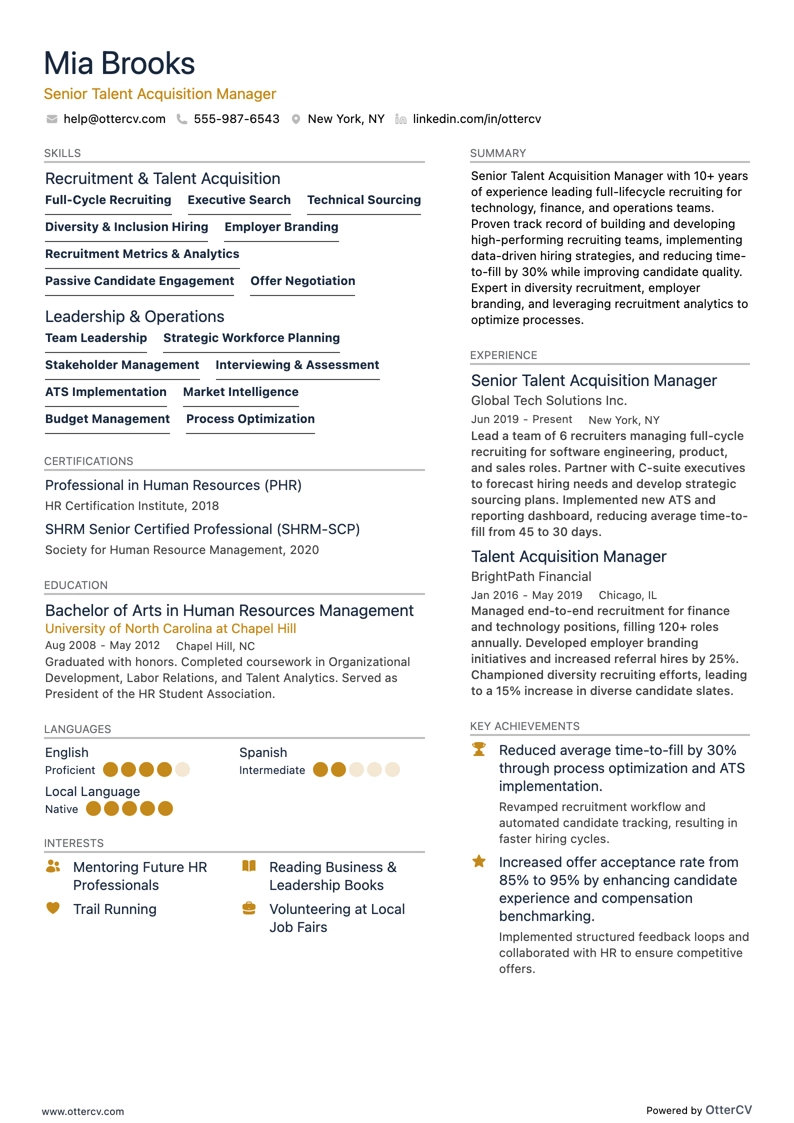
Senior Talent Acquisition Manager full preview

10 Recruitment Manager Resume Examples

OtterCV

Written by The OtterCV Team

Updated: 11/24/2024•8 min read

See all resume examples in this guide, or generate your own resume example with your personalized prompt

Senior Talent Acquisition Manager resume example

Senior Talent Acquisition Manager

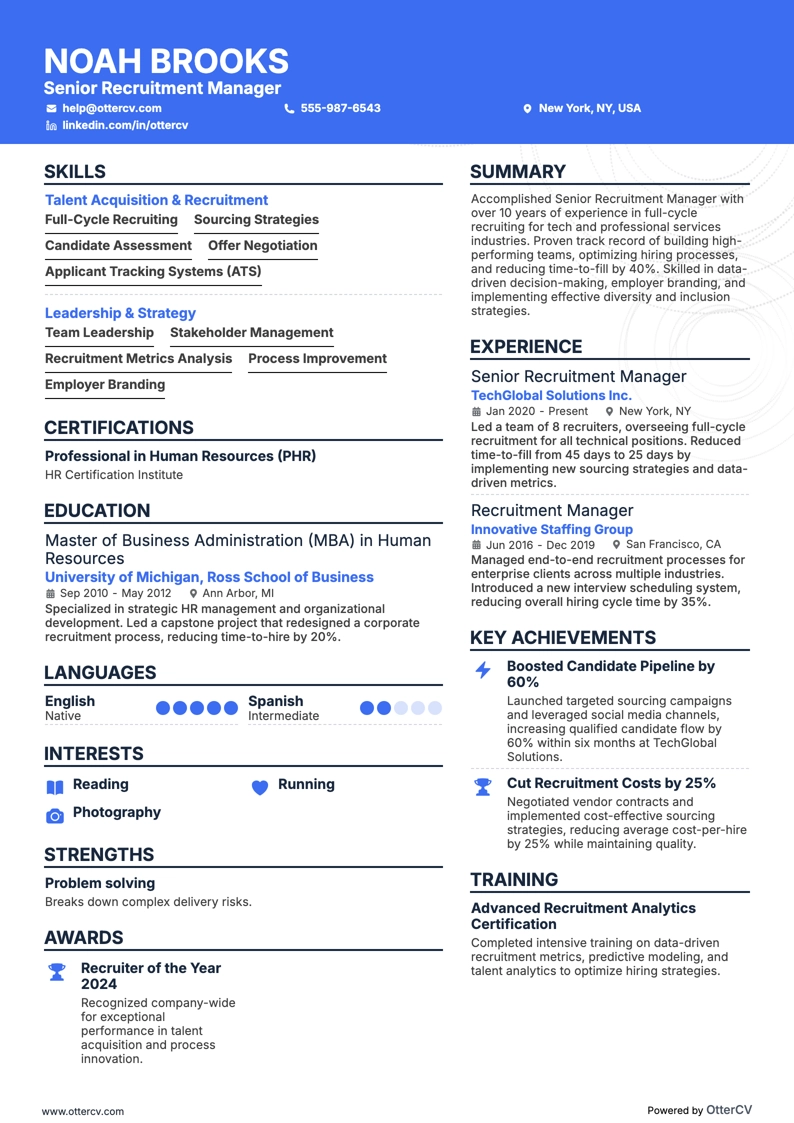
Senior Recruitment Manager resume example

Senior Recruitment Manager

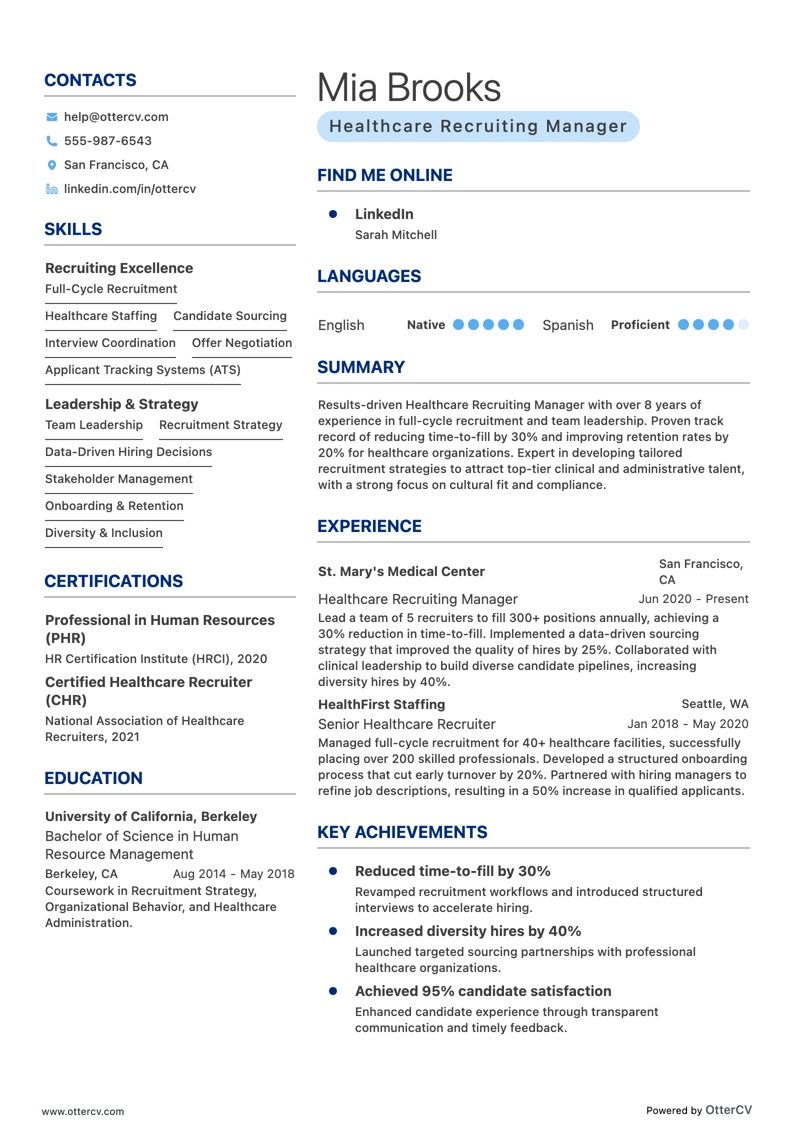
Healthcare Recruiting Manager resume example

Healthcare Recruiting Manager

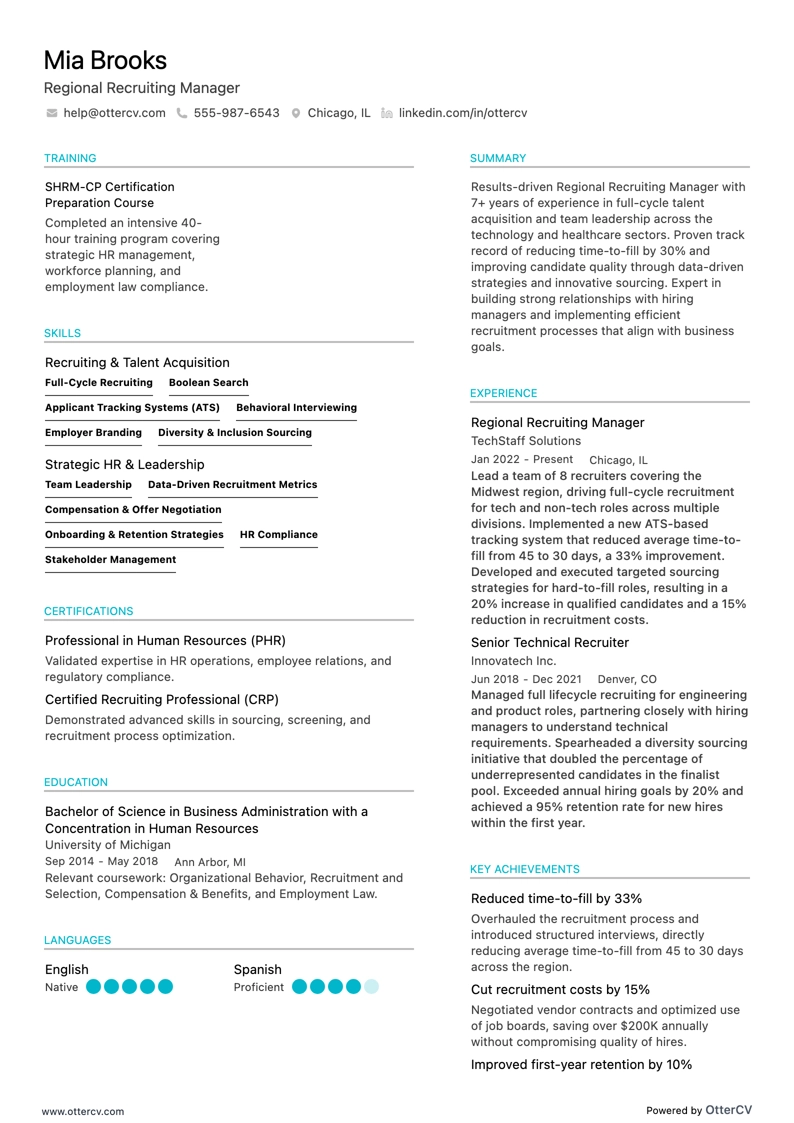
Regional Recruiting Manager resume example

Regional Recruiting Manager

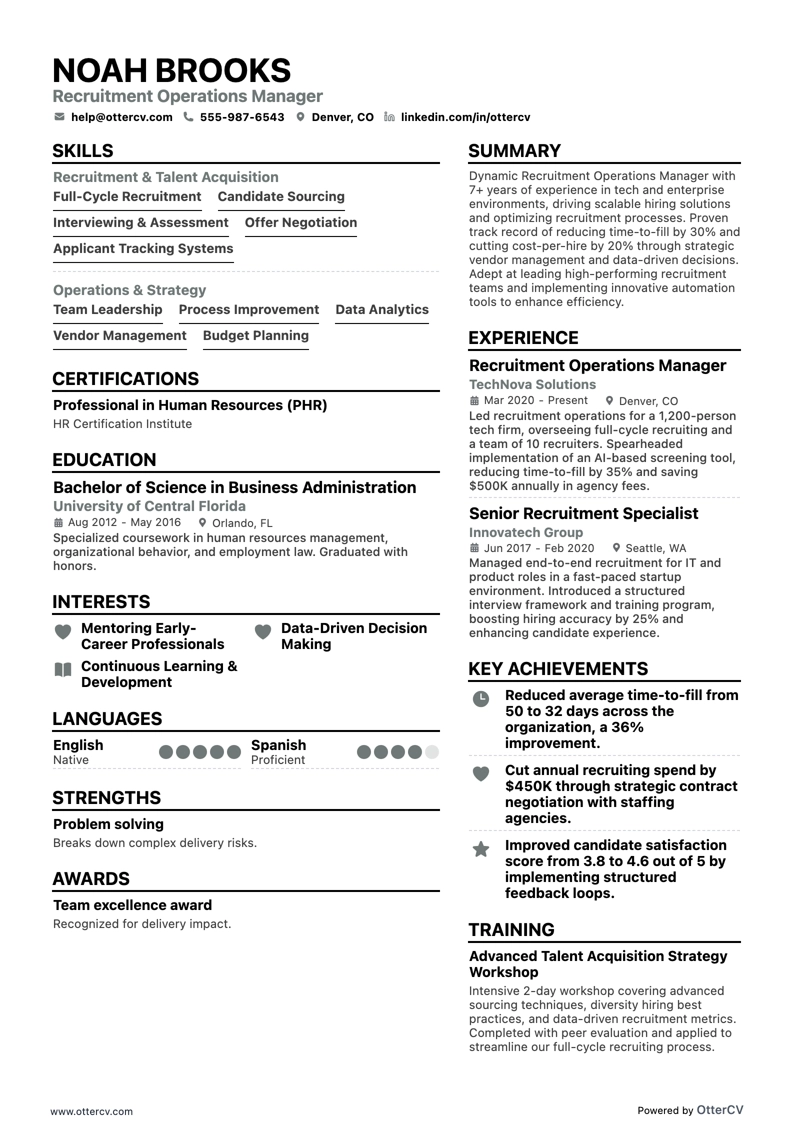
Recruitment Operations Manager resume example

Recruitment Operations Manager

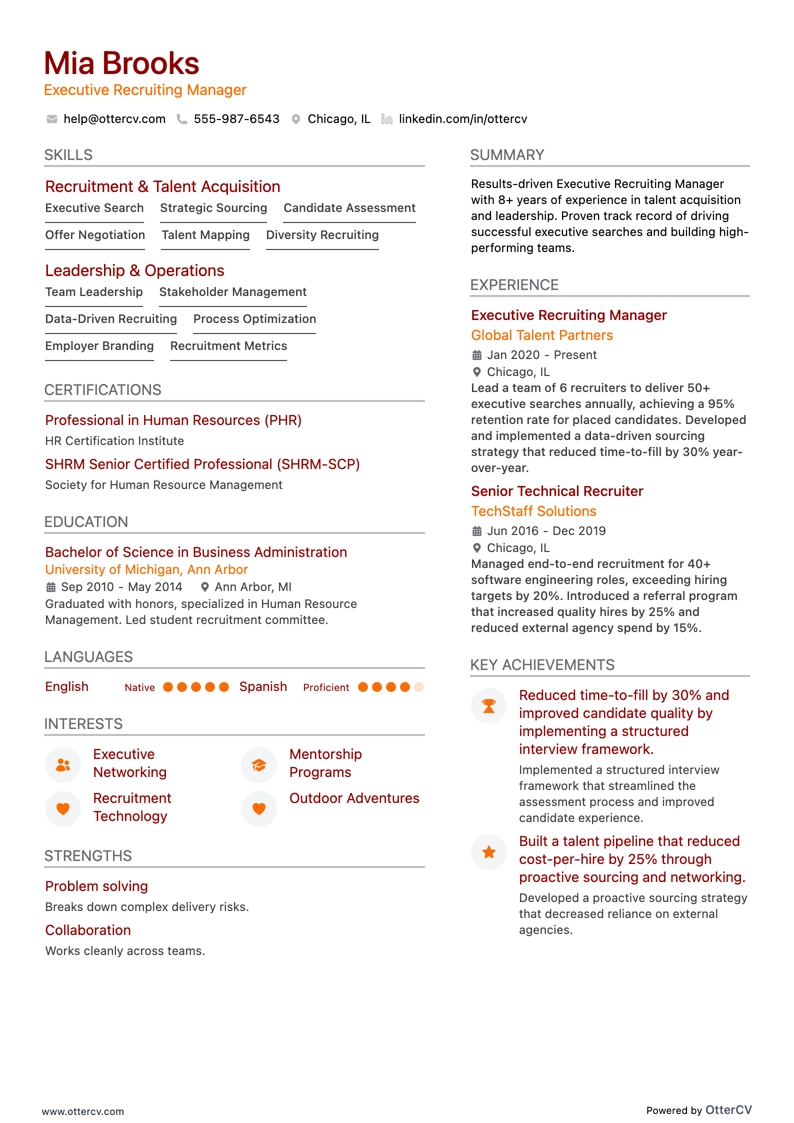
Executive Recruiting Manager resume example

Executive Recruiting Manager

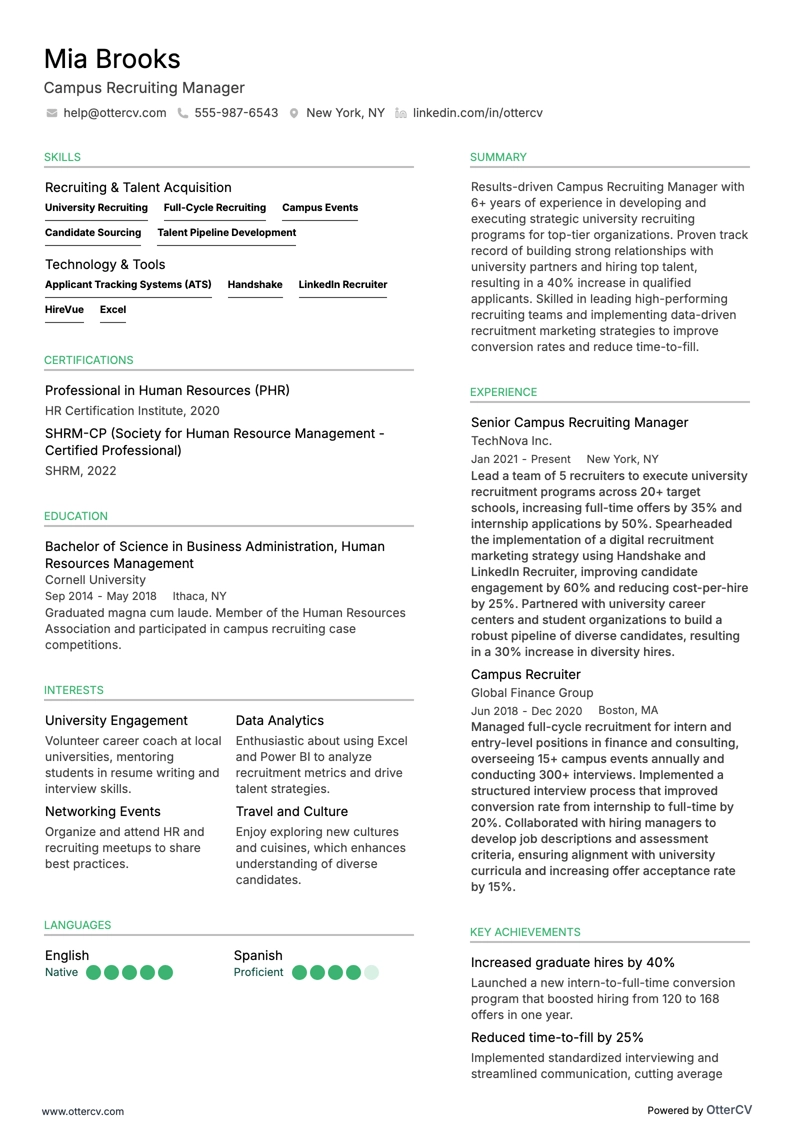
Campus Recruiting Manager resume example

Campus Recruiting Manager

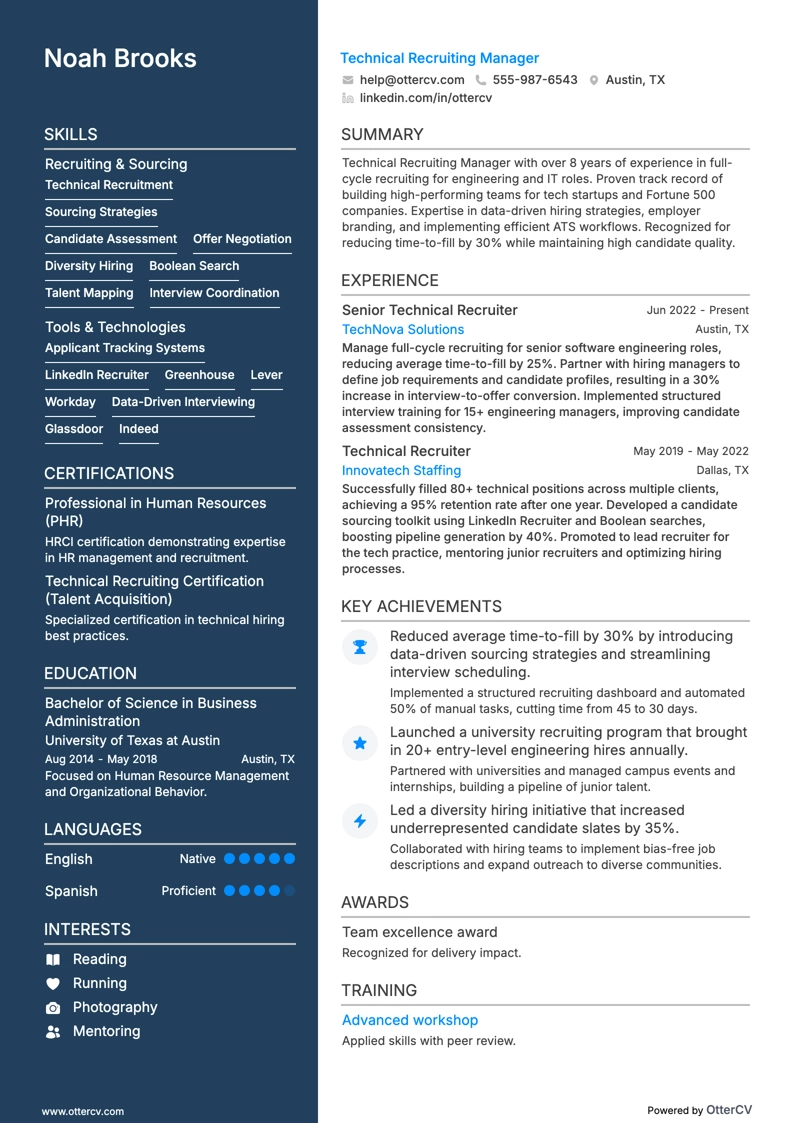
Technical Recruiting Manager resume example

Technical Recruiting Manager

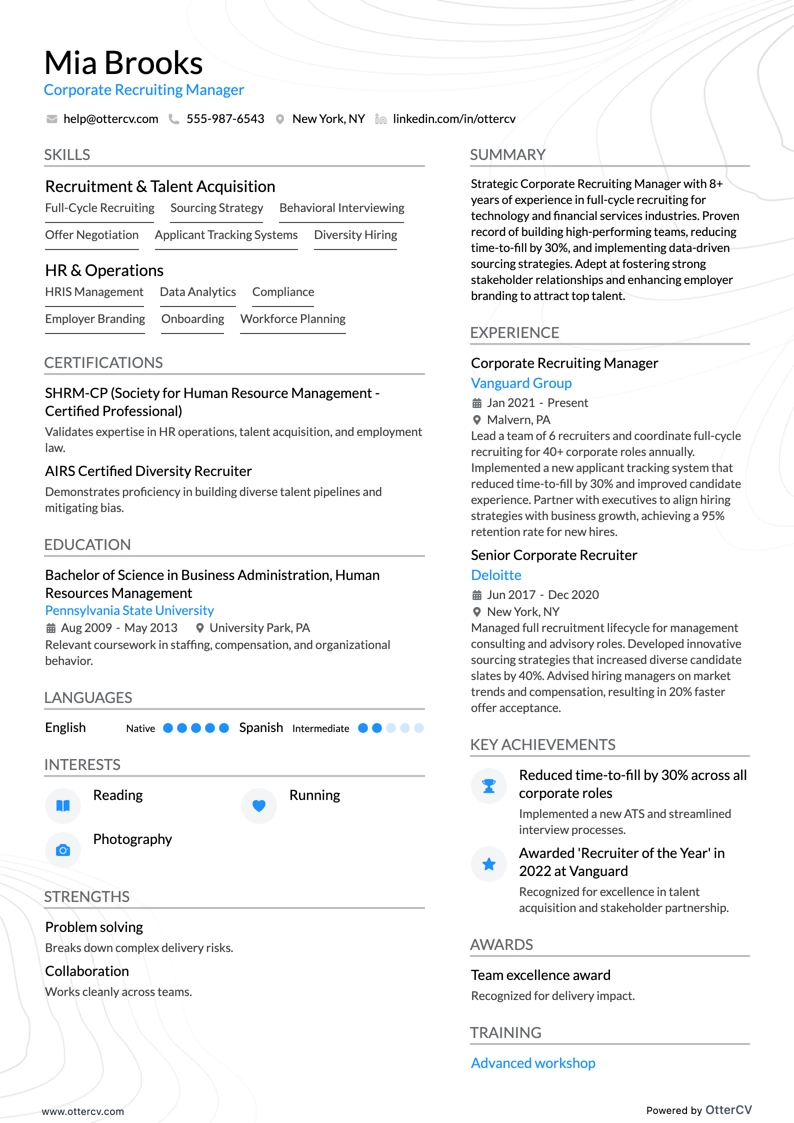
Corporate Recruiting Manager resume example

Corporate Recruiting Manager

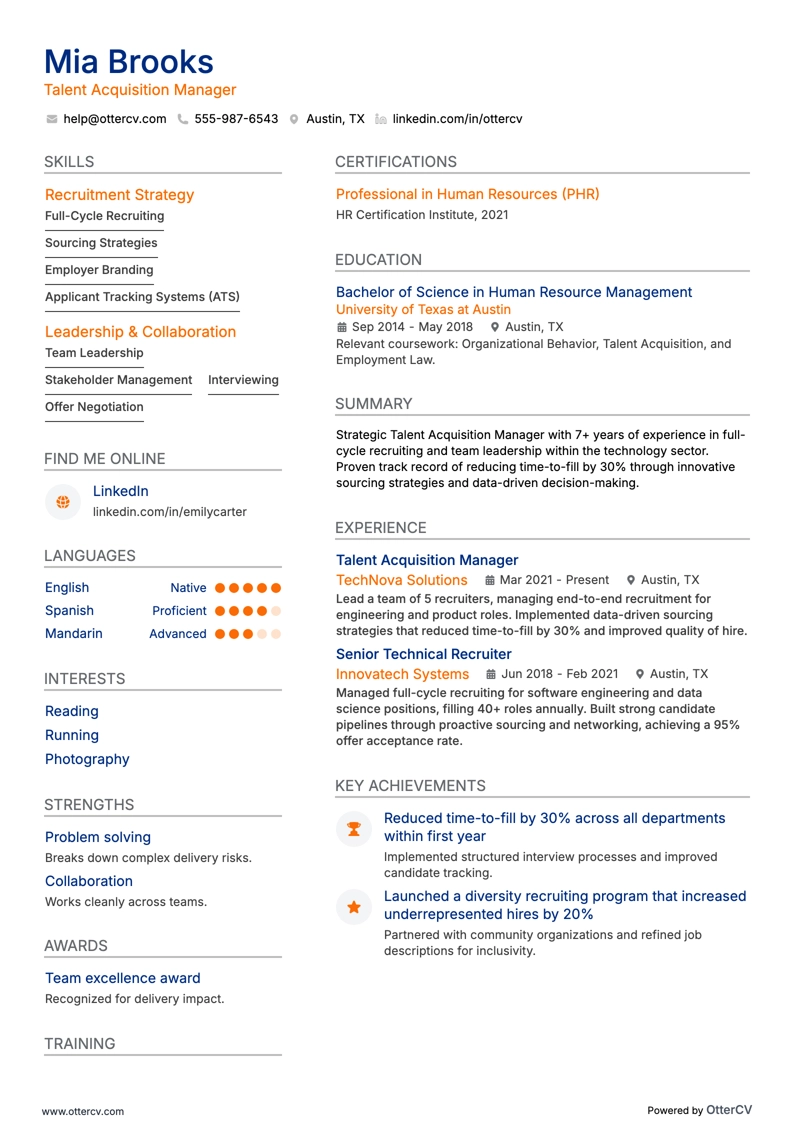
Talent Acquisition Manager resume example

Talent Acquisition Manager

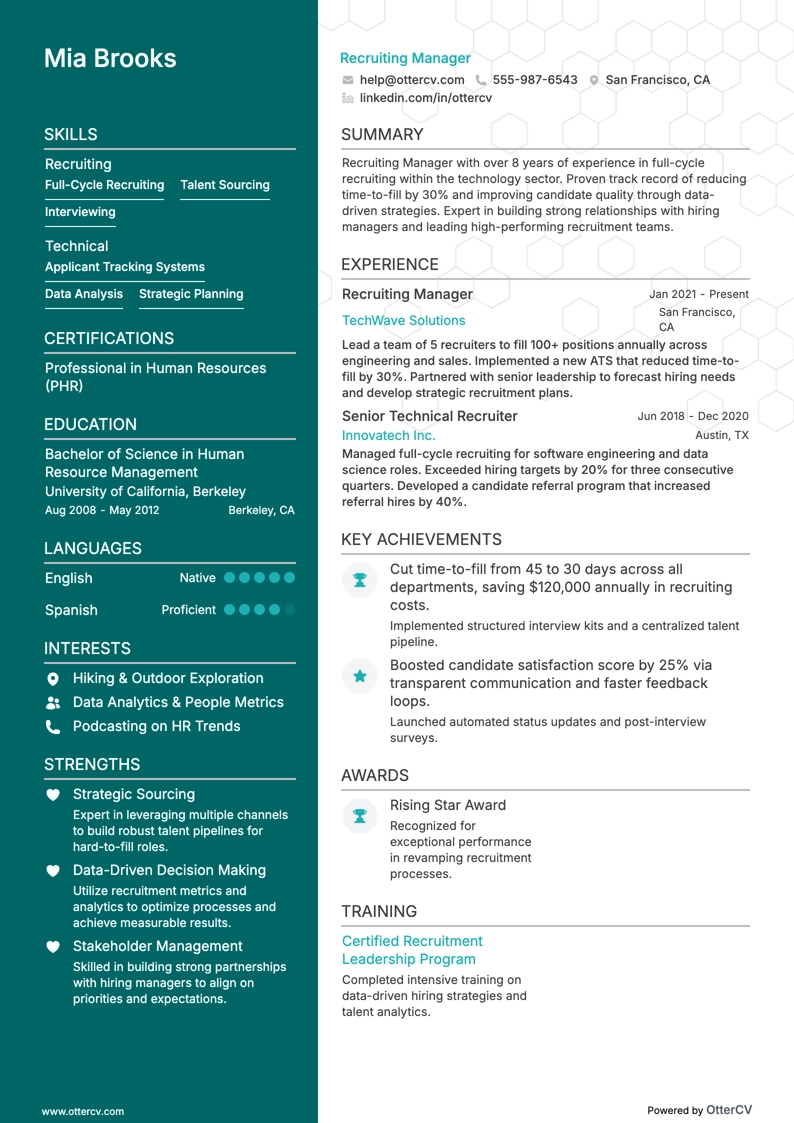
Recruiting Manager resume example

Recruiting Manager

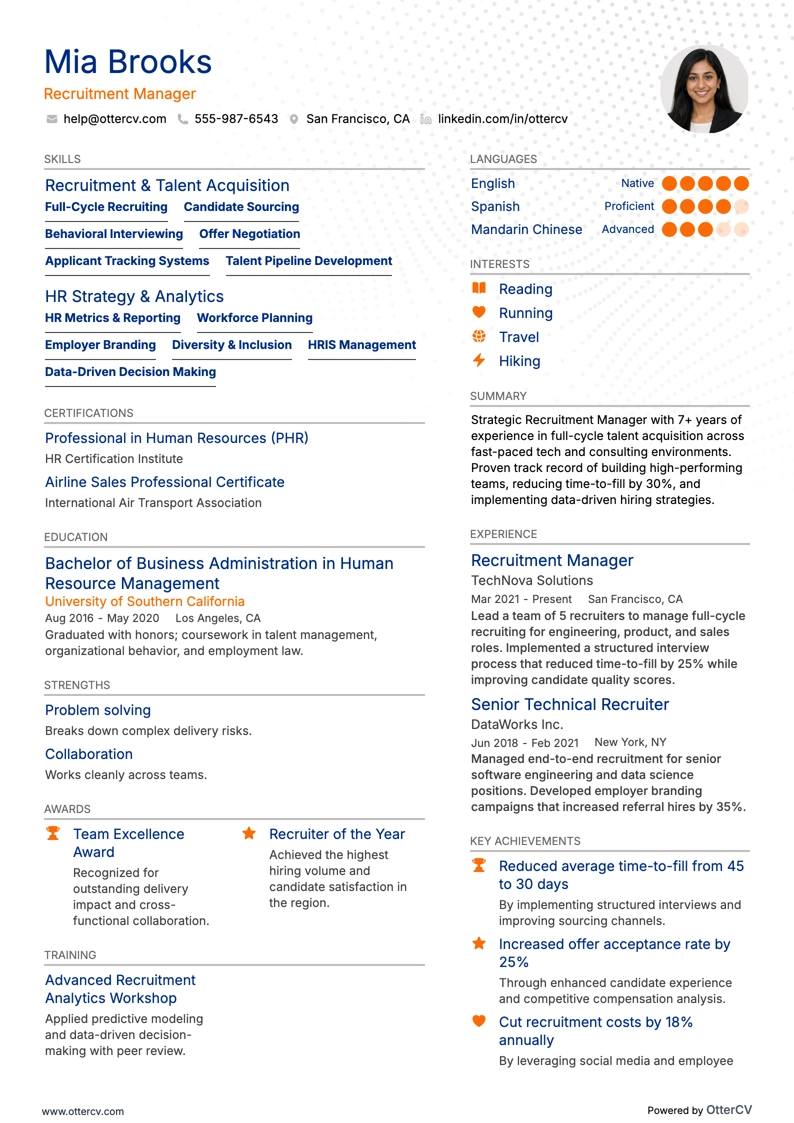
Recruitment Manager resume example

Recruitment Manager

Most recruitment manager resume drafts fail because they read like task lists and hide evidence of hiring impact. As a result, they often get filtered out by applicant tracking systems and overlooked in quick resume scans, especially in competitive markets.

A strong resume emphasizes the outcomes you delivered rather than the tools you used. If you are not sure where to start, begin by learning how to write a resume that prioritizes results. Focus on metrics such as time-to-fill reductions, cost-per-hire improvements, quality-of-hire gains, offer acceptance rates, pipeline conversion, and hiring plan delivery across teams or regions.

Key takeaways

  • Use a reverse-chronological format to show leadership progression and increasing recruitment accountability.

  • Quantify achievements with metrics such as time-to-fill, cost-per-hire, and offer acceptance rates.

  • Tailor experience bullets to match each job posting’s tools, KPIs, and terminology.

  • Show your skills through measurable outcomes in your summary and experience sections.

  • Add certifications like SHRM-CP or PHR to strengthen credibility for competitive roles.

  • Use AI to tighten language and add metrics, but not to invent experience.

  • Build your resume faster with Echocv to keep formatting consistent and sections aligned.

Job market snapshot for recruitment managers

We analyzed 70 recent recruitment manager job ads across major US job boards. These figures provide a quick view of in-demand skills, industry demand, and regional hotspots.

What level of experience employers are looking for recruitment managers

Years of ExperiencePercentage found in job ads
1–2 years15.7% (11)
3–4 years4.3% (3)
5–6 years11.4% (8)
7–8 years7.1% (5)
9–10 years7.1% (5)
10+ years8.6% (6)
Not specified52.9% (37)

Recruitment manager ads by area of specialization (industry)

Industry (Area)Percentage found in job ads
Finance & Banking64.3% (45)
Healthcare15.7% (11)
Education14.3% (10)

Top companies hiring recruitment managers

CompanyPercentage found in job ads
Robert Half International24.3% (17)

Role overview stats

These tables outline the most common responsibilities and employment types for recruitment manager roles. Use them to align your resume with employer expectations and understand how the role is structured across the market.

Day-to-day activities and top responsibilities for a recruitment manager

ResponsibilityPercentage found in job ads
Applicant tracking system7.1% (5)
Applicant tracking systems7.1% (5)
Microsoft excel7.1% (5)
Microsoft office7.1% (5)
Ats5.7% (4)
Data5.7% (4)
Employment law5.7% (4)
Social media5.7% (4)
Talent acquisition5.7% (4)
Metrics4.3% (3)
Power point4.3% (3)
Analysis2.9% (2)

Type of employment (remote vs on-site vs hybrid)

Employment typePercentage found in job ads
On-site80.0% (56)
Hybrid14.3% (10)

How to format a recruitment manager resume

When hiring leaders review recruitment manager candidates, they look for clear evidence of team leadership, execution of hiring strategy, and measurable improvements in talent acquisition outcomes. A reverse-chronological format highlights these strengths most effectively by showing a clear progression in responsibility and operational scope. Choosing the right resume format matters because it affects how quickly reviewers can evaluate your qualifications.

I have significant experience in this role—which format should I use?

I have significant experience in this role—which format should I use?

Use a reverse-chronological format. It is the only structure that accurately shows your leadership progression and increasing accountability across recruitment functions.

Do:

  • Start each role entry with your scope of ownership, including team size managed, departments supported, requisition volume, and budget authority.
  • Highlight proficiency with recruitment-specific platforms and areas such as ATS configuration (Greenhouse, Lever, iCIMS), workforce planning, employer branding, and DEI hiring initiatives.
  • Quantify business impact with metrics such as time-to-fill reduction, cost-per-hire improvement, offer acceptance rates, and retention outcomes tied to hiring quality.

Example: “Led a 12-person recruitment team supporting five business units, reducing average time-to-fill from 52 to 31 days and decreasing cost-per-hire by 28% over 18 months through structured interview standardization and vendor renegotiation.”

Why hybrid and functional resumes don't work for senior roles

Why hybrid and functional resumes don't work for senior roles

Hybrid resume formats fragment your leadership narrative by separating key skills from their operational context. That makes it harder for reviewers to connect your decisions to team outcomes and broader organizational impact. Functional resumes are even less effective: they obscure career progression, remove accountability context, and make it difficult to assess the scope and scale of your management responsibilities over time.

If you have a consistent track record in recruitment leadership, avoid both formats. They dilute the signals hiring executives are looking for.

  • Edge-case exception: a functional format may be acceptable only if you're moving into recruitment management from a related field, such as HR business partnering or talent operations, and have limited direct management titles. Even then, every listed skill should be tied to a specific project, team outcome, or measurable result to preserve credibility.

Once you’ve chosen the right format, the next step is adding the sections hiring teams expect on a recruitment manager resume.

What sections should go on a recruitment manager resume

Recruiters expect a recruitment manager resume to show hiring leadership, measurable results, and stakeholder management. Understanding what to put on a resume at the management level helps ensure you don’t miss any critical sections.

Use this structure for clarity:

  • Header
  • Summary
  • Experience
  • Skills
  • Projects
  • Education
  • Certifications
  • Optional sections: Awards, Leadership, Languages

Strong experience bullets should emphasize hiring outcomes, improvements in time-to-fill and quality-of-hire, pipeline scale, team leadership, and business impact.

Once you’ve organized your resume with the right components, the next step is to write your recruitment manager experience section with clear, results-focused detail that supports the rest of the document.

How to write your recruitment manager resume experience

Your experience section is where you prove the results you’ve delivered as a recruitment manager through the sourcing strategies you implemented, the hiring systems you managed, and the measurable improvements you drove across talent acquisition. Hiring managers care more about demonstrated impact than task-based descriptions, so each line should connect your ownership of recruiting operations to outcomes that mattered to the business. Building a targeted resume helps ensure every bullet aligns with the role’s priorities.

Each entry should include:

  • Job title
  • Company and location (or remote)
  • Dates of employment (month and year)

Add three to five concise bullet points that show what you owned, how you executed, and the outcomes you delivered:

  • Ownership scope: the recruiting functions, talent pipelines, applicant tracking systems, hiring programs, or teams you were directly responsible for as a recruitment manager.
  • Execution approach: the sourcing methodologies, recruiting platforms, assessment frameworks, or data-driven strategies you used to guide hiring decisions and optimize the full recruitment lifecycle.
  • Value improved: changes to time-to-fill, candidate quality, offer acceptance rates, hiring process efficiency, employer brand perception, or compliance risk that resulted from your leadership.
  • Collaboration context: how you partnered with hiring managers, HR business partners, department heads, staffing agencies, or executive leadership to align recruiting efforts with workforce planning goals.
  • Impact delivered: business outcomes such as headcount targets met, retention improvements, cost-per-hire reductions, or scaled hiring programs, rather than a list of daily recruiting tasks.

Experience bullet formula

Experience bullet formula

Use this structure for experience bullets: action verb + technology + what you built or fixed + measurable result.

A recruitment manager experience example

Recruitment Manager

Northbridge HealthTech | Austin, TX

2021–Present

Series C healthcare software company supporting 1,200+ provider organizations across the US.

  • Led full-cycle hiring for product, engineering, sales, and customer success, delivering 110 hires per year using Greenhouse and LinkedIn Recruiter while reducing median time-to-fill from 48 to 34 days (29%).
  • Built structured interview loops and scorecards with hiring managers and department heads, improving offer acceptance from 78% to 86% and reducing first-year regrettable attrition from 12% to 8%.
  • Launched a data-driven sourcing strategy with Gem and SeekOut, increasing qualified pipeline by 35% and raising onsite-to-offer conversion from 18% to 24%.
  • Partnered with HR and finance to implement headcount forecasting and weekly funnel dashboards in Google Looker Studio, improving hiring plan accuracy from 72% to 90% and preventing three quarter-end capacity gaps.
  • Negotiated agency consolidation and introduced a preferred vendor program, reducing external spend by 22% ($180K annually) while maintaining hiring volume and quality-of-hire targets.

Now that you’ve seen what a strong experience section looks like, the next step is adjusting yours for the specific role you’re targeting.

How to tailor your recruitment manager resume experience

Recruiters review recruitment manager resumes through both human screening and applicant tracking systems, looking for clear alignment between your background and the role’s requirements. Tailoring your resume to the job description helps your qualifications stand out to both.

Ways to tailor your recruitment manager experience:

  • Match the ATS platforms and recruiting tools named in the posting.
  • Mirror the hiring methodologies or sourcing strategies listed.
  • Reflect any KPIs mentioned, such as time-to-fill or quality-of-hire.
  • Include industry or sector experience when the role requires it.
  • Highlight compliance standards such as EEO or OFCCP if they are mentioned.
  • Use the same terminology for talent pipelines or workforce planning.
  • Emphasize the collaborative hiring frameworks or stakeholder models described.
  • Align your leadership scope with the team size they specify.

Tailoring means connecting your real accomplishments to what the employer is asking for, not forcing in keywords that do not belong.

Resume tailoring examples for recruitment manager

Job description excerptUntailoredTailored
"Lead full-cycle recruitment for engineering and product teams using Greenhouse ATS, reducing time-to-fill across technical roles."Managed recruiting processes and helped fill open positions across departments.Led full-cycle recruitment for engineering and product teams through Greenhouse ATS, reducing average time-to-fill for technical roles from 58 to 34 days over 12 months.
"Develop and execute diversity sourcing strategies to build inclusive talent pipelines, partnering with ERGs and hiring managers."Worked on sourcing candidates and improving the hiring pipeline.Partnered with three ERGs and 15 hiring managers to design diversity sourcing strategies that increased underrepresented candidate slates by 40% across two quarterly hiring cycles.
"Manage a team of five recruiters, track KPIs in Tableau dashboards, and report hiring metrics to senior leadership weekly."Supervised a team of recruiters and provided updates on hiring progress.Managed a team of five recruiters, built and maintained Tableau dashboards tracking cost-per-hire, offer acceptance rate, and pipeline velocity, and delivered weekly metric reports to senior leadership.

Once you’ve aligned your experience with the role’s priorities, the next step is to quantify your recruitment manager achievements so hiring teams can see the impact behind those choices.

How to quantify your recruitment manager achievements

Quantifying your achievements helps show how your hiring work improved speed, quality, and compliance. Focus on time-to-fill, offer acceptance, quality-of-hire, cost per hire, and candidate experience scores across roles and hiring managers.

Quantifying examples for recruitment manager

MetricExample
Time-to-fillCut average time-to-fill from 52 to 34 days by rebuilding the intake process and using Greenhouse scorecards across 18 roles.
Quality of hireImproved six-month pass rate from 82% to 93% by adding structured interviews and interviewer calibration for 40 hires.
Offer acceptanceRaised offer acceptance from 76% to 88% by standardizing compensation bands and launching a pre-close call workflow in Gem.
Cost per hireReduced agency spend by 35% ($210K annually) by expanding employee referrals and building a direct-sourcing pipeline in LinkedIn Recruiter.
Compliance accuracyCut audit findings from five to zero by enforcing documentation in the applicant tracking system (ATS) and training 25 interviewers on equal employment rules.

Once your bullet points clearly show your accomplishments, the next step is making sure your skills section presents the right mix of hard and soft skills to reinforce your expertise as a recruitment manager.

How to list your hard and soft skills on a recruitment manager resume

Your skills section shows how you build hiring pipelines, lead stakeholders, and manage compliant processes. Recruiters and ATS (applicant tracking system) tools scan this section for keyword alignment and role fit, so it should emphasize mostly hard skills supported by targeted soft skills.

Recruitment manager roles require a blend of:

  • Product strategy and discovery skills.
  • Data, analytics, and experimentation skills.
  • Delivery, execution, and go-to-market discipline.
  • Soft skills.

Your skills section should be:

  • Scannable, using bullet-style grouping.
  • Relevant to the job post.
  • Supported by proof in your experience bullets.
  • Updated with current tools.

Place your skills section:

  • Above your experience section if you're junior or switching careers.
  • Below your experience section if you're mid- or senior-level with strong achievements.

Hard skills

  • Applicant tracking systems include Greenhouse, Lever, and Workday.
  • Sourcing tools include LinkedIn Recruiter, SeekOut, and Gem.
  • Experience includes interview loop design and scorecards.
  • Uses structured interviewing and calibration.
  • Covers workforce planning and headcount forecasting.
  • Supports offer strategy and compensation benchmarking.
  • Handles recruitment analytics and funnel reporting.
  • Applies diversity sourcing strategies and compliance practices.
  • Works on employer branding and talent marketing.
  • Manages background checks and I-9 workflows.
  • Oversees vendor management across agencies, RPO, and job boards.
  • Maintains process documentation and standard operating procedures.

Soft skills

  • Aligns stakeholders with hiring managers.
  • Communicates clearly with candidates and follows through.
  • Coaches recruiters and interviewers.
  • Prioritizes roles under tight timelines.
  • Manages offer negotiations with tact.
  • Resolves hiring conflicts quickly.
  • Runs effective intake meetings.
  • Drives process adoption and accountability.
  • Sets expectations and pushes back when needed.
  • Makes data-informed hiring decisions.
  • Maintains confidentiality and discretion.
  • Builds trust across cross-functional teams.

How to show your recruitment manager skills in context

Skills should not appear only in a dedicated skills section. Reviewing examples of resume skills used in context can help you see how strong candidates weave them throughout their resumes.

Your skills should be demonstrated in:

  • Your summary (high-level professional identity)
  • Your experience (proof through outcomes)

Here’s what that looks like in practice.

Summary example

Recruitment manager with 10+ years in healthcare talent acquisition, with expertise in Greenhouse, structured interviewing, and workforce planning. Built a sourcing pipeline that reduced time-to-fill by 34% across 12 facilities while mentoring a team of six recruiters.

  • Clearly reflects senior-level experience
  • Names specific, relevant tools
  • Leads with a measurable outcome
  • Highlights leadership and mentoring

Recruitment Manager

Vantage Health Partners | Remote

March 2019–Present

  • Redesigned the end-to-end hiring workflow in Greenhouse, reducing average time-to-fill from 52 to 33 days across all departments.
  • Partnered with department heads to create competency-based interview frameworks, improving new-hire retention by 27% within the first year.
  • Trained and managed a distributed team of eight recruiters through weekly pipeline reviews in Tableau, exceeding quarterly hiring targets by 15%.
  • Every bullet includes measurable proof.
  • Skills surface naturally through outcomes.

How do I write a recruitment manager resume with no experience

Once you’ve shown your recruiting ability through specific responsibilities and outcomes, the next step is applying that approach to a recruitment manager resume when you do not yet have direct experience.

Even without full-time experience, you can still show readiness through:

  • Campus recruiting or career fair staffing
  • Internship work coordinating interviews and offers
  • HR volunteer sourcing and screening
  • Talent pipeline projects completed in class
  • Applicant tracking system administration practice
  • Hiring manager intake meeting simulations
  • Onboarding coordination for a student organization

If you’re in this situation, our guide on writing a resume without work experience can help you structure these alternative qualifications effectively.

Focus on:

  • Sourcing strategy and channel performance
  • Applicant tracking system workflow accuracy
  • Structured interview plans and scorecards
  • Metrics such as time-to-fill and conversion rates

Resume format tip for entry-level recruitment manager

Resume format tip for entry-level recruitment manager

Use a hybrid resume format to highlight recruiting projects and skills while still showing consistent experience from internships, volunteer work, and campus roles.

Do:

  • Lead with a targeted summary and core tools.
  • Add a Recruiting Projects section.
  • Use metrics such as applicants, interviews, and offers.
  • Name tools like LinkedIn Recruiter and Greenhouse.
  • Mirror each job posting's keywords.

Example project bullet:

  • Built a student org talent pipeline in Greenhouse, sourced 120 candidates via LinkedIn Recruiter, and increased interview-to-offer conversion from 18% to 28%.

Even without direct experience, your education section can show the foundational knowledge and relevant coursework that qualify you for a recruitment manager role.

How to list your education on a recruitment manager resume

Your education section helps hiring teams confirm that you have the academic background needed for the role. It highlights training in HR, business, or related fields relevant to recruitment management.

Include:

  • Degree name
  • Institution
  • Location
  • Graduation year
  • Relevant coursework (for juniors or entry-level candidates)
  • Honors and GPA (if 3.5 or higher)

Skip the month and day—list the graduation year only.

Here's a strong education entry tailored for a recruitment manager resume:

Example education entry

Bachelor of Science in Human Resource Management

University of Georgia, Athens, GA

Graduated 2018

GPA: 3.7/4.0

  • Relevant coursework: Talent Acquisition Strategy, Organizational Behavior, Employment Law, Workforce Analytics
  • Honors: Magna Cum Laude, Dean's List (six semesters)

How to list your certifications on a recruitment manager resume

Certifications on a resume show a recruitment manager’s commitment to learning, proficiency with hiring tools, and alignment with current industry standards. They also reinforce credibility when you manage pipelines, compliance, and stakeholder expectations.

Include the following details for each certification:

  • Certificate name
  • Issuing organization
  • Year
  • Optional: credential ID or URL
  • Place certifications below education when your highest degree is recent and the certifications provide supporting value rather than serving as a core qualification.
  • Place certifications above education when they are recent, highly relevant to recruiting leadership, or required for the roles you are targeting.

Best certifications for your recruitment manager resume

  • SHRM Certified Professional (SHRM-CP).
  • SHRM Senior Certified Professional (SHRM-SCP).
  • Professional in Human Resources (PHR).
  • Senior Professional in Human Resources (SPHR).
  • Certified Staffing Professional (CSP).
  • LinkedIn Certified Professional–Recruiter.
  • Certified Diversity and Inclusion Recruiter (CDR).

Once your credentials are easy for recruiters to verify, the next step is to write a recruitment manager resume summary that presents your value upfront.

How to write your recruitment manager resume summary

Your resume summary is often the first part a hiring manager reads. A strong summary quickly shows that you bring the leadership and strategic hiring expertise they need.

Keep it to three to four lines and include:

  • Your title and total years of recruitment management experience.
  • The industries or domains you have hired across, such as tech, healthcare, or finance.
  • Core tools and methods, such as ATS platforms, structured interviewing, or workforce planning.
  • One or two measurable achievements, such as reducing time-to-fill or improving retention rates.
  • Soft skills connected to real outcomes, such as stakeholder management that streamlined executive hiring.

PRO TIP

At the management level, emphasize the hiring outcomes, team leadership, and process improvements you directly owned.

Show how your decisions influenced business metrics such as cost-per-hire or quality of hire.

Avoid vague phrases like “passionate leader” or “results-driven professional.” Replace them with specific results and clear scope.

Example summary for a recruitment manager

Recruitment manager with eight years of experience leading talent acquisition teams across SaaS and fintech. Reduced average time-to-fill by 34% through ATS optimization and structured interview frameworks. Managed a team of six recruiters supporting more than 200 annual hires.

Now that your summary is ready to highlight your recruiting expertise, make sure your header includes the contact and professional details hiring managers need to reach you.

What to include in a recruitment manager resume header

A resume header includes your core contact and identity details. It helps a recruitment manager appear in searches, build credibility, and move through recruiter screening faster.

Essential resume header elements:

  • Full name
  • Tailored job title and headline
  • Location
  • Phone number
  • Professional email
  • GitHub link
  • Portfolio link
  • LinkedIn

A LinkedIn link helps recruiters quickly verify titles, dates, and recommendations, which supports faster screening.

Do not include a photo on a recruitment manager resume unless the role is explicitly front-facing or appearance-dependent.

Keep the header consistent with your application, use one professional name format, and match your job title to the role you want.

Example

Once your header clearly presents your identity and contact details, you can strengthen the rest of your resume with additional sections that reinforce your qualifications.

Additional sections for recruitment manager resumes

Extra resume sections can help you stand out when your core experience alone does not fully reflect your recruiting expertise or leadership credibility.

Consider adding sections that are especially relevant to a recruitment manager role:

  • Languages
  • Professional affiliations (e.g., SHRM, AIRS)
  • Certifications and training
  • Awards and recognition
  • Publications or speaking engagements
  • Volunteer experience in talent development
  • Industry conferences attended

Once you’ve rounded out your resume with the right supplementary sections, pairing it with a strong cover letter can help maximize your impact.

Do recruitment manager resumes need a cover letter

A cover letter isn’t required for every recruitment manager role, but it can help in competitive searches or when hiring managers expect one. If you’re unfamiliar with the format, start by understanding what a cover letter is and when it adds value. It can make a difference when your resume needs more context or when you want to show clear alignment with the team.

Use a cover letter when it adds specific, job-relevant detail:

  • Explain role and team fit: Connect your recruiting style to the company’s hiring model, stakeholder needs, and operating rhythm.
  • Highlight one or two outcomes: Focus on metrics-driven wins, such as reducing time-to-fill, improving offer acceptance, or raising hiring manager satisfaction.
  • Show business context awareness: Reference the product, users, or growth stage, and explain how that affects hiring priorities and talent profiles.
  • Address non-obvious experience: Clarify career transitions, industry changes, or gaps, and link them to the skills you’ll use as a recruitment manager.

Whether you include a cover letter or focus on the resume alone, AI tools can help strengthen your recruitment manager resume by improving clarity, relevance, and impact.

Using AI to improve your recruitment manager resume

AI can sharpen your resume's clarity, structure, and impact. It helps tighten language and highlight measurable results. But overusing it can weaken authenticity. Once your content feels clear and aligned with the role, step away from the tool. If you're still comparing options, learn which AI is best for writing resumes before committing to a workflow.

Here are 10 practical prompts to improve specific sections of your recruitment manager resume:

  1. Sharpen your summary: “Rewrite my recruitment manager resume summary to highlight leadership scope, hiring volume, and strategic talent acquisition impact in three concise sentences.”
  2. Quantify experience bullets: “Add specific metrics like time-to-fill, cost-per-hire, and retention rates to these recruitment manager experience bullet points.”
  3. Align skills section: “Compare this recruitment manager skills section against the job description and suggest missing keywords that match my actual experience.”
  4. Strengthen action verbs: “Replace weak or passive verbs in my recruitment manager experience bullets with strong, results-driven alternatives.”
  5. Tighten project descriptions: “Condense these recruitment manager project descriptions into two-line summaries that emphasize outcomes and team contributions.”
  6. Improve education relevance: “Rewrite my education section to emphasize coursework and achievements most relevant to a recruitment manager role.”
  7. Refine certification entries: “Format my recruitment manager certifications section for clarity, including issuing bodies, dates, and relevance to talent acquisition leadership.”
  8. Remove redundant phrasing: “Identify and remove filler words or redundant phrases across my entire recruitment manager resume without changing the meaning.”
  9. Tailor to job posting: “Adjust my recruitment manager experience section to mirror the priorities and language used in this specific job posting.”
  10. Check consistency throughout: “Review my recruitment manager resume for inconsistent formatting, tense shifts, and misaligned bullet-point structure across all sections.”

Stop using AI once your resume sounds accurate, specific, and aligned with your real experience. AI should never invent experience or inflate claims—if it didn't happen, it doesn't belong here.

Conclusion

A strong recruitment manager resume shows measurable outcomes, role-specific skills, and a clear structure. Highlight hiring volume, time-to-fill, offer acceptance rate, retention, and cost savings. Demonstrate expertise in sourcing, stakeholder management, and team leadership.

Keep every section easy to scan with consistent formatting and focused bullets. This approach shows you can deliver results in today’s market and adapt to near-future hiring needs. Your resume should read like a plan you can execute.

Recruitment Manager resume examples

Explore additional Recruitment Manager resume samples and guides and see what works for your level of experience or role.

By Experience

Senior Talent Acquisition Manager

Senior Talent Acquisition Manager resume preview

Senior Recruitment Manager

Senior Recruitment Manager resume preview

Recruitment Manager resume examples

Explore additional Recruitment Manager resume samples and guides and see what works for your level of experience or role.

By Role

Healthcare Recruiting Manager

Healthcare Recruiting Manager resume preview

Regional Recruiting Manager

Regional Recruiting Manager resume preview

Recruitment Operations Manager

Recruitment Operations Manager resume preview

Executive Recruiting Manager

Executive Recruiting Manager resume preview

Campus Recruiting Manager

Campus Recruiting Manager resume preview

Technical Recruiting Manager

Technical Recruiting Manager resume preview

Corporate Recruiting Manager

Corporate Recruiting Manager resume preview

Talent Acquisition Manager

Talent Acquisition Manager resume preview

Recruiting Manager

Recruiting Manager resume preview

Recruitment Manager

Recruitment Manager resume preview