Entry-Level Real Estate Agent full preview

16 Realtor Resume Examples

OtterCV

Written by The OtterCV Team

Updated: 8/29/2024•8 min read

See all resume examples in this guide, or generate your own resume example with your personalized prompt

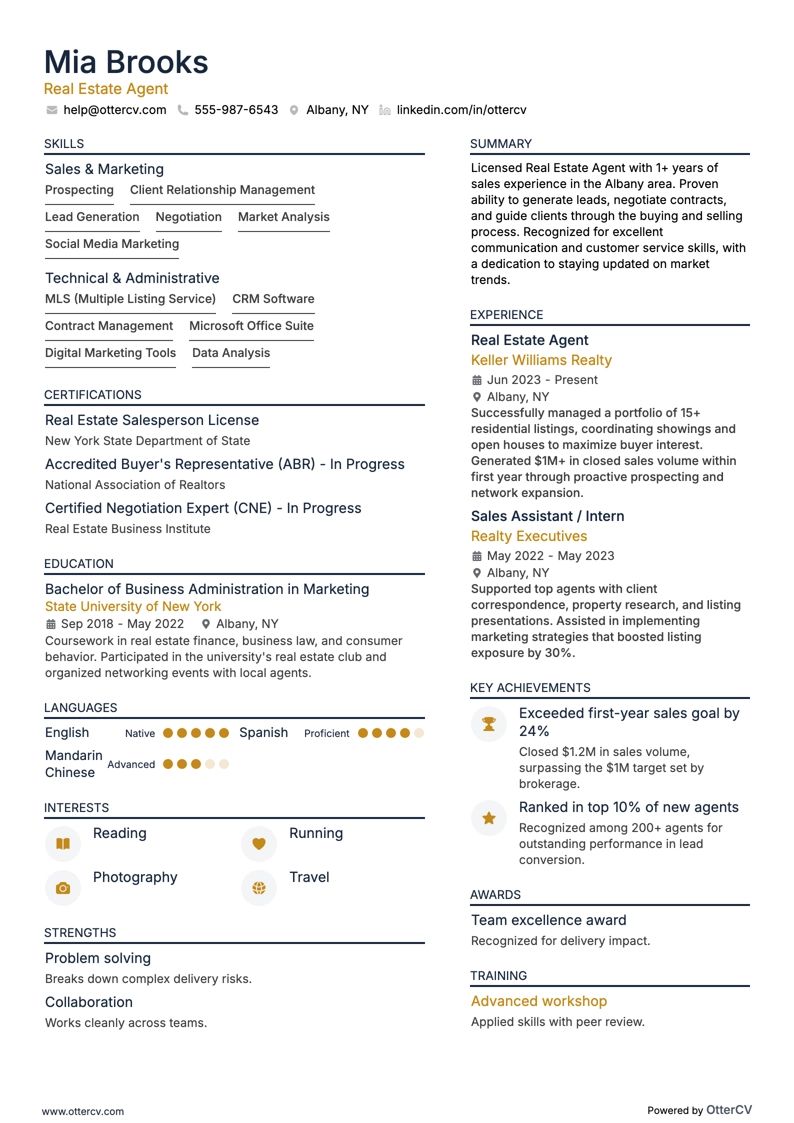
Entry-Level Real Estate Agent resume example

Entry-Level Real Estate Agent

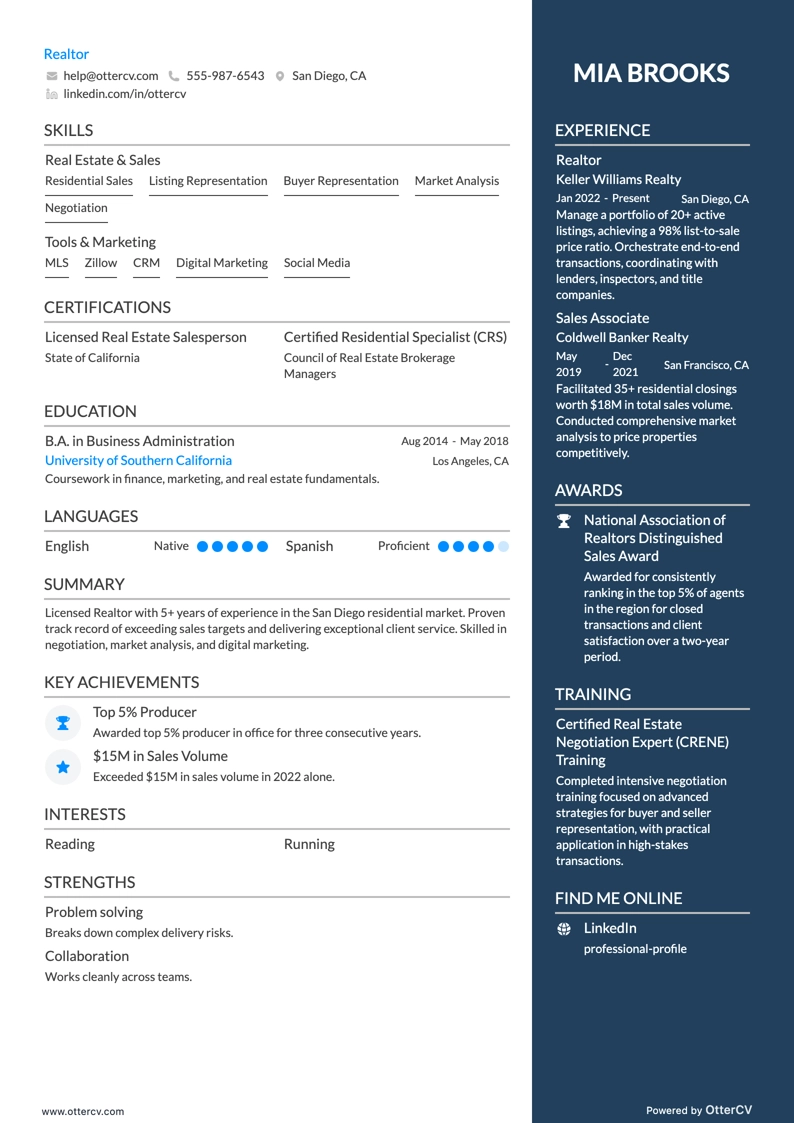
Realtor resume example

Realtor

Most realtor resume drafts fail because they read like job descriptions rather than proof of sales impact. That matters in a crowded market, where ATS systems filter quickly and recruiters scan resumes in seconds. Knowing how to make your resume stand out is critical in such a competitive field.

A strong resume shows what you delivered: closed volume, win rate, average days on market, list-to-sale price ratio, and repeat-referral share. It should also quantify pipeline growth, high-value deals led, negotiation outcomes, and client satisfaction results.

Key takeaways

  • Quantify closed volume, conversion rates, and list-to-sale price ratio in every experience bullet.

  • Use a reverse-chronological format if you have experience, or a hybrid format if you are switching into real estate.

  • Tailor each resume to the job posting’s CRM tools, property types, and sales targets.

  • Put skills above experience for junior candidates and below experience for senior realtors.

  • Keep your summary to four lines and include your title, market specialty, and one measurable win.

  • Support hard skills with proof in your experience bullets so claims do not stand alone.

  • Use Echocv to turn vague duties into concise, metric-driven resume bullets faster.

How to format a realtor resume

Recruiters evaluating realtor candidates prioritize transaction volume, client acquisition ability, market knowledge, and consistent sales performance. A clean, well-structured resume format helps these strengths stand out immediately instead of getting buried under generic skills lists or unclear timelines.

I have significant experience as a realtor—which format should I use?

I have significant experience as a realtor—which format should I use?

Use a reverse-chronological format to showcase your strongest recent sales results and client portfolio growth first.

Do the following:

  • Highlight the scope of your territory, transaction volume, and client base size in each role.
  • Include role-specific skills such as MLS platforms, CRM tools (Salesforce, Follow Up Boss), contract negotiation, and local market analysis.
  • Quantify results with dollar figures, units closed, and percentage growth for each position.

Example bullet: “Closed 47 residential transactions totaling $18.2M in 2023, ranking in the top 5% of agents at a 200-person brokerage.”

I'm junior or switching into a realtor role—what format works best?

I'm junior or switching into a realtor role—what format works best?

A hybrid resume format works best because it highlights transferable skills and relevant training while still showing a clear work timeline.

  • Place a skills section near the top with client relationship management, lead generation, market research, and any real estate licensure or coursework.
  • Include projects or transitional experience, such as open house coordination, property staging internships, or sales roles in adjacent industries.
  • Connect each action to a result so hiring managers can understand your potential impact, even without direct real estate experience.

Example scaffold: Client communication (skill) → conducted 150+ prospecting calls per week during a B2B sales internship (action) → generated $85K in new pipeline revenue within the first quarter (result).

Why not use a functional resume?

Why not use a functional resume?

A functional resume removes the timeline context brokerages use to verify your licensing history, sales consistency, and market tenure, which can make it harder for hiring managers to trust your track record.

  • A functional format may be acceptable if you're transitioning from a related field, such as mortgage lending or property management, or re-entering real estate after a career gap—but only if each listed skill is tied directly to a project, transaction, or measurable outcome.

With a clean, scannable format in place, the next step is choosing the right sections to present your qualifications clearly.

What sections should go on a realtor resume

Recruiters expect a realtor resume to clearly show transaction performance, client outcomes, and local market expertise. Knowing which resume sections to include helps maximize clarity:

  • Header
  • Summary
  • Experience
  • Skills
  • Projects
  • Education
  • Certifications
  • Optional sections: Awards, Leadership, Languages

Strong experience bullets should highlight closed volume, conversion rates, days on market, list-to-sale price performance, client satisfaction, and the scope of your territory and pipeline.

Once you’ve organized the key resume components, focus on writing your realtor resume experience in a way that shows clear impact.

How to write your realtor resume experience

The experience section is where you prove you’ve closed deals, served clients, and delivered measurable results in real estate. Hiring managers care more about demonstrated impact, such as transactions completed, listings sold, and client portfolios grown, than duty-based descriptions of day-to-day work.

Each entry should include:

  • Job title
  • Company and location, or remote
  • Dates of employment, including month and year

Include three to five concise bullet points that explain what you owned, how you executed, and what outcomes you delivered:

  • Ownership scope: the listings, client accounts, geographic markets, property portfolios, or buyer and seller pipelines you were directly responsible for managing and growing.
  • Execution approach: the tools, platforms, and methods you used to price properties, generate leads, negotiate contracts, and move transactions to closing, including MLS databases, CRM systems, comparative market analyses, and digital marketing strategies.
  • Value improved: the changes you drove in client satisfaction, listing-to-close timelines, sale-to-asking-price ratios, lead conversion rates, or overall transaction efficiency in your market.
  • Collaboration context: how you worked with mortgage lenders, home inspectors, appraisers, title companies, attorneys, contractors, and fellow agents to create smooth closings and positive client experiences.
  • Impact delivered: outcomes framed as business results, such as revenue generated, portfolio growth, market share gained, client retention achieved, or referral networks expanded, rather than activities performed.

Experience bullet formula

Experience bullet formula

Action verb + technology + what you built or fixed + measurable result

A realtor experience example

Realtor

Redwood Realty Group | Austin, TX

2021–Present

High-volume residential brokerage serving first-time buyers and move-up sellers across the Austin metro.

  • Negotiated and closed $18.6M in residential transactions across forty-two deals, improving average list-to-close time by 19% through pricing strategy, offer structuring, and weekly pipeline reviews in Google Sheets.
  • Built and maintained a 220+ lead pipeline in Follow Up Boss, increasing lead-to-appointment conversion from 12% to 21% through segmented email and text campaigns and standardized follow-up cadences.
  • Produced pricing analyses and listing strategies using MLS data, ShowingTime, and Canva marketing assets, driving a 6.4% average above-list sale price on fifteen listings while reducing price reductions by 28%.
  • Coordinated inspections, appraisals, and title timelines with lenders, inspectors, and escrow, cutting contract fallout from 9% to 4% by tracking critical dates in Dotloop and resolving contingencies within an average of forty-eight hours.
  • Partnered with photographers, stagers, and brokerage leadership to launch listings in under five business days, improving showing volume by 23% and generating an average of three offers per listing through targeted Meta and Google Ads campaigns.

Now that you've seen how to structure your experience entries, the next step is adjusting them to match the specific requirements of each job posting.

How to tailor your realtor resume experience

Recruiters review resumes both manually and through applicant tracking systems, so tailoring your resume to the job description is essential. It helps ensure the skills, tools, and achievements you highlight reflect what each brokerage or agency values most.

Ways to tailor your realtor experience:

  • Mirror the CRM or MLS platforms named in the job description.
  • Match the listing marketing methods the brokerage specifically references.
  • Use the same terminology for transaction coordination or closing processes.
  • Reflect the sales volume or deal metrics the posting emphasizes.
  • Highlight experience in the property types or markets they serve.
  • Emphasize client relationship strategies aligned with their service model.
  • Include relevant fair housing or real estate compliance knowledge they request.
  • Reference team collaboration or mentorship structures the role describes.

Tailoring means connecting your real accomplishments to the role's requirements, not forcing unrelated keywords into your experience section.

Resume tailoring examples for realtor

Job description excerptUntailoredTailored
"Manage residential listings using MLS, conduct open houses, and guide clients through closing processes in a fast-paced brokerage environment."Helped clients buy and sell homes in the local area.Managed 45+ active residential listings on MLS, hosted weekly open houses that generated an average of 12 qualified leads per event, and guided 30 clients annually through closing—from offer negotiation to final walkthrough.
"Develop new business through cold outreach, referral networks, and community engagement to meet a quarterly sales volume target of $5M."Worked on growing the client base and increasing sales.Built a referral network of 80+ past clients and local mortgage brokers, conducted 50+ cold outreach calls weekly, and consistently exceeded the $5M quarterly sales volume target by 15% through targeted community sponsorships and neighborhood farming campaigns.
"Use CRM software to track buyer and seller pipelines, coordinate with title companies and inspectors, and ensure compliance with state real estate disclosure requirements."Kept track of client information and coordinated with other parties during transactions.Tracked 60+ concurrent buyer and seller pipelines in Salesforce CRM, coordinated inspections and title searches with third-party vendors to keep transactions on schedule, and ensured 100% compliance with state-mandated property disclosure requirements across all listings.

Once you’ve aligned your experience with the role’s priorities, quantify your realtor achievements to show the measurable impact behind those responsibilities.

How to quantify your realtor achievements

Numbers on your resume show the business impact behind your deals and client service. Focus on closed volume, days on market, list-to-sale price ratio, lead-to-close conversion, and compliance accuracy.

Quantifying examples for realtor

MetricExample
Revenue closedClosed $12.4M in residential sales across twenty-eight transactions in 2024, generating $310K in gross commission income in a competitive market.
Cycle timeReduced average days on market from forty-two to twenty-seven by tightening pricing strategy and launching MLS listings within twenty-four hours.
Conversion rateImproved lead-to-appointment conversion from 18% to 29% using Follow Up Boss automations and two-call, two-text outreach within one hour.
Pricing accuracyAchieved a 101.6% list-to-sale price ratio across fifteen listings by using comparative market analysis comps and weekly price-position reviews.
Compliance riskMaintained zero contract-to-close compliance issues across sixty files by standardizing disclosures, e-sign workflows in DocuSign, and audit checklists.

Once you’ve written strong experience bullets, the next step is making sure your resume also highlights the hard and soft skills that help you stand out as a realtor.

How to list your hard and soft skills on a realtor resume

Your skills section shows how you win listings and close transactions. Recruiters and ATS (applicant tracking systems) scan this section to match you to the job post, so aim for a hard-skills-heavy mix supported by role-specific soft skills.

Realtor roles require a blend of:

  • Product strategy and discovery skills.
  • Data, analytics, and experimentation skills.
  • Delivery, execution, and go-to-market discipline.
  • Soft skills.

Your skills section should be:

  • Scannable with bullet-style grouping.
  • Relevant to the job post.
  • Backed by proof in your experience bullets.
  • Updated with current tools.

Place your skills section:

  • Above your experience if you’re junior or switching careers.
  • Below your experience if you’re mid-level or senior with strong achievements.

Hard skills

  • Use multiple listing service (MLS) platforms.
  • Perform comparative market analysis (CMA).
  • Develop listing presentations.
  • Apply pricing strategy and comps.
  • Manage customer relationships and follow-up automation.
  • Draft real estate contracts.
  • Coordinate transaction workflows.
  • Use showing scheduling platforms.
  • Execute digital marketing and paid ads.
  • Handle listing photography and virtual tours.
  • Maintain Fair Housing compliance.
  • Build lead generation funnels.

Soft skills

  • Run structured buyer consultations.
  • Set clear expectations and boundaries.
  • Negotiate inspection and repair terms.
  • Communicate clearly under time pressure.
  • De-escalate conflict between parties.
  • Influence sellers with data-backed advice.
  • Qualify leads and disqualify quickly.
  • Coordinate with lenders, inspectors, and attorneys.
  • Manage multiple deals at the same time.
  • Follow up consistently and on schedule.
  • Document decisions and next steps.
  • Take ownership through closing.

How to show your realtor skills in context

Skills should not appear only in a dedicated skills section. Browse resume skills examples to see how strong candidates weave their competencies throughout the application.

They should be demonstrated in:

  • Your summary (high-level professional identity)
  • Your experience (proof through outcomes)

Here’s what that looks like in practice.

Senior residential realtor with 12 years of experience closing luxury properties across South Florida. Skilled in MLS analytics, CRM pipeline management, and consultative selling, with an average annual sales volume of $9.2M and a 94% client satisfaction rate.

  • Immediately reflects senior-level expertise
  • Names specific tools and methods
  • Leads with a measurable sales metric
  • Highlights client relationship soft skills

Senior Real Estate Agent

Compass Realty Group | Miami, FL

March 2019–Present

  • Closed $47M in residential transactions over four years using MLS data analysis and targeted pricing strategies, exceeding team benchmarks by 18%.
  • Collaborated with mortgage brokers, home inspectors, and attorneys to streamline closings, reducing average transaction timelines by 11 days.
  • Managed a pipeline of 60+ active leads through Salesforce CRM, converting 34% into signed listings via personalized follow-up campaigns.
  • Every bullet includes measurable proof.
  • Skills surface naturally through real outcomes.

Once you’ve grounded your abilities in real examples, the next step is to structure a resume that highlights those strengths, even if you don’t have direct real estate experience.

How do I write a realtor resume with no experience

Even without full-time experience, you can demonstrate readiness through:

  • Real estate coursework and certifications
  • Open house volunteer support
  • Property research and comp analysis
  • Customer-facing sales or retail work
  • CRM pipeline projects and tracking
  • Marketing content for listings
  • Local market reports and data analysis
  • Transaction paperwork practice simulations

If you're building a resume without work experience, focus on:

  • Quantified results from sales roles
  • Clear CRM and pipeline experience
  • Market research and comp analysis
  • Marketing samples tied to outcomes

Resume format tip for entry-level realtor

Resume format tip for entry-level realtor

Use a hybrid resume format. It puts relevant projects and skills first while still showing steady work history and education.

Do:

  • Add a "Relevant Projects" section first.
  • Quantify outcomes using counts and rates.
  • List the realtor tools you used.
  • Mirror keywords from the job post.
  • Keep bullets to one line.

Example project bullet:

  • Built a CRM pipeline in HubSpot with fifty leads, tracked follow-ups for four weeks, and improved response rate from ten percent to twenty-two percent.

Even without direct real estate experience, your education section can show the foundational knowledge and credentials that make you qualified for the role.

How to list your education on a realtor resume

Your education section helps hiring teams quickly confirm that you have a foundation in real estate, business, or finance. It also reinforces your qualifications and adds credibility.

Include:

  • Degree name
  • Institution
  • Location
  • Graduation year
  • Relevant coursework, for juniors or entry-level candidates
  • Honors and GPA, if 3.5 or higher

Avoid listing specific months or days. For a cleaner look, use the graduation year only.

Here's a strong education entry tailored for a realtor resume.

Example education entry

Bachelor of Science in Real Estate and Urban Economics

University of Southern California, Los Angeles, CA

Graduated 2021

GPA: 3.7/4.0

  • Relevant Coursework: Real Estate Finance, Property Valuation, Urban Land Development, Contract Law
  • Honors: Dean's List, Magna Cum Laude

How to list your certifications on a realtor resume

Certifications on your resume show a realtor’s commitment to learning, proficiency with modern tools, and alignment with current industry standards, helping employers trust your expertise more quickly.

Include the following details:

  • Certificate name
  • Issuing organization
  • Year
  • Optional: credential ID or URL
  • Place certifications below education when your degree is recent and your certifications support your background rather than define your specialization.
  • Place certifications above education when they are recent, highly relevant to the role, or more impressive than older education credentials.

Best certifications for your realtor resume

  • REALTOR® (National Association of REALTORS®)
  • Licensed Real Estate Salesperson or Broker (State Real Estate Commission)
  • Accredited Buyer's Representative (ABR®)
  • Seller Representative Specialist (SRS)
  • Certified Residential Specialist (CRS)
  • Pricing Strategy Advisor (PSA)
  • Certified International Property Specialist (CIPS)

Once your key credentials are easy for hiring managers to spot, use your realtor resume summary to reinforce that expertise right away.

How to write your realtor resume summary

Your resume summary is often the first part a recruiter reads, so it should immediately show your value. A strong opening presents you as a qualified realtor with proven results.

Keep it to three to four lines and include:

  • Your title and total years of real estate experience.
  • The market type or property segment you specialize in.
  • Core skills such as contract negotiation, MLS platforms, or CRM tools.
  • One or two measurable achievements, such as sales volume or closing rates.
  • Soft skills connected to results, such as client rapport that leads to repeat business.

PRO TIP

At the mid-level realtor stage, emphasize consistent sales performance and client relationship skills.

Highlight specific transaction volumes or portfolio growth instead of generic phrases like "passionate about real estate" or "motivated self-starter." Recruiters want proof of results, not enthusiasm statements.

Example summary for a realtor

Licensed realtor with four years of residential sales experience. Closed $8.2M in transactions last year across 34 deals. Skilled in CRM management, contract negotiation, and building referral networks that generate 40% repeat business.

What to include in a realtor resume header

A resume header includes your key identity and contact details, so recruiters can quickly recognize you, assess your professionalism, and screen your application efficiently.

Essential resume header elements:

  • Full name
  • Tailored job title and headline
  • Location
  • Phone number
  • Professional email
  • GitHub link
  • Portfolio link
  • LinkedIn

Including a LinkedIn link helps recruiters verify your work history more quickly and supports faster screening.

Do not include a photo unless the role is explicitly front-facing or appearance-dependent.

Match your header title to the job listing, and add your service area to your location to align with how recruiters filter realtor candidates.

Example

Once your contact details and key credentials are easy to spot at the top, strengthen the rest of your application with additional sections that provide relevant context and proof.

Additional sections for realtor resumes

Extra resume sections can help you stand out when your core qualifications are similar to other candidates. They give you space to highlight unique strengths. For example, listing language skills on your resume can be a strong differentiator when serving multilingual clients in diverse markets.

  • Languages
  • Certifications and licenses
  • Professional affiliations
  • Volunteer experience
  • Awards and achievements
  • Publications
  • Hobbies and interests

Once you’ve strengthened your resume with the right supplementary sections, pairing it with a cover letter can make your application stronger overall.

Do realtor resumes need a cover letter

A cover letter isn’t required for most realtor roles, but it can help in competitive markets or at brokerages with stricter hiring expectations. If you’re unsure what a cover letter is and how it supports your application, it’s worth understanding before deciding to skip it. It can be especially useful when your resume needs added context or when you want to show a clear fit.

Use a cover letter when it adds specific, useful detail:

  • Explain why you’re a good fit for the realtor role and the team by connecting your style, market focus, and client approach to how the brokerage operates.
  • Highlight one or two outcomes, such as closed volume, lead conversion gains, referral growth, or a marketing campaign that produced qualified showings.
  • Show that you understand the business context by referencing the brokerage’s market, typical buyers and sellers, listing strategy, and how you support clients through the process.
  • Address transitions or less obvious experience by linking past sales, hospitality, or finance work to client management, negotiation, and pipeline discipline.

Using AI to improve your realtor resume

If you decide to skip a cover letter and rely on your resume to carry the application, AI can help you improve your realtor resume more efficiently.

AI can sharpen your resume’s clarity, structure, and overall impact. It helps tighten language and highlight achievements that matter to brokers. But overusing it can strip away authenticity. Once your content feels clear and aligned with your actual role, step away from AI. If you’re curious about which AI is best for writing resumes, start with tools that refine your writing rather than generate everything from scratch.

Here are 10 practical prompts you can copy and paste to strengthen specific sections of your realtor resume:

  1. Strengthen your summary. “Rewrite my realtor resume summary to highlight my market expertise, client results, and years of experience in under four sentences.”
  2. Quantify sales results. “Add specific metrics like volume sold, units closed, or percentage over asking price to these realtor experience bullets.”
  3. Tighten bullet points. “Shorten each of my realtor experience bullets to one line, starting with a strong action verb.”
  4. Align skills with listings. “Compare my realtor skills section against this job posting and suggest missing keywords I should add.”
  5. Improve certification descriptions. “Rewrite my realtor certifications section so each entry clearly states the credential’s relevance to residential sales.”
  6. Refine education details. “Edit my realtor education section to emphasize real estate coursework, licensing, and any honors earned.”
  7. Clarify project contributions. “Rewrite my realtor project descriptions to specify my role, the property type, and the measurable outcome.”
  8. Remove filler language. “Identify and remove vague or redundant phrases from my realtor resume without changing the original meaning.”
  9. Tailor for brokerage fit. “Adjust my realtor resume summary and experience bullets to match the tone and priorities of this brokerage job description.”
  10. Boost action verbs. “Replace weak or repeated verbs across my realtor experience section with varied, high-impact alternatives.”

Stop using AI once your resume sounds accurate, specific, and aligned with your real experience. AI should never invent experience or inflate claims—if it didn’t happen, it doesn’t belong here.
Conclusion

A strong realtor resume highlights measurable results, role-specific skills, and a clear structure. Use numbers to show closed deals, revenue, lead conversion, and listing performance, and match your skills to the role while keeping each section easy to scan.

This approach shows you’re ready for today’s hiring market and what comes next. A focused, results-led realtor resume helps hiring teams assess your impact quickly. Keep it direct, accurate, and consistent, and you’ll stand out for the right reasons.

Realtor resume examples

Explore additional Realtor resume samples and guides and see what works for your level of experience or role.

By Experience

Entry-Level Real Estate Agent

Entry-Level Real Estate Agent resume preview

Realtor resume examples

Explore additional Realtor resume samples and guides and see what works for your level of experience or role.

By Role

Realtor

Realtor resume preview