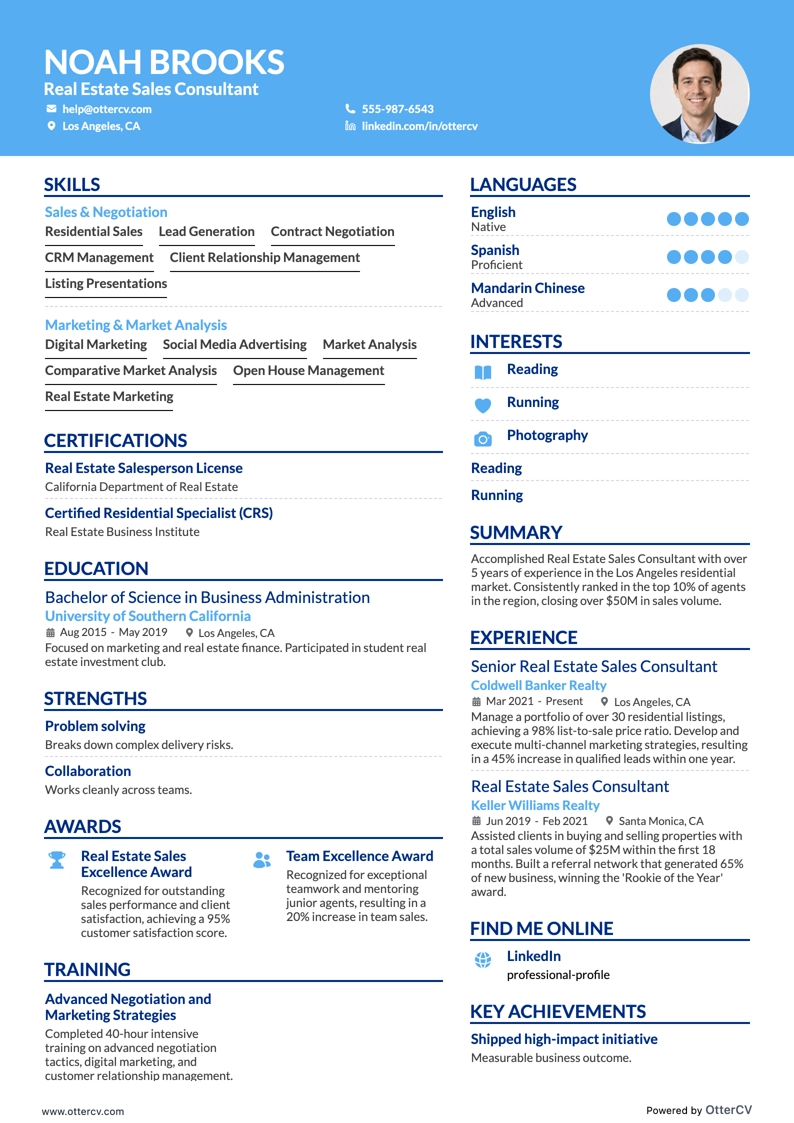
Real Estate Sales Consultant full preview

10 Real Estate Salesperson Resume Examples

OtterCV

Written by The OtterCV Team

Updated: 8/20/2024•8 min read

See all resume examples in this guide, or generate your own resume example with your personalized prompt

Real Estate Sales Consultant resume example

Real Estate Sales Consultant

Most real estate salesperson resume drafts fail because they focus on duties and tools instead of measurable sales results. That matters when ATS software filters for keywords and recruiters scan applications in seconds amid heavy competition.

A strong resume shows what you delivered and how it impacted the business. Understanding how to make your resume stand out starts with highlighting closed volume, units sold, average days on market, list-to-sale price ratio, lead-to-client conversion, repeat and referral rate, and pipeline size.

Key takeaways

  • Quantify each experience bullet with closed volume, conversion rates, or days on market.

  • Use a reverse-chronological format when you have strong sales results to lead with.

  • Tailor every resume to match the job posting’s tools, property types, and metrics.

  • Open with a three- to four-line summary that combines your specialty with a measurable win.

  • Put skills above experience if you’re entry-level or transitioning into real estate sales.

  • Support every listed skill with a specific outcome in your experience or project sections.

  • Use Echocv’s Bullet Point Generator to turn vague duties into recruiter-ready, metric-driven bullets.

How to format a real estate salesperson resume

Recruiters hiring real estate salespersons look for a clear record of sales volume, client acquisition, and deal closures, supported by relevant licensure and local market knowledge. Your resume format affects how quickly a hiring manager can identify these signals, so choosing the right structure can directly influence whether your application moves forward.

I have significant experience in this role—which format should I use?

I have significant experience in this role—which format should I use?

Use a reverse-chronological format to put your strongest and most recent sales performance front and center.

Do:

  • Lead each role entry with your scope of responsibility, including territory size, portfolio value, and the number of concurrent listings or buyer clients managed.
  • Highlight proficiency with role-specific tools and domains such as MLS platforms, CRM software (e.g., Salesforce, Follow Up Boss), comparative market analysis, and local zoning regulations.
  • Quantify outcomes in every bullet, including closed volume, conversion rates, average days on market, and commission revenue generated.

Example bullet: “Closed $14.2M in residential sales across 47 transactions in 2024, exceeding office targets by 28% while maintaining a 94% client satisfaction rating.”

I'm junior or switching into this role—what format works best?

I'm junior or switching into this role—what format works best?

A hybrid format works best because it lets you lead with transferable skills and relevant training while still showing your work history in chronological order.

  • Place a dedicated skills section near the top featuring real estate licensure, negotiation, lead generation, and any completed pre-licensing coursework or certifications.
  • Include internships, open house assistance, transaction coordination projects, or shadow experiences under a broker—even if unpaid—to demonstrate hands-on exposure.
  • Connect every action to a result, no matter how small, so recruiters see cause and effect rather than a list of duties.

Example scaffold: Lead generation (skill) → organized and hosted four community open houses per month for a supervising broker (action) → generated 35 qualified buyer leads over one quarter, contributing to two closed transactions (result).

Why not use a functional resume?

Why not use a functional resume?

A functional resume removes the timeline and context that show you can move deals from listing to close, which makes it harder for recruiters and applicant tracking systems to verify your actual sales ability.

This format may be acceptable if you're entering real estate after a career change or have a gap in employment, but only if you connect every skill to a specific project, transaction, or measurable outcome instead of listing skills on their own.

With your format set, the next step is choosing which resume sections to include and arranging them for the strongest impact.

What sections should go on a real estate salesperson resume

Recruiters want to quickly identify your license status, market expertise, and a clear record of closed deals and client outcomes. Knowing what to put on a resume for this role is key to making the right impression.

Use this structure for maximum clarity:

  • Header
  • Summary
  • Experience
  • Skills
  • Projects
  • Education
  • Certifications
  • Optional sections: Awards, Leadership, Languages

Strong experience bullets should highlight closed volume, units sold, conversion rates, average days on market, client satisfaction, and your scope across listings, buyers, and lead sources.

With your resume’s core components in place, the next step is to write a real estate salesperson experience section that reinforces them with clear, results-focused detail.

How to write your real estate salesperson resume experience

The work experience section is where you show that you can close deals, manage client relationships, and drive revenue in competitive real estate markets. Hiring managers care more about proven impact—transactions completed, listings sold, and client portfolios grown—than generic descriptions of day-to-day tasks.

Each entry should include:

  • Job title
  • Company and location, or remote
  • Dates of employment, including month and year

Add three to five concise bullet points that explain what you owned, how you executed, and the results you delivered:

  • Ownership scope: the listing portfolios, buyer pipelines, geographic territories, property types, or client segments you were directly responsible for managing and growing.
  • Execution approach: the tools, platforms, and methods you used to prospect leads, evaluate properties, negotiate contracts, and close transactions, including MLS databases, CRM systems, comparative market analysis, and digital marketing strategies.
  • Value improved: the changes you drove in listing-to-close timelines, client satisfaction, pricing accuracy, lead conversion rates, or risk mitigation through proper disclosure and compliance practices.
  • Collaboration context: how you worked with mortgage lenders, home inspectors, title companies, appraisers, attorneys, and marketing teams to move transactions from initial contact through closing.
  • Impact delivered: outcomes tied to sales volume growth, revenue generated, market share expansion, client retention, or portfolio performance rather than a list of properties shown or open houses hosted.

Experience bullet formula

Experience bullet formula

Action verb + technology + what you built or fixed + measurable result

A real estate salesperson experience example

Real Estate Salesperson

Redwood Realty Group | Austin, TX
2022–Present

High-volume residential brokerage specializing in first-time buyers and relocation clients across the Austin metro.

  • Generated $12.4M in closed volume across 36 transactions by prospecting and nurturing leads in Follow Up Boss CRM and automating touchpoints with BombBomb video email.
  • Increased buyer conversion rate from 9% to 14% by launching a data-driven showing process using ShowingTime, MLS market reports, and weekly pricing strategy reviews with clients and the managing broker.
  • Reduced average seller concessions by 18% by packaging repair requests with contractor bids, inspection summaries, and comparable sales analysis, while coordinating closely with lenders, title, and listing agents to keep timelines on track.
  • Cut days on market from 31 to 24 across the listing portfolio by optimizing pricing, staging, and photography workflows, partnering with photographers, stagers, and transaction coordinators, and tracking results in MLS analytics.
  • Improved client satisfaction to a 4.9/5 average across 120+ post-close surveys by setting service-level timelines in Dotloop, maintaining proactive milestone updates, and resolving appraisal and underwriting issues with loan officers and escrow.

Now that you've seen what a strong experience section looks like in practice, here's how to adapt yours for the specific real estate salesperson role you're targeting.

How to tailor your real estate salesperson resume experience

Recruiters review your resume through both applicant tracking systems and manual screening. Tailoring your resume to the job description helps you get through both.

Ways to tailor your real estate salesperson experience:

  • Match the CRM or MLS platforms named in the job description.
  • Mirror the sales volume or closing metrics the posting prioritizes.
  • Use the exact property types mentioned, such as residential or commercial.
  • Highlight the lead generation methods the employer specifically requests.
  • Reflect the fair housing compliance or licensing standards the role requires.
  • Include the client relationship or referral strategies the posting emphasizes.
  • Align your prospecting workflows with the brokerage's stated sales process.
  • Reference the team collaboration or mentorship structures described in the listing.

Tailoring means aligning your real accomplishments with the employer's stated requirements, not stuffing unrelated keywords into your experience section.

Resume tailoring examples for real estate salesperson

Job description excerptUntailoredTailored
"Generate leads through cold calling, door knocking, and open houses to build a pipeline of qualified buyers and sellers in the Greater Austin market."Helped find new clients and grow the business.Generated 40+ qualified leads per month through cold calling, door knocking, and weekend open houses across the Greater Austin market, converting 15% into signed listing or buyer agreements.
"Use MLS, Zillow Premier Agent, and CRM tools to manage client relationships, track property listings, and close transactions efficiently."Used technology to stay organized and manage deals.Managed 55+ active client relationships using Salesforce CRM while sourcing and tracking property listings through MLS and Zillow Premier Agent, reducing average days-to-close by 12%.
"Negotiate purchase agreements on behalf of buyers and sellers, ensuring compliance with state disclosure requirements and achieving competitive sale prices."Negotiated deals and handled paperwork for clients.Negotiated 30+ purchase agreements annually on behalf of buyers and sellers, securing sale prices within 3% of asking price while maintaining full compliance with Texas state disclosure requirements.

Once you’ve aligned your experience with the role’s priorities, quantify your achievements to show the impact of that work with clear, measurable results.

How to quantify your real estate salesperson achievements

Quantifying your achievements shows that you drive revenue, speed, and trust—not just activity. Focus on closed volume, conversion rates, days on market, client satisfaction, and compliance accuracy across listings, showings, offers, and closings.

Quantifying examples for real estate salesperson

MetricExample
Revenue closedClosed $6.2M in residential sales across 14 transactions in 2025, averaging 98% of list price using MLS comps and ShowingTime follow-ups.
Conversion rateImproved lead-to-appointment conversion from 18% to 31% by qualifying within five minutes and tracking follow-ups in HubSpot.
Cycle timeReduced average days on market from 42 to 29 for eight listings by adjusting pricing strategy weekly and launching targeted open houses.
Client satisfactionEarned a 4.9/5 average post-closing satisfaction score from 37 clients by setting weekly update cadences and resolving inspection issues within 48 hours.
Compliance accuracyMaintained 100% on-time contract and disclosure submissions for 52 deals by using DocuSign templates and a closing checklist aligned to state requirements.

How to list your hard and soft skills on a real estate salesperson resume

Once you’ve written strong bullet points for your experience section, highlight the hard and soft skills that support your qualifications as a real estate salesperson.

Your skills section shows how you generate leads, qualify buyers and sellers, and close transactions. Recruiters and applicant tracking systems scan it for role-specific keywords and tools, so include a balanced mix of hard skills and soft skills that matches the job post.

Real estate salesperson roles require a blend of:

  • Product strategy and discovery skills.
  • Data, analytics, and experimentation skills.
  • Delivery, execution, and go-to-market discipline.
  • Soft skills.

Your skills section should be:

  • Scannable, using bullet-style grouping.
  • Relevant to the job post.
  • Backed by proof in your experience bullets.
  • Updated with current tools.

Place your skills section:

  • Above experience if you’re junior or switching careers.
  • Below experience if you’re mid-level or senior with strong achievements.

Hard skills

  • Conduct MLS searches and input listing data.
  • Prepare comparative market analyses (CMA).
  • Develop pricing strategies and select comps.
  • Create listing presentations.
  • Lead buyer consultations and needs analysis.
  • Build lead generation funnels and referral programs.
  • Manage customer relationships with Salesforce, HubSpot, and Follow Up Boss.
  • Use showing scheduling tools such as ShowingTime and Calendly.
  • Prepare real estate contracts.
  • Coordinate transactions and timelines.
  • Apply negotiation tactics and offer strategy.
  • Maintain Fair Housing compliance.

Soft skills

  • Run structured discovery with buyers and sellers.
  • Set clear expectations and timelines.
  • Present pricing recommendations with evidence.
  • Communicate with fast, consistent follow-up.
  • Negotiate calmly under pressure.
  • Handle objections without stalling deals.
  • Coordinate with lenders, inspectors, and attorneys.
  • Keep deals moving with proactive updates.
  • Resolve conflicts to protect relationships.
  • Prioritize leads and next steps daily.
  • Maintain confidentiality with client data.
  • Own outcomes from lead to close.

How to show your real estate salesperson skills in context

Skills should not appear only in a bulleted list on your resume. Review examples of resume skills shown in context to understand how strong candidates weave them into their applications.

Your skills should be demonstrated in:

  • Your summary, which presents your high-level professional identity
  • Your experience, which proves your skills through outcomes

Here’s what that looks like in practice.

Summary example

Senior real estate salesperson with 12 years of experience in luxury residential sales. Skilled in CRM pipeline management, comparative market analysis, and consultative negotiation. Increased annual closed volume to $28M while maintaining a 94% client satisfaction rate.

  • Clearly reflects senior-level expertise
  • Names tools and methods relevant to the role
  • Leads with a strong metric
  • Highlights soft skills related to client relationships

Senior Real Estate Salesperson

Pinnacle Realty Group | Austin, TX

March 2019–Present

  • Closed $22M in residential transactions annually by using MLS analytics and targeted comparative market analysis to inform pricing strategy.
  • Worked with mortgage brokers and staging teams to reduce average days on market by 18% across 120+ listings.
  • Grew the client referral pipeline by 35% year over year through Salesforce CRM follow-up sequences and post-closing relationship nurturing.
  • Every bullet includes measurable proof.
  • Skills appear naturally within achievements.

Once you’ve connected your abilities to real examples and outcomes, apply the same approach to a real estate salesperson resume even if you don’t have direct experience.

How do I write a real estate salesperson resume with no experience

Even without full-time experience, you can still show that you’re ready for the role through:

  • Real estate coursework and licensing prep
  • Open house volunteer support
  • Rental listings and showing coordination
  • CRM lead tracking for a club
  • Comparable market analysis practice reports
  • Neighborhood research and buyer tours
  • Customer-facing retail or hospitality sales
  • Property photography and listing copywriting

Our guide on writing a resume without work experience covers additional strategies for showcasing your qualifications effectively.

Focus on:

  • Sales results with clear metrics
  • Real estate salesperson tools proficiency
  • Market research and pricing logic
  • Compliance awareness and documentation accuracy

Resume format tip for entry-level real estate salesperson

Resume format tip for entry-level real estate salesperson

Use a hybrid resume format that leads with skills and projects, then lists experience. This helps highlight relevant proof when your work history is short.

Do:

  • Add a Projects section with metrics.
  • List CRM, MLS, and Excel skills.
  • Include compliance training and certificates.
  • Quantify outreach, leads, and appointments.
  • Tailor keywords to each job post.

Example project bullet:

  • Built a CRM pipeline in HubSpot, logged 120 leads, ran weekly follow-ups, and booked eight buyer consultations over four weeks.

Once you’ve structured your resume around transferable skills and relevant training, the next step is making sure your education section reinforces your qualifications.

How to list your education on a real estate salesperson resume

Your education section helps hiring teams confirm you have foundational knowledge in business, finance, or property markets relevant to a real estate salesperson role.

Include:

  • Degree name
  • Institution
  • Location
  • Graduation year
  • Relevant coursework for juniors or entry-level candidates
  • Honors and GPA if 3.5 or higher

Skip the month and day details, and list the graduation year only.

Here’s a strong education entry tailored for a real estate salesperson resume.

Example education entry

Bachelor of Science in Business Administration

University of Central Florida, Orlando, FL

Graduated 2021

GPA: 3.7/4.0

  • Relevant coursework: Real Estate Principles, Property Valuation, Contract Law, Marketing Strategies, Consumer Behavior
  • Honors: Magna Cum Laude, Dean's List (six consecutive semesters)

How to list your certifications on a real estate salesperson resume

Certifications on your resume show your commitment to learning, demonstrate tool proficiency, and highlight your industry relevance as a real estate salesperson, especially in fast-changing markets.

Include the following details:

  • Certificate name
  • Issuing organization
  • Year
  • Optional: credential ID or URL
  • Place certifications below education when they are older, less relevant, or when you want your degree to lead your real estate salesperson story.
  • Place certifications above education when they are recent, highly relevant, or required for your target real estate salesperson role.

Best certifications for your real estate salesperson resume

  • National Association of Realtors Accredited Buyer's Representative (ABR)
  • National Association of Realtors Seller Representative Specialist (SRS)
  • National Association of Realtors Pricing Strategy Advisor (PSA)
  • National Association of Realtors Real Estate Negotiation Expert (RENE)
  • National Association of Realtors Seniors Real Estate Specialist (SRES)
  • National Association of Realtors Certified Residential Specialist (CRS)
  • e-PRO

How to write your real estate salesperson resume summary

Once your credentials are easy for hiring managers to spot, use your real estate salesperson resume summary to connect those qualifications to the value you bring.

Your resume summary is often the first thing a recruiter reads. A strong summary quickly shows that you are a qualified real estate salesperson worth interviewing.

Keep it to three to four lines and include:

  • Your job title and years of experience in real estate sales.
  • The property types or markets you specialize in, such as residential or commercial.
  • Core skills such as CRM platforms, MLS databases, lead generation, or contract negotiation.
  • One or two quantified achievements, such as sales volume closed or listings sold per year.
  • Interpersonal strengths connected to results, such as client relationship building that drove repeat business.

PRO TIP

At the entry level, emphasize relevant skills, real estate tools you know, and any early wins, such as successful closings or lead conversion rates.

Avoid vague phrases like “passionate go-getter” or “motivated self-starter.” Recruiters want proof of what you can do, not enthusiasm statements.

Example summary for a real estate salesperson

Licensed real estate salesperson with two years of experience in residential sales. Closed $3.2M in transactions using MLS and Salesforce CRM. Known for client communication that generated 40% repeat and referral business.

With your summary ready to highlight your strongest qualifications, make sure the header above it presents your contact details clearly and professionally.

What to include in a real estate salesperson resume header

A resume header is the top section of your resume containing your key identifiers. For a real estate salesperson, it improves visibility, credibility, and quick recruiter screening.

Essential resume header elements

  • Full name
  • Tailored job title and headline
  • Location
  • Phone number
  • Professional email
  • GitHub link
  • Portfolio link
  • LinkedIn

A LinkedIn link helps recruiters verify your experience quickly and supports screening.

Do not include a photo on a real estate salesperson resume unless the role is explicitly front-facing or appearance-dependent.

Keep your header to one or two lines per item, and match your job title and location to the posting for faster sorting.

Example

Once your contact details and key identifiers are clearly presented at the top, add extra sections that strengthen your real estate salesperson resume and support the information already provided.

Additional sections for real estate salesperson resumes

Additional resume sections can help you stand out when your core qualifications are similar to those of other candidates applying for the same real estate salesperson role.

Choose sections that highlight your local expertise, client-facing strengths, or industry credibility. For example, listing language skills on your resume can be a strong differentiator when serving diverse buyer and seller communities.

  • Languages
  • Licenses and certifications
  • Professional affiliations
  • Volunteer experience
  • Awards and sales achievements
  • Publications
  • Hobbies and interests

Once you’ve strengthened your resume with relevant additional sections, pairing it with a strong cover letter can help you make an even better impression.

Do real estate salesperson resumes need a cover letter

A cover letter is not required for a real estate salesperson, but it can help in competitive markets or when hiring managers expect one. If you are unsure where to begin, learn what a cover letter is and how it complements your resume. It can be especially useful when your resume does not fully show your fit, focus, or local market knowledge.

Use a cover letter to add context your resume cannot:

  • Explain role or team fit: Match your strengths to the brokerage’s lead flow, territory, client profile, and sales process.
  • Highlight one or two outcomes: Describe a deal, pipeline rebuild, or referral program, and include a clear result along with your specific actions.
  • Show business understanding: Reference the brokerage’s listings, target buyers, neighborhood trends, and how you would position properties to those users.
  • Address career transitions: Connect less obvious experience to prospecting, negotiation, client management, and compliance, and briefly explain any gaps.

Using AI to improve your real estate salesperson resume

Even if you skip a cover letter and rely on a strong resume, AI can help you improve your real estate salesperson resume by sharpening your content and tailoring it more quickly.

AI can improve your resume’s clarity, structure, and impact. It can refine bullet points and better align your content with real estate salesperson roles. But overusing it can strip away authenticity. Once your resume feels clear and aligned to the role, step away from AI. If you’re comparing tools, our guide to which AI is best for writing resumes can help you choose the right one.

Here are 10 practical prompts to strengthen specific sections of your real estate salesperson resume:

Sharpen your summary

Sharpen your summary

Rewrite my resume summary to highlight my strongest qualifications as a real estate salesperson in under four sentences.

Quantify sales results

Quantify sales results

Add specific metrics like volume, units sold, or percentages to these real estate salesperson experience bullets.

Strengthen action verbs

Strengthen action verbs

Replace weak verbs in my real estate salesperson experience section with stronger, industry-relevant action verbs.

Align skills

Align skills

Compare my skills section against this real estate salesperson job description and identify any relevant skills that are missing.

Tighten bullet points

Tighten bullet points

Shorten each experience bullet to a single concise line while preserving measurable results for a real estate salesperson resume.

Refine certifications

Refine certifications

Reorder and format your certifications section to highlight the credentials most relevant to a real estate salesperson role.

Improve education relevance

Improve education relevance

Rewrite my education section to emphasize the coursework and achievements most relevant to a real estate salesperson position.

Highlight client results

Highlight client results

Rephrase these project descriptions to emphasize client outcomes and successful deal closings from my real estate salesperson experience.

Remove filler language

Remove filler language

Identify and remove vague or redundant phrases throughout my real estate salesperson resume while preserving key details.

Match job language

Match job language

Adjust the terminology throughout my real estate salesperson resume to mirror the language used in this specific job posting.

Conclusion

A strong real estate salesperson resume shows impact through measurable results, such as closed volume, listings won, and lead conversion rates. It also highlights role-specific skills, including prospecting, negotiation, and client service. A clear structure makes those results easy to scan.

Keep your real estate salesperson resume focused, consistent, and tailored to the role. Show steady performance, strong communication, and reliable follow-through. This signals readiness for today’s hiring market and the next hiring cycle.

Real Estate Salesperson resume examples

Explore additional Real Estate Salesperson resume samples and guides and see what works for your level of experience or role.

By Role

Real Estate Sales Consultant

Real Estate Sales Consultant resume preview