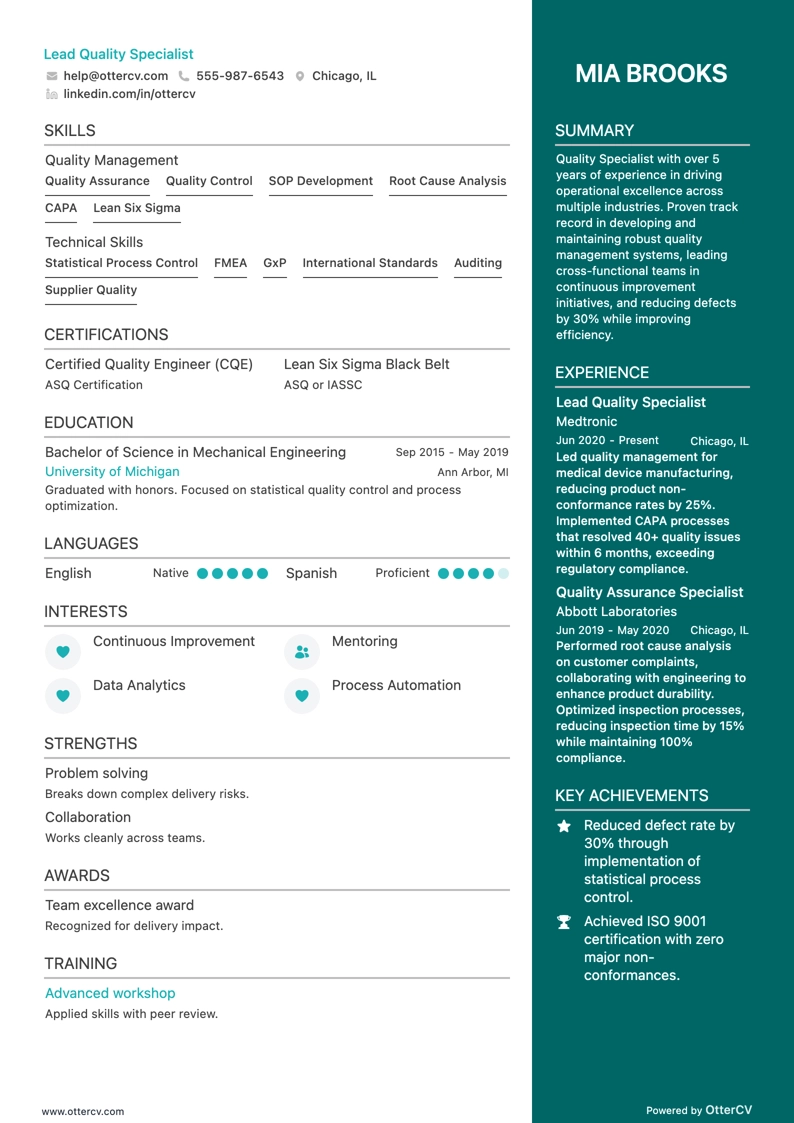
Lead Quality Specialist full preview

10 Quality Specialist Resume Examples

OtterCV

Written by The OtterCV Team

Updated: 11/13/2023•8 min read

See all resume examples in this guide, or generate your own resume example with your personalized prompt

Lead Quality Specialist resume example

Lead Quality Specialist

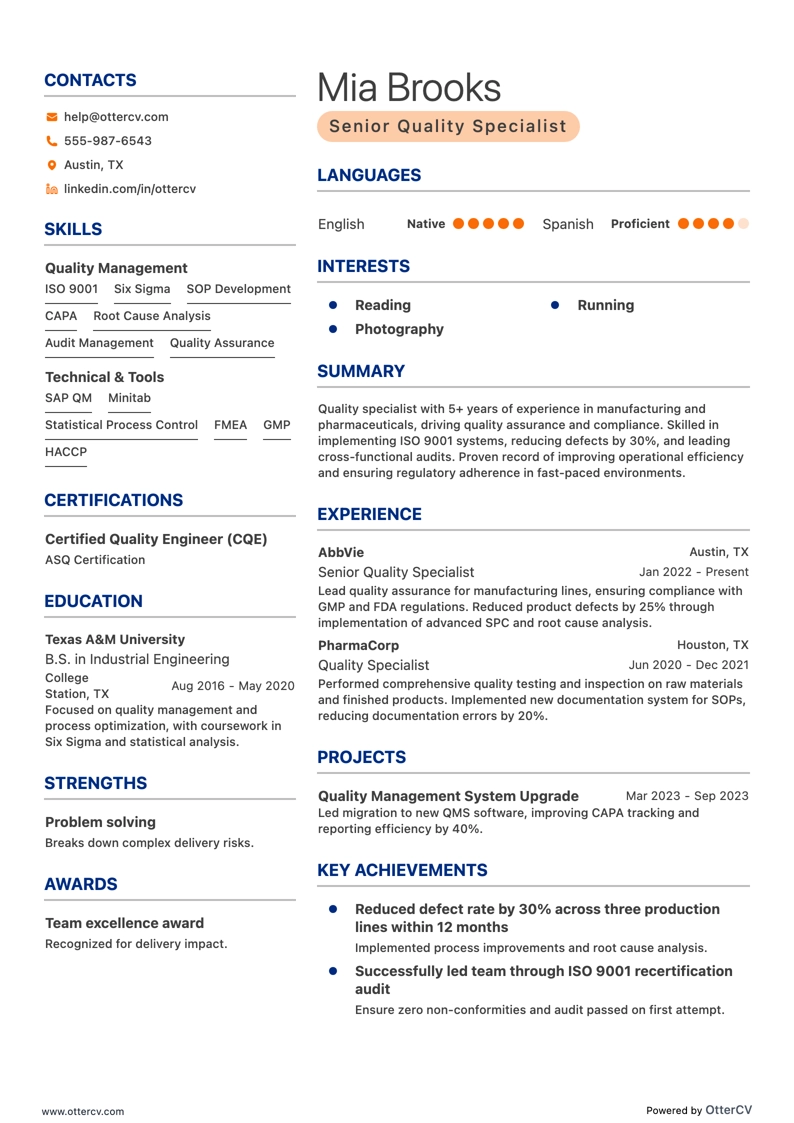
Senior Quality Specialist resume example

Senior Quality Specialist

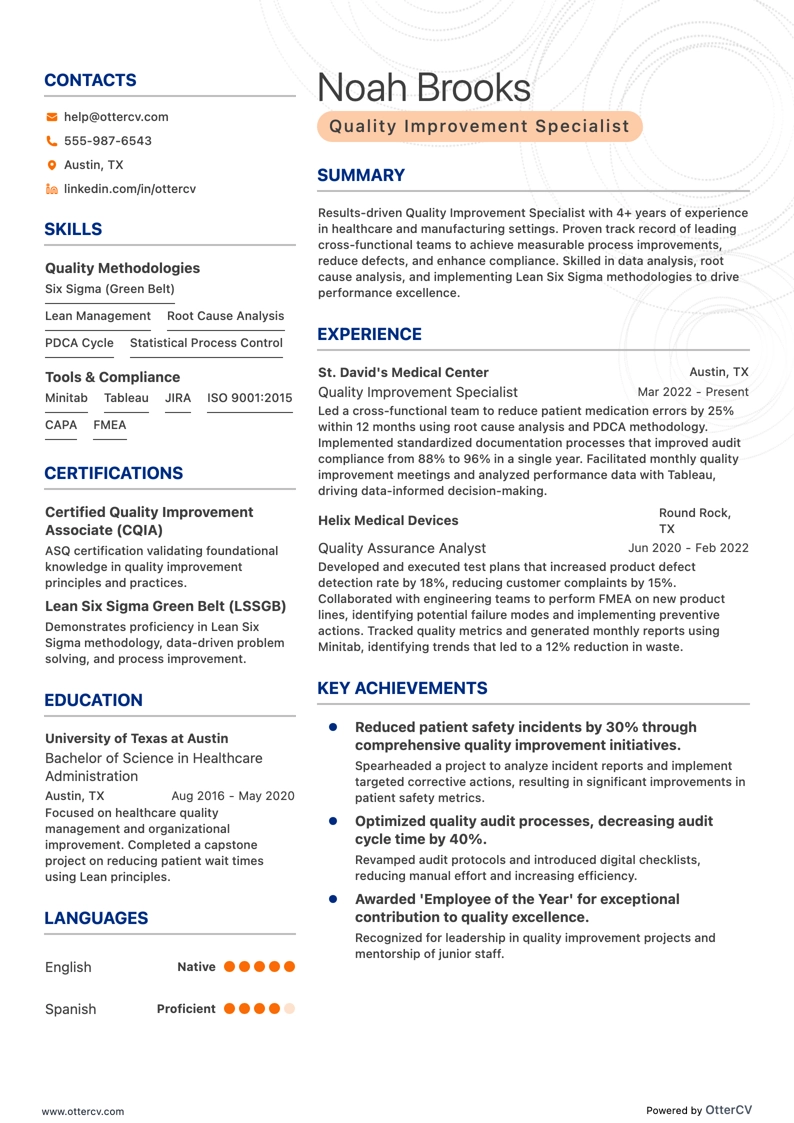
Quality Improvement Specialist resume example

Quality Improvement Specialist

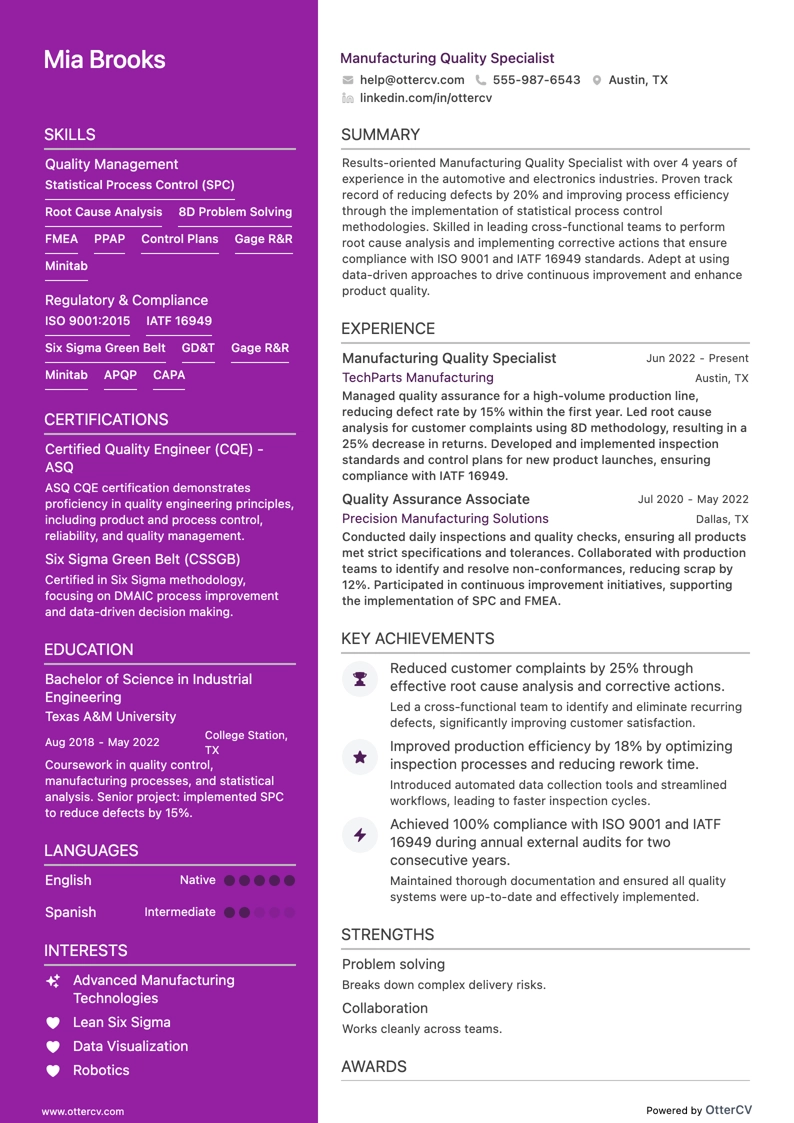
Manufacturing Quality Specialist resume example

Manufacturing Quality Specialist

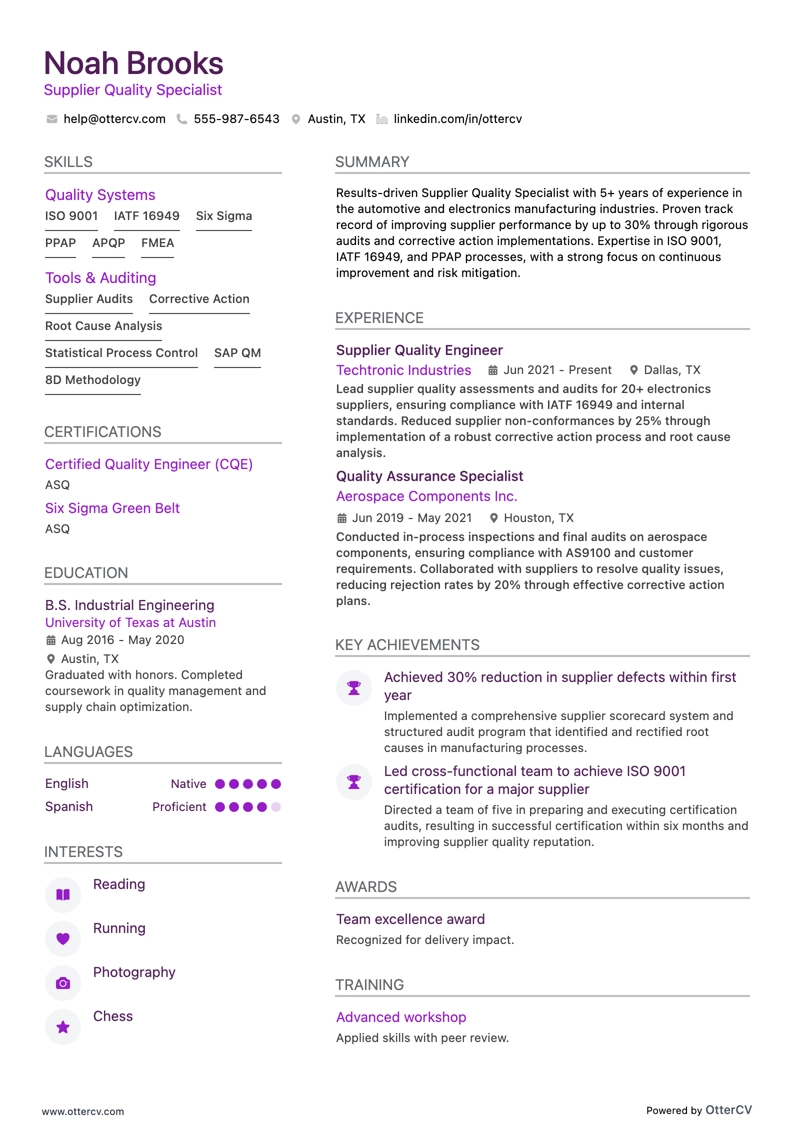
Supplier Quality Specialist resume example

Supplier Quality Specialist

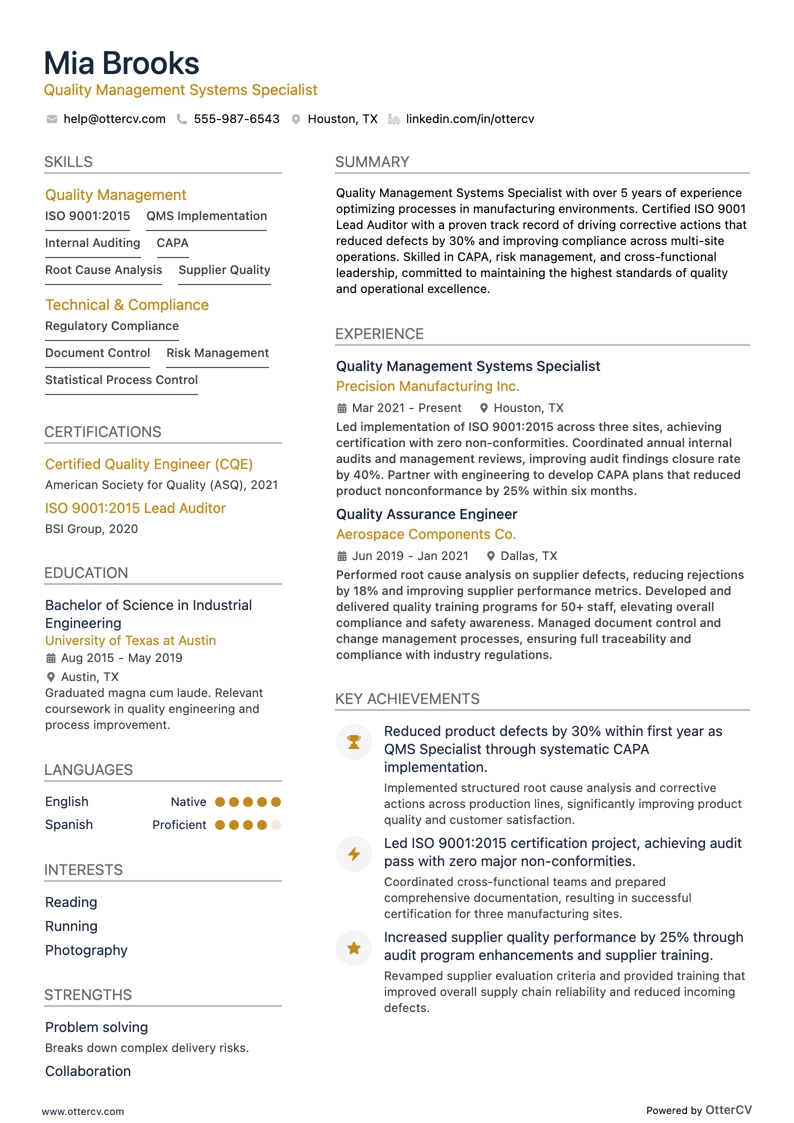
Quality Management Systems Specialist resume example

Quality Management Systems Specialist

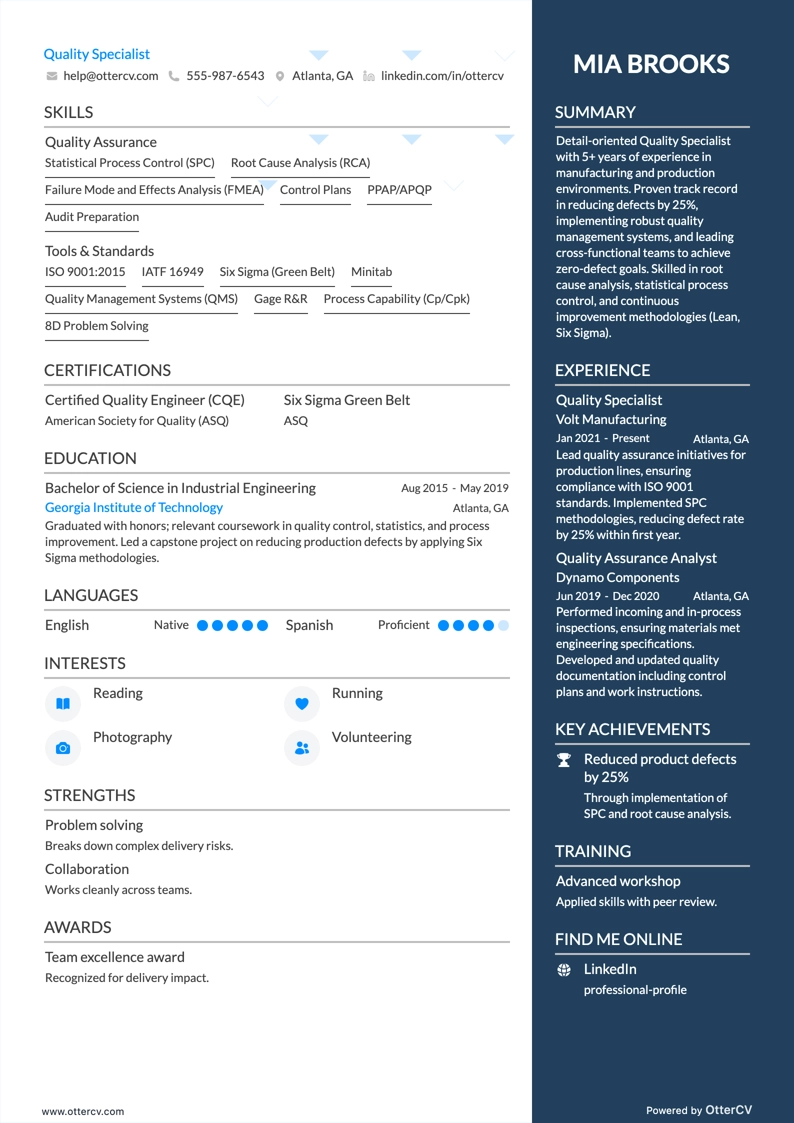
Quality Specialist resume example

Quality Specialist

Many quality specialist resumes fall short because they list inspections and tools without showing measurable impact or compliance results. In today’s ATS screening and quick recruiter scans, that can sound generic and make it harder to stand out in a crowded applicant pool. If you’re not sure where to start, learning how to write a resume that emphasizes results over responsibilities is an important first step.

A strong resume explains what improved because of your work: lower defect rates, higher audit pass rates, faster release cycles, fewer customer complaints, stronger supplier performance, and reduced scrap or rework costs. Quantify the scope, timeline, and business impact whenever possible.

Key takeaways

  • Quantify defect reductions, audit results, and cost savings instead of only listing inspections or tools.

  • Use a reverse-chronological format if you have experience, and a hybrid format if you are changing careers.

  • Tailor each experience bullet to match the job posting’s standards, tools, and terminology.

  • Pair every skill with a measurable outcome in your experience section, not only in a skills list.

  • Place certifications above education when they are more relevant to the target role.

  • Use AI prompts to tighten language and add metrics, but stop before it invents experience.

  • Build your resume faster with Echocv and keep every section focused on role-specific impact.

Job market snapshot for quality specialists

We analyzed 354 recent quality specialist job ads across major US job boards. These figures offer a quick view of employer expectations, industry demand, and role specialization trends.

What level of experience employers are looking for quality specialists

Years of ExperiencePercentage found in job ads
1–2 years34.5% (122)
3–4 years9.6% (34)
5–6 years8.2% (29)
7–8 years3.7% (13)
9–10 years1.7% (6)
10+ years2.8% (10)
Not specified41.2% (146)

Quality specialist ads by area of specialization (industry)

Industry (Area)Percentage found in job ads
Healthcare42.4% (150)
Finance & Banking38.1% (135)
Manufacturing7.3% (26)
Education4.5% (16)
Government3.4% (12)

Top companies hiring quality specialists

CompanyPercentage found in job ads
CVS Health20.9% (74)
SJRC Texas4.0% (14)
Actalent3.4% (12)
Kiewit3.1% (11)

Role overview stats

These tables outline the most common responsibilities and employment types for quality specialist roles. Use them to align your resume with employer expectations and understand how the role is structured across the market.

Day-to-day activities and top responsibilities for a quality specialist

ResponsibilityPercentage found in job ads
Microsoft Office20.3% (72)
Excel18.9% (67)
Quality assurance16.1% (57)
Claims processing11.9% (42)
CPT codes10.7% (38)
ICD-10 codes10.7% (38)
Medical terminology10.7% (38)
ISO 900110.5% (37)
Diagnosis codes9.9% (35)
Formulas9.9% (35)
Pivot tables9.9% (35)
V-lookups9.9% (35)

Type of employment (remote vs on-site vs hybrid)

Employment typePercentage found in job ads
On-site82.8% (293)
Hybrid11.3% (40)
Remote5.9% (21)

How to format a quality specialist resume

Recruiters reviewing quality specialist resumes look for clear evidence of process improvement expertise, familiarity with quality management systems and standards such as ISO 9001 or Six Sigma, and measurable results in defect reduction or compliance outcomes. A clean, well-structured resume helps these signals stand out quickly in both automated screening and manual review. Choosing the right resume format is the foundation of that clarity.

I have significant experience in this role—which format should I use?

I have significant experience in this role—which format should I use?

Use a reverse-chronological format to show how your expertise in quality systems, auditing, and process control has grown across successive roles.

  • Start each role entry with your scope of ownership, such as the number of product lines monitored, facilities supported, or teams coordinated.
  • Highlight proficiency with role-specific tools and frameworks, including SPC software, root cause analysis methods, CAPA processes, and regulatory standards such as ISO, FDA, and GMP.
  • Quantify results tied to defect rates, audit outcomes, cost savings, or cycle-time improvements.

Example bullet: “Redesigned incoming inspection protocol across three manufacturing lines, reducing supplier defect rate by 34% and saving $120K in annual rework costs.”

I'm junior or switching into this role—what format works best?

I'm junior or switching into this role—what format works best?

A hybrid format works best. Put a focused skills section above a concise work history to help bridge experience gaps.

Do:

  • Place a skills summary near the top that highlights quality-relevant competencies such as statistical analysis, document control, or GMP compliance.
  • Include academic projects, internships, or cross-functional assignments where you performed inspections, supported audits, or contributed to corrective actions.
  • Connect every listed skill or project to a specific action and a tangible result to show applied capability.

Example scaffold: Statistical process control (skill) → monitored production data and flagged deviations during a capstone manufacturing project (action) → identified a recurring material defect that reduced scrap rate by 15% in the pilot run (result).

Why not use a functional resume?

Why not use a functional resume?

A functional resume removes the timeline and context recruiters use to understand where and how you applied your quality skills. That makes it harder for them to judge your readiness for hands-on inspection, documentation, or compliance work.

  • Career changers with transferable analytical or compliance experience who do not have direct quality specialist job titles but have completed relevant certifications, such as ASQ CQI or Six Sigma Yellow Belt.
  • Recent graduates whose internship or co-op experience in quality or manufacturing does not fill a full employment history section.
  • Candidates with resume gaps caused by extended training programs, layoffs, or industry transitions.

Functional formats can raise skepticism among hiring managers and may confuse applicant tracking systems. If you have any continuous, relevant work history, avoid this structure and connect your skills to specific projects and measurable outcomes instead of listing them on their own.

Once your layout and formatting choices are set, the next step is choosing resume sections that reinforce your qualifications clearly and effectively.

What sections should go on a quality specialist resume

Recruiters expect a quality specialist resume to show clear quality systems experience, measurable process improvements, and compliance results. Knowing what to put on a resume helps you avoid wasting space on irrelevant details.

Use this structure for maximum clarity:

  • Header
  • Summary
  • Experience
  • Skills
  • Projects
  • Education
  • Certifications
  • Optional sections: Awards, Leadership, Languages

Strong experience bullets should emphasize measurable defect reduction, audit and compliance outcomes, process capability gains, and the scope of products, suppliers, and cross-functional impact you owned.

Once you’ve organized your resume with the right core components, the next step is to build your quality specialist experience section with relevant, role-specific detail that supports the rest of your application.

How to write your quality specialist resume experience

Your experience section should show that you delivered meaningful quality improvements, not just that you participated in routine processes. Hiring managers reviewing quality specialist resumes look for clear impact through role-specific tools, inspection methods, and measurable results rather than long lists of duties. Building a targeted resume that matches each job posting can help your application stand out.

Each entry should include:

  • Job title
  • Company and location, or remote
  • Dates of employment, including month and year

Then add three to five concise bullet points that explain what you owned, how you executed the work, and what results you delivered:

  • Ownership scope: the products, processes, production lines, compliance areas, or teams you were directly responsible for as a quality specialist.
  • Execution approach: the inspection techniques, statistical tools, audit frameworks, quality management systems, or regulatory standards you used to identify defects, drive corrective actions, and maintain compliance.
  • Value improved: the specific improvements you made in defect rates, product reliability, process efficiency, regulatory adherence, or risk reduction tied to your responsibilities.
  • Collaboration context: how you worked with manufacturing, engineering, supply chain, regulatory, or customer-facing teams to align quality standards and resolve nonconformances.
  • Impact delivered: the outcomes your quality work produced, expressed through business results, scale of improvement, or organizational impact instead of a summary of daily activities.

Experience bullet formula

Experience bullet formula

Action verb + technology + what you built or fixed + measurable result

A quality specialist experience example

Quality Specialist

MedSure Devices | Minneapolis, MN

2022–Present

FDA-regulated medical device manufacturer producing Class II patient monitoring systems at 250K+ units per year.

  • Led root cause analysis in TrackWise using 8D and 5 Whys, cutting repeat nonconformances by 28% and reducing average closure time from fourteen to nine days.
  • Executed DFMEA and PFMEA risk assessments with engineering and operations, lowering high-risk failure modes (RPN 200+) by 35% across three production lines.
  • Built and maintained statistical process control dashboards in Minitab and Excel, improving first-pass yield from 93% to 97% and preventing an estimated $420K in scrap annually.
  • Audited suppliers against ISO 13485 and tightened incoming inspection plans through AQL sampling, reducing supplier-related defects by 22% and improving on-time release by 11%.
  • Authored and updated eleven controlled procedures and work instructions in MasterControl, increasing internal audit pass rate from 88% to 96% and aligning training completion to 99% within thirty days.

Now that you've seen what a strong experience section looks like, the next step is adjusting yours for the specific role you want.

How to tailor your quality specialist resume experience

Recruiters review your quality specialist resume through both applicant tracking systems and manual screening, measuring how closely your experience matches the job posting. Tailoring your resume to the job description by reflecting its language and priorities can improve your chances of getting through both stages.

Ways to tailor your quality specialist experience:

  • Mirror the exact quality standards or methodologies listed in the posting.
  • Reference the specific inspection tools or testing systems the role requires.
  • Align your process improvement language with the job description's terminology.
  • Highlight compliance frameworks or regulatory requirements the employer names.
  • Emphasize relevant KPIs or performance metrics the posting prioritizes.
  • Include industry or domain experience that matches the company's sector.
  • Reflect the cross-functional collaboration models described in the listing.
  • Incorporate audit types or corrective action workflows the role specifies.

Each tailored bullet should tie a real accomplishment to a stated job requirement rather than forcing in keywords that do not fit.

Resume tailoring examples for quality specialist

Job description excerptUntailoredTailored
Conduct internal audits per ISO 9001 standards and lead corrective action processes across manufacturing lines.Performed audits and helped improve quality processes.Led 15+ internal audits annually per ISO 9001 requirements, identifying nonconformances and driving corrective actions that reduced repeat defects by 30% across three manufacturing lines.
Analyze product quality data using Minitab and apply Six Sigma methodologies to reduce defect rates in automotive components.Used data tools to analyze quality issues and find improvements.Applied Six Sigma DMAIC methodology and Minitab statistical analysis to isolate root causes of dimensional failures in automotive brake assemblies, cutting defect rates from 4.2% to 1.1% over two quarters.
Collaborate with suppliers to ensure incoming materials meet FDA-regulated quality requirements for medical device production.Worked with suppliers to check material quality.Managed incoming material inspections for 12 suppliers against FDA 21 CFR Part 820 requirements, resolving four critical nonconformances and maintaining a 98.5% lot acceptance rate for Class II medical devices.

Once your experience matches the role’s requirements, strengthen it by quantifying your quality specialist achievements so hiring managers can clearly see your impact.

How to quantify your quality specialist achievements

Quantifying your achievements helps show how your work improves accuracy, compliance, and throughput while reducing defects and risk. Track defect rates, audit outcomes, turnaround time, rework cost, and inspection volume over clear timeframes.

Quantifying examples for quality specialist

MetricExample
Defect reductionCut customer-reported defects from 2.8% to 1.1% in twelve weeks by tightening incoming inspection sampling and adding an Ishikawa root-cause step in CAPA logs.
Audit compliancePassed three ISO 9001 surveillance audits with zero major nonconformities by updating twenty-two work instructions and training forty operators on the revised checklist.
Cycle timeReduced final inspection turnaround from forty-eight hours to eighteen hours by batching by risk tier and using a shared queue tracker in Jira.
Cost of qualityLowered rework and scrap costs by $85,000 per quarter by identifying the top five failure modes and implementing poka-yoke fixtures on two assembly lines.
Volume throughputIncreased inspection capacity from 120 to 190 lots per week by standardizing the AQL plan and automating data capture in Excel with validated templates.

How to list your hard and soft skills on a quality specialist resume

Once you’ve written strong experience bullets, make sure your resume also highlights the hard and soft skills that define a well-rounded quality specialist.

Your skills section should show that you can prevent defects, ensure compliance, and improve processes. Recruiters and applicant tracking systems scan this section for keyword matches and overall role fit, so aim for a balance of quality tools and methods along with collaboration and documentation skills that matter on the job.

Quality specialist roles require a mix of hard skills, such as statistical tools and regulatory frameworks, and soft skills, such as cross-functional communication and stakeholder alignment:

  • Product strategy and discovery skills.
  • Data, analytics, and experimentation skills.
  • Delivery, execution, and go-to-market discipline.
  • Soft skills.

Your skills section should be:

  • Scannable, using bullet-style grouping.
  • Relevant to the job post.
  • Backed by proof in your experience bullets.
  • Updated with current tools.

Place your skills section:

  • Above your experience section if you’re junior or switching careers.
  • Below your experience section if you’re mid-level or senior with strong achievements.

Hard skills

  • ISO 9001 quality management systems.
  • Corrective and preventive action, including 8D.
  • Root cause analysis using 5 Whys.
  • Failure mode and effects analysis.
  • Statistical process control and control charts.
  • Inspection plans and sampling plans.
  • Nonconformance management and deviation control.
  • Internal audits and supplier audits.
  • Supplier quality management.
  • Measurement system analysis.
  • Calibration and gauge management.
  • ERP and quality modules.

Soft skills

  • Write clear nonconformance reports.
  • Lead corrective action follow-ups.
  • Challenge defects with evidence.
  • Align stakeholders on quality decisions.
  • Escalate risk early and clearly.
  • Facilitate cross-functional investigations.
  • Prioritize issues by impact and risk.
  • Negotiate supplier containment actions.
  • Maintain audit-ready documentation.
  • Communicate changes to operators.
  • Coach teams on standard work.
  • Own timelines and close actions.

How to show your quality specialist skills in context

Skills should not appear only as a bulleted list on your resume. Browse examples of resume skills organized by role to see how other professionals present them effectively.

Your skills should be demonstrated in:

  • Your summary, which shows your high-level professional identity
  • Your experience, which proves your skills through outcomes

Here’s how that looks in practice.

Quality specialist with eight years of experience in medical device manufacturing, with expertise in root cause analysis, CAPA management, and FDA audit preparation using SAP QM. Reduced customer complaints by 34% through cross-functional process improvement initiatives.

  • Clearly signals senior-level experience
  • Mentions industry-relevant tools and methods
  • Includes a concrete, measurable outcome
  • Highlights cross-functional collaboration skills

Experience example

Senior Quality Specialist

Meridian Health Technologies | Minneapolis, MN

March 2019–Present

  • Led CAPA investigations using 8D methodology, resolving 96% of nonconformances within 30-day targets and improving supplier quality ratings by 21%.
  • Partnered with production and engineering teams to redesign incoming inspection protocols in MiniTab, reducing material rejection rates by 17%.
  • Managed the internal audit program across three facilities, achieving zero major findings during consecutive ISO 13485 surveillance audits.
  • Every bullet contains measurable proof.
  • Skills surface naturally through real outcomes.

Once you’ve shown your quality specialist skills with measurable, role-relevant examples, the next step is applying that same strategy to a quality specialist resume with no experience. In that case, projects, coursework, and transferable work can provide the context you need.

How do I write a quality specialist resume with no experience

Even without full-time experience, you can still demonstrate readiness through:

  • ISO 9001 coursework assignments
  • Internal audit class simulations
  • Lab quality control reports
  • Capstone process improvement project
  • Internship in regulated production
  • Supplier quality case study analysis
  • Statistical process control practice datasets
  • Volunteer data validation for nonprofit

Writing a resume without work experience means relying on these project-based proof points. Focus on:

  • Documented defect reduction results
  • Familiarity with ISO 9001 requirements
  • Use of statistical process control
  • Clear, traceable documentation samples

Resume format tip for entry-level quality specialist

Resume format tip for entry-level quality specialist

Use a combination resume format. It puts projects, coursework, and tools upfront while keeping education and any work history easy to scan.

  • Start with a Projects section.
  • List tools such as Excel, Minitab, and 5 Whys.
  • Quantify outcomes like defects, time, and yield.
  • Mirror terms from the job posting.
  • Add relevant standards such as ISO 9001.

Example project bullet:

  • Built an Excel statistical process control chart from practice datasets, flagged two out-of-control points, and reduced simulated defect rate by 18% through corrective actions.

Even without direct experience, your education section can show the foundational knowledge and relevant coursework that qualify you for a quality specialist role.

How to list your education on a quality specialist resume

Your education section helps hiring teams confirm that you have the core knowledge a quality specialist needs. It reflects your training in quality principles, analytical methods, and industry standards.

Include:

  • Degree name
  • Institution
  • Location
  • Graduation year
  • Relevant coursework (for juniors or entry-level candidates)
  • Honors and GPA (if 3.5 or higher)

Skip the month and day details and list the graduation year only.

Here’s a strong education entry tailored for a quality specialist resume.

Example education entry

Bachelor of Science in Industrial Engineering

University of Wisconsin–Madison, Madison, WI

Graduated 2021

GPA: 3.7/4.0

  • Relevant coursework: Statistical Quality Control, Six Sigma Methods, Manufacturing Processes, Root Cause Analysis
  • Honors: Dean's List (six consecutive semesters), Magna Cum Laude

How to list your certifications on a quality specialist resume

Certifications on a resume show a quality specialist’s commitment to continuous learning, proficiency with quality tools, and alignment with industry standards employers trust.

Include the following details:

  • Certificate name
  • Issuing organization
  • Year
  • Optional: credential ID or URL
  • Place certifications below education when your degree is recent and the certifications serve as supporting value rather than your main qualification.
  • Place certifications above education when they are recent, relevant to the role, or required, and when they strengthen your fit more than your education does.

Best certifications for your quality specialist resume

  • ASQ Certified Quality Improvement Associate (CQIA)
  • ASQ Certified Quality Technician (CQT)
  • ASQ Certified Quality Auditor (CQA)
  • ASQ Certified Quality Engineer (CQE)
  • Lean Six Sigma Green Belt
  • ISO 9001:2015 Lead Auditor

How to write your quality specialist resume summary

Once you’ve placed your strongest credentials where hiring managers will notice them, use your resume summary to reinforce their relevance and set the tone for the rest of your quality specialist resume.

Your resume summary is often the first thing a recruiter reads. A strong summary quickly shows that you’re qualified and worth interviewing for a quality specialist role.

Keep it to three to four lines and include:

  • Your job title and years of relevant experience in quality assurance or quality control.
  • The domain or industry you’ve worked in, such as manufacturing, pharma, or food safety.
  • Core tools and skills, such as root cause analysis, SPC, ISO 9001, or audit management.
  • One or two measurable achievements, such as defect reduction or audit pass rates.
  • Soft skills connected to real outcomes, such as cross-functional collaboration that improved compliance.

PRO TIP

For non-senior roles, emphasize your technical skills, relevant certifications, and early wins that demonstrate initiative. Show that you can follow established processes and improve them when appropriate.

Avoid vague terms like “passionate” or “detail-oriented” unless you can back them up with evidence. Skip motivational language and focus on specific results, ideally supported by numbers.

Example summary for a quality specialist

Quality specialist with three years of experience in medical device manufacturing. Skilled in ISO 13485 audits, CAPA management, and SPC. Reduced product defect rates by 18% by improving incoming inspection protocols.

Now that your summary highlights your professional value, make sure your resume header is just as polished and complete.

What to include in a quality specialist resume header

A resume header includes your key contact and professional details. For a quality specialist role, it also helps improve visibility, credibility, and recruiter screening.

Essential resume header elements:

  • Full name
  • Tailored job title and headline
  • Location
  • Phone number
  • Professional email
  • GitHub link
  • Portfolio link
  • LinkedIn

Including a LinkedIn link helps recruiters quickly verify your experience and supports screening with consistent dates, job titles, and employers.

Do not include a photo on a quality specialist resume unless the role is explicitly front-facing or appearance-dependent.

Match your header job title to the posting, and add a quality-focused headline that reflects the core requirements.

Example

Additional sections for quality specialist resumes

Once your contact details and role information are easy to find at a glance, you can strengthen your application by adding relevant extra sections to your quality specialist resume.

If your core sections do not fully reflect your expertise, these additions can add role-specific credibility. For example, listing language skills can help you stand out when applying to global manufacturers or companies with international supply chains.

  • Languages
  • Certifications and training
  • Industry publications
  • Professional affiliations
  • Volunteer quality auditing experience
  • Awards and recognitions
  • Conferences and continuing education

Once you’ve strengthened your resume with relevant additional sections, pairing it with a well-crafted cover letter can help maximize your impact.

Do quality specialist resumes need a cover letter

A cover letter is not required for a quality specialist, but it can help in competitive job searches or when hiring teams expect one. If you’re unsure where to begin, learning what a cover letter is and how it complements your resume can make the decision clearer. It can be especially useful when your resume needs more context or when the role involves cross-functional work.

Use a cover letter to add context your resume cannot show:

  • Explain your fit for the role and team by connecting your quality specialist experience to the workflow, tools, and stakeholders listed in the job description.
  • Highlight one or two projects or outcomes, such as reducing defect escapes, improving audit readiness, or speeding up root cause analysis cycles.
  • Show your understanding of the product, users, and business context by naming key risks, quality metrics, and customer-impact scenarios you have handled.
  • Address career transitions or less obvious experience by mapping transferable skills such as documentation control, corrective actions, or supplier quality work.

Using AI to improve your quality specialist resume

Whether you submit a cover letter or not, the next step is using AI to improve your quality specialist resume so you can refine your content and tailor it more quickly.

AI can improve your resume’s clarity, structure, and impact. It can tighten language and help highlight measurable results. But overusing it can strip away authenticity. Once your content is clear and aligned to the role, step away from AI. If you’re comparing tools, this guide on which AI is best for writing resumes can help you choose the right one.

Here are 10 practical prompts to strengthen specific sections of your quality specialist resume:

Strengthen your summary

Strengthen your summary

Rewrite my quality specialist resume summary to highlight my top three measurable achievements in under four sentences.

Quantify experience bullets

Quantify experience bullets

Add specific metrics and outcomes to each experience bullet on my quality specialist resume without changing the original scope of work.

Align skills with job posts

Align skills with job posts

Compare my quality specialist skills section with this job description and identify any missing keywords I genuinely possess.

Tighten action verbs

Tighten action verbs

Replace weak or repetitive action verbs in my quality specialist experience section with stronger, more precise alternatives.

Clarify project contributions

Clarify project contributions

Rewrite my quality specialist projects section to clearly define my individual role, the methods used, and the measurable results delivered.

Improve certification descriptions

Improve certification descriptions

Expand each certification entry on your quality specialist resume with one sentence that explains its direct relevance to quality assurance work.

Refine education details

Refine education details

Edit my quality specialist education section to highlight coursework, honors, or capstone projects that are directly related to quality management.

Remove redundant phrasing

Remove redundant phrasing

Identify and remove filler words, redundancies, and vague language throughout my quality specialist resume without losing essential meaning.

Tailor for industry fit

Tailor for industry fit

Adjust the tone and terminology of my quality specialist resume to better align with standards in the [specific industry] sector.

Audit for consistency

Audit for consistency

Review my entire quality specialist resume for inconsistent formatting, tense shifts, or mismatched date ranges, and flag each issue.

Conclusion

A strong quality specialist resume shows impact through measurable outcomes, highlights role-specific skills, and uses a clear structure that is easy to scan. Use numbers to demonstrate reduced defects, improved yields, faster audits, or fewer customer complaints.

Keep each section focused, consistent, and relevant to the role. This approach shows that you are ready for today’s hiring market and the growing emphasis on traceability, compliance, and continuous improvement.

Quality Specialist resume examples

Explore additional Quality Specialist resume samples and guides and see what works for your level of experience or role.

By Experience

Lead Quality Specialist

Lead Quality Specialist resume preview

Senior Quality Specialist

Senior Quality Specialist resume preview

Quality Specialist resume examples

Explore additional Quality Specialist resume samples and guides and see what works for your level of experience or role.

By Role

Quality Improvement Specialist

Quality Improvement Specialist resume preview

Manufacturing Quality Specialist

Manufacturing Quality Specialist resume preview

Supplier Quality Specialist

Supplier Quality Specialist resume preview

Quality Management Systems Specialist

Quality Management Systems Specialist resume preview

Quality Specialist

Quality Specialist resume preview