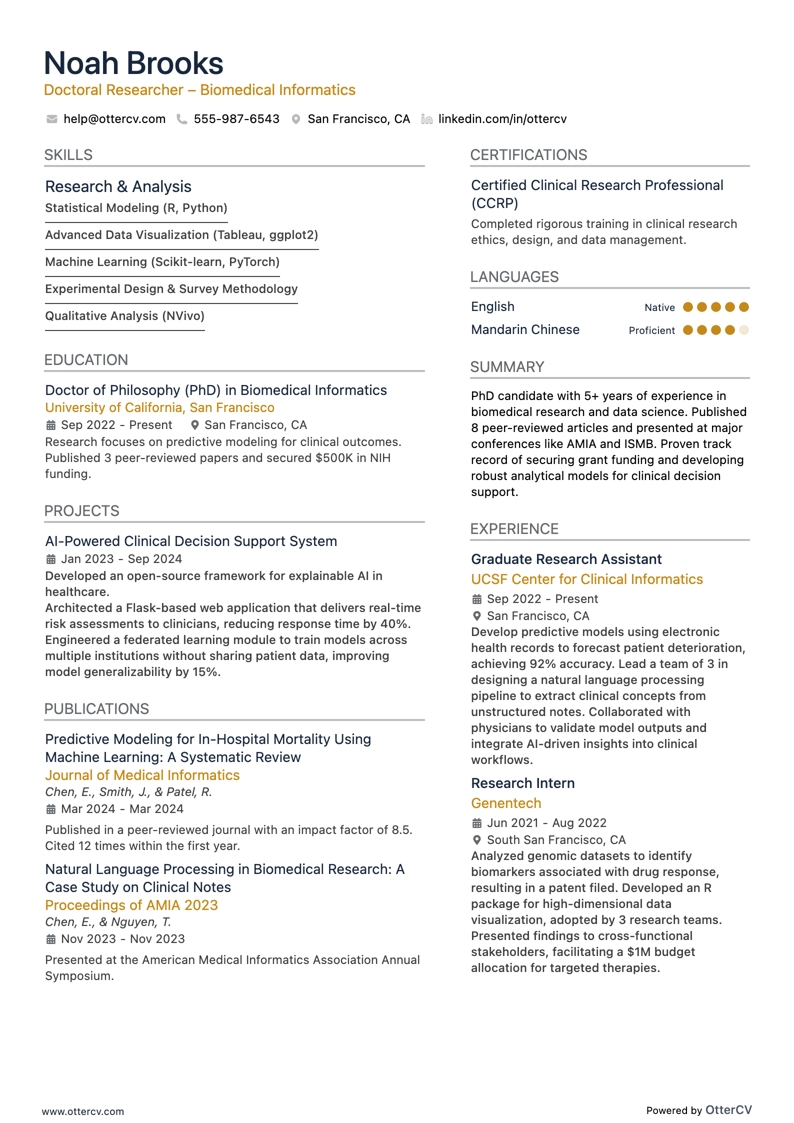
Postdoctoral Scientist full preview

17 PhD Resume Examples

OtterCV

Written by The OtterCV Team

Updated: 11/12/2024•8 min read

See all resume examples in this guide, or generate your own resume example with your personalized prompt

Postdoctoral Scientist resume example

Postdoctoral Scientist

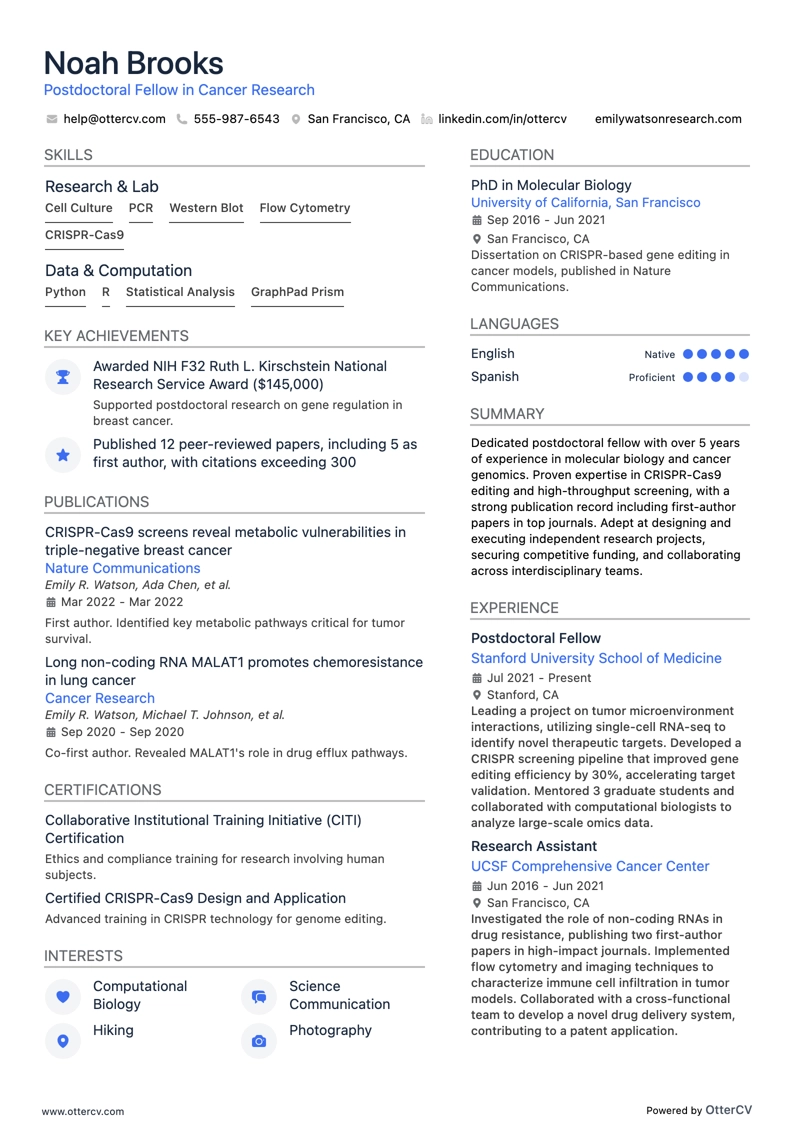
Postdoctoral Fellow resume example

Postdoctoral Fellow

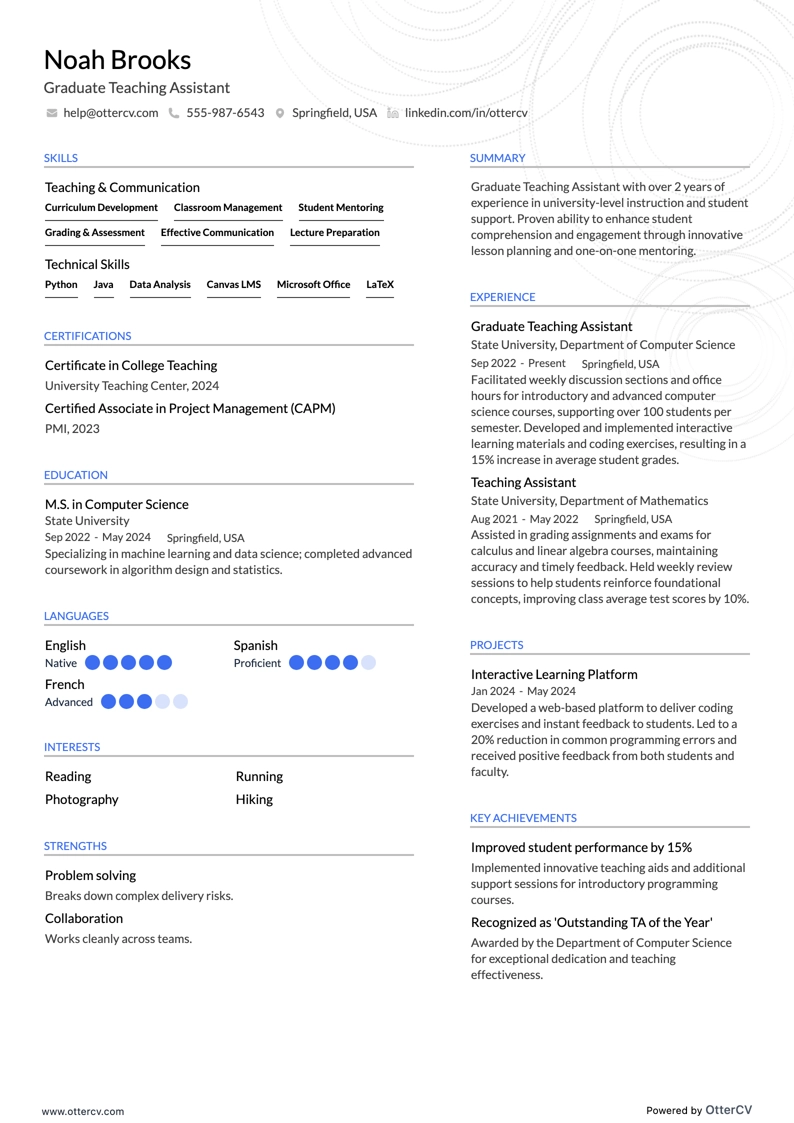
Graduate Teaching Assistant resume example

Graduate Teaching Assistant

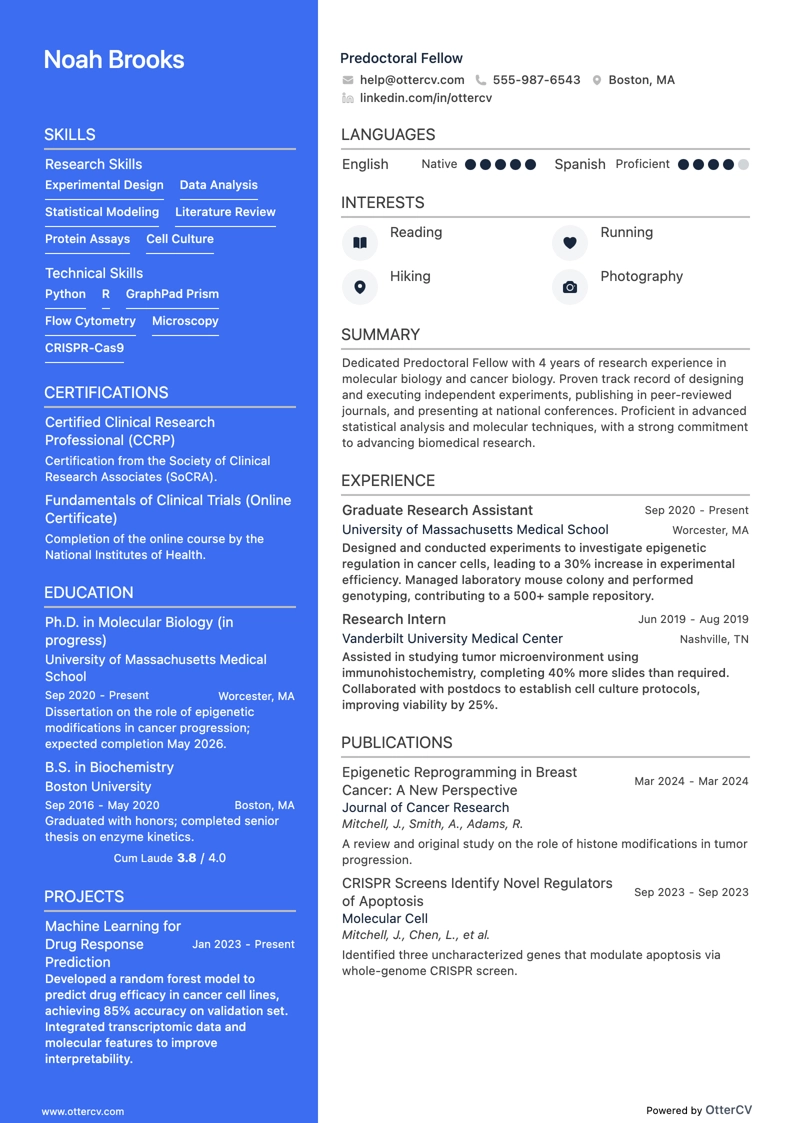
Predoctoral Fellow resume example

Predoctoral Fellow

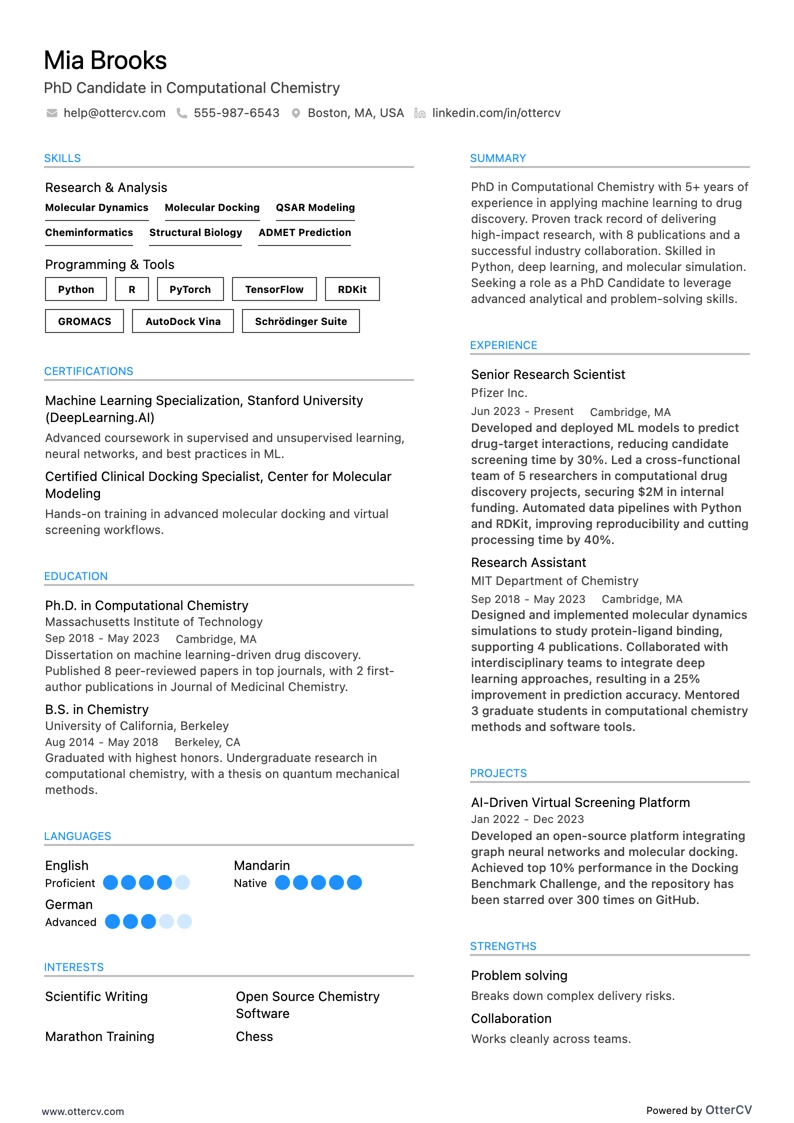
PhD Candidate resume example

PhD Candidate

Doctoral Researcher resume example

Doctoral Researcher

PRO TIP

If you participated in extracurricular activities during your studies, include them on your resume to highlight soft skills such as leadership, initiative, and organization.
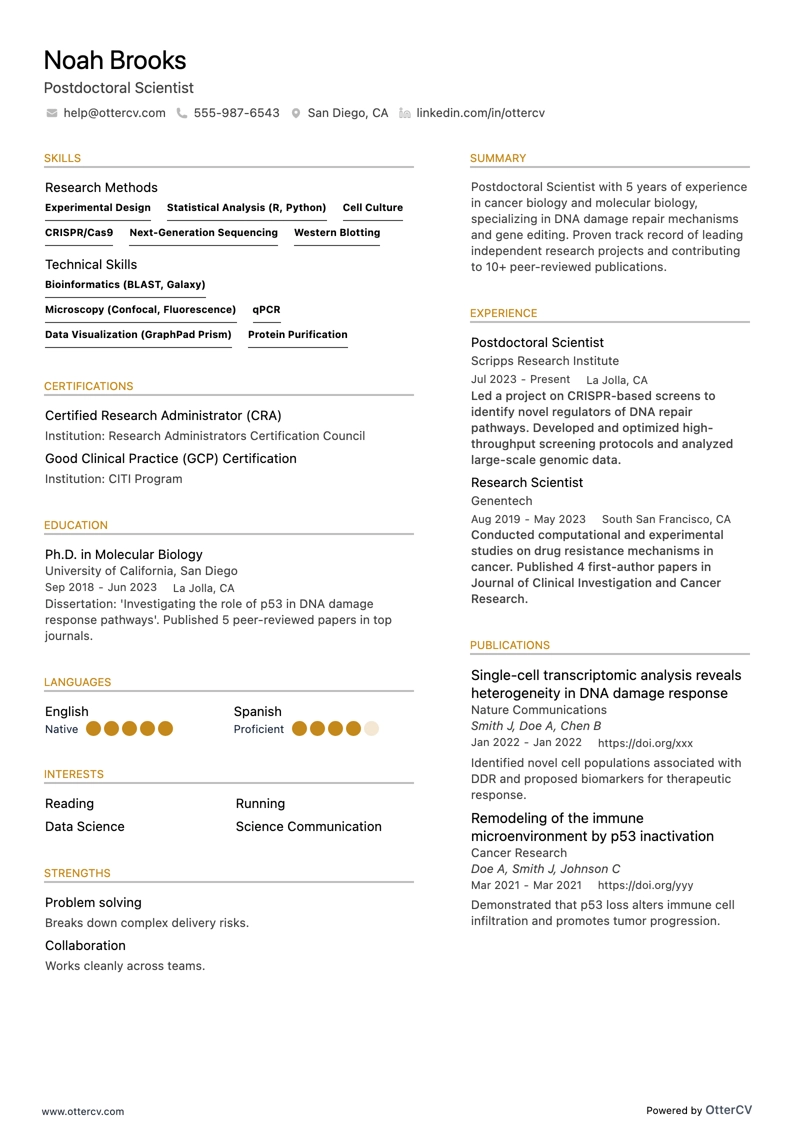
If you are a current Ph.D. student wondering how to present an ongoing degree on your resume, Charles Flack’s resume offers a strong example to follow.

He uses the resume headline and the opening part of the summary to define his research niche, then clearly states that his Ph.D. is still in progress.

Be honest. The hiring process depends on trust, and if you claim to be a Ph.D. graduate when that is not true, recruiters will find out.

His summary also highlights a range of expertise and soft skills, including leadership, adaptiveness, and perfectionism, all supported by results achieved in academia.

In the experience section, he includes work in leadership, technical writing, and private tutoring, showing both his contributions and his breadth of skills.

The strengths on his resume are especially relevant to data science roles, including quantitative problem-solving, deep learning, and iterative process.

21 ph.d. related resume examples to help you get inspired

Quick steps to success in writing your ph.d. resume to get recruiters’ attention

Let’s start with a big no-no: your academic CV, the one you used to secure that tenure position, is a no-go. Put simply, it lacks personality.

HR teams and the Applicant Tracking System (ATS) need more context about your experience.

Unfortunately, this is one of the biggest disadvantages you may face when leaving academia. Ph.D. graduates are often rejected because they lack practical work experience.

Don’t get discouraged. Instead, find a resume format that works for you.

PRO TIP

For Ph.D. graduates with limited work experience, we recommend a functional-skill-based format. It can help highlight your unique skill set and academic excellence.

It also helps align your niche area of expertise with the role’s expectations.

Quick Tips for Your Ph.D. Resume

  1. The top one-third of your resume, including the resume header and summary, is crucial for getting a high ATS score.

    Include as many relevant requirements from the job advert as possible in this section.

  2. Expand your qualifications and skills in the experience section.

    Instead of listing basic bullets, emphasize the outcomes of your studies, research, or publications.

How to write your experience bullets:

How to write your experience bullets:

You can use the following formula to write each experience bullet:

Verb + Who/What + Impact or How

3. Detail your accomplishments within your academic work.

Focus on the bigger picture and explain how your research has influenced the scientific field, business or industry, or communities.

As a bonus, always include all work and academic experience that is relevant to the job you’re applying for.

Your Ph.D. experience can open many doors and place you at the forefront of emerging technologies.

With that in mind, here are a few more things to keep in mind when writing your Ph.D. resume.

What recruiters are looking out for in your Ph.D. resume:

  • Show which methodologies or technologies you used to validate your research.
  • Explain whether you have led teams and managed them successfully.
  • Make clear how your niche expertise can support organizational goals.
  • Demonstrate that you offer more than theoretical knowledge.
  • Show how quickly you can adapt to a non-academic environment and deliver tangible results.

Ph.D. resume's five most important sections:

  • Use a resume header that includes keywords from the job description.
  • Write a resume summary that aligns the role requirements with your experience.
  • Add an experience section that expands on the summary.
  • Include an education section that lists all diplomas.
  • Highlight professional achievements in research and publications.

Your Ph.D. resume should balance your expertise with how quickly it can be applied in a real-world environment.

That is why you need to be precise about the resume sections you choose to demonstrate your merit.

Mythbusters: your PhD resume header under the echocv microscope

After endless hours of searching across different platforms, you finally find a cancer research position that perfectly matches your profile.

Setting aside the excitement, you decide on the following header:

2 PhD resume header examples

On the positive side, if an organization wanted to contact Dr. Garnett, it could easily find his contact details.

However, he is making one major mistake: he is not using the top section of his resume effectively, especially the headline.

This important section gives Ph.D. graduates a chance to include relevant keywords that match their profile while also introducing their professional story.

This example works because it shows that Dr. Garnett is not only a Ph.D. graduate, but also highlights his specific research area and interests, which should align with the role he is applying for.

As a rule of thumb, never be vague in headers about your research and expertise.

PRO TIP

You could include your Ph.D. in your resume title so it is one of the first things recruiters and applicant tracking systems see.

For example, Dr. Garnett’s resume title could read “Dr. David Garnett, Ph.D.”.

Just be mindful of the organization you’re applying to. If the company culture is more informal, this approach may come across as pretentious.

Ph.d. resume summaries: hrs’ favorite instrument for advanced career storytelling

The Ph.D. resume summary is a valuable section for making a strong first impression and explaining your experience.

It helps highlight your skills, strengths, and achievements while telling the story of your professional growth.

Because real-world examples matter, here’s how Dr. Lucina Collard rewrote her resume summary and ultimately caught the attention of a prestigious software development company.

2 PhD resume summary examples

Summary

Ph.D. graduate in Mechatronics with high grades in Human-Robot Interaction, Robotics, Digital Control Systems, Mechatronics, and Industrial Control. Wrote a thesis on “Designing and implementation of PID controller robotic arm.” Passionate about programming robots and working with people.

WRONG

Dr. Collard may have spent too much time in the lab, because her Ph.D. resume summary only listed the courses she completed and her thesis statement.

It included no results or outcomes.

She eventually added some soft skills and personal passions, but still failed to explain the purpose or impact behind her work. That approach does not make much sense.

Here is what her revised resume summary looked like in the end:

Summary

Robotics engineering professional with 6+ years of experience and a Ph.D. in mechatronics from Kent State University. Recognized with the 2021 30 Under 30: Engineer accolade for work in designing, implementing, and testing mechanical and electrical ecosystems. Throughout academic experience, collaborated on 60+ projects with Ph.D. students from Engineering, Manufacturing, and Design backgrounds, achieving a 95% success rate. Thesis work focused on the full hands-on process of designing, prototyping, fabricating, and testing a PID controller robotic arm.

RIGHT

Why This Summary Works

This summary is effective for one simple reason: it qualifies the achievements.

Dr. Collard notes that, over the past 6 years, she has specialized in the job-advert keywords “robotics” and “mechatronics”. Mentioning the award also helps present the broader picture of her experience.

She shows an ability to deliver results in a dynamic environment, including working with professionals from different backgrounds.

Her reference to the thesis further demonstrates familiarity with the process.

Editing Dr. Collard’s summary may seem like a small step, but it can be a major move toward securing an interview.

Making your ph.d. resume experience section stand out for all the right reasons

Most Ph.D. graduates make the same mistakes in the experience section.

The first is leaving out academic practice because they assume recruiters only care about work experience. That is not true. Your education can demonstrate not only your technical capabilities, but also your soft skills.

The second mistake is relying on tricky academic job titles. You will find 1000+ resumes listing experience only under titles such as Professor, Lecturer, Post Doctorate Student, and Graduate Student.

The result is a robotic rather than personalized presentation: 1:0.

PRO TIP

An ATS scans your resume for keywords that matter for the job. The sooner those terms appear near the top of your experience, the better.

For example, instead of writing "Lecturer at XYZ University," use "Data Science and Machine Learning Lecturer at XYZ University."

Third slip-up: writing tricky experience bullets.

Some Ph.D. graduates list all their courses, research, and publications, but that is not the best approach. Instead, align your knowledge with the job description to show tangible results.

Questions like these can help:

  • What did this course help me learn and achieve that could apply to the job I am applying for?
  • How did leading lectures help me cooperate better within the learning environment?
  • What grants did my publications secure for the educational institute?
  • What effects did my research have on the broader subjects within the field?
  • The more you can show the reality and practicality of your education, the better your chances of landing your first interview.

Let’s look at an example of how your experience can be presented on your resume as important for the job.

PhD resume experience examples.

Experience

Post Graduate Student

California Institute of Technology

02/2018 - 11/2021 · Pasadena, CA

Company Description

  • Got PhD in Philosophy
  • Took Philosophy of Mind, Brain, and Behavior Course
  • Took Ethics Course
  • Wrote Diploma on ‘To Be Or Not To Be: The Ethics of The Human Existence In The 21st Century’
WRONG

A sparse experience section can come across as negligent and robotic. Did you only earn a diploma during those three-plus years?

You may be graduating from a leading higher education institution, but putting extra effort into your resume shows diligence.

It also signals that you are genuinely invested in getting that particular job.

Experience

Philosopher, PhD

California Institute of Technology

02/2018 - 11/2021 · Pasadena, CA

Company Description

  • Contributed 60+ publications to the university scientific journal, focusing on human rights, ethics, and the broader question of human existence.
  • Peer-reviewed publications for 12+ philosophy colleagues and professionals, with a focus on thesis consistency and validity.
  • Collaborated with 10+ professionals across arts, science, and biotech to examine and better understand the ethics behind their projects.
  • In addition to the scientific paper for the final thesis, entitled 'To Be Or Not To Be: The Ethics of The Human Existence In The 21st Century', published a short video on the university website to inspire young philosophy professionals to always stay alert.
RIGHT

There’s no direct comparison between the two examples, but a few basics stand out.

The first experience bullet suggests the candidate can write technical papers in their niche. It also highlights attention to detail, collaboration, and teamwork. Finally, it shows they found a way to submit their thesis on time while making it easier to understand.

On a side note, did you notice how a better job title could be a complete game-changer?

One bonus tip on better systematizing your ph.d. experience

In most cases, you would create a single resume experience section.

But if, while writing your Ph.D. resume, you realize that all of your experience over the past six years comes from the same institution, you can organize it differently.

One useful approach is to create multiple experience sections based on function. This helps you highlight job-ad keywords while also giving more detail about your work.

You could group your experience under headings such as:

  • Research Experience
  • Technical Experience
  • Analytical Experience
  • Leadership Experience
  • Mentorship Experience
  • Teamwork Experience
  • Higher Education Experience

Align these sections with the transferable skills that matter most for the job you are applying for.

How should you include your degrees within your ph.d. resume education section?

There are two main scenarios.

If you are applying for a job related to your area of study, include your Ph.D. in detail, covering research topics, method expertise, and publications.

Because many readers may be non-specialists, avoid overloading this section with complex terms. Instead, work relevant keywords from the job requirements into your education section.

If you are applying for a job unrelated to your degree, keep the education section simple. Include your degree, university or college, dates, and location.

In either case, list all of your degrees in chronological order, starting with the latest.

Your resume education section helps recruiters judge whether:

  • Your basic training and knowledge fit the job
  • You stayed focused on your coursework and graduated on time
  • You would be a good fit for the team, as some companies prefer graduates from the same university

Ph.d. in progress: should you include your potential degree on your resume?

Transparency on your Ph.D. resume helps build a strong first impression with the company you are applying to.

That is why your education section should be clear and precise.

If you are still pursuing your Ph.D., focus less on the future and more on what you have achieved so far.

Your education section can answer questions such as:

  • How applicable is your degree to the job opening?
  • Which completed courses could help the company grow?
  • Is your education a stepping stone within your professional experience?
  • What is your expected graduation date?

Sometimes, however, life happens and you may have to leave your Ph.D. unfinished.

Should you list a degree you did not complete?

The answer is yes, because your Ph.D.:

  • Fills gaps within your professional experience
  • Is valuable experience
  • Has helped you gain new knowledge

Make it clear to recruiters that the degree is Incomplete or that you Didn't Graduate.

List the degree, dates, university or college, and status.

If you reach the interview stage, recruiters may ask why you dropped out. Be ready to explain why it was not the best option for your career at the time, or to briefly describe the circumstances.

Even if it may not feel that way, HR managers are people too, and they can show understanding and compassion.

Ph.d. resume: is there a dream skill set your potential employers would like to see?

Recruiters review your resume to understand how your experience matches the role, with a strong focus on transferable skills.

In other words, they want to know what else you can bring to help the business or institution grow.

Transferable skills include both hard, or technical, skills and soft skills.

Your hard skills include the technology you used throughout your studies.

For example, you may have had opportunities to:

  • Test and measure antennas parameters in an Anechoic chamber
  • Audit renewable energy sources' efficiency in a lab environment
  • Develop software using Python to patch cybersecurity risks

The list can go on and on. Your Ph.D. has likely given you a strong technical background.

PRO TIP

When writing your resume’s separate technical skills section, you may wonder which technology to list first.

A good rule of thumb is to align the technologies mentioned in the job description with your own expertise.

The more proficient you are in a skill, the earlier you should place it.

Wondering which hard and technical skills are most common on a Ph.D. resume?

Explore our list based on some of the most popular industries.

PhD resume technical skills for various roles

  • Business consulting skills: benchmarking, Balanced Scorecard, Porter’s Five Forces, the GE-McKinsey Nine-Box Matrix, the BCG Growth-Share Matrix, core competencies, data management and analysis, advanced data modelling, big data, strategy, planning and implementation, risk assessment using frameworks, statistics and correlations, CRMs such as Salesforce, Zendesk, and Bitrix24, lead generation software such as Zendesk Sell, Pipedrive, and HubSpot, project management software such as Jira, Hive, and Asana, employer and customer satisfaction surveys, MSO, proposal writing, scheduling software such as Calendly, Google Calendar, and Doodle, and revenue optimization and sales.
  • Biology, biotech, biochemistry, and medical research skills: design, conduct, and analyze scientific research, tissue culture, PCR, gel electrophoresis, Western blot, ELISA, chemistry, molecular gene cloning, flow cytometry, mass spectrometry, confocal microscopy, cell-based assays, radioimmunoassays, data analysis in biotechnology, bioinformatics, and medical research, and laboratory and equipment work.
  • Engineering skills: manufacturing such as forging, welding, and assembling, quality control, robotics, industrial and system design and analysis, conceptual, logical, or physical data modeling, AI and machine learning, design tools such as AutoCAD, SolidWork, and 3dsMax, programming languages such as C++, Python, and Java, equipment diagnosis, project management tools such as Trello, Zoho, and Microsoft Project, data analysis software such as Microsoft Power BI, Tableau, and Qlik Sense, CNC programming, advanced physics, structural analysis, and nanotechnology.
  • Computer science technologies: programming languages such as C++, PHP, and Swift, software engineering and development tools such as Atom, GitHub, and Chrome DevTools, cloud platforms, data migration and deployment, APIs, integrated environments management, network maintenance, cybersecurity, machine learning and AI, business intelligence and statistical analysis tools, SQL consoles, SAS development and forecasting, data modelling tools such as ER/Studio, Archi, and Ludichart, ETL, and automation tools.
  • Academic and research technical skills: technical literacy, MSO, presentation and visual tools such as Tableau, Prezi, and PPT, learning platforms such as Moodle, Classroom, and Teams, survey tools such as Google Forms, MailChimp, and Kahoot, data-processing software such as SPSS, RStudio, and NVivo, academic networks such as Google Scholar, Academia.edu, and ResearchGate, academic research and technical writing, email writing, data and information analysis, copyright and license knowledge, numeracy, videoconferencing tools such as Zoom, Teams, and Google Meet, grant and funding applications, and peer reviews and co-writing interdisciplinary technical papers.

Moving on to your PhD resume soft skills

There is still no precise formula for how soft skills are gained and applied in the workplace.

How many times have you seen an advert that asks for “a can-do attitude and teamwork”?

Yet soft skills remain on every recruiter’s must-have checklist.

For Ph.D. applicants, these transferable skills are built through the healthy habits you have maintained throughout your education, including:

  • discipline
  • collaboration
  • ability to meet deadlines

Soft skills tell recruiters more about your character and working style.

Here are some ideas for which ones you can include on your resume:

Strengths

  • Presenting Grant Proposals

    In the past 3 years, presented 60+ proposals with a 98% success rate. Received feedback for presenting research with enthusiasm and making complex data understandable.

  • Peer Collaboration

    Worked on 12+ projects with peers on interdisciplinary breakthrough research in robotics and engineering, contributing to the mechanics aspect of the work.

  • Critical Thinking within Engineering

    Created 40+ papers and projects by critically analyzing key engineering problems. For example, the most recent publication, which gained approval from various industry professionals, examines how medical devices' wireless functionality could be improved by investing in more complex antenna design.

RIGHT

37 PhD soft skills to spice up your resume:

  • Critical / Logical Thinking.
  • Analysis.
  • Problem-Solving.
  • Time Management.
  • Brainstorming.
  • Creativity and Innovation.
  • Meeting Deadlines.
  • Working Under Pressure.
  • Negotiation.
  • Project Management.
  • Organization.
  • Prioritization.
  • Flexibility.
  • Independent Work.
  • Resilience.
  • Ethical Decision-Making.
  • Integrity.
  • Teamwork.
  • Leadership or Mentorship.
  • Collaboration.
  • Teaching or Lecturing.
  • Conduct Meetings.
  • Supervision.
  • Feedback and Evaluation.
  • Motivating Others.
  • Networking.
  • Communicating Ideas.
  • Presentation.
  • Constructive Debating.
  • Leading or Participating in Group Discussions.
  • Persuasion.
  • Public Speaking.
  • Accelerated Learning.
  • Attention to Detail.
  • Writing Proficiency.
  • Quantitative Literacy.
  • Listening and Reflection.

PRO TIP

When describing your leadership or mentorship soft skills on your resume, answer a few specific questions to help qualify your achievements:

  • How many direct reports did you have?
  • What was the end goal of your project, research, or paper?
  • How did you achieve your vision? Describe it in a sentence or two.
  • What actions did you take to maintain a consistent and successful team dynamic?

Mix in extracurricular certificates

If you earned a few extracurricular certificates in the past, you may be wondering whether to include them on your Ph.D. resume.

It comes down to how necessary the certification is for the job.

For example, if AICPA's CPA certificate is listed as mandatory in the job description and you have earned it, you should include it.

Certificates can show that you are willing to put in extra effort to stay relevant, and that you are committed, flexible, and a lifelong learner.

Think about how relevant the certificate is within your field, then consider including some of these popular certificates:

Top 50 PhD certificates from various institutions for your resume

  • Association of Clinical Research Professionals (ACRP) - Certified Professional.
  • ACRP - Clinical Research Associate Certification.
  • ACRP - Clinical Research Coordinator Certification.
  • American Health Information Management Association - Coding Specialist Physician-Based Certification.
  • Nationally Registered Certified Patient Care Technician.
  • National Healthcare Association (NHA) - EKG Technician Certification.
  • NHA - Phlebotomy Technician Certification.
  • NHA - Clinical Medical Assistant Certification.
  • American Association of Medical Assistants - Medical Assistant Certification.
  • Red Cross - Nursing Assistant Certification.
  • Behavior Analyst Certification Board, Inc. - Registered Behavior Technician.
  • American Association of Professional Coders - Certified Professional Coder.
  • Pharmacy Technician Certification Board - Certified Pharmacy Technician.
  • Society for Clinical Data Management - Clinical Data Manager.
  • American Medical Writers Association - Medical Writer Certified.
  • Board of Editors in Life Science - Board-Certified Editor in Life Science.
  • International Society for Medical Publication Professionals - Certified Medical Publication Professional.
  • Regulatory Affairs Professional Society - Regulatory Affairs Certification.
  • Google Project Management Professional.
  • Society of Petroleum Engineers - Petroleum Engineering Certification.
  • American Institute of Chemists - National Certification Commission in Chemistry and Chemical Engineering Certification.
  • Coursera - Software Engineering MasterTrack Certificate.
  • Cisco Certified Network Professional in Service Provider Operations.
  • CompTIA Security+ Certification.
  • (ISC)² Certified Information Systems Security Professional.
  • American Society for Quality (ASQ) - Quality Engineer Certification.
  • ASQ - Reliability Engineer Certification.
  • Advanced Certificate Program in CFD-Aircraft Aerodynamics.
  • Engineer in Training License and Certification.
  • Society of Broadcast Engineers - Certified Audio Engineer.
  • Association of Technology, Management, and Applied Engineering - Certified Technical Professional.
  • International Council on Systems Engineering - Systems Engineering Professional Certification.
  • American Academy of Project Management - Certified Planning Engineer.
  • Heating, Ventilation, and Air Conditioning Master Specialist Certificate.
  • iNARTE Electromagnetic Compatibility Designer Engineer Certificate.
  • American Academy of Environmental Engineers and Scientists - Board Certified Environmental Engineer.
  • American Public Power Association - Key Accounts Certificate Program.
  • Global Association of Quality Management - Certified Agile Developer.
  • Environmental Protection Agency - Operator Certification Program Management.
  • Institute of Management Accountants - Certified Management Accountant.
  • National Association of Certified Public Bookkeepers - Certified Bookkeeper.
  • Association of International Certified Professional Accountants - Certified Public Accountant.
  • Chartered Financial Analyst Institute - Chartered Financial Analyst.
  • Internal Revenue Service - Enrolled Agent.
  • The Institute of Internal Auditors - Certified Internal Auditor.
  • Association of Certified Fraud Examiners - Certified Fraud Examiner.
  • National Association of Sales Professionals - Certified Professional Sales Person.
  • Institutes of Management Consulting - Certified Management Consultant.

PhD resume: let’s get creative with a few more resume sections

  • Publications or Projects : focus on the topic, methodology, and impact; include your grant ID code if your research received funding.

  • Academic Awards : consider whether they present your expertise in the best possible light.

  • Conference Presentations: these can highlight your public speaking abilities.

  • Language Skills : be honest when listing your level of proficiency.

  • Aligning your Ph.D. skills with the job you’re applying for helps capture recruiters’ attention.

  • Include as many relevant keywords as possible in the header and summary of your Ph.D. resume.

  • Use separate sections to show how your academic background helped you build experience, skills, and certifications.

  • List all degrees in chronological order, while adapting the level of detail as needed.

  • Remember that recruiters or the ATS reviewing your resume may not be highly scientifically literate. Replace complex terminology with impact and results.

PhD resume examples

Explore additional PhD resume samples and guides and see what works for your level of experience or role.

By Role

Postdoctoral Scientist

Postdoctoral Scientist resume preview

Postdoctoral Fellow

Postdoctoral Fellow resume preview

Graduate Teaching Assistant

Graduate Teaching Assistant resume preview

Predoctoral Fellow

Predoctoral Fellow resume preview

PhD Candidate

PhD Candidate resume preview

Doctoral Researcher

Doctoral Researcher resume preview