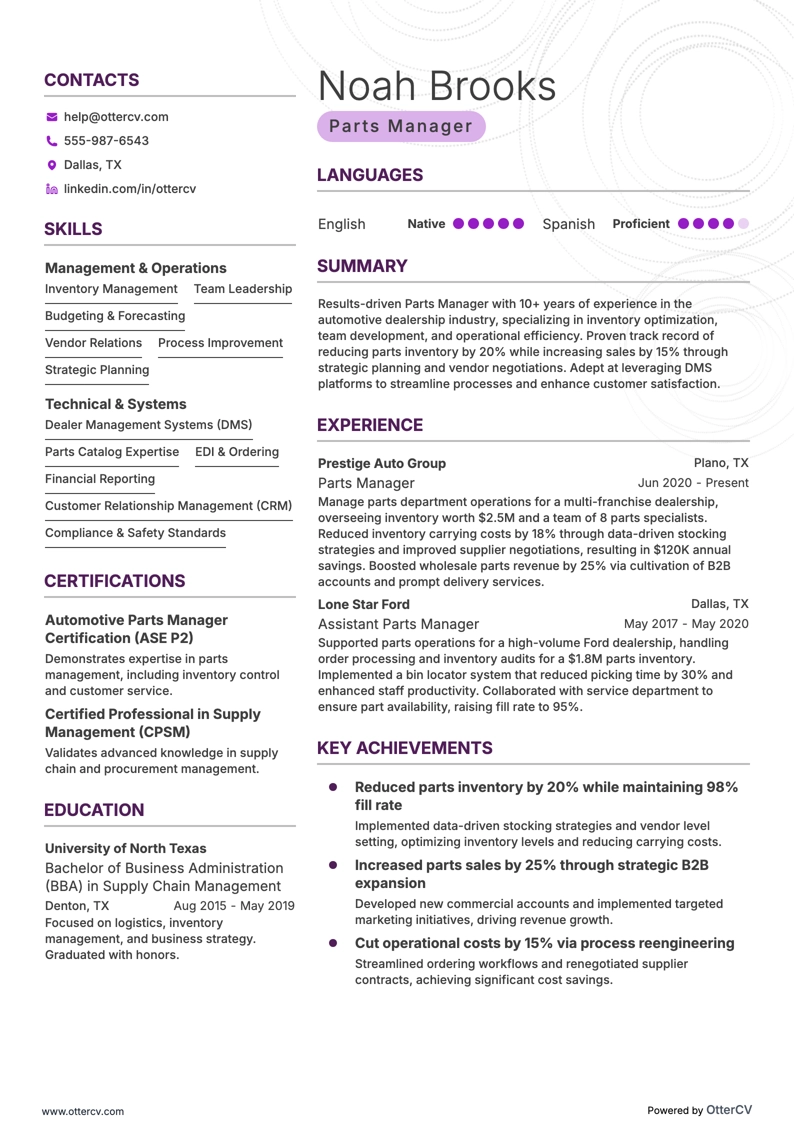
Senior Parts Manager full preview

10 Parts Manager Resume Examples

OtterCV

Written by The OtterCV Team

Updated: 2/12/2024•8 min read

See all resume examples in this guide, or generate your own resume example with your personalized prompt

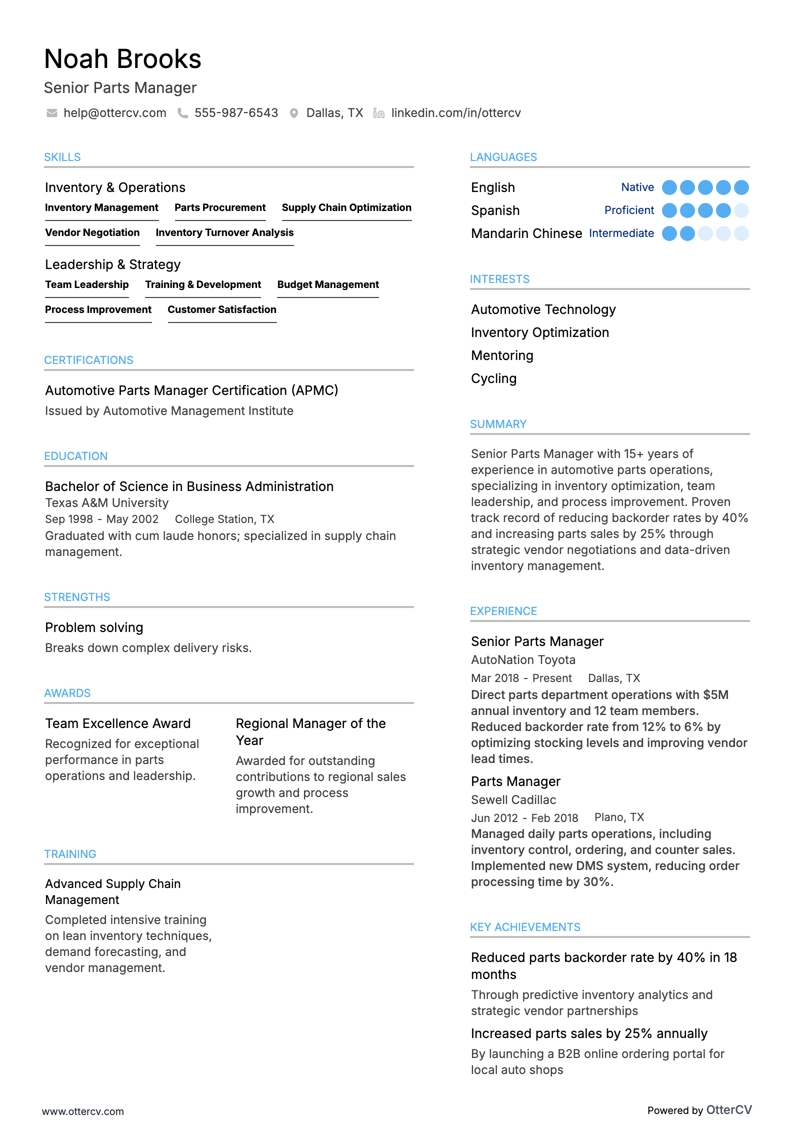
Senior Parts Manager resume example

Senior Parts Manager

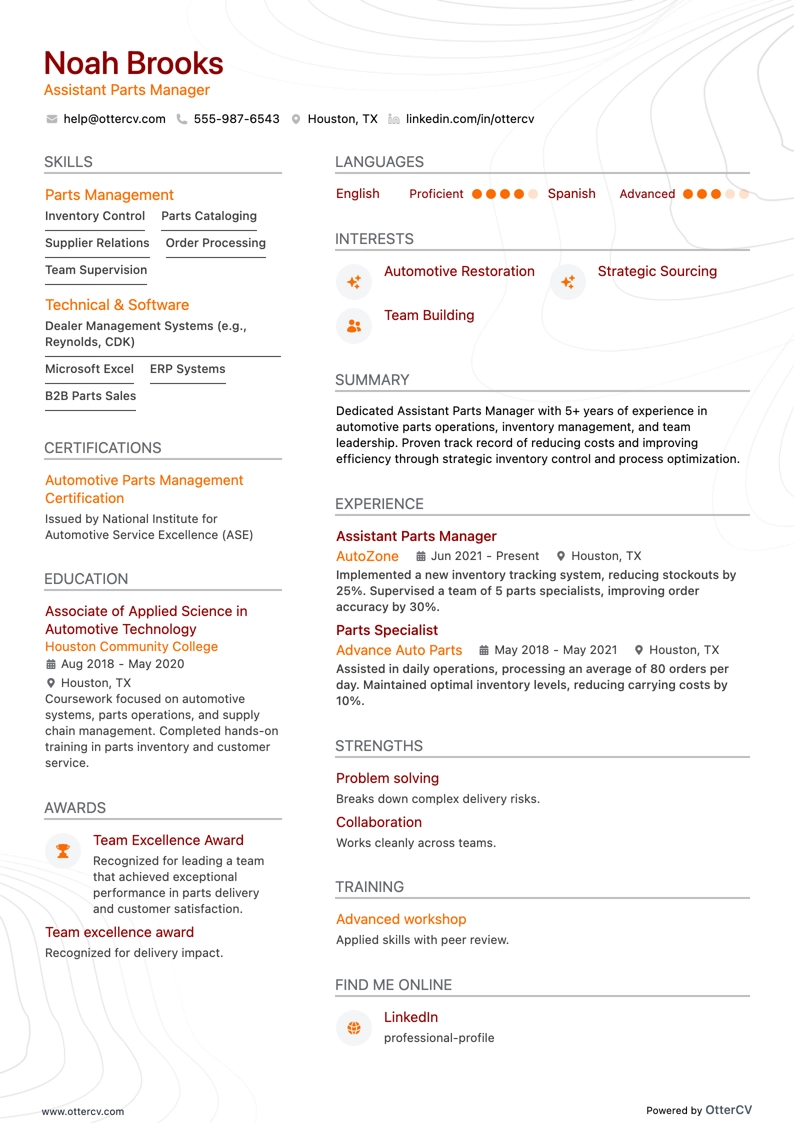
Assistant Parts Manager resume example

Assistant Parts Manager

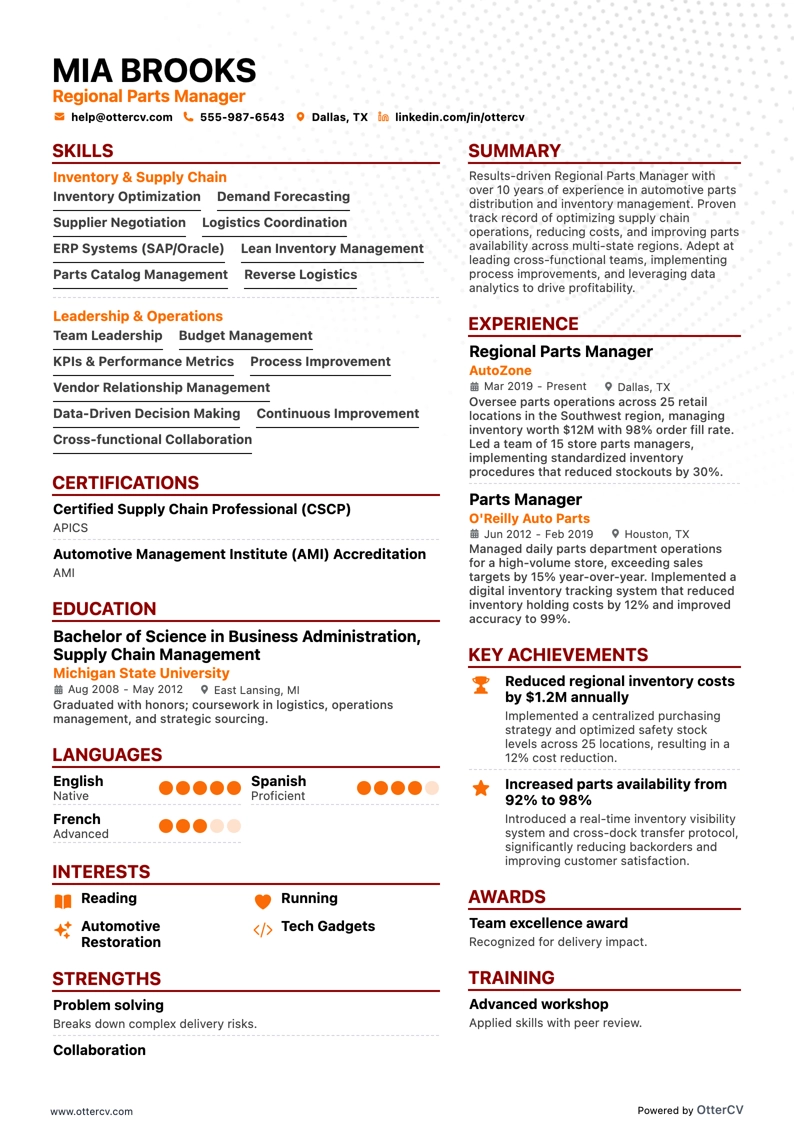
Regional Parts Manager resume example

Regional Parts Manager

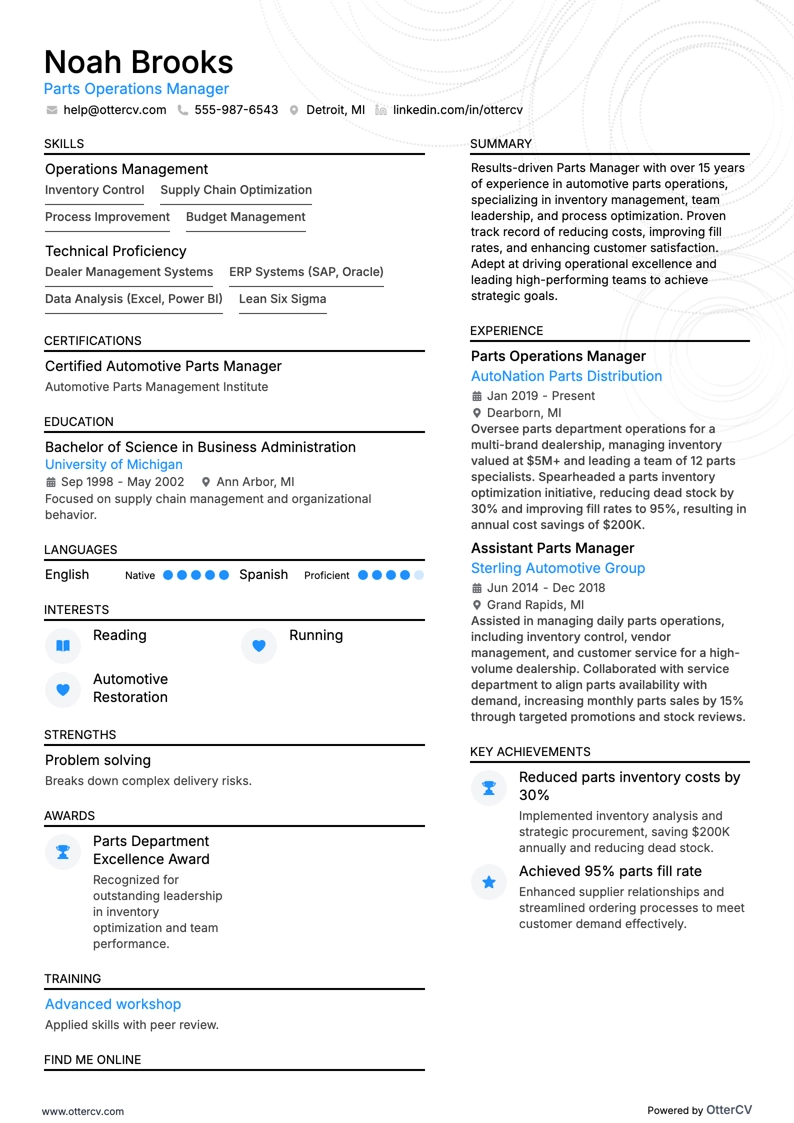
Parts Operations Manager resume example

Parts Operations Manager

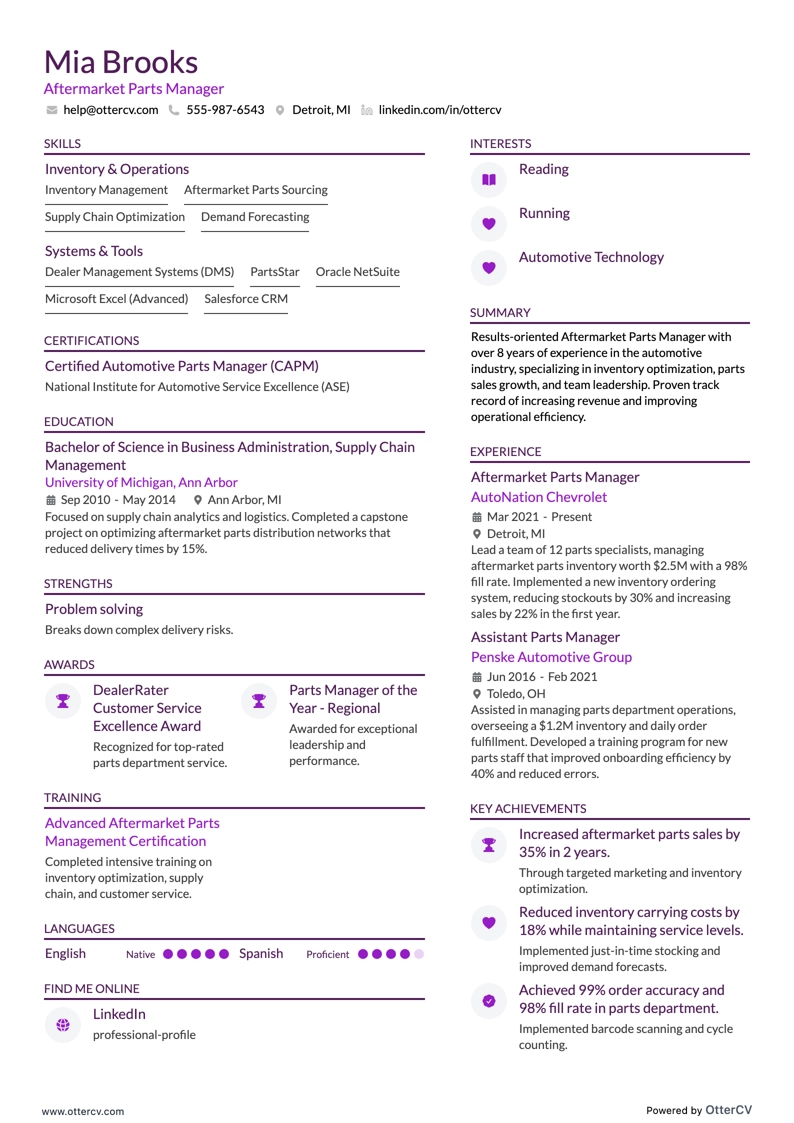
Aftermarket Parts Manager resume example

Aftermarket Parts Manager

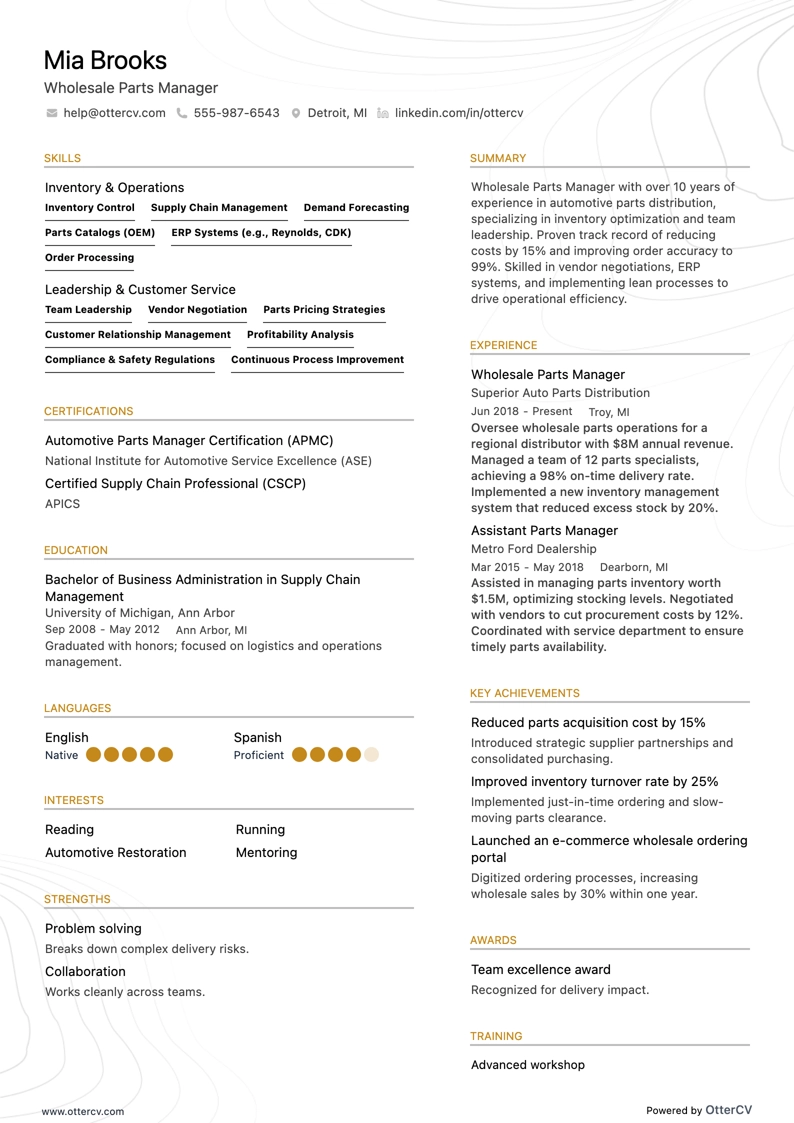
Wholesale Parts Manager resume example

Wholesale Parts Manager

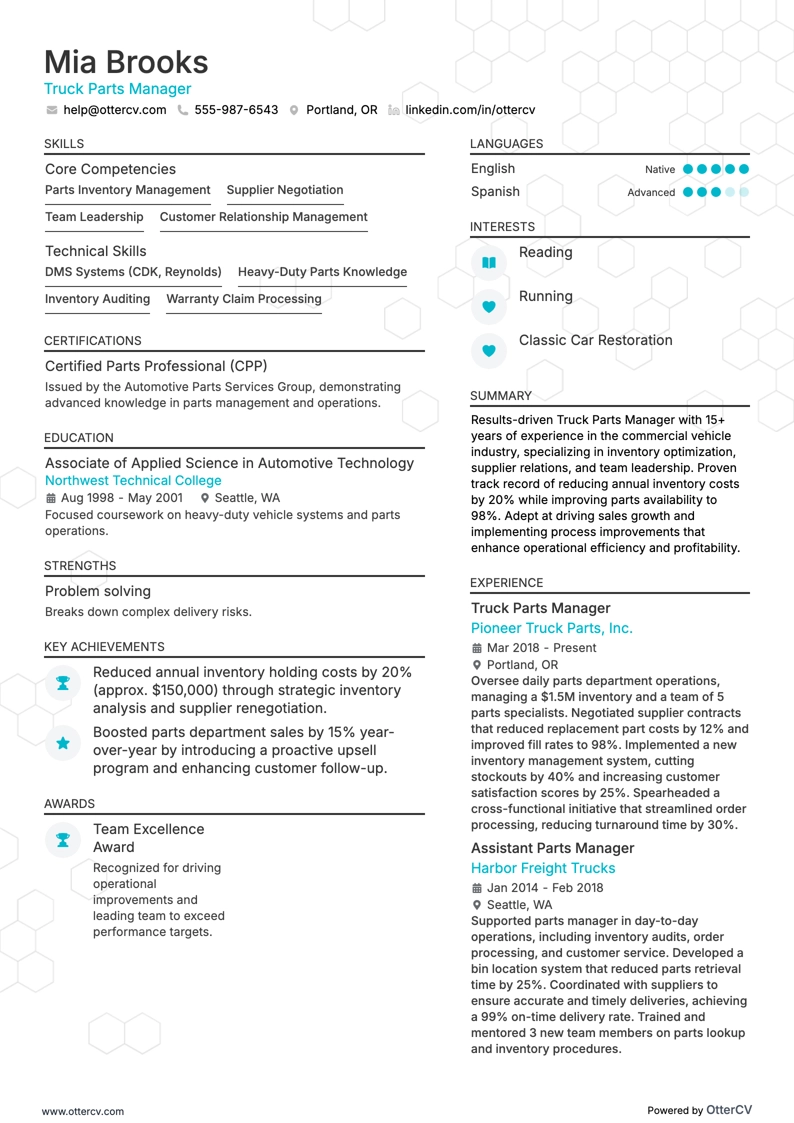
Truck Parts Manager resume example

Truck Parts Manager

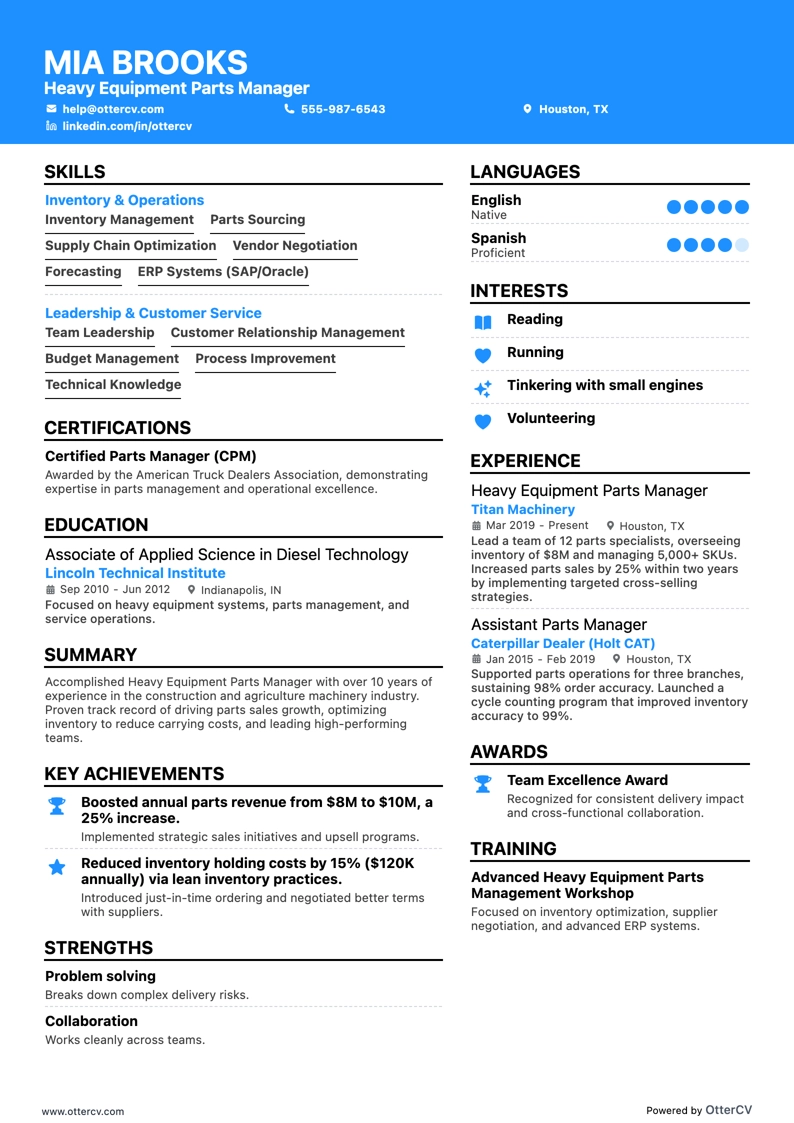
Heavy Equipment Parts Manager resume example

Heavy Equipment Parts Manager

Dealership Parts Manager resume example

Dealership Parts Manager

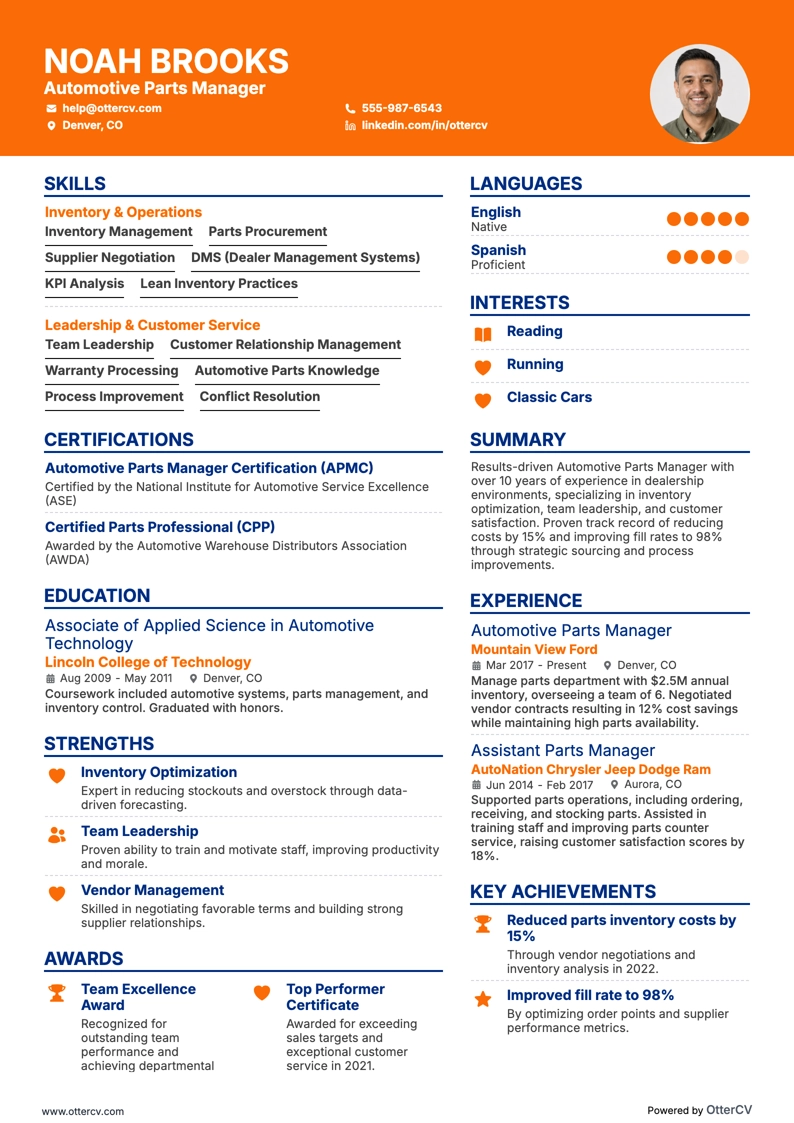
Automotive Parts Manager resume example

Automotive Parts Manager

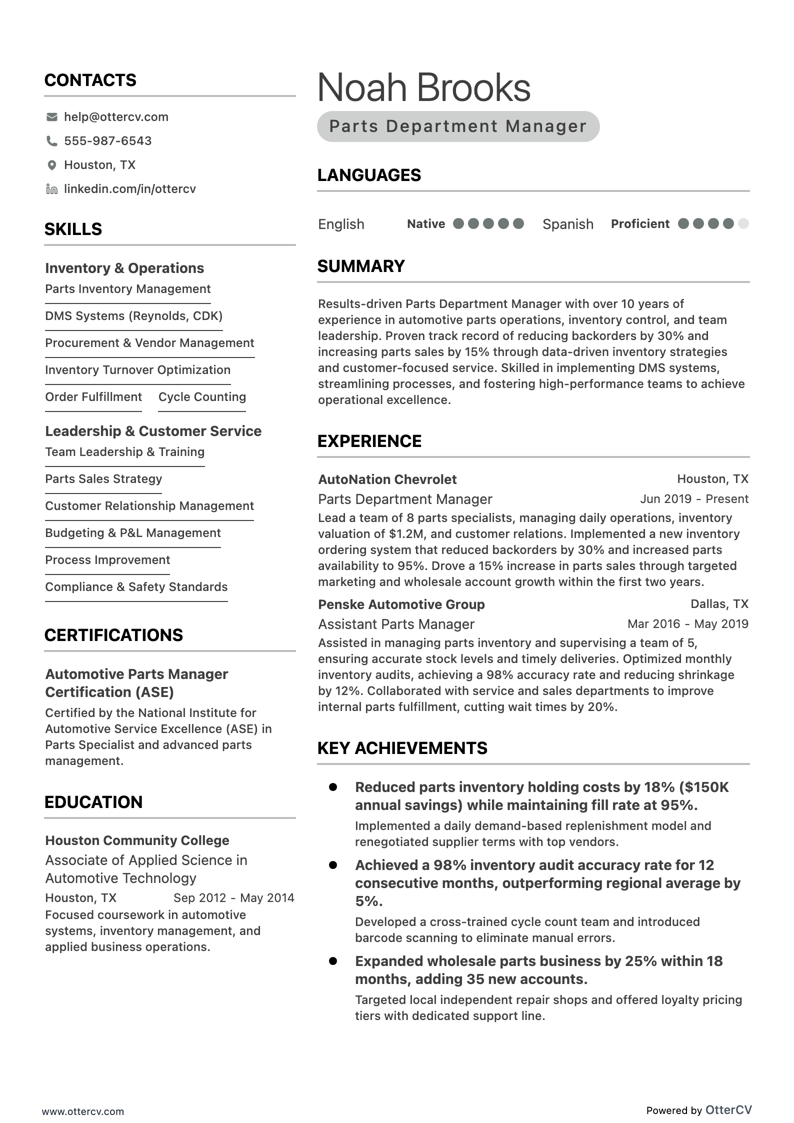
Parts Department Manager resume example

Parts Department Manager

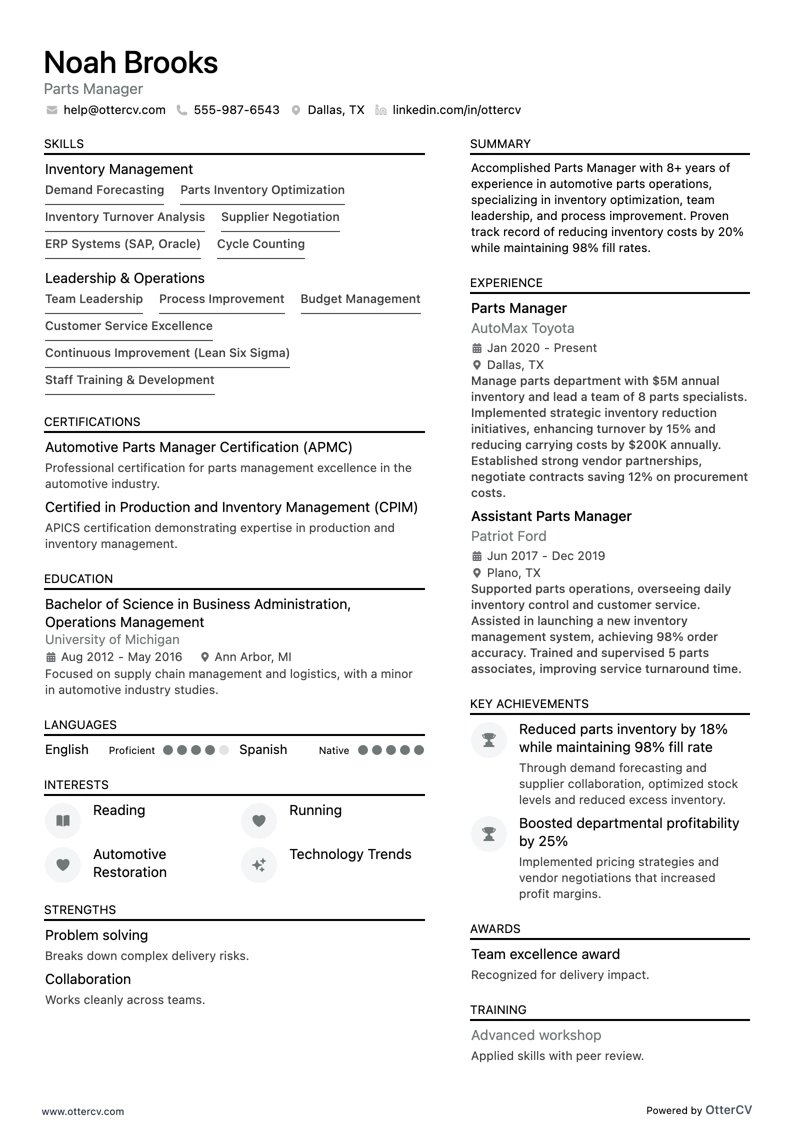
Parts Manager resume example

Parts Manager

Parts manager resumes often fall short because they read like inventory logs instead of evidence of operational control. That can hide your impact in ATS screening and quick recruiter reviews, where clear outcomes stand out. Knowing how to make your resume stand out starts with leading with results rather than responsibilities.

A strong resume shows what improved because of you: fill rate, backorder reduction, cycle count accuracy, shrink control, warranty recovery, and vendor lead times. It should also quantify your scope with stock value managed, locations supported, service level gains, and audit results.

Key takeaways

  • Quantify fill rate, inventory accuracy, cost savings, and cycle time in every experience bullet.

  • Use a reverse-chronological format if you have parts management experience; use a hybrid format if you are switching careers.

  • Tailor your resume language to match each job posting’s software, KPIs, and industry terms.

  • Place skills above experience when you are junior, and below experience when you have strong achievements.

  • Connect every listed skill to a specific action and measurable result; never list skills in isolation.

  • Pair certifications like CPIM or ASE P2 with education to show current, verified expertise.

  • Use Echocv to strengthen bullet points and align your resume with each role faster.

Job market snapshot for parts managers

We analyzed 107 recent parts manager job ads across major US job boards. The results offer a quick view of which companies are hiring, which skills are in demand, and which regions stand out.

What level of experience employers are looking for parts managers

Years of ExperiencePercentage found in job ads
1–2 years6.5% (7)
3–4 years2.8% (3)
5–6 years11.2% (12)
7–8 years0.9% (1)
10+ years5.6% (6)
Not specified72.9% (78)

Parts manager ads by area of specialization (industry)

Industry (Area)Percentage found in job ads
Finance & Banking68.2% (73)
Healthcare19.6% (21)

Top companies hiring parts managers

CompanyPercentage found in job ads
Reynolds and Reynolds Company27.1% (29)

Role overview stats

These tables outline the most common responsibilities and employment types for parts manager roles. Use them to align your resume with employer expectations and understand how the role is typically structured across the market.

Day-to-day activities and top responsibilities for a parts manager

ResponsibilityPercentage found in job ads
Inventory management15.0% (16)
Customer service10.3% (11)
Excel10.3% (11)
Computer skills7.5% (8)
Communication6.5% (7)
ERP5.6% (6)
Time management5.6% (6)
Budgeting4.7% (5)
Continuous improvement4.7% (5)
Financial acumen4.7% (5)
Lean4.7% (5)
Microsoft Office Suite4.7% (5)

How to format a parts manager resume

Recruiters reviewing parts manager resumes look for expertise in inventory management, strong vendor relationship skills, and a proven record of cost control and operational efficiency. A clean, well-structured resume helps these qualifications stand out quickly in both human reviews and applicant tracking system (ATS) scans. Choosing the right resume format is the first step.

I have significant experience in this role—which format should I use?

I have significant experience in this role—which format should I use?

Use a reverse-chronological format to show your progression in parts management and increasing operational responsibility.

  • Start with your most recent role and emphasize scope, including team size, inventory value managed, number of vendor accounts, and facility or location oversight.
  • Highlight proficiency with role-specific tools and systems such as inventory management software (for example, CDK Global, Epicor, or SAP), demand forecasting methods, and procurement platforms.
  • Quantify results tied to cost savings, fill rates, inventory turnover, and waste reduction.

Example bullet: “Managed a $2.4M parts inventory across three locations, improving fill rate from 87% to 96% while reducing carrying costs by 14% over 18 months.”

I'm junior or switching into this role—what format works best?

I'm junior or switching into this role—what format works best?

A hybrid format works best because it lets you highlight relevant skills first while still including a concise work history that provides practical context.

Do:

  • Place a skills section near the top featuring inventory control, vendor coordination, parts cataloging, and any relevant software proficiency.
  • Include projects, internships, or adjacent experience—such as warehouse coordination, retail stock management, or automotive service roles—that demonstrate transferable knowledge.
  • Connect every listed skill to a concrete action and a measurable or observable result.

Example scaffold: Inventory tracking (skill) → Implemented a barcode scanning system for incoming shipments (action) → Reduced receiving errors by 30% within the first quarter (result).

Why not use a functional resume?

Why not use a functional resume?

A functional resume removes the timeline and context recruiters need to verify your hands-on parts management experience, which makes it harder for them to judge whether you're ready for the role.

  • It may be acceptable if you're transitioning from a related field, such as warehouse operations or automotive service, and have limited direct parts management titles.
  • It may also work if you're re-entering the workforce after a gap, but only if each skill is tied to a specific project, task, or outcome instead of being listed on its own.

Caution: Avoid a functional format if you have any relevant work history to show. Most ATS platforms and hiring managers look for chronological job entries, and leaving out that structure can push your resume to the bottom of the pile.

With your resume’s structure and layout in place, the next step is choosing the right sections to present your qualifications clearly.

What sections should go on a parts manager resume

Recruiters expect a parts manager resume to highlight inventory control, vendor management, and operational results. Knowing which resume sections to include helps ensure you do not leave out anything important.

Use this structure for maximum clarity:

  • Header
  • Summary
  • Experience
  • Skills
  • Projects
  • Education
  • Certifications
  • Optional sections: Awards, Leadership, Languages

Your experience bullets should focus on measurable improvements in fill rate, inventory accuracy, shrink reduction, cost savings, and cycle time across the scope you managed.

Once your resume has the right structure and supporting details, the next step is writing the parts manager experience section so it fits that framework and clearly shows your impact.

How to write your parts manager resume experience

The experience section is where you show that you’ve managed inventory systems, sourced parts, and delivered measurable improvements to supply chain operations. Hiring managers look for proven results—such as reduced costs, improved fill rates, and stronger vendor relationships—rather than task lists that simply repeat a job description.

Each entry should include:

  • Job title
  • Company and location (or remote)
  • Dates of employment (month and year)

Add three to five concise bullet points that explain what you owned, how you executed, and what results you delivered.

  • Ownership scope: the parts catalogs, inventory systems, warehouse operations, vendor accounts, or teams you were directly responsible for as a parts manager.
  • Execution approach: the inventory management software, ERP platforms, demand forecasting methods, or procurement frameworks you used to make sourcing decisions and maintain optimal stock levels.
  • Value improved: changes to fill rates, order accuracy, carrying costs, parts availability, turnover speed, or waste reduction resulting from your work.
  • Collaboration context: how you worked with service technicians, sales teams, warehouse staff, OEM representatives, or external suppliers to align parts availability with operational demand.
  • Impact delivered: outcomes expressed as business results—such as cost savings, service-level improvements, inventory optimization, or revenue protection—rather than routine activity descriptions.

Experience bullet formula

Experience bullet formula

Action verb + technology + what you built or fixed + measurable result

A parts manager experience example

Parts Manager

Summit Auto & Fleet Service | Phoenix, AZ

2021–Present

High-volume automotive and light-duty fleet repair shop supporting eight service bays and two mobile units.

  • Implemented an inventory cycle-count program in AutoFluent using barcode scanning and ABC analysis, reducing parts variance from 6.8% to 1.9% and cutting annual write-offs by $48K.
  • Negotiated pricing and fill-rate targets with six key vendors through purchase order controls and vendor scorecards, improving same-day availability from 72% to 89% and lowering average unit cost by 7.4%.
  • Built a demand forecast and min-max replenishment model in Microsoft Excel and Power BI tied to repair order history, reducing backorders by 31% and shortening average special-order lead time by 1.6 days.
  • Partnered with service advisors and technicians to standardize kits for the top twenty jobs and enforce return-core workflows in the shop management system, increasing technician productivity by 9% and recovering $22K in core credits.
  • Audited warranty parts documentation and traceability across repair orders, invoices, and bin locations, decreasing warranty chargebacks by 18% and improving audit pass rate to 98%.

Now that you've seen what a strong experience section looks like, here's how to adapt yours for a specific parts manager job posting.

How to tailor your parts manager resume experience

Recruiters review your parts manager resume through both applicant tracking systems and manual screening. Tailoring your resume to the job description helps you succeed in both by reflecting the language and priorities used in the posting.

Ways to tailor your parts manager experience:

  • Match the inventory management software and ERP systems named in the posting.
  • Use the same terminology for procurement and vendor management processes.
  • Reflect the fill rate or turnover KPIs the employer emphasizes.
  • Include relevant industry experience, such as automotive or heavy equipment.
  • Emphasize compliance with OEM standards or regulatory requirements when mentioned.
  • Highlight cross-functional collaboration with service and warehouse teams if the role references it.
  • Show the forecasting or demand planning methodologies the position requires.
  • Align your experience with the cost reduction or margin improvement goals listed.

Tailoring means aligning your real accomplishments with the employer's stated requirements, not forcing in keywords that don't fit.

Resume tailoring examples for parts manager

Job description excerptUntailoredTailored
Manage inventory of 10,000+ SKUs using CDK Global DMS, ensuring 95% fill rate across OEM and aftermarket parts.Managed parts inventory and kept stock levels organized.Managed inventory of 12,000+ SKUs in CDK Global DMS, maintaining a 96.2% fill rate across OEM and aftermarket parts lines.
Source and negotiate pricing with vendors to reduce parts procurement costs while maintaining quality standards.Worked with vendors to order parts and negotiate deals.Negotiated contracts with 15+ parts vendors, reducing procurement costs by 11% year over year while maintaining OEM quality compliance standards.
Lead a team of parts counter staff, providing training on point-of-sale systems and customer service best practices.Supervised team members and helped with daily operations.Led a six-person parts counter team, delivering hands-on training in Reynolds & Reynolds point-of-sale workflows and reducing average customer wait time by 30%.

Once you’ve aligned your experience with the role’s priorities, quantify your parts manager achievements to show the impact of that work in measurable terms.

How to quantify your parts manager achievements

Quantifying your achievements shows how your inventory decisions affect uptime, cost, and customer satisfaction. Track fill rate, stockouts, inventory accuracy, carrying costs, obsolescence, cycle time, and compliance results.

Quantifying examples for parts manager

MetricExample
Fill rateRaised parts fill rate from 89% to 96% in six months by tuning min-max levels in CDK Drive and aligning reorder points to service demand.
Inventory accuracyImproved inventory accuracy from 92% to 98% by enforcing weekly bin audits, barcode scanning, and root-cause tracking for mispicks.
Stockout reductionCut critical stockouts by 41% by creating a fast-mover list, setting safety stock for A-items, and expediting backorders with top suppliers.
Cost savingsReduced monthly carrying cost by $18,000 by liquidating $120,000 in obsolete inventory and renegotiating freight terms with three vendors.
Cycle timeShortened receiving-to-shelf time from 2.5 days to 1.2 days by redesigning putaway zones and standardizing receiving checklists.

Once you’ve written strong achievement-focused bullet points, the next step is making sure your resume shows the right mix of hard and soft skills employers expect from a parts manager.

How to list your hard and soft skills on a parts manager resume

Your skills section helps recruiters and an ATS (applicant tracking system) see that you can manage inventory, purchasing, and service levels. It works best when it includes a balanced mix of hard skills and role-specific soft skills that match the job post.

Parts manager roles require a blend of:

  • Product strategy and discovery skills
  • Data, analytics, and experimentation skills
  • Delivery, execution, and go-to-market discipline
  • Soft skills

Your skills section should be:

  • Scannable with bullet-style grouping
  • Relevant to the job post
  • Backed by proof in your experience bullets
  • Updated with current tools

Place your skills section:

  • Above your experience if you’re junior or switching careers
  • Below your experience if you’re mid- or senior-level with strong achievements

Hard skills

  • Inventory control and cycle counting.
  • Demand forecasting and reorder point planning.
  • Economic order quantity (EOQ).
  • ABC analysis and bin location systems.
  • Purchase order processing and vendor management.
  • Enterprise resource planning systems.
  • Dealer management systems.
  • Barcode scanning and label printing.
  • Core returns and warranty parts processing.
  • Obsolescence management and write-offs.
  • Parts pricing and margin analysis.
  • Shipping, receiving, and logistics coordination.

Soft skills

  • Prioritize backorders under pressure.
  • Negotiate vendor lead times.
  • Coordinate with service and sales teams.
  • Resolve customer escalations.
  • Communicate stock status clearly.
  • Enforce process and accountability.
  • Make data-driven stocking decisions.
  • Train counter staff on procedures.
  • Lead daily workload planning.
  • Maintain accuracy for counts and audits.
  • Improve workflows across the parts room.
  • Document and standardize processes.

How to show your parts manager skills in context

Skills should not appear only as bullet points on your resume. Review examples of resume skills used in context to see how strong candidates incorporate them into summaries and experience sections.

Your skills should be demonstrated in:

  • Your summary, which presents your high-level professional identity
  • Your experience, which proves your skills through outcomes

Here’s how that looks in practice.

Parts manager with 12 years of experience in heavy equipment distribution, with expertise in ERP inventory systems, demand forecasting, and vendor negotiations. Reduced obsolete stock by 34% while maintaining 98.5% fill rates across three regional warehouses.

  • Clearly reflects senior-level experience
  • Names specific tools and methods
  • Includes a compelling, measurable outcome
  • Signals leadership and strategic thinking

Experience example

Senior Parts Manager

Redline Equipment Co. | Denver, CO

March 2018–Present

  • Implemented SAP-based inventory tracking, reducing order fulfillment errors by 27% within the first year.
  • Worked with procurement and service teams to cut parts lead times by an average of four days.
  • Launched a vendor scorecard system that improved supplier on-time delivery rates from 81% to 95%.
  • Every bullet includes measurable proof.
  • Skills emerge naturally through outcomes.

Once you’ve connected your inventory, ordering, and coordination strengths to real workplace results, the next step is showing that same value on a parts manager resume, even if you do not have direct experience.

How do I write a parts manager resume with no experience

Even without full-time experience, you can still demonstrate readiness through:

  • Parts counter or retail associate work
  • Inventory cycle counts and audits
  • School automotive or logistics projects
  • Volunteer fleet or shop support
  • Warehouse picking, packing, and receiving
  • Customer returns and warranty processing
  • Spreadsheet-based stock tracking reports

If you're building a resume without work experience, focus on:

  • Inventory accuracy and shrink reduction
  • Purchase orders and receiving logs
  • Catalog lookups and fitment accuracy
  • Safety compliance and documentation

Resume format tip for entry-level parts manager

Resume format tip for entry-level parts manager

Use a combination resume format to highlight parts-related skills and projects first, then list your work history. This works well when your experience comes from related roles or coursework.

Do:

  • Add an inventory project under Experience.
  • List tools like Excel and ERP.
  • Quantify counts, errors, and time saved.
  • Include purchase orders and receiving tasks.
  • Match keywords from the job post.

Example project bullet:

  • Built an Excel inventory tracker and cycle count plan for a school automotive lab, cutting stockout incidents by 20% over eight weeks.

Even without direct experience, your education section can show the foundational knowledge and relevant coursework that support your qualifications for a parts manager role.

How to list your education on a parts manager resume

Your education section helps hiring teams quickly confirm your technical training and academic background for a parts manager position.

Include:

  • Degree name
  • Institution
  • Location
  • Graduation year
  • Relevant coursework for juniors or entry-level candidates
  • Honors and GPA if 3.5 or higher

Skip the month and day, and list the graduation year only.

Here’s a strong education entry tailored to a parts manager resume.

Example education entry

Bachelor of Science in Supply Chain Management

University of Northern Iowa, Cedar Falls, IA

Graduated 2019

GPA: 3.7/4.0

  • Relevant coursework: Inventory Control Systems, Procurement Strategies, Warehouse Operations, and Business Logistics
  • Honors: Dean's List, six consecutive semesters

How to list your certifications on a parts manager resume

Certifications on a resume show a parts manager’s commitment to learning, proficiency with inventory and service tools, and current industry knowledge that supports accurate, efficient parts operations.

Include the following details for each certification:

  • Certificate name
  • Issuing organization
  • Year
  • Optional: credential ID or URL
  • Place certifications below education when they are older, less relevant, or mainly used to reinforce baseline qualifications.
  • Place certifications above education when they are recent, highly relevant, or required for the parts manager role you are targeting.

Best certifications for your parts manager resume

  • Automotive Parts Specialist (APS).
  • Automotive Management Institute Parts Management Certification.
  • ASE Parts Specialist Certification (P2).
  • Certified in Production and Inventory Management (CPIM).
  • Certified Supply Chain Professional (CSCP).
  • OSHA 10-Hour General Industry.
  • Microsoft Office Specialist: Excel Associate.

Once your credentials are presented in a clear, easy-to-scan format, write a resume summary that puts your strongest qualifications first.

How to write your parts manager resume summary

Your resume summary is often the first section a recruiter reads, so it should quickly show that you are a strong fit for a parts manager role.

Keep it to three to four lines and include:

  • Your job title and total years of experience in parts management.
  • The industry or domain you have worked in, such as automotive, heavy equipment, or marine.
  • Core skills like inventory control, vendor negotiation, and ERP systems.
  • One or two measurable results, such as cost savings or fill-rate improvements.
  • Soft skills connected to outcomes, such as team coordination that reduced order errors.

PRO TIP

At this level, focus on relevant skills, tools you’ve used daily, and early results you can quantify.

Avoid vague phrases like “passionate team player” or “highly motivated self-starter.” Recruiters want to see what you’ve done, not how you describe yourself.

Example summary for a parts manager

Parts manager with four years of experience in automotive dealership inventory operations, with expertise in DMS platforms and vendor sourcing. Reduced backorder rates by 22% by improving reorder workflows and tracking supplier accountability.

Now that your summary is ready to showcase your expertise, make sure your header presents your contact details clearly so hiring managers can reach you without any hassle.

What to include in a parts manager resume header

A resume header is the top section with your key identifiers, and it helps improve visibility, credibility, and recruiter screening for a parts manager role.

Essential resume header elements

  • Full name
  • Tailored job title and headline
  • Location
  • Phone number
  • Professional email
  • GitHub link
  • Portfolio link
  • LinkedIn

A LinkedIn link helps recruiters verify experience quickly and supports screening.

Do not include photos on a parts manager resume unless the role is explicitly front-facing or appearance-dependent.

Match your header job title to the posting and add a clear parts manager headline that reflects your industry and inventory scope.

Example

Once your contact details and role identifiers are in place at the top of the resume, add relevant supporting sections to strengthen your qualifications and present a more complete profile.

Additional sections for parts manager resumes

When your core qualifications are similar to those of other candidates, carefully chosen additional sections can help your parts manager resume stand out.

These sections are most effective when they showcase specialized knowledge, industry involvement, or unique skills related to parts management:

  • Languages
  • Certifications and licenses
  • Industry affiliations and memberships
  • Inventory management software proficiencies
  • Volunteer experience
  • Awards and recognitions
  • Hobbies and interests

Once you’ve strengthened your resume with these supporting sections, pair it with a tailored cover letter to give hiring managers a fuller picture of your qualifications.

Do parts manager resumes need a cover letter

A cover letter isn’t required for a parts manager role, but it can help in competitive searches or when hiring managers expect one. If you’re unsure where to start, understanding what a cover letter is and how it complements your resume can help you decide when it’s worth writing. It can be especially useful when your resume needs more context or when you’re targeting a specific operation.

Use a cover letter to add details your resume can’t:

  • Explain your fit for the role and team by connecting your experience to the parts manager workflow, systems, and service standards.
  • Highlight one or two outcomes, such as improving fill rate, reducing backorders, or tightening cycle counts, and explain what you changed.
  • Show that you understand the product, users, and business context, including technicians, service advisors, vendors, and warranty requirements.
  • Address career transitions or less obvious experience by linking prior roles to inventory control, purchasing, and customer-facing problem solving.

Even if you apply without a cover letter, AI can help you improve your parts manager resume by sharpening the content and tailoring it more quickly for each role.

Using AI to improve your parts manager resume

AI can improve your resume’s clarity, structure, and impact. It can help you choose stronger wording and tighten vague phrasing. But if you rely on it too much, your resume can start to sound robotic. If you want to explore this approach, review practical ChatGPT resume writing prompts to get started. Once your resume feels clear and aligned with the role, step away from AI.

Here are 10 practical prompts to improve specific sections of your parts manager resume:

  1. Strengthen your summary. “Rewrite my parts manager resume summary to highlight inventory leadership, vendor coordination, and cost reduction in three concise sentences.”
  2. Quantify experience bullets. “Add measurable results to these parts manager experience bullets, focusing on inventory accuracy, order fulfillment speed, and cost savings.”
  3. Tighten action verbs. “Replace weak verbs in my parts manager experience section with strong, specific action verbs relevant to supply chain operations.”
  4. Align skills section. “Compare my skills list against this parts manager job description and suggest missing technical or operational skills I should add.”
  5. Improve certification descriptions. “Write concise descriptions for my parts manager certifications that explain their relevance to inventory management and procurement.”
  6. Refine education details. “Rewrite my education section to emphasize coursework and projects directly relevant to a parts manager role in automotive or manufacturing.”
  7. Clarify project contributions. “Summarize my warehouse reorganization project in two bullets that show my parts manager leadership, timeline, and measurable outcome.”
  8. Remove filler language. “Identify and remove vague or redundant phrases from my parts manager resume without changing the core meaning of each bullet.”
  9. Tailor for ATS. “Rewrite my parts manager experience bullets to naturally include keywords from this job posting without stuffing or awkward phrasing.”
  10. Sharpen accomplishment statements. “Turn these parts manager duty descriptions into accomplishment statements using specific numbers, percentages, or dollar amounts where possible.”

Stop using AI once your resume sounds accurate, specific, and grounded in your real experience. AI should never invent experience or inflate claims—if it didn’t happen, it doesn’t belong on your resume.

Conclusion

A strong parts manager resume highlights measurable results, role-specific skills, and a clear structure. Lead with outcomes such as fill rate, inventory accuracy, shrink reduction, and faster cycle counts, then reinforce them with skills in ordering, forecasting, vendor management, and team coordination.

Keep each section easy to scan with consistent titles, concise bullets, and the most recent achievements first. This approach shows that you can handle current demands and adapt as systems, supply chains, and expectations change, positioning you as a ready parts manager.

Parts Manager resume examples

Explore additional Parts Manager resume samples and guides and see what works for your level of experience or role.

By Experience

Senior Parts Manager

Senior Parts Manager resume preview

Assistant Parts Manager

Assistant Parts Manager resume preview

Parts Manager resume examples

Explore additional Parts Manager resume samples and guides and see what works for your level of experience or role.

By Role

Regional Parts Manager

Regional Parts Manager resume preview

Parts Operations Manager

Parts Operations Manager resume preview

Aftermarket Parts Manager

Aftermarket Parts Manager resume preview

Wholesale Parts Manager

Wholesale Parts Manager resume preview

Truck Parts Manager

Truck Parts Manager resume preview

Heavy Equipment Parts Manager

Heavy Equipment Parts Manager resume preview

Dealership Parts Manager

Dealership Parts Manager resume preview

Automotive Parts Manager

Automotive Parts Manager resume preview

Parts Department Manager

Parts Department Manager resume preview

Parts Manager

Parts Manager resume preview