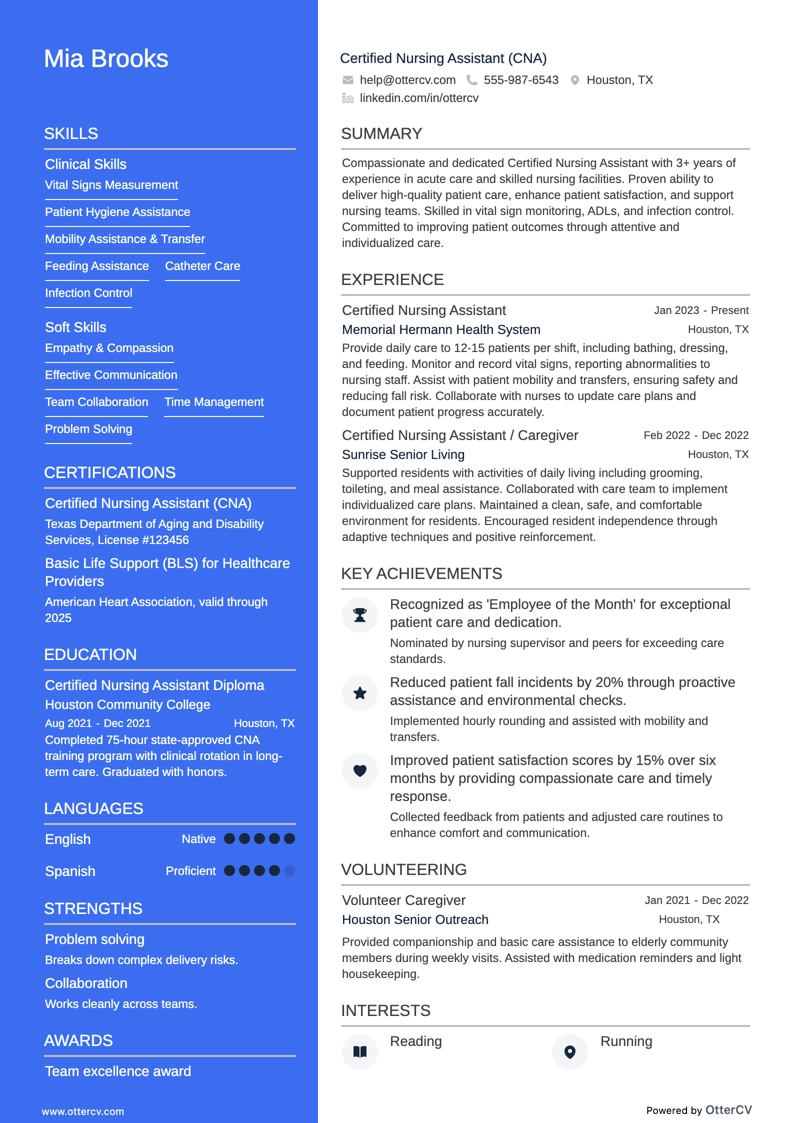
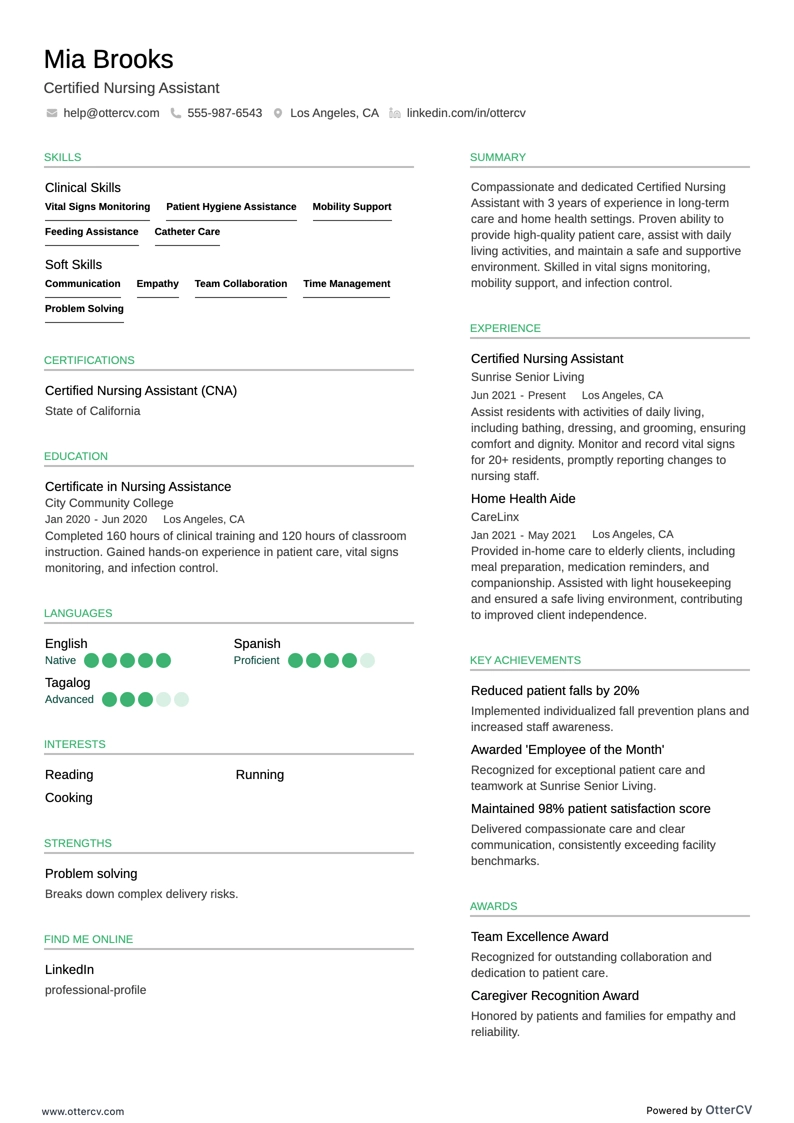
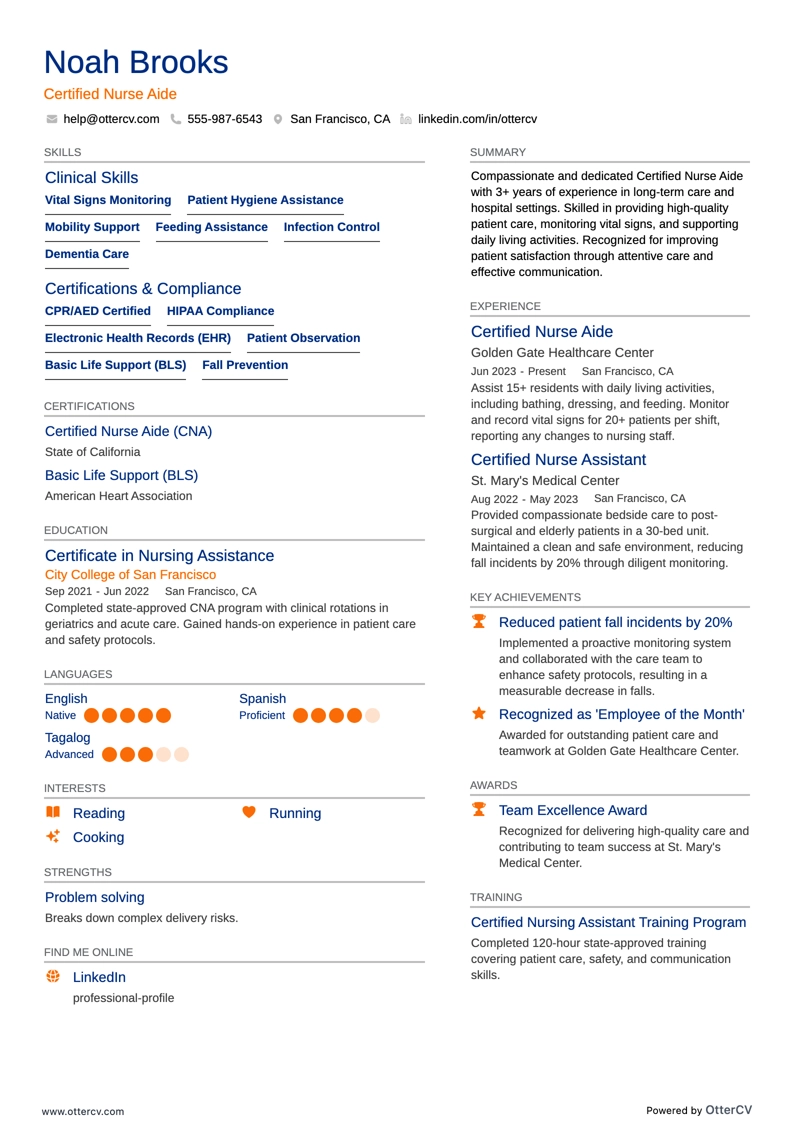
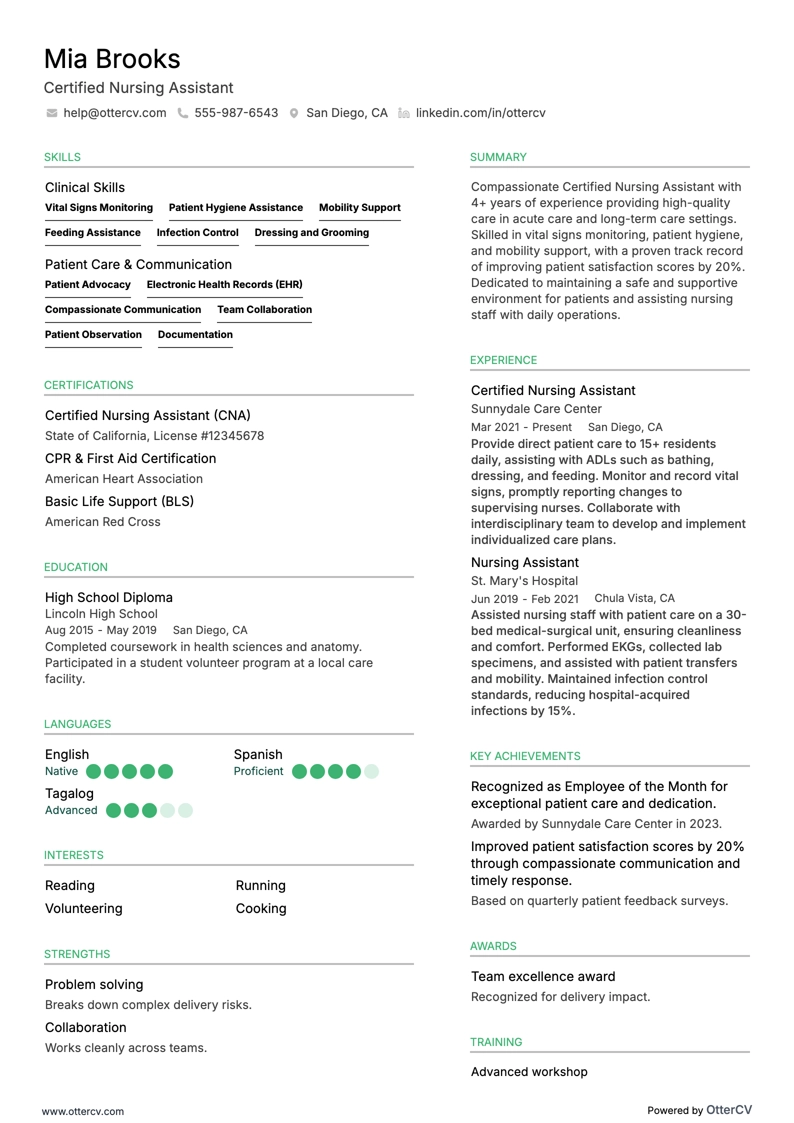
Senior Nursing Assistant full preview

23 Nursing Assistant Resume Examples

OtterCV

Written by The OtterCV Team

Updated: 11/28/2025•8 min read

See all resume examples in this guide, or generate your own resume example with your personalized prompt

Senior Nursing Assistant resume example

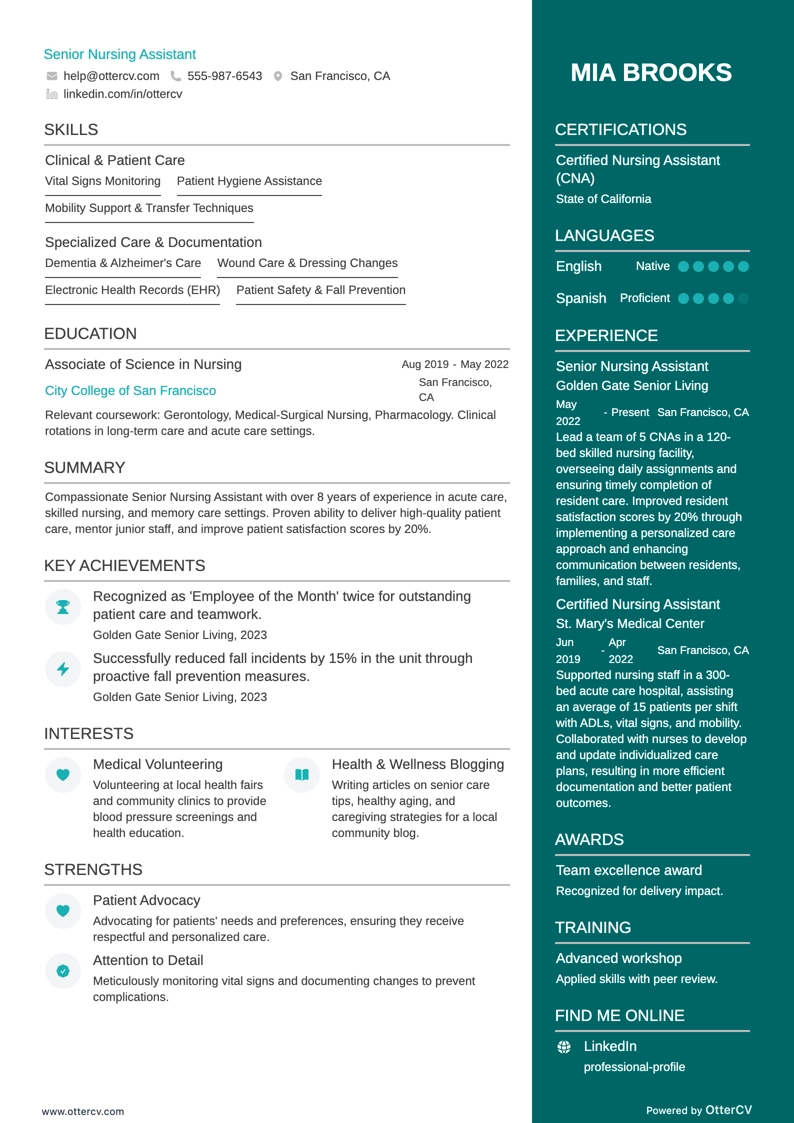
Senior Nursing Assistant

Pediatric Nursing Assistant resume example

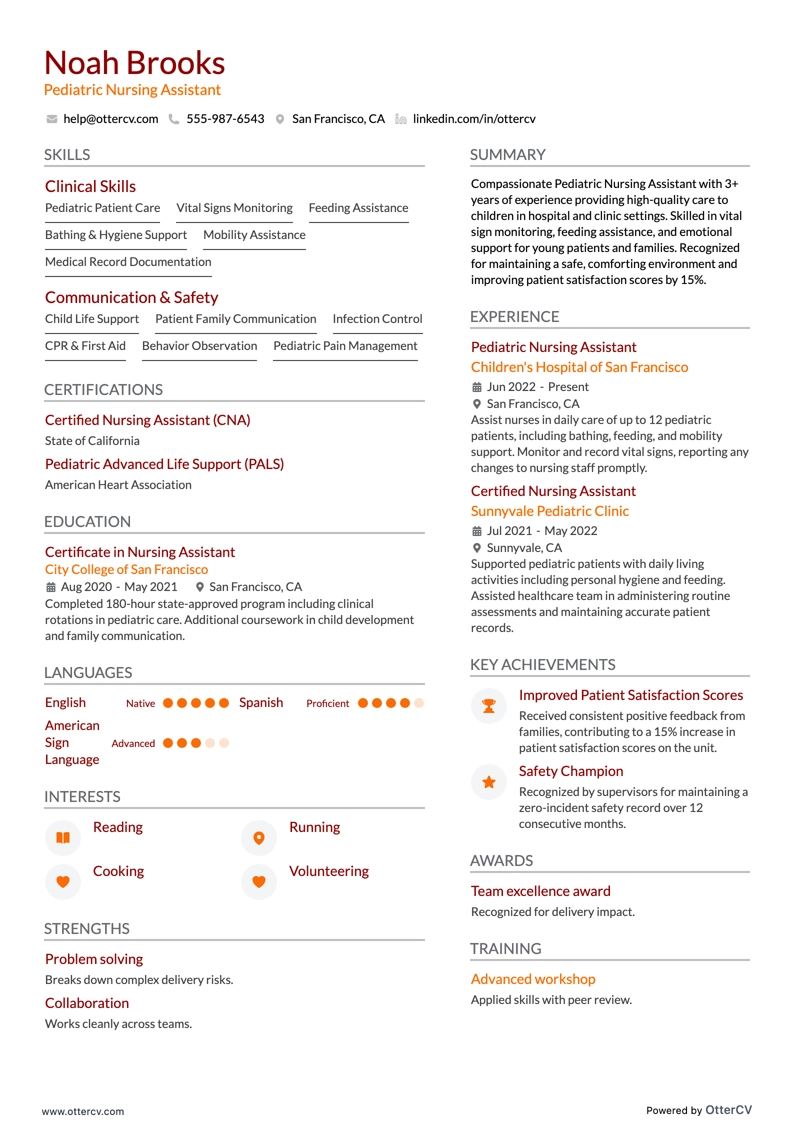
Pediatric Nursing Assistant

State-Tested Nursing Assistant resume example

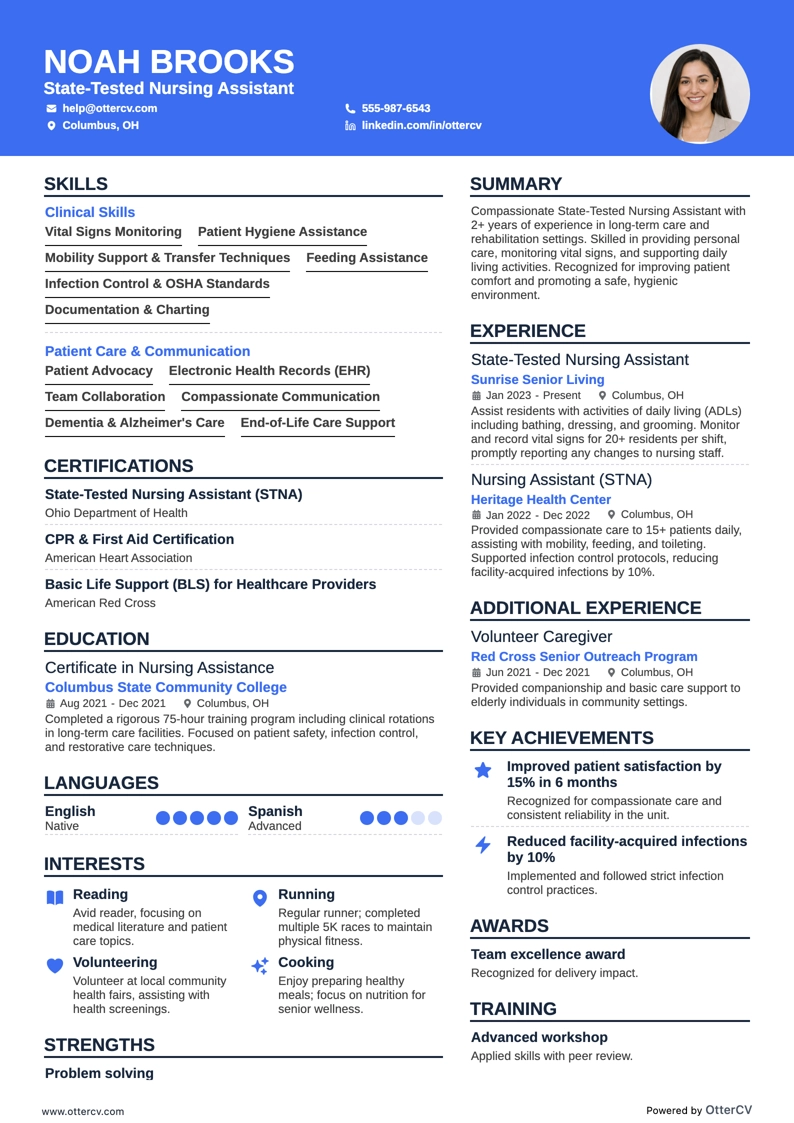
State-Tested Nursing Assistant

Licensed Nursing Assistant resume example

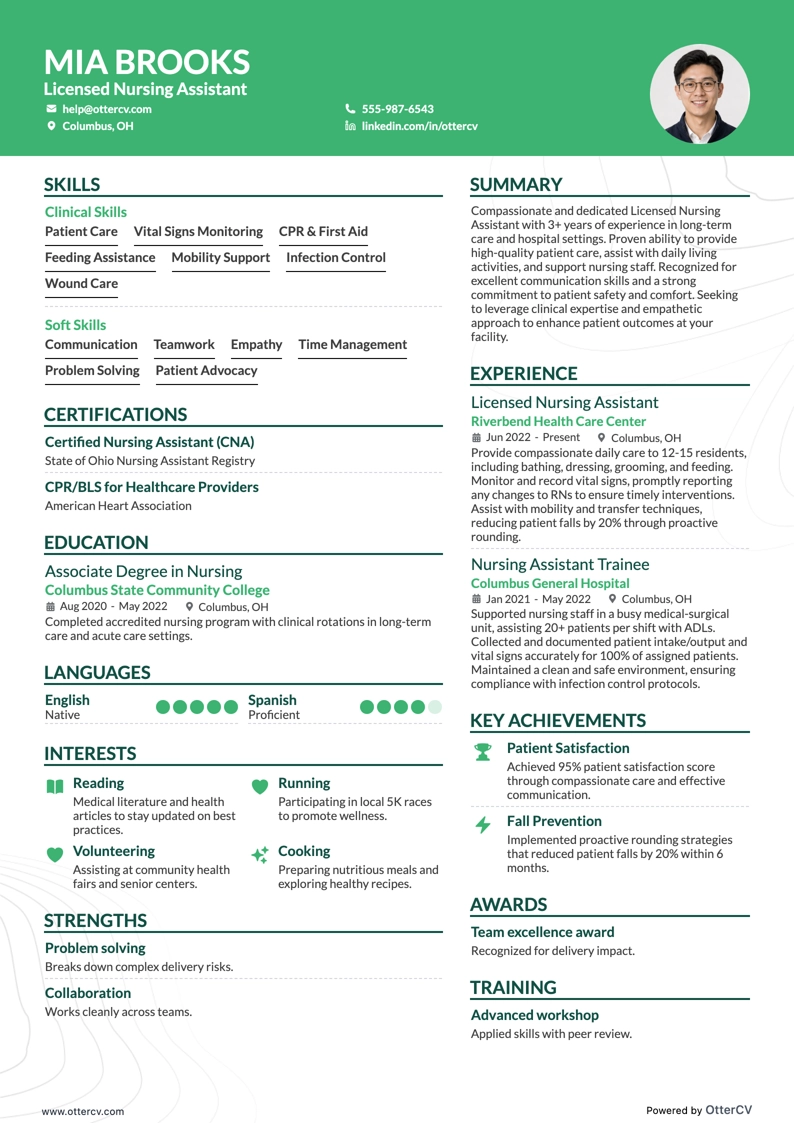
Licensed Nursing Assistant

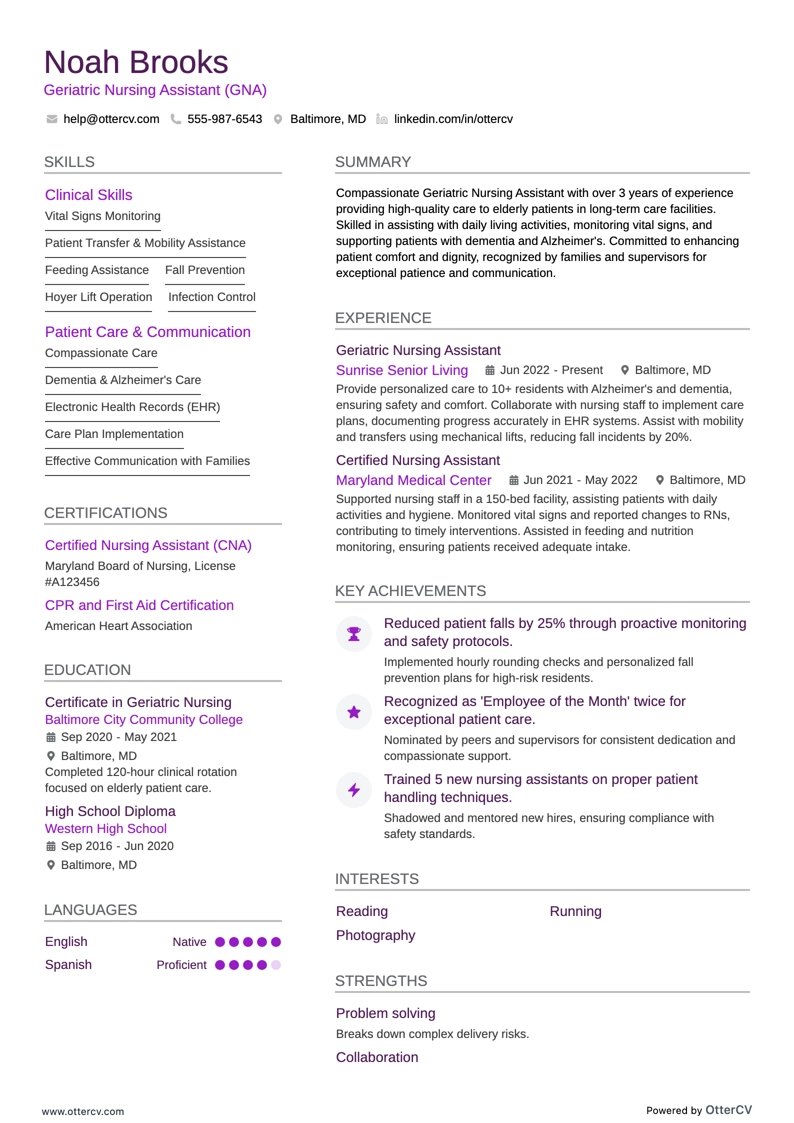
Geriatric Nursing Assistant resume example

Geriatric Nursing Assistant

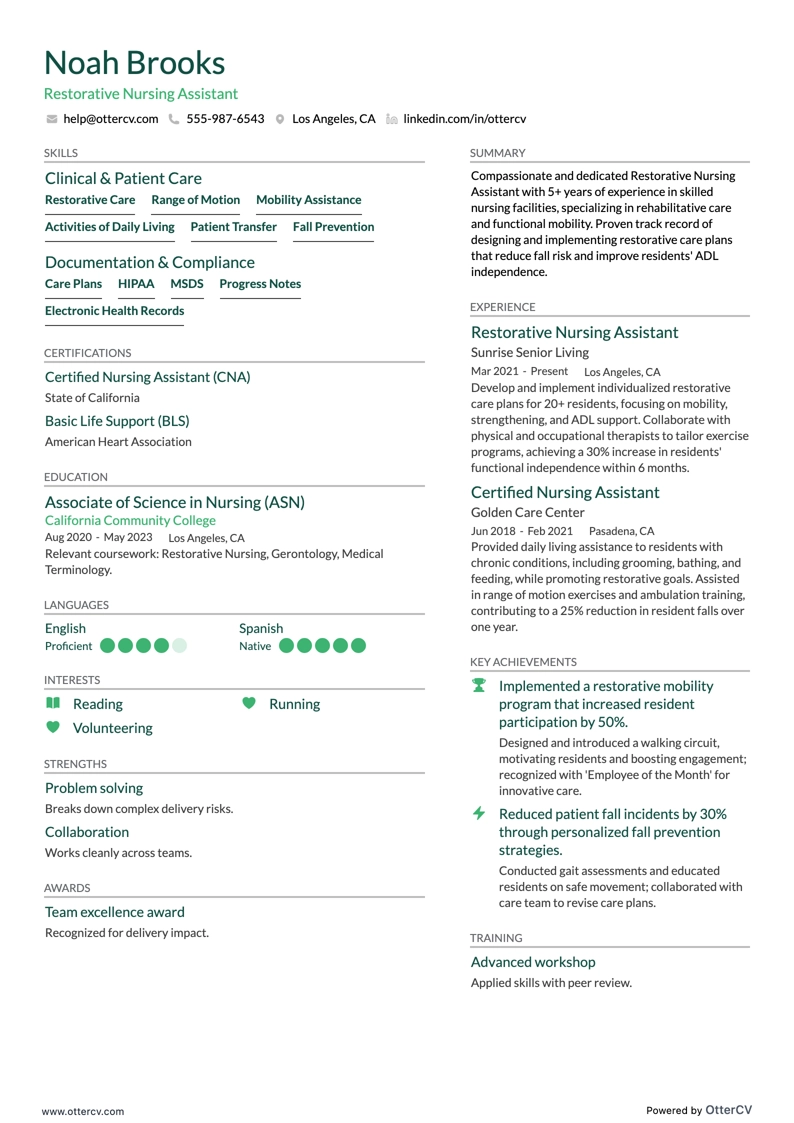
Restorative Nursing Assistant resume example

Restorative Nursing Assistant

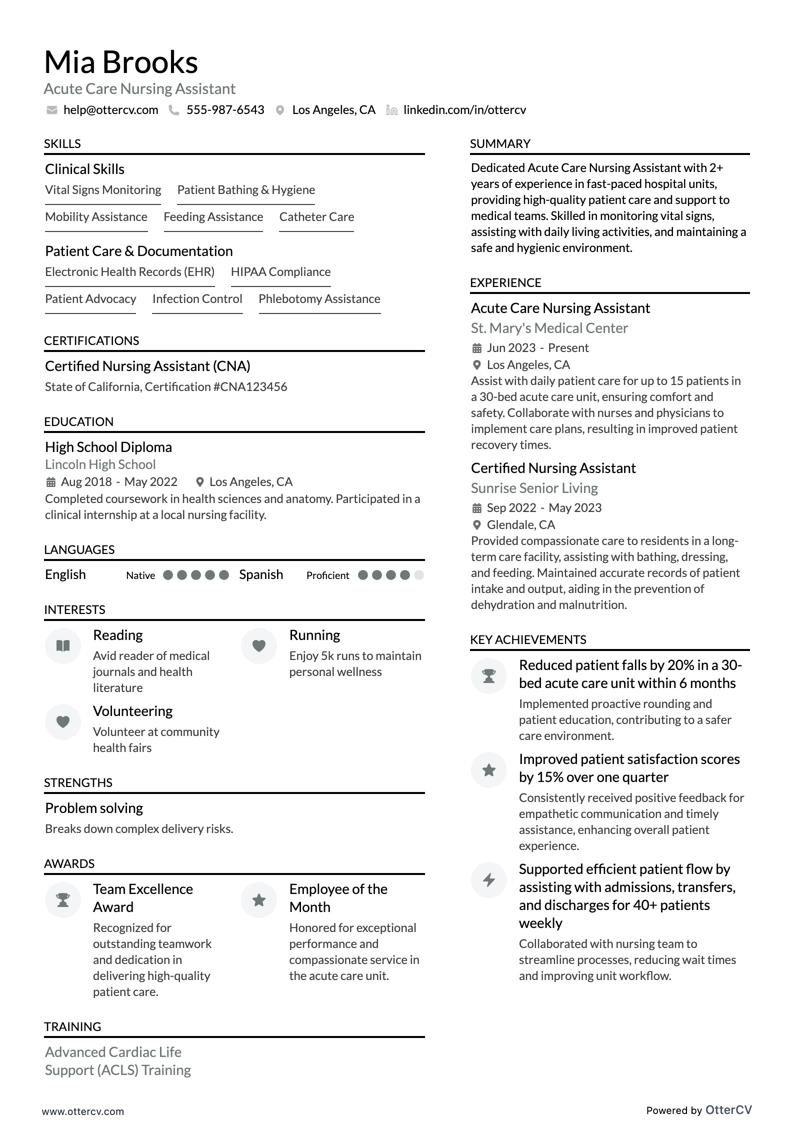
Acute Care Nursing Assistant resume example

Acute Care Nursing Assistant

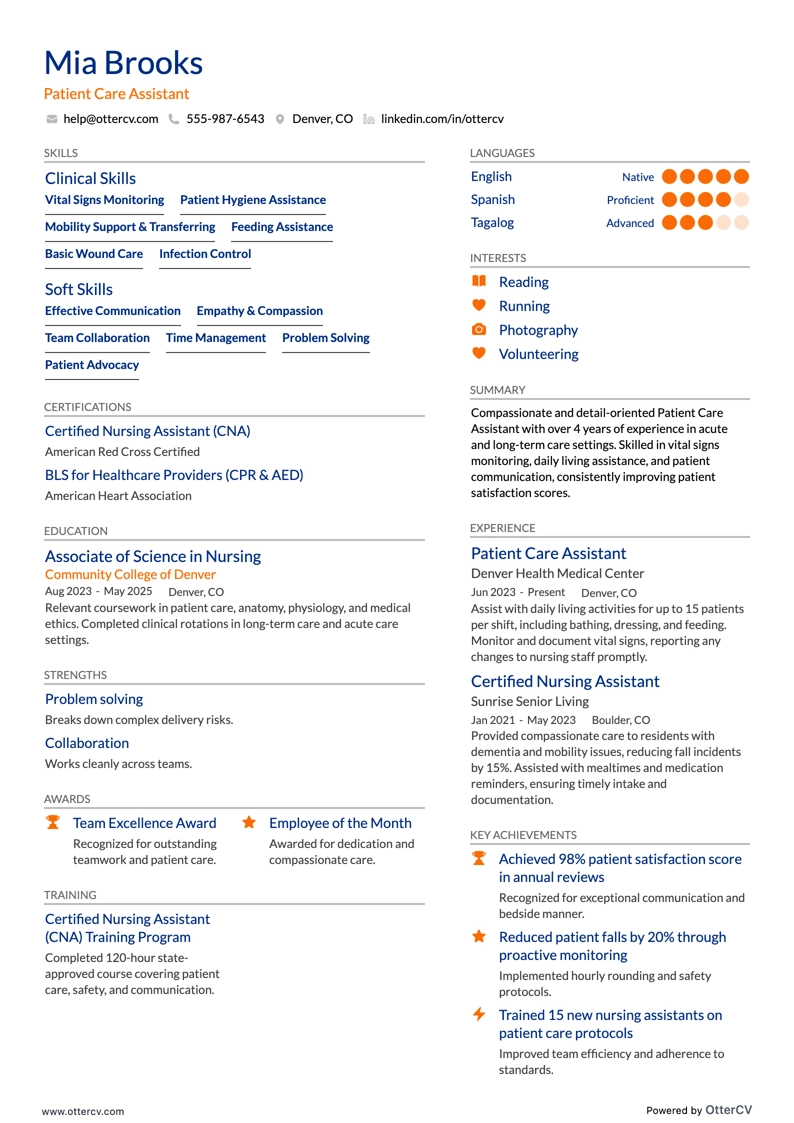
Patient Care Assistant resume example

Patient Care Assistant

Nurse Aide resume example

Nurse Aide

Nursing Assistant resume example

Nursing Assistant

Certified Nurse Aide resume example

Certified Nurse Aide

Certified Nursing Assistant resume example

Certified Nursing Assistant

Many nursing homes and facilities became severely understaffed after the release of new federal requirements, which means many nursing positions are expected to open in the coming months.

If you’re passionate about helping others improve their health and can operate a variety of medical equipment, this could be your opportunity to begin a career as a nursing assistant.

In this guide, we’ll cover:

  • How to choose the best resume format based on your level of experience
  • What to include in your resume header so recruiters understand your qualifications before reviewing your application
  • When and how to write a professional objective or summary
  • How to create an impactful, ATS-compatible (Applicant Tracking System) experience section
  • How to present your professional qualifications and certifications
  • Real nursing assistant resume examples and common writing mistakes to avoid

You may also want to explore these related nursing guides:

How to Format a Nursing Assistant Resume

Writing a clear shift report and building a strong nursing assistant resume both depend on excellent communication and the ability to present important information concisely.

The first step in presenting your skills and expertise effectively is choosing the right resume format. A strong format helps you make the most of your resume by highlighting the most relevant experience and qualifications you have to offer.

Here are the three most common resume layouts and when to use each one.

Reverse-chronological resume format

If you’re an experienced nursing assistant who has worked in a range of healthcare settings, choose the reverse-chronological resume format. Hiring managers want to see how closely your previous roles match the position so they can assess the level of responsibility you may be able to handle.

Because this format emphasizes past positions, it also makes career gaps easier to spot. If you have any gaps, include context that explains how you spent that time, such as other professional commitments or additional nursing training.

Hybrid (combination) resume format

The hybrid resume format offers a balanced view of your practical experience, transferable skills, and expertise. It’s a strong option for candidates with fewer than five years of experience or for people transitioning from a related field. It also works well for roles where you need to highlight both home care and clinical experience, especially when the position involves specialized medical equipment for long-term care patients.

Functional resume format

Your third option is the functional resume format. This layout focuses primarily on relevant skills and qualifications rather than hands-on work experience. For example, if you have a background in customer support, you can emphasize your communication skills and ability to empathize with others. That makes the functional format a good choice for recent college graduates and candidates seeking their first clinical rotation.

Also consider your target market. For example, resumes in Canada follow different layout conventions.

In addition to choosing the right resume format, keep these formatting tips in mind:

  • Add your nursing credentials in the resume header: Health recruiters often look for candidates with specific qualifications. Put your credentials next to your name, contact information, and address so they are easy to spot.
  • Build an ATS-compatible nursing assistant resume: Hiring managers often screen applications with ATS tools. These systems evaluate design, layout, and resume keywords tied to required skills, such as using Electronic health record (EHR) software. Use the wording from the job description when listing your skills.
  • Opt for a readable resume font and a clean design: Choose a simple font, such as Lato or Rubik, so your resume is easy to scan. Stick with a clean, familiar layout that keeps the focus on your achievements and expertise.
  • Use the health organization’s branding colors in your resume: Medical facilities often use colors that convey trust and reflect their services. If you’re applying to a health organization, consider using its branding palette as your resume color scheme.
  • Don’t make your resume longer than necessary: Include only information that is relevant. Be selective about the roles and achievements you highlight, and tailor your experience section to the job description.
  • Save your nursing assistant resume as a PDF file: Unless the job ad says otherwise, save your resume as a PDF to preserve its design and formatting. This helps ensure it displays properly on any device.

After creating a rough draft, divide your resume into sections. Start with the essential ones, then use any extra space for additional sections that show other relevant details about your career.

Below are the must-have sections for your nursing assistant resume:

The top sections on a nursing assistant resume

  • Objective statement: Explain your career goals and how they align with the employer’s needs to show the value you can bring to the healthcare organization.
  • Certifications and licenses: List required qualifications, such as a CNA license, CPR certification, or other nursing-specific credentials.
  • Professional experience: Describe your patient care experience, including where you worked and in what role, to demonstrate your hands-on skills.
  • Skills: Highlight your nursing competencies and include healthcare, patient care, and other relevant skills for easy reference.
  • Education: Include your academic background, especially if it is nursing-related, even if the position only requires a high school diploma or equivalent.

After dividing your resume into sections, identify the key points you need to include in each one.

What recruiters want to see on your resume:

  • Certification or licensure: Recruiters prioritize CNA licenses because they are legally required for nursing assistants in many regions.
  • Direct patient care experience: Recruiters value hands-on experience caring for patients, assisting with routine activities, and responding to patient needs.
  • Knowledge of medical terminology: Understanding medical language helps nursing assistants communicate effectively with healthcare team members.
  • Physical endurance and strength: The role often involves long hours, moving patients, and other physically demanding tasks.
  • Interpersonal and communication skills: Nursing assistants regularly interact with patients, family members, and healthcare staff, so strong people skills are essential.

One wonderful thing about medicine is that people are living longer, healthier lives. However, we also need nurses to care for them.

—Braxton Nowell, UNC Health RN

How to Write Your Nursing Assistant Resume Experience

Generally speaking, the resume experience section is where you summarize your work history, outline your nursing responsibilities, and list your skills. But this simplified view often leads candidates to think they only need to recount tasks and duties. While those details matter, health organizations are more interested in the results your expertise and skills can deliver.

For that reason, one of the best ways to describe your nursing assistant experience is to highlight your career achievements. Doing so helps health recruiters better understand your approach to patient care and the scope of work you can handle.

The relevance of your nursing accomplishments also matters. Hiring managers want to know that you are familiar with the environment you may be working in. If you are applying for a nursing assistant role in a medical facility but most of your background is in home care, you will need to show that you can adapt, multitask, and perform well in a stressful environment.

PRO TIP

Mention the types of patients and conditions you have experience treating to show relevant expertise. When describing your achievements, make sure you protect patient confidentiality and avoid including any sensitive information.

Before filling out your nursing assistant resume template, identify the parts of your work history that are most relevant to the job you want. Then list each role as a separate entry in your experience section.

Use these tips when writing your experience entries:

  • Use the legal name of each past employer: Health recruiters often verify employers carefully, since reputation matters in healthcare. They may check whether a former employer was sanctioned for medical malpractice, especially during your time there.
  • Include your subspecialty when relevant: If you want to join a specific hospital unit, mention your subspecialty. Recruiters often prioritize candidates with focused medical knowledge.
  • Briefly explain your employer’s medical focus: If you are applying to a health organization, you may need to work across teams and support a wide range of specialists and patients. It helps to mention the main health services you have worked with.
  • List your dates of employment: Include the month and year for both the start and end date, for example, “May, 2024.” If you still work there, use “Present” as the end date.
  • Match your experience to the employer: Many health organizations are committed to a particular standard of care or to addressing specific health issues. Show how your nursing assistant experience aligns with the mission and medical community they support.
  • Show your career growth: Instead of only listing daily duties, include one or two achievements for each role to show the results of your work. To make your accomplishments stand out, begin each bullet point with an action verb.
  • Build a targeted resume: An effective resume is tailored to the specific role. That means reflecting the required skills and expertise from the job ad. A practical way to do this is to note resume keywords from the description, such as tools and medical equipment, and include them in your experience entries.

Now, take a look at the following bad example:

Experience

Nursing Assistant

Kettering Health Springfield

06/2022 - 02/2024 · Springfield, OH

www.example.com

A faith-based medical center offering a variety of health services, including routine screenings and complex surgical procedures.

  • Improved the health rate of over 380 patients.
  • Increased patient satisfaction rates.
  • Helped 1150+ patients regain mobility by providing post-operative care and physical therapy assistance.
WRONG

The applicant does a good job describing their previous employer, but the rest of the entry leaves out important details about their tenure and accomplishments.

Although the candidate includes the number of patients treated, they do not explain what types of patients or conditions they have experience with. They also mention some data, but key metrics such as patient satisfaction rate are missing. In addition, none of the entries show whether the candidate is skilled in operating medical equipment.

An improved version of the example above would be:

Experience

Nursing Assistant, Brain and Spine Care Unit

Kettering Health Springfield

06/2022 - 02/2024 | Springfield, OH

www.example.com

A faith-based medical center offering a variety of health services, including routine screening and complex surgical procedures.

  • Improved the health rate of over 380 patients by 75% by establishing care plans for stroke patients with limited or impaired mobility.
  • Increased patient satisfaction rates by 52% by mentoring new nurses on effective communication with patients and their families.
  • Helped 1150+ patients regain mobility by providing post-operative care and physical therapy assistance using equipment such as the RT300, the Bioness Integrated Therapy System, and the Vector Gait & Safety System.
RIGHT

This edit works because the candidate added the missing details, including the types of patients they treat, specific measurable outcomes that show their performance as a nursing assistant, and the medical equipment they know how to operate.

How to quantify impact on your resume

Hiring managers value candidates who are goal-oriented and detail-focused because job performance and results are directly connected to patients’ overall health.

Medical organizations and private employers want nursing assistants who prioritize patient well-being above other performance indicators. By quantifying your achievements and sharing measurable results, you can show that you communicate effectively with patients, think critically, and provide emotional support when needed.

The numbers you include will depend on your experience level and years in the field. Here are some ways to do it:

  • Include the number of patients you cared for regularly: This shows your ability to manage workload, use your time effectively, and maintain quality care.
  • Specify the number of shifts you took per week: Frequently taking extra shifts highlights dedication and commitment.
  • Detail how many types of medical equipment you are proficient with: This shows versatility and the ability to adapt to different care situations.
  • Indicate the percentage of patient satisfaction or feedback received: This gives a tangible measure of the quality of care you provide.
  • Mention whether you trained or mentored new nursing assistants and how many: This showcases leadership and coaching ability.
  • Provide the number of emergency situations you handled: This demonstrates that you can stay calm and effective under pressure.
  • State the number of languages you speak fluently: This shows cultural competency and can improve patient communication and satisfaction.
  • List how many care plans you contributed to or implemented: This reflects your knowledge of planning and delivering comprehensive patient care.

How do I write a nursing assistant resume with no experience

Writing a nursing assistant resume with no experience can be challenging, especially if you need to describe patient care responsibilities or your ability to use certain medical equipment. In many cases, most of your practical exposure may come from shadowing other nurses.

You can still include that on your resume. Even if it is not direct hands-on experience, recruiters will recognize your initiative to learn in a real work setting and improve your skills. It also shows commitment to the nursing profession.

You should also research the health organization you are applying to. Many medical facilities face broader challenges beyond day-to-day tasks. Learn about the organization’s main medical services and the types of patients it treats most often, then align your profile with the expertise they are seeking.

Once you understand the employer’s goals and priorities, connect them to your:

  • Clinical rotations: Highlight your knowledge of the standards and protocols required in a medical environment. Emphasize your ability to follow guidance from medical specialists, implement treatment, and listen actively to patients.
  • Certifications and supplementary training: Show the breadth of your expertise and your ongoing effort to grow as a nursing assistant. If your training earned you specific qualifications, list them next to your name in the resume header.
  • Transferable skills: Social skills are just as important as medical competencies in this role. Recruiters want candidates who can empathize with patients and treat them with respect.

Next, we’ll look more closely at how to present your abilities and core nursing skills.

How to List Your Hard Skills and Soft Skills on Your Resume

Because the job is complex, your nursing assistant resume should highlight different sides of your abilities and character in the skills section.

A common mistake is listing every skill you have, which can overcrowd your resume. The better approach is to focus on the specific requirements in the job ad.

First, it helps to understand how nursing skills are usually grouped so you can build a balanced skills section.

Hard vs soft skills

Your professional skills generally fall into two categories:

  • Nursing assistant hard skills: Also called technical skills, these include knowledge of medical terminology, the ability to use measuring equipment, and providing postoperative patient care.
  • Nursing assistant soft skills: These reflect emotional intelligence and include abilities such as time management, multitasking, and showing compassion to patients and their family members.

If you try to include every skill, your skills section can become too long. You do not need to do that to impress recruiters. Instead, aim to create a balanced and well-rounded picture of your abilities.

To do this:

  • Re-read your resume, especially the experience and education sections.
  • Check whether you have already mentioned any of the skills listed in the job ad.
  • Note the skills you have not addressed yet and add those to your skills section. Do not list more than 10 skills, so your resume stays clear and focused.
  • Explain how you gained your skills by referring to achievements and certificates you have earned.

If the job description does not include a complete list of required skills, return to your research on the health facility. If the ad mentions the organization’s medical services or the nursing assistant subspecialty they want, align your skills section with that information.

We’ve also compiled two lists of popular social and technical skills for nursing assistants. If any are missing from your resume, include them in your skills section.

Best hard skills for your nursing assistant resume

  • Basic nursing skills.
  • Patient transfers.
  • Wound dressing.
  • Infection control.
  • Vital signs measurement.
  • Catheter care.
  • Electronic health record (EHR) software.
  • Microsoft Office.
  • Patient bathing.
  • Medical equipment operation.
  • CPR.
  • Medical terminology.
  • Feeding assistance.
  • Tracheostomy care.
  • Medication administration.
  • Blood glucose monitoring.
  • Therapeutic techniques.
  • Physical therapy assistance.
  • Post-operative care.
  • Bedpan changes.

How to List Your Certifications and Education on Your Resume

As mentioned earlier, healthcare recruiters are often very specific about the nursing assistant qualifications they expect from candidates. That is why presenting your education section clearly is just as important as outlining your work history.

Formal education

How much detail you include in your education section depends on your level of practical experience. If you are a recent graduate, include the following:

  • Your degree name and any qualifications you have earned.
  • The name of the academic institution and its location.
  • The start and end dates of your course. If you are still in training, include the expected graduation date.
  • One of your strongest academic achievements, such as relevant coursework.
  • Majors and minors that directly relate to the required subspecialty.

Here is what an ideal education section looks like:

Education

Associate of Applied Science in Nursing (AAS-N)
Ohio University, School of Nursing
06/2021 - 10/2023
GPA: 3.60 / 4.0

  • Researched and presented on common misconceptions in nursing related to commonly administered drugs in the Journal of Clinical Nursing.
  • Majored in Medical Surgical Nursing, Principles of Human Anatomy and Physiology, and Pharmacology.
RIGHT

If you have more than four years of clinical experience, you can leave out details about your academic focus and earlier work. Instead, focus on the additional training you completed after graduation.

You can do this by listing your qualifications and certifications. Here is a simple way to present them.

Certificates

Listing certifications on your resume is straightforward. Be sure to:

  • Select the credentials most relevant to the position.
  • Check each certificate’s validity date and current status. Health recruiters need to confirm that you are eligible to practice in the jurisdiction named in the job ad and that your credentials are in good standing with the relevant Board of Health.
  • Arrange them by relevance, starting with the most important certificate.
  • State the qualification granted upon completion of the training.
  • Include the issuing institution and the date you received the certificate.

Like so:

Certification

Critical Nursing Assistant (CNA)
Ohio Board of Nursing, 2022

RIGHT

How to Write Your Nursing Assistant Resume Summary Or Objective

Finally, don’t neglect to explain what motivates you to pursue the role by writing a strong resume profile. This short paragraph, usually no more than 100 words at the top of your resume, gives employers a quick overview of your accomplishments and top skills.

There are two main types of resume profiles, and the right one depends on your level of clinical experience.

If you’re a tenured nursing assistant with more than five years of experience, use a resume summary. This type of profile should focus on:

  • Career achievements: Include at least one accomplishment that shows the value you bring as a nursing assistant.
  • Subspecialty and specific training: Mention two or three key technical nursing skills that align your background with the position.
  • Type of patients you have experience treating: Describe your patient care experience to show how you developed your strongest nursing skills.

If you’re new to the field, write a resume objective instead. While it is similar in structure to a summary, it should focus on:

  • Potential value as a nursing assistant: Since you may not have an established track record yet, emphasize the benefits your work can bring.
  • Clinical rotations you’ve completed: Hiring managers value clinical and shadowing experience because familiarity with medical equipment and the work environment is important for the role.
  • Academic background: Mention your qualifications to round out your profile and show that your abilities meet current nursing standards.

Let’s illustrate the differences with a few examples.

First, have a look at the sample below:

Objective

AAS-N with 2 years of experience seeking to join Mercy Health Medical Center's team. Achieved a 49% increase in health rate improvement at Kettering Health Springfield. Proficient in blood glucose monitoring, infection control, and medication administration.

WRONG

Although the candidate tries to appeal to the healthcare organization by naming the exact role they want, this nursing assistant resume objective is unlikely to impress recruiters.

The main problem is that it does not explain the applicant’s achievements or skills clearly enough. It fails to show how those accomplishments were earned or how the candidate developed their abilities.

The applicant should also avoid using field-specific abbreviations, since not every hiring manager will recognize them. To prevent ambiguity, write out the full names of your degree and qualifications.

Here is how to improve the paragraph:

Objective

Associate of Applied Science in Nursing (AAS-N) with 2 years of residency experience in hospital and clinical settings, seeking to join Mercy Health Medical Center. Achieved a 49% increase in health rate improvement by establishing comprehensive care plans for diabetic patients at Kettering Health Springfield. Proficient in blood glucose monitoring, infection control, and medication administration.

RIGHT

This version is stronger because it explains the candidate’s clinical experience and clarifies what their work involved during residency. It also connects the applicant’s technical skills to that clinical background.

Now, take a look at the following example:

Summary

Nursing Assistant with 6 years of experience supporting surgical and intensive care units, seeking to join Kettering Health Springfield's Maternity Ward. Specialized in wound dressing and infection control. CCRN.

WRONG

The nursing assistant resume summary above is unlikely to attract recruiters because it does not clearly explain the applicant’s subspecialty or qualifications. As a result, it does not provide strong support for the candidate’s application for a role in the facility’s maternity ward.

The applicant also misses an opportunity to match relevant resume keywords by spelling out the full name of the certificate.

An improved version of the summary would be:

Summary

Nursing Assistant (Labor and Delivery) with 6 years of experience supporting surgical and intensive care units, seeking to join Kettering Health Springfield's Maternity Ward. At Mercy Health Medical Center, improved patient satisfaction by 67% through personal hygiene and mobility assistance, along with emotional and physical support during active labor. Specialized in wound dressing and infection control. Certified Critical Care Registered Nurse (CCRN) (Neonatal).

RIGHT

This profile clearly explains why the candidate is qualified to join the health organization’s maternity ward by highlighting:

  • Pertinent achievements
  • Relevant hard and soft skills
  • Supplementary subspecialty training

Additional Sections for a Nursing Assistant Resume

  • Volunteering experience : Relevant clinical experience doesn’t only come from residencies and rotations. Volunteering at a health-related event, such as a blood donation drive, can show your commitment to the role and your willingness to strengthen your patient care skills.

  • Publications and research : If your background is more academic, describe your specific medical focus. This helps hiring managers understand what drives your interest in nursing and how you want to grow as a medical specialist.

  • Non-medical training and courses : Depending on the patients you’ll be treating, some non-nursing education may still be valuable to an employer. For example, if you want to work as a nursing assistant at a children’s summer camp, specialized search and rescue medical training could make you a top contender.

  • Language skills : Patients come from all walks of life. Recruiters often prefer candidates who know foreign languages or American Sign Language (ASL) because they may be better prepared to understand patient needs and provide appropriate care.

  • Choose a resume format that best represents your experience and expertise.

  • List your nursing assistant qualifications next to your name in the resume header.

  • Write a resume summary or objective that explains how your skills relate to the role.

  • Describe the range of medical services your past employers provide when outlining prior roles.

  • Explain what experience you gained during your tenure and what your approach to patient care is.

  • Quantify your achievements to show the impact of your work.

  • Don’t include more than 10 skills in your talent section to avoid overcrowding your resume.

  • Arrange your degrees and certificates in order of relevancy.

Nursing Assistant resume examples

Explore additional Nursing Assistant resume samples and guides and see what works for your level of experience or role.

By Experience

Senior Nursing Assistant

Senior Nursing Assistant resume preview

Nursing Assistant resume examples

Explore additional Nursing Assistant resume samples and guides and see what works for your level of experience or role.

By Role

Pediatric Nursing Assistant

Pediatric Nursing Assistant resume preview

State-Tested Nursing Assistant

State-Tested Nursing Assistant resume preview

Licensed Nursing Assistant

Licensed Nursing Assistant resume preview

Geriatric Nursing Assistant

Geriatric Nursing Assistant resume preview

Restorative Nursing Assistant

Restorative Nursing Assistant resume preview

Acute Care Nursing Assistant

Acute Care Nursing Assistant resume preview

Patient Care Assistant

Patient Care Assistant resume preview

Nurse Aide

Nurse Aide resume preview

Nursing Assistant

Nursing Assistant resume preview

Certified Nurse Aide

Certified Nurse Aide resume preview

Certified Nursing Assistant

Certified Nursing Assistant resume preview