Senior Music Director full preview

10 Music Director Resume Examples

OtterCV

Written by The OtterCV Team

Updated: 7/20/2025•8 min read

See all resume examples in this guide, or generate your own resume example with your personalized prompt

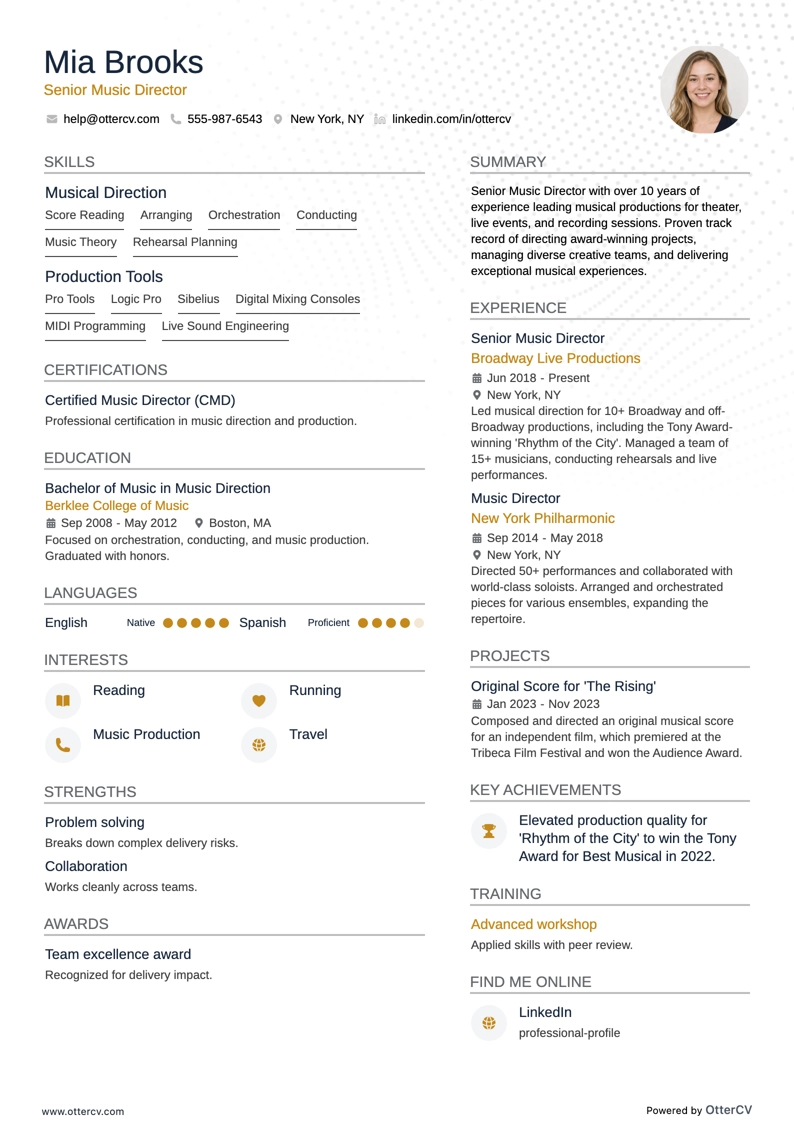
Senior Music Director resume example

Senior Music Director

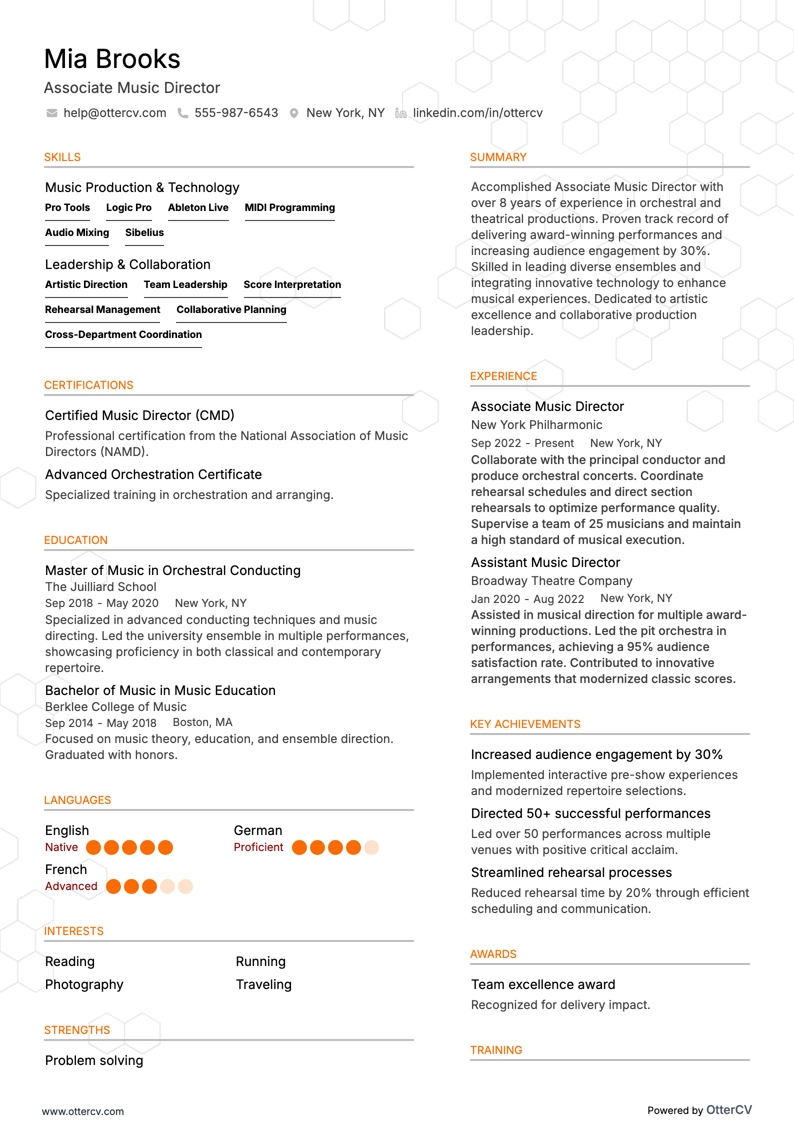
Associate Music Director resume example

Associate Music Director

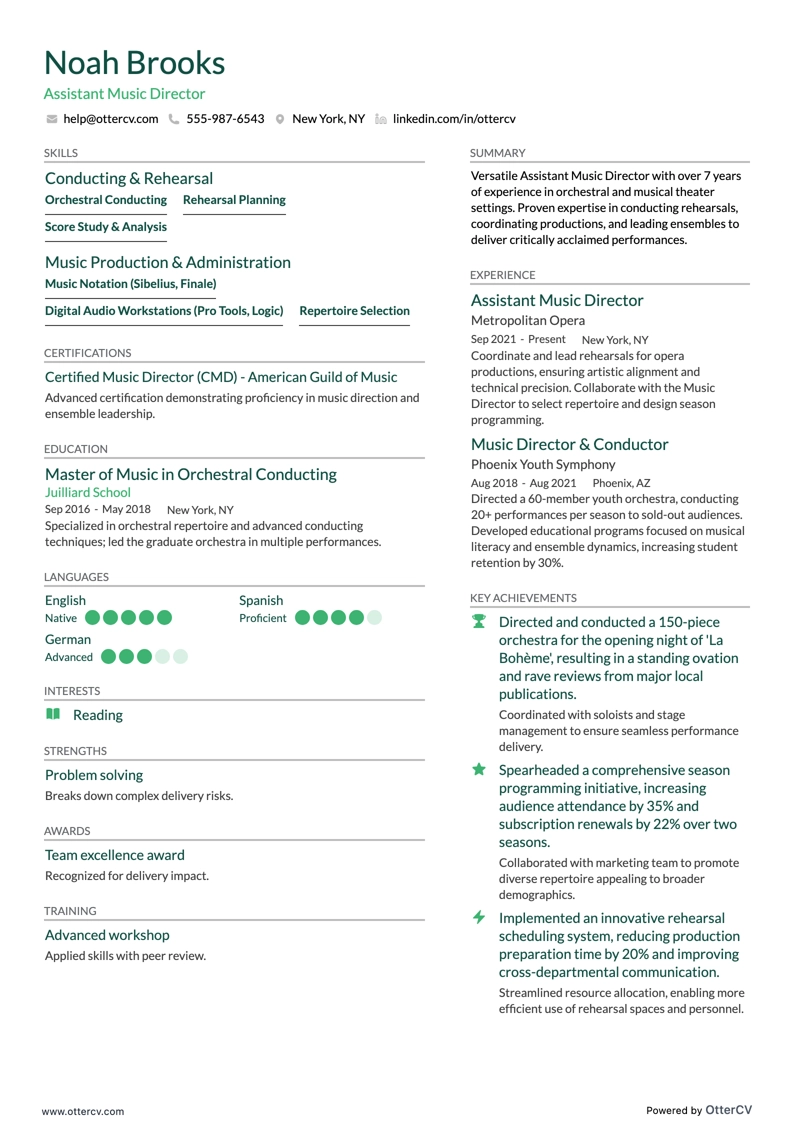
Assistant Music Director resume example

Assistant Music Director

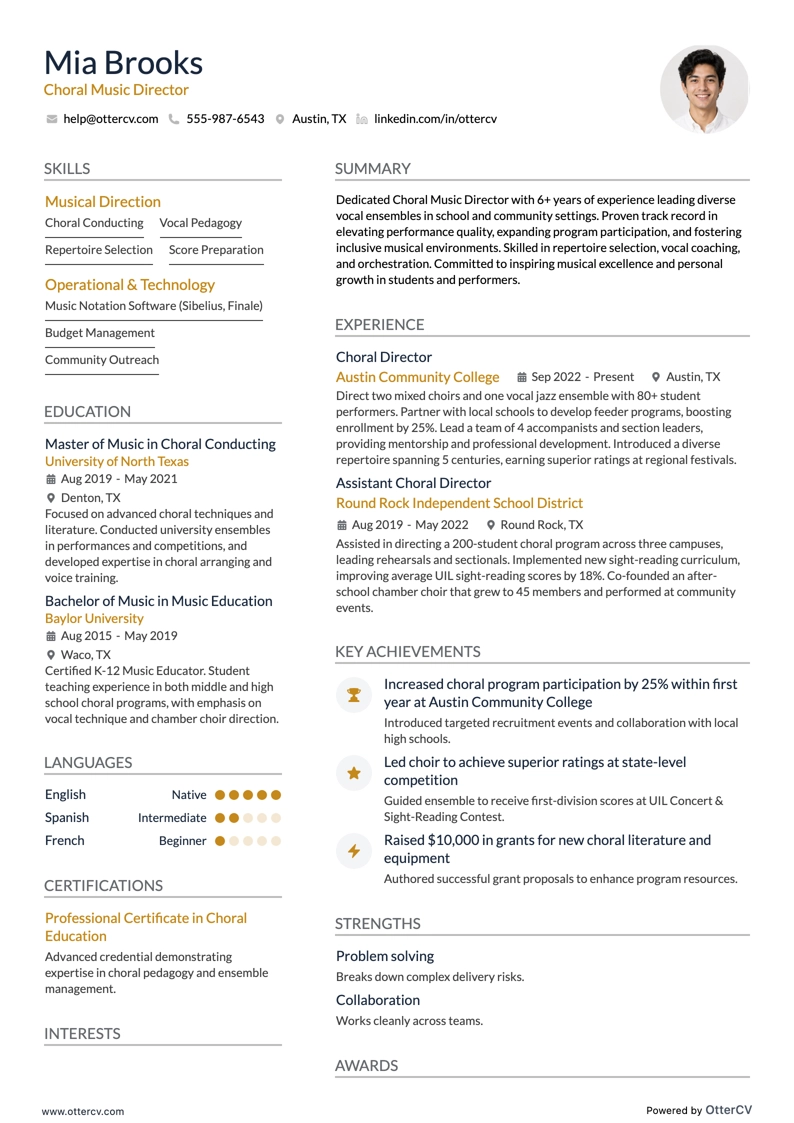
Choral Music Director resume example

Choral Music Director

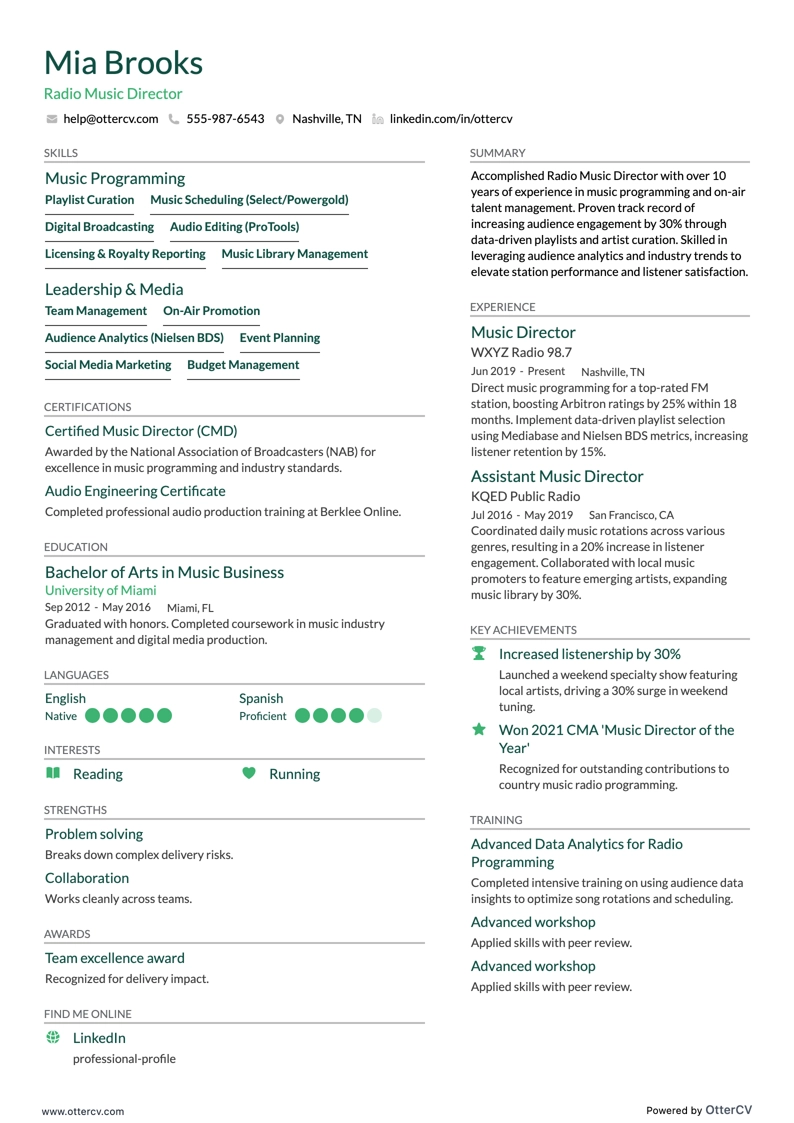
Radio Music Director resume example

Radio Music Director

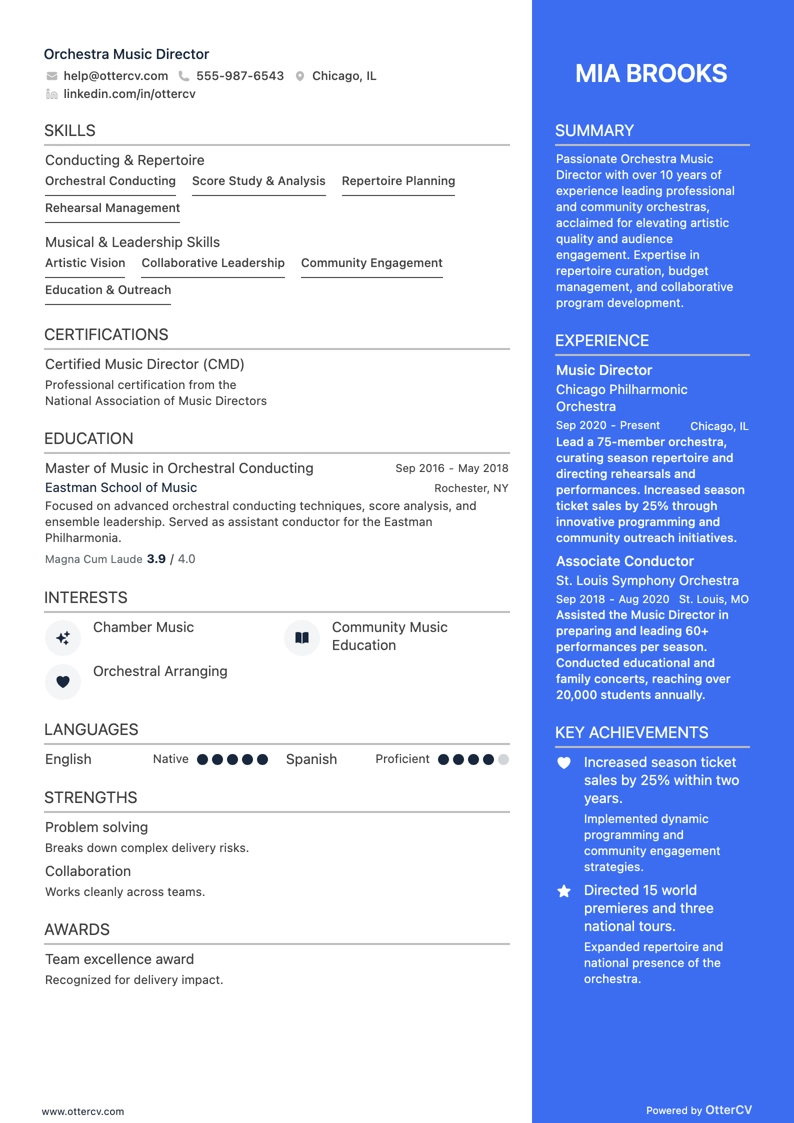
Orchestra Music Director resume example

Orchestra Music Director

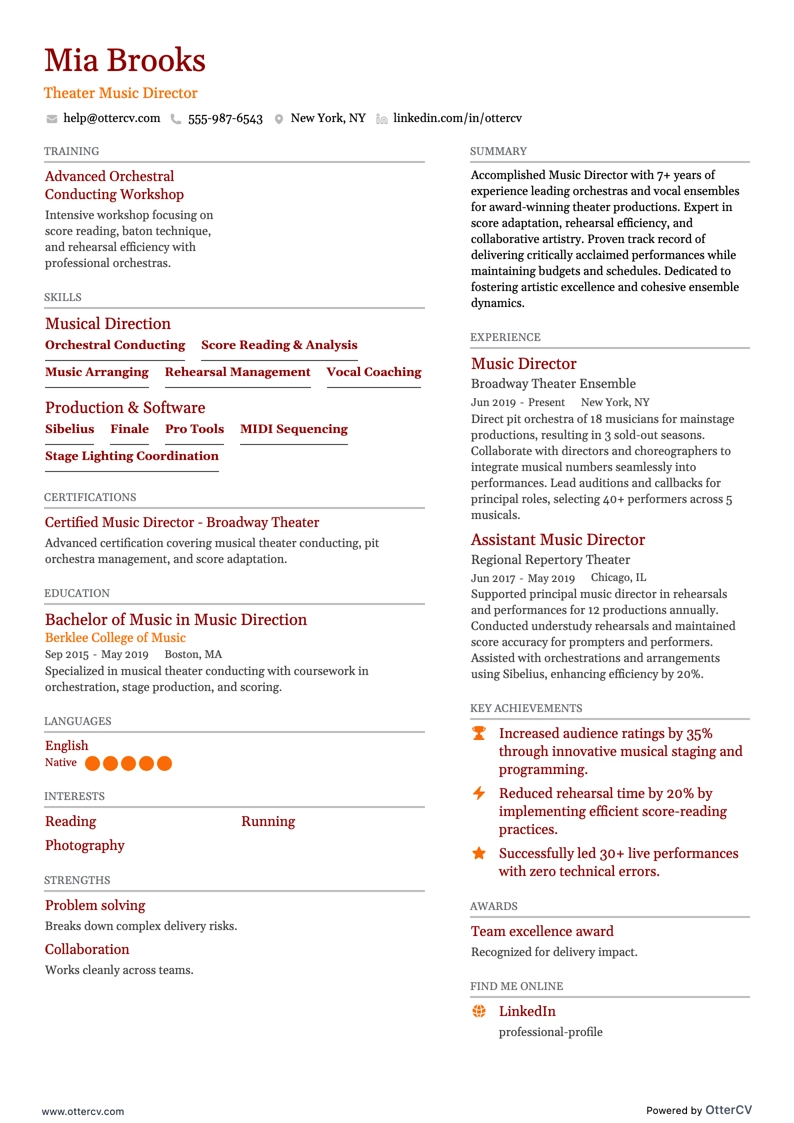
Theater Music Director resume example

Theater Music Director

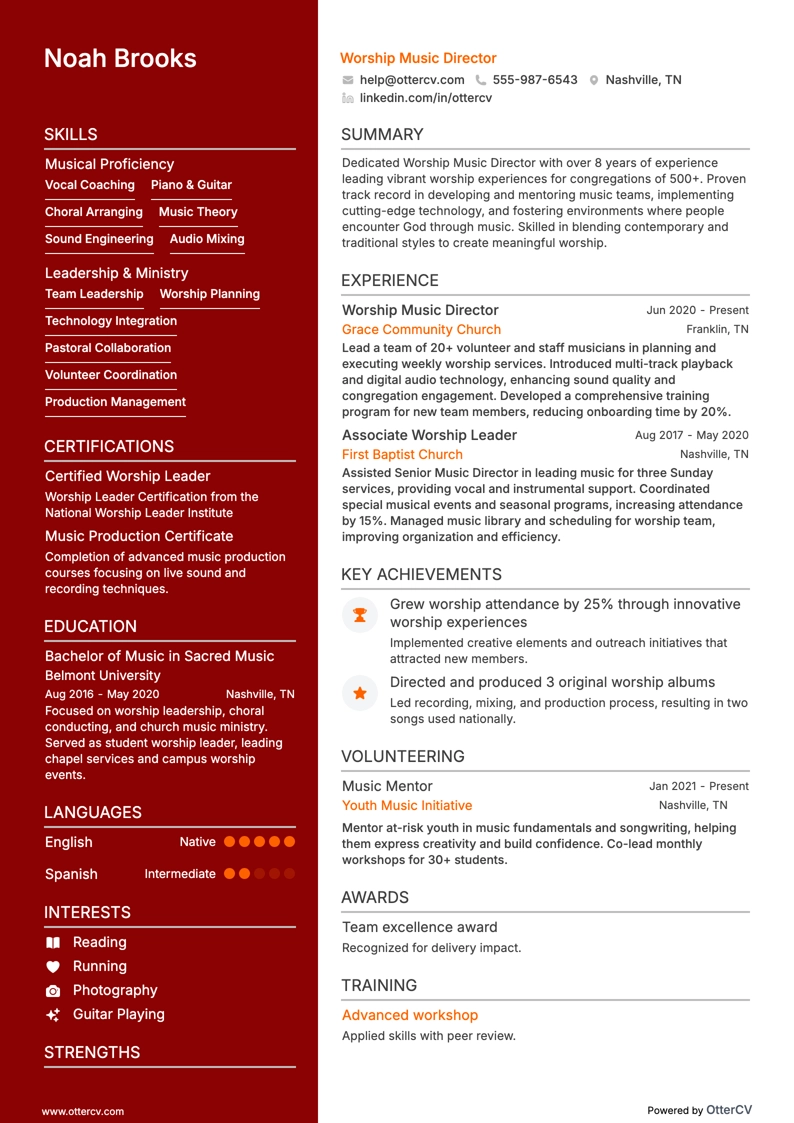
Worship Music Director resume example

Worship Music Director

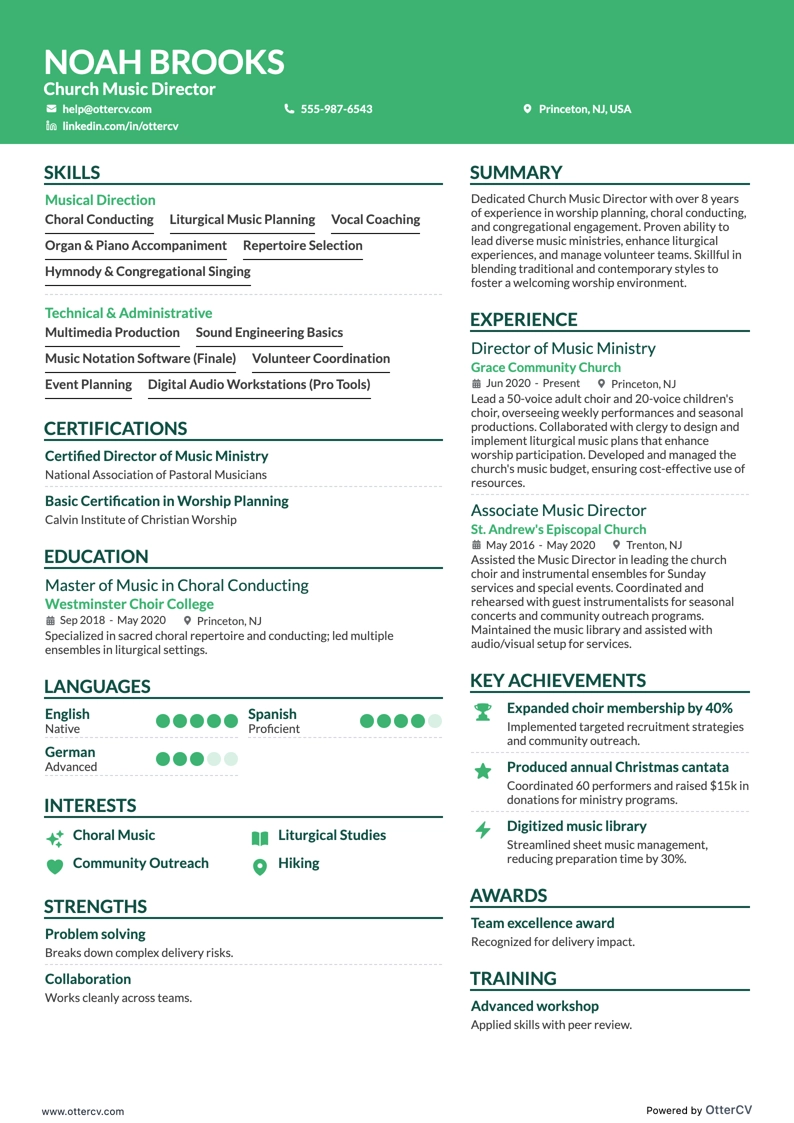
Church Music Director resume example

Church Music Director

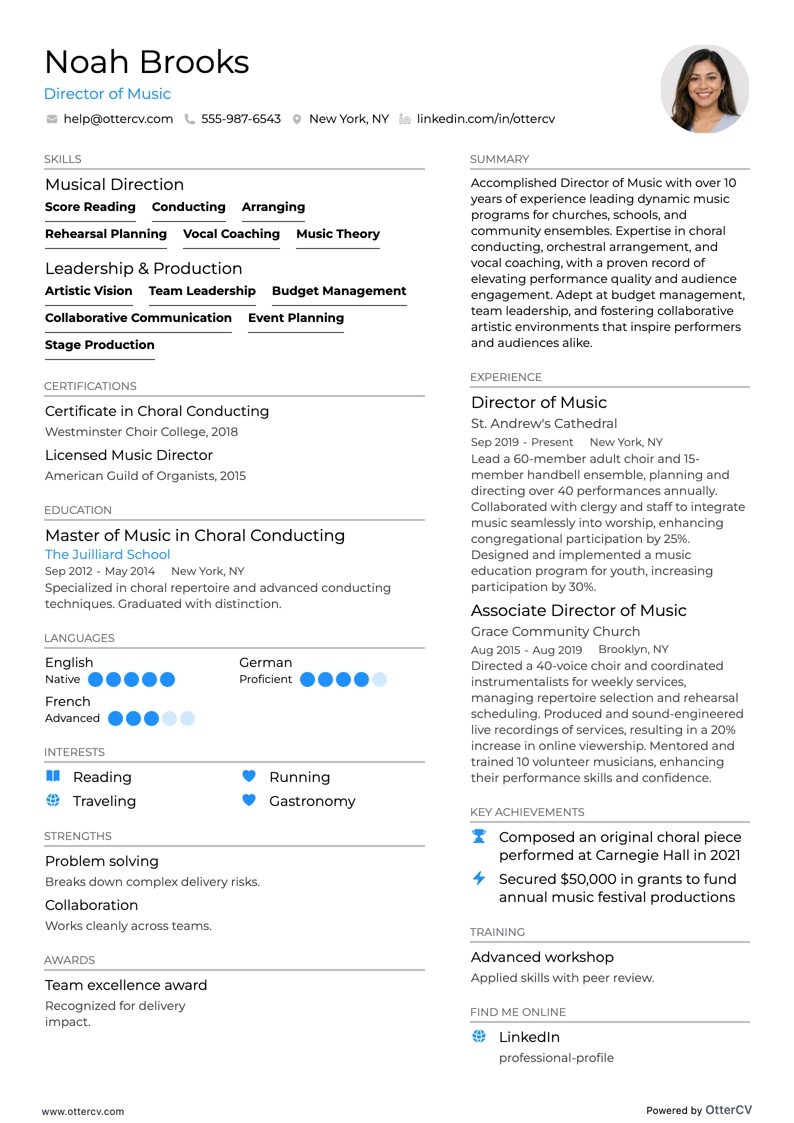
Director of Music resume example

Director of Music

Musical Director resume example

Musical Director

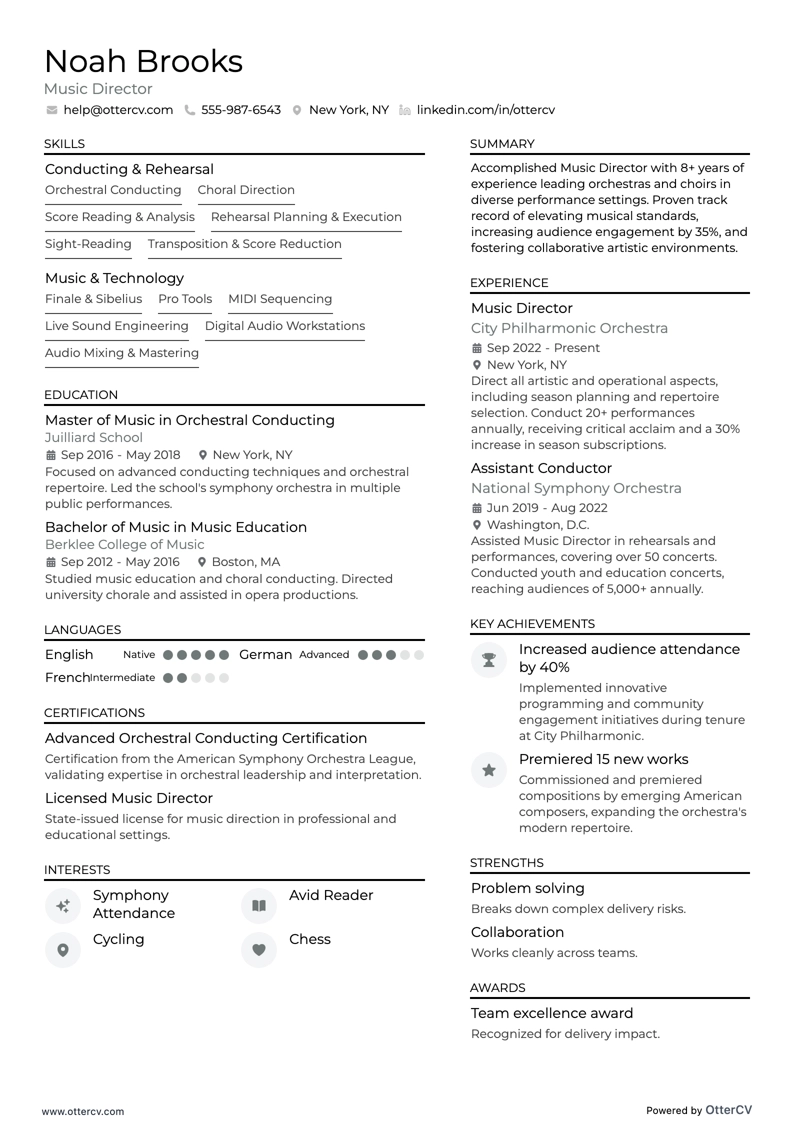
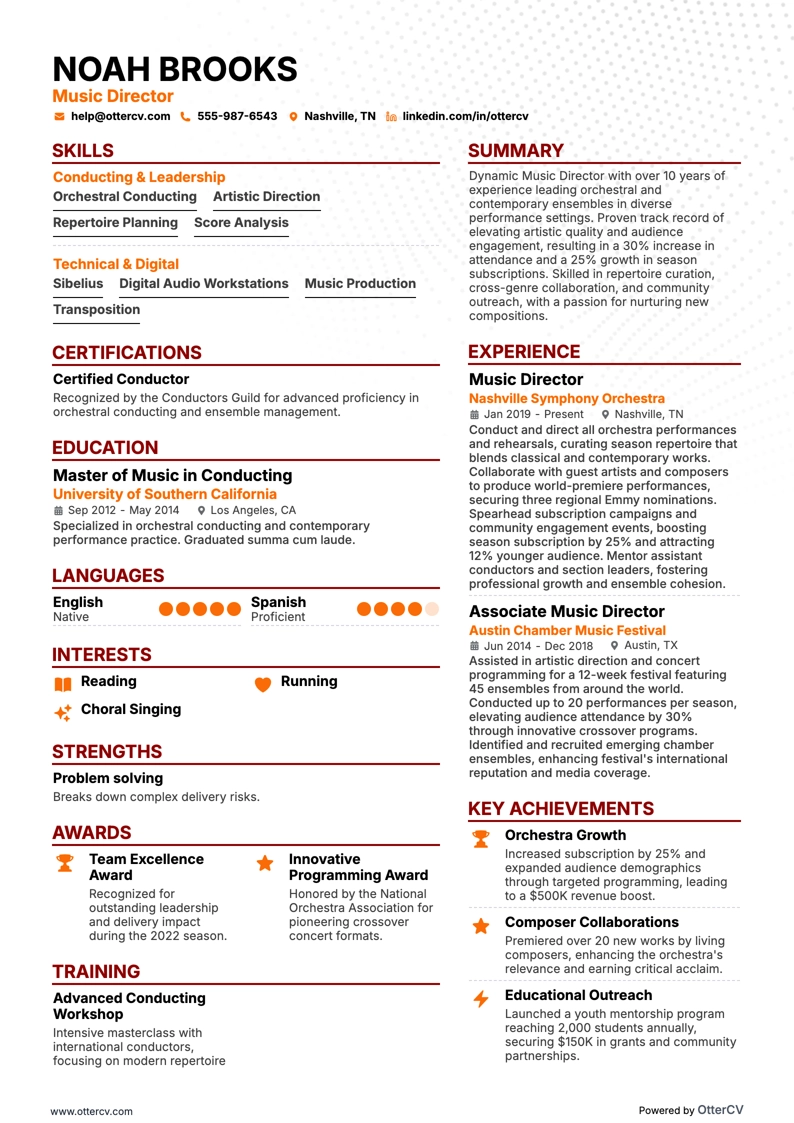
Music Director resume example

Music Director

Many applications fail because they read like a repertoire list rather than evidence of leadership. As a result, a music director resume can be filtered out by applicant tracking systems or skimmed past in seconds. In a crowded field, recruiters want proof that you can deliver consistent results.

A strong resume shows what changed because of you: improved ensemble accuracy, increased attendance, reduced rehearsal time, delivered productions on schedule, raised donor revenue, expanded programming reach, earned stronger reviews, and retained top performers. It also makes your scope, budgets, and measurable impact clear.

Key takeaways

  • Quantify every achievement with metrics such as attendance growth, rehearsal hours saved, or revenue increased.

  • Use a reverse-chronological format to show leadership growth across increasingly complex roles.

  • Tailor each experience bullet to match the job posting’s tools, ensembles, and goals.

  • Show skills through measurable outcomes in your experience section, not only in a standalone skills list.

  • Open your summary with ensemble scope, budget authority, and one or two quantified results.

  • Entry-level candidates should highlight directing projects, arrangements, and ensemble work with clear metrics.

  • Use Echocv to turn vague duties into sharp, recruiter-ready bullets that pass ATS screening.

How to format a music director resume

Recruiters reviewing music director candidates look for clear evidence of artistic leadership, program development, ensemble management, and measurable organizational impact. A strong resume format makes these qualifications easy to see, highlighting your progression into more complex roles, the scope of your creative and administrative oversight, and the results you have delivered instead of leaving them buried or fragmented.

I have significant experience in this role—which format should I use?

I have significant experience in this role—which format should I use?

Use a reverse-chronological format. It’s the strongest choice for a music director with substantial experience.

  • Lead each role entry with your scope of oversight, including ensembles directed, budget authority, staff managed, and programming decisions owned.
  • Highlight domain expertise such as repertoire development, music production platforms (Finale, Sibelius, Pro Tools), curriculum design, and collaboration with boards, donors, or venue partners.
  • Quantify outcomes that show both business and artistic impact, including audience growth, fundraising results, grant acquisitions, awards, or season expansion.

Example bullet: “Directed a 75-member symphony orchestra across four seasonal programs, growing subscription attendance by 32% and securing $220K in new grant funding over two fiscal years.”

Why hybrid and functional resumes don't work for senior roles

Why hybrid and functional resumes don't work for senior roles

Hybrid and functional resume formats break up your career timeline and hide the leadership progression hiring committees need to evaluate. They can obscure how your decision-making authority, ensemble scope, and organizational accountability increased over time. Functional formats are especially harmful because they remove the context that ties your artistic vision and operational results to specific roles, making it difficult for reviewers to judge the depth and consistency of your leadership impact.

For music director positions, avoid hybrid and functional formats entirely when demonstrated progression, sustained accountability, and strategic ownership are core evaluation criteria.

  • A functional format may be acceptable only if you are transitioning into music direction from a related field, such as principal performer, music education, or conducting fellow, and do not have formal director titles. Even then, every listed skill should be tied to a specific project, ensemble, or measurable outcome.

What sections should go on a music director resume

Once you have a clean, readable format, the next step is choosing which sections to include and arranging them for the strongest impact.

Recruiters want clear evidence that you can lead ensembles, deliver high-quality performances, and manage rehearsals and programs effectively.

For maximum clarity, use this structure:

  • Header
  • Summary
  • Experience
  • Skills
  • Projects
  • Education
  • Certifications
  • Optional sections: Awards, Publications, Volunteering

Strong experience bullets should highlight measurable performance outcomes, ensemble size, program scope, budget or stakeholder management, and results such as audience growth, recording quality, or competition placements.

Once you’ve organized your resume with the right components, the next step is to write the experience section so it shows how you applied those strengths on the job.

How to write your music director resume experience

Your experience section should prove that you delivered real results as a music director through repertoire selection, ensemble leadership, production execution, and audience engagement. Hiring managers value demonstrated impact more than task-based descriptions, so each bullet should connect your musical expertise to measurable outcomes.

Each entry should include:

  • Job title
  • Company and location (or remote)
  • Dates of employment (month and year)

Add three to five concise bullet points that explain what you owned, how you executed the work, and what results you delivered:

  • Ownership scope: the ensembles, productions, worship programs, concert series, or educational departments you were directly responsible for leading and developing.
  • Execution approach: the rehearsal techniques, arranging methods, conducting styles, music notation software, or programming strategies you used to shape performances and guide artistic decisions.
  • Value improved: changes to performance quality, audience retention, ensemble cohesion, production efficiency, programming diversity, or artistic standards that resulted from your leadership.
  • Collaboration context: how you worked with performers, composers, stage directors, technical crews, clergy, arts administrators, or community organizations to bring musical visions to life.
  • Impact delivered: outcomes such as audience growth, season expansion, grant funding secured, critical reception, organizational reach, or community engagement rather than routine duties performed.

Experience bullet formula

Experience bullet formula

Action verb + technology + what you built or fixed + measurable result

A music director experience example

Music Director

Crescent City Performing Arts Center | New Orleans, LA

2021–Present

Two-hundred-seat performing arts venue producing weekly concerts, musicals, and community events with union and non-union musicians.

  • Curated seasonal programming and built set lists in Dorico and Sibelius, increasing average ticket revenue by 18% year over year and repeat attendance by 12%.
  • Led rehearsals using click tracks and Aviom in-ear monitoring systems, improving ensemble timing accuracy and reducing rehearsal hours by 22% across eight productions.
  • Standardized audio workflows with Yamaha QL5 scenes, Dante routing, and Shure Wireless Workbench, cutting soundcheck time by 35% and reducing show-stopping RF issues by 60%.
  • Coordinated licensing and cue sheets through ASCAP, BMI, and SESAC portals, eliminating late filings and reducing clearance turnaround time from seven days to two days.
  • Partnered with stage management, lighting designers, and front-of-house engineers to align tempos, cues, and transitions, improving on-time show starts from 82% to 97% over one season.

Now that you've seen what a strong experience section looks like, the next step is customizing yours for each job posting.

How to tailor your music director resume experience

Recruiters review your music director resume through both applicant tracking systems and manual screening, so it's important to align your experience with each role. Tailoring helps the skills, tools, and qualifications the employer values appear clearly throughout your experience section.

Ways to tailor your music director experience:

  • Match the conducting styles or ensemble types named in the job description.
  • Use the exact music software or notation platforms listed in the posting.
  • Reflect the performance metrics or audience growth goals the employer mentions.
  • Include genre or repertoire expertise when the role calls for a specific focus.
  • Highlight liturgical or educational program experience if the posting requires it.
  • Use the same terminology for rehearsal methods or pedagogical frameworks mentioned in the job description.
  • Emphasize budget oversight or fundraising responsibilities when the role has a financial focus.
  • Reference collaboration with the specific departments or community partners listed.

Tailoring means connecting your real accomplishments to the employer's needs, not forcing unrelated keywords into your experience.

Resume tailoring examples for music director

Job description excerptUntailoredTailored
"Lead all musical rehearsals and performances for a 60-member community orchestra, selecting seasonal repertoire and coordinating with guest soloists."Led rehearsals and picked music for performances.Directed a 60-member community orchestra through full rehearsal cycles across four seasonal programs, curating repertoire and coordinating logistics for 12 guest soloists annually.
"Oversee the church's contemporary and traditional worship music programs, manage a team of 15 volunteer musicians, and integrate ProPresenter and Ableton Live into weekly services."Managed worship music and worked with volunteers.Managed contemporary and traditional worship programs with 15 volunteer musicians, built weekly set lists, and ran live audio through Ableton Live and ProPresenter to support two Sunday services.
"Develop and implement K–12 music curriculum aligned with National Core Arts Standards, directing student ensembles for district and state competitions."Taught music classes and helped students prepare for events.Designed K–12 music curriculum aligned with National Core Arts Standards, directing concert band, jazz ensemble, and choir to consistent superior ratings at district and state competitions over three consecutive years.

Once your experience matches the role’s needs, quantify your music director achievements to show the impact behind those responsibilities.

How to quantify your music director achievements

Using numbers helps show how your leadership improved performance, rehearsal efficiency, audience response, budget outcomes, and delivery reliability. Track metrics such as rehearsal hours saved, attendance, ticket revenue, on-time openings, musician retention, and quality scores from adjudicators or surveys.

Quantifying examples for music director

MetricExample
Performance qualityRaised ensemble adjudication scores from 86 to 92 in one season by standardizing warmups, sectional plans, and click-track practice in Logic Pro.
Delivery reliabilityDelivered 12 concert programs with 100% on-time downbeats by locking show files two weeks early and running two full technical rehearsals per program.
EfficiencyCut weekly rehearsal time 15% (from 10 to 8.5 hours) by issuing annotated scores in ForScore and using timed rehearsal blocks.
RevenueIncreased ticket revenue 18% ($96K to $113K) by programming three themed concerts and coordinating sponsor packages with the development team.
Risk reductionReduced performance-day incident reports 60% (10 to four) by implementing stage plots, instrument checklists, and a pre-show safety walk-through.

How to list your hard and soft skills on a music director resume

Once your experience bullets are strong, make sure your skills section highlights the right mix of hard and soft skills for a music director role.

This section shows how you lead rehearsals, shape musical quality, and run productions. Recruiters and ATS also scan it for role-specific keywords, so include a balanced mix of technical music competencies and leadership behaviors that match the job posting.

Music director roles require a blend of:

  • Product strategy and discovery skills.
  • Data, analytics, and experimentation skills.
  • Delivery, execution, and go-to-market discipline.
  • Soft skills.

Your skills section should be:

  • Scannable, using bullet-style grouping.
  • Relevant to the job post.
  • Backed by proof in your experience bullets.
  • Updated with current tools.

Place your skills section:

  • Above your experience if you're junior or switching careers.
  • Below your experience if you're mid- or senior-level with strong achievements.

Hard skills

  • Score study and analysis.
  • Conducting technique.
  • Rehearsal planning and pacing.
  • Vocal coaching and diction.
  • Orchestration and arranging.
  • Transposition and chart preparation.
  • Sibelius, Finale, and Dorico.
  • Pro Tools, Logic Pro, and Ableton Live.
  • Click tracks and timecode.
  • Music licensing and rights clearance.
  • Budgeting and musician contracting.
  • Audio mixing and live sound coordination.

Soft skills

  • Set clear musical direction.
  • Give actionable feedback during rehearsals.
  • Align artistic and production teams.
  • Make fast decisions on the spot.
  • Run efficient, focused rehearsals.
  • Maintain performance standards under pressure.
  • Communicate expectations clearly to musicians.
  • Resolve creative conflicts constructively.
  • Prioritize competing production needs.
  • Adapt interpretations to cast strengths.
  • Take ownership of show readiness and continuity.
  • Coordinate stakeholders across departments.

How to show your music director skills in context

Skills shouldn’t appear only in a dedicated skills section.

They should also be demonstrated in:

  • Your summary, where you define your high-level professional identity
  • Your experience, where you prove those skills through outcomes

Here’s what that looks like in practice.

Senior music director with 15 years of experience leading orchestral and choral ensembles. Skilled in score analysis, Pro Tools, and rehearsal planning. Increased season subscriber retention by 22% through innovative programming and deep community engagement.

  • Reflects senior-level authority immediately
  • Names role-relevant tools and methods
  • Quantifies audience retention impact
  • Highlights leadership and community engagement

Experience Example

Senior Music Director

Lakeshore Philharmonic | Chicago, IL

June 2018–Present

  • Directed 40+ annual performances using Finale and Pro Tools, boosting season attendance by 18% over three years.
  • Collaborated with guest soloists and a 70-member orchestra, reducing rehearsal time by 25% through structured score preparation.
  • Launched a youth outreach program with local schools, increasing community enrollment by 300 participants in two seasons.
  • Every bullet includes measurable proof.
  • Skills appear naturally through outcomes.

How do I write a music director resume with no experience

Once you’ve connected your abilities to real examples, the next step is applying that same approach to a music director resume when you do not have formal experience.

Even without full-time experience, you can still show that you are ready for the role through:

  • Student ensemble conducting assignments
  • Church or community choir leadership
  • Theater pit orchestra music preparation
  • Volunteer band rehearsal direction
  • Private teaching studio recitals
  • Recorded session coordination projects
  • Music notation and arranging portfolio
  • Internship with a performing arts venue

Focus on highlighting:

  • Clear repertoire and ensemble scope
  • Rehearsal planning and documentation
  • Arrangements, charts, and scores
  • Measurable performance outcomes

Resume format tip for entry-level music director

Resume format tip for entry-level music director

Use a skills-based resume format to highlight directing, arranging, and production work when your job history is limited.

  • Lead with a “Music Director Projects” section.
  • List ensembles, instrumentation, and repertoire.
  • Name tools such as Sibelius, Finale, and Logic Pro.
  • Add metrics like attendance, pieces, and rehearsals.
  • Link to a score and audio reel.

Example project bullet:

  • Music director for volunteer community choir; arranged four-part charts in Sibelius, ran six rehearsals, and delivered a 12-song concert with 120 attendees.

Even without formal work experience, your educational background can provide a strong foundation for a music director resume when presented clearly.

How to list your education on a music director resume

Your education section helps hiring teams verify that you have the foundational training in music theory, conducting, and performance needed for a music director role.

Include the following:

  • Degree name
  • Institution
  • Location
  • Graduation year
  • Relevant coursework for junior or entry-level candidates
  • Honors and GPA if it is 3.5 or higher

Do not include the month or day of graduation; list the year only.

Below is a strong education entry tailored for a music director resume.

Example education entry

Bachelor of Music in Conducting

Oberlin Conservatory of Music, Oberlin, OH

Graduated 2019

GPA: 3.8/4.0

  • Relevant coursework: Advanced Orchestral Conducting, Choral Arranging, Music Theory IV, Liturgical Music Studies
  • Honors: Graduated magna cum laude; recipient of the Dean's Award for Excellence in Conducting

How to list your certifications on a music director resume

Certifications show your commitment to learning, demonstrate tool proficiency, and signal industry relevance as a music director. They also help hiring teams trust your rehearsal methods, technology skills, and professional standards.

Include the following details:

  • Certificate name
  • Issuing organization
  • Year
  • Optional: credential ID or URL
  • Place certifications below education when your degree is recent and your certifications are older or less relevant to the music director role.
  • Place certifications above education when they are recent, role-relevant, or required for your music director work and they strengthen your credibility quickly.

Best certifications for your music director resume

  • Apple Certified Pro—Logic Pro
  • Avid Pro Tools Certified User
  • Berklee Online Certificate—Music Production
  • Berklee Online Certificate—Film Scoring
  • Dalcroze Eurhythmics Certificate
  • Orff Schulwerk Certification
  • Kodály Certification

Once your credentials are easy for hiring teams to spot, use your music director resume summary to quickly connect those qualifications to your broader value.

How to write your music director resume summary

Your resume summary is often the first part a recruiter reads, so it needs to make an immediate impression. For a music director role, it should quickly convey leadership depth, artistic vision, and measurable impact.

Keep it to three to four lines and include:

  • Your title and total years of experience directing musical programs or ensembles.
  • Your domain focus, such as orchestral, choral, liturgical, theater, or educational music.
  • Core skills like score analysis, rehearsal planning, budget oversight, and ensemble leadership.
  • One or two quantified achievements tied to program growth, audience engagement, or revenue.
  • Soft skills such as cross-functional collaboration or stakeholder communication, connected to real outcomes.

PRO TIP

As a director-level candidate, lead with scope and outcomes. Highlight the size of the ensembles you’ve managed, the budgets you’ve controlled, and the programs you’ve grown.

Avoid vague descriptors like “passionate” or “dedicated.” Replace them with evidence, skip motivational language, and let your results speak for themselves.

Example summary for a music director

Music director with 12+ years of experience leading 80-member ensembles across orchestral and choral programs. Increased season subscriptions by 35% over three years while managing a $1.2M annual production budget.

Now that your summary highlights your strongest qualifications, make sure your resume header includes the contact and professional details recruiters need to reach you.

What to include in a music director resume header

A resume header should present your key contact and professional details clearly so recruiters can quickly verify your background, assess fit, and move you through screening.

Essential resume header elements:

  • Full name
  • Tailored job title and headline
  • Location
  • Phone number
  • Professional email
  • GitHub link
  • Portfolio link
  • LinkedIn

Including a LinkedIn link can help recruiters verify your experience quickly by confirming consistent dates, titles, and credits.

Do not include a photo on a music director resume unless the role is explicitly front-facing or appearance-dependent.

Match your header job title to the job posting and reflect your core focus, such as choral, orchestral, worship, or musical theater.

Once your contact information and professional identifiers are in place at the top of your resume, add relevant supporting sections to strengthen your music director resume and provide more context.

Additional sections for music director resumes

If your core qualifications are similar to those of other candidates, these additional sections can help distinguish you by highlighting strengths that are especially relevant to a music director role.

  • Languages
  • Publications and scholarly articles
  • Awards and honors
  • Professional affiliations and memberships
  • Masterclasses and workshops
  • Notable performances and premieres
  • Grants and fellowships

Once you’ve rounded out your resume with these supplementary sections, the next step is pairing it with a strong cover letter to make your application feel complete.

Do music director resumes need a cover letter?

A cover letter isn’t required for a music director, but it can help in competitive searches or when hiring managers expect one. It can also make a difference when your resume needs more context or when fit and leadership style matter.

Use a cover letter to add value in these situations:

  • Explain role and team fit by naming the ensemble, stakeholders, and how you lead rehearsals, auditions, and performance standards.
  • Highlight one or two relevant projects or outcomes, such as raising performance quality, improving retention, or delivering a complex program on schedule.
  • Show understanding of the product, users, or business context, such as audience goals, brand sound, budget limits, and production timelines.
  • Address career transitions or less obvious experience by connecting transferable skills to music director priorities with one clear example.

Using AI to improve your music director resume

Once you’ve decided whether to include a cover letter based on the role and employer’s expectations, you can use AI to improve your music director resume so it better matches what hiring teams want to see.

AI can improve clarity, structure, and impact. It can tighten language and highlight measurable results. But overusing it can quickly make your resume sound less authentic. Once your resume is clear and aligned with the role, stop using AI.

Here are 10 practical prompts you can copy, paste, and adapt:

  1. Strengthen your summary. “Rewrite my music director resume summary to highlight leadership experience, ensemble size, and repertoire breadth in three concise sentences.”
  2. Quantify rehearsal results. “Add specific metrics to this music director experience bullet about improving ensemble performance quality during a structured rehearsal process.”
  3. Tighten experience bullets. “Shorten each music director experience bullet to one line, starting with a strong action verb and including a measurable outcome.”
  4. Align skills with postings. “Compare my music director skills section against this job description and suggest missing keywords that match my actual abilities.”
  5. Clarify project scope. “Rewrite this music director project description to clearly state the production scale, my role, and the final audience or performance outcome.”
  6. Refine education details. “Edit my music director education section to emphasize coursework, honors, or training directly relevant to conducting and musical leadership.”
  7. Spotlight certifications. “Reorganize my music director certifications section by relevance, listing the most industry-recognized credentials first with issuing organizations and dates.”
  8. Remove filler language. “Identify and remove vague or redundant phrases across my entire music director resume without changing the core meaning of each bullet.”
  9. Improve action verbs. “Replace weak or repeated verbs in my music director experience section with varied, precise alternatives that reflect leadership and artistic direction.”
  10. Tailor for a specific role. “Adjust my music director resume bullets to better match this specific job posting while keeping all claims truthful and grounded in real experience.”

Stop using AI once your resume sounds accurate, specific, and aligned with your real experience. AI should never invent experience or inflate claims—if it didn’t happen, it doesn’t belong on your resume.

Conclusion

A strong music director resume shows results and leadership through a clear, easy-to-scan structure. Highlight measurable outcomes such as attendance growth, budget savings, and rehearsal efficiency, and present role-specific skills including programming, conducting, musician management, and stakeholder communication.

Connect your skills to outcomes in each section. This signals readiness for today’s hiring market and near-future expectations, while helping employers see how you will lead, deliver, and improve performance from day one.

Music Director resume examples

Explore additional Music Director resume samples and guides and see what works for your level of experience or role.

By Experience

Senior Music Director

Senior Music Director resume preview

Associate Music Director

Associate Music Director resume preview

Assistant Music Director

Assistant Music Director resume preview

Music Director resume examples

Explore additional Music Director resume samples and guides and see what works for your level of experience or role.

By Role

Choral Music Director

Choral Music Director resume preview

Radio Music Director

Radio Music Director resume preview

Orchestra Music Director

Orchestra Music Director resume preview

Theater Music Director

Theater Music Director resume preview

Worship Music Director

Worship Music Director resume preview

Church Music Director

Church Music Director resume preview

Director of Music

Director of Music resume preview

Musical Director

Musical Director resume preview

Music Director

Music Director resume preview