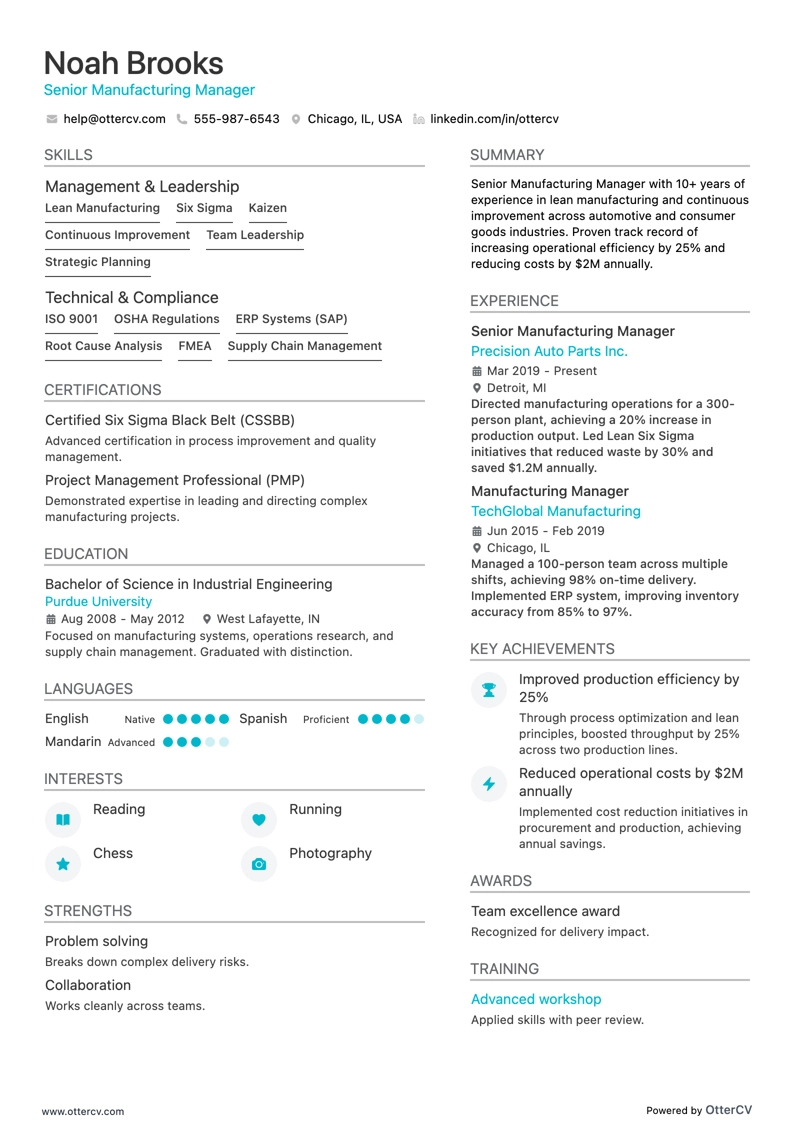
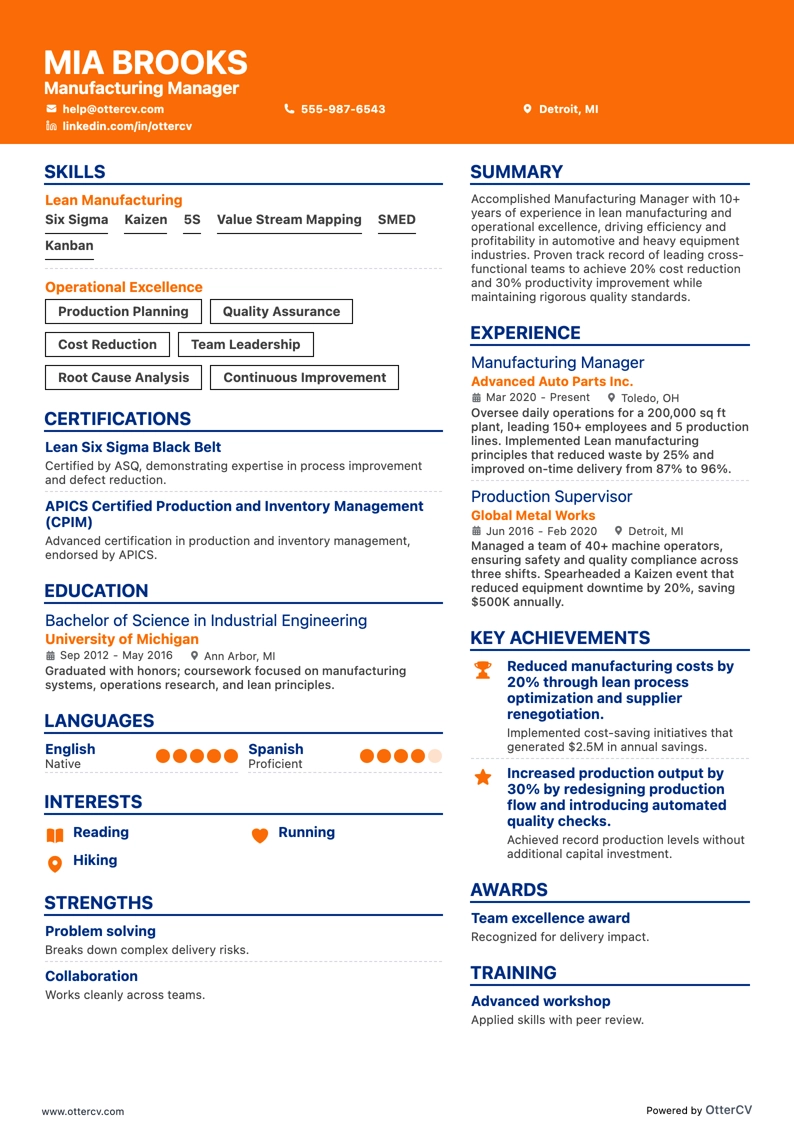
Senior Manufacturing Manager full preview

20 Manufacturing Manager Resume Examples

OtterCV

Written by The OtterCV Team

Updated: 11/29/2024•8 min read

See all resume examples in this guide, or generate your own resume example with your personalized prompt

Senior Manufacturing Manager resume example

Senior Manufacturing Manager

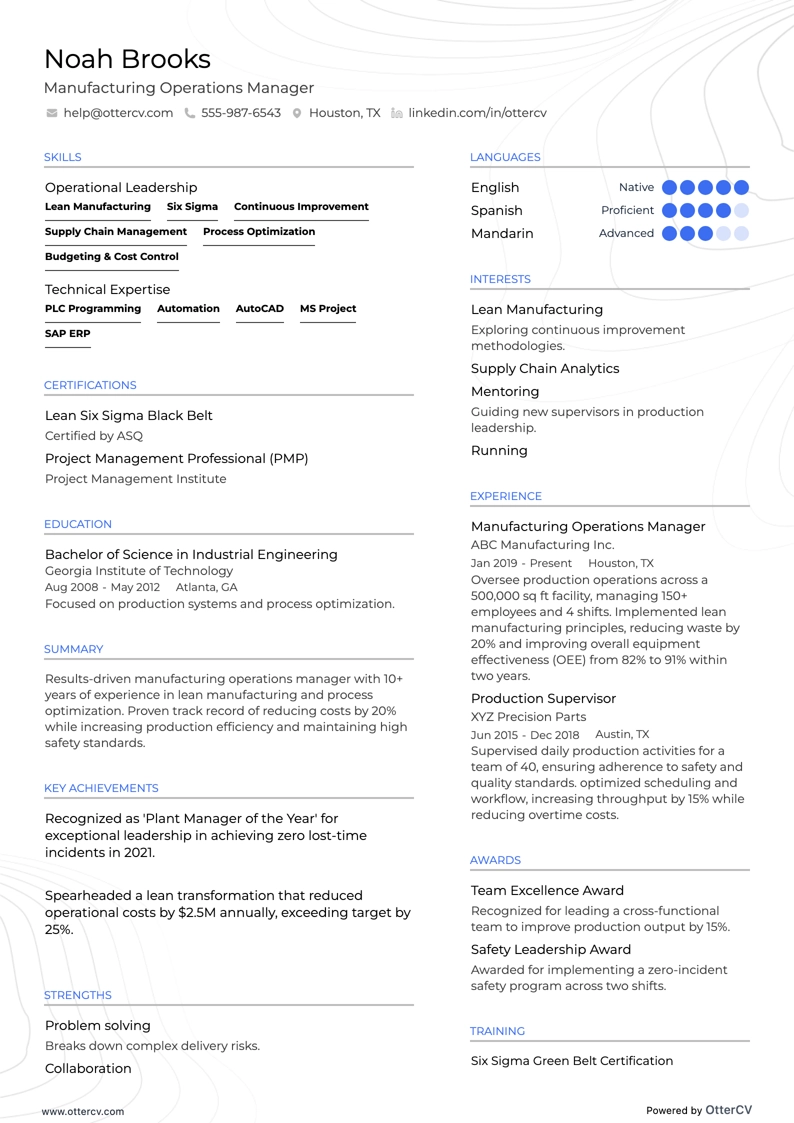
Manufacturing Operations Manager resume example

Manufacturing Operations Manager

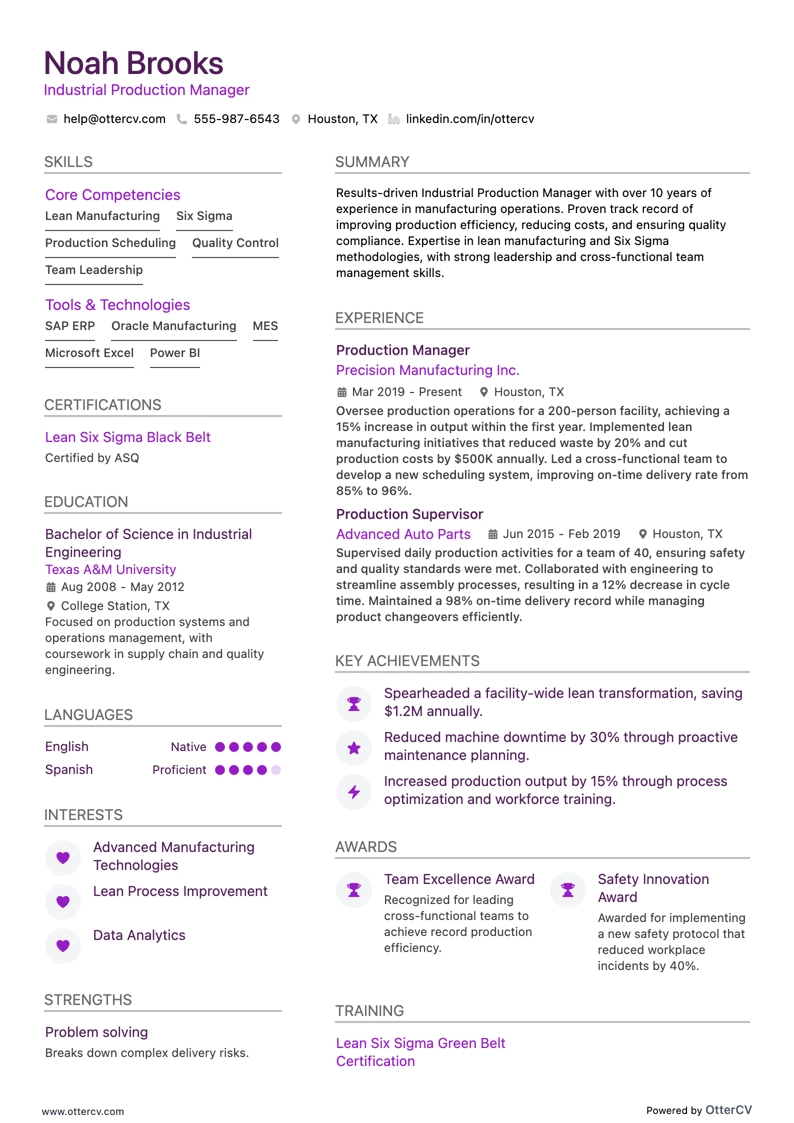
Industrial Production Manager resume example

Industrial Production Manager

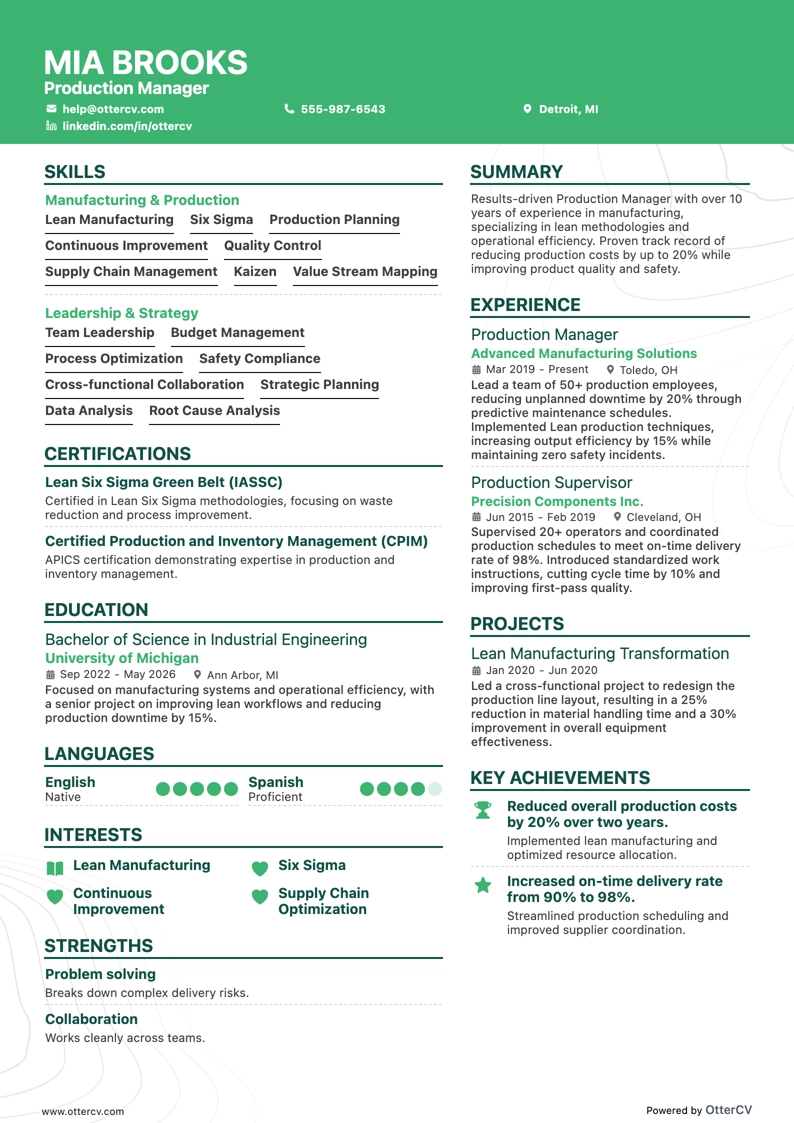
Production Manager resume example

Production Manager

Manufacturing Manager resume example

Manufacturing Manager

Many manufacturing manager resumes fall short because they list duties and tools without showing measurable results tied to throughput, quality, cost, and safety. That can hurt performance in ATS screening and quick recruiter reviews, especially in a competitive market.

A strong resume explains how you improved the operation, not just what you handled. If you are not sure where to start, learning how to write a resume with impact-driven language is an important first step.

Highlight yield gains, scrap reduction, on-time delivery improvements, cost savings, headcount and shift scope, audit results, and faster changeovers. Use clear metrics to show business impact.

Key takeaways

  • Quantify every achievement with metrics such as throughput gains, scrap reduction, and cost savings.

  • Use a reverse-chronological format for experienced managers and a hybrid format for career switchers.

  • Tailor each resume to the job posting’s specific tools, KPIs, and methodologies.

  • Start experience bullets with ownership scope, execution approach, and measurable business impact.

  • Feature hard skills like Lean, Six Sigma, and ERP prominently, and support them with proof.

  • Write a three- to four-line summary that highlights your title, industry, tools, and top results.

  • Use Echocv to turn vague duties into focused, metric-driven bullet points faster.

Job market snapshot for manufacturing managers

We analyzed 137 recent manufacturing manager job ads across major US job boards to give you a quick view of employer expectations, top hiring companies, and regional hotspots.

What level of experience employers are looking for manufacturing managers

Years of ExperiencePercentage found in job ads
1–2 years5.1% (7)
3–4 years41.6% (57)
5–6 years19.0% (26)
7–8 years7.3% (10)
9–10 years5.1% (7)
10+ years5.8% (8)
Not specified21.2% (29)

Manufacturing manager ads by area of specialization (industry)

Industry (Area)Percentage found in job ads
Finance & Banking46.0% (63)
Healthcare43.1% (59)
Manufacturing8.0% (11)

Top companies hiring manufacturing managers

CompanyPercentage found in job ads
Accenture35.8% (49)
Boeing23.4% (32)

Role overview stats

These tables outline the most common responsibilities and employment types for manufacturing manager roles. Use them to align your resume with employer expectations and understand how the role is structured across the market.

Day-to-day activities and top responsibilities for a manufacturing manager

ResponsibilityPercentage found in job ads
Manufacturing40.9% (56)
Sap38.7% (53)
Quality management32.8% (45)
S/4hana32.8% (45)
Sap transportation management30.7% (42)
Lean manufacturing15.3% (21)
Continuous improvement13.9% (19)
Lean12.4% (17)
Microsoft office10.2% (14)
Six sigma10.2% (14)
Project management8.8% (12)
Boeing production system5.8% (8)

How to format a manufacturing manager resume

Recruiters hiring for manufacturing manager roles prioritize operational leadership, process improvement results, and cross-functional team management. A clear resume format helps make these signals—production KPIs, lean methodology expertise, and scope of oversight—immediately visible instead of burying them beneath formatting that obscures your career trajectory.

I have significant experience in this role—which format should I use?

I have significant experience in this role—which format should I use?

Use a reverse-chronological format so your most recent and most impactful manufacturing leadership experience appears at the top of your resume.

  • Lead with your scope of ownership, including plant size, headcount managed, budget authority, and the number of production lines overseen.
  • Highlight role-specific expertise such as lean manufacturing, Six Sigma, ERP systems (SAP, Oracle), OSHA compliance, and supply chain coordination.
  • Quantify business impact with metrics like production throughput, defect reduction, cost savings, and on-time delivery rates.

Example bullet: “Managed a 120-person manufacturing operation across three shifts, implementing lean production workflows that reduced scrap rates by 22% and saved $1.4M annually in material costs.”

I'm junior or switching into this role—what format works best?

I'm junior or switching into this role—what format works best?

A hybrid resume format works well if you have relevant manufacturing skills but limited direct management experience in a production environment.

Do:

  • Place a dedicated skills section near the top that highlights production planning, quality assurance, inventory management, and relevant certifications such as Six Sigma Green Belt.
  • Include project-based experience, such as leading a process improvement initiative, coordinating a product launch, or supervising a team during a peak production cycle.
  • Connect each action to a measurable outcome so hiring managers can see your readiness for greater responsibility.

Example scaffold: Lean manufacturing training → Led a 5S implementation project on a packaging line → Reduced changeover time by 15%, improving daily output by 300 units.

Why not use a functional resume?

Why not use a functional resume?

A functional resume removes the timeline and context manufacturing hiring managers need to assess your progression from floor-level operations into leadership, making it harder for them to verify where and when you delivered results.

A functional format may still be acceptable if you are transitioning from a related field such as industrial engineering or supply chain logistics and do not have direct manufacturing management titles. Even then, each skill should be tied to a specific project, outcome, or measurable contribution instead of being listed as a standalone keyword.

Once your layout and formatting choices are set, the next step is choosing resume sections that directly support your candidacy.

What sections should go on a manufacturing manager resume

Recruiters expect a manufacturing manager resume to show plant leadership, measurable production results, and operational excellence. Knowing what to put on a resume for this role helps you prioritize the right content from the start.

Use this structure for maximum clarity:

  • Header
  • Summary
  • Experience
  • Skills
  • Projects
  • Education
  • Certifications
  • Optional sections: Awards, Leadership, Languages

Strong experience bullets should highlight production and quality outcomes, cost and throughput impact, safety performance, and the scope of the teams, lines, budgets, and sites you led.

Now that you’ve organized the key parts of your manufacturing manager resume, focus on the experience section to show the results you delivered in those areas.

How to write your manufacturing manager resume experience

Your work experience section should highlight the work you shipped, including process improvements, production milestones, and system implementations. Use role-relevant tools, methodologies, and measurable outcomes to show your capability as a manufacturing manager. Hiring managers value proven impact over task-based descriptions, so each line should connect what you did to the change it created.

Each entry should include:

  • Job title
  • Company and location (or remote)
  • Dates of employment (month and year)

Include three to five concise bullet points that explain what you owned, how you executed, and what outcomes you delivered:

  • Ownership scope: the production lines, facilities, supply chains, teams, or operational budgets you were directly responsible for as a manufacturing manager.
  • Execution approach: the lean manufacturing principles, Six Sigma frameworks, ERP systems, quality management tools, or continuous improvement methods you used to guide decisions and deliver work.
  • Value improved: changes to production yield, product quality, workplace safety, equipment uptime, waste reduction, or cost efficiency that resulted from your leadership.
  • Collaboration context: how you worked with engineering, supply chain, quality assurance, procurement, or regulatory teams to align production goals with broader business objectives.
  • Impact delivered: outcomes framed through tangible results, such as capacity gains, defect reductions, on-time delivery improvements, or operational savings, rather than routine activity descriptions.

Experience bullet formula

Experience bullet formula

Action verb + technology + what you built or fixed + measurable result

A manufacturing manager experience example

Manufacturing Manager

Apex Precision Components | Columbus, OH | 2021–Present

High-mix, mid-volume CNC machining and assembly plant supplying aerospace and industrial OEMs across two shifts.

  • Led a lean transformation using value stream mapping, 5S, and Kaizen events, improving on-time delivery from 88% to 96% and reducing average lead time by 18% within nine months.
  • Implemented statistical process control (SPC) and capability studies (Cp/Cpk) in Minitab across eight critical characteristics, reducing scrap from 3.4% to 2.1% and saving $410K annually in material and rework.
  • Deployed an OEE program using MES (manufacturing execution system) dashboards and daily tiered meetings, increasing OEE from 62% to 71% and recovering 420 machine-hours per quarter.
  • Partnered with quality engineering and suppliers to roll out corrective and preventive actions (CAPA) and 8D for top defects, cutting customer returns by 35% and improving first-pass yield from 91% to 95%.
  • Coordinated with maintenance, process engineering, and production supervisors to launch a preventive maintenance schedule in CMMS (computerized maintenance management system), reducing unplanned downtime by 22% and improving schedule adherence by 11 points.

Now that you’ve seen what a strong experience section looks like, the next step is adjusting it for the specific role you’re targeting.

How to tailor your manufacturing manager resume experience

Recruiters review a manufacturing manager resume through both human screening and applicant tracking systems (ATS), so tailoring your resume to the job description is essential. It helps ensure the skills, systems, and achievements you highlight match what the employer is actually looking for.

Ways to tailor your manufacturing manager experience:

  • Match the production software and ERP systems named in the job description.
  • Use the same terminology for lean or Six Sigma methodologies.
  • Reflect the KPIs the posting prioritizes, such as OEE or throughput.
  • Highlight compliance with ISO or OSHA standards when they are mentioned.
  • Include industry experience relevant to the specific manufacturing sector.
  • Emphasize the cross-functional collaboration models outlined in the job description.
  • Align your quality assurance processes with those the employer specifies.
  • Feature the continuous improvement frameworks mentioned in the posting.

Tailoring means aligning your real accomplishments with the role’s stated requirements, not forcing in keywords that do not belong.

Resume tailoring examples for manufacturing manager

Job description excerptUntailoredTailored
“Lead Lean Manufacturing initiatives across three production lines to reduce waste and improve cycle time by 15%.”Helped improve production processes and reduce inefficiencies.Led Lean Manufacturing initiatives across three high-volume production lines, cutting cycle time by 18% and reducing material waste by 22% within 12 months.
“Manage a team of 40+ hourly employees and 5 supervisors while maintaining OSHA compliance and driving continuous improvement using Six Sigma methodologies.”Supervised staff and ensured workplace safety standards were met.Managed a 45-person production team, including five shift supervisors, maintained zero OSHA recordable incidents for two consecutive years, and led continuous improvement projects using Six Sigma DMAIC methodology.
“Oversee daily operations in an ISO 9001-certified facility, ensuring on-time delivery rates above 97% and coordinating with supply chain and quality assurance departments.”Responsible for day-to-day manufacturing operations and meeting delivery goals.Directed daily operations in an ISO 9001-certified facility producing 1.2M units annually, sustained a 98.3% on-time delivery rate, and coordinated cross-functionally with supply chain and quality assurance to resolve bottlenecks.

Once your experience reflects the role’s priorities, the next step is to quantify your manufacturing manager achievements so employers can clearly see the impact you delivered.

How to quantify your manufacturing manager achievements

Quantifying your achievements shows how you improved throughput, quality, cost, and delivery reliability. Focus on metrics such as scrap rate, overall equipment effectiveness, cycle time, on-time delivery, safety incidents, and cost per unit.

Quantifying examples for manufacturing manager

MetricExample
ThroughputIncreased line throughput 18% by balancing workstations and updating standard work across three shifts, raising output from 4,200 to 4,950 units per day.
QualityCut scrap from 3.4% to 1.9% by leading root-cause analysis and poka-yoke installs, reducing monthly material loss by $62,000.
CostReduced overtime cost 22% by redesigning the schedule in UKG and cross-training twelve operators, saving $310,000 annually.
DeliveryImproved on-time delivery from 91% to 97% by tightening production planning in SAP and adding daily tier meetings for constraints.
Safety riskLowered recordable incident rate from 2.1 to 1.2 by implementing lockout-tagout audits and near-miss reporting, completing 180 audits in six months.

Once you’ve written strong experience bullet points, pair them with a well-organized skills section that highlights the hard and soft skills manufacturing employers value most.

How to list your hard and soft skills on a manufacturing manager resume

Your skills section shows how you manage production, quality, and safety day to day. Recruiters and ATS (applicant tracking systems) also use it to quickly assess role fit, so aim for a skills mix that is mostly hard skills supported by a smaller set of job-specific soft skills.

Manufacturing manager roles require a blend of:

  • Product strategy and discovery skills.
  • Data, analytics, and experimentation skills.
  • Delivery, execution, and go-to-market discipline.
  • Soft skills.

Your skills section should be:

  • Scannable, using bullet-style grouping.
  • Relevant to the job posting.
  • Backed by proof in your experience bullets.
  • Updated with current tools.

Place your skills section:

  • Above your experience section if you’re junior or changing careers.
  • Below your experience section if you’re mid-level or senior with strong achievements.

Hard skills

  • Hard skills demonstrate the technical expertise hiring managers look for, including lean manufacturing.
  • Six Sigma and DMAIC.
  • Kaizen and 5S.
  • Overall equipment effectiveness tracking.
  • Root cause analysis and 8D.
  • Corrective and preventive actions (CAPA).
  • Statistical process control.
  • Work instructions and standard work.
  • ERP and MRP scheduling.
  • ISO 9001 quality systems.
  • OSHA compliance and lockout tagout.
  • Preventive maintenance planning.

Soft skills

  • Your soft skills show how you lead teams and drive collaboration on the floor.
  • Lead daily tier meetings.
  • Coach supervisors and leads.
  • Hold teams to standard work.
  • Prioritize safety and quality tradeoffs.
  • Escalate risks with clear options.
  • Align production with planning and procurement.
  • Drive cross-shift handoffs.
  • Communicate changes on the floor.
  • Resolve conflicts quickly and fairly.
  • Run Gemba walks with follow-through.
  • Make data-backed decisions under pressure.
  • Own downtime and defect reduction plans.

How to show your manufacturing manager skills in context

Skills should not appear only in a bulleted list on your resume. Review examples of resume skills used in context to see how strong candidates weave them throughout the document.

Your skills should be demonstrated in:

  • Your summary, which presents your high-level professional identity
  • Your experience, which proves your skills through outcomes

Here is what strong, skills-integrated writing looks like in practice.

Manufacturing manager with 12 years of experience in automotive production, with expertise in lean manufacturing, SAP ERP, and cross-functional leadership. Reduced plant downtime by 31% while scaling output across three assembly lines.

  • Clearly signals senior-level experience
  • Mentions industry-relevant tools and methods
  • Opens with a measurable outcome
  • Highlights leadership as a soft skill

Experience example

Senior Manufacturing Manager

Bridgewell Industries | Grand Rapids, MI

June 2018–Present

  • Implemented Six Sigma workflows across four production lines, cutting defect rates by 27% within 18 months.
  • Partnered with supply chain and quality teams to deploy real-time MES tracking, improving on-time delivery to 96%.
  • Led a 45-person operations team through a facility expansion, increasing monthly throughput by 22% while staying under budget.
  • Every bullet includes measurable proof.
  • Skills surface naturally through real outcomes.

How do I write a manufacturing manager resume with no experience

Once you’ve shown your manufacturing manager skills through measurable examples and relevant responsibilities, the next step is to use that same approach when building a resume without direct experience.

Even without full-time experience, you can show readiness through:

  • Lean Six Sigma coursework projects
  • Capstone production line simulation project
  • Internship in manufacturing operations
  • Student-led Kaizen event facilitation
  • ERP system training labs
  • OSHA safety training certifications
  • Volunteer shift lead in production
  • Quality audits in lab courses

If you're in this situation, our guide on writing a resume without work experience offers strategies tailored to candidates building their first manufacturing management resume.

Focus on:

  • Quantified process improvements and savings
  • Safety compliance and risk controls
  • Production planning and schedule adherence
  • Quality metrics and corrective actions

Resume format tip for entry-level manufacturing manager

Resume format tip for entry-level manufacturing manager

Use a hybrid resume format to put projects and skills first while still presenting your experience and education in a clear timeline.

  • Lead with a Projects section.
  • Add metrics to every project.
  • Name tools like ERP and Minitab.
  • Mirror manufacturing manager job keywords.
  • Include safety and quality credentials.

Example project bullet:

  • Led a student Kaizen event using 5S, value stream mapping, and a fishbone analysis, cutting simulated changeover time by 18% and reducing defects by 12%.

Even without direct experience, your education section can show the foundational knowledge and relevant training that qualify you for a manufacturing manager role.

How to list your education on a manufacturing manager resume

Your education section helps hiring teams confirm that you have the technical and leadership background needed for a manufacturing manager position.

Include:

  • Degree name
  • Institution
  • Location
  • Graduation year
  • Relevant coursework for juniors or entry-level candidates
  • Honors and GPA if 3.5 or higher

Avoid listing the month or day of graduation; use the graduation year only.

Here’s a strong education entry tailored to a manufacturing manager resume.

Example education entry

Bachelor of Science in Industrial Engineering

University of Michigan, Ann Arbor, MI

Graduated: 2016

GPA: 3.7/4.0

  • Relevant coursework: Lean Manufacturing Systems, Supply Chain Management, Quality Control, Production Planning
  • Honors: Magna Cum Laude, Dean's List (all semesters)

How to list your certifications on a manufacturing manager resume

Certifications on your resume show a manufacturing manager’s commitment to learning, proficiency with modern tools, and alignment with current safety, quality, and operations standards.

Include the following details:

  • Certificate name
  • Issuing organization
  • Year
  • Optional: credential ID or URL
  • Place certifications below education when they are older, less relevant, or secondary to your degree for a manufacturing manager role.
  • Place certifications above education when they are recent, role-critical, or required for the manufacturing manager job you are targeting.

Best certifications for your manufacturing manager resume

  • Certified in Production and Inventory Management (CPIM)
  • Certified Supply Chain Professional (CSCP)
  • Lean Six Sigma Green Belt
  • Lean Six Sigma Black Belt
  • OSHA 30-Hour General Industry
  • ISO 9001:2015 Lead Auditor

Once your credentials are easy to verify, use your manufacturing manager resume summary to reinforce those qualifications early and connect them to the role’s requirements.

How to write your manufacturing manager resume summary

Your resume summary is often the first thing a recruiter reads, so it should quickly show that you’re qualified to lead manufacturing operations.

Keep it to three to four lines and include:

  • Your title and total years of manufacturing management experience.
  • The industry or product type you specialize in, such as automotive, food processing, or electronics.
  • Core tools and methodologies like Lean, Six Sigma, SAP, or ERP systems.
  • One or two measurable achievements, such as cost reductions or efficiency gains.
  • Soft skills tied to real results, such as cross-functional leadership that improved on-time delivery.

PRO TIP

At the manager level, emphasize operational ownership, team leadership, and measurable business impact.

Show how your decisions improved throughput, reduced waste, or helped scale production.

Avoid vague descriptors like “passionate” or “results-driven,” which do not clearly demonstrate your capabilities.

Example summary for a manufacturing manager

Manufacturing manager with eight years of experience leading high-volume automotive parts production lines. Implemented Lean workflows that cut defect rates by 22% and reduced downtime across three facilities.

Now that your summary highlights your leadership and operational impact, make sure your resume header is just as polished and error-free.

What to include in a manufacturing manager resume header

A resume header includes your core contact and identity details. For a manufacturing manager, it helps you appear in searches, build credibility, and move through recruiter screening more quickly.

Essential resume header elements:

  • Full name
  • Tailored job title and headline
  • Location
  • Phone number
  • Professional email
  • GitHub link
  • Portfolio link
  • LinkedIn

Including a LinkedIn link helps recruiters verify your experience quickly and supports screening.

Do not include photos on a manufacturing manager resume unless the role is explicitly front-facing or appearance-dependent.

Match your header job title to the posting, and keep every detail accurate, consistent, and easy to scan at a glance.

Example

Once your contact details and role information are in place, add relevant extra sections to strengthen your qualifications and support the rest of your resume.

Additional sections for manufacturing manager resumes

Beyond your core qualifications, these sections can help you stand out from other manufacturing manager candidates with similar experience.

They highlight specialized credibility and well-rounded expertise that hiring teams value.

Choose sections that best support your manufacturing manager profile:

  • Languages
  • Professional affiliations (e.g., SME, APICS, AME)
  • Certifications and licenses
  • Volunteer experience in operations or community safety
  • Publications or conference presentations
  • Continuous improvement projects
  • Hobbies and interests tied to problem-solving or leadership

Once you’ve rounded out your resume with the right supplementary sections, pairing it with a strong cover letter can make an even bigger impact.

Do manufacturing manager resumes need a cover letter

A cover letter isn’t required for a manufacturing manager, but it can help in competitive searches or when hiring managers expect one. If you’re unfamiliar with the format, start by understanding what a cover letter is and how it complements your resume. It can make a difference when your resume needs more context or when you want to show clear alignment with the plant’s priorities.

Use a cover letter to add context your resume can’t:

  • Explain your role and team fit by connecting your leadership style to shift structure, labor relations, safety culture, and production goals.
  • Highlight one or two outcomes, such as scrap reduction, throughput gains, faster changeovers, or improved on-time delivery, and explain how you achieved them.
  • Show that you understand the product, users, and business context, including quality requirements, customer impact, and cost or service tradeoffs.
  • Address career transitions or non-obvious experience, such as moving industries, stepping up in scope, or translating military or project work into plant leadership.

Using AI to improve your manufacturing manager resume

Even if you include a cover letter for added context, improving your manufacturing manager resume with AI can strengthen the document employers review first.

AI can improve clarity, structure, and impact. It can tighten language and bring results into sharper focus, but overusing it can make your resume feel less authentic. If you are not sure where to begin, explore which AI is best for writing resumes before diving in. Once your resume feels clear and aligned with the role, step away from AI.

Here are 10 practical prompts to improve specific sections of your manufacturing manager resume:

  1. Sharpen your summary: “Rewrite my manufacturing manager resume summary to highlight leadership scope, production KPIs, and industry focus in three concise sentences.”
  2. Quantify experience bullets: “Add specific metrics like throughput, downtime reduction, or cost savings to each of my manufacturing manager experience bullets.”
  3. Tighten action verbs: “Replace weak or passive verbs in my manufacturing manager experience section with strong, results-driven action verbs.”
  4. Align skills strategically: “Compare my manufacturing manager skills section against this job description and suggest missing hard or technical skills.”
  5. Strengthen project descriptions: “Rewrite my manufacturing manager project entries to emphasize scope, team size, timeline, and measurable outcomes.”
  6. Refine certifications context: “Add brief context to each certification on my manufacturing manager resume explaining its relevance to production leadership.”
  7. Improve education relevance: “Rewrite my education section to emphasize coursework and achievements directly relevant to a manufacturing manager role.”
  8. Eliminate redundant phrasing: “Identify and remove filler words, clichés, or repeated ideas across my entire manufacturing manager resume.”
  9. Tailor for ATS: “Restructure my manufacturing manager resume bullets to naturally incorporate keywords from this specific job posting.”
  10. Clarify leadership scope: “Rewrite my manufacturing manager experience entries to clearly define team size, budget authority, and reporting structure.”

Stop using AI once your resume sounds accurate, specific, and grounded in your real experience. AI should never invent experience or inflate claims—if it did not happen, it does not belong on your resume.

Conclusion

A strong manufacturing manager resume connects measurable results to role-specific skills such as safety leadership, quality control, lean improvement, and team performance. Use a clear structure, direct language, and consistent formatting, and show results with numbers, timelines, and scope.

Hiring teams look for manufacturing manager resumes that demonstrate impact and readiness for current operations and near-future demands. Emphasize steady execution, cross-functional coordination, and process discipline, and keep each section focused, easy to scan, and aligned with the role.

Manufacturing Manager resume examples

Explore additional Manufacturing Manager resume samples and guides and see what works for your level of experience or role.

By Experience

Senior Manufacturing Manager

Senior Manufacturing Manager resume preview

Manufacturing Manager resume examples

Explore additional Manufacturing Manager resume samples and guides and see what works for your level of experience or role.

By Role

Manufacturing Operations Manager

Manufacturing Operations Manager resume preview

Industrial Production Manager

Industrial Production Manager resume preview

Production Manager

Production Manager resume preview

Manufacturing Manager

Manufacturing Manager resume preview