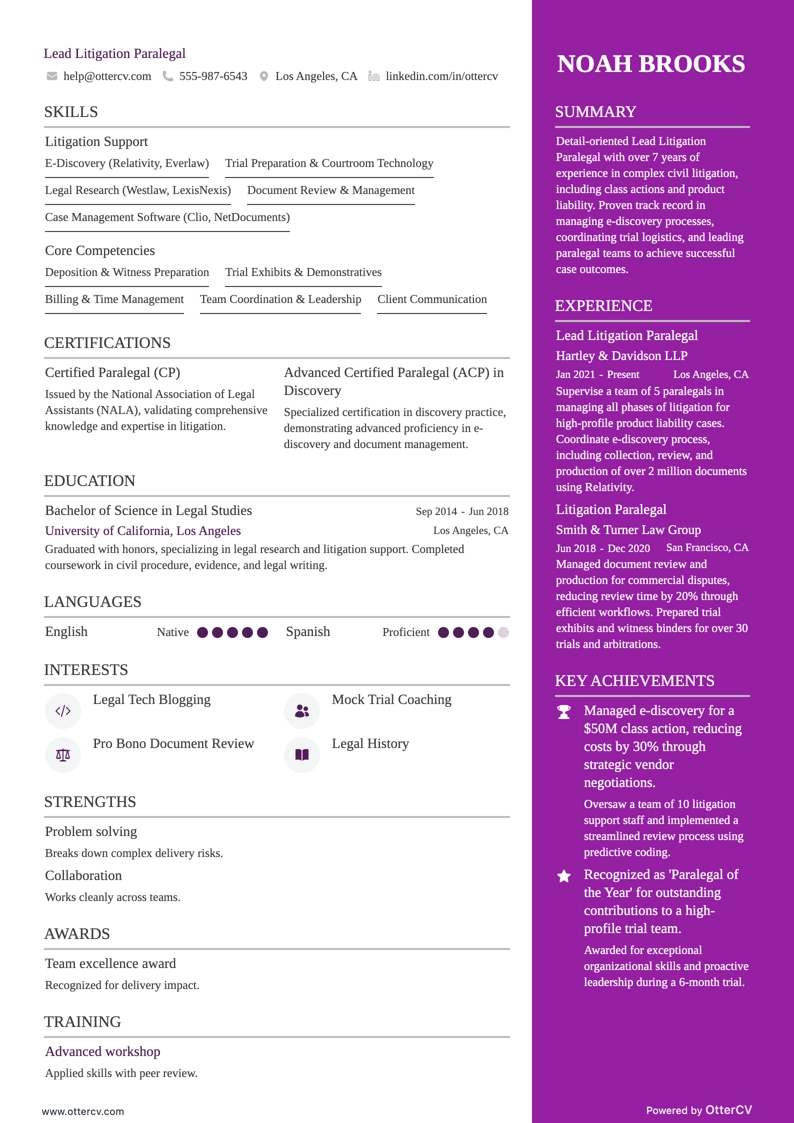
Lead Litigation Paralegal full preview

10 Litigation Paralegal Resume Examples

OtterCV

Written by The OtterCV Team

Updated: 5/7/2023•8 min read

See all resume examples in this guide, or generate your own resume example with your personalized prompt

Lead Litigation Paralegal resume example

Lead Litigation Paralegal

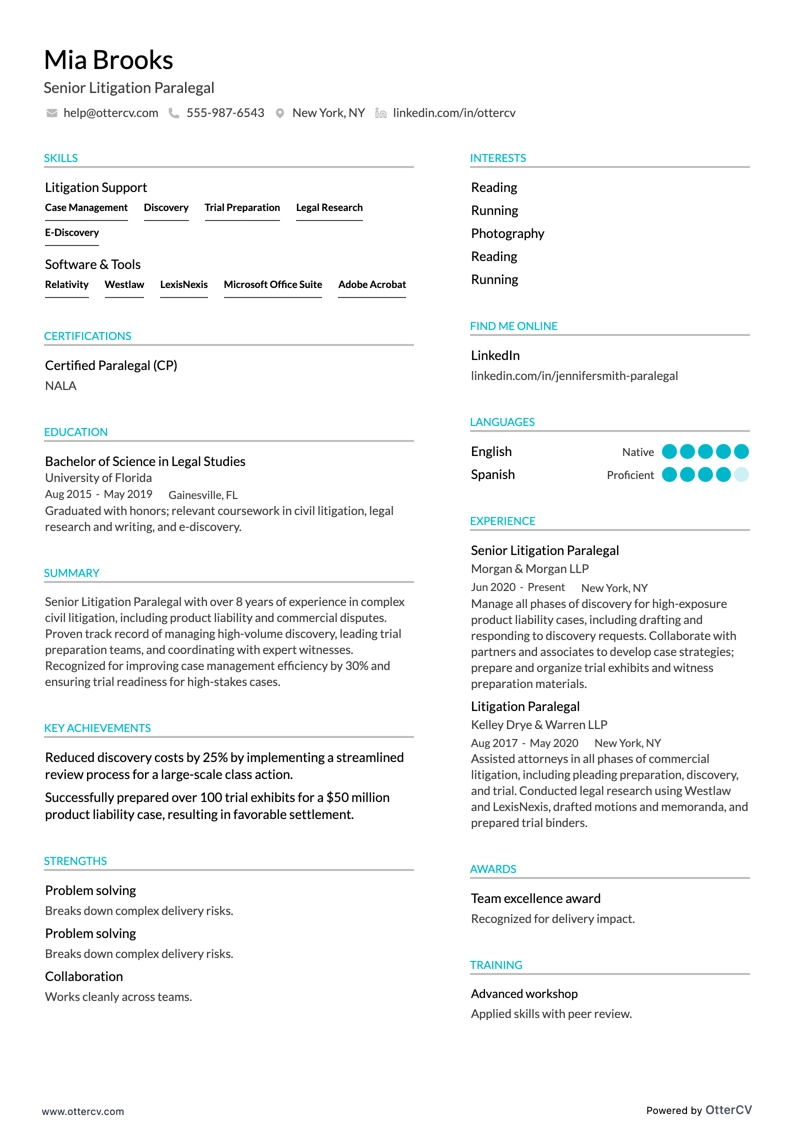
Senior Litigation Paralegal resume example

Senior Litigation Paralegal

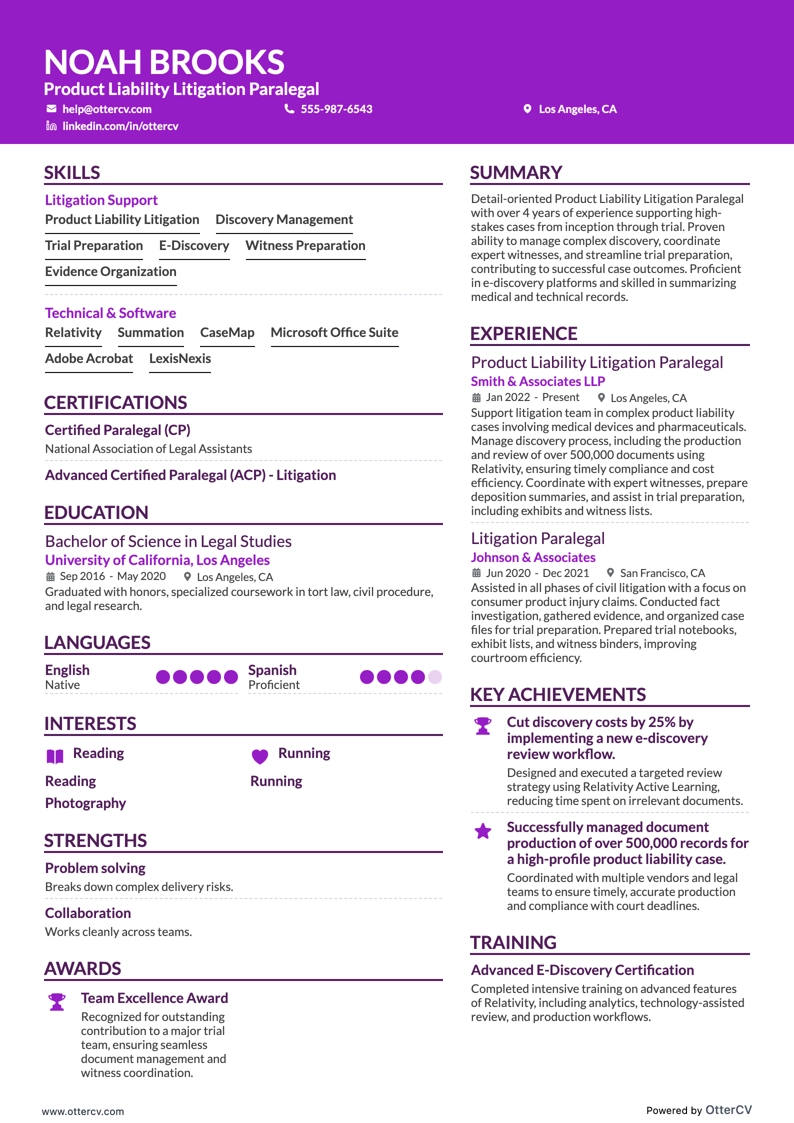
Product Liability Litigation Paralegal resume example

Product Liability Litigation Paralegal

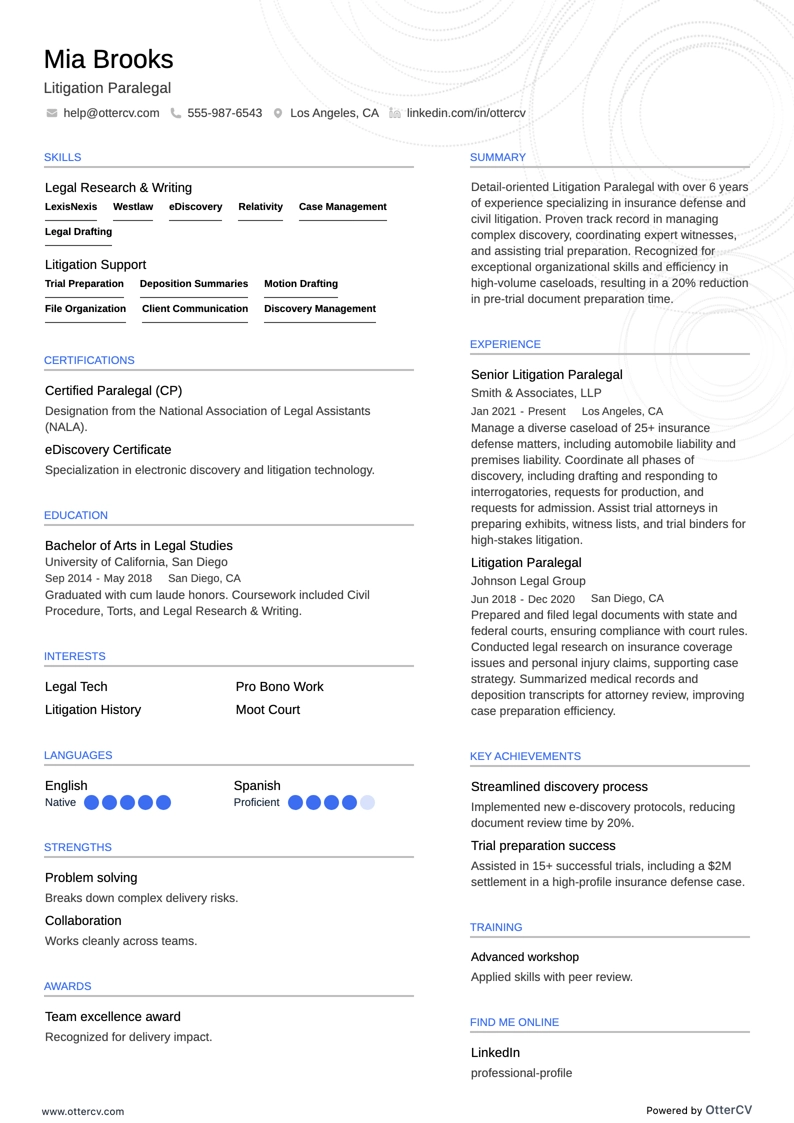
Insurance Defense Litigation Paralegal resume example

Insurance Defense Litigation Paralegal

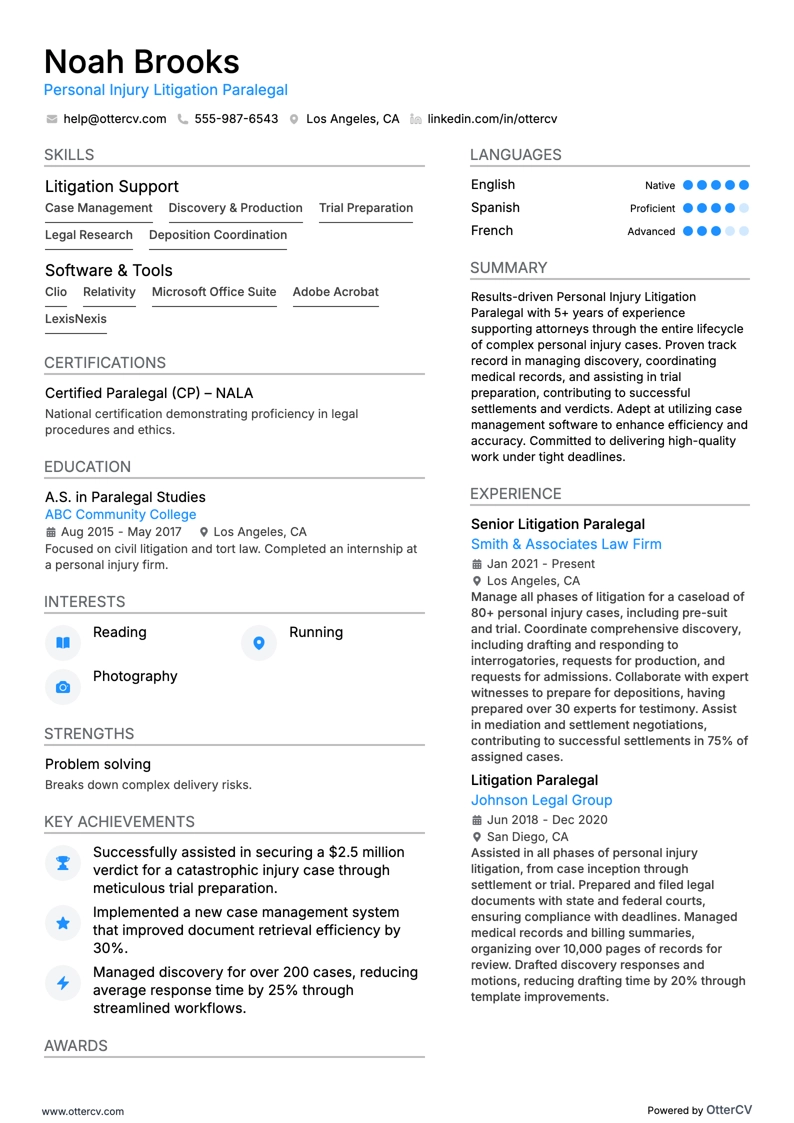
Personal Injury Litigation Paralegal resume example

Personal Injury Litigation Paralegal

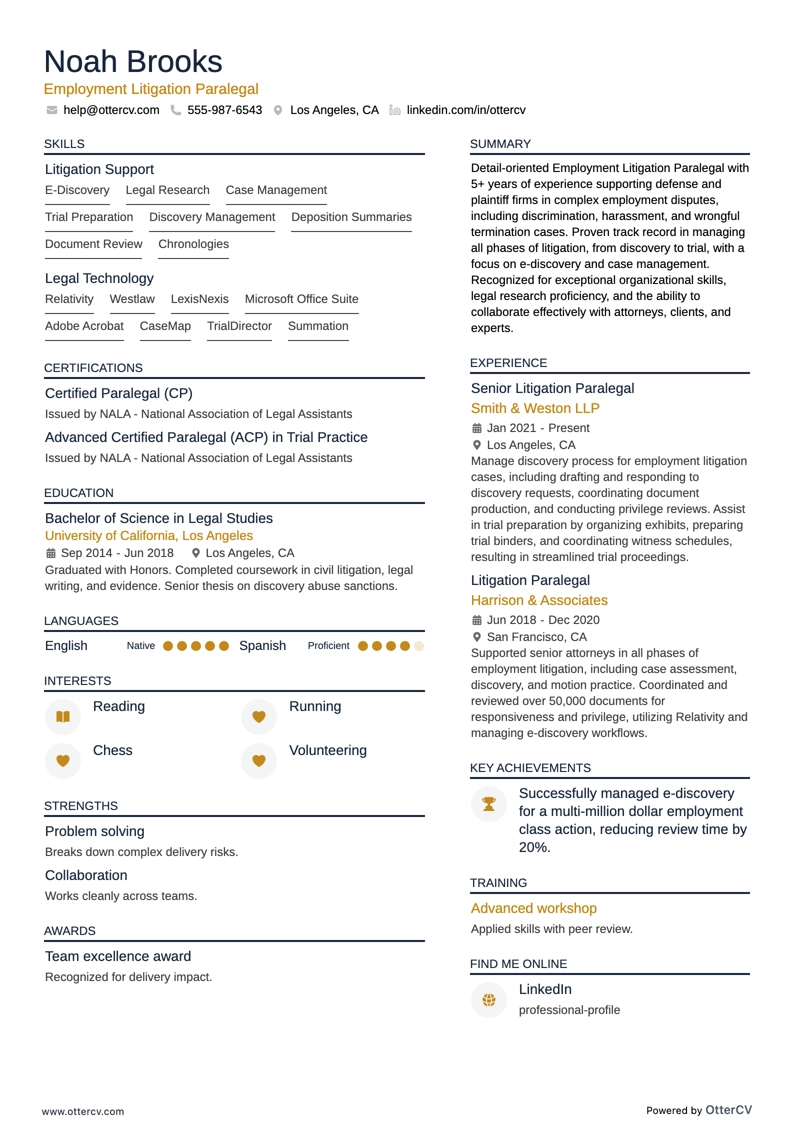
Employment Litigation Paralegal resume example

Employment Litigation Paralegal

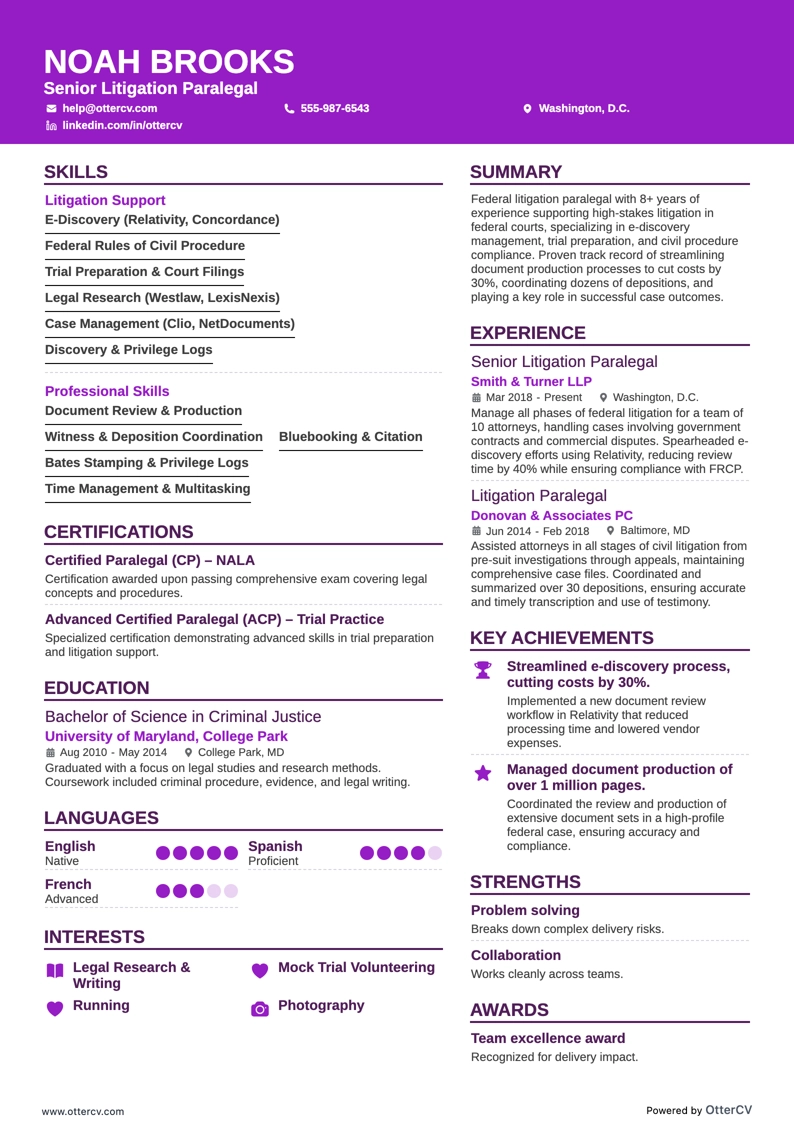
Federal Litigation Paralegal resume example

Federal Litigation Paralegal

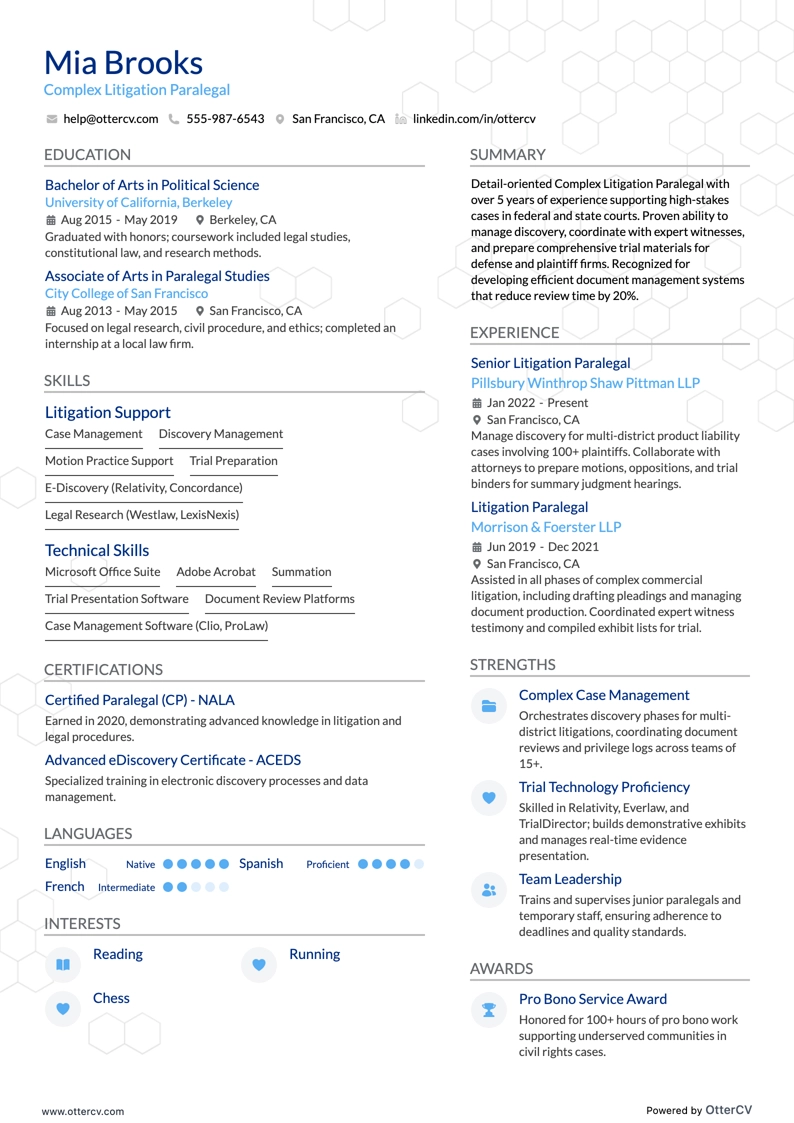
Complex Litigation Paralegal resume example

Complex Litigation Paralegal

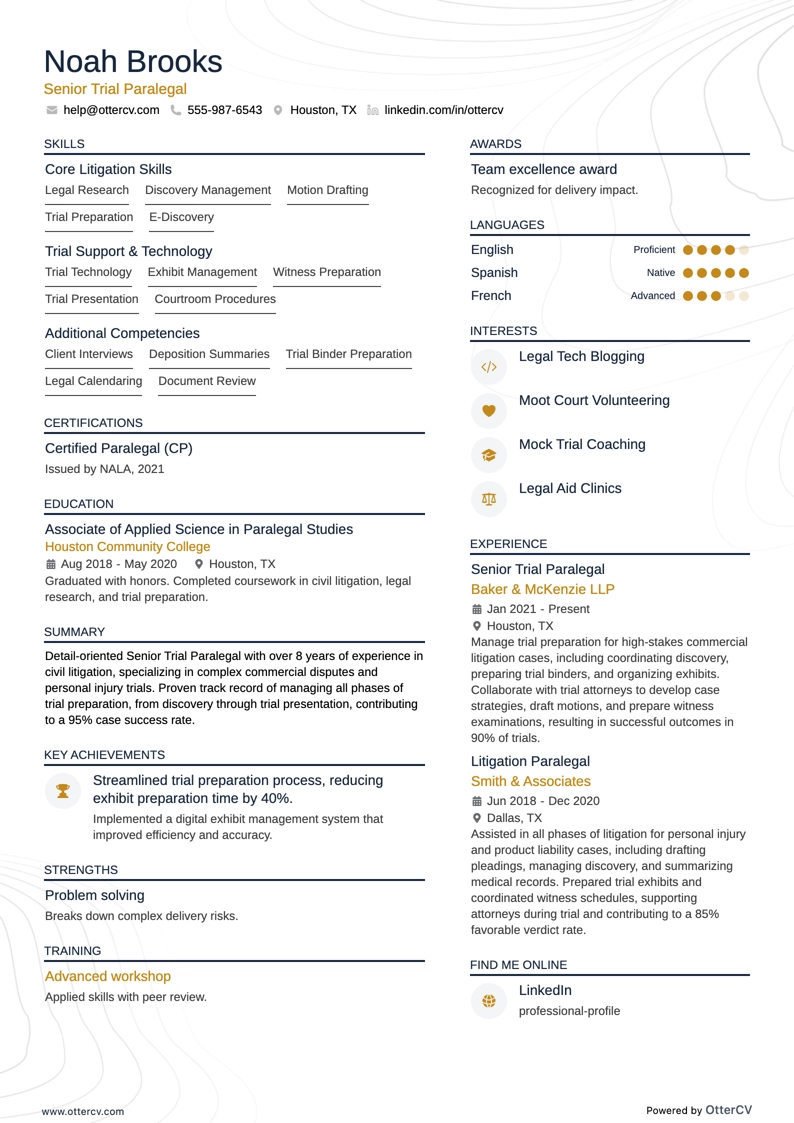
Trial Paralegal resume example

Trial Paralegal

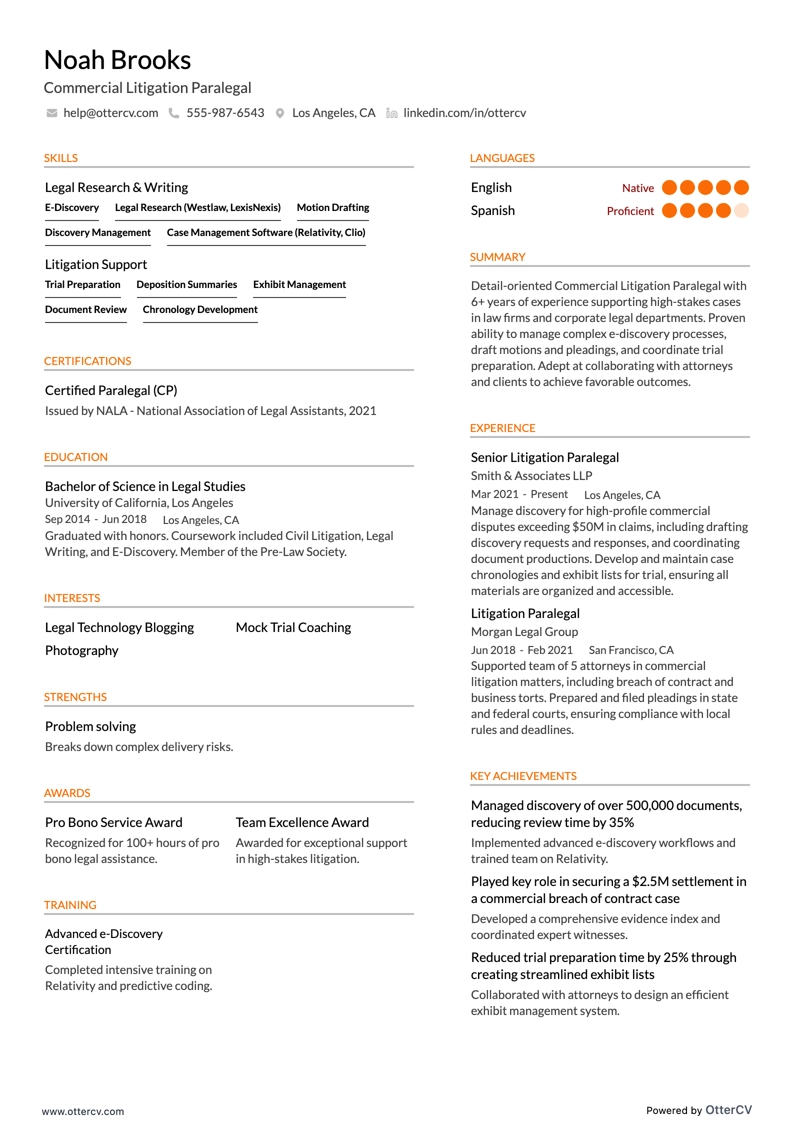
Commercial Litigation Paralegal resume example

Commercial Litigation Paralegal

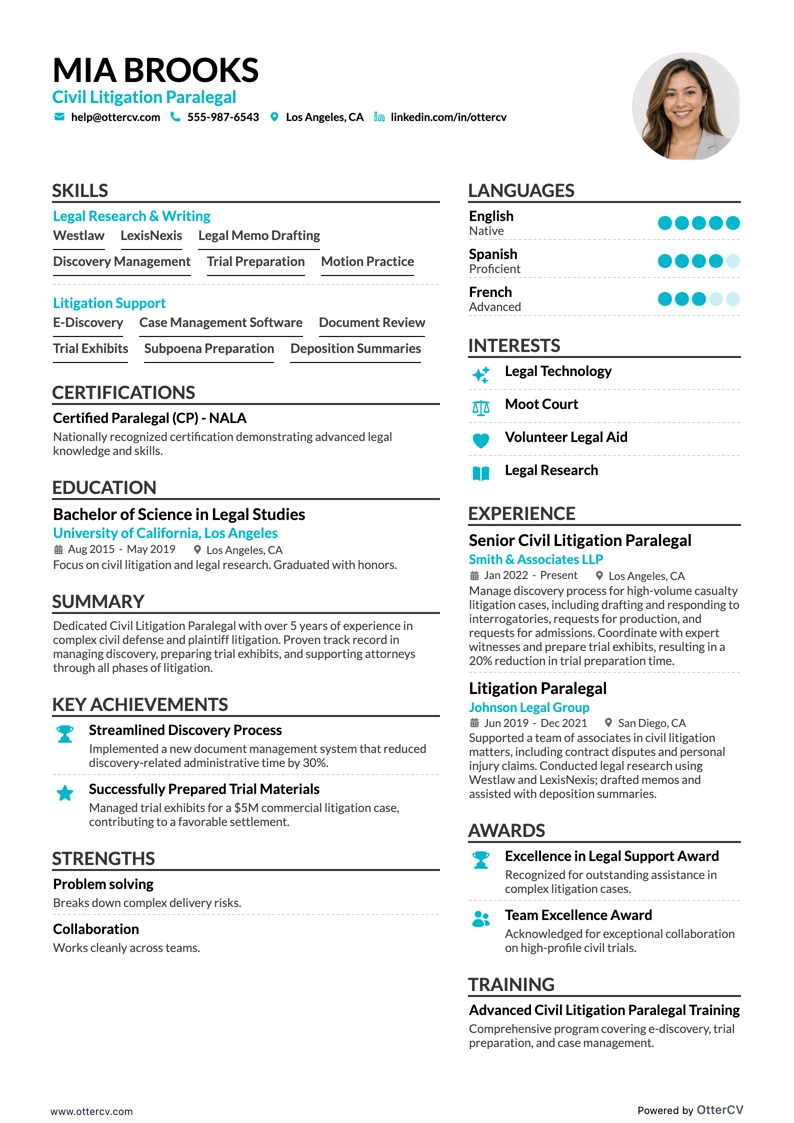
Civil Litigation Paralegal resume example

Civil Litigation Paralegal

Many litigation paralegal resumes fall short because they hide case impact behind task lists and generic keywords. As a result, ATS filters and recruiters may miss your relevance during a quick scan, which can cost you interviews even when your experience is a strong match.

A strong resume focuses on outcomes that show how you help move cases forward. Highlight deadlines met, discovery volume managed, filings accepted without rework, motions supported, and trial preparation delivered on time. Knowing how to make your resume stand out begins with quantifying accuracy, turnaround time, and caseload.

Key takeaways

  • Quantify case outcomes in every bullet, including discovery volume, filing accuracy, and deadlines met.

  • Use a reverse-chronological format if you have direct litigation experience.

  • Choose a hybrid format when changing careers or moving into litigation support roles.

  • Match the job posting’s tools, terminology, and practice areas in your experience section.

  • Show skills through measurable achievements in your summary and experience, not just a skills list.

  • Place certifications above education when they are recent, litigation-focused, or required for the role.

  • Use Echocv’s bullet point generator to turn vague task descriptions into results-driven resume bullets.

How to format a litigation paralegal resume

Recruiters reviewing litigation paralegal resumes look first for case management experience, document review proficiency, and the ability to support attorneys through every stage of litigation, from discovery to trial preparation. A clean, well-structured resume format helps these qualifications stand out quickly in both human review and applicant tracking system (ATS) scans.

I have significant experience in this role—which format should I use?

I have significant experience in this role—which format should I use?

Use a reverse-chronological format to place your strongest litigation support experience and increasing case complexity at the top of your resume.

  • Start with your most recent role and describe the scope of your caseload, including case types such as commercial litigation, personal injury, or class actions, along with the size of the legal teams you supported.
  • Include litigation-specific tools and skills within each position, such as Relativity, Concordance, Westlaw, e-discovery platforms, and court filing systems.
  • Quantify your impact whenever possible, including case volumes, document review counts, filing deadlines met, and any cost or time savings you helped achieve.

Example bullet: “Managed document review and production for a 12-defendant commercial litigation matter, coordinating review of over 45,000 documents in Relativity and reducing outside counsel review costs by 30%.”

I'm junior or switching into this role—what format works best?

I'm junior or switching into this role—what format works best?

A hybrid resume format works best because it lets you highlight litigation-relevant skills first while still presenting your work history in chronological order.

  • Place a skills section near the top of your resume with litigation-specific competencies such as legal research, deposition preparation, case management software, and court filing procedures.
  • Include internships, academic projects, or pro bono work that involved litigation tasks, such as drafting discovery requests, preparing trial binders, or summarizing depositions, even if the experience was unpaid or part of a certificate program.
  • Connect each skill or experience to a specific action and a clear result so recruiters can quickly understand how you apply what you know.

Example scaffold: E-discovery skills → assisted attorneys in reviewing and coding 8,000 documents using Relativity during a product liability case → contributed to meeting a court-imposed production deadline two days ahead of schedule.

Why not use a functional resume?

Why not use a functional resume?

A functional resume removes the timeline of your litigation experience, which makes it harder for recruiters and hiring attorneys to evaluate your familiarity with case lifecycles, filing deadlines, and increasingly complex caseloads. If you have any direct litigation support experience, even at the internship level, avoid this format because chronological context is what shows you can handle active case demands.

  • A functional resume may be acceptable if you're transitioning from a non-legal administrative role or returning to the workforce after an extended gap, but only if each listed skill is tied to a specific project, case, or measurable outcome rather than presented in isolation.

Once you have a clean, readable format, the next step is choosing resume sections that strengthen your candidacy.

What sections should go on a litigation paralegal resume

Recruiters expect a clean, case-focused resume that shows you can support litigation teams accurately, quickly, and under deadline. Understanding which resume sections to include is essential for clarity.

Use this structure:

  • Header
  • Summary
  • Experience
  • Skills
  • Projects
  • Education
  • Certifications
  • Optional sections: Awards, Volunteering, Languages

Your strongest experience bullets should highlight measurable impact, case scope, deadlines met, and results delivered across discovery, filings, trial prep, and attorney support.

Now that you’ve outlined the key resume components, focus on your litigation paralegal experience section to show how your work delivered results in each area.

How to write your litigation paralegal resume experience

Your experience section should show that you can manage complex litigation workflows, produce case-ready documents, and improve efficiency throughout the legal process. Hiring managers look for demonstrated impact, including measurable results, proficiency with litigation-specific tools, and strong work product, rather than simple task lists. Building a targeted resume that aligns your experience with the role is essential.

Each entry should include:

  • Job title
  • Company and location (or remote)
  • Dates of employment (month and year)

Add three to five concise bullet points that explain what you owned, how you executed the work, and the outcomes you delivered:

  • Ownership scope: the case types, dockets, document management systems, or discovery processes you were directly responsible for within the litigation lifecycle.
  • Execution approach: the legal research platforms, e-discovery tools, case management software, or procedural frameworks you used to prepare filings, organize evidence, and support trial preparation.
  • Value improved: changes to case turnaround time, document accuracy, filing compliance, discovery efficiency, or risk reduction resulting from your contributions to active litigation matters.
  • Collaboration context: how you worked with attorneys, opposing counsel, court clerks, expert witnesses, or clients to advance case strategy and meet critical deadlines.
  • Impact delivered: outcomes such as resolved caseloads, successful filing records, reduced costs, or stronger case positioning instead of routine task descriptions.

Experience bullet formula

Experience bullet formula

Action verb + technology + what you built or fixed + measurable result

A litigation paralegal experience example

Litigation Paralegal

Hawthorne & Pierce LLP | Chicago, IL

2021–Present

Mid-size litigation firm handling high-volume commercial disputes and employment matters across state and federal courts.

  • Managed end-to-end eDiscovery in Relativity and Everlaw, coordinating legal holds, collections, and review workflows to reduce review time by 28% and cut outside vendor costs by $45K annually.
  • Drafted and filed pleadings, discovery requests, and motions through CM/ECF and state e-filing portals, maintaining a 99% on-time filing rate across 120+ deadlines per year with zero court rejections.
  • Built deposition and trial preparation systems in CaseMap, TextMap, and Microsoft Excel, indexing 3,500+ exhibits and linking testimony to key issues to shorten attorney prep time by 20% for five trials and eight arbitrations.
  • Coordinated subpoena compliance and records retrieval with clients, custodians, and third-party vendors, tracking production status in SharePoint and Microsoft Teams to improve average response cycle time from ten days to six days.
  • Analyzed privilege and confidentiality issues with attorneys, then implemented redaction and quality control checklists in Adobe Acrobat Pro and Relativity, reducing privilege log errors by 35% and preventing two potential inadvertent disclosures.

Now that you've seen how a strong experience section comes together, let's look at how to adjust those details for the specific litigation paralegal role you're targeting.

How to tailor your litigation paralegal resume experience

Recruiters evaluate your litigation paralegal resume through applicant tracking systems and manual review. Tailoring your resume to the job description helps your qualifications register with both.

Ways to tailor your litigation paralegal experience:

  • Match the specific e-discovery platforms or case management software listed in the posting.
  • Use the same litigation terminology the employer uses for legal processes.
  • Mirror the deposition coordination or trial preparation methods described in the role.
  • Include relevant practice area experience, such as civil defense or plaintiff work.
  • Highlight document review workflows or coding standards mentioned in the job description.
  • Emphasize court filing compliance or procedural accuracy when the posting calls for it.
  • Reflect the team collaboration structures they outline, such as attorney support models.
  • Align your discovery or subpoena management scope with their stated expectations.

Tailoring means aligning your real accomplishments with the role's requirements, not forcing unrelated keywords into your experience.

Resume tailoring examples for litigation paralegal

Job description excerptUntailoredTailored
Manage and organize case files for complex commercial litigation matters using Relativity for document review and production.Helped with file organization and document management tasks.Managed case files for 15+ complex commercial litigation matters, organizing and producing over 50,000 documents through Relativity to meet court-mandated discovery deadlines.
Prepare deposition summaries, draft motions, and coordinate with outside counsel on multi-party civil defense cases.Assisted attorneys with legal documents and communication tasks.Drafted deposition summaries and motions for multi-party civil defense cases involving up to eight co-defendants, coordinating schedules and filings with three outside counsel teams.
Conduct legal research on state and federal procedural rules and maintain trial binders, exhibit lists, and witness files for trial preparation.Did research and helped prepare materials for court proceedings.Conducted legal research on state and federal procedural rules using Westlaw, and assembled trial binders, exhibit lists, and witness files for a six-week product liability trial with 200+ exhibits.

Once you’ve aligned your experience with the role’s litigation needs, quantify your litigation paralegal achievements to show the measurable impact of your work.

How to quantify your litigation paralegal achievements

Quantifying your achievements shows how your work reduced risk, improved accuracy, and helped cases move forward faster. Focus on deadlines met, filings processed, discovery volume, error rates, cost savings, and compliance outcomes across matters and courts.

Quantifying examples for litigation paralegal

MetricExample
Discovery volumeManaged discovery for eight active matters, processing 120,000+ pages in Relativity and producing 35,000 documents with a 99.6% QC pass rate.
Deadline complianceTracked 60+ court deadlines in Outlook and a master docket sheet, achieving 100% on-time filings across three jurisdictions over twelve months.
Filing accuracyPrepared and e-filed 180 pleadings and motions in PACER and state e-filing portals, cutting rejection notices from twelve per quarter to two.
Cost savingsNegotiated and coordinated court reporter and vendor schedules, reducing deposition and transcript costs by $18,500 across twenty-two depositions.
Risk reductionStandardized litigation hold notices and acknowledgments for 300 custodians, increasing completion from 72% to 96% and reducing missed-hold escalations to zero.

How to list your hard and soft skills on a litigation paralegal resume

Once you’ve written strong, results-driven bullet points, the next step is making sure your skills section shows the right mix of hard and soft skills to reinforce your litigation paralegal expertise.

This section should show that you can support discovery, filings, and trial preparation. Recruiters and ATS (applicant tracking systems) scan it quickly for keywords, so focus on a hard-skill-heavy mix supported by targeted soft skills that reflect how you work.

Litigation paralegal roles require a blend of:

  • Product strategy and discovery skills.
  • Data, analytics, and experimentation skills.
  • Delivery, execution, and go-to-market discipline.
  • Soft skills.

Your skills section should be:

  • Scannable, using grouped bullet points.
  • Relevant to the job posting.
  • Supported by proof in your experience bullets.
  • Updated with current tools.

Place your skills section:

  • Above your experience if you’re junior or changing careers.
  • Below your experience if you’re mid-level or senior with strong achievements.

Hard skills

  • Relevant hard skills show technical proficiency with litigation tools and processes.
  • eDiscovery workflows.
  • Relativity, Everlaw, and Logikcull.
  • Document review and issue coding.
  • Privilege logs and redactions.
  • Legal research using Westlaw and LexisNexis.
  • Deposition preparation and summaries.
  • Trial binders and exhibit lists.
  • Court filings through CM/ECF and PACER.
  • Case management with Clio and iManage.
  • Microsoft Excel and Adobe Acrobat Pro.
  • Subpoenas and records retrieval.

Soft skills

  • Prioritize deadlines across matters.
  • Draft clear, attorney-ready summaries.
  • Coordinate with vendors and court staff.
  • Flag risks and inconsistencies early.
  • Manage sensitive information discreetly.
  • Drive follow-ups to close open items.
  • Communicate status without prompting.
  • Align work with case strategy.
  • Maintain accuracy under time pressure.
  • Resolve conflicts in document requests.
  • Take ownership of task handoffs.

How to show your litigation paralegal skills in context

Your skills should not appear only in a bulleted list on your resume. Review resume skills examples to see how strong candidates weave their competencies into the broader story of their experience.

Show your skills in:

  • Your summary, where you present your high-level professional identity
  • Your experience, where you prove those skills through outcomes

Here’s what that looks like in practice.

Litigation paralegal with 10+ years in commercial defense, with expertise in Relativity-driven document review, deposition coordination, and trial preparation. Streamlined e-discovery workflows that reduced review timelines by 30% while supporting attorneys across 50+ federal cases.

  • Clearly reflects senior-level experience
  • Mentions industry-standard tools
  • Quantifies a process improvement
  • Demonstrates strong collaboration skills

Experience example

Senior Litigation Paralegal

Braddock & Steele LLP | Chicago, IL

June 2018–March 2024

  • Managed Relativity-based document review for 40+ civil cases, reducing average production time by 25% through standardized coding protocols.
  • Coordinated deposition scheduling with attorneys and outside counsel across 12 jurisdictions, maintaining a 98% on-time completion rate.
  • Drafted and filed more than 300 motions and pleadings using CompuLaw, ensuring zero missed court deadlines during a six-year tenure.
  • Every bullet includes a measurable outcome.
  • Skills surface naturally through real achievements.

Once you’ve connected your abilities to real tasks and outcomes, the next step is to use that same approach when building a litigation paralegal resume without direct experience.

How do I write a litigation paralegal resume with no experience

Even without full-time experience, you can still show that you’re ready for the role through:

  • Litigation clinic case file support
  • Mock trial exhibit preparation
  • Court docket monitoring assignments
  • E-discovery coursework and labs
  • Legal research and writing projects
  • Deposition summary practice exercises
  • Volunteer intake and case screening
  • Document production and privilege logs

If you're entering the field, our guide on writing a resume without work experience can help you present these transferable accomplishments effectively.

Focus on:

  • Case file organization and naming
  • Legal research with citations
  • Discovery workflows and tracking
  • Court rules and docketing accuracy

Resume format tip for entry-level litigation paralegal

Resume format tip for entry-level litigation paralegal

Use a combination resume format to put litigation paralegal skills and projects first while still clearly showing your education and related experience.

  • Add a Relevant Projects section.
  • List tools such as Relativity and LexisNexis.
  • Quantify outputs, such as the number of records reviewed.
  • Mirror keywords from litigation paralegal job descriptions.
  • Include coursework related to litigation.

Example project bullet:

  • Built a privilege log in Excel from 120 records using Relativity-style fields, reducing review time by 25% for a mock document production project.

Even without direct experience, your education can show the foundational legal knowledge and skills needed for a litigation paralegal role.

How to list your education on a litigation paralegal resume

Your education section helps hiring teams quickly confirm your academic background, training, and core legal knowledge.

Include the following:

  • Degree name
  • Institution
  • Location
  • Graduation year
  • Relevant coursework, for juniors or entry-level candidates
  • Honors and GPA, if 3.5 or higher

Skip the month and day, and list only the graduation year.

Here’s a strong education entry tailored for a litigation paralegal resume.

Example education entry

Bachelor of Science in Paralegal Studies

Florida State University, Tallahassee, FL

Graduated 2021

GPA: 3.7/4.0

  • Relevant coursework: Civil Litigation, Legal Research and Writing, Evidence Law, Federal Court Procedures
  • Honors: Dean's List (six semesters), Magna Cum Laude

How to list your certifications on a litigation paralegal resume

Certifications on your resume show your commitment to learning, your proficiency with legal tools, and your fit for litigation paralegal work in fast-moving case environments.

Include:

  • Certificate name
  • Issuing organization
  • Year
  • Optional: credential ID or URL
  • Place certifications below education when your degree is recent and more relevant than older or general certificates.
  • Place certifications above education when they are recent, litigation-focused, or required for the role you are targeting.

Best certifications for your litigation paralegal resume

  • Certified Paralegal (CP).
  • Advanced Certified Paralegal (ACP) in Trial Practice.
  • Professional Paralegal (PP).
  • Paralegal CORE Competency Exam (PCCE).
  • Registered Paralegal (RP).
  • Certified E-Discovery Specialist (CEDS).
  • Relativity Certified Administrator (RCA).

Once you’ve placed your credentials where hiring managers will notice them, use your litigation paralegal resume summary to connect those qualifications to the role’s core requirements.

How to write your litigation paralegal resume summary

Your resume summary is often the first thing a recruiter reads, so it should quickly show your value. A strong opening tailored to litigation paralegal work helps you stand out from generic applicants.

Keep it to three to four lines and include:

  • Your title and total years of paralegal experience in litigation settings.
  • The type of litigation you support, such as civil, commercial, or personal injury.
  • Core tools and skills, such as case management software, e-discovery platforms, and legal research.
  • One or two measurable achievements, such as cases supported or filing accuracy rates.
  • Soft skills tied to real outcomes, such as organization that reduced missed deadlines.

PRO TIP

At the entry or mid level, focus on specific litigation skills, relevant tools, and early contributions that show you can handle the pace.

Highlight concrete tasks you’ve owned, such as document review or deposition preparation.

Avoid vague phrases like “passionate team player” or “hard-working self-starter.” Recruiters want to see what you’ve done, not how you describe yourself.

Example summary for a litigation paralegal

Detail-oriented litigation paralegal with three years of experience supporting civil defense teams. Skilled in Relativity, trial preparation, and case management. Coordinated document review for 15+ cases, reducing preparation time by 20%.

Now that your summary highlights your litigation expertise, make sure recruiters can easily reach you with a polished, complete resume header.

What to include in a litigation paralegal resume header

A resume header is the top section of your resume with your key identifiers. For a litigation paralegal role, it helps improve visibility, credibility, and recruiter screening.

Essential resume header elements

  • Full name
  • Tailored job title and headline
  • Location
  • Phone number
  • Professional email
  • GitHub link
  • Portfolio link
  • LinkedIn

A LinkedIn link helps recruiters quickly verify your experience and supports the screening process.

Do not include a photo on a litigation paralegal resume unless the role is explicitly front-facing or appearance-dependent.

Keep your header to two lines, match your job title to the posting, and use the same name and dates across all profiles.

Example

Once your contact details and role-specific identifiers are in place at the top of your resume, add extra sections that showcase supporting qualifications and strengthen your litigation paralegal candidacy.

Additional sections for litigation paralegal resumes

These sections can help you stand out when your core qualifications are similar to those of other litigation paralegal candidates.

Choose additions that reinforce your courtroom readiness, legal knowledge, or professional credibility:

  • Languages
  • Professional affiliations, such as the National Association of Legal Assistants
  • Legal publications or case summaries
  • Continuing legal education and specialized training
  • Volunteer or pro bono legal work
  • Awards and recognitions
  • Hobbies and interests

Once you've strengthened your resume with relevant additional sections, pairing it with a well-crafted cover letter can further help your application stand out.

Do litigation paralegal resumes need a cover letter?

A cover letter is not required for a litigation paralegal role, but it can help in competitive openings or at firms that expect one. If you're unsure where to begin, learning what a cover letter is and how it complements your resume can make its value clearer. It may be especially useful when your resume does not fully show your fit, relevant matter exposure, or why you are targeting a specific team.

Use a cover letter to add context your resume cannot provide:

  • Explain role and team fit: Connect your case support strengths to the practice area, case volume, and attorney workflow.
  • Highlight one or two relevant projects or outcomes: Summarize a discovery workflow, trial prep effort, or filing process improvement, and note the measurable result.
  • Show understanding of the business context: Reference the firm's practice focus, typical clients, and how deadlines, accuracy, and confidentiality drive results.
  • Address career transitions or non-obvious experience: Translate adjacent work into litigation paralegal skills, and explain any gaps or changes directly.

Even if you skip a cover letter and rely on your resume to carry your application, the next step is using AI to improve your litigation paralegal resume so it communicates your value more clearly and consistently.

Using AI to improve your litigation paralegal resume

AI can improve your resume's clarity, structure, and overall impact. It can tighten language and highlight relevant strengths, but overusing it can quickly make your resume sound less authentic. Once your content feels clear and aligned with the role, step away from AI. For practical guidance, explore these ChatGPT resume writing prompts designed to strengthen specific sections.

Here are 10 practical prompts you can copy and paste to improve specific parts of your resume:

  1. Strengthen your summary: “Rewrite my litigation paralegal resume summary to emphasize case management experience and courtroom preparation skills in three concise sentences.”
  2. Quantify experience bullets: “Add measurable outcomes to these litigation paralegal experience bullets, focusing on case volumes, filing deadlines met, and document review totals.”
  3. Tighten action verbs: “Replace weak verbs in my litigation paralegal experience section with strong, specific action verbs tied to legal research and trial support.”
  4. Align skills strategically: “Reorganize my litigation paralegal skills section to prioritize abilities matching this job description, removing irrelevant or redundant entries.”
  5. Clarify case contributions: “Rewrite these litigation paralegal project descriptions to clearly state my role, the legal matter type, and the outcome I supported.”
  6. Improve certification details: “Reformat my litigation paralegal certifications section so each entry includes the credential name, issuing body, and completion date.”
  7. Refine education entries: “Edit my litigation paralegal education section to highlight relevant coursework, honors, and legal research training in a clean format.”
  8. Remove filler language: “Identify and remove vague or redundant phrases from my litigation paralegal resume without losing any meaningful detail.”
  9. Target a posting: “Tailor my litigation paralegal experience bullets to match this specific job posting's requirements, using keywords from the listing.”
  10. Sharpen formatting consistency: “Review my litigation paralegal resume for inconsistent punctuation, tense shifts, and formatting errors across all sections.”

Stop using AI once your resume sounds accurate, specific, and grounded in your real experience. AI should never invent experience or inflate claims—if it didn't happen, it doesn't belong here.

Conclusion

A strong litigation paralegal resume should highlight measurable results, role-specific skills, and a clear, easy-to-scan structure. Use metrics to show your impact on deadlines, filings, discovery volume, and case readiness, and keep each section focused and consistent.

Today’s hiring market favors litigation paralegal candidates who demonstrate accuracy, speed, and sound judgment. When your resume links results to core tasks and tools, it signals that you are ready to support active matters now and next.

Litigation Paralegal resume examples

Explore additional Litigation Paralegal resume samples and guides and see what works for your level of experience or role.

By Experience

Lead Litigation Paralegal

Lead Litigation Paralegal resume preview

Senior Litigation Paralegal

Senior Litigation Paralegal resume preview

Litigation Paralegal resume examples

Explore additional Litigation Paralegal resume samples and guides and see what works for your level of experience or role.

By Role

Product Liability Litigation Paralegal

Product Liability Litigation Paralegal resume preview

Insurance Defense Litigation Paralegal

Insurance Defense Litigation Paralegal resume preview

Personal Injury Litigation Paralegal

Personal Injury Litigation Paralegal resume preview

Employment Litigation Paralegal

Employment Litigation Paralegal resume preview

Federal Litigation Paralegal

Federal Litigation Paralegal resume preview

Complex Litigation Paralegal

Complex Litigation Paralegal resume preview

Trial Paralegal

Trial Paralegal resume preview

Commercial Litigation Paralegal

Commercial Litigation Paralegal resume preview

Civil Litigation Paralegal

Civil Litigation Paralegal resume preview