Litigation Partner full preview

10 Litigation Lawyer Resume Examples

OtterCV

Written by The OtterCV Team

Updated: 7/11/2023•8 min read

See all resume examples in this guide, or generate your own resume example with your personalized prompt

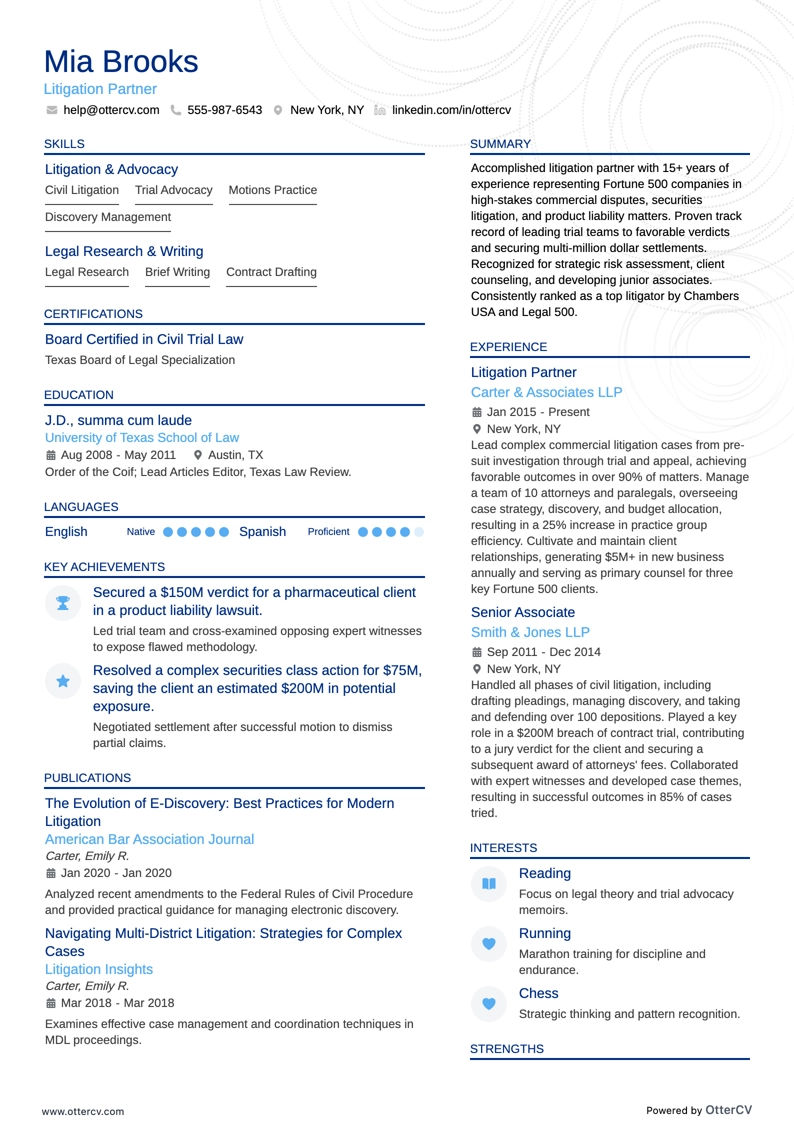
Litigation Partner resume example

Litigation Partner

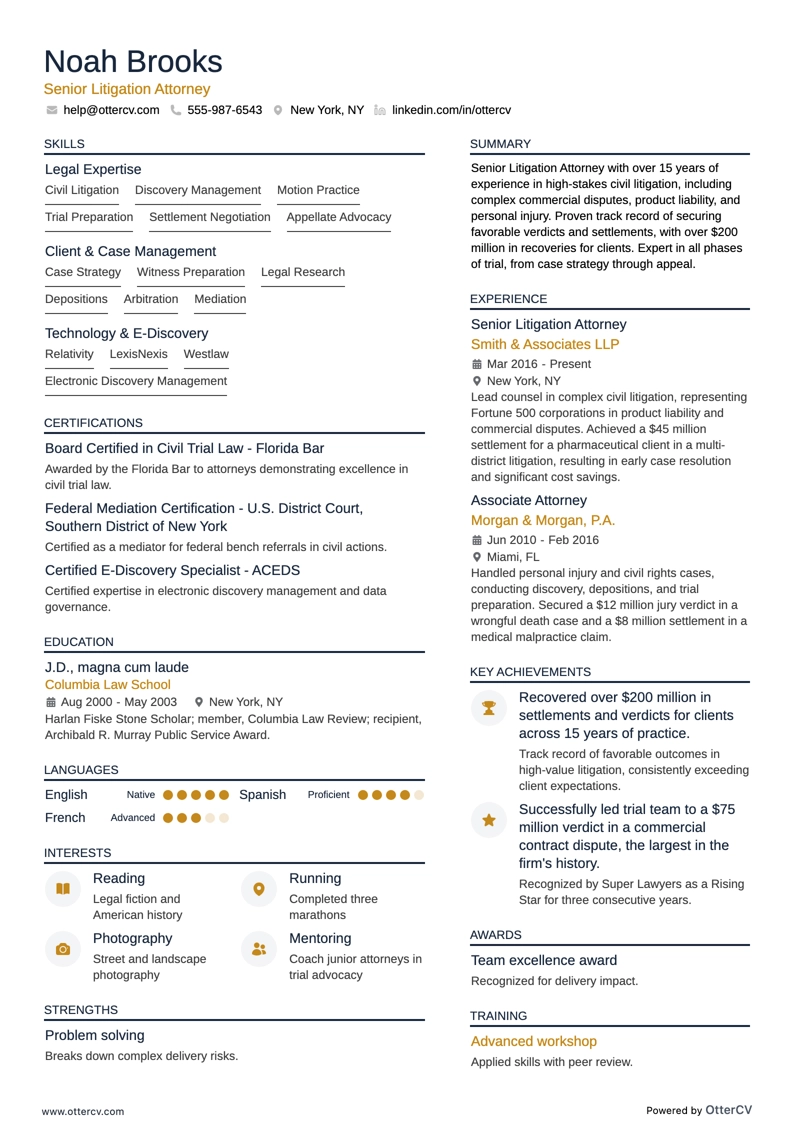
Senior Litigation Attorney resume example

Senior Litigation Attorney

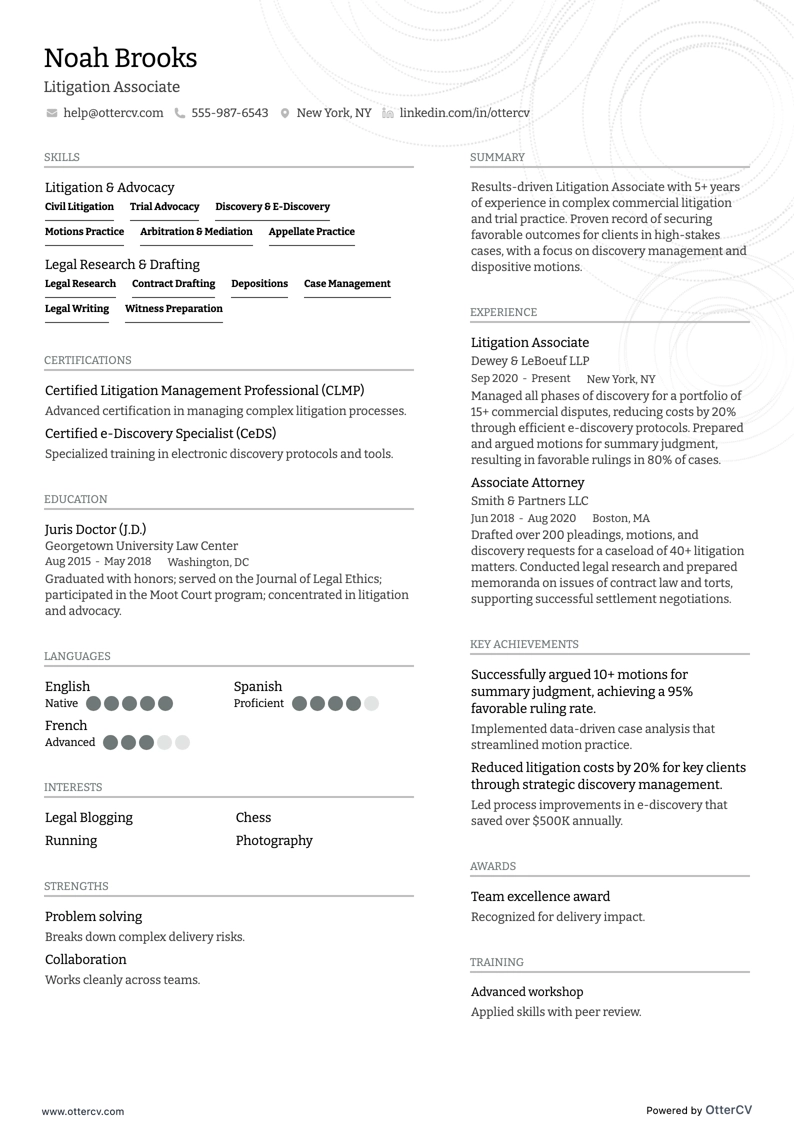
Litigation Associate resume example

Litigation Associate

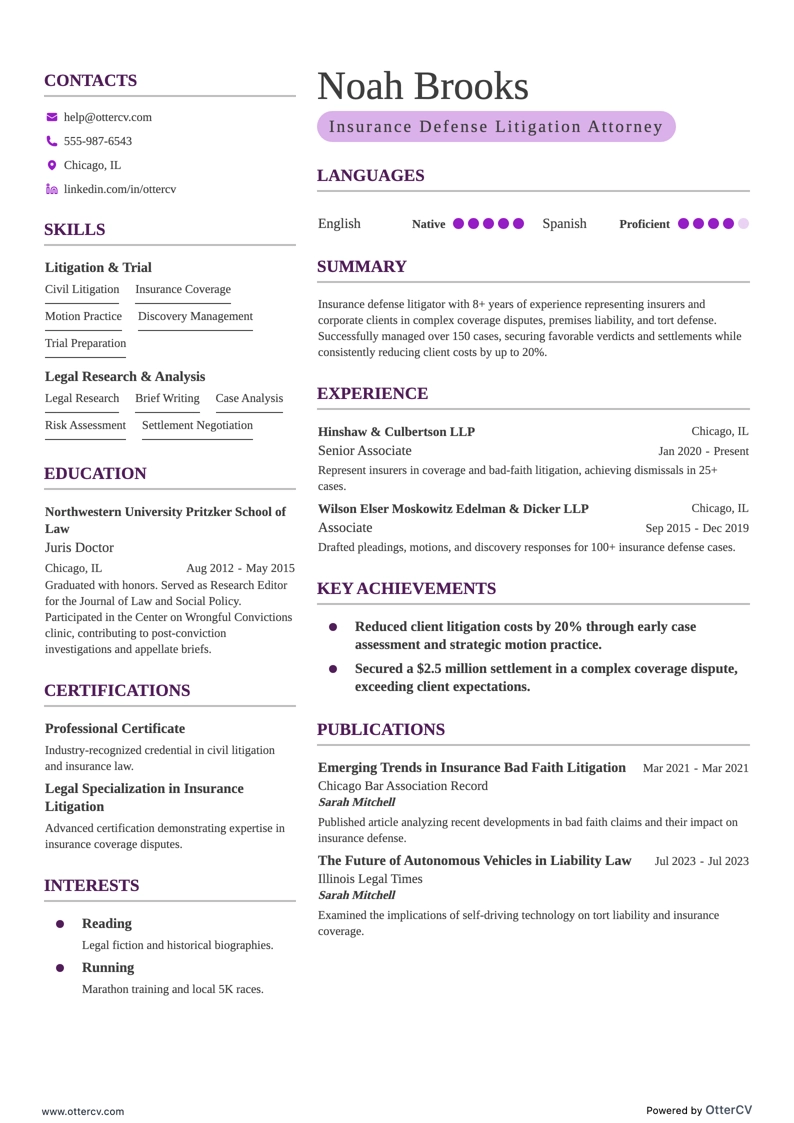
Insurance Defense Litigation Attorney resume example

Insurance Defense Litigation Attorney

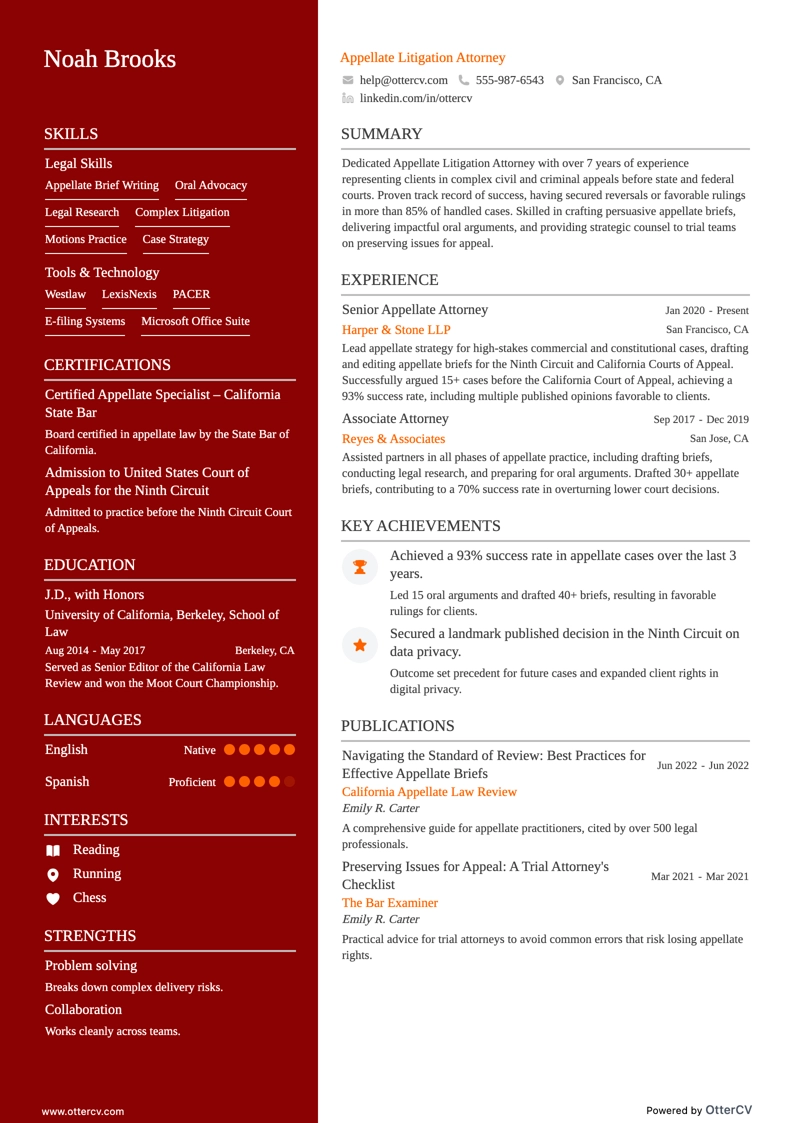
Appellate Litigation Attorney resume example

Appellate Litigation Attorney

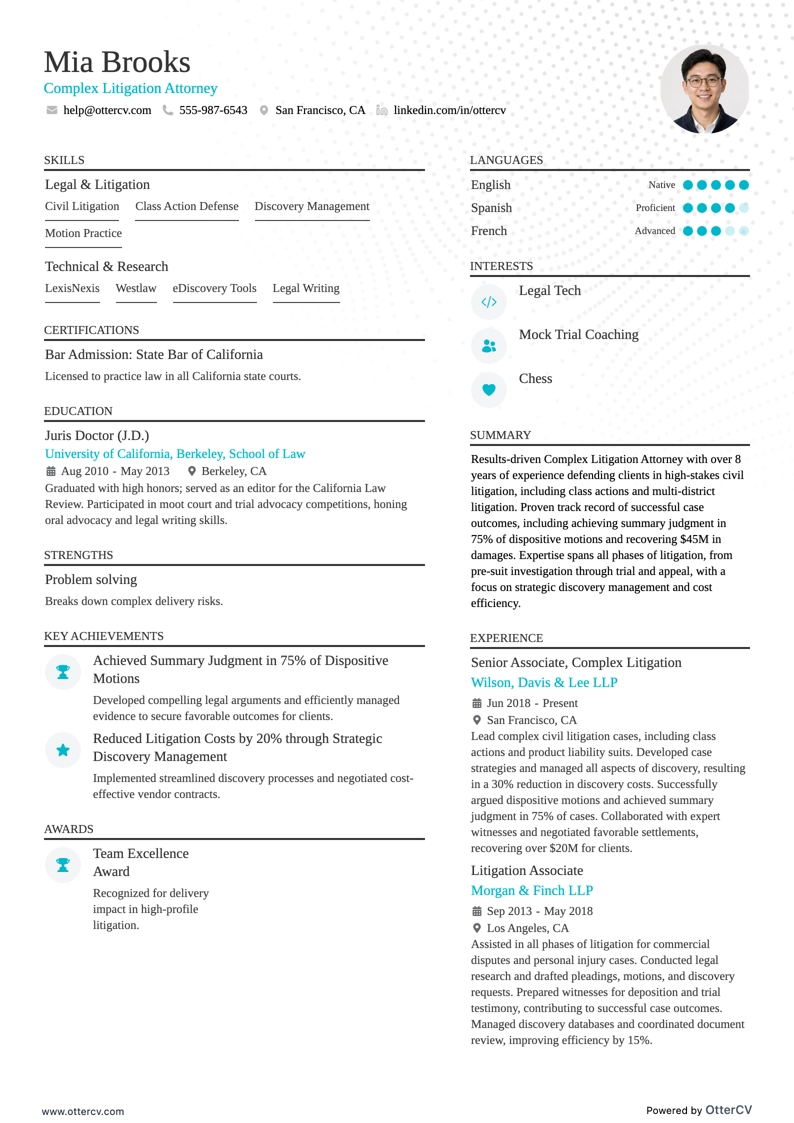
Complex Litigation Attorney resume example

Complex Litigation Attorney

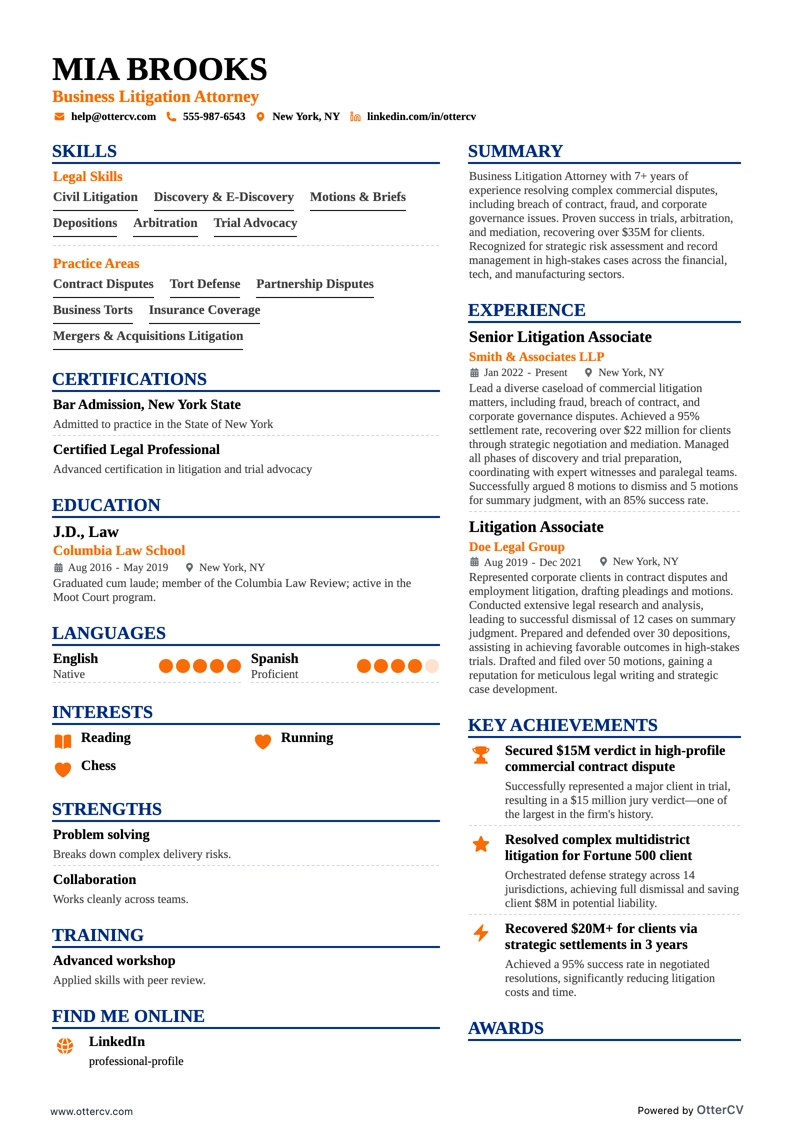
Business Litigation Attorney resume example

Business Litigation Attorney

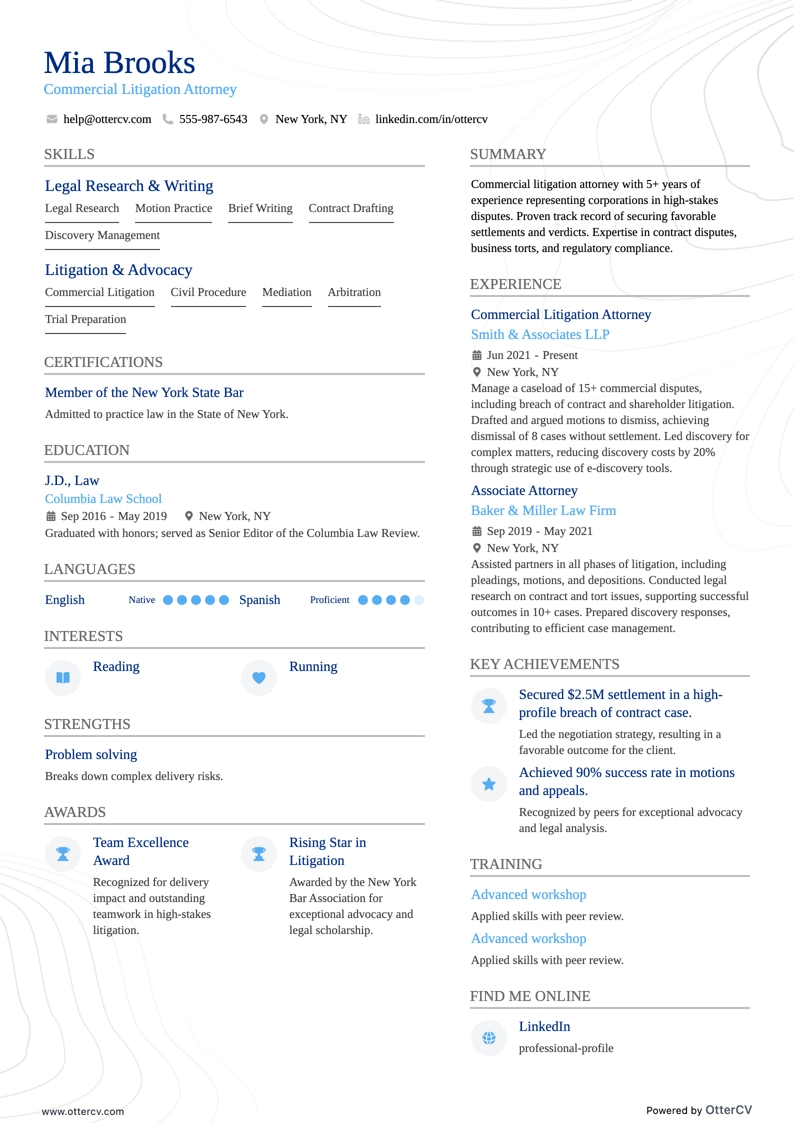
Commercial Litigation Attorney resume example

Commercial Litigation Attorney

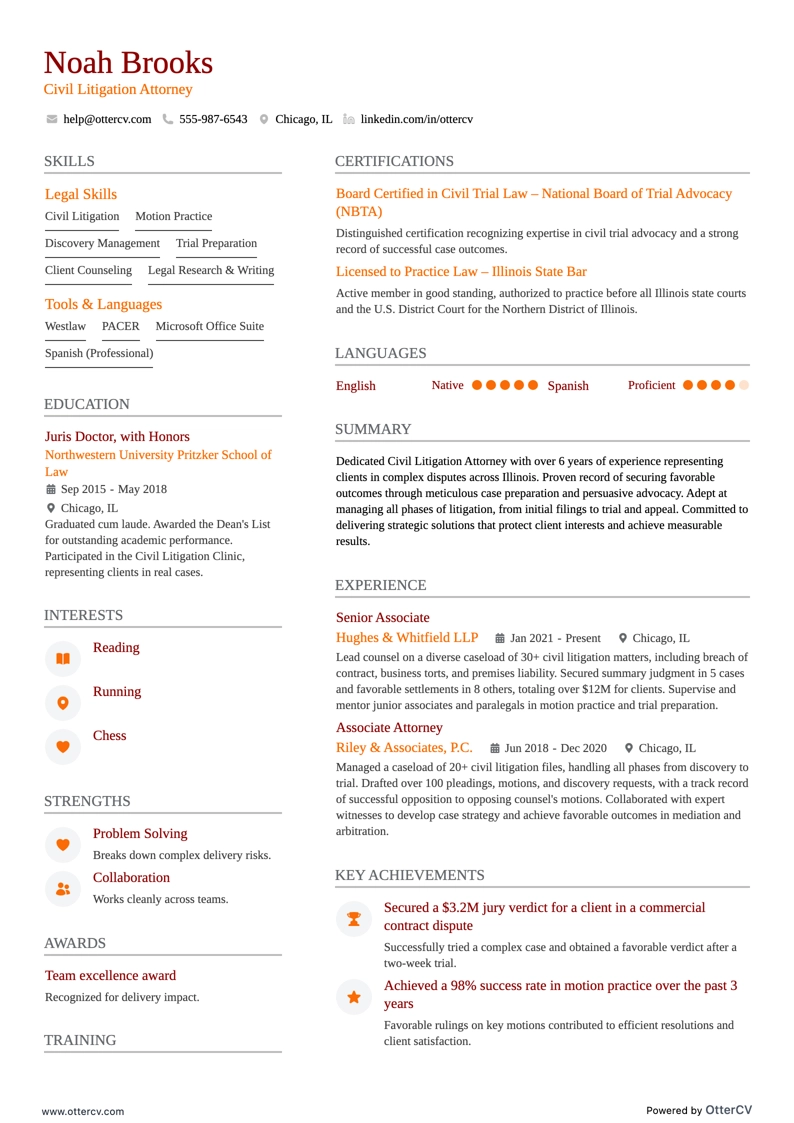
Civil Litigation Attorney resume example

Civil Litigation Attorney

Most litigation lawyer resumes fail because they read like matter logs instead of proof of results. That matters when applicant tracking systems filter applications and recruiters scan resumes in seconds amid intense competition.

A strong resume shows what you changed, not just what you touched. Knowing how to make your resume stand out starts with highlighting wins such as motions granted, claims dismissed, favorable settlements, trial verdicts, and reduced exposure. Add scope and rigor with dollar amounts, jurisdictions, timelines, caseload volume, and error-free filings.

Key takeaways

  • Quantify case outcomes with verdict amounts, win rates, and settlement values on every resume.

  • Tailor experience bullets to each job posting’s practice areas and required tools.

  • Use a reverse-chronological format for experienced lawyers and a hybrid format for career changers.

  • Tie every listed skill to a specific case, project, or measurable result.

  • Place skills above experience if you’re junior and below it if you’re senior.

  • Echocv’s Bullet Point Generator can turn routine duties into measurable, recruiter-ready statements.

  • Stop using AI once your resume accurately reflects your real experience without inflated claims.

How to format a litigation lawyer resume

Recruiters reviewing litigation lawyer resumes prioritize courtroom experience, case outcomes, and deep subject-matter expertise across civil or criminal proceedings. A clear, well-structured resume format helps make these signals—trial wins, settlement figures, motion success rates, and jurisdictional breadth—immediately visible to both hiring attorneys and applicant tracking systems.

I have significant experience in this role—which format should I use?

I have significant experience in this role—which format should I use?

Use a reverse-chronological format to present your litigation career in a clear, progression-driven timeline that highlights increasing case complexity and courtroom responsibility.

Do:

  • Lead each role with scope indicators, including practice area focus, court level (state, federal, appellate), team size supervised, and caseload volume.
  • Highlight litigation-specific competencies such as e-discovery platforms (Relativity, Concordance), legal research tools (Westlaw, LexisNexis), deposition management, and motions practice.
  • Quantify outcomes wherever possible, including verdict amounts recovered, settlement values negotiated, motion grant rates, and case resolution timelines.

Example bullet: “First-chaired 12 jury trials in federal court over a 24-month period, securing favorable verdicts or settlements in 10 cases totaling $18.4M in recovered damages for commercial litigation clients.”

I'm junior or switching into this role—what format works best?

I'm junior or switching into this role—what format works best?

A hybrid format works best. It lets you highlight core litigation skills near the top while backing them up with internships, clerkships, or other transitional legal experience.

Do:

  • Place a skills section near the top that highlights litigation fundamentals such as legal research, brief writing, discovery management, client interviewing, and courtroom observation hours.
  • Feature moot court competitions, law clinic cases, judicial clerkships, or paralegal experience as evidence of applied litigation exposure.
  • Connect every listed skill or project to a concrete action and a measurable or observable result.

Example scaffold: Legal research (skill) → Drafted a 30-page summary judgment motion analyzing 45 precedent cases for a supervising partner (action) → Motion was granted, resulting in full dismissal of plaintiff's claims (result).

Why not use a functional resume?

Why not use a functional resume?

A functional resume removes the chronological context hiring partners use to judge where, when, and under what circumstances you developed your litigation skills. Without that timeline, it becomes much harder to assess courtroom readiness or professional growth.

This format may be acceptable if you're moving from a non-litigation legal role, such as transactional or compliance work, or returning to practice after an extended career gap. Even then, each skill should be tied to a specific project, case, or outcome instead of being presented as a standalone claim.

With your format in place, the next step is to add the right sections to present your litigation expertise clearly.

What sections should go on a litigation lawyer resume

Recruiters want clear evidence that you can manage litigation matters from start to finish and achieve strong case outcomes. Knowing what to put on a resume helps ensure every section adds value.

Use this structure for maximum clarity:

  • Header
  • Summary
  • Experience
  • Skills
  • Projects
  • Education
  • Certifications
  • Optional sections: Awards, Publications, Languages

Your experience bullets should highlight case outcomes, dollar amounts at stake, procedural posture, jurisdiction, scope of responsibility, and measurable results.

Once you’ve chosen the sections that best present your qualifications, focus next on writing your litigation lawyer resume experience to show the impact behind each role.

How to write your litigation lawyer resume experience

The experience section is where you prove your value as a litigation lawyer by showing the cases you’ve handled, the legal strategies you’ve used, and the measurable outcomes you’ve achieved for clients or your firm. Hiring managers care more about demonstrated impact—such as successful verdicts, favorable settlements, and reduced liability exposure—than task lists that only describe day-to-day responsibilities.

Each entry should include:

  • Job title
  • Company and location (or remote)
  • Dates of employment (month and year)

Add three to five concise bullet points that explain what you owned, how you executed, and the outcomes you delivered:

  • Ownership scope: the caseload, practice areas, client portfolios, or litigation teams you were directly responsible for, including the complexity and jurisdiction of matters you managed from filing through resolution.
  • Execution approach: the legal research platforms, discovery tools, case management systems, motions practice strategies, or trial preparation frameworks you used to build arguments, manage evidence, and move cases forward efficiently.
  • Value improved: the changes you drove in case outcomes, settlement timelines, compliance posture, risk mitigation, cost reduction, or procedural efficiency that strengthened your firm’s or client’s legal position.
  • Collaboration context: how you worked with co-counsel, expert witnesses, corporate legal departments, opposing parties during negotiations, paralegals, or regulatory bodies to advance litigation and achieve aligned objectives.
  • Impact delivered: the results you produced, expressed through case dispositions, precedent-setting rulings, portfolio-wide risk reduction, client retention, or business outcomes rather than a list of courtroom appearances or filings completed.

Experience bullet formula

Experience bullet formula

Action verb + technology + what you built or fixed + measurable result

A litigation lawyer experience example

Senior Litigation Associate

Hawthorne & Price LLP | Chicago, IL

2021–Present

Mid-size litigation firm representing Fortune 500 and high-growth companies in complex commercial disputes and employment matters.

  • Led end-to-end case strategy for twelve matters across state and federal courts, achieving a 75% favorable resolution rate through early dispositive motions, targeted discovery, and settlement positioning.
  • Drafted and argued nine dispositive motions using Westlaw Precision and LexisNexis, winning five motions to dismiss and narrowing claims by 60% on average, reducing projected exposure by $3.2M.
  • Managed eDiscovery workflows in Relativity and Everlaw, including ESI protocols, clawback agreements, and privilege reviews, cutting review hours by 30% while maintaining zero court-ordered sanctions.
  • Conducted and defended forty-two depositions, built witness outlines in CaseMap and TrialDirector, and partnered with clients’ HR and finance stakeholders to surface key documents, improving impeachment hit rate by 25% at mediation and trial.
  • Coordinated trial preparation across opposing counsel, expert witnesses, and internal paralegal teams, tracked deadlines in Clio and Microsoft 365, delivered filings with 98% on-time compliance, and reduced last-week trial prep spend by 18%.

Now that you've seen how a strong experience section comes together, here's how to adjust yours for the specific role you're targeting.

How to tailor your litigation lawyer resume experience

Recruiters evaluate litigation lawyer resumes through both human review and applicant tracking systems (ATS), so tailoring your resume to the job description is essential. Aligning your bullet points with the listed requirements helps your resume pass both screening stages.

Ways to tailor your litigation lawyer experience:

  • Mirror the exact practice areas listed in the job description.
  • Reference specific case management software the firm uses daily.
  • Match the litigation phases emphasized, such as discovery or trial preparation.
  • Highlight experience with the court systems or jurisdictions mentioned.
  • Use the firm's terminology for billing or matter management workflows.
  • Emphasize compliance or regulatory knowledge relevant to their client base.
  • Include deposition or mediation experience when the posting requests it.
  • Reflect collaboration structures such as the partner-associate teams they describe.

Tailoring means aligning your real accomplishments with each role's stated requirements, not forcing keywords where they don't belong.

Resume tailoring examples for litigation lawyer

Job description excerptUntailoredTailored
Represent clients in complex commercial litigation matters in state and federal courts, including breach of contract, business torts, and partnership disputes. Manage all phases of litigation from pleading through trial.Handled various legal cases and assisted with court proceedings.Represented clients in over 40 complex commercial litigation matters in state and federal courts, including breach of contract and business tort claims, managing each case from initial pleading through trial.
Conduct and defend depositions, draft dispositive motions, and prepare expert witnesses for trial in high-stakes product liability cases. Experience with Relativity for document review required.Worked on legal documents and participated in discovery activities.Drafted 25+ dispositive motions and conducted over 60 depositions in product liability cases valued at $5M–$50M, using Relativity to manage document review across databases exceeding 500,000 records.
Collaborate with partners to develop case strategy for employment discrimination and wrongful termination litigation. Strong research skills using Westlaw required, with experience filing motions in California Superior Court.Assisted senior attorneys with research and case preparation tasks.Partnered with litigation partners to develop case strategy for 15 employment discrimination and wrongful termination matters, conducting legal research in Westlaw and filing motions in California Superior Court that resulted in favorable summary judgment rulings in 9 cases.

Once you’ve aligned your experience with the role’s casework and priorities, quantify your litigation lawyer achievements to show the impact of that work.

How to quantify your litigation lawyer achievements

Quantifying your achievements shows how your work affected outcomes, speed, and risk. Focus on win rate, settlement value, motion success, cycle time, docket volume, and cost savings from smarter discovery and case strategy.

Quantifying examples for litigation lawyer

MetricExample
Case outcomesImproved summary judgment win rate from 45% to 62% across twenty-one matters by tightening Rule 56 briefing and using Westlaw litigation analytics.
Settlement valueNegotiated $3.8M in settlement recoveries across eight commercial disputes, averaging 18% above last demand while avoiding trial in seven cases.
Cycle timeCut average time from complaint to dispositive motion filing from 210 to 150 days by standardizing case calendars and automating deadlines in Clio.
Discovery efficiencyReduced document review spend by $120K on a 1.6M-file production by applying TAR workflows in Relativity and narrowing custodians by 30%.
Risk reductionLowered sanctions exposure to zero in twelve matters by implementing a litigation hold protocol, tracking acknowledgments, and auditing collections within fourteen days.

Once you've refined your experience bullets, make sure your resume's skills section highlights the right mix of hard and soft skills.

How to list your hard and soft skills on a litigation lawyer resume

Your skills section shows that you can handle high-stakes disputes. Recruiters and ATS also scan it to match your resume to casework needs, so include a balanced mix of hard skills and role-specific soft skills.

Litigation lawyer roles require a blend of:

  • Product strategy and discovery skills
  • Data, analytics, and experimentation skills
  • Delivery, execution, and go-to-market discipline
  • Soft skills

Your skills section should be:

  • Scannable, with bullet-style grouping
  • Relevant to the job post
  • Backed by proof in your experience bullets
  • Updated with current tools

Place your skills section:

  • Above your experience section if you're junior or switching careers
  • Below your experience section if you're mid-level or senior with strong achievements

Hard skills

  • Legal research using Westlaw and LexisNexis.
  • E-discovery with Relativity and Everlaw.
  • Deposition strategy and outline preparation.
  • Motion practice and briefing.
  • Discovery, including interrogatories and requests.
  • Document review and privilege logs.
  • Trial preparation and exhibit lists.
  • Evidence, including FRE and objections.
  • Case management using Clio and iManage.
  • Litigation holds and preservation.
  • Settlement demands and releases.
  • Court filings through PACER and CM/ECF.

Soft skills

  • Develop case themes quickly.
  • Translate facts into persuasive arguments.
  • Lead witness preparation sessions.
  • Negotiate effectively under tight deadlines.
  • Manage client expectations clearly.
  • Communicate with opposing counsel.
  • Coordinate with paralegals and vendors.
  • Prioritize tasks across active matters.
  • Make risk-based recommendations.
  • Stay composed during hearings.
  • Write concise, persuasive updates.
  • Follow through on commitments.

How to show your litigation lawyer skills in context

Skills should not appear only as bullet points on your resume. Review curated resume skills examples to see how strong candidates present their capabilities.

Your skills should be demonstrated in:

  • Your summary, which shows your high-level professional identity
  • Your experience, which proves your abilities through outcomes

Here’s how that looks in practice.

Summary example

Litigation lawyer with 12 years of experience in commercial disputes and securities enforcement. Skilled in e-discovery platforms, deposition strategy, and motion practice. Secured favorable outcomes in 85% of cases while managing portfolios with more than $50M in exposure.

  • Clearly reflects senior-level experience
  • Mentions tools and methods relevant to the role
  • Uses metrics to quantify case success
  • Shows leadership and client management experience

Senior Litigation Associate

Caldwell, Briggs & Monroe LLP | Chicago, IL

June 2017–Present

  • Led a five-attorney trial team using Relativity for e-discovery, reducing document review time by 34% across 12 complex commercial cases.
  • Negotiated settlements totaling $28M in contract disputes in close collaboration with corporate counsel and outside experts.
  • Drafted and argued 40+ dispositive motions, achieving a 78% success rate on summary judgment in state and federal courts.
  • Every bullet includes measurable proof.
  • Skills surface naturally through outcomes.

How do I write a litigation lawyer resume with no experience

Once you’ve connected your courtroom-ready strengths to concrete responsibilities and results, apply the same approach when building a litigation lawyer resume without formal experience.

Even without full-time experience, you can show readiness through:

  • Law school litigation clinic cases
  • Judicial internship bench memo drafting
  • Moot court brief and argument
  • Pro bono eviction defense support
  • Legal research and writing journal
  • Deposition observation and summaries
  • E-discovery review in externship
  • Trial advocacy course simulations

If you're building a resume without work experience, focus on:

  • Writing samples: motions, briefs
  • Case strategy: issue spotting
  • Research: Westlaw and LexisNexis
  • Court exposure: filings, hearings

Resume format tip for entry-level litigation lawyer

Resume format tip for entry-level litigation lawyer

Use a combination resume format because it puts litigation skills and writing samples ahead of limited work history.

Do:

  • Put a "Writing and Advocacy" section first.
  • Add two to four writing samples.
  • Quantify outcomes from clinic work.
  • List tools such as Westlaw, LexisNexis, and Relativity.
  • Translate coursework into litigation tasks.

Example project bullet:

  • Drafted a motion to compel and supporting memorandum in a law school litigation clinic, citing ten cases and securing a stipulated production within seven days.

Even without formal litigation experience, your education section can show the legal knowledge and training that qualify you for the role.

How to list your education on a litigation lawyer resume

Your education section helps hiring teams confirm that you have the required legal credentials. It also reinforces your foundation in law, research, and advocacy, which are essential for litigation lawyer roles.

Include:

  • Degree name
  • Institution
  • Location
  • Graduation year
  • Relevant coursework for junior or entry-level candidates
  • Honors and GPA if 3.5 or higher

Skip the month and day, and list the graduation year only.

Here’s a strong education entry tailored for a litigation lawyer resume.

Example education entry

Juris Doctor

Georgetown University Law Center, Washington, D.C.

Graduated 2021

GPA: 3.7/4.0

  • Relevant coursework: Civil Procedure, Evidence, Trial Advocacy, Federal Litigation, Legal Writing & Research
  • Honors: Dean's List (all semesters), Moot Court Board Member, CALI Award in Trial Advocacy

How to list your certifications on a litigation lawyer resume

Certifications on your resume show your commitment to learning, tool proficiency, and industry relevance as a litigation lawyer. They also help employers trust your courtroom readiness and practice focus.

Include:

  • Certificate name
  • Issuing organization
  • Year
  • Optional: credential ID or URL
  • Place certifications below education when they are older, broad, or less relevant than your degree and litigation lawyer experience.
  • Place certifications above education when they are recent, highly relevant to your target litigation lawyer role, or required for your practice focus.

Best certifications for your litigation lawyer resume

  • Board Certification in Civil Trial Law (National Board of Trial Advocacy).
  • Board Certification in Criminal Trial Law (National Board of Trial Advocacy).
  • Certified E-Discovery Specialist (Association of Certified E-Discovery Specialists).
  • Relativity Certified Administrator (Relativity).
  • Certified Information Privacy Professional, United States (International Association of Privacy Professionals).
  • Certified Fraud Examiner (Association of Certified Fraud Examiners).
  • Mediator Certification (State Court or Approved Provider).

How to write your litigation lawyer resume summary

After highlighting the credentials that support your legal qualifications, use your litigation lawyer resume summary to show the value you bring.

Your resume summary is often the first part a recruiter reads. A strong summary quickly shows that you are qualified and worth interviewing for a litigation lawyer role.

Keep it to three to four lines and include:

  • Your title and total years of litigation experience.
  • Your practice area focus, such as commercial, civil, or insurance defense litigation.
  • Core skills such as discovery management, deposition preparation, trial advocacy, and legal research platforms.
  • One or two measurable wins, such as case outcomes, settlement values, or caseload volume.
  • Soft skills connected to real results, such as negotiation that reduced settlement costs or client communication that improved retention.

PRO TIP

For a mid-level litigation role, emphasize your hands-on courtroom experience and case results. Highlight specific practice areas and measurable outcomes.

Avoid vague phrases like "passionate legal professional" or "hardworking team player." Recruiters want proof of skill, not self-praise.

Example summary for a litigation lawyer

Litigation lawyer with six years of experience handling commercial and civil disputes. Managed 40+ active cases at a time while securing favorable outcomes in 85% of trials. Skilled in e-discovery, depositions, and Westlaw.

Now that your summary clearly communicates your litigation expertise, make sure your resume header includes the contact details recruiters need to reach you.

What to include in a litigation lawyer resume header

Your resume header contains your identifying and contact information and can improve visibility, credibility, and recruiter screening for a litigation lawyer role.

Essential resume header elements

  • Full name
  • Tailored job title and headline
  • Location
  • Phone number
  • Professional email
  • GitHub link
  • Portfolio link
  • LinkedIn

A LinkedIn link helps recruiters quickly verify your experience and supports screening.

Do not include photos on a litigation lawyer resume unless the role is explicitly front-facing or appearance-dependent.

Keep the header to two lines, mirror the job posting's title, and use a professional email that matches your name.

Example

Jordan M. Carter

Litigation lawyer | Civil litigation, motion practice, and trial support

Chicago, IL

(312) 555-01XX | your.name@echocv.com | github.com/yourname | yourwebsite.com | linkedin.com/in/yourname

Once your contact details, role, and key credentials are clearly presented at the top, add targeted sections that reinforce your fit and provide supporting context.

Additional sections for litigation lawyer resumes

These extra sections can help you stand out when your core qualifications are similar to other candidates, giving hiring partners more reasons to choose you.

  • Languages
  • Publications
  • Bar admissions and court admissions
  • Professional affiliations and legal associations
  • Pro bono work
  • Speaking engagements and CLE presentations
  • Awards and recognitions

Once you’ve strengthened your resume with relevant additional sections, pairing it with a cover letter can give your application more impact.

Do litigation lawyer resumes need a cover letter

A cover letter is not always required for a litigation lawyer, but it often helps in competitive searches or at firms that expect one. If you are unsure what a cover letter is or when it adds value, it can help when your resume needs added context or when hiring teams are comparing candidates with similar credentials.

Use these tips to decide when to include one and what to say:

  • Explain role and team fit: Match your experience to the practice area, case mix, and seniority level the litigation lawyer role requires.
  • Highlight one or two outcomes: Choose a trial, motion, or settlement result and explain your role, the strategy, and the measurable impact.
  • Show business and user context: Connect your work to the client’s industry, risk tolerance, and decision-makers, not just the legal issues.
  • Address transitions or non-obvious experience: Clarify gaps, lateral moves, or industry shifts, and tie them to the needs of the litigation lawyer role.

Using AI to improve your litigation lawyer resume

Even if a cover letter adds context to your application, AI can help strengthen your litigation lawyer resume by improving language, structure, and role-specific impact.

AI can make your resume clearer, better organized, and more results-focused. It can refine wording and highlight outcomes, but overusing it can weaken authenticity. Once your resume feels clear and aligned with the role, step away from AI. If you're comparing tools, learn which AI is best for writing resumes before choosing an approach.

Here are 10 practical prompts to improve specific sections of your litigation lawyer resume:

  1. Strengthen summary focus. “Rewrite my litigation lawyer resume summary to emphasize courtroom experience, case outcomes, and core practice areas in three sentences.”
  2. Quantify case results. “Add measurable outcomes to my litigation lawyer experience bullets, including case volumes, settlement amounts, and win rates.”
  3. Sharpen action verbs. “Replace weak verbs in my litigation lawyer experience section with precise legal action verbs like negotiated, deposed, or adjudicated.”
  4. Tailor skills section. “Reorganize my litigation lawyer skills section to prioritize trial preparation, discovery management, and motion drafting relevance.”
  5. Refine project descriptions. “Edit my litigation lawyer project entries to clearly state the legal issue, my specific role, and the resolution achieved.”
  6. Align with job posting. “Compare my litigation lawyer resume against this job description and flag missing keywords or misaligned experience bullets.”
  7. Trim redundant content. “Identify and remove repetitive phrases across my litigation lawyer resume without losing important case-related details.”
  8. Improve education relevance. “Rewrite my litigation lawyer education section to highlight moot court honors, legal clinics, and relevant coursework.”
  9. Clarify certification value. “Revise my litigation lawyer certifications section to briefly explain each credential's relevance to civil or criminal litigation.”
  10. Tighten bullet structure. “Reformat my litigation lawyer experience bullets into consistent result-driven statements using the action-context-outcome framework.”

Stop using AI once your resume sounds accurate, specific, and true to your real experience. AI should never invent experience or exaggerate claims—if it didn't happen, it doesn't belong on your resume.

Conclusion

A strong litigation lawyer resume demonstrates impact through measurable outcomes, highlights role-specific skills, and follows a clear, easy-to-scan structure. Use concise bullet points, consistent formatting, and focused sections that make your experience credible and easy to trust.

Hiring teams want litigation lawyers who deliver results and work efficiently with today’s tools and processes. When your resume shows outcomes, core litigation skills, and clean organization, it signals readiness for current roles and near-future demands.

Litigation Lawyer resume examples

Explore additional Litigation Lawyer resume samples and guides and see what works for your level of experience or role.

By Experience

Litigation Partner

Litigation Partner resume preview

Senior Litigation Attorney

Senior Litigation Attorney resume preview

Litigation Associate

Litigation Associate resume preview

Litigation Lawyer resume examples

Explore additional Litigation Lawyer resume samples and guides and see what works for your level of experience or role.

By Role

Insurance Defense Litigation Attorney

Insurance Defense Litigation Attorney resume preview

Appellate Litigation Attorney

Appellate Litigation Attorney resume preview

Complex Litigation Attorney

Complex Litigation Attorney resume preview

Business Litigation Attorney

Business Litigation Attorney resume preview

Commercial Litigation Attorney

Commercial Litigation Attorney resume preview

Civil Litigation Attorney

Civil Litigation Attorney resume preview