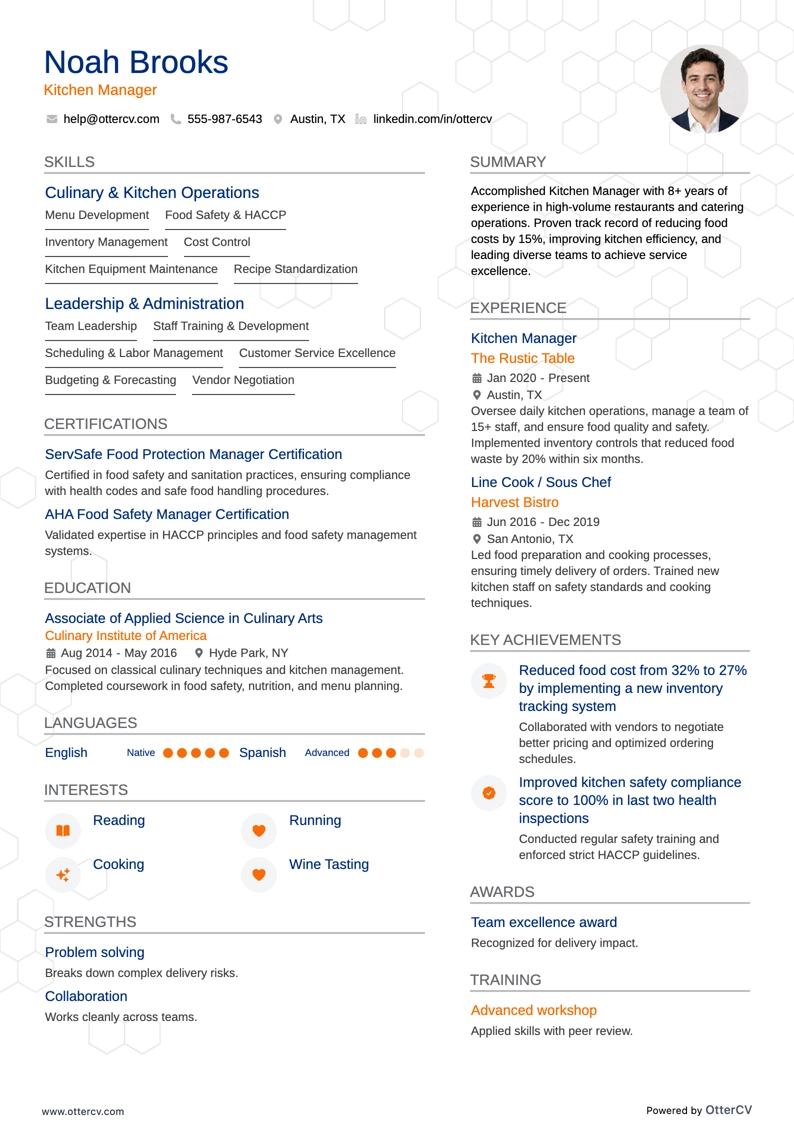
Executive Kitchen Manager full preview

10 Kitchen Manager Resume Examples, Templates

OtterCV

Written by The OtterCV Team

Updated: 1/13/2024•8 min read

See all resume examples in this guide, or generate your own resume example with your personalized prompt

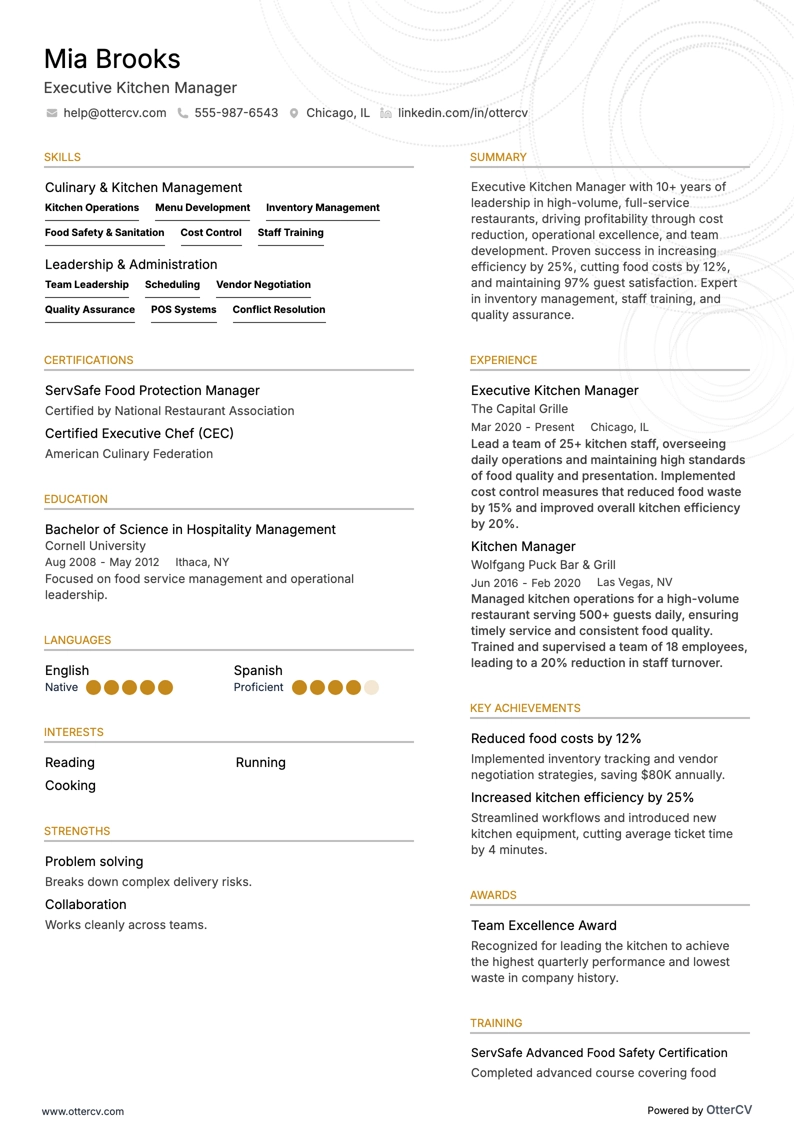
Executive Kitchen Manager resume example

Executive Kitchen Manager

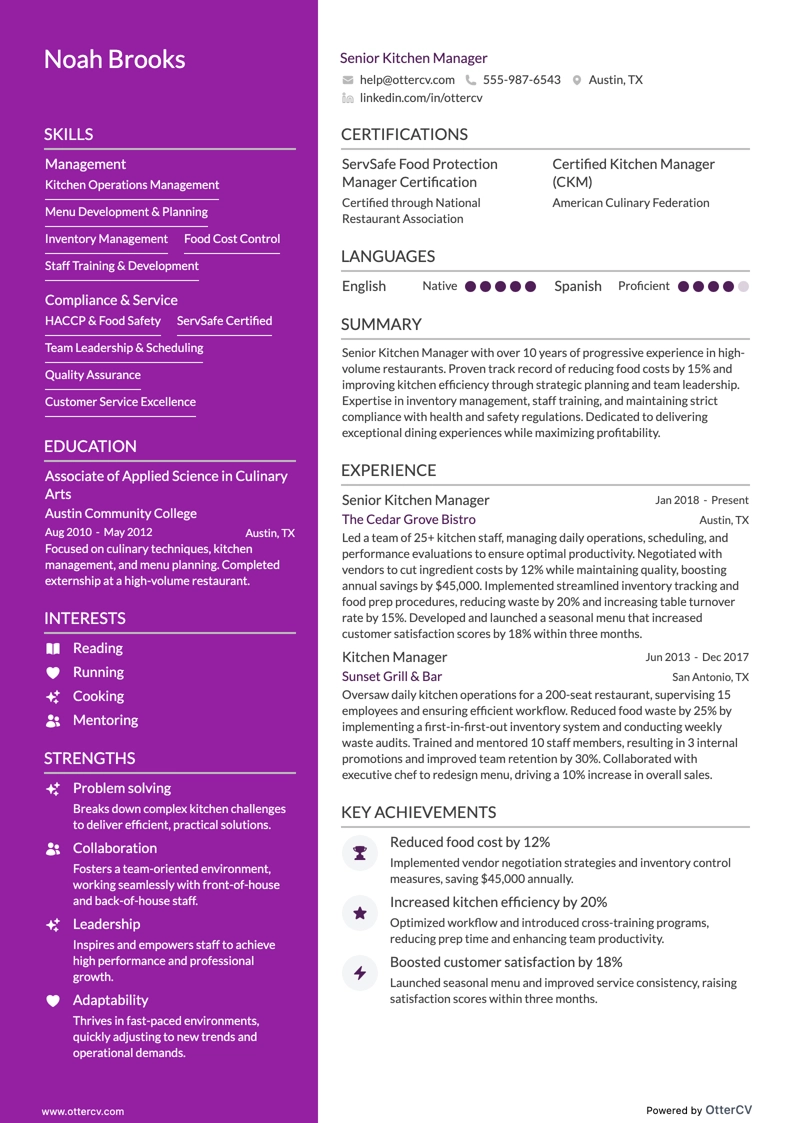
Senior Kitchen Manager resume example

Senior Kitchen Manager

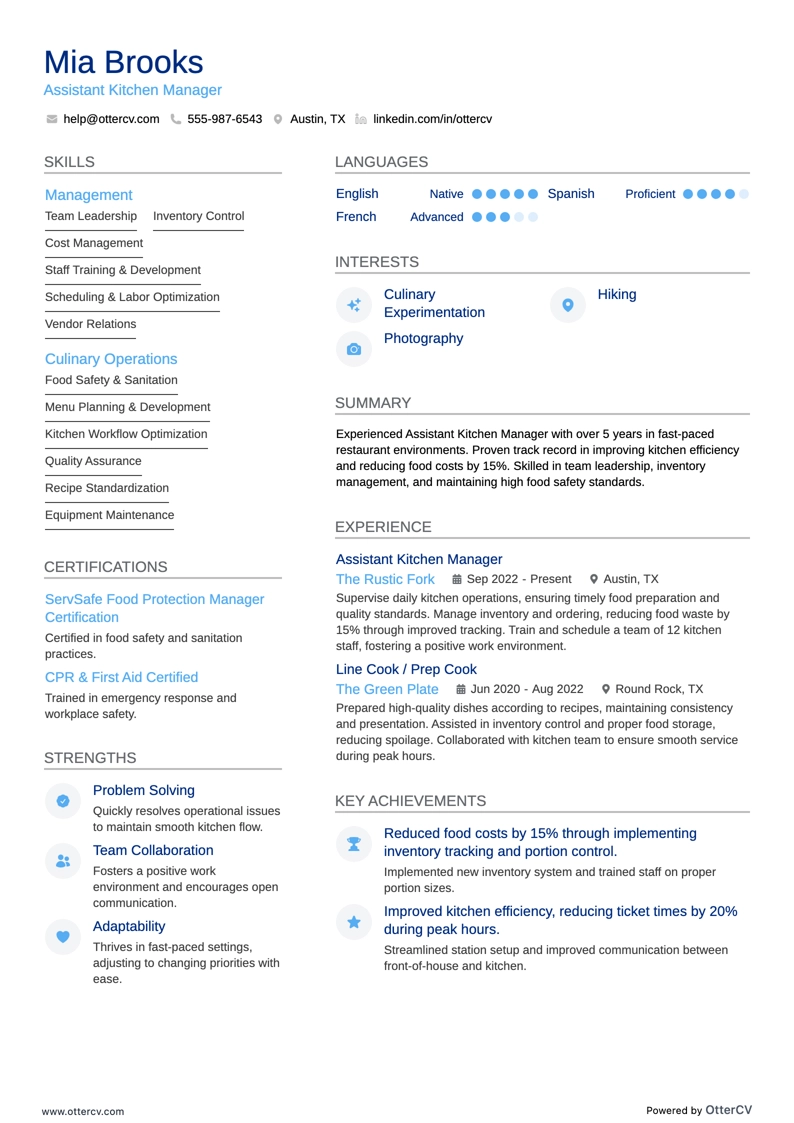
Assistant Kitchen Manager resume example

Assistant Kitchen Manager

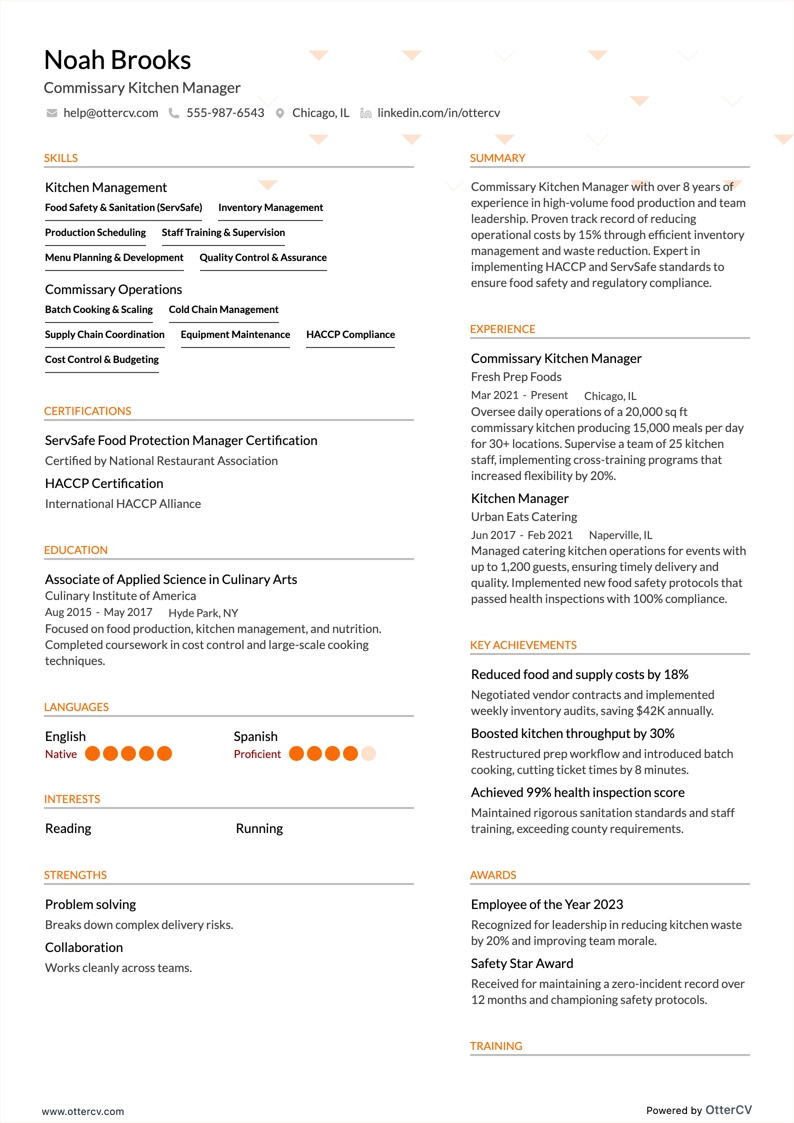
Commissary Kitchen Manager resume example

Commissary Kitchen Manager

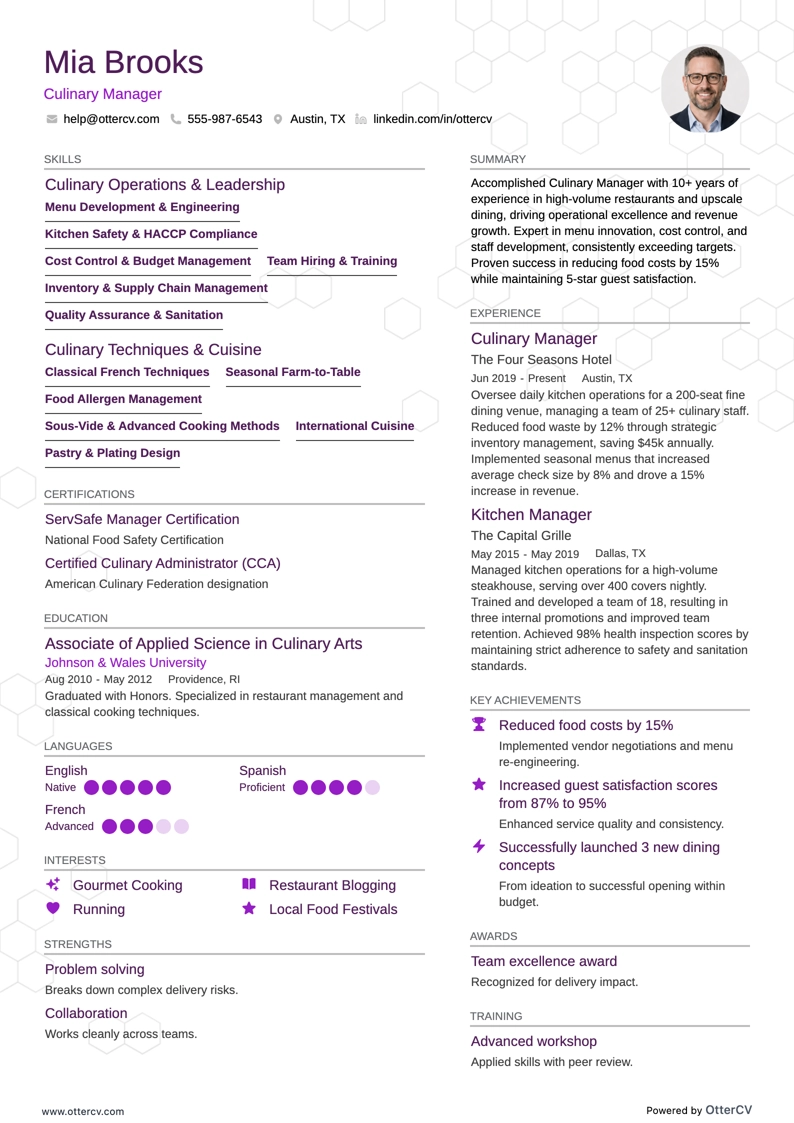
Culinary Manager resume example

Culinary Manager

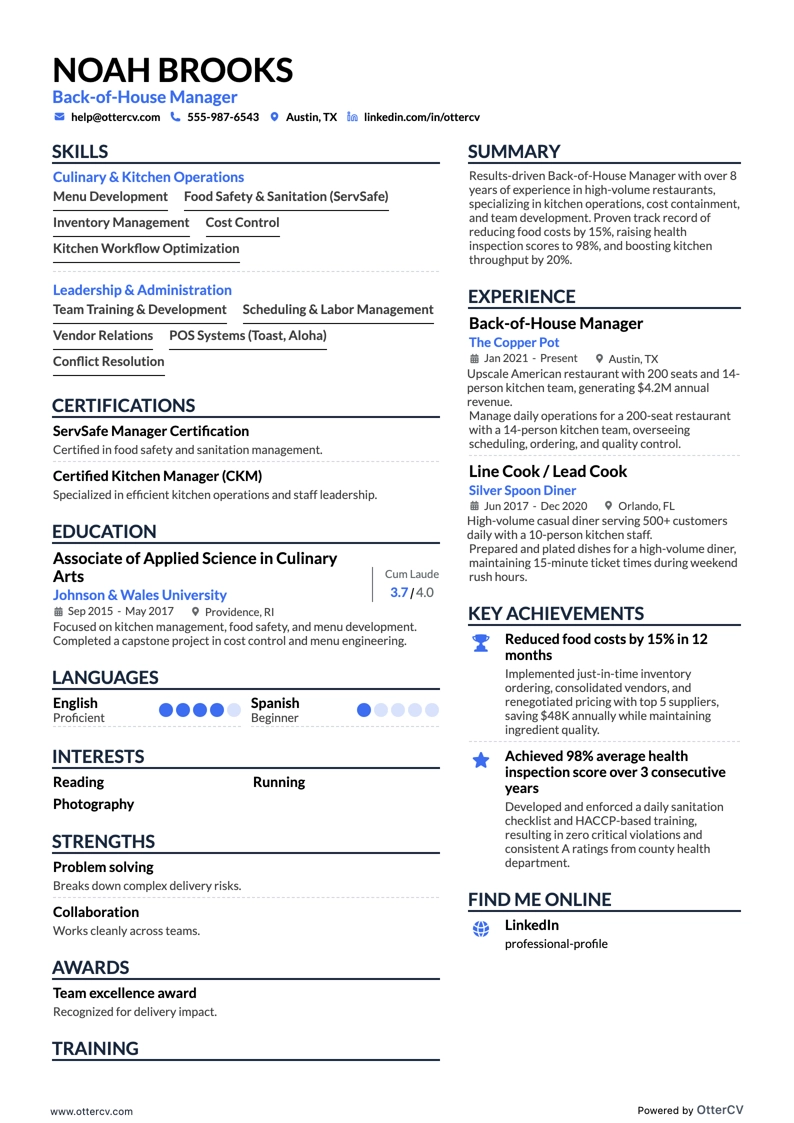
Back-of-House Manager resume example

Back-of-House Manager

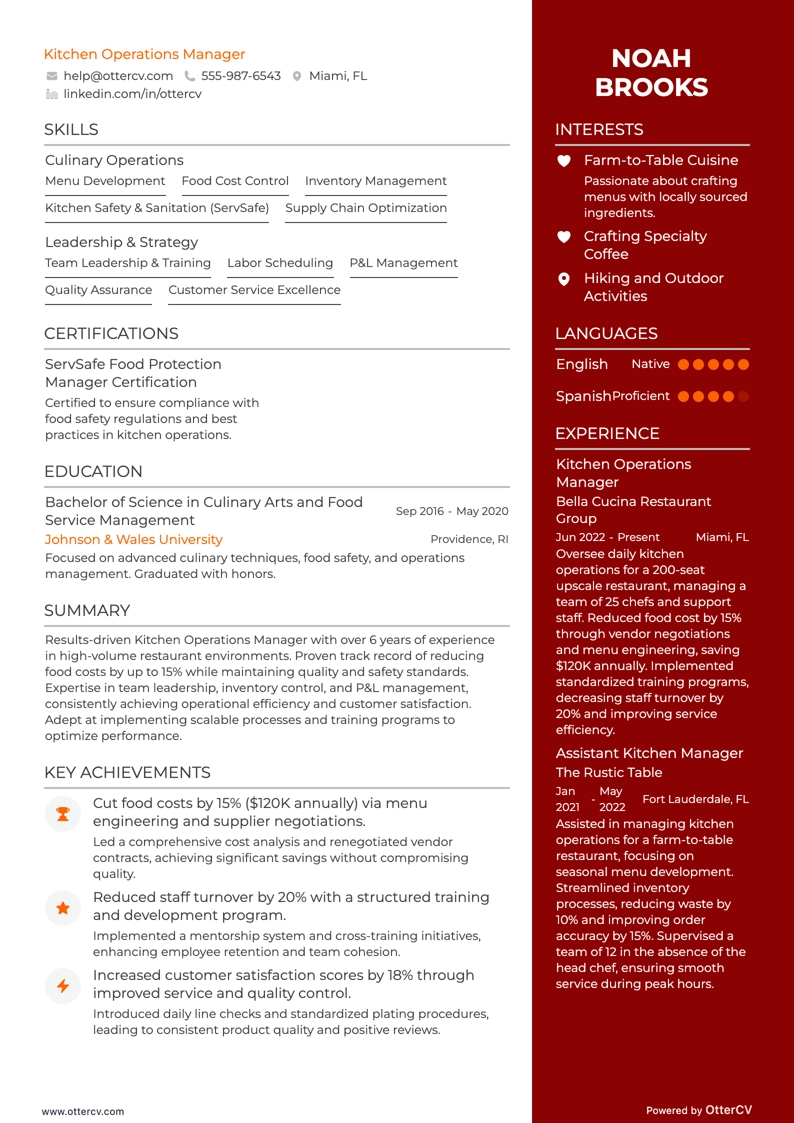
Kitchen Operations Manager resume example

Kitchen Operations Manager

Restaurant Kitchen Manager resume example

Restaurant Kitchen Manager

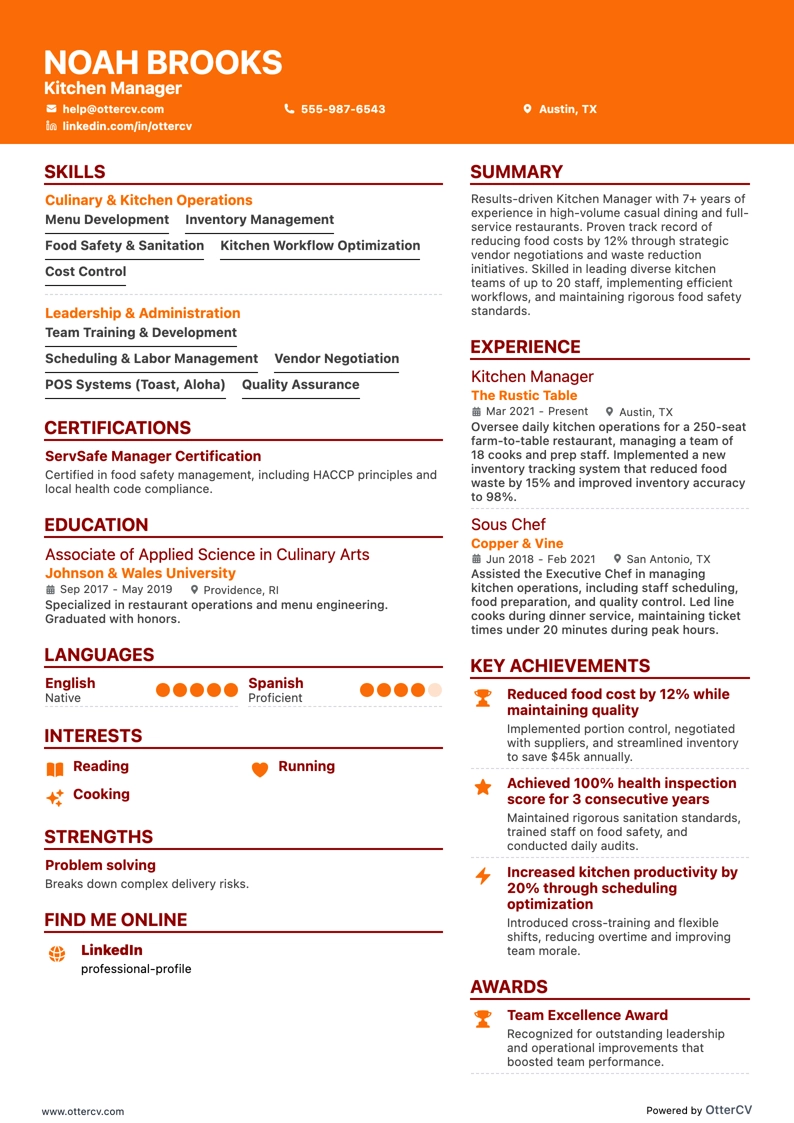
Kitchen Manager resume example

Kitchen Manager

Many kitchen manager resume drafts fail because they read like task lists and hide results. As a result, ATS filters miss key terms and recruiters move on within seconds. In a competitive hiring process with rapid resume scans, that can cost you interviews.

A strong resume shows what you improved and how it affected the business. Knowing how to make your resume stand out means highlighting food cost reductions, labor savings, on-time service during peak volume, lower waste, higher health inspection scores, fewer ticket errors, and stronger guest satisfaction.

Key takeaways

  • Quantify food cost savings, waste reduction, and ticket times to show operational impact.

  • Use a reverse-chronological format if you have experience, and a hybrid format if you are changing careers.

  • Match the exact software names, certifications, and terminology used in each job posting.

  • Place certifications such as ServSafe and HACCP near your education to signal compliance readiness.

  • Connect every listed skill to a measurable result in your experience bullets.

  • Write a three- to four-line summary that highlights your kitchen type, scope, and top result.

  • Use Echocv's tools to improve bullet points and tailor your resume to specific job descriptions.

Job market snapshot for kitchen managers

We analyzed 574 recent kitchen manager job ads across major US job boards. These figures provide a quick view of role specialization trends, employer expectations, and overall industry demand.

What level of experience employers are looking for kitchen managers

Years of ExperiencePercentage found in job ads
1–2 years14.6% (84)
3–4 years3.3% (19)
5–6 years2.1% (12)
7–8 years0.3% (2)
10+ years8.5% (49)
Not specified71.1% (408)

Kitchen manager ads by area of specialization (industry)

Industry (Area)Percentage found in job ads
Finance & Banking31.5% (181)
Healthcare27.9% (160)
Retail & E-commerce18.6% (107)
Manufacturing14.6% (84)
Education3.5% (20)
Government2.1% (12)

Top companies hiring kitchen managers

CompanyPercentage found in job ads
Caseys General Store17.6% (101)
Golden Corral15.5% (89)
Texas Roadhouse Holdings LLC5.2% (30)
Chick-fil-A4.7% (27)
The Cheesecake Factory4.5% (26)
Parker's Convenience Stores4.4% (25)
Bloomin' Brands, Inc.2.4% (14)
Landry's2.4% (14)
Red Robin International, Inc.2.4% (14)
TopGolf2.1% (12)

Role overview stats

These tables outline the most common responsibilities and employment types for kitchen manager roles. Use them to align your resume with employer expectations and understand how the role is typically structured across the market.

Day-to-day activities and top responsibilities for a kitchen manager

ResponsibilityPercentage found in job ads
Food safety13.4% (77)
Inventory management11.3% (65)
Sanitation7.8% (45)
Food preparation5.1% (29)
Microsoft office4.4% (25)
Customer service4.2% (24)
Servsafe4.2% (24)
Aloha3.5% (20)
Microsoft excel3.1% (18)
Communication3.0% (17)
Kitchen management2.8% (16)
Microsoft word2.8% (16)

How to format a kitchen manager resume

Recruiters reviewing kitchen manager candidates look first for hands-on operational experience, food safety compliance, staff leadership, and cost control skills. A clean, well-structured resume format helps these qualifications stand out quickly for both human reviewers and applicant tracking system (ATS) scans.

I have significant experience in this role—which format should I use?

I have significant experience in this role—which format should I use?

Use a reverse-chronological format to lead with your most recent and relevant kitchen management experience.

  • Highlight the scope and ownership of each role, including kitchen size, team headcount, and number of daily covers managed.
  • Feature role-specific competencies such as inventory management systems, health code compliance, menu costing, and vendor negotiations.
  • Quantify outcomes tied to profitability, waste reduction, labor efficiency, or guest satisfaction improvements.

Example bullet: “Managed a 14-person kitchen team serving 800+ daily covers, reducing food waste by 22% and cutting monthly supply costs by $4,500 through renegotiated vendor contracts and standardized portioning protocols.”

I'm junior or switching into this role—what format works best?

I'm junior or switching into this role—what format works best?

A hybrid format works best because it lets you highlight transferable kitchen and leadership skills while still showing a clear work history.

  • Place a dedicated skills section near the top featuring food safety certifications such as ServSafe, POS systems, and inventory platforms relevant to kitchen operations.
  • Include project-based experience, staging, or supervisory responsibilities from adjacent roles like line cook, sous chef, or catering coordinator.
  • Connect every listed skill to a specific action and measurable result so recruiters can assess your readiness.

Example scaffold: Inventory management → implemented a first-in, first-out (FIFO) tracking system for a 200-item stockroom → reduced monthly spoilage by 15% and saved $1,200 in food costs.

Why not use a functional resume?

Why not use a functional resume?

A functional resume removes the timeline and context recruiters use to assess how you progressed from kitchen roles into management. Without that background, it becomes harder to verify where and how you built leadership and operational skills.

This format may seem appealing for:

  • career changers from front-of-house or hospitality roles who have transferable skills but no formal kitchen manager title yet
  • candidates with resume gaps due to seasonal employment cycles, relocation, or industry disruptions
  • recent culinary program graduates with strong practicum or externship experience but limited full-time kitchen management history

Even in these situations, avoid a purely functional resume if you have any continuous work history. Always connect your skills to specific projects, workplaces, or measurable outcomes. Otherwise, ATS parsers and recruiters may reject the resume because it lacks verifiable context.

Once you’ve chosen the right resume format, the next step is deciding which sections to include so each one supports that structure.

What sections should go on a kitchen manager resume

Recruiters want to quickly see evidence that you can run a safe, efficient kitchen while meeting cost, quality, and service goals. Knowing what to put on a resume helps you prioritize the most relevant information for this role.

Use this structure for clarity:

  • Header
  • Summary
  • Experience
  • Skills
  • Projects
  • Education
  • Certifications
  • Optional sections: Awards, Leadership, Languages

Your experience bullets should highlight measurable results in food cost control, labor efficiency, safety compliance, ticket times, and team performance across the volume and complexity you managed.

How to write your kitchen manager resume experience

Once you’ve organized your resume with the right components, focus on writing a kitchen manager experience section that reinforces each element with relevant, role-specific impact.

Your experience section should highlight the work you’ve delivered across kitchen operations, food safety systems, inventory control, and team leadership, with clear, measurable outcomes tied to each responsibility. Hiring managers care more about proven impact than descriptive task lists, so every bullet should show the results you drove, not just the duties you handled. Writing a targeted resume helps ensure each entry speaks directly to what the employer needs.

Each entry should include:

  • Job title
  • Company and location (or remote)
  • Dates of employment (month and year)

Include three to five concise bullet points that explain what you owned, how you executed, and the outcomes you delivered:

  • Ownership scope: the kitchen operations, menu programs, food production lines, prep teams, or vendor relationships you were directly responsible for as a kitchen manager.
  • Execution approach: the tools, frameworks, and methods you used to run your kitchen, such as inventory management systems, HACCP protocols, scheduling software, cost-control techniques, or standardized recipe procedures.
  • Value improved: the specific changes you drove in food quality, kitchen efficiency, waste reduction, health inspection scores, order accuracy, labor cost management, or workplace safety compliance.
  • Collaboration context: how you worked with front-of-house managers, sous chefs, suppliers, health inspectors, corporate leadership, or catering clients to align kitchen output with broader business goals.
  • Impact delivered: the outcomes your work produced, expressed through improvements in revenue, cost savings, team retention, guest satisfaction, throughput capacity, or operational consistency rather than a list of daily tasks.

Experience bullet formula

Experience bullet formula

Use this structure for experience bullets: action verb + technology + what you built or fixed + measurable result.

A kitchen manager experience example

Kitchen Manager

Riverstone Bistro | Austin, TX

2022–Present

High-volume, 140-seat neighborhood bistro serving dinner seven days a week, with peak weekend covers exceeding 450.

  • Streamlined prep and line execution using checklists, par sheets, and Kitchen Display System (KDS) routing, cutting ticket times 18% during peak service while maintaining 97% on-time orders.
  • Implemented inventory controls in Restaurant365 with weekly cycle counts and vendor par levels, reducing food cost from 32.4% to 29.8% and shrinking monthly waste by 22%.
  • Led ServSafe-based training and HACCP-aligned temperature logs with calibrated probe thermometers, improving the health inspection score from 92 to 98 and eliminating critical violations for three consecutive inspections.
  • Partnered with the executive chef and general manager to engineer menu items using recipe costing and yield tests, increasing contribution margin 6% and lifting dessert attach rate 11%.
  • Coordinated with vendors and front-of-house leads to redesign ordering and 86 communication through Slack and POS modifiers, reducing comped items 15% and cutting re-fires 20%.

Now that you've seen what a strong experience section looks like, the next step is adjusting yours to fit the specific job you're applying for.

How to tailor your kitchen manager resume experience

Recruiters review kitchen manager resumes through both human screening and applicant tracking systems, so tailoring your resume to the job description can improve your chances of moving forward. In practice, tailoring means presenting your background using the same language and priorities the employer emphasizes.

Here are several ways to tailor your kitchen manager experience:

  • Match the food safety systems and certifications listed in the job posting.
  • Use the exact inventory management software named by the employer.
  • Reflect any cost control or waste reduction goals mentioned.
  • Use the same terminology for health code and HACCP standards.
  • Highlight BOH leadership experience that fits their team structure.
  • Include relevant cuisine type or foodservice industry experience.
  • Emphasize vendor management or purchasing workflows they reference.
  • Align your scheduling and labor optimization methods with their operation.

Tailoring is about framing your real accomplishments around what each employer values, not stuffing unrelated keywords into your experience section.

Resume tailoring examples for kitchen manager

Job description excerptUntailoredTailored
"Manage daily kitchen operations, maintain food cost below 30%, and oversee inventory using MarketMan software."Responsible for kitchen tasks and ordering supplies as needed.Managed daily kitchen operations for a 120-seat restaurant, holding food cost at 28% by tracking waste and optimizing purchasing through MarketMan.
"Ensure compliance with local health codes, lead ServSafe training for all BOH staff, and maintain a 95%+ health inspection score."Made sure the kitchen was clean and followed safety rules.Led quarterly ServSafe certification training for 14 back-of-house staff members, maintaining a 97% average health inspection score across three consecutive years.
"Develop seasonal menus in collaboration with the executive chef, source local ingredients, and reduce plate cost by 10% year over year."Helped create new menu items and worked with vendors.Partnered with the executive chef to launch four seasonal menus per year, sourcing 60% of produce from local farms and reducing plate cost by 12% through supplier negotiation and recipe engineering.

Once you’ve aligned your experience with the role’s priorities, the next step is to quantify your kitchen manager achievements so employers can see the impact of your work.

How to quantify your kitchen manager achievements

Quantifying your achievements shows how you improved operations, not just what you were responsible for. Focus on food cost, ticket times, waste, health inspection results, labor efficiency, and sales lift from smoother service.

Quantifying examples for kitchen manager

MetricExample
Food costCut food cost from 32% to 28% in four months by tightening portion control, renegotiating two vendor contracts, and tracking variance in Toast reports.
Ticket timeReduced average ticket time from fourteen to eleven minutes during Friday dinner rush by redesigning the expo flow and adding a hot-hold station.
Waste reductionLowered weekly spoilage from $1,200 to $700 by implementing FIFO labels, daily prep pars, and end-of-shift cooler temp logs.
Compliance riskEarned a 98 health inspection score after retraining twelve staff on allergen protocols, sanitizing schedules, and temperature checks using calibrated thermometers.
Labor efficiencyDecreased overtime hours by 22% while maintaining coverage by rebuilding schedules in 7shifts and cross-training five line cooks for peak stations.

Once you’ve written strong experience bullets, add a well-organized skills section that highlights both your hard and soft skills.

How to list your hard and soft skills on a kitchen manager resume

Your skills section shows that you can run a safe, efficient kitchen. Recruiters and ATS (applicant tracking systems) scan it quickly to match your qualifications to the job, so aim to include more hard skills than soft skills, while emphasizing role-specific strengths that support leadership and service.

Kitchen manager roles require a blend of:

  • Product strategy and discovery skills.
  • Data, analytics, and experimentation skills.
  • Delivery, execution, and go-to-market discipline.
  • Soft skills.

Your skills section should be:

  • Scannable, using bullet-style grouping.
  • Relevant to the job post.
  • Backed by proof in your experience bullets.
  • Updated with current tools.

Place your skills section:

  • Above your experience if you’re junior or switching careers.
  • Below your experience if you’re mid- or senior-level with strong achievements.

Hard skills

  • Food safety and HACCP.
  • ServSafe compliance.
  • Health inspection readiness.
  • Allergen controls and labeling.
  • Inventory management and FIFO.
  • Food costing and yield testing.
  • Menu costing and recipe costing.
  • Recipe standardization and plating specs.
  • Prep scheduling and line setup.
  • Vendor ordering and par levels.
  • POS systems, including Toast and Square.
  • Labor scheduling and timekeeping systems.

Soft skills

  • Coach line cooks on standards.
  • Set the pace during peak service.
  • Delegate prep and station duties clearly.
  • Give clear, in-the-moment feedback.
  • Resolve ticket and timing issues quickly.
  • Communicate priorities to the front of house.
  • Hold the team to safety rules.
  • Make calm decisions under pressure.
  • Coordinate multiple stations smoothly.
  • Lead pre-shift and post-shift huddles.
  • Address performance issues directly.
  • Take ownership of service outcomes.

How to show your kitchen manager skills in context

Skills should not appear only in a dedicated skills section. Browse examples of resume skills to see how other professionals present their competencies effectively.

Your skills should also be demonstrated in:

  • Your summary (high-level professional identity)
  • Your experience (proof through outcomes)

Here’s how that looks in practice.

Summary example

Kitchen manager with 12 years of experience in high-volume hotel foodservice. Skilled in HACCP compliance, inventory forecasting, and line optimization. Reduced food waste by 28% through standardized prep protocols while mentoring teams of 15+ cooks.

  • Clearly reflects senior-level experience
  • Names relevant industry tools and methods
  • Leads with a measurable outcome
  • Highlights team leadership and mentoring

Kitchen Manager

The Bridwell Hotel Group | Austin, TX

March 2019–August 2024

  • Implemented a rotating inventory system using MarketMan, reducing monthly food costs by 18% across three kitchen stations.
  • Worked with the executive chef and purchasing team to redesign vendor contracts, saving $42,000 annually on produce sourcing.
  • Trained 22 line cooks on updated HACCP sanitation protocols, contributing to a 98% health inspection pass rate over four consecutive years.
  • Every bullet includes measurable proof.
  • Skills surface naturally through real outcomes.

Once you’ve shown your kitchen management strengths with specific, results-focused examples, the next step is using that same strategy to build a kitchen manager resume when you don’t have direct experience.

How do I write a kitchen manager resume with no experience

Even without full-time experience, you can still show that you’re ready through:

  • Catering and event kitchen lead
  • Restaurant shift lead experience
  • Culinary school kitchen labs
  • Food safety certification training
  • Inventory and ordering projects
  • Volunteer meal service coordination
  • Pop-up or food truck ops

If you're building a resume without work experience, focus on:

  • Food safety compliance results
  • Cost control and inventory accuracy
  • Shift execution and ticket times
  • Scheduling and labor tracking

Resume format tip for entry-level kitchen manager

Resume format tip for entry-level kitchen manager

Use a combination resume format because it highlights transferable skills and verified projects before a short work history.

Do:

  • Add a Skills section tied to outcomes.
  • List certifications with dates and IDs.
  • Include projects with metrics and tools.
  • Use job postings to mirror keywords.
  • Quantify inventory, waste, and timing.

Example project bullet:

  • Led a volunteer meal service shift using FIFO labeling, temperature logs, and a prep checklist, cutting plate waste by 18% across four events.

Even without direct experience, your education section can show the foundational knowledge and credentials that support your qualification for a kitchen manager role.

How to list your education on a kitchen manager resume

Your education section helps hiring teams confirm that you have relevant knowledge in food science, hospitality, or business management.

Include:

  • Degree name
  • Institution
  • Location
  • Graduation year
  • Relevant coursework, for juniors or entry-level candidates
  • Honors and GPA, if 3.5 or higher

Skip the month and day, and list only the graduation year.

Here's a strong education entry tailored for a kitchen manager resume.

Example education entry

Bachelor of Science in Hospitality Management

Johnson & Wales University, Providence, RI

Graduated 2019

GPA: 3.7/4.0

  • Relevant coursework: Food Safety Systems, Culinary Operations, Inventory Cost Control, and Nutrition Science
  • Honors: Dean's List, magna cum laude

How to list your certifications on a kitchen manager resume

Certifications on your resume show your commitment to learning, your mastery of key kitchen tools and systems, and your up-to-date industry knowledge as a kitchen manager.

For each certification, include:

  • Certificate name
  • Issuing organization
  • Year
  • Optional: credential ID or URL
  • Place certifications below education if your degree is recent and your certifications are older or less relevant to your current kitchen manager focus.
  • Place certifications above education if they are recent, critical to the role, or required for compliance in your kitchen manager position.

Best certifications for your kitchen manager resume

  • ServSafe Food Protection Manager Certification.
  • ServSafe Alcohol Certification.
  • Certified Executive Chef (CEC).
  • Certified Kitchen Manager (CKM).
  • HACCP Certification.
  • OSHA Food Safety and Sanitation Certificate.
  • Allergen Awareness Certification.

Once you’ve positioned your credentials where hiring managers can easily see them, use your kitchen manager resume summary to reinforce those qualifications and set the tone for the rest of your resume.

How to write your kitchen manager resume summary

Your resume summary is the first thing a recruiter reads, so a strong one should quickly show that you’re qualified to run a kitchen efficiently.

Keep it to three to four lines and include:

  • Your title and total years of kitchen management experience.
  • The cuisine type, restaurant format, or food service environment you know best.
  • Core skills such as inventory control, food safety compliance, and scheduling software.
  • One or two measurable wins, such as reducing food waste or improving ticket times.
  • Soft skills connected to real results, such as training staff who earned promotions or resolving vendor issues.

PRO TIP

At this level, focus on hands-on operational skills and the concrete contributions you made in previous kitchens.

Highlight areas such as food cost management, team coordination, and health code compliance. Avoid vague phrases like “passionate foodie” or “hard worker.” Let your numbers and day-to-day responsibilities speak for themselves.

Example summary for a kitchen manager

Kitchen manager with four years of experience in high-volume casual dining. Reduced food waste by 18% through tighter inventory tracking. Skilled in staff scheduling, health inspections, and vendor negotiations.

Now that your summary highlights your leadership and kitchen expertise, make sure your contact details are presented in an equally polished and professional way.

What to include in a kitchen manager resume header

A resume header is the top section of your resume that contains your key details. For a kitchen manager role, it can improve visibility, credibility, and recruiter screening.

Essential resume header elements:

  • Full name
  • Tailored job title and headline
  • Location
  • Phone number
  • Professional email
  • GitHub link
  • Portfolio link
  • LinkedIn

A LinkedIn link helps recruiters quickly verify your experience and supports screening.

Do not include a photo on a kitchen manager resume unless the role is explicitly front-facing or appearance-dependent.

Keep your header easy to scan by using one line per item and matching your kitchen manager title to the job posting.

Once you’ve confirmed that your contact details and role title are accurate and easy to find, add optional resume sections to highlight relevant strengths that don’t fit in the header.

Additional sections for kitchen manager resumes

When your core qualifications are similar to other applicants, well-chosen additional sections can help you stand out and strengthen your credibility.

  • Languages
  • Certifications (ServSafe, HACCP, food handler permits)
  • Volunteer experience in food service or community kitchens
  • Professional memberships (ACF, NRA, local culinary associations)
  • Awards and recognitions
  • Hobbies and interests related to culinary arts or leadership

Once you’ve rounded out your resume with the right supplementary sections, pairing it with a strong cover letter can make your application feel more complete.

Do kitchen manager resumes need a cover letter

Kitchen manager resumes do not always need a cover letter, but one can help in competitive roles or when an employer expects it. If you are unsure what a cover letter is or when it adds value, it can help when your resume does not fully show context, leadership style, or specific operational impact.

Use these tips to decide when to include one and what to cover:

  • Explain role and team fit: Connect your leadership approach to the kitchen’s volume, service style, staffing model, and standards.
  • Highlight one or two outcomes: Cite a cost control, waste reduction, safety audit result, or ticket time improvement, and explain your role.
  • Show business understanding: Reference the menu strategy, guest expectations, prep workflow, and how you support profitability and consistency.
  • Address transitions or non-obvious experience: Clarify a move between concepts, gaps, or a shift from line cook to kitchen manager with concrete proof.

Even if you decide a cover letter will not add value to your application, using AI to improve your kitchen manager resume can strengthen the document hiring teams review first.

Using AI to improve your kitchen manager resume

AI can improve your resume’s clarity, structure, and overall impact. It can help refine bullet points and better align your content with job descriptions. But overusing it can strip away authenticity. Once your resume feels clear and tailored to the role, step away from AI. If you’re wondering which AI is best for writing resumes, start with tools that let you control the output instead of auto-generating entire sections.

Here are 10 practical prompts to strengthen specific parts of your kitchen manager resume:

  1. Sharpen your summary: “Rewrite my kitchen manager resume summary to highlight leadership, food safety expertise, and cost control in under four sentences.”
  2. Quantify experience bullets: “Add measurable results to these kitchen manager experience bullets using percentages, dollar amounts, or team sizes.”
  3. Align with job posting: “Compare my kitchen manager resume experience section to this job description and suggest missing keywords or skills.”
  4. Tighten skills list: “Review my kitchen manager skills section and remove vague entries. Suggest specific, industry-relevant replacements.”
  5. Strengthen action verbs: “Replace weak or repeated verbs in my kitchen manager experience bullets with stronger, more precise alternatives.”
  6. Improve certification details: “Reformat my kitchen manager certifications section so each entry clearly states the credential, issuing body, and date.”
  7. Refine education section: “Rewrite my kitchen manager education section to emphasize coursework or training relevant to food service management.”
  8. Highlight project impact: “Rewrite this kitchen manager project description to focus on outcomes, team coordination, and operational improvements.”
  9. Remove redundancy: “Identify and eliminate redundant phrases across my entire kitchen manager resume without losing key details.”
  10. Check tone consistency: “Review my kitchen manager resume for inconsistent tone. Make it confident, direct, and professional throughout.”

Stop using AI once your resume sounds accurate, specific, and aligned with your real experience. AI should never invent experience or inflate claims—if it did not happen, it does not belong here.

Conclusion

A strong kitchen manager resume highlights measurable results, role-specific skills, and a clear structure. Emphasize cost control, food safety compliance, scheduling, inventory accuracy, and team leadership with numbers that demonstrate impact.

Make each section easy to scan so hiring managers can quickly see your value. With a focused summary, clean formatting, and consistent metrics, your kitchen manager resume shows readiness for today’s hiring market and near-future needs.

Kitchen Manager resume examples

Explore additional Kitchen Manager resume samples and guides and see what works for your level of experience or role.

By Experience

Executive Kitchen Manager

Executive Kitchen Manager resume preview

Senior Kitchen Manager

Senior Kitchen Manager resume preview

Assistant Kitchen Manager

Assistant Kitchen Manager resume preview

Kitchen Manager resume examples

Explore additional Kitchen Manager resume samples and guides and see what works for your level of experience or role.

By Role

Commissary Kitchen Manager

Commissary Kitchen Manager resume preview

Culinary Manager

Culinary Manager resume preview

Back-of-House Manager

Back-of-House Manager resume preview

Kitchen Operations Manager

Kitchen Operations Manager resume preview

Restaurant Kitchen Manager

Restaurant Kitchen Manager resume preview

Kitchen Manager

Kitchen Manager resume preview