Senior Reporter full preview

24 Journalist Resume Examples

OtterCV

Written by The OtterCV Team

Updated: 4/30/2025•8 min read

See all resume examples in this guide, or generate your own resume example with your personalized prompt

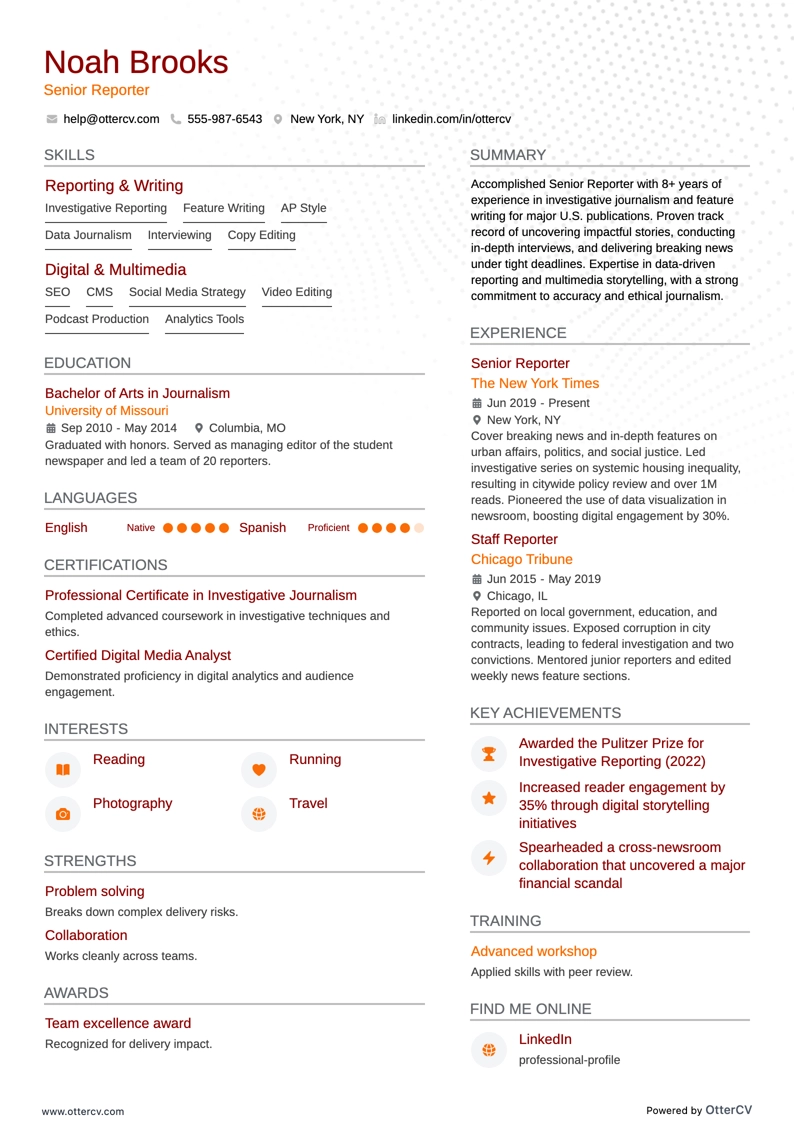
Senior Reporter resume example

Senior Reporter

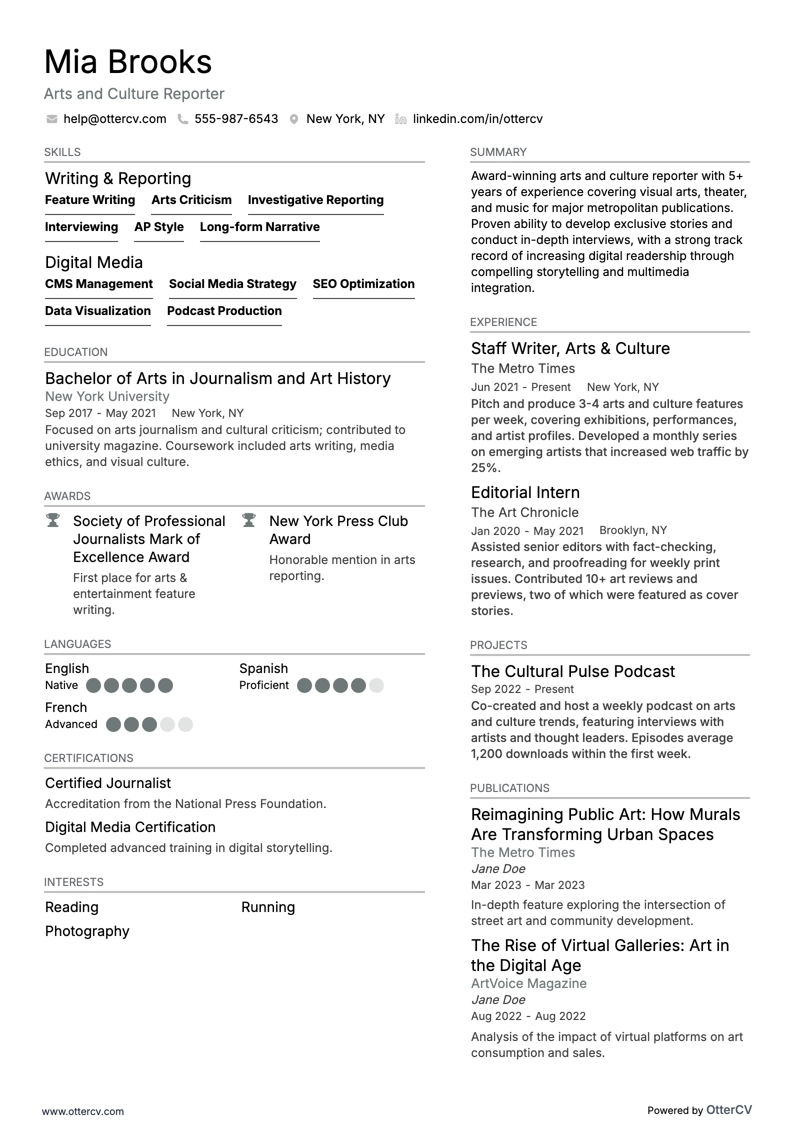
Arts and Culture Reporter resume example

Arts and Culture Reporter

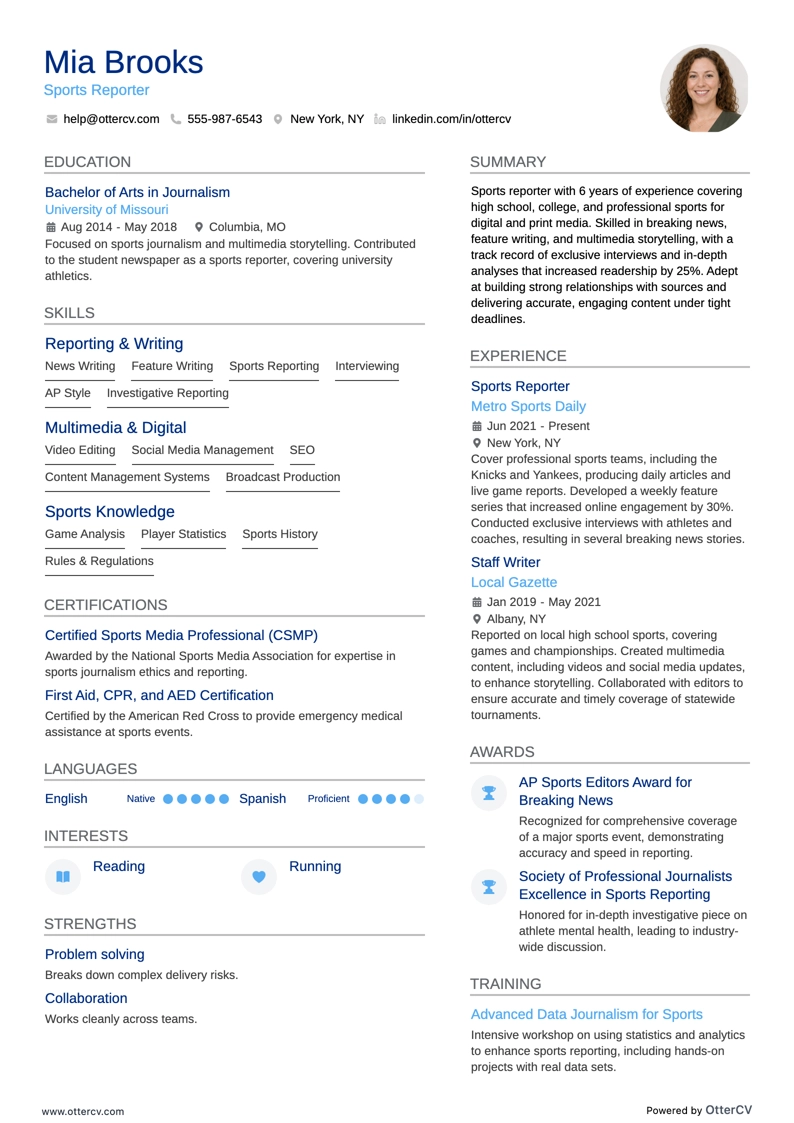
Sports Reporter resume example

Sports Reporter

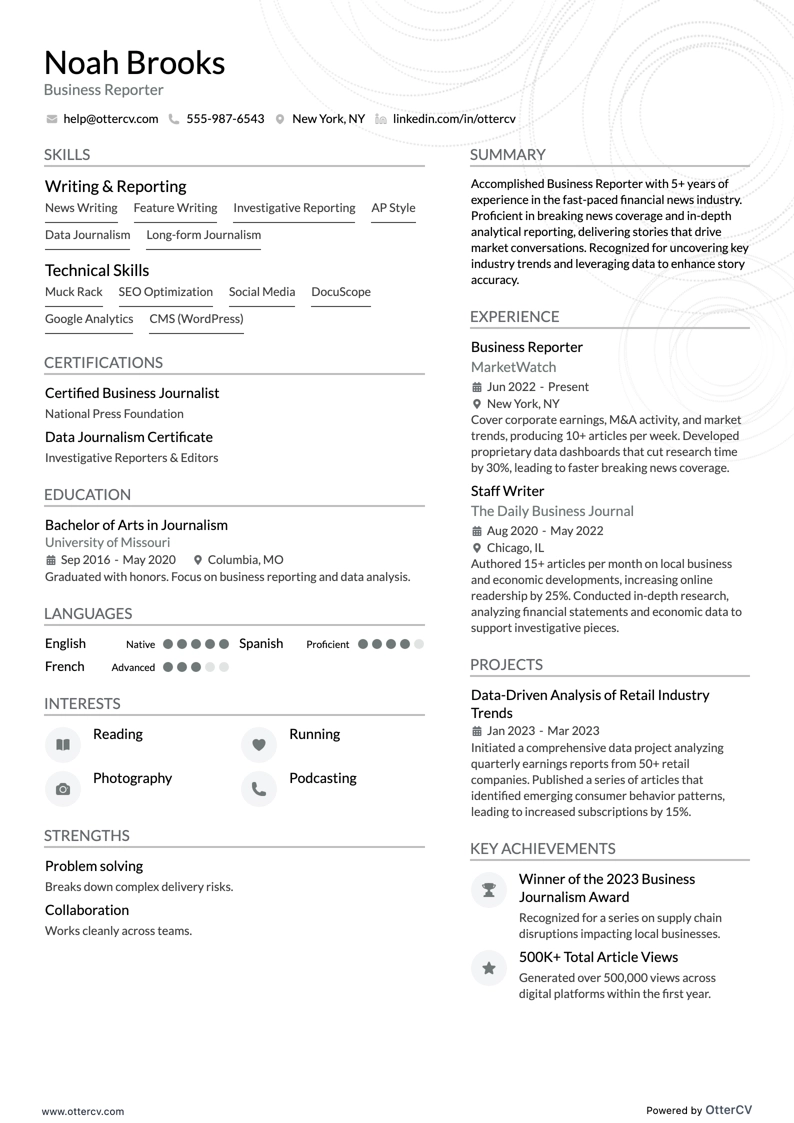
Business Reporter resume example

Business Reporter

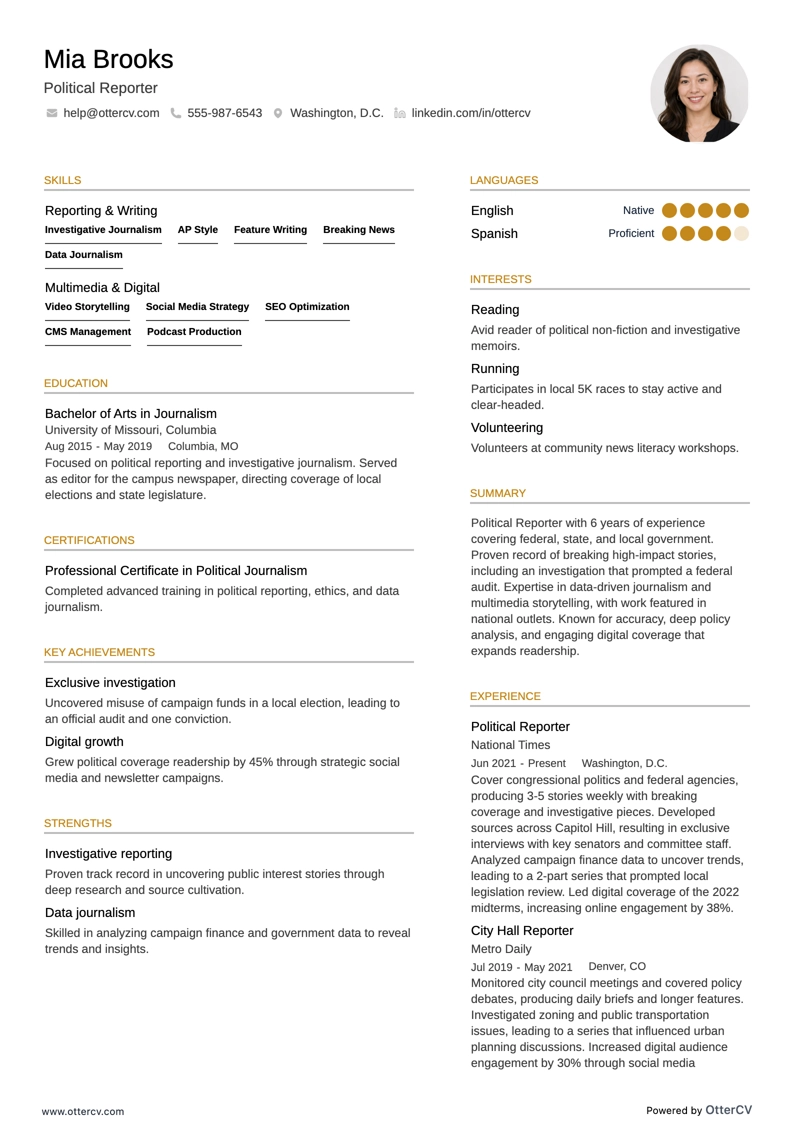
Political Reporter resume example

Political Reporter

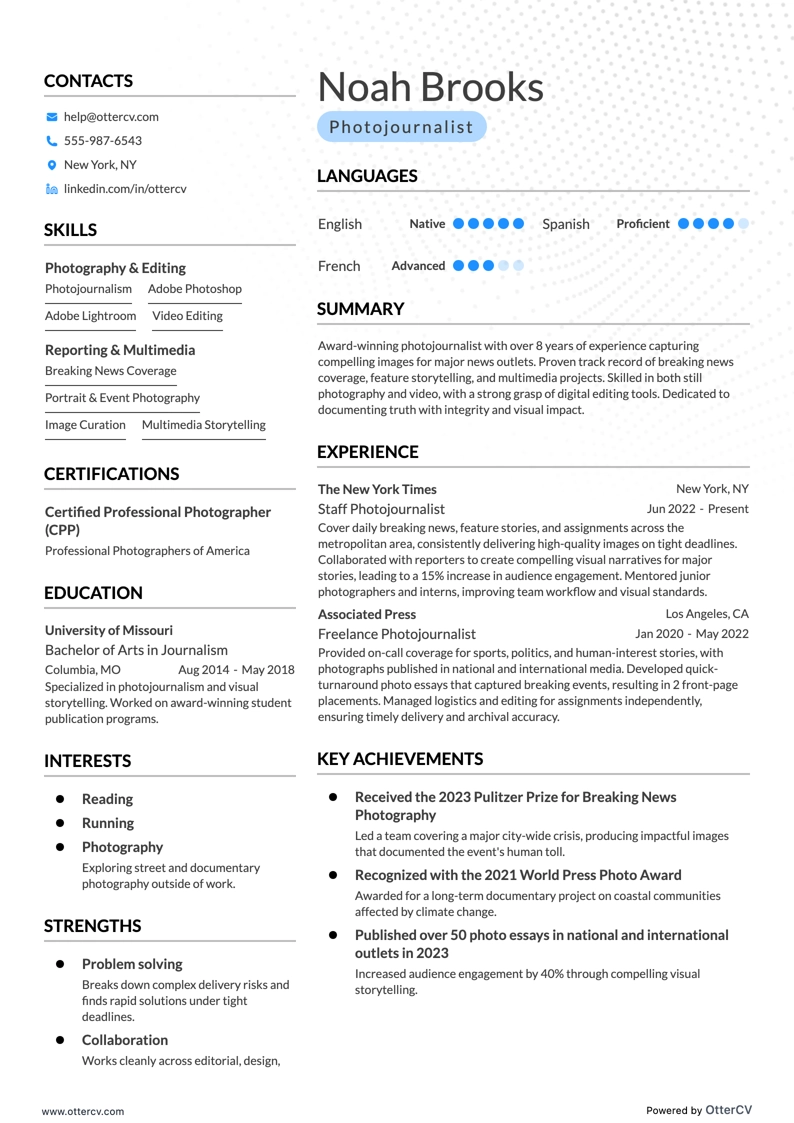
Photojournalist resume example

Photojournalist

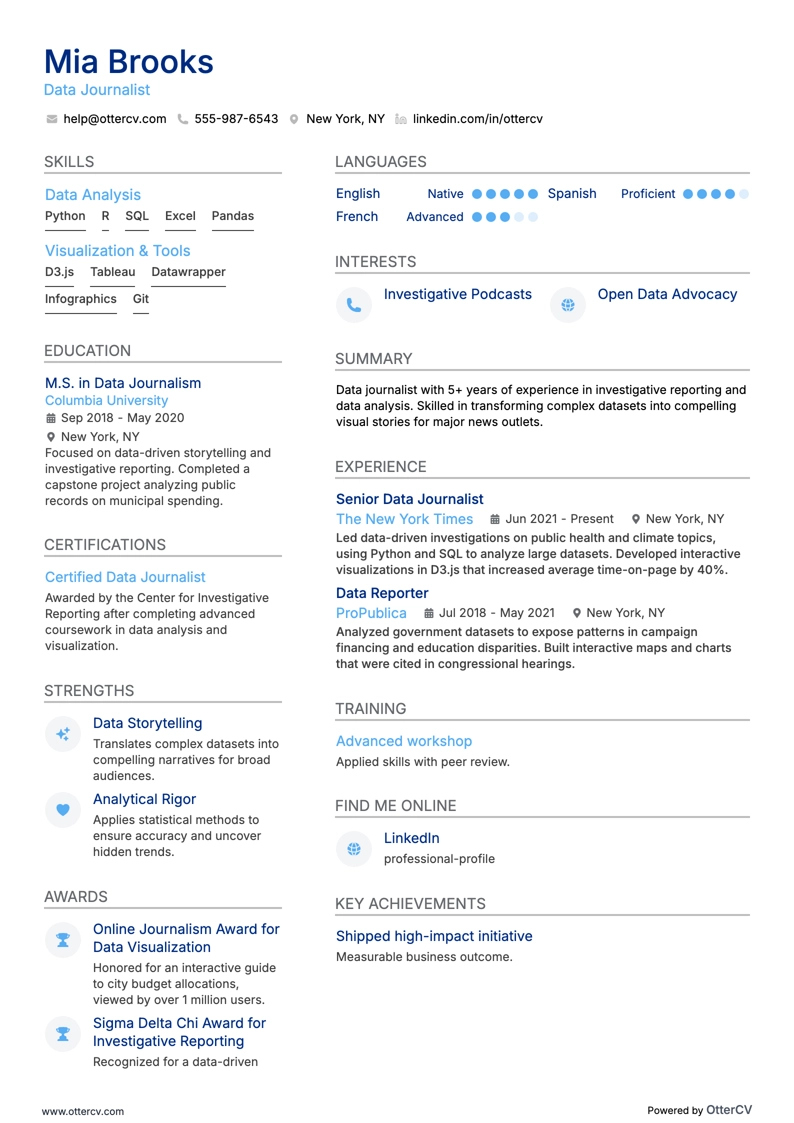
Data Journalist resume example

Data Journalist

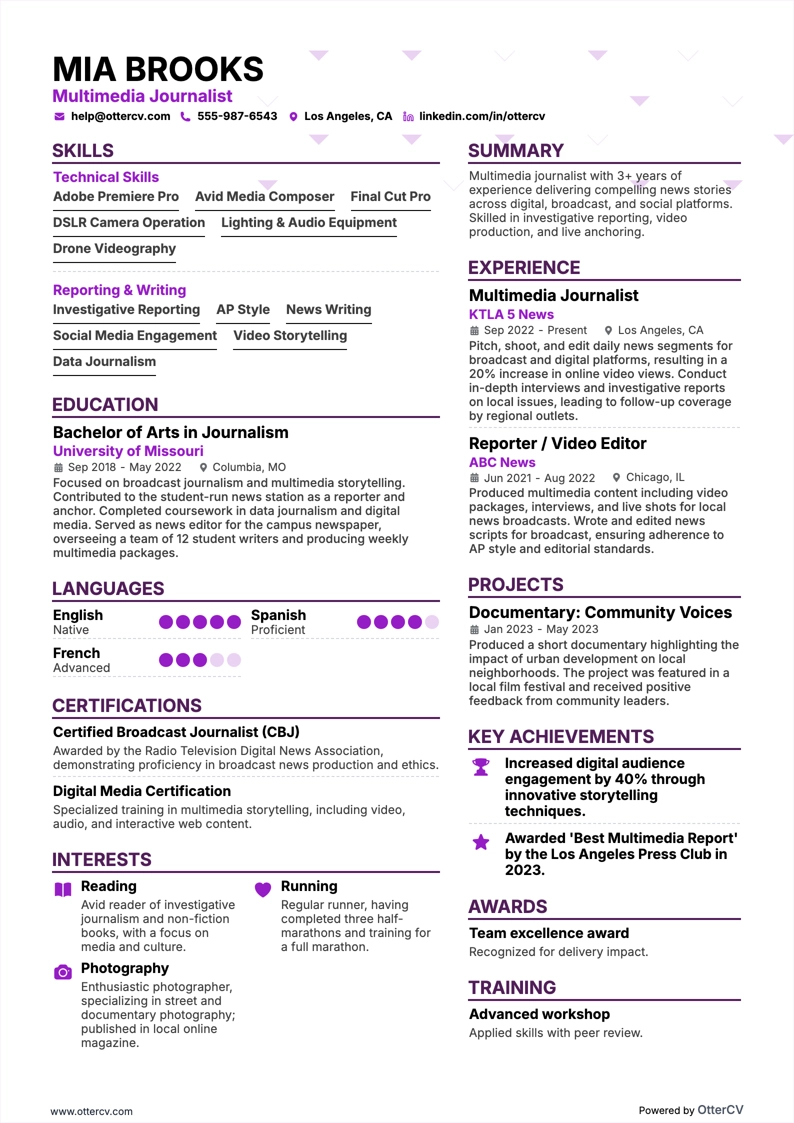
Multimedia Journalist resume example

Multimedia Journalist

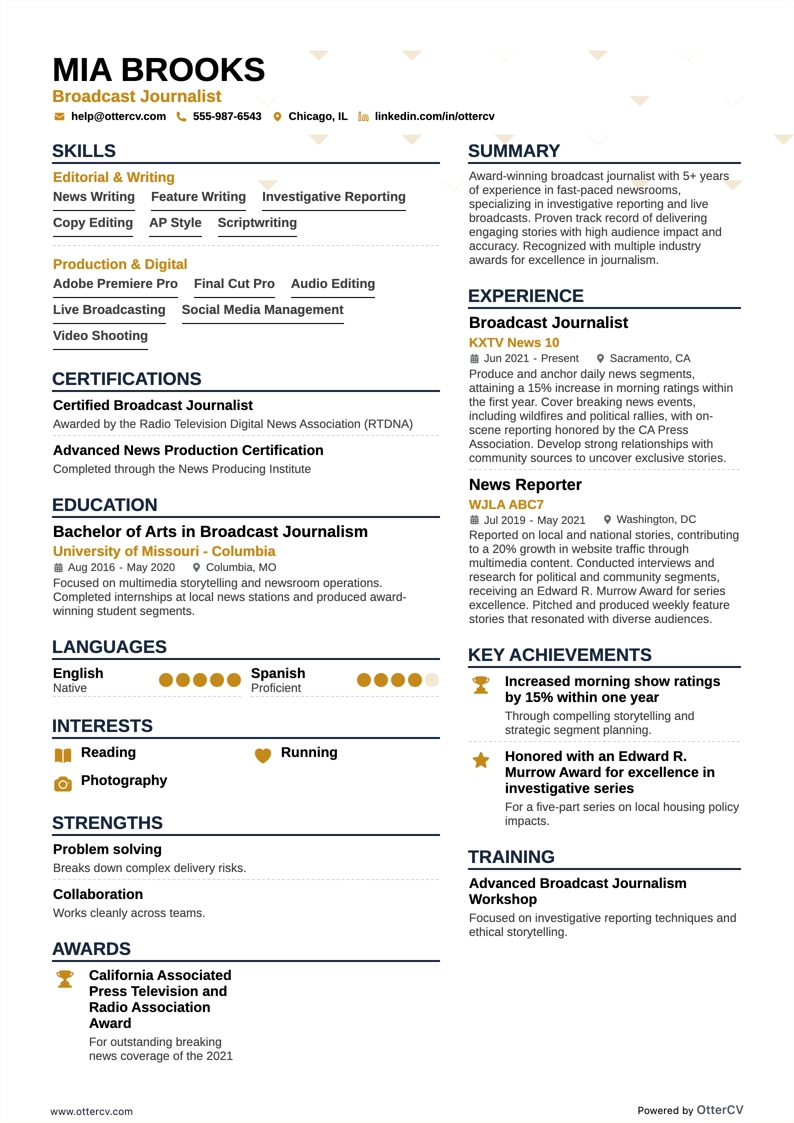
Broadcast Journalist resume example

Broadcast Journalist

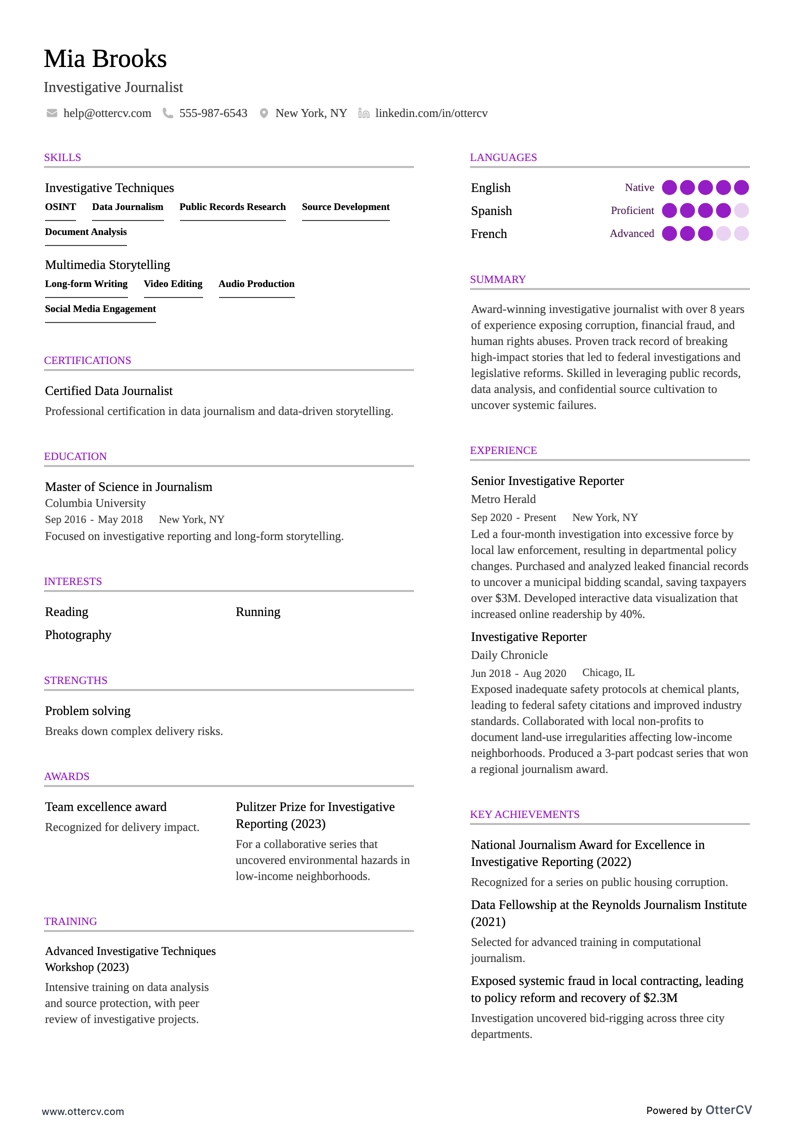
Investigative Journalist resume example

Investigative Journalist

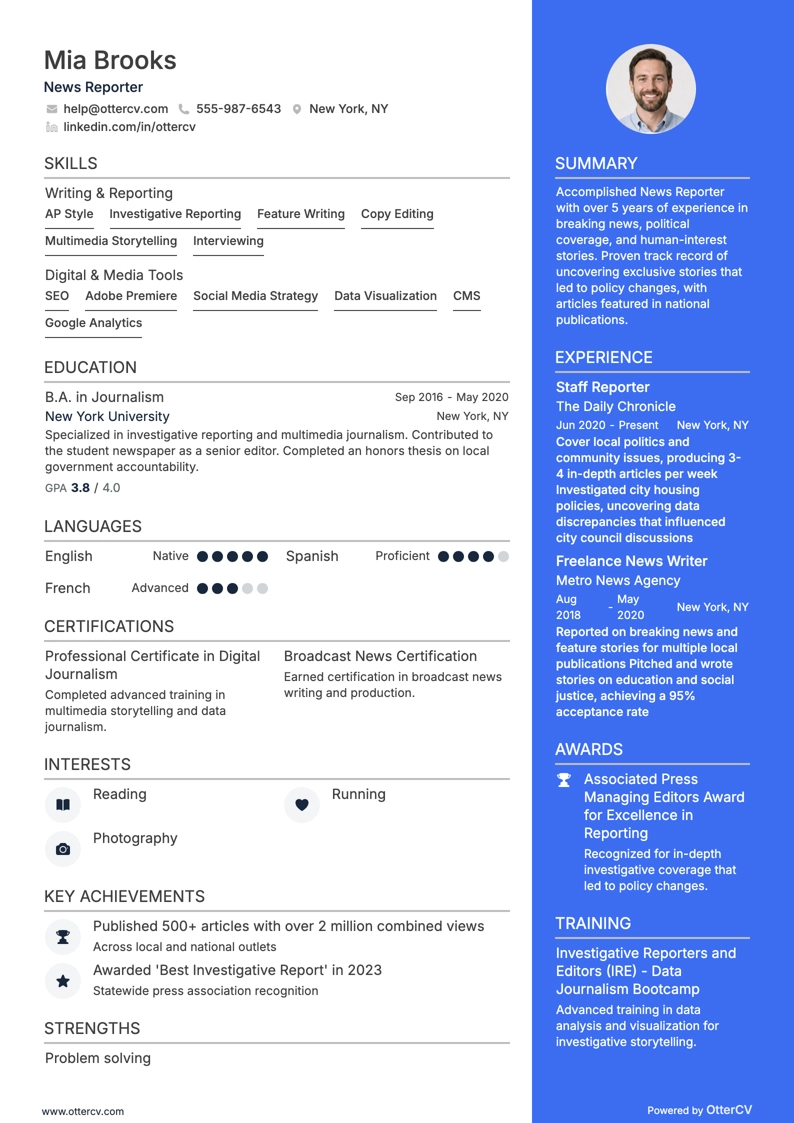
News Reporter resume example

News Reporter

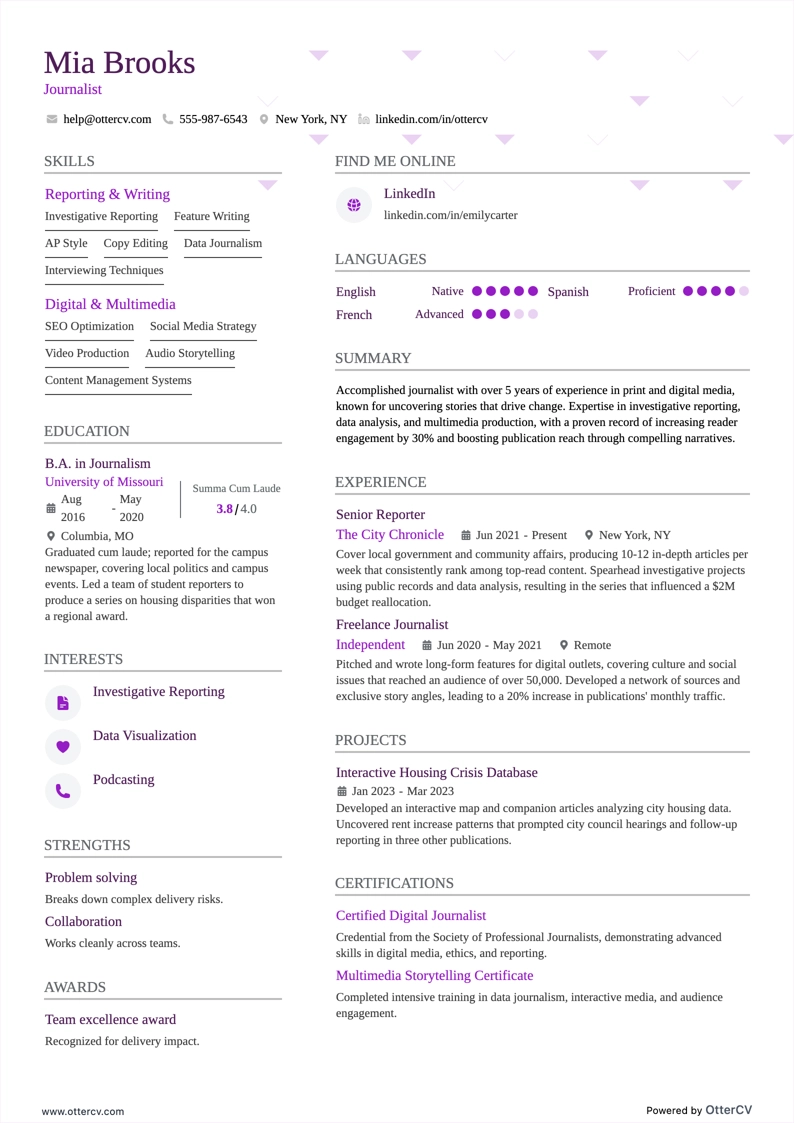
Journalist resume example

Journalist

As a journalist, you work to deliver accurate stories that connect with your audience. The role often comes with tight deadlines, low pay, and demanding schedules, especially in broadcasting, where overnight and holiday shifts are common.

Those challenges also help shape determined, resilient journalists. This guide will show you how to build a journalist resume that highlights your bylines and helps media recruiters quickly see your value.

Here’s a quick overview of what this guide covers:

Key takeaways

  • List your journalism work history and career progression in reverse chronological order.

  • Write a strong resume summary that highlights your qualifications, journalistic style, and key achievements.

  • Show both technical skills, such as content management systems and multimedia tools, and core strengths in writing, editing, and communication.

  • Demonstrate your impact with specific metrics, such as readership growth, engagement rates, or successful investigative work.

  • Tailor your resume to each role by matching your skills and experience to the job requirements.

  • Include your education and any relevant certifications or training to reinforce your expertise.

  • If you have limited professional experience, emphasize internships, freelance work, or personal projects that demonstrate your journalism skills.

Building a strong resume is vital for journalists. Let’s explore the best format to highlight your writing skills and professional experience.

Journalist resume sample

Review this journalist resume example for inspiration as you create your own.

Alex Morgan

Reporter

help@echocv.com | @linkedin.com | Los Angeles, California

Summary

Experienced reporter with over 7 years in breaking news operations, specializing in uncovering exclusive stories and presenting them in a compelling, vibrant style. Works independently, maintains a strong network of contacts across California, and has a proven ability to turn local stories into national news. Skilled in navigating legal documents, conducting on-the-scene reporting, and meeting tight deadlines in fast-paced environments.

Experience

Senior Reporter
Los Angeles Times, Los Angeles, CA
January 2019 – Present

  • Uncover exclusive stories, driving a 15% increase in online readership through innovative reporting.
  • Develop and maintain a strong network of sources across Los Angeles, improving access to breaking news.
  • Provide on-the-scene reporting for major events, boosting site traffic by 20% with timely coverage.
  • Collaborate with editorial teams to brainstorm and refine story ideas, increasing engagement by 10%.
  • Navigate complex court documents and simplify details for a broad audience while maintaining accuracy.

Breaking News Reporter
NBC News, Los Angeles, CA
March 2015 – December 2018

  • Covered breaking news stories, contributing to a 25% growth in real-time online engagement.
  • Worked closely with producers and editors to deliver content that met editorial standards and audience expectations.
  • Reworked local stories into national news angles, increasing visibility and reach by 30%.
  • Maintained high reporting standards under pressure, ensuring all content was accurate and timely.
  • Traveled nationally for on-the-ground reporting and secured exclusive interviews for major news events.

Education

Bachelor of Arts in Journalism

University of Southern California, Los Angeles, CA

Graduated: 2012

Relevant Coursework

  • Investigative Journalism: Emphasized in-depth reporting techniques and uncovering hidden stories.
  • News Writing and Reporting: Developed advanced skills in crafting compelling news stories.

Certifications

  • Digital Journalism Certification, Poynter Institute, 2019
  • Court Reporting and Legal Document Navigation, California State University, 2017

Skills

  • Investigative Reporting
  • Breaking News Coverage
  • Story Development
  • Legal Document Analysis
  • Digital Journalism
  • On-the-Scene Reporting

Languages

  • English (Fluent)
  • Spanish (Intermediate)

Now that you've seen an example, let's look at the best format for a journalist resume.

How to format a journalist resume

For journalists, a reverse-chronological resume format is often the best choice. It highlights your most recent work experience, making it easier for recruiters to follow your career growth and the stories you've brought to life.

Here’s a suggested order for your resume sections:

  • Header
  • Summary/Objective
  • Professional experience
  • Education
  • Certifications
  • Skills
  • Languages

With this structure in place, focus on a design that helps your application stand out.

Resume designs

Contact information

File format

Your resume should also match the market. For example, Canadian applications may use a different layout.

Take advantage of our free AI-powered resume checker to optimize your document for applicant tracking systems.

Now that we’ve covered the details, let’s move to the highlight of your resume: your work experience.

How to write your journalist resume experience

Getting the experience section of your resume right is especially important for journalists because it shows the impact of your reporting. Simply listing responsibilities isn’t enough.

Instead, tailor your resume to the journalism role you want. Look for where your experience matches the publication’s needs, and emphasize those points.

The right way to tailor your journalist resume to the job description

When you tailor your resume to a journalism job description, your strongest qualifications stand out. This helps capture the hiring manager’s attention. By prioritizing the skills and experience the publication values most, you show clearly why you’re a strong fit. This is known as a targeted resume.

Let’s look at this journalism job offer to customize the work experience section.

Multimedia journalist

Multimedia journalist

Job description: The multimedia journalist at Starnes Media creates and manages digital content for six community publications, capturing photos and videos for print and digital platforms. This role ensures content meets quality standards, deadlines, and key metrics while working with the team to support the company’s vision.

Responsibilities:

  • Produce, shoot, and edit multimedia content for print, online, and social platforms, including photos, videos, social videos, and graphics.
  • Plan and assign work to freelancers.
  • Train staff and freelancers on best practices for light multimedia assignments.
  • Establish best practices and checklists for content workflows.
  • Ensure story budgets are up to date with details on multimedia content.

Qualifications:

  • Bachelor’s degree in digital media or equivalent field experience.
  • Proactive, organized, and comfortable using technology and working with remote coworkers.
  • Experience shooting, editing, and distributing photos and video for publications, websites, and social media.
  • Knowledge of journalistic standards for quality and ethics, with a strong desire and track record of capturing compelling stories in visual form.
  • Ability to newsgather, write, and edit stories, captions, and social posts.

This is how we matched this section to the role’s needs:

Experience

Multimedia Journalist

Local News Network

03/2016 - 07/2024 · Los Angeles, CA

  • Produced, shot, and edited multimedia content, increasing digital engagement by 20%.
  • Captured photos and videos for print and digital platforms while meeting quality standards and deadlines.
  • Collaborated with coworkers and freelancers to establish best practices for content workflows.
  • Trained staff and freelancers on multimedia assignments, improving content quality.
  • Managed story budgets with up-to-date multimedia details, boosting efficiency by 15%.
  • Created graphics and social videos, raising social media engagement by 25%.
RIGHT

This resume addresses the job ad's key points by:

  • Underscoring experience in producing multimedia content and showcasing strong storytelling and digital media skills.
  • Emphasizing coverage of major events that led to a 20% increase in digital engagement.
  • Proving impact with metrics, including a 25% boost in social media engagement and a 15% improvement in content workflow efficiency.
  • Covering essential skills such as shooting and editing videos, capturing compelling photos, and managing content across multiple platforms.
  • Demonstrating collaboration with freelancers and staff to maintain content quality and meet deadlines.

By starting each bullet point with an action verb and focusing on results, your contributions become clear and impactful. In journalism, where tangible outcomes matter, this approach is especially important.

We'll explore how this can strengthen your resume in the next section.

How to quantify your experience on a resume

Using measurable results on your journalist resume is crucial because they provide tangible evidence of your effectiveness. Emphasize areas such as audience growth, social media engagement, or the impact of your stories. Quantifying achievements helps your resume stand out.

Consider this:

Reporting Impact Highlights

  • Investigative reporting led to a 30% increase in readership within a six-month period.
  • Exclusive stories generated 50,000+ page views in the first 24 hours.
  • Multimedia content boosted social media engagement by 40% across multiple platforms.
  • Consistently met 100% of deadlines while managing 20+ articles per month.
  • Coverage of a specific event or issue resulted in a 25% spike in subscription rates.

No journalism experience? You can still strengthen your resume by highlighting relevant skills and any bylines.

Learn more below.

How do i write a journalist resume with no experience

Even if you’re new to journalism, your resume should still include essentials such as your contact information, skills, and any bylines. Here’s what else to add:

  • Use a skill-based resume format to highlight relevant abilities such as writing, editing, or photography and reduce the focus on your lack of direct work experience. Support your claims with clear examples without exaggerating.
  • Include any journalism-related classes, workshops, or training, even if they were not part of a formal program.
  • Add transferable skills relevant to journalism, such as communication, information research, and languages.
  • Mention contributions to school newspapers, blogs, or other writing-related activities that show your interest and commitment.
  • List hobbies that reflect creativity or journalism-related skills, such as storytelling, photography, or blogging.
  • Include any freelance writing or content creation you’ve done, even if it was unpaid or part of personal projects, to show initiative.
  • Reference internships, volunteer work, or projects where you applied journalism skills to show a proactive approach to gaining experience.
  • Add a link to your online portfolio with your best work, including articles, blog posts, photography, or multimedia projects, to give clear evidence of your skills and creativity.

The key idea is to think like the outlet. When outlets bring on new talent, they care about the work that person has produced, not the prestige of where it appeared. Talent should think the same way. So push to do the kind of work you want people to notice—even if that means publishing it on your own blog.

—— Ezra Klein

Resume objective for beginner journalists

An objective statement sets the tone for your resume and quickly shows editors what you can offer. It is especially useful when you are just beginning a career in journalism and need to make a strong first impression.

To write an impressive personal statement, keep these points in mind:

  • Keep it concise, with no more than 3 sentences, while showing your passion for journalism and commitment to building a career in the field.
  • State what you hope to achieve, such as improving your skills in investigative reporting, digital media, or a specific beat.
  • Highlight standout abilities or traits, such as strong storytelling, social media savvy, or bilingual communication.

Now, review this strong example from a multimedia journalist’s resume:

Objective

Detail-oriented and creative multimedia journalist seeking an entry-level position at Starnes Media. Eager to leverage strong storytelling skills, proficiency in digital media tools, and a keen eye for capturing compelling visuals. Dedicated to contributing to the team’s success by producing high-quality content that engages and informs the community.

RIGHT

Now that we’ve reviewed your work history, let’s look at the skills you bring to journalism.

How to list your hard and soft skills on your resume

Journalists need to show a diverse skill set, highlighting both their established expertise and the new abilities they are developing. This matters because the industry demands staying current with evolving media platforms and technologies.

To improve your chances of moving forward in the hiring process, feature your key skills in a separate section. When deciding which skills to include, prioritize those that match the keywords in the job offer. This makes it easier for editors to quickly see your fit for the role.

Here’s a list of sought-after hard skills featured on journalist resumes:

Best hard skills for your journalist resume

  • Adobe Premiere Pro supports professional video editing for news and multimedia content.
  • Final Cut Pro is useful for producing polished video packages.
  • Adobe Photoshop helps with photo editing and visual content preparation.
  • Adobe Audition is valuable for editing interviews and other audio content.
  • WordPress is a common platform for publishing digital stories.
  • Content management systems are essential for organizing and publishing newsroom content.
  • Hootsuite helps manage and schedule social media content.
  • AP Stylebook demonstrates familiarity with standard journalistic writing conventions.
  • Microsoft Office Suite supports everyday reporting, writing, and collaboration tasks.
  • Slack helps journalists communicate quickly with editors and team members.
  • Trello can be used to track assignments and editorial workflows.
  • Asana helps manage deadlines and collaborative projects.
  • Social media platforms such as X, Facebook, and Instagram support reporting, promotion, and audience engagement.
  • DSLR cameras are useful for capturing photos and video in the field.
  • Video editing software is important for multimedia journalism.
  • Podcasting software, including Audacity and GarageBand, supports audio storytelling.
  • YouTube Studio helps manage and publish video content.

When listing skills on a journalism resume, don’t just name them. Add brief descriptions or context to show how you’ve used them. Many successful journalists include tools and technologies within their experience entries, where those skills carry more weight alongside past roles.

The same applies to soft skills. Support them with evidence. For example, if you list time management, add a short description in your Strengths or Achievements section, such as: Managed tight deadlines across multiple projects, consistently delivering high-quality content on time.

Here are some common soft skills found on a resume for journalists:

Best soft skills for your journalist resume

  • Communication helps you interview sources, ask clear questions, and report accurately.

  • Time management helps you balance reporting, writing, and revisions efficiently.

  • Attention to detail supports accuracy in facts, quotes, and formatting.

  • Research helps you gather reliable information and build credible stories.

  • Storytelling helps you turn facts into engaging, readable content.

  • Adaptability helps you adjust to breaking news, new formats, and changing priorities.

  • Critical thinking helps you evaluate sources and interpret information carefully.

  • Problem-solving helps you handle reporting challenges and tight production demands.

  • Collaboration helps you work effectively with editors, producers, and other team members.

  • Networking helps you build sources and professional relationships.

  • Creativity helps you develop fresh angles and compelling coverage.

  • Ethical judgment helps you make responsible decisions in reporting and publishing.

  • Multitasking helps you manage interviews, deadlines, and edits at the same time.

  • Proactivity helps you pitch ideas and pursue stories independently.

  • Deadline management helps you deliver accurate work on schedule.

  • Analytical thinking helps you identify patterns, context, and key takeaways.

  • Public speaking helps you present information clearly in interviews, broadcasts, or events.

  • Editing helps you refine structure, clarity, and accuracy before publication.

  • Curiosity helps you ask better questions and uncover stronger stories.

  • Initiative helps you take ownership of assignments and follow leads.

After refining your journalism resume’s skills section, another important improvement is to add relevant education and certifications. This can help show your specialized knowledge and commitment to professional growth.

How to list your education and certifications on your resume

In media, your educational background can play a major role in shaping your career. A bachelor’s degree in journalism, communications, or a related field is often expected, and many journalists also pursue advanced degrees or specialized certifications. To help your resume stand out, build your education section carefully.

It should include:

  • Your degree and major, such as B.A. in Journalism and Digital Media
  • The university name, location, and graduation year
  • Relevant coursework, such as Investigative Reporting, Multimedia Journalism, and Media Ethics
  • Key projects, such as a capstone project on community journalism or a multimedia documentary
  • Any honors and awards, such as Dean’s List or a Society of Professional Journalists Award
  • Additional certifications or training, such as Digital Journalism Certification or SEO for journalists

Here’s an example tailored to the journalist role discussed earlier.

Education

Bachelor's Degree in Digital Media

University of Southern California

09/2018 - 05/2022 · Los Angeles, CA

GPA: 4.0 / 4.0

  • Completed coursework in Digital Content Creation, Social Media Strategies for Journalists, and Multimedia Storytelling.
  • Graduated with honors and served as Editor-in-Chief of the student digital media publication.
RIGHT

This journalist’s education section stands out because it:

  • Shows a Bachelor's Degree in Digital Media, which is well suited to the role.
  • Includes the essential details: degree, school, location, and dates.
  • Highlights relevant coursework, such as Digital Content Creation and Multimedia Storytelling.
  • Mentions leadership experience as Editor-in-Chief of the student digital media publication.
  • Demonstrates academic excellence by noting honors at graduation.

You can further strengthen this journalist’s resume by adding a certifications section. While not every journalism role requires certifications, including them can strengthen your credentials and create more career opportunities.

Now that you know how to underscore your expertise, let’s create a resume summary that helps you stand out as a journalist.

How to write your journalist resume summary

The summary section of your journalist resume gives a brief overview of your skills and accomplishments.

For an effective resume summary:

  • Start with your job title and the number of years you’ve worked in journalism.
  • Highlight key skills and achievements, supported by specific examples.
  • Include your experience with relevant tools and platforms, such as content management systems and video editing software.
  • Keep it concise at 3-5 strong sentences, use compelling language to showcase your accomplishments, and avoid the first-person narrative.

Here’s an example summary customized for the journalist role we discussed earlier.

Summary

Dedicated journalist with over 6 years of experience delivering compelling stories and supporting editorial teams. Proven expertise in researching, writing, and editing articles, increasing reader engagement by 20%. Skilled at managing deadlines and improving workflow efficiency by 15%. Seeking a position at Starnes Media to apply strong journalistic skills and contribute to impactful storytelling.

RIGHT

This summary effectively highlights essential journalism skills, including research, writing, and editing. It also includes measurable results, such as increasing reader engagement by 20%, which clearly shows the candidate's value and impact to recruiters.

The power of a free press lies in its ability to challenge, question, and hold the powerful accountable.

—Joseph Pulitzer

Additional sections for a journalist resume

Optional sections can help highlight distinctive parts of your background and set you apart from other candidates. Include them only if space allows or if they add clear value to the journalism role.

  • Professional associations: Mention memberships in industry groups, such as the Society of Professional Journalists or the Online News Association, to show your active involvement in the journalism community.
  • Passions: Include hobbies and interests that relate to journalism, such as photography, creative writing, or blogging, especially when they demonstrate your passion for storytelling.
  • Language abilities: Note any additional languages you speak, particularly if they align with the publication’s readership or international focus.
  • Publications or presentations: Highlight any articles you have authored or talks you have given on journalism-related topics. This can reflect your expertise and thought leadership in the field.

In conclusion

This guide is designed to help journalists build a strong resume by focusing on key skills, accomplishments, and relevant certifications. It also stresses the importance of tailoring your resume to the specific role you are targeting so you can present your most important qualifications. With a polished resume, you will be ready to capture the attention of potential employers.

Journalist resume examples

Explore additional Journalist resume samples and guides and see what works for your level of experience or role.

By Experience

Senior Reporter

Senior Reporter resume preview

Journalist resume examples

Explore additional Journalist resume samples and guides and see what works for your level of experience or role.

By Role

Arts and Culture Reporter

Arts and Culture Reporter resume preview

Sports Reporter

Sports Reporter resume preview

Business Reporter

Business Reporter resume preview

Political Reporter

Political Reporter resume preview

Photojournalist

Photojournalist resume preview

Data Journalist

Data Journalist resume preview

Multimedia Journalist

Multimedia Journalist resume preview

Broadcast Journalist

Broadcast Journalist resume preview

Investigative Journalist

Investigative Journalist resume preview

News Reporter

News Reporter resume preview

Journalist

Journalist resume preview