Senior Criminal Investigator full preview

10 Investigator Resume Examples

OtterCV

Written by The OtterCV Team

Updated: 5/24/2023•8 min read

See all resume examples in this guide, or generate your own resume example with your personalized prompt

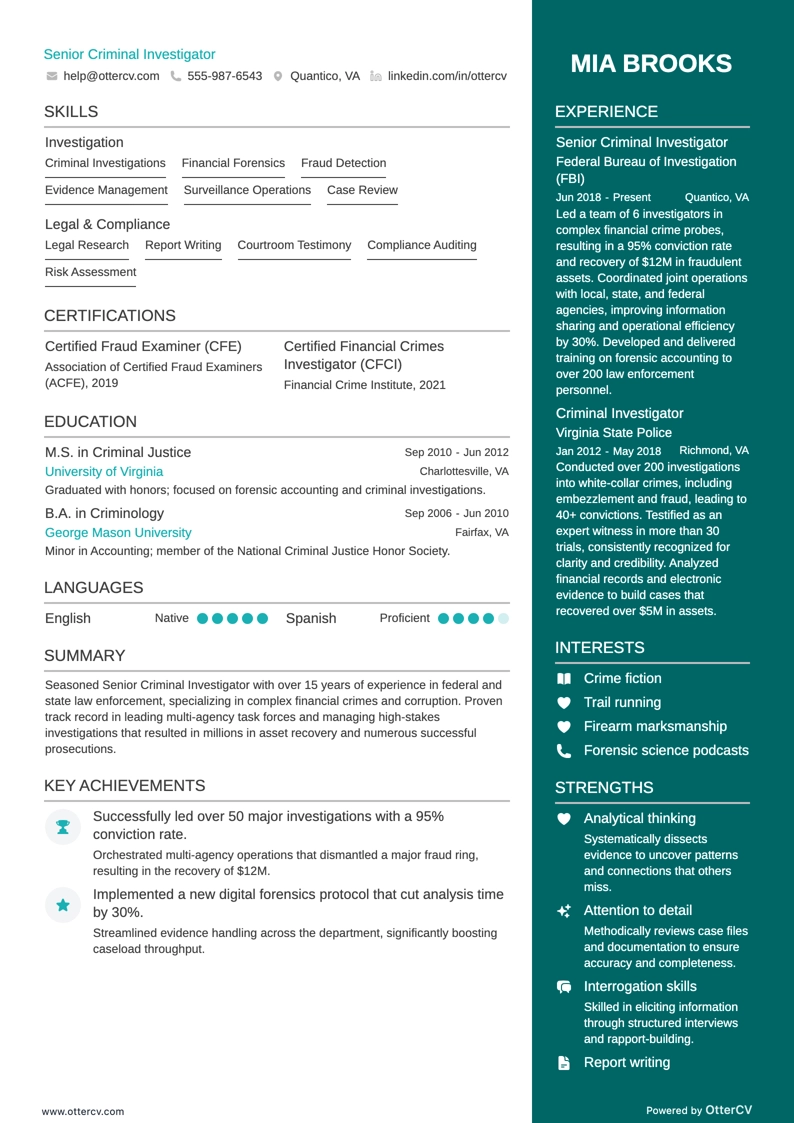
Senior Criminal Investigator resume example

Senior Criminal Investigator

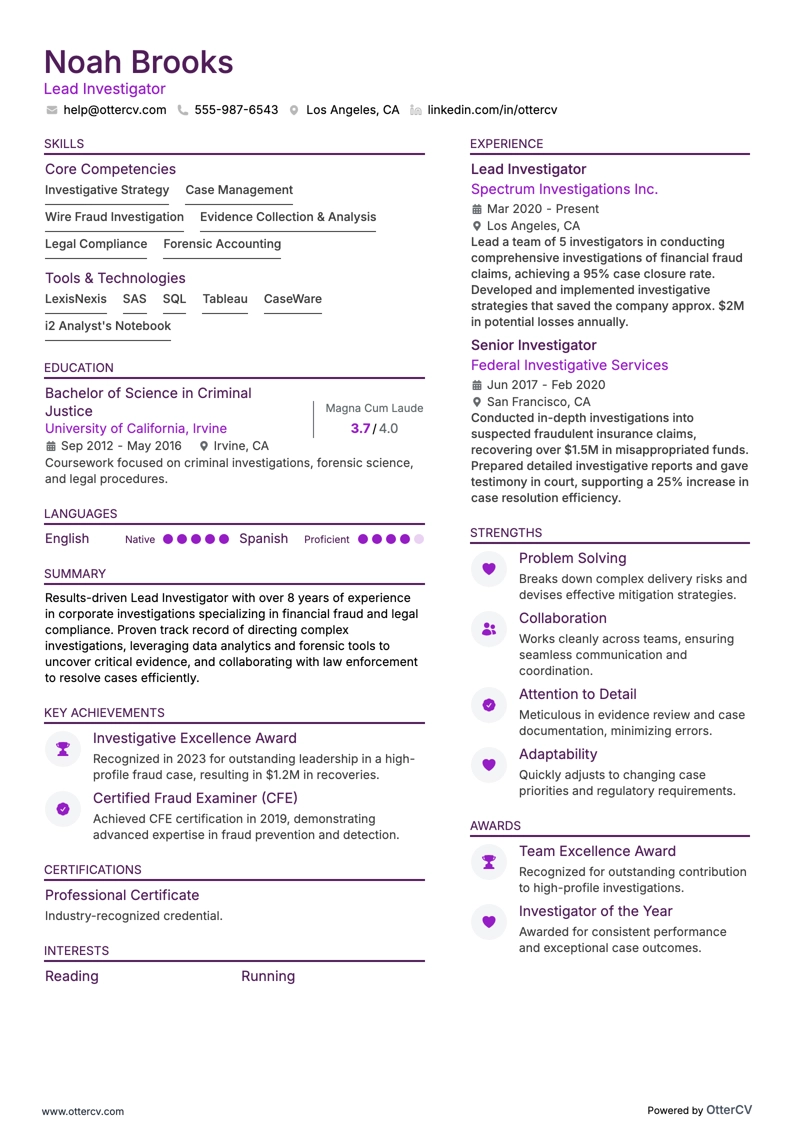
Lead Investigator resume example

Lead Investigator

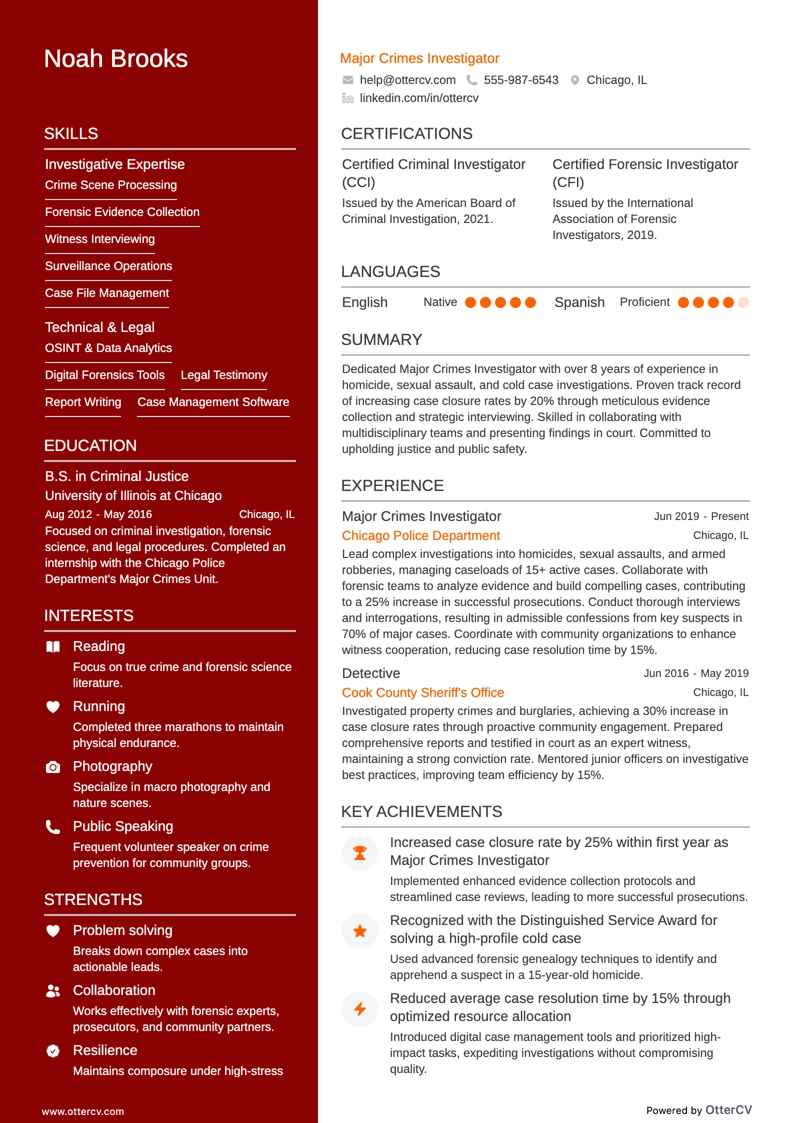
Major Crimes Investigator resume example

Major Crimes Investigator

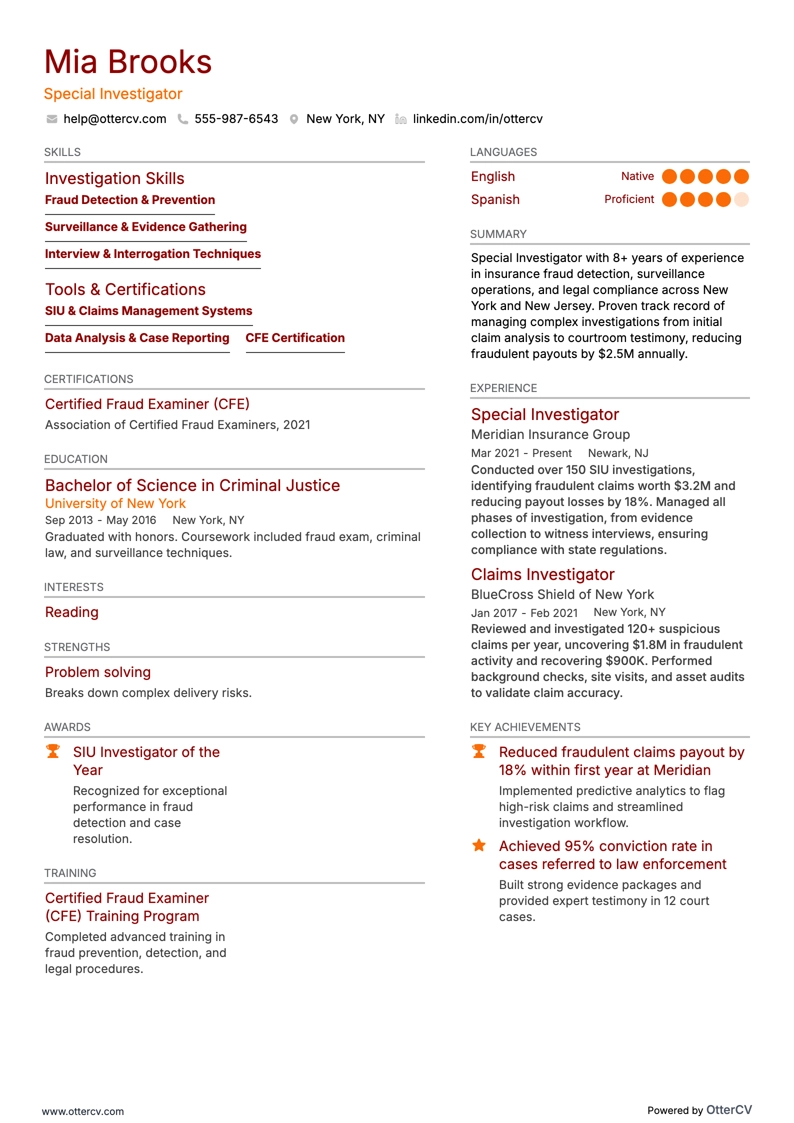
Special Investigator resume example

Special Investigator

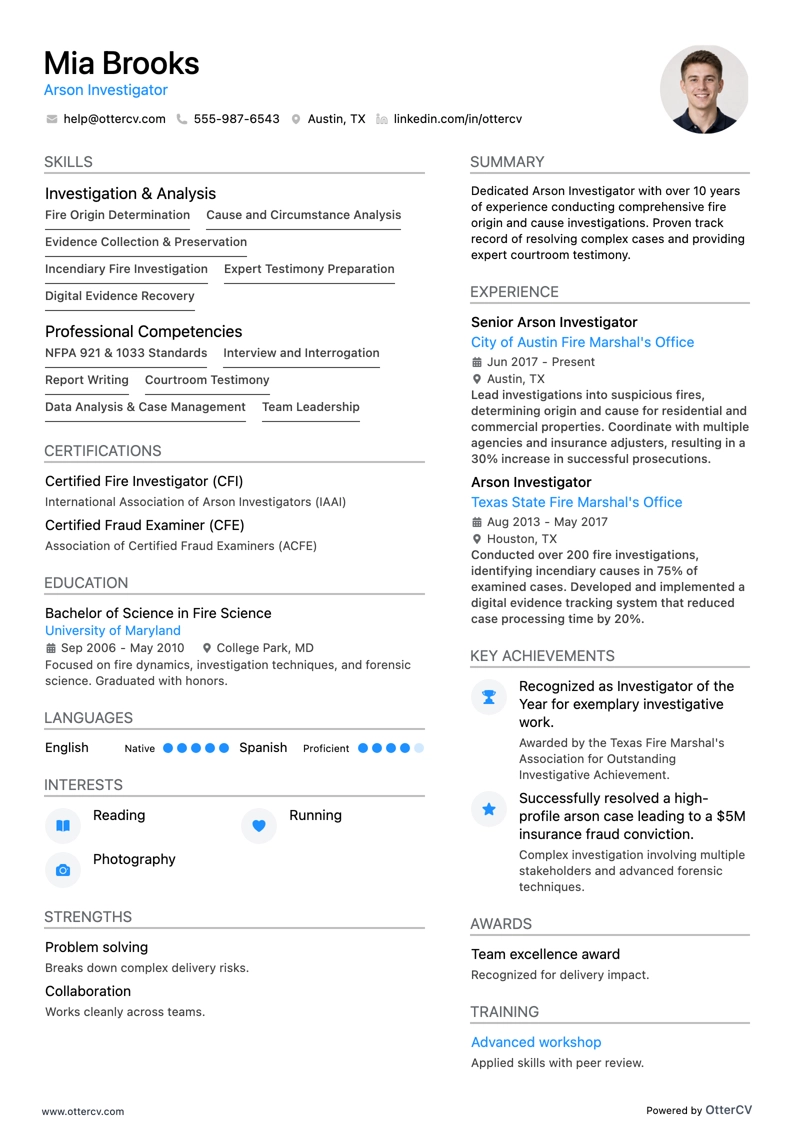
Arson Investigator resume example

Arson Investigator

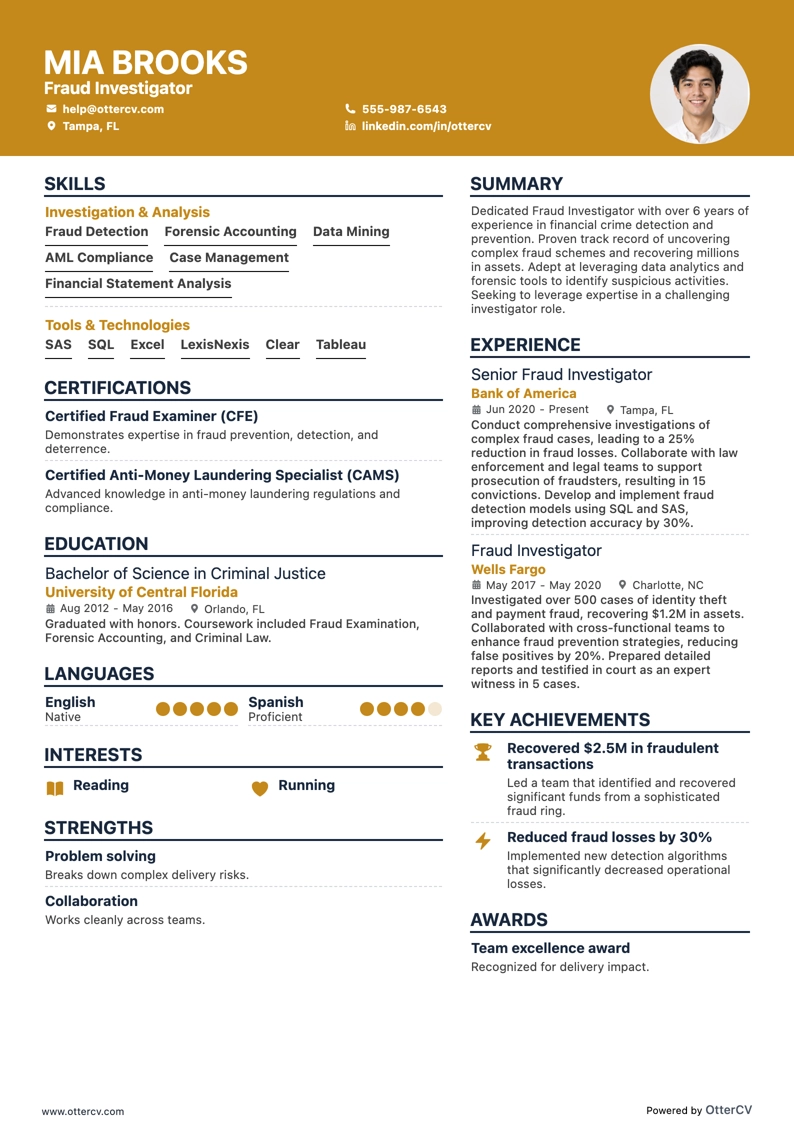
Fraud Investigator resume example

Fraud Investigator

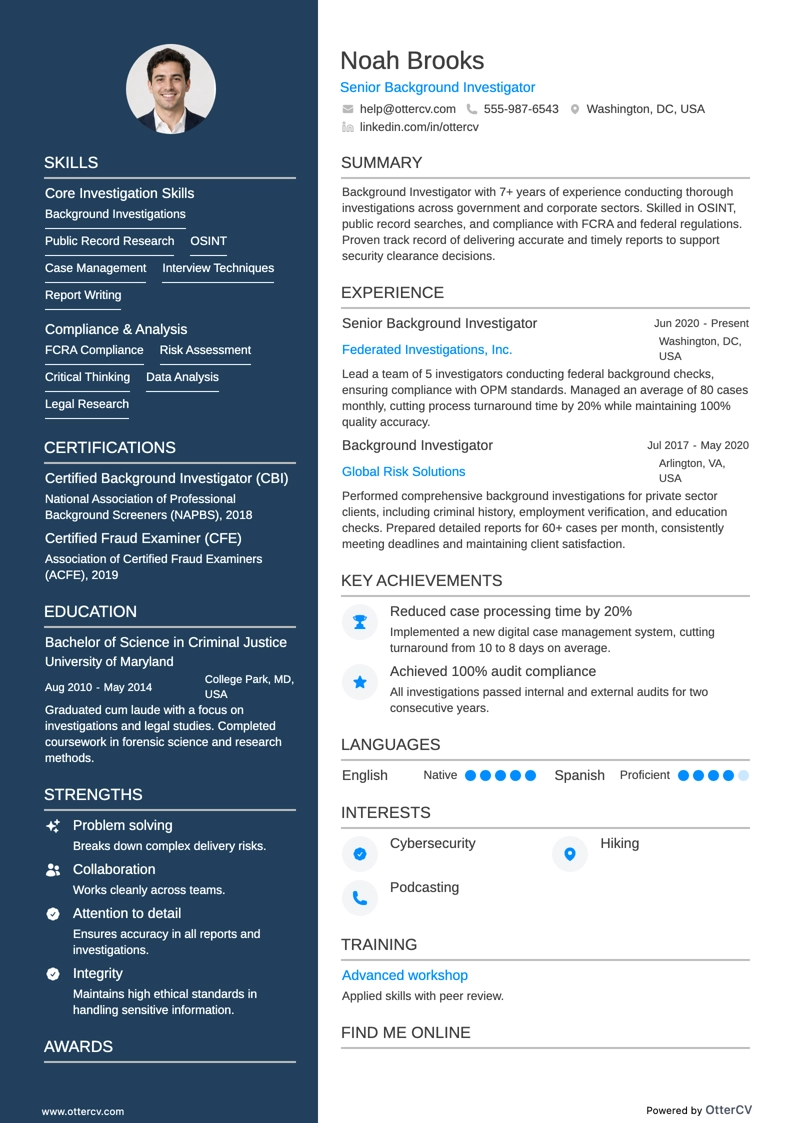
Background Investigator resume example

Background Investigator

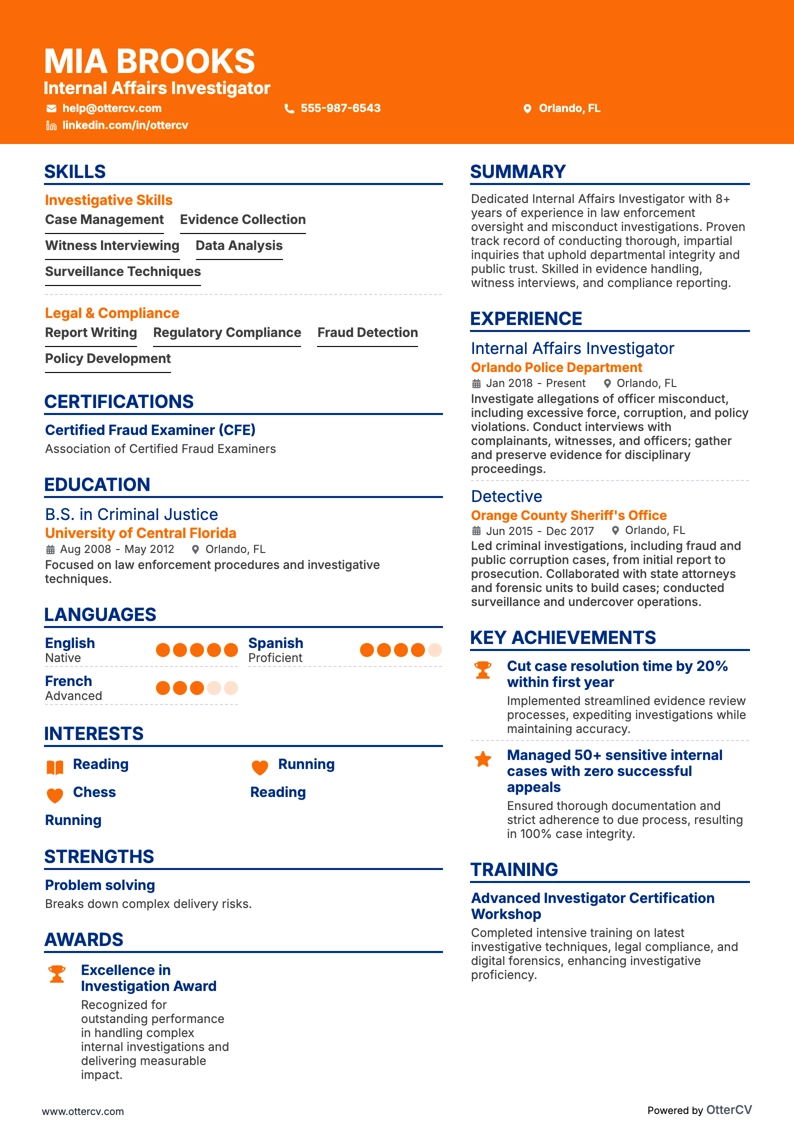
Internal Affairs Investigator resume example

Internal Affairs Investigator

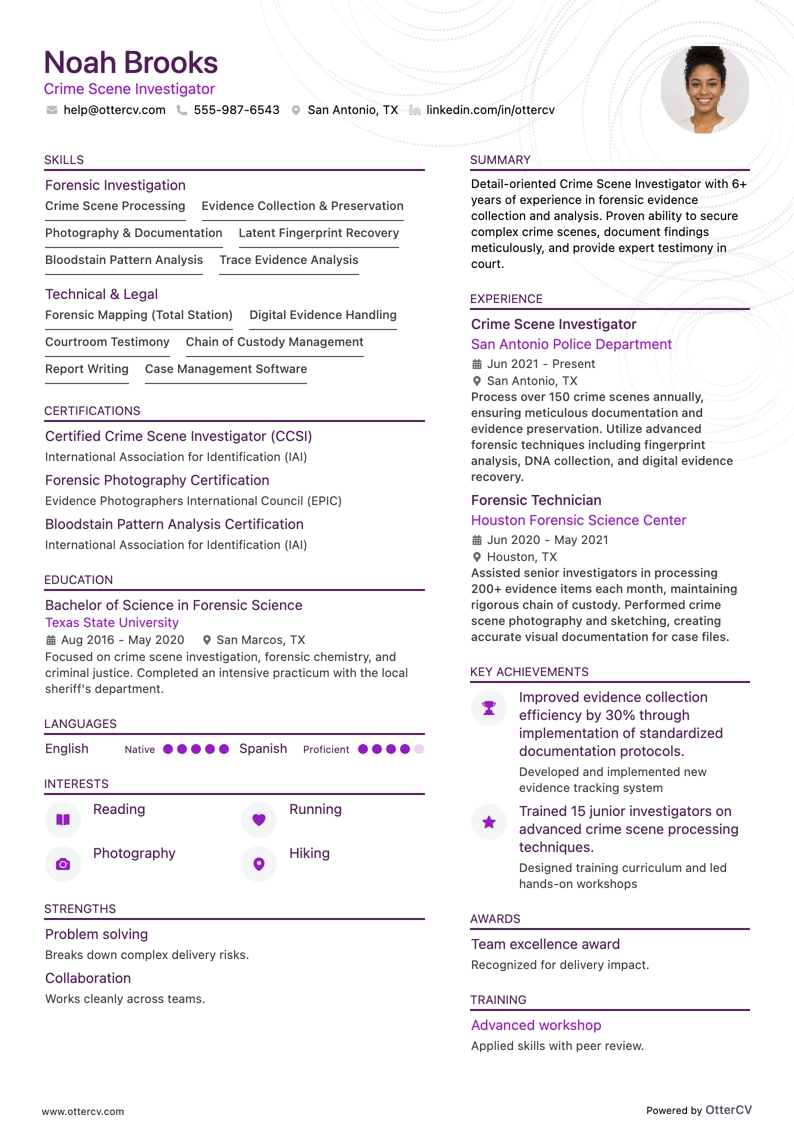
Crime Scene Investigator resume example

Crime Scene Investigator

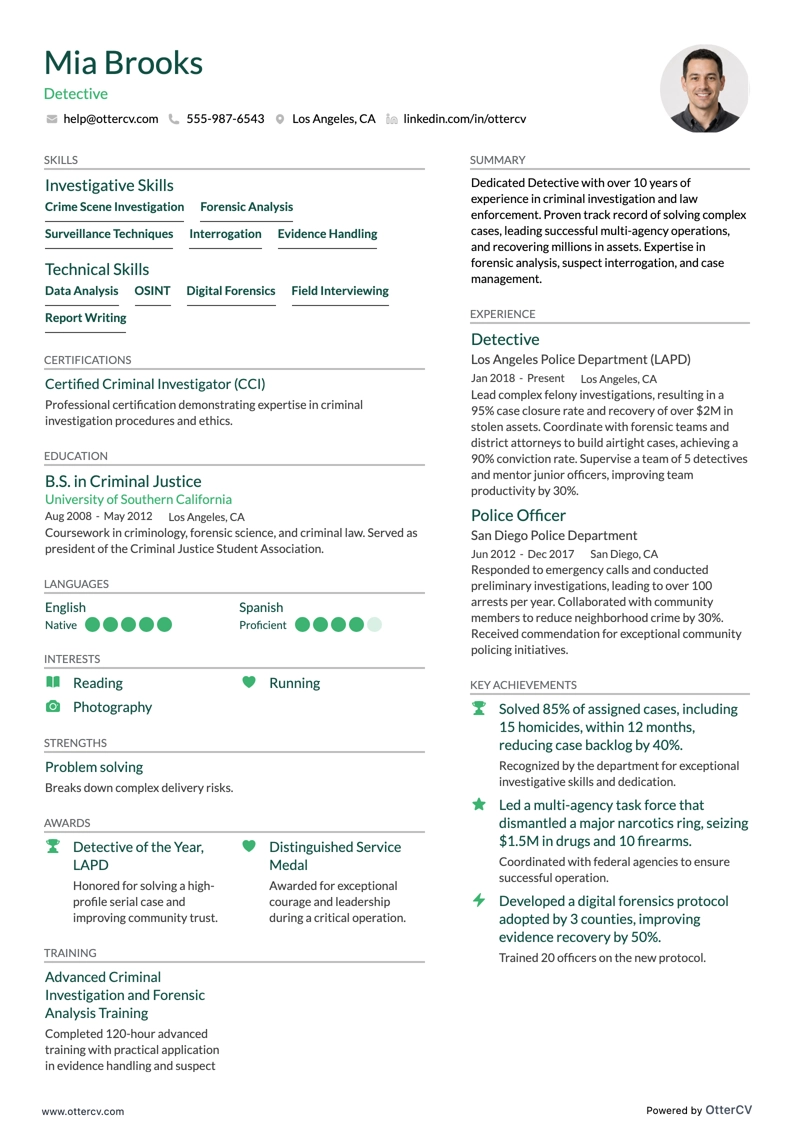
Detective resume example

Detective

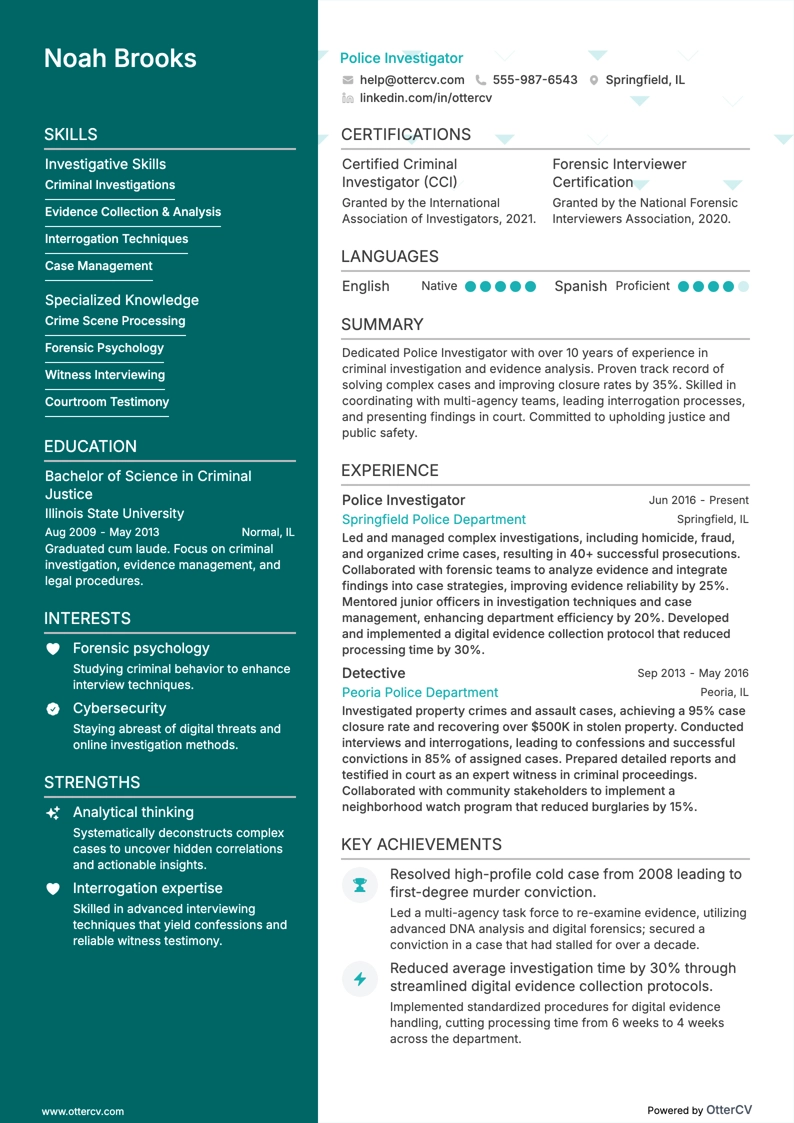
Police Investigator resume example

Police Investigator

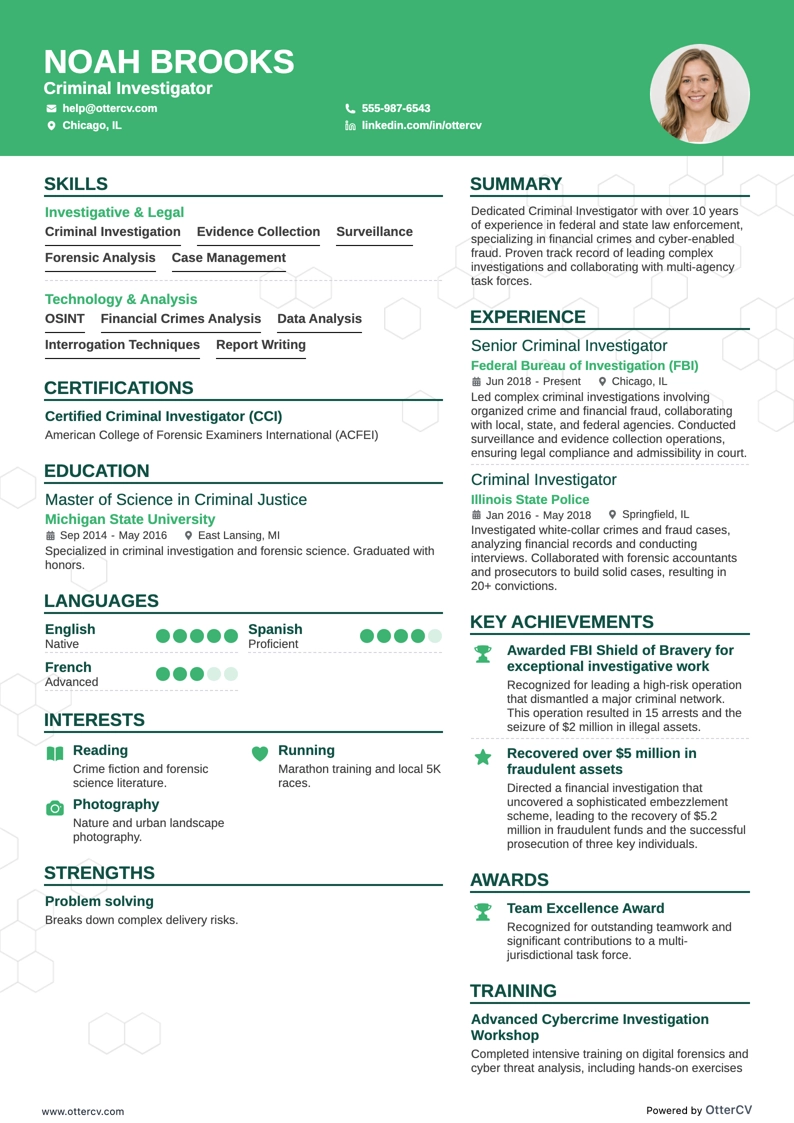
Criminal Investigator resume example

Criminal Investigator

Most investigator resume drafts fail because they read like case logs rather than hiring documents. Dense narratives bury results, making it hard for both ATS tools and recruiters to quickly verify impact.

A strong resume shows what you changed and how you proved it. Knowing how to make your resume stand out starts with highlighting case closure rates, dollar value recovered, cycle time reduced, audit findings cleared, subpoenas executed, and reports adopted by counsel.

Key takeaways

  • Quantify case outcomes such as closure rates, dollars recovered, and reduced cycle time instead of listing daily tasks.

  • Use a reverse-chronological format if you have investigative experience, and a hybrid format if you are changing careers.

  • Tailor each experience bullet to the job posting’s tools, frameworks, and compliance standards.

  • Keep roughly two-thirds of your skills section focused on hard skills and one-third on soft skills.

  • Show your skills in experience bullets and in your summary, not just in a standalone skills list.

  • Add a cover letter when the role is competitive or your background needs extra context.

  • Use Echocv to turn routine investigative tasks into measurable, recruiter-ready resume bullets faster.

Job market snapshot for investigators

We analyzed 3,159 recent investigator job ads across major US job boards to highlight employer expectations, experience requirements, and employment type trends at a glance.

What level of experience employers are looking for investigators

Years of ExperiencePercentage found in job ads
1–2 years18.5% (583)
3–4 years5.2% (165)
5–6 years4.3% (136)
7–8 years1.2% (39)
9–10 years0.5% (15)
10+ years2.1% (65)
Not specified68.4% (2162)

Investigator ads by area of specialization (industry)

Industry (Area)Percentage found in job ads
Government50.5% (1594)
Finance & Banking31.9% (1008)
Healthcare10.9% (344)
Education3.3% (105)
Retail & E-commerce1.3% (42)
Professional Services0.8% (24)
Media & Entertainment0.4% (12)
Nonprofit0.3% (11)

Top companies hiring investigators

CompanyPercentage found in job ads
State of Florida14.5% (459)
Department Of Justice10.8% (341)
Allied Universal Security8.0% (254)
Department Of Homeland Security8.0% (254)
State of Oklahoma2.7% (84)
Texas Health & Human Services Commission2.2% (70)
TD Bank1.8% (58)
Capital One
1.7% (54)
State of Virginia1.7% (54)
State of California1.6% (50)

Role overview stats

These tables outline the most common responsibilities and employment types for investigator roles. Use them to align your resume with employer expectations and understand how the role is structured across the market.

Day-to-day activities and top responsibilities for an investigator

ResponsibilityPercentage found in job ads
Data analysis19.9% (629)
Report writing11.6% (367)
Microsoft Word10.7% (337)
Microsoft Office7.9% (250)
Research7.9% (249)
Maps6.6% (209)
Charts6.6% (208)
Crime analysis6.6% (208)
Infographics6.6% (208)
Matrices6.6% (208)
Tables6.6% (208)
Law enforcement indices6.6% (207)

Type of employment (remote vs on-site vs hybrid)

Employment typePercentage found in job ads
On-site80.6% (2546)
Hybrid13.9% (440)
Remote5.5% (173)

How to format a investigator resume

Recruiters reviewing investigator resumes prioritize analytical rigor, attention to detail, case management experience, and the ability to synthesize evidence into actionable findings. A clean, well-structured resume format helps these qualifications stand out quickly in both automated screening and manual review, so important strengths do not get overlooked.

I have significant experience in this role—which format should I use?

I have significant experience in this role—which format should I use?

Use a reverse-chronological format to showcase your investigative experience and how the complexity of your cases has grown over time.

  • Start with your most recent role and highlight the scope of your caseload, jurisdictional reach, and ownership of investigations from intake through resolution.
  • Include role-specific strengths such as fraud examination, digital forensics tools, surveillance techniques, regulatory compliance frameworks, or interview and interrogation methodologies.
  • Quantify results whenever possible, including case clearance rates, financial recoveries, reduced investigation timelines, or successful prosecutions supported.

Example bullet: “Led a 14-month internal fraud investigation spanning three regional offices, identifying $2.3M in misappropriated funds and delivering evidence that supported termination of four employees and full financial recovery.”

I'm junior or switching into this role—what format works best?

I'm junior or switching into this role—what format works best?

A hybrid resume format works best because it helps you lead with transferable investigative skills while still showing a clear work history.

Do:

  • Put a dedicated skills section near the top with competencies such as evidence collection, report writing, data analysis, background screening, or compliance auditing.
  • Highlight relevant projects, internships, academic research, or volunteer work that included investigation-adjacent tasks like fact-finding, interviewing, or case documentation.
  • Connect each skill or experience to a specific action and measurable result so hiring managers can evaluate your real-world impact.

Example scaffold: “Open-source intelligence research → conducted social media and public records analysis for a university capstone project → produced a 40-page investigative report that identified three previously undocumented risk factors for the client organization.”

Why not use a functional resume?

Why not use a functional resume?

A functional resume removes the timeline and context hiring managers need to judge how your investigative skills were used in real situations, which makes it harder to confirm your credibility and track record.

It may still be acceptable if you're moving from a related field, such as law enforcement, compliance, or journalism, have an employment gap, or do not hold formal investigative titles but have done substantial case-based work. Even then, connect every skill you list to a specific project, case, or outcome instead of presenting skills on their own.

With your format established, the next step is adding the right sections to showcase your qualifications effectively.

What sections should go on a investigator resume

Recruiters expect to see a clear record of investigative work, case outcomes, and compliance with legal and ethical standards on your investigator resume. Understanding which resume sections to include helps you present a complete picture of your qualifications.

Use this structure for maximum clarity:

  • Header
  • Summary
  • Experience
  • Skills
  • Projects
  • Education
  • Certifications
  • Optional sections: Awards, Publications, Languages

Strong experience bullets should emphasize case impact, measurable outcomes, the scope of investigations, and defensible results.

With your resume’s key components in place, the next step is to write the experience section so your work history fits clearly within that structure.

How to write your investigator resume experience

The experience section is where you demonstrate your investigative skills through completed casework, the methods and tools you used, and the measurable results you achieved. Hiring managers care most about impact—cases resolved, fraud uncovered, and risks mitigated—rather than task lists that only repeat a job description.

Each entry should include:

  • Job title
  • Company and location (or remote)
  • Dates of employment (month and year)

Add three to five concise bullet points that show what you owned, how you worked, and what outcomes you delivered:

  • Ownership scope: the caseloads, investigative portfolios, jurisdictions, or compliance areas you were directly responsible for.
  • Execution approach: the investigative tools, databases, surveillance techniques, interview methods, or analytical frameworks you used to gather evidence and reach sound conclusions.
  • Value improved: changes in case resolution quality, fraud detection accuracy, regulatory compliance rates, risk reduction, or evidence integrity resulting from your work.
  • Collaboration context: how you worked with law enforcement agencies, legal teams, compliance officers, internal stakeholders, or external regulatory bodies to move investigations forward or close them.
  • Impact delivered: outcomes such as case resolutions, recoveries, policy changes, or reduced organizational risk instead of a simple list of daily investigative duties.

Experience bullet formula

Experience bullet formula

Action verb + technology + what you built or fixed + measurable result

A investigator experience example

Senior Corporate Investigator

Northbridge Payments | Austin, TX

2021–Present

Fintech payments company supporting over 2M customers with a high-volume fraud, disputes, and compliance program.

  • Led complex fraud and insider-risk investigations using SQL, Splunk, and Salesforce Service Cloud, reducing average case cycle time from twelve to seven days (42%) while maintaining a 98% quality audit score.
  • Built an evidence pipeline with Python and Tableau to correlate device fingerprinting, chargeback data, and transaction logs across 30M monthly events, increasing confirmed fraud detection yield by 18% and preventing $2.4M in losses.
  • Authored and executed investigation plans aligned to Bank Secrecy Act (BSA) and Anti-Money Laundering (AML) controls, improving suspicious activity report filing timeliness from 86% to 97% through standardized templates and peer review.
  • Partnered with product managers, engineers, and legal to implement case management workflows and chain-of-custody standards, cutting evidence retrieval time by 55% and reducing escalation rework by 23%.
  • Interviewed complainants, employees, and third parties; documented findings in Confluence and Jira; and supported HR and compliance decisions that lowered repeat policy violations by 15% quarter over quarter.

Now that you've seen how to structure your experience entries, the next step is to align them with the specific requirements of each job posting.

How to tailor your investigator resume experience

Recruiters assess your experience through applicant tracking systems and manual review, measuring how closely your background matches the posting. Tailoring your resume to the job description helps your qualifications stand out in both screening stages.

Ways to tailor your investigator experience:

  • Mirror the investigative methodologies and frameworks listed in the posting.
  • Reference the databases or surveillance tools named in the job description.
  • Match the compliance standards and regulatory requirements the employer prioritizes.
  • Highlight the case management systems or software platforms required for the role.
  • Align your interview and interrogation techniques with those described in the posting.
  • Include the industry or domain focus stated in the job listing.
  • Reflect the collaboration structures and reporting workflows the employer uses.
  • Echo the performance benchmarks or case resolution criteria the role emphasizes.

Tailoring means aligning your real accomplishments with what the employer is asking for, not forcing unrelated keywords into your experience section.

Resume tailoring examples for investigator

Resume tailoring examples for investigator

Job description excerptUntailoredTailored

Once you’ve aligned your casework and responsibilities with the role’s priorities, the next step is to quantify your investigator achievements so hiring teams can understand the scope and impact of your results.

How to quantify your investigator achievements

Quantifying your achievements shows outcomes, not just effort. Focus on case volume, cycle time, accuracy, compliance, and risk reduction, along with dollar impact when you prevent fraud, recover losses, or avoid regulatory penalties.

Quantifying examples for investigator

MetricExample
Case throughputClosed 42 investigations per month on average across fraud and policy violations, using Salesforce and Excel trackers to prioritize high-risk queues.
Cycle timeCut average time to resolution from 12 days to seven by standardizing intake questions and building a triage checklist in Confluence.
Accuracy rateImproved substantiation accuracy from 88% to 95% after introducing a two-step evidence review and audit sampling in SharePoint.
Compliance riskReduced overdue regulatory reports from nine per quarter to zero by creating a calendar-driven workflow and escalation rules in Outlook.
Loss preventionPrevented $310,000 in potential losses by identifying chargeback patterns and coordinating account holds with finance within 24 hours.

How to list your hard and soft skills on a investigator resume

Once your bullet points are strong, the next step is making sure your investigator resume shows the right mix of hard and soft skills for hiring managers.

Your skills section should show that you can gather evidence, analyze facts, and write defensible findings. Recruiters and ATS also scan this section for role-specific keywords, tools, and methods, so aim for roughly two-thirds hard skills and one-third soft skills.

Investigator roles require a blend of:

  • Product strategy and discovery skills
  • Data, analytics, and experimentation skills
  • Delivery, execution, and go-to-market discipline
  • Soft skills

Your skills section should be:

  • Scannable, using bullet-style grouping
  • Relevant to the job post
  • Backed by proof in your experience bullets
  • Updated with current tools

Place your skills section:

  • Above your experience if you're junior or switching careers
  • Below your experience if you're mid- or senior-level with strong achievements

Hard skills

  • Uses case management systems.
  • Handles evidence collection and maintains chain of custody.
  • Applies interview and interrogation techniques.
  • Plans surveillance and prepares reports.
  • Conducts open-source intelligence (OSINT) research.
  • Performs background checks and records searches.
  • Supports digital forensics triage.
  • Works with eDiscovery platforms and legal holds.
  • Writes reports and drafts affidavits.
  • Conducts regulatory compliance investigations.
  • Supports fraud detection and loss prevention.
  • Uses Excel, SQL, and Tableau.

Soft skills

  • Ask precise, non-leading questions.
  • Document decisions and the rationale behind them.
  • Write clear, defensible narratives.
  • Deliver concise updates to stakeholders.
  • Handle sensitive information discreetly.
  • Manage competing case priorities effectively.
  • Escalate risk with clear options.
  • Coordinate with legal and HR.
  • Maintain objectivity under pressure.
  • De-escalate tense conversations.
  • Follow up until closure.
  • Present findings to leadership.

How to show your investigator skills in context

Skills should not appear only in a bulleted list on your resume. Review examples of resume skills used in context to see how professionals incorporate competencies into their summary and experience sections.

Show your skills in these areas:

  • Your summary, which reflects your high-level professional identity
  • Your experience, which proves your skills through outcomes

Here is what that looks like in practice.

Summary example

Senior investigator with 12 years of experience in corporate fraud detection. Skilled in forensic accounting, i2 Analyst's Notebook, and witness interviewing. Led a cross-departmental task force that reduced fraudulent claims by 34% within one fiscal year.

  • Clearly reflects senior-level experience
  • Names tools and methods relevant to the role
  • Includes a specific, measurable outcome
  • Highlights leadership as a soft skill

Experience example

Senior Fraud Investigator

Redline Compliance Group | Remote

March 2019–Present

  • Investigated 200+ complex fraud cases using i2 Analyst's Notebook, recovering $4.1M in misappropriated funds over three years.
  • Partnered with legal counsel and compliance teams to build evidentiary packages, achieving a 91% case resolution rate.
  • Developed a standardized digital forensics workflow that cut average investigation timelines by 28% across the department.
  • Every bullet contains measurable proof.
  • Skills appear naturally within achievements.

Once you’ve connected your investigative strengths to real examples and outcomes, the next step is learning how to write an investigator resume with no experience so you can present those strengths without relying on formal investigator roles.

How do I write a investigator resume with no experience

Even without full-time experience, you can still demonstrate readiness. Our guide on writing a resume without work experience explains how to build a strong application using transferable skills and projects.

Consider showcasing:

  • University research methods coursework
  • Case study analyses with citations
  • Compliance or audit class projects
  • Mock interviews and statement taking
  • Open-source intelligence research assignments
  • Evidence handling lab exercises
  • Volunteer incident documentation work
  • Internship in legal support

Focus on:

  • Documented methods and process
  • Clear, quantifiable project outcomes
  • Relevant tools and records management
  • Industry-aligned compliance knowledge

Resume format tip for entry-level investigator

Resume format tip for entry-level investigator

Use a hybrid resume format because it puts skills and projects first while still showing your education and any relevant experience.

Do:

  • Add a Projects section near the top.
  • Write bullet points using method, tool, and result.
  • Name tools such as Excel, SQL, and OSINT.
  • Quantify outputs, such as records reviewed or time saved.
  • Tailor keywords to each job posting.

Example project bullet:

  • Conducted OSINT research using Google dorks and Maltego on a mock fraud case, documented twenty-three sources, and reduced false leads by 30%.

Even without direct experience, your educational background can strengthen your investigator resume if you present it clearly.

How to list your education on a investigator resume

Your education section helps hiring teams confirm you have the foundational knowledge needed for investigator work. It shows your analytical training, critical thinking skills, and relevant academic background.

Include:

  • Degree name
  • Institution
  • Location
  • Graduation year
  • Relevant coursework (for juniors or entry-level candidates)
  • Honors and GPA (if 3.5 or higher)

Skip the month and day—list the graduation year only.

Here's a strong education entry tailored for an investigator resume.

Example education entry

Bachelor of Science in Criminal Justice

George Mason University, Fairfax, VA

Graduated 2021

GPA: 3.7/4.0

  • Relevant coursework: Criminal Law, Forensic Science, White-Collar Crime Analysis, Evidence and Legal Procedures
  • Honors: Magna Cum Laude, Dean's List (six consecutive semesters)

How to list your certifications on a investigator resume

Certifications on a resume show an investigator's commitment to learning, proficiency with modern tools, and alignment with industry standards that employers trust.

Include the following details:

  • Certificate name
  • Issuing organization
  • Year
  • Optional: credential ID or URL
  • Place certifications below education when your degree is recent and more relevant than older credentials.
  • Place certifications above education when they are recent, role-specific, or required for the investigator role.

Best certifications for your investigator resume

  • Certified Fraud Examiner (CFE).
  • Certified Forensic Interviewer (CFI).
  • Certified Financial Crimes Investigator (CFCI).
  • Certified Anti-Money Laundering Specialist (CAMS).
  • Certified Information Systems Security Professional (CISSP).
  • GIAC Certified Forensic Analyst (GCFA).
  • EnCase Certified Examiner (EnCE).

How to write your investigator resume summary

Once your key credentials are easy for hiring managers to spot, use your investigator resume summary to show how those qualifications match the role’s requirements.

Your resume summary is often the first thing a recruiter reads, so a strong opening should quickly show that you’re qualified for the investigator role.

Keep it to three to four lines and include:

  • Your title and total years of investigative experience.
  • Your area of specialization, such as fraud, insurance, or corporate compliance.
  • Core skills and tools, such as surveillance equipment, case management software, or forensic analysis.
  • One or two measurable achievements that demonstrate your effectiveness.
  • Soft skills connected to real results, such as attention to detail that reduced case errors.

PRO TIP

At this level, emphasize relevant skills, specific tools, and early wins that demonstrate initiative.

Avoid vague descriptors like “hard-working” or “passionate.” Instead, use concrete contributions, such as cases closed or accuracy rates improved.

Example summary for a investigator

Detail-oriented investigator with two years of experience handling insurance fraud cases. Proficient in surveillance techniques and i2 Analyst's Notebook. Resolved 95% of assigned cases within target timelines.

Now that your summary shows the depth of your investigative expertise, make sure your header includes the contact and professional details hiring managers need to reach you.

What to include in a investigator resume header

A well-crafted resume header presents your key identifiers and contact details clearly, helping your investigator application stand out during recruiter screening through visibility and credibility.

Essential resume header elements

  • Full name
  • Tailored job title and headline
  • Location
  • Phone number
  • Professional email
  • GitHub link
  • Portfolio link
  • LinkedIn

A LinkedIn link helps recruiters verify your work history quickly and supports consistent screening.

Don't include a photo on an investigator resume unless the role is explicitly front-facing or appearance-dependent.

Keep the header easy to scan by using one line per element and matching your investigator job title to the posting.

Once your contact details and professional identifiers are clearly presented at the top, you can strengthen your application with additional resume sections that provide relevant context and support your qualifications.

Additional sections for investigator resumes

Additional sections can strengthen an investigator resume when they highlight specialized qualifications, unique expertise, or credentials that distinguish you from other candidates. For example, listing language skills on your resume can be especially valuable if you conduct multilingual interviews, translate documents, or work across jurisdictions.

  • Languages
  • Certifications and licenses
  • Professional affiliations and memberships
  • Publications and case studies
  • Awards and commendations
  • Continuing education and specialized training
  • Security clearances

Once you’ve strengthened your resume with relevant additional sections, the next step is pairing it with a cover letter that gives your qualifications more context.

Do investigator resumes need a cover letter

A cover letter isn’t required for an investigator, but it can help in competitive searches or when a team expects context beyond a resume. If you’re unsure where to start, learning what a cover letter is and how it complements your resume can clarify when it’s worth writing. It can make a difference when your experience needs framing or when the role has strict hiring expectations.

Use a cover letter to add clarity and relevance:

  • Explain role and team fit by matching your investigation style to the team’s scope, pace, and collaboration model.
  • Highlight one or two relevant projects or outcomes using specific metrics, turnaround times, risk reduction, or case resolution results.
  • Show understanding of the product, users, or business context by naming key workflows, abuse patterns, compliance needs, or operational constraints you’ve handled.
  • Address career transitions or less obvious experience by connecting past work to investigator skills, tools, and decision-making standards.

Using AI to improve your investigator resume

Once you’ve decided whether to include a cover letter based on the role and employer’s expectations, the next step is using AI to improve your investigator resume so it aligns more quickly and precisely with the job requirements.

AI can improve your resume’s clarity, structure, and overall impact. It can tighten language and highlight relevant strengths, but overuse can make your resume sound less authentic. Once your content is clear and aligned with the role, step away from AI. For more prompt ideas, see our guide on ChatGPT resume writing prompts.

Here are 10 practical prompts to strengthen specific sections of your investigator resume:

  1. Strengthen summary focus: “Rewrite my investigator resume summary to emphasize case resolution skills and analytical strengths in three concise sentences.”
  2. Quantify experience bullets: “Add measurable outcomes to each experience bullet on my investigator resume, using caseload numbers and resolution rates.”
  3. Tighten skills section: “Remove vague or generic entries from my investigator skills section and suggest specific, role-relevant replacements.”
  4. Align with job posting: “Compare my investigator resume experience section against this job description and flag missing keywords or qualifications.”
  5. Improve action verbs: “Replace weak or repetitive verbs in my investigator experience bullets with precise, high-impact alternatives.”
  6. Clarify certifications: “Reformat the certifications section of my investigator resume for clarity, listing credential names, issuers, and dates consistently.”
  7. Refine education details: “Edit my investigator resume education section to highlight coursework and training directly relevant to investigative work.”
  8. Showcase project impact: “Rewrite the projects section of my investigator resume to emphasize scope, methodology, and documented outcomes.”
  9. Eliminate redundancy: “Identify and remove redundant phrases or repeated ideas across all sections of my investigator resume.”
  10. Improve readability: “Shorten any sentence longer than 20 words in my investigator resume while preserving its original meaning and specificity.”

Stop using AI once your resume sounds accurate, specific, and aligned with your real experience. AI should never invent experience or inflate claims—if it didn’t happen, it doesn’t belong on your resume.

Conclusion

A strong investigator resume shows measurable outcomes, role-specific skills, and a clear structure. It highlights case results, evidence handling, interview strength, and accurate reporting while staying easy to scan with focused sections and consistent formatting.

This approach shows you’re ready for today’s hiring market and near-future expectations. It proves you can deliver reliable findings, meet deadlines, and work with stakeholders. Keep every line relevant, and let your results speak.

Investigator resume examples

Explore additional Investigator resume samples and guides and see what works for your level of experience or role.

By Experience

Senior Criminal Investigator

Senior Criminal Investigator resume preview

Lead Investigator

Lead Investigator resume preview

Investigator resume examples

Explore additional Investigator resume samples and guides and see what works for your level of experience or role.

By Role

Major Crimes Investigator

Major Crimes Investigator resume preview

Special Investigator

Special Investigator resume preview

Arson Investigator

Arson Investigator resume preview

Fraud Investigator

Fraud Investigator resume preview

Background Investigator

Background Investigator resume preview

Internal Affairs Investigator

Internal Affairs Investigator resume preview

Crime Scene Investigator

Crime Scene Investigator resume preview

Detective

Detective resume preview

Police Investigator

Police Investigator resume preview

Criminal Investigator

Criminal Investigator resume preview