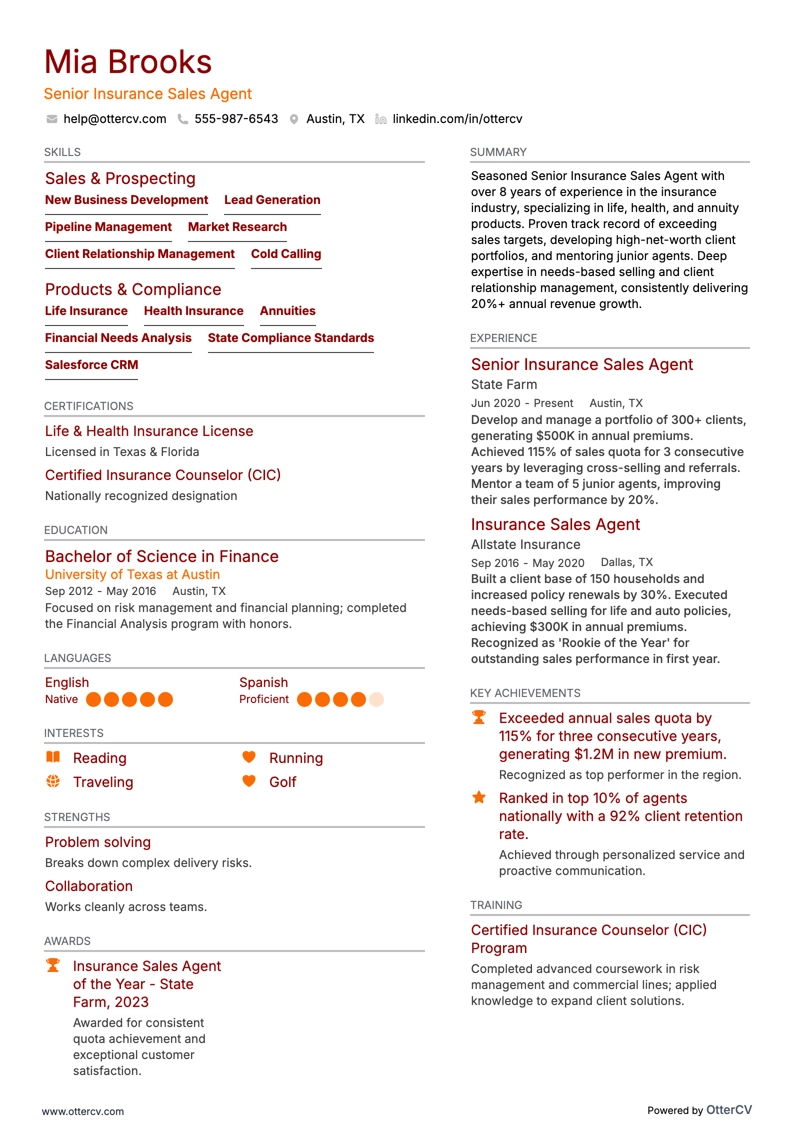
Senior Insurance Sales Agent full preview

20 Insurance Sales Resume Examples

OtterCV

Written by The OtterCV Team

Updated: 8/14/2025•8 min read

See all resume examples in this guide, or generate your own resume example with your personalized prompt

Senior Insurance Sales Agent resume example

Senior Insurance Sales Agent

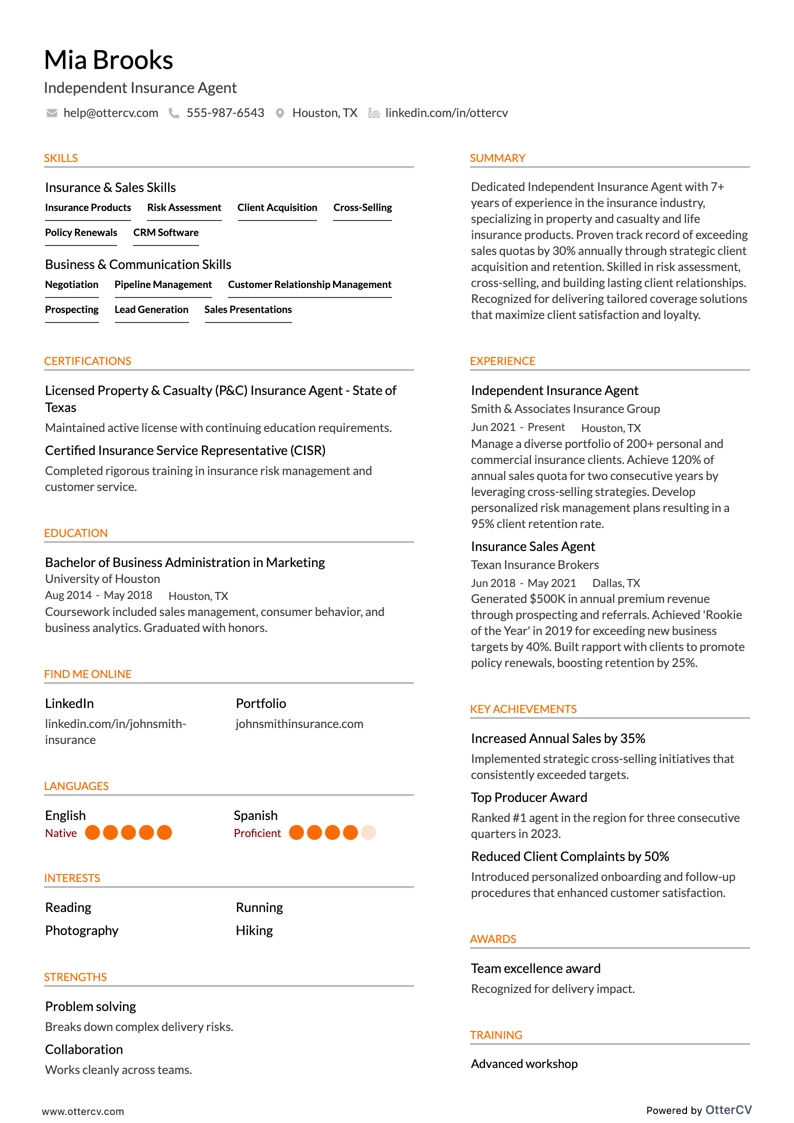
Independent Insurance Agent resume example

Independent Insurance Agent

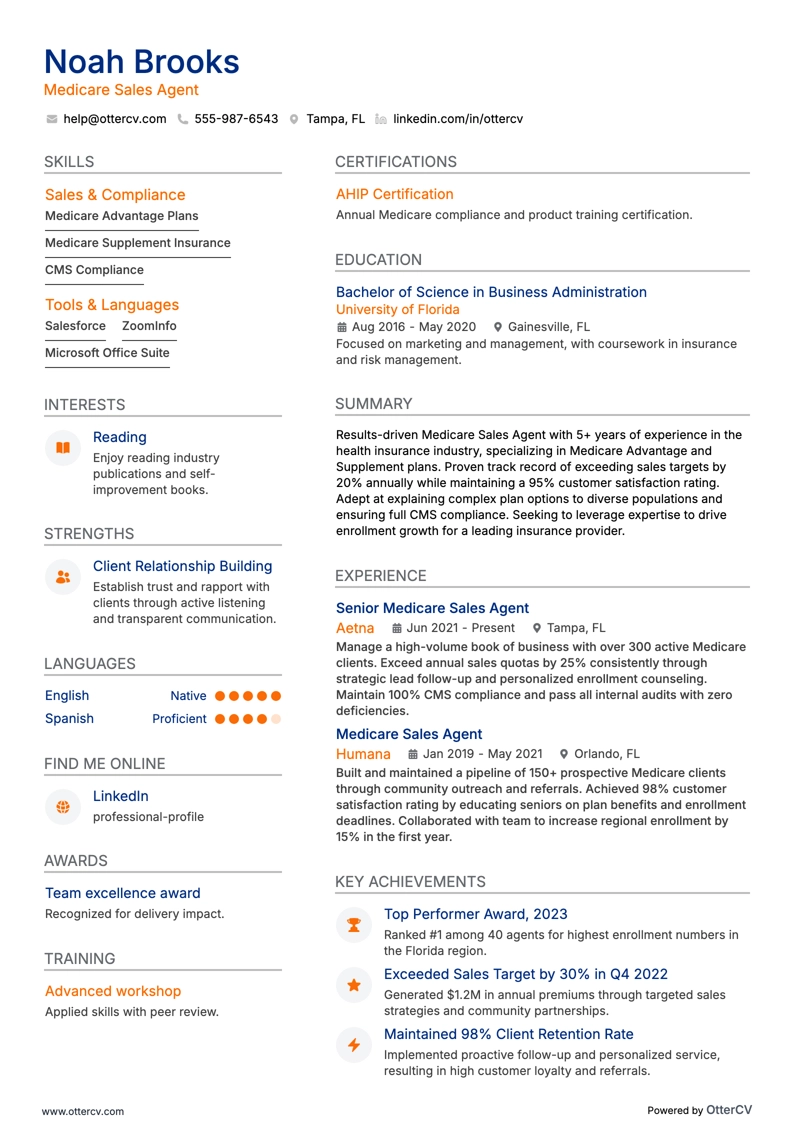
Medicare Sales Agent resume example

Medicare Sales Agent

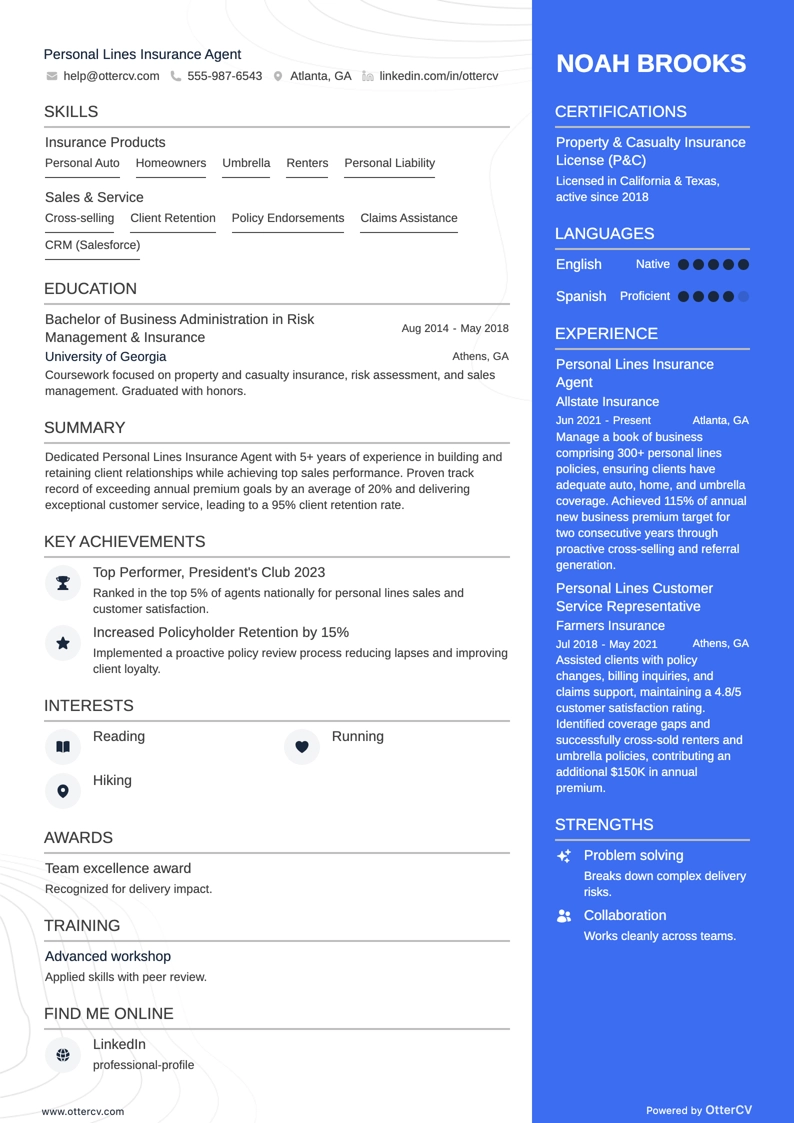
Personal Lines Insurance Agent resume example

Personal Lines Insurance Agent

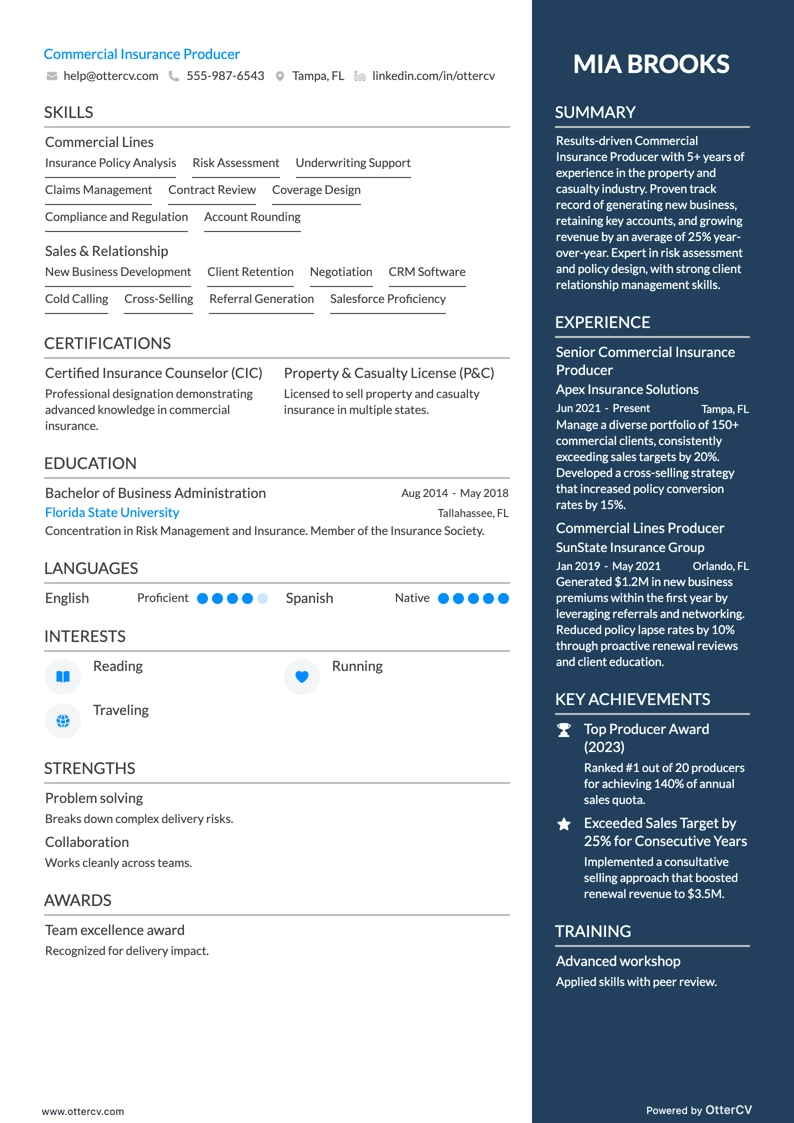
Commercial Insurance Producer resume example

Commercial Insurance Producer

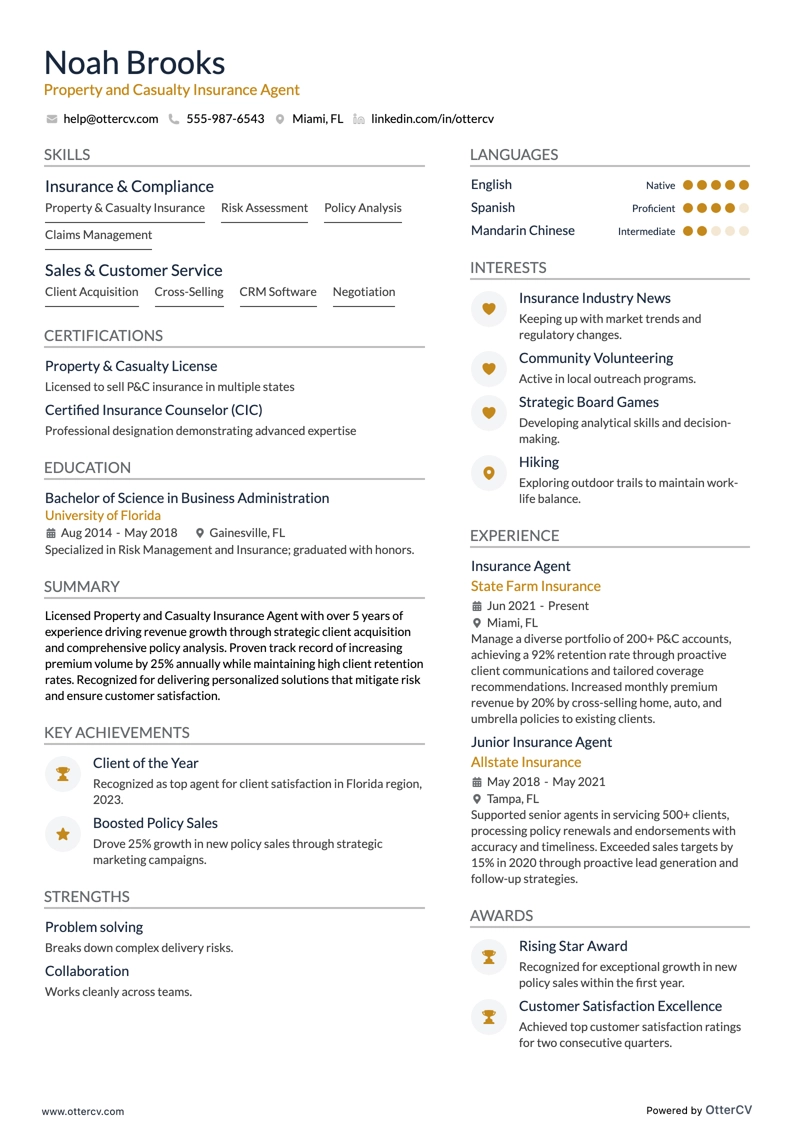
Property and Casualty Insurance Agent resume example

Property and Casualty Insurance Agent

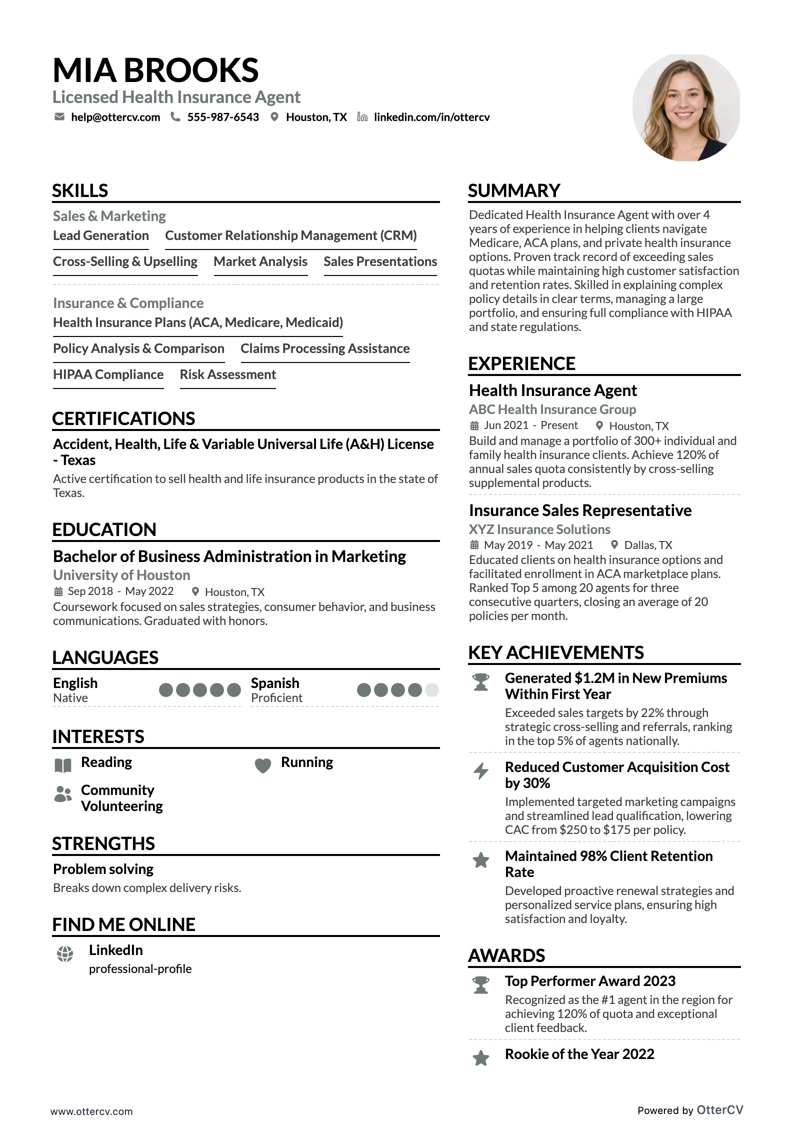
Health Insurance Agent resume example

Health Insurance Agent

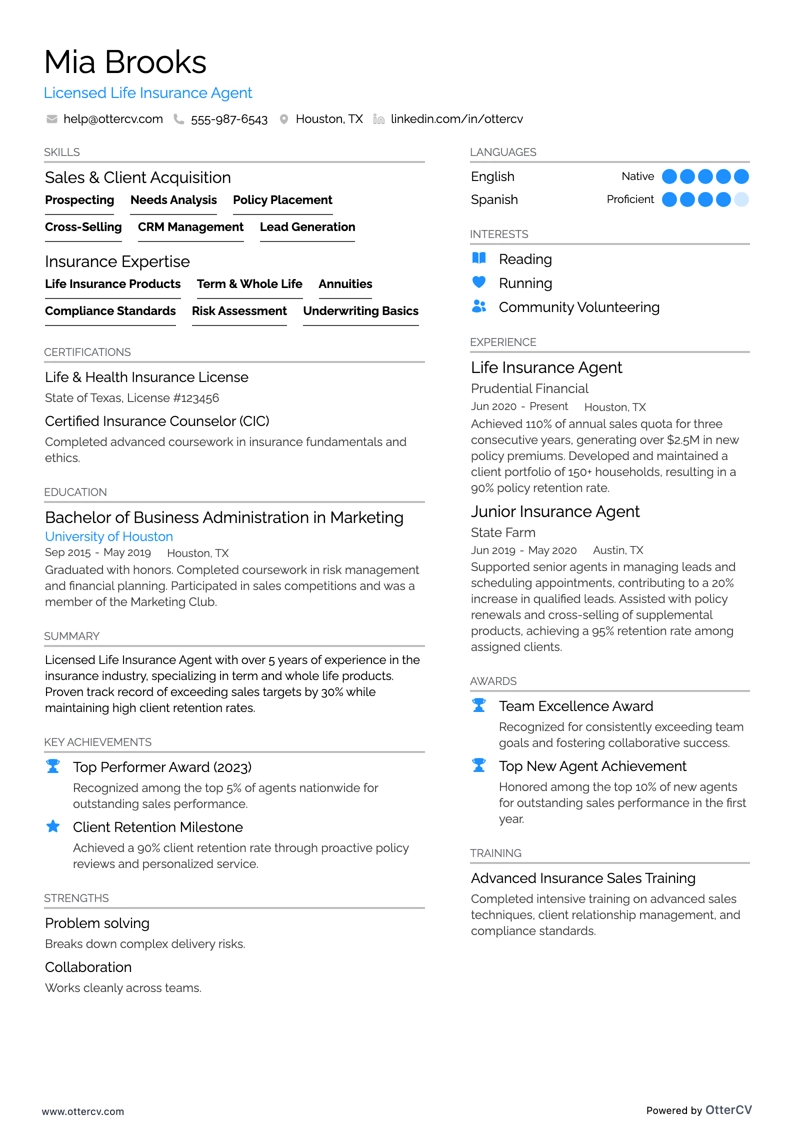
Life Insurance Agent resume example

Life Insurance Agent

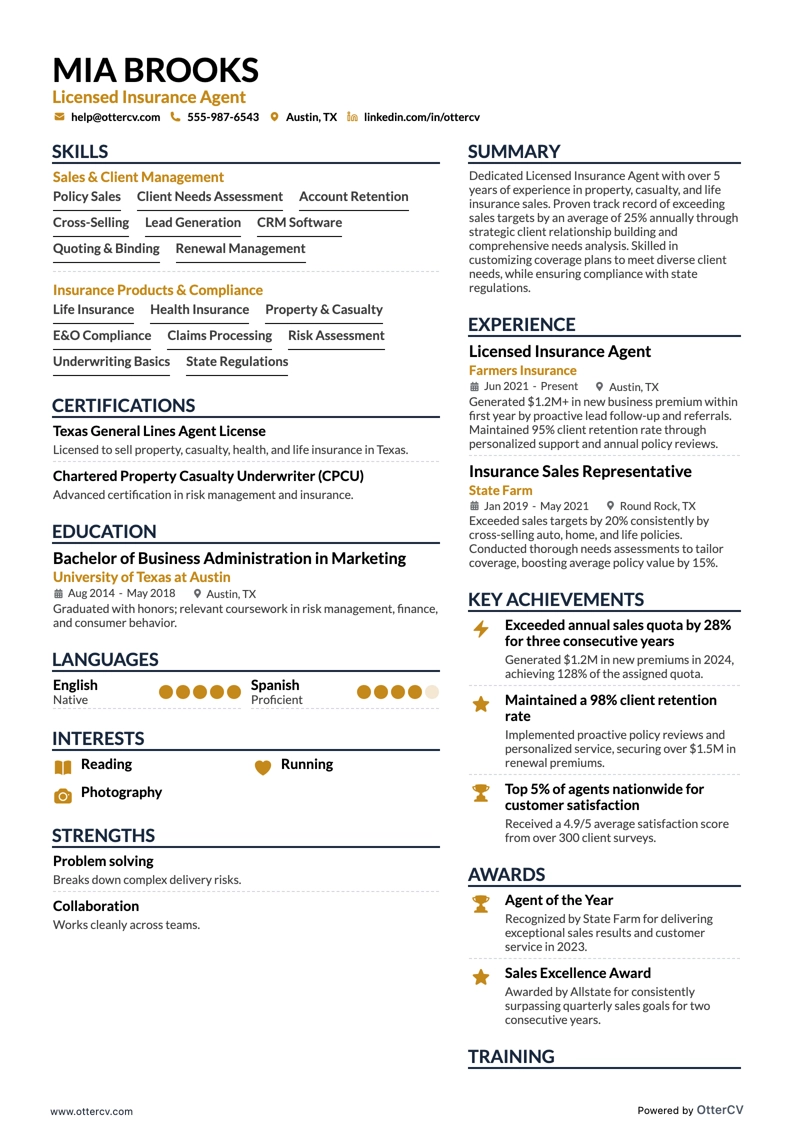
Licensed Insurance Agent resume example

Licensed Insurance Agent

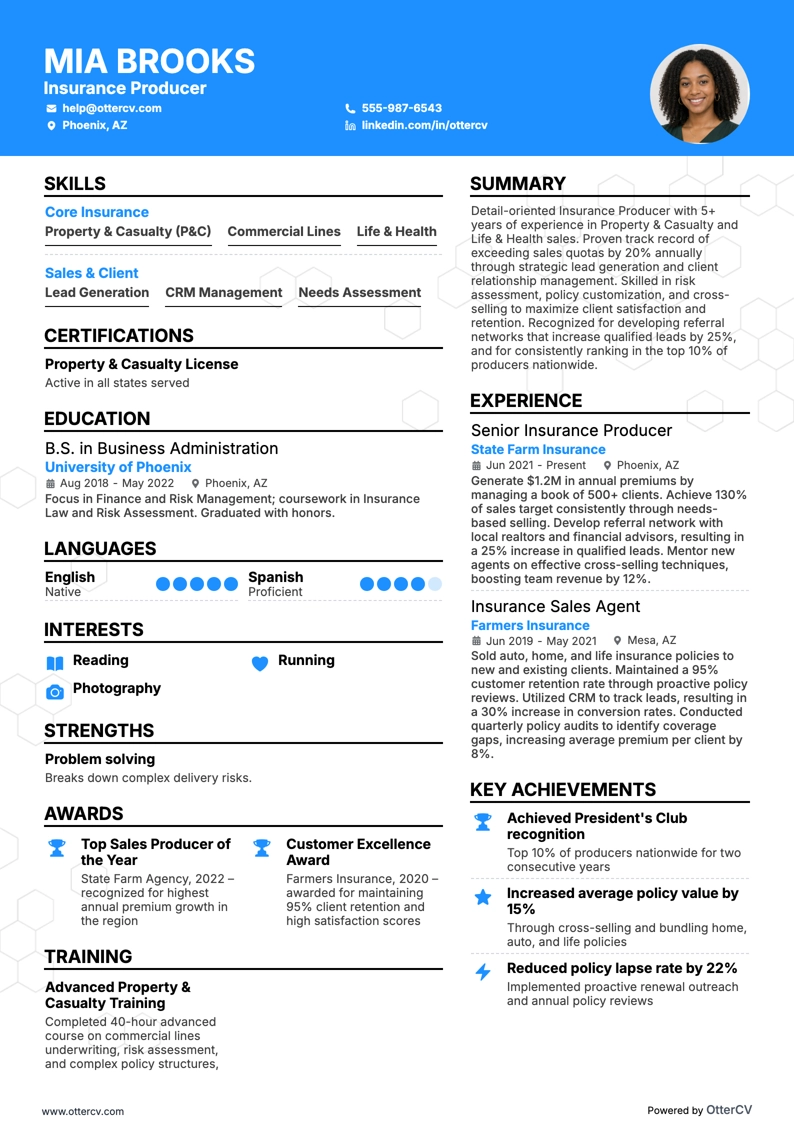
Insurance Producer resume example

Insurance Producer

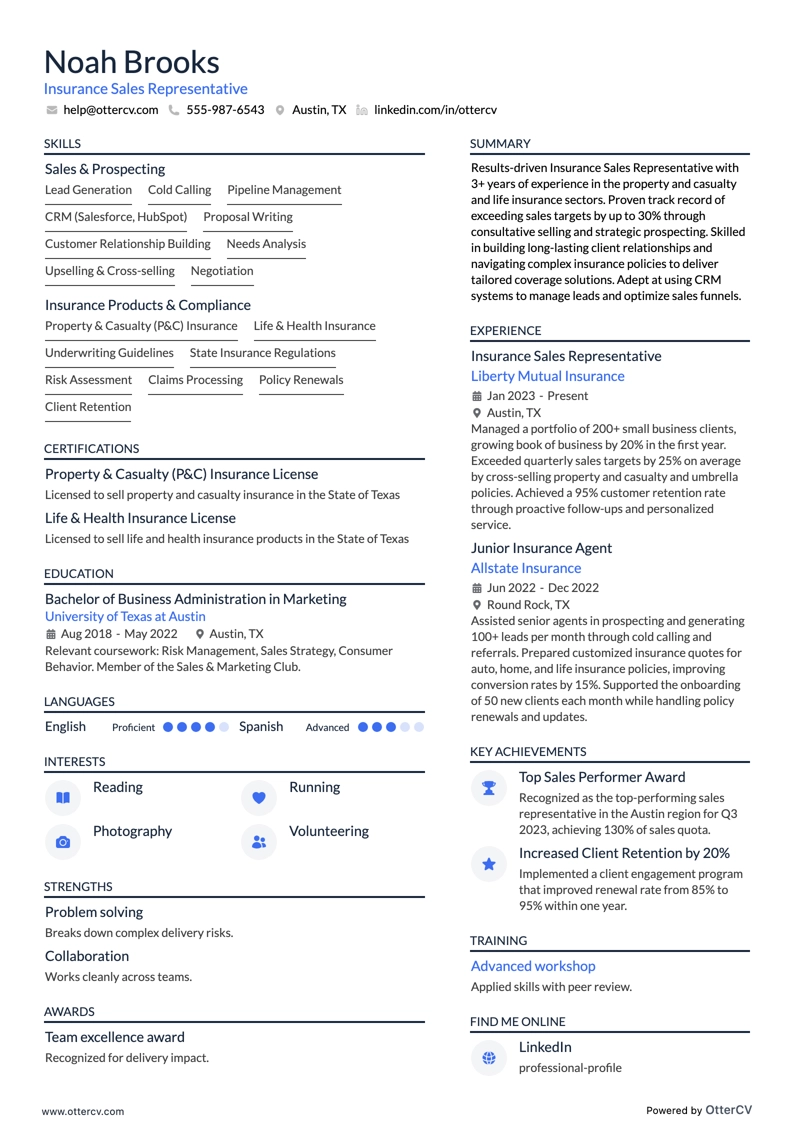
Insurance Sales Representative resume example

Insurance Sales Representative

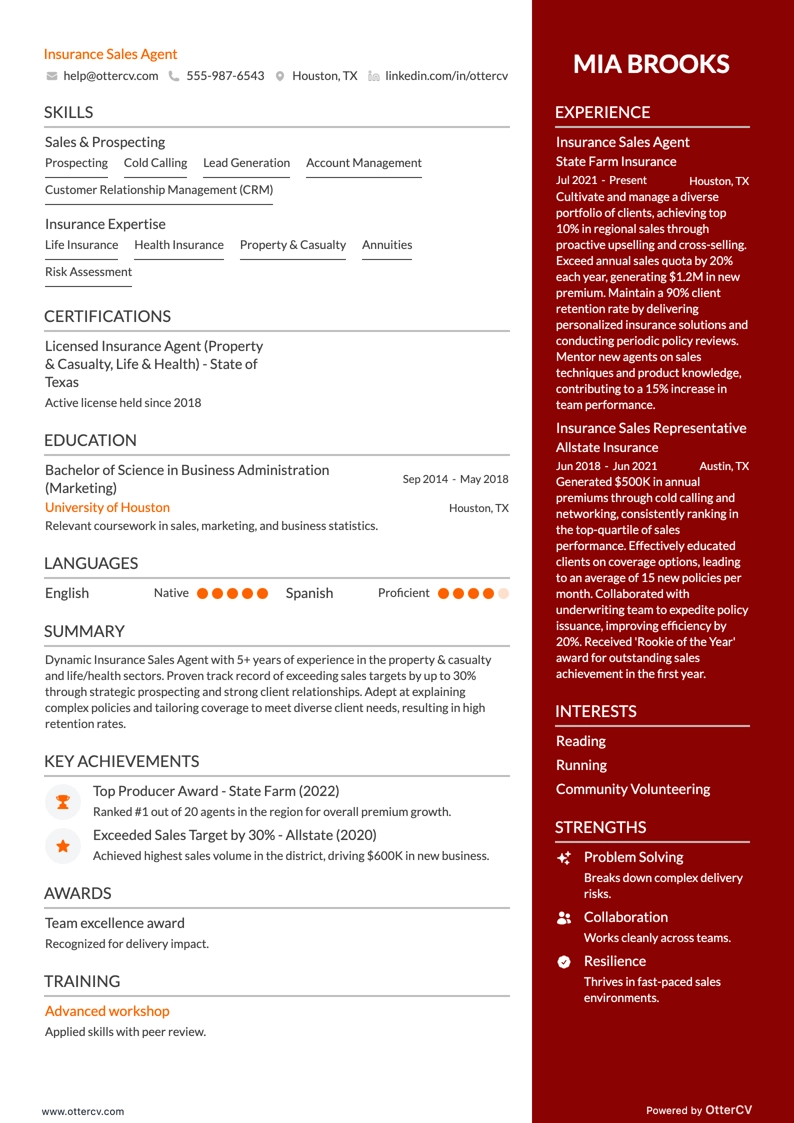
Insurance Sales Agent resume example

Insurance Sales Agent

If you’re enthusiastic about helping people protect their assets and make smart financial decisions, insurance sales can be a strong career choice.

To succeed, you need to show strong risk assessment skills, knowledge of state and federal insurance regulations, and the ability to understand and address client needs. These are the fundamentals of an effective insurance sales resume because they show agencies you have the experience and expertise to bring in new business.

In this guide, we cover:

  • How to choose a resume format that highlights your relevant skills and training.
  • What kind of experience hiring managers look for and how to present it.
  • How to write an insurance sales resume with no prior industry experience.
  • How to select certifications that match the position.
  • How to choose between a resume objective and a summary.
  • How to use the insurance sales resume examples in the article to build a stronger application.

You may also want to review these related guides:

How to format your insurance sales resume

A background in insurance and risk management can lead to many career opportunities. That’s why your resume should clearly show how your career has progressed and how you plan to keep growing professionally.

To do that, choose an appropriate resume format that presents your current insurance expertise effectively. Here are the most suitable formats for this role.

Reverse-chronological resume format

Choose the reverse-chronological resume format if you have at least 5 years of industry experience. Hiring managers generally prefer it because it is the most familiar and easiest format to read.

Use it to show how each past role helped you build the experience and knowledge needed to advance in your career. Keep in mind that this format makes career gaps more noticeable. If you have gaps, add details that explain the gaps, such as professional training or other commitments.

Insurance sales professionals handle sensitive personal information and large budgets, so recruiters want to see that you are trustworthy and that any gaps on your resume are not red flags.

Also, be selective about the roles you include and don’t go back further than 10 years. Insurance regulations and standards change over time, and employers usually want candidates who understand the current landscape.

Hybrid (combination) resume format

If you are changing careers from a related field or have less than 5 years of hands-on experience, consider the hybrid resume format. It lets you emphasize your industry knowledge along with relevant and transferable skills.

Because this format is less common than the traditional one, it can interrupt the usual reading flow for recruiters. Be intentional about which roles, qualifications, and skills you feature, and place the most relevant information near the top of your resume.

Customize your resume for the market. For example, a Canadian format might vary in structure.

Generally, recruiters spend only 6 seconds reviewing a resume before deciding whether it is worth reading further.

Functional resume format

If you have little to no industry experience, choose a functional resume format. This template is especially useful for recent college graduates because it highlights your education and training, particularly if you’re knowledgeable about specific products such as health or property insurance.

Be sure to include any internships you’ve completed. While practical experience is not the main focus of this format, employers still value hands-on exposure, even if it only involved shadowing other professionals.

Resume design tips

Once you’ve chosen a resume format, use these tips to further tailor your insurance sales resume to your target role:

  • Arrange your experience in reverse chronological order: No matter which format you use, start your experience section with your most recent role. Hiring managers prefer candidates to present the current scope of their skills first.
  • Include your credentials in the resume header: Many job seekers treat this section as a place for only their name, occupation, and contact information. You can also add details that help recruiters understand your qualifications more quickly. Since many insurance sales roles require a specific mix of credentials, place them next to your name.
  • Keep your resume under two pages: An effective insurance sales resume is relevant and concise. Aim for a one-page resume, and use two pages only if you have more than 10 years of experience.
  • Apply the agency’s brand colors to your resume: Presentation matters, especially when you need to show financial and regulatory expertise and build trust with clients. When customizing the design of your insurance sales resume, show that you can observe, adapt, and present effectively.
  • Pick a readable serif or sans-serif resume font: You don’t have to rely on Arial or Times New Roman. Google fonts such as Rubik or Lato are compatible with Applicant Tracking System (ATS) software. Just make sure the font fits the overall design of your resume.
  • Preserve your resume design by saving it as a PDF file: Employers value candidates who are meticulous and professional, especially when representing their company. Save your resume in a format that keeps the layout intact after submission.

Next, consider the space you have available and the sections you want to include. Start with the most essential resume sections first.

The top sections on an insurance sales resume

  • Contact information: Include the details recruiters need to contact you.
  • Career objective or summary: Show your sales goals and understanding of the insurance industry.
  • Work experience: Highlight past roles, achievements, and skills relevant to insurance sales.
  • Certifications and licenses: Confirm your professional qualifications, which are especially important in insurance.
  • Skills: Emphasize strengths such as product knowledge, customer service, and negotiation.

Finally, consider how your experience and expertise align with the following key factors:

What recruiters want to see on your resume:

  • Experience in insurance sales shows familiarity with the industry and proven selling techniques.
  • Licensing demonstrates that you meet state regulations and standards for insurance selling.
  • Knowledge of insurance products is essential for effective selling and strong customer service.
  • Communication skills are vital for explaining complex insurance policies clearly to potential and existing clients.
  • Sales target achievement shows a proven ability to meet or exceed goals in previous roles.

Now, let’s look at how to apply the tips above when writing individual resume sections.

How to write your insurance sales resume experience section

The main purpose of the experience section is to show the breadth of your insurance knowledge, regulatory expertise, and skills.

That may sound simple, but many candidates make the mistake of listing every task they handled on the job. While that can show the scope of your responsibilities, achievements are a much more effective way to present your value.

Instead of repeating job duties, focus on the impact of your work. Use your accomplishments to demonstrate your skills without having to name each one directly.

Because every agency has its own process for winning new clients or renegotiating existing policies, read the job description carefully. Note the experience and strengths recruiters want, then make sure your work history and skills section reflect them.

For example, you can describe the size of the portfolio you manage and how you stay responsive to client needs. You can also highlight customer retention tactics by citing the retention rate you have maintained over time.

If you have limited experience, include relevant training you have completed or sales campaigns you have supported.

Create a separate entry for each position you include on your insurance resume. For each one, make sure to:

  • Use the full legal name of your past employer: Insurance and brokerage agencies often operate with sister companies, so names can easily be confused. Double-check for typos so hiring managers identify the correct employer.
  • List your full job title: You may have specialized in certain clients or products, so do not make recruiters guess where your strengths lie. Mention the specific policies you sold or the regulations you know well.
  • Provide a brief company description: Even if the agency is well known, include a short overview of its business operations so hiring managers do not have to research it themselves.
  • Include your employment dates: Listing the month and year is enough. If you still work there, use “Present” as the end date.
  • Mention software, techniques, or skills you used: Where possible, name the insurance sales tools or techniques that helped you achieve results.
  • Name any certificates you earned: Insurance sales professionals are expected to stay current with industry trends and regulatory changes, so include qualifications you obtained while working.
  • Show your career growth: Hiring managers value candidates who can demonstrate professional development and show how they plan to keep growing.
  • Tailor your experience to the job: Align your achievements with the job ad. Employers want to see that you researched the agency’s portfolio and can explain how your background will benefit them over time.

Pay close attention to how you write the accomplishments under each experience entry:

  • Do not include more than 5 bullet points for each role.
  • Start each bullet point with an action verb to emphasize achievement.
  • Use resume keywords from the job ad in your entries where relevant.
  • Avoid resume buzzwords and unnecessary adjectives that decorate your accomplishments without adding value.
  • Use concrete numbers to show the scale of your results.

Let’s look at a bad example first:

Experience

Account Manager

United Health Group

04/2022 - 02/2024 | Atlanta, GA

www.example.com

National insurance provider.

  • Renegotiated existing life insurance policies.
  • Onboarded 8+ new transport and logistics clients.
  • Mentored 5 Insurance Sales Interns.
WRONG

Here is why this sample experience section doesn’t work:

  • The company name is wrong: Insurance and risk management recruiters know the major players in the industry, so they are likely to notice misspelled names and typos. Failing to use the proper legal name suggests a lack of attention to detail.
  • The company description is not informative: Even well-known companies regularly expand and update their services and products. A brief overview of the agency’s current business focus makes the entry more useful.
  • Much of the context in the bullet points is missing: The first bullet point mentions only one job responsibility without showing any results. The second includes a specific accomplishment, but it does not explain how it was achieved.

Taking these points into account, an improved version of the example would be:

Experience

Account Manager (Life Insurance)

UnitedHealth Group

04/2022 - 02/2024 · Atlanta, GA

www.example.com

National provider of health care coverage, data consultancy and software services.

  • Increased 2023 year-over-year revenue by $2.8 million by renegotiating existing life insurance policies and cross-selling critical illness and long-term care insurance policies.
  • Onboarded 8+ new transport and logistics clients, each with more than 5,000 employees, by offering a portfolio of policies and consulting executives.
  • Mentored 5 Insurance Sales Interns in forecasting tools, risk analysis, and client relationship management.
RIGHT

This example is much stronger because the applicant has:

  • Made a comparative analysis of their work: Employers care about the bottom line, so they tend to favor candidates who take a results-oriented approach.
  • Elaborated on the size of their portfolio: This helps show the scope of their responsibilities and the types of clients they usually serve.
  • Shown initiative in guiding other insurance sales specialists: Mentoring interns suggests the employer places deep trust in the candidate’s sales ability and industry knowledge.

How to quantify impact on your resume

Insurance sales is almost always a numbers game. Employers often work with projections because their work directly affects earnings and investor relations.

As a result, hiring managers pay attention to applicants who share specific data to quantify their achievements. Doing so highlights a candidate’s ability to strategize, plan budgets, and forecast results. A skilled insurance sales agent is constantly aware of agency performance and the processes that can be improved.

When listing achievements on your resume, remember to:

  • Show your ability to manage multiple relationships at once—a key part of insurance sales—by including the number of clients you’ve handled.
  • Provide proof of your sales ability by specifying the sales targets you’ve achieved.
  • Demonstrate financial acumen and trustworthiness by mentioning the size of the portfolio you’ve managed.
  • Highlight your selling efficiency by reporting the number of insurance policies you’ve sold.
  • Illustrate service quality by indicating customer retention and satisfaction rates.
  • Show your ability to increase revenue strategically by detailing the percentage of upselling or cross-selling you’ve made.
  • Emphasize business growth by quantifying the number of new clients you’ve brought in.
  • Stress your commitment to continued professional development by stating the number of industry-specific training courses you’ve attended.

Whatever statistics you include on your resume, make sure they comply with any non-disclosure agreements (NDAs) you have signed. You may be handling sensitive information, and employers need to protect their clients’ data privacy.

How do I write an insurance sales resume with no experience

If you’re a recent college graduate trying to create an insurance sales resume with no experience, focus on your professional training, workshop participation, and any other sales roles you’ve held.

Some effective ways to make a strong impression include:

  • Highlight your academic background and qualifications: Emphasize your training to show recruiters that you meet regulatory standards to work as an insurance sales agent and can perform well in the role.
  • Expand on workshops you’ve participated in: Hiring managers value candidates who show initiative and a willingness to grow their industry knowledge and skill set.
  • Showcase your transferable skills: If your work history includes any customer-facing role, include it. Recruiters know that sales abilities like problem-solving, decision-making, and effective communication are often developed through hands-on experience.

That leads to another important part of your resume: showing your sales skills clearly and effectively.

How to list your hard and soft skills on your resume

One of the main goals of an insurance sales resume is to present a balanced view of your abilities. Your experience section will naturally reflect some of your strengths.

The rest can be covered in the skills section, where you can include additional competencies you have not yet mentioned elsewhere on your resume.

It’s also important to tailor your skills section to the job description. Although insurance sales agents need a wide range of abilities, each role may require a different mix of skills and knowledge. You do not need to list every skill you have; the key is choosing the ones that best match the position.

Hard vs soft skills

Skills usually fall into two categories:

  • Insurance sales hard skills: These include your financial, regulatory, and sales knowledge, along with your ability to evaluate, analyze, and use forecasting tools.
  • Insurance sales soft skills: These relate to your ability to build client relationships, present insurance products, and provide informed, ethical financial advice.

Before building your skills section:

  • Review your work history and education section again.
  • Note the skills you have already mentioned.
  • Check the job description for important skills you may not have referenced in other parts of your resume.
  • Add those abilities to your skills section, but avoid overcrowding it with too many skills from the same category. Hiring managers prefer candidates with a well-rounded profile.

Also, avoid listing more than 10 skills at a time. Ultimately, your goal is to align your strengths and expertise with the demands of the offered position. If you still have extra space and are unsure what else to include, here are some suggestions:

Best hard skills for your insurance sales resume

  • Negotiation skills for closing deals and handling objections.
  • Lead generation to build a strong sales pipeline.
  • Knowledge of insurance policies to explain coverage clearly.
  • Client relationship management to support long-term retention.
  • Risk assessment for evaluating customer needs and exposure.
  • Financial reporting to track performance and sales results.
  • Data analysis to identify trends and improve strategy.
  • Microsoft Office suite proficiency for daily sales and reporting tasks.
  • CRM software proficiency to manage leads and customer records.
  • Use of sales forecasting tools to plan targets and revenue.
  • Understanding of underwriting principles to align sales with approval requirements.
  • Knowledge of different insurance products, including Life, Auto, Health, and Property.
  • Sales presentation techniques to communicate product value effectively.
  • Product development knowledge to support insurance solution planning.
  • Familiarity with insurance software used in policy and sales workflows.
  • Compliance with insurance laws and regulations in all sales activities.
  • Budget planning to manage goals and resources effectively.
  • Proficiency in advanced Excel for analysis, reporting, and forecasting.
  • Experience with data visualization tools to present insights clearly.
  • Use of digital marketing tools for sales promotion and lead support.

How to list your certifications and education on your resume

Because sales insurance roles can vary widely, recruiters are often very specific about a candidate’s academic background. This usually comes down to two factors: the products being sold and the customer base the agency serves.

Hiring managers want to confirm that candidates have the foundational knowledge needed for the role. That’s why your education section should clearly present your qualifications, ideally combining a relevant degree with certifications.

Let’s look at each part in turn.

Formal education

If you have a degree in an insurance-related field, do not list your high school diploma. Start with your degree or degrees, then follow with any additional qualifications.

For a single degree entry, use this structure:

  • State the name of your degree and any relevant majors you studied.
  • List the name and location of the academic institution.
  • Include the date you completed the course. If you are still studying, provide the date you expect to graduate.

If you are a recent graduate, you can also include:

While this may seem like a lot of detail, the right framework can keep your education section concise and informative.

Education

BBA Risk Management and Insurance

Mercer University

07/2020 - 04/2023

GPA: 3.65 / 4.0

  • Published a paper on The Importance and Effects of Relationship Building in Client Acquisition and Retention in the International Journal of Commerce and Management.
  • Majored in Principles of Risk Management & Insurance, Risk Assessment Methods, and Theory of Risk.
RIGHT

Certifications

Some recruiters are less focused on whether applicants have a Bachelor’s or Master’s degree, especially for entry-level roles. In those cases, additional professional training can carry more weight.

Listing certifications on your resume shows your professional specialization and your commitment to developing your insurance sales skills. It also helps recruiters decide whether your background matches the candidate profile they need.

When including a certificate on your resume, be sure to:

  • State the qualification you earned.
  • Name the accrediting institution.
  • Include the date you obtained the certificate.
  • Add a one-sentence explanation of how the credential relates to the position, if needed. This is optional, but helpful when the certificate name is not very descriptive.

You can use the following example certificate section for reference:

Certification

Chartered Life Underwriter (CLU)

The American College of Financial Services, 2022

RIGHT

Below are some of the most popular insurance sales certificates:

How to write your insurance sales resume summary or objective

The last essential section of your resume is the resume profile. It should highlight your key sales achievements, career goals, and understanding of the insurance industry in a concise paragraph of no more than 100 words.

Depending on your level of experience, you can choose between two types of resume profiles: the objective and the summary.

The resume objective is best for entry-level insurance sales agents with less than 3 years of experience. It should include:

  • Career goals and aspirations: Since your experience is limited, focus on your professional goals instead of past accomplishments. Make sure they align with the agency’s business plans and mission.
  • Core insurance sales skills: Summarize your main sales skills and explain how they support the agency’s business focus and operations.
  • Value as an insurance sales professional: Tailor your technical and sales abilities to the job description, and use the same phrasing recruiters use in the ad when relevant.

By contrast, the resume summary is better suited to seasoned professionals because it emphasizes your sales track record. It should include:

  • Current professional accomplishments: Highlight your top 1-2 achievements and clearly show the results of your work. Include the names of notable past employers.
  • Additional qualifications and specializations: If you are targeting a senior role, show your understanding of the regulatory insurance landscape by mentioning extra certifications and memberships in relevant associations.
  • Insurance sales focus: Describe your professional specialization, such as in-depth knowledge of the healthcare industry and health insurance products.

To better understand the difference between these two resume profile types, look at a few examples.

Check out the insurance sales resume objective example below:

Objective

RMI graduate with one year of experience at UnitedHealth Group. Skilled in relationship building, client acquisition, and data analysis. Registered Health Underwriter (RHU).

WRONG

Although this paragraph is concise, it depends too heavily on skills to impress recruiters rather than highlighting relevant achievements. It also abbreviates the candidate’s credentials.

Avoid abbreviations in a resume objective, as they can make your experience seem more limited. It is better to write out the full name of the course to prevent any ambiguity.

With these issues in mind, here is how the resume objective could be improved:

Objective

BBA Risk Management and Insurance graduate with one year of experience as an Insurance Sales Agent Intern at UnitedHealth Group. Exceeded the target quota for health insurance sales by 30% by identifying clients' needs and curating insurance options that best addressed them. Registered Health Underwriter (RHU).

RIGHT

Hiring managers now have a clearer understanding of the applicant’s profile because the resume objective highlights their academic background, practical insurance sales experience, and other relevant qualifications.

Next, review the following example of an insurance sales resume summary:

Summary

Insurance Sales Manager with 5 years of experience at UnitedHealth Group. Achieved a YoY revenue increase for 2023 through contract renegotiation and cross-selling life insurance products. LUTCF and RHU.

WRONG

In this case, the applicant misses a chance to highlight more job-relevant hard and soft skills. The resume summary also fails to present the candidate’s full credentials or include the specific details needed to support their claims and make a stronger impression on recruiters.

An improved version of the resume summary would be:

Summary

Insurance Sales Manager with 5 years of experience in client acquisition strategy, risk analysis, budget planning, and forecasting. As an Account Manager at UnitedHealth Group, achieved a year-over-year revenue increase of $2.8 million through contract renegotiation and cross-selling life insurance products. Certified Life Underwriter Training Council Fellow (LUTCF) and Registered Health Underwriter (RHU).

RIGHT

By correcting the issues in the previous sample, hiring managers can see that the applicant has a broad skill set and can leverage existing business relationships. It also shows that the candidate has experience navigating complex financial and insurance projects.

Additional sections for an insurance sales resume

  • Relevant association memberships: Membership in an industry organization shows that you have a strong professional network of insurance sales specialists you can consult and rely on.

  • Awards and prizes you’ve received: Professional recognition helps you stand out. Even if an award was given to your former team, include it to show your ability to collaborate and work effectively with other sales specialists toward a shared goal.

  • Publications you’ve authored : For senior roles, employers may want to see your perspective on the insurance industry and your ability to anticipate sales trends, especially if the position involves publicly representing the agency.

  • Foreign languages : Depending on the employer’s customer base, language skills can help bring in new business and strengthen existing client relationships.

  • Select a resume format based on your level of expertise and years of experience.

  • Organize your work history in reverse chronological order, regardless of the layout you choose.

  • Include your professional credentials next to your name in the resume header.

  • Choose a resume design and colors that convey trustworthiness and confidence in your abilities as an insurance sales specialist.

  • Use the resume objective or summary to highlight your achievements and core insurance sales skills.

  • Tailor your experience entries to the job ad requirements and the agency’s business goals.

  • Quantify your achievements, while still honoring any NDAs you have signed.

  • Present a balanced mix of hard and soft insurance sales skills.

  • Prioritize professional training and qualifications over a high school diploma if you do not have a Bachelor’s or Master’s degree in an insurance-related field.

Insurance Sales resume examples

Explore additional Insurance Sales resume samples and guides and see what works for your level of experience or role.

By Experience

Senior Insurance Sales Agent

Senior Insurance Sales Agent resume preview

Insurance Sales resume examples

Explore additional Insurance Sales resume samples and guides and see what works for your level of experience or role.

By Role

Independent Insurance Agent

Independent Insurance Agent resume preview

Medicare Sales Agent

Medicare Sales Agent resume preview

Personal Lines Insurance Agent

Personal Lines Insurance Agent resume preview

Commercial Insurance Producer

Commercial Insurance Producer resume preview

Property and Casualty Insurance Agent

Property and Casualty Insurance Agent resume preview

Health Insurance Agent

Health Insurance Agent resume preview

Life Insurance Agent

Life Insurance Agent resume preview

Licensed Insurance Agent

Licensed Insurance Agent resume preview

Insurance Producer

Insurance Producer resume preview

Insurance Sales Representative

Insurance Sales Representative resume preview

Insurance Sales Agent

Insurance Sales Agent resume preview