Lead HR Analyst full preview

10 HR Analyst Resume Examples

OtterCV

Written by The OtterCV Team

Updated: 6/11/2023•8 min read

See all resume examples in this guide, or generate your own resume example with your personalized prompt

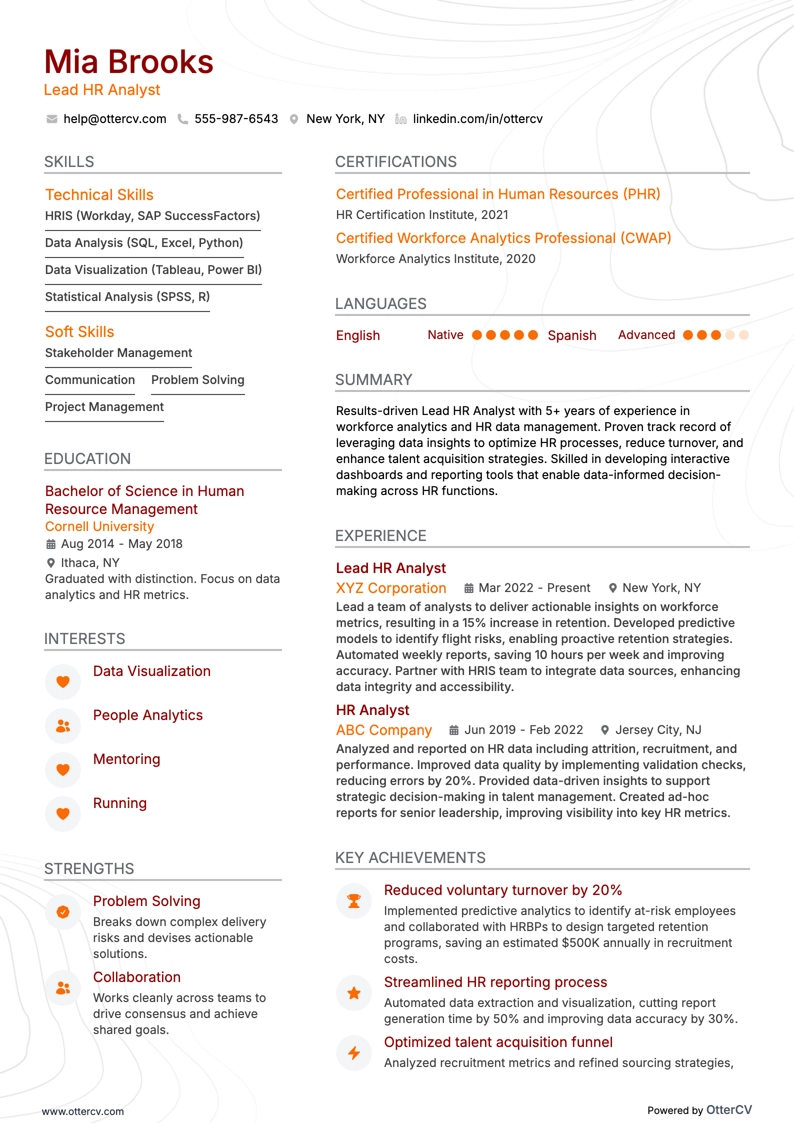
Lead HR Analyst resume example

Lead HR Analyst

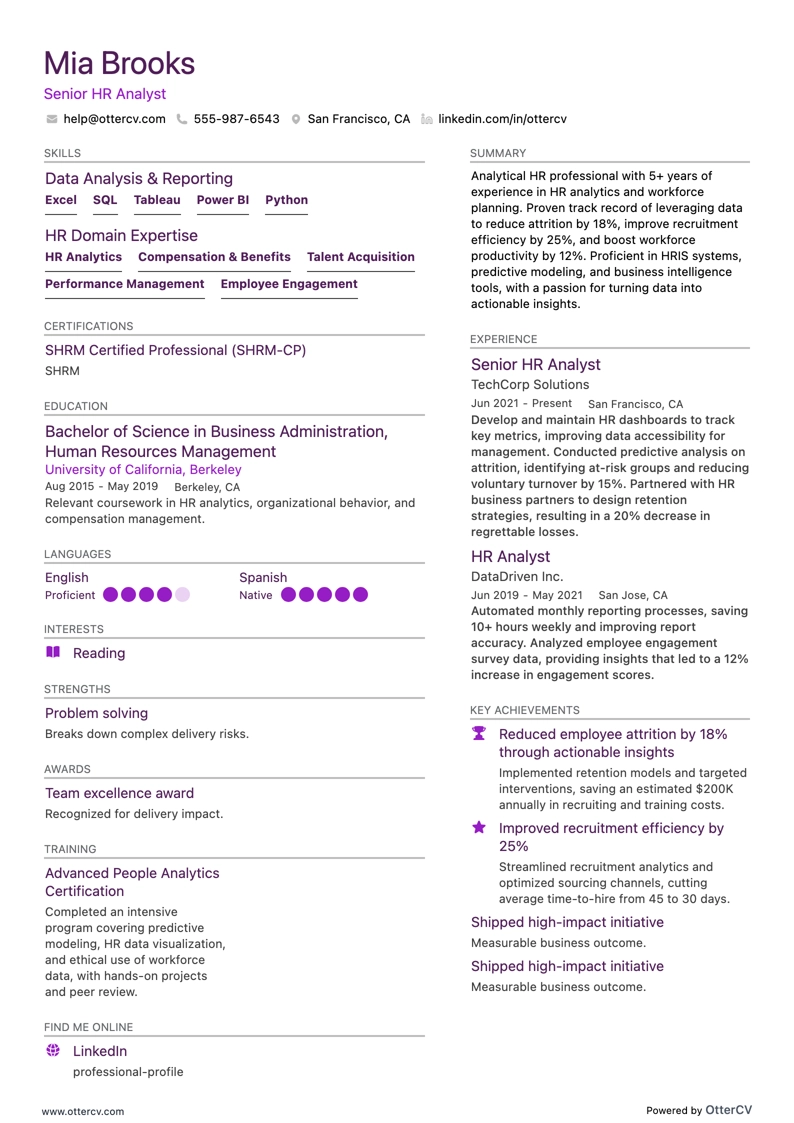
Senior HR Analyst resume example

Senior HR Analyst

Junior HR Analyst resume example

Junior HR Analyst

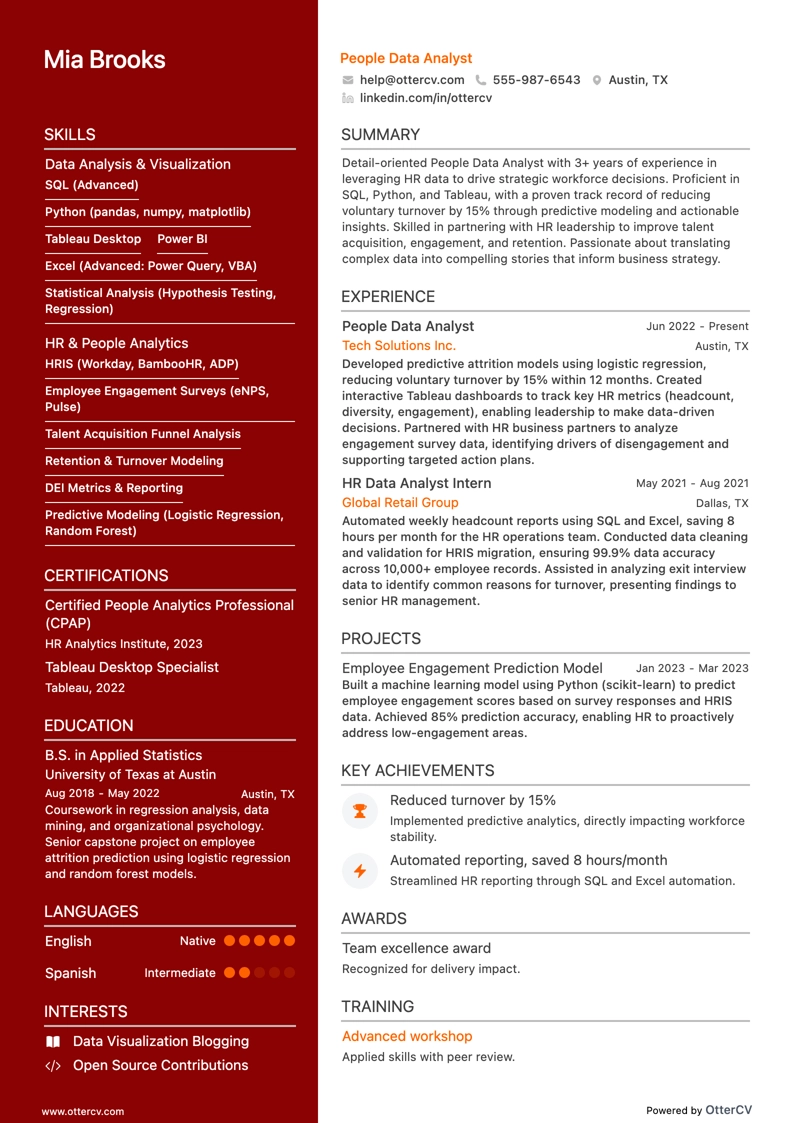
People Data Analyst resume example

People Data Analyst

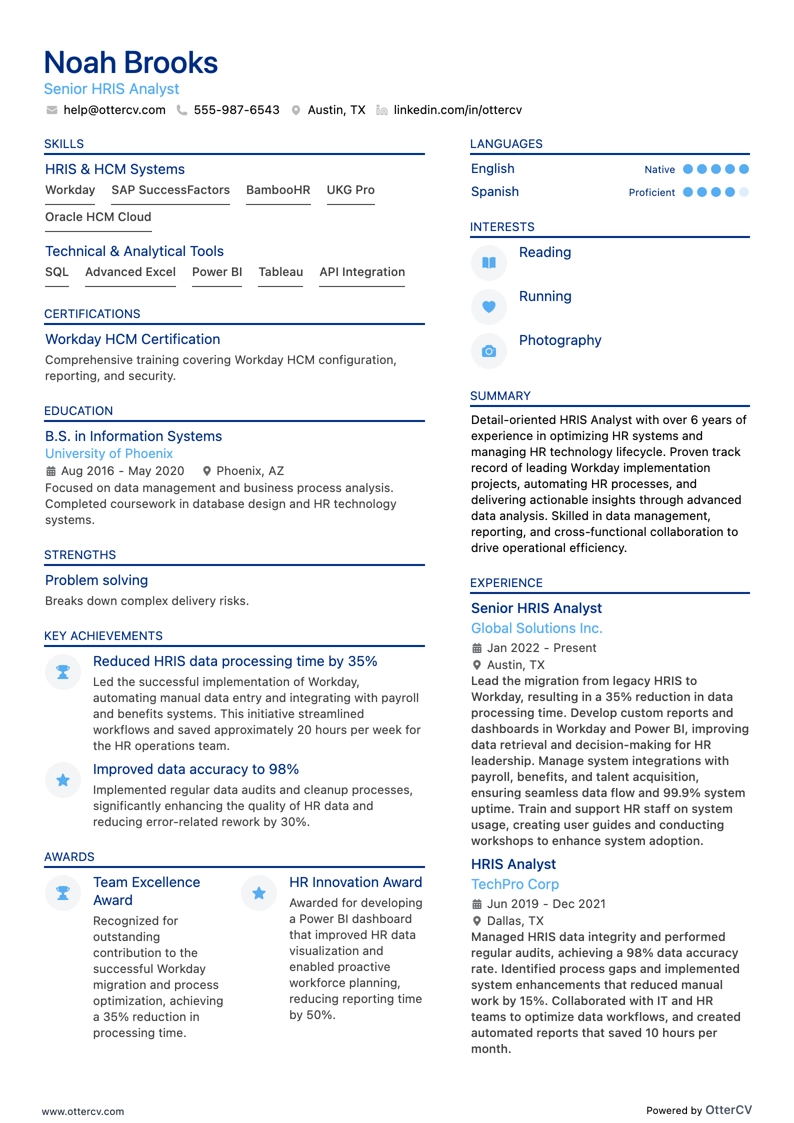
HRIS Analyst resume example

HRIS Analyst

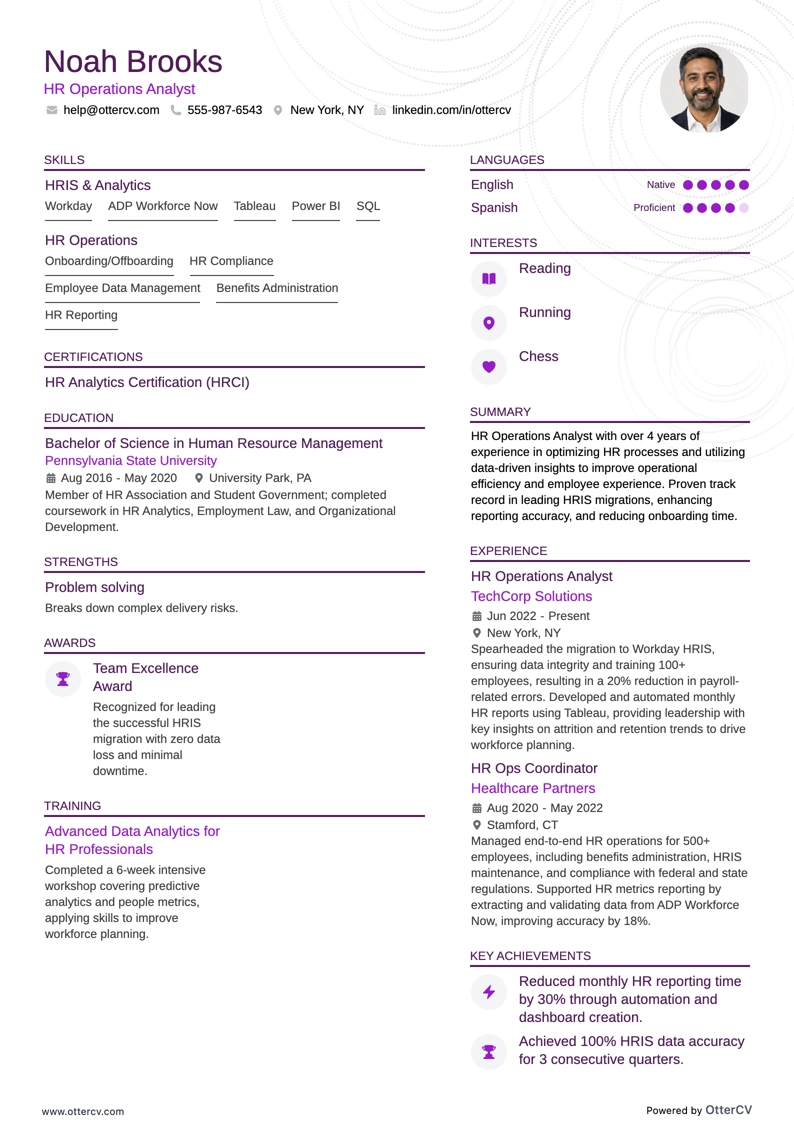
HR Operations Analyst resume example

HR Operations Analyst

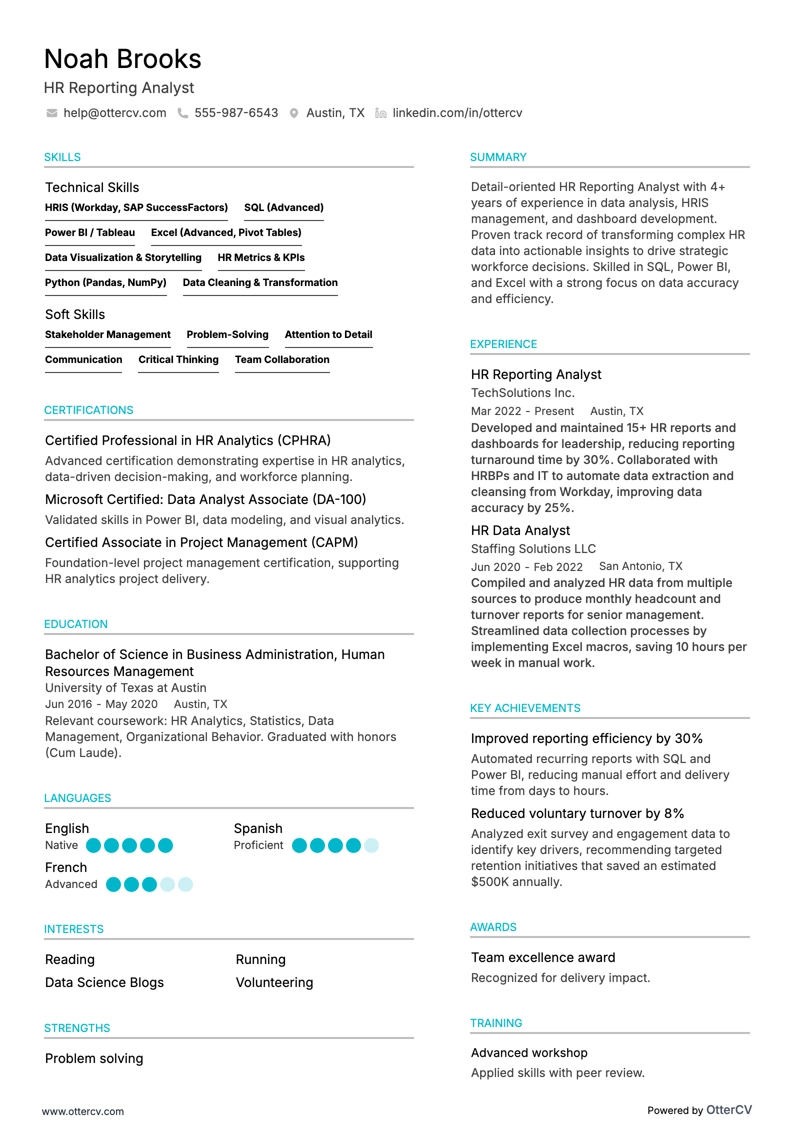
HR Reporting Analyst resume example

HR Reporting Analyst

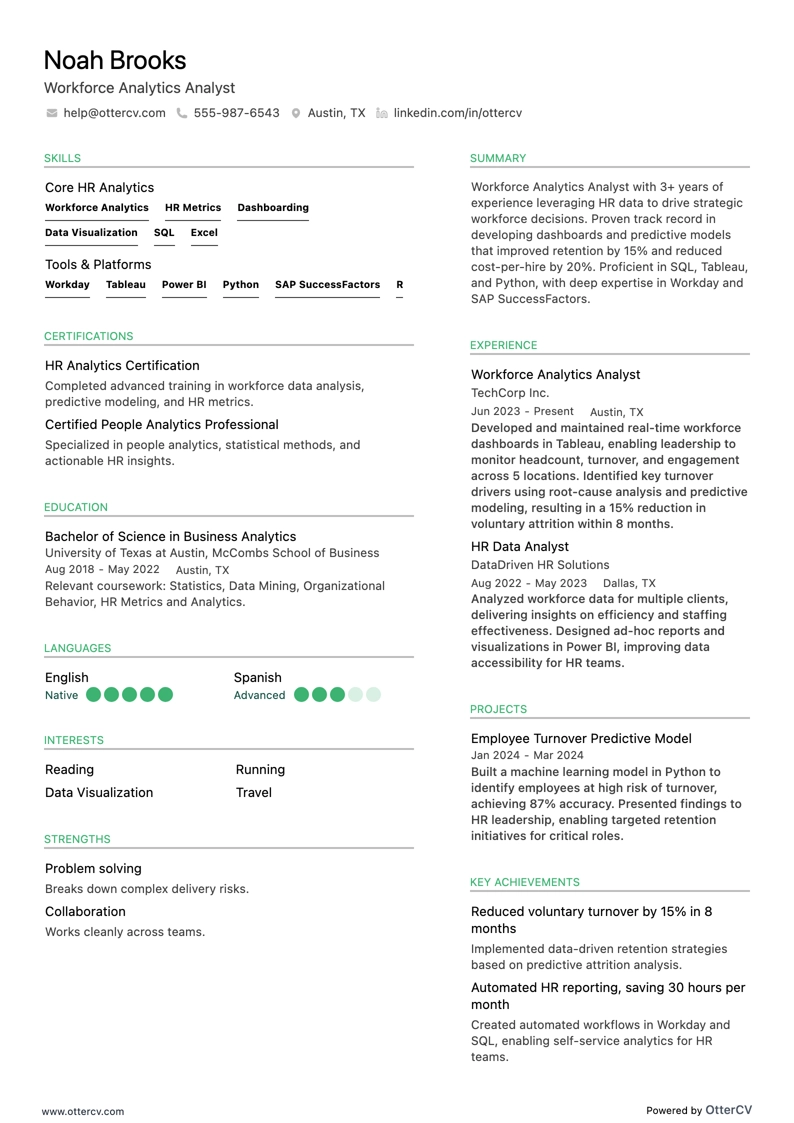
Workforce Analytics Analyst resume example

Workforce Analytics Analyst

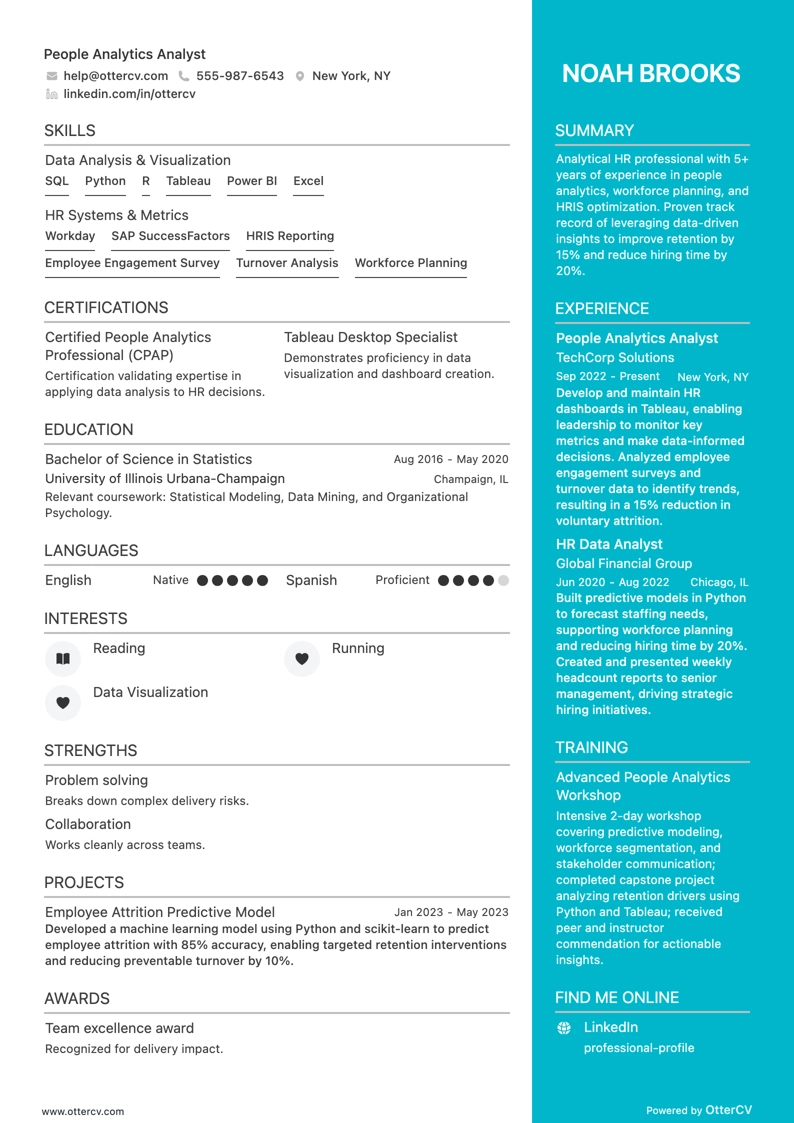
People Analytics Analyst resume example

People Analytics Analyst

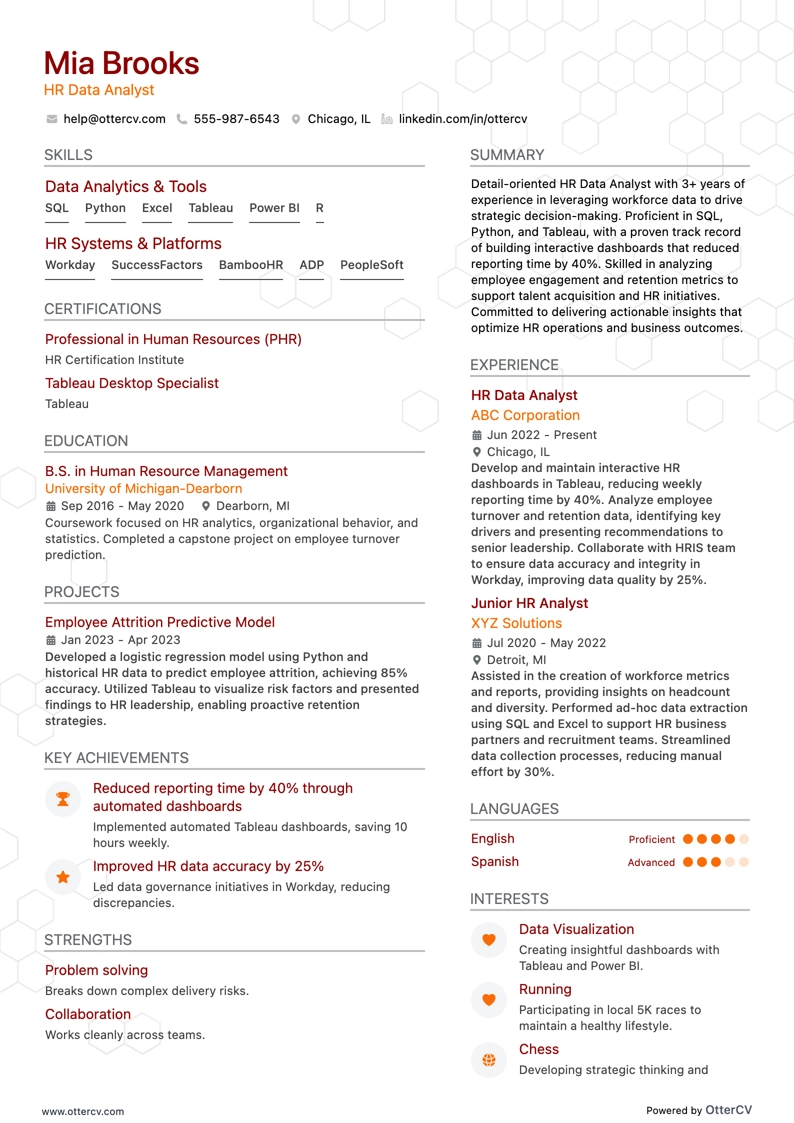
HR Data Analyst resume example

HR Data Analyst

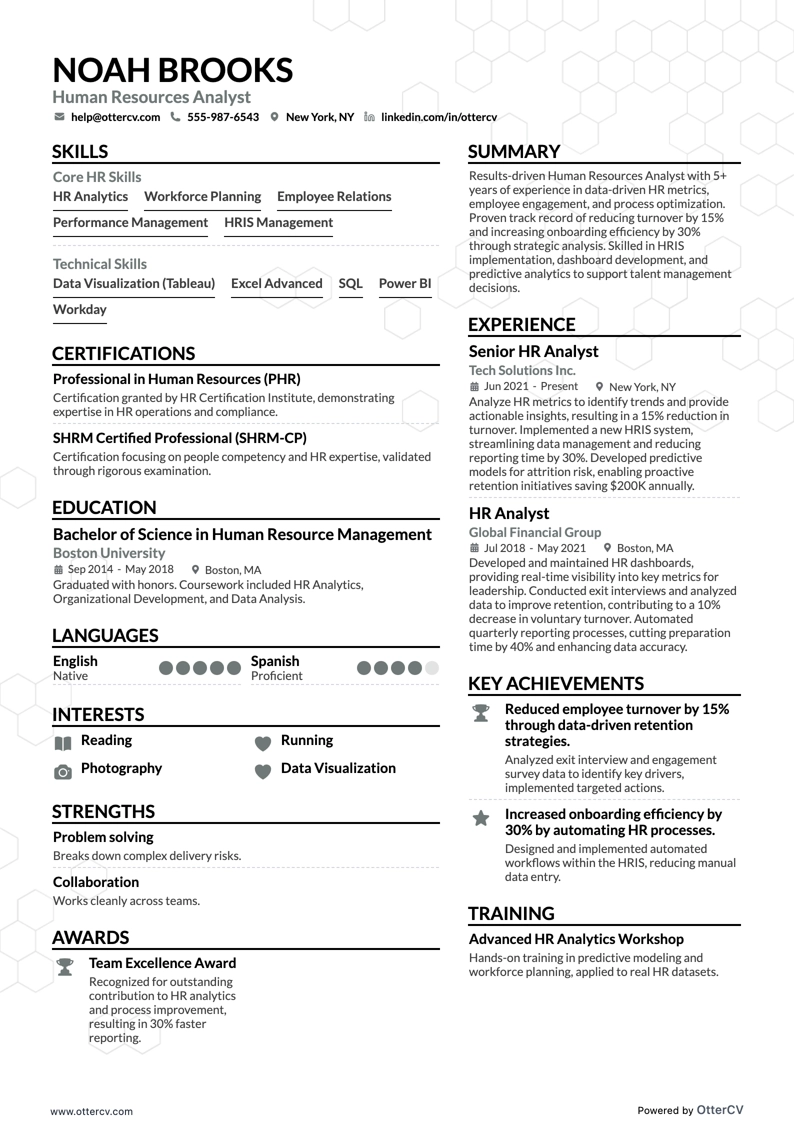
Human Resources Analyst resume example

Human Resources Analyst

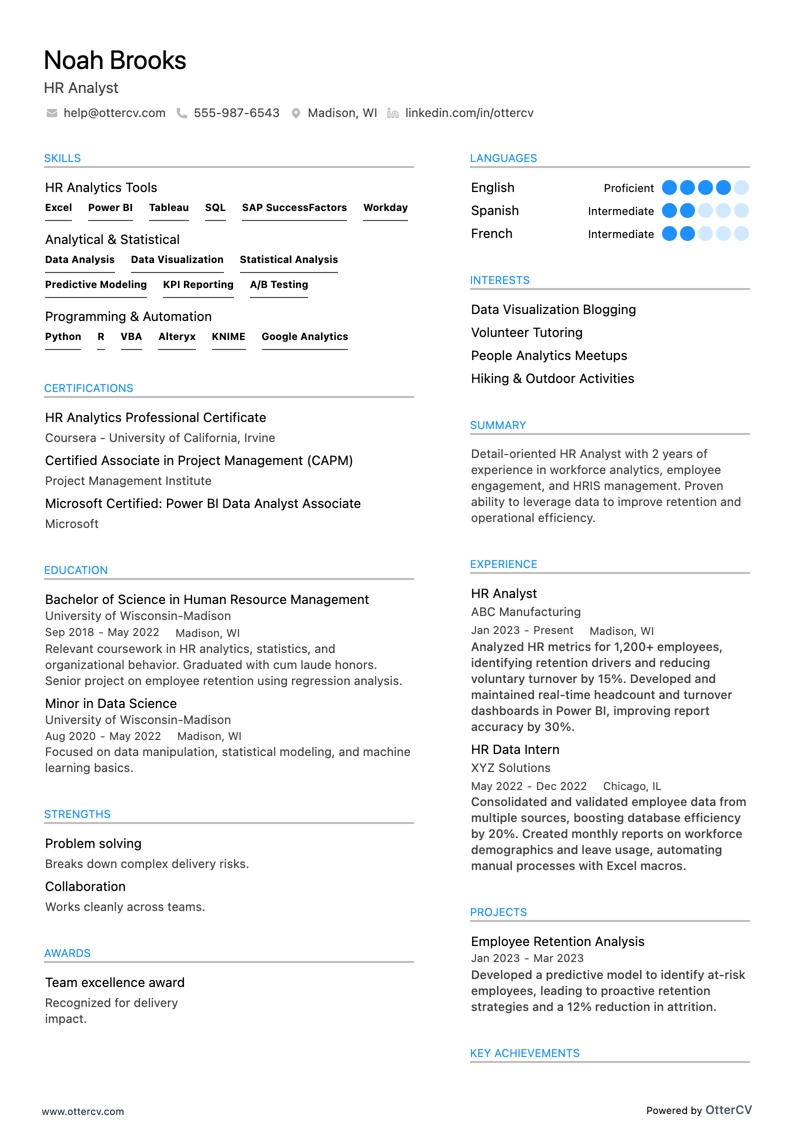
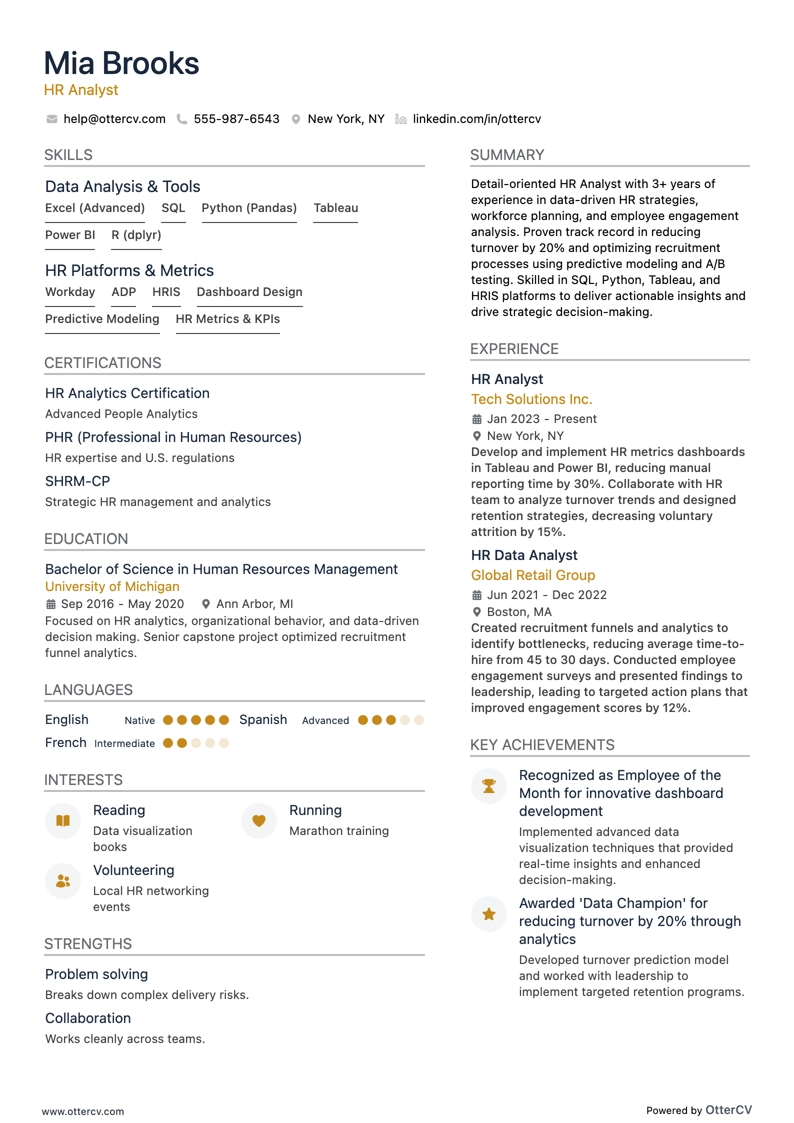
HR Analyst resume example

HR Analyst

Most HR analyst resumes fall short because they list tasks and systems without showing measurable impact or decision support. As a result, they blend in during ATS screening, quick recruiter reviews, and competitive hiring processes.

A strong HR analyst resume shows what changed because of your work, not just what you used or touched. If you want to understand how to make your resume stand out, focus on results such as improved time-to-fill, lower turnover, higher data accuracy, cleaner dashboards, faster reporting cycles, and stakeholder adoption across regions or business units.

Key takeaways

  • Quantify achievements with metrics such as turnover reduction, time-to-fill, and cost savings.

  • Tailor each resume to the job posting’s tools, KPIs, and terminology.

  • Use a reverse-chronological format for experienced analysts and a hybrid format for career changers.

  • Show skills through outcome-driven experience bullets instead of standalone skills lists.

  • Include certifications such as SHRM-CP or PHR to strengthen credibility with hiring managers.

  • Write a three- to four-line summary that highlights your domain, tools, and measurable wins.

  • Use Echocv to refine bullet points and align your resume with HR analyst job descriptions.

How to format a HR analyst resume

Recruiters reviewing HR analyst resumes look for clear evidence of data-driven decision-making, proficiency with HRIS platforms and people analytics tools, and the ability to turn workforce data into actionable business recommendations. A clean, well-structured resume format helps these strengths stand out quickly in both automated screening and manual review.

I have significant experience in this role—which format should I use?

I have significant experience in this role—which format should I use?

Use a reverse-chronological format to present your strongest and most relevant HR analytics experience first.

  • Start with your most recent role and clearly define your scope, including team size, business units supported, and decision-making authority over workforce planning or compensation analysis.
  • Highlight proficiency with role-specific tools and domains such as Workday, SAP SuccessFactors, Tableau, Power BI, predictive attrition modeling, and compliance reporting.
  • Quantify results tied to business impact, such as cost savings from benefits optimization, reductions in turnover, or improvements in time-to-fill driven by your analysis.

Example bullet:

  • Designed and automated a quarterly turnover forecasting model in Power BI across four business units, reducing reactive hiring spend by 18% and improving workforce planning accuracy by 23% year over year.

I'm junior or switching into this role—what format works best?

I'm junior or switching into this role—what format works best?

A hybrid resume format works best. It lets you lead with core HR analytics skills while backing them up with relevant experience, internships, or projects.

  • Place a skills section near the top that highlights technical competencies recruiters expect for this role, such as Excel (pivot tables, VLOOKUP), HRIS platforms, SQL, and data visualization tools.
  • Include academic projects, HR internships, or cross-functional work that shows hands-on experience with workforce data, such as building a dashboard for employee engagement survey results or analyzing compensation benchmarks.
  • Write each bullet with a clear action-to-result structure so recruiters can see how your analytical work led to a measurable or meaningful outcome.

Example scaffold:

  • SQL proficiency → queried and cleaned three years of employee demographic data from an HRIS database → produced a diversity metrics report that informed the team's revised hiring strategy.

Why not use a functional resume?

Why not use a functional resume?

A functional resume removes the timeline and context recruiters need to understand how you applied your HR analytics skills in real work settings. That makes it harder for both hiring managers and applicant tracking systems to evaluate your candidacy. Avoid this format unless you have no other clear way to present your qualifications.

  • A functional resume may be acceptable if you are changing careers into HR analytics from a related field, such as data analysis, finance, or operations, and have minimal direct HR experience. Even then, each skill should be tied to a specific project, deliverable, or outcome rather than listed in isolation.

Once you have a clean, professional resume format, the next step is choosing sections that reinforce your qualifications.

What sections should go on a HR analyst resume

Recruiters expect a focused, role-relevant resume that highlights your HR data analysis, reporting, and business impact. Understanding which resume sections to include helps you present your qualifications with maximum clarity.

Use this structure:

  • Header
  • Summary
  • Experience
  • Skills
  • Projects
  • Education
  • Certifications
  • Optional sections: Awards, Publications, Languages

Strong experience bullets should emphasize measurable impact, business outcomes, and the scope of the HR metrics, dashboards, and process improvements you delivered.

Now that you’ve organized the key parts of your resume, focus on writing your HR analyst experience so your work history reinforces the rest of the document.

How to write your HR analyst resume experience

Your experience section should show that you can deliver measurable results as an HR analyst, not just list day-to-day duties. Hiring managers look for clear impact through workforce analytics, HRIS platforms, compensation modeling, and data-driven recommendations rather than generic responsibility statements.

Each entry should include:

  • Job title
  • Company and location (or remote)
  • Dates of employment (month and year)

Add three to five concise bullet points that explain what you owned, how you executed the work, and what outcomes you delivered:

  • Ownership scope: the HR programs, HRIS platforms, employee datasets, reporting dashboards, or workforce segments you were directly responsible for.
  • Execution approach: the analytics tools, survey instruments, statistical methods, compliance frameworks, or HR technologies you used to gather insights and support decisions.
  • Value improved: changes to hiring efficiency, employee retention, pay equity, compliance accuracy, reporting speed, or workforce planning reliability that resulted from your work.
  • Collaboration context: how you worked with talent acquisition, compensation, legal, department leaders, or external vendors to align HR data with organizational priorities.
  • Impact delivered: outcomes such as reduced turnover, improved engagement scores, faster time-to-fill, cost savings, audit readiness, or stronger workforce forecasting, expressed as results rather than activities.

Experience bullet formula

Experience bullet formula

Action verb + technology + what you built or fixed + measurable result

A HR analyst experience example

HR Analyst

BrightWave Logistics | Austin, TX

2022–Present

Third-party logistics provider supporting five hundred employees across six sites in the Southwest.

  • Automated monthly headcount, turnover, and time-to-fill dashboards in Workday and Power BI, cutting reporting time by 70% and improving data accuracy from 92% to 98%.
  • Built an attrition model in Python and SQL using three years of human resources information system and engagement data, identifying two high-risk segments and reducing voluntary turnover by 12% within two quarters.
  • Standardized recruiting funnel metrics in Greenhouse and Excel in partnership with talent acquisition and hiring managers, removing bottlenecks and reducing time-to-hire from forty-six to thirty-four days.
  • Reconciled payroll and benefits eligibility between ADP Workforce Now and Workday through weekly audits, resolving one hundred twenty discrepancies per quarter and reducing payroll adjustments by 35%.
  • Led quarterly compensation and equity analyses using Radford benchmarks and Workday, partnering with finance and HR business partners to remediate pay gaps and lower out-of-band offers by 18%.

Now that you've seen what a strong experience section looks like, the next step is adjusting those details to fit a specific job posting.

How to tailor your HR analyst resume experience

Recruiters review your HR analyst resume both manually and through applicant tracking systems (ATS) that scan for relevant qualifications. Tailoring your resume to the job description helps your strongest qualifications stand out right away.

Ways to tailor your HR analyst experience:

  • Match the HRIS platforms and analytics tools named in the job description.
  • Use the same terminology for HR processes and standards.
  • Reflect the specific KPIs or workforce metrics the posting emphasizes.
  • Highlight compliance and regulatory experience when the role requires it.
  • Include industry or sector experience that aligns with the employer.
  • Emphasize data visualization or reporting methods mentioned in the posting.
  • Align your collaboration language with the cross-functional workflows described.
  • Include relevant compensation or benefits analysis if the role calls for it.

Tailoring means matching your real accomplishments to what the employer is asking for, not forcing in keywords where they don't belong.

Resume tailoring examples for HR analyst

Job description excerptUntailoredTailored
Analyze workforce data using SAP SuccessFactors and Tableau to identify trends in employee turnover and retention across business units.Helped with data analysis projects for the HR department.Analyzed employee turnover and retention trends across five business units using SAP SuccessFactors and Tableau, identifying patterns that informed a 12% improvement in first-year retention.
Develop and maintain HR compliance reports, ensuring alignment with federal EEO and FLSA regulations, and present findings to senior leadership quarterly.Prepared reports and shared them with management on a regular basis.Developed quarterly EEO and FLSA compliance reports for senior leadership, tracked 15 regulatory metrics, and flagged two policy gaps that reduced audit findings by 30%.
Partner with talent acquisition to build predictive hiring models using Excel and Power BI, reducing average time-to-fill for critical roles.Worked with other teams to support hiring and recruiting efforts.Built predictive hiring models in Excel and Power BI with talent acquisition, reducing average time-to-fill for critical roles from 58 to 41 days over two hiring cycles.

Once you’ve aligned your experience with the role’s priorities, quantify your HR analyst achievements to show the measurable impact of that work.

How to quantify your HR analyst achievements

Quantifying your work shows business impact beyond listing tasks. For HR analysts, focus on metrics such as cycle time, data accuracy, compliance risk reduction, cost savings, and employee outcomes like retention and satisfaction.

Quantifying examples for HR analyst

MetricExample
Cycle timeCut time-to-fill from 52 to 39 days by rebuilding weekly pipeline reporting in Workday and Excel for 18 requisitions.
Data accuracyReduced payroll data errors by 31% by adding validation rules and exception dashboards in Excel and Power BI for 1,200 employees.
Compliance riskImproved I-9 audit pass rate from 92% to 99% by standardizing document tracking and running monthly audits in SharePoint.
Cost savingsSaved $48,000 annually by consolidating three HR vendor reports into one automated Power BI dataset and retiring duplicate licenses.
RetentionLowered first-year attrition from 18% to 14% by analyzing exit and onboarding surveys and recommending manager coaching for five teams.

With strong, tailored bullet points in place, the next step is making sure your skills section shows the right mix of hard and soft skills for an HR analyst role.

How to list your hard and soft skills on a HR analyst resume

Your skills section matters because HR analysts turn people data into decisions, and recruiters and ATS often scan this section first to confirm you match the role quickly. Aim for a strong hard-skill foundation, supported by a smaller set of job-specific soft skills.

HR analyst roles require a blend of:

  • Product strategy and discovery skills.
  • Data, analytics, and experimentation skills.
  • Delivery, execution, and go-to-market discipline.
  • Soft skills.

Your skills section should be:

  • Scannable, with bullet-style grouping.
  • Relevant to the job post.
  • Backed by proof in your experience bullets.
  • Updated with current tools.

Place your skills section:

  • Above your experience if you're junior or switching careers.
  • Below your experience if you're mid/senior with strong achievements.

Hard skills

  • HRIS administration using Workday, UKG, and ADP.
  • Advanced Excel, including PivotTables and Power Query.
  • SQL reporting and queries.
  • Power BI dashboard creation.
  • Tableau reporting.
  • People analytics and KPI design.
  • Compensation benchmarking.
  • Job architecture and leveling.
  • Headcount, turnover, and attrition analysis.
  • Survey tools, including Qualtrics and Culture Amp.
  • Data governance and HR data privacy.
  • ATS (applicant tracking system) reporting.

Soft skills

  • Translate data into HR actions.
  • Ask precise stakeholder questions.
  • Present insights to nontechnical teams.
  • Write clear metric definitions.
  • Challenge assumptions with evidence.
  • Prioritize requests by impact.
  • Manage competing deadlines.
  • Partner with HR, finance, and legal.
  • Handle sensitive employee data.
  • Document processes for reuse.
  • Drive alignment on next steps.
  • Follow through on deliverables.

How to show your HR analyst skills in context

Your skills should not appear only in a dedicated skills section. Explore resume skills examples to see how analysts present their competencies effectively.

Show those skills in:

  • Your summary (high-level professional identity)
  • Your experience (proof through outcomes)

Here’s what that looks like in practice.

HR analyst with eight years of experience in healthcare workforce planning. Skilled in Workday, predictive attrition modeling, and labor cost analysis. Reduced annual turnover by 18% through data-driven retention strategies and cross-functional stakeholder collaboration.

  • Clearly signals senior-level experience
  • Names specific, relevant tools
  • Leads with a measurable outcome
  • Highlights collaboration as a strength

Experience example

Senior HR Analyst

Meridian Health Partners | Remote

June 2019–Present

  • Built predictive turnover dashboards in Tableau, helping leadership reduce nursing attrition by 22% over two years.
  • Partnered with finance and department heads to redesign compensation bands, improving offer acceptance rates by 15%.
  • Automated monthly headcount reporting using Power BI and SQL, saving the HR team roughly 12 hours per cycle.
  • Every bullet includes measurable proof.
  • Skills surface naturally through achievements.

Once you’ve shown your HR analyst skills through relevant examples and results, the next step is using that same approach to structure your resume when you do not yet have formal experience.

How do I write a HR analyst resume with no experience

Even without full-time experience, you can still show readiness through:

  • HR analytics course capstone project
  • Internship supporting HR reporting
  • Volunteer staffing and onboarding tracking
  • Campus job in an HR office
  • Data cleanup for employee records
  • Survey analysis for engagement results
  • HRIS sandbox practice and exercises
  • Case competitions using HR metrics

Our guide on building a resume without work experience covers more strategies for showcasing your qualifications.

Focus on:

  • HR data accuracy and validation
  • HR reporting in Excel dashboards
  • HRIS exposure and data workflows
  • Metrics tied to business outcomes

Resume format tip for entry-level HR analyst

Resume format tip for entry-level HR analyst

Use a skills-first resume format to highlight analytics tools, HR reporting, and projects before a limited work history.

Do:

  • Lead with HR analyst skills and tools.
  • Add a projects section above experience.
  • Quantify results with clear metrics.
  • List relevant coursework with deliverables.
  • Use HR analyst keywords from job postings.

Example project bullet:

  • Built an Excel dashboard from engagement survey data, cleaned four hundred responses, and cut reporting time by thirty percent for weekly HR analyst updates.

Even without direct experience, your education section can show the analytical foundation and relevant coursework that qualify you for an HR analyst role.

How to list your education on a HR analyst resume

Your education section helps hiring teams confirm you have the foundational knowledge needed for HR analyst work. It also highlights relevant training in human resources, analytics, and business principles.

Include:

  • Degree name
  • Institution
  • Location
  • Graduation year
  • Relevant coursework (for juniors or entry-level candidates)
  • Honors and GPA (if 3.5 or higher)

Skip the month and day—list the graduation year only.

Here’s a strong education entry tailored to a HR analyst resume:

Example education entry

Bachelor of Science in Human Resource Management

University of Illinois at Urbana-Champaign, Champaign, IL

Graduated 2022

GPA: 3.7/4.0

  • Relevant coursework: Workforce Analytics, Compensation & Benefits, Organizational Behavior, Employment Law, Applied Statistics
  • Honors: Dean's List (six semesters), HR Student Association Vice President

How to list your certifications on a HR analyst resume

Certifications show your commitment to learning, your proficiency with HR tools, and your knowledge of current standards relevant to an HR analyst role.

Include:

  • Certificate name
  • Issuing organization
  • Year
  • Optional: credential ID or URL
  • Place certifications below education when they are older, less relevant, or secondary to your degree for an HR analyst role.
  • Place certifications above education when they are recent, highly relevant, or required for the HR analyst jobs you target.

Best certifications for your HR analyst resume

  • SHRM Certified Professional (SHRM-CP).
  • Professional in Human Resources (PHR).
  • Associate Professional in Human Resources (aPHR).
  • Certified Compensation Professional (CCP).
  • Certified Benefits Professional (CBP).
  • Workday HCM Certification.
  • SAP SuccessFactors Employee Central Certification.

Once you’ve placed your credentials where hiring managers can quickly see them, use your HR analyst resume summary to show how those qualifications translate into value.

How to write your HR analyst resume summary

Your resume summary is often the first section a recruiter reads, so it should quickly show that you’re qualified for an HR analyst role.

Keep it to three to four lines and include:

  • Your title and one to three years of relevant HR analytics experience.
  • The industry or domain you’ve worked in, such as tech, healthcare, or retail.
  • Core tools such as Excel, Workday, Tableau, SQL, or HRIS platforms.
  • One or two measurable wins, such as reducing turnover or improving reporting speed.
  • Soft skills connected to results, such as cross-team collaboration that streamlined onboarding.

PRO TIP

At a junior level, emphasize the specific tools you know and the HR processes you have supported.

Highlight your early contributions with real numbers, and avoid filler phrases like "passionate team player" or "eager to grow." Recruiters want proof of capability, not motivation statements.

Example summary for a HR analyst

HR analyst with two years of experience supporting workforce reporting in Workday and Tableau. Built automated dashboards that reduced monthly reporting time by 35% across three departments.

Now that you've written a summary highlighting your core qualifications, make sure the header above it clearly presents your contact details so recruiters can reach you.

What to include in a HR analyst resume header

A resume header is the top section of your resume that includes your identity and contact details. For a HR analyst role, it can improve visibility, credibility, and recruiter screening.

Essential resume header elements

  • Full name
  • Tailored job title and headline
  • Location
  • Phone number
  • Professional email
  • GitHub link
  • Portfolio link
  • LinkedIn

A LinkedIn link helps recruiters verify your experience quickly and supports faster screening decisions.

Don't include a photo on a HR analyst resume unless the role is explicitly front-facing or appearance-dependent.

Match your header job title to the posting, and keep your contact details consistent across your resume, LinkedIn, and application profiles.

Example

Additional sections for HR analyst resumes

Once your contact details and key identifiers are in place, you can strengthen your resume with additional sections that add relevant context and support your HR analyst qualifications.

If your core sections do not fully reflect your experience, these additions can help you stand out by showing more role-specific credibility and depth. For example, listing language skills can highlight your ability to support multilingual workforces or global HR operations.

  • Languages
  • Certifications (e.g., PHR, SHRM-CP, People Analytics)
  • Professional affiliations
  • Publications
  • Conferences and speaking engagements
  • Volunteer experience in HR or workforce development
  • Awards and recognitions

Once you’ve strengthened your resume with the right supporting sections, pairing it with a cover letter can give hiring managers more context about your qualifications.

Do HR analyst resumes need a cover letter

A cover letter isn’t required for an HR analyst, but it can help in competitive job searches or when hiring managers expect one. If you’re unsure where to start, understanding what a cover letter is and how it complements your resume can help you decide. It can make a difference when your resume needs more context or when you want to show a clear fit for the role.

Use a cover letter when you can add details your resume can’t:

  • Explain your fit for the role and team by connecting your strengths to the job’s priorities, reporting lines, and stakeholder needs.
  • Highlight one or two relevant projects or outcomes, including the problem, your analysis, and the measurable result.
  • Show that you understand the product, users, or business context by naming key metrics, processes, or compliance needs you’d support.
  • Address a career transition or less obvious experience by linking your past work to HR analyst tasks, tools, and decision support.

Using AI to improve your HR analyst resume

Even if you skip a cover letter and rely on your resume to carry your application, AI can help you strengthen that document and tailor it more effectively.

AI can improve your resume’s clarity, structure, and impact. It can tighten language and highlight measurable results, but overusing it can make your application sound less authentic. Once your resume is clear and aligned with the role, step away from the tool. For specific prompts and techniques, see our guide on ChatGPT resume writing.

Here are 10 practical prompts you can copy and paste to improve specific sections of your resume:

  1. Strengthen your summary: “Rewrite my HR analyst resume summary to emphasize data-driven workforce insights and strategic HR support in under four sentences.”
  2. Quantify experience bullets: “Add measurable outcomes to these HR analyst experience bullets using metrics like turnover rates, time-to-fill, or cost savings.”
  3. Tighten action verbs: “Replace weak or passive verbs in my HR analyst experience section with strong, specific action verbs tied to analytics tasks.”
  4. Align skills section: “Review this HR analyst skills section and remove outdated tools. Suggest relevant replacements based on current HR technology trends.”
  5. Tailor to job posting: “Compare my HR analyst resume to this job description. Identify missing keywords and suggest where to add them naturally.”
  6. Clarify project descriptions: “Rewrite my HR analyst project descriptions to clearly state the business problem, my role, the method used, and the result.”
  7. Refine education details: “Suggest how to present my education section for an HR analyst role, highlighting relevant coursework and academic achievements.”
  8. Improve certification entries: “Format my HR analyst certifications section for maximum clarity. Include credential names, issuing bodies, and dates earned.”
  9. Eliminate redundancy: “Scan my HR analyst resume for repeated phrases or overlapping bullet points. Suggest concise alternatives that preserve unique contributions.”
  10. Sharpen accomplishment statements: “Rewrite these HR analyst accomplishment statements using a clear challenge-action-result structure with specific numbers where possible.”

Stop using AI once your resume sounds accurate, specific, and aligned with your real experience. AI should never invent experience or inflate claims—if it didn’t happen, it doesn’t belong here.

Conclusion

A strong HR analyst resume shows impact through measurable results, highlights role-specific skills, and follows a clear, easy-to-scan structure. Lead with outcomes, emphasize strengths in reporting, data accuracy, and HR systems, and keep each section focused.

This signals readiness for today’s hiring market and the one ahead. When your resume is focused, consistent, and specific, employers can quickly understand how you can support better HR decisions.

HR Analyst resume examples

Explore additional HR Analyst resume samples and guides and see what works for your level of experience or role.

By Experience

Lead HR Analyst

Lead HR Analyst resume preview

Senior HR Analyst

Senior HR Analyst resume preview

Junior HR Analyst

Junior HR Analyst resume preview

HR Analyst resume examples

Explore additional HR Analyst resume samples and guides and see what works for your level of experience or role.

By Role

People Data Analyst

People Data Analyst resume preview

HRIS Analyst

HRIS Analyst resume preview

HR Operations Analyst

HR Operations Analyst resume preview

HR Reporting Analyst

HR Reporting Analyst resume preview

Workforce Analytics Analyst

Workforce Analytics Analyst resume preview

People Analytics Analyst

People Analytics Analyst resume preview

HR Data Analyst

HR Data Analyst resume preview

Human Resources Analyst

Human Resources Analyst resume preview

HR Analyst

HR Analyst resume preview