Lead Housekeeper full preview

27 Housekeeper Resume Examples

OtterCV

Written by The OtterCV Team

Updated: 7/18/2025•8 min read

See all resume examples in this guide, or generate your own resume example with your personalized prompt

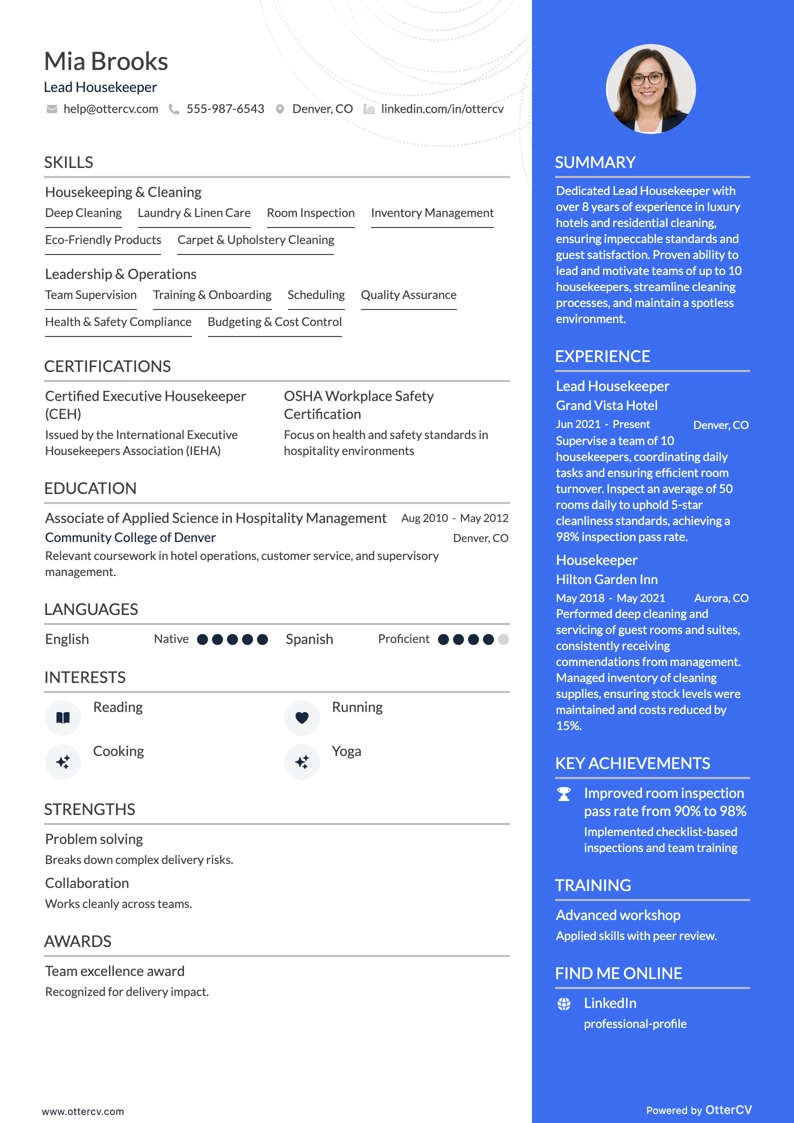
Lead Housekeeper resume example

Lead Housekeeper

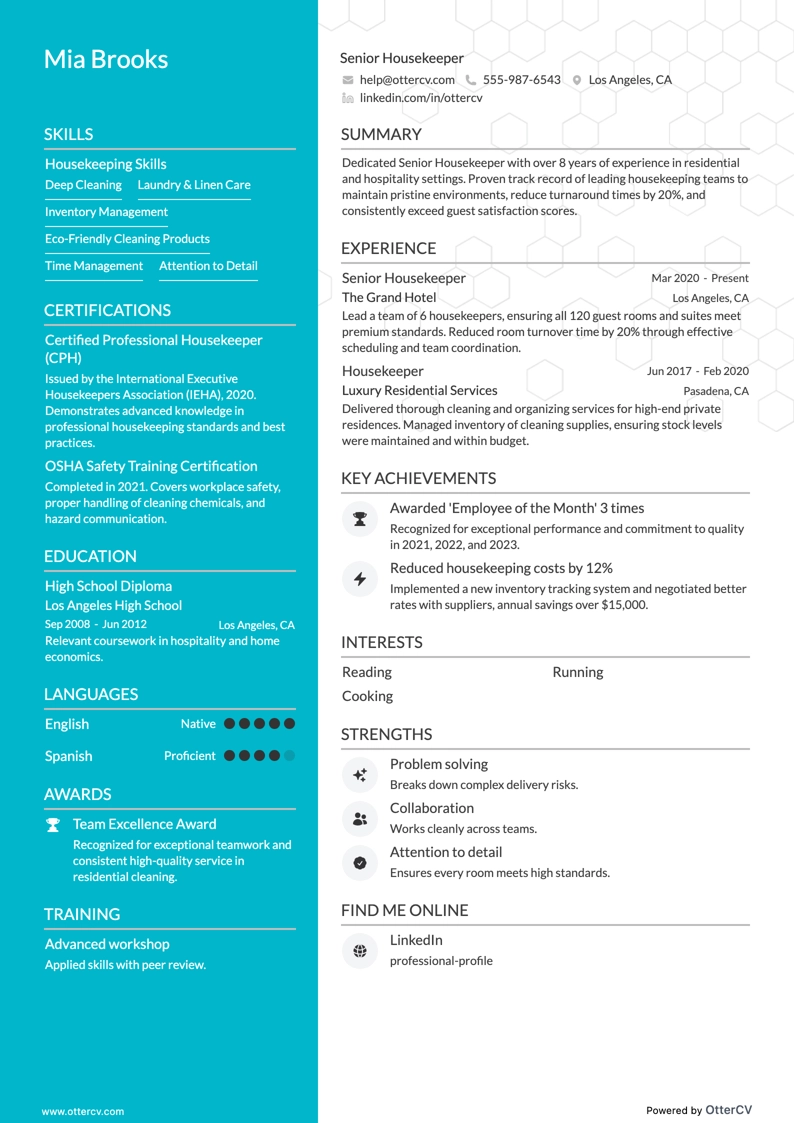
Senior Housekeeper resume example

Senior Housekeeper

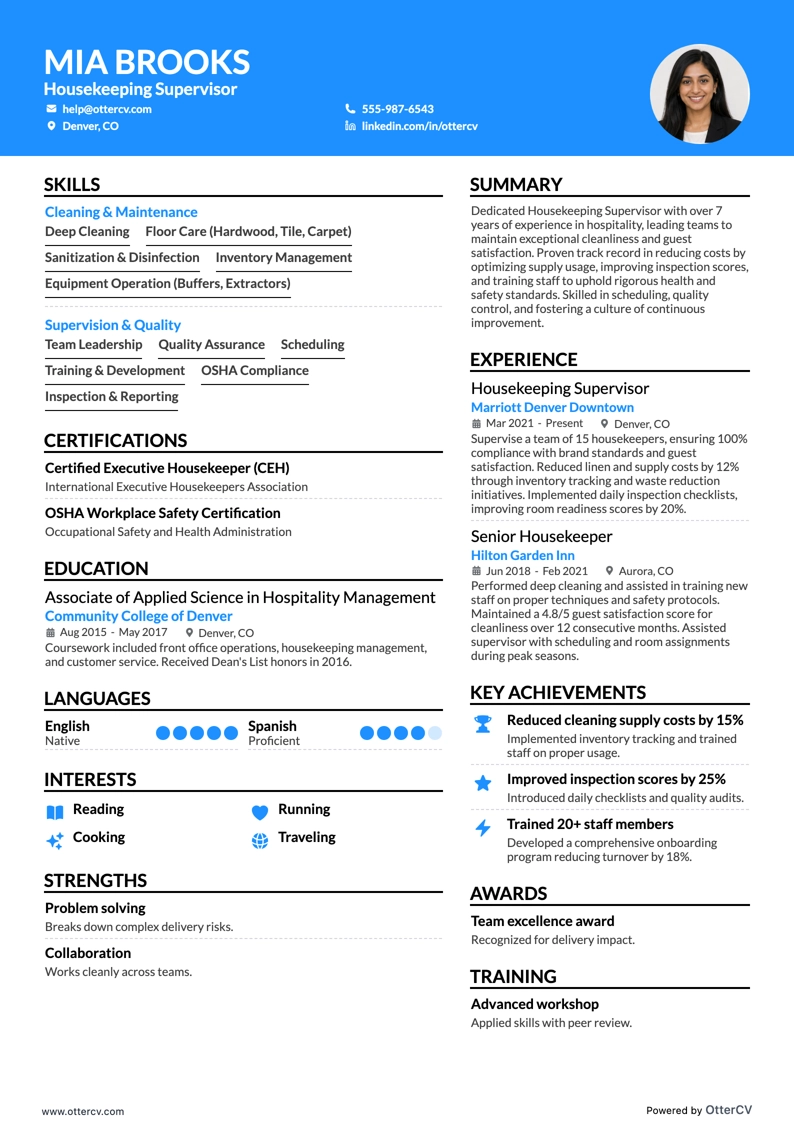
Housekeeping Supervisor resume example

Housekeeping Supervisor

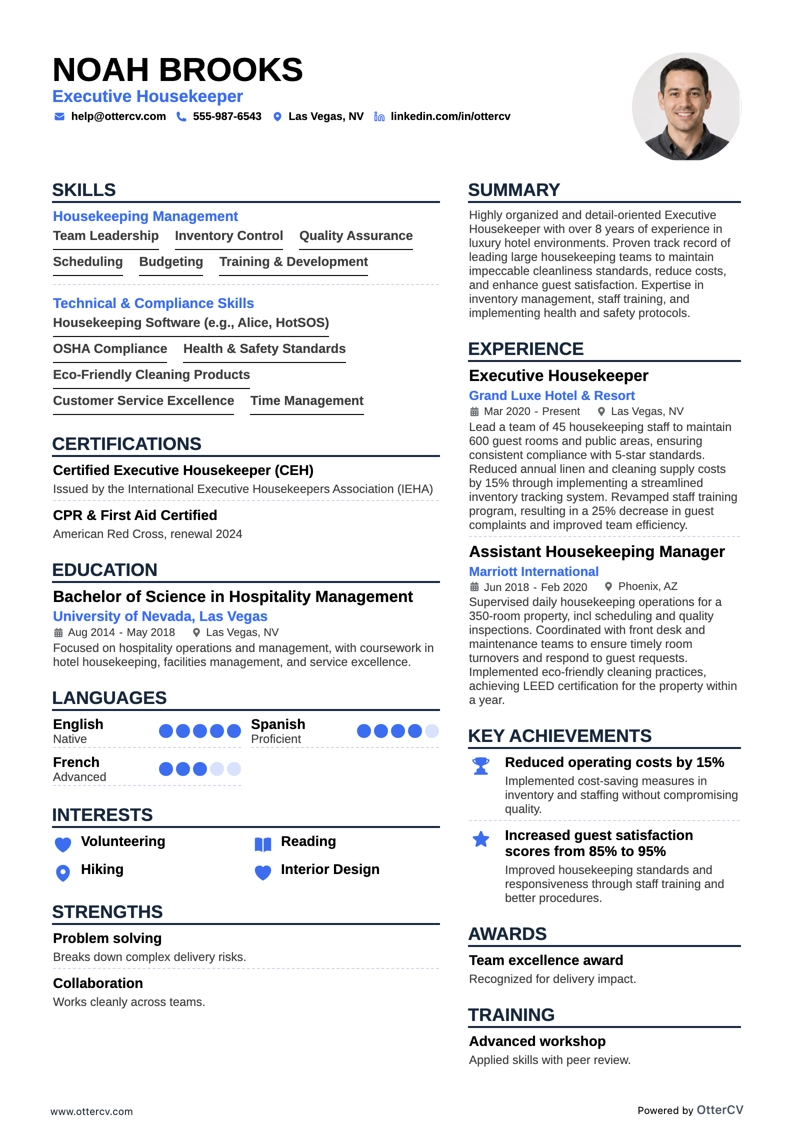
Executive Housekeeper resume example

Executive Housekeeper

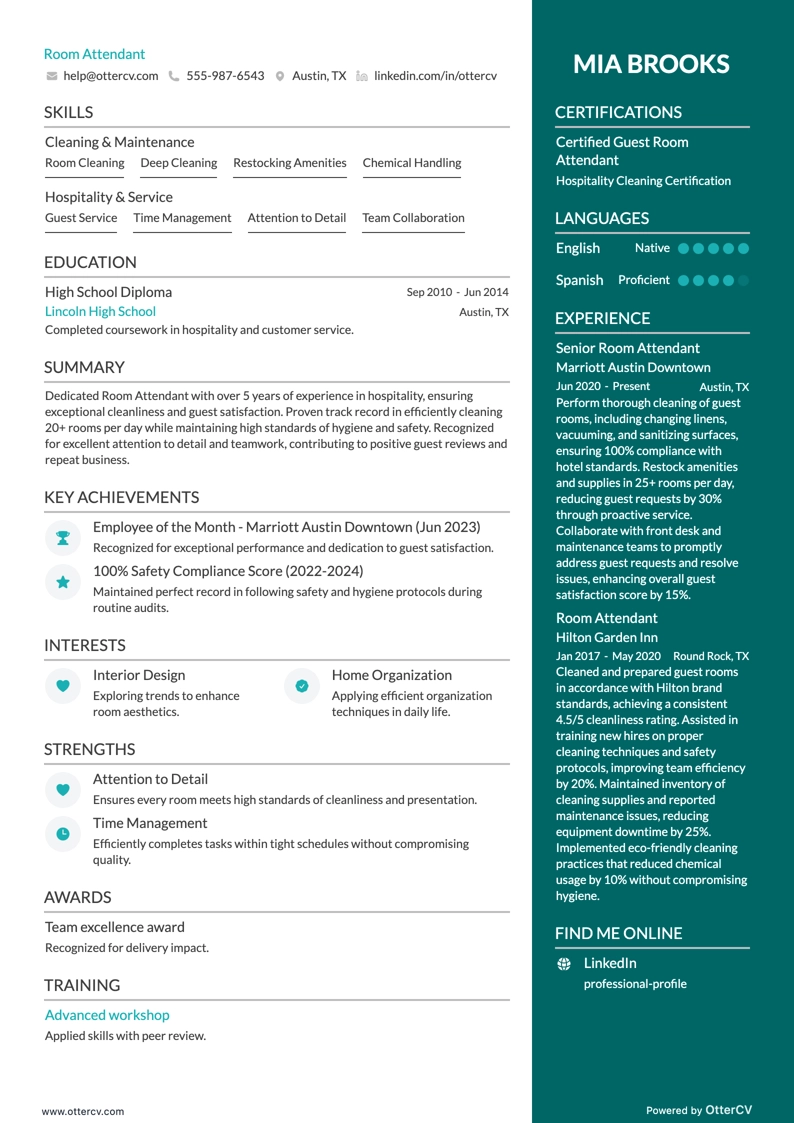
Room Attendant resume example

Room Attendant

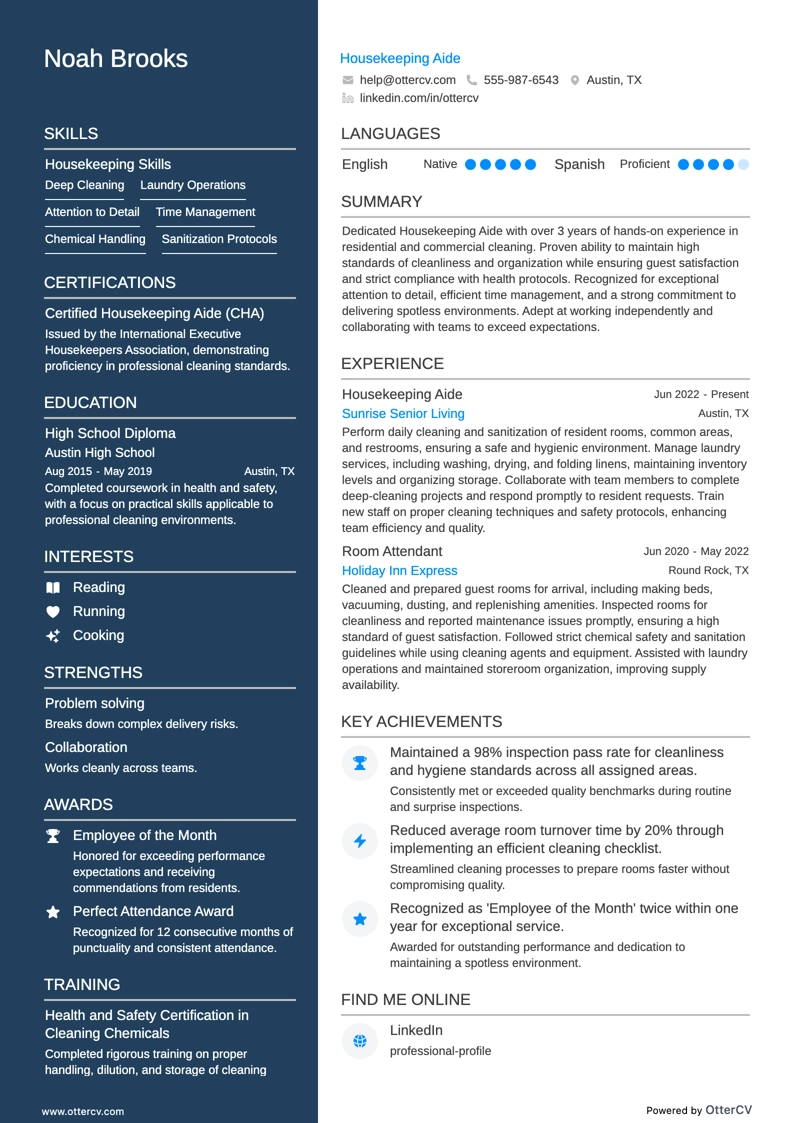
Housekeeping Aide resume example

Housekeeping Aide

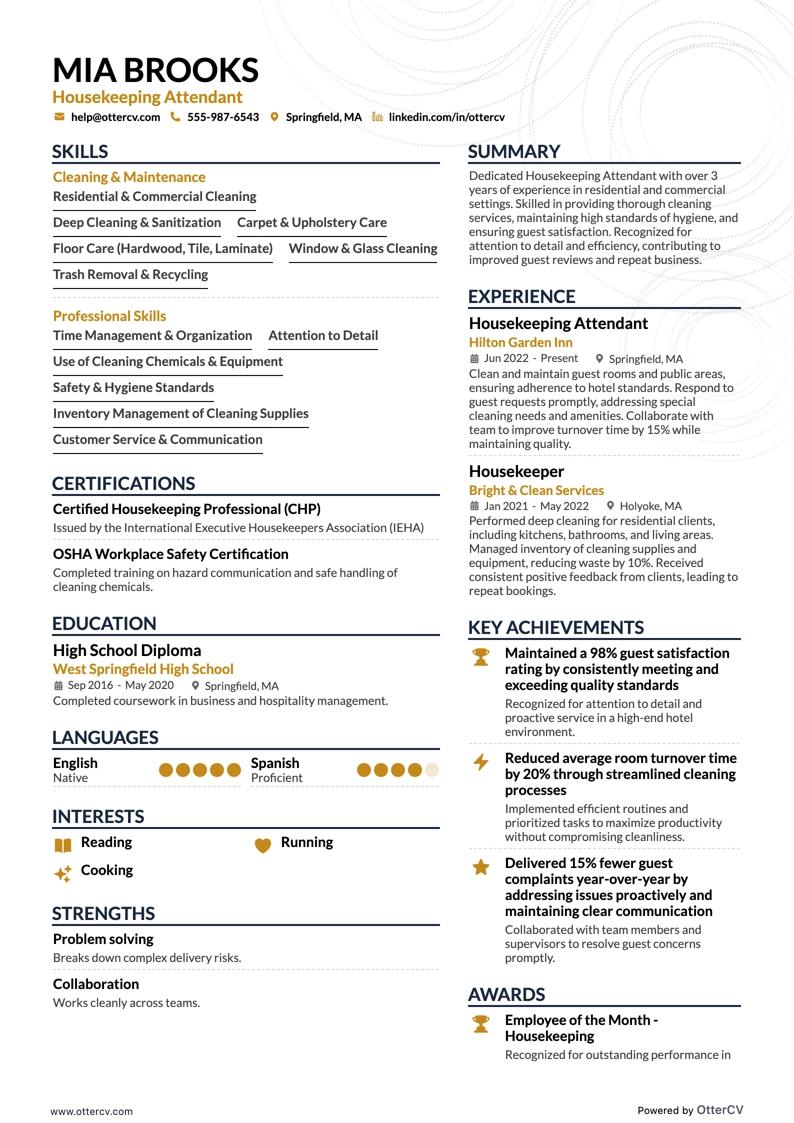
Housekeeping Attendant resume example

Housekeeping Attendant

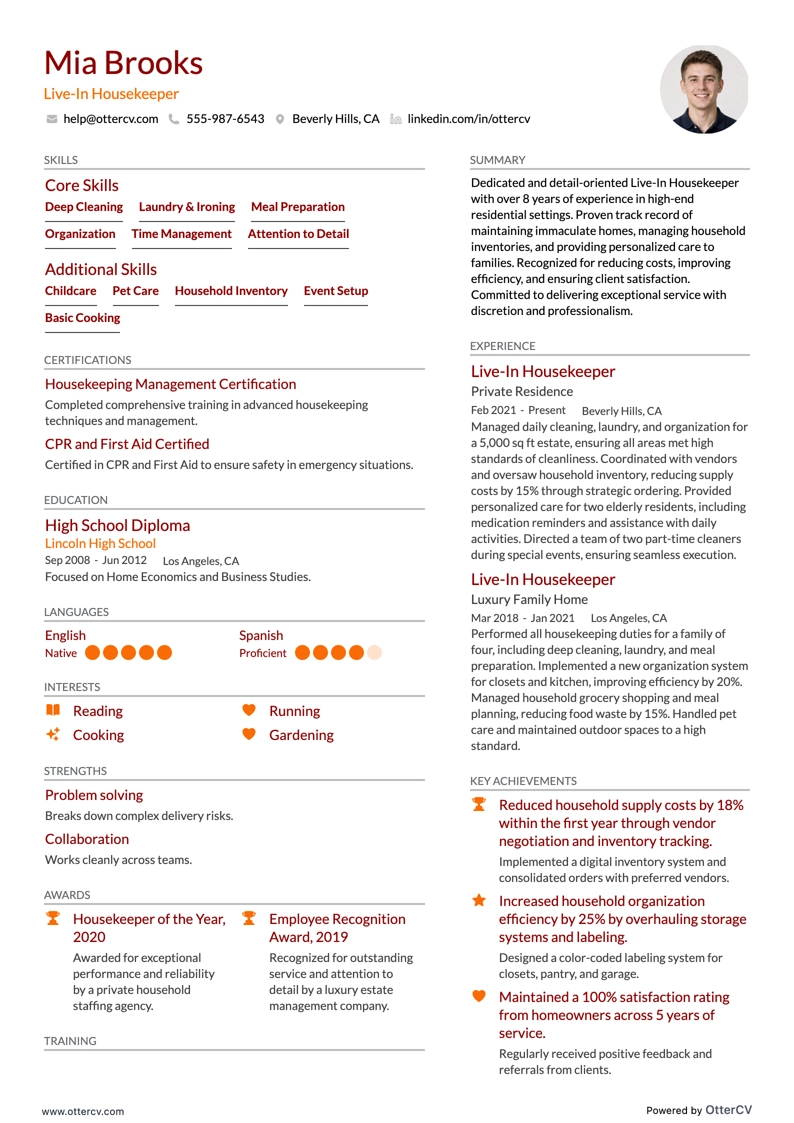
Live-In Housekeeper resume example

Live-In Housekeeper

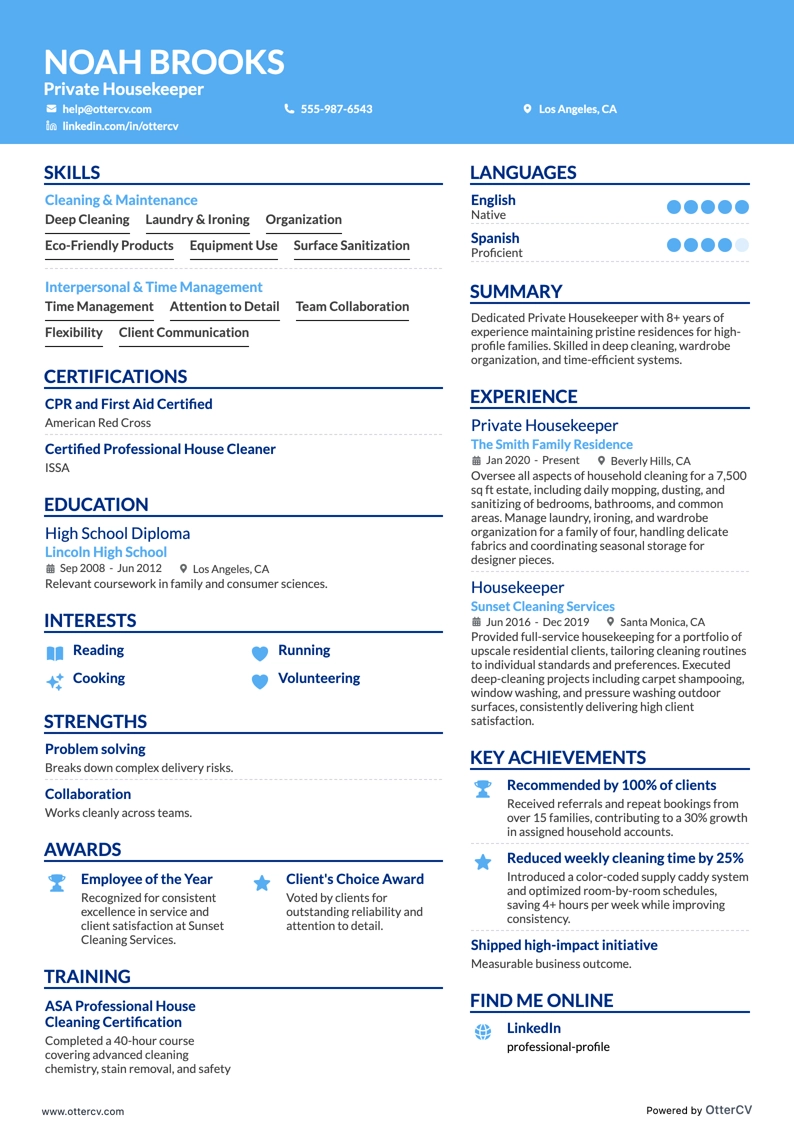
Private Housekeeper resume example

Private Housekeeper

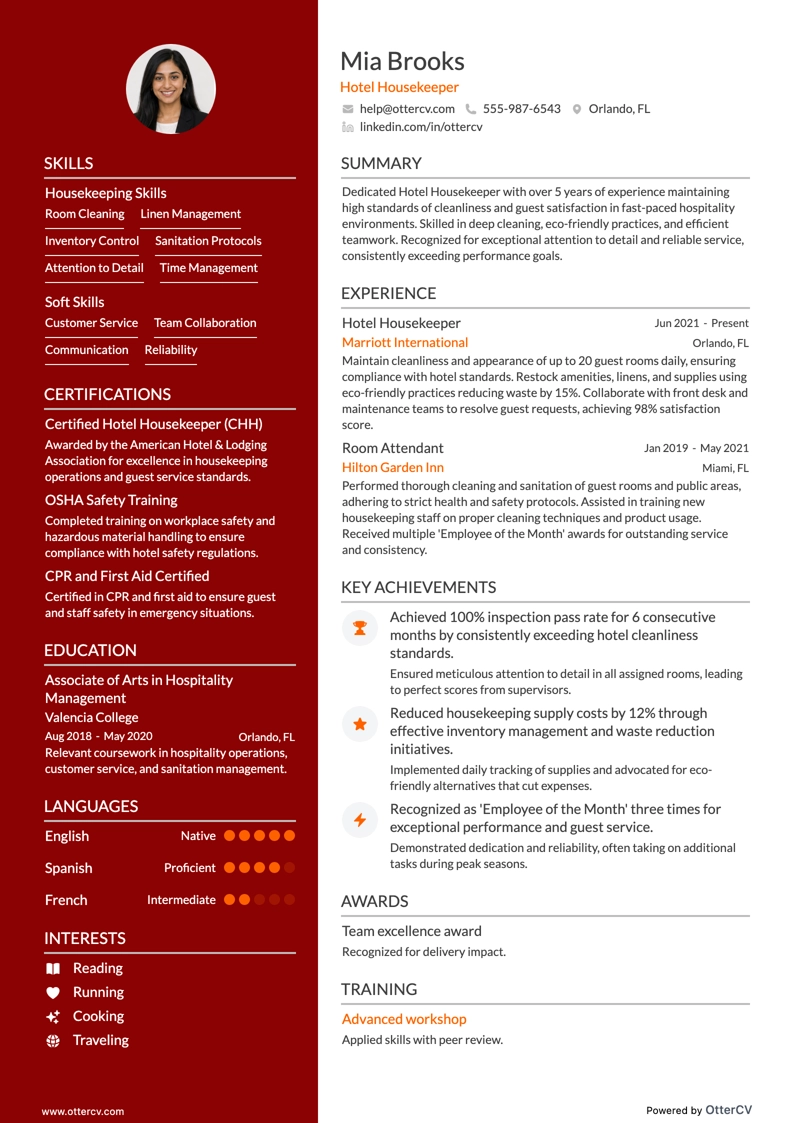
Hotel Housekeeper resume example

Hotel Housekeeper

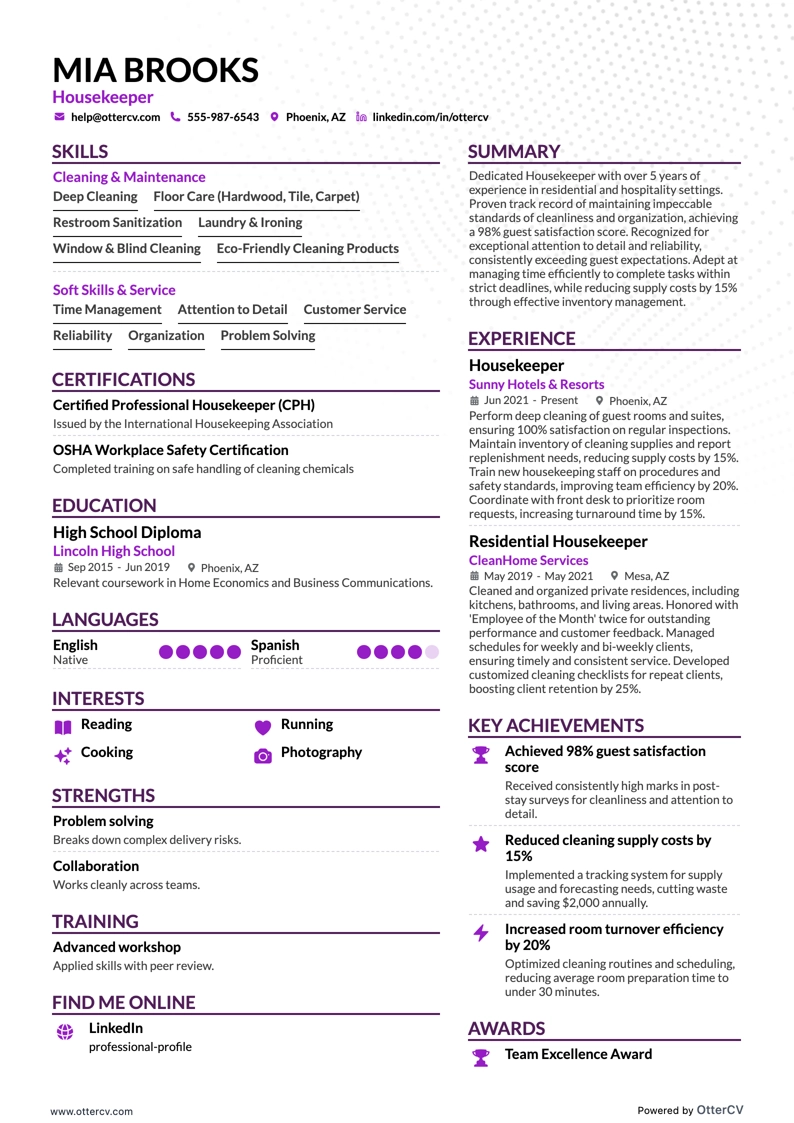
Residential Housekeeper resume example

Residential Housekeeper

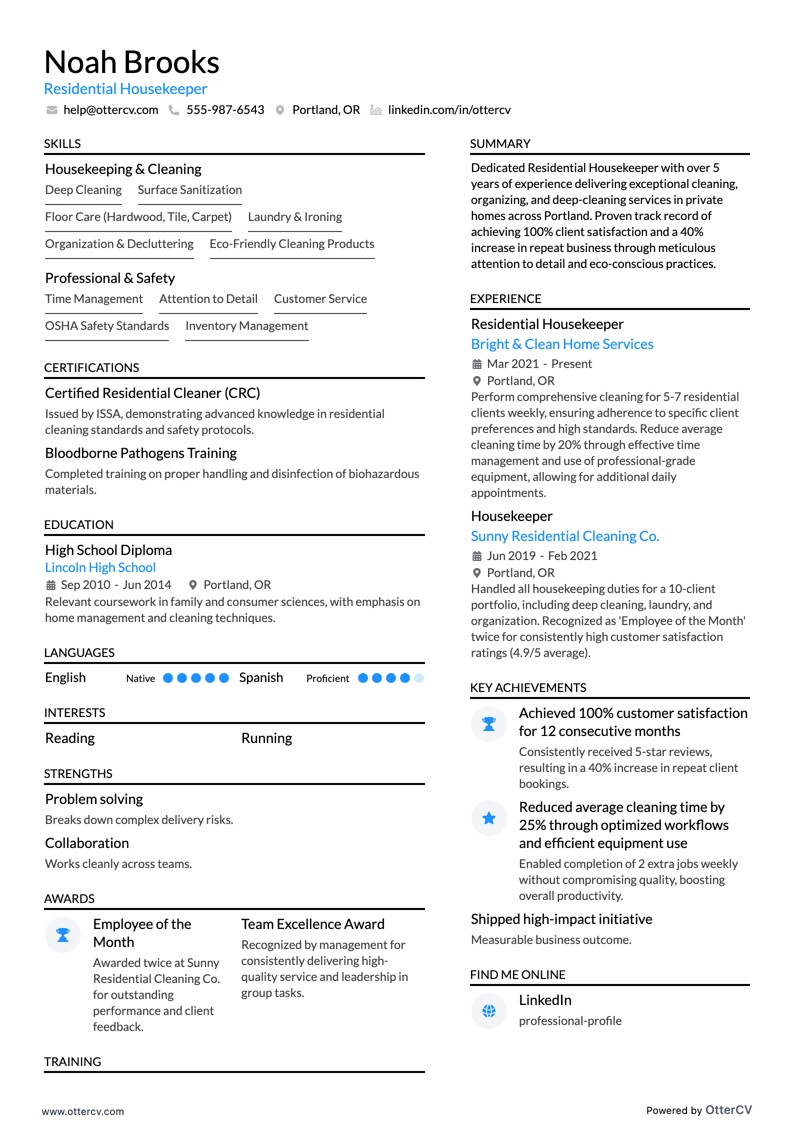
Housekeeper resume example

Housekeeper

Creating a strong housekeeper resume is the first step toward landing a role in this essential and rewarding field. Because demand for qualified candidates can vary significantly by state, it helps to review current market information through the Bureau of Labor Statistics. Whether you want to work in a busy hotel, a private home, or a healthcare facility, your resume is a key tool for showing your skills, experience, and commitment.

In this guide, we’ll show you how to create a resume that stands out.

Here’s what we’ll cover:

  • How to format your resume so it is easy to read and can pass recruiter screening filters.
  • Common challenges housekeeper applicants face and what recruiters are watching for.
  • The right way to list your work experience and education, including certifications and licenses.
  • The skills to include so you can present yourself as an ideal candidate.
  • How to make a strong impression with an effective resume summary or objective statement.

Housekeepers contribute to our peace of mind and quality of life. They’re the unsung heroes who ensure our environments are not just clean, but also comforting and healthful.

—Anonymous

Lead Housekeeper resume preview

The right format for a housekeeper’s resume

When crafting a resume for a housekeeper position, choosing the right resume format is important for highlighting your strengths and matching the job requirements. Here are the three most common resume formats and when each one may work best.

Reverse chronological resume

  • Description: A reverse chronological resume lists your work experience with your most recent job first. It emphasizes your work history and presents a clear timeline of your professional growth.
  • Best for: Housekeepers with a solid work history, especially those whose past roles show increasing responsibility or upward progression.

Functional resume

  • Description: A functional resume focuses on skills and abilities instead of a chronological work history. It groups experience under skill categories to show how your background fits the job.
  • Best for: People changing careers, those with employment gaps, or those entering the workforce for the first time. It helps highlight housekeeping skills and competencies without focusing on when or where they were developed.

Hybrid (Combination) Resume

  • Description: Hybrid or combination resumes blend chronological and functional formats. They begin with a section highlighting skills and accomplishments, followed by a reverse chronological work history.
  • Best for: Housekeepers with both solid work experience and specific relevant skills they want to emphasize. This format helps showcase both career progression and the competencies that make you a strong fit for the role.

Ultimately, your choice should reflect how your experience and skills make you the best match for the housekeeping position you’re applying for.

Different markets may prefer specific resume formats. For example, a Canadian resume could vary in layout.

Besides choosing the right format, there are a few other essentials to keep in mind when writing your housekeeping resume.

  • Choose a clean layout: Use a simple, professional design that keeps the focus on your content rather than distracting graphics. Keep it readable and limit your resume length to one or two pages.
  • Customize for the job: Tailor your resume for each application based on the job description. Highlight the experience and skills that match the role, and use relevant keywords.
  • Use professional language: Keep a professional tone throughout your resume, and use action verbs to describe your responsibilities and achievements.
  • PDF format and fonts: If you are deciding between PDF or Word, always submit your resume as a PDF. It preserves your layout across devices and platforms. Also choose a suitable resume font, such as Rubik, Lato, Montserrat, Raleway, Exo 2, Volkhov, serif, or sans-serif fonts.
  • ATS compatibility: Applicant tracking system (ATS) software scans resumes and cover letters based on employer-defined criteria. This can include resume keywords, design, resume layout, length, and salary requirements.

If you have a minute or two, explore more of Echocv’s resume tips.

Next, here are the individual sections you should focus on when applying for a housekeeping position.

The top sections on a housekeeper’s resume

  • Contact information: Include accurate contact details so employers can reach you quickly for potential interviews.
  • Objective statement or summary: Write a brief, compelling statement about your goals as a housekeeper and the value you bring.
  • Work experience: Highlight previous housekeeping roles to show you have the required hands-on experience.
  • Skills and qualifications: Showcase relevant housekeeping skills, such as attention to detail, time management, the ability to work under pressure, and cleanliness standards.
  • References: Add trustworthy references to support your skills and experience and strengthen your credibility.

Many housekeepers face obstacles when creating a strong resume. The good news is that these challenges can be addressed once you know what to look for.

  • Lack of technical skills: Housekeeping often requires the use of different cleaning equipment, tools, and chemicals, so limited technical knowledge can be a major challenge. Your resume should clearly show your familiarity with the tools and products used in the job.
  • Inability to quantify accomplishments: Housekeeping results can be difficult to measure. For example, it is not easy to put a number on how clean a room was or how satisfied a guest felt. That can make listing achievements on a resume more challenging.
  • Limited relevant websites or institutions: Unlike some professions, housekeeping does not have many widely recognized institutions or websites for certifications or accreditation. As a result, resumes in this field often rely more heavily on practical experience and references.
  • Difficulty showcasing soft skills: Housekeeping depends heavily on soft skills such as attention to detail, reliability, and customer service. Communicating these strengths convincingly on a resume is not always easy.
  • Low impact of job boards: Housekeeping roles are not always posted regularly on major job boards like LinkedIn or Indeed. That can make it harder to gain visibility and stand out among candidates in other fields.

Another important point is that recruiters often look for similar things when reviewing a resume. Below are some of the housekeeping-specific elements your resume should not leave out.

What recruiters want to see on your resume

  • Previous housekeeping experience: Recruiters value candidates who already understand the role and may need less training.
  • Attention to detail: Housekeepers must notice small issues and maintain high hygiene standards.
  • Ability to work independently: This matters because housekeepers often work alone or with minimal supervision and need to take initiative.
  • Physical stamina and agility: The job often involves lifting, bending, and staying active throughout the workday.
  • Pleasant disposition: A friendly, professional manner is important because housekeepers interact with many people and represent their employer.

Next, focus on the information you need to present on your resume: your work history.

Presenting your housekeeper work experience

Your work history on a resume is one of the most important sections. It shows your experience, reliability, and areas of specialization, all of which help demonstrate whether you can do the job effectively. While the other sections matter too, your work history most clearly highlights your practical skills and accomplishments.

For a housekeeper role, start with your most recent job and work backward. Include your job title, employer, location, and dates of employment. Add bullet points for your responsibilities and achievements, and begin them with strong action verbs. Be specific about tasks you handled well or improvements you introduced, such as “Implemented a green cleaning program that reduced chemical use by 30%.”

Now, look at the following example of how you should not list your experience.

Experience

House Cleaner

A regional cleaning company
02/2021 - Present
Phoenix Area

  • Performed cleaning duties.
  • Maintained rooms.
  • Used cleaning supplies.
WRONG

Why this isn’t a good example

  • Vague descriptions: Terms like "Did cleaning" and "Used cleaning stuff" are too broad and don’t explain the specific tasks performed or the skills involved.
  • Lack of detail: "Took care of rooms" doesn’t clarify what that included, such as dusting, vacuuming, or deep cleaning.
  • Missing achievements: There are no accomplishments or examples of initiative that help the candidate stand out.
  • Passive language: Stronger action verbs like "Managed," "Implemented," or "Reduced" make the entry more compelling.
  • No results shown: Including outcomes, such as improvements made or compliments received, helps show the value of the work.

Now, look at a much better way to present your work history.

Experience

Lead Housekeeper

Prestige Worldwide Cleaning Services

02/2019 - Present · New York, NY

Prestige Worldwide is a leading provider of residential and commercial cleaning solutions, known for its commitment to eco-friendly practices and exceptional service quality.

  • Managed a team of 5 housekeepers, coordinating schedules and maintaining high standards of cleanliness across all assignments.
  • Implemented eco-friendly cleaning techniques, reducing chemical use by 40% and improving client satisfaction scores by 25%.
  • Developed a comprehensive training program for new hires focused on efficiency, safety, and customer service excellence.
  • Received the “Employee of the Year” award in 2020 for outstanding performance and dedication.
RIGHT

Why this is an outstanding example

  • Company description: A brief description of the company adds context about the work environment and shows how the candidate’s achievements support the company’s goals.
  • Detailed responsibilities and achievements: The bullet points clearly explain the candidate’s role, initiatives, and measurable results, helping demonstrate effectiveness and leadership.
  • Action-oriented language: Using strong action verbs reflects a proactive mindset and competence in the role.
  • Recognition: Mentioning awards highlights excellence and helps distinguish the candidate from others.
  • Eco-friendly focus: Emphasizing eco-friendly practices aligns with current environmental priorities and shows awareness of industry trends.

If you’re looking for more ways to make your experience stand out, the answer is yes. In addition to tailoring your resume to the job description and using accurate resume keywords, use the tips below to strengthen this section.

Quantify impact on your resume

You can show your impact by using the right numbers on your resume. This matters because it gives concrete evidence of your contributions and achievements. Try including:

  • The number of rooms cleaned per shift: This shows your ability to handle a heavy workload and manage time efficiently.
  • The size of the property or properties you managed: This helps recruiters understand your level of responsibility, especially in larger spaces.
  • The types of cleaning tasks you performed: This highlights your versatility and range of housekeeping skills, such as “Proficient in the use of 5 different types of cleaning equipment for various tasks.”
  • The number of special cleaning projects you took on: Tasks like deep carpet cleaning or pressure washing can demonstrate initiative.
  • Any reduction in supply costs you helped achieve: This shows effectiveness and cost efficiency.
  • The number of shifts worked without absences: This reflects reliability and commitment.
  • The amount of positive feedback or recognition received from employers or clients: This emphasizes your performance and commitment to quality service.
  • How many people you trained and what the training covered: This can show leadership ability and strong housekeeping knowledge.

Creating a housekeeper resume without any experience

You don’t always need direct work experience to get hired. Everyone starts somewhere. If you don’t have experience yet, strengthen your resume by focusing on transferable skills and other relevant sections that show your potential to do well in the role.

In the last section of this article, we cover additional details you can include to improve your chances of getting the job. Include as many of them as possible, especially if you lack work history or formal education.

Your attitude, willingness to learn, and ability to show how your current skills can translate into success as a housekeeper matter a lot. Tailor your resume around these strengths and explain why they make you a strong fit.

How to list your hard skills and soft skills on your resume

Including a diverse resume skills section shows essential competencies, adaptability, and professionalism. This is important for both experienced cleaners and newcomers. It can also improve your visibility in applicant tracking systems (ATS) and help align your resume with job requirements in a competitive field.

  • Hard skills for a housekeeper resume are specific, teachable abilities such as cleaning techniques, operating cleaning equipment, and knowledge of cleaning chemicals.
  • Soft skills on a resume include personal traits and interpersonal abilities such as reliability, attention to detail, communication, and customer service.
Best hard skills for your housekeeper resume

  • Floor cleaning and waxing.
  • Carpet cleaning.
  • Use of industrial vacuum cleaners.
  • Laundry management.
  • Waste disposal management.
  • Stain removal.
  • Glass cleaning.
  • Sanitation.
  • Guest room servicing.
  • Upholstery cleaning.
  • Knowledge of cleaning agents and chemicals.
  • Use of steam cleaners.
  • Use of scrubbing machines.
  • Knowledge of OSHA safety guidelines.
  • Pest control.
  • Window washing.
  • Power washing.
  • Equipment maintenance.
  • Pool cleaning.
  • Deep-cleaning tasks.

The ideal number of skills to list on your resume is usually 5 to 10. Focus on skills that closely match the job description and show why you’re a strong fit for the role. Tailor this section for each application so it reflects the employer’s specific requirements.

Want to learn more about listing skills? Check out Echocv’s informative article on skills to learn more about the benefits of having a strong skills section on your resume.

How to list your certifications and education on your resume

For a housekeeper’s resume, certifications are often more immediately relevant than formal education, especially when they relate directly to housekeeping, cleaning techniques, safety protocols, or specialized equipment use.

Certifications on a resume can quickly show employers that you have the specific skills and knowledge needed to do the job well from day one. That said, listing education on a resume still matters, especially if it relates to hospitality, business, or other areas that support the role.

If you have both, include both, but place greater emphasis on certifications that strengthen your qualifications for a housekeeping position. Below is an ideal example of what to include for certifications.

Certifications

A certification entry on your resume should include these key details:

  • Certification name: List the full name of the certification so it is easy to recognize and understand.
  • Issuing organization: Include the organization or institution that awarded the certification.
  • Date of certification: Add the month and year you earned it. If it expires, you can also include the expiration date to show it is current.
  • Relevance and skills acquired: Briefly explain how the certification relates to the job and highlight any important skills or knowledge gained.

Certifications

Certified Hospitality Housekeeping Executive (CHHE)

American Hotel & Lodging Educational Institute

02/2021

Demonstrates advanced knowledge in hospitality housekeeping management, with a focus on operational efficiency and high standards of cleanliness.

RIGHT

What they did right:

  • Specific title: Clearly stating the certification title helps hiring managers quickly understand the candidate’s qualifications.
  • Issuing organization: Naming the organization adds credibility and makes the credential easier to verify.
  • Date of certification: Including the date shows how current the candidate’s knowledge and skills are.
  • Relevance to the job: Each certification is directly related to housekeeping, emphasizing specialized skills that can help the candidate stand out.
  • Details on skills gained: A brief explanation of what the certification covers, such as management skills, gives employers a clearer view of the candidate’s abilities and expertise.

Education

Here is an example of what an education entry on a resume should typically include:

  • Degree: Specify the degree and, if applicable, the field of study or major.
  • Institution name: Include the name of the school or institution where you earned the degree.
  • Location: Mention the city and state where the institution is located.
  • Graduation date: List the month and year of graduation. If you are still enrolled, you can write “Expected graduation [month, year].”
  • Relevant coursework or projects: Include relevant coursework or projects that directly relate to the job you are applying for.
  • Honors and awards: Mention any academic honors, scholarships, or awards that reflect your achievements in your field of study.
  • GPA: Including your GPA on a resume is optional and is usually recommended if it is above 3.0 or if you are a recent graduate.

Education

Associate Degree in Hospitality Management

New York Community College

02/2018 - 11/2020 · New York, NY

  • Specialized coursework in Hotel Operations Management and Customer Service Excellence.
  • Completed a capstone project on, focusing on eco-friendly and efficient cleaning practices.
  • Participated in a semester-long internship with XYZ Hotel, gaining hands-on experience in housekeeping and guest relations.
RIGHT

What they did right

  • Clear format: The education section clearly presents the degree, institution, and graduation date, making it easy to scan.
  • Relevant coursework: Including specialized coursework related to housekeeping and hospitality shows field-specific knowledge and skills.
  • Practical experience: A project and internship demonstrate how learned skills can be applied in real housekeeping work.
  • Focus on relevance: Emphasizing education that connects to housekeeping, such as eco-friendly practices and customer service, makes the resume more targeted and compelling to employers.

Here’s a list of some of the more recognized and sought-after certifications available to housekeepers.

Writing a convincing housekeeper resume summary or objective

A resume summary or objective statement highlights your aspirations and qualifications at the start of your resume, helping capture an employer’s attention right away. Place it at the top, just below your contact information.

Here’s what to aim for when writing one, along with a few tips for doing it well.

A summary: Best for candidates with housekeeping experience. Highlight your years of experience, key skills, and major achievements. Use active language and quantify achievements when possible.

An objective: Best for entry-level candidates or career changers. A resume objective focuses on your career goals and how they align with the job. Mention any relevant skills or qualities you bring.

Write it effectively by:

  • Choosing the right type: Decide between a summary or objective based on your experience level.
  • Tailoring to the job: Customize it to the job description and focus on what the employer values.
  • Being specific and concise: Keep it brief but informative, using specific examples or numbers to show your qualifications or goals.
  • Using keywords: Incorporate keywords from the job description to help pass applicant tracking systems (ATS).

Next, here’s an example of a wrong and a right way to write your summary.

Summary

Experienced in cleaning and maintaining neat, organized spaces. Seeking more cleaning work and able to handle a wide range of household tasks.

WRONG

What they did incorrectly

  • Lack of specificity and professionalism: The summary is vague, uses unprofessional language, and does not quantify experience or highlight specific skills. As a result, employers may struggle to assess the candidate’s qualifications or level of commitment.
  • Personal reasons over value contribution: Emphasizing personal reasons for needing a job instead of explaining how the candidate can contribute value to the employer does not make a strong case for hiring.

Summary

Dedicated and detail-oriented housekeeping professional with over 8 years of experience in hotel and residential settings. Demonstrated success in improving efficiency and client satisfaction through proactive organization and high standards of cleanliness. Skilled in eco-friendly cleaning practices and team leadership, with consistently high marks for service excellence.

RIGHT

What They Did Correctly

  • Specific experience and skills: It clearly states the number of years of experience and highlights specific strengths, such as eco-friendly cleaning practices and team leadership, so employers can quickly understand what the candidate offers.
  • Quantifiable achievements: It mentions improvements in efficiency and client satisfaction, along with high service ratings, giving clear evidence of the candidate’s impact in previous roles.

Take your time and craft this paragraph carefully so it accurately reflects who you are and what you can contribute. Make the recruiter want to keep reading.

Additional sections for a housekeeper resume

  • Volunteer work: If you’ve done volunteer work that involved organization, cleaning, or team coordination, include it. Briefly describe your responsibilities and any positive feedback you received.

  • Personal projects: Add relevant personal projects , such as organizing community clean-up events or managing household tasks for a family member. Explain the work involved and the results.

  • Languages: Language skills can be a strong asset, especially in diverse communities or hospitality settings where communicating with clients or team members in their native language is valuable.

  • Interests and hobbies: Include interests or hobbies that reflect relevant strengths, such as gardening for attention to detail, DIY projects for handiness and creativity, or sports for stamina and teamwork.

  • Awards and recognitions: Any awards or recognitions that highlight your work ethic, leadership, or contributions to a team can support your application and show that others have recognized your efforts.

  • Professional references: If you don’t have housekeeping experience, references on a resume from past employers or instructors can add credibility. Choose people who can speak positively about your character, work ethic, and potential.

  • Choosing the right resume format is essential and should depend on several factors. Your format should reflect how your experience and skills make you the best match for the job.

  • List your credentials, whether work experience or education, in reverse chronological order, starting with the most recent. This helps show your professional development clearly.

  • Don’t just list responsibilities—make your achievements quantifiable whenever possible. Numbers help demonstrate your value.

  • Select hard and soft skills carefully, and make sure they are relevant to the job description.

  • While education matters, certifications and licenses can be especially important for a housekeeper.

  • Spend enough time crafting a strong resume summary or objective so recruiters have a reason to keep reading.

  • If you lack experience, don’t be discouraged. Additional sections and transferable talents can help make up for limited professional history.

Housekeeper resume examples

Explore additional Housekeeper resume samples and guides and see what works for your level of experience or role.

By Experience

Lead Housekeeper

Lead Housekeeper resume preview

Senior Housekeeper

Senior Housekeeper resume preview

Housekeeper resume examples

Explore additional Housekeeper resume samples and guides and see what works for your level of experience or role.

By Role

Housekeeping Supervisor

Housekeeping Supervisor resume preview

Executive Housekeeper

Executive Housekeeper resume preview

Room Attendant

Room Attendant resume preview

Housekeeping Aide

Housekeeping Aide resume preview

Housekeeping Attendant

Housekeeping Attendant resume preview

Live-In Housekeeper

Live-In Housekeeper resume preview

Private Housekeeper

Private Housekeeper resume preview

Hotel Housekeeper

Hotel Housekeeper resume preview

Residential Housekeeper

Residential Housekeeper resume preview

Housekeeper

Housekeeper resume preview