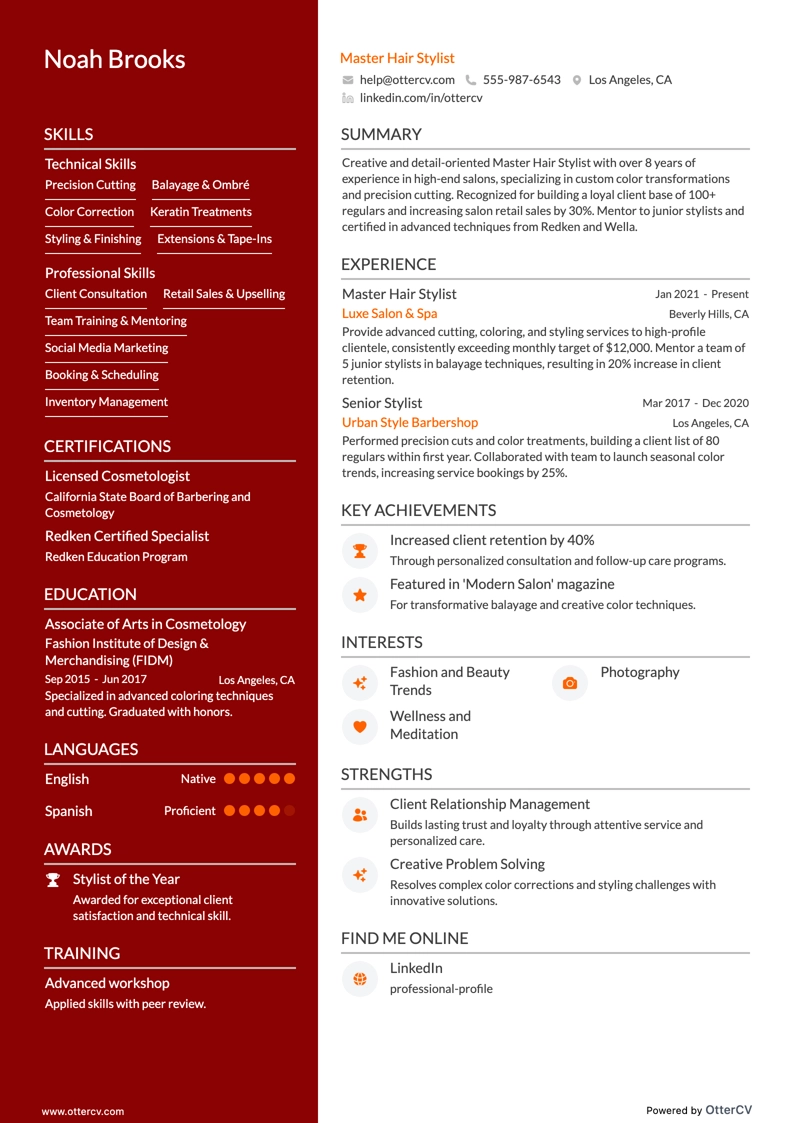
Master Hair Stylist full preview

20 Hair Stylist Resume Examples

OtterCV

Written by The OtterCV Team

Updated: 2/27/2024•8 min read

See all resume examples in this guide, or generate your own resume example with your personalized prompt

Master Hair Stylist resume example

Master Hair Stylist

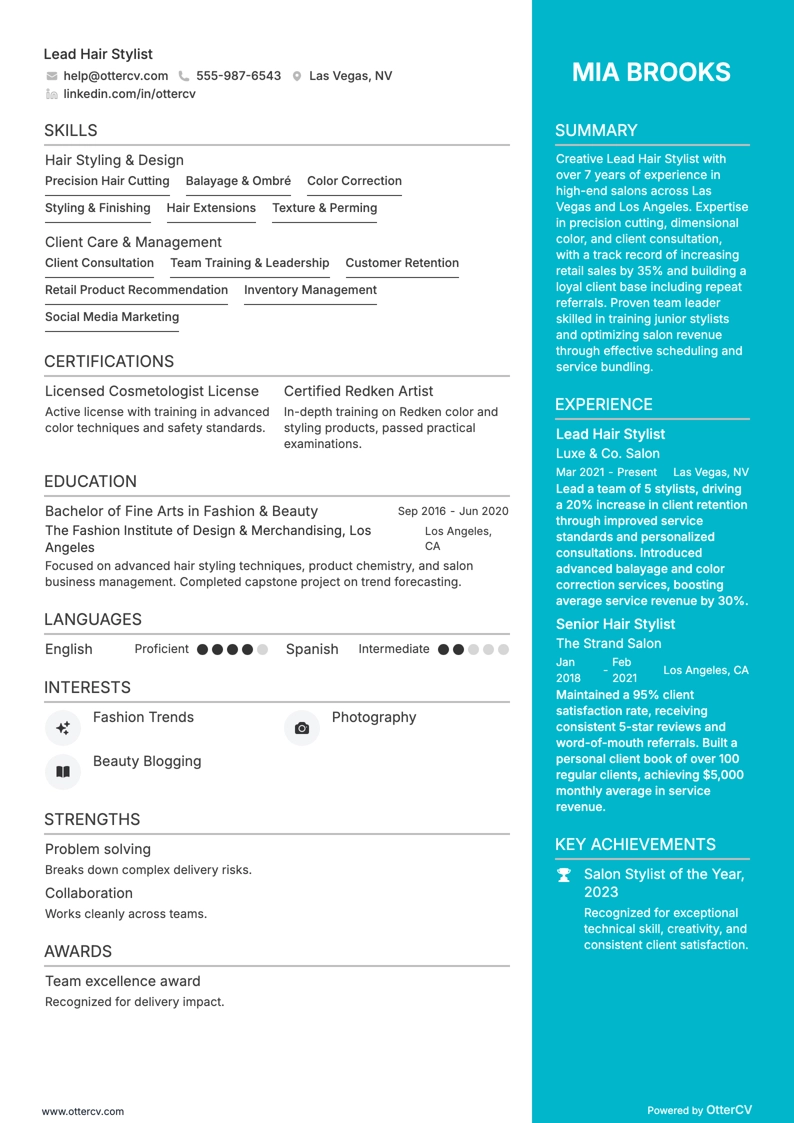
Lead Hair Stylist resume example

Lead Hair Stylist

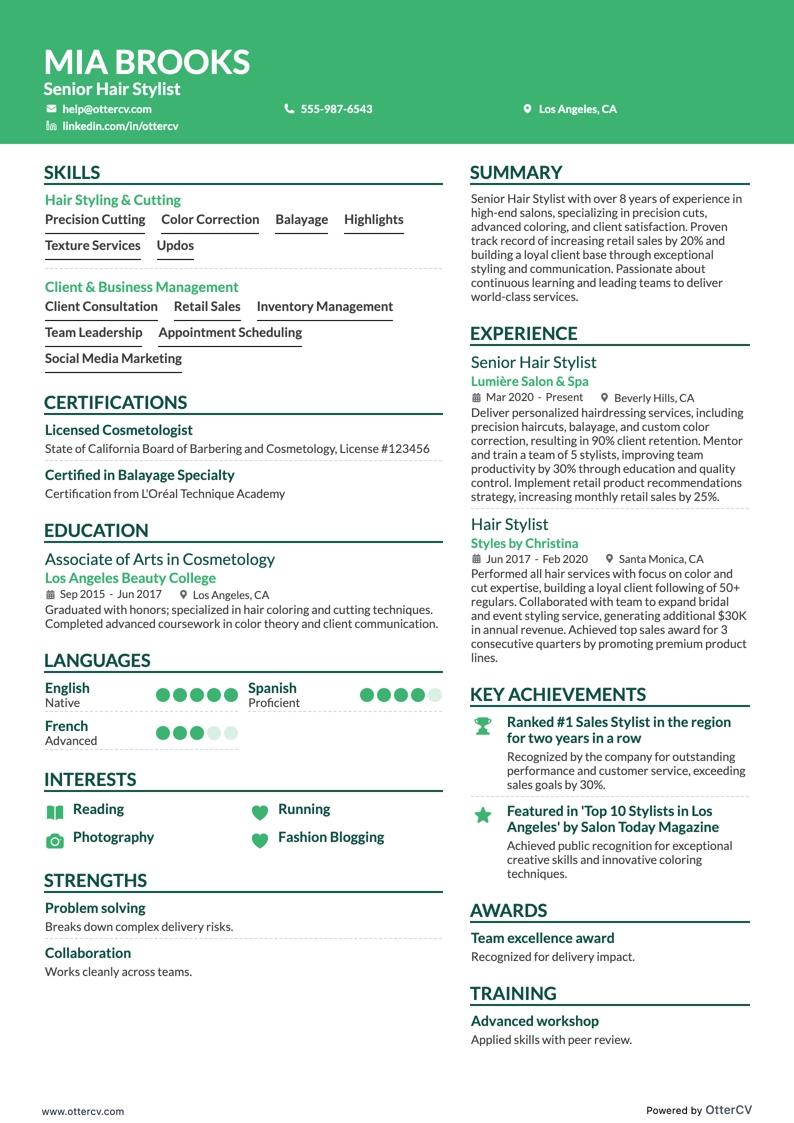
Senior Hair Stylist resume example

Senior Hair Stylist

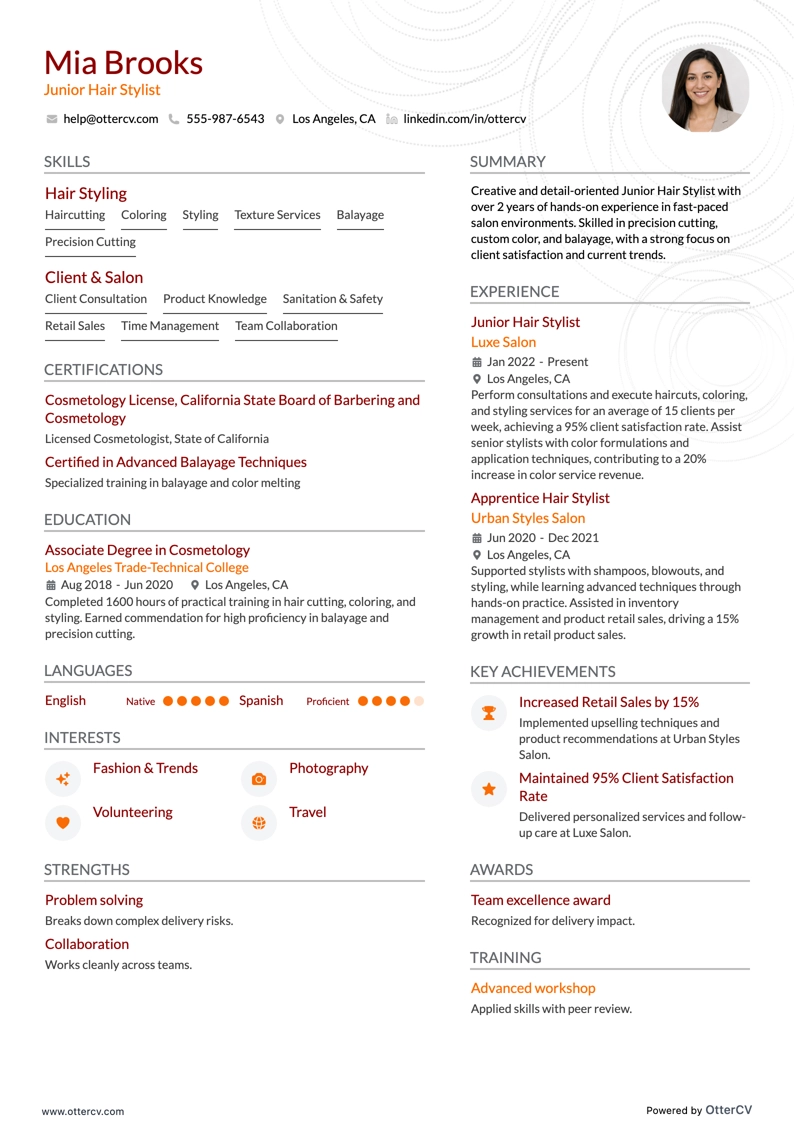
Junior Hair Stylist resume example

Junior Hair Stylist

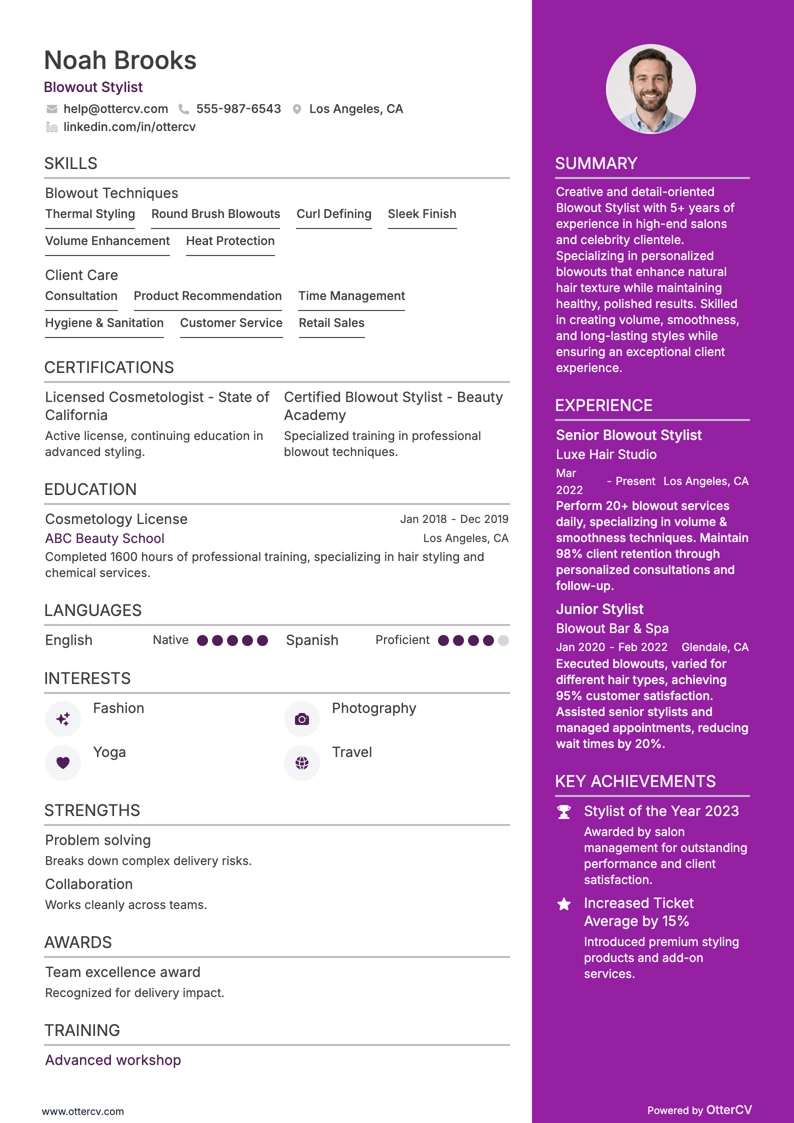
Blowout Stylist resume example

Blowout Stylist

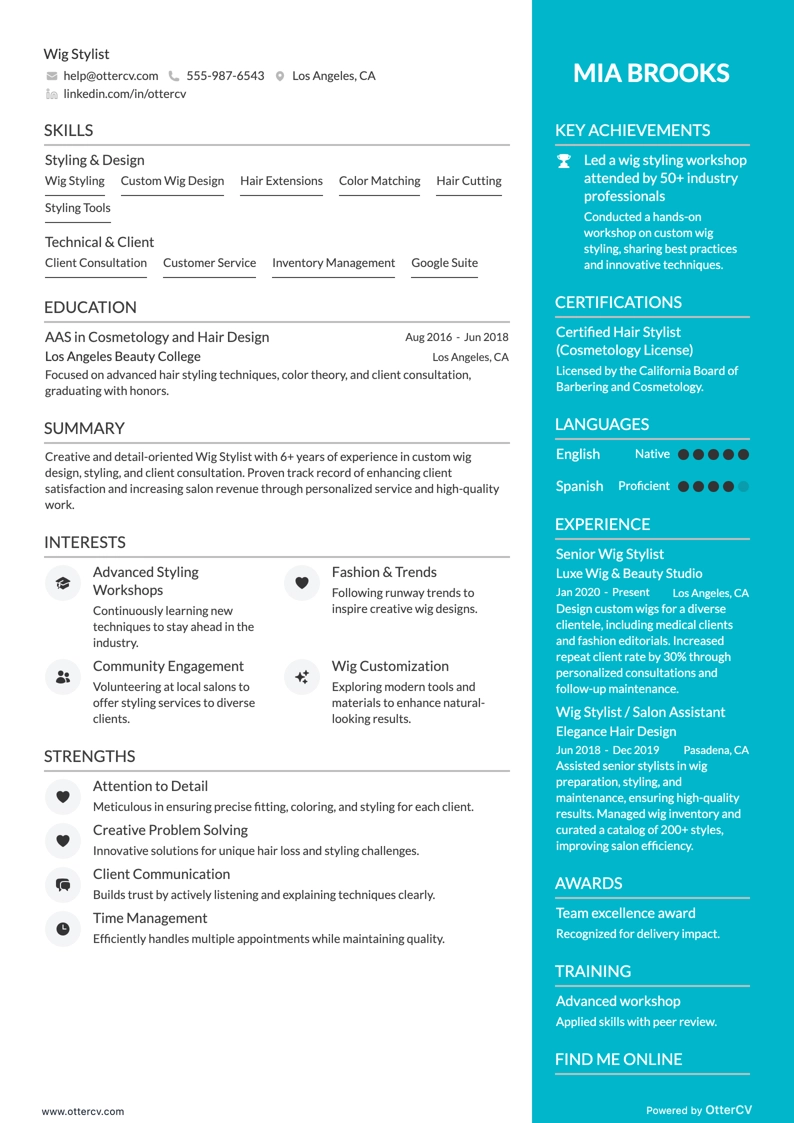
Wig Stylist resume example

Wig Stylist

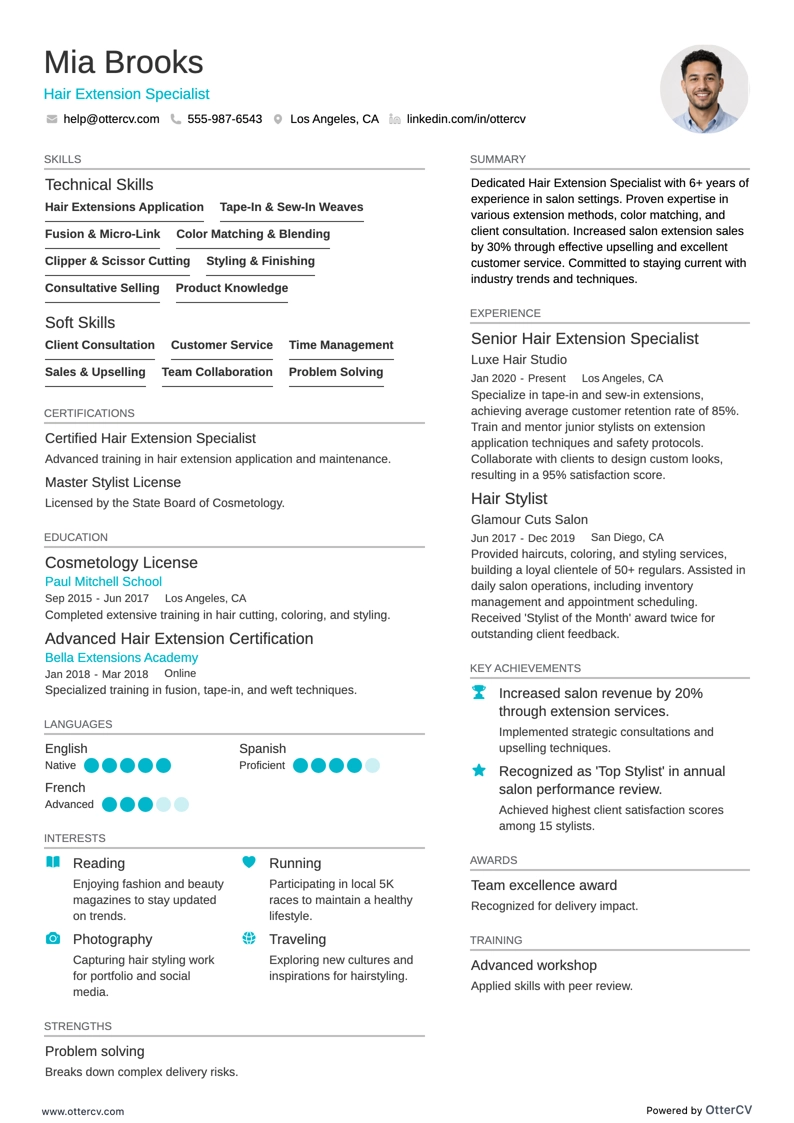
Hair Extension Specialist resume example

Hair Extension Specialist

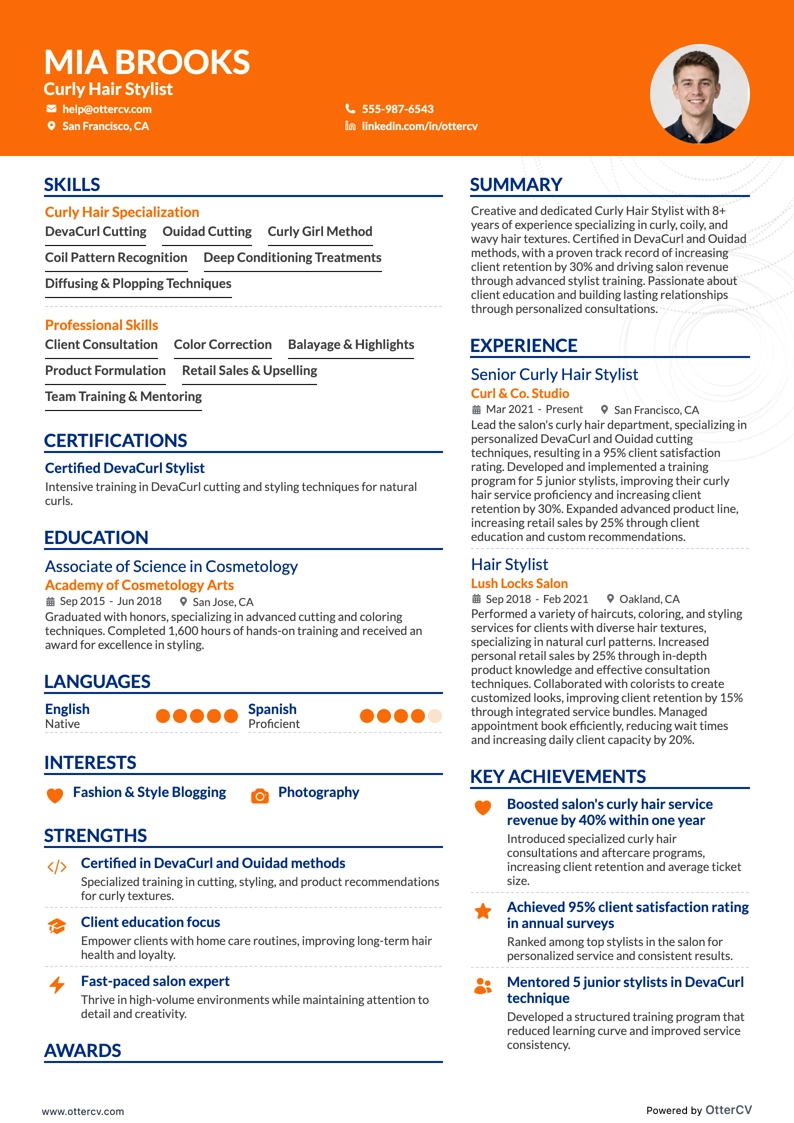
Curly Hair Stylist resume example

Curly Hair Stylist

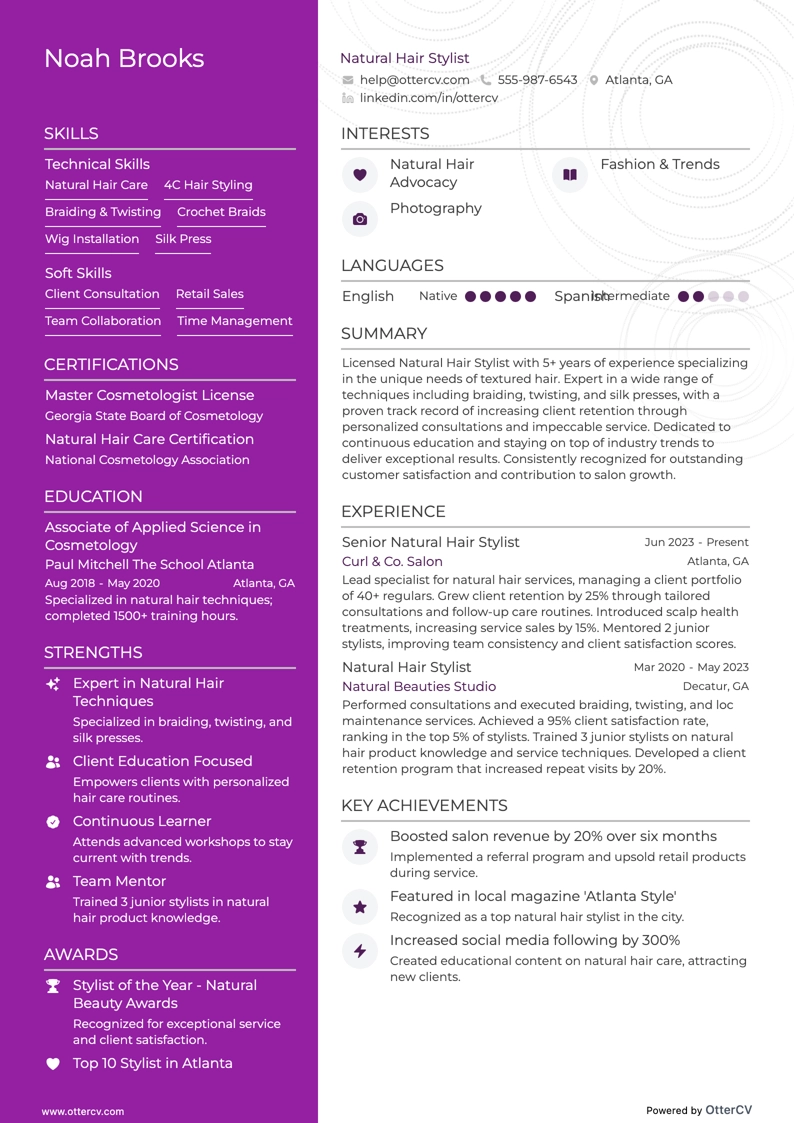
Natural Hair Stylist resume example

Natural Hair Stylist

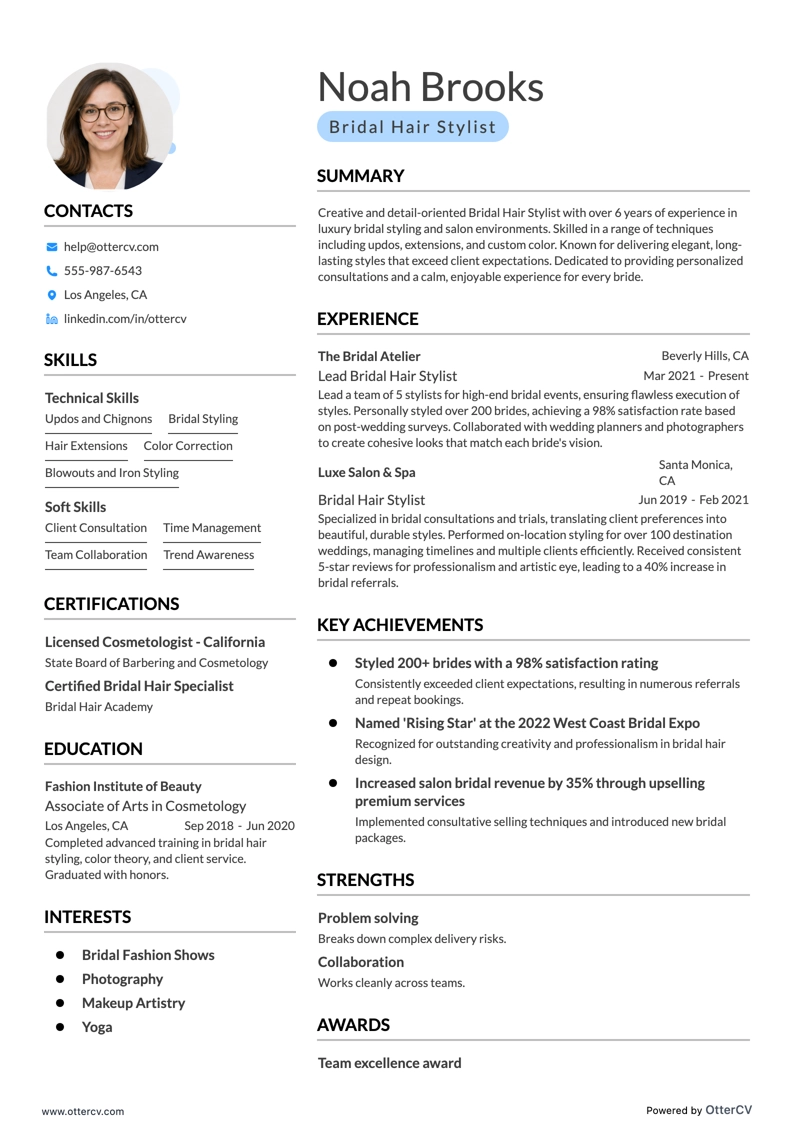
Bridal Hair Stylist resume example

Bridal Hair Stylist

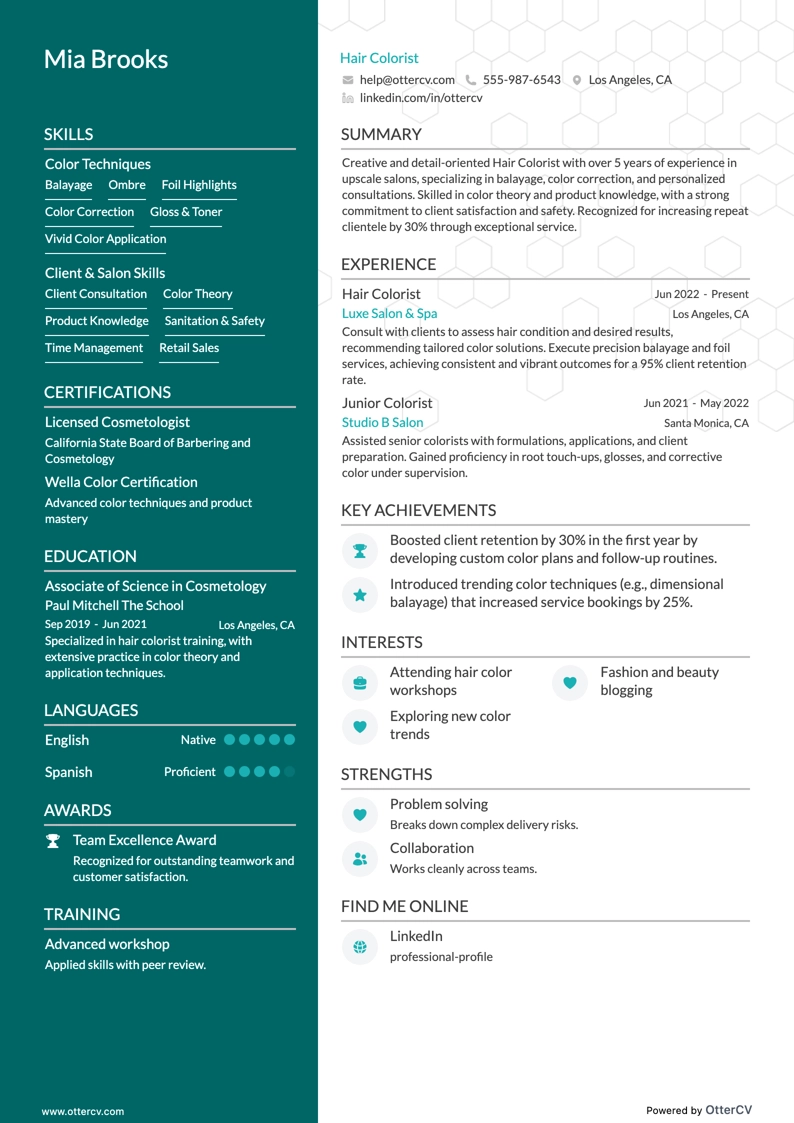
Hair Colorist resume example

Hair Colorist

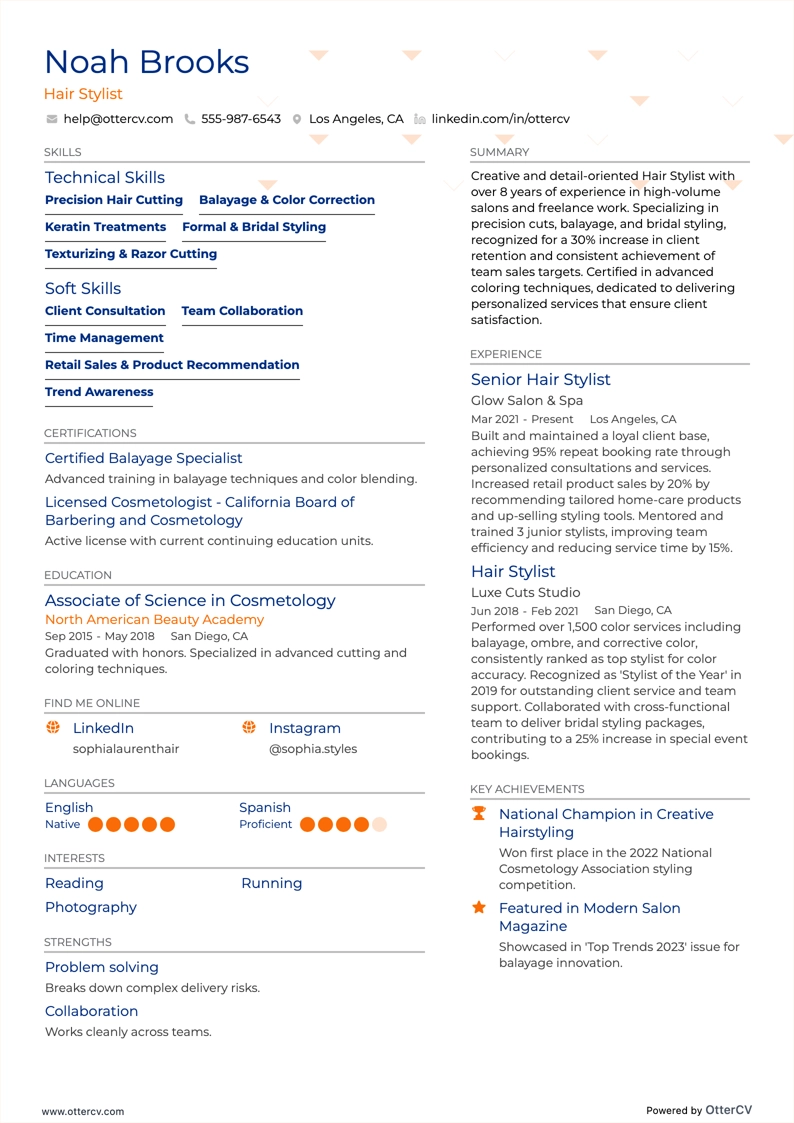
Hair Stylist resume example

Hair Stylist

Hair styling is a creative, skill-based profession that can shape how people see themselves and feel about their appearance. To get hired, it helps to understand both the job market and how to present your strengths clearly on a resume.

The outlook is encouraging. The U.S. Bureau of Labor Statistics predicts that jobs in personal appearance, including hair styling, will grow faster than average in the next decade, driven by population growth and increased interest in grooming and wellness.

If you're passionate about hair styling and ready to take on its challenges, there are many opportunities to grow, create, and inspire. Success in this field takes patience, practice, and a willingness to keep learning and adapting.

As you build your application, it also helps to understand the purpose of a resume and how to craft one that reflects your value.

Related guides in the personal appearance field:

Common obstacles faced by hair stylists when crafting a resume

Before writing your resume, it helps to recognize the challenges that often come up during the job search and resume-building process.

  • Demonstrating specialized skills: Hair stylists need a distinct set of abilities, including cutting, coloring, and maintaining different hairstyles. The challenge is showing these skills clearly and effectively on a resume.
  • Listing appropriate certifications: Hair stylists often need specific certifications or licenses to work. It can be difficult to present these credentials correctly on your resume.
  • Deciding which experience to include: Many stylists work freelance or hold different roles, such as salon assistant or hairdresser. Choosing which experiences to prioritize can be challenging.
  • Showcasing creativity: A strong stylist can create impressive looks and styles, but communicating that creativity in a text-based resume is not always easy.
  • Highlighting customer service skills: Hair stylists need excellent customer service skills, yet these soft skills can be hard to measure and describe effectively.

PRO TIP

Build a strong online presence. In today’s digital age, an engaging online portfolio or social media presence that showcases your work can significantly increase your visibility and appeal to potential employers.

Feature before-and-after transformations, creative styles, and any special techniques or certifications. This demonstrates your skills, as well as your passion and commitment to the craft, helping you stand out in the competitive hair styling job market.

How to format a hair stylist resume

Crafting a standout hair stylist resume requires professional formatting, clear design choices, and strategic content placement so it catches the eye of salon owners and passes through Applicant Tracking Systems (ATS).

Accepted resume formats for the job

  • Reverse chronological resume: Emphasizes your work history and shows your experience and progression in the beauty industry.
  • Functional resume: Focuses on your skills and qualifications, making it ideal for less traditional career paths or for those new to the field.
  • Combination (hybrid) resume: Blends chronological and functional formats, highlighting your skills first and then your work history.

Resume design

  • Margins: Use standard 1-inch margins on all sides.
  • Resume colors: Use subtle resume colors for accents if desired, while keeping the overall look professional and easy to read.
  • Resume fonts: Choose clean, professional resume fonts like Rubik, Arial, Calibri, or Times New Roman in size 10-12 for readability.
  • Columns: Single-column layouts are the most ATS-friendly. If you use two columns, keep critical information in the main column.
  • Resume length: Keep your resume length to one page, especially if you do not have much experience.

Contact info on a resume

  • Include: Name, phone number, professional email address, and optionally, your LinkedIn profile or online portfolio.
  • Resume address: A full address on your resume is not necessary; city and state are enough.
  • Links: Add links to your professional online profiles or portfolio, and make sure they are professional and up to date.
  • Resume photo: Generally, resume photos are not recommended on resumes in the U.S. because of anti-discrimination laws.

Align your resume with the market’s standards—Canadian resumes may have unique layout guidelines.

Your resume is your first handshake with an employer. It creates your first impression and, when done well, can be a powerful asset in your career toolkit.

—Amanda Augustine, career advice expert

ATS Compatibility and Resume File Tips

ATS compatibility

  • Keywords: Use job-specific resume keywords throughout your resume, especially in the skills and experience sections.
  • Simple formatting: Avoid headers, footers, tables, and other complex formatting that may confuse ATS scanners.
  • Bullet points: Use bullet points to improve readability, with a focus on achievements and responsibilities in each role.

File formatting and naming convention

  • Format: Resumes in PDF are usually preferred because they preserve formatting, though some employers may ask for a Word document.
  • Naming convention: Use a clear and professional file name, such as FirstNameLastNameHairStylist_Resume.pdf.

Remember, the goal of your resume is to clearly and succinctly show your skills, experience, and the unique qualities you bring to the role. Be sure to tailor your resume for each job application.

Keep these sections in your hair stylist resume:

The top sections on a hair stylist's resume

  • Contact information: Include your contact details so an employer can reach you for an interview.
  • Objective statement or summary: Add a brief overview of your hairstyling career goals.
  • Skills and competencies: Highlight your hair styling, customer service, and other relevant skills to show you are qualified for the job.
  • Work experience: Describe your previous hairstylist roles or related positions to show your professional background.
  • Certifications and licenses: Show your professional qualifications and that you are legally approved to perform the role.

Besides including the most important sections listed above in your resume, it’s also important to address the elements recruiters most often look for, even if some of them overlap.

Check out the following:

What recruiters want to see on your resume

  • Hairstyling skills: Recruiters want to see that you can handle the core responsibilities of the role.
  • Client service skills: These show you can help create a positive experience for clients.
  • Knowledge of latest trends: This helps demonstrate that you can offer current, in-demand hairstyles.
  • Certifications and/or licenses: These confirm that you meet industry standards and local regulations.
  • Portfolio of work: This gives recruiters a visual way to assess your skills and creativity.

How to write your hair stylist resume experience

To create an effective hair stylist resume, present your skills, experience, and achievements in a way that is clear and engaging to employers. Here’s how to list your work experience on a resume effectively:

Format for listing experience:

  • Position title: Start with your job title, such as "Senior hair stylist" or "Salon Manager."
  • Salon/Company name, location: Include the salon or company name and its location (city, state).
  • Employment dates: Add the start and end dates of your employment using month and year format.
  • Key responsibilities and achievements: Use bullet points to show your responsibilities and quantifiable achievements. Emphasize what sets you apart, such as specialized techniques, customer satisfaction rates, or initiatives you led.

Here’s the first example:

Experience

Hairdresser

Local Salon

02/2022 - Present | Washington State

  • Performed haircuts and coloring services.
  • Sold salon products.
  • Cleaned and maintained the salon.
WRONG

Why this is bad

  • Vague descriptions: Uses broad, undefined tasks such as “did haircuts and colors” without explaining the types of cuts, color services, or any specialty work.
  • Lack of achievements: It does not mention any accomplishments or measurable results.
  • No indication of growth or contribution: It fails to show any initiative, contribution to the salon’s success, or personal development in the role.

Now let’s look at the right way to present your job experience.

Experience

Senior Hair Stylist

Glamour Locks Salon

02/2020 - Present | New York, NY

  • Led the introduction of a new organic product line, increasing customer satisfaction by 20%.
  • Trained 5 junior stylists in advanced coloring techniques, contributing to a 15% increase in salon revenue.
  • Consistently earned 5-star client reviews for exceptional service and innovative hair styling.
  • Organized monthly creative hair styling workshops to strengthen team skills and expand salon offerings.
RIGHT

Why this is good:

  • Specific achievements: Lists clear, quantifiable results, such as revenue growth and customer satisfaction.
  • Leadership and initiative: Shows leadership responsibilities and steps taken to improve the salon’s services and revenue.
  • Skills development: Demonstrates commitment to personal and team growth through training and workshops.
  • Client satisfaction: Highlights a strong record of keeping clients happy.

Tips for listing work experience on a hair stylist resume:

Highlight specialized skills: Include any specialized skills or certifications, such as expertise in unique hair treatments, advanced cutting techniques, or styling for special events.

Quantify your impact: Use numbers whenever possible, including percentage increases in bookings, sales, or client satisfaction. See below for more tips on this.

Showcase your creativity: Mention creative contributions such as participating in hair shows, styling for photoshoots, or helping with salon marketing campaigns.

Professional development: Include ongoing education or workshops you’ve completed to stay current with hairstyling trends and techniques.

Soft skills: Include important interpersonal strengths such as communication, customer service, and teamwork.

Organizing your resume this way gives employers a clear view of your experience while showing the value you can bring to the salon.

How to quantify impact on your resume

This is an essential part of your resume and worth keeping in mind as you write.

  • List the average number of clients served daily: This shows your ability to manage a heavy workload and use time efficiently.
  • Include the number of hairstyles you’re proficient in: This demonstrates your versatility and ability to meet different client needs.
  • Mention the success rate of customer satisfaction surveys: This reflects your commitment to client satisfaction.
  • Specify any increase in client retention rate at your previous employment: This emphasizes relationship-building and consistent service quality.
  • Indicate the percentage of clients who requested repeat services with you specifically: This highlights trust in your skills and customer satisfaction.
  • State the number of industry-related trainings or courses completed: This shows commitment to continued learning and professional development.
  • If you’ve supervised or trained others, provide the number of stylists you’ve mentored: This highlights leadership and mentoring ability.
  • Specify the percentage of time you’ve saved in executing common hairstyling procedures: This can demonstrate efficiency and time management.

How do I write a hair stylist resume with no experience

If you don't have relevant work experience for your hair stylist resume, focus on sections that show your passion, skills, education, and any industry exposure, even if it was unpaid.

To make your resume stand out, be sure to:

  1. Emphasize education and training: We explain this in more detail in the education section later in the article.
  2. Showcase relevant skills: We’ll cover this more below.
  3. Include volunteer work or internships: See the “additional sections for a hair stylist resume” section at the bottom of this article for more detail.
  4. Highlight academic achievements: See the “additional sections for a hair stylist resume” section at the bottom of this article for more detail.
  5. Leverage personal projects or social media: If you’ve styled hair for friends and family for special events or run a social media account featuring your hairstyling work, include it.
  6. Network and seek mentorship: Networking can sometimes create opportunities faster than a resume. Attend industry events, join beauty and hairstyling groups, and connect with professionals on social media.
  7. Write a compelling objective statement: We discuss this more a little later.
  8. Craft a cover letter: Use your cover letter to explain your passion for hairstyling, how you’ve pursued it so far, and what you want in a role. Also explain how you can contribute positively to the salon despite not having traditional work experience.

By focusing on these areas, you can build a resume and cover letter that show your potential, enthusiasm, and readiness to begin your career as a hair stylist.

How to list your hard skills and soft skills on your resume

Listing your skills on a hair stylist resume is important because it helps you:

  • Showcase your expertise
  • Demonstrate your professionalism
  • Match job descriptions
  • Highlight your unique offerings
  • Provide a quick overview
  • Support your experience
  • Show your readiness to contribute
  • Reflect your commitment to growth

In short, your resume skills section is more than a list of abilities. It is a strategic way to communicate your value as a hair stylist, your fit for a specific role, and your potential contribution to a salon’s success.

There are two equally important types of skills: hard skills and soft skills. Hard skills on a resume are technical, teachable abilities specific to the job, such as hair coloring techniques. Resume soft skills are interpersonal qualities, such as communication and teamwork, that apply across many roles.

Here are two extensive lists related to a hair stylist:
Best hard skills for your hair stylist resume

  • Haircutting techniques.
  • Hair coloring techniques.
  • Hair styling techniques.
  • Knowledge of hair treatment products.
  • Blow-drying skills.
  • Chemical mixing.
  • Weaving and extensions.
  • Razor cutting techniques.
  • Balayage techniques.
  • Knowledge of using styling tools.
  • Application of hair products.
  • Perm techniques.
  • Hair smoothening techniques.
  • Keratin treatment techniques.
  • Foiling techniques.
  • Knowledge of using sterilization tools.
  • Knowledge of using various hair conditioners.
  • Knowledge of using hair repair treatments.

Best soft skills for your hair stylist resume

  • Customer service skills help you create a positive client experience.
  • Communication skills help you understand client needs clearly.
  • Creativity supports personalized styles and fresh ideas.
  • Time management skills help you stay on schedule throughout the day.
  • Active listening skills help you follow client preferences carefully.
  • Reliability shows clients and employers they can count on you.
  • Problem-solving abilities help you handle styling challenges effectively.
  • Detail-orientated work helps ensure precise results.
  • Patience helps you stay calm and attentive with every client.
  • Adaptability helps you respond to different clients and changing situations.
  • Teamwork skills help you work well with salon staff.
  • Decision-making abilities support quick and confident choices.
  • Organizational skills help you keep tools, appointments, and tasks in order.
  • Multitasking skills help you manage several responsibilities at once.
  • Negotiation skills can help when discussing services or client expectations.
  • Interpersonal skills help you connect with clients and coworkers.
  • Confidence helps you present your expertise professionally.
  • Resilience helps you stay effective during busy or stressful shifts.
  • Creating a good rapport helps build trust and repeat business.

In essence, your skills section is more than a list of abilities. It is a strategic tool that shows your value as a hair stylist, your fit for the role, and your potential to contribute to a salon’s success.

Certifications and education on your resume

Listing education and certifications on a resume is essential for hair stylists because it strengthens professional credibility, provides a competitive edge, and supports compliance with industry regulations. Formal qualifications show commitment to the craft, which can appeal to both employers and clients.

Certifications can also demonstrate legal compliance and specialized expertise, making a stylist more attractive in a competitive market. Together, these details strengthen a hair stylist’s professional image and career opportunities.

Education

Here’s how to list your formal education on a resume:

  1. Start with your most recent educational achievement.
  2. Include the institution’s name and location.
  3. State your degree, diploma, or certification. For a hair stylist, this may include cosmetology degrees, hairdressing diplomas, or specific certifications in hair styling techniques.
  4. Mention the graduation date or expected completion date.
  5. Highlight relevant coursework, specializations, and honors.
  6. Include professional licenses.

Below is an example of a well-presented education listing:

Education

Licensed Cosmetologist

Cosmetology School of Excellence

02/2019 - 11/2020 | New York, NY

  • Completed 1,500 hours of specialized training in cutting, styling, and coloring.
  • Awarded for excellence in creative hair design techniques.
  • Certified in modern hair straightening and extensions application.
RIGHT

Certification

Why it’s good:

  • Specifics and clarity: Lists the exact qualification, such as Licensed Cosmetologist, so the candidate’s credentials are immediately clear.
  • Relevance: Emphasizes specialized training that directly matches hairstyling job requirements.
  • Achievements: Including an award shows recognition in the field, adds credibility, and helps the candidate stand out.
  • Additional certifications: Mentioning certifications beyond the primary cosmetology license, such as hair straightening or extensions, shows a broader skill set and commitment to professional development.

A note on GPA: Grade Point Average on a resume is often omitted unless required by the employer, so unless it’s relevant or over 3.5, don’t worry about it.

To list a certification on a hair stylist resume effectively, present the information clearly and concisely while highlighting your additional skills and expertise. You can follow this structure:

  • Certification title: Start with the official name of the certification.
  • Certifying organization: Include the name of the organization that issued it.
  • Date of certification: Mention the month and year you obtained the certification. If renewal is required, include the expiration date.
  • Relevance: Briefly explain how the certification applies, especially if it reflects a specialized skill that sets you apart.
  • Location (Optional): If the certification is recognized or required in specific regions or states, mention the location.

Let’s look at a good listing:

Certifications

Certified Hair Color Specialist (CHCS)

American Board of Certified Hair Colorists

02/2020 - 06/2022

  • Demonstrates advanced competency in hair coloring techniques and theory.
  • Recognized for achieving high standards in color selection, application, and correction.
RIGHT

We’ve put together a short list of desirable certifications for hair stylists. Take a look and consider exploring them further.

Writing your hair stylist resume summary or objective

Adding a resume summary or objective below your header can make a strong first impression on a recruiter.

A resume summary emphasizes your experience, skills, and accomplishments, making it a strong choice for seasoned stylists who want to show their expertise and value. A resume objective, by contrast, focuses on your career goals and is often better for new stylists or those changing careers, highlighting what you want to achieve and how you can contribute.

Both help employers quickly understand your qualifications and intentions, which can help your resume stand out. Choose the one that best fits your experience level and career stage.

Below are a few examples to show the right and wrong way to present yourself. Let’s start with the wrong way.

Summary

Experienced in cutting and styling hair, with a focus on helping clients look their best. Seeking a role that allows for reliable day-to-day work with minimal hassle. Prefer to focus on core hairstyling responsibilities rather than sales, and open to learning new techniques when required.

WRONG

Why it’s no good:

  • Casual tone: It uses informal language that may come across as unprofessional on a resume.
  • Lack of specifics: It does not mention any skills, experience, or achievements that would help the candidate stand out.
  • Negativity: It shows disinterest in important parts of the job, such as sales or learning new techniques, which may concern employers.
  • Minimal effort: It suggests the candidate wants limited involvement, which can imply a lack of willingness to contribute to the salon's success or take on responsibility.

Now for a much better version.

Summary

Passionate and creative hair stylist with over 5 years of experience in a dynamic salon environment. Skilled in the latest cutting, coloring, and styling techniques, with consistently high client satisfaction ratings. Proven ability to increase salon revenue through effective client consultations and innovative styling. Strong interpersonal skills with a focus on understanding and meeting clients' needs. Eager to deliver top-notch styling services and contribute to the continued success of a forward-thinking salon.

RIGHT

Why It’s So Good

  • Professional tone: Uses professional language that reflects a serious, committed approach to the career.
  • Specific experience: Includes the exact years of experience, showing a solid background in the field.
  • Skill highlight: Clearly describes specific skills and techniques mastered, demonstrating versatility and expertise.
  • Achievements: Notes increased salon revenue, showing impact beyond basic job duties.
  • Client focus: Emphasizes client satisfaction and interpersonal skills, which are essential in service-oriented roles.
  • Growth mindset: Shows eagerness to contribute to a salon’s success, reflecting a team player and continuous learner mentality.

Keep these elements in mind the next time you write a summary or objective statement.

Additional sections for a hair stylist resume

  • Professional memberships: Mention memberships in professional organizations, such as the Professional Beauty Association, to show your commitment to the industry.

  • Client retention rate: Including a high client retention rate can highlight your ability to maintain client satisfaction and loyalty.

  • Community service: Listing volunteering on a resume related to hairstyling, such as offering services at local shelters or events, can show your willingness to give back and your ability to work in diverse environments.

  • Testimonials: Short quotes from satisfied clients or employers can offer credible insight into your professionalism, skill, and work ethic.

  • Hair stylists may face a few challenges when writing a resume, but with the right tools and knowledge, you can overcome them and excel.

  • There are three possible resume formats, and the right choice depends on your current situation in the industry. For a creative position, the hybrid format is often a safe option.

  • List your previous employment in reverse chronological order, and use a standard format to create clear, informative entries.

  • Don’t be discouraged by a lack of relevant work experience. There are still ways to present yourself strongly and improve your chances of getting a callback from a recruiter.

  • Choose your skills carefully and include a strong mix of hard and soft skills. Be sure to tailor them to the job description.

  • Education and certification are essential, so make sure you include everything a potential employer is looking for, including licenses.

  • Take time to write a convincing and appealing resume summary or objective. Recruiters see this first, so it needs to make a strong impression.

Hair Stylist resume examples

Explore additional Hair Stylist resume samples and guides and see what works for your level of experience or role.

By Experience

Master Hair Stylist

Master Hair Stylist resume preview

Lead Hair Stylist

Lead Hair Stylist resume preview

Senior Hair Stylist

Senior Hair Stylist resume preview

Junior Hair Stylist

Junior Hair Stylist resume preview

Hair Stylist resume examples

Explore additional Hair Stylist resume samples and guides and see what works for your level of experience or role.

By Role

Blowout Stylist

Blowout Stylist resume preview

Wig Stylist

Wig Stylist resume preview

Hair Extension Specialist

Hair Extension Specialist resume preview

Curly Hair Stylist

Curly Hair Stylist resume preview

Natural Hair Stylist

Natural Hair Stylist resume preview

Bridal Hair Stylist

Bridal Hair Stylist resume preview

Hair Colorist

Hair Colorist resume preview

Hair Stylist

Hair Stylist resume preview