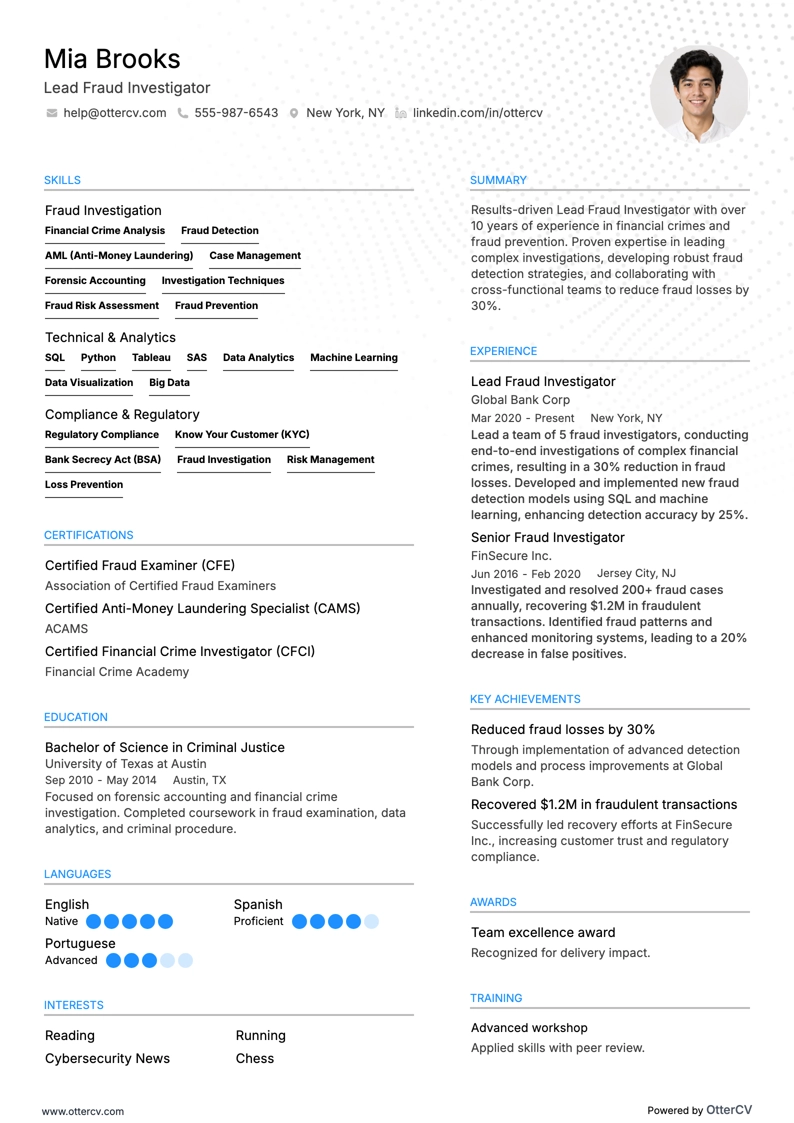
Lead Fraud Investigator full preview

10 Fraud Investigator Resume Examples

OtterCV

Written by The OtterCV Team

Updated: 9/15/2023•8 min read

See all resume examples in this guide, or generate your own resume example with your personalized prompt

Lead Fraud Investigator resume example

Lead Fraud Investigator

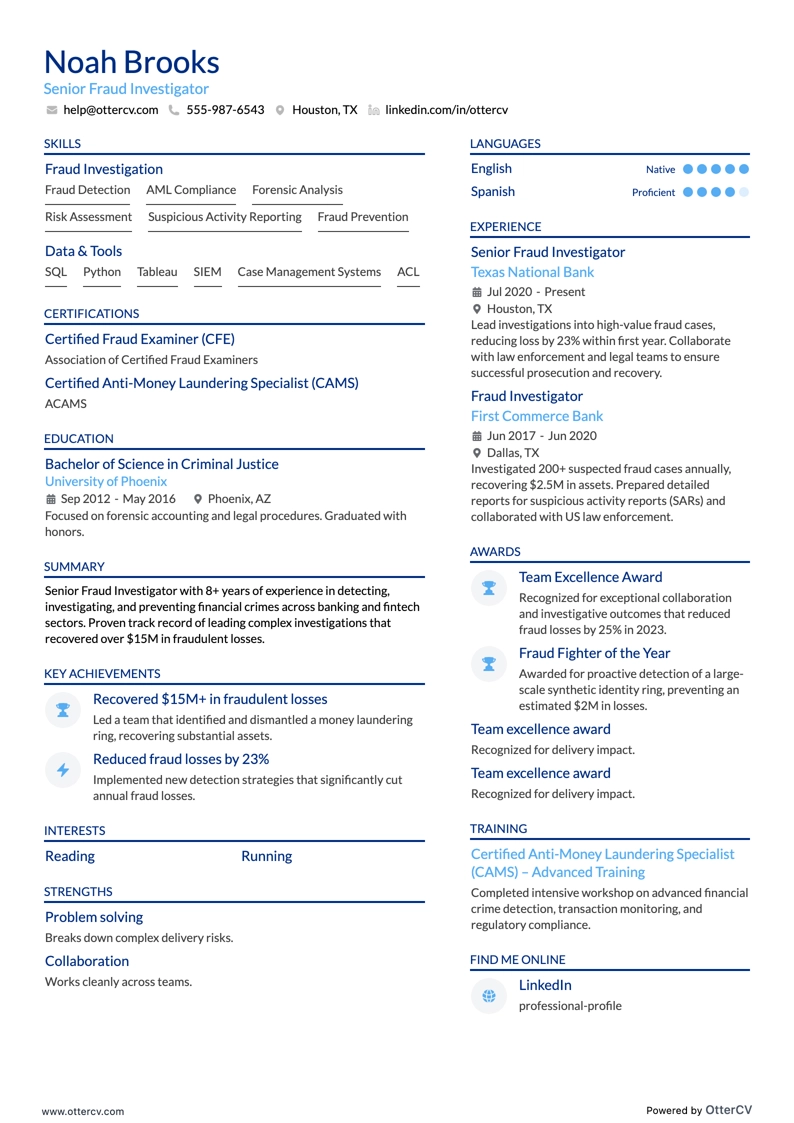
Senior Fraud Investigator resume example

Senior Fraud Investigator

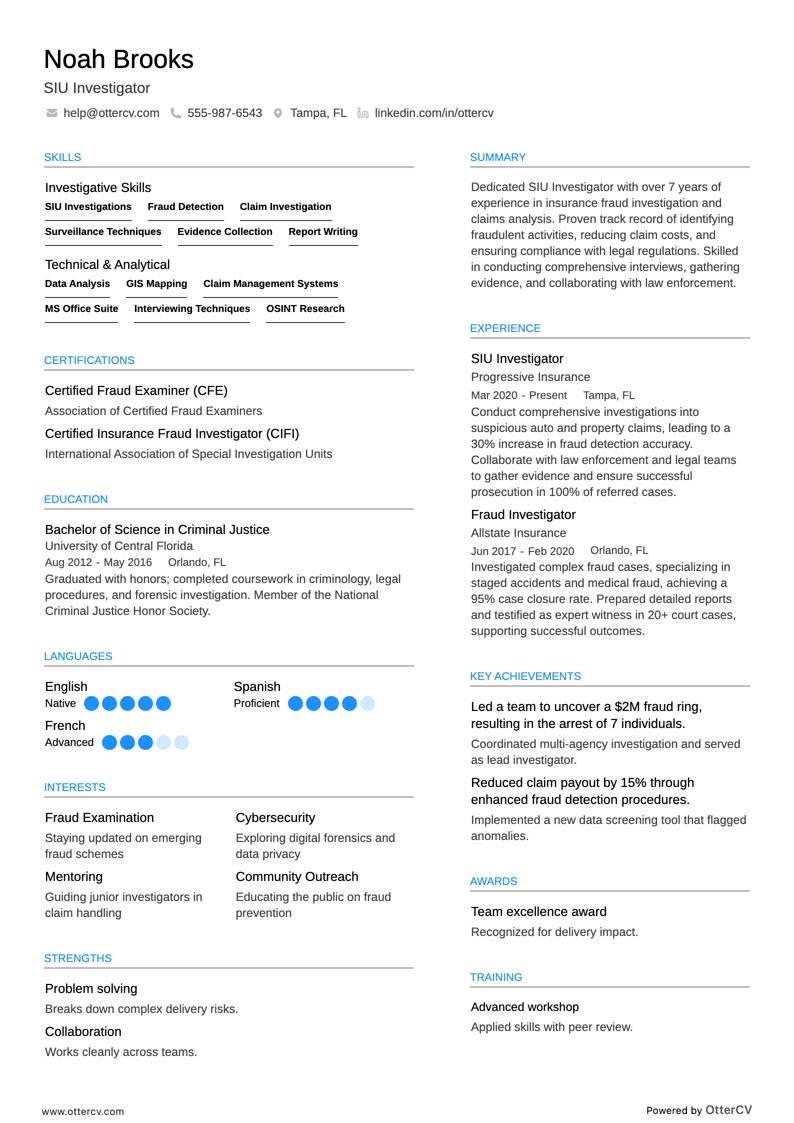
SIU Investigator resume example

SIU Investigator

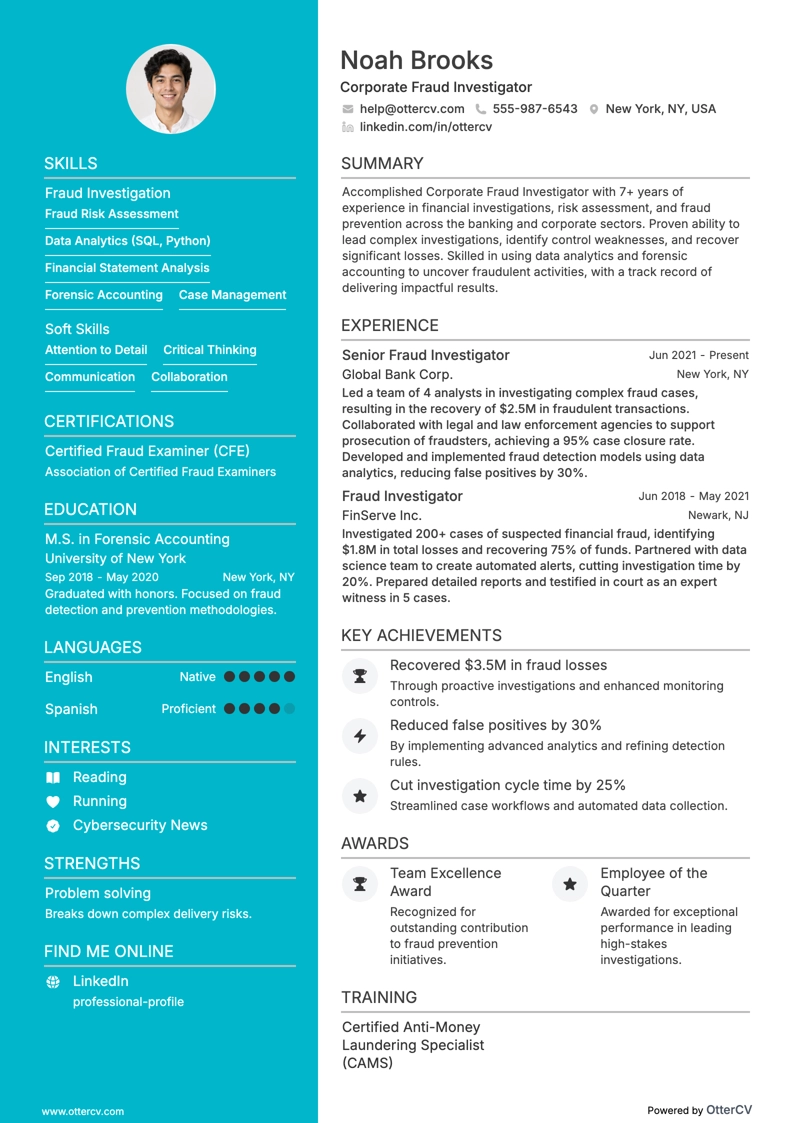
Corporate Fraud Investigator resume example

Corporate Fraud Investigator

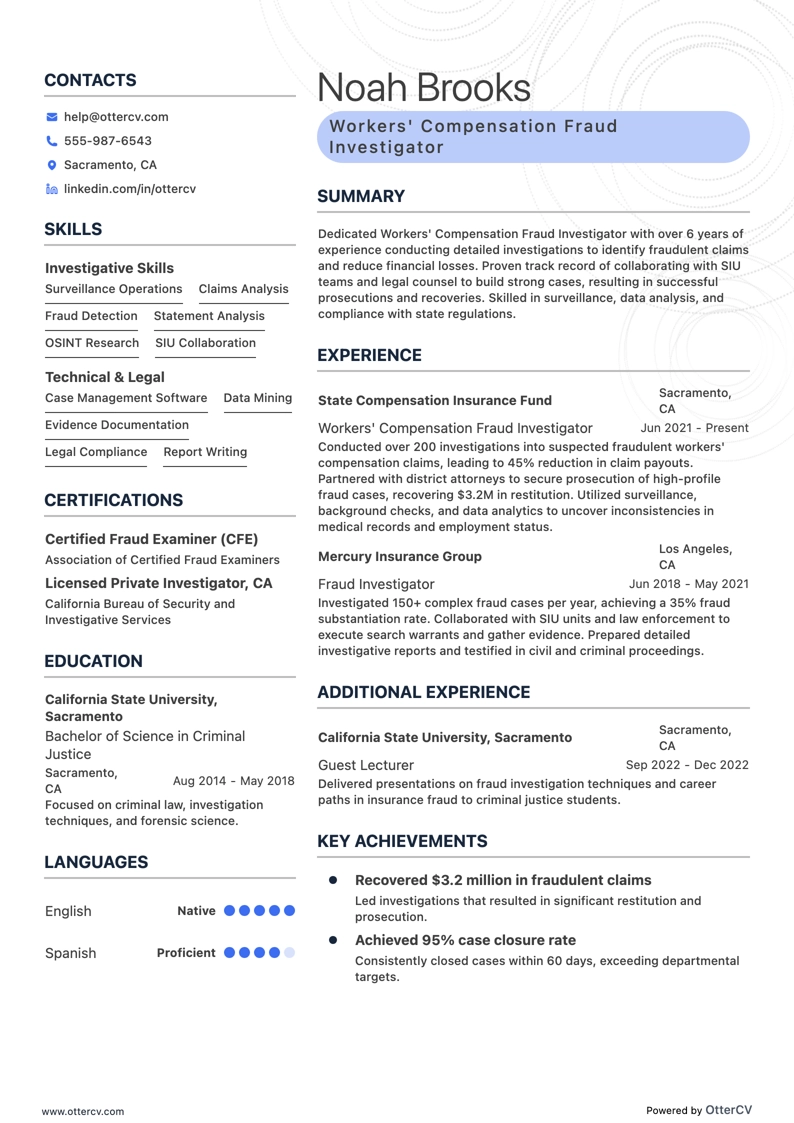
Workers' Compensation Fraud Investigator resume example

Workers' Compensation Fraud Investigator

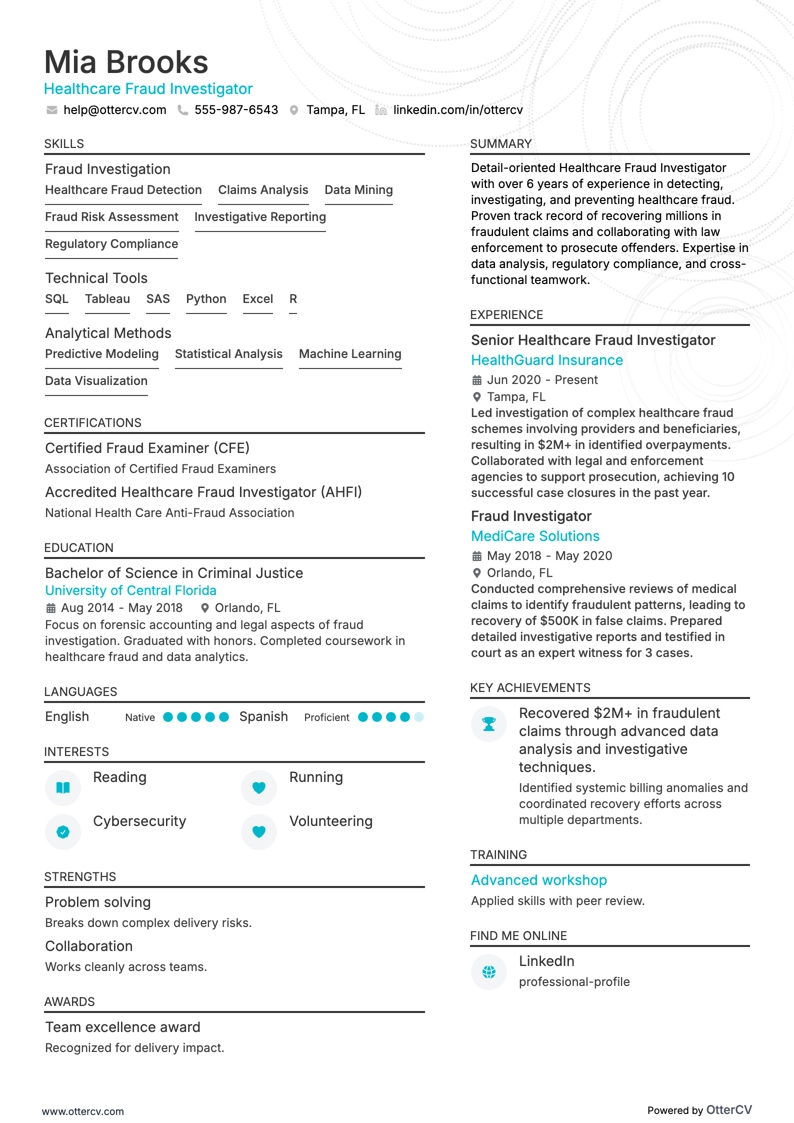
Healthcare Fraud Investigator resume example

Healthcare Fraud Investigator

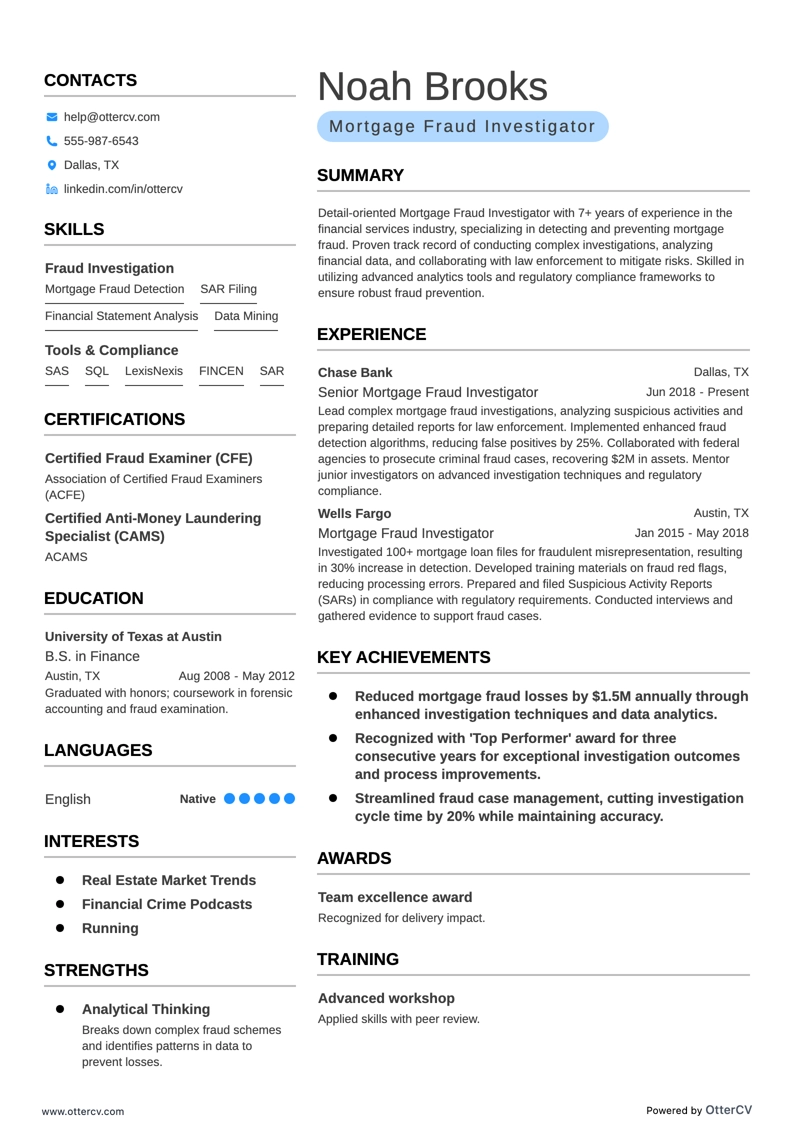
Mortgage Fraud Investigator resume example

Mortgage Fraud Investigator

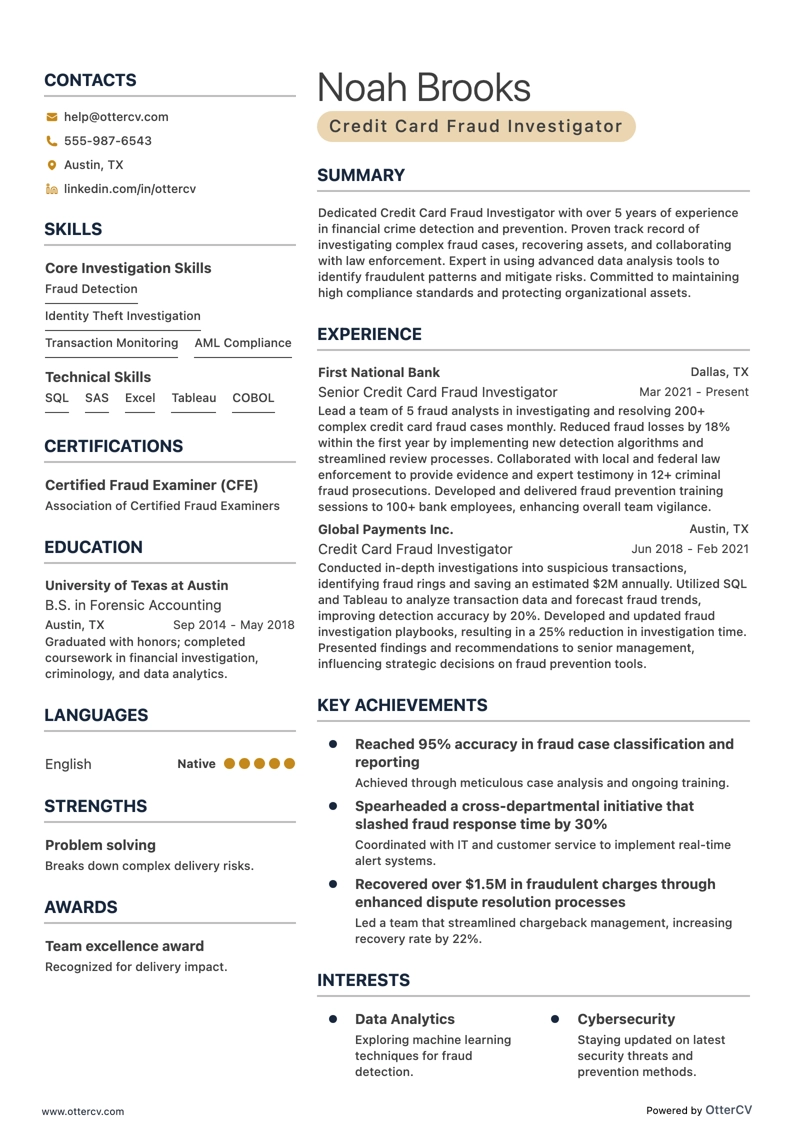
Credit Card Fraud Investigator resume example

Credit Card Fraud Investigator

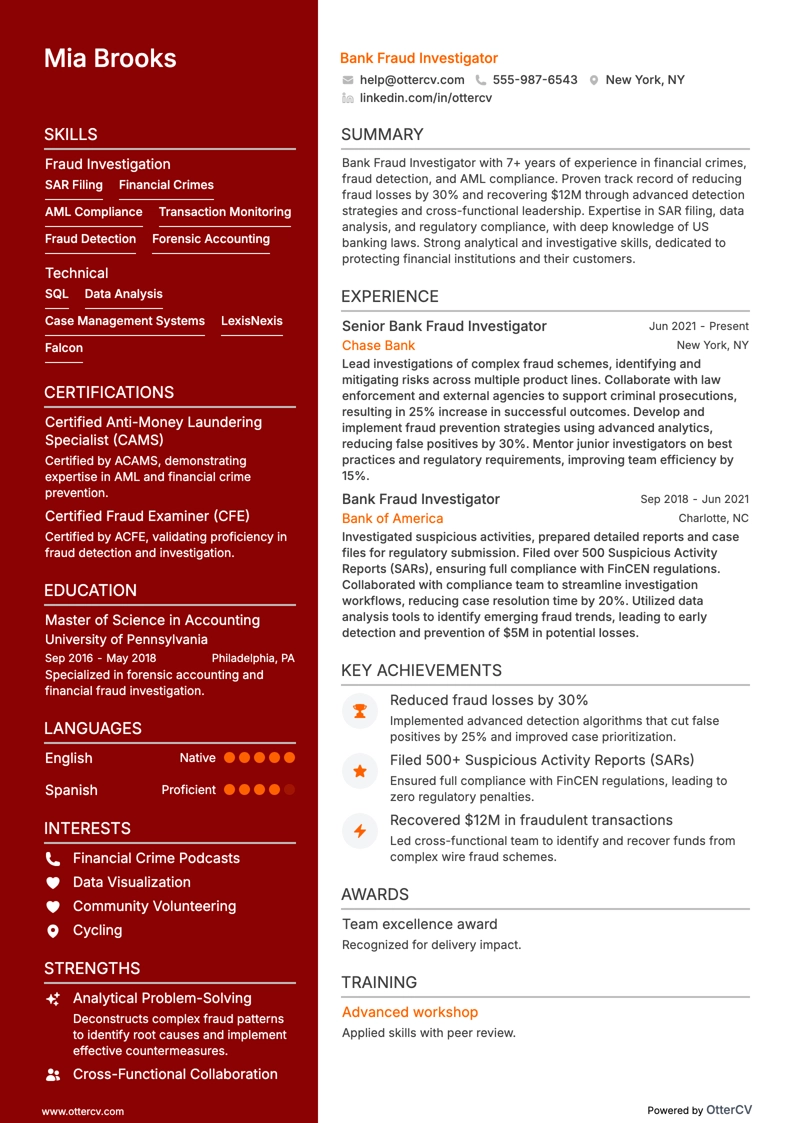
Bank Fraud Investigator resume example

Bank Fraud Investigator

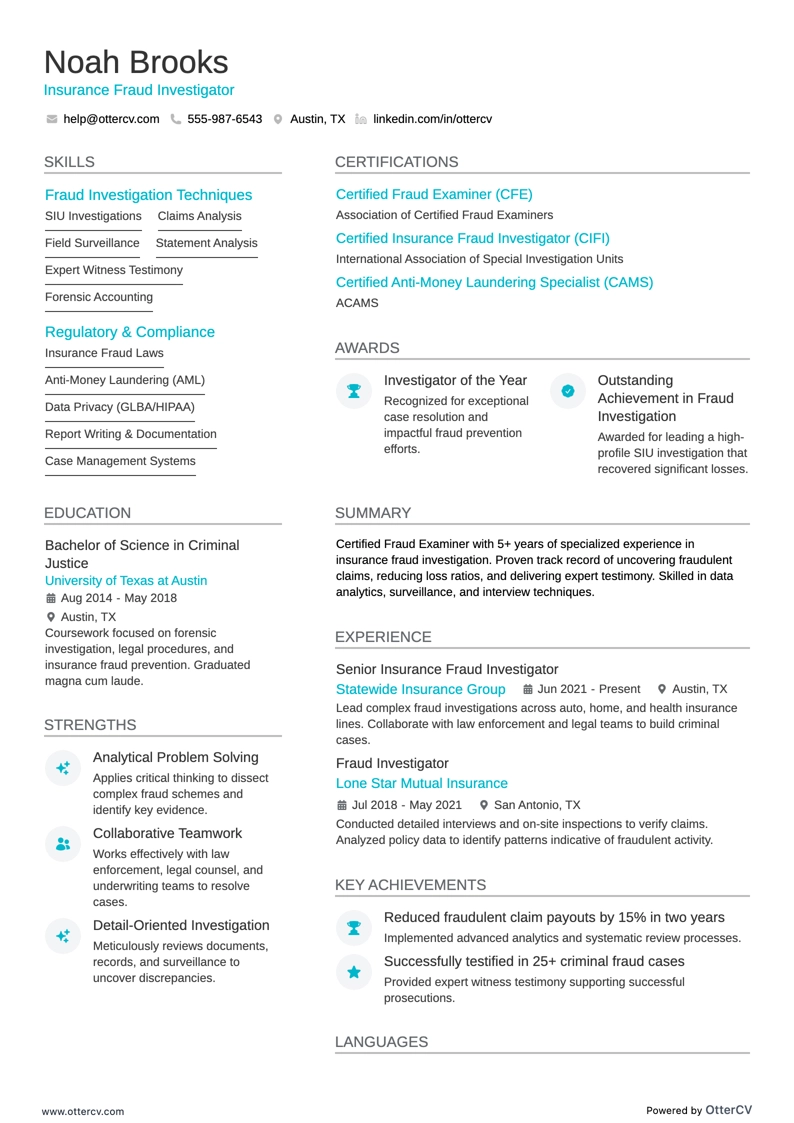
Insurance Fraud Investigator resume example

Insurance Fraud Investigator

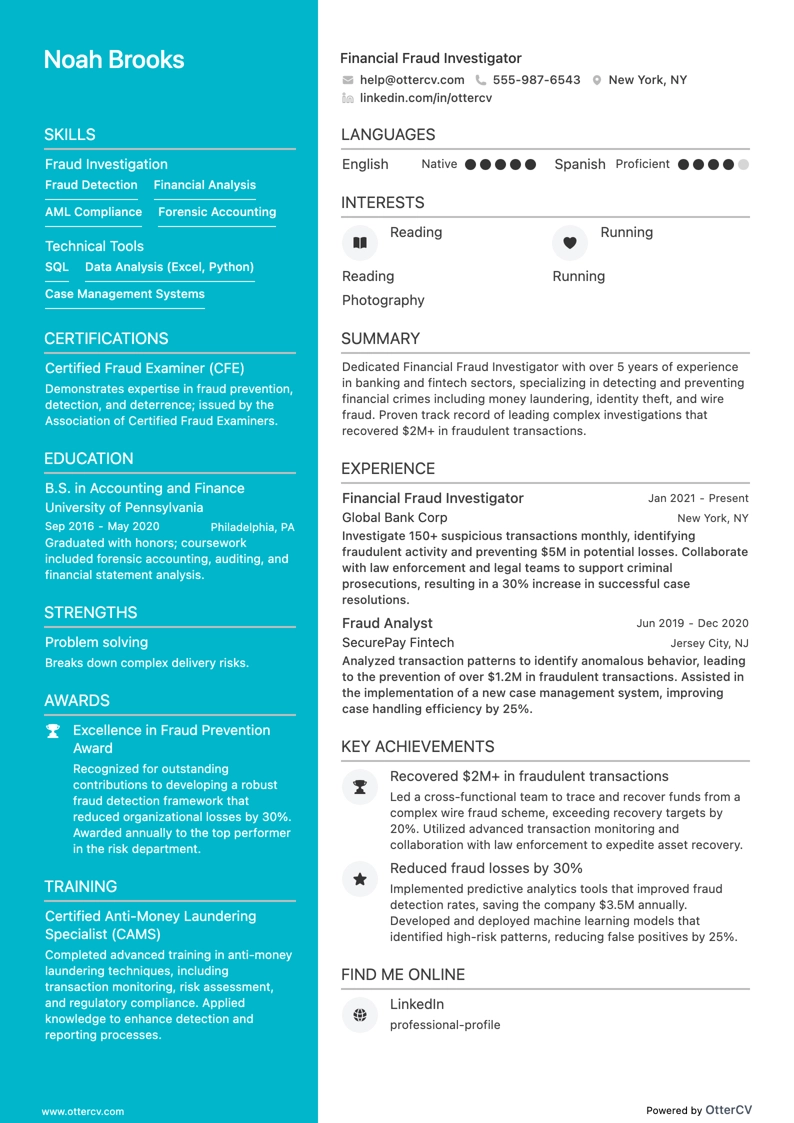
Financial Fraud Investigator resume example

Financial Fraud Investigator

Many fraud investigator resumes fall short because they read like case logs instead of hiring documents, with results buried beneath tools and tasks. That creates problems when an ATS is filtering for keywords and recruiters are scanning applications in seconds in a competitive market. If you need a refresher on the basics, our guide on how to write a resume covers the essentials before you focus on role-specific details.

A strong resume should show how you protect revenue and reduce risk. Highlight dollars prevented or recovered, reductions in false positives, case volume and cycle time, SAR or chargeback outcomes, audit findings cleared, and cross-team impact.

Key takeaways

  • Quantify fraud outcomes with dollars recovered, cases resolved, and reduced cycle time.

  • Use a reverse-chronological format for experienced investigators and a hybrid format for career changers.

  • Match the exact tools, frameworks, and terminology used in each job posting.

  • Write each experience bullet with an action verb, a specific task, and a measurable result.

  • Open your summary with years of experience, domain expertise, and one standout achievement.

  • Place certifications such as CFE or CAMS near education to quickly reinforce specialized credibility.

  • Use Echocv to turn vague duties into recruiter-ready bullets with clear metrics.

Job market snapshot for fraud investigators

We analyzed 75 recent fraud investigator job ads across major US job boards to give you a quick view of experience requirements, top hiring companies, and industry demand.

What level of experience employers are looking for fraud investigators

Years of ExperiencePercentage found in job ads
1–2 years4.0% (3)
3–4 years14.7% (11)
5–6 years2.7% (2)
7–8 years12.0% (9)
9–10 years1.3% (1)
10+ years2.7% (2)
Not specified64.0% (48)

Fraud investigator ads by area of specialization (industry)

Industry (Area)Percentage found in job ads
Finance & Banking58.7% (44)
Government33.3% (25)

Top companies hiring fraud investigators

CompanyPercentage found in job ads
CONTACT GOVERNMENT SERVICES26.7% (20)

Role overview stats

These tables highlight the most common responsibilities and employment types for fraud investigator roles. Use them to align your resume with employer expectations and understand how the role is structured across the market.

Day-to-day activities and top responsibilities for a fraud investigator

ResponsibilityPercentage found in job ads
Data analysis41.3% (31)
Microsoft Excel30.7% (23)
Microsoft Word30.7% (23)
Microsoft PowerPoint29.3% (22)
Microsoft Outlook28.0% (21)
Communication12.0% (9)
Active Directory10.7% (8)
Amazon Web Services10.7% (8)
Artificial intelligence10.7% (8)
Atlassian Jira10.7% (8)
Authentication management10.7% (8)
Backup and recovery10.7% (8)

Type of employment (remote vs on-site vs hybrid)

Employment typePercentage found in job ads
On-site80.0% (60)
Hybrid16.0% (12)

How to format a fraud investigator resume

Recruiters hiring fraud investigators look for analytical rigor, familiarity with investigation methodologies, and a proven record of resolving cases with measurable results. The right resume format makes those signals—case volume, recovery figures, tool proficiency, and collaboration with legal or compliance teams—immediately clear instead of hiding your progression behind poor formatting choices.

I have significant experience in this role—which format should I use?

I have significant experience in this role—which format should I use?

Use a reverse-chronological format to present your investigative career in a clear, linear progression that highlights increasing caseload responsibility and domain expertise.

  • Start with your most recent role and emphasize scope, including team size, case volume, jurisdictions covered, and cross-functional coordination with law enforcement or compliance units.
  • Highlight role-specific tools and domains such as SAS, ACL, i2 Analyst's Notebook, Verafin, SAR filing, anti-money laundering frameworks, or insurance fraud detection platforms.
  • Quantify outcomes tied to financial recovery, loss prevention, case resolution rates, or policy improvements you directly influenced.

Example bullet: “Managed a portfolio of 120+ fraud cases annually, leveraging SAS and i2 Analyst's Notebook to identify organized fraud rings, resulting in $2.4M in recovered assets and a 35% reduction in average case resolution time.”

I'm junior or switching into this role—what format works best?

I'm junior or switching into this role—what format works best?

A hybrid resume format works best because it lets you lead with relevant analytical and investigative skills while still showing a concise work history for professional context.

Do:

  • Place a dedicated skills section near the top of your resume, highlighting fraud detection tools, data analysis platforms, regulatory knowledge, and relevant certifications such as the Certified Fraud Examiner (CFE) designation.
  • Include academic projects, internships, or transitional experience—such as compliance auditing, loss prevention, or financial analysis roles—that demonstrate investigative thinking and attention to detail.
  • Connect every action to a clear result so recruiters see cause and effect, not just task descriptions.

Example scaffold: "Data analysis (skill) → conducted transaction anomaly reviews across 10,000+ records during a compliance internship (action) → flagged 47 suspicious accounts later confirmed as fraudulent, contributing to $180K in prevented losses (result)."

Why not use a functional resume?

Why not use a functional resume?

A functional resume removes the timeline and context recruiters need to understand how you applied your investigative skills in real workplace settings. That makes it harder for them to assess your competence and credibility.

This format may still be considered by:

  • Career changers from law enforcement, accounting, or compliance who have transferable analytical and investigative skills but do not yet hold a formal fraud investigator title.
  • Recent graduates with relevant internships or capstone projects in fraud examination, forensic accounting, or criminal justice who lack full-time experience.
  • Candidates with extended resume gaps due to personal circumstances or industry transitions who need to emphasize certifications and skills.

Even in these cases, every skill should be tied to a specific project, case study, or measurable outcome. Never list skills in isolation. If you have more than one year of directly relevant fraud investigation experience, avoid a functional resume entirely, as it can raise questions about what your timeline is hiding.

Once your layout and formatting are set, the next step is choosing resume sections that reinforce your qualifications.

What sections should go on a fraud investigator resume

Recruiters expect a fraud investigator resume to show investigative experience, case outcomes, and compliance knowledge at a glance. Knowing what to put on a resume helps you prioritize the right content from the start.

Use this structure for maximum clarity:

  • Header
  • Summary
  • Experience
  • Skills
  • Projects
  • Education
  • Certifications
  • Optional sections: Awards, Publications, Languages

Your strongest experience bullets should emphasize measurable impact, case volume and complexity, dollar amounts prevented or recovered, tools used, and results delivered in audits, referrals, or prosecutions.

Once you’ve organized your resume with the right components, the next step is writing your fraud investigator experience section to show how you applied those elements in real investigations.

How to write your fraud investigator resume experience

Your work experience section is where you prove you’ve actually caught fraud, recovered losses, and protected organizations, not just monitored alerts. Hiring managers care more about demonstrated impact than generic task lists, so each bullet should show the results you delivered, the investigative tools or methods you used, and measurable outcomes tied to fraud detection, prevention, or resolution.

Each entry should include:

  • Job title
  • Company and location (or remote)
  • Dates of employment (month and year)

Add three to five concise bullet points that explain what you owned, how you executed, and what outcomes you delivered:

  • Ownership scope: the case portfolios, fraud categories, account populations, monitoring systems, or investigative teams you were directly responsible for as a fraud investigator.
  • Execution approach: the tools, frameworks, technologies, or methods you used to investigate and resolve fraud, such as case management platforms, data analytics software, transaction monitoring systems, regulatory databases, evidence preservation protocols, or interview techniques.
  • Value improved: changes to detection accuracy, false-positive rates, case resolution speed, loss recovery, compliance posture, or organizational risk exposure resulting from your investigative work.
  • Collaboration context: how you worked with law enforcement agencies, compliance teams, legal counsel, financial institutions, internal audit, or technology partners to advance investigations and strengthen fraud prevention controls.
  • Impact delivered: outcomes such as recovered funds, reduced fraud losses, successful prosecutions, stronger controls, or risk mitigation at scale, framed as results rather than activities.

Experience bullet formula

Experience bullet formula

Action verb + technology + what you built or fixed + measurable result

A fraud investigator experience example

Fraud Investigator

PayWave Financial | Austin, TX | 2022–Present

Digital payments platform supporting five million customers and mid-market merchants across the US.

  • Led end-to-end investigations across card-not-present, account takeover, and synthetic identity cases using SQL, Excel, and Splunk; reduced fraud loss rate by 18% year over year while maintaining a 0.6% false-positive rate.
  • Built and tuned rules in Actimize and internal risk engines using device fingerprinting, IP intelligence, and velocity checks; cut high-risk transaction approval time from 24 hours to 4 hours and prevented $1.3M in confirmed losses.
  • Partnered with product managers and engineers to ship step-up authentication and KYC (know your customer) flow changes; increased verified-user conversion by 6% while lowering new-account fraud by 22%.
  • Produced and presented weekly fraud trend reporting in Tableau and Jira to operations and leadership; improved case triage accuracy by 15% and reduced backlog from 9 days to 3 days.
  • Coordinated with bank partners, legal, and customer support to file SARs (Suspicious Activity Reports) and support chargeback disputes; improved representment win rate by 11% and recovered $420K in revenue.

Now that you’ve seen what a strong experience section looks like, the next step is adjusting yours for the specific role you want.

How to tailor your fraud investigator resume experience

Recruiters review fraud investigator resumes through both applicant tracking systems and manual screening, so tailoring your resume to the job description is essential. A tailored experience section helps your qualifications match the language, tools, and priorities each employer emphasizes.

Ways to tailor your fraud investigator experience:

  • Mirror the exact fraud detection software or platforms listed in the job posting.
  • Match the terminology used for investigative methods, such as SARs or link analysis.
  • Reflect the compliance frameworks or regulatory standards the employer references.
  • Highlight experience in the specific industry the role targets.
  • Use the same KPIs or case resolution metrics prioritized in the job description.
  • Emphasize collaboration with law enforcement or legal teams when relevant.
  • Align your experience with any anti-money laundering or BSA requirements mentioned.
  • Include the data analytics tools or forensic technologies named in the posting.

Tailoring means aligning your real accomplishments with the role’s stated requirements, not stuffing unrelated keywords into your experience bullets.

Resume tailoring examples for fraud investigator

Job description excerptUntailoredTailored
Conduct detailed investigations of suspected fraudulent insurance claims using SIU protocols, including recorded statements, scene inspections, and database cross-referencing through ISO ClaimSearch.Investigated fraud cases and reported findings to management.Conducted 40+ SIU investigations annually into suspected fraudulent insurance claims, performing recorded statements, coordinating scene inspections, and cross-referencing claimant data through ISO ClaimSearch to identify inconsistencies.
Analyze transactional data in SQL and SAS to detect patterns of internal and external fraud across banking operations, escalating confirmed cases to BSA/AML compliance teams.Reviewed data to find fraud and worked with compliance.Analyzed over 500,000 monthly transactions using SQL and SAS to detect internal and external fraud patterns across retail banking operations, escalating 15–20 confirmed cases per quarter to BSA/AML compliance teams.
Lead end-to-end healthcare fraud investigations involving Medicare and Medicaid billing irregularities, prepare case documentation for referral to the OIG, and testify as a subject matter expert when required.Managed fraud investigations and prepared documentation for leadership review.Led end-to-end investigations into Medicare and Medicaid billing irregularities, preparing detailed case documentation that resulted in 12 successful referrals to the OIG over two years and testifying as a subject matter expert in three federal proceedings.

Once you’ve aligned your experience with the role’s requirements, quantify your fraud investigator achievements to show the measurable impact of your work.

How to quantify your fraud investigator achievements

Quantifying your achievements shows your ability to reduce fraud risk, protect revenue, and improve investigation efficiency. Focus on case volume, cycle time, accuracy, loss prevented, chargeback reduction, compliance results, and tool-driven productivity gains.

Quantifying examples for fraud investigator

MetricExample
Cycle timeCut average investigation turnaround from 3.2 days to 1.4 days by standardizing evidence checklists and prioritizing queues in ServiceNow.
Accuracy rateImproved true-positive rate from 62% to 78% by tuning rules in SAS and validating alerts against chargeback outcomes.
Loss preventedPrevented $420K in confirmed fraud losses in one quarter by escalating high-risk rings and coordinating account freezes with operations.
Case throughputResolved 145 cases per week on average, up from 95, by batching data pulls in SQL and automating report templates in Excel.
Compliance qualityAchieved a 98% audit pass rate across 60 sampled cases by tightening documentation standards and meeting all suspicious activity report deadlines.

How to list your hard and soft skills on a fraud investigator resume

Once you’ve written strong experience bullets, make sure your resume also highlights the hard and soft skills that qualify you for a fraud investigator role.

Your skills section shows that you can detect, investigate, and stop fraud. Recruiters and ATS (applicant tracking systems) scan this section for job-match keywords, so include a balanced mix of hard skills, such as investigation tools, and role-specific soft skills.

Fraud investigator roles require a blend of:

  • Product strategy and discovery skills.
  • Data, analytics, and experimentation skills.
  • Delivery, execution, and go-to-market discipline.
  • Soft skills.

Your skills section should be:

  • Scannable, using bullet-style grouping.
  • Relevant to the job post.
  • Backed by proof in your experience bullets.
  • Updated with current tools.

Place your skills section:

  • Above your experience if you’re junior or switching careers.
  • Below your experience if you’re mid- or senior-level with strong achievements.

Hard skills

  • Experience with fraud case management systems.
  • Conducting suspicious activity investigations.
  • Tuning transaction monitoring rules.
  • Handling anti-money laundering investigations.
  • Performing know your customer verification.
  • Managing sanctions screening workflows.
  • Analyzing chargebacks and disputes.
  • Using link analysis and entity resolution.
  • Working with SQL, Excel, and Python.
  • Using Tableau and Power BI.
  • Applying OSINT and digital forensics.
  • Drafting and filing SARs.

Soft skills

  • Write clear investigative narratives.
  • Interview customers and staff.
  • Challenge assumptions with evidence.
  • Prioritize cases by risk.
  • Escalate issues with context.
  • Coordinate with legal and HR.
  • Communicate findings to stakeholders.
  • Maintain chain of custody.
  • Make decisions under time pressure.
  • Document work for audit readiness.
  • Protect sensitive information.
  • Resolve cross-team blockers.

How to show your fraud investigator skills in context

Skills should not appear only in a bulleted list on your resume. Browse our curated resume skills examples to see how other professionals present their capabilities effectively.

Your skills should be demonstrated in:

  • Your summary (high-level professional identity)
  • Your experience (proof through outcomes)

Here is what strong, contextual skill placement looks like in practice.

Summary example

Senior fraud investigator with 10+ years of experience in financial services, specializing in anti-money laundering and forensic data analysis. Proficient in SAS, Actimize, and link analysis. Led a cross-functional team that reduced false positives by 37%.

  • Clearly reflects senior-level experience
  • Directly names industry-standard tools
  • Quantifies a meaningful outcome
  • Highlights cross-functional leadership ability

Senior Fraud Investigator

Meridian Financial Group | Remote

March 2019–Present

  • Investigated 200+ complex fraud cases annually using Actimize and i2 Analyst's Notebook, recovering $4.2M in losses.
  • Partnered with compliance, legal, and law enforcement teams to build case referrals, improving prosecution rates by 28%.
  • Designed a transaction-monitoring rule set that reduced false-positive alerts by 34%, saving analysts 15 hours per week.
  • Every bullet includes measurable proof.
  • Skills surface naturally through outcomes.

Once you’ve grounded your capabilities in real examples and outcomes, the next step is learning how to write a fraud investigator resume with no experience so you can present that evidence effectively, even without a formal fraud title.

How do I write a fraud investigator resume with no experience

Even without full-time experience, you can show readiness through:

  • Fraud case study capstone project
  • AML (anti-money laundering) coursework
  • Chargeback and dispute analysis project
  • SQL and Excel data audits
  • KYC (know your customer) mock reviews
  • Internship in compliance or risk
  • Volunteer role handling sensitive data

Our guide on writing a resume without work experience walks you through how to position these strengths effectively.

Focus on:

  • Evidence-based investigations and documentation
  • Data analysis tools and queries
  • Compliance frameworks and reporting standards
  • Clear, quantified impact and accuracy

Resume format tip for entry-level fraud investigator

Resume format tip for entry-level fraud investigator

Use a skills-based resume format if your work history is limited, because it puts more focus on investigations, analytics, and compliance experience.

Do the following:

  • Lead with a summary of fraud investigator skills.
  • Add a projects section with measurable results.
  • List tools such as SQL, Excel, and Tableau.
  • Include compliance exposure, including KYC and AML.
  • Use action verbs and metrics.

Example project bullet:

  • Built SQL queries to flag duplicate refunds, reviewed 200 transactions, and documented ten high-risk cases with a 95% match rate against test labels.

Once you’ve highlighted your transferable skills and relevant strengths to offset limited experience, the next step in building credibility is your educational background.

How to list your education on a fraud investigator resume

Your education section helps hiring teams quickly confirm that you have the foundational knowledge needed for fraud investigation. It also reinforces your analytical training and relevant academic background.

Include:

  • Degree name
  • Institution
  • Location
  • Graduation year
  • Relevant coursework for juniors or entry-level candidates
  • Honors and GPA if 3.5 or higher

Skip the month and day details, and list the graduation year only.

Here’s a strong education entry tailored to a fraud investigator resume.

Example education entry

Bachelor of Science in Criminal Justice

George Mason University, Fairfax, VA

Graduated 2021

GPA: 3.7/4.0

  • Relevant coursework: Financial Crime Analysis, Forensic Accounting, White-Collar Crime, and Data Analytics
  • Honors: Magna Cum Laude, Dean's List (six consecutive semesters)

How to list your certifications on a fraud investigator resume

Certifications show your commitment to learning, confirm tool proficiency, and demonstrate industry relevance as a fraud investigator. They also help recruiters trust your judgment, methods, and compliance knowledge.

Include the following details:

  • Certificate name
  • Issuing organization
  • Year
  • Optional: credential ID or URL
  • Place certifications below education when they are older, less relevant, or when you want your degree to lead your qualifications.
  • Place certifications above education when they are recent, highly relevant, or required for the fraud investigator roles you are targeting.

Best certifications for your fraud investigator resume

  • Certified Fraud Examiner (CFE).
  • Certified Anti-Money Laundering Specialist (CAMS).
  • Certified Financial Crime Specialist (CFCS).
  • Certified in Financial Forensics (CFF).
  • Accredited Financial Investigator (AFI).
  • Certified Forensic Interviewer (CFI).

Once you’ve positioned your credentials where hiring managers will see them, use your fraud investigator resume summary to reinforce that expertise and show your fit for the role right away.

How to write your fraud investigator resume summary

Your resume summary is often the first thing a recruiter reads, so it needs to capture attention quickly. A strong opening focused on fraud investigation shows that you understand the role and belong in the candidate pool.

Keep it to three to four lines and include:

  • Your title and total years of fraud investigation experience.
  • The industry or domain you work in, such as financial services, insurance, or healthcare.
  • Core tools and skills, such as SAS, SQL, case management systems, or data analytics.
  • One or two measurable achievements, such as cases resolved or losses recovered.
  • Soft skills connected to real results, such as attention to detail that reduced false positives.

PRO TIP

At this level, lead with relevant skills, tools, and concrete early wins instead of vague career goals. Recruiters want to see that you can investigate cases, use fraud detection platforms, and deliver results.

Avoid phrases like "passionate professional" or "eager learner." Replace them with evidence of what you’ve already accomplished.

Example summary for a fraud investigator

Fraud investigator with three years of experience in financial services. Skilled in SAS, SQL, and i-Sight case management. Resolved more than 200 cases annually, recovering $1.2M in losses through detailed transaction analysis.

Now that you’ve written a summary that highlights your investigative expertise, make sure the header above it clearly presents your contact details so hiring managers can reach you easily.

What to include in a fraud investigator resume header

A resume header lists your key identifiers and contact details, helping fraud investigator candidates stay visible, credible, and easy to screen quickly.

Essential resume header elements

  • Full name
  • Tailored job title and headline
  • Location
  • Phone number
  • Professional email
  • GitHub link
  • Portfolio link
  • LinkedIn

A LinkedIn link helps recruiters verify your experience quickly and supports faster screening.

Don’t include a photo on a fraud investigator resume unless the role is explicitly front-facing or appearance-dependent.

Match your header title to the job posting and mirror key fraud investigator keywords to improve recruiter searches and applicant tracking system sorting.

Example

Once your contact details and role information are clearly presented at the top, add optional sections that highlight relevant strengths not covered in the main resume content.

Additional sections for fraud investigator resumes

Beyond the core sections, these additions can help you stand out by showing specialized credentials and interests that strengthen your fraud investigator profile. For example, listing language skills can be especially useful if you investigate cross-border fraud or work with international compliance teams.

  • Certifications (CFE, CAMS, CPA)
  • Languages
  • Professional affiliations (ACFE, ACAMS)
  • Publications and case studies
  • Continuing education and training
  • Hobbies and interests
  • Awards and recognitions

Once you’ve strengthened your resume with relevant additional sections, pairing it with a strong cover letter can help increase your overall impact.

Do fraud investigator resumes need a cover letter

A cover letter is not required for a fraud investigator role, but it can help in competitive job searches or when hiring teams expect one. If you’re not sure how to begin, learn what a cover letter is and how it complements your resume. It can be especially useful when your resume does not fully convey your fit, impact, or context.

Use these pointers to decide when to include a cover letter and what to cover:

  • Explain your fit for the role or team by aligning your casework, tools, and risk approach with the job’s fraud types and workflows.
  • Highlight one or two projects or outcomes, such as reducing chargebacks, improving alert precision, or shortening investigation time.
  • Show that you understand the product, users, and business context, including where fraud appears in the customer journey and how decisions affect losses.
  • Address career transitions or less obvious experience by translating adjacent work into fraud investigator skills such as evidence handling, pattern analysis, and reporting.

Using AI to improve your fraud investigator resume

Whether you include a cover letter or rely on your resume alone, the next step is using AI to improve your fraud investigator resume so it aligns more closely with the role.

AI can improve your resume's clarity, structure, and impact. It can tighten your language and highlight relevant achievements, but overusing it can reduce authenticity. If you're exploring AI tools, our comparison of which AI is best for writing resumes can help you choose the right one. Once your content is clear and aligned with the role, step away from AI.

Here are 10 practical prompts to strengthen specific sections of your fraud investigator resume:

Strengthen your summary

Strengthen your summary

Rewrite my fraud investigator resume summary to emphasize investigative expertise, case outcomes, and regulatory knowledge in under four sentences.

Quantify experience bullets

Quantify experience bullets

Add measurable results to your fraud investigator experience bullets by highlighting cases resolved, dollars recovered, or fraud prevented.

Tighten action verbs

Tighten action verbs

Replace weak verbs in my fraud investigator experience section with stronger, investigation-specific action verbs.

Align skills strategically

Align skills strategically

Compare my fraud investigator skills section against this job description and identify any missing keywords I should add.

Clarify certification relevance

Clarify certification relevance

Explain how each certification listed on my fraud investigator resume directly supports the responsibilities in this job posting.

Refine project descriptions

Refine project descriptions

Rewrite my fraud investigator project descriptions so they clearly explain the problem investigated, the methods used, and the outcome achieved.

Remove redundant phrasing

Remove redundant phrasing

Identify and remove filler words and redundant phrases throughout my fraud investigator resume without changing the meaning.

Improve education section

Improve education section

Revise my fraud investigator education section to highlight coursework, honors, or training that is directly relevant to fraud detection.

Target industry language

Target industry language

Adjust my fraud investigator resume language to align with terminology commonly used in financial crimes and regulatory compliance roles.

Sharpen bullet structure

Sharpen bullet structure

Restructure each fraud investigator experience bullet into a consistent format: action verb, task, and measurable result.

Conclusion

A strong fraud investigator resume shows impact through measurable results, such as dollars recovered, cases closed, and reduced cycle time. It should also highlight role-specific skills, including case management, interviews, evidence handling, and report writing, while keeping the structure clear with focused sections and clean formatting.

Today’s hiring market rewards fraud investigators who demonstrate results, sound judgment, and consistent documentation. Using precise metrics, relevant skills, and a logical layout makes your qualifications easy to scan and shows you’re ready to contribute on day one.

Fraud Investigator resume examples

Explore additional Fraud Investigator resume samples and guides and see what works for your level of experience or role.

By Experience

Lead Fraud Investigator

Lead Fraud Investigator resume preview

Senior Fraud Investigator

Senior Fraud Investigator resume preview

Fraud Investigator resume examples

Explore additional Fraud Investigator resume samples and guides and see what works for your level of experience or role.

By Role

SIU Investigator

SIU Investigator resume preview

Corporate Fraud Investigator

Corporate Fraud Investigator resume preview

Workers' Compensation Fraud Investigator

Workers' Compensation Fraud Investigator resume preview

Healthcare Fraud Investigator

Healthcare Fraud Investigator resume preview

Mortgage Fraud Investigator

Mortgage Fraud Investigator resume preview

Credit Card Fraud Investigator

Credit Card Fraud Investigator resume preview

Bank Fraud Investigator

Bank Fraud Investigator resume preview

Insurance Fraud Investigator

Insurance Fraud Investigator resume preview

Financial Fraud Investigator

Financial Fraud Investigator resume preview