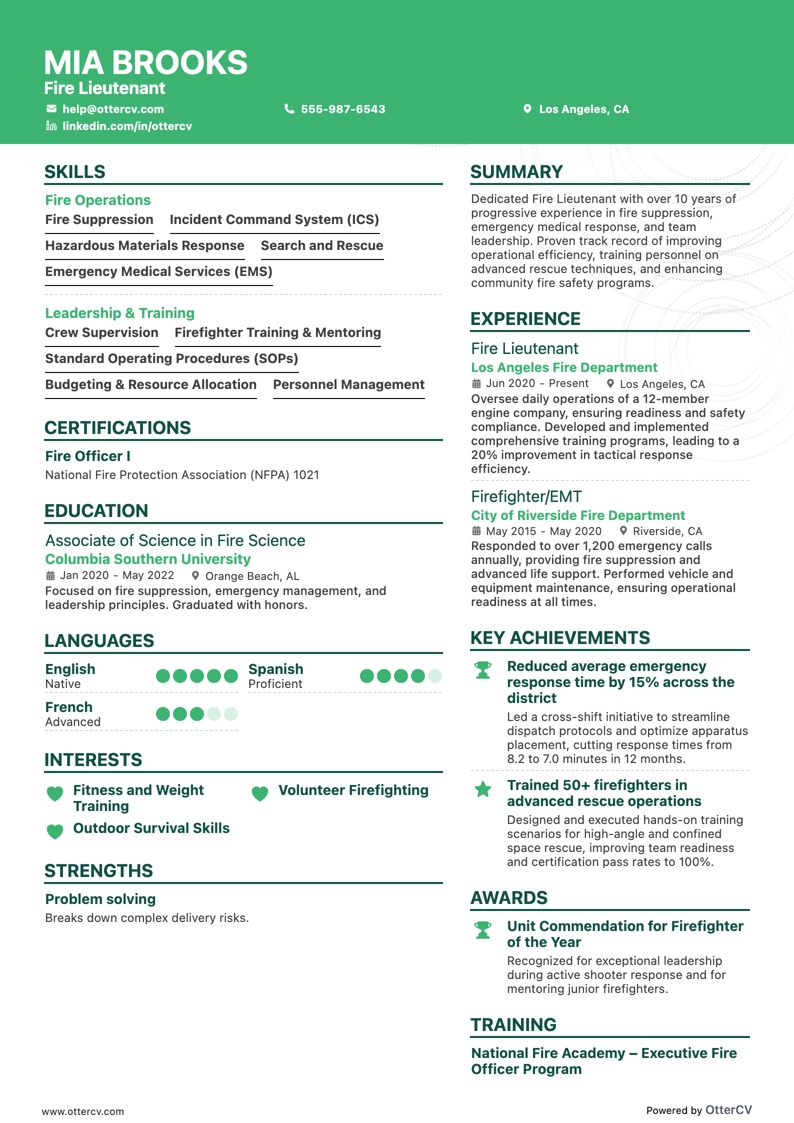
Fire Lieutenant full preview

20 Firefighter Resume Examples, Templates

OtterCV

Written by The OtterCV Team

Updated: 8/11/2023•8 min read

See all resume examples in this guide, or generate your own resume example with your personalized prompt

Fire Lieutenant resume example

Fire Lieutenant

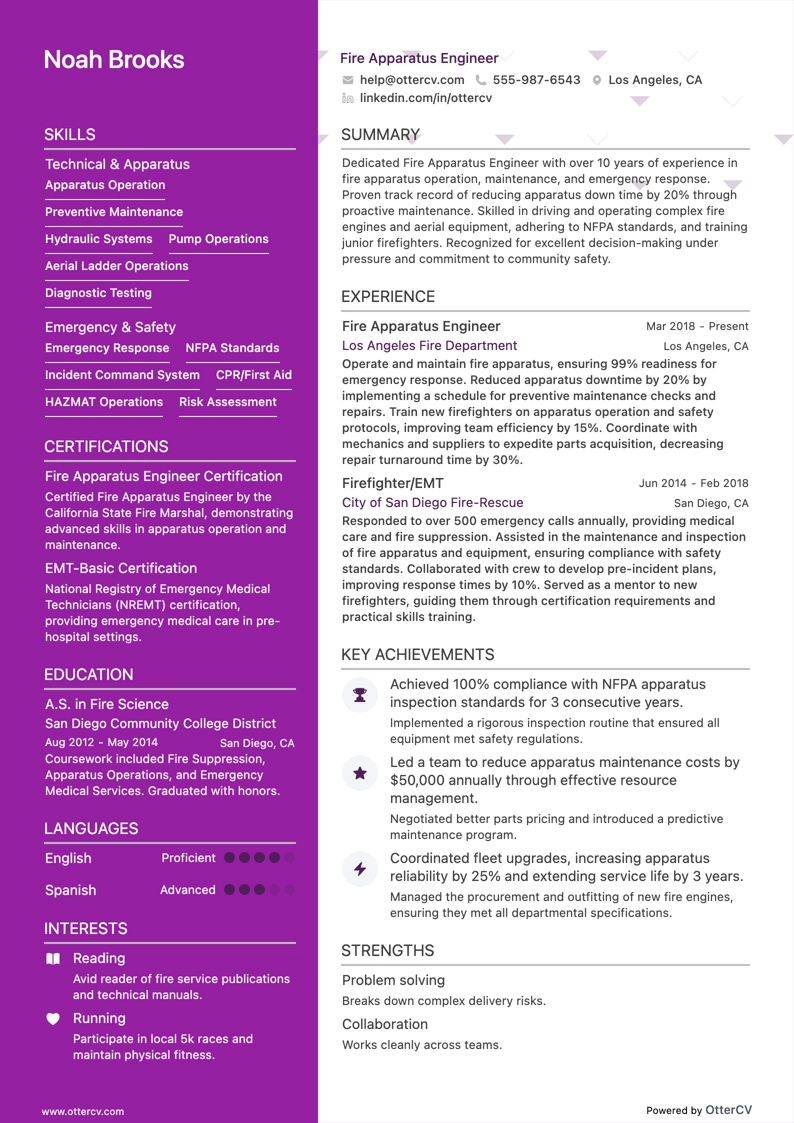
Fire Apparatus Engineer resume example

Fire Apparatus Engineer

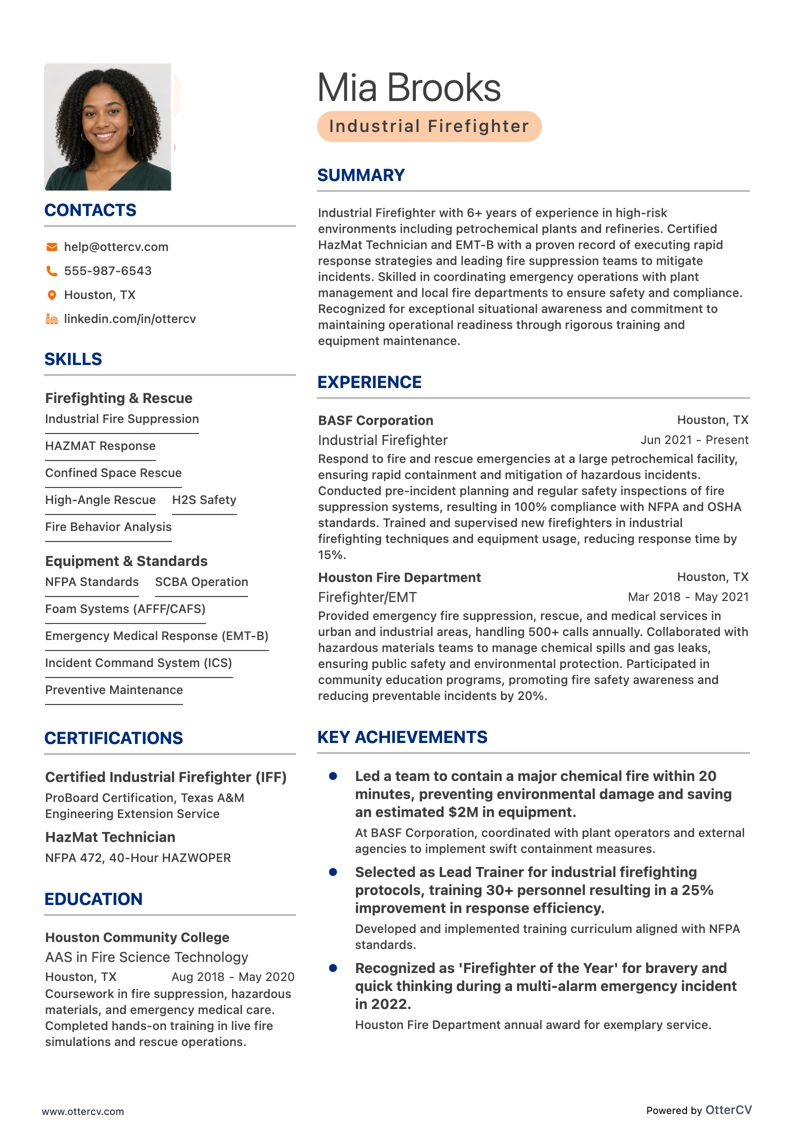
Industrial Firefighter resume example

Industrial Firefighter

ARFF Firefighter resume example

ARFF Firefighter

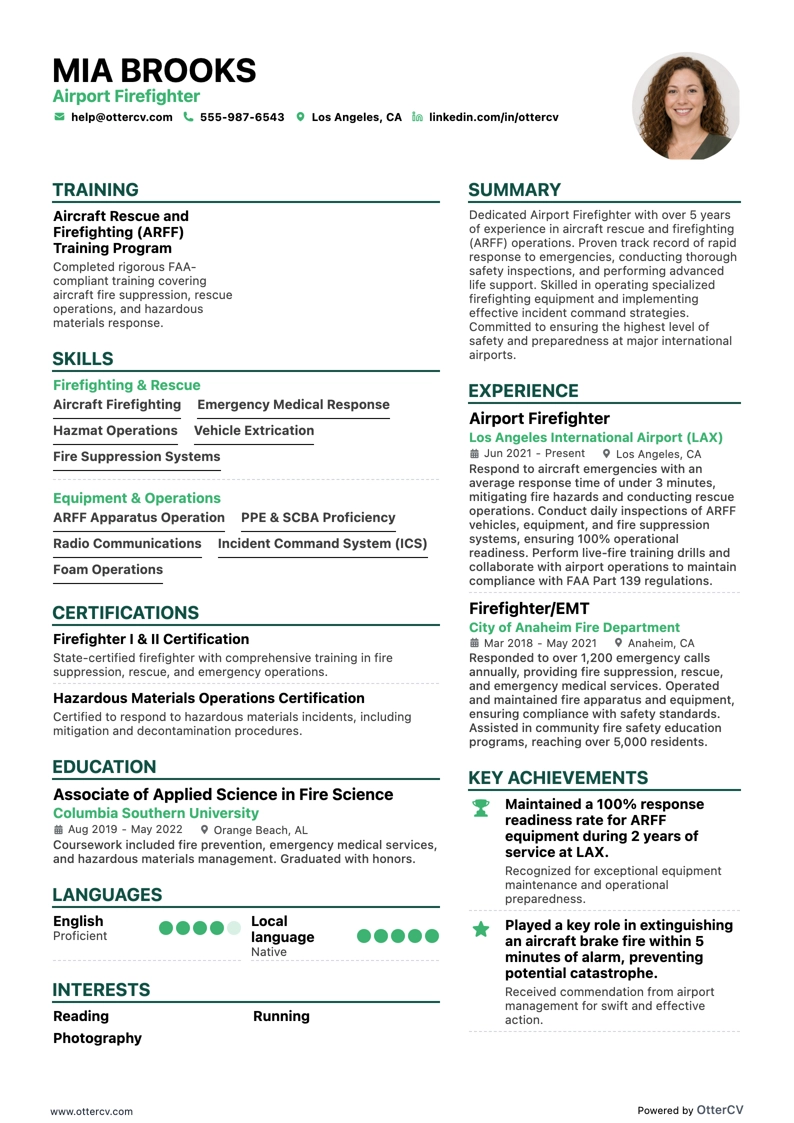
Airport Firefighter resume example

Airport Firefighter

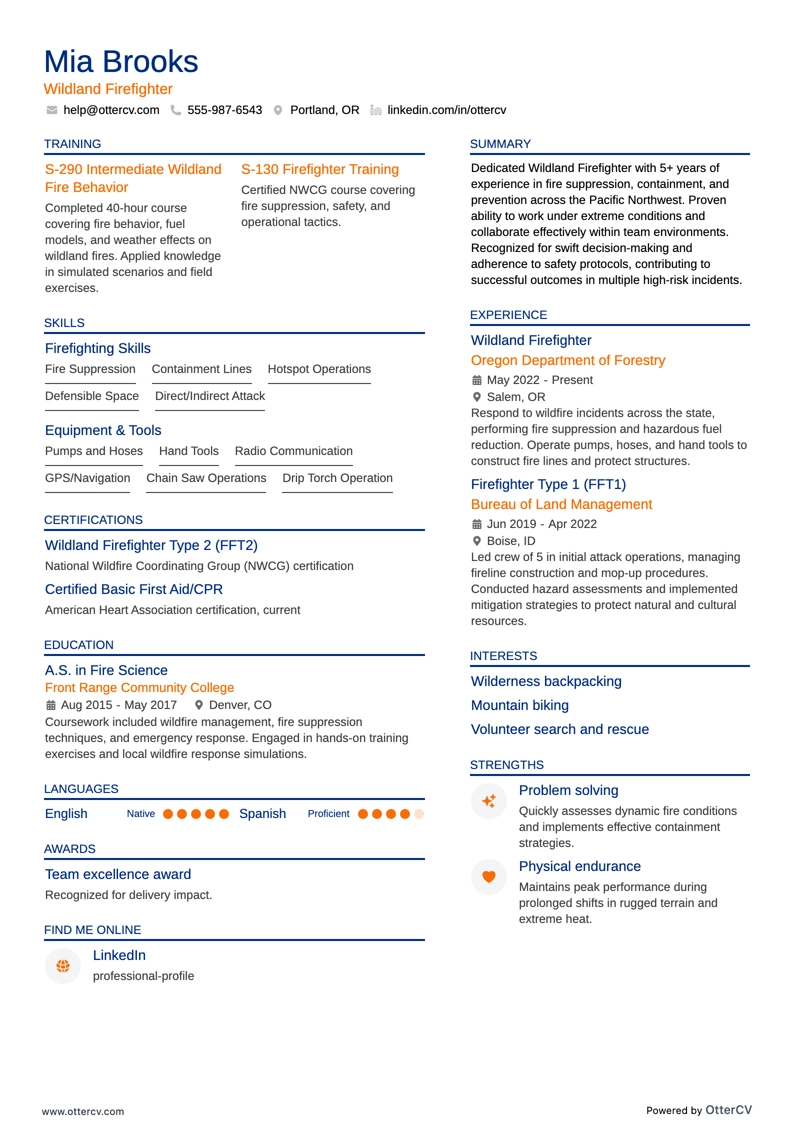
Wildland Firefighter resume example

Wildland Firefighter

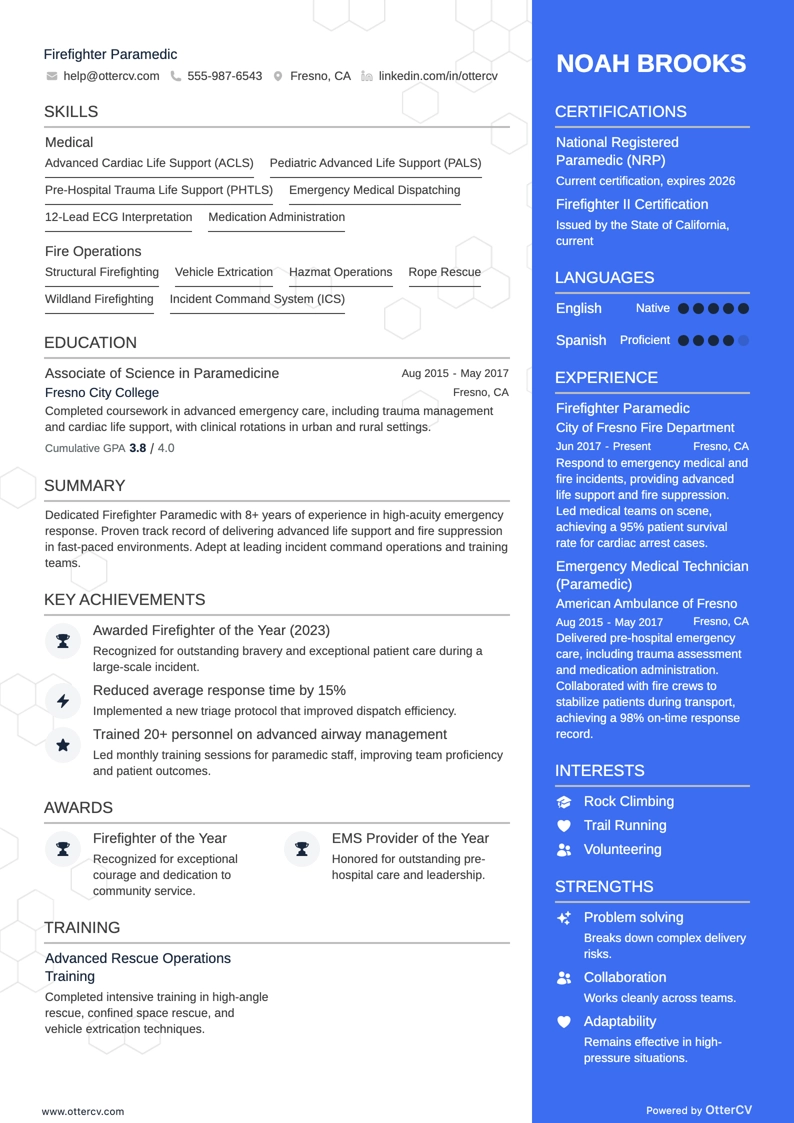
Firefighter Paramedic resume example

Firefighter Paramedic

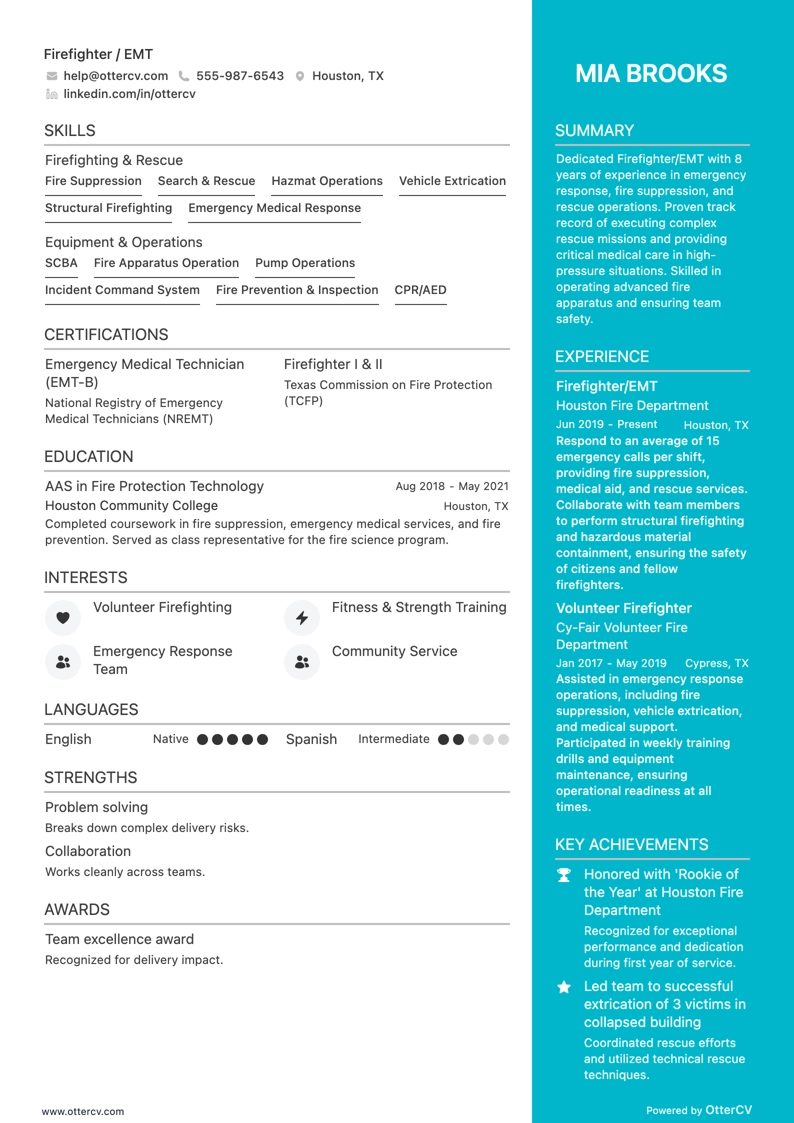
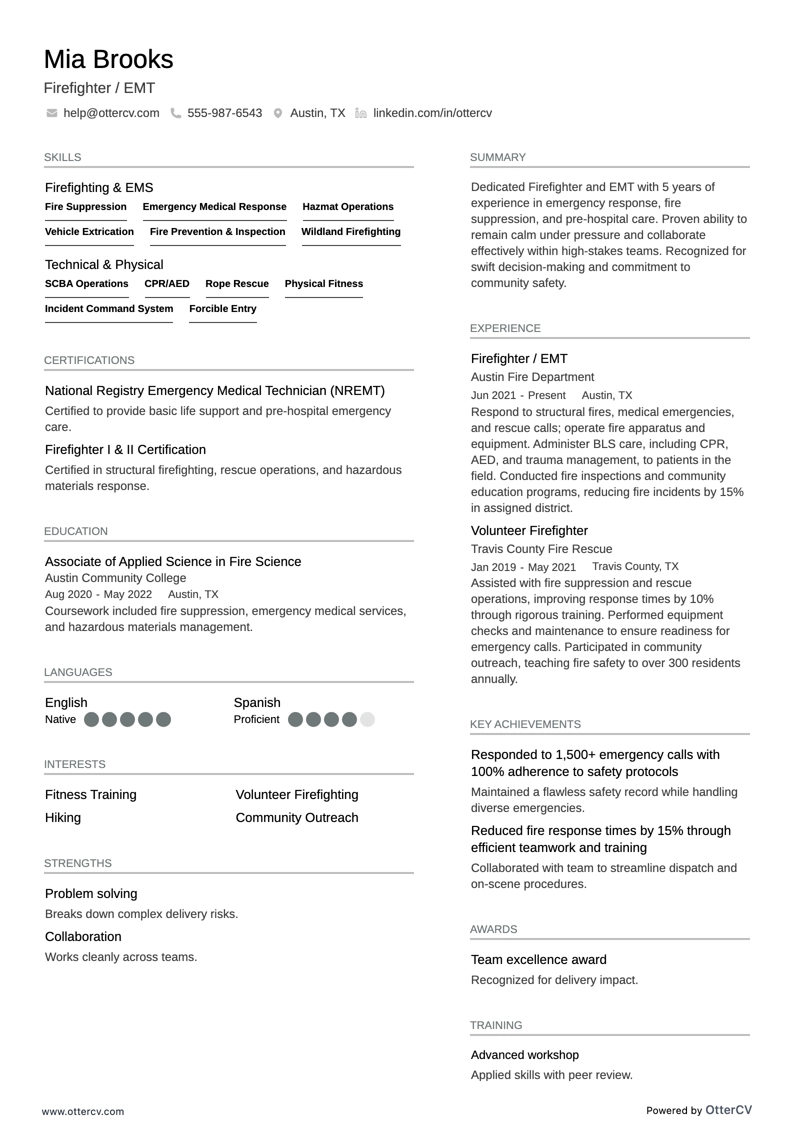
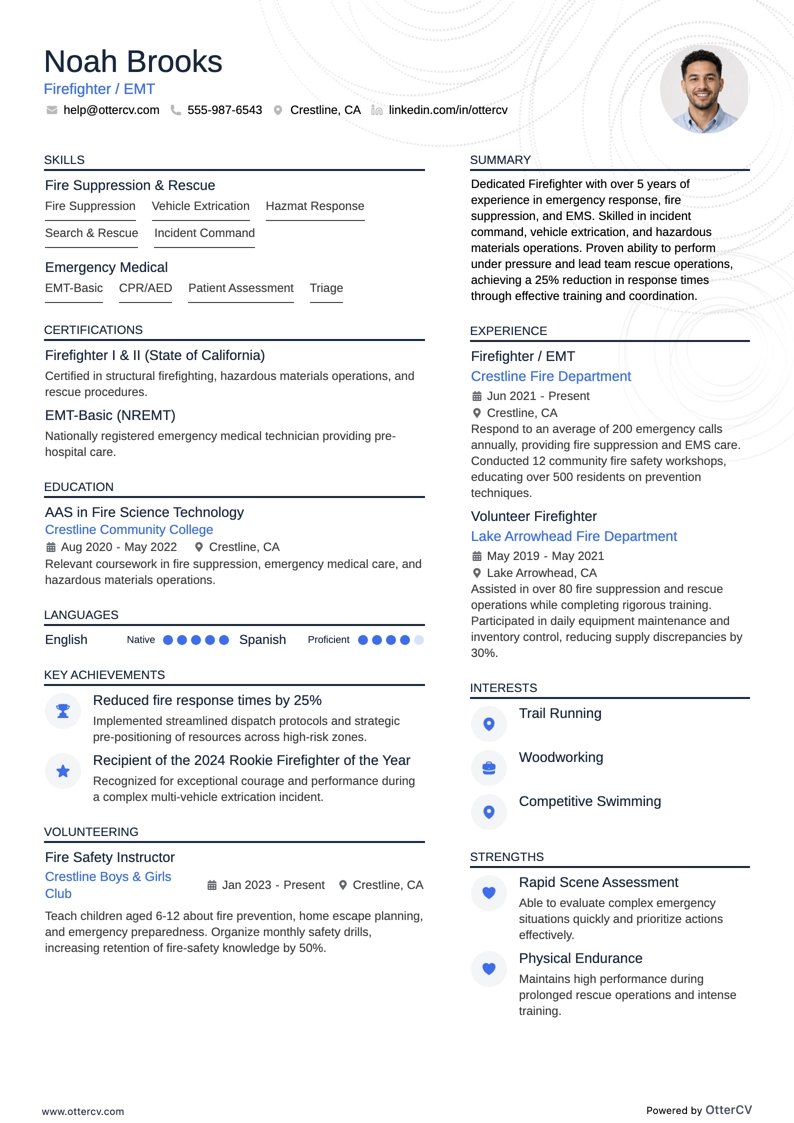
Firefighter EMT resume example

Firefighter EMT

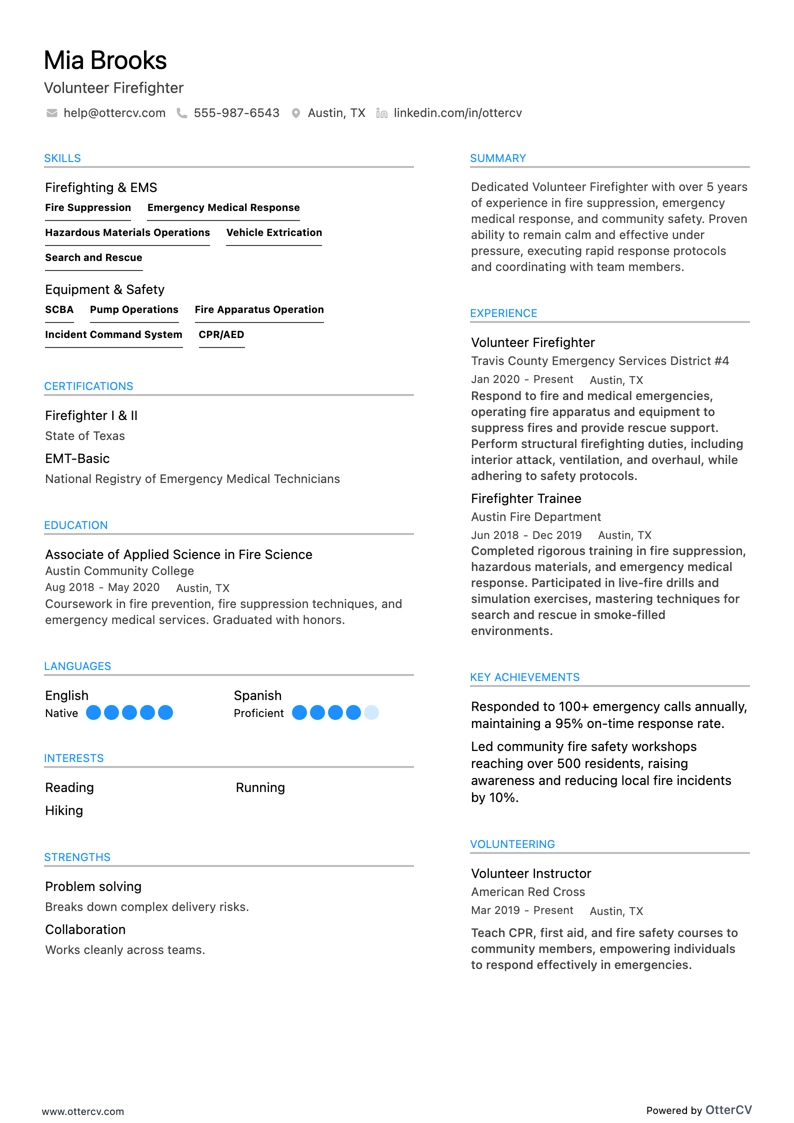
Volunteer Firefighter resume example

Volunteer Firefighter

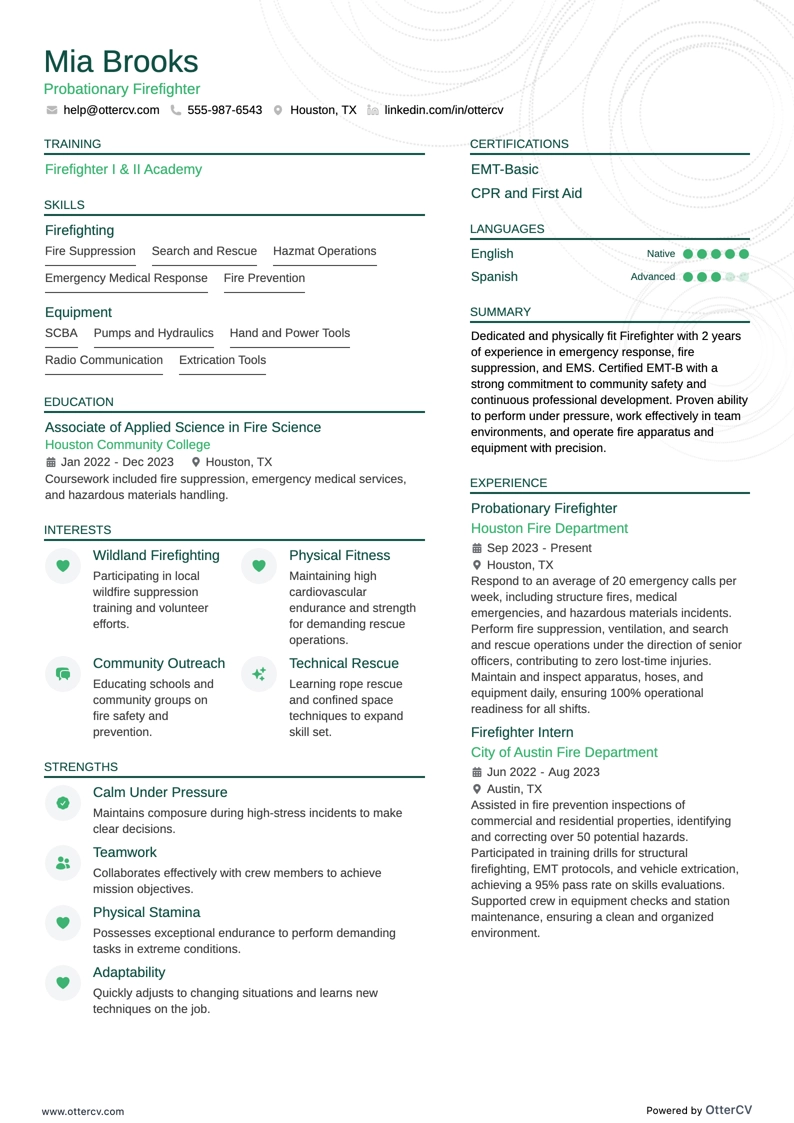
Probationary Firefighter resume example

Probationary Firefighter

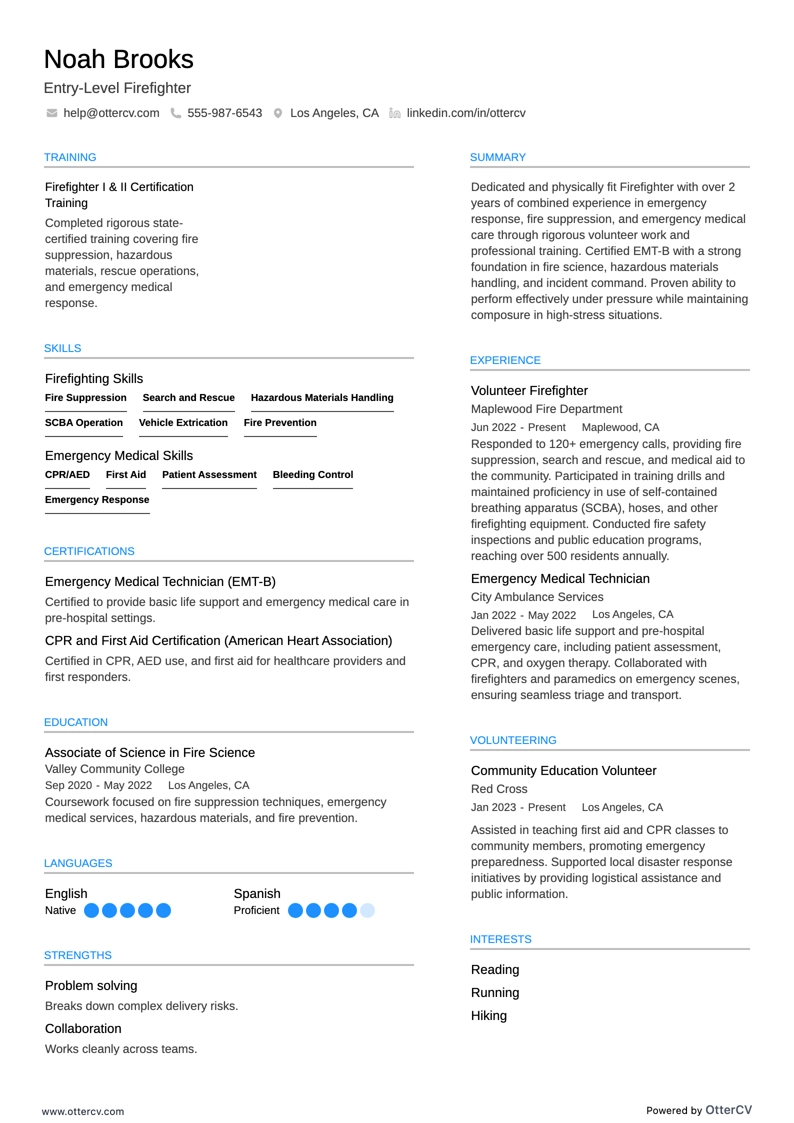
Entry-Level Firefighter resume example

Entry-Level Firefighter

Firefighter resume example

Firefighter

With wildfires becoming more frequent and intense, the demands of firefighting are changing. Climate change is forcing the field to adapt and rethink how these disasters are managed, which makes skilled firefighters more essential than ever.

If you’re considering a career in firefighting, you’re choosing a path where you can make a real difference. The role now goes beyond fighting fires. It also involves understanding and responding to the broader environmental impact of climate change. It means joining a new generation of firefighters committed to sustainability as well as protecting lives and property.

That raises an important question: how do you show your readiness and range of skills on a resume? How do you stand out in a profession where the demands are constantly evolving?

This guide is here to help. After reading it, you’ll be able to build a resume that highlights your courage, commitment, and qualifications while opening the door to new opportunities.

  • How to build a clear, concise resume that passes ATS screening and recruiter review.
  • How to turn front-line experience into a strong career story that highlights transferable skills such as leadership, crisis management, and teamwork.
  • How to quantify your achievements and impact so your contributions stand out.
  • How to organize resume sections effectively to show your fit for the role you want.

Whether you want to move up within the fire service or transition to a new career path, creating a resume that fully reflects your experience, skills, and bravery is no small task. Let’s get started.

Considering another public safety role? Explore these related resume examples:

How to format a firefighter resume

There are usually three main resume layouts. The reverse chronological resume lists your work history starting with the most recent role and is best for people with extensive experience. The functional resume focuses on skills instead of chronological work history, which makes it a better fit for entry-level candidates or people with career gaps.

For firefighters, the strongest option is usually the combination, or hybrid, resume. This format gives you space to highlight transferable skills near the top, including crisis management, teamwork, leadership, problem-solving, and communication. The hybrid resume is especially useful if you want to advance within the fire service or move into a new role where your broader skill set matters.

Formatting tips for a job-winning resume

Resume formatting requires attention to important details such as ATS-friendly fonts and the right file format. Below are the main formatting principles to follow when creating your firefighter resume.

Keep the target market in mind. For example, a Canadian resume may follow a different layout.

  • Resume header: Include your name, contact information, and location. This is also a good place to add a link to your LinkedIn account.
  • Fonts: Use a professional, readable font that applicant tracking systems can process easily. Lato, Arial, Rubik, or Calibri in 10–12 pt works well for a firefighter resume.
  • Margins: Keep margins aligned with industry standards and no smaller than 1 inch. Margins create white space and improve readability.
  • Layout: Choose a clean single-column or double-column design, and keep your resume length to no more than 1 page.
  • Language: Proofread your resume carefully for typos and grammar mistakes. If needed, use our resume checker for optimization.
  • PDF format: Many resumes fail ATS screening because of the file type. Make sure you save your resume as a PDF to preserve the layout across devices and platforms.

If you already have a resume, there’s a chance it may not be ATS-friendly. Click the button below to find out whether it passes the test.

Now that we’ve covered the foundations of a well-organized resume, let’s look at the must-have sections you’ll need to fill in.

The top sections on a firefighter's resume

  • Firefighting and rescue experience: Show hands-on experience and results in firefighting, rescue operations, and emergency response.
  • Emergency medical services (EMS) skills: Highlight qualifications in providing medical assistance and the ability to perform under pressure.
  • Fire safety and prevention education: Reflect contributions to community safety through educational programs, inspections, and compliance efforts.
  • Specialized training: Include training or experience in managing hazardous situations for safety-focused roles.
  • Professional certifications: List relevant credentials such as EMT, Firefighter I/II, and HazMat to demonstrate specialized skills and knowledge.

Next, consider how recruiters interpret these sections and what they look for when reviewing your application.

What recruiters want to see on your resume

  • Proven firefighting and emergency response experience shows recruiters you can handle the physical and mental demands of the job.
  • Certifications such as EMT, Firefighter I/II, and HazMat demonstrate commitment and readiness for the role.
  • Physical fitness and agility are necessary for strenuous firefighting duties, including carrying heavy equipment and rescuing individuals.
  • Teamwork and communication skills are critical for working effectively in high-pressure situations while maintaining safety and coordination.
  • Community service and public education highlight dedication to fire prevention and safety awareness within the community.

To show your effectiveness as a firefighter, describe your work experience clearly. We’ll go into more detail in the next section.

How to write your firefighter resume experience

The largest part of your resume should show how you apply your skills and knowledge in real-world situations. This is where you prove you can handle the intense and varied demands of firefighting and emergency response.

The most common approach for writing your experience section is to use reverse chronological order.

  • Start with the title of your most recent position.
  • Include your dates of employment and the name of the organization.
  • List your key responsibilities, achievements, and any specialized tasks or operations.

Remember to highlight quantifiable achievements, such as the number of fire incidents managed or training sessions led. This helps show the tangible impact of your work.

Let’s see this in practice, starting with an exaggeratedly bad example.

Experience

Firefighter/EMT

Los Angeles Fire Department

04/2019 - 11/2023 · Los Angeles, CA

  • Responded to numerous emergency calls each year across a range of situations.
  • Participated in discussions with LA County Emergency Services to develop a wildfire prevention plan.
  • Worked to improve team efficiency by creating and delivering a training program covering various firefighting techniques.
  • Conducted fire safety inspections and led community education sessions.
WRONG

These achievements are not especially compelling because they lack quantifiable outcomes. As written, they read like a list of routine duties presented in a fairly ordinary way.

The improved version below shows how a few small changes can add much more depth to your experience section.

Experience

Firefighter/EMT

Los Angeles Fire Department
04/2019 - 11/2023 · Los Angeles, CA

  • Responded to over 300 emergency calls annually, including fires, medical emergencies, and hazardous material incidents, demonstrating rapid decision-making and a strong commitment to community safety.
  • Collaborated with LA County Emergency Services to develop and implement a comprehensive wildfire prevention program, contributing to a 20% reduction in wildfire occurrences in the Los Angeles area.
  • Improved team efficiency by 15% by designing and delivering an in-house training program focused on advanced firefighting techniques, emergency medical care, and team leadership.
  • Conducted 200+ fire safety inspections and community education sessions annually, helping raise local fire safety standards and promote preventive practices within the community.
RIGHT

The strength of these resume entries is clear for several reasons:

  • Quantified achievements: The example measures the firefighter's contributions with concrete results, such as responding to over 300 emergency calls annually and conducting more than 200 fire safety inspections each year. These metrics show clear, measurable impact.
  • Action verbs: Using strong action verbs like responded, collaborated, enhanced, and conducted at the start of each bullet makes the resume more dynamic and emphasizes the firefighter's active role in each achievement.
  • Key skills: The section highlights essential firefighter skills, including rapid decision-making, teamwork and collaboration, especially with LA County Emergency Services, leadership through improved team efficiency and training, and community engagement through inspections and education sessions.

To follow best practices for writing a resume experience section, use the tips below.

How to quantify impact on your resume

Quantifying achievements on a resume helps prove your capabilities and impact. Here are practical ways to make a firefighter resume more compelling:

  • Include the total area (in square miles or acres) you helped protect from wildfires to show your role in safeguarding communities and natural resources.
  • Mention the percentage decrease in fire incidents or emergency calls in areas where you led public education initiatives to demonstrate preventive impact.
  • List the exact number of fire safety inspections you conducted to show thoroughness and commitment to safety standards.
  • Detail the number of training sessions you conducted or participated in to reflect your dedication to continuous improvement and skill development.
  • Specify the volume of emergency medical services calls you responded to to highlight your versatility and effectiveness in critical situations.
  • Report the amount of equipment and assets you managed or maintained to indicate responsibility and trust.
  • Present the number of community outreach programs you initiated or supported to show commitment to public engagement and safety education.
  • State the number of high-risk interventions you participated in, such as complex rescues or hazardous materials incidents, to demonstrate your ability in high-stakes environments.

Regardless of your experience level, try to add quantifiable achievements to every statement on your resume. Doing so shows your commitment to the profession.

“Real heroes are men who fall and fail and are flawed, but win out in the end because they've stayed true to their ideals and beliefs and commitments.”

—Kevin Costner

Next, we’ll discuss how to write a resume if you’re a first-time firefighter.

How do I write a firefighter resume with no work experience

For firefighters starting their careers with no direct experience, you can still build a strong resume by focusing on relevant skills, volunteer work, certifications, and education. Here are key strategies to consider:

  • Highlight education and certifications: Start with your firefighting education, relevant certifications, and any emergency medical training, such as hazardous materials handling, to show you’re ready to begin work.
  • Emphasize transferable skills: Even without direct firefighter experience, you may have valuable skills from other activities or roles. Highlight teamwork, physical fitness, decision-making under pressure, and leadership. Use examples from school, sports teams, or other jobs to support these strengths.
  • Volunteer experiences: If you’ve volunteered in emergency services, community safety, first aid, or similar areas, include those details. Volunteer work shows commitment to community service and may demonstrate practical skills relevant to firefighting.
  • Soft skills: Firefighting requires strong communication, empathy, and resilience. Include examples of how you’ve shown these qualities in other settings.
  • Technical proficiencies: List any technical skills related to emergency response, such as familiarity with firefighting equipment, emergency dispatch software, or first aid techniques.
  • An objective statement: This can show your enthusiasm for a firefighting career and your understanding of the role’s demands.

Above all, customize your resume for the job. Tailor your resume to match the specific requirements and duties of the firefighter position you’re applying for, and use keywords from the job listing to make it more relevant.

PRO TIP

Test your draft firefighter resume by sharing it with peers and mentors in your network. Ask them to review it as if they were hiring you for a project, then apply their feedback.

We’ll explore each of the bullet points above in more detail throughout the guide. Next: skills on a resume.

How to list hard and soft skills on your resume

We’ve already highlighted the importance of using keywords in your resume. They help guide the entire writing process. Review the job description, note the requirements, and include those exact terms in your resume. This is one of the most effective ways to pass ATS scanners and catch recruiters’ attention.

When deciding which skills to include, prioritize the ones mentioned in the job posting and the ones most relevant to the role you’re applying for. Being highly proficient in programming languages may be impressive, but it won’t save lives if you’re applying for a firefighter position.

Your hard skills are gained through education, certifications, and training, so they should be clearly featured in a dedicated section of your resume.

Best hard skills for your firefighter resume

  • Emergency Medical Services (EMS) certification.
  • Fire suppression techniques.
  • Hazardous materials handling (HAZMAT).
  • Fire safety inspection protocols.
  • CPR and First Aid certification.
  • Operation of firefighting equipment, including hoses, extinguishers, and ladders.
  • Knowledge of the Incident Command System (ICS).
  • Wildland firefighting techniques.
  • Structural firefighting strategies.
  • Fire prevention and education methodologies.
  • Technical rescue techniques, including confined space, high angle, and trench rescue.
  • Water rescue certification.
  • Fire scene investigation and reconstruction.
  • Understanding of building codes and fire regulations.
  • Emergency vehicle operation.
  • Maintenance of fire alarm and suppression systems.
  • Proper use of firefighting personal protective equipment (PPE).
  • Basic Life Support (BLS) certification.
  • Use of thermal imaging technology.
  • Proficiency with radio and communication systems.

Interpersonal skills are just as important to include on your resume. Instead of listing them on their own, try weaving them into other sections. This saves space and helps demonstrate them with real context.

For example, you can naturally incorporate these skills into your objective statement or your experience entries. For instance:

  • Played a pivotal role in a high-profile rescue operation during the 2020 California wildfires, safely evacuating 50+ residents from a threatened neighborhood and receiving the Fire Chief’s Commendation for bravery.

This experience example shows how to imply key skills such as bravery, working under pressure, and problem-solving without naming them directly. Just be sure to provide enough context and quantify your achievements.

Below is a list of the most valued soft skills a firefighter should possess.

Next, we focus on the education needed for a firefighter.

How to list education and certifications on your resume

The importance of education for firefighters in the U.S. can vary significantly by fire department and by the specific role. In many regions, firefighting is highly competitive, so a degree in fire science can make a candidate more appealing to hiring committees by showing commitment to the profession and a deeper understanding of fire behavior, emergency management, and fire prevention strategies.

However, entry-level firefighter positions generally require at least a high school diploma or GED. This baseline helps ensure candidates have essential skills in communication, mathematics, and science.

Your education section could look like this:

Education & Certification

Bachelor of Science in Fire Science

Texas A&M University | 08/2016 - 05/2020 | College Station, TX

GPA: 3.5 / 4.0

  • Specialized in urban fire safety and fire prevention methods.
  • Completed coursework in emergency medical services and fire behavior analysis.

Certified Emergency Medical Technician (EMT)

Texas Department of State Health Services | 06/2020 - 08/2020 | Austin, TX

  • Completed state-approved EMT program, focusing on basic life support, patient assessment, and emergency response.
RIGHT

Completing certification programs and continuing education is essential in the firefighting profession. Firefighters must complete initial training at a fire academy and keep building their skills through specialized courses offered by organizations such as the National Fire Protection Association (NFPA) and the International Association of Fire Fighters (IAFF).

Below are some of the most popular firefighting certificates.

How to List Firefighter Certifications

Certifications can be essential for meeting job requirements and staying current with the latest firefighting techniques and safety protocols. Because they matter more than college education in this case, it is best to give them their own section.

List each certification using the following format:

  • Start with the certification title.
  • Add the serial number, if available, or the certification date.
  • Include the organization or institution that issued it.

Certifications

Hazardous Materials (HazMat) Operations Certification (2022-08)

Occupational Safety and Health Administration (OSHA)

RIGHT

The next section of this guide explains the right steps for writing your career summary or objective.

How to write your firefighter resume summary or objective

There are two main differences between a summary and an objective: length and purpose.

An objective statement is usually 1–3 sentences that highlight your biggest strengths, relevant experience, and how you would add value to the specific job or organization you are applying to. It is best suited for less experienced candidates.

Summary

Dedicated professional firefighter known for exceptional problem-solving abilities. Aiming to apply strong leadership skills, demonstrated by training and leading a team of 20 firefighters, to excel in high-stakes environments. Passionate about serving as a pillar of support and safety for the community I am part of.

RIGHT

A summary can be up to five sentences long and should highlight your most valuable strengths and accomplishments. If you have more than 3 years of experience, choose a career summary.

Below are two examples of career statements, along with the do’s and don’ts of writing summaries.

Summary

Firefighter with 3 years of experience in Nevada, including responding to fires and emergencies. Seeking new opportunities in the field.

WRONG
  • This summary lacks specific details about achievements and responsibilities, making it hard to assess the candidate’s experience and skill level.
  • The use of vague language does not clearly explain the candidate’s role, contributions, or the scope of their experience in firefighting and emergency response.
  • It also misses the chance to highlight unique skills or specialized training relevant to firefighting that could help distinguish the candidate from others.

Professional Summary

Dedicated firefighter/EMT with over 8 years of experience in emergency response and fire suppression in Nevada, with strong proficiency in advanced life support and emergency medical services. Led a team that reduced fire-related injuries in the community by 20% through proactive fire safety education and training programs. Skilled in hazardous material handling, with over 100 hours of specialized training to support the safe and effective management of chemical and gas fires. Awarded "Firefighter of the Year" twice for exemplary service and leadership in high-pressure situations.

RIGHT

This is a strong resume summary. Here’s why:

  • Length: It uses 4 sentences packed with specific details and job-relevant keywords.
  • Quantified achievements: Reducing fire-related injuries by 20% gives a clear measure of the candidate’s impact.
  • Specific skills and specialized training: It highlights expertise in key areas of firefighting and emergency medical services.
  • Recognition: Mentioning “Firefighter of the Year” awards provides concrete proof of excellence and leadership in the field.

These are some of the most important elements of a good resume summary. Feel free to use this example and adapt it to your own needs. If you’re not confident about how to describe your accomplishments, our resume-building app offers thousands of content suggestions to help you find the right words for your experience.

Additional sections for a firefighter resume

To make a firefighter resume more compelling, go beyond core qualifications and work history by adding optional sections that highlight your skills, accomplishments, and personal strengths.

  • Awards and honors: Include any recognitions or awards for service, bravery, lifesaving actions, or community involvement.
  • Professional memberships: Membership in organizations such as the International Association of Fire Fighters (IAFF) or the National Fire Protection Association (NFPA) shows engagement with the broader firefighting community and a commitment to staying current with industry standards and developments.
  • Languages: Fluency in languages other than English can be a major advantage, especially in diverse communities.
  • Community engagement: Participation in community activities or initiatives, especially those focused on safety, health, and well-being, can show dedication to public service beyond firefighting duties.

How to put volunteer experience in your resume

Highlighting volunteer work, especially when it relates to emergency response, community service, or healthcare, can be especially valuable for firefighters. According to a BBC article from January 2026, “Of the more than one million firefighters in the US, 65% of them are volunteers […]. Of the more than 29,000 fire departments across the country, almost 19,000 of them are run completely by volunteers.”

Your community contributions should be clearly shown on your resume. To save space, you can include volunteer work in your experience section. Focus on measurable achievements rather than simply listing responsibilities.

Experience

Wildland Fire Volunteer Firefighter

State Forestry Fire Department
04/2015 - 11/2018

Contributed to wildfire control and ecosystem management through strategic firefighting and prescribed burns.

  • Led a team of 10 volunteer firefighters in responding to wildfires and wildland fires, implementing fire suppression strategies.
  • Participated in 3 prescribed burn operations, reducing the risk of uncontrolled wildfires and enhancing ecosystem health.
RIGHT

Key takeaways

  • Organize your resume to spotlight your most important accomplishments.

  • Use AI to improve readability, generate content suggestions, and proofread thoroughly.

  • Quantify your contributions with specific data to show the impact of your work.

  • Identify and include the most relevant firefighting skills throughout your resume.

  • Present your certifications clearly to emphasize your qualifications and specialized knowledge.

  • Feature volunteer work to demonstrate community service and teamwork.

Firefighter resume examples

Explore additional Firefighter resume samples and guides and see what works for your level of experience or role.

By Experience

Probationary Firefighter

Probationary Firefighter resume preview

Entry-Level Firefighter

Entry-Level Firefighter resume preview

Firefighter resume examples

Explore additional Firefighter resume samples and guides and see what works for your level of experience or role.

By Role

Fire Lieutenant

Fire Lieutenant resume preview

Fire Apparatus Engineer

Fire Apparatus Engineer resume preview

Industrial Firefighter

Industrial Firefighter resume preview

ARFF Firefighter

ARFF Firefighter resume preview

Airport Firefighter

Airport Firefighter resume preview

Wildland Firefighter

Wildland Firefighter resume preview

Firefighter Paramedic

Firefighter Paramedic resume preview

Firefighter EMT

Firefighter EMT resume preview

Volunteer Firefighter

Volunteer Firefighter resume preview

Firefighter

Firefighter resume preview