Senior Event Director full preview

10 Event Director Resume Examples

OtterCV

Written by The OtterCV Team

Updated: 5/24/2024•8 min read

See all resume examples in this guide, or generate your own resume example with your personalized prompt

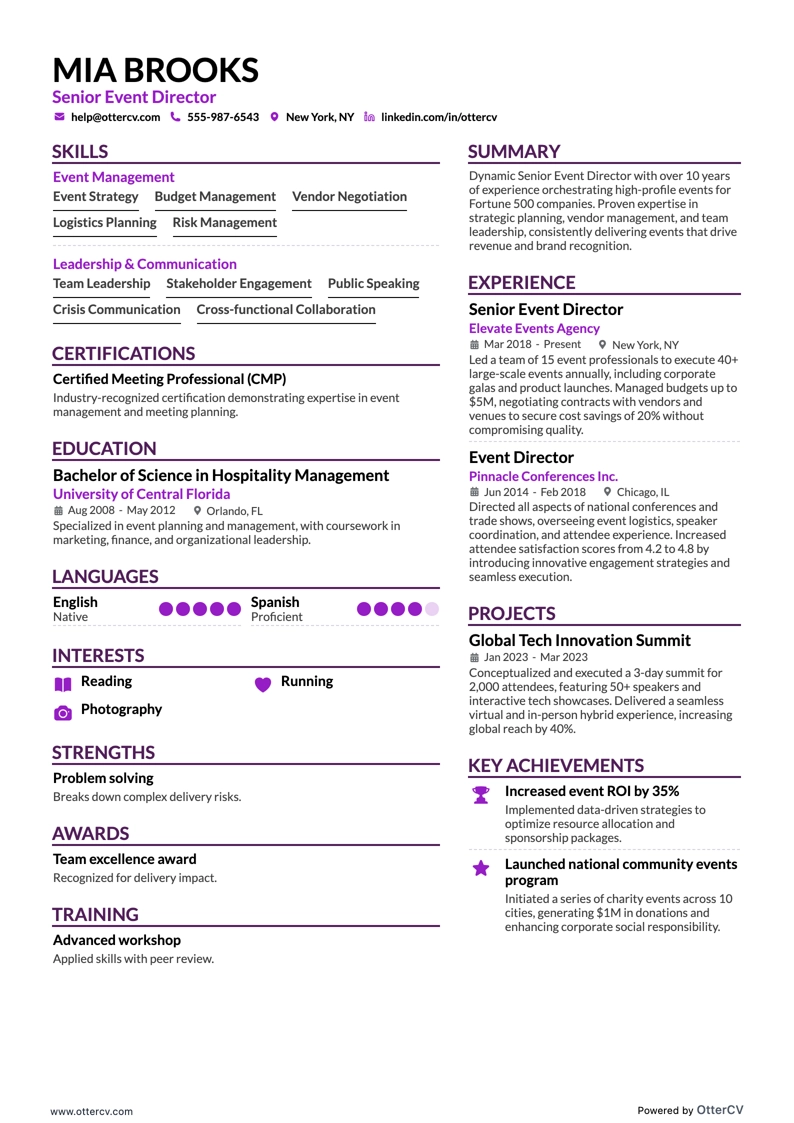
Senior Event Director resume example

Senior Event Director

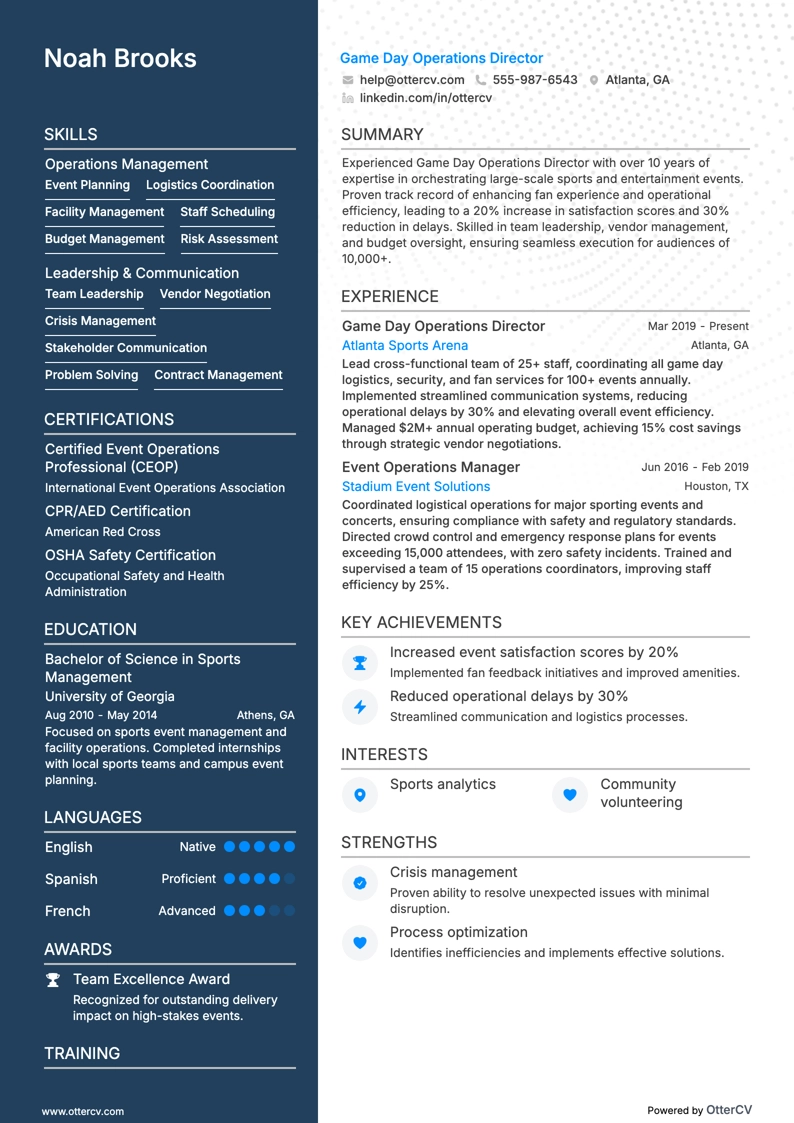
Game Day Operations Director resume example

Game Day Operations Director

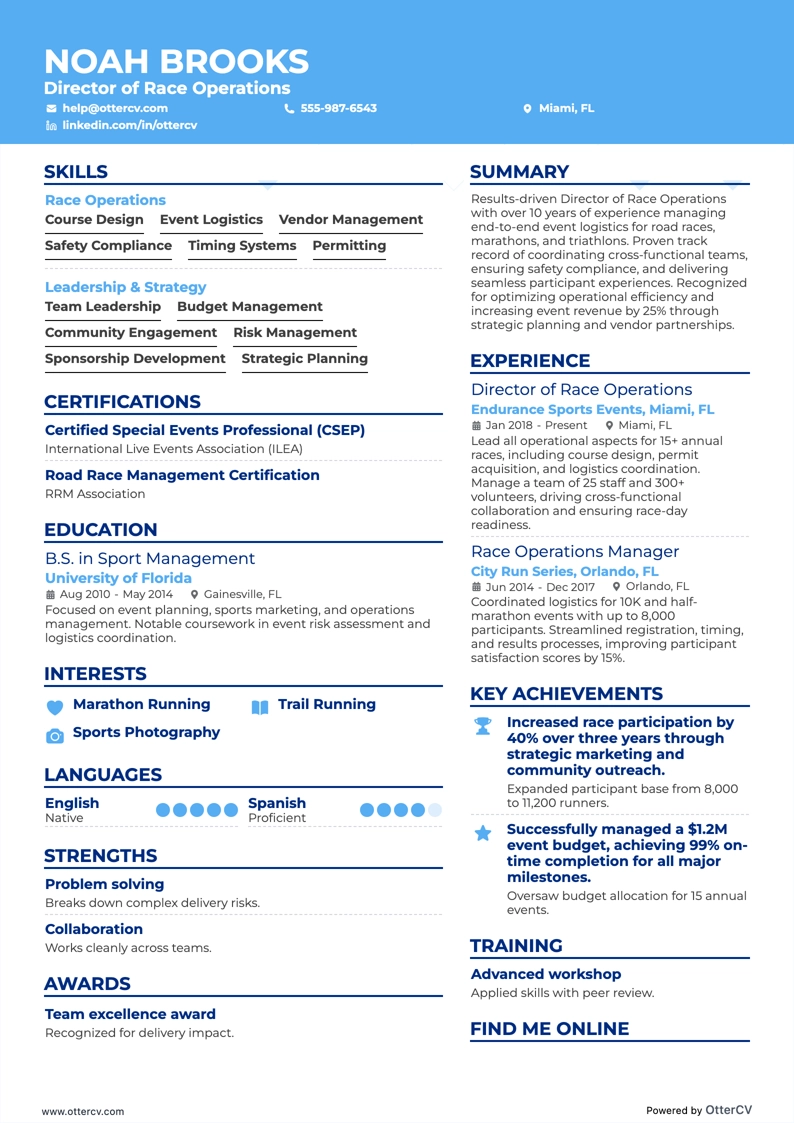
Director of Race Operations resume example

Director of Race Operations

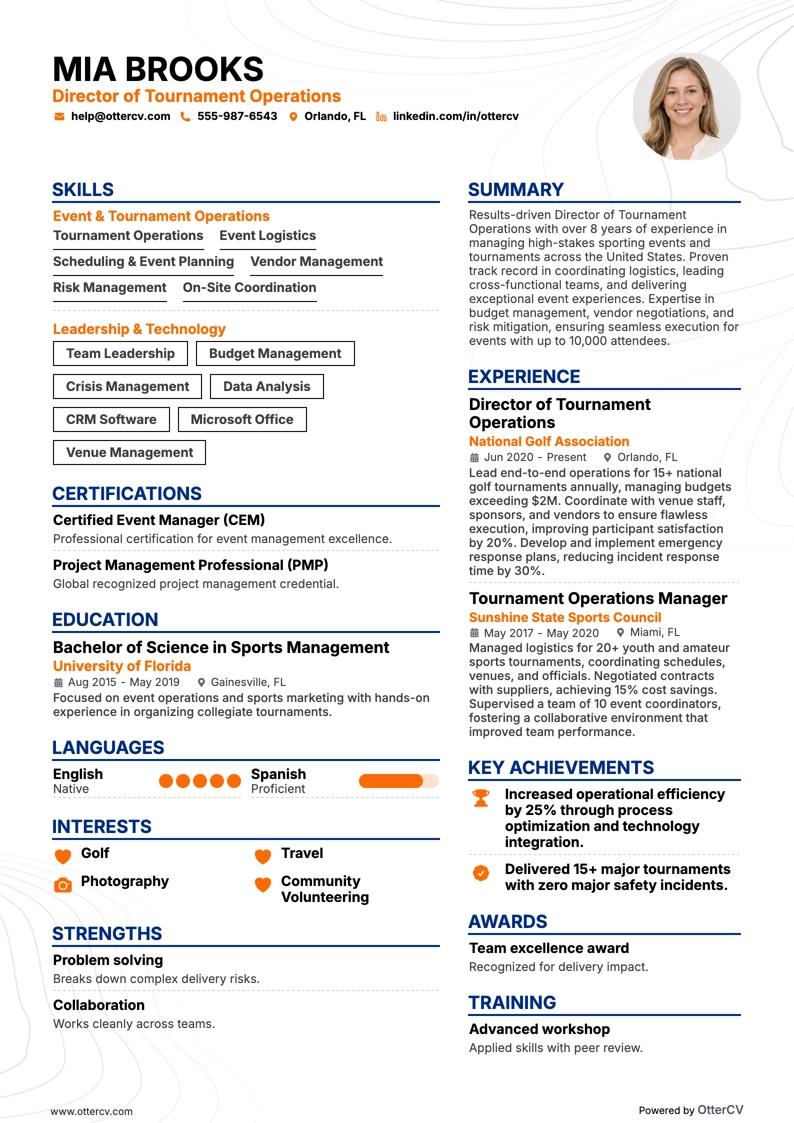
Director of Tournament Operations resume example

Director of Tournament Operations

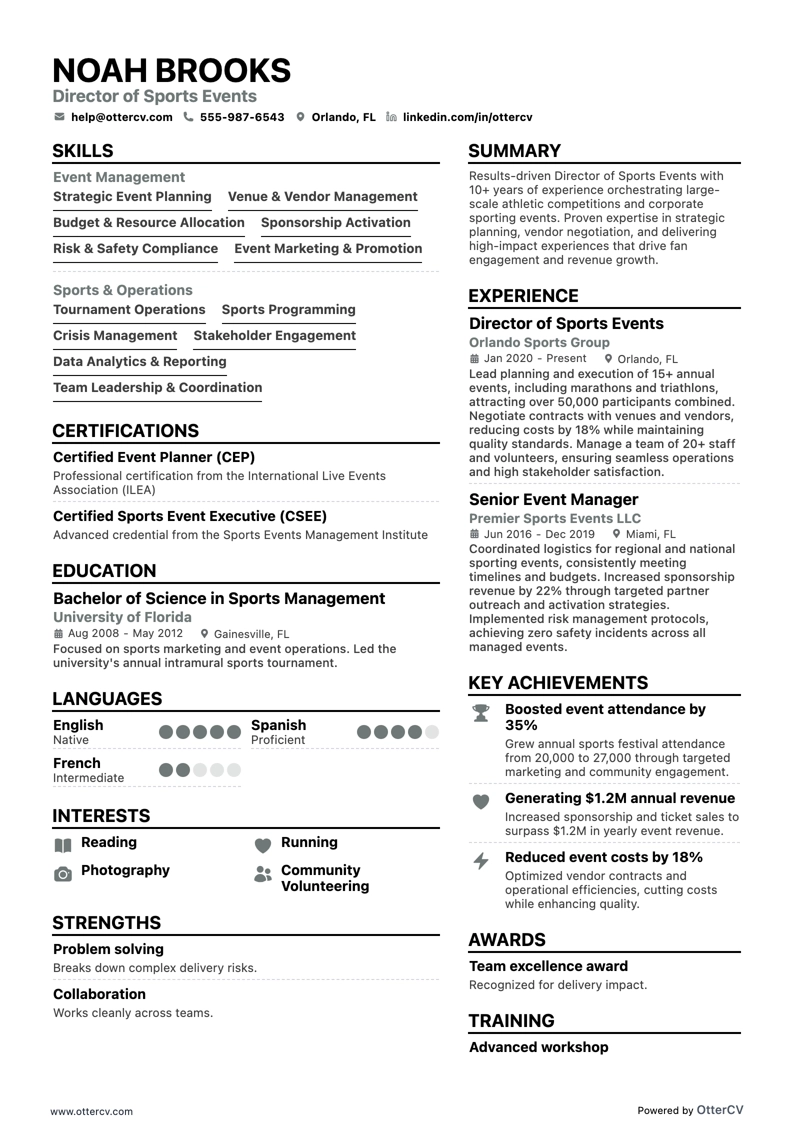
Director of Sports Events resume example

Director of Sports Events

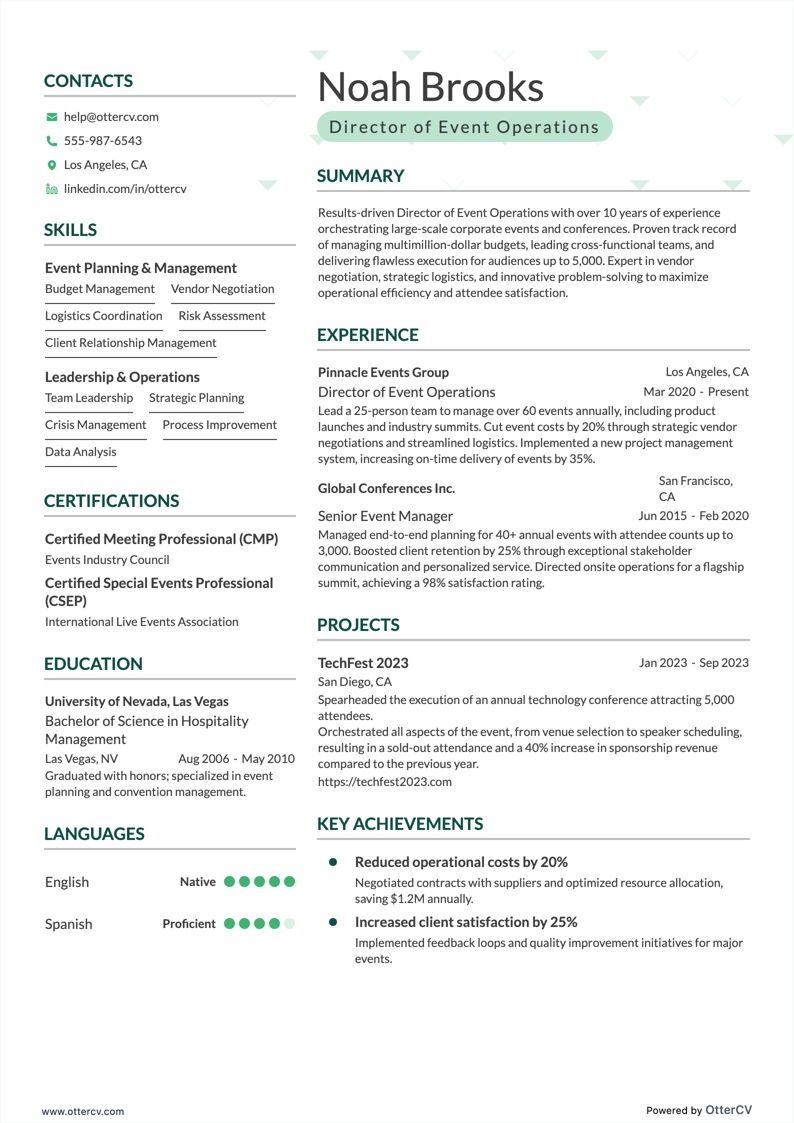
Director of Event Operations resume example

Director of Event Operations

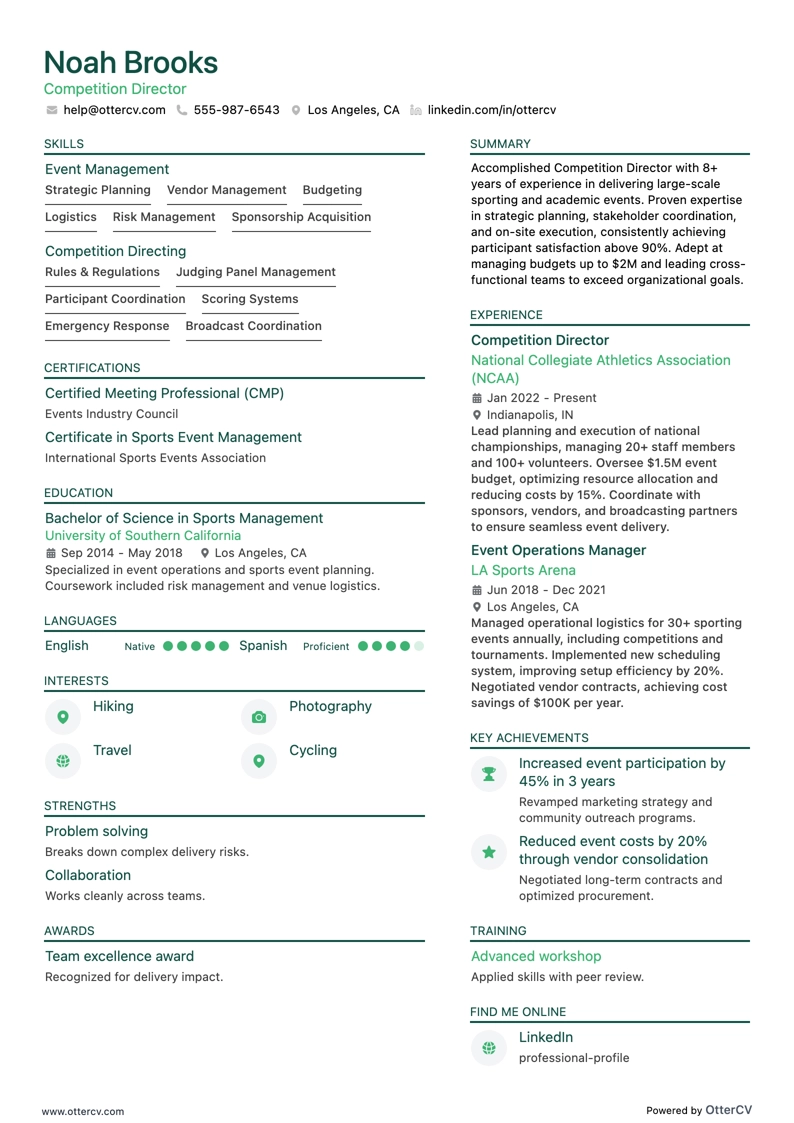
Competition Director resume example

Competition Director

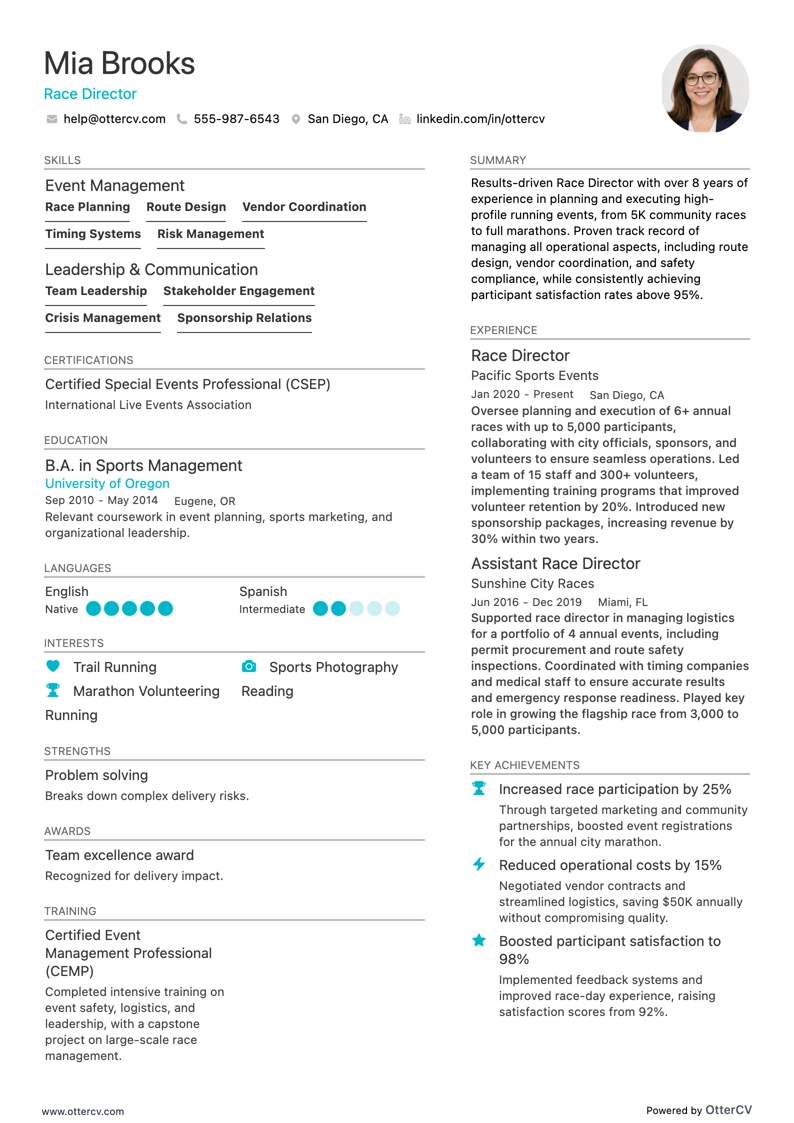
Race Director resume example

Race Director

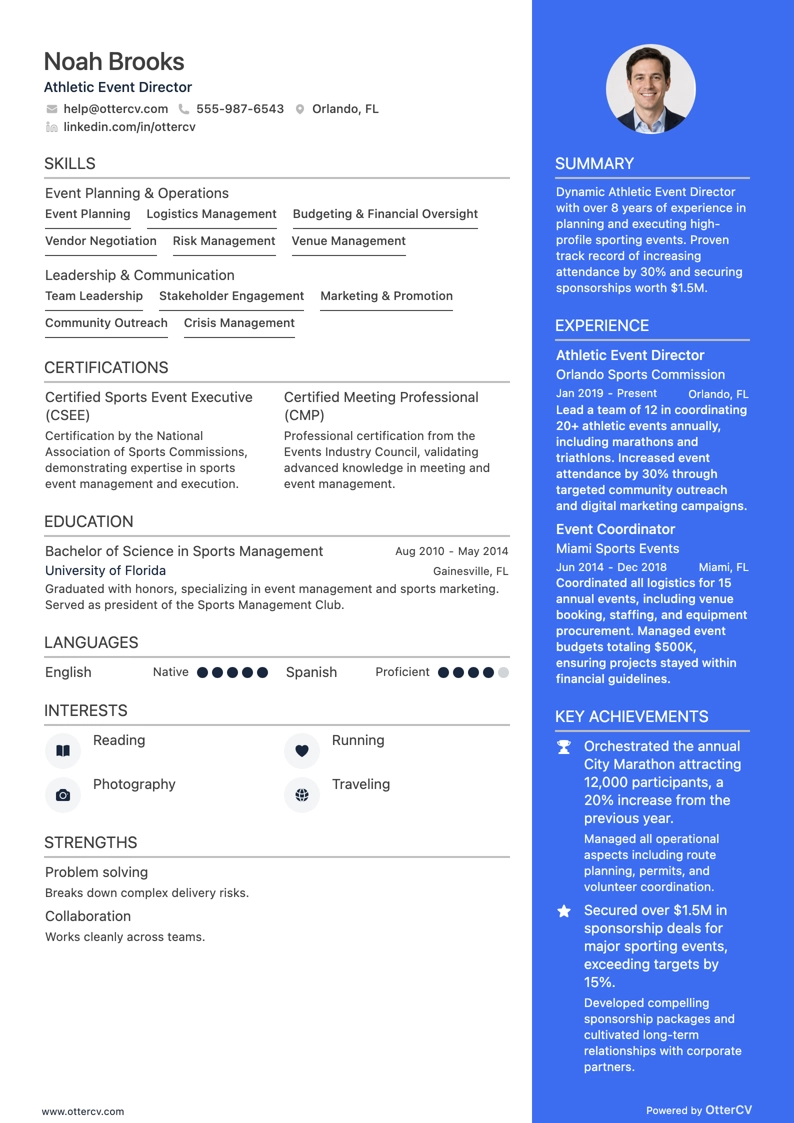
Athletic Event Director resume example

Athletic Event Director

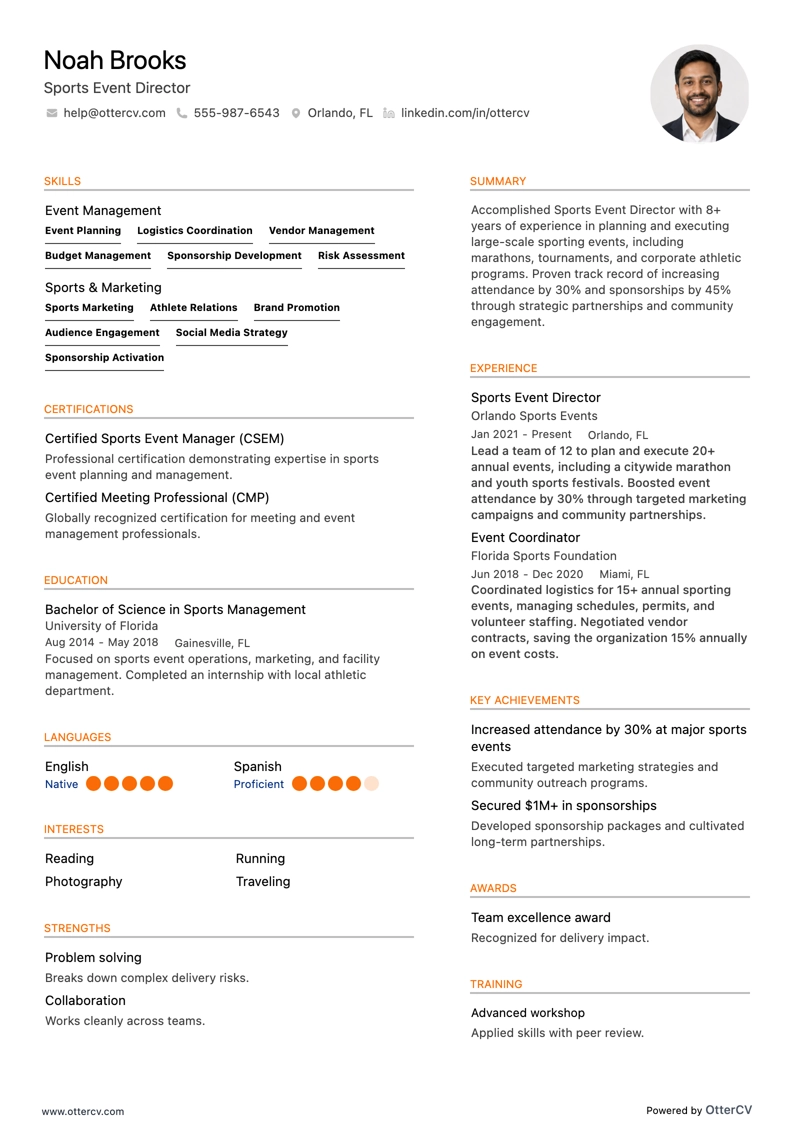
Sports Event Director resume example

Sports Event Director

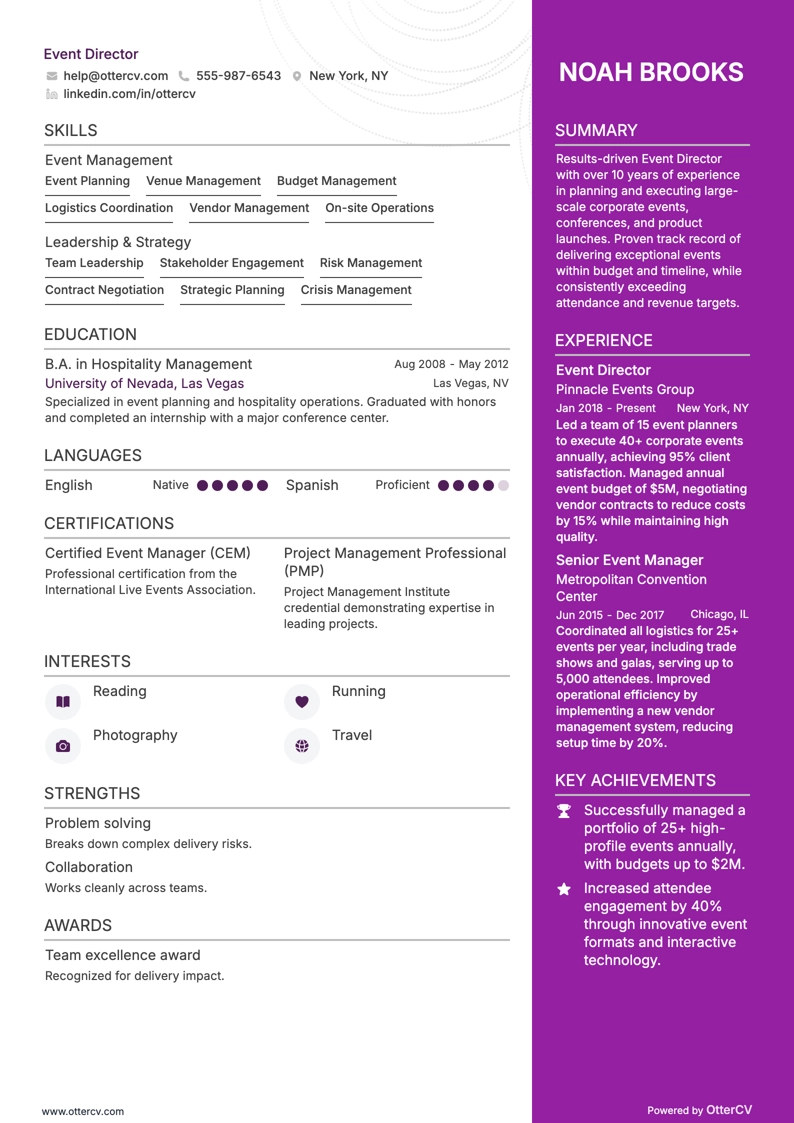
Event Director resume example

Event Director

Most event director resume drafts fall short because they read like task lists and hide scale, budget, and stakeholder impact. That matters when an ATS (applicant tracking system) filters quickly and recruiters scan resumes in seconds during heavy competition.

A strong resume shows what you delivered and why it mattered. Understanding how to write a resume that highlights budget managed, attendance growth, sponsor revenue, on-time launches, vendor savings, risk reduction, and post-event satisfaction scores is essential. You’ll connect those outcomes to business goals and repeatable execution.

Key takeaways

  • Use a reverse-chronological format to show leadership growth and expanding event scope.

  • Quantify achievements with budgets, attendance numbers, revenue growth, or satisfaction scores.

  • Tailor experience bullets to match each job posting’s terminology, tools, and KPIs.

  • Pair hard skills like Cvent and vendor negotiation with execution-focused soft skills in context.

  • Tie every listed skill to specific outcomes in your summary and experience sections.

  • Use AI to tighten language and surface metrics, but not to the point that it replaces your real voice.

  • Build your resume faster with Echocv to keep it clean, scannable, and aligned to the role.

How to format a event director resume

Recruiters reviewing event director candidates look for clear evidence of leadership scope, budget ownership, cross-functional team management, and a history of delivering large-scale events with measurable business results. A reverse-chronological format highlights these strengths right away by putting your career progression first, making it easier for hiring managers and applicant tracking systems to connect increasing responsibility with concrete outcomes.

I have significant experience in this role—which format should I use?

I have significant experience in this role—which format should I use?

Use a reverse-chronological format. It is the strongest choice for an event director with a proven leadership track record.

Do:

  • Lead each role entry with your scope of ownership, including team size, event portfolio scale, and budget authority.
  • Highlight domain expertise in event management platforms (Cvent, Bizzabo, Eventbrite), vendor negotiation, sponsorship strategy, and risk management.
  • Quantify business impact through revenue generated, attendance growth, cost savings, or client retention tied directly to the events you directed.

Example bullet: “Directed a portfolio of 40+ annual corporate and consumer events with combined budgets exceeding $3.2M, increasing sponsor revenue by 28% year over year through restructured partnership tiers and data-driven audience targeting.”

Why hybrid and functional resumes don't work for senior roles

Why hybrid and functional resumes don't work for senior roles

Hybrid and functional resume formats break up your career timeline and obscure the progression from coordinator or manager to a director-level role. That makes it harder for recruiters to verify the increasing scope, accountability, and decision-making ownership that define senior event leadership.

Functional formats are especially risky because they turn multi-year accomplishments—such as building an events department or managing a seven-figure budget—into isolated skill categories without the clear where and when hiring teams need to assess credibility.

If you're applying for director-level roles or above, avoid hybrid and functional resumes. They add ambiguity to what should be a clear narrative of leadership growth. For more guidance on choosing the right structure, review this guide on resume layout best practices.

  • Edge-case exception: A functional resume may be acceptable only if you're moving into event directing from a closely related senior role, such as VP of marketing or hospitality operations director, and you do not have a direct event director title. Even then, every listed skill should be tied to a specific project, measurable outcome, and organizational context.
With a clean, scannable format in place, the next step is choosing the sections that make up a complete event director resume.

What sections should go on a event director resume

Recruiters want clear proof that you can plan, lead, and execute high-impact events at scale while managing budgets, vendors, teams, and stakeholders. Knowing what to put on a resume for this role helps you include the right details from the start.

Use this structure for maximum clarity:

  • Header
  • Summary
  • Experience
  • Skills
  • Projects
  • Education
  • Certifications
  • Optional sections: Awards, Leadership, Languages

Strong experience bullets should highlight measurable outcomes, event scope, budget ownership, stakeholder management, and operational excellence.

Once your resume has the right components in place, the next step is writing an event director experience section that supports them with clear, role-specific detail.

How to write your event director resume experience

The experience section is where you show that you can plan, execute, and deliver events that drive measurable business results. Hiring managers care more about proven impact—such as budgets managed, attendance growth, sponsor revenue secured, and operational efficiencies gained—than task lists that only describe day-to-day responsibilities.

Each entry should include:

  • Job title
  • Company and location (or remote)
  • Dates of employment (month and year)

Include three to five concise bullet points that explain what you owned, how you executed, and what results you delivered:

  • Ownership scope: the event portfolios, venue partnerships, production timelines, vendor networks, or teams you were directly responsible for as an event director.
  • Execution approach: the event management platforms, budgeting tools, registration systems, project management frameworks, or logistical methods you used to deliver events on time and within scope.
  • Value improved: changes to attendee experience, event profitability, operational efficiency, risk mitigation, vendor performance, or production quality that resulted from your leadership.
  • Collaboration context: how you worked with marketing teams, sponsors, clients, venue operators, AV crews, caterers, municipal authorities, and other internal or external stakeholders to bring events to life.
  • Impact delivered: outcomes shown through attendance scale, revenue generated, sponsorship growth, cost savings, client retention, or brand visibility rather than a summary of activities performed.

Experience bullet formula

Experience bullet formula

Action verb + technology + what you built or fixed + measurable result

A event director experience example

Event Director

Northbridge Live | Austin, TX
2021–Present

Full-service experiential agency producing corporate conferences and brand activations for Fortune 1000 clients across North America.

  • Directed end-to-end delivery for 12 multi-day conferences per year (200–2,500 attendees), using Cvent, Asana, and Smartsheet to standardize run-of-show, staffing, and approvals—cut planning cycle time 18% and improved on-time milestone completion from 82% to 96%.
  • Negotiated venue, audiovisual, and production contracts ($3.8M annual spend) using competitive bid matrices and rate benchmarking—reduced costs 11% year over year while maintaining a 4.7/5 attendee satisfaction average.
  • Built an integrated registration and communications workflow in Cvent, including segmentation, automated confirmations, and on-site QR check-in, and synced leads to Salesforce—reduced check-in time from four minutes to ninety seconds and increased marketing-qualified leads 22%.
  • Led cross-functional teams of creative, production, and digital vendors, with up to 35 staff on-site, aligning stakeholders through weekly risk reviews and RACI ownership—reduced show-critical incidents 40% and achieved zero safety recordables across 36 event days.
  • Launched post-event analytics in Tableau using survey data, session scans, and budget actuals—improved net promoter score from 41 to 55 and grew sponsorship revenue 17% by optimizing agenda and sponsor placements with sales and client teams.

Now that you’ve seen what a strong experience section looks like, the next step is customizing yours for a specific event director role.

How to tailor your event director resume experience

Recruiters review an event director resume through both applicant tracking systems and manual screening, so close alignment with the job posting matters. Tailoring your resume to the job description helps your most relevant qualifications stand out right away.

Ways to tailor your event director experience:

  • Match the event management platforms and registration tools named in the posting.
  • Use the same terminology for event formats or production methodologies.
  • Reflect the specific KPIs the role prioritizes, such as attendance growth or sponsor retention.
  • Highlight experience in the industry or event domain the employer serves.
  • Emphasize budget oversight and vendor negotiation when the posting mentions cost control.
  • Include risk management and compliance protocols when safety standards are referenced.
  • Show cross-functional collaboration with marketing or operations teams when relevant.
  • Align your logistics and timeline management language with the job description.

Tailoring your resume means connecting your real accomplishments to the employer’s needs, not stuffing in unrelated keywords.

Resume tailoring examples for event director

Resume tailoring examples for event director

Job description excerptUntailoredTailored

Once you’ve aligned your experience with the role’s priorities, quantify your event director achievements to show the scope of your work and the results you delivered.

How to quantify your event director achievements

Quantifying your achievements shows how you improved revenue, attendee experience, delivery speed, and risk control. Track budget variance, ticket sales, sponsor value, on-time milestones, satisfaction scores, and incident rates across each event.

Quantifying examples for event director

MetricExample
Revenue growthGrew ticket revenue 18% ($420K to $496K) by optimizing pricing tiers in Eventbrite and launching three segmented email campaigns in Mailchimp.
Budget efficiencyDelivered a $750K conference 6% under budget by renegotiating venue and catering contracts and tracking spend weekly in Smartsheet.
Delivery speedCut planning cycle time from 16 to 12 weeks by standardizing run-of-show templates and moving approvals into Asana with two-day deadlines.
Attendee satisfactionRaised post-event satisfaction from 4.2 to 4.6 out of 5 across 1,800 surveys by redesigning check-in flow and adding session capacity buffers.
Risk reductionReduced onsite incidents 40% (15 to 9) by implementing a vendor safety checklist, tabletop drills, and a real-time comms plan using Slack and radios.

With strong, action-driven bullet points in place, the next step is making sure your event director resume shows the right mix of hard and soft skills.

How to list your hard and soft skills on a event director resume

Your skills section should show that you can plan, budget, and deliver events at scale. Recruiters and applicant tracking systems also scan this section for role-specific keywords and tool matches, so aim for a balanced mix of hard skills and execution-focused soft skills.

Event director roles require a blend of:

  • Product strategy and discovery skills.
  • Data, analytics, and experimentation skills.
  • Delivery, execution, and go-to-market discipline.
  • Soft skills.

Your skills section should be:

  • Scannable with bullet-style grouping.
  • Relevant to the job post.
  • Backed by proof in your experience bullets.
  • Updated with current tools.

Place your skills section:

  • Above experience if you're junior or switching careers.
  • Below experience if you're mid/senior with strong achievements.

Hard skills

  • Event budgeting and forecasting.
  • Vendor sourcing and contract negotiation.
  • Request for proposal development.
  • Venue selection and site inspections.
  • Run of show and show calling.
  • Registration platforms: Cvent and Eventbrite.
  • Project management tools: Asana, Monday.com, and Smartsheet.
  • Customer relationship management tools: Salesforce and HubSpot.
  • Floor plans and seating charts.
  • Audio visual production coordination.
  • Sponsorship packages and fulfillment.
  • Post-event reporting and surveys.

Soft skills

  • Lead cross-functional planning meetings.
  • Align stakeholders on priorities.
  • Communicate timelines and dependencies clearly.
  • Negotiate tradeoffs under pressure.
  • Make fast, risk-based decisions.
  • Manage vendors with clear accountability.
  • De-escalate issues on event day.
  • Present plans to executives and clients.
  • Coach teams through peak workloads.
  • Maintain attendee-first service standards.
  • Drive follow-through across workstreams.
  • Run tight post-mortems and improvements.

How to show your event director skills in context

Skills should not appear only in a bulleted list on your resume. Review curated resume skills examples to see how top candidates present their abilities effectively.

Your skills should be demonstrated in:

  • Your summary, which shows your high-level professional identity
  • Your experience, which proves your impact through outcomes

Here’s what that looks like in practice.

Event director with 12 years of experience producing large-scale corporate conferences and brand activations. Skilled in vendor negotiation, Cvent, and cross-functional leadership. Increased attendee satisfaction scores by 34% while reducing per-event costs by 18%.

  • Signals senior-level experience immediately
  • Names a role-relevant platform
  • Leads with a concrete metric
  • Highlights leadership as a soft skill

Experience example

Senior Event Director

Meridian Live Group | Chicago, IL

June 2019–Present

  • Planned and executed 45+ annual corporate events using Cvent, increasing client retention by 27% through streamlined registration workflows.
  • Worked with marketing, sales, and creative teams to launch a flagship product summit attended by 3,200 guests over two days.
  • Negotiated venue and vendor contracts totaling $2.1M annually, reducing overall event spend by 15% without compromising attendee experience quality.
  • Every bullet includes measurable proof.
  • Skills surface naturally through outcomes.

How do I write a event director resume with no experience

Once you’ve connected your relevant strengths to real responsibilities and outcomes, the next step is applying that same approach to an event director resume with no experience.

Even without full-time experience, you can still show readiness through work such as:

  • Volunteer festival or fundraiser coordination
  • Campus event committee leadership roles
  • Vendor outreach and contract support
  • Sponsorship pitch deck contributions
  • Event day run-of-show management
  • Budget tracking in spreadsheets
  • Registration and ticketing administration
  • Venue walkthroughs and logistics planning

If you're starting out, this guide on building a resume without work experience explains how to position transferable projects and skills effectively.

Focus on highlighting:

  • Event budgets, timelines, deliverables
  • Vendor, venue, and sponsor coordination
  • Tools: Eventbrite, Asana, Excel
  • Results: attendance, revenue, satisfaction

Resume format tip for entry-level event director

Resume format tip for entry-level event director

Use a skills-based resume format to highlight event director tools and project outcomes when your work history is limited.

Do:

  • Put an "Event Projects" section first.
  • Quantify results with numbers and dates.
  • List the tools used in each project.
  • Show budget, vendor, and timeline scope.
  • Tailor keywords to each job posting.

Example project bullet:

  • Directed a campus fundraiser using Eventbrite, Asana, and Excel; managed run-of-show and vendor outreach, increasing attendance 25% (240 to 300).

Even without direct experience, your education section can show the foundational knowledge and relevant coursework that support your qualifications for an event director role.

How to list your education on a event director resume

Your education section helps hiring teams confirm you have the background needed for an event director position. It reinforces your knowledge of planning, logistics, and business strategy.

Include:

  • Degree name
  • Institution
  • Location
  • Graduation year
  • Relevant coursework for juniors or entry-level candidates
  • Honors and GPA if 3.5 or higher

Skip the month and day details, and list the graduation year only.

Here’s a strong education entry tailored to an event director resume.

Example education entry

Bachelor of Science in Hospitality and Event Management

University of Central Florida, Orlando, FL

Graduated 2019

GPA: 3.7/4.0

  • Relevant coursework: Event Operations, Budget Management, Venue Logistics, Sponsorship Strategy, and Risk Assessment
  • Honors: Magna Cum Laude, Dean's List (six consecutive semesters)

How to list your certifications on a event director resume

Certifications on a resume show an event director's commitment to learning, proficiency with key tools, and alignment with current industry standards. They can also validate specialized skills when your work history needs extra support.

Include the following details:

  • Certificate name
  • Issuing organization
  • Year
  • Optional: credential ID or URL
  • List certifications below education when they are older, less relevant to your target event director role, or you already have strong recent experience.
  • List certifications above education when they are recent, highly relevant to the event director role, or required by the employer or venue.

Best certifications for your event director resume

  • Certified Meeting Professional (CMP).
  • Certified Special Events Professional (CSEP).
  • Certified Government Meeting Professional (CGMP).
  • Digital Event Strategist (DES).
  • Certified in Exhibition Management (CEM).
  • Project Management Professional (PMP).
  • ServSafe Food Protection Manager Certification.

Once your credentials are positioned where hiring managers can spot them quickly, use that foundation to write your event director resume summary.

How to write your event director resume summary

Your resume summary is the first thing a recruiter reads, so it should immediately communicate your leadership caliber. A strong opening presents you as a strategic event leader, not just a capable coordinator.

Keep it to three to four lines and include:

  • Your title and total years of senior event management experience.
  • Your industry focus, such as corporate, nonprofit, trade, or experiential events.
  • Core competencies like budget oversight, vendor negotiations, and stakeholder management.
  • One or two measurable achievements, such as revenue driven or attendance growth.
  • Leadership soft skills tied to real outcomes, like cross-functional team direction or executive communication.

PRO TIP

At the director level, focus first on strategic impact and organizational scope. Emphasize P&L ownership, team size, and enterprise-level results.

Avoid task-based duty lists and generic phrases like "passionate leader" or "results-driven professional." Recruiters are looking for clear evidence of decision-making authority and business outcomes.

Example summary for a event director

Event director with 12 years of experience leading large-scale corporate and trade events. Managed $4M annual budgets and 15-person teams, increasing attendee satisfaction scores by 31% year over year.

Now that your summary shows the value you bring, make sure your resume header includes the contact and professional details recruiters need to reach you.

What to include in a event director resume header

A resume header highlights your key contact details and role focus, helping event director candidates stay visible, credible, and easy to review quickly.

Essential resume header elements

  • Full name
  • Tailored job title and headline
  • Location
  • Phone number
  • Professional email
  • GitHub link
  • Portfolio link
  • LinkedIn

A LinkedIn link helps recruiters confirm roles, dates, and recommendations quickly, which can speed up screening.

Do not include photos on a event director resume unless the role is explicitly front-facing or appearance-dependent.

Put your job title first, keep links readable, and make sure your location and contact details match what you use across your professional profiles.

Example

Once your name and key contact details clearly position you for the role, you can strengthen your application with additional sections that support your event director qualifications.

Additional sections for event director resumes

When your core qualifications are similar to other candidates, these sections can help you stand out by highlighting strengths that are relevant to event direction.

  • Languages
  • Certifications and professional development
  • Industry awards and recognitions
  • Professional affiliations and memberships
  • Volunteer event coordination
  • Publications and speaking engagements
  • Hobbies and interests

Once you’ve rounded out your resume with the right supplementary sections, it’s worth turning your attention to the cover letter that goes with it.

Do event director resumes need a cover letter

Event director resumes do not always need a cover letter, but one can help in competitive searches or when hiring managers expect it. If you are unsure where to begin, learn what a cover letter is and how it complements your resume. It can make a difference when your fit, scope, or impact is not obvious from the resume alone.

Use a cover letter to add context your resume cannot show:

  • Explain your role and team fit by matching your event director experience to the employer’s event types, stakeholders, and operating rhythm.
  • Highlight one or two outcomes with numbers, such as attendance growth, sponsor revenue, budget savings, or on-time delivery under constraints.
  • Show that you understand the product, users, or business context by naming the audience, success metrics, and how events support retention, pipeline, or brand.
  • Address career transitions or less obvious experience by connecting transferable skills to event director responsibilities and clarifying any timeline changes.

Using AI to improve your event director resume

Whether you include a cover letter or rely on a strong resume alone, the next step is using AI to improve your event director resume so it communicates your value clearly and efficiently.

AI can improve your resume’s clarity, structure, and impact by tightening language and highlighting results. But overusing it can strip away authenticity. Once your resume feels clear and aligned with the role, step away from AI. For practical guidance, explore these ChatGPT resume writing prompts tailored to different resume sections.

Here are 10 practical prompts to strengthen specific sections of your event director resume:

  1. Strengthen your summary. “Rewrite my event director resume summary to highlight leadership scope, event scale, and measurable outcomes in three concise sentences.”
  2. Quantify experience bullets. “Review my event director experience bullets and suggest where I can add specific metrics like attendance numbers, budgets managed, or revenue generated.”
  3. Sharpen action verbs. “Replace weak or passive verbs in my event director experience section with strong, industry-specific action verbs.”
  4. Align skills section. “Compare my event director skills section against this job description and identify missing keywords I should add.”
  5. Tighten project descriptions. “Edit my event director project descriptions to focus on scope, challenges overcome, and concrete results delivered.”
  6. Refine education details. “Rewrite my education section to emphasize coursework, honors, or training directly relevant to an event director role.”
  7. Improve certification relevance. “Reorder and rewrite my certifications section to prioritize credentials most valued for an event director position.”
  8. Eliminate redundant phrasing. “Identify and remove filler words, redundancies, or vague phrases throughout my event director resume.”
  9. Tailor for specific roles. “Adjust my event director experience bullets to better match the priorities and language in this specific job posting.”
  10. Clarify career progression. “Restructure my event director work history to clearly show upward growth in responsibility, team size, and event complexity.”

Stop using AI once your resume sounds accurate, specific, and aligned with your real experience. AI should never invent experience or inflate claims—if it didn’t happen, it doesn’t belong here.

Conclusion

A strong event director resume highlights measurable results, role-specific skills, and a clear structure that is easy to scan. Use numbers to demonstrate impact, emphasize planning and vendor management, and show calm execution under pressure.

Keep each section focused, consistent, and aligned with the event director role you want now. This approach matches today’s hiring needs and supports near-future expectations for results, speed, and cross-team coordination.

Event Director resume examples

Explore additional Event Director resume samples and guides and see what works for your level of experience or role.

By Experience

Senior Event Director

Senior Event Director resume preview

Event Director resume examples

Explore additional Event Director resume samples and guides and see what works for your level of experience or role.

By Role

Game Day Operations Director

Game Day Operations Director resume preview

Director of Race Operations

Director of Race Operations resume preview

Director of Tournament Operations

Director of Tournament Operations resume preview

Director of Sports Events

Director of Sports Events resume preview

Director of Event Operations

Director of Event Operations resume preview

Competition Director

Competition Director resume preview

Race Director

Race Director resume preview

Athletic Event Director

Athletic Event Director resume preview

Sports Event Director

Sports Event Director resume preview

Event Director

Event Director resume preview