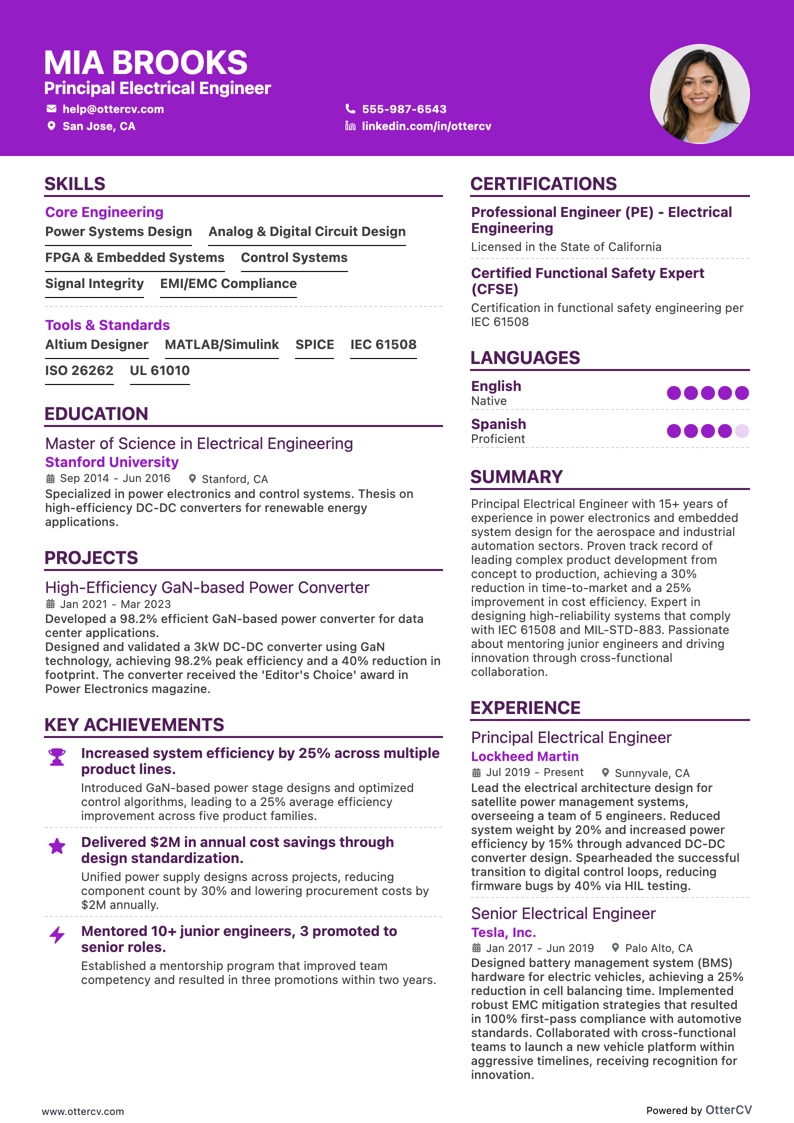
Principal Electrical Engineer full preview

22 Electrical Engineering Resume Examples

OtterCV

Written by The OtterCV Team

Updated: 12/23/2025•8 min read

See all resume examples in this guide, or generate your own resume example with your personalized prompt

Principal Electrical Engineer resume example

Principal Electrical Engineer

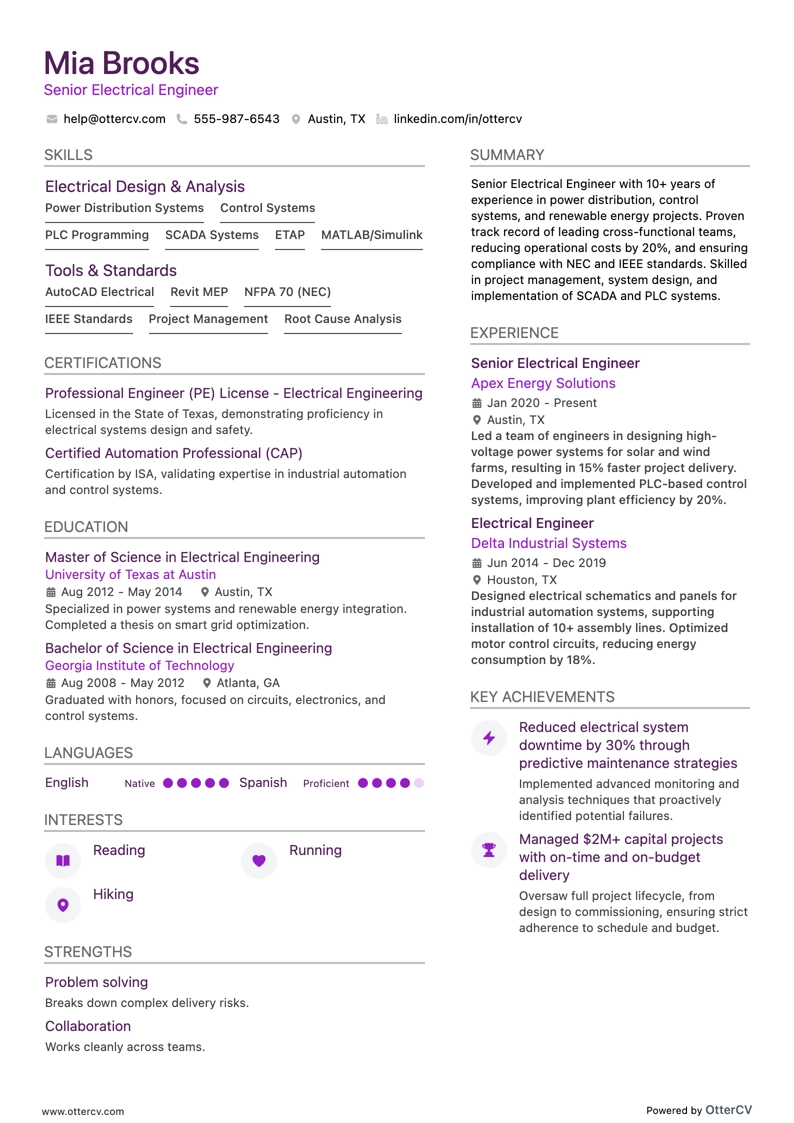
Senior Electrical Engineer resume example

Senior Electrical Engineer

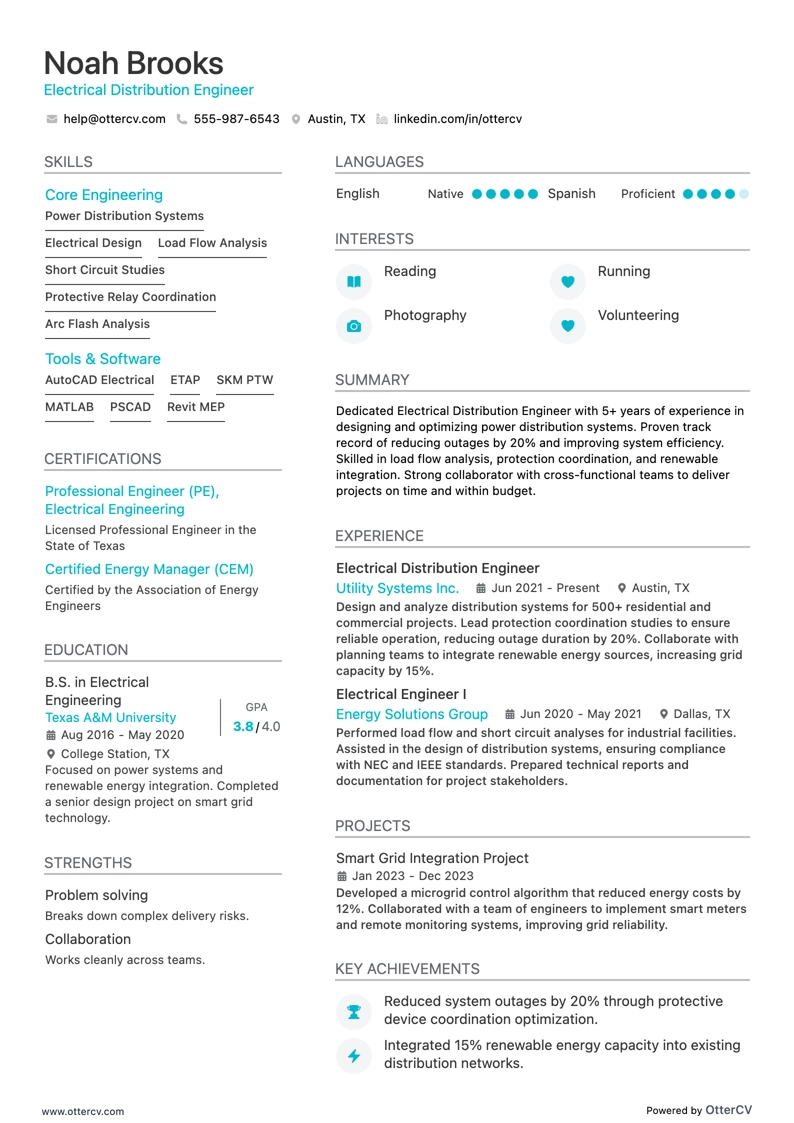
Electrical Distribution Engineer resume example

Electrical Distribution Engineer

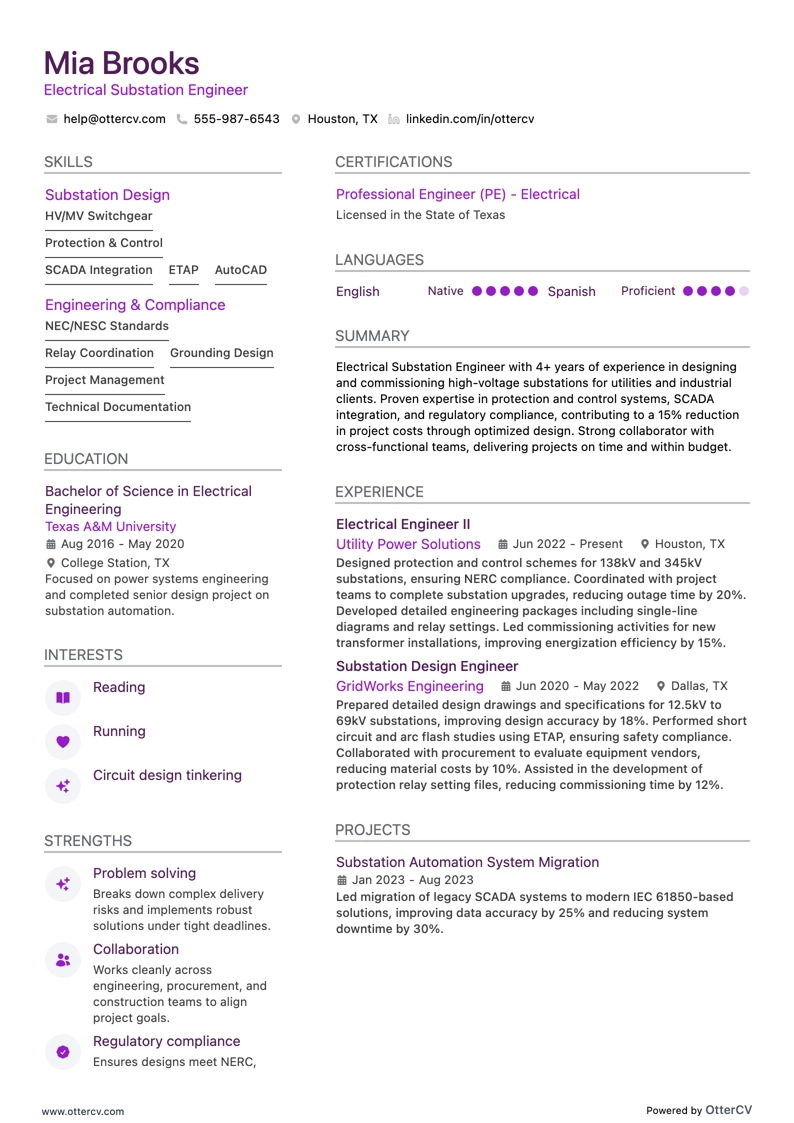
Electrical Substation Engineer resume example

Electrical Substation Engineer

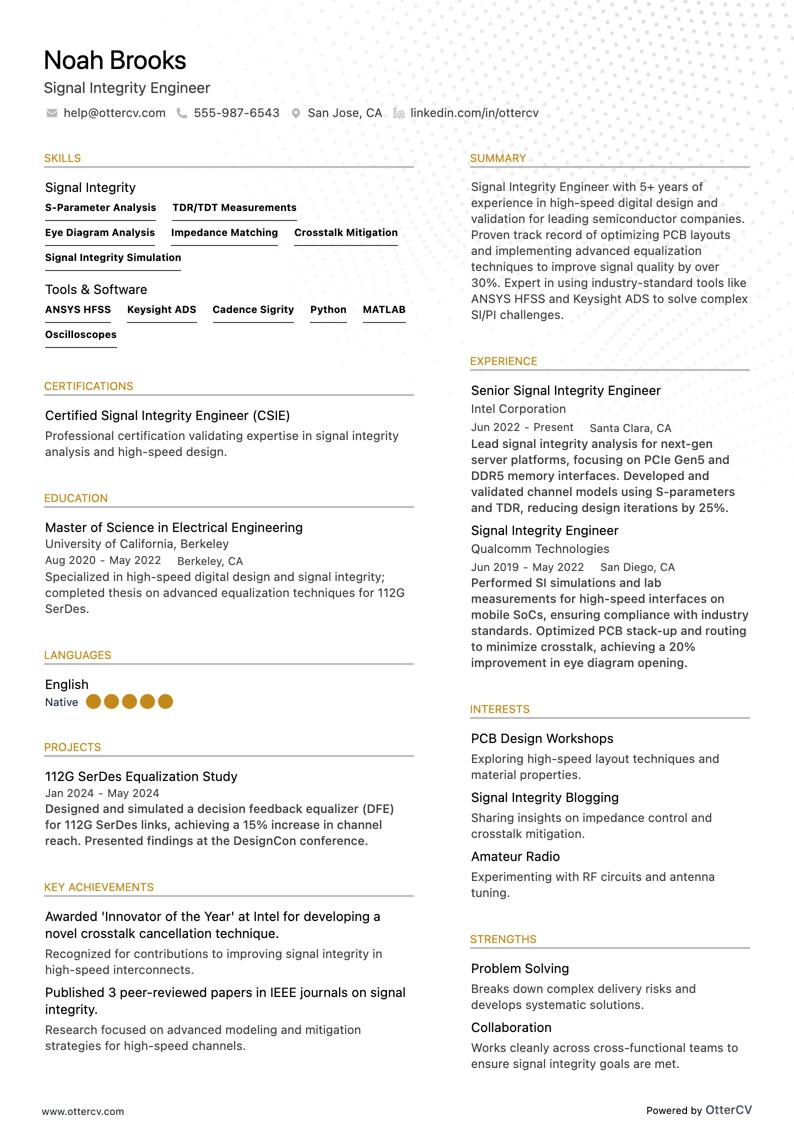
Signal Integrity Engineer resume example

Signal Integrity Engineer

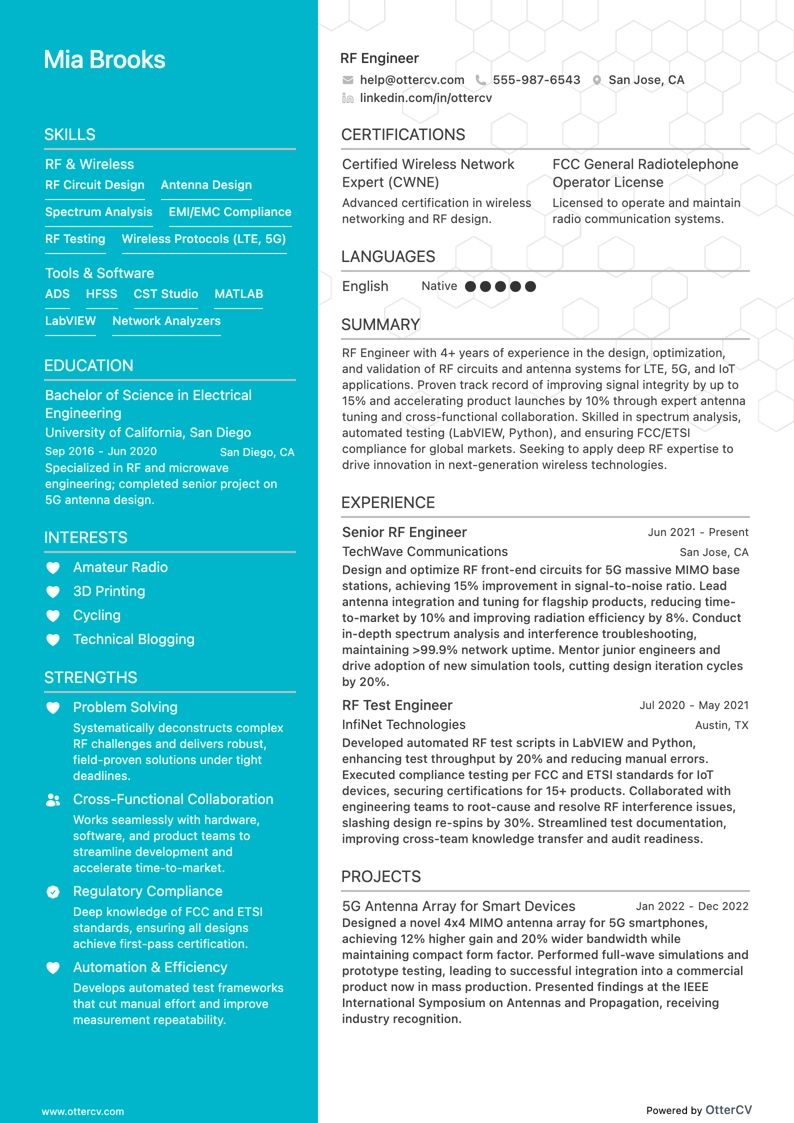
RF Engineer resume example

RF Engineer

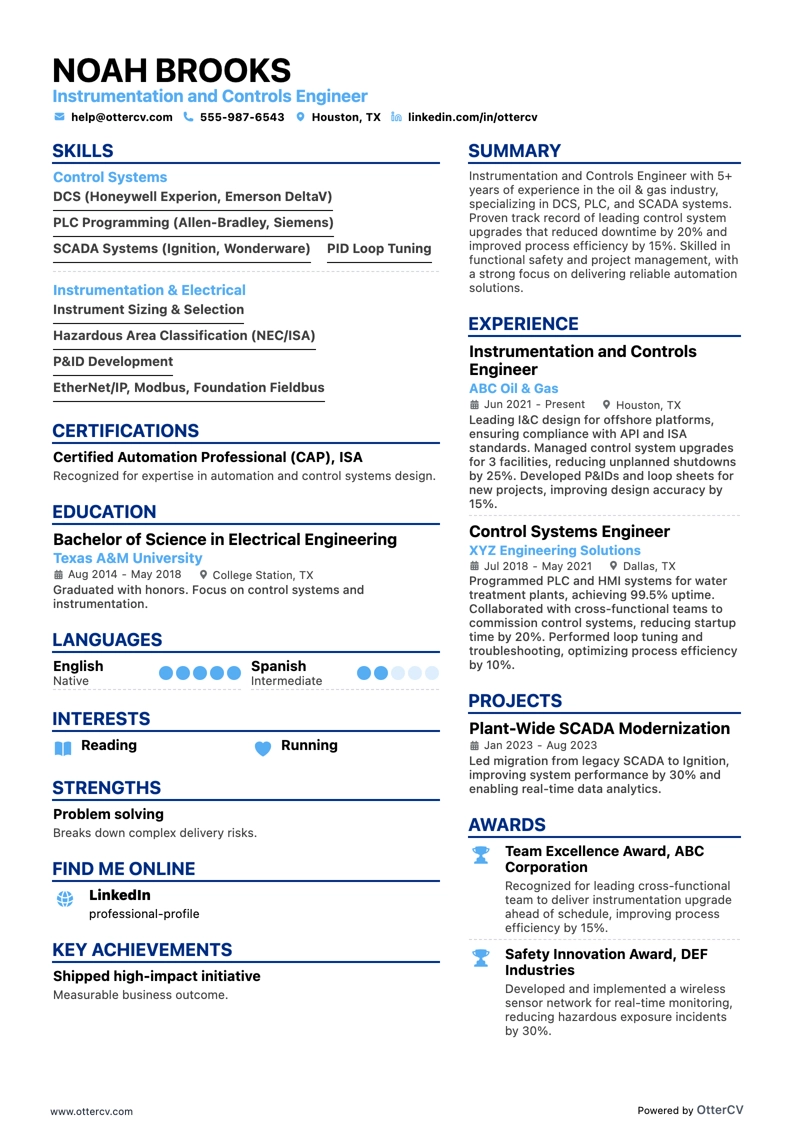
Instrumentation and Controls Engineer resume example

Instrumentation and Controls Engineer

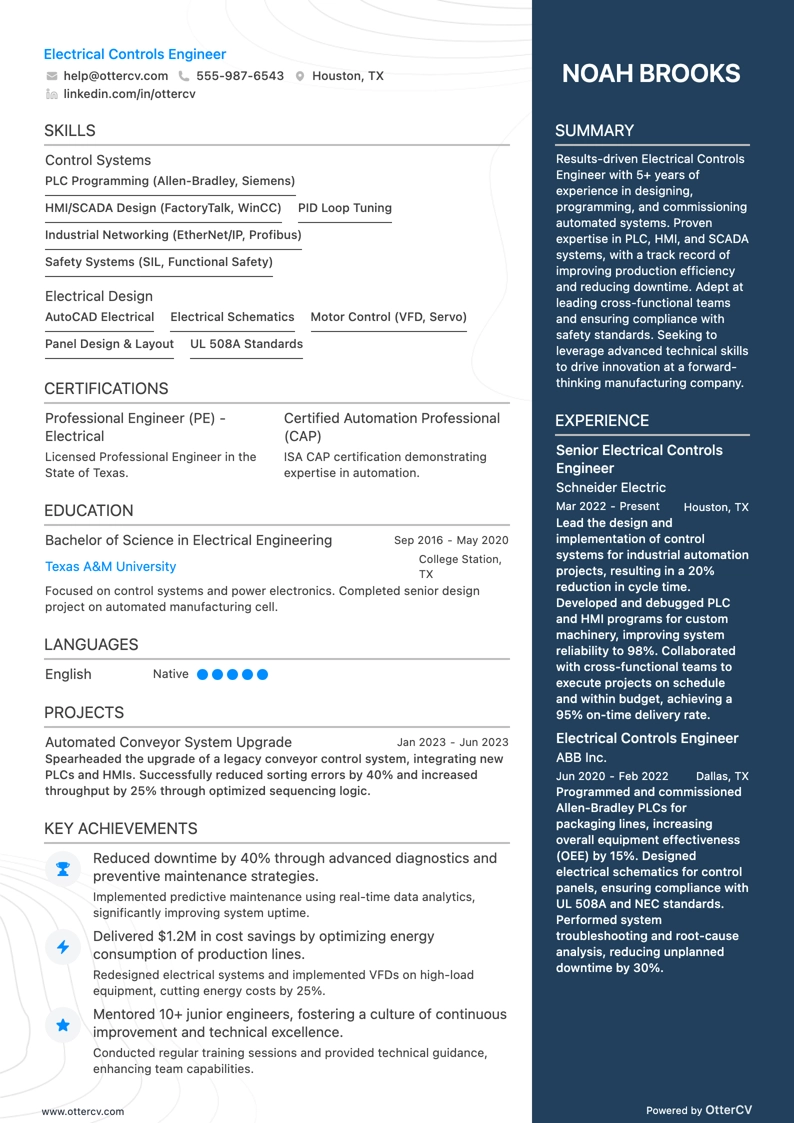
Electrical Controls Engineer resume example

Electrical Controls Engineer

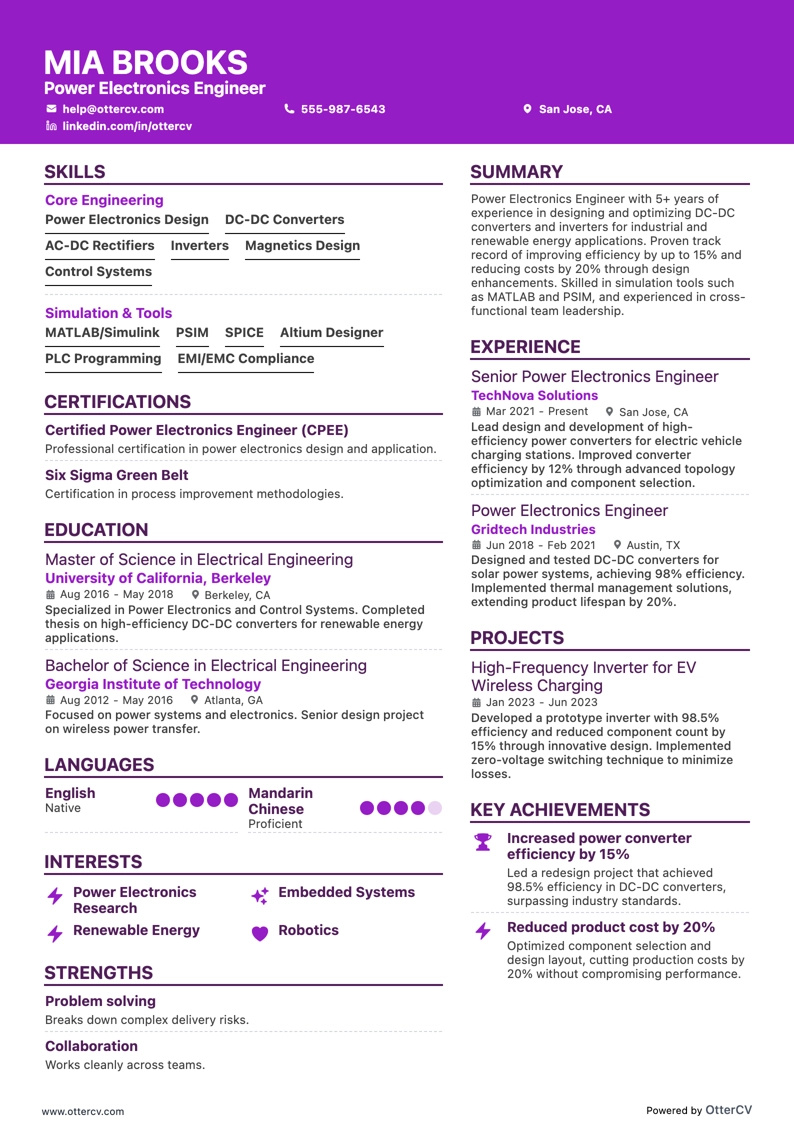
Power Electronics Engineer resume example

Power Electronics Engineer

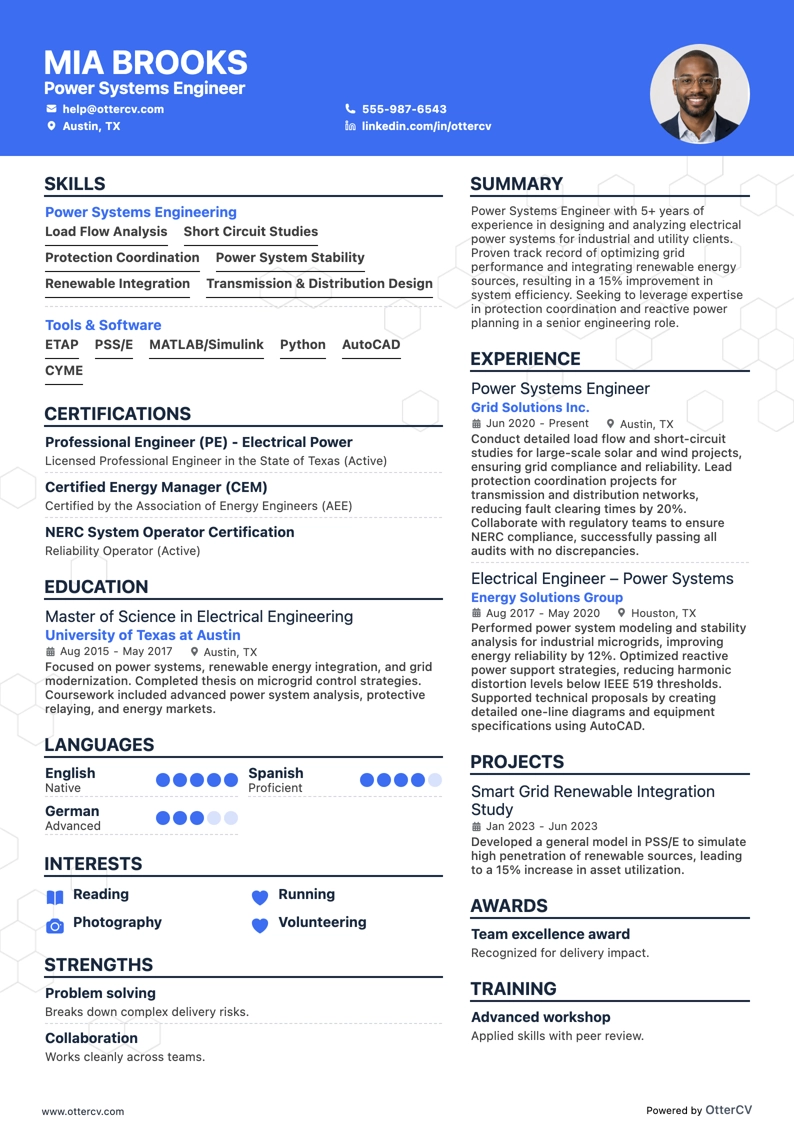
Power Systems Engineer resume example

Power Systems Engineer

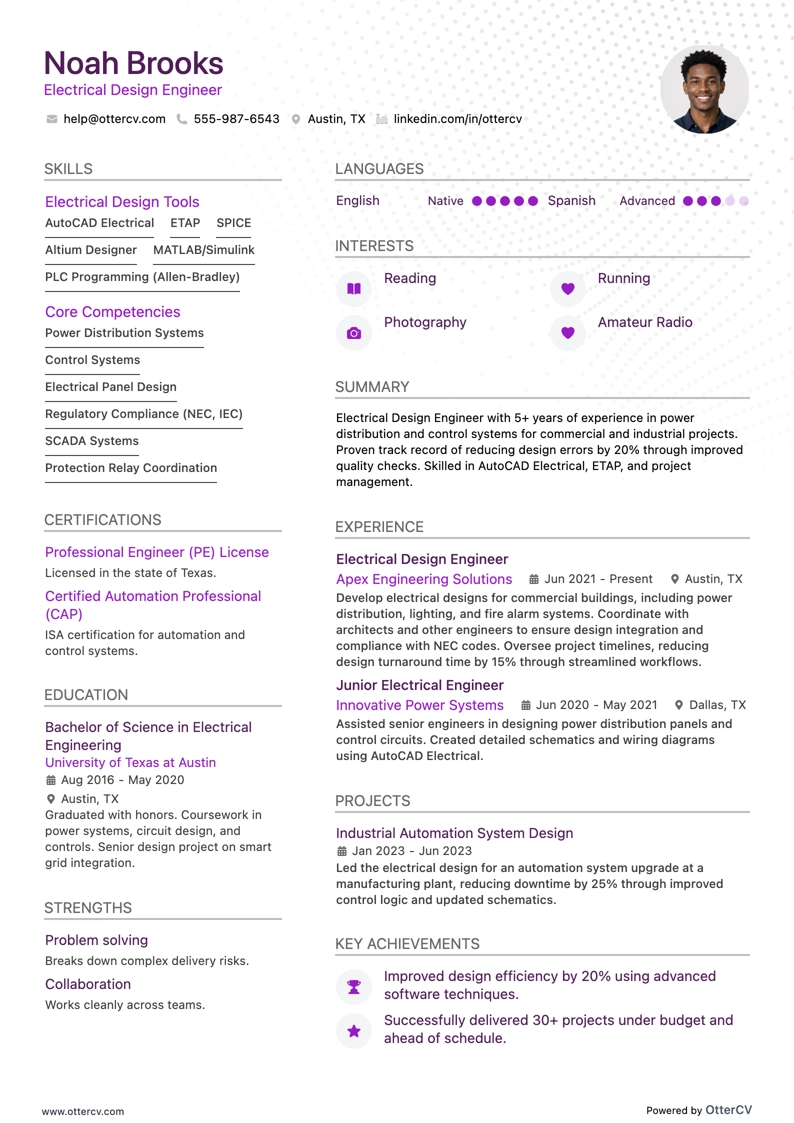
Electrical Design Engineer resume example

Electrical Design Engineer

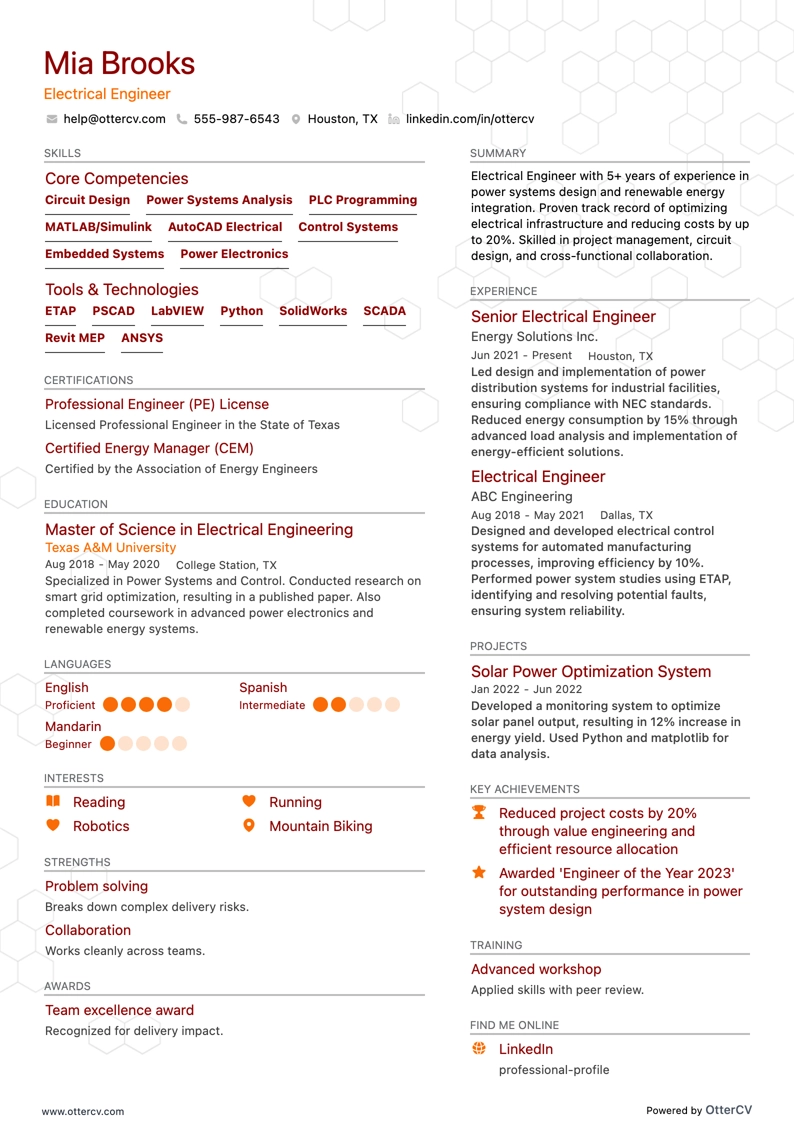
Electrical Engineer resume example

Electrical Engineer

Electrical engineers seem to be running the world these days. From hair dryers and smartphones to telecommunications, transportation, power generation, transmission, and everything in between, electrical engineers help build the modern world.

As we continue moving toward a digital future, electrical engineering remains a profession with growing demand and diversification. In fact, employment of electrical and electronics engineers is projected to grow 7% from 2022 to 2032, faster than the average for all occupations.

Crafting an electrical engineering resume can be challenging because the field is broad while most job openings are highly specific. One of the biggest difficulties electrical engineers face when applying is keeping their resume relevant to each position.

This guide will show you how to create an effective electrical engineering resume and make a positive impression on employers.

Key takeaways

  • Use a reverse-chronological format so your work history is clear and easy to scan.

  • Choose a clean resume layout with subtle colors and modern fonts to highlight your strengths.

  • Show measurable results in your experience and add context to make your achievements more compelling.

  • List hard skills in a dedicated section, and weave people skills into your experience for added depth.

  • Present your educational background clearly for an electrical engineering role, and include relevant certifications.

  • Add extra sections, such as engineering projects you have worked on in your spare time.

Let’s look at a sample resume for an electrical engineer so you can better visualize what to include in your own.

Electrical engineering resume sample

This sample includes all the key sections of an electrical engineer resume.

Carla Jensen

Electrical Engineer

carlajensen@email.com | LinkedIn | Seattle, WA

Summary

Highly skilled Electrical Engineer with over 5 years of experience developing, testing, and managing manufacturing processes for electrical devices. Proficient in design software for creating schematics and overseeing installation processes. Committed to maintaining safety and efficiency across all projects.

Experience

Electrical Engineer
Tech Innovators Inc., Seattle, WA
June 2019 – Present

  • Developed electrical devices and systems in compliance with safety and efficiency standards.
  • Managed the manufacturing process for new electrical equipment while coordinating with cross-functional teams.
  • Used design software to produce detailed schematics and blueprints.
  • Oversaw installation to ensure proper implementation and functionality.

Junior Electrical Engineer
FutureTech Solutions, Seattle, WA
August 2016 - May 2019

  • Assisted in the development and testing of electrical devices.
  • Supported manufacturing processes to ensure adherence to quality standards.
  • Collaborated with senior engineers to produce design schematics.
  • Participated in the installation and troubleshooting of electrical systems.

Education

Bachelor of Science in electrical engineering
University of Washington
Graduated: 2016

Certifications

  • Professional Engineer (PE) License
  • Certified Automation Professional (CAP)

Skills

  • Electrical Device Development
  • Safety and Efficiency Testing
  • Manufacturing Process Management
  • Design Software (AutoCAD, MATLAB)
  • Schematic Production
  • Installation Process Oversight

Languages

  • English (Native)
  • Spanish (Conversational)

Let’s break down the elements of a successful resume, starting with formatting.

How to format an electrical engineering resume

Think of the right resume format as the switch of an electric system: it should be easy to use, intuitive, and highlight what matters most. A resume template should do exactly that by putting your best qualities in the spotlight.

Here are the key formatting tips:

Resume format

The reverse-chronological format is a timeless choice. It presents your work history in an orderly way, starting with the most recent role for an easy reading experience.

Resume design

Contact information

Your resume header is likely the first thing hiring managers will see, so include the essentials: your name, job title, and contact information. A photo is generally not needed, as it can cause bias, but always check the job description.

Also consider your target market. Resumes in Canada, for example, follow different layout conventions.

PRO TIP

Contrary to popular belief, our tests showed that fonts, colors, columns, and resume length do not affect ATS (Applicant Tracking Systems) parsing. Instead, focus on matching the language in the job description and on formatting details such as dates and bullet symbols, since those may affect your application.

File formatting

Use a PDF format to ensure all elements of your chosen resume layout stay in place. You can name your file using this formula: FirstName_LastName_JobTitle.

Top sections on a resume

Here are the main resume sections:

  • Work experience
  • Skills
  • Education
  • Summary/Objective
  • Additional sections

We’ll discuss them in more detail below.

Have you tried the Echocv resume builder? It helps ensure your resume includes all the key sections.

We’ve got the design covered, so now let’s move on to your strongest suit—your experience.

How to write your electrical engineering resume experience

One of the best parts of electrical engineering is that the results of your work are often visible—and easy for others to recognize too. Use that to make your resume experience concrete and compelling.

Key components of an experience section

Make sure your experience section includes:

  • The companies you worked for, your roles, and the time period you spent there.
  • The purpose of the projects you worked on, your contributions, and the outcomes.
  • Specific technical skills and tools you used, such as AutoCAD, MATLAB, and PLC programming.
  • Quantifiable achievements. We’ll look at this in more detail in a moment.

Tailor your experience to the role

Be strategic about how you present your electrical engineer experience. Select keywords from the job description and include them in your resume summary or experience section to show recruiters you’re a strong match for the position. This helps tailor your resume to the job posting. The more relevant your application is, the better your chances of landing an interview.

Let’s take a look at a real electrical engineer job description.

Electrical engineer

Electrical engineer

Company profile: The Corporate Real Estate Operations group manages day-to-day facilities operations, capital planning, and engineering operations across owned and leased facilities to help maintain a clean, safe, and efficient work environment. The team is focused on protecting and improving the value of the company’s physical assets while upholding high engineering standards.

Responsibilities:

  • Provide engineering services to in-house project teams, clients, and third-party consultants for the design, development, testing and fixing, documentation, programming, and ongoing support of electrical and critical power systems across the portfolio.
  • Partner with third-party MEP consultants on electrical design, power calculations, facility resiliency, and system redundancy.
  • Assist with critical system design for studios, broadcast spaces, data centers, and similar environments.
  • Develop, review, and interpret electrical drawings to support projects.
  • Recommend and implement engineering changes to meet BU requirements.
  • Provide technical support for capital improvements and forecast expense and capital budgets related to service contracts and end-of-life capital predictive maintenance.
  • Review new project designs for alignment with the Company’s Energy Goals.

Required qualifications & skills:

  • 3+ years of confirmed experience in electrical engineering or equivalent.
  • Strong communication and presentation skills with both internal staff and outside entities, including Studio, Walt Disney Imagineering, and vendors.
  • Detail orientation and the ability to work under deadlines or short notice while addressing problems quickly.
  • Experience in electrical system design, including Utility, Critical Power Plants, and Lighting Controls.
  • Knowledge of instrumentation, including electronic devices, power supplies, relays, contact blocks, as well as start-up and commissioning of electrical systems.
  • Strong digital literacy with MS Office Suite, AutoCAD, and Bluebeam REVU.

Here’s an example experience entry tailored to that same job description. We’ve bolded the parts that align with the job ad.

Experience

Electrical Engineer

General Electric

01/2020 - Present | Los Angeles, CA

  • Provided engineering services for electrical and critical power systems across a portfolio of corporate properties.
  • Partnered with third-party MEP consultants on electrical design, power calculations, and system redundancy to enhance facility resiliency.
  • Assisted in designing critical systems, including studios, broadcast spaces, and data centers, ensuring all electrical requirements were met.
RIGHT

Here’s why this section works:

  • Aligns with job responsibilities: The experience entry reflects the duties and responsibilities outlined in the job description, showing direct relevance to the target role.
  • Highlights key skills: Mentioning skills such as electrical system design and collaboration with third-party consultants demonstrates technical proficiency and readiness for the position.
  • Shows fieldwork capability: Referencing the design of critical systems such as studios, broadcast spaces, and data centers highlights practical experience and adaptability to the role’s demands.

The most effective way to describe your experience is through real results. Here’s how to quantify your achievements.

How to quantify your experience on a resume

Quantifiable experience is especially important for an electrical engineer. Engineering employers favor candidates who can show proven success with concrete data because it demonstrates competence, efficiency, and problem-solving ability.

For example, instead of saying, Improved the efficiency of a power system, say, Enhanced the efficiency of a power distribution system by 20%, resulting in a cost savings of $50,000 annually. This makes the technical improvement clear and connects it to business impact, which is more compelling for both hiring managers and non-technical stakeholders.

Here’s how you can quantify your achievements

  • Show any improvements you made to electrical system efficiency, using percentages to highlight the impact.

  • State how many engineering designs or drafts you completed or helped develop.

  • Include the number and types of electrical equipment you managed or maintained.

  • Specify any project cost reductions you achieved and how much money you saved the company.

  • Mention how many safety standards or protocols you implemented or supported.

Being inexperienced can feel intimidating, but there are ways to present yourself effectively.

How do i write an electrical engineering resume with no experience

It’s perfectly understandable to be inexperienced at the beginning of your career. What matters most is your willingness to learn and your ability to focus on your strengths.

Focus on your skills, education, and projects or volunteering

  • Your education is integral to an electrical engineering career, so include a relevant degree, a high GPA, and other academic accomplishments.
  • Highlight the transferable skills you already have, such as communication, teamwork, and attention to detail.
  • Avoid the rookie mistake of skipping projects or volunteering. These activities show your eagerness to contribute and grow professionally. For example, volunteering as a STEM mentor, conducting workshops, and guiding students through projects can strengthen teaching and leadership skills that employers value.

And it’s not just our opinion. Here are a few specific tips on how to approach this section, based on advice from an HR interviewing for an electrical engineering department:

Resume Section Priorities

  • Put your skills and certifications at the top, followed by your education section.
  • In your projects section, emphasize what you learned and why the work was genuinely interesting to you.
  • Your bullet points should explain how you used implementation choices and tooling to achieve a specific design aspect of the project. Otherwise, a recruiter or hiring manager may assume you were only experimenting with a language, software, or tool to learn it or check a box.

Format for an entry-level electric engineer resume

Consider using a skill-based resume format or a hybrid format that highlights both experience and skills. These formats place more emphasis on your achievements than on your work history alone.

Finally, an electric engineer resume with no experience can stand out with a strong resume objective. Keep it brief, ideally 1–3 sentences, and focused. Ask yourself: what can I bring to the table, and how can I show my passion and willingness to work in the electrical engineering field?

Here’s a strong resume objective example:

Objective

Energetic electrical engineer with a strong academic background and hands-on experience in electrical design. Eager to contribute to the development of innovative medical devices by collaborating with cross-functional teams and ensuring compliance with regulatory standards.

RIGHT

The objective is short, engaging, and to the point, creating a strong introduction by showing energy and eagerness. It highlights a strong academic background and hands-on experience in electrical design, directly addressing key qualifications. It also emphasizes collaboration with cross-functional teams and compliance with regulatory standards, aligning with the job responsibilities.

Your skills and experience go hand in hand. Here’s how to position your abilities on your resume.

How to list your hard and soft skills on your resume

Your skills section should clearly describe your capabilities to potential employers. Organize your skills into two categories: hard and soft. Hard skills are the technical proficiencies specific to your industry, and they should be highlighted in a distinct section for easy readability.

Here are our top picks:

Best hard skills for your electrical engineering resume

  • Circuit design.
  • Systems analysis.
  • Power distribution.
  • Control systems.
  • Project management.
  • Microprocessors.
  • Digital logic design.
  • Electrical testing tools.
  • Computer-aided design (CAD).
  • Electrical system simulation.
  • MATLAB.
  • Soldering.
  • PCB design.
  • Proficiency in C/C++.
  • Programmable logic controllers (PLC).
  • Knowledge of VHDL/Verilog.
  • Process control.
  • FPGA design.
  • Knowledge of NEC codes.
  • Instrumentation and measurements.

Soft skills are best woven into your experience section through concrete examples. Don’t underestimate them—even in a technically oriented environment, people skills remain fundamental.

Consider adding some of these to your resume:

Your resume would be incomplete without an education section. Here’s how to structure it.

How to list your certifications and education on your resume

Did you know that nearly half of the students who start an electrical engineering degree drop out before completing their program? Reasons include challenging coursework, poor teaching methods, and a lack of hands-on experience in the early years of the curriculum.

If you’ve completed such a demanding degree, make sure to include it on your resume. It shows dedication, consistency, and a strong work ethic.

Here are a few tips for structuring your education section:

  • Clearly state your degree and major (for example, a BA in Human Resources Management or Psychology).
  • List your educational institution to reinforce the credibility of your education.
  • Include your graduation year to show context and recency. Skip the month.
  • Mention courses related to recruitment and human resources, such as Talent Acquisition, Organizational Behavior, or HR Management.
  • If you’ve been on the Dean's List, graduated Cum Laude, or received a scholarship, mention it in your application.

We’ve crafted an education entry targeting the job description from above:

Education

Bachelor of Science in Electrical Engineering
University of California, Berkeley
08/2017 - 05/2024 · Berkeley, CA
GPA: 3.8 / 4.0

  • Specialized in Power Systems and Instrumentation.
  • Completed a capstone project focused on Critical Power Plant design and resilience.
  • Extensive use of AutoCAD and Bluebeam REVU in coursework and projects.
RIGHT

We believe this is a strong example because it:

  • Aligns with job requirements: The degree and specialization directly relate to the role’s focus on electrical systems, critical power plants, and instrumentation.
  • Mentions relevant skills and tools: Referencing tools like AutoCAD and Bluebeam REVU shows proficiency in the software required by the job posting.
  • Includes a capstone project: A capstone project on Critical Power Plant design demonstrates hands-on experience and a direct connection to the position’s responsibilities.

In addition to your higher education, you could also mention that you stay current with developments in electrical engineering through certifications.

Consider listing some of these:

With your educational foundation in place, let’s shift to writing a compelling resume summary that highlights your key achievements.

How to write your electrical engineering resume summary

A strong resume summary is essential for an experienced electrical engineer. When written well, it can capture a hiring manager’s attention. Keep it concise in 3–4 sentences, use active voice, and show how your experience can help the company you’re applying to.

This summary is tailored to the job description above:

Summary

Experienced Electrical Engineer with over 3 years of expertise in electrical system design, utility management, critical power plants, and lighting controls. Proven success in providing technical resources for large-scale real estate operations to support efficient, safe, and sustainable environments. Skilled in collaborating with third-party consultants, managing capital improvements, and supporting engineering changes to meet business unit requirements.

RIGHT

This summary is concise and relevant. It highlights specific technical expertise while also emphasizing the candidate’s collaborative, proactive approach to working with internal teams and external consultants.

Finally, let’s explore the optional sections you can include on your resume.

Additional sections for an electrical engineering resume

Why limit yourself to the standard resume sections when adding relevant extras can help your resume stand out? Any additional section should support the position you want, and these are strong options to consider:

In conclusion

An effective electrical engineering resume should highlight key technical skills, professional achievements, and relevant experience. Essential elements include a concise summary that presents your expertise and accomplishments, a detailed work experience section focused on specific projects and measurable results, and a clear presentation of your educational background and proficiencies.

Electrical Engineering resume examples

Explore additional Electrical Engineering resume samples and guides and see what works for your level of experience or role.

By Experience

Principal Electrical Engineer

Principal Electrical Engineer resume preview

Senior Electrical Engineer

Senior Electrical Engineer resume preview

Electrical Engineering resume examples

Explore additional Electrical Engineering resume samples and guides and see what works for your level of experience or role.

By Role

Electrical Distribution Engineer

Electrical Distribution Engineer resume preview

Electrical Substation Engineer

Electrical Substation Engineer resume preview

Signal Integrity Engineer

Signal Integrity Engineer resume preview

RF Engineer

RF Engineer resume preview

Instrumentation and Controls Engineer

Instrumentation and Controls Engineer resume preview

Electrical Controls Engineer

Electrical Controls Engineer resume preview

Power Electronics Engineer

Power Electronics Engineer resume preview

Power Systems Engineer

Power Systems Engineer resume preview

Electrical Design Engineer

Electrical Design Engineer resume preview

Electrical Engineer

Electrical Engineer resume preview