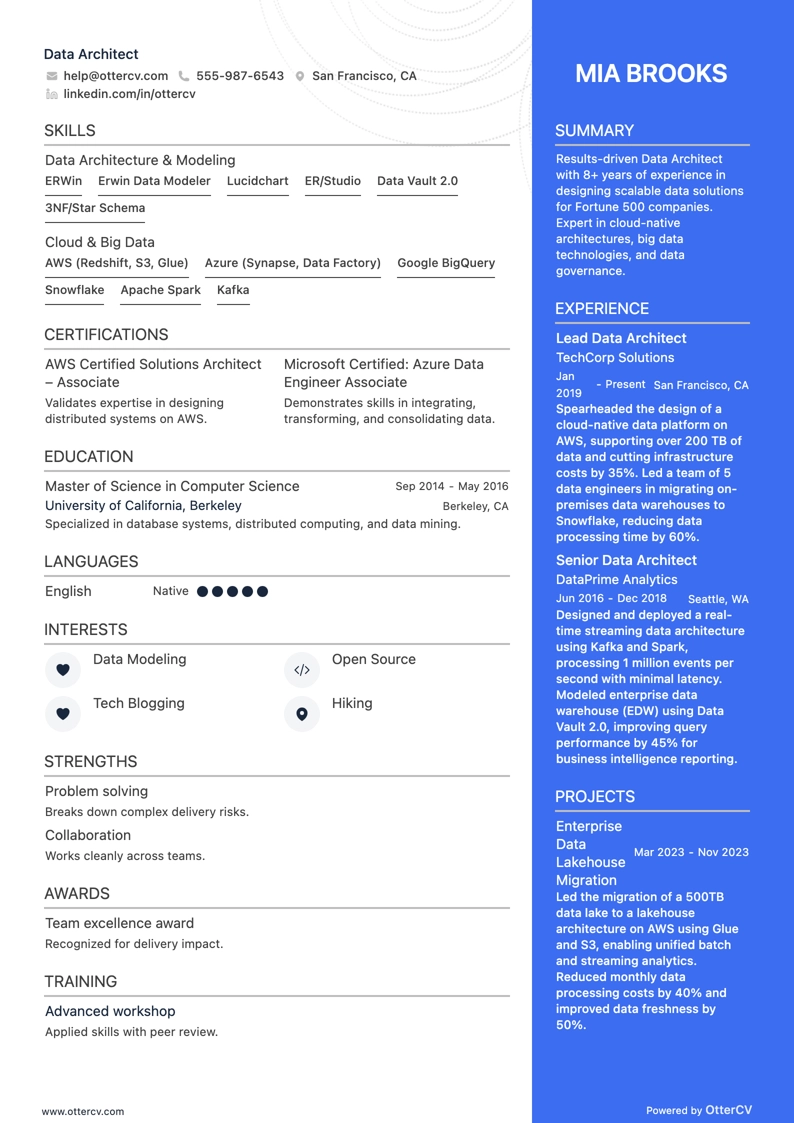
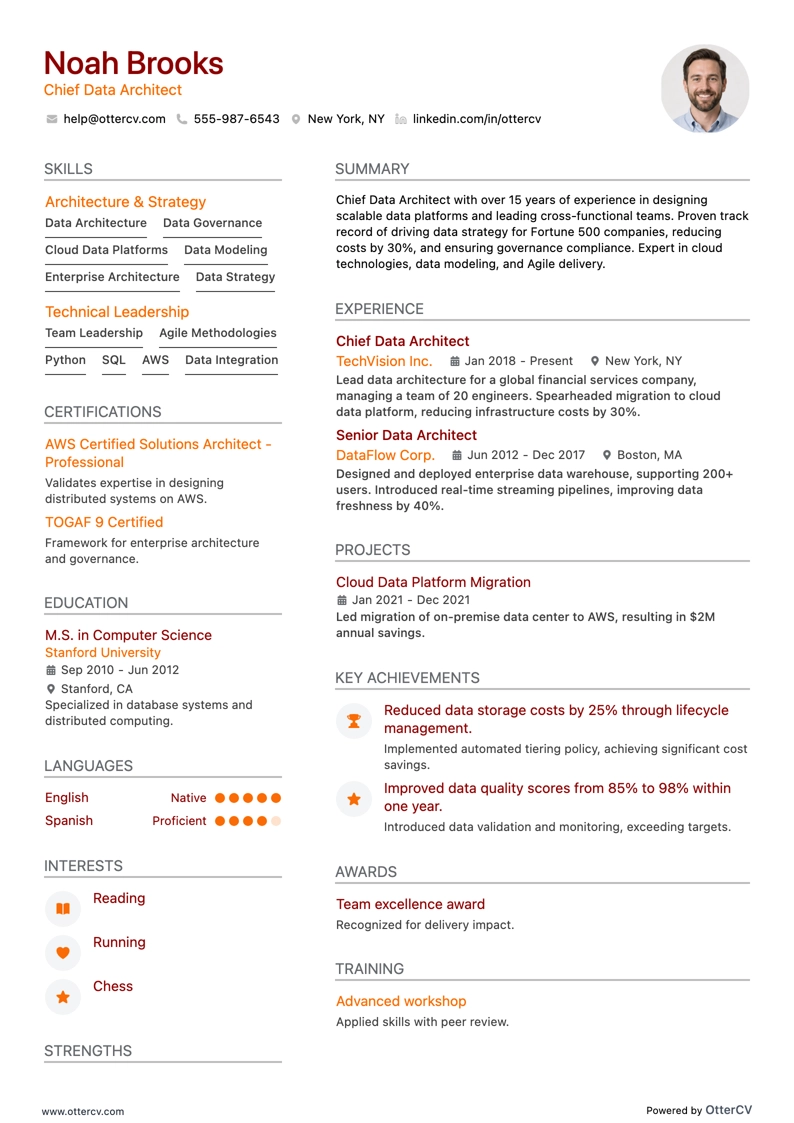
Chief Data Architect full preview

15 Data Architect Resume Examples

OtterCV

Written by The OtterCV Team

Updated: 2/15/2023•8 min read

See all resume examples in this guide, or generate your own resume example with your personalized prompt

Chief Data Architect resume example

Chief Data Architect

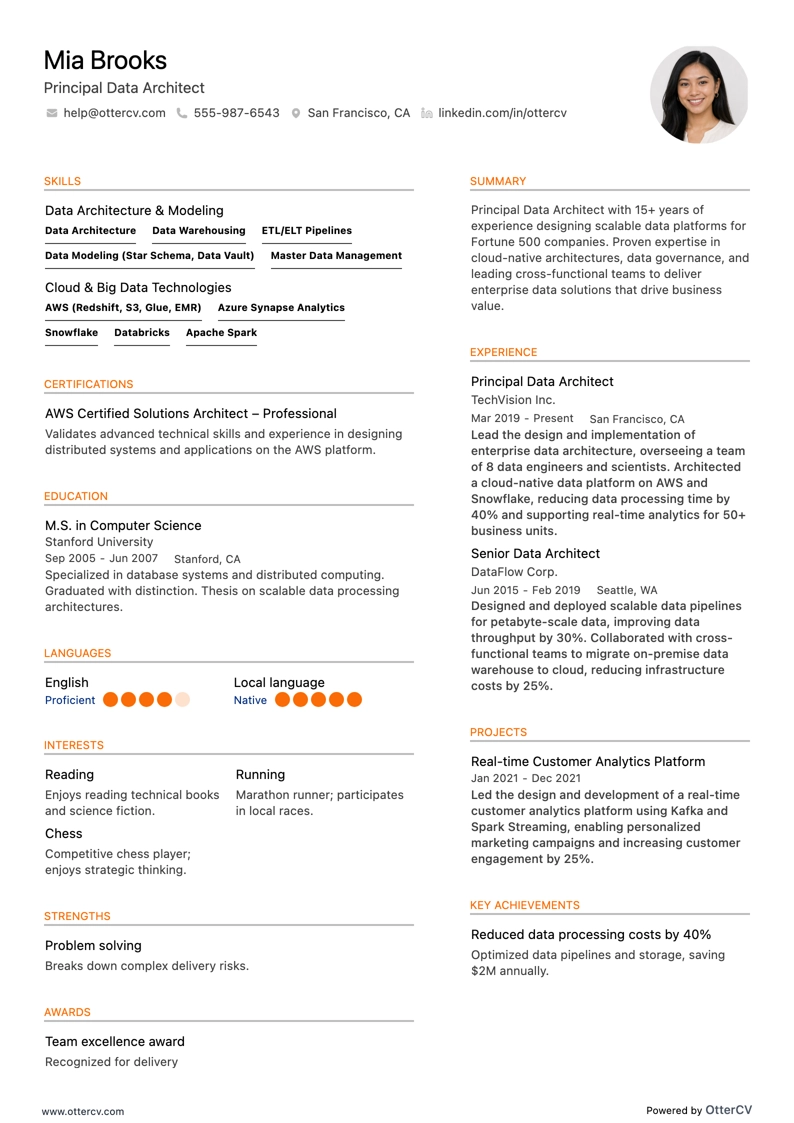
Principal Data Architect resume example

Principal Data Architect

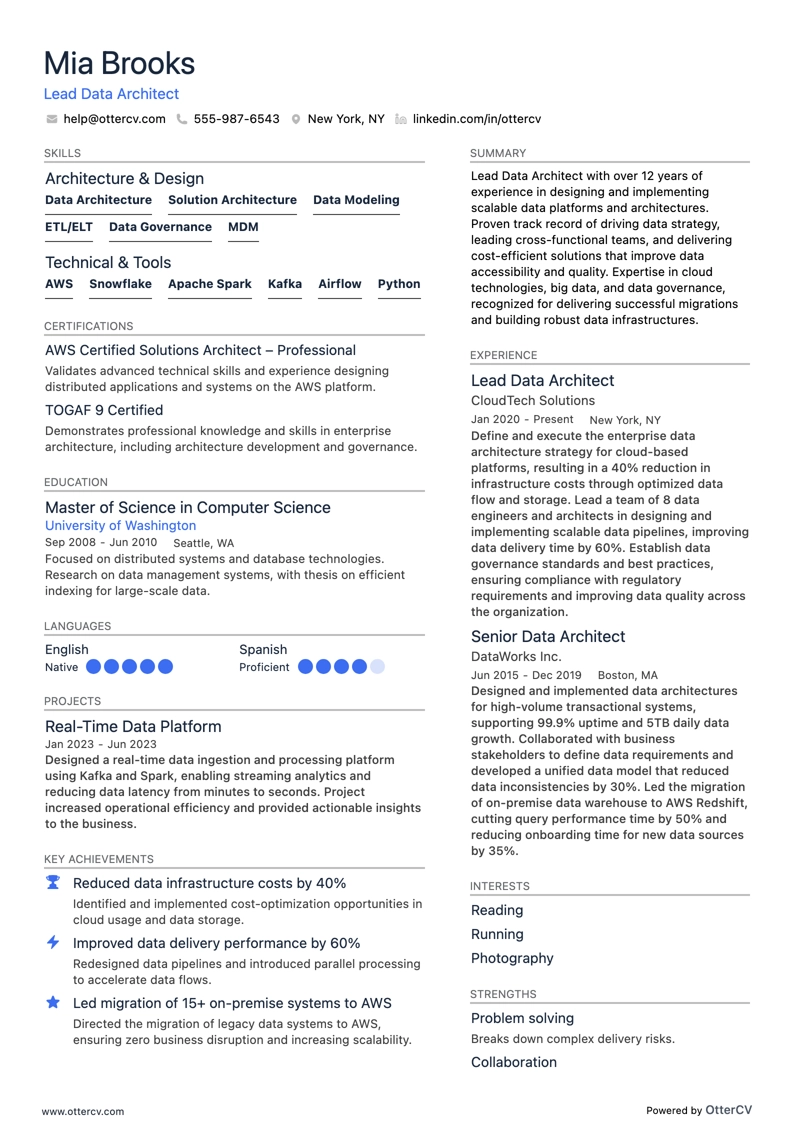
Lead Data Architect resume example

Lead Data Architect

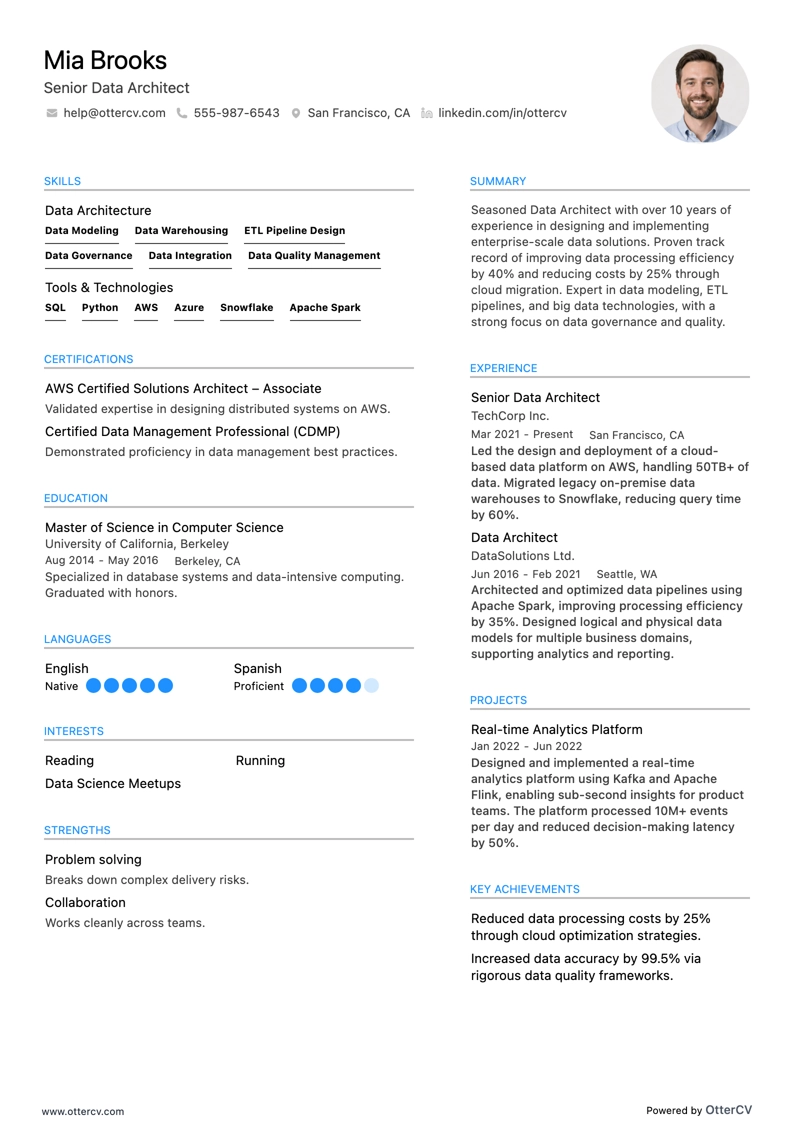
Senior Data Architect resume example

Senior Data Architect

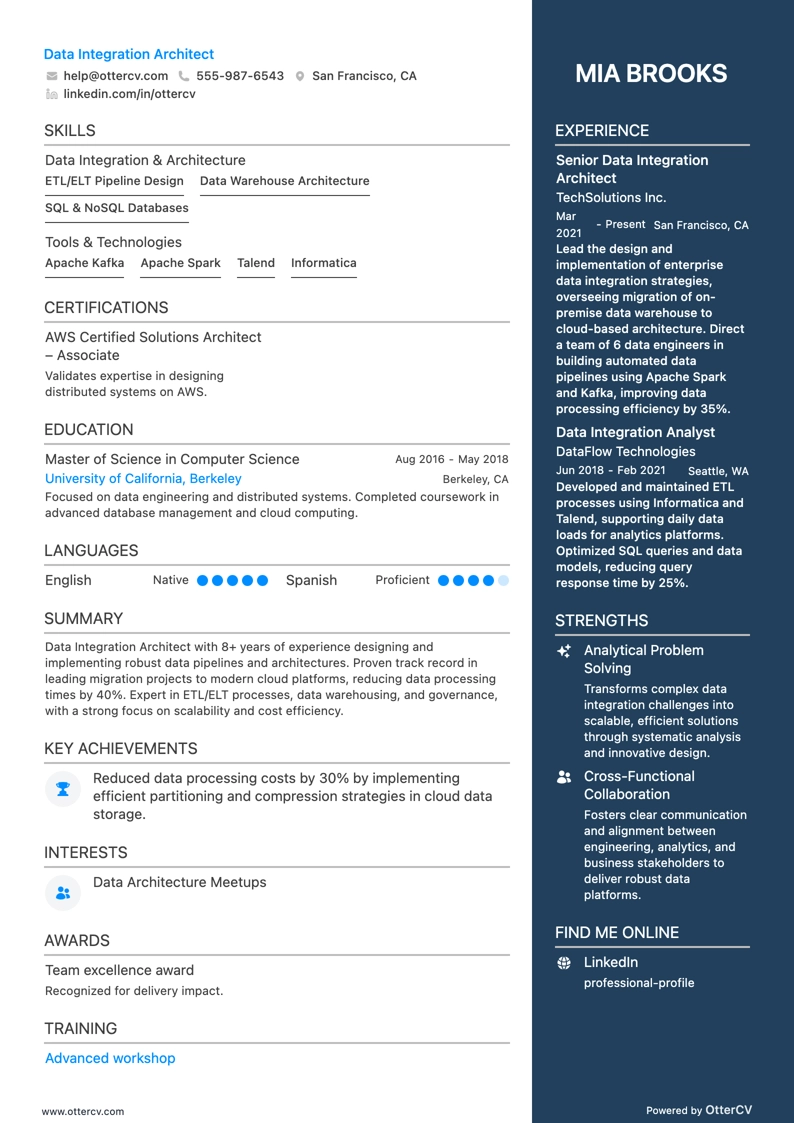
Data Integration Architect resume example

Data Integration Architect

Database Architect resume example

Database Architect

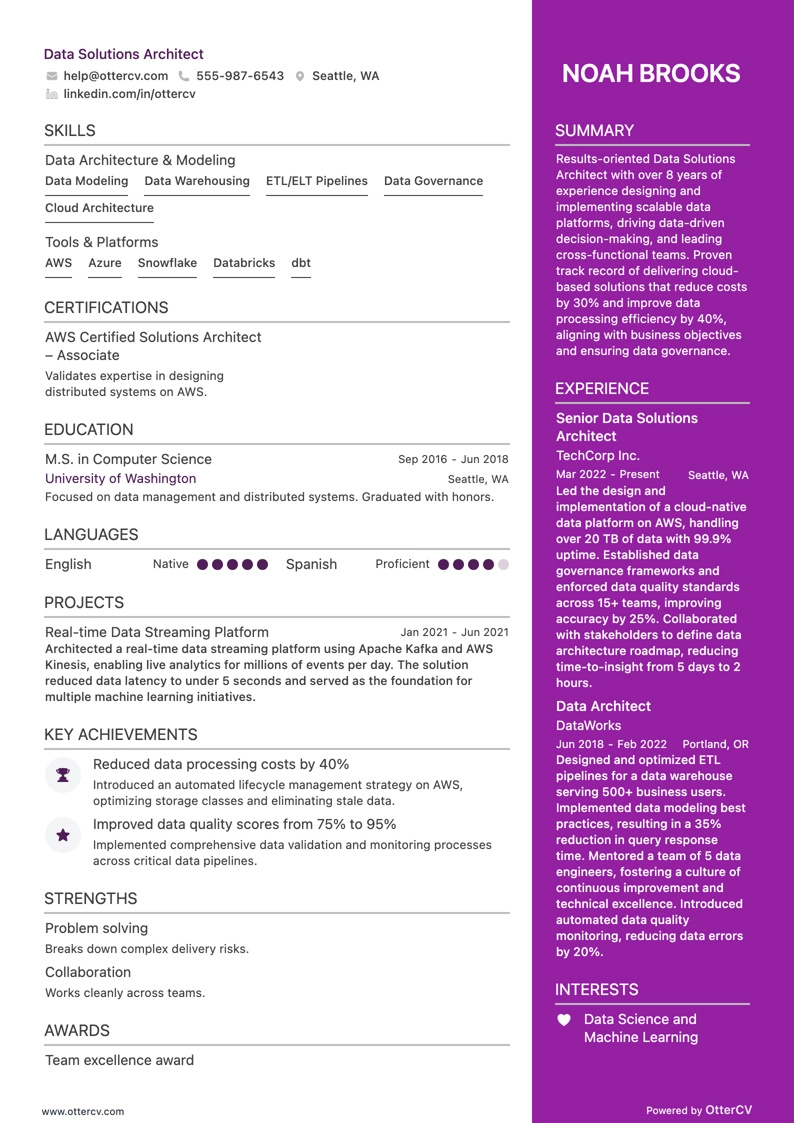
Data Solutions Architect resume example

Data Solutions Architect

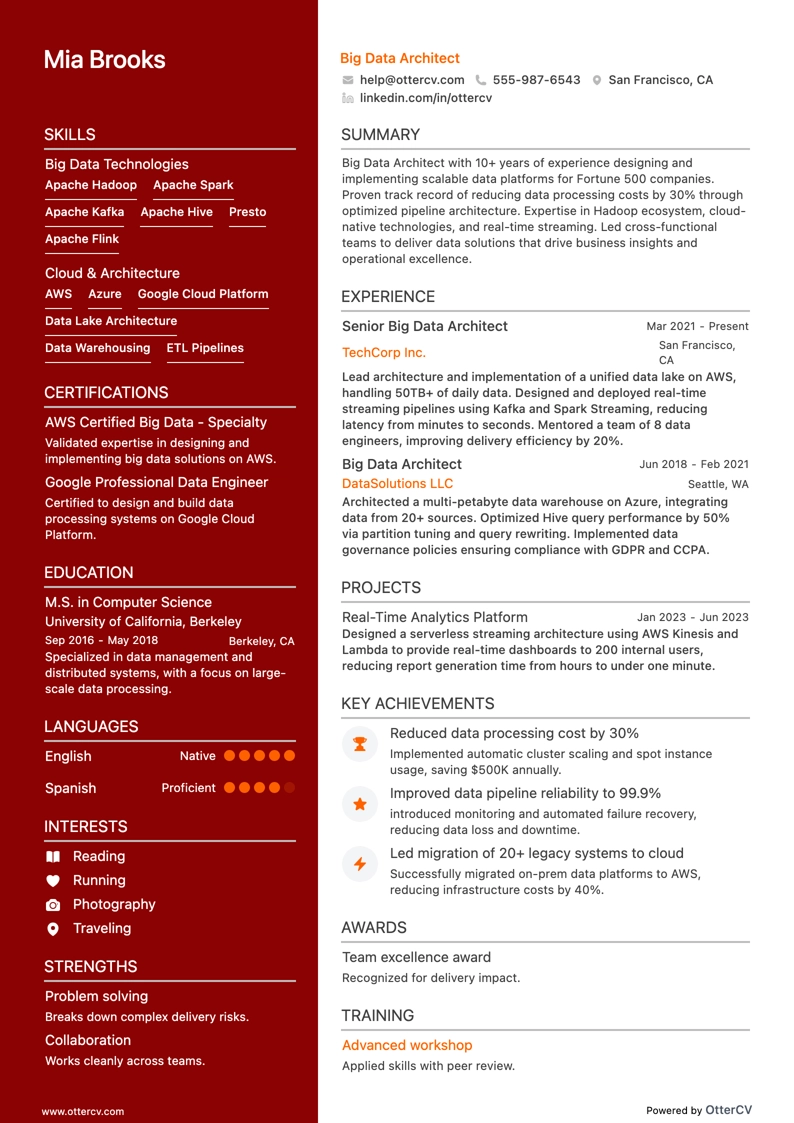
Big Data Architect resume example

Big Data Architect

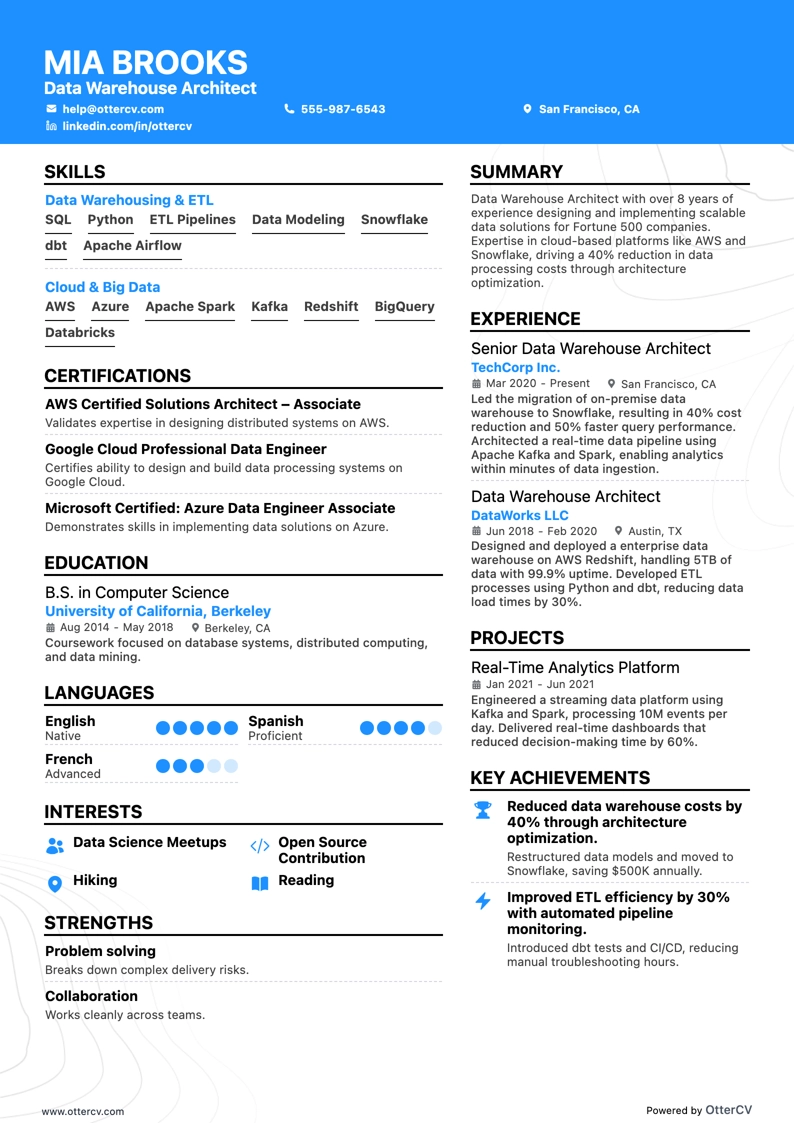
Data Warehouse Architect resume example

Data Warehouse Architect

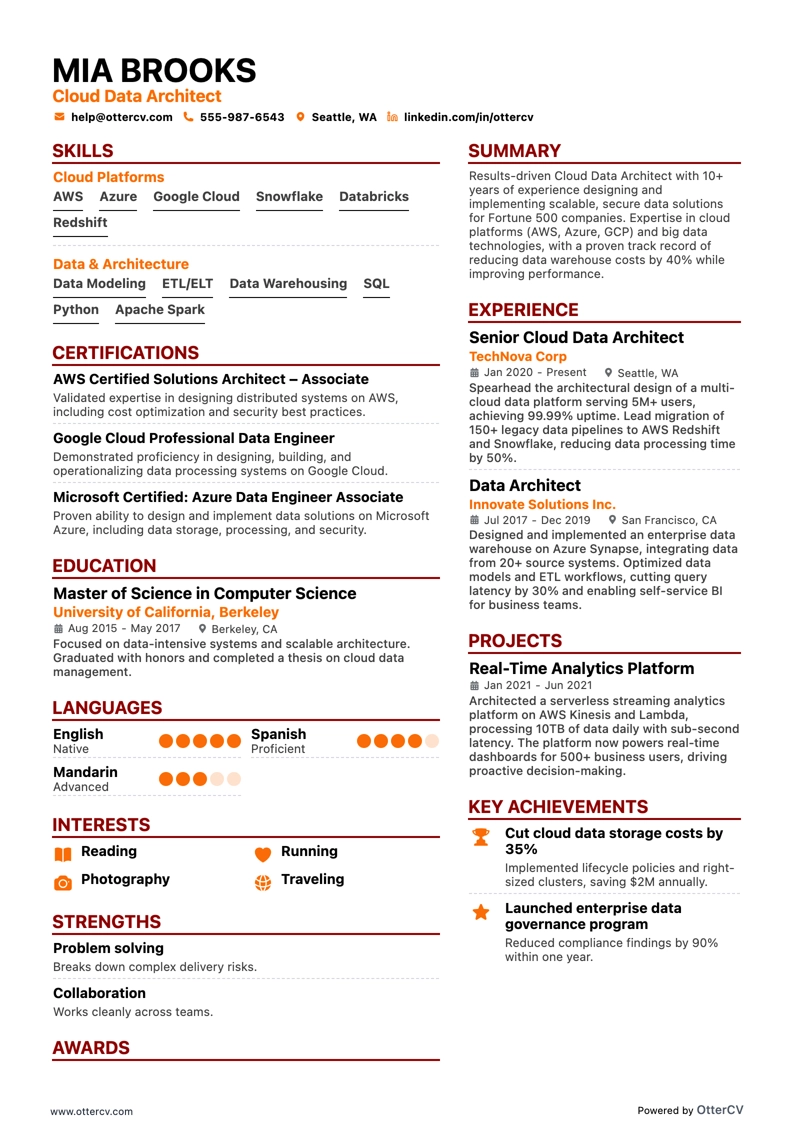
Cloud Data Architect resume example

Cloud Data Architect

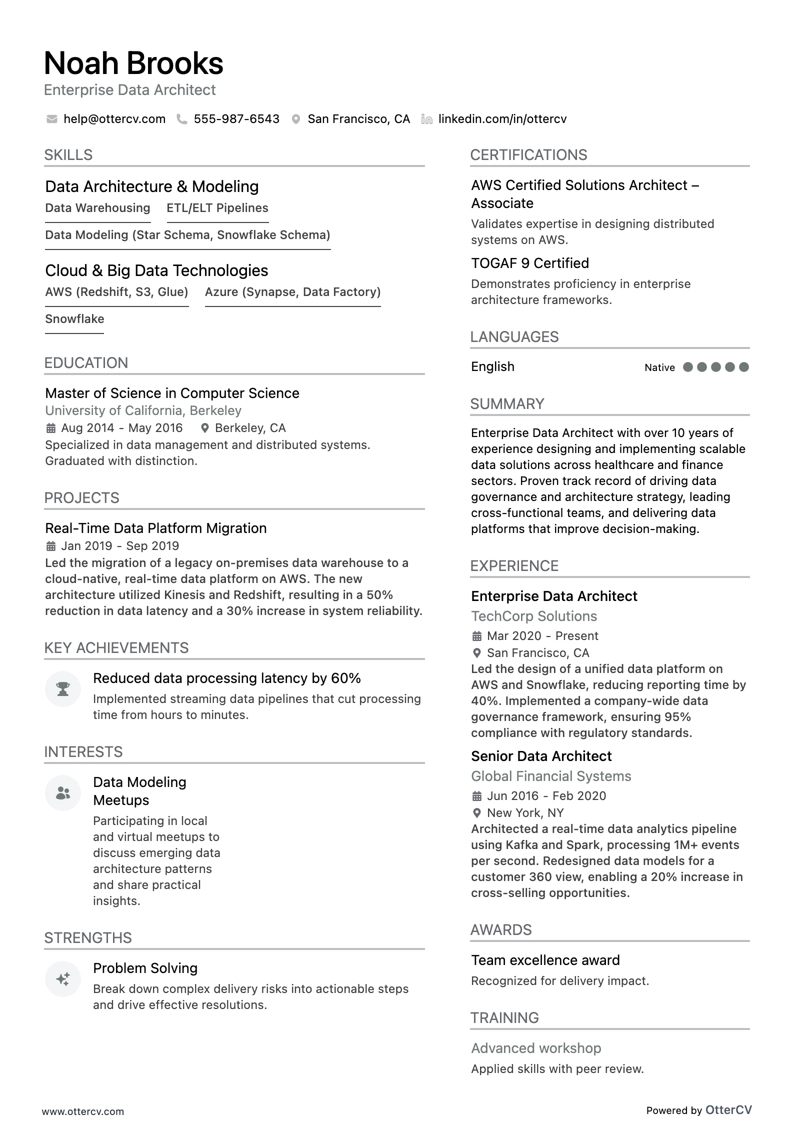
Enterprise Data Architect resume example

Enterprise Data Architect

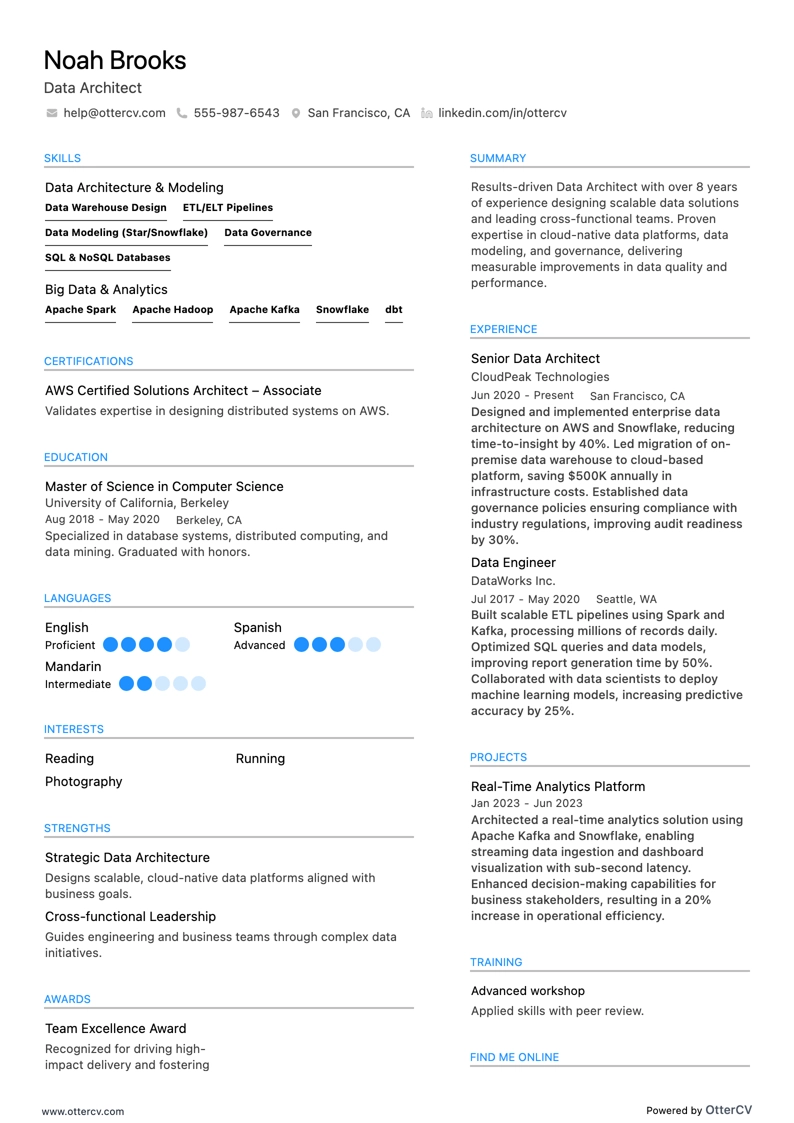
Data Architect resume example

Data Architect

Data architects looking for a new career opportunity often face several challenges when updating their resume. In a high-demand industry, it is easy to get overlooked among the 200+ resumes HR teams may review for a single opening.

How can you create a data architect resume that stands out and avoids common mistakes? This guide shows you how to:

  • Highlight experience with specific technologies and programming languages, such as SQL, Java, and Python, that match the skills listed in the job posting.
  • Present complex projects and data analysis with the right level of technical detail, without becoming overly technical.
  • Showcase the technical, business, and interpersonal skills that are essential for data architects.
  • Quantify your work experience to demonstrate achievements in improving data performance, optimizing data access, and ensuring data security.

We’ll use real-world resume examples to show you how to create a concise, detailed resume that presents both your technical and personal skills in the right format.

Before we begin, if this guide does not match your career goals, check out these resume examples for similar roles:

How to Format a Data Architect Resume

Before adding your relevant skills, experience, and education, you should format your resume according to industry standards.

Proper resume formatting helps you perform better in applicant tracking systems and improves the chances of your resume being seen by the right people.

While you can start with a pre-formatted resume template, it helps to understand the standard formatting settings:

When choosing fonts, avoid decorative or script styles because they are harder to read. Classic fonts such as Times New Roman and Arial are still acceptable, even if they can feel overused or dated. More modern options include Exo 2, Lato, Montserrat, Raleway, Rubix, and Volkhov.

You can also learn more about the different types of fonts you can use on your resume.

Most templates already include these standard settings, so you usually will not need to worry about the technical side of formatting. What you do need to choose is the overall design and layout.

For heavily technical careers, a modern resume template is often a strong option. It offers a clean, efficient design and may include graphics, icons, QR codes, and embedded videos. It also reflects the fact that most resumes are read on a computer screen.

Other template styles can also work well, depending on your goals:

  • Traditional: A single-column layout that gives your resume a classic, conservative appearance. It uses a simple background without graphics, colors, or other modern features.
  • Simple: A minimalistic layout that presents your information in a clean, concise way. Best for candidates who want to show their skills and experience directly.
  • Creative: A format for showing more individuality and creativity. It often uses a two-column layout, colored backgrounds, and eye-catching graphics to help your resume stand out.

Different markets may follow different resume conventions. For example, a Canadian resume may require a different approach.

If your data architect resume is ready, run it through our resume checker for a free analysis.

A well-formatted resume should include several essential sections to help HR teams better understand your capabilities.

The top sections on a data architect resume:

  • Professional statement: Write a brief career summary that highlights your years of experience and key data architect metrics to show why you should be hired.
  • Technical skills: Show your experience with relevant hard skills, including data modeling and design, database management, system architecture, data security, and other essential technical skills.
  • Work experience: List relevant roles in a chronological format that emphasizes applicable experience, which is especially effective for experienced data architects.
  • Relevant projects: Include data architecture projects from past companies or personal or volunteer work, such as cloud-based data designs, large-scale enterprise data solutions, and data security improvements.
  • Education and certifications: Present a strong educational background with a bachelor’s or master’s degree, technical certifications, and continuing education courses.

To create a job-getting data architect resume, focus on the following strengths and abilities.

What recruiters want to see on your resume:

  • Strong technical abilities: Show a solid technical background with experience in data integration, ETL, SQL, MySQL, Oracle, other database management tools, and multiple programming languages.
  • Project management skills: Demonstrate your ability to manage multiple projects, prioritize work, and collaborate with technical and non-technical staff to ensure projects are fully tested and completed on time.
  • Knowledge of data privacy and security regulations: Recruiters want to see clear results in your ability to secure data and protect customer information.
  • Problem-solving abilities: Complex data structures require creative solutions that improve security and minimize downtime in the face of evolving threats.
  • Relevant certifications: Many roles require advanced training in technologies such as Certified Data Management Professional (CDMP), AWS Certified Solutions Architect, or Oracle Certified Master.

Here are a few final formatting tips for your resume experience and education sections. Each has its own requirement.

In the education section, list each degree in reverse chronological order, starting with the most recently completed degree.

For the resume experience section, you can organize your work history in several ways:

  • Chronological order: This format focuses more on relevant skills than on a strict career timeline. It works well for tech-heavy positions and for candidates with many temp or contract data architect roles.
  • Reverse chronological order: Like the education section, this format starts with your most recent role and works backward. It is best for those with only a few years of experience or several roles using similar technologies and responsibilities.
  • Functional skills-based: This format emphasizes technical skills such as big data analysis, designing stronger data architectures, and improving real-time data processing times.
  • Hybrid/combo: This format blends the strengths of other resume formats. It can work well for data architects with less than 3 years of experience who want to give equal weight to their skills.

When you are ready to send your resume, save it as a PDF document (.pdf). This is the standard resume format because it preserves your layout and is accessible across operating systems and devices.

How to Write Your Data Architect Resume Experience Section

The main purpose of your resume is to show your past work experience as a data architect, or in roles where you performed data architect responsibilities. The resume experience section should include part-time and full-time employment, freelance data architect work, and volunteer work where you improved a company’s data infrastructure.

This section should list up to three jobs that best reflect your relevant experience. Each entry should include:

  • Job title
  • Company name and location
  • Industry type or brief
  • Dates of employment, including any current position
  • 3-5 bullet points describing your duties and responsibilities

A common mistake is to list job duties without showing how your work improved the company’s data infrastructure. Avoid that by making the impact of your work clear.

Take a look at this first example from a real-world data architect resume experience section:

Experience

Data Architect

Collier - Fahey

04/2021 - Present | Pittsburgh, PA

  • Designed and implemented a data architecture framework that enabled data-driven decision-making.
  • Developed an ETL process for transforming and loading data into a data warehouse.
  • Developed a data governance strategy to ensure consistency and accuracy of all data.
  • Created data charts for reporting, analytics, and decision support.
WRONG

After reading this example, do you get a clear sense of how well this person could perform as a data architect? Not really.

It does not show how effective the framework they designed was, how well the ETL processes they implemented performed, or how their data analysis improved backend performance. Instead of answering those questions, the example leaves recruiters with more uncertainty than confidence.

This is a common issue, but it is also easy to fix. Take a look at the revised example after adding relevant details.

Experience

Data Architect

Collier - Fahey

04/2021 - Present | Pittsburgh, PA

A legal law firm specializing in personalized, client-centered legal services since 2013.

  • Designed and implemented a real-time relational data architecture framework that enabled data-driven decision-making and increased data efficiency by 43%.
  • Developed an ETL process to transform and load data into a data warehouse from 15 law offices nationwide, resulting in 28% faster data throughput.
  • Developed a data governance strategy to ensure data consistency and accuracy, leading to a 78% reduction in data errors.
  • Implemented new monitoring tools using Redgate SQL Monitor, increasing problem detection by 60% and alerting technicians before issues affected users.
RIGHT

This example gives a clearer picture of the candidate’s ability to improve a company’s database. It shows:

  • Their ability to design and implement a relational database.
  • The industry they have experience in.
  • The impact their work had on the data infrastructure.
  • Their knowledge of federal and local regulations and their efforts to remain compliant.
  • Their ability to analyze data and make improvements based on their findings.

If you are unsure which metrics to quantify, here are a few examples of data architect metrics you can include.

How to quantify impact on your resume

One of the biggest complaints from hiring staff is receiving resumes that do not accurately show a candidate’s potential. Instead of using numbers and percentages to highlight measurable results, many resumes simply repeat job duties and responsibilities.

Recruiters already know the responsibilities of the role because they created the job post. What they want to see is the outcome of your work. How did your database design improve efficiency or reduce downtime? How did your data-hardening techniques affect customers? What results came from the cross-functional teams you led or supported?

Here are some real-world examples of quantifying the impact of your data architect resume:

  • Number of data systems designed and implemented: “Supervised the design and development of 12 new AWS data warehouses to support BI initiatives, which led to a $5M annual revenue increase.”
  • Number of business processes improved: “Developed 25 reports using Tableau Desktop and SQL queries, which increased visibility in the status of the sales pipeline by 78%.”
  • Size and scale of data managed: “Managed a 100GB MySQL database with over 50 million rows, achieving 99.99% uptime and 5ms average query response time.”
  • Number of cross-functional team collaborations: “Collaborated with cross-functional teams to define and document system requirements, resulting in a 30% increase in project success rate and a 20% reduction in project delivery time.”
  • Increases in data accessibility or usability: “Generated 75% performance gain for enterprise BI systems by strengthening OLAP database systems.”
  • Reductions in downtime: “Developed solution architecture for CRM capability of the company, decreasing delays in data by 80% and boosting data availability by 100%.”
  • Value of cost savings initiatives: “Designed and implemented a scalable data lake and data warehouse architecture for a global retailer, resulting in a 50% reduction in data storage costs.”
  • Success rates of projects led: “Conceived a new monitoring system that tracked the performance rating of 3,400 staff, increasing productivity among 11 top sales performers.”

One of the easiest ways to create a tailored resume is to quantify the metrics mentioned in the job post. If a posting emphasizes team collaboration and data design, make sure those are the metrics you highlight.

Next, it helps to understand what first-time data architects can include when applying for their first professional role.

How do I write a data architect resume with no experience

Landing your first data architect job can feel daunting. A common mistake is listing irrelevant jobs that do not support your skills in database design, analysis, and security.

For entry-level data architects, recruiters want to see experience where you:

  • Gained experience in programming languages such as SQL, Python, or Java.
  • Worked on managing relational databases through SQL Server, MongoDB, or MySQL.
  • Managed different types of data storage systems.
  • Used data modeling tools like Erwin Data Modeler, Lucidchart, or SQL Developer Data Modeler.
  • Worked with big data technologies such as Hadoop, Spark, or Kafka.

If you do not yet have professional experience, you can still showcase relevant work through personal projects, volunteering, academic projects, and college internships.

From there, focus on adding the technical, business, and personal skills that can further strengthen your resume.

How to List Your Hard and Soft Skills on Your Resume

Data architecture is a highly technical role, but it also requires personal skills such as leadership, stress management, and creative problem-solving. When updating your resume, include all relevant hard and soft skills you are proficient in.

Hard skills are the technical abilities you learn through school, continuing education, and on-the-job training. These include designing and implementing data systems, working with programming languages, handling complex processes like ETL, understanding state and federal regulatory compliance, and implementing distributed data systems.

Soft skills are the traits that help you lead effectively and stay composed when working with difficult staff or customers. These include empathy, advanced problem-solving, active listening, and resilience. They help you develop complex solutions and adapt to different work environments.

Here are some of the top hard skills recruiters like to see in candidates.
Best hard skills for your data architect resume

  • SQL is a core skill for data architect roles.
  • NoSQL databases are important to include.
  • Hadoop is a valuable big data technology.
  • Apache Kafka is relevant for data streaming and integration.
  • Hive is a useful tool for working with large-scale data.
  • Spark is a key platform for distributed data processing.
  • ETL (extract, transform, load) processes are essential.
  • Python is a widely used language for data architecture work.
  • XML remains useful for data formatting and exchange.
  • Data warehousing is a foundational hard skill.
  • Data modeling is central to designing effective data systems.
  • Machine learning can strengthen your technical skill set.
  • Database design is an important competency.
  • Oracle experience is worth highlighting.
  • Microsoft SQL Server is another relevant database platform.
  • Cloud technologies such as AWS, Google Cloud, and Azure are important.
  • Tableau is a helpful tool for data visualization.
  • Big data analytics is a valuable area of expertise.
  • Apache Cassandra is a useful NoSQL database to list.
  • Data security and encryption are critical hard skills.

Data architects play an integral role in designing, implementing, and maintaining a company’s data infrastructure in an increasingly technical world. This work requires a strong technical background across a wide range of hardware and software.

The Echocv technical section lets you group various hard skills, like this:

Technical Skills

Cloud-Based Data Architecture
Amazon Web Services (AWS), Software as a Service (SaaS), Microsoft Azure
Programming Languages
SQL, Python, C++, Java, JavaScript, R
Data Integration and ETL
Talend, Informatica PowerCenter, Apache NiFi, SQL Server Integration Services (SSIS)
RIGHT

In addition to your hard skills, include one or two sections that demonstrate the following soft skills.

Echocv offers several additional resume sections where you can highlight soft skills, including passion, strengths, and talent.

Another essential section covers your education and advanced training in specialized technologies and data architecture.

How to List Your Certifications and Education on Your Resume

The resume education section is important for all data architects, no matter how long ago you earned your degree. It shows recruiters that you have a strong educational foundation and the skills and knowledge needed for the role.

When listing your education, include:

  • Degree type and major
  • School name and location
  • Dates of enrollment and graduation
  • Relevant courses, academic projects, or extracurricular activities

You only need to include coursework if you recently graduated or are still building real-world experience.

Education

Master's in Data Science

New York Institute of Technology

08/2021 - 04/2023 · Old Westbury, NY

GPA: 4.0 / 4.0

Bachelor of Science in Information Systems

Carnegie Mellon University

08/2015 - 05/2019 · Pittsburg, PA

GPA: 3.93 / 4.0

RIGHT

The certification section is where you list relevant technical certifications in cloud architecture, relational database design, data security, and other specialized training.

For each entry, include only the certificate name and the institution that provided the training.

Below are some top certifications that can help strengthen your skills and increase your earning potential.

In this section, we’ll show you how to further tailor your resume by writing a compelling resume summary or objective.

How to Write Your Data Architect Resume Summary Or Objective

One of the first things HR staff and hiring managers read is your professional career statement. Use this section to highlight your past career experience or, if you do not yet have much real-world experience, to outline your career goals.

A resume summary is best for candidates with more than five years of data architect experience who are pursuing a similar role or staying within the same industry. It should be a concise 3-5 sentence overview of your career that includes measurable results relevant to the job description.

A resume objective is better for data architects who are just starting out and still building real-world experience. It should state career goals in 2-5 sentences and may also include a brief plan for achieving them.

Next, we’ll look at a professional data architect resume summary to show the best way to format this section. The first example reflects how most data architects summarize their careers.

Summary

Skilled data architect with several years of experience designing and implementing cloud-based solutions. Proven success in reducing infrastructure costs, increasing system reliability, and improving overall system performance. Strong ability to collaborate with cross-functional teams, develop and maintain architecture standards, and provide technical guidance and support.

WRONG

This example does an acceptable job of summarizing the person’s career, but it is still too vague and does not clearly showcase their abilities. It gives a general sense of what they can do, yet leaves important questions unanswered, such as: “How did you use your skills and knowledge to reduce infrastructure costs and improve system reliability?”

Your goal should be to answer those questions, not create more of them. To strengthen this, add relevant details that better explain the impact of their work.

Summary

CCP-Certified Data Architect with 8 years of experience designing and implementing cloud-based solutions, system integrations, and data migration strategies for a worldwide financial institution. Proven success in reducing infrastructure costs by 40%, increasing system reliability by 25%, and improving overall system performance by 15%. Skilled at collaborating with cross-functional teams, developing and maintaining architecture standards, and providing technical guidance and support to drive project success.

RIGHT

This example does an excellent job of highlighting the candidate’s abilities while quantifying several important data architect metrics. With just a few added details, it gives a clearer picture of:

  • The number of years of experience as a data architect.
  • The industry they have worked in.
  • The results of their data design and implementation efforts.
  • Their ability to lead both technical and non-technical team members to improve the company’s overall data performance.

Still have space to fill on your resume? Consider adding a few more sections to better demonstrate your skills.

Additional Sections for a Data Architect Resume

One way to show more of your technical strengths and passion for working with data is to include additional resume sections that highlight relevant skills and experience.

Here are some of Echocv's customizable sections included with all resume templates:

  • Professional associations: Showing membership in local networking groups and national associations demonstrates your connection to the industry and your commitment to staying current with new technologies and hacking threats.
  • Published works: Data architects who publish articles, books, or technical documents can use this section to highlight their expertise.
  • Awards and recognitions: This section helps highlight your accomplishments and recognitions.
  • Continuing education: Technology fields are always changing, and this section helps demonstrate your commitment to learning through workshops, seminars, conferences, and continuing education courses.

Adding Relevant Projects to Your Data Architect Resume

As an experienced data architect, you have likely worked on multiple projects that can demonstrate your skills and experience.

A project portfolio can include:

  • Database design projects
  • Data integration and ETL projects
  • Data warehouse/lake projects
  • Data quality and governance projects
  • Big data projects
  • Cloud data architecture projects

Designing your own website is another way to demonstrate your design and coding skills.

The best place to add a link to a project portfolio is in the header.

Key Takeaways

  • Wordpress

  • Squarespace

  • Weebly

  • GoDaddy

  • Wix

  • Quantify your work experience using the keywords and technologies listed in the job post.

  • Detail required and relevant technical and interpersonal skills in your resume experience, summary, and other technical resume sections.

  • Highlight advanced training through certifications, tech seminars, and continuing education courses.

  • Create a project portfolio to showcase your technical skills, published works, awards and accomplishments, and training programs created.

Data Architect resume examples

Explore additional Data Architect resume samples and guides and see what works for your level of experience or role.

By Experience

Chief Data Architect

Chief Data Architect resume preview

Principal Data Architect

Principal Data Architect resume preview

Lead Data Architect

Lead Data Architect resume preview

Senior Data Architect

Senior Data Architect resume preview

Data Architect resume examples

Explore additional Data Architect resume samples and guides and see what works for your level of experience or role.

By Role

Data Integration Architect

Data Integration Architect resume preview

Database Architect

Database Architect resume preview

Data Solutions Architect

Data Solutions Architect resume preview

Big Data Architect

Big Data Architect resume preview

Data Warehouse Architect

Data Warehouse Architect resume preview

Cloud Data Architect

Cloud Data Architect resume preview

Enterprise Data Architect

Enterprise Data Architect resume preview

Data Architect

Data Architect resume preview