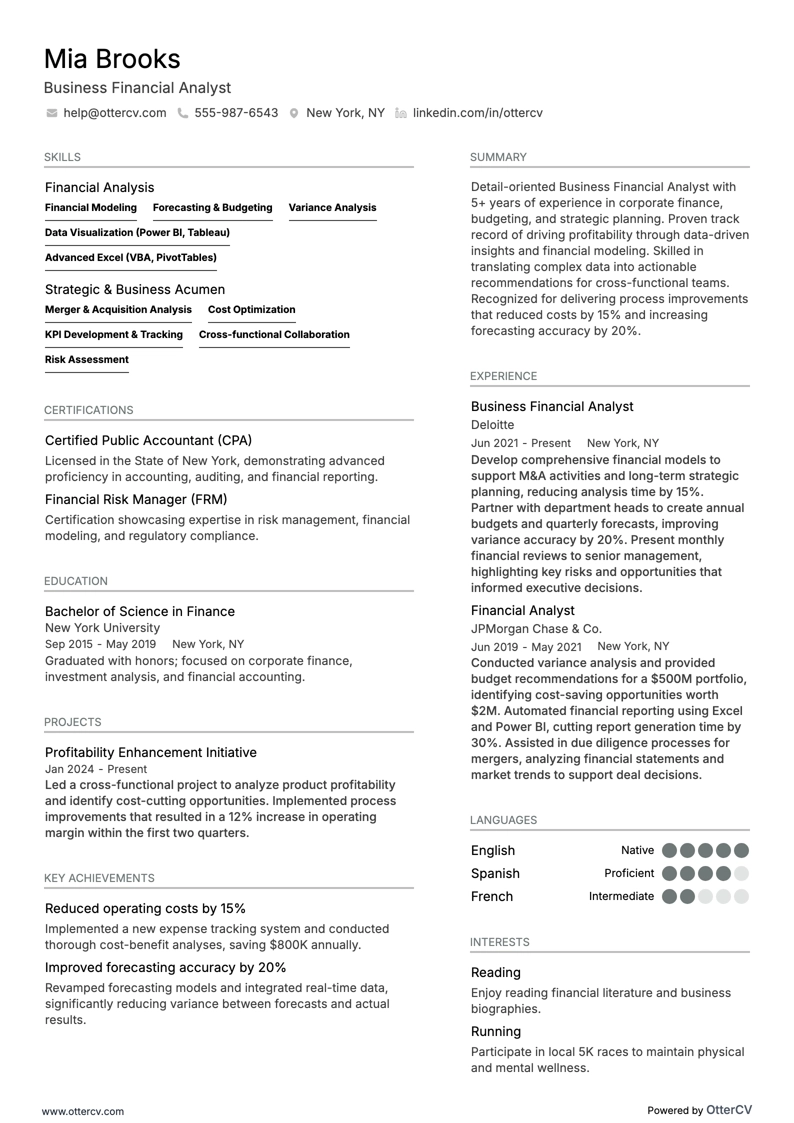
Business Financial Analyst full preview

10 Corporate Financial Analyst Resume Examples

OtterCV

Written by The OtterCV Team

Updated: 5/13/2024•8 min read

See all resume examples in this guide, or generate your own resume example with your personalized prompt

Business Financial Analyst resume example

Business Financial Analyst

Many corporate financial analyst resumes fall short because they read like task logs instead of decision support. In today’s ATS screening and fast recruiter scans, that can hide your impact and put you behind equally qualified candidates.

A strong resume shows how you improved results, not just which tools or processes you used. Knowing how to make your resume stand out means emphasizing variance reductions, forecast accuracy gains, budget scope managed, cycle time cut, margin lift, and faster leadership decisions. Quantify model adoption, audit-ready reporting, and risk reduction.

Key takeaways

  • Quantify forecast accuracy, cost savings, and cycle time reductions in every experience bullet.

  • Use a reverse-chronological format if you are an experienced analyst, or a hybrid format if you are changing careers.

  • Tailor your resume language to match the exact tools, metrics, and processes in each job posting.

  • Connect every listed skill to a specific project, outcome, or measurable business result.

  • Place certifications such as the CFA or FMVA near your education to reinforce specialized credibility.

  • Write a three- to four-line summary that names your domain, tools, and top achievement.

  • Use Echocv to structure your resume so recruiters and applicant tracking systems can quickly see your impact.

How to format a corporate financial analyst resume

Recruiters evaluating corporate financial analyst candidates prioritize financial modeling proficiency, budgeting and forecasting accuracy, and the ability to turn data into actionable business recommendations. A clean, well-structured resume format helps these strengths stand out quickly in both automated screening and the 6–10 seconds a hiring manager typically spends on an initial scan.

I have significant experience in this role—which format should I use?

I have significant experience in this role—which format should I use?

Use a reverse-chronological format to lead with your most recent and relevant financial analysis experience.

Do:

  • Highlight the scope and ownership of your work by specifying which business units, revenue streams, or portfolios you supported and the size of budgets you managed.
  • Feature role-specific tools and domains prominently, including Excel (advanced modeling), SQL, ERP systems (SAP, Oracle), BI platforms (Tableau, Power BI), and areas like FP&A, variance analysis, or capital allocation.
  • Quantify outcomes tied to business impact, such as cost savings identified, forecast accuracy improvements, or revenue influence from your recommendations.

Example bullet:

  • Built and maintained a rolling 12-month cash flow forecast for a $200M business unit, reducing quarterly variance by 18% and enabling leadership to reallocate $4.5M toward high-margin product lines.

I'm junior or switching into this role—what format works best?

I'm junior or switching into this role—what format works best?

Use a hybrid resume format that starts with a targeted skills section, then follows with your experience or relevant project work in reverse-chronological order.

  • Put core financial analysis skills at the top of the resume, including financial modeling, data visualization, variance analysis, and Excel proficiency, so recruiters and applicant tracking systems can quickly identify your fit.
  • Include internships, academic projects, case competitions, or freelance consulting work that shows hands-on financial analysis experience, even if it was not in a traditional corporate setting.
  • Connect each action to a clear outcome so hiring managers can see your analytical thinking in practice, rather than just a list of coursework or tools.

Example scaffold:

  • Financial modeling (skill) → Developed a three-year DCF model for a capstone project evaluating a mid-cap acquisition target (action) → Presented findings that identified a 12% overvaluation, earning top marks and faculty recognition (result).

Why not use a functional resume?

Why not use a functional resume?

A functional resume removes the timeline and context hiring managers use to judge how you’ve applied financial analysis skills in real work settings, which makes it harder for them to evaluate your readiness for the role.

  • This format may be acceptable if you’re changing careers from a quantitative field such as accounting, data science, or economics, or returning to work after a gap—but only if each skill is tied to a specific project, analysis, or measurable outcome instead of listed as a standalone competency.

What sections should go on a corporate financial analyst resume

Recruiters want to quickly identify your financial analysis experience, core modeling skills, and measurable business impact. Understanding the essential resume sections helps you organize this information clearly and effectively.

Use this structure for maximum clarity:

  • Header
  • Summary
  • Experience
  • Skills
  • Projects
  • Education
  • Certifications
  • Optional sections: Awards, Leadership, Languages

Your experience bullets should highlight quantifiable results, business outcomes, scope of ownership, and decision-making impact across forecasting, budgeting, variance analysis, and executive reporting.

Once you’ve organized your resume with the right components, focus on your corporate financial analyst experience section to show the results you delivered in each role.

How to write your corporate financial analyst resume experience

Your experience section should prove that you delivered meaningful financial work, not just that you were involved in it. Hiring managers reviewing corporate financial analyst resumes look for clear impact through relevant tools, analytical methods, and measurable outcomes rather than generic task lists.

Each entry should include:

  • Job title
  • Company and location, or remote
  • Dates of employment, including month and year

Add three to five concise bullet points that explain what you owned, how you executed, and what outcomes you delivered.

  • Ownership scope: the financial models, forecasting processes, budgets, reporting systems, or business units you were directly accountable for as a corporate financial analyst.
  • Execution approach: the tools, frameworks, and methods you used to support decisions, such as financial modeling techniques, enterprise resource planning platforms, data visualization software, or variance analysis methodologies.
  • Value improved: the areas of performance you strengthened, whether that meant tighter forecast accuracy, reduced reporting cycle times, improved cost efficiency, better risk visibility, or more reliable cash flow projections.
  • Collaboration context: how you worked with cross-functional stakeholders such as treasury, accounting, operations, executive leadership, or external auditors to align financial analysis with broader corporate strategy.
  • Impact delivered: the business outcomes your work produced, expressed through results and scale rather than activity, such as decisions influenced, capital allocated more effectively, or financial risks mitigated across the organization.

Experience bullet formula

Experience bullet formula

Action verb + technology + what you built or fixed + measurable result

A corporate financial analyst experience example

Corporate Financial Analyst

NorthBridge Medical Devices | Minneapolis, MN

2022–Present

Mid-market medical device manufacturer with $650M in annual revenue and multi-site operations across North America.

  • Led monthly close and variance analysis in Oracle NetSuite and Excel Power Query, reducing forecast-to-actual review time by 30% and improving budget owner response rates by 20%.
  • Built a driver-based forecasting model in Anaplan for revenue, gross margin, and operating expenses across six business units, improving forecast accuracy from 92% to 97% and reducing rework by 25%.
  • Partnered with sales operations and product managers to redesign pricing waterfall and discount governance in Salesforce and Tableau, increasing average realized price by 1.8% and adding $4.2M in annual gross profit.
  • Automated capital expenditure tracking and return on investment reporting using Power BI and SQL extracts, shortening reporting cycle time from five days to two days and improving on-time approvals by 15%.
  • Presented quarterly performance and cash flow insights to the chief financial officer and department heads, aligning cost actions to targets and delivering $3.1M in run-rate savings through vendor consolidation and spend controls.

Now that you’ve seen what a strong experience section looks like, the next step is adjusting yours to fit a specific job posting.

How to tailor your corporate financial analyst resume experience

Recruiters review your corporate financial analyst resume through both applicant tracking systems and manual screening. Tailoring your resume to the job description helps your qualifications stand out in both.

Ways to tailor your corporate financial analyst experience:

  • Match the financial modeling tools and ERP systems named in the posting.
  • Use the same terminology for forecasting and budgeting processes.
  • Reflect the specific KPIs or financial performance metrics the role tracks.
  • Highlight any variance analysis or reporting frameworks mentioned in the description.
  • Emphasize regulatory compliance and audit standards when they are listed as requirements.
  • Include relevant industry experience, such as banking or manufacturing.
  • Align your work with the cross-functional collaboration model described in the posting.
  • Reference the valuation methodologies or capital planning approaches the role requires.

Tailoring means aligning your real accomplishments with the job requirements, not stuffing unrelated keywords into your experience bullets.

Resume tailoring examples for corporate financial analyst

Job description excerptUntailoredTailored
Build and maintain three-statement financial models to support quarterly forecasting and annual budgeting across business unitsAssisted with financial planning and helped prepare reports for management review.Built and maintained three-statement financial models in Excel to support quarterly forecasting and annual budgeting across four business units, improving forecast accuracy by 12%.
Perform variance analysis on P&L results and present findings to senior leadership using Power BI dashboardsAnalyzed financial data and created presentations for stakeholders.Conducted monthly P&L variance analysis, identified $2.3M in cost overruns, and presented root-cause findings to senior leadership through automated Power BI dashboards.
Partner with FP&A and treasury teams to evaluate capital allocation decisions and support M&A due diligenceWorked cross-functionally on various finance projects and initiatives.Partnered with FP&A and treasury to evaluate capital allocation scenarios for three acquisition targets, building DCF and comparable company models that informed $85M in M&A due diligence decisions.

Once your experience aligns with the role’s priorities, the next step is to quantify your corporate financial analyst achievements so hiring managers can see the impact behind those responsibilities.

How to quantify your corporate financial analyst achievements

Quantifying your achievements shows business impact beyond day-to-day tasks. Focus on metrics like cycle time, forecast accuracy, cost savings, risk reduction, and reporting reliability—numbers that demonstrate better decisions, faster closes, and tighter control.

Quantifying examples for corporate financial analyst

MetricExample
Forecast accuracyImproved quarterly revenue forecast accuracy from 92% to 97% by rebuilding the driver-based model in Excel and Power BI for a $250M business unit.
Close cycle timeCut the monthly close reporting cycle from five days to three by automating variance bridges and consolidations with Power Query and standardized templates.
Cost savingsIdentified $1.2M in annual savings by analyzing vendor spend and renegotiation scenarios, then tracking realized savings in a rolling budget forecast.
Risk reductionReduced budget overrun risk by 30% by introducing scenario analysis and weekly burn-rate alerts for ten cost centers totaling $40M in annual spend.
Reporting reliabilityLowered reporting errors from eight to one per month by adding reconciliation checks and version control across 25 recurring management reports.

How to list your hard and soft skills on a corporate financial analyst resume

Once you’ve written strong bullet points for your experience section, apply that same precision to how you present your skills.

Your skills section should show that you can model performance, forecast outcomes, and influence decisions. Recruiters and an ATS (applicant tracking system) scan it quickly to confirm fit, so aim for a heavier mix of hard skills supported by targeted, role-specific soft skills.

Corporate financial analyst roles require a blend of:

  • Product strategy and discovery skills.
  • Data, analytics, and experimentation skills.
  • Delivery, execution, and go-to-market discipline.
  • Soft skills.

Your skills section should be:

  • Scannable, with bullet-style grouping.
  • Relevant to the job post.
  • Backed by proof in your experience bullets.
  • Updated with current tools.

Place your skills section:

  • Above your experience section if you’re junior or switching careers.
  • Below your experience section if you’re mid- or senior-level with strong achievements.

Hard skills

  • Financial modeling, including three-statement models.
  • Budgeting and forecasting.
  • Variance analysis.
  • Management reporting.
  • Profit and loss analysis.
  • Cash flow forecasting.
  • Scenario and sensitivity analysis.
  • Microsoft Excel, Power Query, and PivotTables.
  • SQL reporting queries.
  • Power BI dashboards.
  • NetSuite, SAP, and Oracle.
  • GAAP and SEC reporting support.

Soft skills

  • Translate analysis into decisions.
  • Present to finance leadership.
  • Partner with business owners.
  • Challenge assumptions with data.
  • Align stakeholders on trade-offs.
  • Drive deadlines and close cadence.
  • Write clear executive summaries.
  • Ask targeted clarifying questions.
  • Prioritize the highest-impact analyses.
  • Own deliverables end to end.
  • Communicate risks early.
  • Influence without authority.

How to show your corporate financial analyst skills in context

Skills should not appear only in a dedicated skills section. Explore curated resume skills examples to see how strong candidates present their competencies effectively.

Show your skills in:

  • Your summary (high-level professional identity)
  • Your experience (proof through outcomes)

Here is what strong, skill-rich entries look like in practice.

Senior corporate financial analyst with eight years in healthcare finance. Skilled in SAP, advanced DCF modeling, and cross-functional forecasting. Reduced budget variance by 14% through improved rolling forecast accuracy and executive-level scenario analysis.

  • Clearly reflects senior-level expertise
  • Mentions industry-relevant tools and methods
  • Opens with a measurable outcome
  • Highlights communication and collaboration strengths

Experience Example

Senior Corporate Financial Analyst

Meridian Health Partners | Chicago, IL

June 2019–Present

  • Built a dynamic three-statement model in Excel and SAP, reducing monthly close time by 22% through collaboration with accounting leadership.
  • Led cross-departmental variance analysis with Power BI dashboards, lowering quarterly forecast deviation from 9% to 4%.
  • Partnered with the FP&A director to redesign capital allocation frameworks, freeing $3.2M for strategic reinvestment.
  • Every bullet contains measurable proof.
  • Skills surface naturally through real outcomes.

Once you’ve shown your financial analyst ability through concrete examples and outcomes, the next step is to apply that same approach to building a corporate financial analyst resume when you don’t have direct experience.

How do I write a corporate financial analyst resume with no experience

Even without full-time experience, you can still show that you’re ready through:

  • Finance case competitions and pitches
  • University budgeting or finance committees
  • Financial modeling course capstone project
  • Internship-style consulting for nonprofits
  • Equity research reports and valuations
  • Personal portfolio tracking and analysis
  • Accounting or finance tutoring assistant

If you're building a resume without work experience, focus on:

  • Three-statement models with assumptions
  • Forecasting, variance, and KPI tracking
  • Excel, SQL, and Power BI
  • Clean, audited, documented work samples

Resume format tip for entry-level corporate financial analyst

Resume format tip for entry-level corporate financial analyst

Use a reverse-chronological resume format because it highlights recent projects, internships, and coursework that show readiness for a corporate financial analyst role.

Do the following:

  • Put projects above experience.
  • Quantify outcomes with dollars and percentages.
  • List tools such as Excel, SQL, and Power BI.
  • Add links to models and dashboards.
  • Match keywords to the job posting.

Example project bullet:

  • Built a three-statement model in Excel with scenario analysis for a capstone company, improving forecast accuracy by 12% versus baseline assumptions.

How to list your education on a corporate financial analyst resume

Your education section helps hiring teams confirm you have the foundational knowledge needed for a corporate financial analyst role. It also validates your analytical training and financial expertise.

Include:

  • Degree name
  • Institution
  • Location
  • Graduation year
  • Relevant coursework (for juniors or entry-level candidates)
  • Honors and GPA (if 3.5 or higher)

Skip the month and day—list only the graduation year.

Here’s a strong education entry for a corporate financial analyst resume.

Example education entry

Bachelor of Science in Finance

University of Michigan, Ann Arbor, MI

Graduated 2021

GPA: 3.7/4.0

  • Relevant Coursework: Corporate Finance, Financial Modeling, Econometrics, Advanced Accounting, Capital Markets
  • Honors: Magna Cum Laude, Dean's List (six consecutive semesters)

How to list your certifications on a corporate financial analyst resume

Certifications on a resume show a corporate financial analyst's commitment to learning, proficiency with core tools, and alignment with industry standards, especially when your experience does not cover every requirement.

Include:

  • Certificate name
  • Issuing organization
  • Year
  • Optional: credential ID or URL
  • Place certifications below education when they are older, less relevant, or you already have strong corporate financial analyst experience.
  • Place certifications above education when they are recent, highly relevant, or required for the corporate financial analyst role you target.

Best certifications for your corporate financial analyst resume

  • Chartered Financial Analyst (CFA).
  • Certified Public Accountant (CPA).
  • Certified Management Accountant (CMA).
  • Financial Modeling and Valuation Analyst (FMVA).
  • Chartered Global Management Accountant (CGMA).
  • Bloomberg Market Concepts (BMC).
  • Certified Treasury Professional (CTP).

Once your key credentials are easy for recruiters to spot, use your corporate financial analyst resume summary to connect those qualifications to the value you can deliver.

How to write your corporate financial analyst resume summary

Your resume summary is often the first thing a recruiter reads. A strong summary quickly shows that you are qualified for a corporate financial analyst role.

Keep it to three to four lines and include:

  • Your title and relevant years of experience in financial analysis.
  • Your domain focus, such as corporate FP&A, treasury, or capital markets.
  • Core tools such as Excel, SQL, Hyperion, or Tableau.
  • One or two quantified achievements that show measurable impact.
  • Soft skills tied to real outcomes, such as cross-functional collaboration or stakeholder communication.

PRO TIP

At this level, emphasize your technical skills, relevant coursework, and early wins that show you can deliver. Highlight the specific tools and methodologies you’ve used in real projects.

Avoid vague phrases like “passionate self-starter” or “fast learner.” Instead, focus on concrete contributions and measurable results.

Example summary for a corporate financial analyst

Corporate financial analyst with two years of experience in FP&A and variance reporting. Built automated Excel models that reduced monthly close time by 20%. Skilled in SQL, Hyperion, and cross-departmental budget collaboration.

Now that you've crafted a summary that highlights your financial expertise and value, make sure the header above it clearly presents your professional contact details so recruiters can easily reach you.

What to include in a corporate financial analyst resume header

A resume header includes your key contact details and professional links. For a corporate financial analyst, it can improve visibility, credibility, and recruiter screening.

Essential resume header elements

  • Full name
  • Tailored job title and headline
  • Location
  • Phone number
  • Professional email
  • GitHub link
  • Portfolio link
  • LinkedIn

A LinkedIn link helps recruiters quickly verify your experience and supports screening.

Don't include a photo on a corporate financial analyst resume unless the role is explicitly front-facing or appearance-dependent.

Keep your header to one or two lines, match your job title to the posting, and use links that open to complete, updated profiles.

Example

Once your contact details and role identifiers are in place, add targeted extra sections to strengthen your fit and round out the resume.

Additional sections for corporate financial analyst resumes

When your core qualifications are similar to those of other applicants, well-chosen additional sections can help your corporate financial analyst resume stand out. For example, listing language skills on your resume can be a strong differentiator in multinational finance environments.

  • Languages
  • Certifications (CFA, CPA, FMVA)
  • Industry conferences and presentations
  • Publications and financial research
  • Professional affiliations
  • Volunteer financial consulting
  • Technical proficiencies (ERP systems, BI tools)

Once you’ve rounded out your resume with the right supplementary sections, pairing it with a cover letter can strengthen your overall application.

Do corporate financial analyst resumes need a cover letter

A cover letter is not required for a corporate financial analyst role, but it often helps. If you’re wondering what a cover letter is and when it matters most, it is usually most useful in competitive job postings or when hiring managers want context beyond the resume. It can make a difference when your fit is not immediately obvious.

Use a cover letter to add value in these situations:

  • Explain your fit for the role and team by connecting your planning, budgeting, or forecasting strengths to the job’s priorities.
  • Highlight one or two outcomes, such as improving forecast accuracy, shortening close timelines, or building a model leaders used to make decisions.
  • Show that you understand the product, users, and business context by naming key drivers, revenue streams, costs, and the stakeholders you would support.
  • Address career transitions or less obvious experience by mapping your prior work to corporate financial analyst responsibilities and tools.

Once you’ve decided how to handle a cover letter for your application, you can use AI to improve your corporate financial analyst resume by sharpening your content and aligning it with the role.

Using AI to improve your corporate financial analyst resume

AI can improve your resume’s clarity, structure, and impact. It can tighten language and highlight measurable results, but overuse can make your resume feel less authentic. Once your content is clear and aligned with the role, step away from the tool. For specific guidance, explore these ChatGPT resume writing prompts to get started.

Here are 10 practical prompts to strengthen specific sections of your corporate financial analyst resume:

Strengthen your summary

Strengthen your summary

Rewrite my resume summary in under four sentences to clearly highlight my core value as a corporate financial analyst.

Quantify experience bullets

Quantify experience bullets

Add measurable outcomes to each experience bullet on my corporate financial analyst resume using percentages, dollar amounts, or timeframes.

Tighten action verbs

Tighten action verbs

Replace weak or generic verbs in my corporate financial analyst experience section with stronger, finance-specific action verbs.

Align skills section

Align skills section

Compare my skills section with this corporate financial analyst job description and identify any missing hard skills to add.

Refine project descriptions

Refine project descriptions

Rewrite my project entries to clearly highlight my corporate financial analyst contributions, the tools I used, and the business impact of my work.

Improve education details

Improve education details

Present your education section in a way that supports a corporate financial analyst role, with clear emphasis on relevant coursework.

Clarify certification relevance

Clarify certification relevance

Explain how each certification on your resume supports your candidacy as a corporate financial analyst in one line each.

Remove filler language

Remove filler language

Identify and remove vague or redundant wording throughout my corporate financial analyst resume while preserving the key details.

Tailor for ATS

Tailor for ATS

Optimize my corporate financial analyst resume with keywords from this job posting while keeping the language natural.

Sharpen bullet structure

Sharpen bullet structure

Restructure each experience bullet on my corporate financial analyst resume into a clear result-action-context format.

Conclusion

A strong corporate financial analyst resume shows measurable results, role-specific skills, and a clear structure. It demonstrates impact in forecasting, budgeting, variance analysis, reporting, and modeling, supported by numbers. It should also stay easy to scan, consistent, and focused on the role.

Hiring teams want corporate financial analyst candidates who can improve decisions and communicate results. A resume that proves performance, reflects strong technical and business skills, and reads clearly signals readiness for today’s market and what comes next.

Corporate Financial Analyst resume examples

Explore additional Corporate Financial Analyst resume samples and guides and see what works for your level of experience or role.

By Role

Business Financial Analyst

Business Financial Analyst resume preview