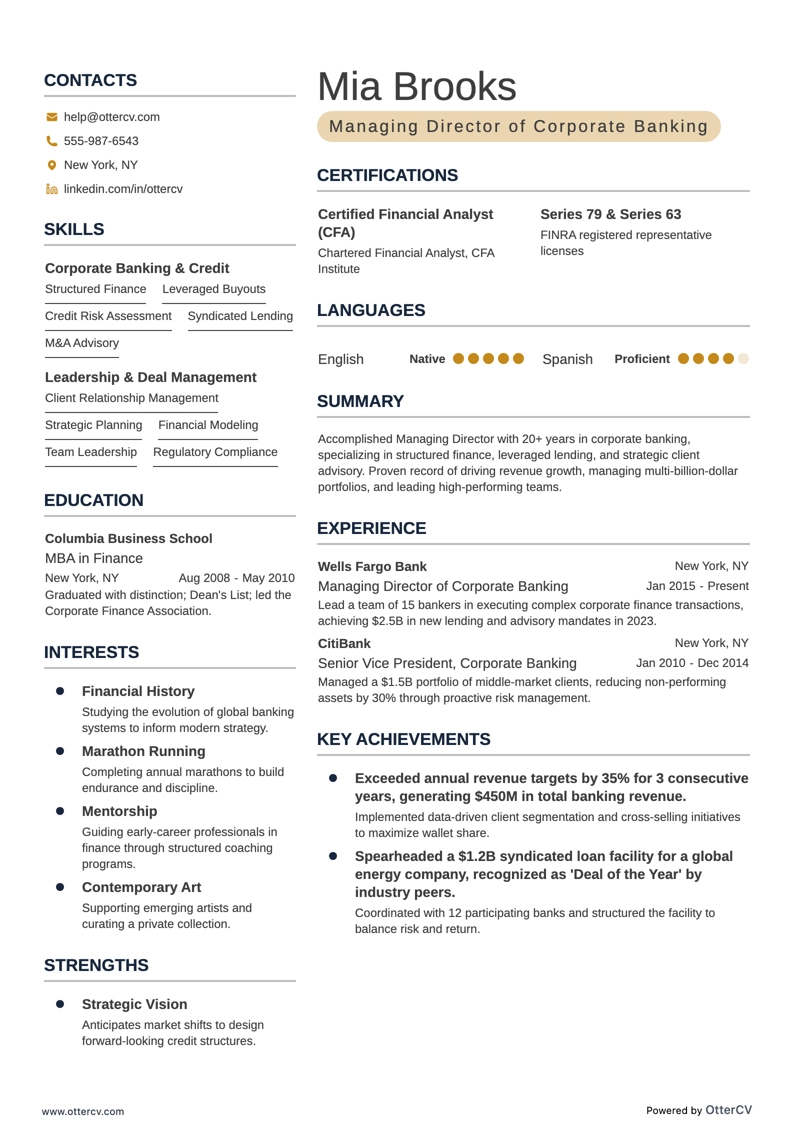
Managing Director of Corporate Banking full preview

10 Corporate Banking Resume Examples

OtterCV

Written by The OtterCV Team

Updated: 6/21/2023•8 min read

See all resume examples in this guide, or generate your own resume example with your personalized prompt

Managing Director of Corporate Banking resume example

Managing Director of Corporate Banking

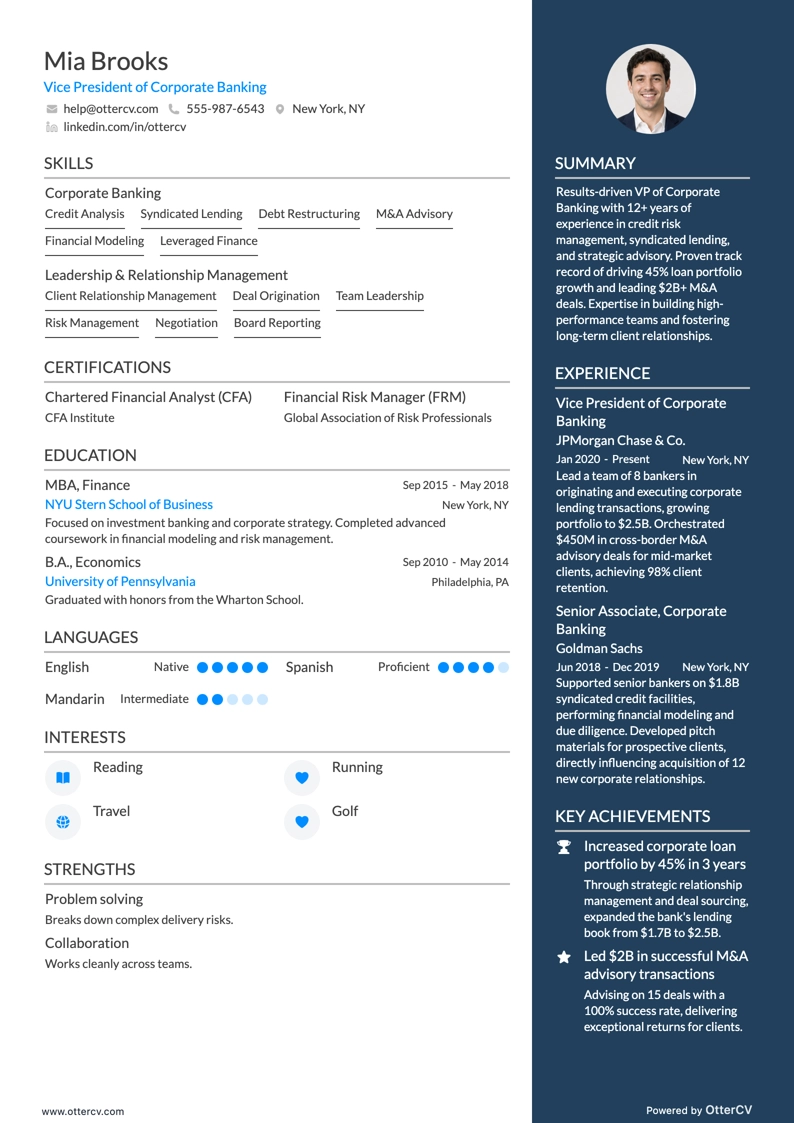
Vice President of Corporate Banking resume example

Vice President of Corporate Banking

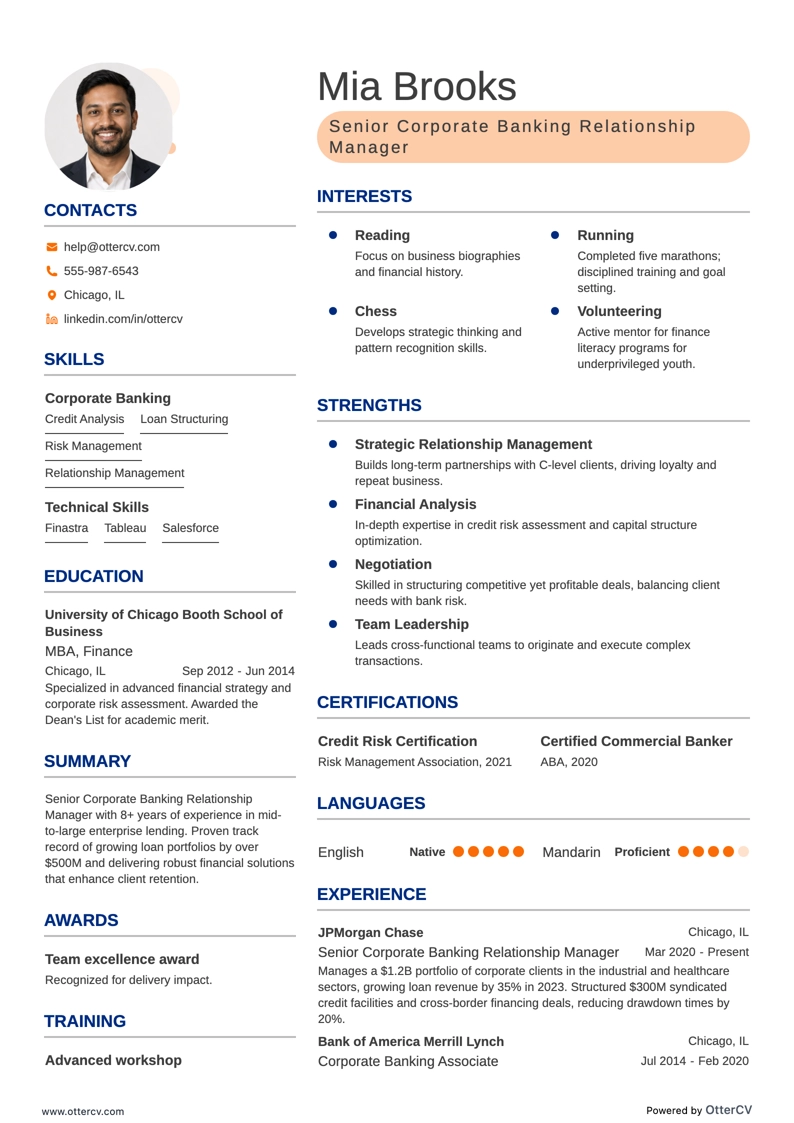
Senior Corporate Banking Relationship Manager resume example

Senior Corporate Banking Relationship Manager

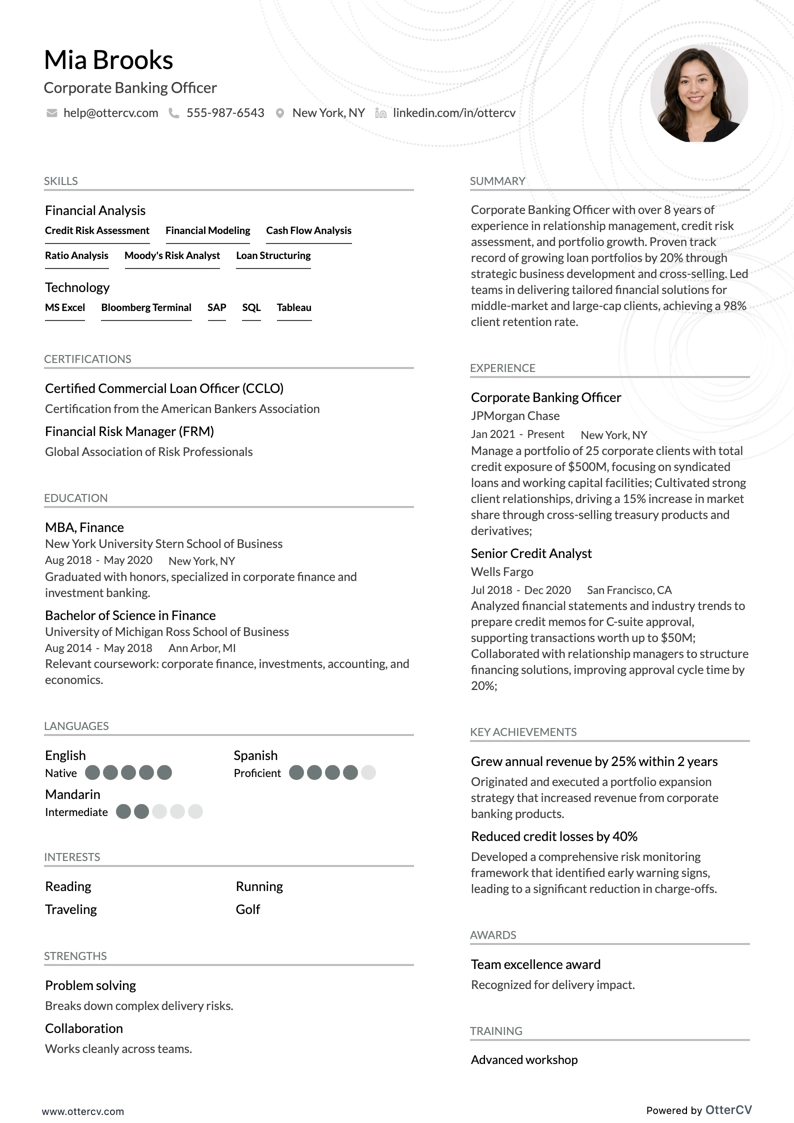
Corporate Banking Officer resume example

Corporate Banking Officer

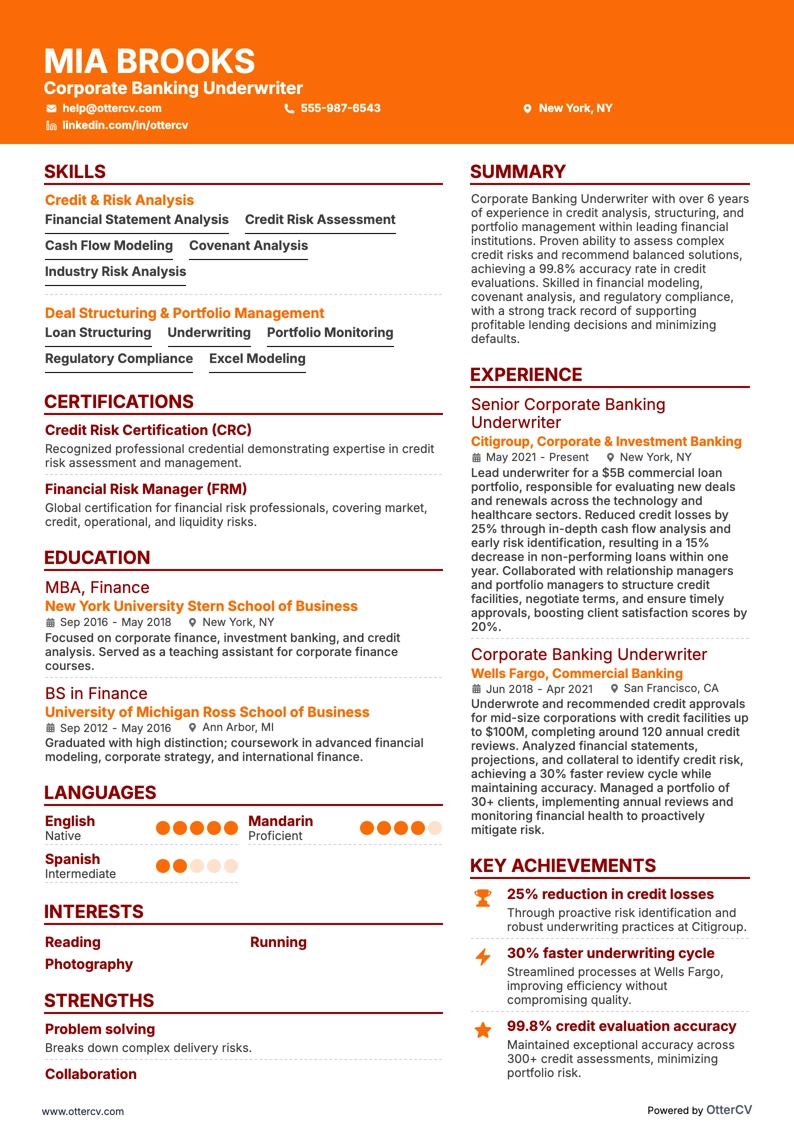
Corporate Banking Underwriter resume example

Corporate Banking Underwriter

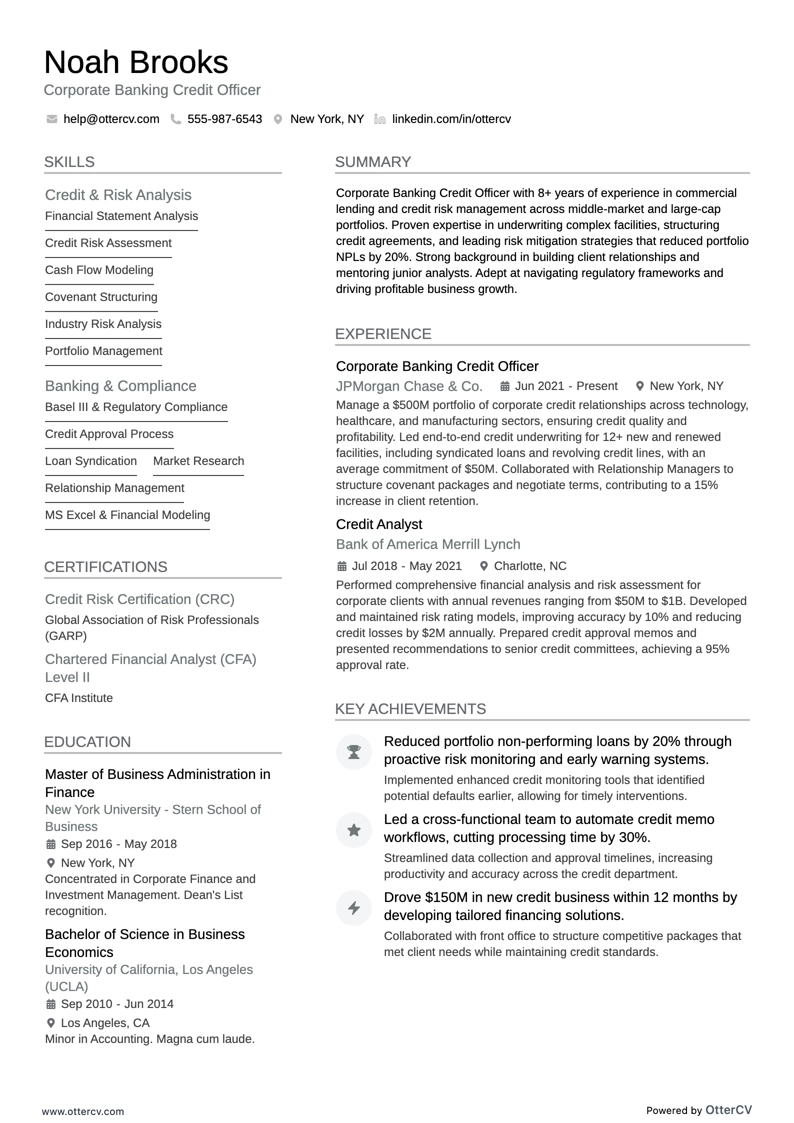
Corporate Banking Credit Officer resume example

Corporate Banking Credit Officer

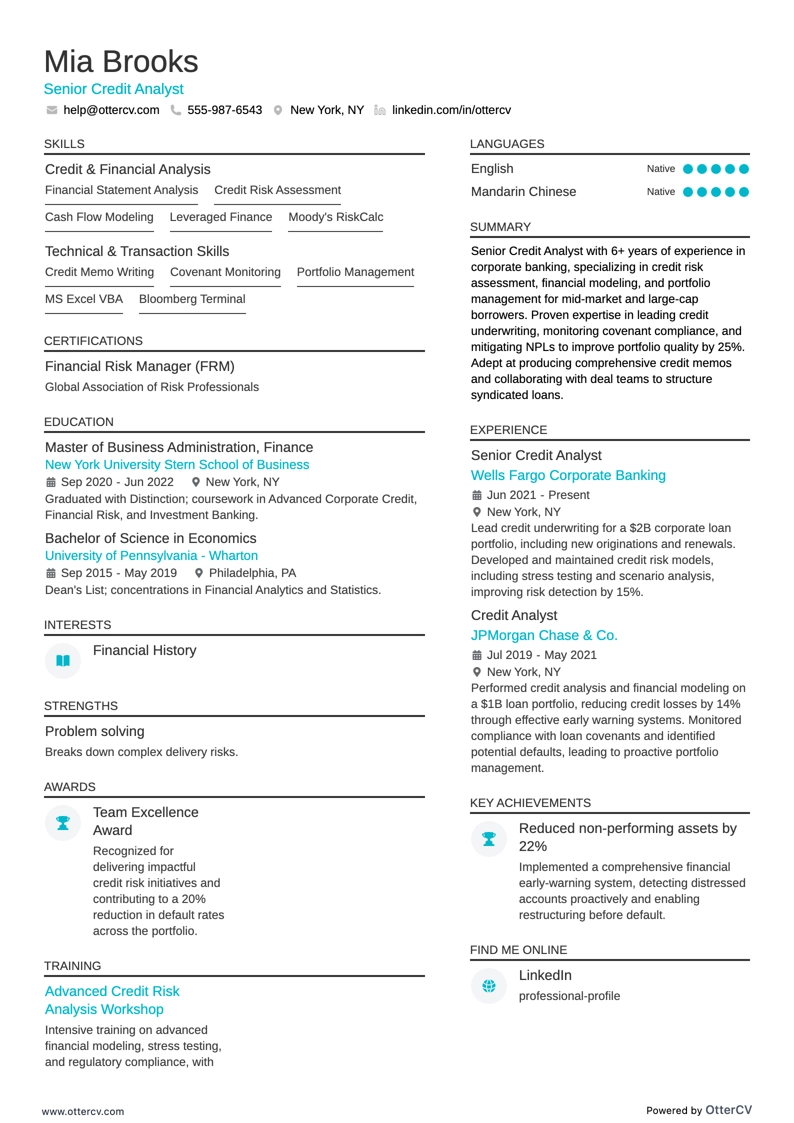
Corporate Banking Credit Analyst resume example

Corporate Banking Credit Analyst

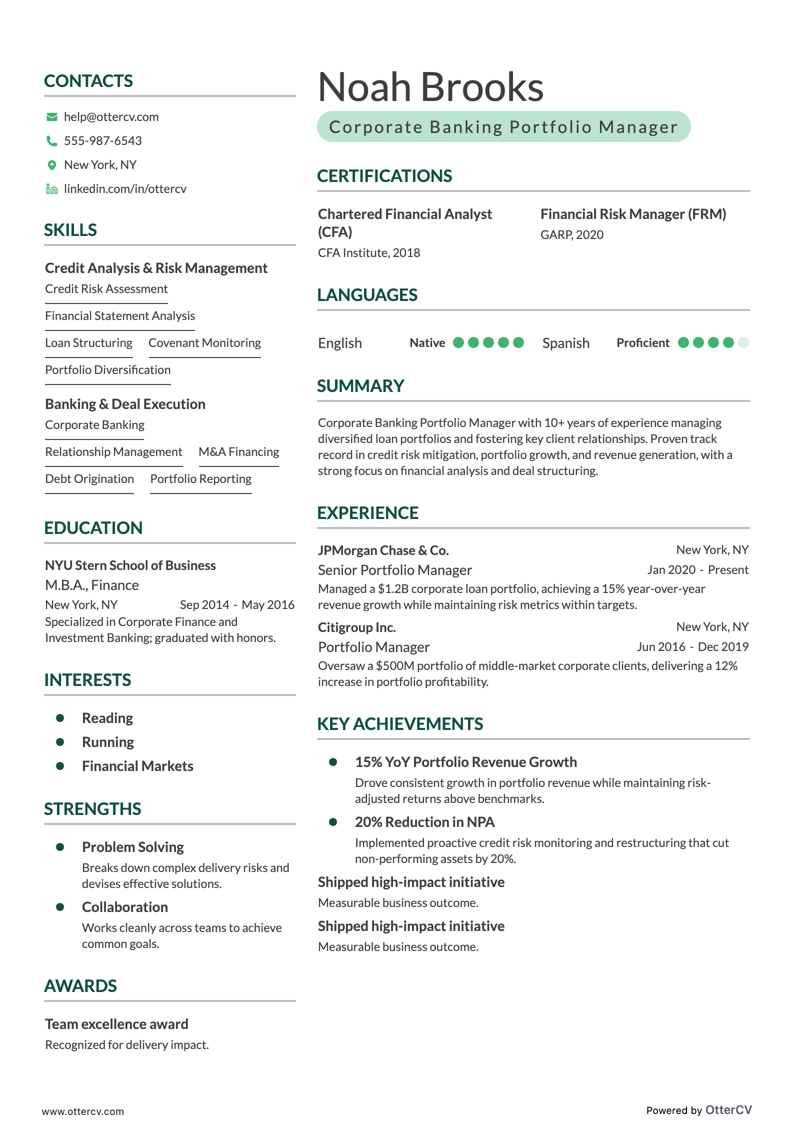
Corporate Banking Portfolio Manager resume example

Corporate Banking Portfolio Manager

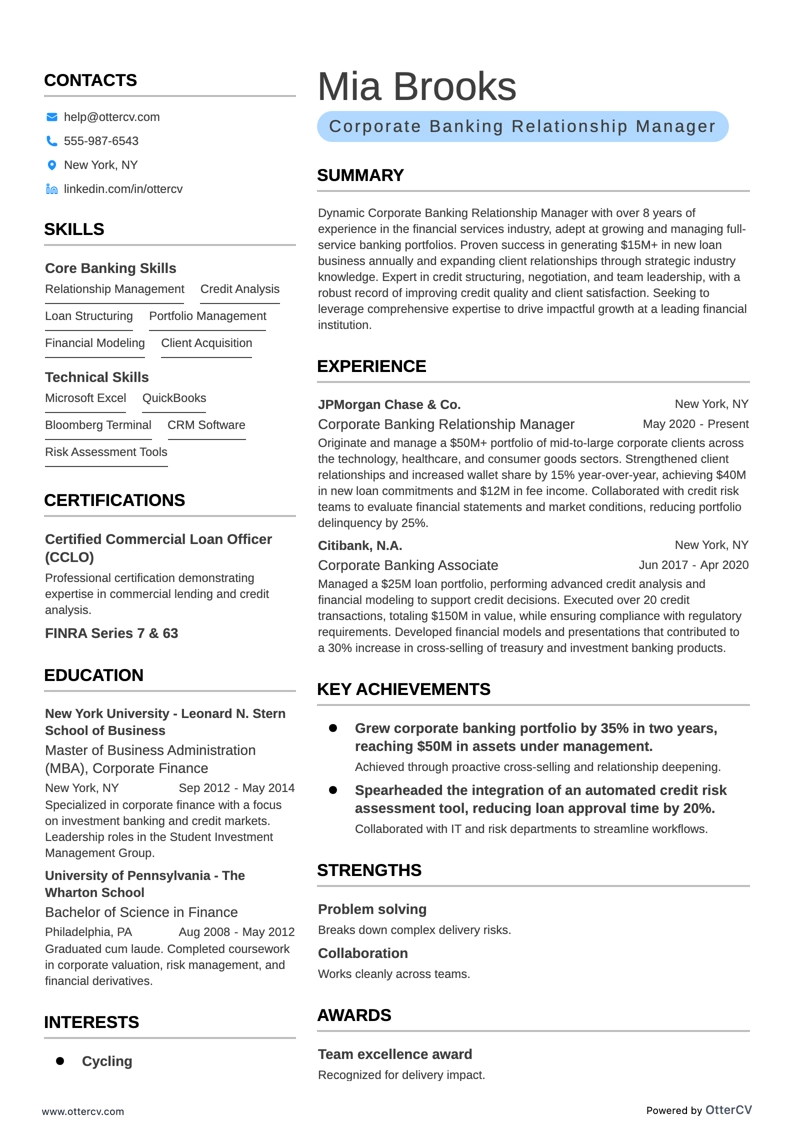
Corporate Banking Relationship Manager resume example

Corporate Banking Relationship Manager

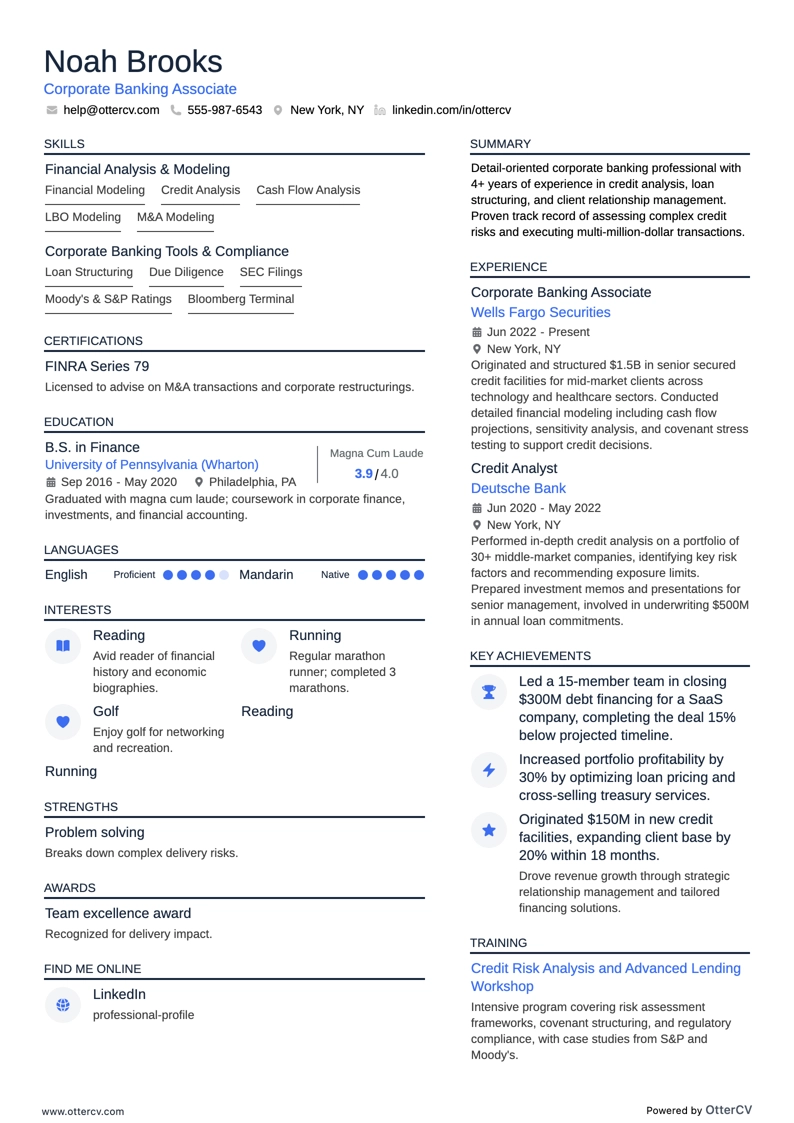
Corporate Banking Associate resume example

Corporate Banking Associate

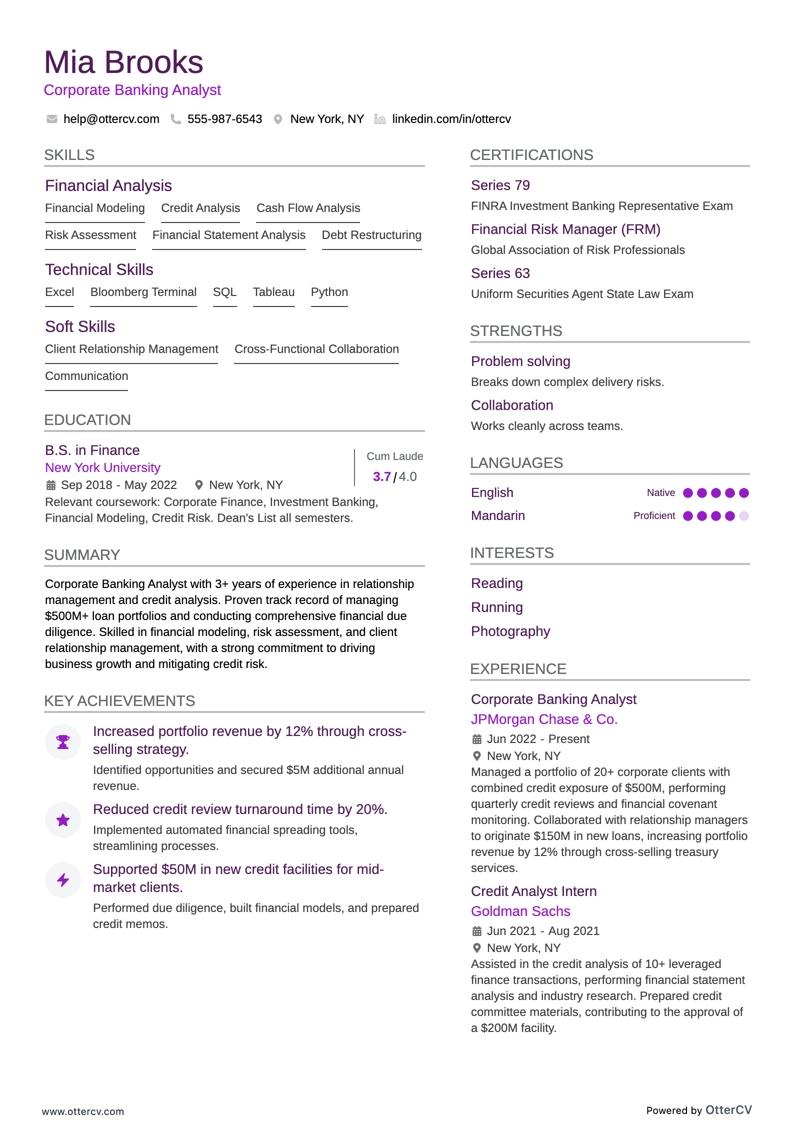
Corporate Banking Analyst resume example

Corporate Banking Analyst

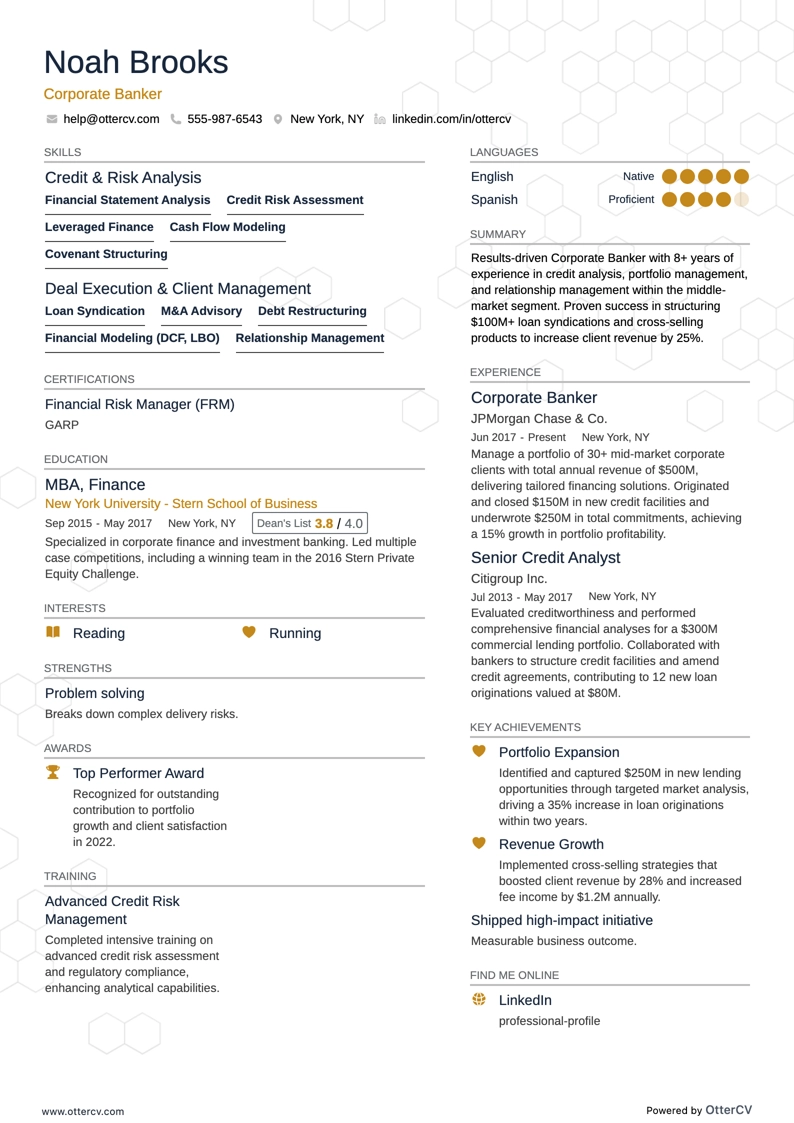
Corporate Banker resume example

Corporate Banker

Most corporate banking resumes fall short because they hide credit and deal impact behind generic responsibilities. That can hurt performance in applicant tracking system screening and quick recruiter reviews, especially when competition is high.

A strong resume puts outcomes first to show what you actually delivered. Knowing how to make your resume stand out starts with highlighting revenue or fee growth, portfolio size and risk reduction, deal volume and close rate, turnaround time, and client retention. Quantify approvals, covenants, and compliance results.

Key takeaways

  • Start each experience bullet with measurable results such as revenue, deal size, or risk reduction.

  • Use a reverse-chronological format for senior roles to show clear career progression.

  • Tailor your resume language to match each job posting’s terminology and priorities.

  • Connect every listed skill to a specific deal, project, or measurable outcome.

  • Place certifications such as CFA or FRM near your education section to build credibility quickly.

  • Write a three- to four-line summary that highlights your title, domain focus, and top metric.

  • Use Echocv’s tools to sharpen bullet points and align your resume with specific roles.

Job market snapshot for corporate bankings

We analyzed 136 recent corporate banking job ads across major US job boards to give you a quick view of industry demand, the salary landscape, and the skills most in demand.

What level of experience employers are looking for corporate bankings

Years of ExperiencePercentage found in job ads
1–2 years5.9% (8)
3–4 years8.1% (11)
5–6 years8.8% (12)
7–8 years6.6% (9)
9–10 years6.6% (9)
10+ years9.6% (13)
Not specified60.3% (82)

Corporate banking ads by area of specialization (industry)

Industry (Area)Percentage found in job ads
Finance & Banking100.0% (136)

Top companies hiring corporate bankings

CompanyPercentage found in job ads
PNC Financial Services Group, Inc.16.2% (22)
Citizens Financial Group, Inc.14.0% (19)
JPMorgan Chase & Co.9.6% (13)
Old National Bank7.4% (10)

Role overview stats

These tables outline the most common responsibilities and employment types for corporate banking roles. Use them to align your resume with employer expectations and understand how the role is structured across the market.

Day-to-day activities and top responsibilities for a corporate banking

ResponsibilityPercentage found in job ads
Financial analysis44.9% (61)
Financial modeling19.1% (26)
Portfolio management18.4% (25)
Credit analysis16.2% (22)
Credit decisions16.2% (22)
Office support tools16.2% (22)
Risk assessments16.2% (22)
Coaching others15.4% (21)
Credit analysis and verification15.4% (21)
Decision making15.4% (21)
Effective communications15.4% (21)
Managing multiple priorities15.4% (21)

How to format a corporate banking resume

Recruiters reviewing corporate banking resumes look first for clear evidence of deal execution, client relationship management, depth in credit analysis, and increasing responsibility across more complex transactions. Your resume format should make these strengths visible immediately. If they are buried under long skills lists or a non-linear layout, you risk losing attention from both human reviewers and applicant tracking systems.

I have significant experience in corporate banking—which format should I use?

I have significant experience in corporate banking—which format should I use?

Use a reverse-chronological format to present your corporate banking career in a clear, progression-driven narrative.

  • Lead each role entry with scope indicators such as portfolio size, client tier (middle-market, large-cap, multinational), and any direct reports or cross-functional teams managed.
  • Highlight domain-specific expertise, including credit structuring, syndicated lending, cash management, debt capital markets, and platforms such as Moody's CreditLens, Bloomberg Terminal, or Salesforce CRM.
  • Quantify business impact through deal volume, revenue generated, portfolio growth, or risk metrics improved.

Example bullet: “Originated and structured $1.2B in syndicated credit facilities for Fortune 500 clients, reducing average time-to-close by 18% while maintaining a non-performing loan ratio below 0.4%.”

I'm junior or switching into corporate banking—what format works best?

I'm junior or switching into corporate banking—what format works best?

A hybrid resume format works best. It lets you lead with relevant skills and financial competencies while still showing a chronological work history that demonstrates how you have applied them in practice.

  • Place a focused skills section near the top covering credit analysis, financial modeling, loan documentation, and regulatory frameworks such as Basel III or IFRS 9.
  • Include internships, rotational programs, case competitions, or transitional roles in adjacent fields such as commercial lending, equity research, or risk advisory that show transferable banking knowledge.
  • Connect every listed skill or project to a concrete action and a measurable or observable result.

Example scaffold: Financial modeling (skill) → built a three-statement LBO model to evaluate a $50M acquisition target for a class capstone project (action) → identified a 22% overvaluation that reshaped the team's investment recommendation (result).

Why hybrid and functional resumes don't work for senior corporate banking roles

Why hybrid and functional resumes don't work for senior corporate banking roles

Hybrid resume formats fragment your career trajectory, making it harder for reviewers to judge how your leadership scope, deal complexity, and client accountability expanded over time. Functional formats are even less effective because they remove the institutional and timeline context senior banking roles require, weakening evidence of progression from analyst-level execution to portfolio-level ownership and strategic decision-making.

If you have five or more years of progressive corporate banking experience, avoid both formats entirely. They can undermine the seniority signals hiring committees actively look for.

  • A functional format may be acceptable only in edge cases, such as transitioning into corporate banking from a closely adjacent field like private credit or treasury management, or returning after an extended career gap. Even then, every listed skill should be tied to a specific project, deal, or measurable outcome rather than presented in isolation.

Once you have a clean, professional layout, the next step is choosing the right sections to present your qualifications clearly.

What sections should go on a corporate banking resume

Recruiters expect a finance-first resume that highlights deal exposure, client impact, and measurable results. Knowing what to put on a resume for corporate banking roles helps you prioritize the most relevant content.

Use this structure for clarity:

  • Header
  • Summary
  • Experience
  • Skills
  • Projects
  • Education
  • Certifications
  • Optional sections: Awards, Leadership, Languages

Strong experience bullets should emphasize revenue impact, portfolio size, credit risk outcomes, deal scope, and your role in originating, structuring, underwriting, and executing transactions.

Once you’ve organized your resume with the right structure and supporting sections, you can focus on presenting your corporate banking experience in a way that fits that framework.

How to write your corporate banking resume experience

The work experience section of your corporate banking resume should emphasize the deals you’ve closed, the financial structures you’ve built, and the measurable results you’ve delivered for institutional clients. In corporate banking, hiring managers value demonstrated impact—such as revenue generated, portfolios managed, and risk mitigated—more than task-based descriptions of day-to-day responsibilities.

Each entry should include:

  • Job title
  • Company and location (or remote)
  • Dates of employment (month and year)

Include three to five concise bullet points that show what you owned, how you executed, and what outcomes you delivered:

  • Ownership scope: the client portfolios, lending products, credit facilities, syndicated deals, or industry verticals you were directly responsible for managing or originating.
  • Execution approach: the financial modeling techniques, credit analysis frameworks, risk assessment methodologies, or regulatory compliance tools you used to structure transactions and support lending decisions.
  • Value improved: changes to portfolio quality, credit risk exposure, deal turnaround time, client retention, underwriting accuracy, or covenant structuring that strengthened the bank’s position or the client relationship.
  • Collaboration context: how you worked with credit committees, risk management teams, treasury departments, legal counsel, relationship managers, or C-suite clients to move complex transactions forward and maintain compliance.
  • Impact delivered: outcomes shown through loan book growth, fee income contribution, default rate reduction, deal volume, or strategic client acquisition rather than routine banking activities.

Experience bullet formula

Experience bullet formula

Action verb + technology + what you built or fixed + measurable result

A corporate banking experience example

Senior Corporate Banking Relationship Manager

JPMorgan Chase | Chicago, IL | 2021–Present

Managed a $1.2B middle-market portfolio across manufacturing, logistics, and business services, delivering integrated lending, treasury, and risk solutions.

  • Originated and closed $410M in new credit commitments across revolving credit facilities, term loans, and asset-based lending, increasing portfolio revenue 18% year over year through risk-adjusted pricing and treasury services cross-sell.
  • Structured and renewed thirty-two facilities using Moody’s Analytics RiskAnalyst, Bloomberg, and internal credit models, reducing approval cycle time 22% by standardizing covenant packages and underwriting memos in the credit workflow system.
  • Partnered with treasury management and payments product teams to implement host-to-host file transmission, SWIFT, and API-based cash reporting for twelve clients, increasing operating deposit balances 14% and reducing payment exception rates 28%.
  • Led quarterly portfolio stress testing and covenant monitoring in Salesforce and the loan servicing platform, lowering past-due exposure 35% by triggering early-warning reviews and executing proactive amendments with credit risk and legal.
  • Coordinated with client finance leaders, credit risk, loan operations, and counsel to close nine syndicated transactions totaling $260M, improving documentation accuracy to 99% and reducing post-close remediation hours 30%.

Now that you’ve seen how a strong experience section comes together, the next step is adjusting yours to fit the specific corporate banking role you’re targeting.

How to tailor your corporate banking resume experience

Recruiters review corporate banking resumes through both human screening and applicant tracking systems (ATS). Tailoring your resume to the job description helps you get through both.

Ways to tailor your corporate banking experience:

  • Match the credit analysis platforms and financial modeling tools listed in the posting.
  • Mirror the exact terminology used for loan structuring or syndication processes.
  • Reflect the portfolio size and revenue KPIs the role prioritizes.
  • Highlight regulatory compliance frameworks mentioned in the posting, such as Basel III or SOX.
  • Emphasize industry verticals like energy or healthcare when the role specifies them.
  • Align your deal execution workflow language with the phrasing in the job description.
  • Include risk assessment methodologies named as requirements.
  • Reference cross-functional collaboration with treasury or capital markets teams when relevant.

Tailoring means aligning your real accomplishments with the role’s requirements, not forcing in keywords that do not belong.

Resume tailoring examples for corporate banking

Job description excerptUntailoredTailored
"Structure and execute syndicated loan facilities for investment-grade and sub-investment-grade clients, coordinating with credit risk, legal, and compliance teams."Worked on loan transactions and supported client relationships across departments.Structured and executed over $2.5B in syndicated loan facilities for investment-grade and sub-investment-grade borrowers, coordinating directly with credit risk, legal, and compliance teams to ensure a timely close.
"Perform detailed financial modeling and credit analysis using Moody's RiskCalc and Bloomberg Terminal to assess counterparty risk for corporate lending portfolios exceeding $500M."Conducted financial analysis and built models to support lending decisions.Built discounted cash flow and leverage models in Moody's RiskCalc and Bloomberg Terminal to assess counterparty risk across a $750M corporate lending portfolio, reducing credit losses by 12% year over year.
"Manage day-to-day client coverage for Fortune 500 corporate banking relationships, driving cross-sell of treasury management, FX hedging, and debt capital markets products."Maintained client accounts and identified opportunities for additional services.Managed primary coverage for eight Fortune 500 corporate banking relationships, cross-selling treasury management, FX hedging, and debt capital markets products that generated $18M in incremental annual revenue.

Once you’ve aligned your experience with the role’s priorities, quantify your corporate banking achievements to show the measurable impact of your contributions.

How to quantify your corporate banking achievements

Quantifying your achievements demonstrates business impact in corporate banking and strengthens your credibility with hiring teams. Focus on revenue, risk, compliance, deal volume, turnaround time, accuracy, portfolio size, client retention, and credit quality.

Quantifying examples for corporate banking

MetricExample
Revenue growthGenerated $4.2M in annual fee and interest revenue by expanding wallet share across 12 middle-market clients using Salesforce pipeline tracking.
Risk reductionReduced criticized exposure by 18% ($27M) by tightening covenant monitoring and escalating early-warning triggers in Moody's RiskAnalyst.
Cycle timeCut credit approval turnaround from 12 to seven business days by standardizing underwriting templates and coordinating weekly deal huddles with credit and legal.
Compliance accuracyAchieved 99.6% documentation accuracy across 85 loan closings by implementing a closing checklist and reconciling exceptions in nCino.
Volume handledManaged a $620M portfolio across 34 corporate clients while processing 160+ annual reviews and renewals with zero missed deadlines.

Once you’ve written strong bullet points for your experience section, the next step is making sure your skills section clearly highlights the hard and soft skills corporate banking employers look for.

How to list your hard and soft skills on a corporate banking resume

Your skills section matters in corporate banking because it shows your ability to evaluate credit risk, structure deals, and manage client relationships. Recruiters and ATS (applicant tracking systems) also scan this section to assess role fit, so aim for a balanced mix of hard skills and soft skills.

Corporate banking roles require a blend of:

  • Product strategy and discovery skills
  • Data, analytics, and experimentation skills
  • Delivery, execution, and go-to-market discipline
  • Soft skills

Your skills section should be:

  • Scannable, with bullet-style grouping
  • Relevant to the job post
  • Backed by proof in your experience bullets
  • Updated with current tools

Place your skills section:

  • Above your experience section if you’re junior or switching careers
  • Below your experience section if you’re mid-level or senior and have strong achievements

Hard skills

  • Credit analysis and underwriting.
  • Financial statement analysis.
  • Cash flow modeling and forecasting.
  • Loan structuring and pricing.
  • Debt capital markets execution.
  • Syndicated loans and club deals.
  • Covenant analysis and compliance monitoring.
  • Portfolio management and risk grading.
  • Know your customer and anti-money laundering.
  • Bloomberg and Refinitiv Eikon.
  • Microsoft Excel and PowerPoint.
  • Salesforce and DealCloud.

Soft skills

  • Lead client discovery calls.
  • Translate client needs into solutions.
  • Present credit recommendations clearly.
  • Partner with product specialists.
  • Coordinate legal and credit stakeholders.
  • Negotiate terms and covenants.
  • Manage competing deal priorities.
  • Escalate risks early and directly.
  • Write concise credit narratives.
  • Own deliverables end-to-end.
  • Make data-backed tradeoffs.
  • Build trust with treasurers and CFOs.

How to show your corporate banking skills in context

Skills should not appear only in a dedicated skills section. Explore resume skills examples to see how banking professionals integrate their competencies throughout the document.

They should be demonstrated in:

  • Your summary, which presents your high-level professional identity
  • Your experience, which proves your skills through outcomes

Here’s how that looks in practice.

Summary example

Corporate banking director with 12 years of experience structuring syndicated loans and credit facilities for Fortune 500 clients. Skilled in financial modeling, risk assessment, and relationship management. Grew portfolio revenue by 34% while maintaining a sub-1% default rate.

  • Immediately signals senior-level expertise
  • Mentions tools and methods relevant to the role
  • Opens with a concrete metric
  • Emphasizes client relationship soft skills

Experience Example

Vice President, Corporate Banking

Meridian Capital Group | Chicago, IL

March 2019–Present

  • Structured $2.1B in syndicated credit facilities using cash flow modeling, partnering with risk and legal teams to accelerate closings by 18%.
  • Led a six-person analyst team that underwrote 40+ leveraged transactions annually, reducing portfolio loss provisions by 22%.
  • Partnered with treasury solutions and sales teams to cross-sell deposit products, generating $4.6M in incremental annual fee income.
  • Every bullet includes measurable proof.
  • Skills surface naturally through real outcomes.

Once you’ve connected your abilities to real outcomes and responsibilities, the next step is to apply that same approach to a corporate banking resume when you don’t have direct experience.

How do I write a corporate banking resume with no experience

Even without full-time experience, you can still show readiness through:

  • Finance case competitions
  • Credit analysis class projects
  • Student-managed investment fund
  • Corporate finance modeling coursework
  • Treasury or accounting internships
  • Commercial banking job shadowing
  • Pro bono financial consulting

If you're building a resume without work experience, focus on:

  • Financial modeling with Excel outputs
  • Credit memos and risk rationale
  • Industry research tied to ratios
  • Deal support tasks and accuracy

Resume format tip for entry-level corporate banking

Resume format tip for entry-level corporate banking

Use a skills-based resume format to highlight corporate banking skills, projects, and coursework before limited work history.

Do the following:

  • Lead with a corporate banking skills section.
  • Add two to three project bullets.
  • Quantify results with clear metrics.
  • Mirror keywords from job postings.
  • List relevant tools under skills.

Example project bullet:

  • Built a three-statement model in Excel for a $250M revenue manufacturer, analyzed leverage and coverage ratios, and recommended a $15M revolver with two risk mitigants.

Even without direct experience, your education section can carry significant weight on a corporate banking resume, so it should be presented strategically.

How to list your education on a corporate banking resume

Your education section helps hiring teams quickly confirm that you have the foundational knowledge corporate banking requires. It also validates your academic background in finance, accounting, or economics.

Include:

  • Degree name
  • Institution
  • Location
  • Graduation year
  • Relevant coursework for juniors or entry-level candidates
  • Honors and GPA if 3.5 or higher

Skip the month and day, and list the graduation year only.

Here’s a strong education entry tailored to corporate banking:

Example education entry

Bachelor of Science in Finance

New York University, Stern School of Business — New York, NY

Graduated 2022 | GPA: 3.8/4.0

  • Relevant coursework: Corporate Valuation, Credit Risk Analysis, Financial Modeling, Mergers & Acquisitions
  • Honors: Magna Cum Laude, Dean's List (all semesters)

How to list your certifications on a corporate banking resume

Certifications on your resume show your commitment to learning, demonstrate tool proficiency, and signal industry relevance in corporate banking. They also help recruiters quickly confirm that you meet role requirements.

Include:

  • Certificate name
  • Issuing organization
  • Year
  • Optional: credential ID or URL
  • Place certifications below education when they are older, less relevant, or you already have strong corporate banking experience.
  • Place certifications above education when they are recent, highly relevant to corporate banking, or help fill a skills gap for the role.

Best certifications for your corporate banking resume

  • Chartered Financial Analyst (CFA).
  • Financial Risk Manager (FRM).
  • Certified Treasury Professional (CTP).
  • Certified Public Accountant (CPA).
  • Chartered Alternative Investment Analyst (CAIA).
  • Bloomberg Market Concepts (BMC).
  • Series 79 (Investment Banking Representative).

How to write your corporate banking resume summary

Once your credentials are easy for recruiters to spot, use your corporate banking resume summary to connect those qualifications to your value at a glance.

Your resume summary is often the first thing a recruiter reads. A clear, specific opening shows that you understand corporate banking and can deliver results.

Keep it to three to four lines and include:

  • Your title and total years of corporate banking experience.
  • Your domain focus, such as credit analysis, debt structuring, or relationship management.
  • Core skills like financial modeling, risk assessment, or loan syndication.
  • One or two measurable achievements tied to portfolio growth or deal execution.
  • Soft skills shown through real outcomes, such as client retention or cross-functional coordination.

PRO TIP

At the junior level, lead with relevant skills, tools, and early wins that show you can contribute quickly.

Avoid vague claims like “passionate team player” or “motivated self-starter.” Instead, make every line specific and verifiable.

Example summary for a corporate banking

Corporate banking analyst with two years of experience in credit risk and financial modeling. Supported $120M in loan originations and reduced underwriting turnaround time by 15% by improving documentation workflows.

Now that your summary shows your corporate banking expertise at a glance, make sure the header above it lists your contact details clearly so recruiters can reach you.

What to include in a corporate banking resume header

A resume header is the top section of your resume that includes your identity and contact details. In corporate banking, it supports visibility, credibility, and recruiter screening.

Essential resume header elements

  • Full name
  • Tailored job title and headline
  • Location
  • Phone number
  • Professional email
  • GitHub link
  • Portfolio link
  • LinkedIn

A LinkedIn link helps recruiters quickly confirm your experience and screen you against role requirements.

Do not include a photo on a corporate banking resume unless the role is explicitly front-facing or appearance-dependent.

Keep your corporate banking header consistent with the rest of your application, use one professional name format, and match your job title to the posting.

With your identifying details and key links clearly presented at the top, the next step is to add additional sections that strengthen your qualifications and round out your corporate banking resume.

Additional sections for corporate banking resumes

When your core sections look similar to those of other applicants, additional sections can help you stand out and reinforce your credibility in corporate banking. For example, listing language skills can show your ability to work with multinational clients and cross-border teams.

  • Languages
  • Certifications and licenses
  • Industry publications
  • Professional affiliations
  • Volunteer experience in financial literacy
  • Awards and honors
  • Conference presentations

Once you’ve strengthened your resume with the right supplementary sections, the next step is to pair it with a cover letter that supports your candidacy.

Do corporate banking resumes need a cover letter

Corporate banking resumes do not always require a cover letter, but including one can help for competitive roles or at firms that expect it. If you are unsure what a cover letter is or when it adds value, it can make a difference when your resume needs extra context or when hiring teams are comparing similar backgrounds.

Use these guidelines to decide when to include one and what to say:

  • Explain your fit for the role and team by linking your experience to the group’s focus, such as credit, treasury, syndications, or relationship management.
  • Highlight one or two results with numbers, such as improving underwriting turnaround time or reducing exceptions through better covenant tracking.
  • Show that you understand the products and users by referencing how corporate banking clients use credit facilities, cash management, and liquidity tools.
  • Address career transitions or less obvious experience by connecting your prior work to corporate banking skills such as risk, analysis, and client communication.

Using AI to improve your corporate banking resume

Even if you also submit a cover letter, using AI to improve your corporate banking resume can help you tailor your content faster and more consistently for each role.

AI can improve your resume’s clarity, structure, and impact. It can tighten language and help highlight results. But overusing it can strip away authenticity. Once your content is clear and aligned to the role, step away from AI.

For practical prompt ideas, see this guide on ChatGPT resume writing.

Here are 10 practical prompts to strengthen specific sections of your corporate banking resume:

Strengthen your summary

Strengthen your summary

Rewrite my resume summary to clearly position me as a corporate banking professional, highlighting measurable achievements in client management and deal execution.

Quantify experience bullets

Quantify experience bullets

Review my corporate banking experience bullets and suggest specific metrics, percentages, or dollar figures that show measurable impact.

Tighten action verbs

Tighten action verbs

Replace weak or passive verbs in my corporate banking experience section with strong, industry-relevant action verbs.

Align skills section

Align skills section

Compare my skills section against common corporate banking job descriptions and identify any missing hard or technical skills.

Refine project descriptions

Refine project descriptions

Edit my corporate banking project entries to clearly explain my role, the challenge, the actions I took, and the outcome.

Improve education relevance

Improve education relevance

Rewrite my education section to emphasize coursework, honors, or research that is directly relevant to corporate banking.

Clarify certification entries

Clarify certification entries

Format the certifications section for corporate banking roles by listing credential names, issuing bodies, and completion dates consistently.

Remove redundant phrasing

Remove redundant phrasing

Identify and remove filler words, redundancies, and vague phrasing throughout my corporate banking resume.

Tailor for specific roles

Tailor for specific roles

Adjust my corporate banking resume bullets to better match the specific job description I’m pasting below.

Check consistency throughout

Check consistency throughout

Review my entire corporate banking resume for inconsistent formatting, tense shifts, or misaligned date formats.

Conclusion

A strong corporate banking resume demonstrates impact through measurable outcomes, highlights role-specific skills, and uses a clear, easy-to-scan structure. Use concise bullets, consistent formatting, and precise language to show results, judgment, and client focus.

Hiring teams continue to prioritize clarity, accountability, and performance, and that will remain true as expectations evolve. When your corporate banking resume links outcomes to core responsibilities, it signals readiness for today’s roles and the next step.

Corporate Banking resume examples

Explore additional Corporate Banking resume samples and guides and see what works for your level of experience or role.

By Experience

Managing Director of Corporate Banking

Managing Director of Corporate Banking resume preview

Vice President of Corporate Banking

Vice President of Corporate Banking resume preview

Senior Corporate Banking Relationship Manager

Senior Corporate Banking Relationship Manager resume preview

Corporate Banking resume examples

Explore additional Corporate Banking resume samples and guides and see what works for your level of experience or role.

By Role

Corporate Banking Officer

Corporate Banking Officer resume preview

Corporate Banking Underwriter

Corporate Banking Underwriter resume preview

Corporate Banking Credit Officer

Corporate Banking Credit Officer resume preview

Corporate Banking Credit Analyst

Corporate Banking Credit Analyst resume preview

Corporate Banking Portfolio Manager

Corporate Banking Portfolio Manager resume preview

Corporate Banking Relationship Manager

Corporate Banking Relationship Manager resume preview

Corporate Banking Associate

Corporate Banking Associate resume preview

Corporate Banking Analyst

Corporate Banking Analyst resume preview

Corporate Banker

Corporate Banker resume preview