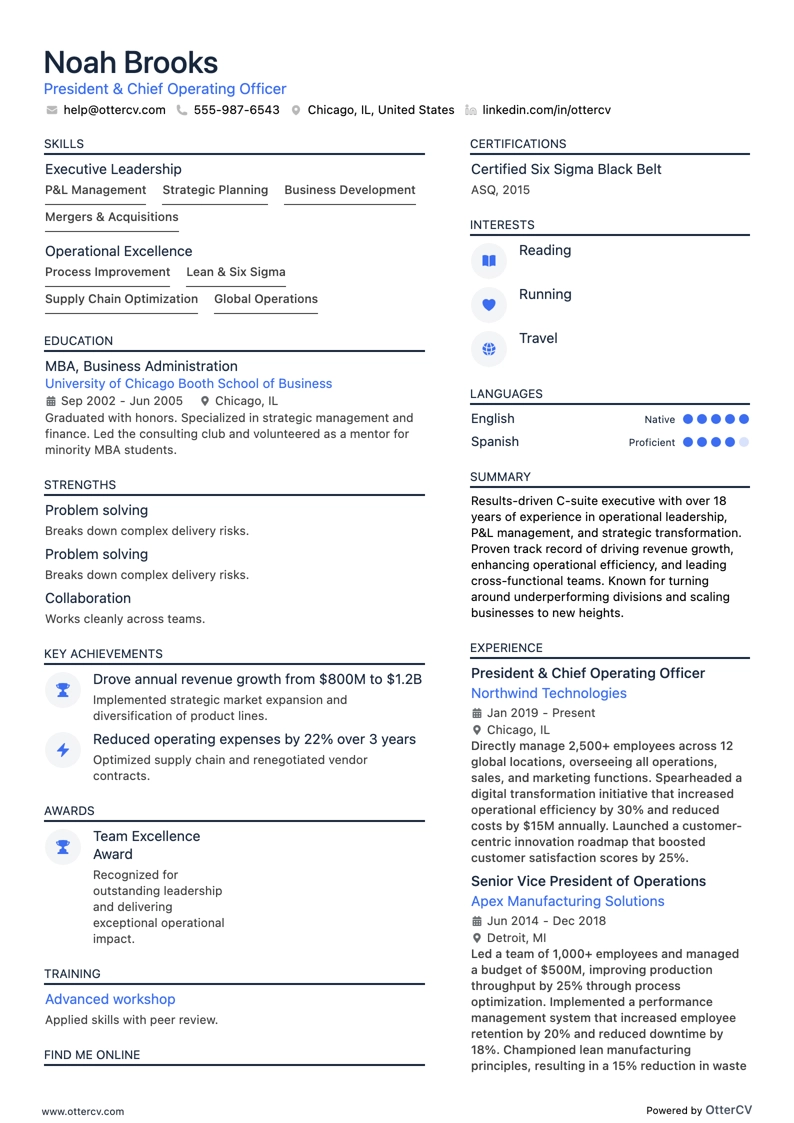
Chief Operations Officer full preview

23 Chief Operating Officer (COO) Resume Examples

OtterCV

Written by The OtterCV Team

Updated: 12/19/2025•8 min read

See all resume examples in this guide, or generate your own resume example with your personalized prompt

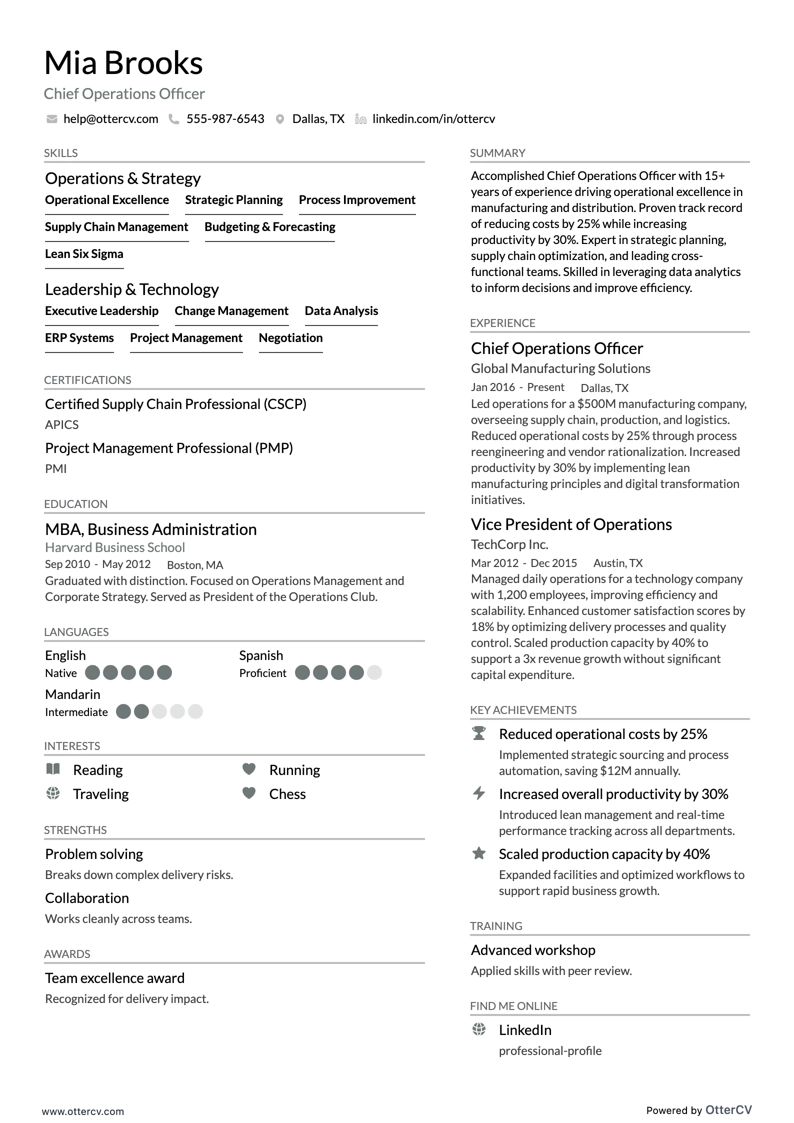
Chief Operations Officer resume example

Chief Operations Officer

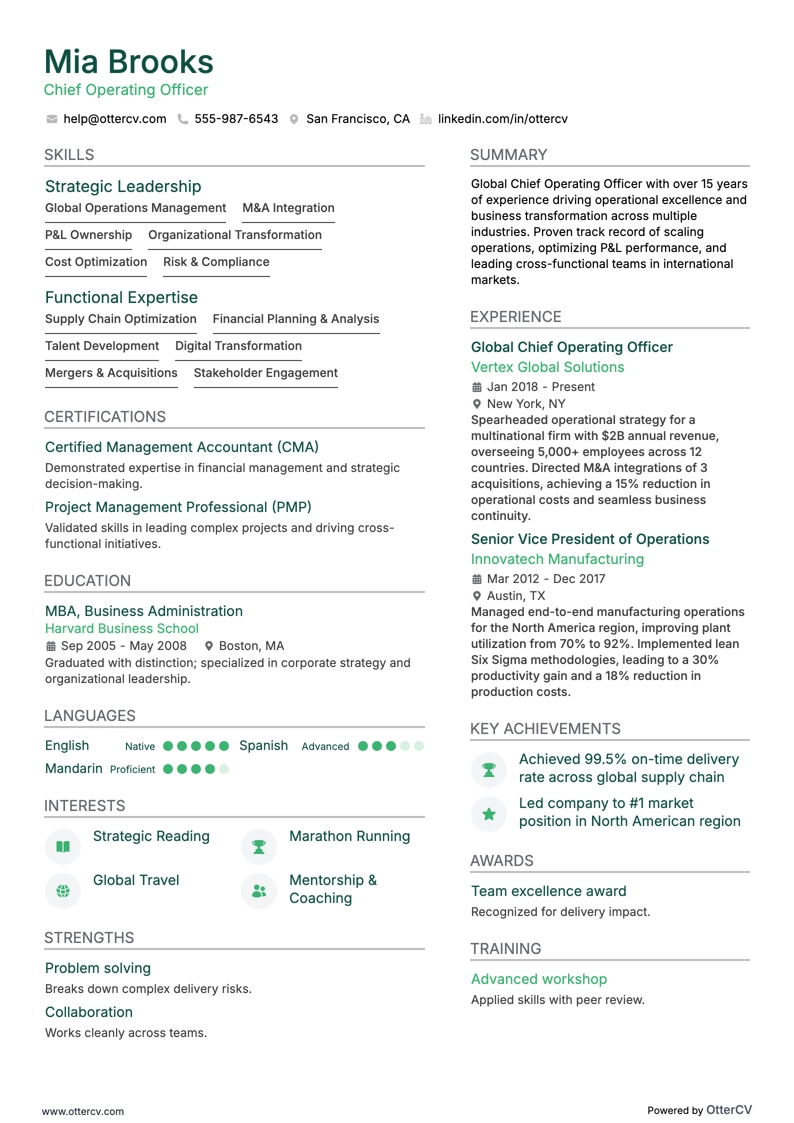
Global Chief Operating Officer resume example

Global Chief Operating Officer

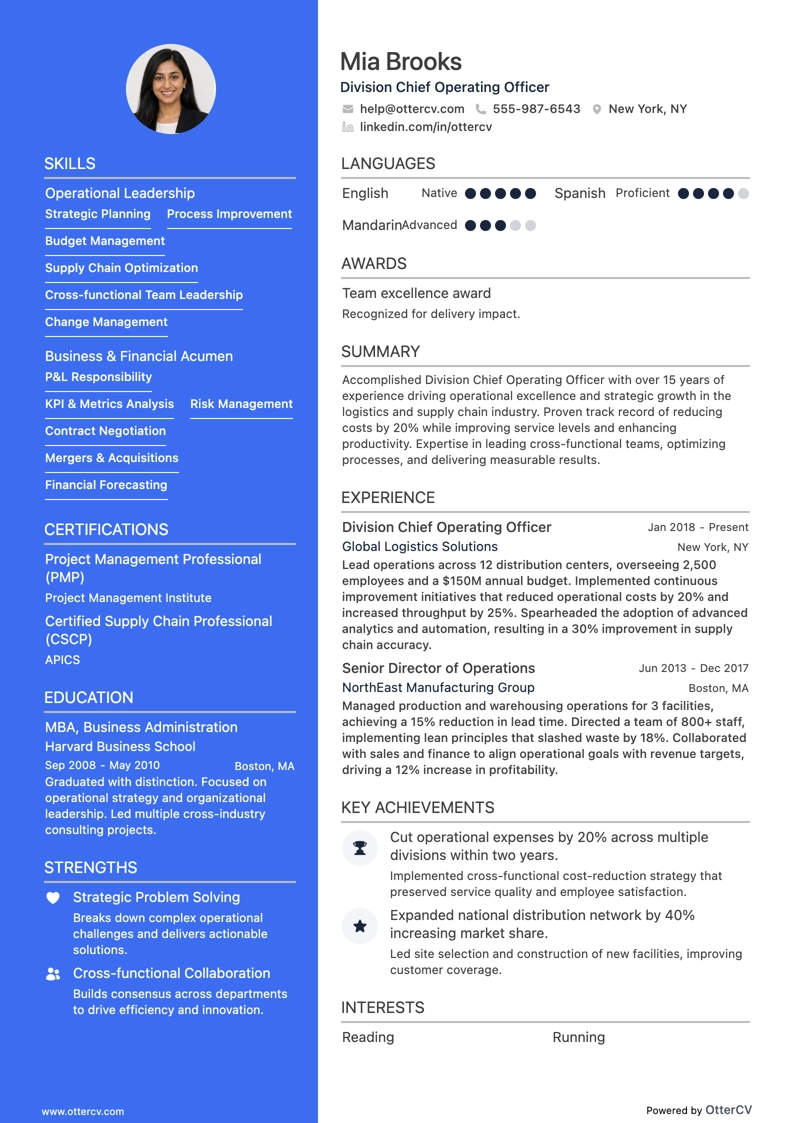
Division Chief Operating Officer resume example

Division Chief Operating Officer

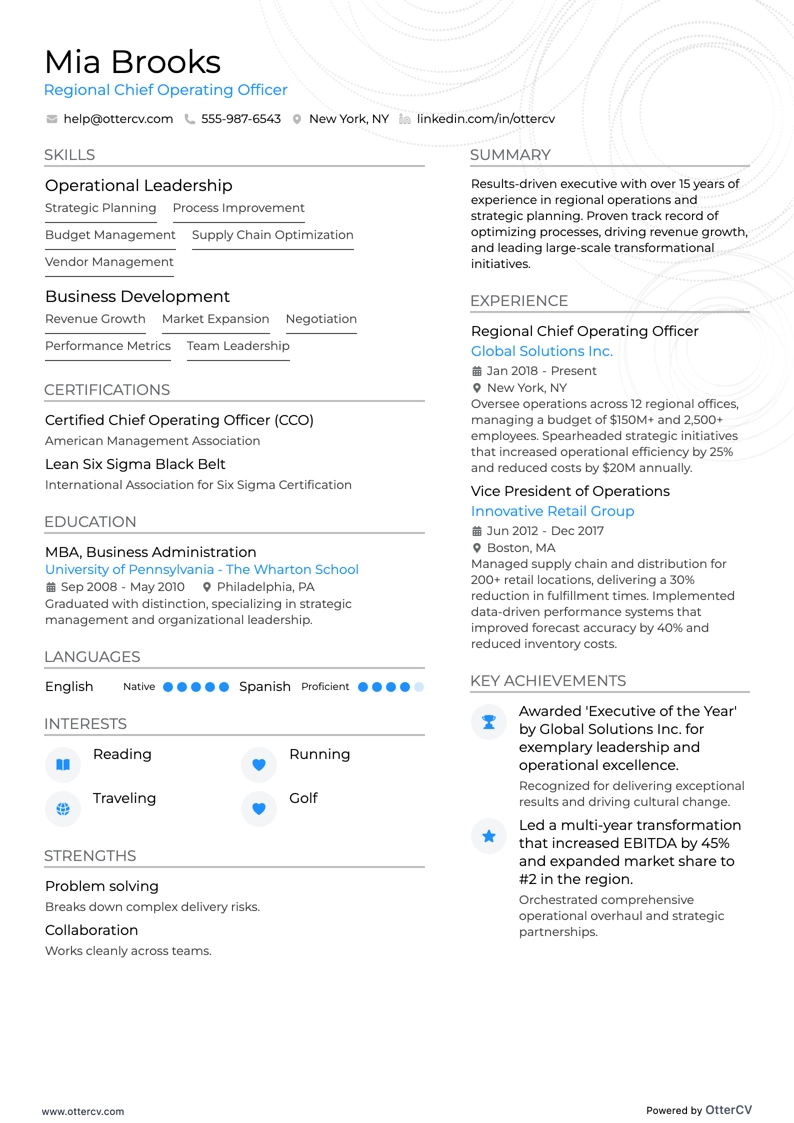
Regional Chief Operating Officer resume example

Regional Chief Operating Officer

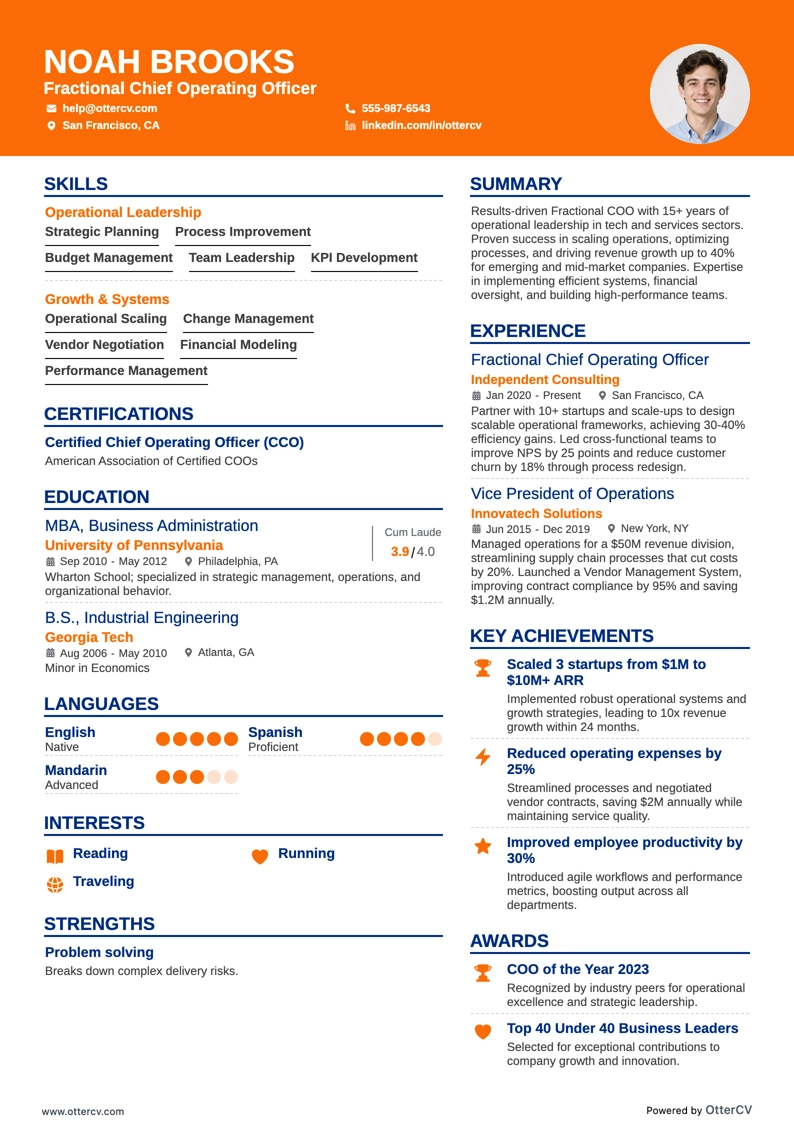
Fractional Chief Operating Officer resume example

Fractional Chief Operating Officer

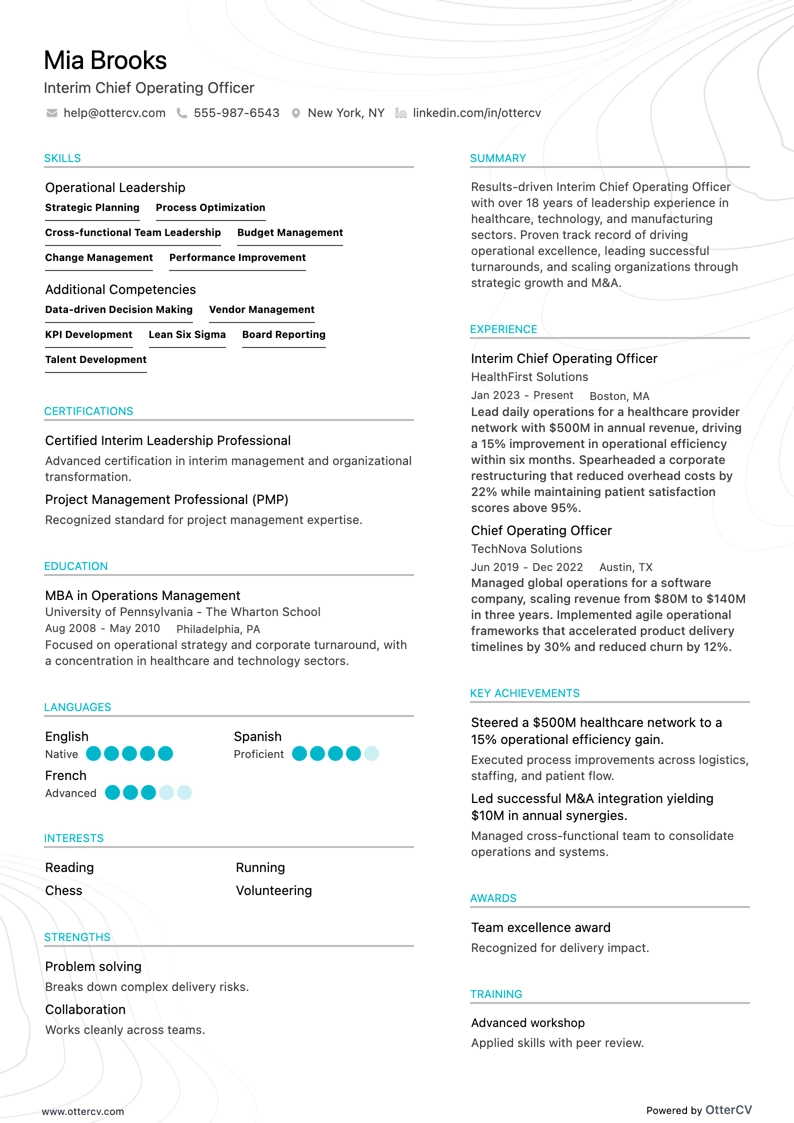
Interim Chief Operating Officer resume example

Interim Chief Operating Officer

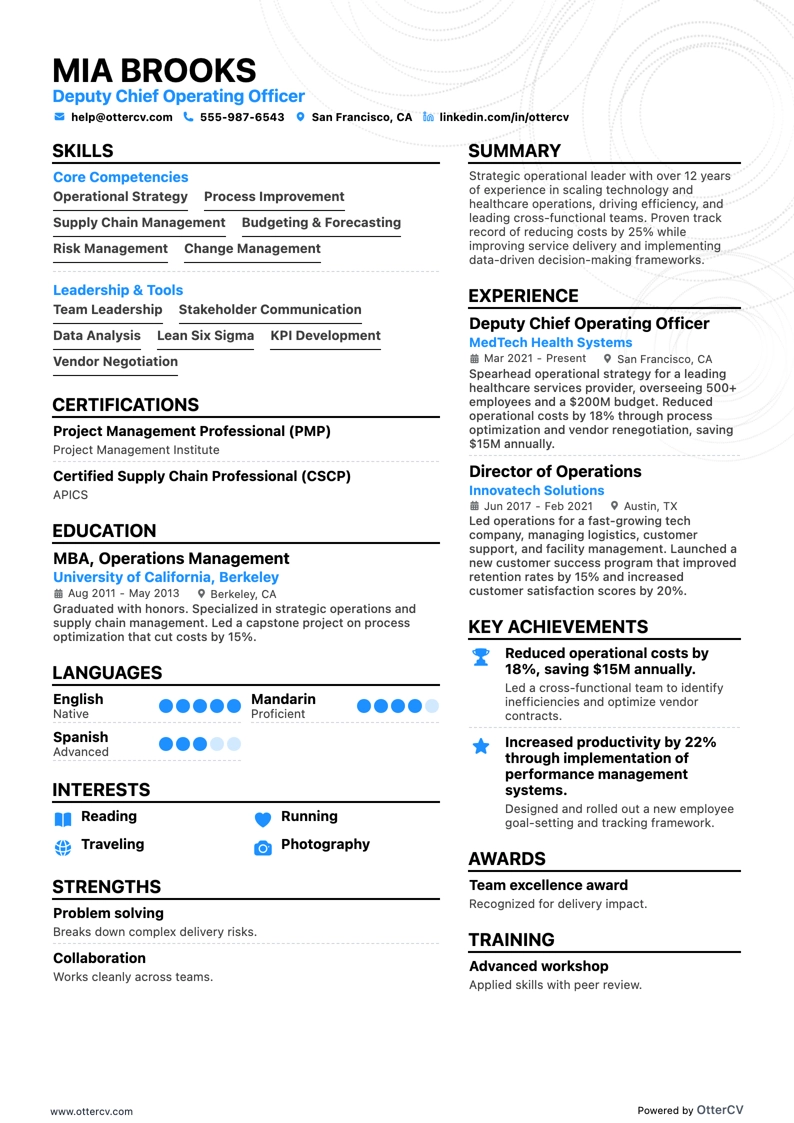
Deputy Chief Operating Officer resume example

Deputy Chief Operating Officer

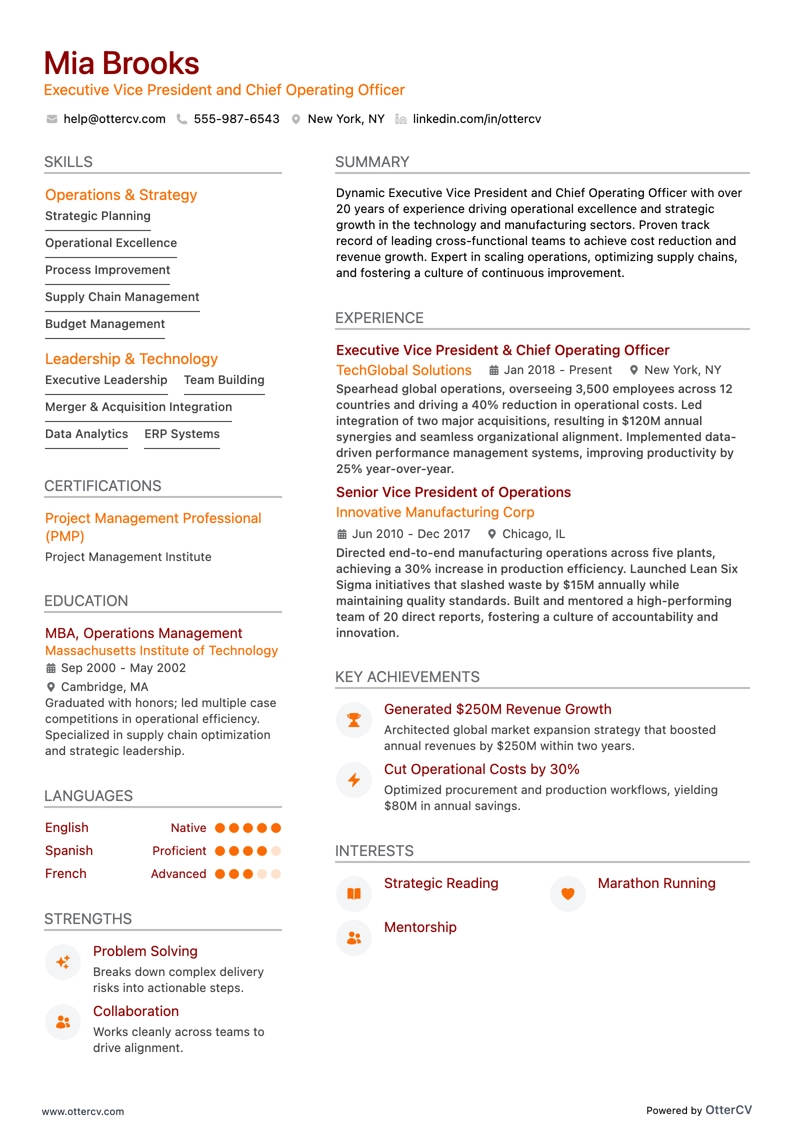
Executive Vice President and COO resume example

Executive Vice President and COO

President and Chief Operating Officer resume example

President and Chief Operating Officer

The projected job growth rate for COO roles between 2018 and 2028 was about 6%, showing that companies remain highly interested in hiring and retaining talented chief operating officers.

At the same time, growth often brings stronger competition. More candidates are entering the market, which means even experienced COOs cannot approach the job search as a numbers game. To stand out, you need resume strategies that help your application get noticed.

This chief operating officer resume guide covers:

  • Expert tips for formatting and designing your resume
  • The most important resume sections and how to organize them
  • The best ways to present core skills and managerial experience
  • Real-world COO resume examples to support your job search

If you want more C-level resume examples, see:

Ready? Let’s get started.

How to format a chief operating officer (coo) resume

When applying for a COO position, your resume needs to do more than summarize your experience and skills. A job-winning resume is a strategic tool that supports your career advancement in a highly competitive executive market.

Your formatting choices help communicate a clear, professional message to employers. Layout and design also influence how hiring managers assess your qualifications. A well-structured resume presents your experience and strengths as a COO in the most compelling way.

Essential tips for formatting a COO resume:

  • Use the reverse chronological format: This is the most widely recognized and preferred option, especially for executive roles. It highlights your most recent positions first and shows a strong progression toward leadership.
  • Craft an impactful header: Recruiters see this first, so include your name, job title, and up-to-date contact information.
  • Feature all essential sections: Emphasize experience, skills, education, certifications, and achievements relevant to a COO role. Each section should reflect leadership experience, operational improvements, and strategic planning ability.
  • Keep a concise resume length: Most recruiters prefer a one-page resume if it covers the necessary details effectively. However, a two-page resume can be appropriate because most COO roles require more than a decade of experience.

Also keep location-based layout differences in mind. For example, Canadian resumes may follow a different format.

PRO TIP

When saving your COO resume template, PDF is often the preferred file format for both job seekers and recruiters. It helps preserve your resume’s formatting across different devices and software, keeping your content professional and intact.

For example, our resume builder lets you create and export your resume in PDF format.

ATS-Friendly Fonts for a COO Resume

Compatibility with applicant tracking systems is an important factor when creating your COO resume. Most companies now screen applications before they reach a hiring manager, so your resume should follow ATS-friendly formatting guidelines.

Keep these font-related considerations in mind:

  • Choose professional fonts that are easy to scan: If you’ve used our resume builder, you may have noticed that our most recommended fonts are Rubik, Lato, Montserrat, Raleway, Exo 2, and Volkhov. These options look professional and are also easy for ATS systems to read.
  • Use classic fonts thoughtfully: Arial and Times New Roman are widely accepted and suitable, but because they are so common, they may not help your resume stand out among other applications.
  • Consider both serif and sans serif fonts: Both can be ATS-friendly, which is why our resume builder includes a selection of serif and sans serif typefaces.

The top sections on a COO resume

  • Experience: Show your leadership expertise and ability to manage large-scale operations, which are core requirements for a COO.
  • Education and certifications: Highlight your foundational knowledge and specialized training, both important for strategic decision-making in this role.
  • Skills: Include a mix of soft and technical skills that reflect your operational and strategic expertise and help prove your fit for the job.
  • Achievements: Demonstrate your measurable impact and career successes to show the value you brought to previous roles.
  • Leadership philosophy: Share your management style and vision for the company, since employers look for leaders who align with their culture and values.

What recruiters want to see on your resume:

  • Exceptional leadership skills, with the ability to motivate and develop teams to achieve high performance.
  • Proven ability to improve operational efficiency and implement long-term strategies that support growth and align with company goals.
  • Capacity to identify challenges, analyze complex situations, and deliver effective, innovative solutions.
  • Strong understanding of financial management, budgeting, and resource allocation to maintain fiscal health.
  • Excellent communication skills, with the ability to engage internal teams, stakeholders, and partners clearly and persuasively.

How to write your chief operating officer resume experience

The experience section is where you present your accomplishments and work history, making it the centerpiece of your COO resume. Recruiters will examine this part most closely because it offers concrete proof of your operational expertise and ability to drive strategic decisions.

To make this section a strong selling point, follow these three principles:

  • Tailor to your target COO role: Ensure each bullet point shows why you are a strong fit for the specific COO position you want.
  • Contextualize your impact: Emphasize how your actions benefited the organization rather than listing generic responsibilities.
  • Quantify achievements: Use specific figures and percentages to show your effectiveness as a leader, such as growth metrics, cost reductions, and efficiency improvements.

Now, take a look at the following experience section as a chief operating officer resume example:

Professional Experience

Operations Manager

OCL Systems

03/2016 - 10/2021 · New York, NY

  • Managed day-to-day operations to ensure smooth workflow.
  • Supported team management and oversaw general project activities.
  • Played a key role in strategic planning and operational decision-making.
WRONG

The example above has several weaknesses that could keep the applicant from landing their ideal job. Most importantly, it does not present the candidate as a dynamic, results-driven leader.

Here are three key ways to improve it:

  • Replace broad statements such as “project activities” with specific details about what you accomplished in each role.
  • Include measurable results to quantify key achievements and show your impact within the organization.
  • Use strong, action verbs at the beginning of bullet points to highlight your role and contributions.

After making these changes, here is what your COO resume experience section should look like.

Professional Experience

Operations Manager

OCL Systems

03/2016 - 10/2021 | New York, NY

  • Led a team of 50+ to streamline operations, achieving a 30% increase in overall efficiency within two years.
  • Implemented a new project management system that reduced project delivery times by 20%.
  • Spearheaded strategic planning initiatives that contributed to 15% year-over-year revenue growth.
RIGHT

How to quantify impact on your resume

Quantifying achievements with numbers and percentages is a key strategy for crafting a top-tier resume that ends your job hunt. Tangible data helps recruiters assess your performance objectively and understand the full scope of your contributions in previous roles.

Use metrics like these to strengthen your COO resume:

  • Drove revenue growth: Show how your strategic initiatives increased company revenue, including specific growth figures.
  • Optimized operational processes: Explain the methods you used to improve operational efficiency and the outcomes they produced.
  • Expanded market reach: Describe how your leadership helped the company enter new markets or segments, and note the scale and impact of that expansion.
  • Implemented cost-saving measures: Include examples of cost-saving strategies you introduced and their measurable financial benefits.
  • Led successful mergers or acquisitions: Outline your role in mergers or acquisitions, focusing on the integration process and positive results.
  • Cultivated key partnerships: Share how you built and maintained strategic partnerships, emphasizing their value to company growth and success.
  • Advanced technological integration: Discuss how you led the adoption of new technologies and the improvements or efficiencies gained.
  • Fostered team development and growth: Highlight your approach to team building and development, including any training programs or initiatives you led.

How to list hard and soft skills on your resume

Because of the nature of the role, hiring managers place significant weight on your skills and abilities. Think of yourself as a cog designed to fit into the machinery of an organization: your skills are the teeth that mesh with the company’s needs and culture.

There are two types of skills you can showcase on your resume: hard skills and soft skills.

Hard skills are job-specific, technical abilities you’ve gained through training and experience. They are measurable and clearly defined, such as operational planning or data analytics. These skills show your ability to handle the technical side of a COO role.

Best hard skills for your Chief Operating Officer resume

  • Strategic planning.
  • Financial management.
  • Operational efficiency.
  • Business process improvement.
  • Project management.
  • Leadership and team building.
  • Risk management.
  • Change management.
  • Supply chain management.
  • Data analysis and reporting.
  • Human resources management.
  • Customer relationship management (CRM).
  • Enterprise resource planning (ERP) systems.
  • Quality assurance and control.
  • Marketing and sales strategies.
  • Negotiation and vendor management.
  • Corporate governance.
  • Compliance and regulatory knowledge.
  • Information technology management.
  • Sustainability and corporate social responsibility programs.

Soft skills are the interpersonal qualities that shape how you interact and work with others. They include traits such as leadership, communication, and problem-solving. These skills are crucial because they influence how effectively you can handle the complexities of executive-level management.

Best soft skills for your COO resume

  • Leadership helps guide teams and operations effectively.
  • Communication skills support clear direction across departments.
  • Problem-solving is essential for handling operational challenges.
  • Decision-making shows confidence in setting priorities and acting quickly.
  • Adaptability helps you respond to changing business needs.
  • Teamwork and collaboration strengthen cross-functional execution.
  • Emotional intelligence supports effective leadership and strong working relationships.
  • Conflict resolution helps maintain alignment and productivity.
  • Persuasion and influencing are valuable for gaining buy-in from stakeholders.
  • Time management helps keep priorities, deadlines, and execution on track.
  • Strategic thinking supports long-term planning and operational direction.
  • Creativity and innovation help improve processes and business performance.
  • Resilience shows you can stay effective during pressure and change.
  • Empathy helps you lead people with awareness and understanding.
  • Active listening improves communication and decision quality.
  • Negotiation supports productive discussions and better outcomes.
  • Delegation helps distribute responsibilities efficiently.
  • Stress management shows you can perform well in demanding situations.
  • Resource allocation reflects the ability to use people and budgets wisely.
  • Ethical judgment and integrity demonstrate trustworthiness in leadership.

How to Present Your Skills on a Resume

Here’s how you can best present your skills on a resume:

  1. Identify required skills: Review the job description carefully to understand which skills the company is looking for in a COO.
  2. Assess your own skill set: List your soft and hard skills based on your full career experience.
  3. Prioritize relevance and impact: Narrow your list to the skills that are most valuable and relevant to the COO role you are applying for.
  4. Match the job ad language for ATS: Align your wording with the terminology used in the job posting so your resume skills are better optimized for applicant tracking systems.

PRO TIP

Weave your skills throughout other sections of your resume, such as your experience, projects, and summary.

This helps contextualize your abilities with real examples and use cases, making them more impactful and easier for recruiters to notice.

How to list certifications and education on your resume

Recent HR research shows that recruiters still view education and certificates as important indicators of a candidate's potential and capability. This matters even more for highly competitive roles such as COO, where expectations for expertise and leadership are higher.

Including formal education, relevant certifications, and academic achievements can play a decisive role in securing an interview. It shows employers both a solid foundation of knowledge and skills and a clear commitment to professional growth and excellence.

For this executive-level role, companies often expect at least a bachelor's degree in business administration, finance, or a related field. Some organizations also prefer candidates with an MBA or a comparable advanced degree, as it suggests a deeper understanding of the role's complexity.

Keep these two rules in mind when listing your educational background:

  • Relevance: Focus on degrees, coursework, and training that directly relate to a COO position.
  • Impact: Mention honors, relevant extracurricular activities, or societies to strengthen your profile.

Here's what your education section should look like:

Education

Bachelor of Science in Business Administration
University of California
09/2009 - 08/2013

RIGHT

Certificates are another way to validate your expertise in areas critical to the COO role, such as leadership and financial strategy. They can strengthen your credibility while demonstrating a clear commitment to ongoing professional development.

Here are some of the most in-demand certificates to consider before applying for your next COO role:

How to write your coo resume summary or objective

A well-crafted resume gives recruiters a clear snapshot of your potential and capabilities, encouraging them to explore your application further. In most fields, this personal statement can take the form of either a resume summary or an objective.

A summary is a short section at the top of the page that highlights your strongest achievements, skills, and experience. For a COO resume, it should clearly reflect your management background, operational wins, and leadership roles.

An objective explains your career goals and what you hope to achieve in the role you are applying for.

However, for an executive-level position like COO, an objective statement is not appropriate. Employers expect you to present substantial experience and proven results, rather than emphasize personal career goals or learning ambitions.

Check out these two examples of COO summary statements:

Summary

Experienced executive seeking a COO position. Skilled in a range of management functions and ready to apply that knowledge in a new environment. Familiar with business operations and interested in opportunities for professional growth.

WRONG

The previous example has several weaknesses. For simplicity, here are the 4 main reasons it fails to capture a recruiter's interest:

  • Lacks specifics about the applicant: The statement is too vague and leaves out important details such as years of experience, industry expertise, and notable achievements.
  • Focuses on needs instead of contributions: It emphasizes what the candidate wants rather than what they can bring to the company.
  • Uses dull, generic language: The wording is uninspiring and does not reflect the professional tone expected for a COO role.
  • Fails to feature skills or results within context: It does not mention specific skills or explain how the candidate's actions led to positive outcomes in previous roles.

With this feedback in mind, let's make some changes and see how the personal statement improves.

Summary

Seasoned Chief Operating Officer with over 15 years of experience optimizing operational processes and driving substantial revenue growth in the technology sector. Certified in Lean Management, with a proven track record in strategic planning and execution that has resulted in a 40% increase in efficiency and significant market expansion. Skilled in building stakeholder relationships, implementing innovative business solutions, and navigating complex business challenges.

RIGHT

Additional sections for a chief operating officer resume

  • Strengths: Briefly describe the core competencies that make you an exceptional COO candidate.

  • Key Impact: Highlight major contributions and transformative initiatives you have led in previous roles.

  • Leadership Philosophy: Outline your approach and principles for leading and inspiring teams.

  • Industry Expertise: Showcase your deep knowledge and experience within your industry sector.

  • Awards and Honors: List recognitions that reflect your professional excellence and achievements.

  • Professional Affiliations: Mention memberships in relevant professional organizations, including any leadership roles.

  • Community Involvement: Demonstrate your commitment to social responsibility through notable volunteer work or community service.

  • Review the job description closely so you can match the specific requirements of the COO role you are targeting.

  • Create a clear, compelling header that includes a professional email address and your LinkedIn profile.

  • Use a professional layout with a modern design to communicate your value and help your application stand out.

  • Emphasize relevant skills and key achievements to impress hiring managers and show your fit for the role.

  • Use your education and certifications to further strengthen your qualifications.

  • Include unique sections such as Strengths and Leadership Philosophy to highlight your distinct attributes and leadership style.

coo resume examples

Explore additional coo resume samples and guides and see what works for your level of experience or role.

By Role

Chief Operations Officer

Chief Operations Officer resume preview

Global Chief Operating Officer

Global Chief Operating Officer resume preview

Division Chief Operating Officer

Division Chief Operating Officer resume preview

Regional Chief Operating Officer

Regional Chief Operating Officer resume preview

Fractional Chief Operating Officer

Fractional Chief Operating Officer resume preview

Interim Chief Operating Officer

Interim Chief Operating Officer resume preview

Deputy Chief Operating Officer

Deputy Chief Operating Officer resume preview

Executive Vice President and COO

Executive Vice President and COO resume preview

President and Chief Operating Officer

President and Chief Operating Officer resume preview