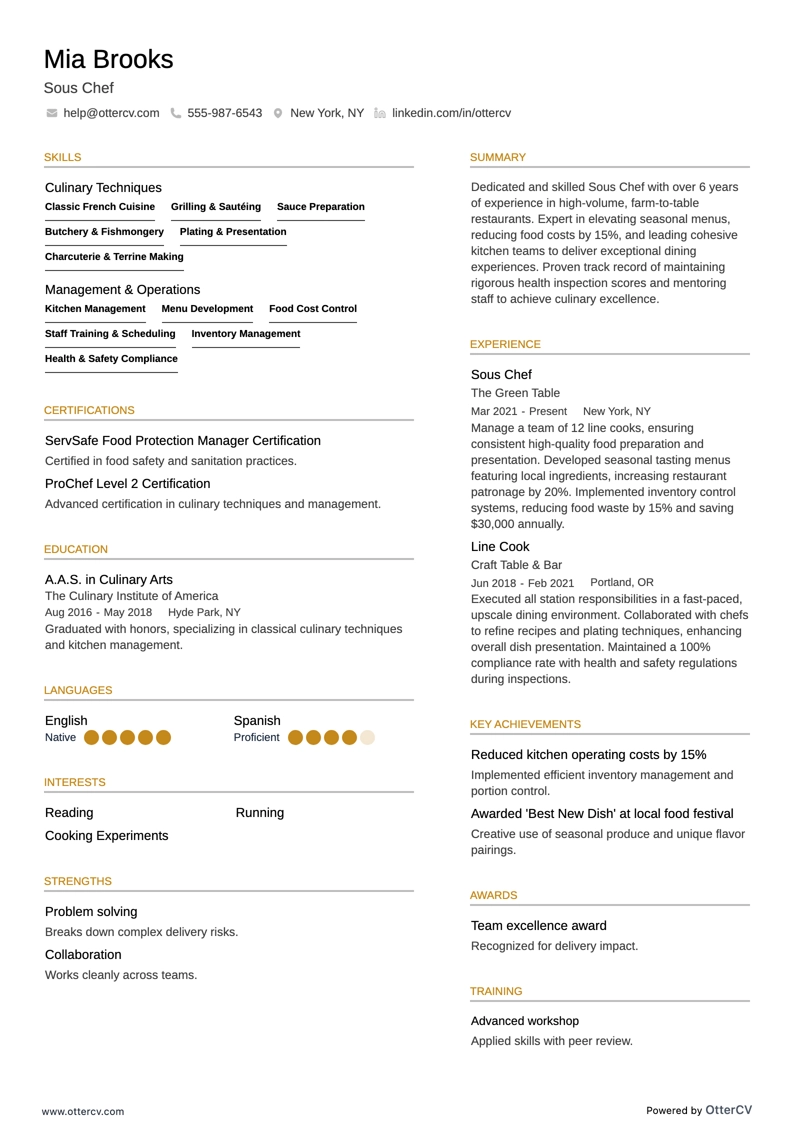
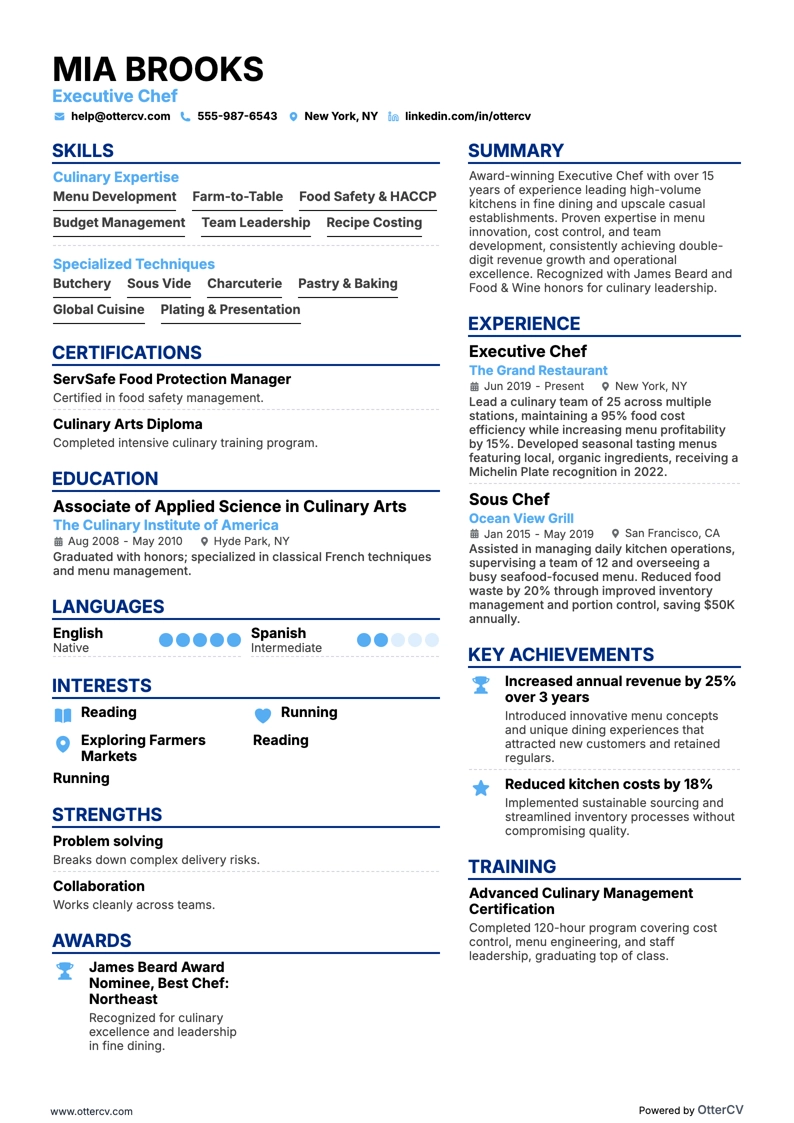
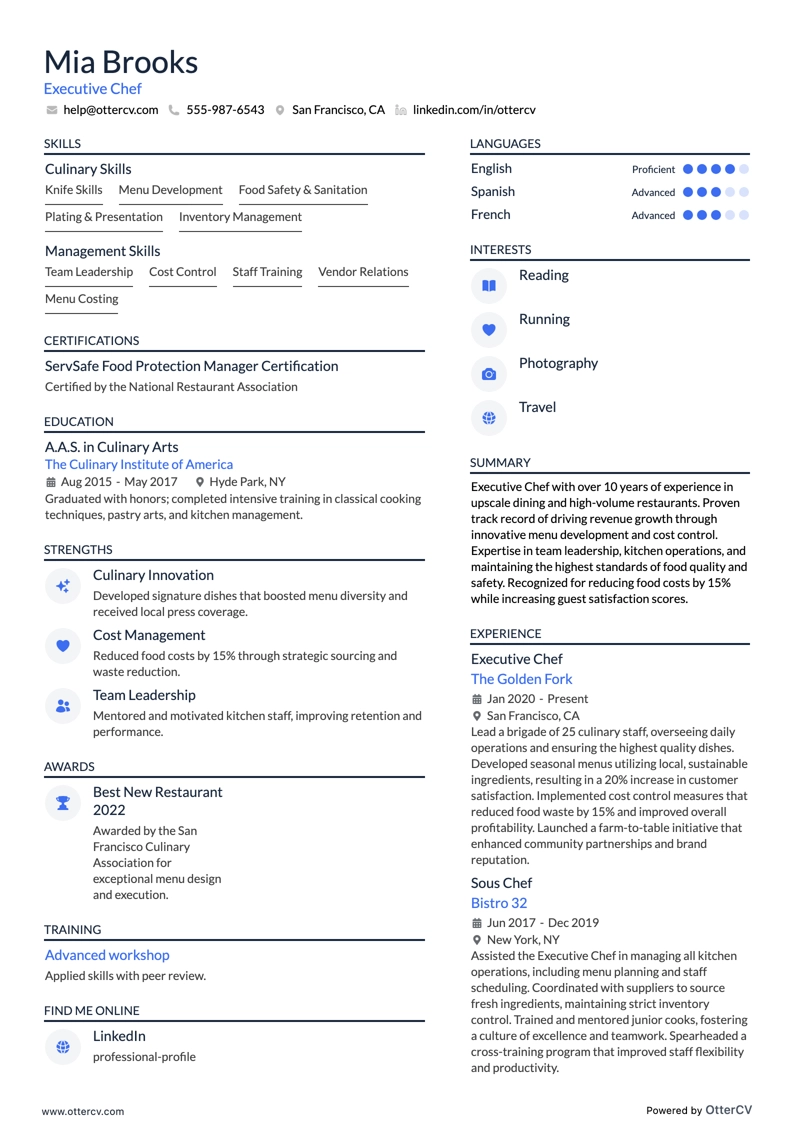
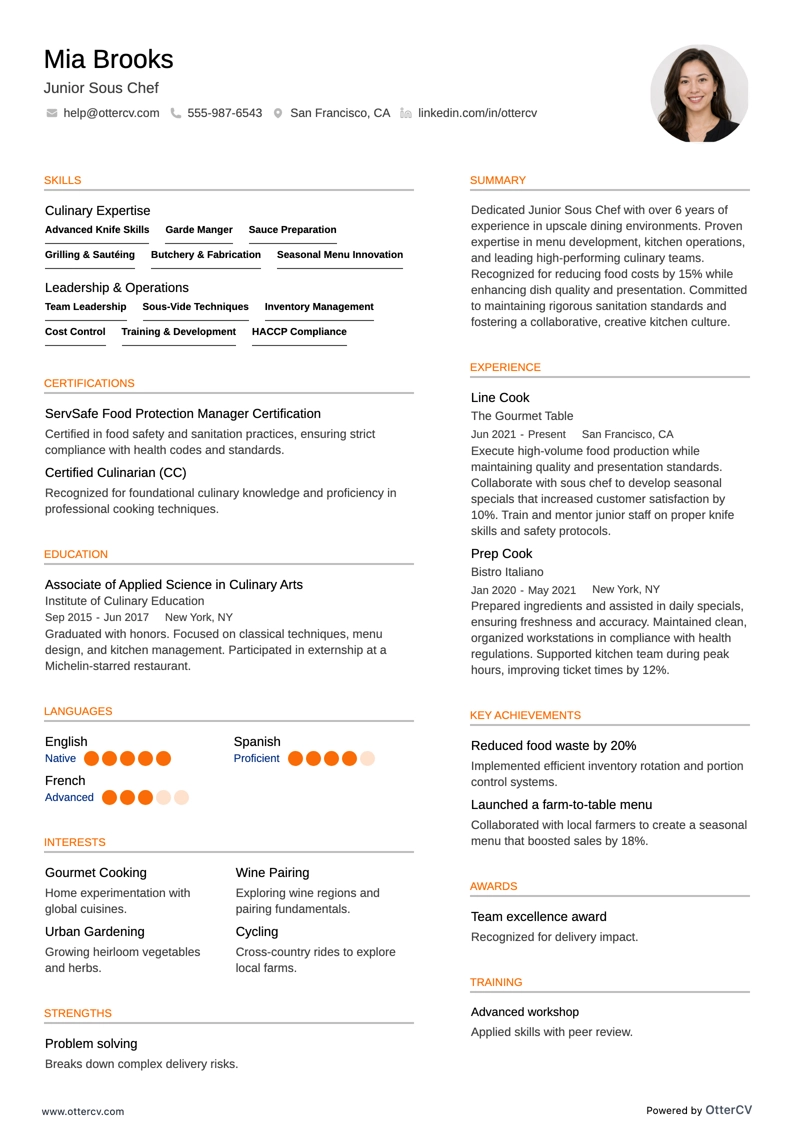
Junior Sous Chef full preview

24 Chef Resume Examples

OtterCV

Written by The OtterCV Team

Updated: 4/8/2023•8 min read

See all resume examples in this guide, or generate your own resume example with your personalized prompt

Junior Sous Chef resume example

Junior Sous Chef

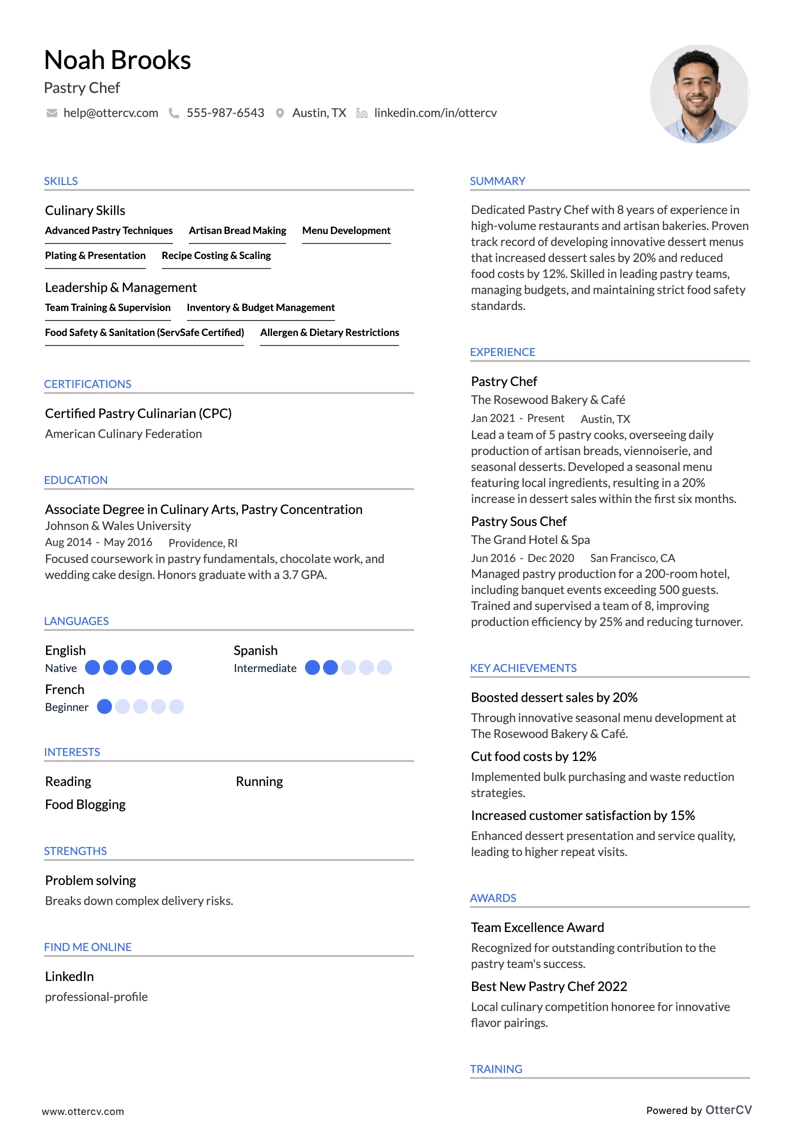
Pastry Chef resume example

Pastry Chef

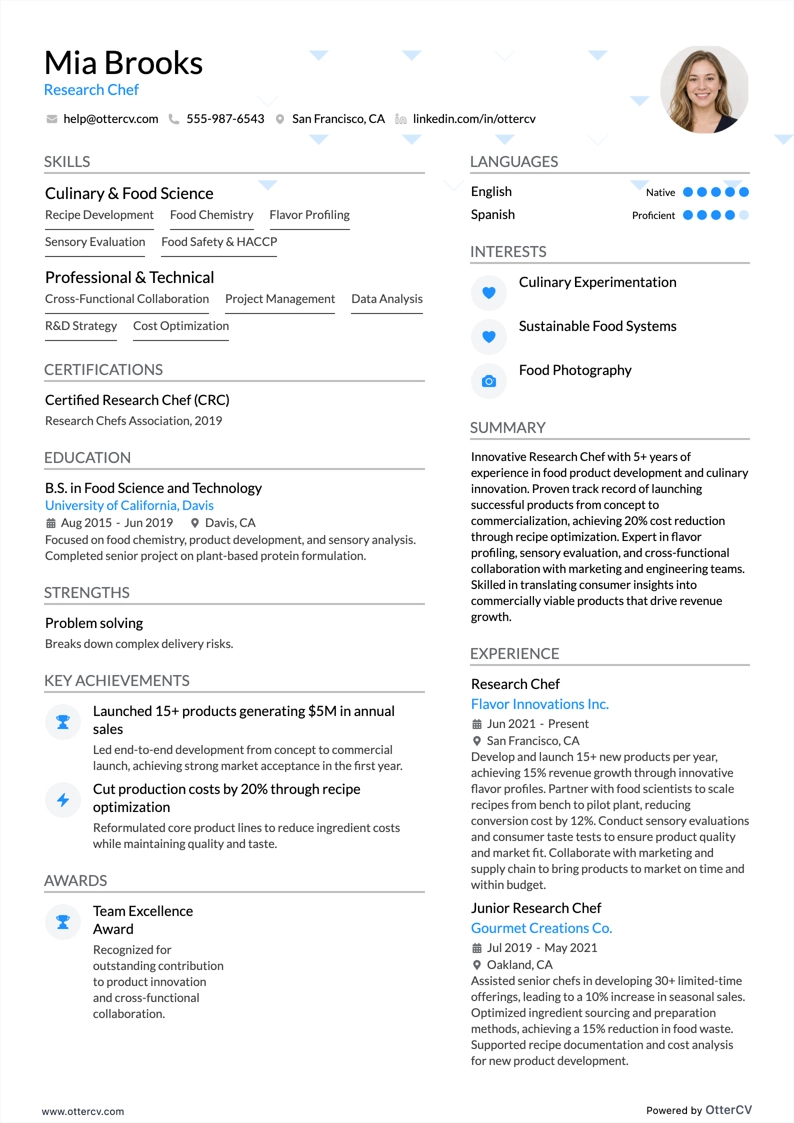
Research Chef resume example

Research Chef

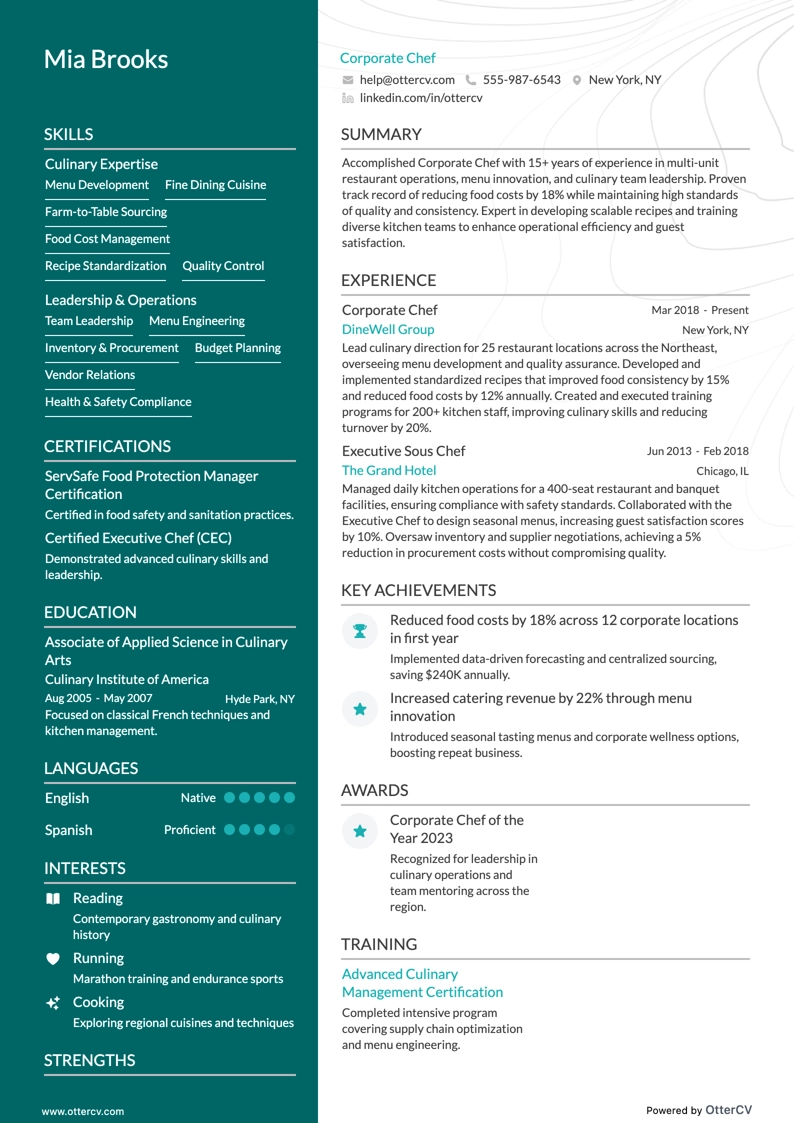
Corporate Chef resume example

Corporate Chef

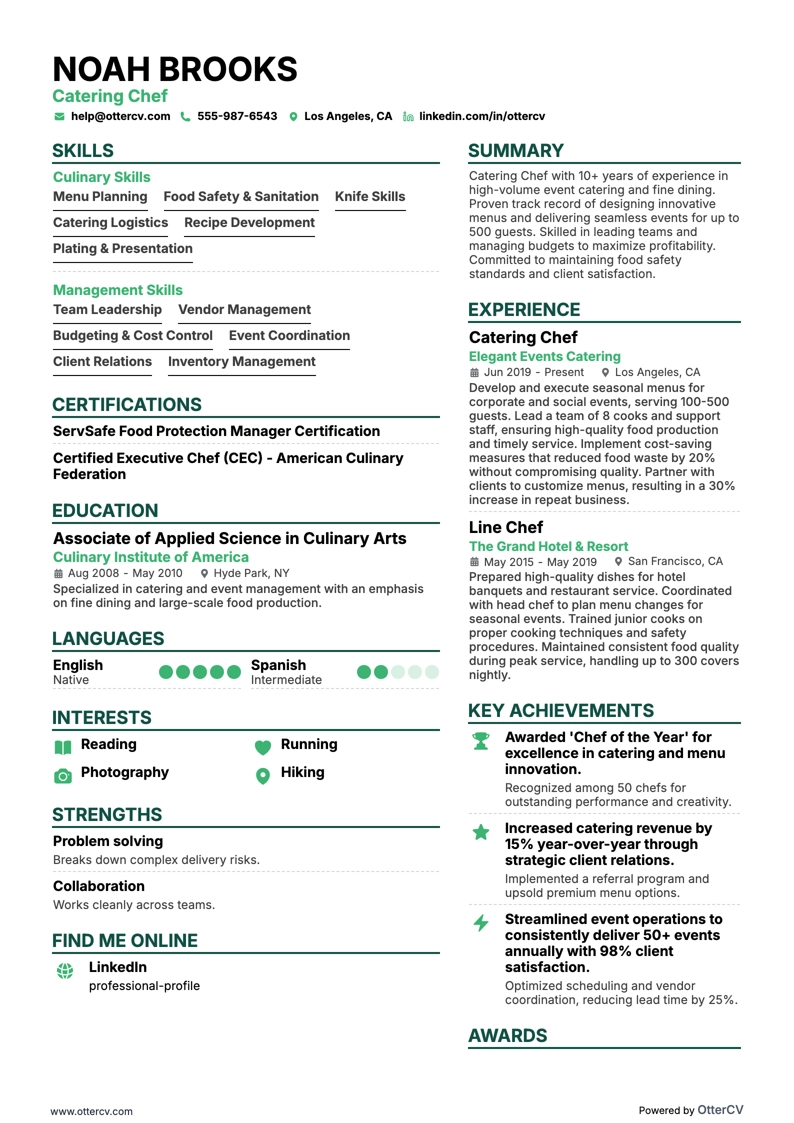
Catering Chef resume example

Catering Chef

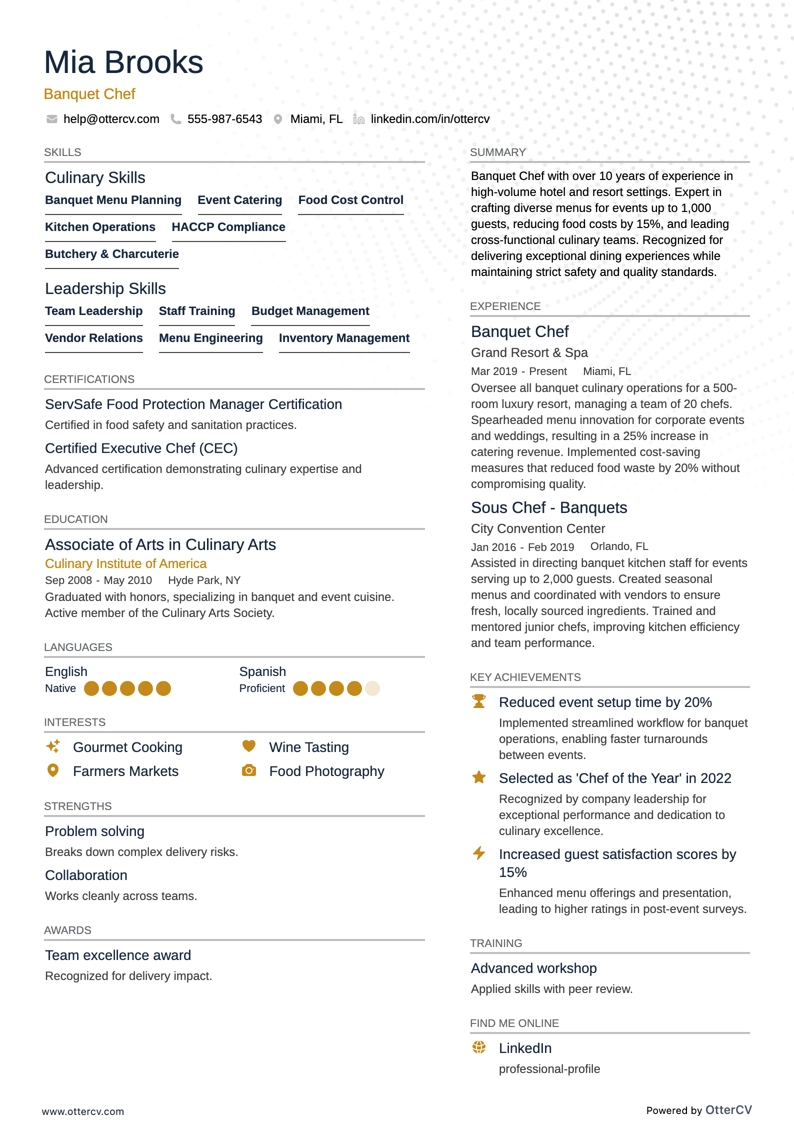
Banquet Chef resume example

Banquet Chef

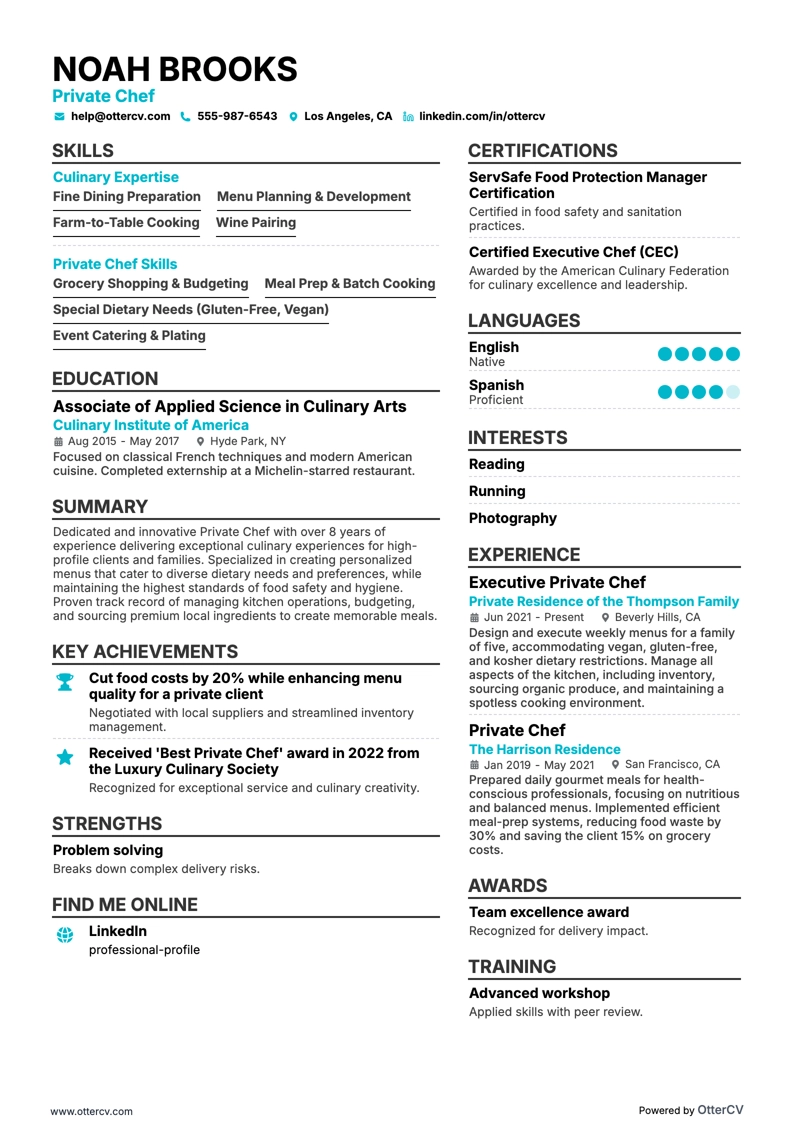
Private Chef resume example

Private Chef

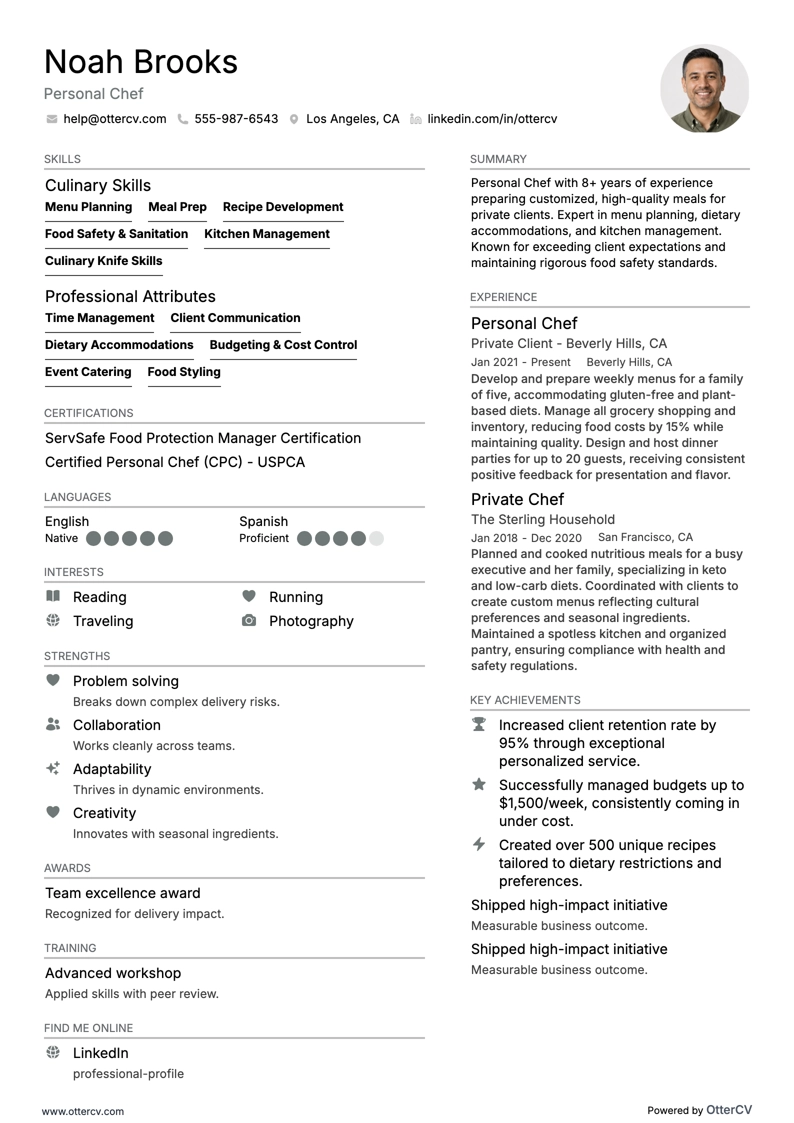
Personal Chef resume example

Personal Chef

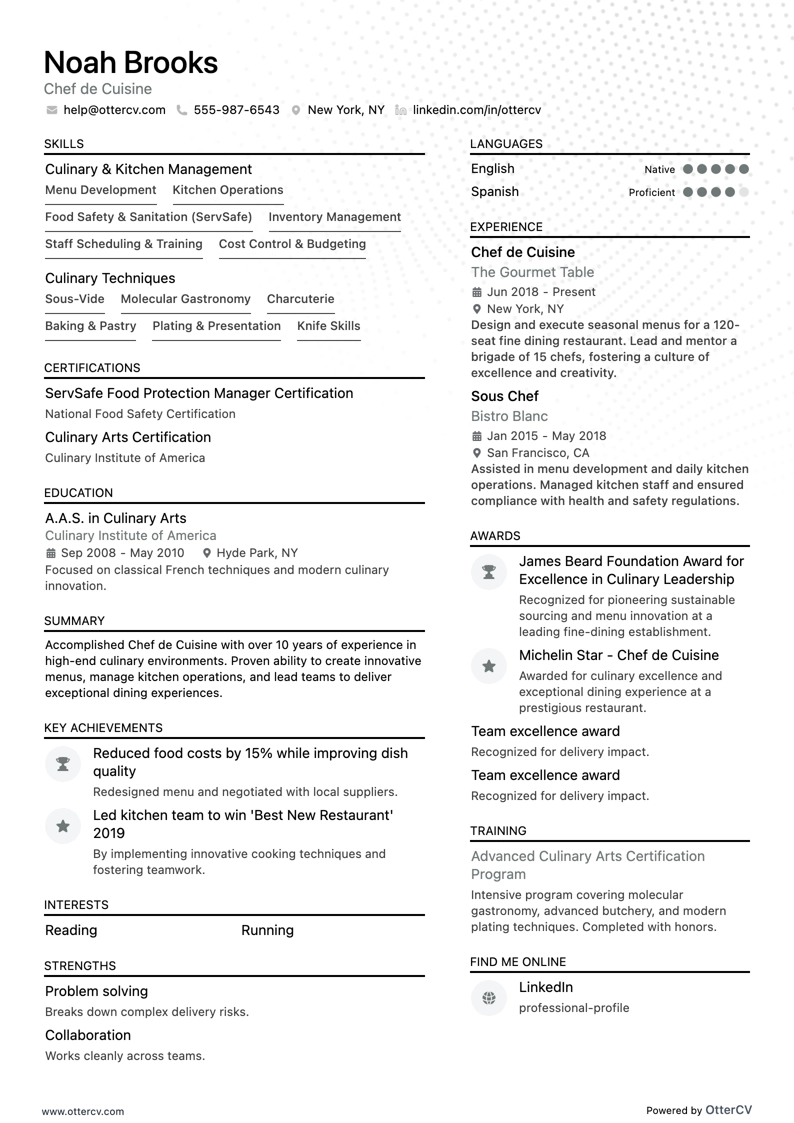
Chef de Cuisine resume example

Chef de Cuisine

Sous Chef resume example

Sous Chef

Executive Chef resume example

Executive Chef

Chef resume example

Chef

Being a chef is one of the most demanding jobs on the market, both physically and psychologically. The challenges chefs face may seem daunting, but they are well known across the industry.

Anthony Bourdain said, “To be a good chef, first and foremost, you have to be a good technician. You have to know how to cook. It's like being a musician. You can be a great musician technically and not have much to say. You can also be a technically mediocre musician and still have a lot of soul.”

To succeed, you need to show that you are ready to meet those demands with the right abilities and talents. Prove that you have the technical tools and chef experience to handle challenges effectively, and that you can deliver in any back-of-house situation.

Here’s how we’ll help get you into that kitchen:

  • Chef resume examples you can study and reference
  • Guidance on the key elements of a resume, including how to write a chef resume summary and objective and how to present your experience, or lack of it
  • Advice on how to highlight your culinary strengths so you stand out from other candidates
  • Full guidance on including your chef hard and soft skills to show you can tackle challenges in the kitchen

Want a more specific resume? Check out these related culinary resumes:

Are you wondering what an ideal chef’s resume looks like? Have a look below.

Chef resume example

Junior Sous Chef resume preview

Here’s what this applicant did well in their resume:

  • Highlighting achievements: They showcased specific results, including developing a fusion menu that increased customer satisfaction by 25% and implementing a waste reduction program that reduced food costs by 15%. These accomplishments are measurable and closely tied to the role’s core responsibilities.
  • Leadership and team development: They demonstrated strong leadership by leading culinary teams, organizing monthly culinary workshops, and spearheading a kitchen renovation project. This shows a proactive approach to team management and operational efficiency.
  • Specialized education and certification: The resume includes valuable degrees and certificates that reflect a commitment to continuous learning and specialization, both of which are important for high-end culinary management roles.

A chef’s resume format that gets results

Just like a dish coming out of the kitchen, the format, structure, and design of your resume play a crucial role in making a strong first impression. They are not just about aesthetics; they help communicate your professional story effectively.

As in any field, culinary roles vary by experience and education. Whether you’re applying for a head chef position or a line cook role, it’s important to choose a resume format that matches your background and the job you want.

If you’re just starting to turn your passion for cooking into a profession, a functional resume may be the best choice. This skills-based layout helps you emphasize your abilities while placing less focus on limited experience.

If you’re an established chef with years of experience, a reverse-chronological resume is often a better fit. It highlights your career progression by listing your previous positions from most recent to oldest.

If you fall somewhere between those two categories, a hybrid resume can be a strong option. It lets you emphasize relevant cooking skills without downplaying your experience, while also giving you room to showcase achievements that help you stand out.

Here are some common concepts to know when writing your resume:

  • Reverse chronological format: This format lists your most recent experience first. It is widely used because it clearly shows your career trajectory and professional growth.
  • Header: Your header is one of the first things a recruiter sees. It can include your contact information and a photo of yourself.
  • Length of a resume: While there is no strict rule, it’s usually best to keep your resume between 1–2 pages, since most recruiters lose interest after the second page.
  • What file format to use: Unless stated otherwise, PDF is usually better than a Word document because it is easier to share and avoids layout issues such as shifting images.
  • Choose the right font: A standard 12p font should be used. Common choices include Rubik, Lato, Montserrat, Raleway, Exo 2, and Volkhov, along with widely used serif and sans-serif fonts.

A quick note on ATS optimization

ATS stands for Applicant Tracking System. It is a digital gatekeeper that some applications must pass through before a recruiter reviews them, so your resume should be compatible. It can help to learn how the system works and some myths surrounding it.

Although some companies use ATS, most systems don’t as of 2025. That said, these AI features may become more common soon. Larger restaurant chains do use ATS, so it’s wise to make the adjustments needed to handle possible ATS screening.

Also consider local standards. Canadian resumes, for example, may have a different format.

The top sections on a chef resume

  • Professional Summary: Briefly highlights your culinary experience and specialties to help you stand out.
  • Skills and Competencies: Shows your culinary abilities, food knowledge, and any cuisines you specialize in.
  • Work Experience: Details your role, achievements, and impact in previous chef positions.
  • Education and Certifications: Presents your formal culinary training or relevant certifications to reinforce quality and professionalism.
  • References: Confirm your skills, performance, and work ethic to leave a strong impression.

What recruiters want to see on your resume:

  • Culinary skills, including food preparation, recipe customization, and knowledge of different cooking techniques, are essential in a kitchen environment.
  • Work experience as a chef or in a related culinary role shows reliability and a clear understanding of the job.
  • Certifications and training, including formal culinary education, help demonstrate credibility, expertise, and dedication.
  • Kitchen management abilities such as inventory control, meal planning, and equipment maintenance are valued because they affect efficiency and costs.
  • Creativity and food presentation matter because chefs are often expected to develop and present new dishes.

Effectively highlighting your cooking experience

The experience section outlines your work history, including past positions, employers, and employment dates. It should also show your responsibilities and achievements in each role, demonstrating your skills and how you have applied them. This section is essential because it helps employers assess whether you are a strong fit for the role.

For chefs, experience usually matters more than formal education. Unlike many professions, chefs often develop their skills primarily on the job rather than in the classroom. Presenting that experience in a professional and compelling way on a resume can be challenging, so focus on the requirements of the specific role and tailor the information carefully.

Avoid listing experience that has no relevance to the job you want. A summer job at a second-hand clothes shop, for example, has no real value on a chef resume.

Below are two example experience sections you might see on a chef resume. The first is ineffective, while the second is much stronger.

Experience

Line Cook

Bob’s Diner

02/2015 - 11/2018 | Twin Peaks, Idaho

An Idaho diner where I worked as an hourly line cook.

  • Required to show up on time
  • Managed to keep things clean
  • Participated in recipes
WRONG

Experience

Pastry Chef

Dubious Delicacies

02/2020 - 11/2023 · Portland, Oregon

An upscale establishment in the heart of Portland, Oregon, known for its high-quality and innovative dessert menu.

  • Developed and executed seasonal dessert offerings with a team of three other pastry chefs, enhancing customer satisfaction.
  • Managed inventory and procured high-quality ingredients, reducing waste by 15%.
  • Specialized in French patisserie techniques, creating award-winning croissants and macarons.
  • Conducted pastry workshops and cooking classes to increase the restaurant's community engagement.
  • Streamlined bakery operations, improving production efficiency by 20%.
RIGHT

In the first example, it is obvious the applicant is likely sending out the same resume broadly without much care. The description is vague, reveals almost nothing about the company beyond that it is in Idaho, and even misspells “diner” as “dinner.” Proofread your resume several times before sending it out.

In the second example, the description accurately explains the workplace and type of cuisine. It is followed by a strong list of duties and responsibilities that uses action verbs, avoids overused buzzwords, and likely reuses relevant keywords from the job advertisement.

The weaker line cook example lists too few responsibilities and includes no achievements or measurable results. The stronger candidate makes an effort to highlight achievements and quantify them properly, for example: Managed inventory and procurement of high-quality ingredients, reducing waste by 15%. That makes it clear they took responsibility and delivered a concrete result.

Be clear, concise, and quantify.

Quantifying impact can be a hurdle for many candidates, so it is worth looking at more closely.

How to quantify impact on your resume

Numbers and statistics show that you know what you are doing and that you have achieved success. In the food industry, there are many opportunities to quantify your work, and the more relevant metrics you can include, the better. Employers want results, and they want them communicated clearly.

Here are some useful details you can quantify in your experience section:

  • The number of menu items you created or improved to demonstrate innovation and responsibility.
  • How many special diets or food allergies you accommodated to highlight flexibility and customer care.
  • The number of staff you trained or mentored to show leadership and teamwork.
  • The percentage by which you reduced food costs without compromising quality.
  • The number of repeat customers tied to your culinary creations to show your ability to attract and retain clientele.
  • The increase in customer satisfaction ratings during your tenure.
  • The volume of meals served during special events or rush hours to reflect stamina and performance under pressure.
  • The percentage decrease in kitchen waste achieved under your supervision to show sustainability and efficient resource use.

How do I write a chef resume with no experience?

If you are just entering the industry, start by building a strong education section. Highlight coursework, activities, projects, and your GPA if it is 3.5 or higher. In addition to education, include internships, extracurricular activities, volunteering, side projects, hobbies, passions, and, most importantly for a chef, a skills section.

If you have a minute, read our detailed article on writing resumes with no experience. Otherwise, follow these steps:

  • Write a resume objective: The way you write an objective or summary depends on your experience level. Experienced candidates can focus on proven results, while newer candidates should emphasize their goals, ambitions, and enthusiasm for specific cuisines or culinary techniques.
  • Use applicable experience to show competency: Even without restaurant employment, you may have relevant experience. Preparing meals at a shelter or organizing a potluck for your nephew’s school can still demonstrate culinary ability.
  • Highlight your education section: If you recently graduated, include projects from your studies that show your fit for the role. For example, if you designed a lunch menu for your high school cafeteria, mention it and briefly explain the research behind it.
  • Consider the functional resume format: A skills-based layout can help emphasize your abilities while placing less focus on limited work experience. In the skills section, include both your skills and practical examples from your life and career.

Other sections you can include are:

  • Internships: A relevant internship can help you stand out. Focus on duties performed and achievements accomplished.
  • Extracurricular activities: Clubs, sports, and student organizations can show commitment and transferable skills.
  • Volunteering experience: Hiring managers often value volunteer work because it can build leadership and communication skills.
  • Projects: Add projects and activities that relate to the job you are applying for.
  • Hobbies and interests: Hobbies are regular activities you enjoy, while interests are subjects you want to learn more about.
  • Passions: Passions can strengthen the effect of your hobbies and interests section.

Now let’s move on to the most critical section for a chef: the skill section.

How to list your hard skills and soft skills on your resume

For a chef’s resume, hard and soft skills play different but equally important roles. Together, they show both your technical ability and how well you work with others.

Hard skills

Hard skills are the technical abilities and knowledge needed for specific cooking and kitchen management tasks. These are usually developed through education, training, and hands-on experience.

Soft skills

Soft skills are personal attributes and interpersonal abilities that affect how well you work with others. In a kitchen, they are especially important because the environment often demands teamwork, communication, and stress management.

A strong chef resume should balance both. Hard skills show technical competence, while soft skills show how you will fit into the kitchen culture and contribute to the team. Including examples of how you used these skills in previous roles can strengthen your resume further.

Steps to showcase your skills effectively

  • Identify relevant skills: Review job descriptions, note the skills mentioned most often, compare them with your own abilities, and think about which skills helped you achieve results.
  • Categorize your skills: Separate hard skills from soft skills. If helpful, use more specific groupings such as culinary skills and management skills.
  • Prioritize your skills: List the most relevant skills first, and emphasize the ones you are strongest in that best match the job requirements.
  • Use keywords from job descriptions: Match the wording used in the posting to help your resume pass Applicant Tracking Systems and catch the attention of hiring managers.
  • Provide evidence: Add context for how you used your skills in past roles, and quantify achievements when possible. For example, “Increased kitchen efficiency by 20% through improved inventory management techniques.”
  • Format for readability: Create a clear skills section near the top of your resume after your contact information and summary. Use bullet points and keep formatting consistent.
  • Review and update regularly: Tailor your skills section for each application and keep it current as you gain new experience.

Here are some more examples of culinary skills:
Best hard skills for your chef resume

  • Recipe development.
  • Inventory management.
  • Culinary techniques.
  • Menu development.
  • Specialized cuisine knowledge.
  • Budgeting and cost control.
  • Catering.
  • Baking and pastry skills.
  • Knowledge of nutrition.
  • Food plating and presentation.
  • Quality control.
  • Food safety and hygiene.
  • Kitchen equipment use.
  • Knowledge of food allergies and dietary restrictions.
  • Butchery skills, including knife skills.
  • Sauteing and grilling.
  • Seafood preparation.
  • Wine and other alcohol pairing.
  • Use of commercial-grade kitchen appliances.
  • Experience with the sous-vide method.
  • Mastery of gastronomy software.

Best soft skills for your chef resume

  • Detail orientation.
  • Multitasking.
  • Stress management.
  • Leadership.
  • Decision making.
  • Patience.
  • Time management.
  • Adaptability.
  • Communicative.
  • Flexibility.
  • Teamwork.
  • Problem solving.
  • Customer service.
  • Creativity.
  • Motivation.
  • Cultural awareness.
  • Physical stamina.
  • Energy.
  • Precision.
  • Diplomacy.

Including your education and certifications on your chef’s resume

Including an education section on a chef’s resume is important, even in a field that often emphasizes practical skills and hands-on experience. It helps employers understand your foundational knowledge, commitment to the profession, and potential for growth.

Why it matters:

  • Demonstrates formal training
  • Highlights relevant coursework
  • Shows commitment to professional development
  • Provides context for your career path
  • Fulfills employer expectations

Presenting your professional development as a chef

Describing your professional development on a chef’s resume shows your commitment to staying current and continuing to build your culinary skills, which is essential in the constantly evolving food industry.

By showing your career progression and the steps you’ve taken toward personal and professional growth, you present yourself as a capable and motivated culinary professional, which can make you a stronger candidate for the role.

How to format your education

  • Name of the institution: Start with the name of the culinary school or university.
  • Location: Include the city and state.
  • Degree or diploma: Specify the degree or diploma earned.
  • Major or focus: Mention your major or area of focus, if applicable.
  • Graduation date: Include your graduation date or expected graduation date.
  • Relevant courses or achievements: Optionally, list relevant courses, projects, or academic achievements.

Here’s an example:

Education

Associate of Applied Science in Culinary Arts
Culinary Institute of America
02/2020 - 05/2022
GPA: 4.0 / 4.0

  • Specialized in French Cuisine & pastry arts
  • Completed a capstone project on sustainable sourcing practices
  • Graduated with Honors
RIGHT

Certifications

  • ServSafe Food Protection Manager Certification, June 2022

    National Restaurant Association

  • Advanced Bread Baking Certificate, September 2021

    French Culinary Institute, New York, NY

RIGHT

In conclusion, although the culinary field places high value on experience and skill, the education section of a chef's resume remains essential. It offers a clear view of the chef's background, formal training, and commitment to the craft.

How to write your chef resume summary or objective

A resume summary is a concise introduction at the top of your resume that highlights the qualifications, skills, and achievements most relevant to the job. Its purpose is to quickly show employers why you are a strong fit by presenting your value and professional background in a few sentences.

A resume objective is a brief statement at the beginning of your resume that explains your career goals and how you hope to contribute to the employer. It emphasizes your aspirations, relevant skills, and interest in the role while showing how your goals align with the company’s needs.

In short, a resume objective is forward-looking, focusing on your future aspirations and what you want to achieve. A resume summary is backward-looking, emphasizing what you have already accomplished and how that experience makes you a strong candidate for the job.

How to make a good resume summary or objective statement

A strong resume summary for a chef should briefly highlight extensive culinary experience, specialized skills in a particular cuisine or technique, proven success in kitchen management or menu innovation, and a clear passion for culinary excellence.

An effective objective statement should focus on career goals, relevant skills, and how they support the restaurant's mission.

Here are some examples to illustrate:

Summary

Experienced chef with years of hands-on work in various kitchens. Enjoy cooking and seeking a new opportunity to prepare a wider range of foods.

WRONG

Why It's Bad: This summary lacks specificity, measurable achievements, and clearly defined skills or specialties. It does not communicate the candidate's unique value or show how they could contribute to a potential employer, which makes it less compelling and less informative.

Summary

Dynamic Chef with 8 years of experience in high-volume kitchens, specializing in Mediterranean and fusion cuisines. Proven success in menu development, food cost management, and team leadership, contributing to a 30% increase in customer satisfaction. Committed to sustainability and culinary innovation.

RIGHT

Key takeaways

  • To succeed in your job hunt, dedicate yourself to creating the strongest resume possible.

  • Follow a clear format and include accurate, impactful information.

  • Proofread your resume several times. Simple errors can put a potential employer off.

  • If something is not relevant to your cooking career, it should not be on your resume.

  • The main focus of a chef's resume is the skills section. Match your skills to those listed in the job description.

  • Your summary or objective is your first line of offense, so make it great.

Chef resume examples

Explore additional Chef resume samples and guides and see what works for your level of experience or role.

By Experience

Junior Sous Chef

Junior Sous Chef resume preview

Chef resume examples

Explore additional Chef resume samples and guides and see what works for your level of experience or role.

By Role

Pastry Chef

Pastry Chef resume preview

Research Chef

Research Chef resume preview

Corporate Chef

Corporate Chef resume preview

Catering Chef

Catering Chef resume preview

Banquet Chef

Banquet Chef resume preview

Private Chef

Private Chef resume preview

Personal Chef

Personal Chef resume preview

Chef de Cuisine

Chef de Cuisine resume preview

Sous Chef

Sous Chef resume preview

Executive Chef

Executive Chef resume preview

Chef

Chef resume preview