Lead Case Manager full preview

10 Case Manager Resume Examples

OtterCV

Written by The OtterCV Team

Updated: 10/1/2024•8 min read

See all resume examples in this guide, or generate your own resume example with your personalized prompt

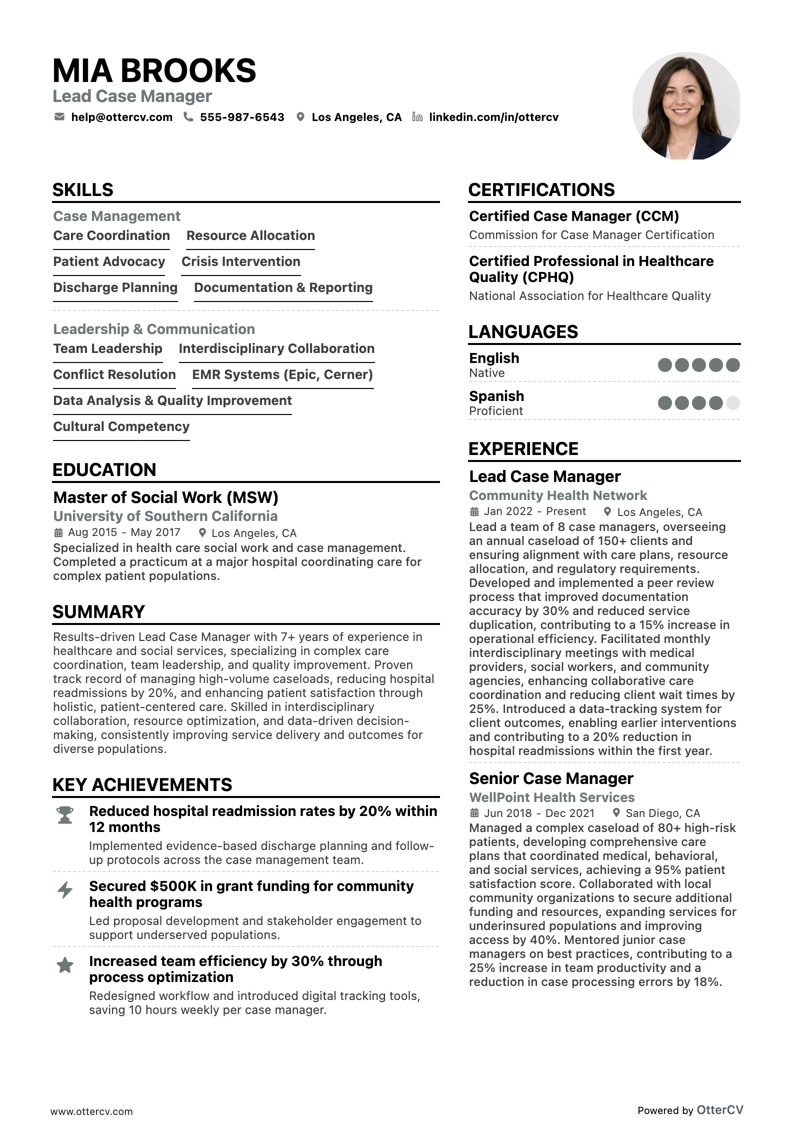
Lead Case Manager resume example

Lead Case Manager

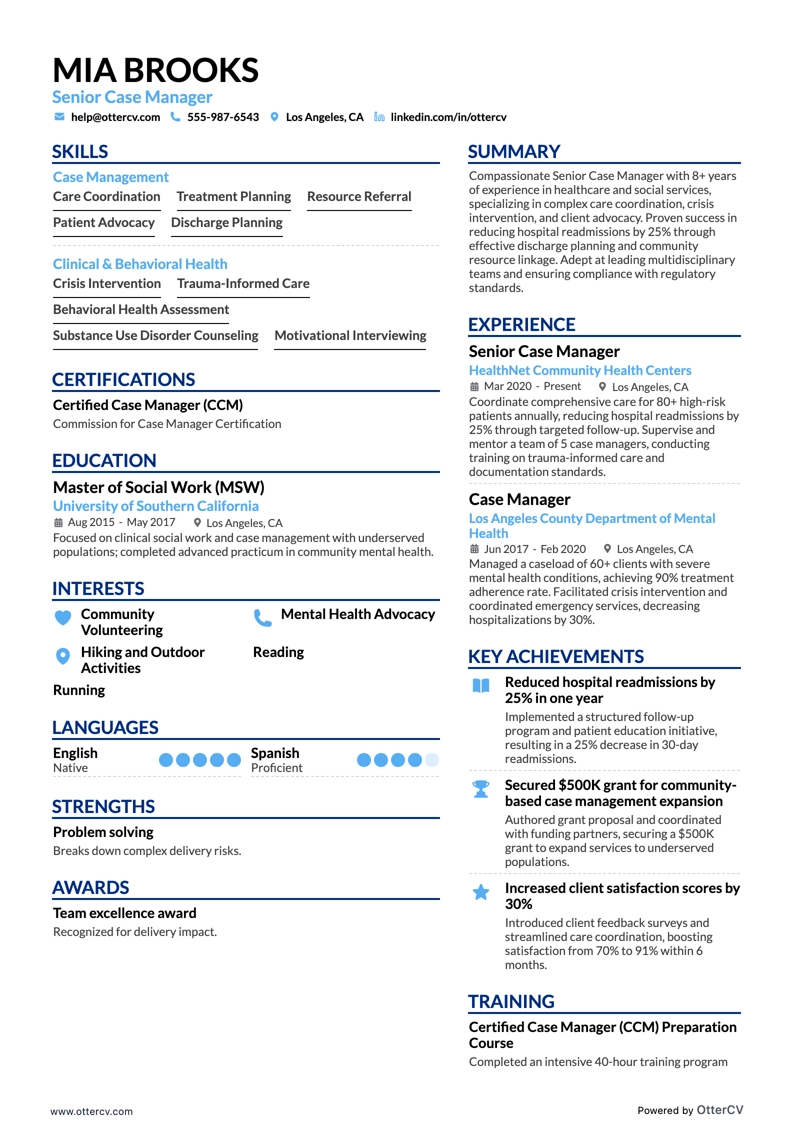
Senior Case Manager resume example

Senior Case Manager

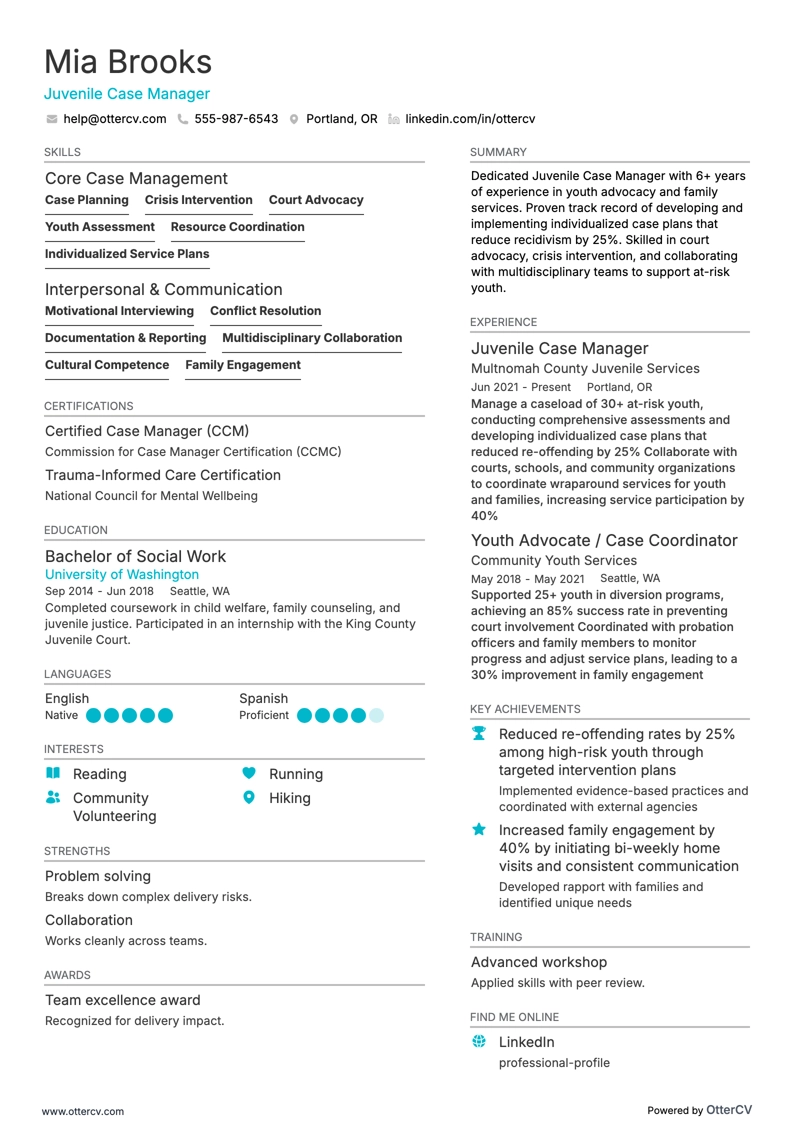
Juvenile Case Manager resume example

Juvenile Case Manager

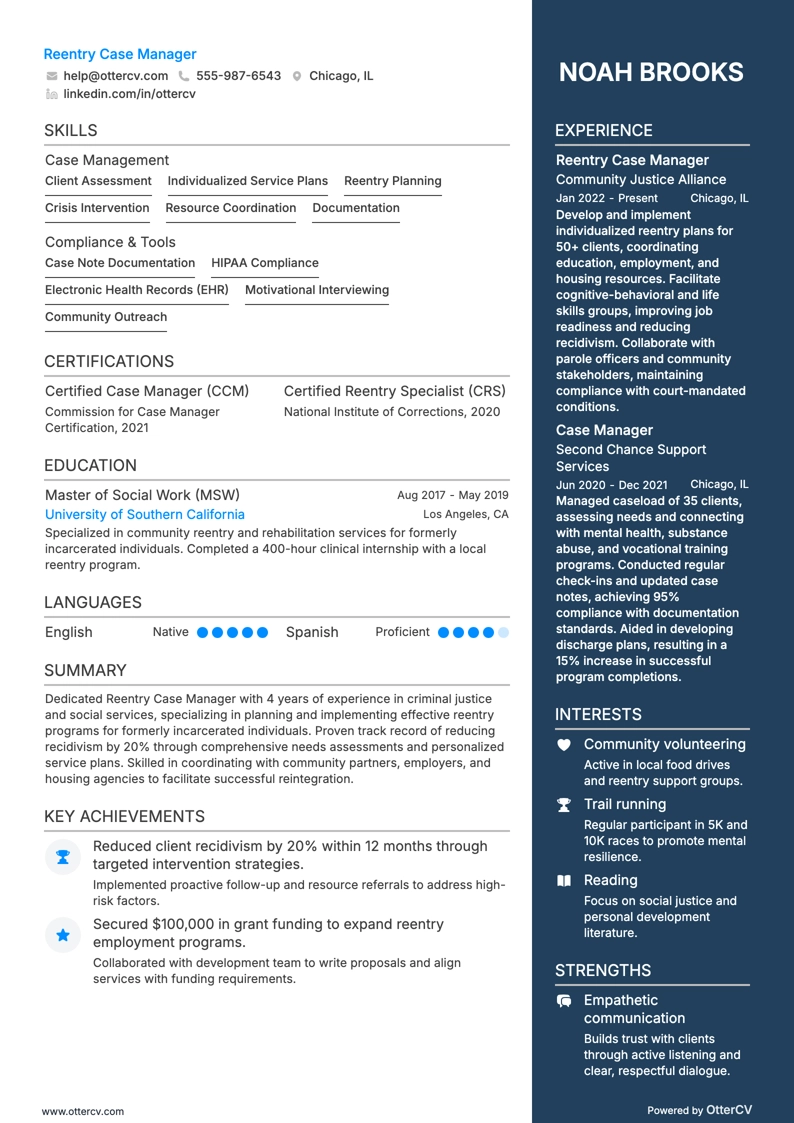
Reentry Case Manager resume example

Reentry Case Manager

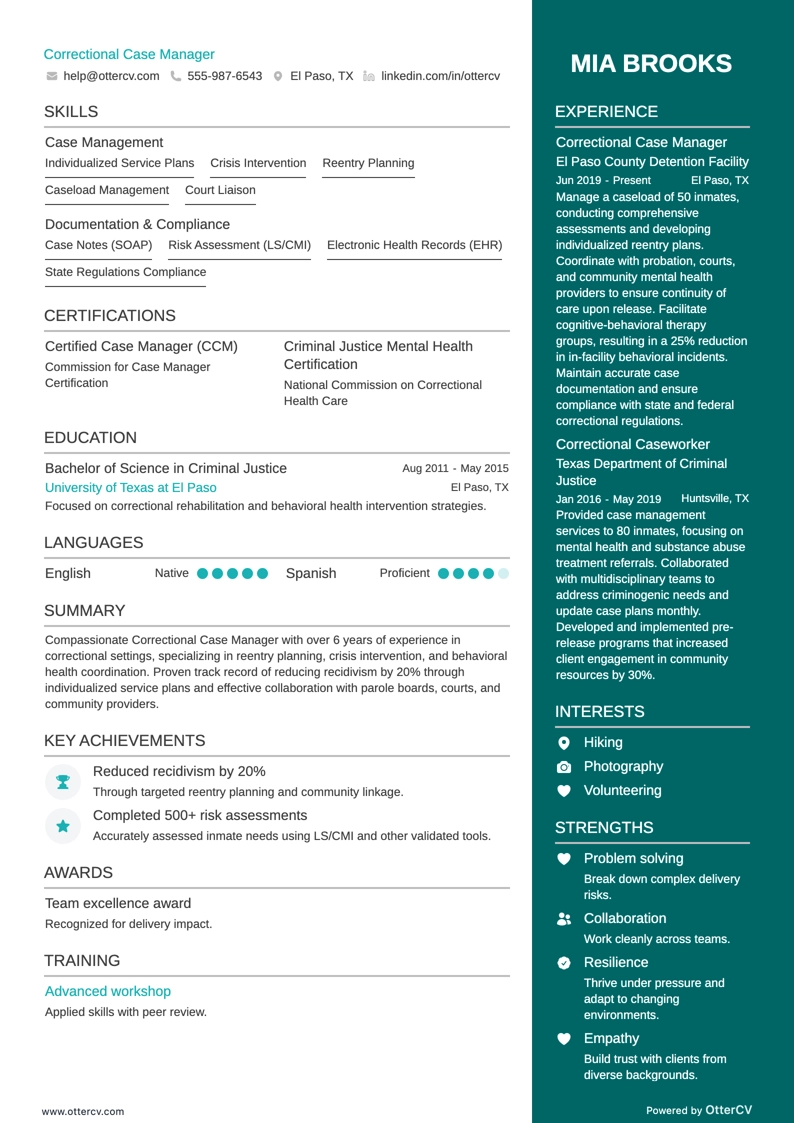
Correctional Case Manager resume example

Correctional Case Manager

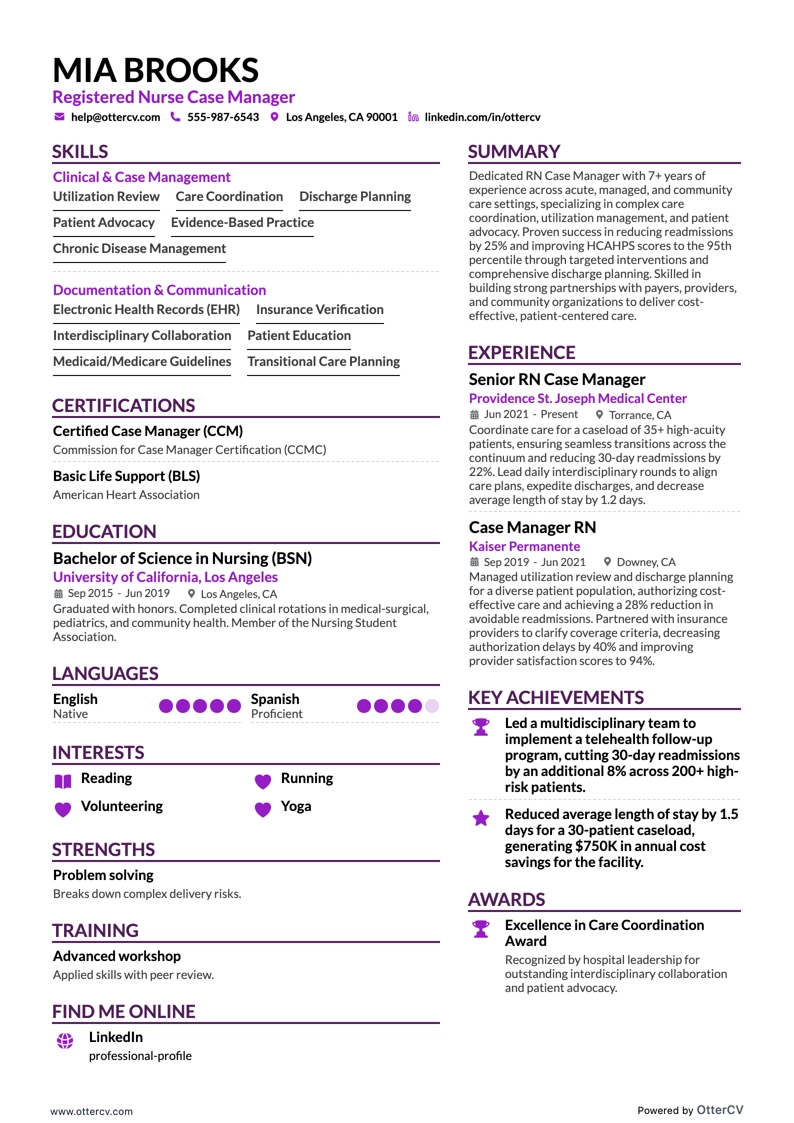
RN Case Manager resume example

RN Case Manager

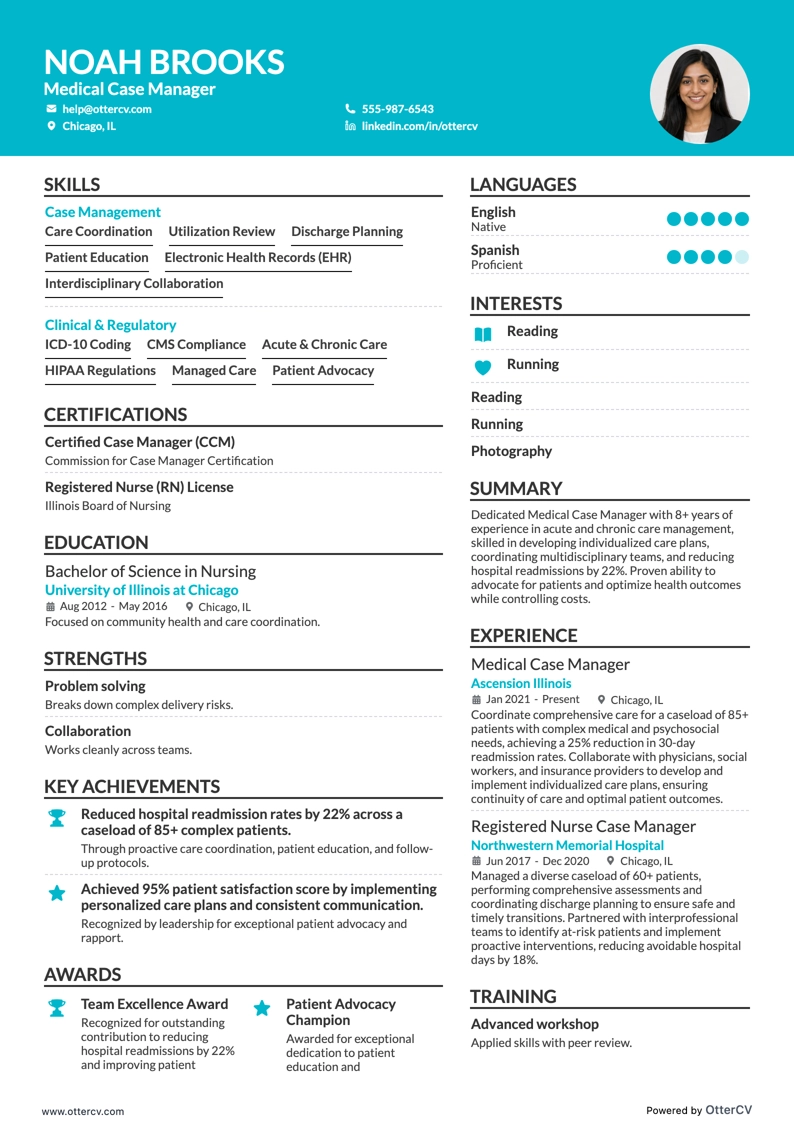
Medical Case Manager resume example

Medical Case Manager

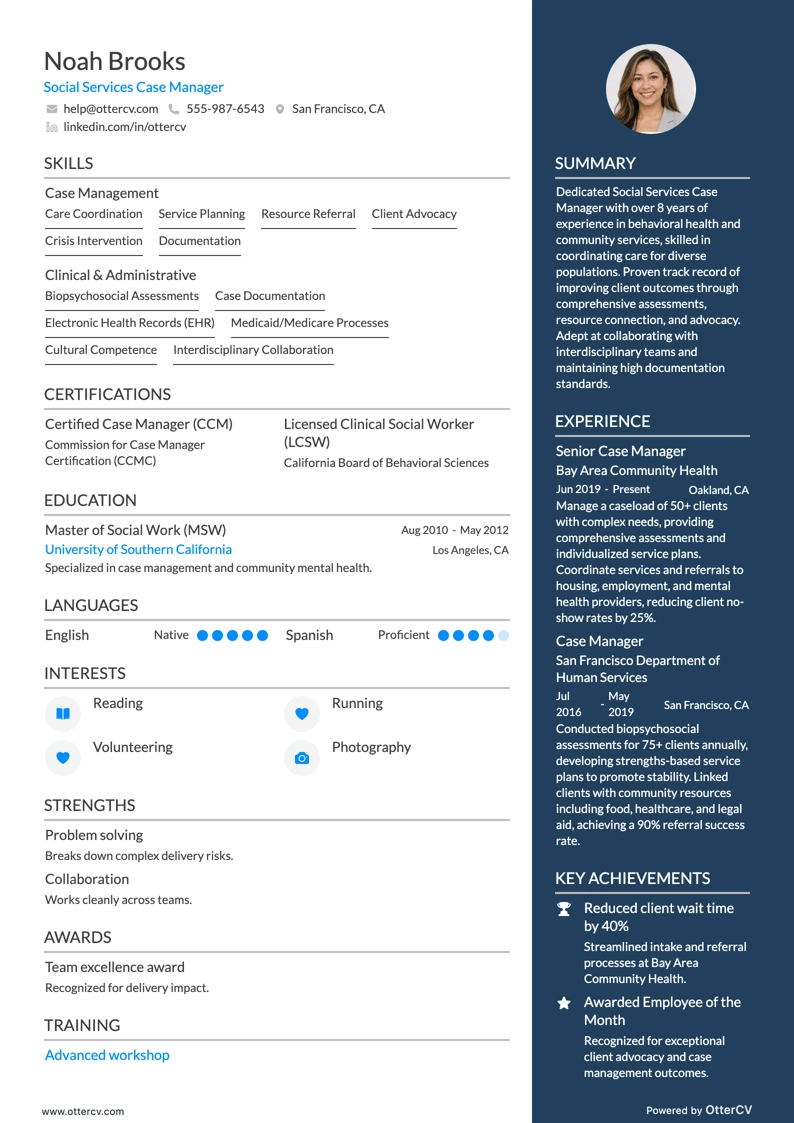
Social Services Case Manager resume example

Social Services Case Manager

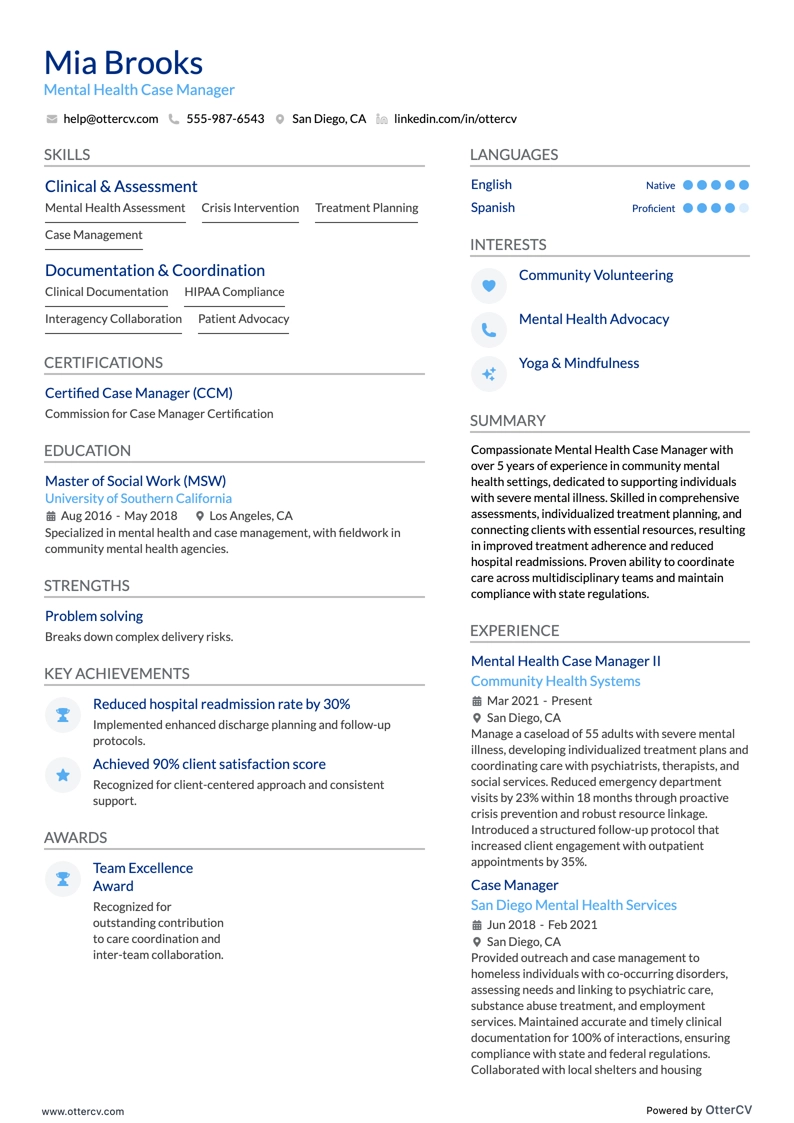
Mental Health Case Manager resume example

Mental Health Case Manager

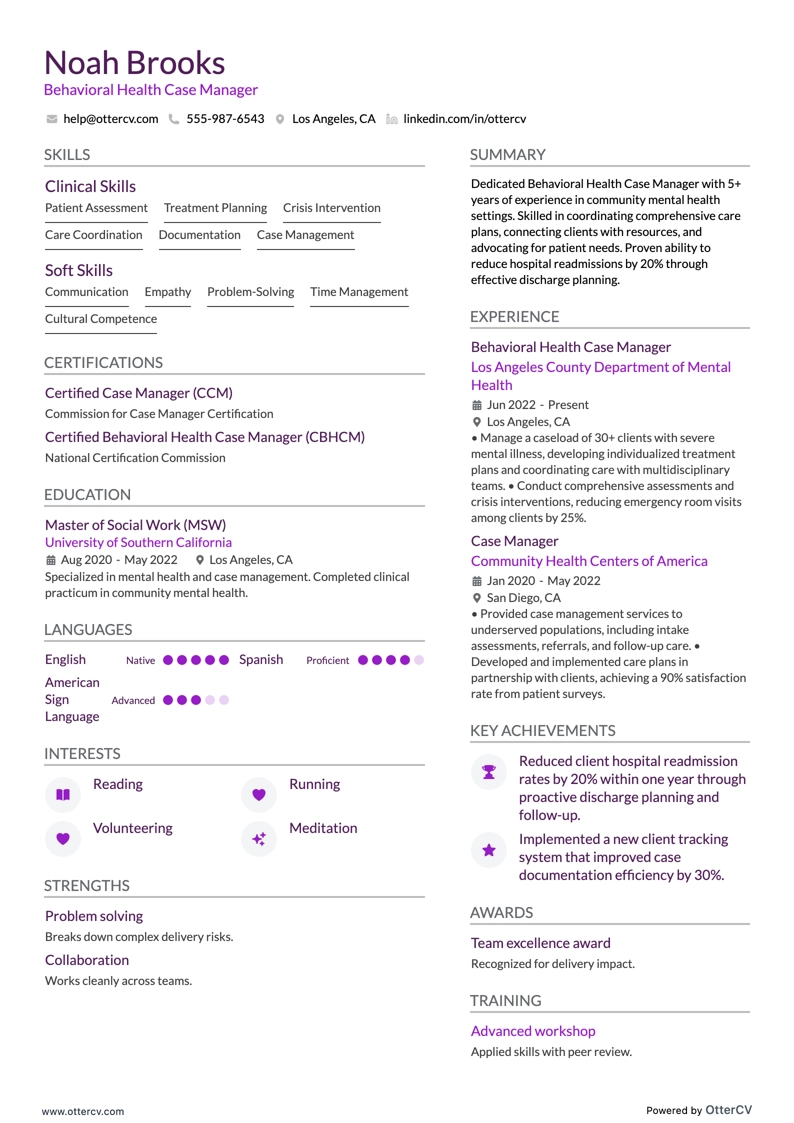
Behavioral Health Case Manager resume example

Behavioral Health Case Manager

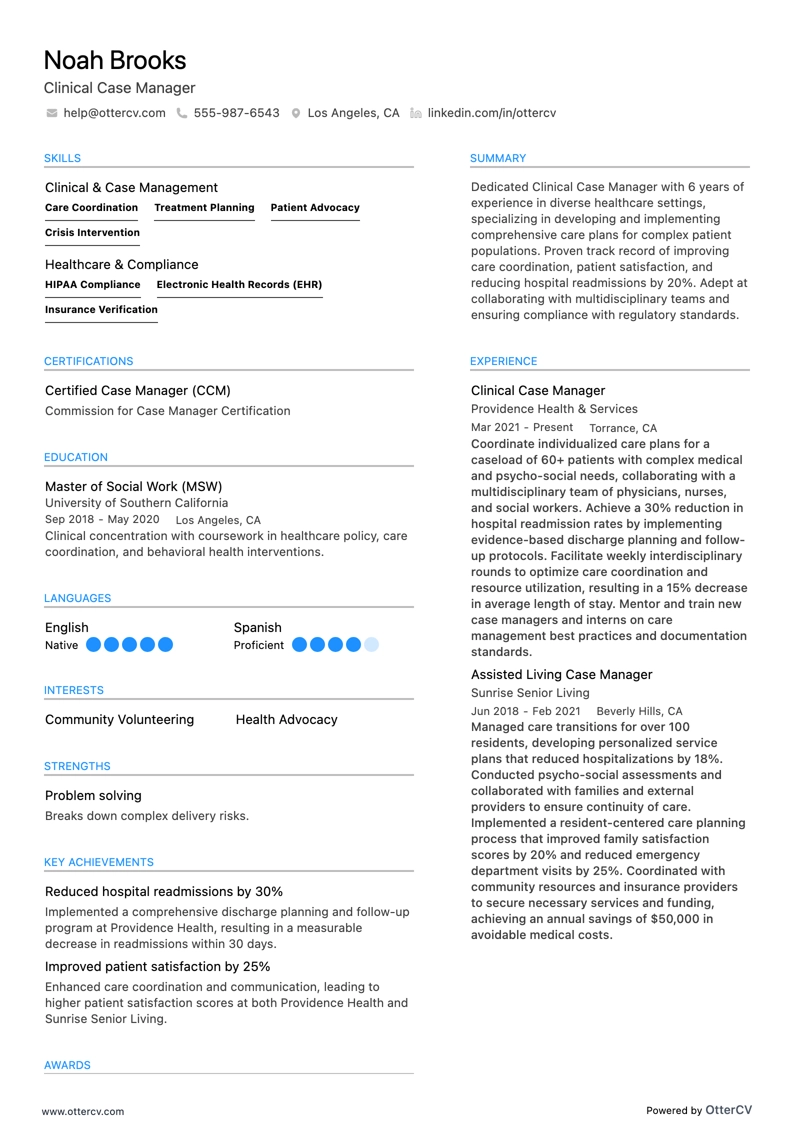
Clinical Case Manager resume example

Clinical Case Manager

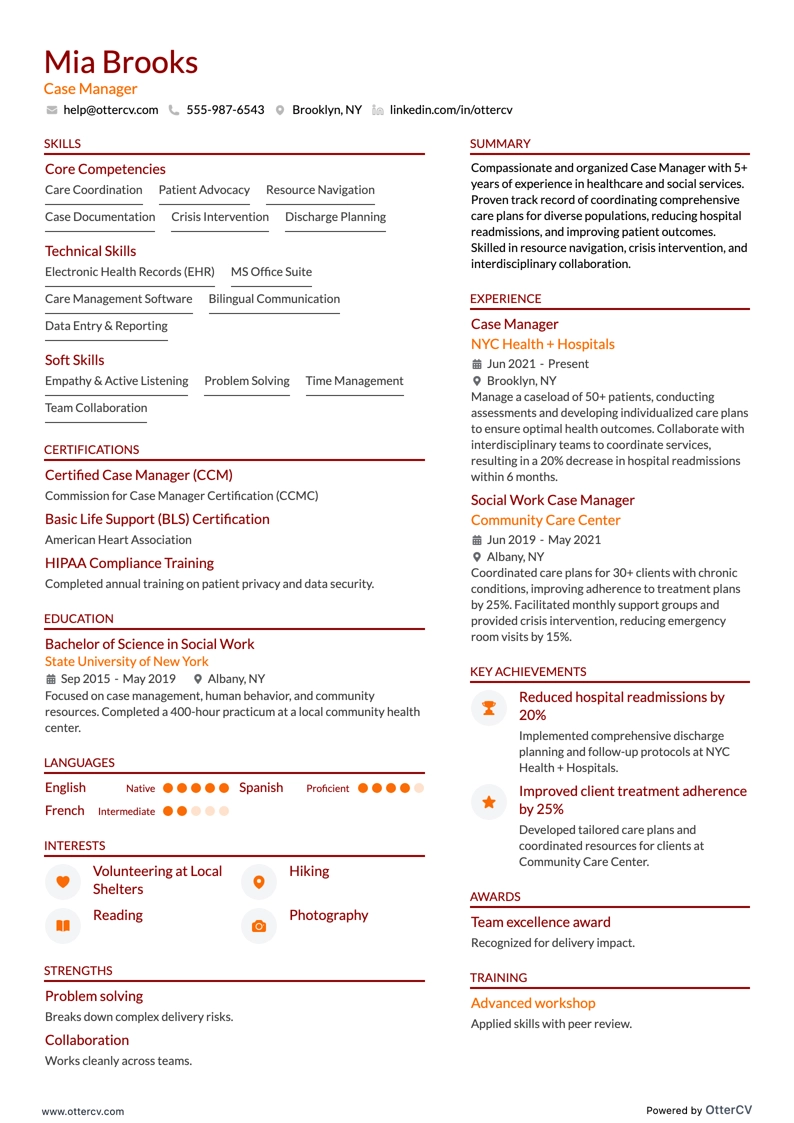
Case Manager resume example

Case Manager

Most case manager resumes fall short because they read like task logs and hide results in dense wording. That creates problems when an ATS filters for keywords and recruiters scan quickly in a crowded applicant pool.

A strong resume shows what changed because of your work, not just what you did. If you're not sure where to start, learning how to write a resume from the ground up can help you avoid common mistakes.

Focus on results such as reduced caseload backlogs, improved care plan adherence rates, faster referrals, fewer readmissions, higher client satisfaction, audit-ready documentation, and outcomes across complex, high-risk populations.

Key takeaways

  • Quantify caseload size, client outcomes, and cycle times in every experience bullet.

  • Use a reverse-chronological format if you have direct case management experience.

  • Tailor each resume to the job posting’s terminology, tools, and compliance standards.

  • Place certifications like CCM or ACM near the top when the role requires them.

  • Show your skills through measurable results in your summary and experience sections.

  • If you are entry-level, lead with transferable skills, practicum work, and project outcomes.

  • Use Echocv’s tools to tighten bullet points and align your resume with specific job descriptions.

Job market snapshot for case managers

We analyzed 5,448 recent case manager job ads across major US job boards. These figures offer a quick look at industry demand, leading employers, and common hiring expectations.

What level of experience employers are looking for case managers

Years of ExperiencePercentage found in job ads
1–2 years14.5% (789)
3–4 years7.9% (432)
5–6 years2.7% (146)
7–8 years0.2% (10)
9–10 years0.1% (5)
10+ years1.2% (64)
Not specified73.5% (4004)

Case manager ads by area of specialization (industry)

Industry (Area)Percentage found in job ads
Healthcare51.5% (2805)
Finance & Banking30.0% (1636)
Government14.7% (802)
Education3.0% (166)
Real Estate & Construction0.3% (19)

Top companies hiring case managers

CompanyPercentage found in job ads
CVS Health8.7% (472)
State of Tennessee6.5% (355)
Elevance Health3.4% (183)
Fusion Medical Staffing2.3% (123)
State of Arizona2.1% (115)
Compassus1.8% (99)
Res-Care, Inc.1.8% (99)
Encompass Health Corp.1.8% (98)
UnitedHealth Group Inc.1.7% (95)
Amedisys Inc.1.6% (88)

Role overview stats

These tables outline the most common responsibilities and employment types for case manager roles. Use them to align your resume with employer expectations and understand how the role is typically structured across the market.

Day-to-day activities and top responsibilities for a case manager

ResponsibilityPercentage found in job ads
Case management30.8% (1680)
Microsoft office11.8% (641)
Discharge planning11.7% (635)
Registered nurse8.0% (438)
Excel7.7% (420)
Nursing6.8% (373)
Utilization review6.3% (342)
Rn license6.1% (332)
Rn5.9% (321)
Outlook5.7% (311)
Documentation5.6% (307)
Time management5.1% (280)

Type of employment (remote vs on-site vs hybrid)

Employment typePercentage found in job ads
On-site78.4% (4272)
Hybrid12.4% (673)
Remote9.2% (503)

How to format a case manager resume

Recruiters reviewing case manager resumes look for clear evidence of client advocacy, care coordination across multidisciplinary teams, and measurable caseload outcomes. A clean, well-organized resume format helps these strengths stand out quickly in both automated screening and the first human review.

I have significant experience in this role—which format should I use?

I have significant experience in this role—which format should I use?

Use a reverse-chronological format to lead with your most recent and relevant case management experience.

  • Highlight the scope and size of your caseloads, the populations you've served, and any supervisory or program-level responsibilities you've held.
  • Feature role-specific tools and domains, such as electronic health records (EHR) systems, care plan software, Medicaid/Medicare compliance, behavioral health frameworks, or discharge planning protocols.
  • Quantify outcomes tied to client progress, cost savings, or service delivery improvements.

Example bullet: “Managed a caseload of 85+ clients with chronic behavioral health conditions, coordinating services across 12 community providers and reducing hospital readmissions by 22% over 18 months.”

I'm junior or switching into this role—what format works best?

I'm junior or switching into this role—what format works best?

A hybrid format works best because it lets you lead with transferable skills while still showing a clear work history.

  • Place a dedicated skills section near the top featuring core competencies like crisis intervention, needs assessment, resource referral, and documentation.
  • Include internships, practicums, volunteer coordination, or adjacent roles such as social work, patient navigation, or community outreach that demonstrate case management fundamentals.
  • Connect every action to a client-facing or organizational result so recruiters can see your impact, even if the setting was not a traditional case management role.

Example scaffold: Crisis intervention skills → conducted intake assessments for 30+ individuals at a community shelter → connected 90% to ongoing support services within 48 hours.

Why not use a functional resume?

Why not use a functional resume?

A functional resume hides your work timeline, making it harder for recruiters to judge how your case management skills developed in real-world settings.

  • Career changers from adjacent fields (social work, nursing, counseling, community health): You may have relevant transferable skills but not yet hold a formal case manager job title.
  • Recent graduates or practicum completers: Your hands-on experience may be mostly academic or volunteer-based rather than employment-based.
  • Professionals with resume gaps: Extended breaks for caregiving, health, or other circumstances can make a skills-first structure feel safer because it reduces focus on the timeline.

Even in these cases, avoid a purely functional format if you cannot connect each skill to a specific project, practicum, or measurable outcome. Unsupported skill claims carry little weight with hiring managers and are easily filtered out by applicant tracking systems.

Once you’ve established a clean, readable format, the next step is choosing sections that give every part of your resume a clear purpose.

What sections should go on a case manager resume

Recruiters want a clear snapshot of your caseload management, client outcomes, and care coordination across settings. Understanding what to put on a resume helps you focus on the details that matter most for case manager roles.

Use this structure for maximum clarity:

  • Header
  • Summary
  • Experience
  • Skills
  • Projects
  • Education
  • Certifications
  • Optional sections: Volunteering, Leadership, Languages

Strong experience bullets should highlight caseload size, measurable client outcomes, cross-functional coordination, compliance, and program results.

How to write your case manager resume experience

Now that you’ve organized the key resume components, the next step is to write your case manager resume experience so your background shows clear impact and relevance.

Your work experience section should focus on the casework you’ve delivered, the assessment tools and intervention methods you’ve used, and the measurable outcomes you’ve achieved for clients and organizations. Hiring managers value demonstrated impact—such as improved client outcomes, reduced recidivism, or more efficient service coordination—more than simple task lists.

Each entry should include:

  • Job title
  • Company and location, or remote
  • Dates of employment, including month and year

Add three to five concise bullet points that show what you owned, how you carried out the work, and what outcomes you delivered.

  • Ownership scope: the caseloads, client populations, service programs, or community partnerships you were directly responsible for as a case manager.
  • Execution approach: the assessment instruments, care planning frameworks, documentation systems, or evidence-based interventions you used to guide client decisions and deliver services.
  • Value improved: changes to client well-being, service accessibility, compliance rates, care continuity, or risk reduction that resulted from your case management work.
  • Collaboration context: how you worked with multidisciplinary teams, social service agencies, healthcare providers, legal professionals, or family members to support client goals.
  • Impact delivered: outcomes shown through client progress, program effectiveness, organizational efficiency, or community-level results rather than routine activity.

Experience bullet formula

Experience bullet formula

Action verb + technology + what you built or fixed + measurable result

A case manager experience example

Case Manager, Behavioral Health

Riverbend Community Health | Columbus, OH

2022–Present

Federally qualified health center supporting high-acuity adults across outpatient, crisis, and community-based programs.

  • Coordinated care for a caseload of eighty-five adults with serious mental illness using Epic, Unite Us, and standardized biopsychosocial assessments, improving appointment adherence by eighteen percent over twelve months.
  • Built and maintained interdisciplinary care plans with psychiatrists, therapists, primary care providers, and housing partners, reducing psychiatric emergency department visits by fourteen percent across the panel.
  • Streamlined intake and referral workflows in Salesforce Health Cloud and DocuSign, cutting average referral-to-first-visit time from nine days to five days and increasing successful warm handoffs by twenty-two percent.
  • Implemented safety planning and risk stratification using the Columbia-Suicide Severity Rating Scale (C-SSRS) and SBAR handoffs, decreasing high-risk escalation response time by thirty percent.
  • Audited documentation and outcomes in Microsoft Excel and Power BI dashboards, raising care plan completion within seven days from seventy percent to ninety-one percent and improving audit pass rate to ninety-six percent.

Now that you've seen how to structure a strong experience entry, the next step is adjusting those details to fit the specific role you're targeting.

How to tailor your case manager resume experience

Recruiters review your case manager resume through both applicant tracking systems and manual screening, so tailoring your resume to the job description is essential. This helps ensure the skills, tools, and processes you highlight match what the employer is actually looking for.

Ways to tailor your case manager experience:

  • Mirror the exact care coordination terminology used in the job posting.
  • Reference the specific case management software or EHR platforms listed.
  • Align your caseload volume with the scope described in the role.
  • Highlight compliance with the standards or regulations the employer names.
  • Include relevant population or service area experience when specified.
  • Match the interdisciplinary collaboration models outlined in the job description.
  • Emphasize the quality assurance or outcome tracking methods they prioritize.
  • Reflect the assessment frameworks or clinical methodologies they require.

Tailoring means connecting your real accomplishments to the job requirements, not forcing in keywords where they don't belong.

Resume tailoring examples for case manager

Job description excerptUntailoredTailored
Conduct comprehensive biopsychosocial assessments and develop individualized service plans using a strengths-based approach for clients in a community mental health setting.Assessed clients and created service plans as needed.Conducted over 15 biopsychosocial assessments per week in a community mental health program, developing individualized service plans grounded in a strengths-based approach that improved client goal attainment by 30%.
Coordinate care across multidisciplinary teams including psychiatrists, social workers, and housing specialists, with documentation in AWARDS (EHR system).Worked with other team members to help clients access services.Coordinated care for a caseload of 45 clients across psychiatrists, social workers, and housing specialists, maintaining accurate and timely documentation in AWARDS to ensure compliance with Medicaid billing requirements.
Facilitate discharge planning and connect clients to community resources, including substance use treatment programs, to reduce 30-day hospital readmission rates.Helped clients transition clients out of the hospital and provided referrals.Led discharge planning for 20+ clients per month, connecting them to substance use treatment programs and community resources that contributed to a 22% reduction in 30-day hospital readmission rates.

Once you’ve aligned your experience with the role’s priorities, the next step is to quantify your case manager achievements so employers can quickly see the impact of your work.

How to quantify your case manager achievements

Quantifying your achievements helps show how you improved client outcomes, reduced risk, and kept services moving. Focus on caseload volume, time to resolution, compliance accuracy, client retention, and measurable outcome gains across programs.

Quantifying examples for case manager

MetricExample
Caseload volumeManaged a caseload of 45 active clients per month in Epic, completing weekly check-ins and updating care plans within 48 hours of changes.
Cycle timeCut average intake-to-service enrollment from 12 days to seven by standardizing documentation and coordinating referrals through a shared tracker.
Compliance accuracyImproved documentation audit pass rate from 88% to 97% across 120 charts by using a checklist aligned to Medicaid requirements.
Risk reductionReduced missed follow-up appointments by 30% over six months by adding SMS reminders and a two-call escalation workflow for high-risk clients.
Outcome improvementIncreased program completion from 62% to 75% for a cohort of 80 clients by adding biweekly progress reviews and barrier-focused action plans.

Once you've written strong experience bullets, apply the same level of precision to the hard and soft skills that show your value as a case manager.

How to list your hard and soft skills on a case manager resume

Your skills section should show that you can coordinate care, navigate systems, and document outcomes. Recruiters and ATS often scan this section to match role requirements, so include a balanced mix of hard skills such as tools, compliance, and workflows, along with soft skills such as coordination, judgment, and communication.

Case manager roles require a blend of:

  • Product strategy and discovery skills
  • Data, analytics, and experimentation skills
  • Delivery, execution, and go-to-market discipline
  • Soft skills

Your skills section should be:

  • Scannable, with clear bullet-style grouping
  • Relevant to the job post
  • Supported by proof in your experience bullets
  • Updated with current tools

Place your skills section:

  • Above your experience section if you're junior or switching careers
  • Below your experience section if you're mid- or senior-level with strong achievements

Hard skills

  • Care plan development.
  • Biopsychosocial assessments.
  • Utilization management.
  • Prior authorization workflows.
  • ICD-10 and CPT coding basics.
  • Motivational interviewing (MI).
  • Crisis intervention protocols.
  • Discharge planning.
  • Community resource coordination.
  • EHR documentation in Epic and Cerner.
  • HIPAA compliance.
  • Medicaid and Medicare eligibility.

Soft skills

  • Lead interdisciplinary care coordination.
  • Communicate with empathy and clarity.
  • De-escalate tense situations.
  • Set clear boundaries with clients.
  • Advocate for patient needs.
  • Negotiate services with providers.
  • Prioritize high-risk caseloads.
  • Make timely escalation decisions.
  • Document objectively and consistently.
  • Manage stakeholder expectations.
  • Follow through on action plans.
  • Adapt communication across cultures.

How to show your case manager skills in context

Skills should not appear only in a bulleted list on your resume. Explore resume skills examples to see how other professionals present their competencies effectively.

Show your skills in:

  • Your summary (high-level professional identity)
  • Your experience (proof through outcomes)

Here is what each looks like in practice.

Licensed case manager with 10+ years in behavioral health, with expertise in motivational interviewing, crisis intervention, and EHR documentation. Reduced client readmission rates by 28% through individualized care coordination and cross-agency collaboration.

  • Signals senior-level experience immediately
  • Names role-specific tools and methods
  • Leads with a measurable outcome
  • Highlights collaboration as a soft skill

Experience example

Senior Case Manager

Horizon Behavioral Health Services | Richmond, VA

March 2018–Present

  • Coordinated care plans for 85+ clients each month using Apricot and HMIS, improving service completion rates by 34%.
  • Worked with psychiatrists, social workers, and housing agencies to reduce average client stabilization time by three weeks.
  • Implemented a trauma-informed screening protocol that increased early intervention referrals by 22% within the first year.
  • Every bullet contains measurable proof.
  • Skills appear naturally within achievements.

Once you’ve shown your abilities with concrete examples, the next step is using that same approach to build a strong case manager resume, even without direct experience.

How do I write a case manager resume with no experience

Even without full-time experience, you can still show readiness through:

  • Social work or human services internship
  • Volunteer client intake and screening
  • Crisis hotline or peer support
  • Community outreach and resource navigation
  • Care coordination for family members
  • Case notes for supervised practicum
  • Benefits enrollment or eligibility assistance
  • Shelter, clinic, or nonprofit volunteering

If you're starting out, our guide on building a resume without work experience explains how to highlight these activities effectively.

Focus on:

  • Documented client volume and outcomes
  • Compliance with privacy requirements
  • Referral coordination with community providers
  • Accurate case notes in systems

Resume format tip for entry-level case manager

Resume format tip for entry-level case manager

Use a skills-based resume format because it highlights transferable case manager methods and tools before limited work history.

Do:

  • Write a targeted summary with case manager keywords.
  • Add a projects section with measurable results.
  • List tools used: Excel, Google Sheets, EHR.
  • Quantify client volume, referrals, and timelines.
  • Include relevant coursework and certifications.

Example project bullet:

  • Coordinated referrals for 25 shelter clients using Excel tracker and local resource directory, documenting follow-ups within 48 hours and improving appointment attendance by 20%.

Even without direct experience, your educational background can be one of the strongest parts of your resume, so it’s important to present it clearly.

How to list your education on a case manager resume

Your education section helps hiring teams confirm you have the foundational knowledge needed for case management. It also shows your training in social work, counseling, psychology, or related fields.

Include:

  • Degree name
  • Institution
  • Location
  • Graduation year
  • Relevant coursework, for juniors or entry-level candidates
  • Honors and GPA, if 3.5 or higher

Skip the month and day details and list only the graduation year.

Here’s a strong education entry tailored to a case manager resume.

Example education entry

Bachelor of Social Work

University of Georgia, Athens, GA

Graduated 2021

GPA: 3.7/4.0

  • Relevant Coursework: Crisis Intervention, Human Behavior in Social Environments, Case Management Methods, Community Health Systems
  • Honors: Magna Cum Laude, Dean's List (six semesters)

How to list your certifications on a case manager resume

Certifications show your commitment to learning, your proficiency with care tools and standards, and your relevance in the case manager field.

For each certification, include:

  • Certificate name
  • Issuing organization
  • Year
  • Optional: credential ID or URL
  • Place certifications below education when they are older, less relevant, or supplemental to your core case manager qualifications.
  • Place certifications above education when they are recent, highly relevant, or required for the case manager roles you are targeting.

Best certifications for your case manager resume

  • Certified Case Manager (CCM)
  • Accredited Case Manager (ACM)
  • Certified Social Work Case Manager (C-SWCM)
  • Certified Rehabilitation Counselor (CRC)
  • Certified Professional in Healthcare Quality (CPHQ)
  • Mental Health First Aid Certification
  • HIPAA Privacy and Security Certification

How to write your case manager resume summary

Once your credentials are easy for hiring managers to scan, use them to build a focused case manager resume summary that highlights your qualifications right away.

Your resume summary is often the first thing a recruiter reads, so it needs to capture attention quickly. A strong opening helps position you as the right case manager before they review the rest of your resume.

Keep your summary to three to four lines and include:

  • Your job title and total years of case management experience.
  • Your area of work, such as healthcare, social services, or behavioral health.
  • Core tools and skills, such as electronic health records, care coordination, or crisis intervention.
  • One or two measurable achievements that show your impact.
  • Soft skills connected to real results, such as client advocacy that improved retention rates.

PRO TIP

At this level, focus on relevant skills, certifications, and early wins that show you can manage a caseload effectively.

Avoid vague phrases like “passionate team player” or “motivated self-starter.” Instead, tie every detail to a concrete result or a specific competency that hiring managers need.

Example summary for a case manager

Case manager with two years of experience in behavioral health, with expertise in care coordination using EHR systems. Reduced client readmission rates by 18% through structured follow-up plans and cross-team collaboration.

Now that your summary highlights your professional value, make sure your contact header is just as polished and error-free.

What to include in a case manager resume header

A resume header is the top section of your resume that presents your key details. For a case manager, it supports visibility, credibility, and faster recruiter screening.

Essential resume header elements:

  • Full name
  • Tailored job title and headline
  • Location
  • Phone number
  • Professional email
  • GitHub link
  • Portfolio link
  • LinkedIn

A LinkedIn link helps recruiters verify your experience quickly and can speed up screening.

Do not include a photo on a case manager resume unless the role is explicitly front-facing or appearance-dependent.

Use a tailored job title, keep spacing consistent, and make sure every link is clickable and professional.

Example

Once your contact details and role identifiers are in place, add targeted optional sections to strengthen your case manager resume and provide relevant context.

Additional sections for case manager resumes

When your core qualifications are similar to other applicants, well-chosen additional sections can help your case manager resume stand out by adding credibility. For example, listing language skills can show your ability to serve diverse client populations effectively.

  • Languages
  • Volunteer experience
  • Professional affiliations
  • Certifications and licenses
  • Publications
  • Continuing education
  • Awards and recognitions

Once you’ve strengthened your resume with relevant additional sections, the next step is pairing it with a well-crafted cover letter to make an even stronger impression.

Do case manager resumes need a cover letter

A cover letter is not required for every case manager role, but it often helps. If you’re unsure about the basics, our guide on what a cover letter is can help you decide whether to include one. It can make a difference in competitive postings or at organizations that expect one. Skip it when the application says “no cover letter” or the process is strictly standardized.

Use these pointers to decide when a cover letter adds value:

  • Explain your fit for the specific case manager team, including caseload type, care setting, and collaboration style with clinicians and community partners.
  • Highlight one or two outcomes from relevant projects, such as reduced readmissions, faster service access, or improved documentation quality.
  • Show that you understand the organization’s users and context, including patient barriers, payer rules, and referral workflows that affect case manager work.
  • Address career transitions or less obvious experience by mapping transferable skills to case manager tasks such as assessments, care plans, and follow-up.

Using AI to improve your case manager resume

Whether you include a cover letter or rely on your resume to carry the application, AI can help you strengthen and tailor that core document more efficiently.

AI can improve your resume's clarity, structure, and impact by sharpening phrasing and tightening weak sentences. But overusing it can quickly strip away authenticity. Once your resume is clear and aligned with the role, step away from AI. For practical prompts and techniques, see our guide on ChatGPT resume writing.

Here are 10 prompts you can copy and paste to improve specific sections of your case manager resume:

  1. Strengthen your summary. "Rewrite my case manager resume summary to highlight client outcomes, coordination skills, and years of relevant experience in under four sentences."
  2. Quantify your impact. "Add measurable results to these case manager experience bullets using client caseload numbers, retention rates, or service completion percentages."
  3. Tighten bullet points. "Shorten each case manager experience bullet to one concise line that leads with a strong action verb and states a clear result."
  4. Align with postings. "Compare my case manager resume skills section to this job description and suggest missing keywords that match my actual qualifications."
  5. Improve skills relevance. "Remove generic skills from my case manager resume and replace them with specific competencies like crisis intervention or discharge planning."
  6. Refine certifications. "Reorder and format the certifications section of my case manager resume so the most relevant credentials appear first."
  7. Clarify education details. "Rewrite the education section of my case manager resume to emphasize coursework or training directly related to social services."
  8. Showcase project work. "Turn this case manager program initiative into a resume bullet that highlights my role, the population served, and the outcome achieved."
  9. Eliminate vague language. "Identify and replace vague words like 'assisted' or 'helped' in my case manager resume with specific, results-oriented alternatives."
  10. Check for consistency. "Review my entire case manager resume for inconsistent tense, formatting errors, and repeated phrases, then suggest corrections."

Stop using AI once your resume sounds accurate, specific, and grounded in real experience. AI should never invent experience or inflate claims—if it didn't happen, it doesn't belong here.

Conclusion

A strong case manager resume should highlight measurable outcomes, role-specific skills, and a clear structure. It should show caseload impact, timely follow-ups, accurate documentation, and effective coordination across providers and services.

Keep your resume focused, scannable, and easy to verify. This approach signals readiness for today’s hiring market and supports a strong fit as expectations evolve.

Case Manager resume examples

Explore additional Case Manager resume samples and guides and see what works for your level of experience or role.

By Experience

Lead Case Manager

Lead Case Manager resume preview

Senior Case Manager

Senior Case Manager resume preview

Case Manager resume examples

Explore additional Case Manager resume samples and guides and see what works for your level of experience or role.

By Role

Juvenile Case Manager

Juvenile Case Manager resume preview

Reentry Case Manager

Reentry Case Manager resume preview

Correctional Case Manager

Correctional Case Manager resume preview

RN Case Manager

RN Case Manager resume preview

Medical Case Manager

Medical Case Manager resume preview

Social Services Case Manager

Social Services Case Manager resume preview

Mental Health Case Manager

Mental Health Case Manager resume preview

Behavioral Health Case Manager

Behavioral Health Case Manager resume preview

Clinical Case Manager

Clinical Case Manager resume preview

Case Manager

Case Manager resume preview