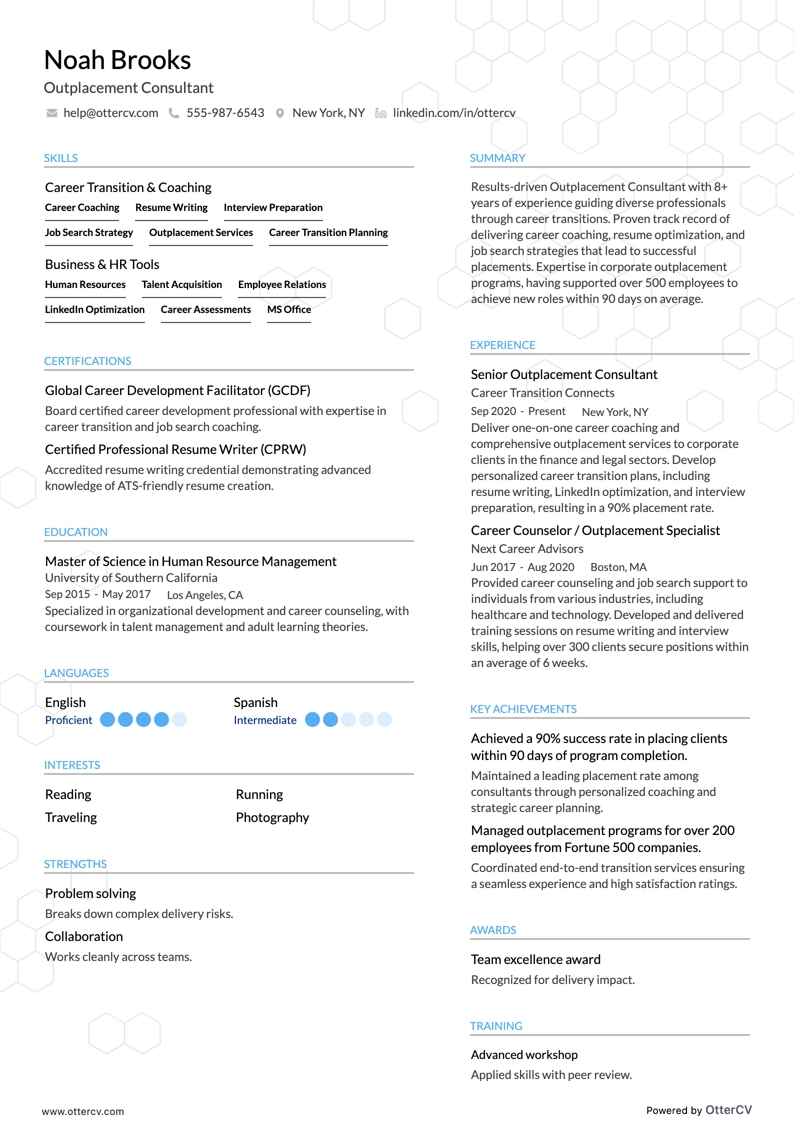
Outplacement Consultant full preview

21 Career Change Resume Examples

OtterCV

Written by The OtterCV Team

Updated: 7/26/2023•8 min read

See all resume examples in this guide, or generate your own resume example with your personalized prompt

Outplacement Consultant resume example

Outplacement Consultant

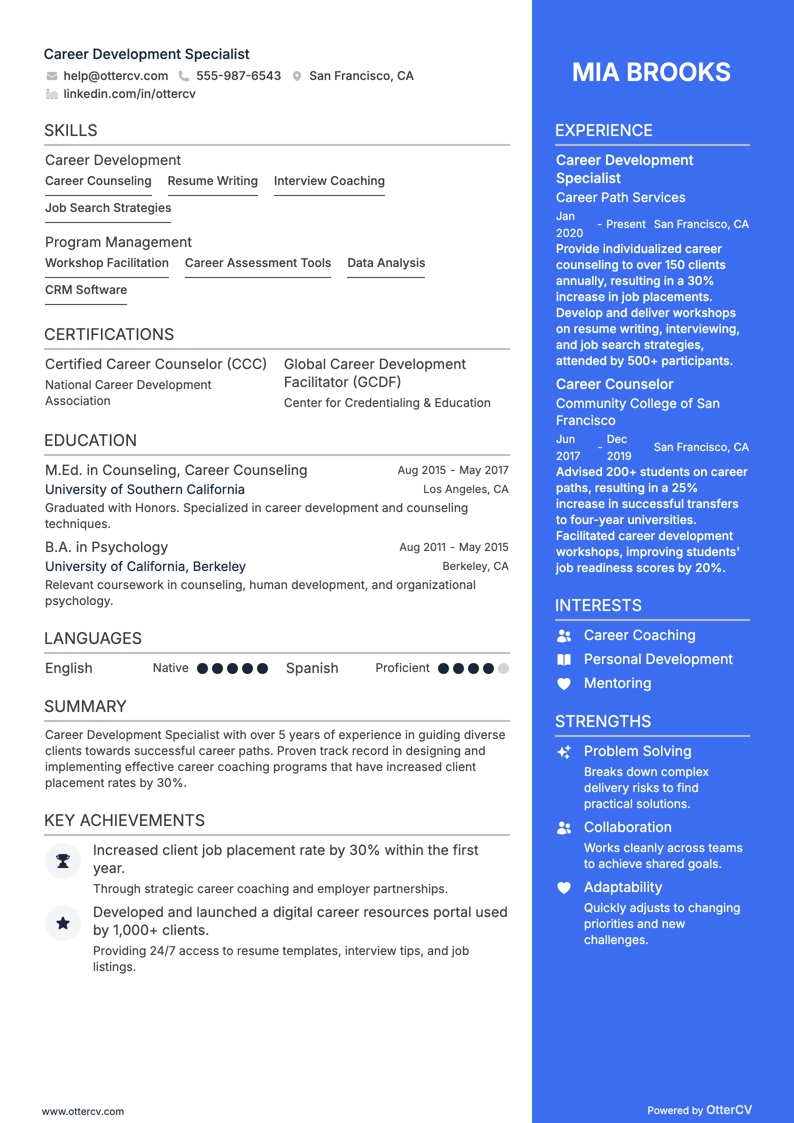
Career Development Specialist resume example

Career Development Specialist

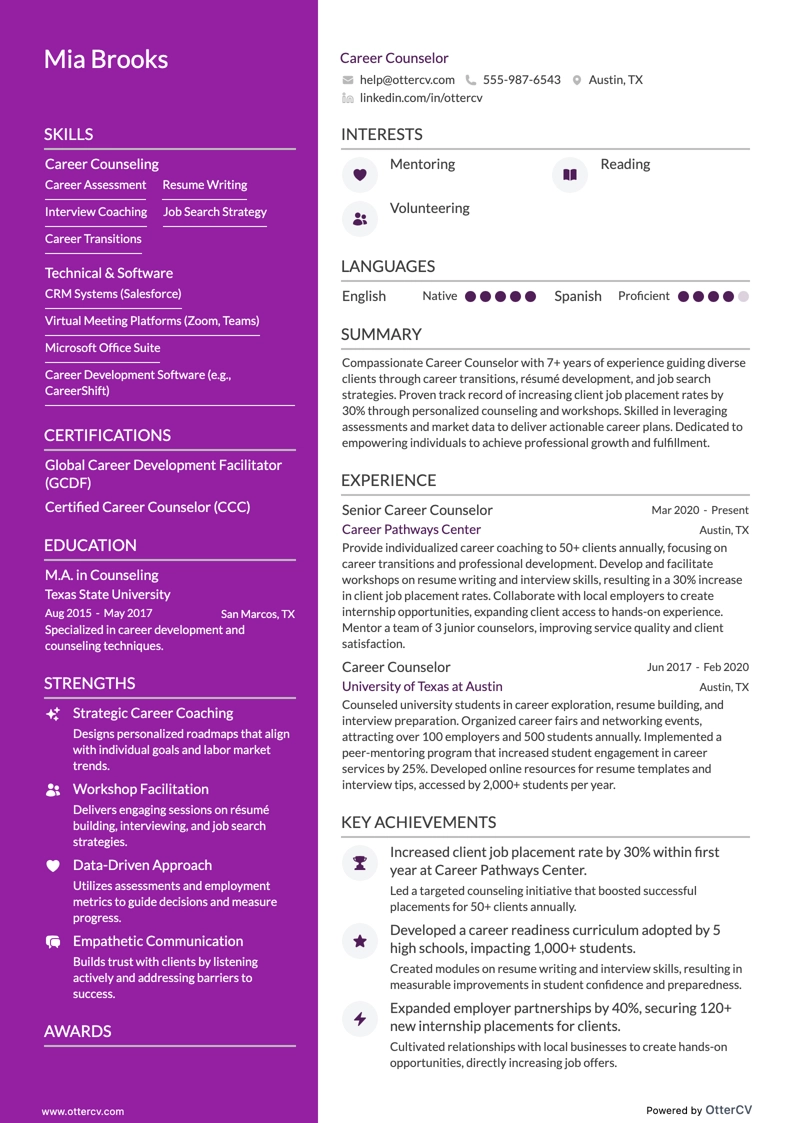
Career Counselor resume example

Career Counselor

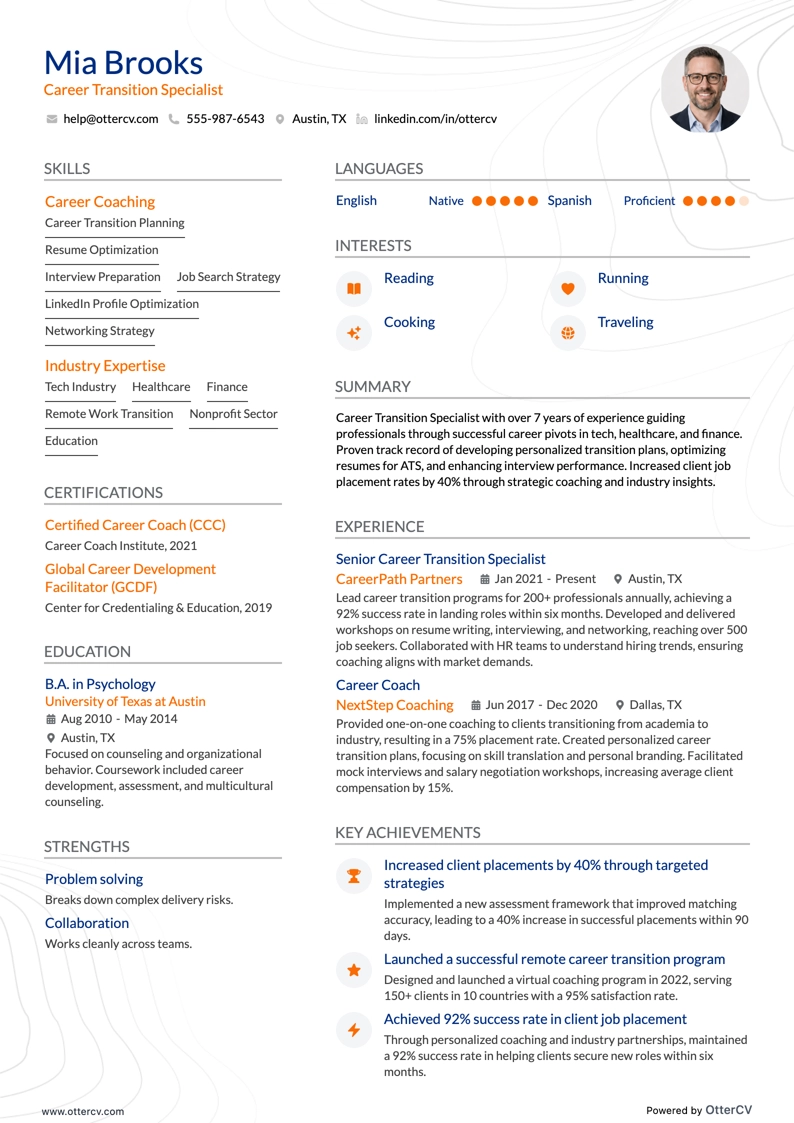
Career Transition Specialist resume example

Career Transition Specialist

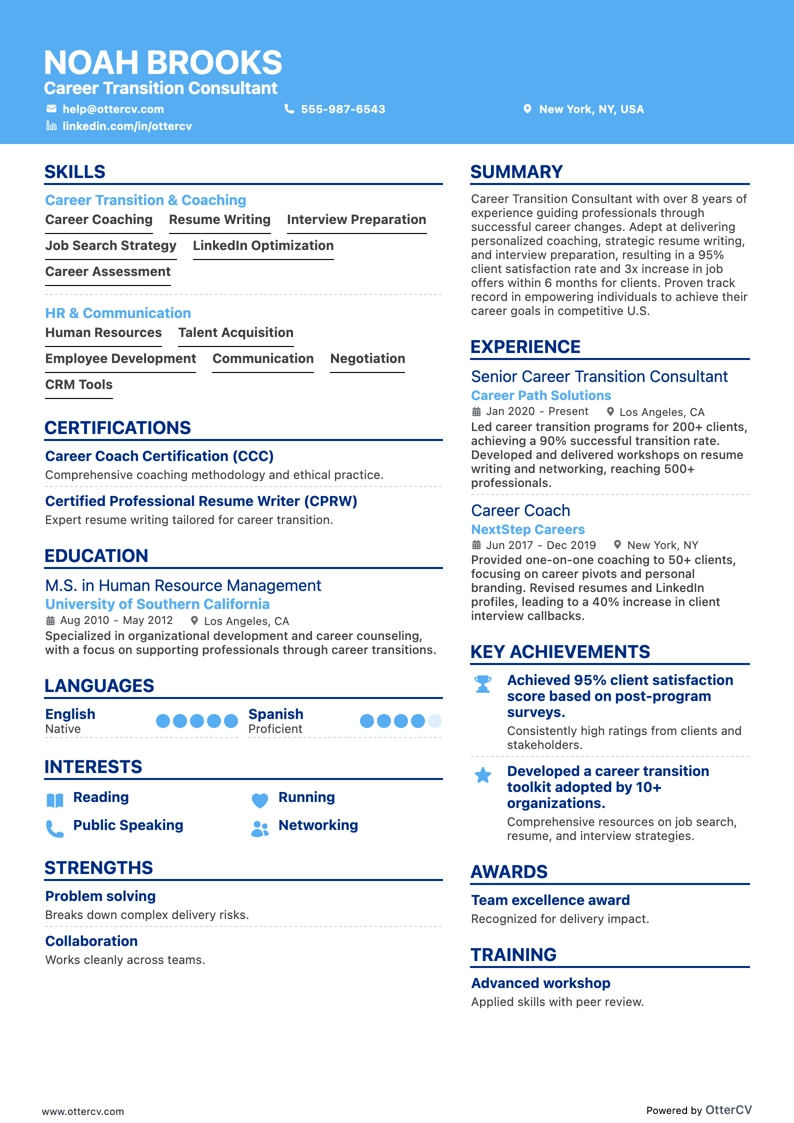
Career Transition Consultant resume example

Career Transition Consultant

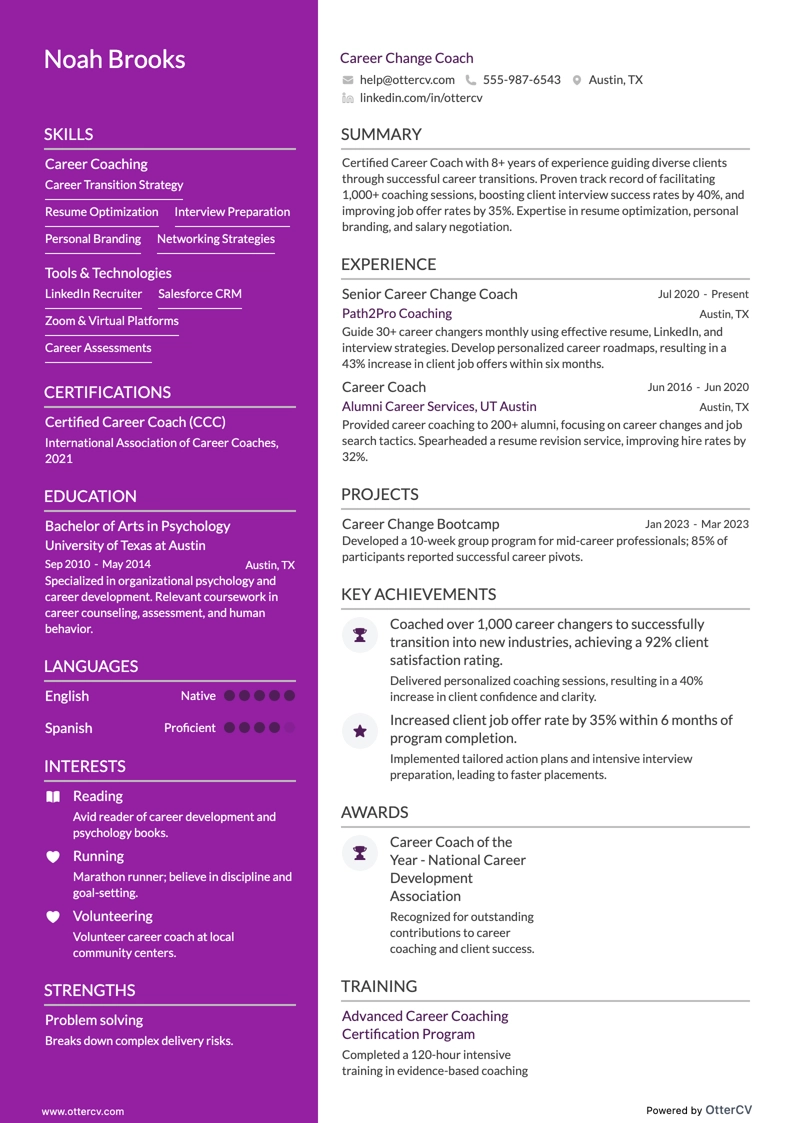
Career Change Coach resume example

Career Change Coach

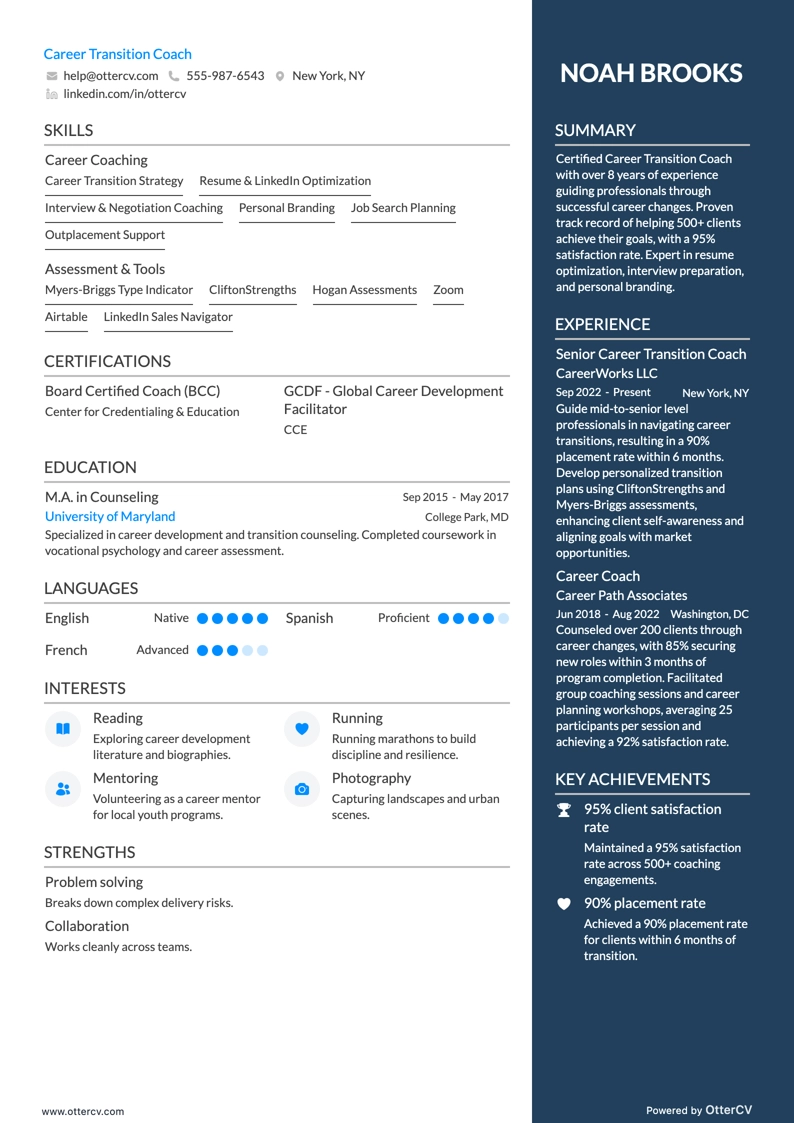
Career Transition Coach resume example

Career Transition Coach

A career change can be an exciting journey full of growth and discovery. Whether you're moving from healthcare to graphic design, from education to IT, or from hospitality to digital marketing, reinventing your professional path is both rewarding and challenging. Creating a resume that reflects your unique mix of skills and experience is a key step toward landing your dream job in a new field.

As you make this transition, focus on the transferable skills that connect your past experience to your future career. Emphasizing your adaptability, problem-solving abilities, and commitment to lifelong learning can help your resume stand out, even if your direct experience in the new field is still limited. The goal is to present yourself as a capable candidate who is ready to take on new challenges and contribute from day one.

A recent poll found that about half (52%) of American employees are considering a career change this year, and 44% are already planning to make the switch.

Changing careers can feel daunting, especially when you are trying to connect your past experience to new professional goals. But your unique path is an asset. A diverse background offers a fresh perspective that can help set you apart from other candidates. Embrace your career-change story with confidence and show how your journey has given you a rare and valuable mix of skills.

You may face doubts or obstacles along the way, from learning new industry terminology to building specific technical skills. Still, with persistence, a willingness to learn, and a strategic resume, you are not simply changing jobs—you are moving toward a future full of possibility. Let your resume reflect your journey and invite employers to be part of your next chapter. Every skill you have gained and every challenge you have overcome has prepared you for this moment. Now is the time to take the leap into your new adventure with confidence.

Making a big life change is scary. But do you know what’s even scarier? Regret.

—Zig Ziglar

Looking for more information about changing careers? These additional resources may help:

How to format a career change resume

The most effective way to format a career change resume is to use a combination, or hybrid resume format, rather than a reverse-chronological or functional format. This structure lets you present your transferable skills and competencies first, followed by your employment history in reverse chronological order.

Here’s why this format works well for career changers:

  • Highlights transferable skills: Begin with a strong summary or objective statement that explains your career change goal and value proposition. Then add a skills section featuring transferable skills relevant to your target field. This helps your most applicable abilities stand out right away.
  • Demonstrates relevant experience: After the skills section, include a "Relevant Experience" section to list any direct experience, projects, or roles, including volunteer work, that support your new career path, even if they were not part of your primary job duties.
  • Includes professional experience: Follow with your professional experience in reverse chronological order, emphasizing achievements and responsibilities that show skills relevant to the new field. Use bullet points to quantify achievements and show how your work contributed to organizational goals.
  • Education and continuous learning: Clearly present your educational background along with any certifications or courses relevant to your new career. This shows commitment to building the skills needed for the transition.
  • Custom sections for extra impact: Depending on your situation, you may also add sections for projects, certifications, or professional affiliations related to your new field. These can further show your interest in and engagement with the industry.

Keep in mind that resume standards vary by market. For example, a Canadian resume layout may differ.

PRO TIP

Remember to tailor your resume for each job application by emphasizing the skills and experience most relevant to the job description.

Combined with a hybrid format, this targeted approach can make your career change look not just plausible, but advantageous to potential employers.

It’s not all smooth sailing, though.

The biggest challenges facing individuals making a career change resume

Many career changers run into similar obstacles when building a resume for a new role in a new field. Before we look at how to solve them, here are the most common challenges:

  • Writing a compelling career objective: A career change often requires a new objective or personal statement at the top of the resume. The challenge is making it convincing and relevant to prospective employers.
  • Translating skills and experiences to fit the new industry: Many skills from one profession can transfer to another. The difficulty is presenting those skills in a way that hiring managers in the new industry will understand and value.
  • Understanding industry jargon: Different professions use different vocabulary. A career change may introduce unfamiliar terms, tools, or protocols, making it harder to create a resume that speaks to the specific needs of the industry.
  • Using relevant job posting websites: Every industry has its own job boards. If you are moving from tech to finance, for example, platforms like Dice or TechCrunch may be less relevant than eFinancialCareers or Wall Street Oasis.
  • Identifying relevant further training or certification programs: Depending on the industry you are entering, you may need to highlight qualifications or certifications that show your commitment and eligibility.

Here are the most important sections to focus on while crafting your next resume.

The top sections on a career change resume

  • Objective or professional summary: Explain your career direction and how it aligns with the role.
  • Skills: Show the capabilities and proficiencies that support your new career path.
  • Relevant training and certifications: Include training you’ve completed or certifications you’ve earned to demonstrate you’re building the skills needed for the job.
  • Transferable experience: Highlight past experience that applies to the new role and shows relevant background.
  • List of references: Add references so recruiters can verify your skills and capabilities.

It’s not just about format—it’s about content, too. Throughout your resume, aim to communicate and demonstrate the following elements.

What recruiters want to see on your resume

  • Relevant skills: Recruiters prioritize the skills that show you can handle the role you are moving into.
  • Transferable skills: They also look for experience and strengths from past roles that can apply to the new position.
  • Willingness to learn: Showing this highlights initiative and motivation, which matter when changing careers.
  • Networking connections: Connections in the new field can suggest a smoother transition.
  • Career change rationale: Your reasons for changing careers help demonstrate your commitment to the new path.

How to write your career change resume experience

This can be the trickiest section for anyone changing careers. When writing the work experience section on a career change resume, focus on transferable skills that align with the new role.

Unlike a regular resume, you need to:

  • Show how your past experience, even in different industries, gave you skills that apply to the new job.
  • Highlight achievements and responsibilities that demonstrate universal strengths such as leadership, problem-solving, and communication.
  • Use action verbs and quantify achievements to show impact.
  • Tailor each entry to show how your background supports the new field, making the connection between past roles and future career goals clear and compelling.

Let’s look at one possible experience entry and how to position it for a career change.

Experience

Customer Service Manager

ABC Electronics

02/2015 - 11/2019 | Newport, OR

  • Led a team of 10 and increased productivity by 25% through strategic leadership and effective communication.
  • Implemented a customer feedback system that reduced response times by 30%, improving efficiency through strong problem-solving.
  • Led cross-functional training programs that improved team adaptability and technical knowledge.
  • Negotiated with suppliers to reduce costs by 15%, demonstrating strong negotiation and financial management skills.
RIGHT

Even if your previous job title is not directly related to the role you want, the skills can still be highly relevant. Focus on transferable strengths such as leadership, efficiency, problem-solving, and financial savvy.

How to quantify impact on your resume

On a career change resume, quantifying impact means highlighting accomplishments that show transferable skills and relevance to a new field. As with a traditional resume, use measurable results, but place extra emphasis on universality and adaptability.

Here’s how:

  • Use numbers and percentages: Include data and metrics to show your achievements, such as “Increased sales by 20%” or “Reduced customer complaints by 30%.”
  • Emphasize transferable outcomes: Choose metrics that reflect results valued in your target field. For example, if you are moving into project management, highlight organization, leadership, and efficiency with examples like “Managed a team of 5” or “Completed projects 10% under budget.”
  • Highlight efficiency improvements: Show how you improved processes or saved time or money, since these are widely valued skills. For example, “Streamlined inventory management, saving 5 hours weekly.”
  • Focus on problem-solving: Quantify how you identified and resolved issues, such as “Resolved a recurring issue, improving customer satisfaction by 25%.”

The key is to make sure your achievements not only show success in past roles but also align with the priorities and values of your new industry, demonstrating your potential even without direct experience.

How to list your hard and soft skills on your resume

In the skills section of your resume, prioritize transferable skills. List hard skills relevant to the new field first, then include soft skills that show adaptability and potential. Unlike a standard resume, emphasize how each skill applies to the new industry, even if you developed it in a different context.

Hard skills are technical abilities or knowledge learned through education or training and are specific to a job, such as software proficiency.
Examples of transferable hard skills for a career change resume

  • Technical proficiency: Skills in software and applications used across industries, such as Microsoft Office, Adobe Creative Suite, or programming languages.
  • Data analysis: The ability to collect, analyze, and interpret data using tools like Excel, SPSS, or Google Analytics.
  • Project management: Experience with methodologies and tools such as Agile, Scrum, Trello, or Asana.
  • Foreign languages: Proficiency in additional languages can be a valuable asset in many fields.
  • Financial literacy: Skills in budgeting, financial forecasting, and using financial software.
  • Digital marketing: Knowledge of SEO, content marketing, social media marketing, and platforms like Google Ads or Facebook Business Manager.
  • Technical writing: The ability to create clear, concise, and useful documentation and reports.

Soft skills are interpersonal attributes and traits that affect how well you work or interact with others, such as communication and teamwork.

Examples of transferable soft skills for a career change resume

  • Communication: Effective verbal and written communication.
  • Problem-solving: The ability to identify problems and find effective solutions.
  • Adaptability: The ability to adjust to new environments and challenges.
  • Teamwork: Working well with others toward a common goal.
  • Team leadership: The ability to lead and motivate others.
  • Time management: Managing time efficiently to meet deadlines.
  • Emotional intelligence: Understanding and managing your emotions and those of others.
  • Critical thinking: Analyzing information and making reasoned decisions.
  • Creative thinking: Generating innovative ideas and solutions.
  • Interpersonal skills: Building and maintaining strong work relationships.

How to list your certifications and education on your resume

Properly listing certifications and education on your resume is especially important for career changers.

On a traditional resume, education and certifications support work experience that already aligns with the role. For career changers, these sections play a bigger role by highlighting transferable skills and new knowledge that support the move into a different field.

When presented strategically, your certifications and education can help bridge the gap between your previous career and your target path, making it easier for employers to understand how your background supports a successful transition.

Here’s what to keep in mind:

  • Prioritize relevance: Place the most relevant education and certifications near the top of your resume. If you have completed courses or earned certifications specifically for your new career, list those first.
  • Include details: For each certification or course, include the certification or course name, the issuing organization, and the completion or expiration date. For education, include your degree, field of study, and institution.
  • Explain relevance: Briefly note how specific certifications or parts of your education relate to the new field, especially when the connection is not immediately obvious. You can do this with a short bullet point or a parenthetical note.

Next, it’s time to look at one of the most important parts of a career-change resume: the resume profile.

How to write your career change resume summary or objective

The resume summary or objective statement is crucial on a career-change resume because it quickly clarifies your intent to switch fields while highlighting your transferable skills and motivation.

A resume summary highlights your most relevant achievements, skills, and experience for the job, and is typically best suited for experienced professionals. An objective statement explains your career goals and what you hope to accomplish in the role. It is often used by recent graduates or people changing careers, with a focus on how they can contribute to the employer.

When changing careers, write a strong objective statement that clearly explains your career goals, why you are making the transition, and how your current skills and experience relate to the new field.

Include specific details about your professional background, show your willingness to learn, and mention any relevant skills or training you have completed to prepare for the change. This helps personalize your application and shows your commitment to your new career path.

Below is an example of an effective objective statement that does exactly that.

Summary

Passionate professional with 5+ years in the healthcare sector seeking to bring extensive project management and communication experience to a project coordinator role in the tech industry. Eager to apply transferable skills to support successful project outcomes and foster team collaboration in a dynamic new setting.

RIGHT

This is what’s done right

  • Clear transition: It clearly explains the move from healthcare to tech, helping the employer follow the career change narrative.
  • Highlights transferable skills: It emphasizes skills such as project management and communication that are valuable in both fields.
  • Demonstrates enthusiasm: It shows eagerness to contribute to the new field, which can appeal to potential employers.
  • Focuses on contribution: It emphasizes how the candidate can benefit the new industry, rather than only what they hope to gain.

PRO TIP

Tailor your objective statement to the specific job and industry you’re targeting by incorporating keywords from the job description. This shows genuine interest in the role and can also help your resume pass through Applicant Tracking Systems (ATS), making it more likely to reach the hiring manager.

Key takeaways

  • Focusing on transferable skills is essential in a career change resume.

  • A combination or hybrid resume format is often the most effective choice for career changers because it puts transferable skills and relevant experience first.

  • Including a clear objective statement helps explain your career change goals and how your past experience connects to new roles.

  • Common challenges include translating your skills for a new industry, understanding industry jargon, using industry-specific job boards, and identifying relevant training.

  • It is important to demonstrate relevant skills, related experience, a willingness to learn, and useful networking connections.

  • Hard skills, such as technical proficiency, and soft skills, such as communication, are equally valuable in a new career.

  • Education and certifications should be listed with the new field in mind to show commitment to a successful transition.

Career Change resume examples

Explore additional Career Change resume samples and guides and see what works for your level of experience or role.

By Role

Outplacement Consultant

Outplacement Consultant resume preview

Career Development Specialist

Career Development Specialist resume preview

Career Counselor

Career Counselor resume preview

Career Transition Specialist

Career Transition Specialist resume preview

Career Transition Consultant

Career Transition Consultant resume preview

Career Change Coach

Career Change Coach resume preview

Career Transition Coach

Career Transition Coach resume preview