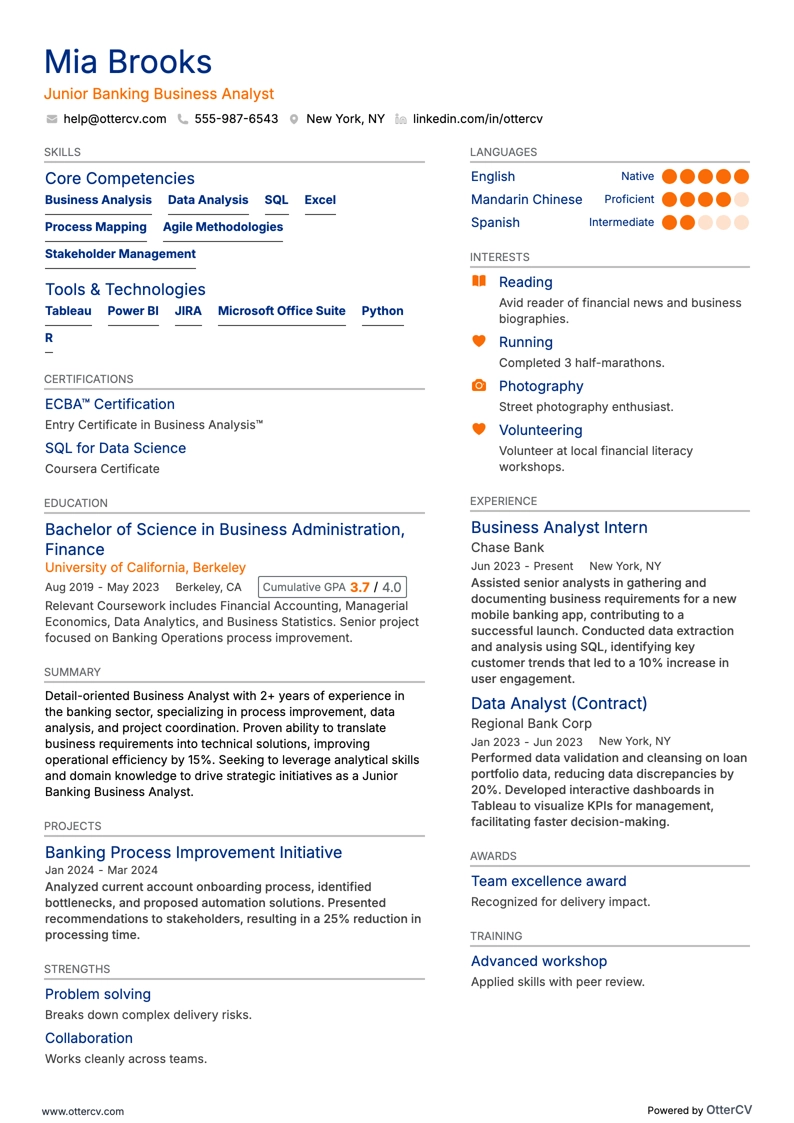
Junior Banking Business Analyst full preview

10 Banking Business Analyst Resume Examples

OtterCV

Written by The OtterCV Team

Updated: 8/11/2023•8 min read

See all resume examples in this guide, or generate your own resume example with your personalized prompt

Junior Banking Business Analyst resume example

Junior Banking Business Analyst

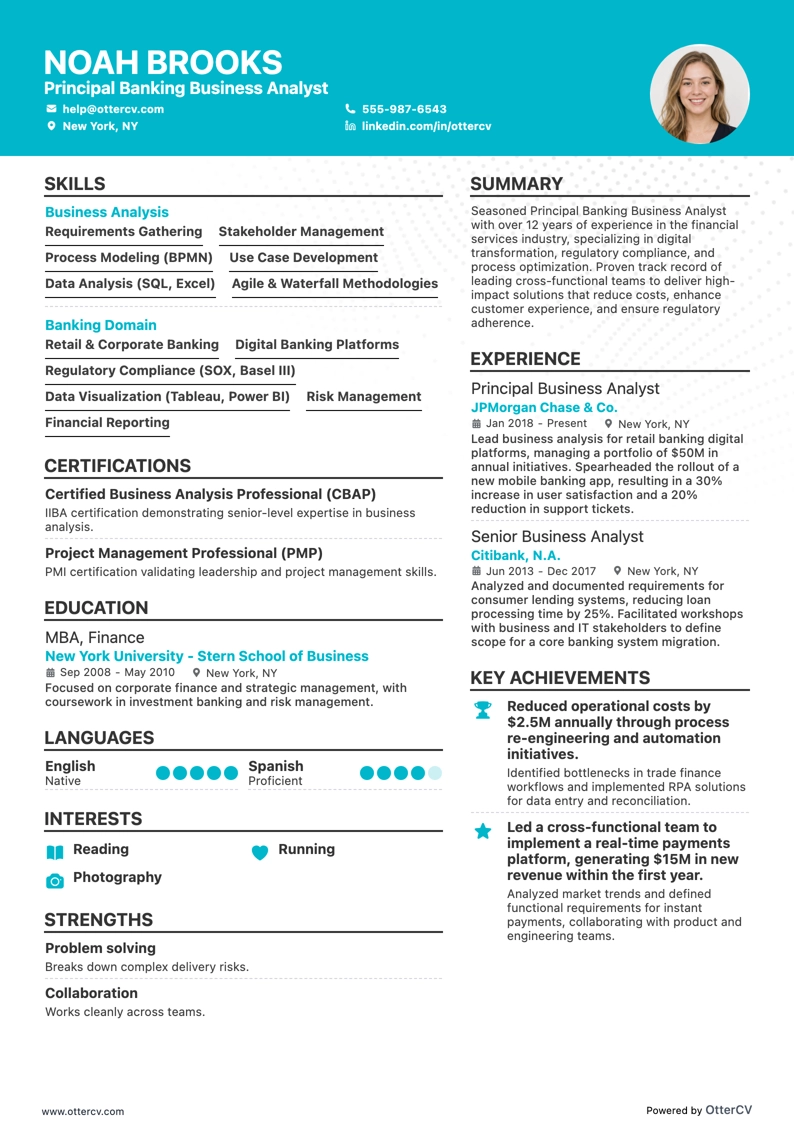
Principal Banking Business Analyst resume example

Principal Banking Business Analyst

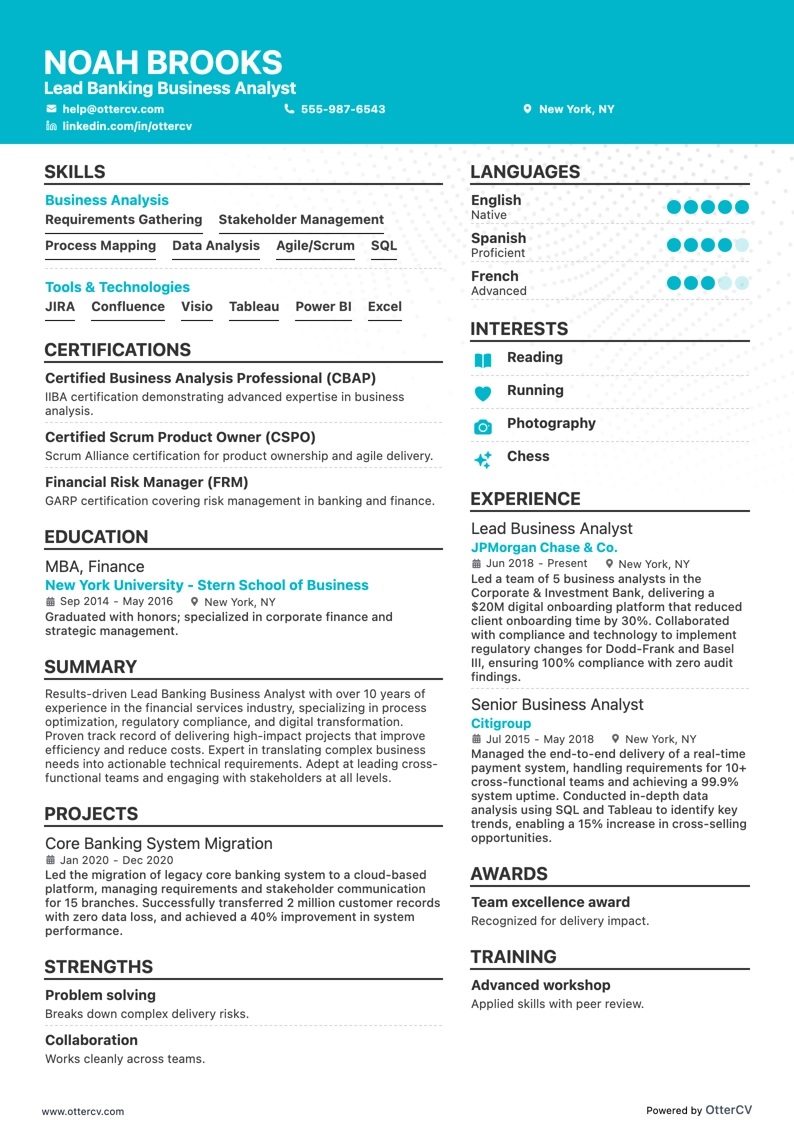
Lead Banking Business Analyst resume example

Lead Banking Business Analyst

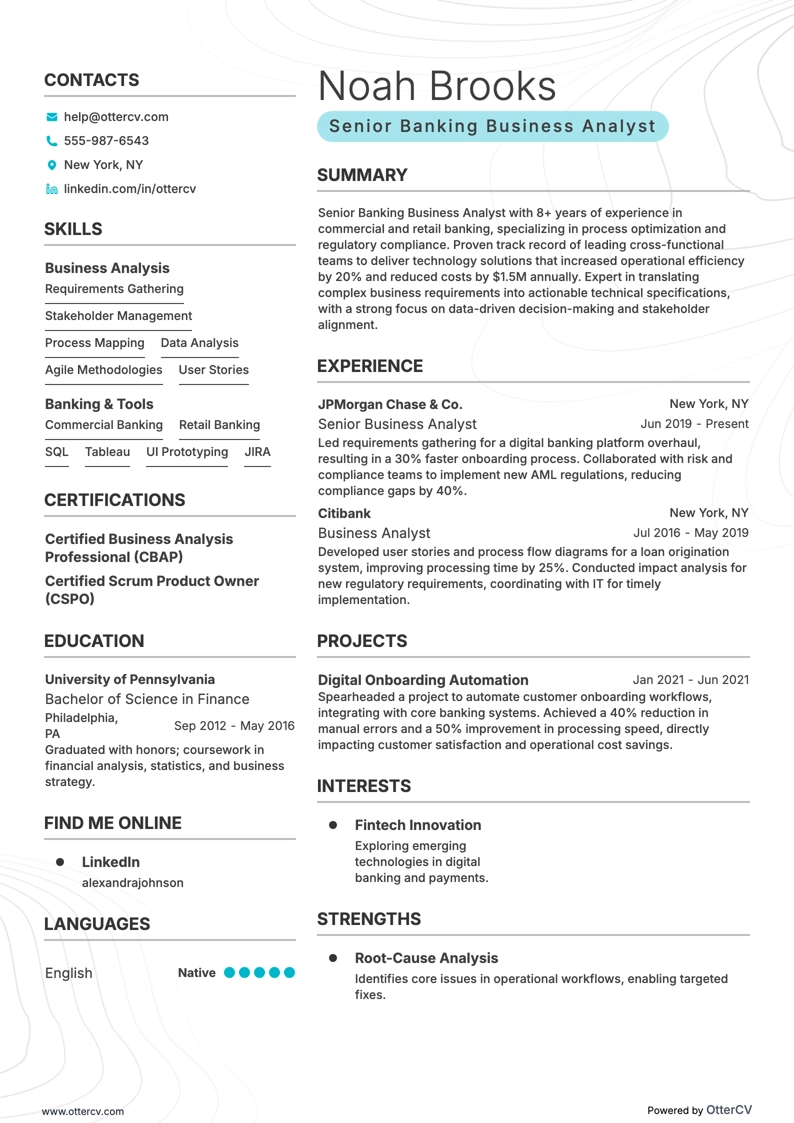
Senior Banking Business Analyst resume example

Senior Banking Business Analyst

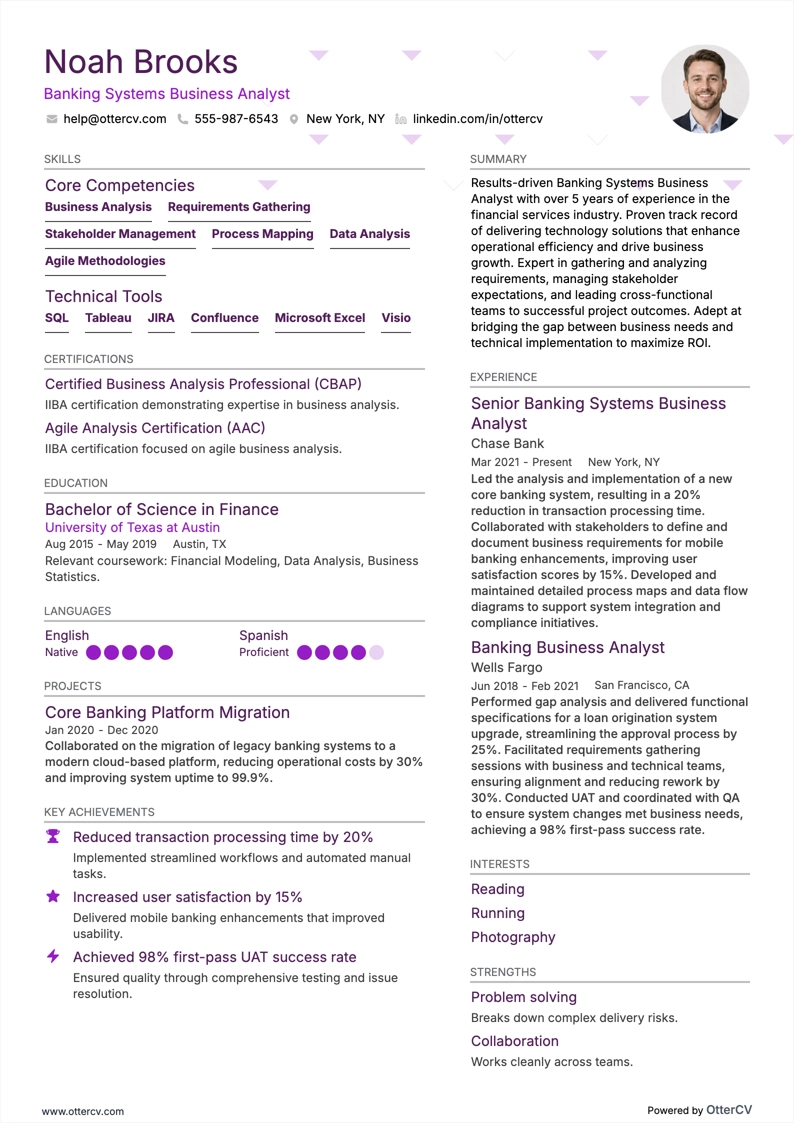
Banking Systems Business Analyst resume example

Banking Systems Business Analyst

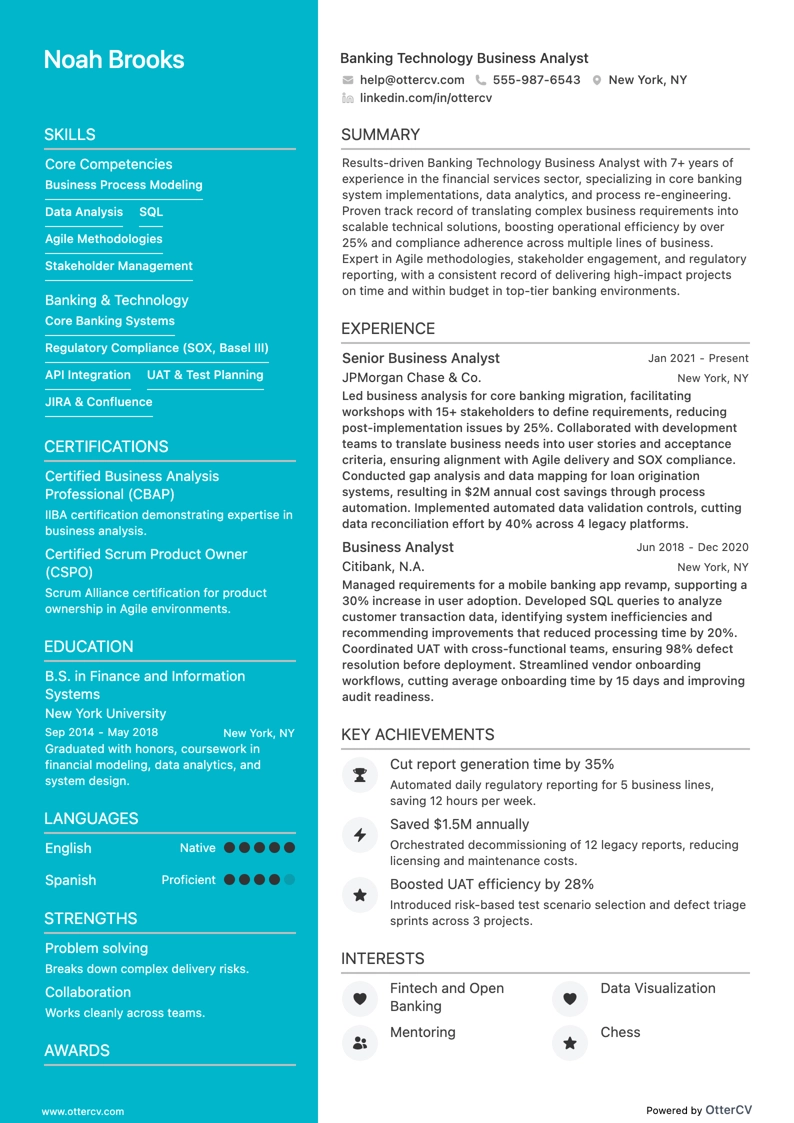
Banking Technology Business Analyst resume example

Banking Technology Business Analyst

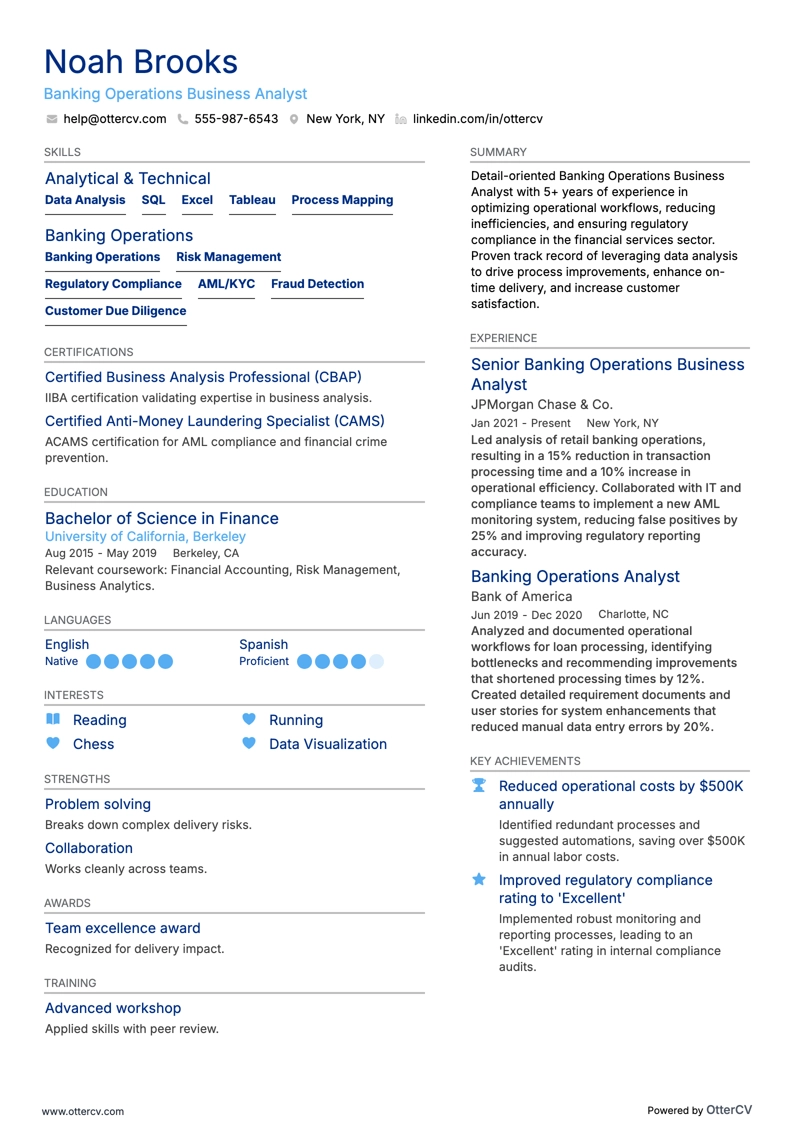
Banking Operations Business Analyst resume example

Banking Operations Business Analyst

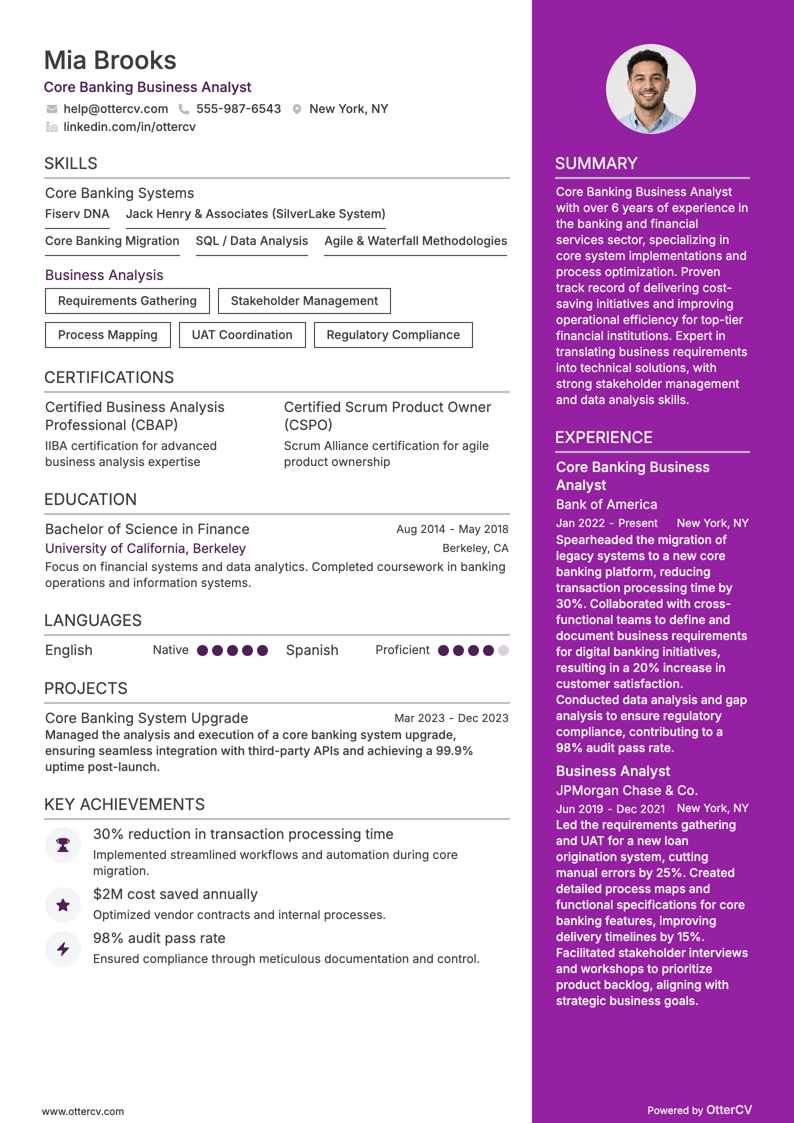
Core Banking Business Analyst resume example

Core Banking Business Analyst

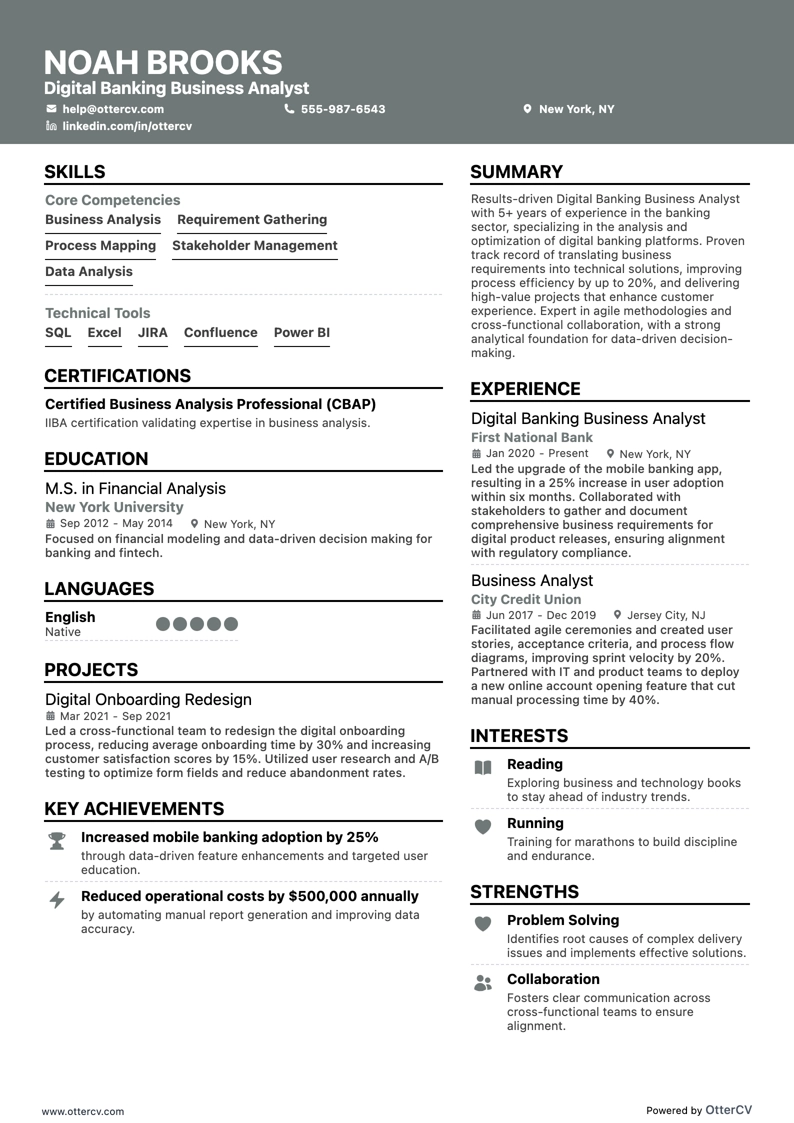
Digital Banking Business Analyst resume example

Digital Banking Business Analyst

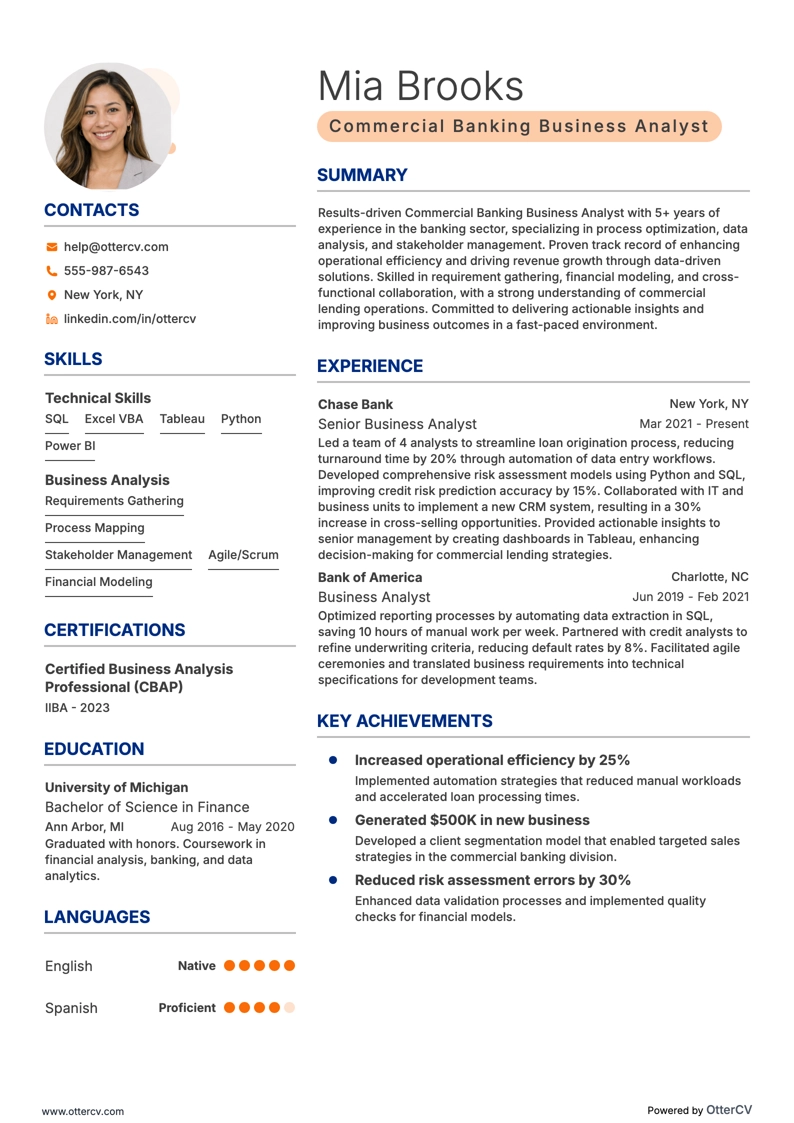
Commercial Banking Business Analyst resume example

Commercial Banking Business Analyst

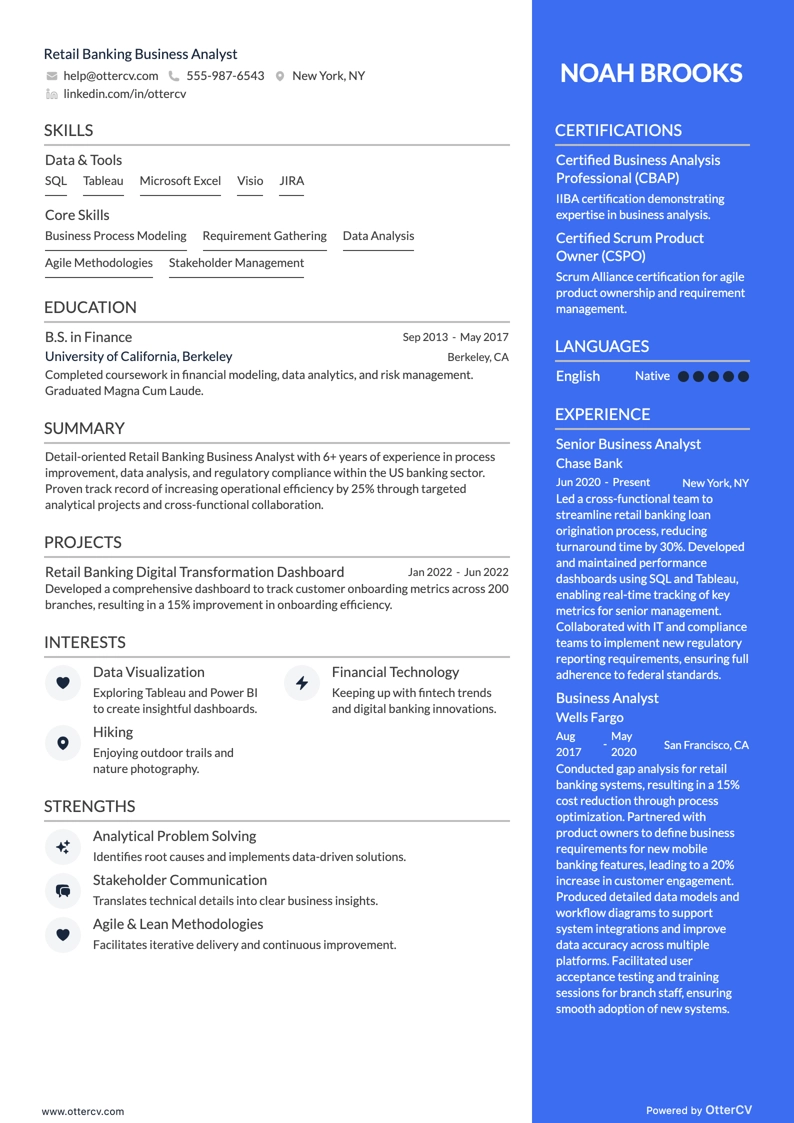
Retail Banking Business Analyst resume example

Retail Banking Business Analyst

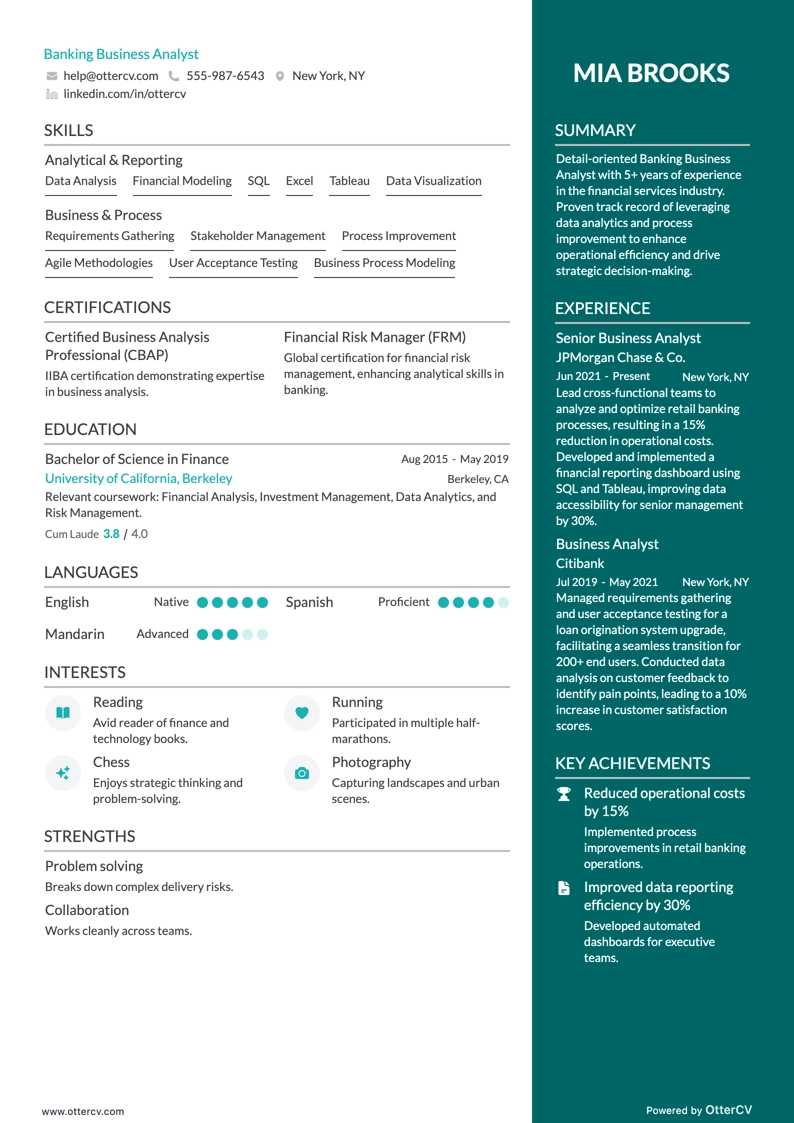
Banking Business Analyst resume example

Banking Business Analyst

Many banking business analyst resumes fail because they read like task logs and bury risk, controls, and measurable impact. That weakens performance when an ATS scans for keywords quickly and recruiters review applications in seconds. Competition remains high, even for strong candidates.

A strong resume emphasizes outcomes tied to business value and regulated delivery. Knowing how to make your resume stand out means highlighting quantified savings, reduced fraud loss, improved reconciliation accuracy, faster cycle times, cleaner audit results, and adoption across branches. Show the scope, the stakeholders involved, and what changed.

Key takeaways

  • Quantify major achievements with metrics such as cost savings, cycle time, or error reduction.

  • Tailor experience bullets to each job posting’s tools, terminology, and success metrics.

  • Use a reverse-chronological format if you have experience, or a hybrid format if you are changing careers.

  • Show ownership, execution approach, and business outcomes in each role entry.

  • Support every listed skill with a specific action and measurable result from your experience.

  • Write a three-to-four-line summary that highlights your domain focus, core tools, and top achievement.

  • Use Echocv’s tools to turn vague duties into focused, recruiter-ready resume bullets.

How to format a banking business analyst resume

Recruiters hiring banking business analysts look for financial services domain knowledge, proficiency with data analysis and requirements-gathering tools, and a clear track record of measurable process or system improvements. Choosing the right resume format helps these qualifications stand out quickly in both ATS parsing and the initial six-to-ten-second recruiter scan.

I have significant experience in this role—which format should I use?

I have significant experience in this role—which format should I use?

Use a reverse-chronological format to present your banking business analyst experience in a clear, progression-driven timeline.

  • Lead each role entry with your scope of ownership, such as the number of stakeholders managed, business lines supported, or project budgets influenced.
  • Highlight domain-specific tools and skills such as SQL, Tableau, JIRA, UAT coordination, BRD/FRD documentation, and regulatory frameworks like Basel III or AML/KYC.
  • Quantify outcomes tied to efficiency gains, cost reductions, risk mitigation, or revenue impact for every major initiative.

Example bullet: “Mapped end-to-end loan origination workflows across three business units, identifying 12 process gaps that led to a $1.4M annual reduction in operational losses after system redesign.”

I'm junior or switching into this role—what format works best?

I'm junior or switching into this role—what format works best?

A hybrid resume format works best. It lets you lead with a targeted skills section while still showing concrete work experience, internships, or projects underneath.

Do the following:

  • Place a skills section near the top of your resume with banking-relevant competencies such as requirements elicitation, data modeling, process mapping, and familiarity with core banking platforms.
  • Include academic projects, internships, or cross-functional work that shows analytical rigor in financial or regulated environments.
  • Connect every listed skill to a specific action and a measurable or observable result.

Example scaffold: SQL (skill) → built automated reconciliation queries for daily transaction reporting (action) → reduced manual review time by 35% during a capstone banking simulation project (result).

Why not use a functional resume?

Why not use a functional resume?

A functional resume removes the timeline and context recruiters need to verify where, when, and how you used your banking analysis skills, which makes it harder for them to judge your readiness for the role.

  • This format may be acceptable if you are changing careers from a related field, such as financial operations or IT analysis, have limited formal work history, or need to address resume gaps—but only if each skill is tied to a specific project, deliverable, or outcome instead of being listed as a standalone claim.

What sections should go on a banking business analyst resume

Once your layout and structure are in place, the next step is filling your resume with the right sections to present your qualifications clearly.

Recruiters expect a clean, business-focused resume that shows you can translate banking requirements into measurable outcomes. Understanding what to put on a resume is especially important for banking business analysts who need to balance technical depth with business impact.

Use this structure for maximum clarity:

  • Header
  • Summary
  • Experience
  • Skills
  • Projects
  • Education
  • Certifications
  • Optional sections: Awards, Leadership, Languages

Your experience bullet points should highlight business impact, quantified results, stakeholder scope, and the banking processes, products, and regulatory constraints you improved.

Now that you’ve organized the key parts of your resume, the next step is to write your banking business analyst resume experience section so each role reinforces that structure with clear, relevant detail.

How to write your banking business analyst resume experience

Your work experience section should show the projects you delivered, the analytical tools and methodologies you used, and the measurable outcomes you achieved in banking environments. Hiring managers look for demonstrated impact—clear results tied to business goals—rather than task lists that only describe day-to-day responsibilities.

Each entry should include:

  • Job title
  • Company and location, or remote
  • Dates of employment, including month and year

Add three to five concise bullet points that explain what you owned, how you executed the work, and what outcomes you delivered.

  • Ownership scope: the banking products, regulatory domains, data systems, or cross-functional initiatives you were directly responsible for, such as lending platforms, risk reporting, compliance workflows, or core banking migrations.
  • Execution approach: the requirements-gathering frameworks, data analysis tools, modeling techniques, or documentation standards you used to turn stakeholder needs into actionable specifications and informed decisions.
  • Collaboration context: how you worked with technology teams, risk officers, compliance units, operations groups, or external vendors to align business requirements with technical delivery across the banking organization.
  • Value improved: the performance areas you strengthened, including process efficiency, data accuracy, regulatory adherence, report reliability, turnaround time, or risk exposure within banking operations.
  • Impact delivered: the business outcomes your work produced, expressed through results and scale rather than activity, such as revenue protected, costs reduced, processes streamlined, or launches completed that advanced the bank's strategic priorities.

Experience bullet formula

Experience bullet formula

Action verb + technology + what you built or fixed + measurable result

A banking business analyst experience example

Senior Business Analyst, Digital Banking

HarborPoint Bank | Charlotte, NC

2021–Present

Regional bank serving 1.2M customers, focused on mobile-first retail banking and risk-managed growth.

  • Led requirements discovery and user story mapping in Jira and Confluence for a mobile deposit redesign, partnering with product managers, designers, and engineers to reduce deposit failures by 28% and average time-to-funds by 14%.
  • Built SQL and Power BI dashboards to track the onboarding funnel, Know Your Customer (KYC) completion, and fraud flags, surfacing root causes that improved account-opening conversion by 9% and reduced manual review volume by 17%.
  • Facilitated workshops with compliance, risk, and operations to turn regulatory and policy changes into acceptance criteria and test scenarios, lowering audit findings from six to one across two quarterly reviews.
  • Authored end-to-end process maps and swimlanes in Visio and BPMN for dispute and chargeback workflows, aligning stakeholders on target-state changes that shortened case cycle time from nine days to six days and improved first-contact resolution by 11%.
  • Coordinated user acceptance testing in Azure DevOps, creating traceability matrices and defect triage routines with quality assurance and engineering; increased release pass rate from 92% to 98% and cut production hotfixes by 35%.

Now that you’ve seen what a strong experience section looks like in practice, here’s how to adapt yours for the specific banking business analyst role you’re targeting.

How to tailor your banking business analyst resume experience

Recruiters review your banking business analyst resume through both human screening and applicant tracking systems (ATS). Tailoring your resume to the job description helps your qualifications stand out to both.

Ways to tailor your banking business analyst experience:

  • Mirror the exact tools and platforms listed in the job description.
  • Match the terminology used for methodologies such as Agile or Waterfall.
  • Reflect the specific KPIs or success metrics the employer prioritizes.
  • Highlight regulatory compliance experience when the role requires it.
  • Include relevant banking domain knowledge, such as lending or treasury operations.
  • Align your workflow descriptions with the collaboration models mentioned in the posting.
  • Emphasize data analysis techniques or SQL skills if the job specifically asks for them.
  • Reference risk assessment or audit support experience when it is listed as essential.

Tailoring means aligning your real accomplishments with the employer’s requirements, not forcing in keywords that don’t belong.

Resume tailoring examples for banking business analyst

Job description excerptUntailoredTailored
Gather and document business requirements for core banking system migrations, working with stakeholders across retail and commercial banking divisionsGathered requirements from stakeholders and created documentation for various projects.Gathered and documented business requirements for a core banking system migration across retail and commercial banking divisions, facilitating 30+ stakeholder sessions to align functional specifications with platform capabilities.
Perform data analysis using SQL and Tableau to identify trends in loan portfolio performance and support credit risk reportingAnalyzed data and created reports for management review.Queried loan portfolio data using SQL and built Tableau dashboards that tracked delinquency trends, prepayment rates, and concentration risk, reducing credit risk reporting turnaround by 40%.
Lead UAT efforts for regulatory reporting enhancements to ensure compliance with Basel III and CECL standardsParticipated in testing activities and helped ensure project deliverables met quality standards.Led UAT for regulatory reporting enhancements aligned with Basel III capital adequacy and CECL expected credit loss standards, coordinating 15 test cycles and resolving 95% of defects before production release.

Once you’ve aligned your experience with the role’s priorities, the next step is to quantify your banking business analyst achievements so hiring managers can quickly see the impact behind those choices.

How to quantify your banking business analyst achievements

Quantifying your achievements shows business impact and helps de-risk your claims. Focus on cycle time, defect leakage, compliance outcomes, revenue lift, and operational cost, along with volumes, scope, and delivery speed across systems, teams, and releases.

Quantifying examples for banking business analyst

MetricExample
Cycle timeCut loan-origination requirements cycle time from 15 to nine business days by standardizing user stories in Jira and tightening sign-off criteria with underwriting.
QualityReduced post-release defects by 32% by adding acceptance criteria, SQL-based data validations, and a UAT defect triage workflow across three scrum teams.
Compliance riskClosed eight audit findings in six weeks by mapping controls to requirements, updating traceability in Confluence, and validating evidence with compliance and internal audit.
Cost savingsSaved $420K annually by identifying duplicate KYC checks, redesigning the workflow, and eliminating two vendor API calls per application across 180K yearly applications.
Delivery speedDelivered a core-banking fee-rule update two sprints early by aligning stakeholders, clarifying edge cases, and coordinating regression testing across five downstream systems.

Once you’ve written strong, impact-focused bullet points for your experience section, present your hard and soft skills strategically to give recruiters a fuller view of your qualifications.

How to list your hard and soft skills on a banking business analyst resume

Skills matter because banking business analysts must turn business needs into compliant, data-backed solutions. Recruiters and applicant tracking systems (ATS) also scan your skills section to confirm fit, usually looking for a balance of hard skills and role-specific soft skills.

Banking business analyst roles require a mix of:

  • Product strategy and discovery skills
  • Data, analytics, and experimentation skills
  • Delivery, execution, and go-to-market discipline
  • Soft skills

Your skills section should be:

  • Scannable, using bullet-style grouping
  • Relevant to the job posting
  • Supported by proof in your experience bullets
  • Updated with current tools

Place your skills section:

  • Above your experience section if you’re junior or switching careers
  • Below your experience section if you’re mid-level or senior with strong achievements

Hard skills

  • Requirements elicitation and user story writing.
  • Business process mapping and BPMN.
  • SQL and data profiling.
  • Advanced Excel and Power Query.
  • Tableau and Power BI.
  • Data lineage and metadata management.
  • Core banking systems and payment rails.
  • AML and KYC requirements.
  • Regulatory reporting and audit readiness.
  • API integration using Swagger and Postman.
  • Jira and Confluence.
  • UAT planning and defect triage.

Soft skills

  • Translate risk into requirements.
  • Lead stakeholder workshops.
  • Align priorities across teams.
  • Challenge scope creep with data.
  • Write clear functional specs.
  • Present trade-offs to leaders.
  • Drive decisions under constraints.
  • Manage dependencies and handoffs.
  • Negotiate timelines and scope.
  • Own end-to-end delivery.
  • Communicate with compliance partners.
  • Escalate risks early and clearly.

How to show your banking business analyst skills in context

Skills should not appear only in a bulleted list on your resume. Review resume skills examples to see how strong candidates weave their competencies into the overall narrative.

Your skills should be demonstrated in:

  • Your summary, which defines your high-level professional identity
  • Your experience, which proves your skills through outcomes

Here is what strong, contextual use of skills looks like in practice.

Summary example

Senior banking business analyst with 10 years of experience in retail banking operations. Skilled in SQL, Tableau, and process reengineering. Led a cross-functional deposit platform migration that reduced transaction processing errors by 34% and saved $1.2M annually.

  • Clearly reflects senior-level experience
  • Names specific, relevant tools
  • Leads with a measurable outcome
  • Shows cross-functional collaboration

Experience example

Senior Business Analyst

Ridgeline Federal Credit Union | Charlotte, NC

March 2019–Present

  • Partnered with compliance and IT teams to redesign AML transaction monitoring workflows in SQL, reducing false-positive alerts by 41%.
  • Built Tableau dashboards to track mortgage pipeline KPIs, helping leadership cut average loan approval time from 18 to 11 days.
  • Facilitated requirements-gathering workshops with stakeholders across three departments, delivering a core banking system upgrade two weeks ahead of schedule.
  • Every bullet includes measurable proof.
  • Skills appear naturally within achievements.

Once you’ve connected your strengths to real banking outcomes and workflows, the next step is to use that same approach when building a banking business analyst resume with no experience.

How do I write a banking business analyst resume with no experience

Even without full-time experience, you can still show readiness through:

  • Bank process mapping class projects
  • Requirements gathering capstone deliverables
  • SQL and Excel analytics coursework
  • Internship in finance operations
  • Case competitions on lending workflows
  • Volunteer budgeting for nonprofits
  • Shadowing analysts in a bank

Our guide on building a resume without work experience explains how to position these assets effectively.

Focus on:

  • Requirements artifacts with traceability
  • Banking domain knowledge and regulations
  • Data analysis with SQL, Excel
  • Measurable outcomes from projects

Resume format tip for entry-level banking business analyst

Resume format tip for entry-level banking business analyst

Use a functional resume format if you do not yet have full-time banking business analyst experience. This format puts more focus on projects, coursework, and tools.

  • Lead with a Projects section.
  • Add a Tools section with SQL, Excel, Jira, and Visio.
  • Quantify results with time, error, or cost metrics.
  • Include banking business analyst keywords from job postings.
  • Attach links to a portfolio or GitHub.

Example project bullet:

  • Built a loan onboarding requirements package in Jira and Visio, mapped eight steps, and reduced simulated rework by 20% in a capstone project.

Even without direct experience, your education can show the analytical and financial knowledge needed for the role.

How to list your education on a banking business analyst resume

Your education section helps hiring teams confirm that you have the foundational knowledge required. It also supports your analytical, financial, and technical background for a banking business analyst position.

Include:

  • Degree name
  • Institution
  • Location
  • Graduation year
  • Relevant coursework for junior or entry-level candidates
  • Honors and GPA if it is 3.5 or higher

Skip the month and day, and list only the graduation year.

Here’s a strong education entry tailored for a banking business analyst:

Example education entry

Bachelor of Science in Finance

Georgetown University, Washington, D.C.

Graduated 2021

GPA: 3.7/4.0

  • Relevant coursework: Financial Modeling, Data Analytics, Risk Management, Banking Regulations, Business Process Optimization
  • Honors: Magna Cum Laude, Dean's List (six consecutive semesters)

How to list your certifications on a banking business analyst resume

Certifications on your resume show your commitment to learning, your proficiency with banking tools, and your relevance in the industry as a banking business analyst. They also validate specialized skills employers look for in regulated, data-driven banking work.

Include:

  • Certificate name
  • Issuing organization
  • Year
  • Optional: credential ID or URL
  • Place certifications below education if your degree is recent and the certifications provide supporting skills rather than core banking business analyst qualifications.
  • Place certifications above education if they are recent, highly relevant, or required for the banking business analyst roles you are targeting.

Best certifications for your banking business analyst resume

  • Certified Business Analysis Professional (CBAP).
  • Certification of Capability in Business Analysis (CCBA).
  • PMI Professional in Business Analysis (PMI-PBA).
  • Agile Analysis Certification (AAC).
  • Professional Scrum Product Owner (PSPO I).
  • Certified Anti-Money Laundering Specialist (CAMS).
  • Lean Six Sigma Green Belt.

Once you’ve positioned your credentials to support your qualifications, use your banking business analyst resume summary to quickly connect those strengths to the role you’re targeting.

How to write your banking business analyst resume summary

Your resume summary is often the first thing a recruiter reads, so a strong one should immediately show that you’re qualified for a banking business analyst role.

Keep it to three to four lines and include:

  • Your title and total years of relevant experience.
  • Your domain focus, such as retail banking, capital markets, or payments.
  • Core tools and skills like SQL, JIRA, Agile, or business process modeling.
  • One or two quantified achievements that show measurable impact.
  • Soft skills tied to real outcomes, such as stakeholder communication that reduced approval cycles.

PRO TIP

At this level, emphasize technical skills, domain relevance, and early wins that show you can deliver.

Highlight the specific tools you’ve used and the results you’ve contributed to. Avoid vague phrases like “passionate self-starter” or “eager to learn.” Recruiters want proof of capability, not motivation statements.

Example summary for a banking business analyst

Banking business analyst with three years of experience in retail banking operations. Skilled in SQL, JIRA, and Agile methodologies. Streamlined loan processing workflows, reducing turnaround time by 18% across two regional branches.

Now that your summary highlights your strongest qualifications, make sure your header includes the key contact and professional details recruiters need to reach you.

What to include in a banking business analyst resume header

A resume header is the contact and identity section at the top of your resume. For a banking business analyst, it improves visibility, credibility, and quick recruiter screening.

Essential resume header elements:

  • Full name
  • Tailored job title and headline
  • Location
  • Phone number
  • Professional email
  • GitHub link
  • Portfolio link
  • LinkedIn

A LinkedIn link helps recruiters verify your experience quickly and supports screening across roles, dates, and employers.

Do not include a photo on a banking business analyst resume unless the role is explicitly front-facing or appearance-dependent.

Match your header title and headline to the banking business analyst job posting, and keep every link current and easy to scan.

Once your contact details and key identifiers are in place at the top of your resume, you can strengthen the rest of your application with additional sections that add relevant context to your banking business analyst experience.

Additional sections for banking business analyst resumes

Extra sections can help you stand out when your core qualifications are similar to those of other candidates. They add credibility and show greater depth in banking. For example, listing language skills can be a strong differentiator for roles that support multilingual customer bases or international banking operations.

  • Languages
  • Certifications
  • Industry publications
  • Professional affiliations
  • Volunteer experience in financial literacy
  • Awards and recognitions
  • Conferences and speaking engagements

Once you’ve strengthened your resume with relevant additional sections, pairing it with a cover letter can help increase your impact.

Do banking business analyst resumes need a cover letter

A cover letter is not required for a banking business analyst role, but it can be helpful for competitive positions or teams with stricter hiring expectations. Knowing what a cover letter is and when to use one can make a difference when your resume needs added context or when the role calls for strong stakeholder communication.

Use a cover letter when it adds clear, role-specific value:

  • Explain fit for the team: Align your strengths with the bank’s priorities, such as risk, compliance, operations, data, or digital channels.
  • Highlight one or two outcomes: Choose a project with measurable impact, such as reduced losses, faster onboarding, fewer exceptions, or improved reporting accuracy.
  • Show business context: Reference the product, users, and constraints, such as branch staff workflows, call center volumes, fraud controls, or regulatory requirements.
  • Address transitions: Clarify a move from another industry, a gap, or a less obvious career path, and connect it to banking business analyst responsibilities.

Even if you decide to submit a cover letter to strengthen your application, the next step is using AI to improve your banking business analyst resume so it communicates your value clearly and consistently.

Using AI to improve your banking business analyst resume

AI can improve your resume’s clarity, structure, and overall impact. It can help reframe weak bullet points and tighten your language. But overusing it can make your resume feel less authentic. Once your content is clear and aligned with the role, step away from AI. For a deeper look at effective prompts, see our guide on ChatGPT resume writing.

Here are 10 practical prompts you can copy and paste to strengthen specific sections of your resume:

  1. Sharpen your summary: “Rewrite my resume summary to highlight my core strengths as a banking business analyst in under four sentences.”
  2. Quantify experience bullets: “Add measurable outcomes to these banking business analyst experience bullets using percentages, dollar amounts, or timeframes.”
  3. Align skills section: “Review my skills section and remove anything irrelevant to a banking business analyst role. Suggest replacements.”
  4. Strengthen project descriptions: “Rewrite this project description to clearly show my banking business analyst contributions, deliverables, and business impact.”
  5. Tighten action verbs: “Replace weak or vague verbs in my banking business analyst experience section with stronger, more specific alternatives.”
  6. Refine certification relevance: “Reorder and describe my certifications to emphasize those most relevant to a banking business analyst position.”
  7. Improve education details: “Rewrite my education section to highlight coursework and achievements directly applicable to banking business analyst roles.”
  8. Remove filler language: “Identify and remove filler words or redundant phrases throughout my banking business analyst resume.”
  9. Tailor to job posting: “Compare my banking business analyst resume against this job description and flag missing keywords or requirements.”
  10. Clarify technical tools: “Rewrite my tools and technologies section so each item clearly connects to banking business analyst responsibilities.”

Stop using AI once your resume sounds accurate, specific, and aligned with your real experience. AI should never invent experience or inflate claims—if it didn’t happen, it doesn’t belong here.

Conclusion

A strong banking business analyst resume demonstrates impact through measurable outcomes, role-specific skills, and a clear structure. It should highlight requirements gathering, process mapping, data analysis, stakeholder management, and risk and compliance work while remaining easy to scan with focused sections and consistent formatting.

This approach shows that you can deliver results in today’s hiring market and adapt to near-future needs. Your banking business analyst resume should read as a record of decisions, improvements, and outcomes rather than a task list.

Banking Business Analyst resume examples

Explore additional Banking Business Analyst resume samples and guides and see what works for your level of experience or role.

By Experience

Junior Banking Business Analyst

Junior Banking Business Analyst resume preview

Principal Banking Business Analyst

Principal Banking Business Analyst resume preview

Lead Banking Business Analyst

Lead Banking Business Analyst resume preview

Senior Banking Business Analyst

Senior Banking Business Analyst resume preview

Banking Business Analyst resume examples

Explore additional Banking Business Analyst resume samples and guides and see what works for your level of experience or role.

By Role

Banking Systems Business Analyst

Banking Systems Business Analyst resume preview

Banking Technology Business Analyst

Banking Technology Business Analyst resume preview

Banking Operations Business Analyst

Banking Operations Business Analyst resume preview

Core Banking Business Analyst

Core Banking Business Analyst resume preview

Digital Banking Business Analyst

Digital Banking Business Analyst resume preview

Commercial Banking Business Analyst

Commercial Banking Business Analyst resume preview

Retail Banking Business Analyst

Retail Banking Business Analyst resume preview

Banking Business Analyst

Banking Business Analyst resume preview