Assistant Vice President, Branch Manager full preview

22 Bank Manager Resume Examples That Got Jobs

OtterCV

Written by The OtterCV Team

Updated: 2/21/2024•8 min read

See all resume examples in this guide, or generate your own resume example with your personalized prompt

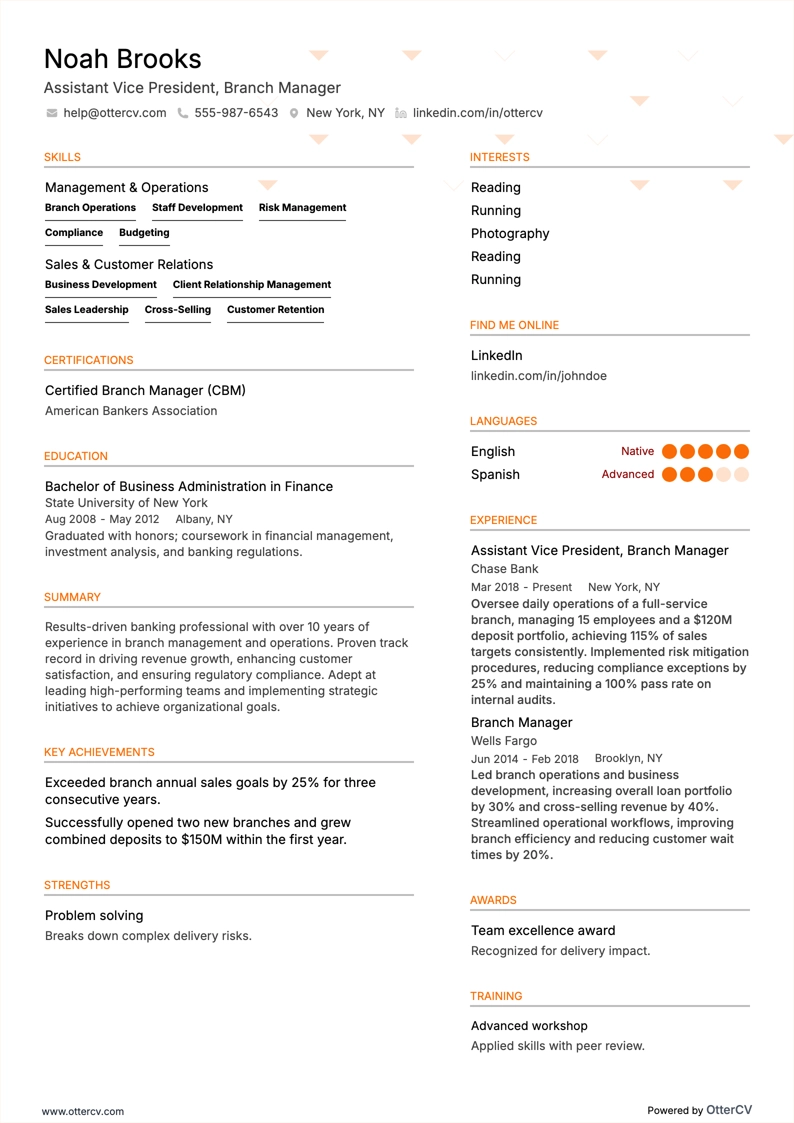
Assistant Vice President, Branch Manager resume example

Assistant Vice President, Branch Manager

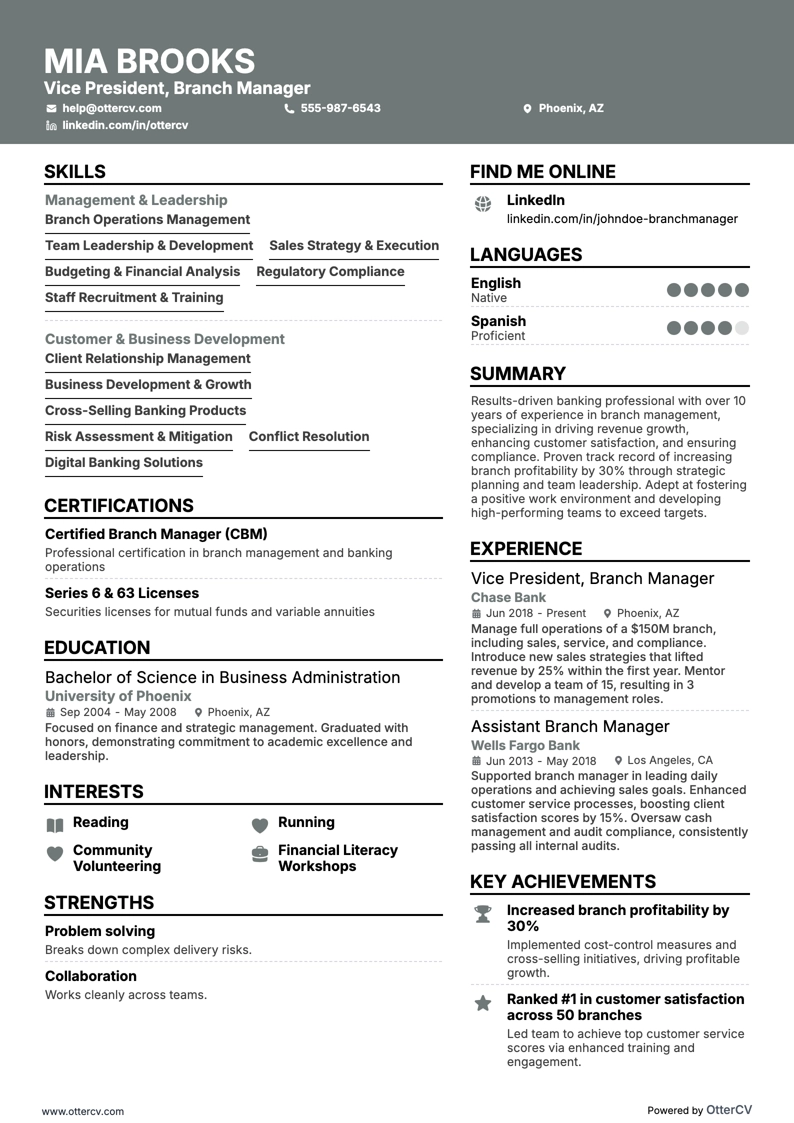
Vice President, Branch Manager resume example

Vice President, Branch Manager

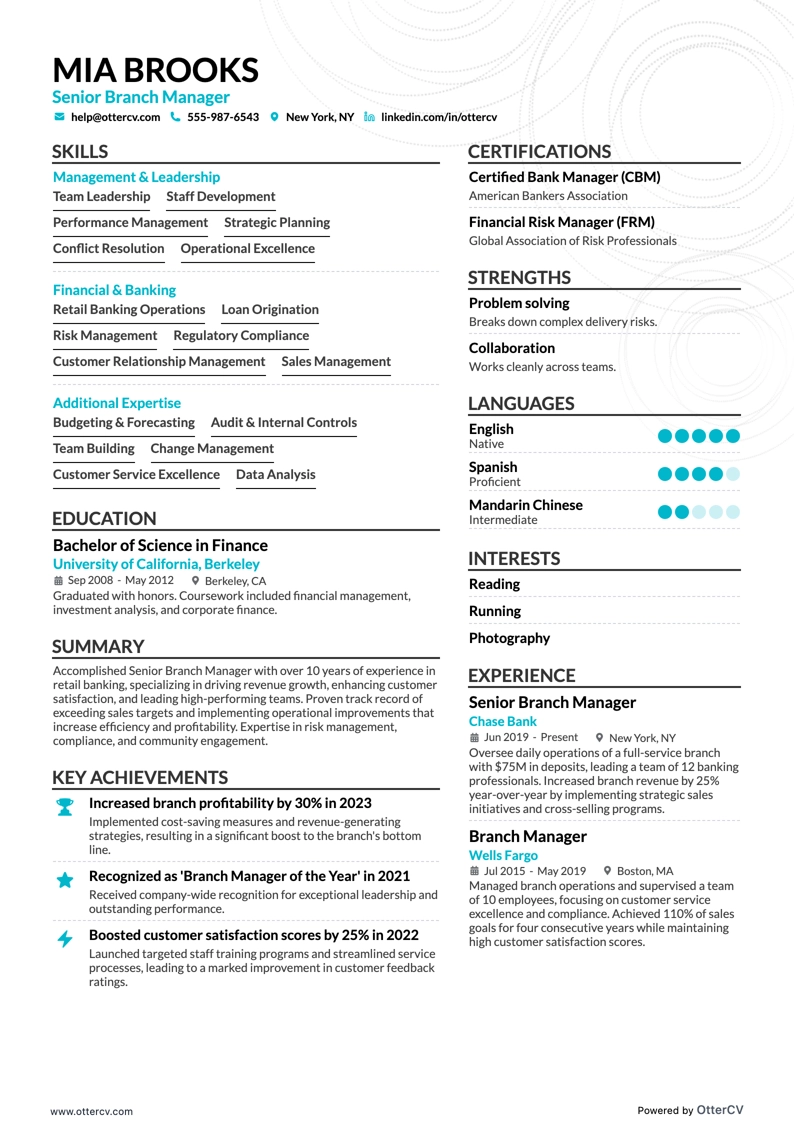
Senior Branch Manager resume example

Senior Branch Manager

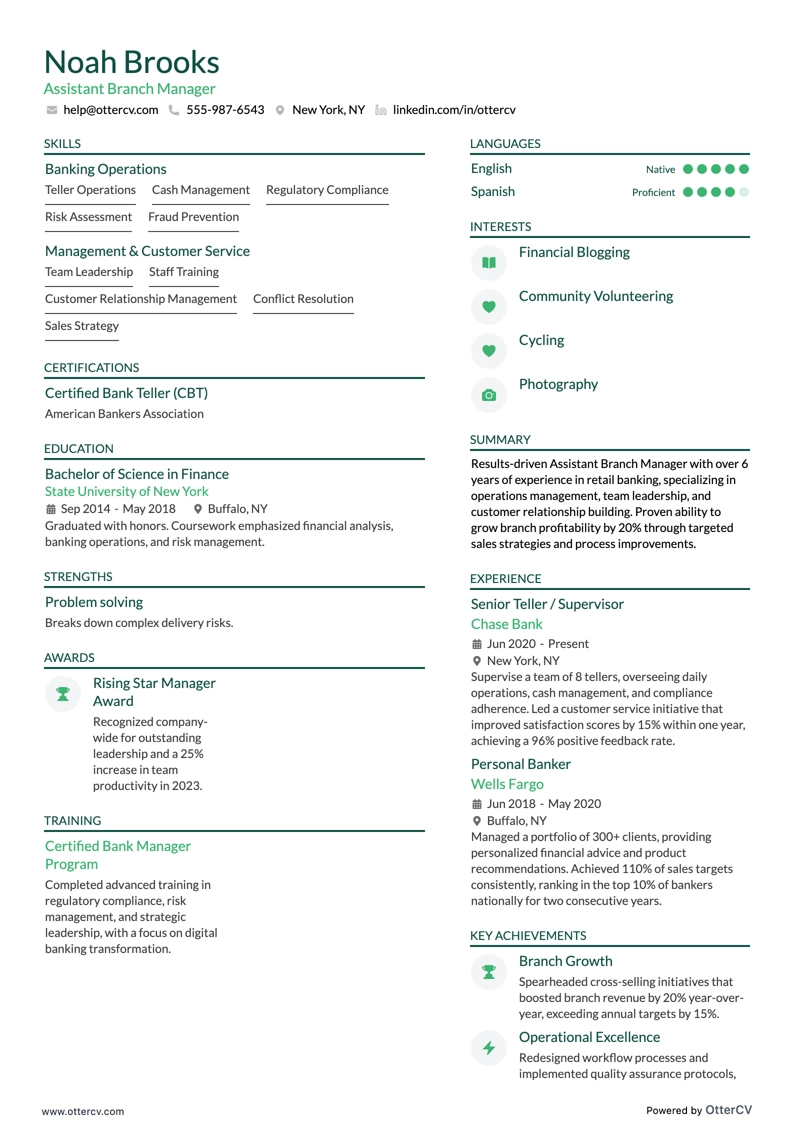
Assistant Branch Manager resume example

Assistant Branch Manager

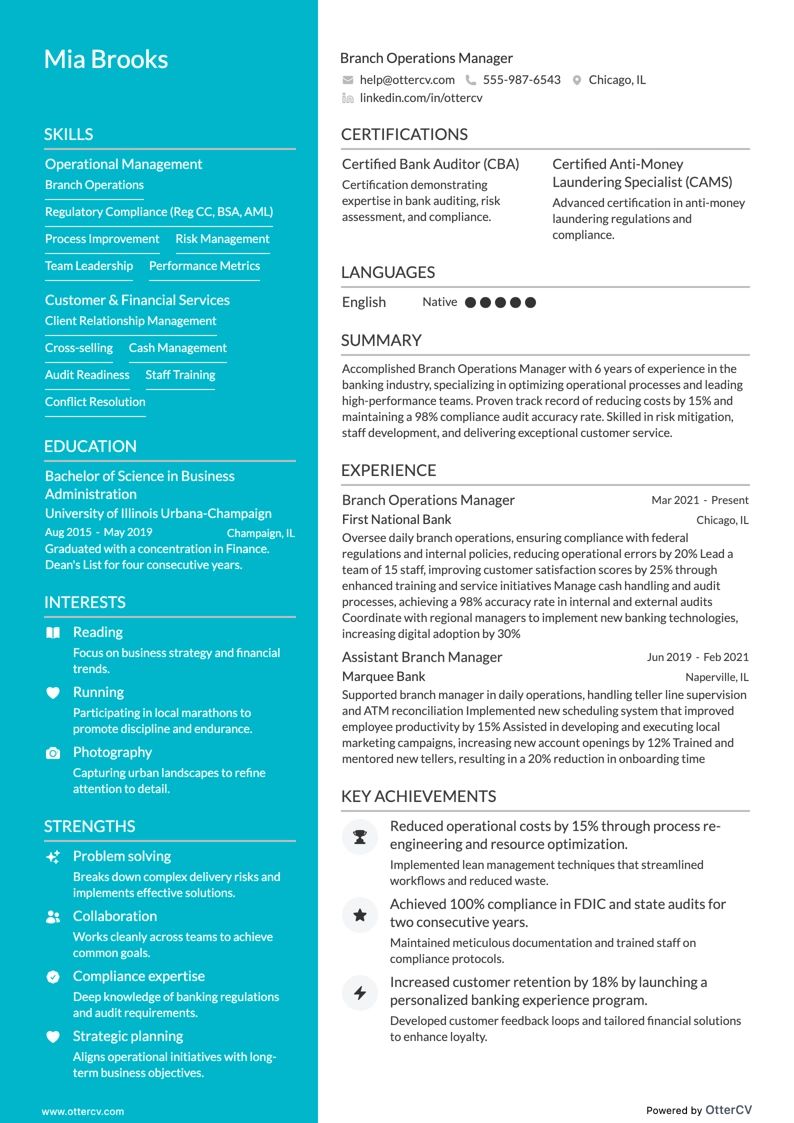
Branch Operations Manager resume example

Branch Operations Manager

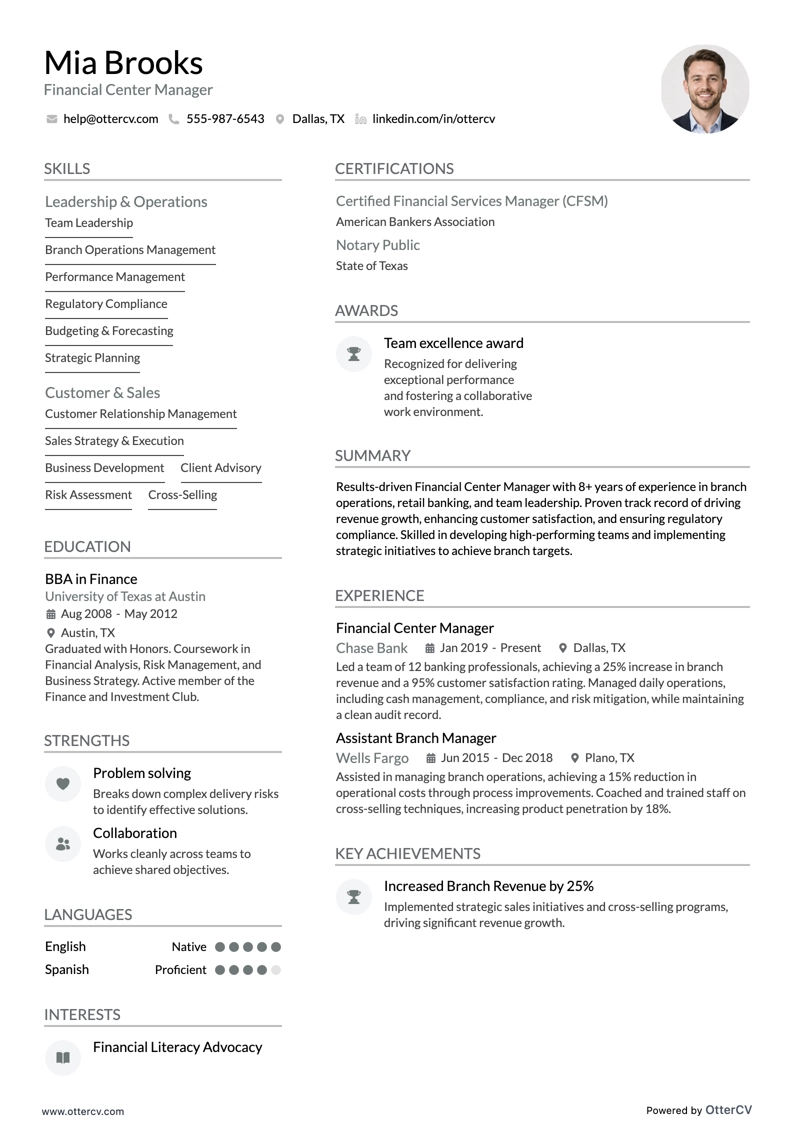
Financial Center Manager resume example

Financial Center Manager

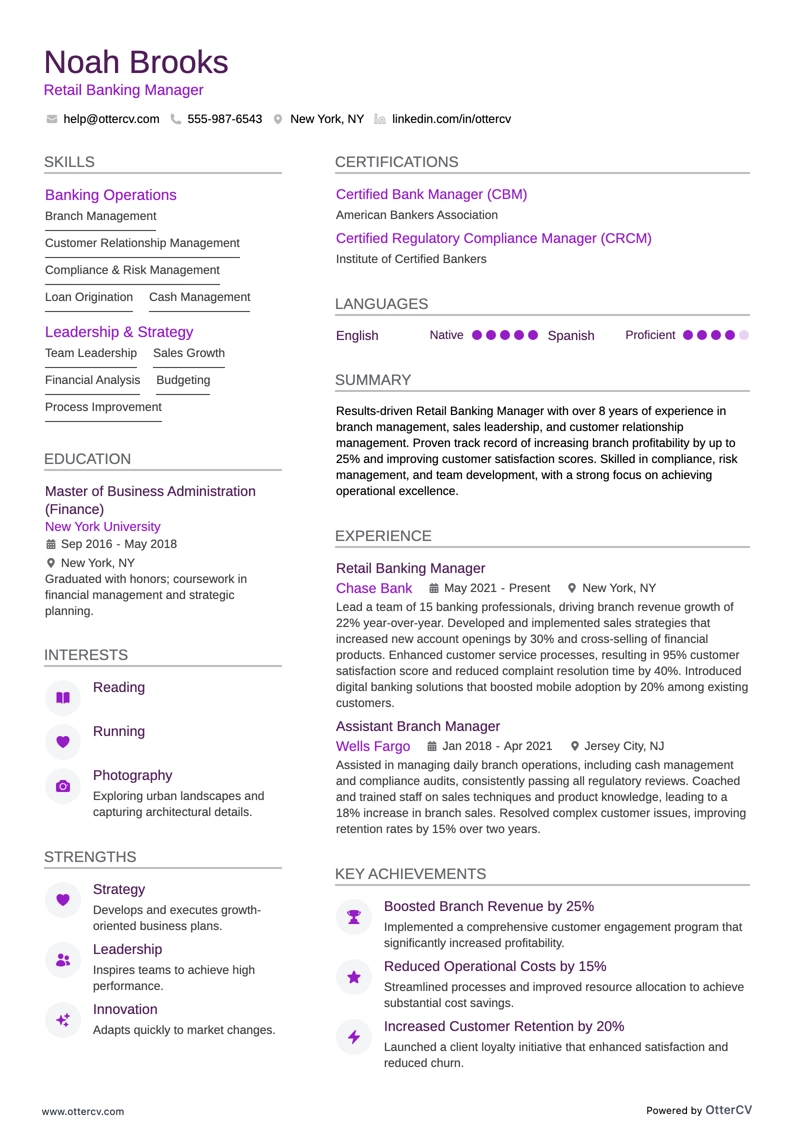
Retail Banking Manager resume example

Retail Banking Manager

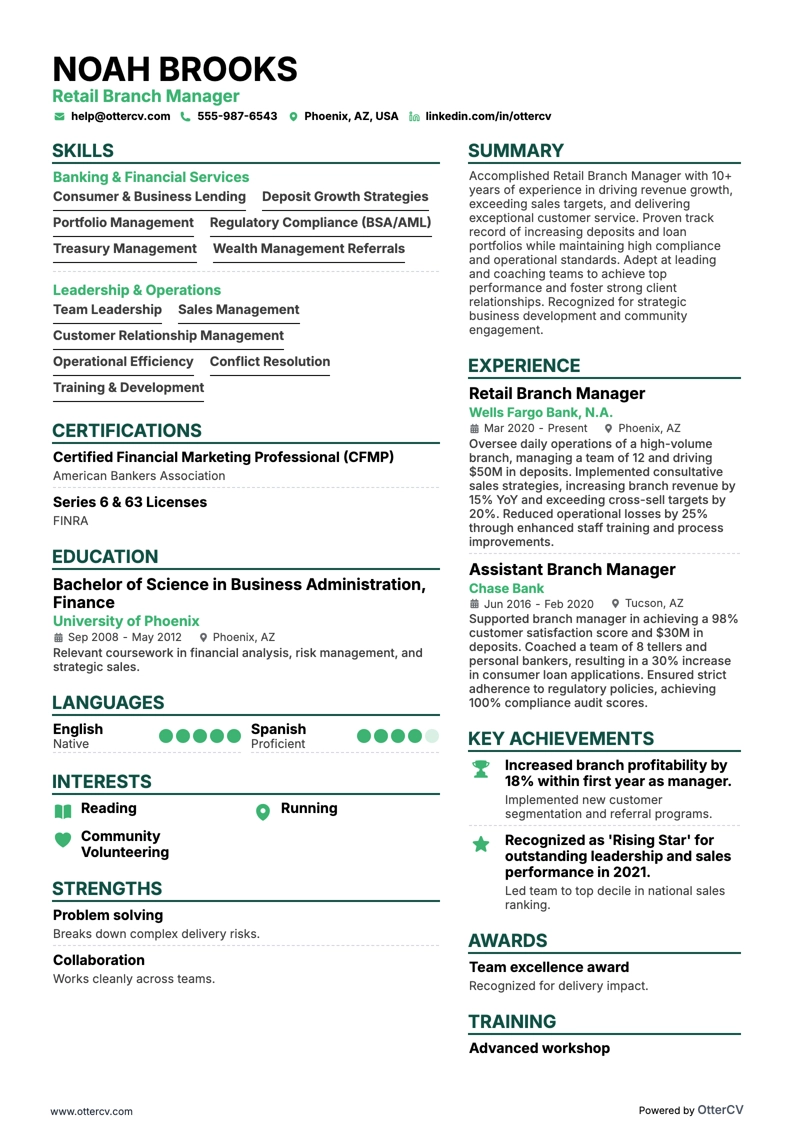
Retail Branch Manager resume example

Retail Branch Manager

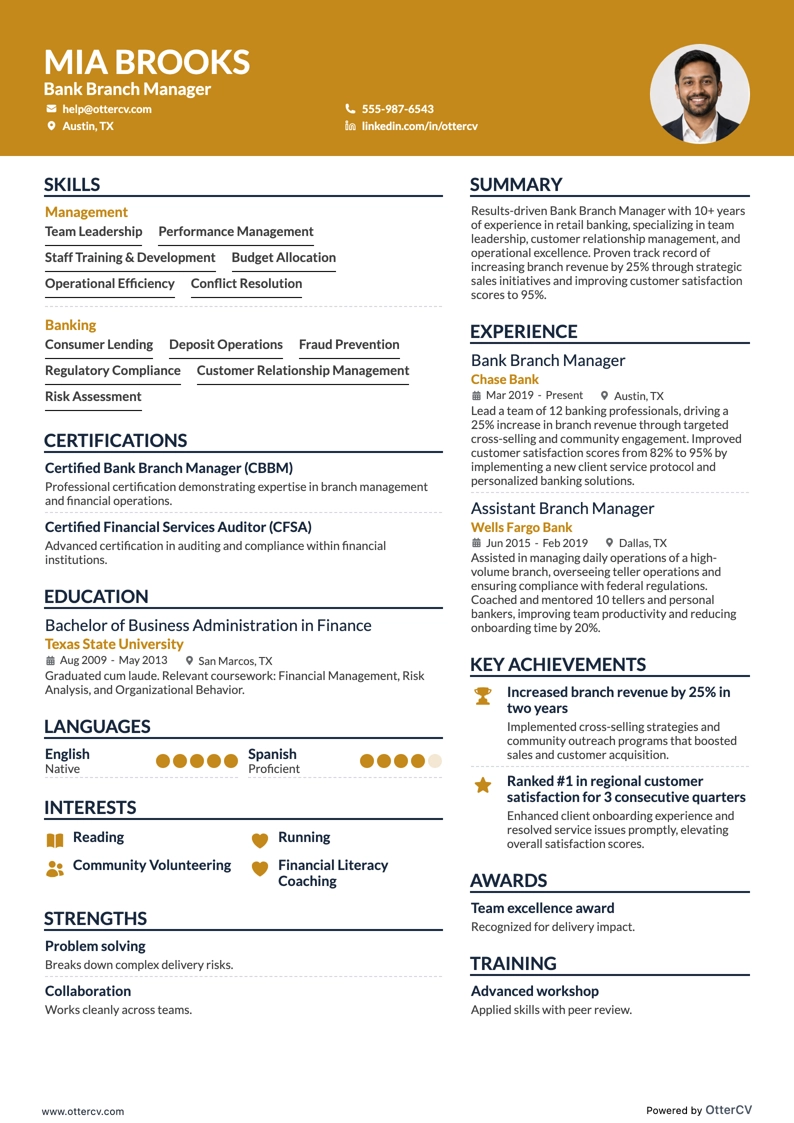
Bank Branch Manager resume example

Bank Branch Manager

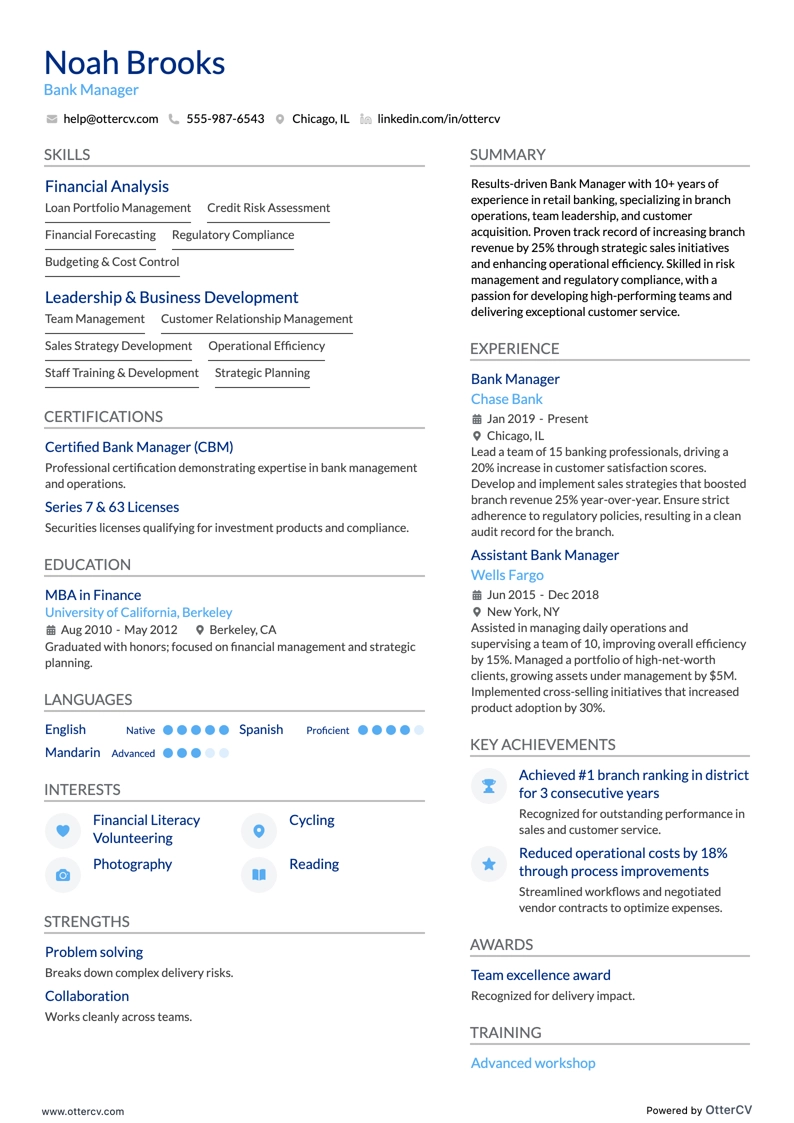
Bank Manager resume example

Bank Manager

Many bank manager resumes fail because they read like job descriptions instead of performance records. That hurts you in ATS screening and quick recruiter scans, where competition is high and space is limited.

A strong resume shows what you improved, not just what you used. Knowing how to write a resume that highlights branch revenue growth, deposit and loan volume gains, lower delinquency rates, stronger audit results, larger portfolios managed, and higher customer satisfaction is what sets top candidates apart.

Key takeaways

  • Quantify branch results like deposit growth, loan volume, and audit outcomes in every experience bullet.

  • Use a reverse-chronological format if you have management experience; use a hybrid format if you're transitioning.

  • Tailor each resume to the job posting's exact platforms, KPIs, and compliance frameworks.

  • Show skills through measurable achievements in your summary and experience, not just in a skills list.

  • Place certifications above education when they are recent, relevant, or required for the role.

  • Avoid functional resumes; banking hiring managers expect a clear, verifiable work timeline.

  • Use Echocv to turn routine banking tasks into stronger, metric-driven resume bullets faster.

Job market snapshot for bank managers

We analyzed 282 recent bank manager job ads across major US job boards. This snapshot helps you quickly understand regional hotspots, the salary landscape, and typical experience requirements.

What level of experience employers are looking for bank managers

Years of ExperiencePercentage found in job ads
1–2 years1.1% (3)
3–4 years9.6% (27)
5–6 years47.2% (133)
7–8 years15.2% (43)
9–10 years0.4% (1)
10+ years0.7% (2)
Not specified26.2% (74)

Bank manager ads by area of specialization (industry)

Industry (Area)Percentage found in job ads
Finance & Banking99.6% (281)

Top companies hiring bank managers

CompanyPercentage found in job ads
Accenture75.2% (212)
BMO (Bank of Montreal)11.0% (31)

Role overview stats

These tables outline the most common responsibilities and employment types for bank manager roles. Use them to align your resume with employer expectations and understand how the role is structured across the market.

Day-to-day activities and top responsibilities for a bank manager

ResponsibilityPercentage found in job ads
Ai31.2% (88)
Powerpoint31.2% (88)
Data30.5% (86)
Agile30.1% (85)
Cloud-native architectures30.1% (85)
Consumer lending30.1% (85)
Core banking30.1% (85)
Data governance30.1% (85)
Data visualization30.1% (85)
Management consulting30.1% (85)
Mortgage lending30.1% (85)
Visual storytelling30.1% (85)

How to format a bank manager resume

Recruiters reviewing bank manager resumes look first for evidence of branch performance, team leadership, regulatory compliance, and revenue growth. A clear, well-structured resume format helps these qualifications stand out immediately for both human reviewers scanning quickly and applicant tracking systems parsing your credentials.

I have significant experience in this role—which format should I use?

I have significant experience in this role—which format should I use?

Use a reverse-chronological format. It is the strongest choice for an experienced bank manager because it highlights your leadership progression, growing scope, and cumulative business impact.

Do the following:

  • Lead each role entry with your management scope, including branch size, team headcount, portfolio value, and decision-making authority.
  • Highlight domain-specific expertise such as loan origination, deposit growth strategies, risk assessment frameworks, CRA compliance, and core banking platforms like FIS, Fiserv, and Jack Henry.
  • Quantify results tied directly to branch performance, profitability, or operational efficiency.

Example bullet: “Grew branch deposit portfolio by $14M (22% year-over-year) while reducing employee turnover from 31% to 12% through a restructured coaching and incentive program.”

I'm junior or switching into this role—what format works best?

I'm junior or switching into this role—what format works best?

A hybrid resume format works best if you're moving into bank management. It lets you emphasize transferable skills first while still presenting a clear employment timeline.

Do:

  • Place a focused skills section near the top that highlights competencies such as customer relationship management, cash handling oversight, regulatory knowledge, and sales leadership.
  • Include projects or transitional experience—such as acting branch manager assignments, teller supervisor duties, or cross-functional banking initiatives—that show readiness for management responsibility.
  • Connect each skill or experience entry to a specific action and a measurable result so recruiters can evaluate your potential impact.

Example scaffold: “Financial sales expertise → led a four-person teller team in a targeted cross-selling campaign → increased new account openings by 35% over one quarter.”

Why not use a functional resume?

Why not use a functional resume?

A functional resume removes the timeline and context recruiters need to assess your progression toward management responsibility. That makes it harder to verify where, when, and how you built your banking skills.

A functional resume may be acceptable in this situation:

  • You're re-entering the banking industry after an extended career break and need to reframe transferable management skills around specific branch operations projects and measurable outcomes.

Keep in mind that many applicant tracking systems struggle to parse functional formats correctly. In banking, where accountability and compliance traceability matter, hiring managers may also view the lack of a clear work history with skepticism. Avoid this format entirely if you have any consistent employment record you can present.

Once you’ve chosen the right resume format, the next step is deciding which sections to include and how to arrange them for the strongest impact.

What sections should go on a bank manager resume

Recruiters want to see a clear record of branch leadership, regulatory compliance, sales performance, and risk management. Knowing which resume sections to include helps you present that information clearly and effectively.

Use this structure for maximum clarity:

  • Header
  • Summary
  • Experience
  • Skills
  • Projects
  • Education
  • Certifications
  • Optional sections: Awards, Leadership, Languages

Strong experience bullets should emphasize measurable branch results, portfolio scope, compliance outcomes, and the impact of your leadership on revenue, customer retention, and risk reduction.

Once you’ve organized your resume with the right structure, focus on your bank manager experience section to show the impact you made in each role.

How to write your bank manager resume experience

Your experience section should prove that you delivered results, not just that you held a title. Hiring managers reviewing bank manager candidates look for clear impact in areas such as revenue growth, risk mitigation, regulatory compliance, and team leadership rather than generic duty-based descriptions. Building a targeted resume helps ensure every bullet aligns with what the employer values most.

Each entry should include:

  • Job title
  • Company and location (or remote)
  • Dates of employment (month and year)

Add three to five concise bullet points that explain what you owned, how you executed, and what outcomes you delivered:

  • Ownership scope: the branch operations, lending portfolios, deposit products, compliance programs, or staff teams you were directly accountable for as a bank manager.
  • Execution approach: the banking platforms, risk assessment frameworks, CRM systems, audit procedures, or coaching methods you used to guide decisions and deliver day-to-day results.
  • Value improved: changes to loan quality, branch profitability, customer retention, operational efficiency, regulatory adherence, or fraud prevention that resulted from your leadership.
  • Collaboration context: how you partnered with loan officers, tellers, compliance teams, regional leadership, auditors, or commercial clients to achieve shared objectives.
  • Impact delivered: measurable business results such as portfolio growth, reduced delinquency, improved satisfaction scores, or successful audit outcomes, instead of a list of routine activities.

Each bullet should connect what you owned, how you executed, and what changed because of your work. Keep your language specific to banking operations and leadership, and make every point reflect the value you created for the branch, the institution, or the customers you served.

Experience bullet formula

Experience bullet formula

Use this structure for experience bullets: action verb + technology + what you built or fixed + measurable result.

A bank manager experience example

Bank Manager

Riverstone Community Bank | Austin, TX

2021–Present

Led a full-service retail branch serving 18,000 customers across consumer, small business, and mortgage products.

  • Directed branch performance using Salesforce CRM dashboards and core banking reporting, increasing net new deposit growth by 14% year over year and improving cross-sell rate from 1.6 to 2.1 products per household.
  • Reduced fraud losses by 22% by strengthening BSA (Bank Secrecy Act) and AML (anti-money laundering) controls, partnering with compliance and fraud operations to refine transaction-monitoring alerts and retrain staff on escalation workflows.
  • Improved customer experience by 11 points in Net Promoter Score through queue analytics, appointment scheduling, and service recovery playbooks, reducing average lobby wait time from nine to six minutes.
  • Increased small business lending revenue by $420K annually by redesigning the pipeline in Salesforce CRM, standardizing credit package checklists, and aligning weekly deal reviews with underwriters and risk stakeholders.
  • Cut teller balancing and end-of-day close time by 25% by standardizing dual-control procedures and optimizing cash logistics with the vault system, reducing cash outages by 30% while maintaining audit-ready documentation.

Now that you’ve seen what a strong experience section looks like, the next step is tailoring those details to the specific bank manager role you’re targeting.

How to tailor your bank manager resume experience

Recruiters review your bank manager resume through both human screening and applicant tracking systems, so tailoring your resume to the job description is essential. It helps ensure the skills, tools, and accomplishments you emphasize match what the employer is seeking.

Ways to tailor your bank manager experience:

  • Match the banking platforms and core systems named in the job description.
  • Use the same terminology for lending or deposit processes.
  • Reflect specific KPIs such as portfolio growth or loan volume targets.
  • Highlight any regulatory compliance frameworks referenced in the posting.
  • Emphasize retail or commercial banking experience when the role calls for it.
  • Include the cross-functional collaboration models described in the role.
  • Align your leadership style with the team management expectations listed.
  • Reference the risk assessment or audit methodologies the employer prioritizes.

The goal is to align your real achievements with each job’s requirements, not to add keywords where they do not naturally fit.

Resume tailoring examples for bank manager

Job description excerptUntailoredTailored
"Oversee daily branch operations, ensuring compliance with federal and state banking regulations, including BSA/AML requirements."Managed daily operations and ensured the team followed company policies.Directed daily operations for a full-service branch with 18 staff members, maintaining 100% compliance across quarterly BSA/AML audits and all federal and state regulatory examinations.
"Drive growth in consumer and commercial deposit portfolios by developing relationships with local businesses and community organizations."Helped increase sales and built relationships with customers.Grew the branch's commercial deposit portfolio by $4.2M in 12 months by establishing partnerships with 35+ local businesses and leading quarterly community outreach events.
"Coach, develop, and performance-manage a team of personal bankers and tellers to meet cross-selling and customer satisfaction targets."Supervised employees and helped improve team performance.Coached a team of nine personal bankers and tellers through weekly one-on-ones and role-play sessions, increasing cross-sell ratios by 27% and raising Net Promoter Scores from 72 to 86 within two quarters.

Once you’ve aligned your experience with the role’s priorities, the next step is to quantify your bank manager achievements so hiring teams can see the measurable impact behind those responsibilities.

How to quantify your bank manager achievements

Quantifying your achievements helps show how you improved branch performance, reduced risk, and delivered better service. Focus on revenue growth, deposit and loan volume, compliance and audit outcomes, customer satisfaction, and efficiency metrics such as wait times and error rates.

Quantifying examples for bank manager

MetricExample
Revenue growthGrew branch fee and interest revenue 12% year over year by coaching eight bankers on cross-sell scripts and weekly pipeline reviews.
Deposit growthIncreased core deposits by $9.4M in nine months by launching a small business referral program with two local chambers of commerce.
Credit qualityCut 60+ day delinquency from 2.1% to 1.4% by tightening underwriting checklists and adding monthly portfolio reviews in the loan system.
Compliance outcomesPassed two internal audits with zero high-risk findings by standardizing Bank Secrecy Act (BSA) documentation and running quarterly teller controls testing.
Service efficiencyReduced average lobby wait time from 14 to seven minutes by redesigning staffing schedules and adding appointment slots in the branch calendar tool.

With your experience clearly expressed in strong bullet points, the next step is making sure your skills section highlights the right mix of hard and soft skills for a bank manager role.

How to list your hard and soft skills on a bank manager resume

Your skills section should quickly show that you can grow deposits, manage risk, and lead a branch. Recruiters and ATS (applicant tracking systems) scan this section to confirm fit fast, so include a balanced mix of hard skills and job-specific soft skills.

Bank manager roles require a blend of:

  • Product strategy and discovery skills
  • Data, analytics, and experimentation skills
  • Delivery, execution, and go-to-market discipline
  • Soft skills

Your skills section should be:

  • Scannable, with bullet-style grouping
  • Relevant to the job post
  • Backed by proof in your experience bullets
  • Updated with current tools

Place your skills section:

  • Above your experience section if you're junior or switching careers
  • Below your experience section if you're mid- or senior-level with strong achievements

Hard skills

  • Branch P&L management.
  • Deposit growth strategy.
  • Consumer and small business lending.
  • Underwriting and credit analysis.
  • Loan portfolio monitoring.
  • Risk controls and audit readiness.
  • Bank Secrecy Act and anti-money laundering compliance.
  • Know your customer and customer identification program compliance.
  • Fraud detection and dispute operations.
  • Core banking systems and teller platforms.
  • Customer relationship management systems.
  • Microsoft Excel and Tableau.

Soft skills

  • Coach bankers to hit targets.
  • Lead daily branch huddles.
  • Resolve escalations quickly.
  • Communicate risk tradeoffs clearly.
  • Hold teams accountable to controls.
  • Prioritize competing branch demands.
  • Partner with regional leadership.
  • Influence others without formal authority.
  • Deliver candid performance feedback.
  • Make decisions with incomplete data.
  • Negotiate win-win customer outcomes.
  • Drive cross-sell through needs analysis.

How to show your bank manager skills in context

Your skills should not appear only in a bulleted list on your resume. Reviewing examples of how other professionals present their resume skills can help you see what works.

Show your skills in these two places:

  • Your summary, where you present your high-level professional identity
  • Your experience, where you prove your skills through outcomes

Here is what both look like in practice.

Summary example

Senior bank manager with 12 years of experience in commercial lending and retail operations. Skilled in portfolio risk analysis, Fiserv, and cross-functional team leadership. Grew branch deposits by 34% while maintaining a loan default rate below 1.2%.

  • Clearly reflects senior-level experience
  • Names industry-relevant tools and methods
  • Leads with a measurable financial outcome
  • Highlights leadership as a soft skill

Experience Example

Senior Bank Manager

Crestline National Bank | Portland, OR

March 2018–Present

  • Managed a $210M loan portfolio using Fiserv and internal risk dashboards, reducing delinquency rates by 18% over three years.
  • Worked with compliance and lending teams to streamline approval workflows, cutting average processing time by 25%.
  • Coached a team of 14 branch staff on consultative sales techniques, driving a 31% increase in new business account openings.
  • Every bullet includes a measurable outcome.
  • Skills surface naturally through real achievements.

Once you’ve shown your banking leadership strengths with specific, results-driven examples, the next step is applying that approach to create a bank manager resume with no experience.

How do I write a bank manager resume with no experience

Even without full-time experience, you can still show readiness through:

  • Bank teller or vault support
  • Branch internship or job shadowing
  • Cash handling and reconciliation
  • Customer account opening support
  • Retail store shift supervision
  • Sales targets and pipeline tracking
  • Compliance training and quizzes
  • Community financial literacy volunteering

If you're in this situation, our guide on writing a resume without work experience explains strategies that apply directly to banking roles.

Focus on:

  • Metrics: deposits, loans, retention
  • Compliance: KYC, AML, audits
  • Cash controls and reconciliations
  • Leadership scope and process improvements

Resume format tip for entry-level bank manager

Resume format tip for entry-level bank manager

Use a combination resume format. It highlights transferable achievements and projects while still showing steady experience and training.

Do:

  • Put a summary with target role.
  • Add a Relevant projects section.
  • Quantify results with clear metrics.
  • List compliance training with dates.
  • Tailor keywords to each posting.

Example project bullet:

  • Led weekly cash reconciliation using Excel checklists and dual-control logs, reducing cash overage and shortage incidents by 30% over eight weeks.

Even without direct experience, your education section can show the foundational knowledge and qualifications that make you a strong candidate for a bank manager role.

How to list your education on a bank manager resume

Your education section helps hiring teams quickly confirm that you have the academic background and financial knowledge needed for a bank manager position.

Include:

  • Degree name
  • Institution
  • Location
  • Graduation year
  • Relevant coursework for juniors or entry-level candidates
  • Honors and GPA if 3.5 or higher

Avoid listing specific graduation months or days. Use the year only for a clean, professional look.

Here's a strong education entry tailored to a bank manager resume.

Example education entry

Bachelor of Science in Finance

University of Michigan, Ann Arbor, MI

Graduated 2018

GPA: 3.7/4.0

  • Relevant coursework: Financial Risk Management, Commercial Lending, Corporate Banking, and Business Ethics
  • Honors: Magna Cum Laude, Dean's List (six consecutive semesters)

How to list your certifications on a bank manager resume

Certifications on your resume show a bank manager’s commitment to learning, proficiency with financial tools, and alignment with current banking standards and regulations.

For each certification, include:

  • Certificate name
  • Issuing organization
  • Year
  • Optional: credential ID or URL
  • Place certifications below education when they are older, secondary to your degree, or only loosely related to bank manager responsibilities.
  • Place certifications above education when they are recent, highly relevant to bank manager work, or required for your target role.

Best certifications for your bank manager resume

  • Chartered Financial Analyst (CFA)
  • Certified Treasury Professional (CTP)
  • Certified Anti-Money Laundering Specialist (CAMS)
  • Financial Risk Manager (FRM)
  • Certified Financial Planner (CFP)
  • Certified Regulatory Compliance Manager (CRCM)
  • Six Sigma Green Belt

How to write your bank manager resume summary

Once you’ve positioned your credentials where they add the most value, write your bank manager resume summary to showcase those qualifications upfront.

Your resume summary is often the first thing a recruiter reads, so it should quickly show that you’re qualified. A strong summary tailored to a bank manager role sets the tone for the rest of your resume.

Keep it to three to four lines and include:

  • Your title and total years of banking or financial services experience.
  • Your area of specialization, such as retail banking, commercial lending, or branch operations.
  • Core skills like P&L management, regulatory compliance, CRM platforms, or loan portfolio oversight.
  • One or two measurable achievements, such as revenue growth, portfolio size, or customer retention rates.
  • Soft skills connected to real results, such as team development that reduced turnover or client relationship management that drove deposits.

PRO TIP

In your bank manager summary, focus on operational leadership, financial results, and team performance. Make the scope of your responsibility clear by noting details such as branch size, portfolio value, or headcount managed.

Avoid vague phrases like “passionate leader” or “results-driven professional.” Recruiters want evidence of impact, not generic personality descriptors.

Example summary for a bank manager

Bank manager with eight years of experience in retail banking, overseeing a 15-member team and a $120M deposit portfolio. Increased new account openings by 30% year over year through targeted community outreach and streamlined onboarding processes.

What to include in a bank manager resume header

Now that your summary communicates your value as a bank manager, make sure your header includes the key contact and professional details recruiters need to reach you.

A resume header is the contact and identity section at the top of your resume. For a bank manager role, it can improve visibility, credibility, and recruiter screening.

Essential resume header elements

  • Full name
  • Tailored job title and headline
  • Location
  • Phone number
  • Professional email
  • GitHub link
  • Portfolio link
  • LinkedIn

A LinkedIn link helps recruiters quickly verify your roles and dates, which supports faster screening.

Don't include a photo on a bank manager resume unless the role is explicitly front-facing or appearance-dependent.

Match your header job title to the posting, and keep every detail consistent with your application and LinkedIn profile.

Example

Once your contact details and role identifiers are in place at the top of your resume, you can strengthen the rest of the document by adding supporting sections that reinforce your candidacy.

Additional sections for bank manager resumes

If your core resume sections look similar to those of other candidates, these additional sections can help you stand out and strengthen your credibility as a bank manager.

  • Languages
  • Certifications and licenses
  • Professional affiliations and memberships
  • Volunteer experience and community involvement
  • Awards and recognitions
  • Publications and industry contributions

Once you’ve strengthened your resume with relevant additional sections, it’s worth pairing it with a cover letter to give hiring managers more context about your qualifications.

Do bank manager resumes need a cover letter

A cover letter isn’t required for a bank manager, but it can help in competitive searches or when hiring teams expect one. If you’re unsure where to begin, understanding what a cover letter is and how it complements your resume can help you decide when it’s worth including. It can be especially useful when your resume needs added context or when you’re targeting a specific branch or segment.

Use a cover letter to provide context your resume can’t:

  • Explain why you’re a good fit for the branch, team, and leadership style, and how you’ll support performance, compliance, and customer experience.
  • Highlight one or two results, such as improving deposit growth, reducing operational losses, or increasing customer satisfaction scores, and clarify your role.
  • Show that you understand the bank’s products, customers, and local market, and how you’ll balance sales goals with risk controls.
  • Address career transitions or less obvious experience, and connect it to bank manager responsibilities with one clear example.

Using AI to improve your bank manager resume

Even if you include a cover letter to add context beyond your resume, using AI to improve your bank manager resume can strengthen the document recruiters review first.

AI can improve your resume’s clarity, structure, and impact. It can tighten language and bring measurable results into focus. But overusing it can remove your authentic voice. If you’re exploring this approach, our guide on which AI is best for writing resumes can help you choose the right tool. Once your content is clear and aligned with the role, step away from AI.

Here are 10 practical prompts to improve specific sections of your bank manager resume:

  1. Sharpen your summary. “Rewrite my bank manager resume summary to highlight leadership scope, portfolio size, and key achievements in under four sentences.”
  2. Quantify experience bullets. “Review my bank manager experience bullets and suggest where I can add specific metrics like revenue growth, team size, or loan volume.”
  3. Align skills strategically. “Compare my bank manager skills section against this job description and recommend missing hard or soft skills I should include.”
  4. Strengthen action verbs. “Replace weak or repeated verbs in my bank manager experience section with strong, specific action verbs tied to banking operations.”
  5. Tighten project descriptions. “Edit my bank manager project descriptions to emphasize measurable outcomes, stakeholder impact, and timeline efficiency.”
  6. Refine education details. “Suggest how to format my bank manager education section to highlight relevant coursework, honors, or financial certifications.”
  7. Improve certification visibility. “Reorganize my bank manager certifications section so the most role-relevant credentials appear first with issuing bodies and dates.”
  8. Remove filler language. “Identify and remove vague or redundant phrases across my entire bank manager resume without losing important details.”
  9. Target compliance experience. “Rewrite my bank manager experience bullets to better reflect regulatory compliance, audit readiness, and risk management contributions.”
  10. Tailor for ATS clarity. “Restructure my bank manager resume formatting and keyword usage to improve readability by applicant tracking systems.”

Stop using AI once your resume sounds accurate, specific, and grounded in real experience. AI should never invent experience or inflate claims—if it didn’t happen, it doesn’t belong here.

Conclusion

A strong bank manager resume should highlight measurable results, role-specific skills, and a clear structure. Use metrics to show growth, risk control, service improvements, and team performance, and keep each section clean, consistent, and easy to scan.

This approach shows you are ready for today’s hiring market and near-future expectations. Your bank manager resume should connect results to leadership, compliance, lending, and operations so hiring teams can quickly see your fit.

Bank Manager resume examples

Explore additional Bank Manager resume samples and guides and see what works for your level of experience or role.

By Experience

Assistant Vice President, Branch Manager

Assistant Vice President, Branch Manager resume preview

Vice President, Branch Manager

Vice President, Branch Manager resume preview

Senior Branch Manager

Senior Branch Manager resume preview

Assistant Branch Manager

Assistant Branch Manager resume preview

Bank Manager resume examples

Explore additional Bank Manager resume samples and guides and see what works for your level of experience or role.

By Role

Branch Operations Manager

Branch Operations Manager resume preview

Financial Center Manager

Financial Center Manager resume preview

Retail Banking Manager

Retail Banking Manager resume preview

Retail Branch Manager

Retail Branch Manager resume preview

Bank Branch Manager

Bank Branch Manager resume preview

Bank Manager

Bank Manager resume preview