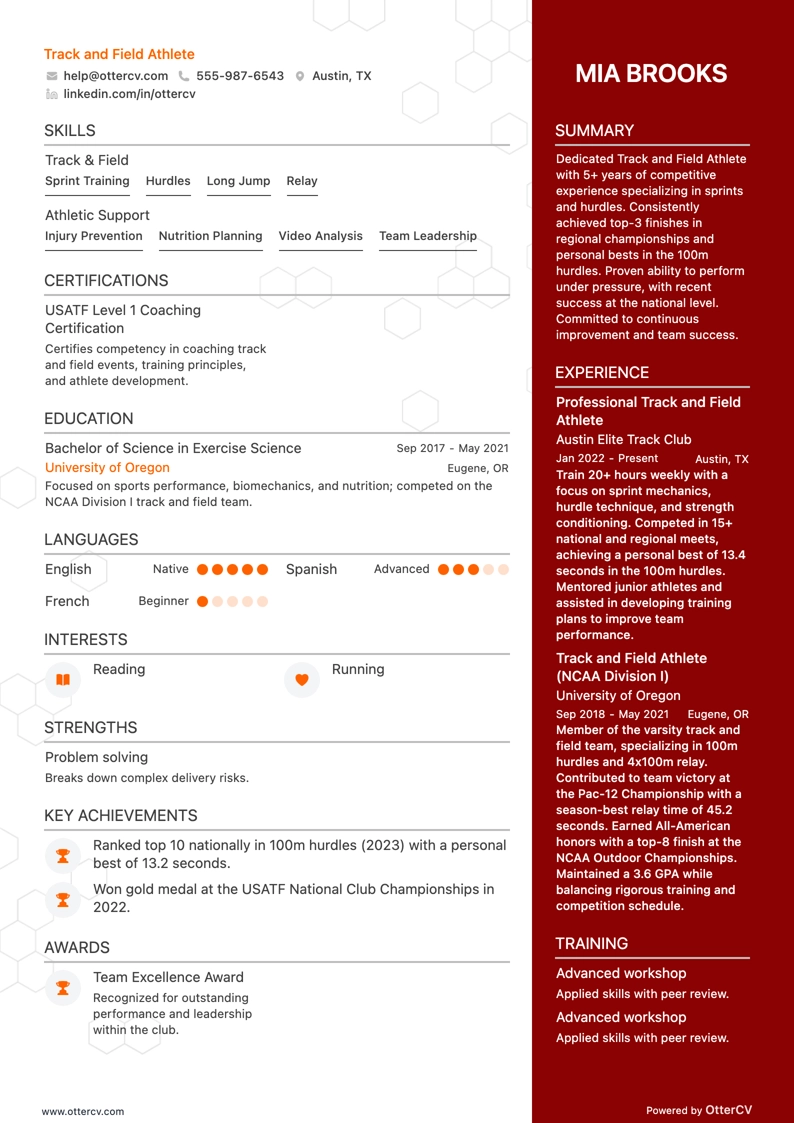
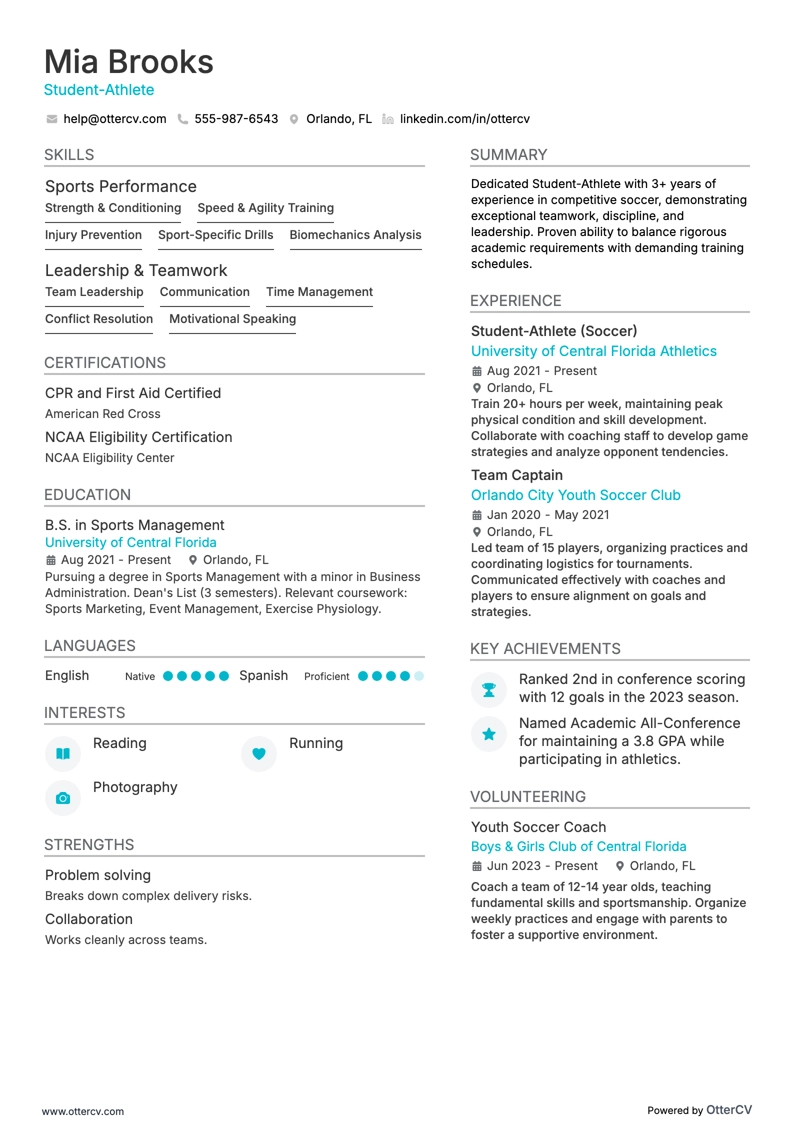
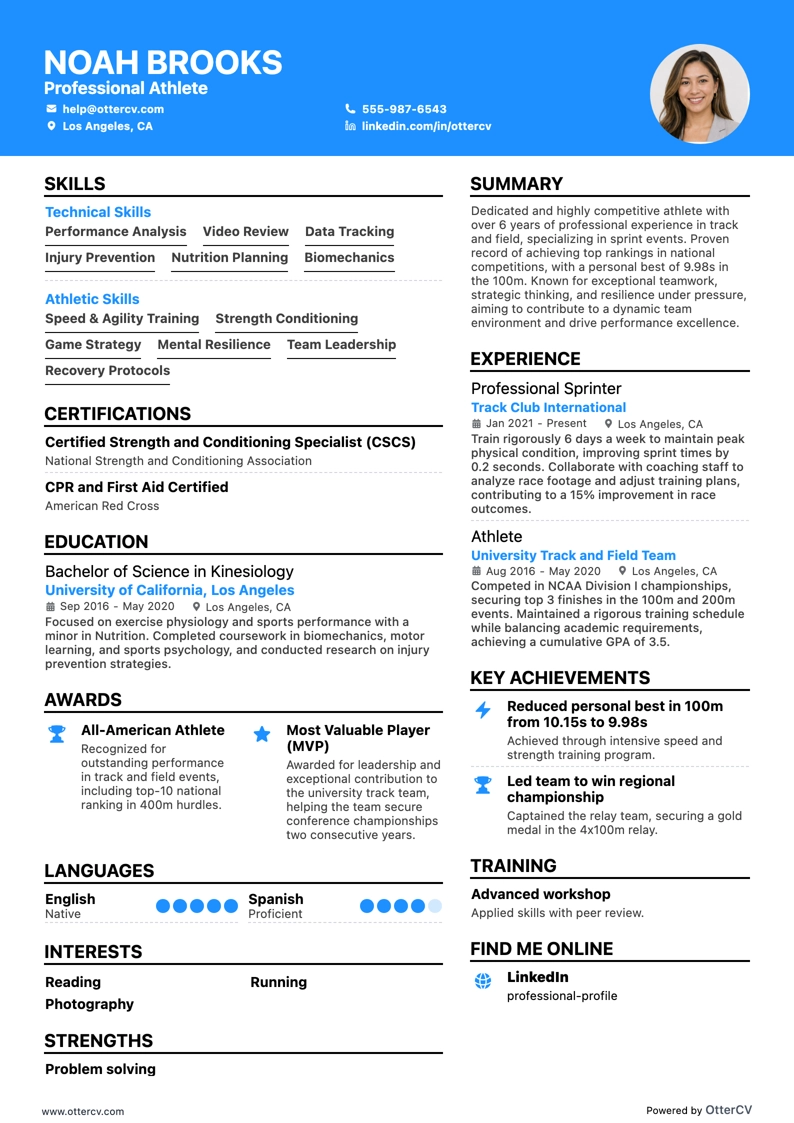
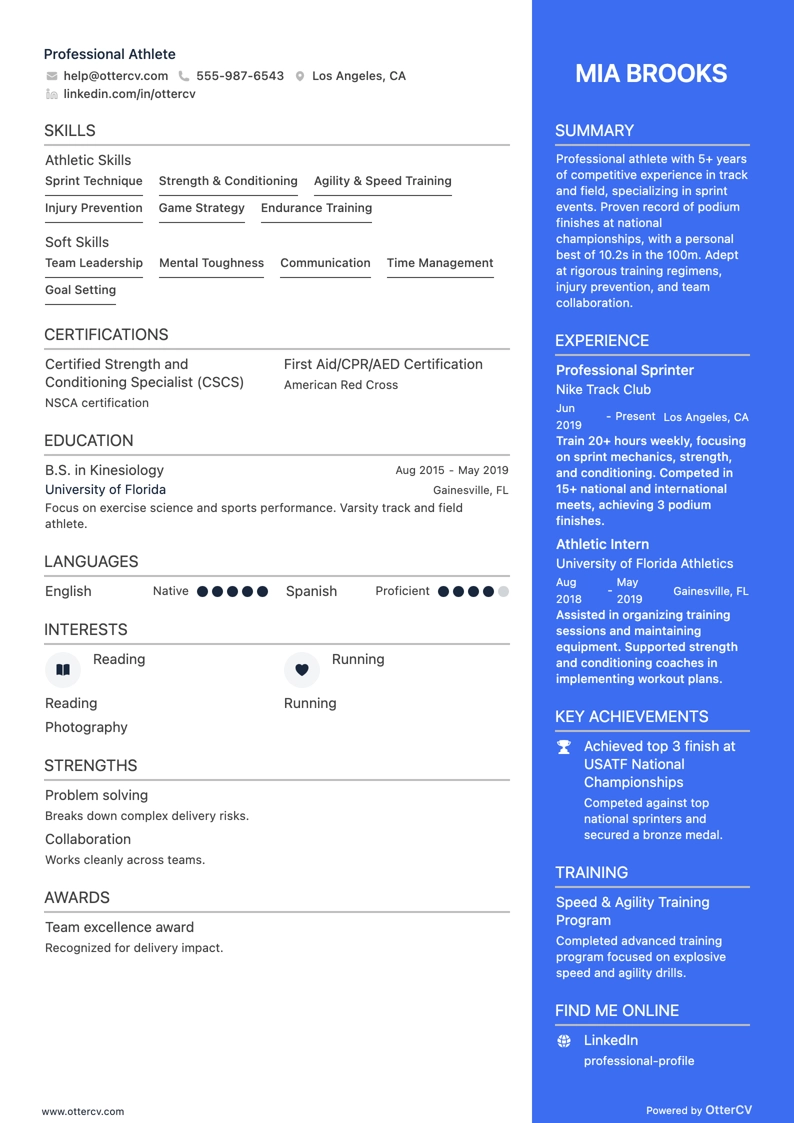
Track and Field Athlete full preview

22 Athlete Resume Examples That Got Jobs

OtterCV

Written by The OtterCV Team

Updated: 6/18/2024•8 min read

See all resume examples in this guide, or generate your own resume example with your personalized prompt

Track and Field Athlete resume example

Track and Field Athlete

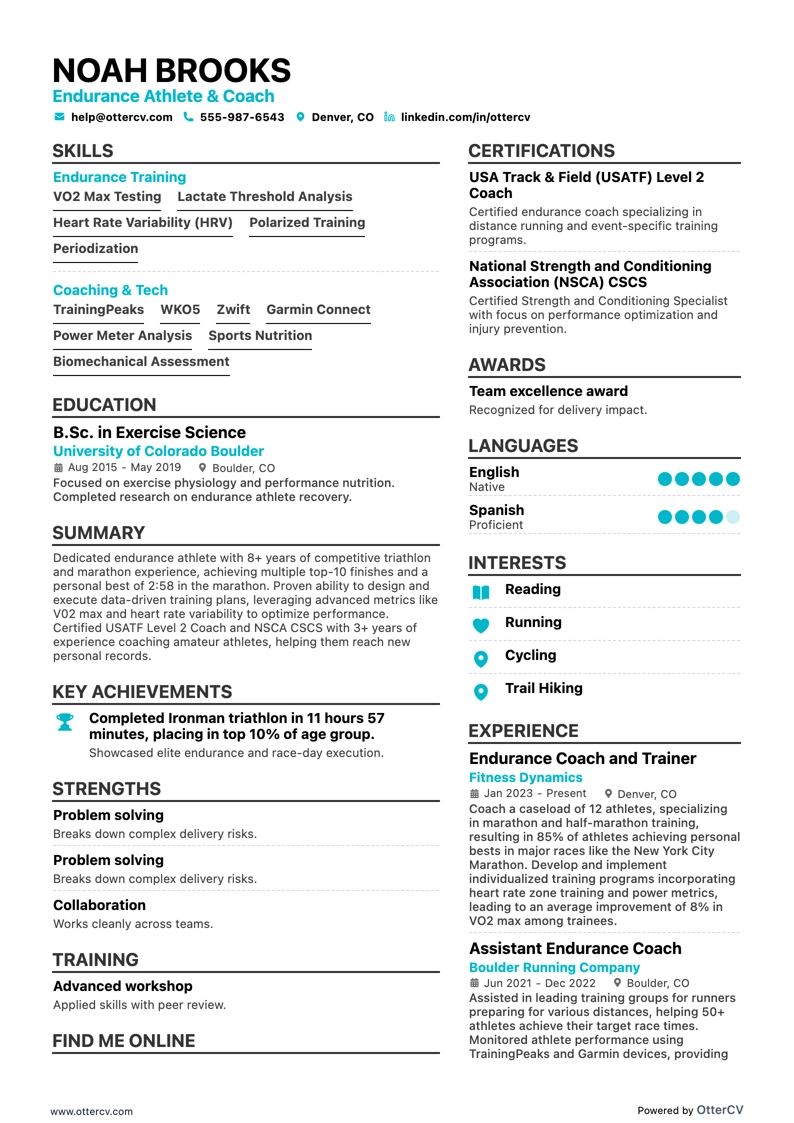
Endurance Athlete resume example

Endurance Athlete

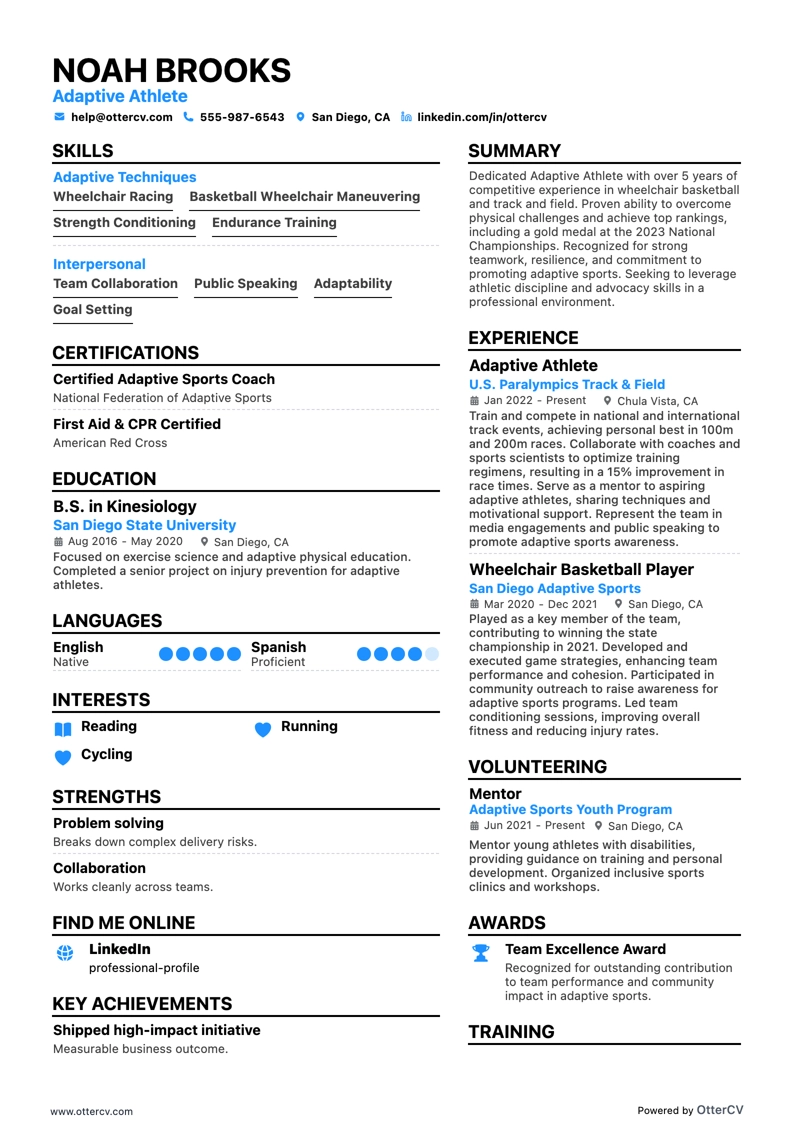
Adaptive Athlete resume example

Adaptive Athlete

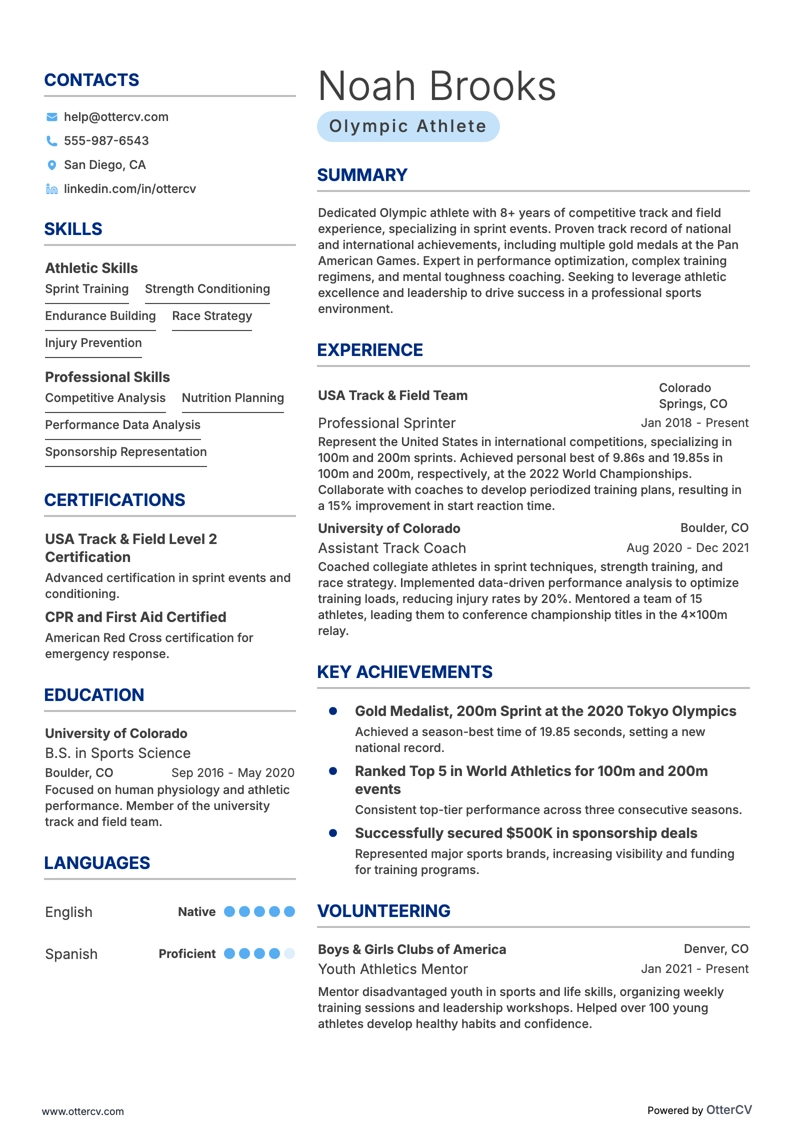
Olympic Athlete resume example

Olympic Athlete

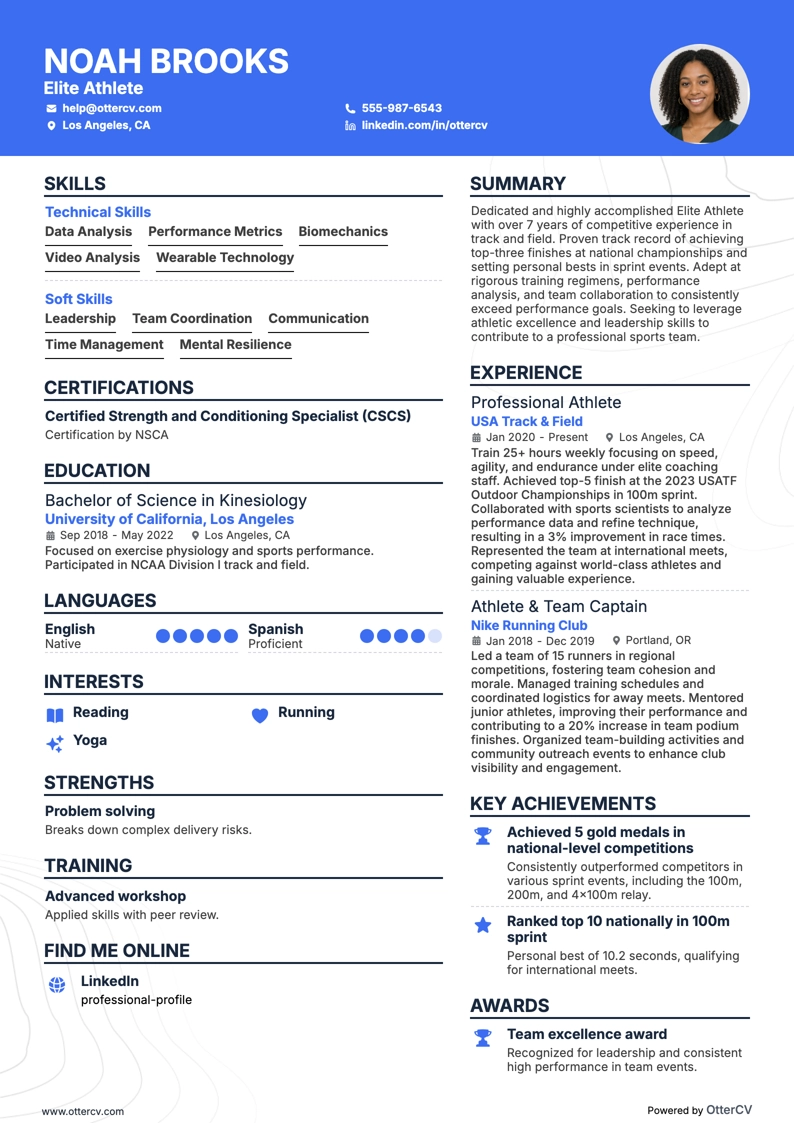
Elite Athlete resume example

Elite Athlete

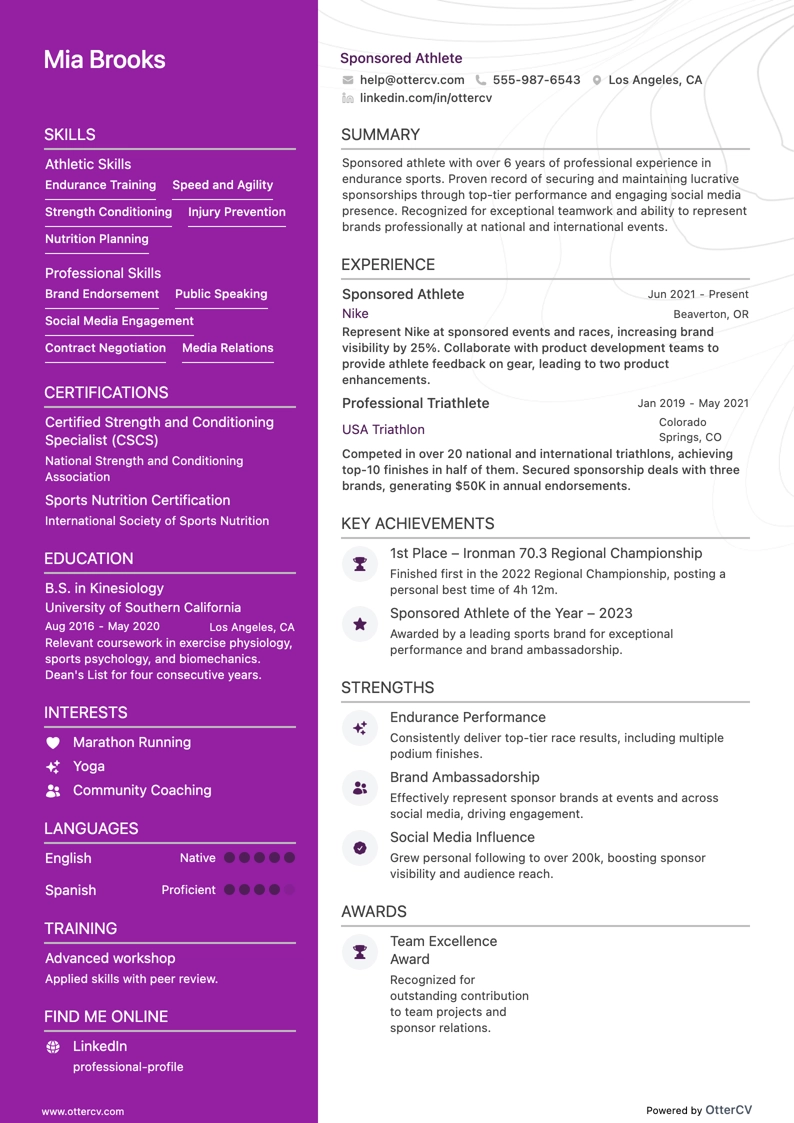
Sponsored Athlete resume example

Sponsored Athlete

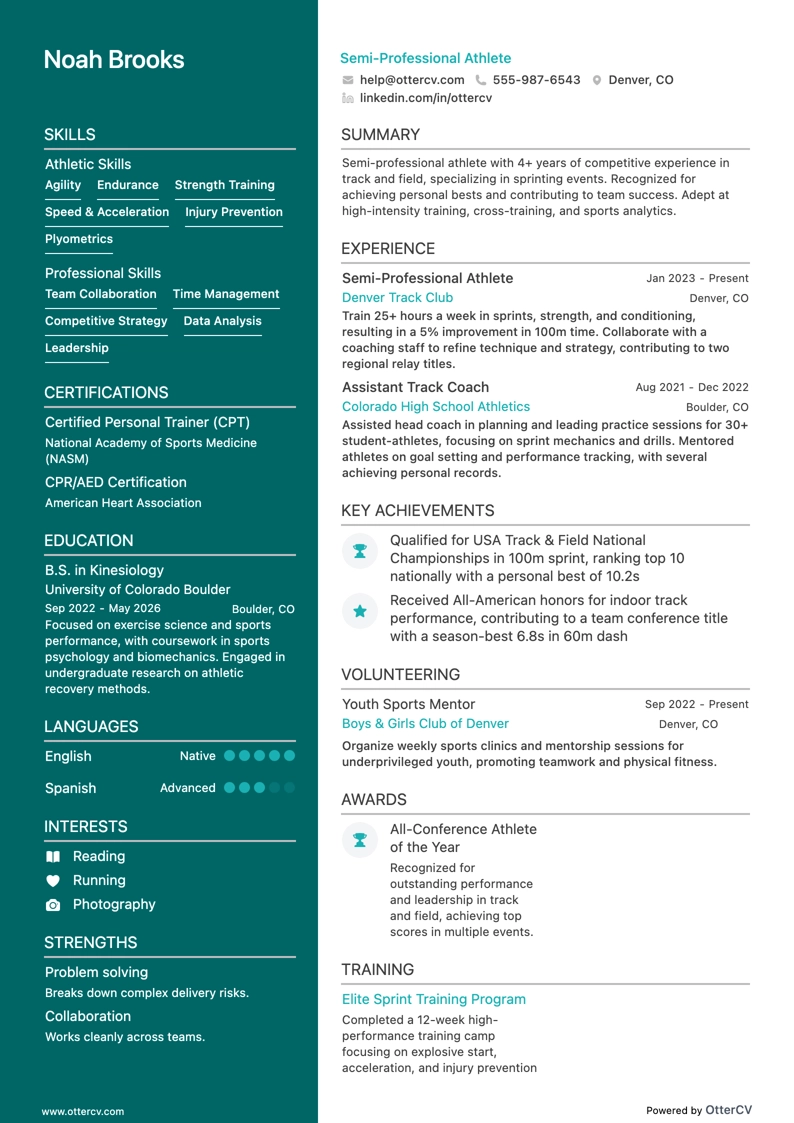
Semi-Professional Athlete resume example

Semi-Professional Athlete

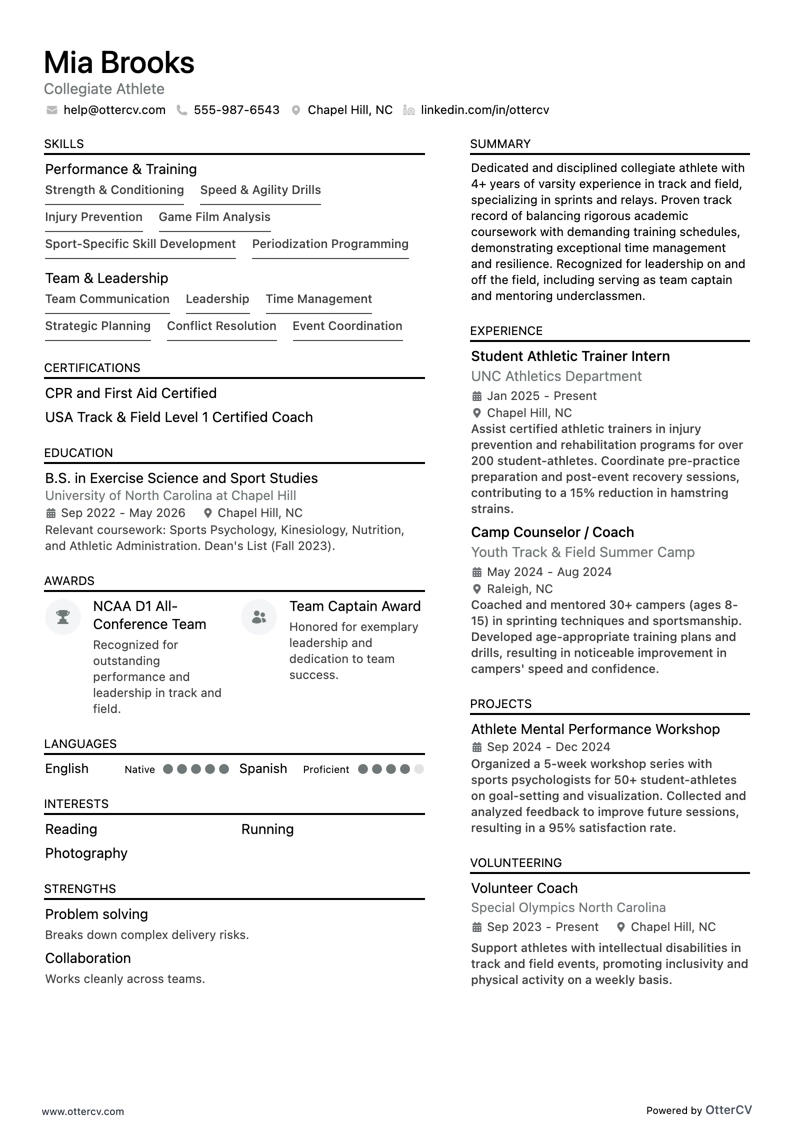
Collegiate Athlete resume example

Collegiate Athlete

Student-Athlete resume example

Student-Athlete

Competitive Athlete resume example

Competitive Athlete

Athlete resume example

Athlete

Most athlete resumes fail because they read like a sports bio instead of a hiring document. Transferable results are often buried, so an ATS (applicant tracking system) and recruiters scanning quickly may miss your fit in a crowded applicant pool.

A strong resume shows what you delivered, not just what you did. Understanding how to make your resume stand out starts with highlighting measurable outcomes such as win rate, rankings, minutes played, recovery time, training load, leadership scope, sponsorship growth, and community program participation. Connect each one to the results you drove.

Key takeaways

  • Quantify athletic achievements with specific metrics such as win rates, times, and rankings.

  • Tailor each experience bullet to match the job posting’s terminology and requirements.

  • Use a reverse-chronological format if you have athletic experience, and a hybrid format if you are changing careers.

  • Show skills through measurable results in your experience section rather than relying only on skills lists.

  • Include training tools, analytics platforms, and certifications that recruiters scan for in ATS filters.

  • Write a cover letter when the role is competitive or your background needs extra context.

  • Use Echocv to strengthen bullet points and align your resume structure with employer expectations.

Job market snapshot for athletes

We analyzed 1,483 recent athlete job ads across major US job boards to give you a quick view of industry demand, in-demand skills, and employer expectations.

What level of experience employers are looking for athletes

Years of ExperiencePercentage found in job ads
1–2 years14.5% (215)
3–4 years3.8% (57)
5–6 years1.6% (24)
7–8 years0.4% (6)
9–10 years0.4% (6)
10+ years2.2% (33)
Not specified76.0% (1127)

Athlete ads by area of specialization (industry)

Industry (Area)Percentage found in job ads
Education48.9% (725)
Healthcare36.4% (540)
Finance & Banking10.4% (154)
Government2.2% (33)
Manufacturing1.1% (17)

Top companies hiring athletes

CompanyPercentage found in job ads
U.S. Physical Therapy6.3% (93)
Select Medical Corporation3.2% (48)
Connecticut REAP2.0% (30)
Aramark Corp.1.6% (23)
State of Virginia1.4% (21)
Athletico Physical Therapy1.3% (20)
Summit Orthopedic1.3% (20)
Brigham and Women's Hospital0.9% (14)
University of South Florida0.9% (14)
ATI Physical Therapy0.8% (12)

Role overview stats

These tables show the most common responsibilities and employment types for athlete roles. Use them to align your resume with employer expectations and understand how the role is structured across the market.

Day-to-day activities and top responsibilities for an athlete

ResponsibilityPercentage found in job ads
Athletic training22.5% (334)
CPR15.4% (228)
First aid14.6% (217)
AED9.0% (134)
Rehabilitation7.3% (108)
BLS6.7% (100)
Documentation6.5% (97)
Injury prevention6.3% (94)
Microsoft Office6.0% (89)
Ergonomics5.3% (78)
Basic life support4.9% (73)
Communication4.4% (65)

How to format a athlete resume

Recruiters reviewing athlete resumes look for competitive achievements, physical versatility, leadership in team settings, and a clear record of athletic development. The right resume format brings these strengths to the forefront, making it easier for coaches, scouts, and hiring managers to assess your readiness at a glance.

I have significant experience in this role—which format should I use?

I have significant experience in this role—which format should I use?

Use a reverse-chronological format to show your progression through competitive levels, teams, and athletic milestones.

  • Lead with your most recent team, league, or competitive role, and highlight scope such as division level, roster size, or captaincy responsibilities.
  • Include sport-specific skills, certifications, and training areas—such as strength and conditioning protocols, sport analytics tools, or nutrition planning—in a dedicated skills section.
  • Quantify your athletic and leadership impact with concrete metrics tied to performance outcomes.

Example bullet: “Captained a Division I varsity soccer team of 28 athletes to a conference championship, improving team win rate by 35% over two seasons while maintaining a 3.6 GPA.”

I'm junior or switching into this role—what format works best?

I'm junior or switching into this role—what format works best?

A hybrid resume format works best. It helps you highlight transferable skills and relevant athletic experience, even if you do not have a long competitive history.

Do:

  • Place a skills section near the top of your resume, listing sport-specific abilities such as speed, agility, and game strategy alongside soft skills like teamwork and discipline.
  • Include club sports, intramural competition, volunteer coaching, personal training projects, or athletic camps to show active engagement with the field.
  • Connect every skill or activity to a concrete action and a measurable or observable result.

Example scaffold: Sport analytics proficiency → tracked and visualized in-game performance data for a club basketball team → contributed to a 20% improvement in second-half scoring efficiency over one season.

When does a functional resume make sense?

When does a functional resume make sense?

A functional resume can make sense in limited situations where traditional athletic experience is sparse but your transferable skills are strong:

  • You're transitioning from another sport or physical discipline and need to highlight crossover strengths such as endurance, coordination, or mental toughness.
  • You have a significant gap in competitive play due to injury recovery, academic focus, or personal circumstances.
  • You don't have formal team experience but do have relevant individual training, personal records, or fitness certifications that show athletic ability.

Because functional resumes make it harder for recruiters to verify your competitive history and progression, avoid this format if you have any consistent record of team or individual competition to present.

A functional format may also be acceptable if you're changing careers into athletics from a non-sport background, but you should connect every listed skill to specific projects, training outcomes, or documented results instead of listing skills on their own.

Once you’ve established a clean, scannable format, the next step is choosing the right sections to highlight your athletic and professional strengths.

What sections should go on a athlete resume

Recruiters expect a resume that presents your athletic performance, training, and transferable strengths in a clear, easy-to-scan way. Knowing what to put on a resume helps you prioritize the sections that matter most.

Use this structure for maximum clarity:

  • Header
  • Summary
  • Experience
  • Skills
  • Projects
  • Education
  • Certifications
  • Optional sections: Awards, Leadership, Volunteering

Strong experience bullets should emphasize measurable impact, competitive results, scope of responsibility, and outcomes under pressure.

Now that you’ve identified the key components to include on an athlete resume, the next step is to write your experience section so those details translate into clear, relevant impact.

How to write your athlete resume experience

The experience section of your athlete resume should show that you delivered results through training, competition, and physical performance—not that you simply participated. Hiring managers value demonstrated impact over task lists, so focus on achievements, role-relevant methods, and measurable outcomes that reflect your discipline and drive. Writing a targeted resume helps ensure each bullet connects your athletic background directly to the employer’s needs.

Each entry should include:

  • Job title
  • Company and location (or remote)
  • Dates of employment (month and year)

Include three to five concise bullet points that show what you owned, how you executed, and what outcomes you delivered:

  • Ownership scope: the training programs, competitive seasons, team roles, athletic departments, or performance areas you were directly accountable for as an athlete.
  • Execution approach: the conditioning methods, sport-specific techniques, recovery protocols, nutrition strategies, or analytical tools you used to prepare, compete, and make performance decisions.
  • Value improved: changes to athletic performance, physical conditioning, injury prevention, team dynamics, competitive rankings, or personal benchmarks relevant to the athlete role.
  • Collaboration context: how you worked with coaches, teammates, sports medicine professionals, athletic directors, sponsors, or support staff to achieve shared goals.
  • Impact delivered: outcomes expressed through competitive results, progression milestones, leadership contributions, or organizational impact rather than routine participation or daily activity.

Experience bullet formula

Experience bullet formula

Action verb + technology + what you built or fixed + measurable result

A athlete experience example

Professional Track Sprinter (100m/200m)

Phoenix Elite Track Club | Phoenix, AZ

2022–Present

High-performance training group competing on the USATF circuit, with a focus on data-driven development and injury prevention.

  • Implemented a GPS (global positioning system) and IMU (inertial measurement unit) workflow using Catapult OpenField, reducing peak training-load spikes by 22% and cutting soft-tissue injury downtime from twelve days to four days per season.
  • Optimized block start mechanics through Dartfish video analysis and force-plate testing, improving the average 0–10m split by 0.07 seconds and increasing start consistency (coefficient of variation) by 18% over sixteen weeks.
  • Built and maintained a training analytics dashboard in Google Sheets and Tableau, integrating heart rate variability (HRV) and wellness surveys to raise session adherence from 84% to 95% and improve taper accuracy ahead of three meets.
  • Coordinated weekly with the coach, sports physiotherapist, and strength coach using periodization plans in TeamBuildr, increasing squat 1RM by 12% while maintaining body mass within 1.5% of race weight across the season.
  • Partnered with a sports dietitian to run a fueling protocol tracked in MyFitnessPal and continuous glucose monitoring, improving repeat-sprint performance by 9% in practice testing and reducing late-session fatigue reports by 30%.

How to tailor your athlete resume experience

Now that you’ve seen how athletic experience can appear on a resume, the next step is tailoring those entries to the specific role you’re applying for.

Recruiters review resumes through applicant tracking systems and manual screening, so tailoring your resume to the job description is essential. When your background is aligned with the role, your qualifications are easier to recognize right away.

Ways to tailor your athlete experience:

  • Match the sport-specific training methods and conditioning systems listed in the posting.
  • Mirror the exact performance metrics and KPIs the organization tracks.
  • Use the same terminology for coaching philosophies or team frameworks mentioned.
  • Highlight compliance with league regulations or governing body standards when required.
  • Emphasize injury prevention protocols or recovery systems named in the description.
  • Include relevant competition levels or divisions that fit the role’s scope.
  • Reference collaboration with sports medicine staff or strength coaches if the posting notes it.
  • Showcase experience with athlete management software or video analysis tools that are listed.

Effective tailoring means connecting your real accomplishments to the role’s actual requirements, not stuffing unrelated keywords into your experience section.

Resume tailoring examples for athlete

Job description excerptUntailoredTailored
"Seeking a collegiate track and field athlete with experience in periodized strength training, NCAA Division I competition, and demonstrated improvement in event-specific performance metrics."Trained regularly and competed in various track and field events throughout the season.Completed a four-year NCAA Division I career in the 400m hurdles, following periodized strength programs that contributed to a 1.8-second personal record improvement and two conference championship qualifications.
"Looking for a professional soccer player skilled in high-press defensive systems, GPS-tracked conditioning benchmarks, and video analysis review sessions with coaching staff."Played defense on a competitive soccer team and stayed in good physical shape during the season.Played center-back in a high-press defensive system, consistently meeting GPS-tracked sprint and distance thresholds while taking part in weekly video analysis sessions to improve positioning and transition play.
"Requires a competitive swimmer proficient in race-pace interval training, VASA ergometer drills, and collaboration with sports nutritionists to optimize body composition for peak taper performance."Practiced swimming daily and worked hard to improve times before important meets.Completed race-pace interval sets and VASA ergometer sessions five days per week, partnering with a sports nutritionist to adjust macronutrient intake during a six-week taper cycle that led to a 0.4-second drop in the 200m freestyle at conference finals.

Once you’ve aligned your athletic experience with the role’s requirements, quantify your athlete achievements to show their impact with clear, measurable results.

How to quantify your athlete achievements

Numbers help show how you improved performance, consistency, and results. Focus on times, rankings, win rates, workload, error reduction, training volume, and recovery consistency. Learning how to use numbers on your resume effectively can turn generic claims into compelling proof of your athletic impact.

Quantifying examples for athlete

MetricExample
Performance time"Cut my 5K time from 18:42 to 17:55 over 12 weeks using Garmin training plans and weekly interval sessions."
Win rate"Improved match win rate from 48% to 63% across 30 league matches by tracking opponent tendencies in Hudl."
Consistency"Placed top five in eight of 10 meets this season after reducing race-to-race time variance from 2.1% to 1.2%."
Training load"Increased weekly training volume from 35 to 50 miles while maintaining a steady RPE of seven through structured deload weeks."
Error reduction"Reduced unforced errors from 14 to nine per match over six weeks by logging shot outcomes and targeting two drills per practice."

Once you’ve written strong bullet points for your experience section, the next step is to highlight the hard and soft skills that strengthen your qualifications across the rest of your athlete resume.

How to list your hard and soft skills on a athlete resume

Your skills section shows how you train, compete, and contribute to team outcomes. Recruiters and ATS often scan it for sport-specific keywords and overall fit, so aim for a balanced mix of technical, sport, and communication skills.

Athlete roles require a blend of:

  • Product strategy and discovery skills.
  • Data, analytics, and experimentation skills.
  • Delivery, execution, and go-to-market discipline.
  • Soft skills.

Your skills section should be:

  • Scannable with bullet-style grouping.
  • Relevant to the job post.
  • Supported by proof in your experience bullets.
  • Updated with current tools.

Place your skills section:

  • Above experience if you’re junior or switching careers.
  • Below experience if you’re mid/senior with strong achievements.

Hard skills

  • Sport-specific technique execution.
  • Strength and conditioning programming.
  • Periodization planning.
  • Injury prevention protocols.
  • Rehabilitation and return-to-play planning.
  • Nutrition planning and macros tracking.
  • GPS tracking systems.
  • Heart rate monitoring with Polar and Garmin.
  • Video analysis using Hudl and Dartfish.
  • Performance testing, including VO2 max.
  • Tactics and playbook systems.
  • Anti-doping compliance with WADA.

Soft skills

  • Strong soft skills help round out your profile and show the interpersonal strengths coaches and teams value.
  • You respond well to feedback and turn coaching into improvement.
  • You make sound decisions during game-time situations.
  • You communicate clearly on the field.
  • You stay aligned with your team role.
  • You manage practice intensity with discipline.
  • You follow a consistent pre-competition routine.
  • You take accountability for your preparation.
  • You handle conflict with teammates constructively.
  • You stay composed under pressure.
  • You lead by example.
  • You learn quickly from film review.
  • You manage time well across training and travel.

How to show your athlete skills in context

Skills should not appear only in a dedicated skills section. Explore resume skills examples to see how athletes can weave their competencies throughout a resume more effectively.

Show these skills in:

  • Your summary (high-level professional identity)
  • Your experience (proof through outcomes)

Here’s what this looks like in practice.

Summary example

Senior strength and conditioning coach with 12 years of experience designing periodized training programs. Skilled in biomechanical analysis, Vald performance testing, and athlete load monitoring. Reduced soft-tissue injury rates by 34% across three professional rosters through data-driven recovery protocols.

  • Immediately reflects senior-level expertise.
  • Names specific tools and methods.
  • Leads with a measurable outcome.
  • Highlights collaboration through team context.

Experience example

Head of Athletic Performance

Ridgeline Sports Performance | Denver, CO

June 2019–March 2024

  • Designed individualized return-to-play protocols using Catapult GPS monitoring, reducing rehabilitation timelines by 22% across 45 athletes.
  • Collaborated with sports medicine staff and nutritionists to develop integrated recovery plans, improving athlete availability rates by 18%.
  • Implemented force-plate testing with VALD ForceDecks to benchmark power output, helping 12 athletes exceed pre-injury performance levels.
  • Every bullet includes measurable proof.
  • Skills appear naturally within achievements.

Once you’ve connected your athletic strengths to measurable outcomes and real situations, the next step is learning how to write an athlete resume with no experience so you can present those strengths clearly without relying on a work history.

How do I write a athlete resume with no experience

Even without full-time experience, you can still show readiness through:

  • Varsity team seasons and stats
  • Club athlete tournaments and rankings
  • Strength training program tracking logs
  • Coach-led camps and clinics
  • Team captain or leadership roles
  • Volunteer assistant coaching sessions
  • Sport-specific certifications and coursework
  • Injury rehab plan adherence records

If you're building your first athlete resume, this guide on writing a resume without work experience shows how to turn training, competition, and leadership into compelling resume content.

Focus on:

  • Measurable performance metrics and progression
  • Training structure, volume, and consistency
  • Competition level and verified results
  • Leadership roles with documented outcomes

Resume format tip for entry-level athlete

Resume format tip for entry-level athlete

Use a combination resume format to highlight measurable results and training skills while clearly presenting limited work history.

Do the following:

  • Lead with an athlete summary and key stats.
  • Add a “Training and Competition” section.
  • Quantify results with times, ranks, or totals.
  • List tools such as a heart rate monitor and GPS.
  • Include certifications, camps, and clinics.

Example project bullet:

  • Tracked eight-week strength training program in a training log, improving squat max by 15% and reducing mile time by 30 seconds.

Even without prior experience, your education section can provide the foundation of your resume, so it’s important to present it clearly and effectively.

How to list your education on a athlete resume

Your education section helps hiring teams confirm your foundational knowledge. It also shows the academic training that supports your athlete career goals and professional credibility.

Include:

  • Degree name
  • Institution
  • Location
  • Graduation year
  • Relevant coursework (for juniors or entry-level candidates)
  • Honors and GPA (if 3.5 or higher)

Skip the month and day details and list only the graduation year.

Here’s a strong education entry tailored for an athlete resume.

Example education entry

Bachelor of Science in Kinesiology

University of Florida, Gainesville, FL

2022 | GPA: 3.7

  • Relevant coursework: Biomechanics, Exercise Physiology, Sports Nutrition, Athletic Injury Prevention
  • Honors: Dean's List (six semesters), Cum Laude

How to list your certifications on a athlete resume

Certifications show an athlete's commitment to learning, proficiency with key tools, and alignment with modern training, safety, and performance standards. Knowing how to list certifications on your resume helps recruiters quickly verify your qualifications.

Include the following details:

  • Certificate name
  • Issuing organization
  • Year
  • Optional: credential ID or URL
  • Place certifications below education when your degree is recent and more relevant than your credentials.
  • Place certifications above education when they are recent, role-specific, or required for the athlete role you target.

Best certifications for your athlete resume

  • CPR/AED for Professional Rescuers
  • First Aid Certification
  • Strength and Conditioning Specialist (CSCS)
  • USA Track and Field Coaching Certification
  • SafeSport Trained
  • World Rugby Level One Coaching Certificate
  • FIFA Football Medicine Diploma

Once you’ve placed your credentials where recruiters can find them quickly, you’re ready to write your athlete resume summary, which connects those qualifications to the value you bring.

How to write your athlete resume summary

Your resume summary is the first thing a recruiter reads. A strong opening should quickly link your athletic background to the value you offer in a professional setting.

Keep it to three to four lines and include:

  • Your current title or target role, plus your total years of relevant experience.
  • The sport, competitive level, or athletic domain you competed in.
  • Core skills such as team coordination, performance analysis, or program development.
  • One or two measurable achievements, such as records broken, revenue raised, or teams led.
  • Soft skills tied to real outcomes, such as discipline that drove consistent training gains.

PRO TIP

At the entry level, lead with your transferable skills, specific tools or certifications, and any early wins that show professional promise.

Avoid vague phrases like “hard worker” or “passionate team player.” Instead, tie every claim to a concrete result or contribution from your athletic career.

Example summary for a athlete

Former NCAA Division I swimmer transitioning into sports marketing, with skills in event coordination, social media strategy, and sponsor outreach. Grew a university athletics Instagram account by 40% in one season through targeted content campaigns.

Now that your summary highlights your athletic strengths at a glance, make sure your header includes the essential contact and identification details recruiters need to reach you.

What to include in a athlete resume header

A resume header is the top section of your resume that presents your key details. For a athlete, it helps improve visibility, credibility, and recruiter screening.

Essential resume header elements

  • Full name
  • Tailored job title and headline
  • Location
  • Phone number
  • Professional email
  • GitHub link
  • Portfolio link
  • LinkedIn

A LinkedIn link helps recruiters quickly verify your experience and supports screening.

Do not include photos on a athlete resume unless the role is explicitly front-facing or appearance-dependent.

Keep your header to one or two lines, match your job title to the posting, and make sure your links lead to active, public profiles.

Example

Once your header clearly identifies you and makes it easy for recruiters to contact you, you can strengthen the rest of your resume with additional sections that support your candidacy.

Additional sections for athlete resumes

Extra resume sections can help you stand out when your athletic background alone does not fully reflect your competitive edge or personal brand.

  • Athletic achievements and awards
  • Languages
  • Community involvement and volunteer work
  • Sports-related certifications and training
  • Media appearances and press coverage
  • Hobbies and interests
  • Endorsements and sponsorships

Once you’ve strengthened your resume with the right supporting sections, pairing it with a cover letter can add useful context.

Do athlete resumes need a cover letter

A cover letter is not required for an athlete, but it can help when roles are competitive or when teams expect one. If you’re unsure where to begin, learning what a cover letter is and when it adds value can help you decide. It can be especially useful when your resume needs more context or when team fit matters as much as results.

Use these pointers to decide when and how to include one:

  • Explain role and team fit: Connect your training style, communication habits, and strengths to the team’s needs and coaching approach.
  • Highlight one or two outcomes: Choose a project, season, or competition result and show what you changed, measured, and improved.
  • Show context awareness: Reference the team’s goals, schedule demands, and fan or community expectations, and explain how you support them.
  • Address transitions or non-obvious experience: Clarify position changes, time off, cross-training, or work outside sport that strengthened performance.

Using AI to improve your athlete resume

Whether you include a cover letter or rely on a strong athlete resume, using AI to improve your athlete resume is a practical next step because it can help you refine and tailor your materials efficiently.

AI can improve your resume's clarity, structure, and impact. It can tighten language and highlight measurable results. But overusing it can strip away your authentic voice. Once your resume reads clearly and aligns with your target role, step away from AI. If you're comparing tools, this guide on which AI is best for writing resumes reviews top options for athlete candidates.

Here are 10 practical prompts to strengthen specific sections of your athlete resume:

  1. Strengthen your summary. “Rewrite this athlete resume summary to highlight competitive achievements, leadership qualities, and transferable skills in under four sentences.”
  2. Quantify training results. “Add specific metrics and measurable outcomes to these athlete experience bullets, focusing on performance improvements, win records, or training benchmarks.”
  3. Tighten experience bullets. “Rewrite these athlete resume experience bullets using strong action verbs and remove any filler words or vague descriptions.”
  4. Align skills strategically. “Compare this athlete resume's skills section against the following job description and suggest missing relevant skills to add.”
  5. Showcase leadership roles. “Revise these athlete resume experience entries to better emphasize team captaincy, mentorship, and leadership responsibilities with concrete examples.”
  6. Refine education details. “Improve the education section of this athlete resume by highlighting relevant coursework, academic honors, and athletic scholarships earned.”
  7. Clarify certification value. “Rewrite the certifications section of this athlete resume to explain each credential's relevance to the target role clearly.”
  8. Improve project descriptions. “Strengthen this athlete resume's project entries by specifying goals, individual contributions, and measurable outcomes achieved.”
  9. Remove redundant language. “Identify and eliminate repeated phrases, clichés, or unnecessary words across this entire athlete resume without losing key details.”
  10. Tailor for specific roles. “Adjust this athlete resume's summary, skills, and experience sections to better match this specific job posting's requirements and keywords.”

Stop using AI once your resume sounds accurate, specific, and aligned with your real experience. AI should never invent experience or inflate claims—if it didn't happen, it doesn't belong here.

Conclusion

A strong athlete resume shows impact through measurable results, role-specific skills, and a clear structure. It highlights performance metrics, leadership, and reliability while staying easy to scan with consistent headings, concise bullets, and results that match the role.

This approach shows you are ready for today’s hiring market and near-future expectations. It helps employers quickly connect your athlete experience to the job’s needs. Keep it focused, accurate, and outcome-driven, and your resume will work harder for you.

Athlete resume examples

Explore additional Athlete resume samples and guides and see what works for your level of experience or role.

By Role

Track and Field Athlete

Track and Field Athlete resume preview

Endurance Athlete

Endurance Athlete resume preview

Adaptive Athlete

Adaptive Athlete resume preview

Olympic Athlete

Olympic Athlete resume preview

Elite Athlete

Elite Athlete resume preview

Sponsored Athlete

Sponsored Athlete resume preview

Semi-Professional Athlete

Semi-Professional Athlete resume preview

Collegiate Athlete

Collegiate Athlete resume preview

Student-Athlete

Student-Athlete resume preview

Competitive Athlete

Competitive Athlete resume preview

Athlete

Athlete resume preview