Lead WordPress Developer full preview

10 Wordpress Developer Resume Examples

OtterCV

Written by The OtterCV Team

Updated: 12/8/2024•8 min read

See all resume examples in this guide, or generate your own resume example with your personalized prompt

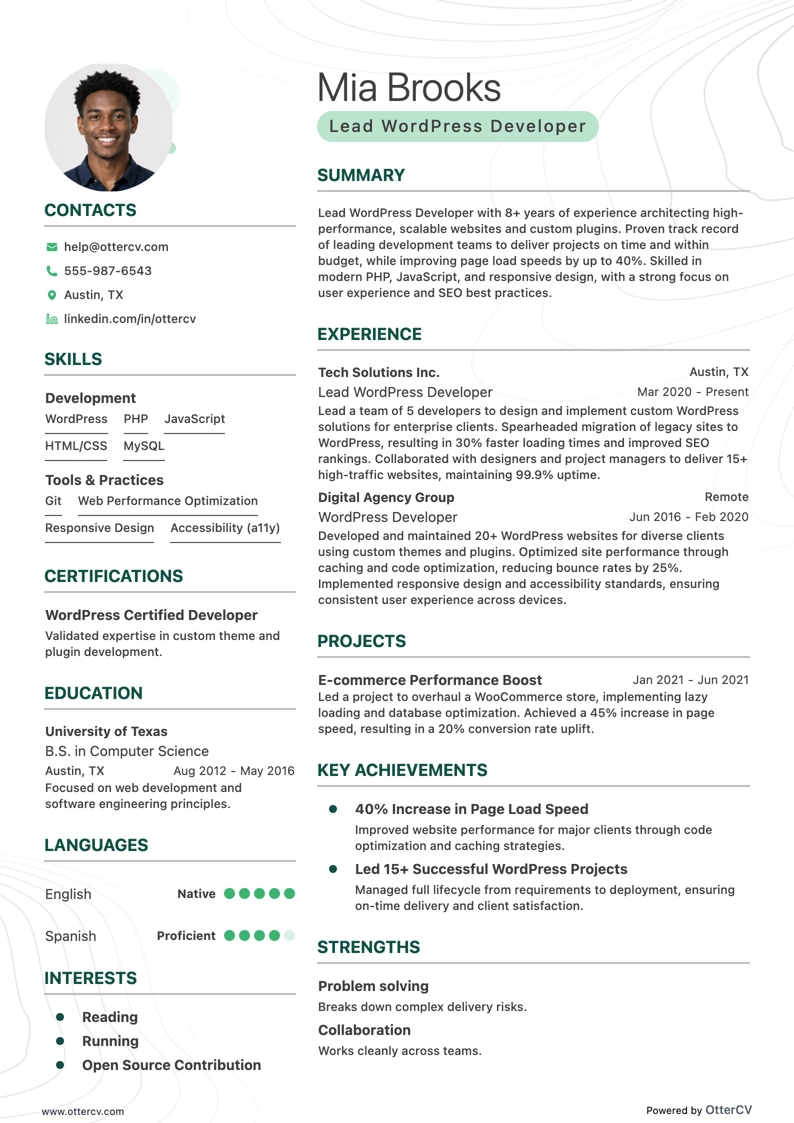
Lead WordPress Developer resume example

Lead WordPress Developer

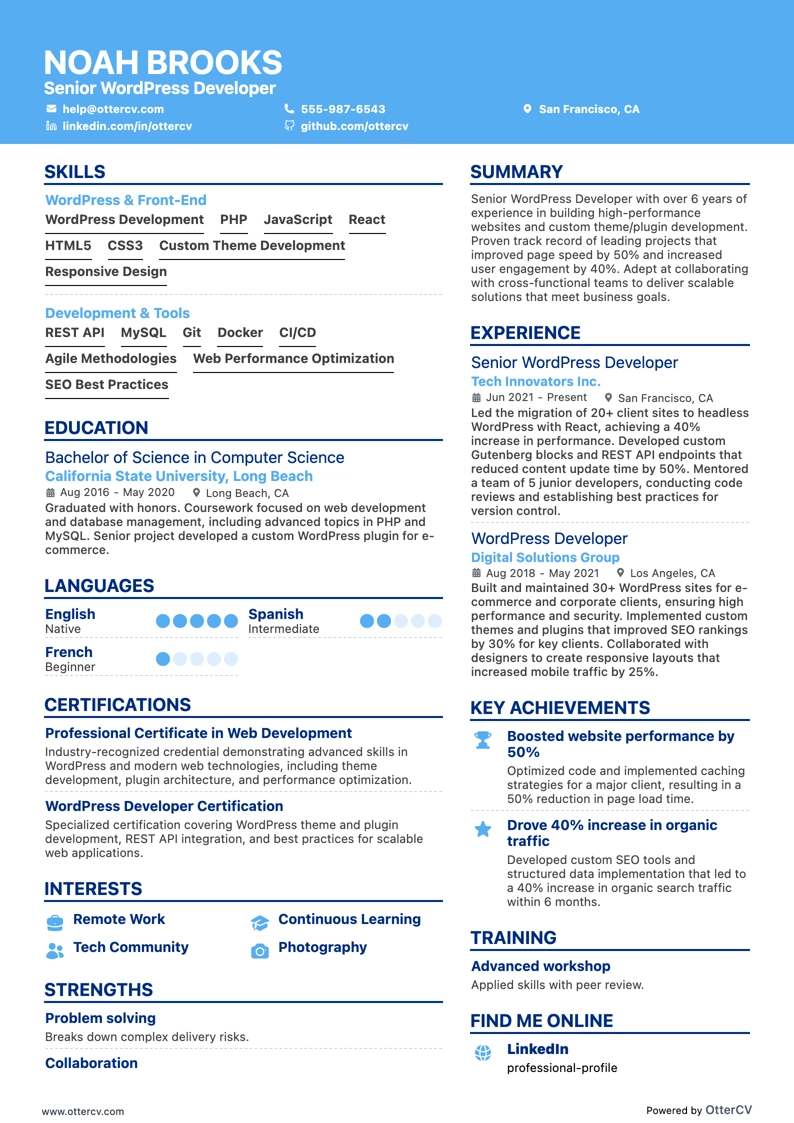
Senior WordPress Developer resume example

Senior WordPress Developer

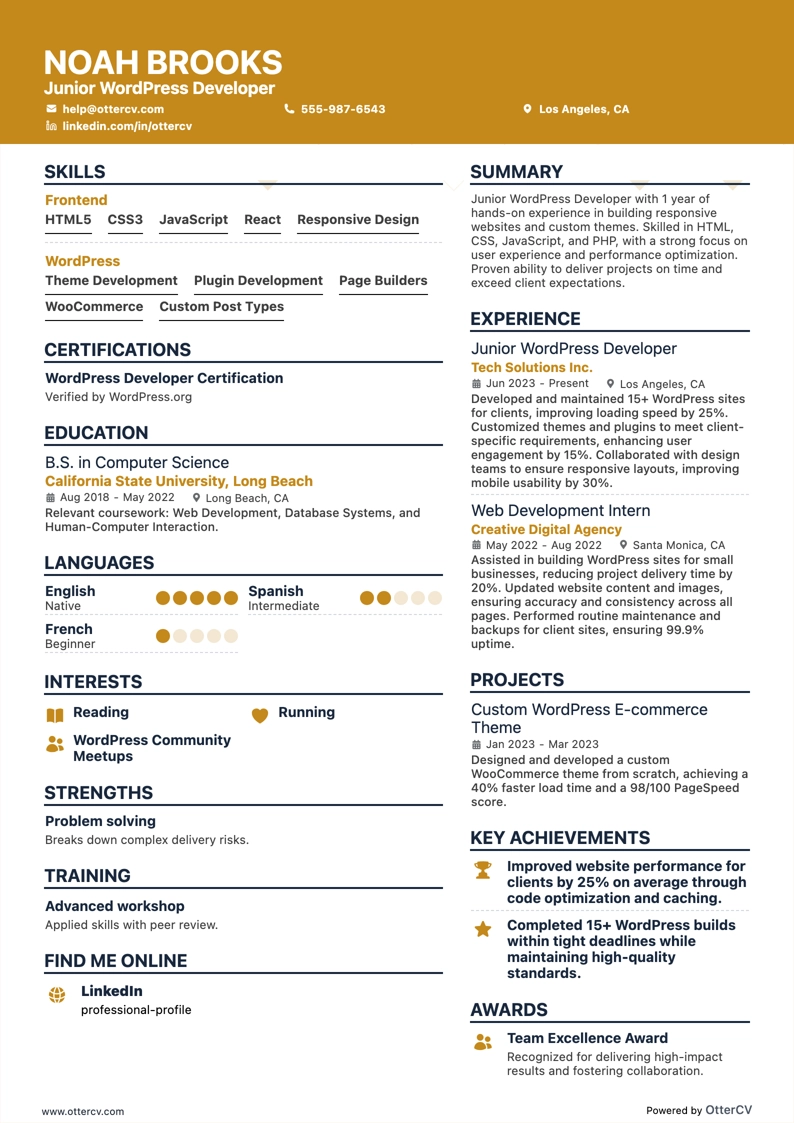
Junior WordPress Developer resume example

Junior WordPress Developer

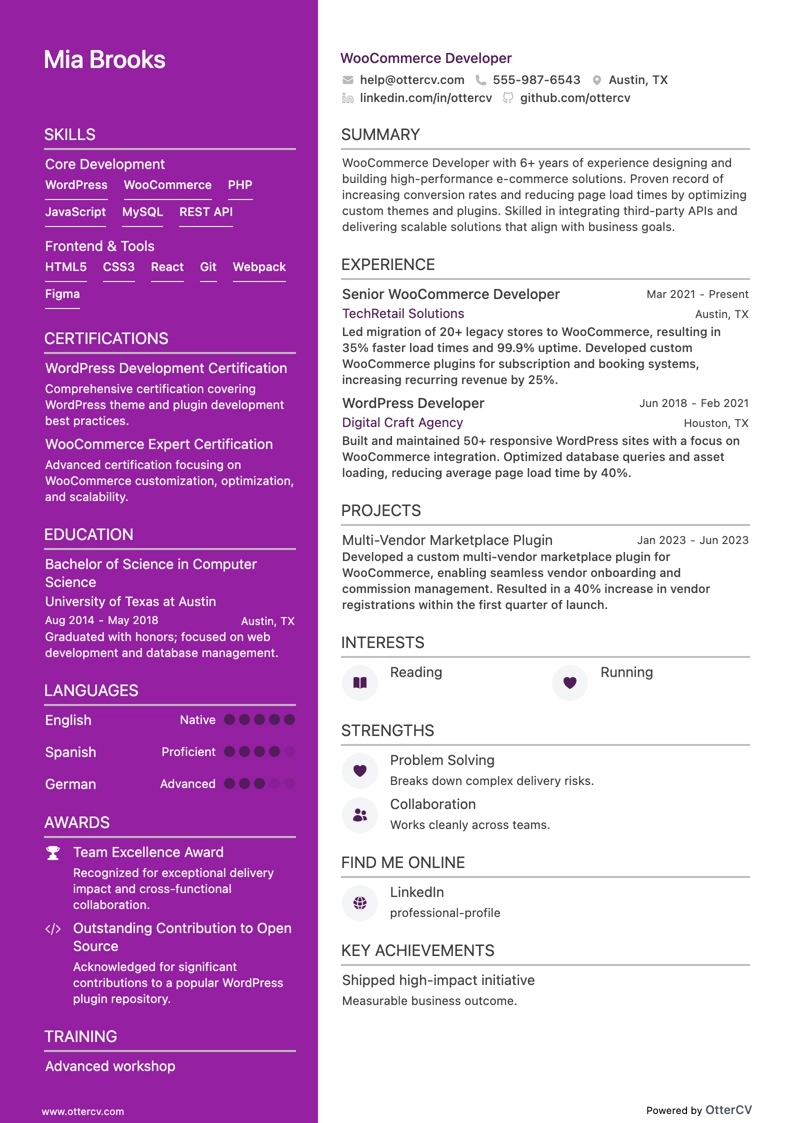
WooCommerce Developer resume example

WooCommerce Developer

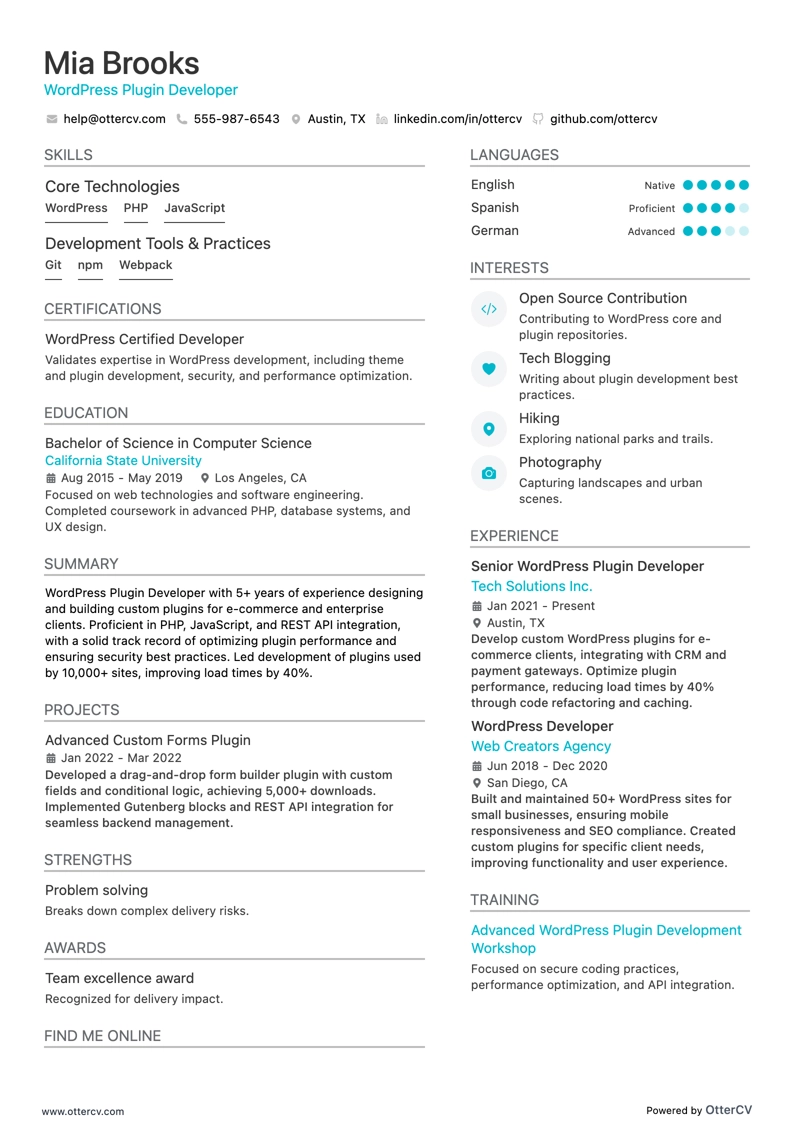
WordPress Plugin Developer resume example

WordPress Plugin Developer

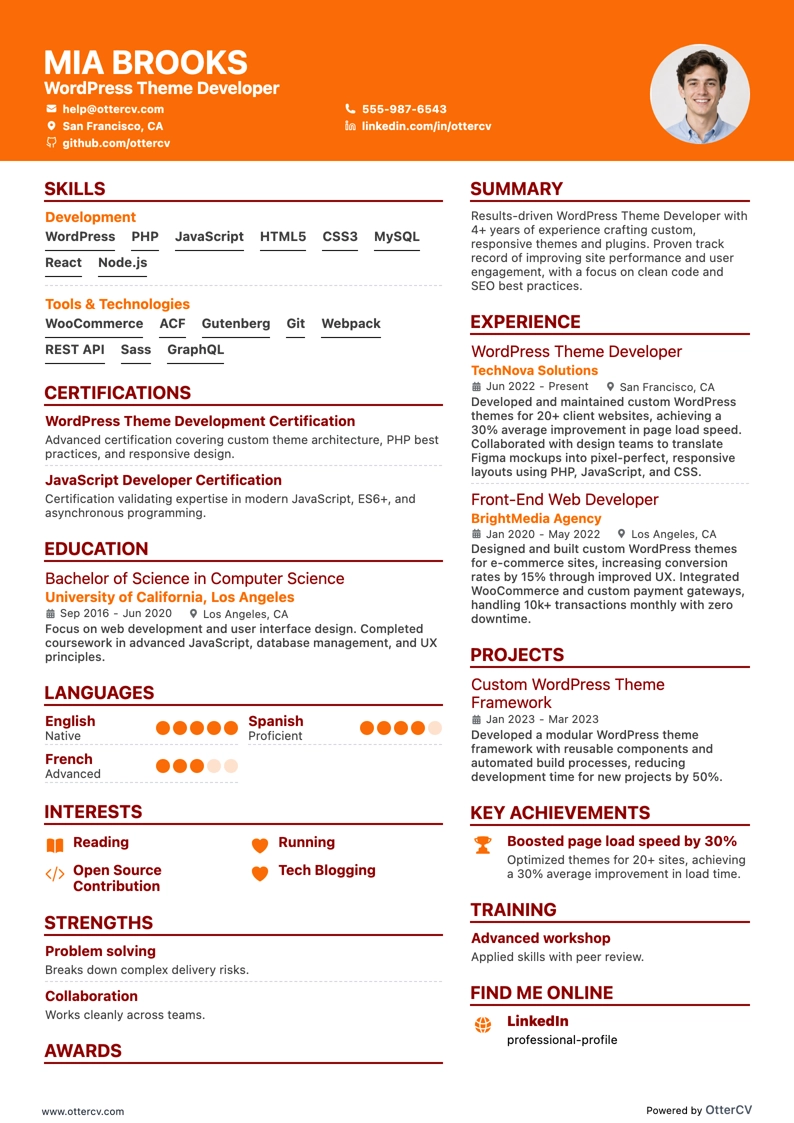
WordPress Theme Developer resume example

WordPress Theme Developer

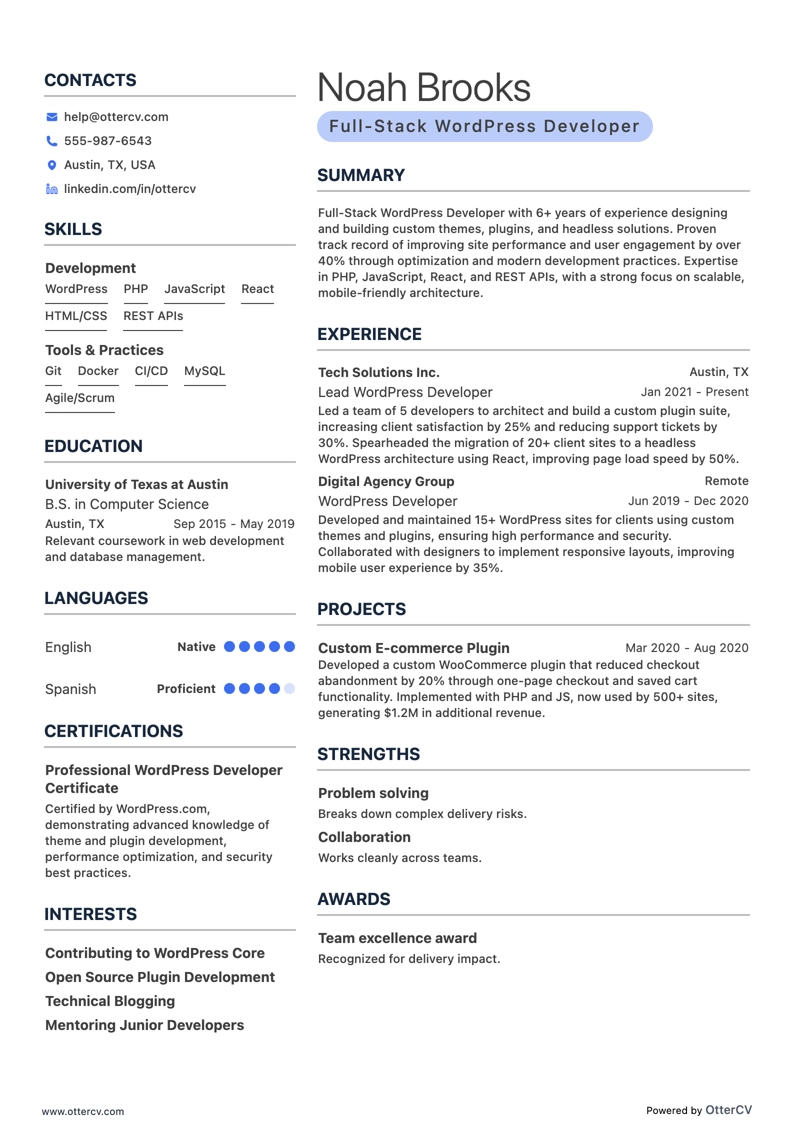
Full-Stack WordPress Developer resume example

Full-Stack WordPress Developer

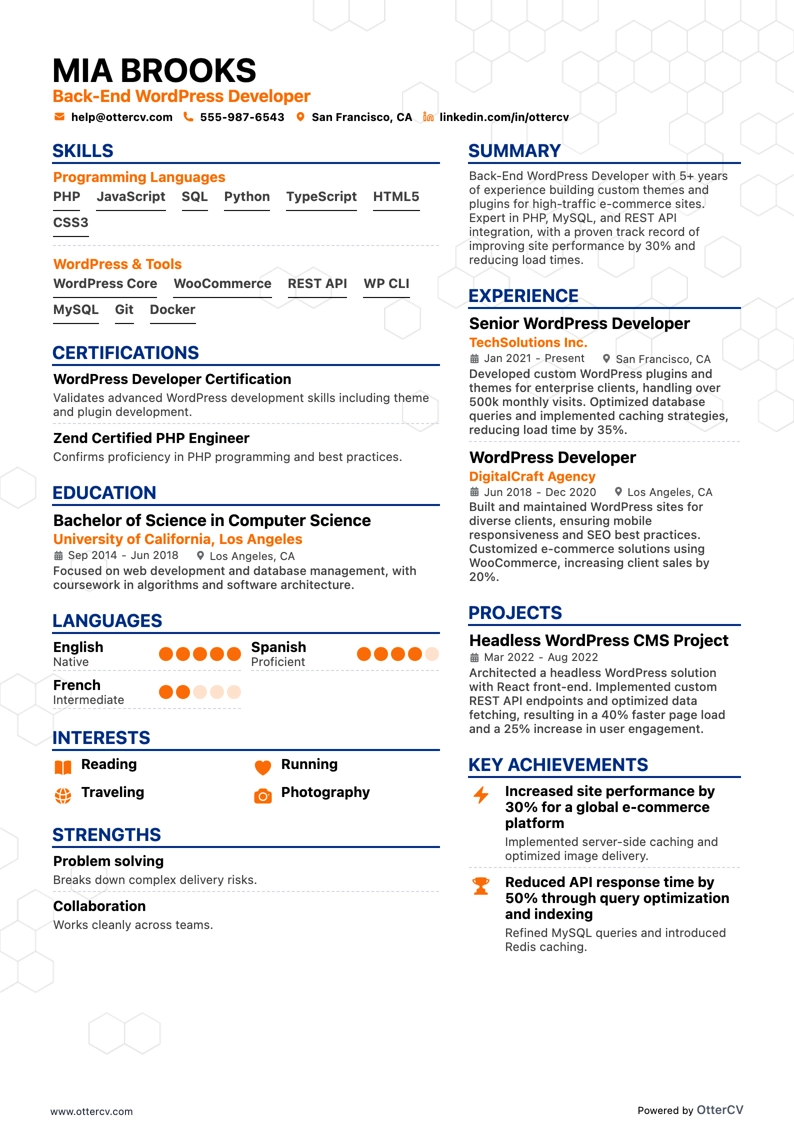
Back-End WordPress Developer resume example

Back-End WordPress Developer

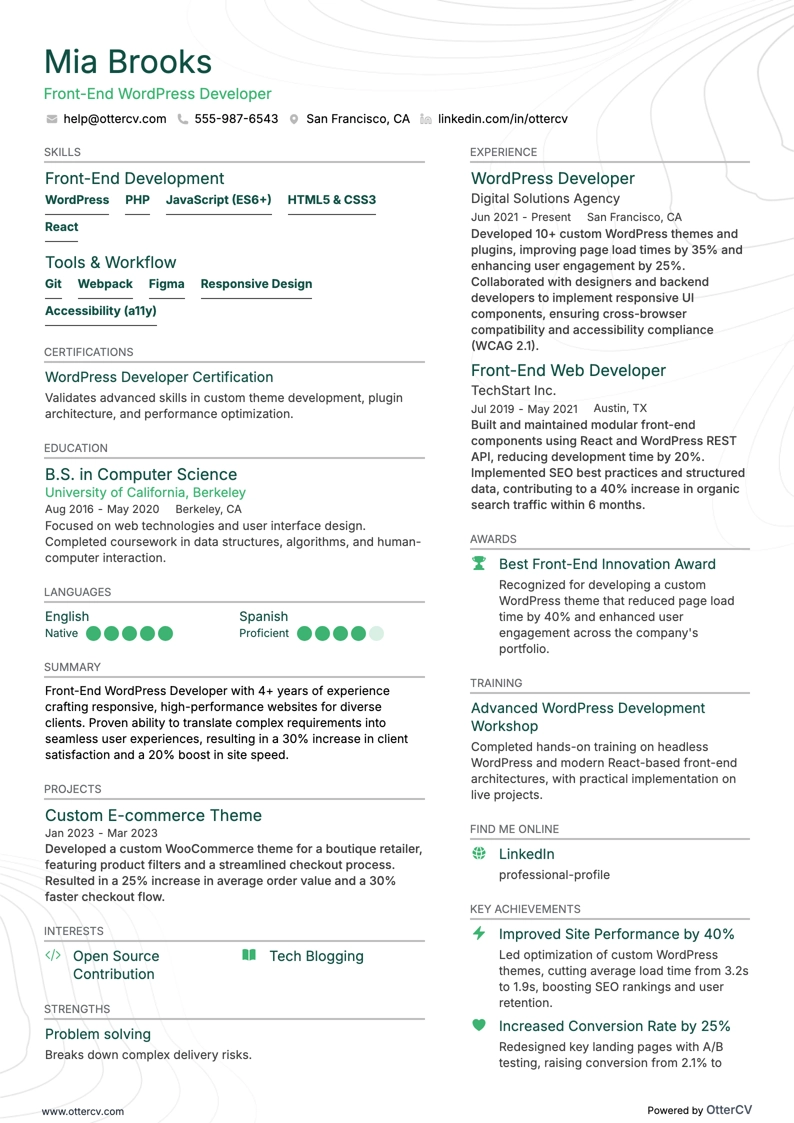
Front-End WordPress Developer resume example

Front-End WordPress Developer

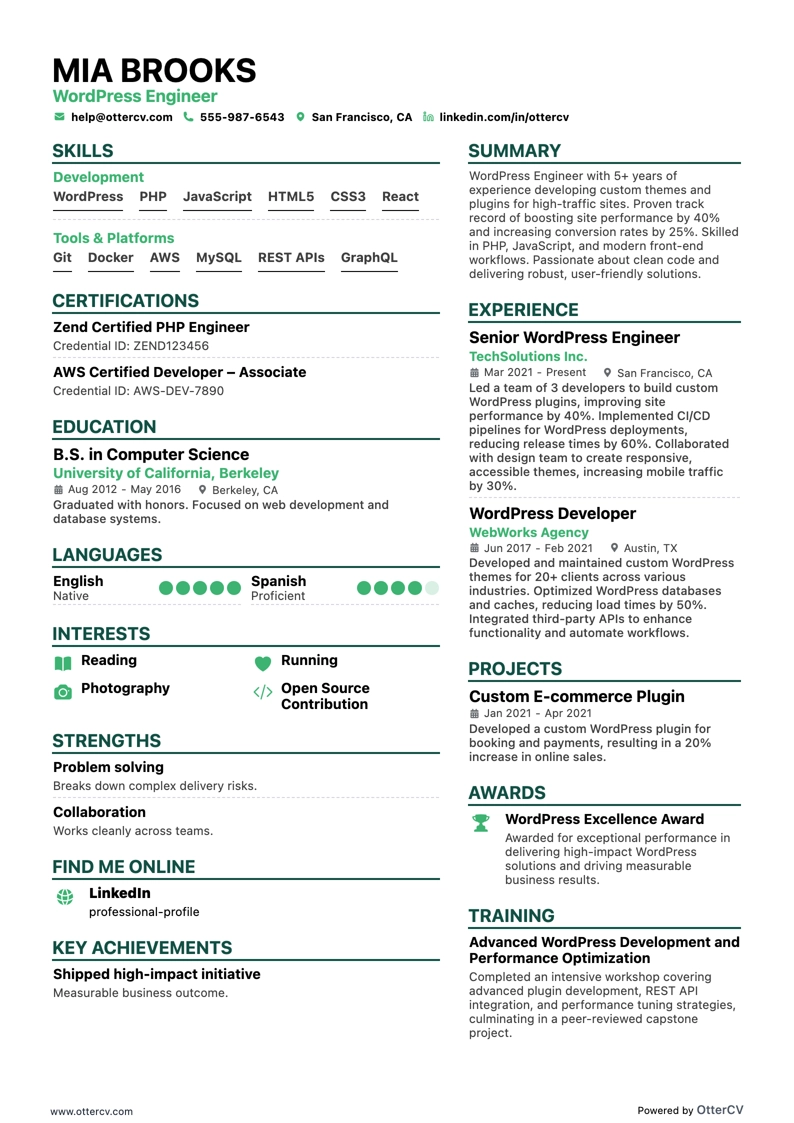
WordPress Engineer resume example

WordPress Engineer

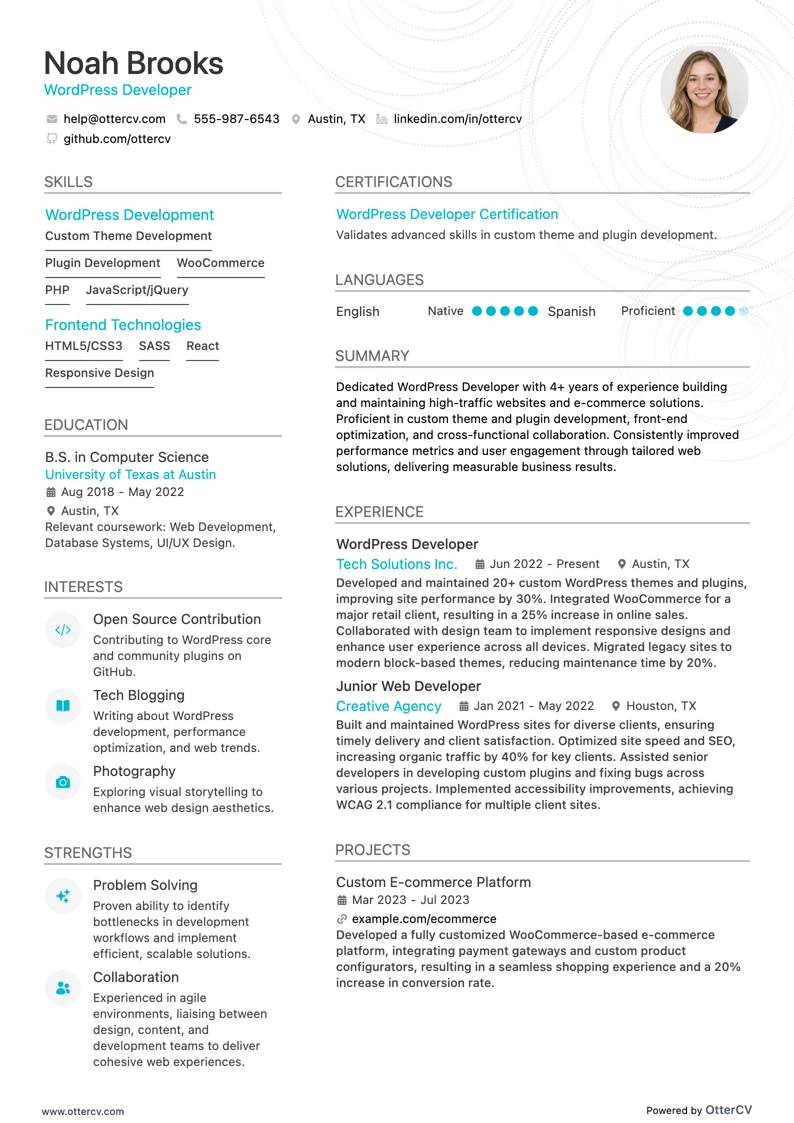
WordPress Web Developer resume example

WordPress Web Developer

A WordPress developer resume often fails because it lists plugins and tasks without showing impact, so it reads more like a job description. When competition is high, that can lead to low ATS matches and cause recruiters to skip over it during quick scans.

A strong resume shows what you improved, not just what you used. Knowing how to make your resume stand out means highlighting faster load times, higher Core Web Vitals scores, fewer production bugs, successful migrations, and launches delivered on schedule for high-traffic sites.

Key takeaways

  • Quantify each experience bullet with metrics such as load times, conversions, or uptime improvements.

  • Tailor your resume to every job posting by matching its tools and terminology.

  • Use a reverse-chronological format if you have experience, and a hybrid format if you are changing careers.

  • Place skills above experience if you are junior, and below it if you are senior.

  • Show shipped projects, Git history, and live demos to prove your ability without formal experience.

  • Write a three-to-four-line summary that names your tools, years of experience, and one measurable win.

  • Use Echocv to turn routine WordPress tasks into stronger, results-driven resume bullets.

How to format a WordPress developer resume

Recruiters reviewing WordPress developer resumes look first for hands-on technical skills, including theme and plugin development, PHP, JavaScript, and REST API integration, along with proof of completed projects and measurable results. A clean, well-structured resume format helps these signals stand out quickly during ATS parsing and the initial six-to-ten-second recruiter scan.

I have significant experience in this role—which format should I use?

I have significant experience in this role—which format should I use?

Use a reverse-chronological format to lead with your strongest, most recent WordPress development work and show clear technical growth.

  • Highlight the scope of your contributions, such as full-stack builds, multisite management, custom plugin architecture, or collaboration across design and DevOps.
  • Feature role-specific tools and domains prominently, including PHP, MySQL, WooCommerce, Advanced Custom Fields, Gutenberg block development, Git, and CI/CD pipelines.
  • Quantify outcomes tied to business impact, such as load time improvements, uptime targets, traffic growth, or revenue generated through custom e-commerce functionality.

Example bullet: "Rebuilt a legacy WordPress theme into a modular, Gutenberg-compatible framework, reducing average page load time by 42% and increasing organic traffic by 28% over six months."

I'm junior or switching into this role—what format works best?

I'm junior or switching into this role—what format works best?

A hybrid resume format works best. It lets you lead with a focused skills section while still showing a clear timeline of relevant projects or employment.

  • Put core WordPress skills—PHP, HTML/CSS, JavaScript, theme customization, and plugin configuration—in a dedicated skills section near the top of your resume.
  • List freelance projects, open-source contributions, or personal WordPress builds as structured experience entries with dates and deliverables.
  • Tie each action to a clear result so recruiters can judge your potential impact, not just your knowledge.

Example scaffold: WooCommerce customization → built a filtered product search feature for a freelance client → reduced average browsing-to-purchase time by 18%.

Why not use a functional resume?

Why not use a functional resume?

A functional resume format can hide the project context and timeline recruiters need to see how you applied WordPress skills in real-world settings. Without that context, it is harder for them to judge your readiness for the role.

This format may still work if you are moving from a closely related field, such as front-end development or web design, or returning to work after a gap. Even then, each skill should be tied to a completed project or measurable outcome instead of being listed on its own.

What sections should go on a WordPress developer resume

Once your resume has a clean, scannable format, the next step is choosing the right sections to present your qualifications clearly.

Recruiters expect a WordPress developer resume to highlight your WordPress-specific experience, technical skills, and measurable results. Knowing what to put on a resume helps you prioritize the most relevant content.

Use this structure for maximum clarity:

  • Header
  • Summary
  • Experience
  • Skills
  • Projects
  • Education
  • Certifications
  • Optional sections: Open-source contributions, Publications, Languages

Strong experience bullets should emphasize performance gains, reliability improvements, conversion or revenue impact, and the scope of the WordPress work you owned end to end.

How to write your WordPress developer resume experience

Once your resume includes the right core components, the next step is to write your WordPress developer experience section so it backs them up with clear, relevant proof.

Your work experience section should highlight the WordPress sites, themes, plugins, and integrations you’ve shipped, along with the tools, frameworks, and development methods you used to deliver them. Hiring managers care more about demonstrated impact than lists of routine tasks, so each entry should focus on measurable outcomes.

Each entry should include:

  • Job title
  • Company and location (or remote)
  • Dates of employment (month and year)

Add three to five concise bullet points that show what you owned, how you executed the work, and what results you delivered:

  • Ownership scope: the WordPress sites, custom themes, plugin ecosystems, multisite networks, or WooCommerce storefronts you were directly responsible for, including the audiences, traffic levels, or business units they served.
  • Execution approach: the languages, libraries, page builders, deployment pipelines, or development workflows you used, such as PHP, JavaScript, React, the REST API, Gutenberg block development, Git-based version control, or staging-to-production release processes.
  • Value improved: the quality, performance, security, accessibility, or reliability gains your work produced, whether that meant faster load times, higher Lighthouse scores, fewer plugin conflicts, or stronger WCAG compliance.
  • Collaboration context: how you worked with designers, content strategists, SEO specialists, DevOps engineers, or external clients to scope requirements, review pull requests, or align theme and plugin development with broader project goals.
  • Impact delivered: the tangible results of your contributions, expressed through site uptime, conversion lifts, page-speed improvements, migration completions, or reduced support tickets instead of a list of duties.

Experience bullet formula

Experience bullet formula

Action verb + technology + what you built or fixed + measurable result

A WordPress developer experience example

WordPress Developer

BrightPath Health | Remote

2022–Present

Built and optimized patient-facing marketing sites and content workflows for a multi-state healthcare provider serving 1M+ annual visitors.

  • Architected custom Gutenberg blocks and a design system using Advanced Custom Fields, WordPress, PHP, and Tailwind CSS, cutting page build time by 45% and improving brand consistency across six sites.
  • Reduced median Largest Contentful Paint from 3.2 seconds to 1.9 seconds by implementing WebP/AVIF, critical CSS, server-side caching, and Cloudflare, increasing organic sessions by 18% quarter over quarter.
  • Integrated HubSpot forms, Google Tag Manager, and GA4 event tracking with consent management, raising lead attribution accuracy from 70% to 95% and improving conversion rate by 12%.
  • Automated deployments with GitHub Actions, WP-CLI, and Pantheon multidev, decreasing release time from two hours to twenty minutes and reducing rollback incidents by 60%.
  • Partnered with product managers, designers, and compliance stakeholders to deliver HIPAA-aligned content publishing workflows and accessibility fixes, improving Lighthouse accessibility score from 82 to 96 across top templates.

Now that you've seen what a strong experience section looks like, the next step is adjusting those details to fit the specific role you're targeting.

How to tailor your WordPress developer resume experience

Recruiters review your WordPress developer resume through both human screening and applicant tracking systems. Tailoring your resume to the job description improves your chances of getting through both.

Ways to tailor your WordPress developer experience:

  • Match the exact plugins and themes listed in the job description.
  • Mirror the CMS workflows or development methodologies the employer specifies.
  • Reference the same performance or site speed benchmarks they mention.
  • Highlight accessibility or WCAG compliance work when the posting requires it.
  • Include WooCommerce or multisite experience if the role demands it.
  • Use the employer's terminology for version control and deployment processes.
  • Emphasize cross-functional collaboration with designers or content teams if the job mentions it.
  • Showcase security hardening or reliability practices when those are priorities for the role.

Tailoring means aligning your real accomplishments with what the employer values, not forcing in keywords that don't belong.

Resume tailoring examples for WordPress developer

Job description excerptUntailoredTailored
Build and maintain custom WordPress themes and plugins using PHP, HTML, CSS, and JavaScript. Collaborate with the design team to translate Figma mockups into responsive, pixel-perfect pages.Worked on websites and helped with front-end development tasks.Built 12 custom WordPress themes and 8 plugins using PHP, JavaScript, HTML, and CSS, translating Figma mockups into responsive, pixel-perfect pages that passed QA review on first submission 90% of the time.
Optimize site performance and page load speed using caching solutions (WP Rocket, Varnish), image optimization, and database query tuning. Maintain 90+ Google PageSpeed scores across all properties.Helped improve website speed and made updates to improve user experience.Configured WP Rocket and Varnish caching layers, optimized database queries, and compressed image assets across a 40-page WordPress multisite network, raising Google PageSpeed scores from 62 to 94 within three months.
Manage WooCommerce storefronts, including custom checkout flows, payment gateway integrations (Stripe, PayPal), and inventory syncing with third-party ERP systems via REST API.Supported e-commerce features and handled online store updates.Managed four WooCommerce storefronts processing $1.2M in annual revenue, building custom checkout flows, integrating Stripe and PayPal gateways, and syncing real-time inventory with NetSuite ERP through REST API endpoints.

Once your experience aligns with the role’s priorities, quantify your WordPress developer achievements to show the measurable impact of your work.

How to quantify your WordPress developer achievements

Quantifying your achievements shows business impact, not just effort. For WordPress developers, focus on performance, uptime, security, delivery speed, and conversion outcomes tied to Core Web Vitals, incidents, releases, and revenue.

Quantifying examples for WordPress developer

MetricExample
PerformanceImproved LCP from 4.1s to 2.3s by optimizing queries, adding Redis object caching, and compressing images with WebP.
ReliabilityReduced 500 errors by 62% by fixing plugin conflicts, adding health checks, and tuning PHP-FPM on a high-traffic WooCommerce site.
SecurityClosed 18 vulnerabilities by enforcing least-privilege roles, hardening wp-config.php, and adding Wordfence rules after a failed login spike.
Delivery speedCut the release cycle from two weeks to five days by automating deployments with GitHub Actions and WP-CLI across three environments.
Revenue conversionIncreased checkout conversion by 9% by simplifying WooCommerce checkout, reducing form fields, and A/B testing with Google Optimize.

Once you've written strong, results-focused bullet points for your experience section, use that same level of precision when presenting your hard and soft skills throughout your WordPress developer resume.

How to list your hard and soft skills on a WordPress developer resume

Your skills section matters because WordPress developers are often screened quickly for platform, theme, plugin, and performance expertise. Recruiters and ATS review this section for keyword match, depth, and fit, so aim for a skills mix that emphasizes hard skills while still including role-specific soft skills.

WordPress developer roles require a blend of:

  • Product strategy and discovery skills.
  • Data, analytics, and experimentation skills.
  • Delivery, execution, and go-to-market discipline.
  • Soft skills.

Your skills section should be:

  • Scannable, using bullet-style grouping.
  • Relevant to the job post.
  • Backed by proof in your experience bullets.
  • Updated with current tools.

Place your skills section:

  • Above experience if you're junior or switching careers.
  • Below experience if you're mid- or senior-level with strong achievements.

Hard skills

  • WordPress core and Gutenberg.
  • PHP, JavaScript, HTML, and CSS.
  • Custom theme development.
  • Block development with React.
  • Plugin development.
  • WooCommerce customization.
  • Advanced Custom Fields (ACF).
  • REST API and WP-CLI.
  • MySQL and database optimization.
  • Performance optimization and Core Web Vitals.
  • Git and GitHub Actions.
  • Technical SEO and schema markup.
  • Focus on listing hard skills that directly match the job posting's technical requirements and tools.

Soft skills

  • Translate requirements into clear specifications.
  • Estimate scope and evaluate trade-offs.
  • Write clear technical documentation.
  • Collaborate with designers in Figma.
  • Partner with SEO and content teams.
  • Communicate risks and blockers early.
  • Debug systematically under pressure.
  • Prioritize fixes based on user impact.
  • Review code and give actionable feedback.
  • Own deployments and rollbacks.
  • Align stakeholders on acceptance criteria.
  • Maintain accessibility-first habits.
  • Include the right soft skills to show recruiters you can collaborate effectively and communicate clearly with cross-functional teams.

How to show your WordPress developer skills in context

Skills should not live only in a bulleted list on your resume. Reviewing examples of resume skills shown in context can help you see how strong candidates weave their competencies into real experience.

Your skills should appear in:

  • Your summary, where you define your high-level professional identity
  • Your experience, where you prove your skills through outcomes

Here’s what that looks like in practice.

Summary example

Senior WordPress developer with eight years of experience building scalable e-commerce and membership sites. Skilled in PHP, WooCommerce, REST API, and performance optimization. Reduced average page load times by 52% across a portfolio of 30+ client sites.

  • Immediately signals senior-level expertise
  • References role-specific tools and frameworks
  • Leads with a measurable performance outcome
  • Suggests client management and collaboration experience

Experience example

Senior WordPress Developer

Brightlane Digital | Remote

March 2020–Present

  • Rebuilt a WooCommerce storefront with custom Gutenberg blocks and REST API integrations, increasing conversion rates by 34% within six months.
  • Worked with UX designers and content strategists to launch 12 responsive client sites on time, each scoring above 90 on Google PageSpeed Insights.
  • Migrated 18 legacy sites to an optimized WordPress multisite architecture, reducing annual hosting costs by $14,000 and cutting maintenance hours by 40%.
  • Every bullet includes measurable proof.
  • Skills surface naturally through real outcomes.

Once you’ve shown your WordPress development ability through real examples and outcomes, the next step is turning that proof into a resume, even without formal experience.

How do I write a WordPress developer resume with no experience

Even without full-time experience, you can show you’re ready through personal projects and contributions. Building a resume without work experience is completely possible when you emphasize real deliverables such as:

  • Personal WordPress site builds
  • Custom theme from starter theme
  • Plugin customization with hooks
  • Local development with Docker
  • GitHub portfolio with commits
  • Freelance fixes for small businesses
  • Core Web Vitals optimization work
  • Contributions to WordPress.org support

Focus on:

  • Shipped WordPress developer projects
  • Code samples and Git history
  • Performance, security, accessibility metrics
  • Clear stack: PHP, JavaScript, SQL

Resume format tip for entry-level WordPress developer

Resume format tip for entry-level WordPress developer

Use a skills-first hybrid resume format. When your work history is limited, this format helps emphasize projects, tools, and measurable outcomes.

  • Lead with a Projects section.
  • Link to GitHub and live demos.
  • List tools such as PHP, JavaScript, and MySQL.
  • Describe the scope, stack, and results.
  • Include testing, security, and performance steps.

Example project bullet:

  • Built a custom theme from a starter theme using PHP, Advanced Custom Fields, and Git; improved Lighthouse performance score from 62 to 90.

Once you’ve organized your resume around transferable skills and relevant projects, the next step is to present your education clearly to reinforce your qualifications.

How to list your education on a WordPress developer resume

Your education section helps hiring teams confirm that you have foundational knowledge in web development, computer science, or design principles relevant to the WordPress developer role.

Include:

  • Degree name
  • Institution
  • Location
  • Graduation year
  • Relevant coursework (for juniors or entry-level candidates)
  • Honors & GPA (if 3.5 or higher)

Skip month and day details and list the graduation year only.

Here’s a strong education entry tailored to a WordPress developer resume.

Example education entry

Bachelor of Science in Computer Science

University of Colorado Denver, Denver, CO

Graduated 2021

GPA: 3.7/4.0

  • Relevant coursework: Web Application Development, Database Systems, PHP Programming, User Interface Design
  • Honors: Magna Cum Laude, Dean's List (six semesters)

How to list your certifications on a WordPress developer resume

Certifications on your resume show a WordPress developer’s commitment to learning, proficiency with key tools, and alignment with current industry standards, especially for modern site building and performance work.

Include:

  • Certificate name
  • Issuing organization
  • Year
  • Optional: credential ID or URL
  • List certifications below education when your degree is recent and more relevant than your certifications.
  • List certifications above education when they’re recent, highly relevant, or your education is older or unrelated to WordPress developer work.

Best certifications for your WordPress developer resume

  • Google Analytics Certification.
  • Google Tag Manager Fundamentals Certification.
  • AWS Certified Cloud Practitioner.
  • HubSpot Content Marketing Certification.
  • Yoast SEO for WordPress Certification.
  • Microsoft Certified: Azure Fundamentals.
  • Certified ScrumMaster (CSM).

How to write your WordPress developer resume summary

Once you’ve placed your certifications where they have the most impact, use your WordPress developer resume summary to show how those credentials translate into immediate value.

Your resume summary is often the first thing a recruiter reads. A strong summary quickly shows that you’re a qualified WordPress developer worth interviewing.

Keep it to three to four lines and include:

  • Your title and total years of WordPress development experience.
  • The types of projects, industries, or products you’ve worked on.
  • Core tools and technologies such as PHP, JavaScript, REST API, WooCommerce, or Gutenberg.
  • One or two measurable achievements that demonstrate your impact.
  • Soft skills connected to real results, such as collaboration that shortened sprint cycles.

PRO TIP

At a junior or mid-level, lead with your strongest technical skills and any early wins that show initiative.

Highlight the specific tools you’ve used and the contributions you’ve made to real projects.

Avoid vague phrases like “passionate self-starter” or “eager to learn.” Instead, let concrete results and relevant technologies show that you’re ready.

Example summary for a WordPress developer

WordPress developer with three years of experience building custom themes and plugins for e-commerce clients. Skilled in PHP, JavaScript, and WooCommerce. Improved site performance, reducing load times by 40% across 12 client projects.

Now that your summary highlights your strongest qualifications, make sure your header includes the key contact and professional details recruiters need to reach you.

What to include in a WordPress developer resume header

A resume header is the top section of your resume that shows your identity and contact details. For a WordPress developer, it also improves visibility, credibility, and recruiter screening.

Essential resume header elements:

  • Full name
  • Tailored job title and headline
  • Location
  • Phone number
  • Professional email
  • GitHub link
  • Portfolio link
  • LinkedIn

A LinkedIn link helps recruiters quickly confirm your experience and supports screening with consistent dates, titles, and work history.

Do not include a photo on a WordPress developer resume unless the role is explicitly front-facing or appearance-dependent.

Keep your header to two lines, match your job title to the posting, and use links that open to your best WordPress developer work.

Example

Once your contact details and role focus are clear at the top, add supporting sections to highlight qualifications that do not fit in the header but still strengthen your WordPress developer resume.

Additional sections for WordPress developer resumes

When applicants have similar core qualifications, additional sections can help a WordPress developer stand out by showing credibility and personality. For example, listing language skills can help you stand out when applying to companies with international clients or multilingual user bases.

  • Languages
  • Open source contributions
  • WordPress community involvement
  • Certifications
  • Publications
  • Hobbies and interests
  • Speaking engagements

Once you’ve strengthened your resume with relevant additional sections, the next step is pairing it with a strong cover letter to make an even greater impact.

Do WordPress developer resumes need a cover letter

A cover letter isn’t required for a WordPress developer, but it often helps for competitive roles or teams that expect one. If you’re unsure what a cover letter is or when it adds value, it can make a difference when your resume needs more context or when hiring managers want clear communication.

Use a cover letter when it strengthens your application:

  • Explain your fit for the role and team by connecting your strengths to the stack, workflow, and collaboration style in the job description.
  • Highlight one or two relevant projects or outcomes, including measurable results such as performance gains, conversion lifts, or reduced support tickets.
  • Show that you understand the product, users, or business context by referencing key pages, integrations, or user journeys that affect revenue or retention.
  • Address career transitions or less obvious experience by linking past work to WordPress developer tasks such as migrations, accessibility, or security.

Even if you decide a cover letter will not add value to your application, you can still use AI to strengthen your WordPress developer resume and improve how clearly it matches the role.

Using AI to improve your WordPress developer resume

AI can improve your resume’s clarity, structure, and impact. It can help rewrite weak bullet points, tighten language, and align your content with job descriptions. If you are wondering which AI is best for writing resumes, start with tools that give you control over the output and let you edit freely. But overusing AI can make your resume feel less authentic. Once it reads clearly and fits the role, stop using it.

Here are 10 practical prompts to strengthen specific sections of your WordPress developer resume:

  1. Strengthen your summary. “Rewrite my WordPress developer resume summary to highlight my strongest technical skills and years of experience in under four sentences.”
  2. Quantify experience bullets. “Add measurable results to each of my WordPress developer experience bullets, focusing on site speed, uptime, or traffic improvements.”
  3. Tailor skills placement. “Reorganize the skills section of my WordPress developer resume to prioritize skills mentioned in this job description.”
  4. Tighten project descriptions. “Shorten each WordPress developer project description to two concise sentences that emphasize scope, tools used, and outcomes.”
  5. Remove filler language. “Identify and remove vague or redundant words from my WordPress developer resume without changing the core meaning.”
  6. Improve action verbs. “Replace weak or repeated action verbs in my WordPress developer experience section with stronger, more specific alternatives.”
  7. Align with job postings. “Compare my WordPress developer resume against this job listing and suggest keyword gaps in my experience and skills sections.”
  8. Refine education details. “Rewrite the education section of my WordPress developer resume to highlight coursework and projects relevant to web development.”
  9. Highlight certifications. “Reorder and describe my certifications section so each entry clearly supports my qualifications as a WordPress developer.”
  10. Fix inconsistent formatting. “Review my WordPress developer resume for inconsistent tense, punctuation, or formatting across all sections and suggest corrections.”

Stop using AI once your resume sounds accurate, specific, and aligned with your real experience. AI should never invent experience or exaggerate claims—if it did not happen, it does not belong on your resume.

Conclusion

A strong WordPress developer resume shows impact through measurable outcomes, such as faster load times, higher conversions, fewer support tickets, or smoother releases. It should also highlight role-specific skills, including theme and plugin development, PHP, JavaScript, security, performance, and accessibility.

Keep the structure clear so hiring teams can scan it quickly. Lead with results, match your skills to the role, and show consistent delivery across projects. This signals that you are ready for today’s WordPress developer roles and the market ahead.

Wordpress Developer resume examples

Explore additional Wordpress Developer resume samples and guides and see what works for your level of experience or role.

By Experience

Lead WordPress Developer

Lead WordPress Developer resume preview

Senior WordPress Developer

Senior WordPress Developer resume preview

Junior WordPress Developer

Junior WordPress Developer resume preview

Wordpress Developer resume examples

Explore additional Wordpress Developer resume samples and guides and see what works for your level of experience or role.

By Role

WooCommerce Developer

WooCommerce Developer resume preview

WordPress Plugin Developer

WordPress Plugin Developer resume preview

WordPress Theme Developer

WordPress Theme Developer resume preview

Full-Stack WordPress Developer

Full-Stack WordPress Developer resume preview

Back-End WordPress Developer

Back-End WordPress Developer resume preview

Front-End WordPress Developer

Front-End WordPress Developer resume preview

WordPress Engineer

WordPress Engineer resume preview

WordPress Web Developer

WordPress Web Developer resume preview