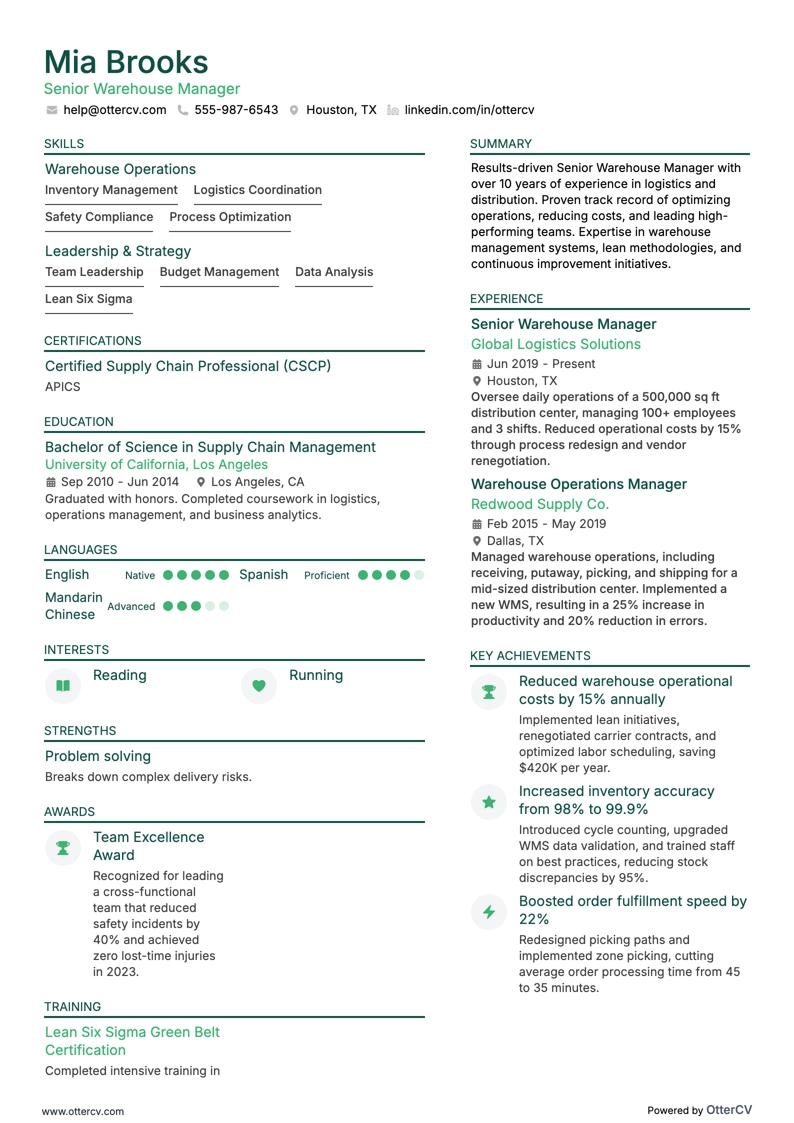
Senior Warehouse Manager full preview

10 Warehouse Manager Resume Examples

OtterCV

Written by The OtterCV Team

Updated: 1/24/2024•8 min read

See all resume examples in this guide, or generate your own resume example with your personalized prompt

Senior Warehouse Manager resume example

Senior Warehouse Manager

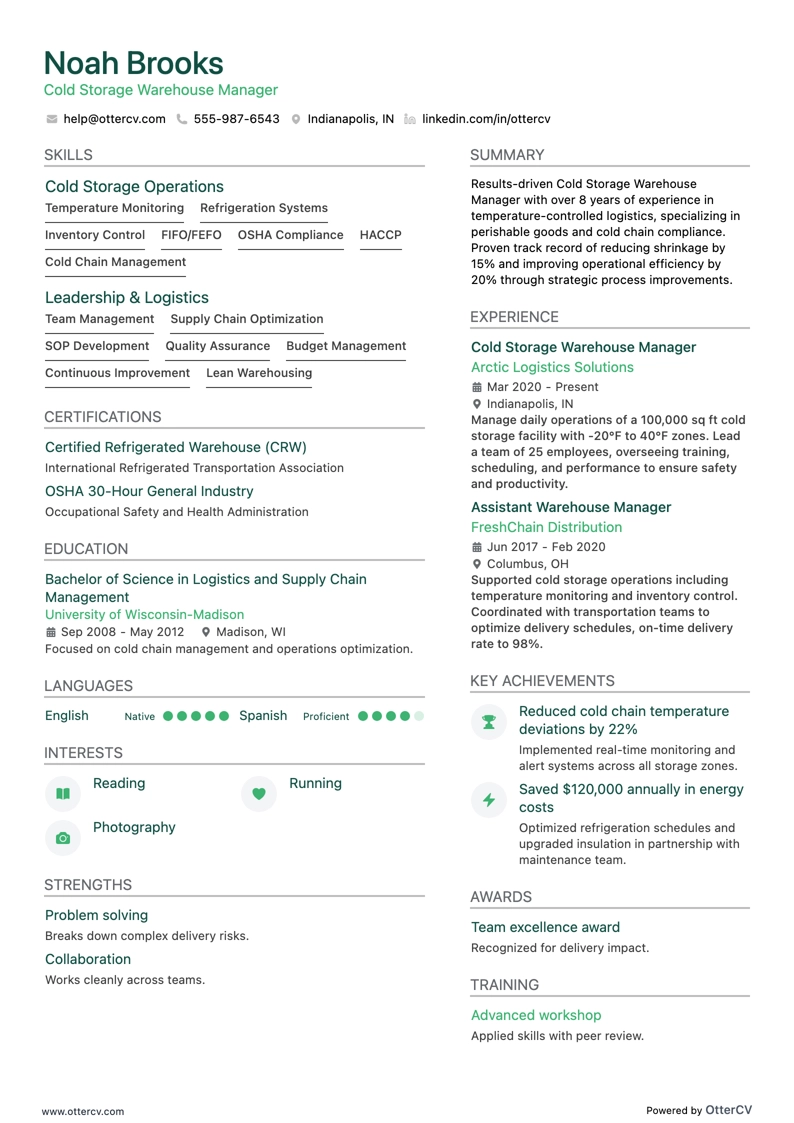
Cold Storage Warehouse Manager resume example

Cold Storage Warehouse Manager

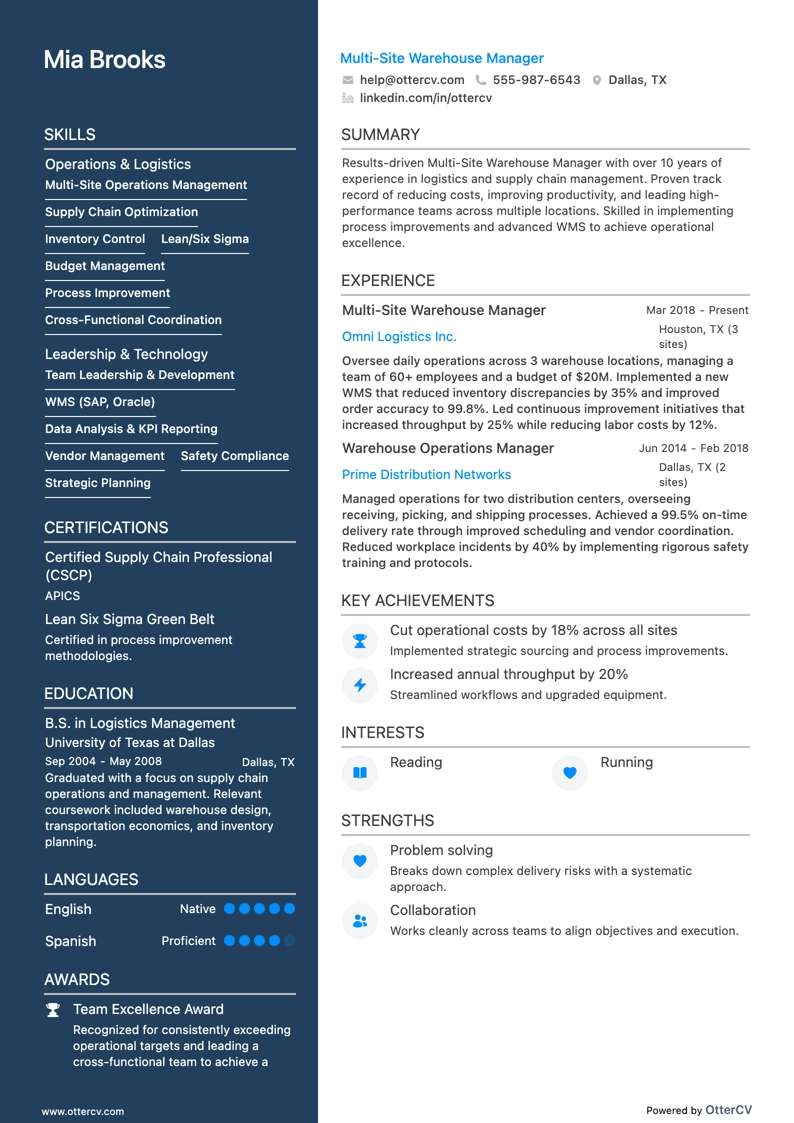
Multi-Site Warehouse Manager resume example

Multi-Site Warehouse Manager

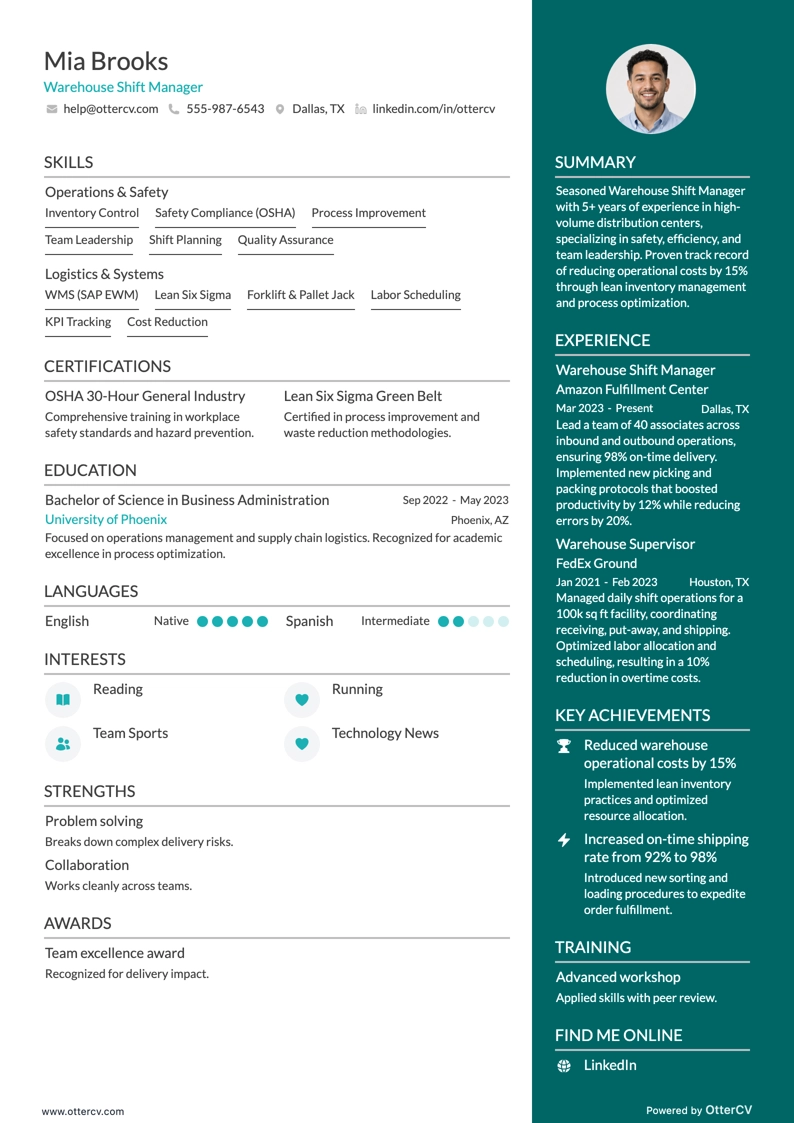
Warehouse Shift Manager resume example

Warehouse Shift Manager

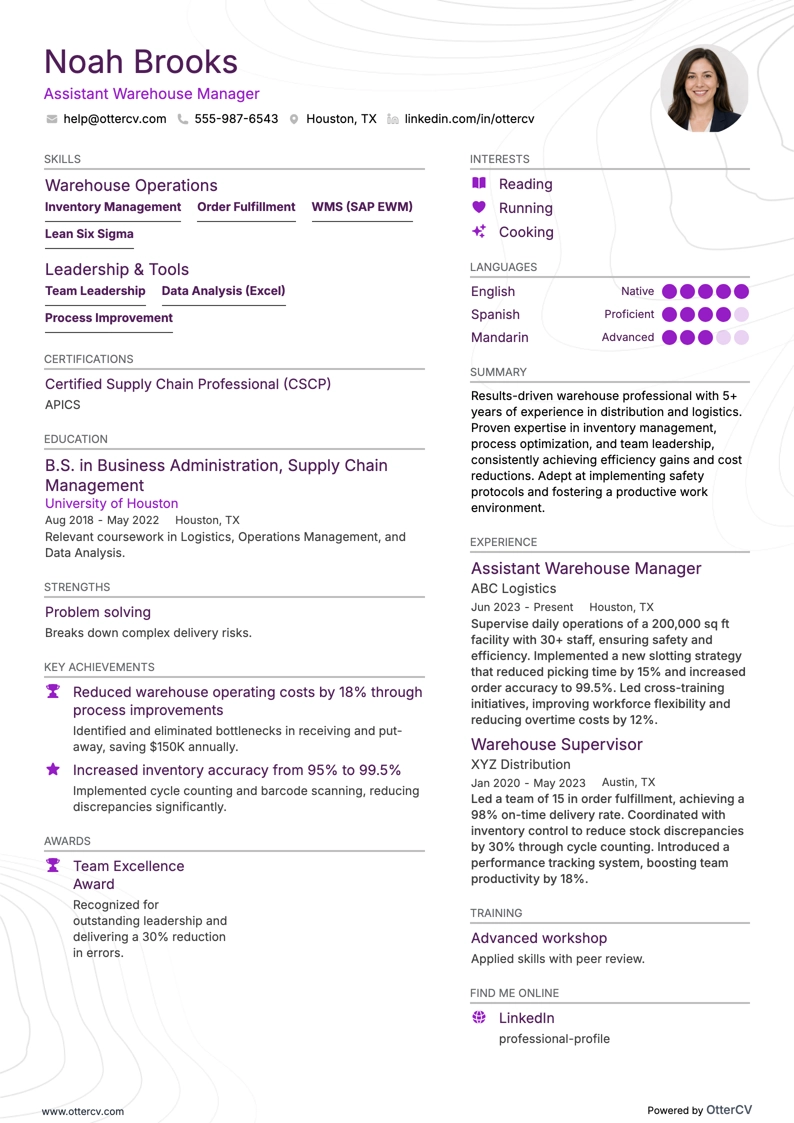
Assistant Warehouse Manager resume example

Assistant Warehouse Manager

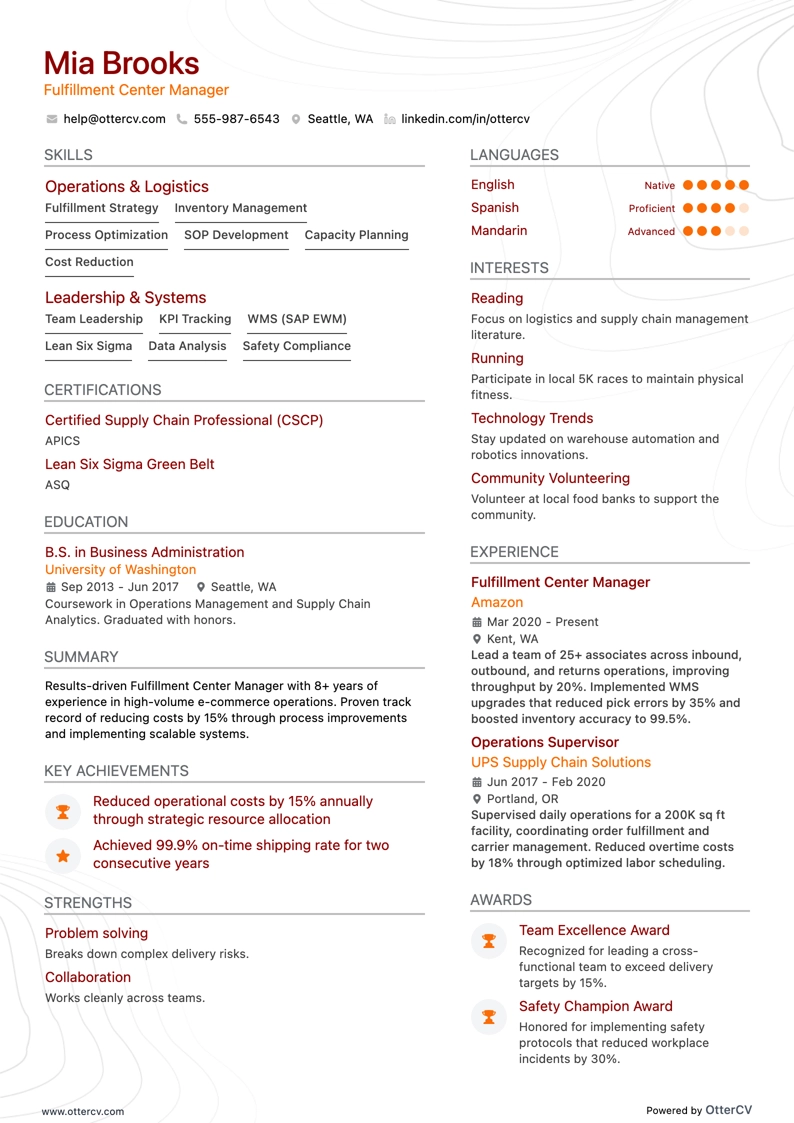
Fulfillment Center Manager resume example

Fulfillment Center Manager

Most warehouse manager resumes fall short because they list duties and tools without showing measurable impact on throughput, accuracy, or costs. That makes your value harder to spot during ATS screening and the six-second recruiter scan, especially in a competitive market.

A strong resume shows what improved because you led the operation. If you are not sure where to start, learning how to write a resume with an impact-focused approach is an essential first step. Highlight gains in pick rate, order accuracy, on-time shipping percentage, inventory shrink reduction, headcount and shift coverage, safety incident reduction, and dock-to-stock cycle time. Quantify your scope, budgets, and multi-site results.

Key takeaways

  • Quantify throughput, accuracy, cost savings, and safety outcomes in every experience bullet.

  • Use a reverse-chronological format for experienced managers and a hybrid format for career changers.

  • Tailor your resume language to match each job posting’s tools, metrics, and terminology.

  • Lead your summary with years of experience, operational scope, and one measurable result.

  • Place certifications like OSHA and Six Sigma near education to signal hands-on readiness.

  • Support every listed skill with a concrete outcome in your experience section.

  • Use Echocv to turn vague warehouse duties into measurable, recruiter-ready resume bullets.

Job market snapshot for warehouse managers

We analyzed 599 recent warehouse manager job ads across major US job boards to provide a quick view of experience requirements, top hiring companies, and role specialization trends.

What level of experience employers are looking for warehouse managers

Years of ExperiencePercentage found in job ads
1–2 years11.4% (68)
3–4 years18.2% (109)
5–6 years19.4% (116)
7–8 years2.5% (15)
9–10 years2.2% (13)
10+ years4.7% (28)
Not specified43.9% (263)

Warehouse manager ads by area of specialization (industry)

Industry (Area)Percentage found in job ads
Healthcare54.6% (327)
Finance & Banking30.9% (185)
Manufacturing5.3% (32)
Education3.7% (22)
Retail & E-commerce2.0% (12)

Top companies hiring warehouse managers

CompanyPercentage found in job ads
Accenture36.1% (216)
Uline, Inc.10.7% (64)
Army National Guard9.8% (59)
ABB LTD1.7% (10)
Compass Group USA Inc1.7% (10)

Role overview stats

These tables outline the most common responsibilities and employment types for warehouse manager roles. Use them to align your resume with employer expectations and understand how the role is structured across the market.

Day-to-day activities and top responsibilities for a warehouse manager

ResponsibilityPercentage found in job ads
Inventory management26.9% (161)
Warehouse management19.7% (118)
Supply chain17.5% (105)
SAP EWM16.9% (101)
Oracle WMS Cloud13.0% (78)
Data analysis12.2% (73)
Forklift operation12.0% (72)
Shipping11.7% (70)
SAP10.9% (65)
Lean10.4% (62)
Accounting9.0% (54)
Agile9.0% (54)

How to format a warehouse manager resume

Recruiters reviewing warehouse manager candidates look first for signs of operational efficiency, team leadership, inventory accuracy, and safety compliance. These qualifications should be immediately clear on your resume.

Choosing the right resume format helps those strengths stand out in both human review and applicant tracking system (ATS) scans. The wrong format can hide the exact experience hiring managers want to see.

I have significant experience in this role—which format should I use?

I have significant experience in this role—which format should I use?

Use a reverse-chronological format to show your progression through increasingly complex warehouse operations and leadership responsibilities.

  • Start with your most recent role and emphasize scope, including facility size, team headcount, budget ownership, and the number of SKUs or shipments managed.
  • Highlight your proficiency with warehouse management systems (WMS), enterprise resource planning (ERP) platforms, inventory control methodologies, and lean/Six Sigma practices.
  • Quantify business impact with metrics such as cost reduction, order accuracy, throughput improvements, and reductions in safety incidents.

Example bullet: “Directed daily operations across a 250,000 sq. ft. distribution center with 45 direct reports, reducing order fulfillment errors by 32% and cutting average shipping costs by $1.2M annually through route optimization and WMS integration.”

I'm junior or switching into this role—what format works best?

I'm junior or switching into this role—what format works best?

A hybrid format works best because it highlights transferable skills and relevant competencies while still showing a clear work history.

  • Place a skills section near the top with warehouse-relevant strengths such as inventory management, forklift certification, safety protocols, and team coordination.
  • Include projects, internships, or transitional experience that show operational problem-solving, such as process improvements, vendor coordination, or logistics support roles.
  • Connect each action to a measurable result so hiring managers can see your potential impact, even without direct warehouse management titles.

Example scaffold: Inventory control skills → conducted weekly cycle counts and reconciled discrepancies across three storage zones → reduced shrinkage by 18% over one quarter.

Why not use a functional resume?

Why not use a functional resume?

A functional resume removes the timeline and context hiring managers use to assess your hands-on operational growth, which makes it harder for them to verify where and how you built your warehouse management skills.

This format may still work if you are moving from a related field, such as logistics coordination or retail operations management, have limited warehouse-specific experience, or are returning to the workforce after a gap. However, each skill should be tied to specific projects, certifications, or outcomes instead of being presented on its own.

Once your layout and formatting are set, the next step is choosing resume sections that each serve a clear purpose.

What sections should go on a warehouse manager resume

Recruiters want clear evidence that you can run safe, efficient warehouse operations and meet service-level targets. Knowing which resume sections to include helps you present that evidence clearly.

Use this structure for maximum clarity:

  • Header
  • Summary
  • Experience
  • Skills
  • Projects
  • Education
  • Certifications
  • Optional sections: Awards, Leadership, Languages

Strong experience bullets should highlight measurable results, operational scope, and improvements in safety, accuracy, throughput, cost, and on-time performance.

How to write your warehouse manager resume experience

Once you’ve organized the key resume components, the next step is to write your warehouse manager resume experience section, because this is where you prove your impact in the role.

The experience section should show your ability to run warehouse operations, including the systems you’ve managed, the tools and methods you’ve used, and the measurable results you’ve delivered. Hiring managers care more about demonstrated impact than generic task lists, so every bullet should reflect work that shipped, improved, or solved something concrete.

Each entry should include:

  • Job title
  • Company and location (or remote)
  • Dates of employment (month and year)

Add three to five concise bullet points that explain what you owned, how you executed, and what outcomes you delivered:

  • Ownership scope: the warehouse facilities, inventory categories, distribution channels, equipment fleets, or teams you were directly accountable for as a warehouse manager.
  • Execution approach: the warehouse management systems, inventory control methods, lean principles, safety protocols, or logistics technologies you used to make decisions and keep operations running.
  • Value improved: changes to order accuracy, fulfillment speed, inventory shrinkage, workplace safety, storage capacity, or cost efficiency that resulted from your leadership.
  • Collaboration context: how you coordinated with procurement, transportation, sales, quality assurance, or third-party logistics providers to align warehouse operations with broader supply chain goals.
  • Impact delivered: outcomes expressed through operational results, throughput scale, or business impact—such as reductions in waste, gains in productivity, or improvements in on-time delivery—rather than a list of daily activities.

Experience bullet formula

Experience bullet formula

Action verb + technology + what you built or fixed + measurable result

A warehouse manager experience example

Warehouse Manager

Redwood Supply Co. | Phoenix, AZ

2021–Present

Led a two-shift, 250,000-square-foot distribution center supporting retail and e-commerce fulfillment across the Southwest.

  • Directed daily inbound, putaway, replenishment, and outbound operations using Manhattan WMS (warehouse management system) and RF scanners, increasing order accuracy from 98.6% to 99.7% and reducing mis-picks by 58%.
  • Implemented slotting optimization and ABC velocity analysis in Excel and Power BI, cutting average pick path distance by 18% and improving lines picked per hour by 22% across forty-five associates.
  • Partnered with transportation, procurement, and key suppliers to launch an appointment scheduling and ASN (advanced shipping notice) process, reducing dock-to-stock time from nine hours to five hours and lowering detention fees by $84,000 annually.
  • Standardized cycle counting and root-cause workflows in the WMS, improving inventory accuracy from 96.9% to 99.2% and reducing stockouts by 31% for the top one hundred SKUs.
  • Co-led a safety and equipment reliability program with HR and maintenance, deploying daily pre-shift checklists and forklift telematics, reducing recordable incidents by 40% and improving equipment uptime by 15%.

Now that you've seen what a strong experience section looks like, the next step is adjusting it for the specific warehouse manager role you're targeting.

How to tailor your warehouse manager resume experience

Recruiters review your warehouse manager resume through both human screening and applicant tracking systems, so tailoring your resume to the job description is essential. When each bullet reflects the language and priorities of the role, you improve your chances of getting through both.

Ways to tailor your warehouse manager experience:

  • Match the WMS platforms or inventory tools named in the posting.
  • Use the same fulfillment or distribution terminology the employer uses.
  • Reflect the throughput KPIs or accuracy metrics the job description prioritizes.
  • Highlight OSHA compliance or safety protocols if the role requires them.
  • Include lean warehousing or Six Sigma experience if referenced.
  • Emphasize cross-functional coordination with logistics or procurement teams when mentioned.
  • Specify cold chain or hazmat handling if the posting names those areas.
  • Align your leadership scope with the team size the employer describes.

Tailoring means presenting your real accomplishments in the employer's language, not forcing unrelated keywords into your experience section.

Resume tailoring examples for warehouse manager

Job description excerptUntailoredTailored
"Manage daily warehouse operations across multiple shifts, ensuring compliance with OSHA safety standards and maintaining inventory accuracy using SAP WMS."Managed warehouse operations and kept daily activities running smoothly.Directed daily warehouse operations across three shifts, enforcing OSHA safety standards and maintaining 99.2% inventory accuracy through SAP WMS cycle count protocols.
"Lead a team of 30+ associates, coordinate inbound/outbound logistics, and reduce order fulfillment errors by implementing lean warehouse practices."Supervised warehouse staff and supported shipping and receiving tasks.Led a team of 35 warehouse associates, coordinating inbound/outbound logistics and reducing order fulfillment errors by 18% after implementing lean 5S methodology across all picking zones.
"Oversee fleet scheduling, vendor coordination, and cold chain storage compliance for perishable goods in a 150,000 sq. ft. distribution center."Responsible for coordinating deliveries and working with vendors to keep the warehouse running.Oversaw fleet scheduling and vendor coordination for a 150,000 sq. ft. cold chain distribution center, maintaining FDA-compliant storage temperatures for 2,000+ perishable SKUs with zero spoilage violations over 14 months.

Once you’ve aligned your experience with the role’s priorities, the next step is to quantify your warehouse manager achievements so hiring teams can quickly see your impact.

How to quantify your warehouse manager achievements

Using metrics shows how your decisions improved speed, accuracy, cost, and safety. Focus on order volume, pick accuracy, dock-to-stock time, labor cost per unit, inventory shrink, and incident rates. For more guidance on quantifying achievements, see how specific numbers can turn generic bullets into clear proof of impact.

Quantifying examples for warehouse manager

MetricExample
ThroughputIncreased daily shipped orders from 3,200 to 4,100 by re-slotting fast movers and tightening wave planning in Manhattan WMS.
Inventory accuracyRaised cycle count accuracy from 96.8% to 99.2% across 18,000 SKUs by moving to ABC counting and fixing root causes in SAP.
Order qualityCut mis-picks from 1.4% to 0.6% by rolling out RF scanning at pack-out and adding a two-step verification for high-value items.
Cost efficiencyReduced labor cost per shipped unit by 12% by redesigning pick paths, adjusting staffing by forecast, and cross-training thirty associates.
Safety riskLowered recordable incident rate from 4.1 to 2.3 per 200,000 hours by enforcing lockout-tagout audits and coaching leads on daily safety huddles.

Once you’ve written strong bullet points for your experience section, apply that same level of precision to how you present your hard and soft skills.

How to list your hard and soft skills on a warehouse manager resume

Your skills section shows that you can run safe, accurate, on-time warehouse operations. Recruiters and ATS (applicant tracking systems) also scan this section for role-specific keywords, so aim for a mix of hard skills and soft skills, with hard skills taking a slight lead.

Warehouse manager roles require a blend of:

  • Product strategy and discovery skills
  • Data, analytics, and experimentation skills
  • Delivery, execution, and go-to-market discipline
  • Soft skills

Your skills section should be:

  • Scannable, using bullet-style grouping
  • Relevant to the job post
  • Backed by proof in your experience bullets
  • Updated with current tools

Place your skills section:

  • Above experience if you’re junior or switching careers
  • Below experience if you’re mid- or senior-level with strong achievements

Hard skills

  • Warehouse management systems (WMS).
  • Enterprise resource planning (ERP).
  • Inventory control and cycle counts.
  • Receiving, putaway, and replenishment.
  • Picking, packing, and shipping.
  • Slotting and warehouse layout.
  • Labor planning and scheduling.
  • Key performance indicators and dashboards.
  • Lean and Six Sigma tools.
  • Root cause analysis and corrective actions.
  • OSHA compliance and safety audits.
  • RF scanners and barcode labeling.

Soft skills

  • Lead shifts and coach team members.
  • Coordinate work across functions.
  • Communicate clearly on the floor.
  • Resolve conflicts during shifts.
  • Manage escalations effectively.
  • Prioritize tasks under constraints.
  • Make fast, accurate decisions.
  • Maintain accountability for service levels.
  • Coordinate with vendors and carriers.
  • Execute training and onboarding.
  • Follow disciplined incident reporting.
  • Support change adoption and rollout.

How to show your warehouse manager skills in context

Skills should not appear only in a bulleted list on your resume. Browse resume skills examples to see how warehouse competencies can be presented across different roles and formats.

Show these skills in:

  • Your summary, which communicates your high-level professional identity
  • Your experience, which proves your abilities through outcomes

Here is what both look like in practice.

Summary example

Warehouse manager with 12 years of experience in retail distribution, with expertise in WMS optimization, lean inventory methods, and team leadership. Reduced order fulfillment errors by 34% while managing a 60-person operation across two facilities.

  • Clearly reflects senior-level experience
  • Names specific tools and methods
  • Leads with a measurable outcome
  • Signals leadership as a soft skill

Experience example

Senior Warehouse Manager

Redfield Logistics | Columbus, OH

March 2018–Present

  • Implemented a new WMS platform with the IT department, reducing picking errors by 27% within six months.
  • Redesigned inbound receiving workflows using lean principles, improving dock-to-stock time by 19% across all shifts.
  • Partnered with procurement and transportation teams to consolidate shipments, reducing freight costs by $140K annually.
  • Every bullet includes measurable proof.
  • Skills appear naturally through real outcomes.

Once you’ve shown your logistics strengths with specific, results-focused examples, the next step is using that same approach for a warehouse manager resume with no experience.

How do I write a warehouse manager resume with no experience

Even without full-time experience, you can still show readiness through:

  • Inventory cycle count volunteer lead
  • Retail stockroom shift supervisor
  • Campus mailroom operations coordinator
  • Forklift certification and practice hours
  • WMS (warehouse management system) training
  • Safety audit participation and logs
  • Lean 5S improvement project

If you’re building your application from scratch, this guide on writing a resume without work experience covers strategies that apply directly to entry-level warehouse roles.

Focus on:

  • Inventory accuracy and shrink control
  • Safety compliance and incident metrics
  • WMS and spreadsheet reporting
  • Labor planning and throughput results

Resume format tip for entry-level warehouse manager

Resume format tip for entry-level warehouse manager

Use a hybrid resume format because it puts relevant skills and projects first while still showing steady work history and training.

Do the following:

  • Add a Projects section with metrics.
  • List tools such as WMS, Excel, and scanners.
  • Quantify volume, accuracy, and time saved.
  • Include certifications such as OSHA, forklift, and CPR.
  • Translate retail stockroom work into warehouse terms.

Example project bullet:

  • Led a Lean 5S improvement project in a campus mailroom, reorganizing pick zones and labeling locations, cutting mis-sorts by 22% and reducing average retrieval time by 15%.

Even without direct experience, your educational background can strengthen your warehouse manager resume if you present it clearly.

How to list your education on a warehouse manager resume

Your education section helps hiring teams confirm you have foundational knowledge in logistics, supply chain operations, or business management relevant to a warehouse manager role.

Include:

  • Degree name
  • Institution
  • Location
  • Graduation year
  • Relevant coursework for juniors or entry-level candidates
  • Honors and GPA if 3.5 or higher

Skip the month and day, and list only the graduation year.

Here’s a strong education entry tailored for a warehouse manager resume:

Example education entry

Bachelor of Science in Supply Chain Management

University of Tennessee, Knoxville, TN

Graduated 2019

GPA: 3.7/4.0

  • Relevant coursework: Inventory Control Systems, Warehouse Operations, Logistics Analytics, and Lean Management Principles
  • Honors: Dean's List (six consecutive semesters), Supply Chain Excellence Award

How to list your certifications on a warehouse manager resume

Certifications show a warehouse manager’s commitment to learning, proficiency with essential tools, and alignment with industry standards that support safe, efficient operations.

Include:

  • Certificate name
  • Issuing organization
  • Year
  • Optional: credential ID or URL
  • Place certifications below education when they are older, less relevant, or supplemental to your core warehouse manager qualifications.
  • Place certifications above education when they are recent, highly relevant, or required for the warehouse manager roles you target.

Best certifications for your warehouse manager resume

  • OSHA 10-Hour General Industry certification.
  • OSHA 30-Hour General Industry certification.
  • Certified Supply Chain Professional (CSCP).
  • Certified in Production and Inventory Management (CPIM).
  • Certified Logistics Associate (CLA).
  • Lean Six Sigma Green Belt certification.
  • Certified Forklift Operator certification.

How to write your warehouse manager resume summary

Once your credentials are easy to verify, write your warehouse manager resume summary to reinforce those qualifications right away.

Your resume summary is often the first part a recruiter reads, so it needs to capture attention quickly. A strong opening positions you as the right warehouse manager before they review the rest of your resume.

Keep it to three to four lines and include:

  • Your title and total years of warehouse management experience.
  • The industry or warehouse type you specialize in, such as e-commerce fulfillment or cold chain logistics.
  • Core skills and tools, such as WMS platforms, inventory control, or lean methodology.
  • One or two measurable achievements, such as cost reductions or throughput improvements.
  • Soft skills connected to outcomes, such as team leadership that reduced turnover or cross-functional communication that improved order accuracy.

PRO TIP

As a warehouse manager, focus on operational results and team leadership rather than task-level duties.

Highlight measurable impact, such as cost savings, efficiency gains, or safety improvements you directly influenced.

Avoid vague phrases like “hardworking professional” or “passionate about logistics.” Recruiters want proof, not personality summaries.

Example summary for a warehouse manager

Warehouse manager with eight years of experience in e-commerce fulfillment, leading teams of 40+ associates. Implemented a new WMS that cut order processing time by 22% and reduced shipping errors by 15%.

Now that your summary highlights your top qualifications, make sure the header above it lists your contact details clearly so recruiters can reach you.

What to include in a warehouse manager resume header

A resume header is the top section of your resume that includes your key identifiers and contact information. For a warehouse manager, it helps improve visibility, credibility, and recruiter screening.

Essential resume header elements

  • Full name
  • Tailored job title and headline
  • Location
  • Phone number
  • Professional email
  • GitHub link
  • Portfolio link
  • LinkedIn

Including a LinkedIn link helps recruiters quickly verify your experience and review roles, dates, and recommendations.

Do not include a photo on a warehouse manager resume unless the role is explicitly front-facing or appearance-dependent.

Keep the header to one or two lines of contact details, match the job title in the posting, and use a professional email address you check daily.

Example

Once your contact details and role information are in place, add extra sections that strengthen your warehouse manager resume with relevant supporting information.

Additional sections for warehouse manager resumes

If your core qualifications are similar to those of other applicants, targeted additional sections can help you stand out and support your credibility as a warehouse manager. For example, listing language skills can be especially useful if you manage multilingual teams or work with international suppliers.

  • Languages
  • Certifications and licenses
  • Professional affiliations
  • Volunteer experience
  • Hobbies and interests
  • Awards and recognitions
  • Continuing education and training

Once you’ve strengthened your resume with relevant extra sections, pairing it with a cover letter can give hiring managers more context about your qualifications.

Do warehouse manager resumes need a cover letter

A cover letter isn’t required for a warehouse manager role, but it can help when a position attracts many qualified applicants or when an employer expects one. If you’re wondering what a cover letter is and how it supports your resume, it can be especially useful when your background needs added context or when a job posting asks for specific operational examples.

Use a cover letter to add details your resume can’t fully show:

  • Explain role and team fit: Connect your leadership style to the shift structure, safety culture, and the way you work with transportation, purchasing, and HR.
  • Highlight one or two outcomes: Share a project with clear results, such as improving pick accuracy, reducing overtime, or increasing on-time shipping rates.
  • Show business context: Reference the company’s products, order profiles, and service expectations, and explain how you would align labor planning and inventory flow.
  • Address transitions or non-obvious experience: Clarify a move from another industry, a gap, or a step up in scope, and tie it back to warehouse manager work.

Even if you skip a cover letter, you can still strengthen your application by using AI to improve your warehouse manager resume.

Using AI to improve your warehouse manager resume

AI can improve your resume’s clarity, structure, and impact. It can tighten language and better highlight results. But overusing it can make your resume feel less authentic. Once your content is clear and aligned with the role, step away from AI. For specific prompt ideas, explore how ChatGPT can help with resume writing across different sections.

Here are 10 practical prompts to strengthen specific sections of your warehouse manager resume:

Strengthen your summary

Strengthen your summary

Rewrite my warehouse manager resume summary to highlight leadership scope, operational results, and industry expertise in three concise sentences.

Quantify experience bullets

Quantify experience bullets

Review my warehouse manager experience bullets and suggest where I can add specific metrics, such as throughput, cost savings, or error reduction rates.

Tighten action verbs

Tighten action verbs

Replace weak or passive verbs in your warehouse manager experience section with strong, precise action verbs that reflect logistics and operations work.

Align skills strategically

Align skills strategically

Compare my warehouse manager skills section against this job description to identify missing keywords and remove irrelevant entries.

Improve certification descriptions

Improve certification descriptions

Rewrite the certifications section of my warehouse manager resume so each credential briefly explains its relevance to warehouse operations leadership.

Refine project descriptions

Refine project descriptions

Edit my warehouse manager project entries to clearly state the problem, my role, the action taken, and the measurable outcome.

Simplify dense language

Simplify dense language

Simplify any overly technical or wordy sentences in my warehouse manager resume so a non-specialist recruiter can understand them quickly.

Sharpen education relevance

Sharpen education relevance

Revise your education section to highlight coursework, honors, or training that directly relates to a warehouse manager role.

Eliminate redundant content

Eliminate redundant content

Identify and remove duplicate responsibilities or overlapping bullet points across different roles in your warehouse manager resume.

Tailor for ATS clarity

Tailor for ATS clarity

Restructure my warehouse manager resume formatting and phrasing so applicant tracking systems can accurately parse job titles, dates, and skills.

Conclusion

A strong warehouse manager resume emphasizes measurable results, role-specific skills, and a clear, easy-to-scan structure. Lead with outcomes such as on-time shipping, inventory accuracy, safety performance, and labor efficiency, then reinforce them with strengths in leadership, workflow planning, and warehouse systems.

Make each section easy to review and connect every role to business impact. This approach aligns with today’s hiring market, remains relevant as operations and reporting needs evolve, and shows you’re ready to lead a warehouse team from day one.

Warehouse Manager resume examples

Explore additional Warehouse Manager resume samples and guides and see what works for your level of experience or role.

By Experience

Senior Warehouse Manager

Senior Warehouse Manager resume preview

Warehouse Manager resume examples

Explore additional Warehouse Manager resume samples and guides and see what works for your level of experience or role.

By Role

Cold Storage Warehouse Manager

Cold Storage Warehouse Manager resume preview

Multi-Site Warehouse Manager

Multi-Site Warehouse Manager resume preview

Warehouse Shift Manager

Warehouse Shift Manager resume preview

Assistant Warehouse Manager

Assistant Warehouse Manager resume preview

Fulfillment Center Manager

Fulfillment Center Manager resume preview