Lead Videographer full preview

21 Videographer Resume Examples

OtterCV

Written by The OtterCV Team

Updated: 12/11/2023•8 min read

See all resume examples in this guide, or generate your own resume example with your personalized prompt

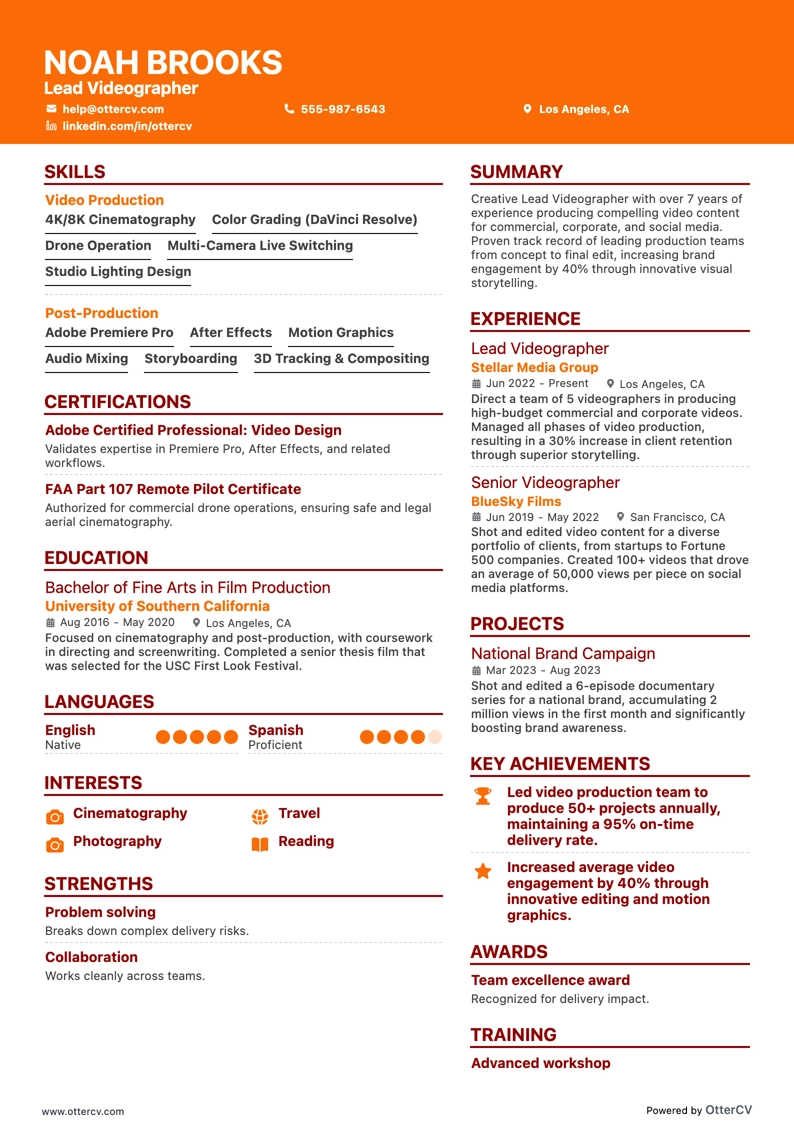
Lead Videographer resume example

Lead Videographer

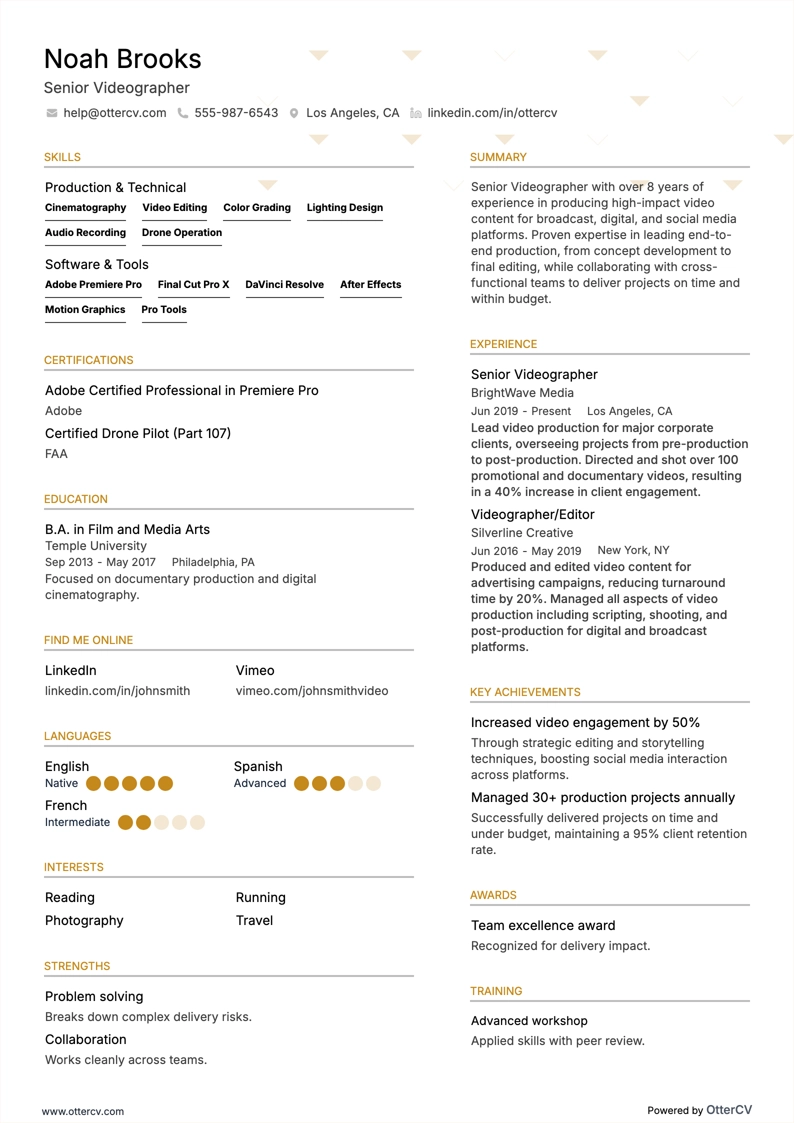
Senior Videographer resume example

Senior Videographer

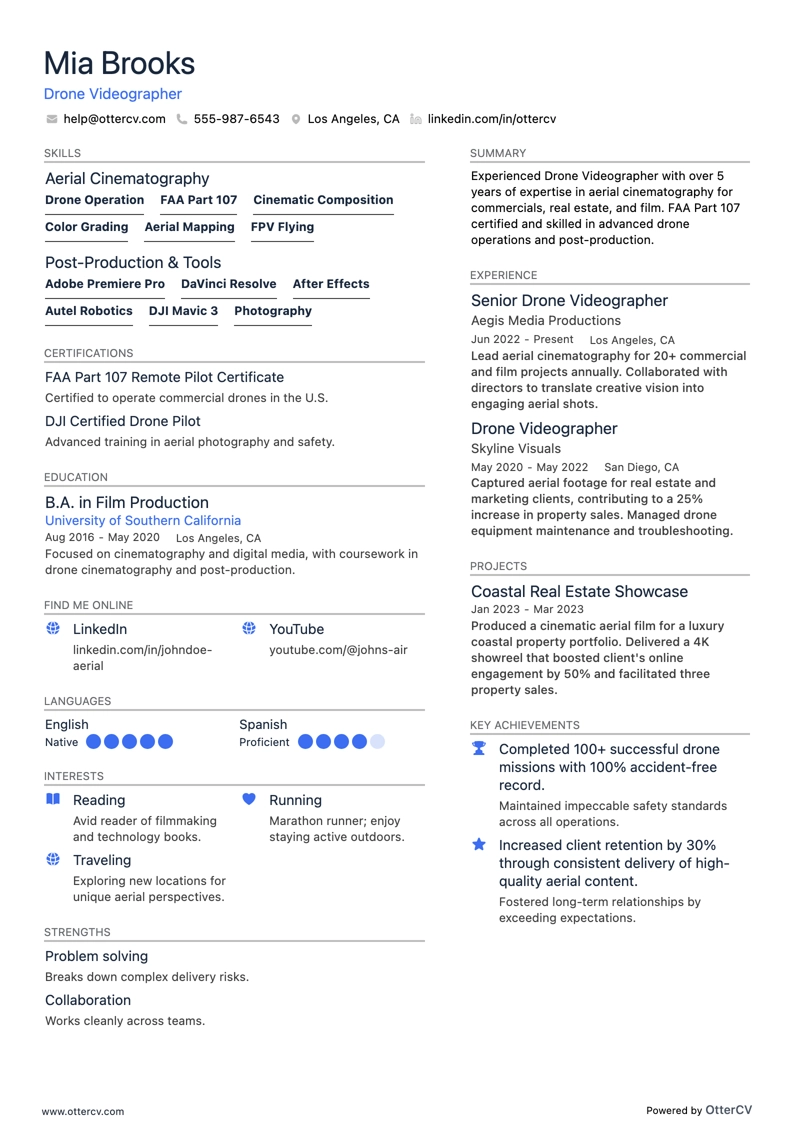
Drone Videographer resume example

Drone Videographer

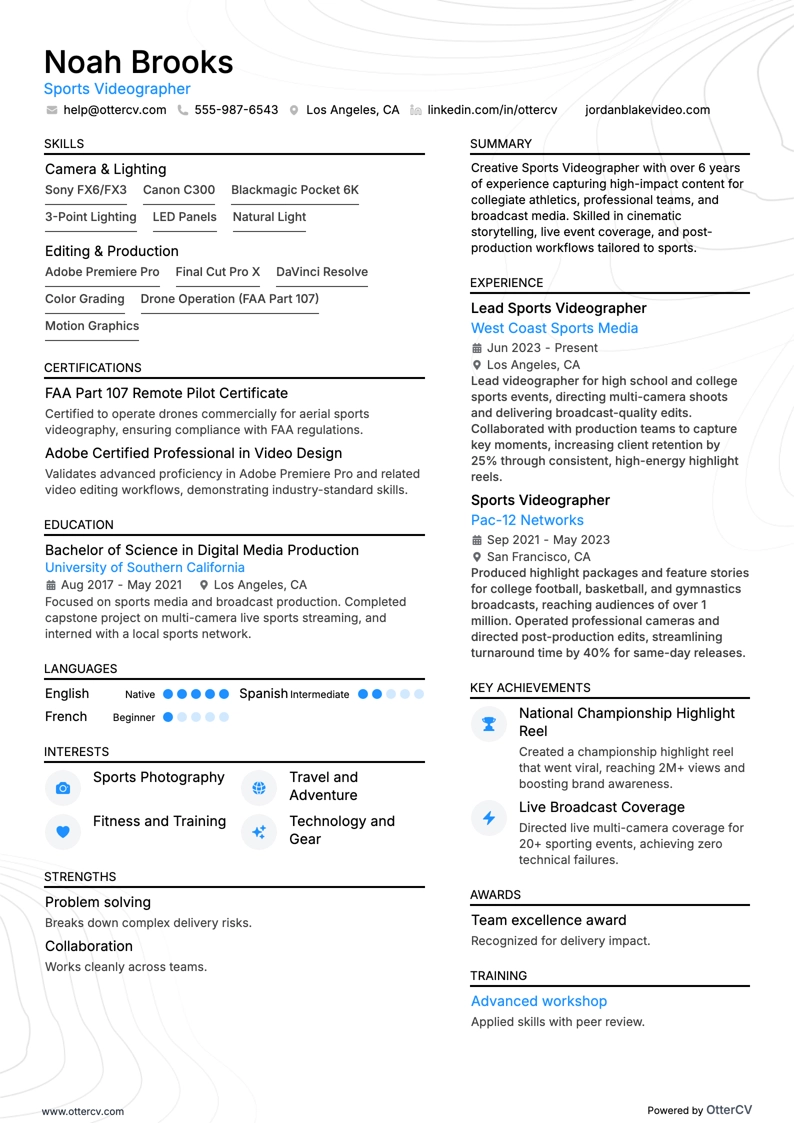
Sports Videographer resume example

Sports Videographer

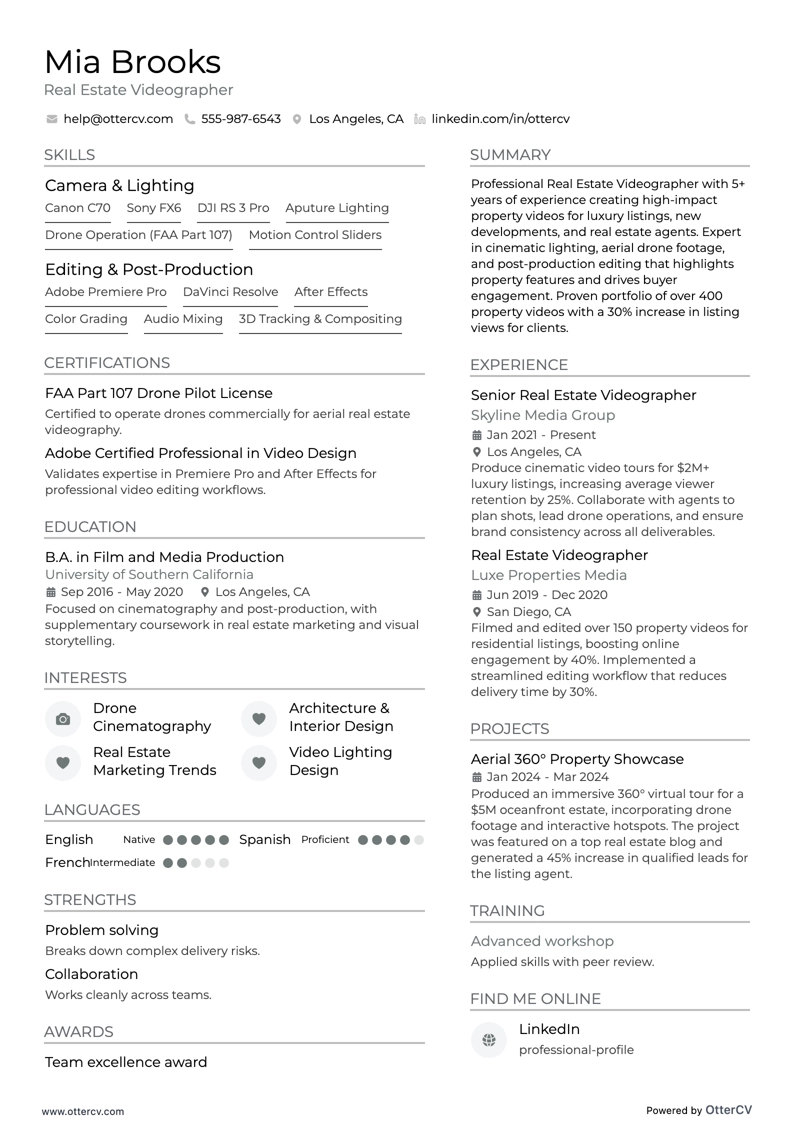
Real Estate Videographer resume example

Real Estate Videographer

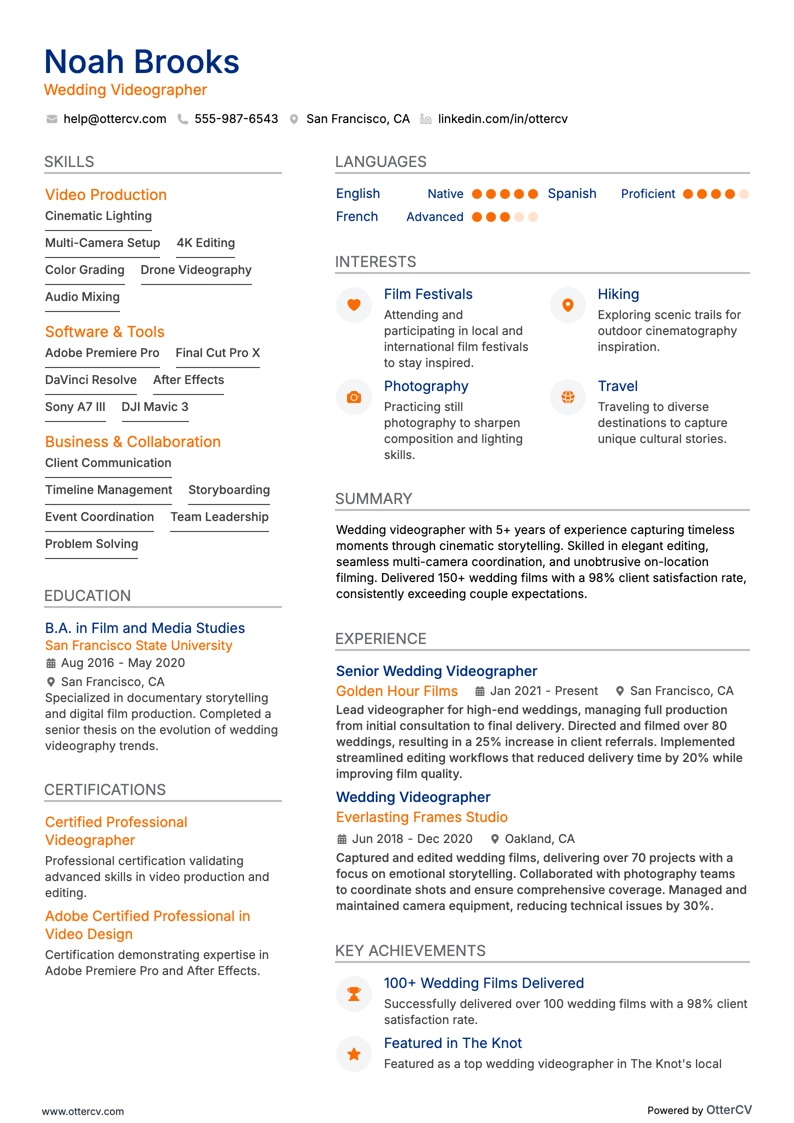
Wedding Videographer resume example

Wedding Videographer

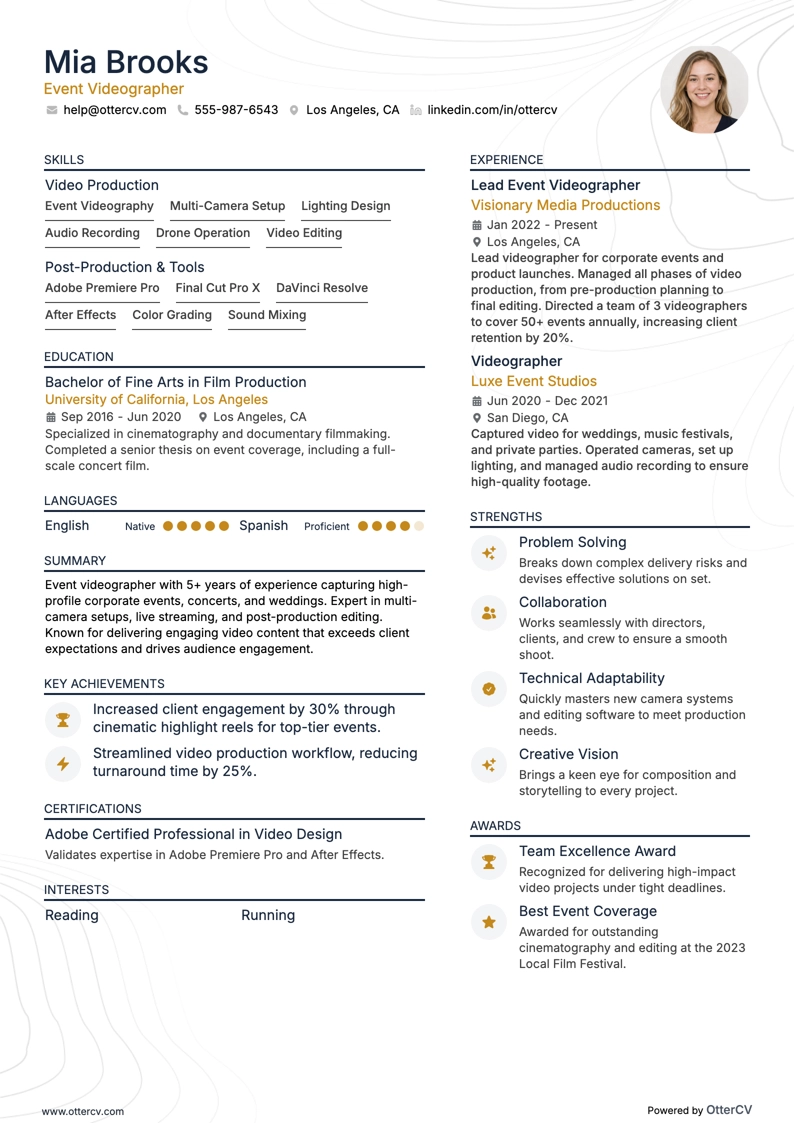
Event Videographer resume example

Event Videographer

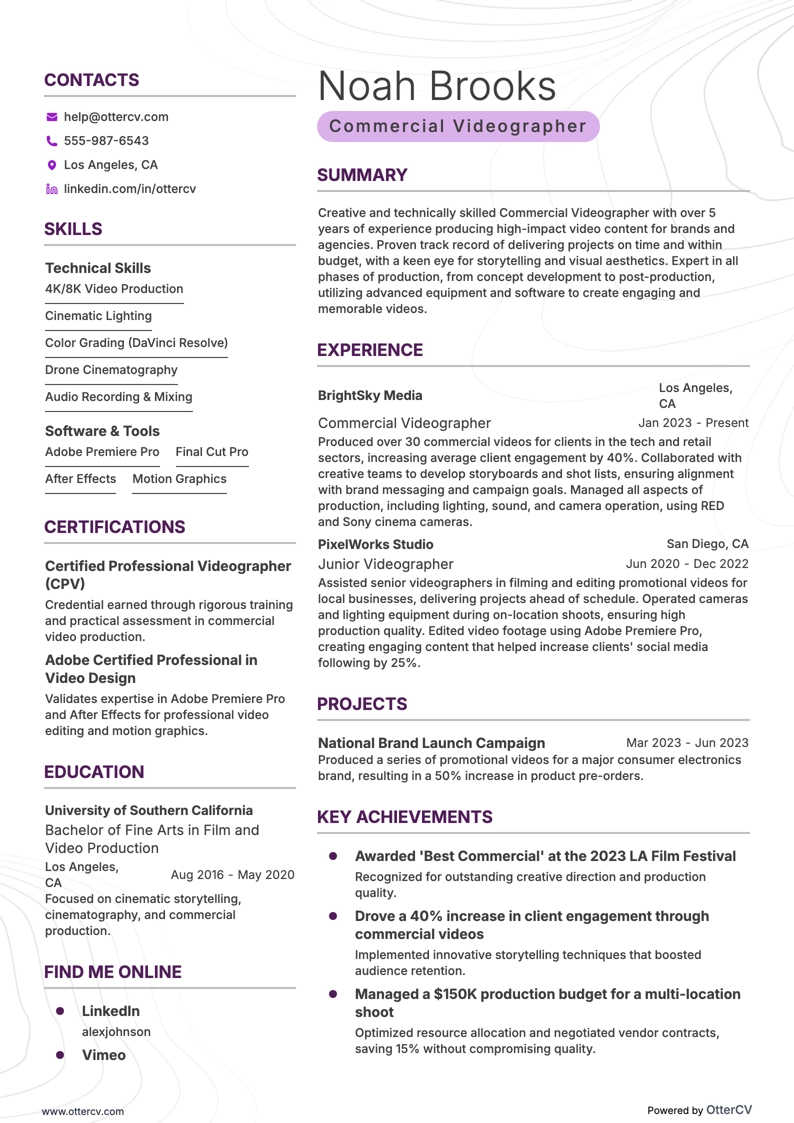
Commercial Videographer resume example

Commercial Videographer

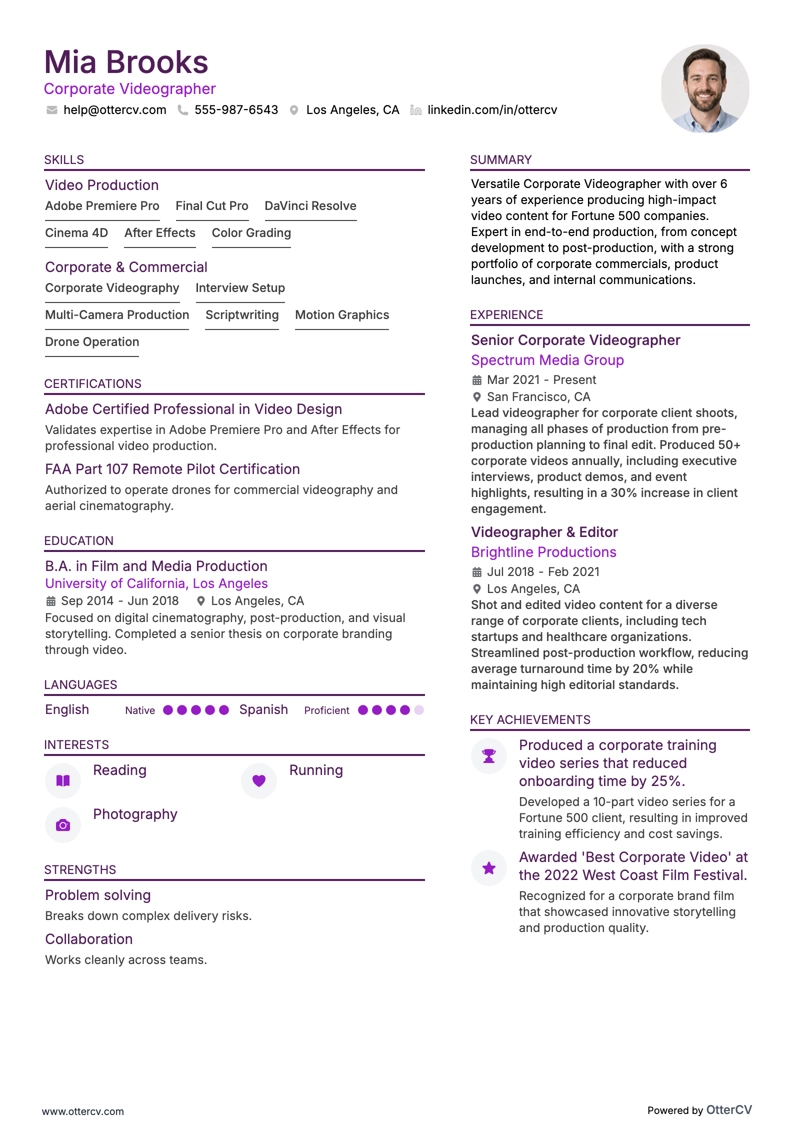
Corporate Videographer resume example

Corporate Videographer

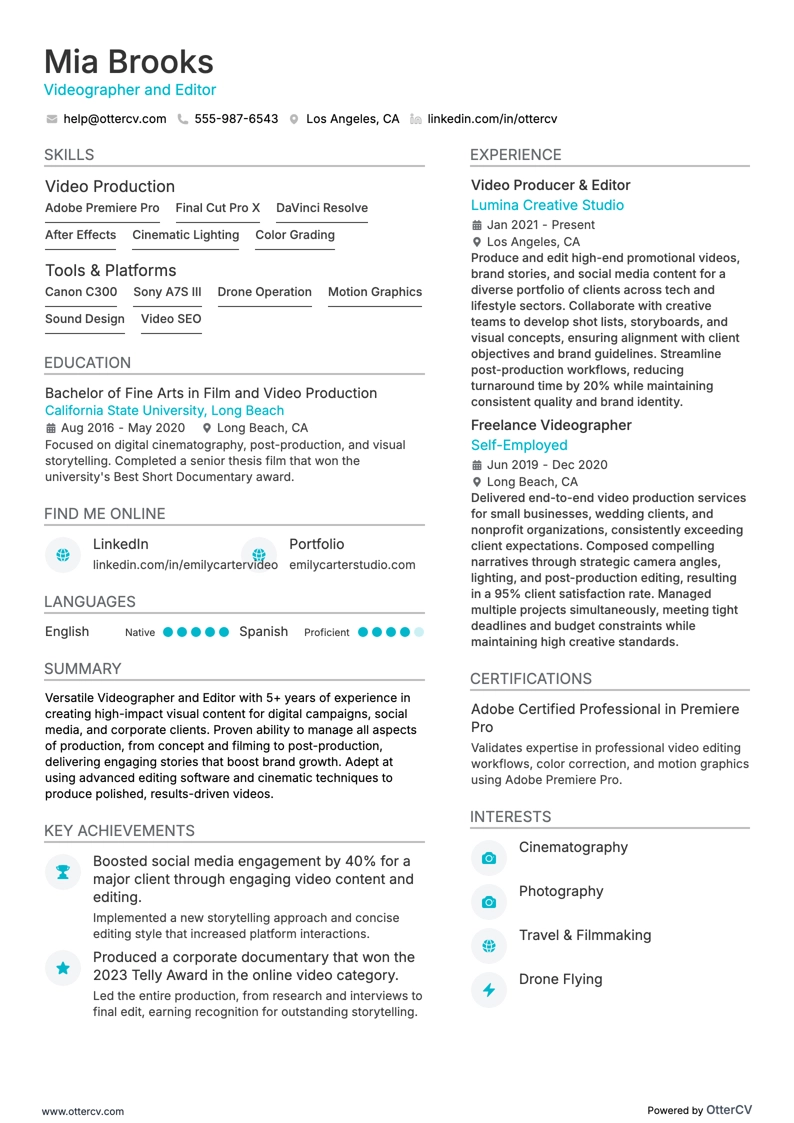
Videographer and Editor resume example

Videographer and Editor

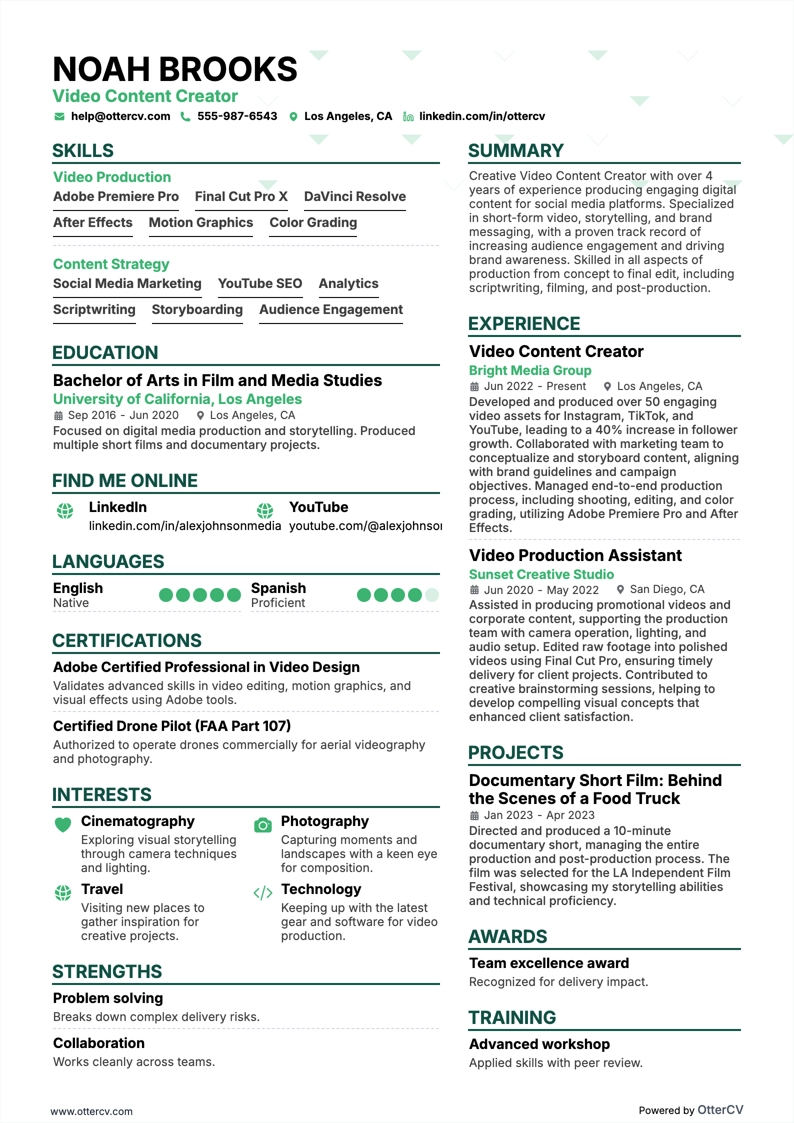
Video Content Creator resume example

Video Content Creator

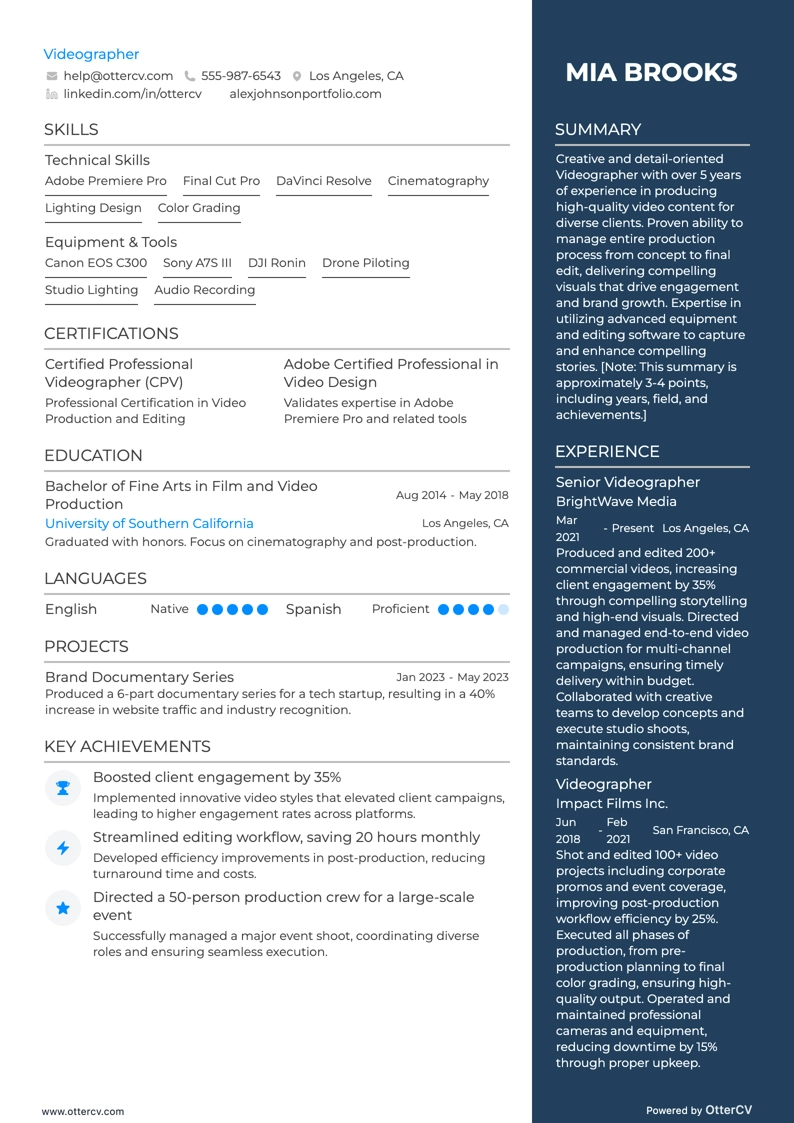
Videographer resume example

Videographer

Most videographer resumes fall short because they read like gear checklists and generic task logs, causing your impact to disappear in seconds. In today’s hiring process, ATS screening and quick recruiter scans penalize vague descriptions in a highly competitive field.

A strong resume shows what changed because of your work, not just what tools you used. To make your resume stand out, highlight results such as on-time delivery across multi-location shoots, faster edit cycles, higher watch time, brand lift, fewer revisions, accessible captions, and measurable campaign revenue.

Key takeaways

  • Quantify videography achievements with metrics such as watch time, turnaround speed, and conversion impact.

  • Use a reverse-chronological resume format if you have videography experience, or a hybrid format if you are changing careers.

  • Tailor each resume to match the job posting’s cameras, software, and production terminology.

  • Show skills through experience bullets instead of relying only on a standalone skills section.

  • Connect every listed skill to a specific project and a measurable outcome.

  • Build your resume faster with Echocv, then refine the language with targeted AI prompts.

  • Pair your resume with a cover letter when the role is competitive or extra context matters.

Job market snapshot for videographers

We analyzed 74 recent videographer job ads across major US job boards. These figures offer a quick view of role specialization trends, employment type patterns, and regional hotspots.

What level of experience employers are looking for videographers

Years of ExperiencePercentage found in job ads
1–2 years8.1% (6)
3–4 years25.7% (19)
5–6 years5.4% (4)
7–8 years4.1% (3)
9–10 years1.4% (1)
10+ years1.4% (1)
Not specified55.4% (41)

Videographer ads by area of specialization (industry)

Industry (Area)Percentage found in job ads
Finance & Banking24.3% (18)
Manufacturing20.3% (15)
Education17.6% (13)
Media & Entertainment13.5% (10)

Role overview stats

These tables outline the most common responsibilities and employment types for videographer roles. Use them to align your resume with employer expectations and better understand how the role is structured across the market.

Day-to-day activities and top responsibilities for a videographer

ResponsibilityPercentage found in job ads
Video editing58.1% (43)
Lighting40.5% (30)
After effects36.5% (27)
Video production35.1% (26)
Motion graphics33.8% (25)
Adobe premiere pro29.7% (22)
Videography25.7% (19)
Adobe creative suite21.6% (16)
Photography20.3% (15)
Photoshop16.2% (12)
Sound design16.2% (12)
Color grading14.9% (11)

Type of employment (remote vs on-site vs hybrid)

Employment typePercentage found in job ads
On-site87.8% (65)
Hybrid12.2% (9)

How to format a videographer resume

Recruiters reviewing videographer resumes look for a strong portfolio of production work, technical skill with camera systems and editing software, and clear evidence of creative problem-solving across different projects. A clean, well-structured resume format helps these qualifications stand out during the initial scan and supports applicant tracking system (ATS) compatibility without losing important detail.

I have significant experience as a videographer—which format should I use?

I have significant experience as a videographer—which format should I use?

Use a reverse-chronological format to put your most recent and relevant production work first.

Do:

  • Emphasize the scope of each role, including the types of productions, team size, and client or brand ownership.
  • Highlight proficiency with role-specific tools such as Adobe Premiere Pro, DaVinci Resolve, Cinema 4D, RED or ARRI camera systems, and color grading workflows.
  • Quantify outcomes tied to your work, including viewership metrics, project budgets managed, turnaround improvements, or increases in audience engagement.

Example bullet: “Shot and edited a 12-part branded video series for a SaaS client that generated 2.4M organic views and increased demo sign-ups by 34% within 90 days.”

I'm junior or switching into a videographer role—what format works best?

I'm junior or switching into a videographer role—what format works best?

A hybrid resume format works best. It lets you lead with a focused skills section while still showing relevant experience or projects in chronological order.

  • Place core technical skills—camera operation, lighting design, audio capture, nonlinear editing—near the top so recruiters and ATS software see them immediately.
  • Include freelance projects, personal productions, internships, or coursework that show hands-on videography ability, even if they were not formal job roles.
  • Connect each action you list to a clear result so hiring managers can assess your impact, not just your participation.

Example scaffold: Color grading (skill) → color-corrected a 20-minute short film using DaVinci Resolve for a university festival submission (action) → selected as an official festival entry from a pool of 150+ submissions (result).

Why not use a functional resume?

Why not use a functional resume?

A functional resume removes the timeline and context of your production work, which makes it harder for recruiters to evaluate how you used your skills in real projects and whether those abilities are current.

This format may be acceptable if you are moving into videography from a related creative field, such as photography or motion graphics, or if you have significant employment gaps. Even then, each listed skill should be tied directly to a specific project and a measurable outcome.

Once your layout and formatting choices are set, the next step is deciding which sections to include so each one supports your qualifications clearly.

What sections should go on a videographer resume

Recruiters expect a videographer resume to show clear production experience, technical ability, and measurable results. Knowing which resume sections to include helps you organize that information for maximum clarity.

Use this structure:

  • Header
  • Summary
  • Experience
  • Skills
  • Projects
  • Education
  • Certifications
  • Optional sections: Awards, Publications, Languages

Strong experience bullet points should highlight the scope of shoots, the tools used, the timelines managed, and the outcomes achieved, including engagement, conversions, or delivery speed.

Once you’ve organized your resume with the right components, focus next on writing your videographer resume experience in a way that shows how your work delivers results.

How to write your videographer resume experience

The experience section is where you prove you’ve completed real video projects using industry-standard cameras, editing software, lighting setups, and production workflows to deliver measurable results. Hiring managers care more about demonstrated impact—such as audience growth, client retention, or production efficiency—than task lists that only describe daily duties. Building a targeted resume helps ensure every bullet aligns with what the role requires.

Each entry should include:

  • Job title
  • Company and location (or remote)
  • Dates of employment (month and year)

Add three to five concise bullet points that show what you owned, how you executed the work, and what outcomes you delivered:

  • Ownership scope: the video projects, content pipelines, channels, production stages, or client accounts you were directly responsible for as a videographer.
  • Execution approach: the cameras, editing platforms, color grading tools, motion graphics software, lighting techniques, or post-production workflows you used to plan, shoot, and deliver final video assets.
  • Value improved: changes to video quality, turnaround time, production cost efficiency, content accessibility, brand consistency, or technical reliability that resulted from your videography work.
  • Collaboration context: how you worked with directors, producers, editors, marketing teams, on-screen talent, sound designers, or external clients across pre-production, production, and post-production.
  • Impact delivered: outcomes expressed through audience engagement, project scale, revenue influence, client satisfaction, or distribution reach rather than a simple list of filming activities.

Experience bullet formula

Experience bullet formula

Action verb + technology + what you built or fixed + measurable result

A videographer experience example

Senior Videographer & Editor

BrightSide Health | Austin, TX

2022–Present

Series B telehealth company producing patient education and brand campaigns across paid social, web, and in-app experiences.

  • Produced and shot forty-plus patient stories and product demos using Sony FX6/FX3, Sennheiser wireless lavs, and Aputure lighting, increasing paid-social click-through rate by 28% quarter over quarter.
  • Edited and color-graded in Adobe Premiere Pro and DaVinci Resolve, standardizing LUTs and audio chains in Adobe Audition to cut average turnaround time from five days to three days while reducing revision rounds by 35%.
  • Built a motion graphics template system in Adobe After Effects and Essential Graphics, enabling marketers and designers to localize end cards and lower-thirds in under ten minutes and saving seventy hours per quarter.
  • Led two-camera studio and remote productions via Riverside and Frame.io, coordinating with product marketing managers, clinicians, and legal reviewers to deliver 100% on-time approvals and maintain zero compliance escalations.
  • Implemented a media management workflow with LucidLink, Dropbox, and a consistent naming and proxy pipeline, improving asset findability and reducing relink and conform issues by 40% across the team.

Now that you’ve seen how to structure a strong experience entry, the next step is adapting it to the specific job you’re applying for.

How to tailor your videographer resume experience

Recruiters review videographer resumes through both manual screening and applicant tracking systems that scan for relevant qualifications. Tailoring your resume to the job description helps ensure your skills and achievements match what hiring managers prioritize.

Ways to tailor your videographer experience:

  • Match the specific cameras and editing software listed in the job description.
  • Use the same terminology the posting uses for video production workflows.
  • Reflect the delivery formats and resolution standards it specifies.
  • Include relevant industry experience, such as broadcast or corporate video.
  • Highlight color grading or sound design skills when the role calls for them.
  • Reference collaboration with creative directors or marketing teams when mentioned.
  • Emphasize live streaming or multicamera production if those are priorities.
  • Align your metrics with the KPIs the employer uses to measure success.

Tailoring means aligning your real accomplishments with the role’s stated requirements, not forcing unrelated keywords into your experience bullets.

Resume tailoring examples for videographer

Job description excerptUntailoredTailored
Produce short-form video content for social media channels using Adobe Premiere Pro and After Effects, with a focus on Instagram Reels and TikTok.Created video content for various platforms.Produced 50+ short-form videos per month for Instagram Reels and TikTok using Adobe Premiere Pro and After Effects, increasing follower engagement by 35% over six months.
Shoot and edit corporate training videos in a studio environment, managing multi-camera setups and ensuring brand consistency across all deliverables.Helped with video production and editing tasks.Operated three-camera studio setups to shoot and edit corporate training videos, maintaining strict brand guidelines across 20+ deliverables per quarter for internal L&D teams.
Capture event footage for live-streamed product launches, coordinating with the marketing team to deliver same-day highlight reels using DaVinci Resolve.Recorded footage at company events.Captured live footage at product launch events and delivered same-day highlight reels edited in DaVinci Resolve, coordinating with a five-person marketing team to meet real-time publishing deadlines.

Once you’ve aligned your experience with the role’s priorities, quantify your videographer achievements to show the measurable impact behind that fit.

How to quantify your videographer achievements

Quantifying your work shows business impact beyond “great visuals.” Using numbers on your resume helps highlight turnaround time, output volume, engagement and conversion, quality and rework rates, and budget efficiency across shoots and edits.

Quantifying examples for videographer

MetricExample
Turnaround timeCut average edit turnaround from five days to two by standardizing Premiere Pro templates and a Frame.io review workflow across twelve weekly deliverables.
Engagement liftIncreased average watch time by 28% on five product videos by tightening the first five seconds, adding motion graphics in After Effects, and testing two hooks.
Conversion impactBoosted landing page sign-ups by 14% after producing a 60-second testimonial video, tracked in Google Analytics with tagged calls to action.
Quality and reworkReduced revision rounds from four to two per project by using a pre-shoot storyboard, a shot list, and a color reference workflow in DaVinci Resolve.
Cost efficiencyCut freelance spend by $6,500 per quarter by building an in-house b-roll library and batching three shoots per month with shared lighting setups.

Once your bullet points clearly show your accomplishments, the next step is making sure your skills section reflects the right mix of technical and interpersonal strengths employers expect from a videographer.

How to list your hard and soft skills on a videographer resume

Your skills section helps recruiters and applicant tracking system (ATS) filters see that you can plan shoots, capture clean footage, and deliver edits on deadline. List role-specific tools and workflows, then balance them with collaborative execution skills—often about two-thirds hard skills and one-third soft skills.

Videographer roles require a blend of:

  • Product strategy and discovery skills.
  • Data, analytics, and experimentation skills.
  • Delivery, execution, and go-to-market discipline.
  • Soft skills.

Your skills section should be:

  • Scannable with bullet-style grouping.
  • Relevant to the job post.
  • Backed by proof in your experience bullets.
  • Updated with current tools.

Place your skills section:

  • Above experience if you're junior or switching careers.
  • Below experience if you're mid or senior with strong achievements.

Hard skills

  • Proficient in Adobe Premiere Pro and After Effects.
  • Experienced in DaVinci Resolve color grading.
  • Skilled in Avid Media Composer.
  • Comfortable operating Sony, Canon, and RED cameras.
  • Knowledgeable in lens selection, exposure, and focus.
  • Experienced with lighting setups, including three-point lighting and practicals.
  • Skilled in audio capture using lavaliers and shotgun mics.
  • Experienced in multi-camera production and syncing.
  • Able to create storyboards, shot lists, and call sheets.
  • Capable of producing motion graphics and lower thirds.
  • Experienced in media management and proxy workflows.
  • Familiar with export specs for social platforms.

Soft skills

  • Align on the creative brief.
  • Direct on-camera talent.
  • Keep communication on set efficient.
  • Collaborate with producers and editors.
  • Give and receive actionable feedback.
  • Manage stakeholder revisions.
  • Prioritize shots under time constraints.
  • Troubleshoot gear on set.
  • Protect brand and style guidelines.
  • Own deadlines and deliverables.
  • Communicate tradeoffs clearly.
  • Stay calm during live shoots.

How to show your videographer skills in context

Skills should not live only in a dedicated skills list. Browse resume skills examples to see how strong candidates weave their abilities into every section.

Your skills should be demonstrated in:

  • Your summary, which presents your high-level professional identity
  • Your experience, which proves your abilities through outcomes

Here’s what that looks like in practice.

Summary example

Senior videographer with 10+ years of experience in branded content and documentary production. Skilled in Cinema 4D, DaVinci Resolve, and narrative storytelling. Directed a product launch series that increased client engagement by 45%.

  • Immediately signals senior-level experience
  • Mentions industry-standard tools
  • Opens with a measurable outcome
  • Emphasizes storytelling as a soft skill

Experience example

Senior Videographer

Reel Focus Media | Portland, OR

March 2019–Present

  • Produced 120+ branded videos using RED cameras and DaVinci Resolve, increasing client retention by 30%.
  • Collaborated with marketing and design teams to deliver a 12-part docuseries that generated 2M+ organic views.
  • Developed a streamlined color-grading workflow in Premiere Pro, cutting post-production turnaround time by 25%.
  • Every bullet includes measurable proof.
  • Skills surface naturally through outcomes.

Once you’ve shown your videography skills through relevant examples and results, the next step is applying that same approach to writing a videographer resume with no experience.

How do I write a videographer resume with no experience

Even without full-time experience, you can show that you’re ready through:

  • Student film crew videography roles
  • Freelance shoots for local businesses
  • Volunteer event coverage for nonprofits
  • Social media video content series
  • Self-directed short film projects
  • Internship or job shadowing days
  • YouTube channel production workflow
  • Equipment rentals and test shoots

If you’re just starting out, our guide on writing a resume without work experience walks you through how to build a compelling application from scratch.

Focus on:

  • Portfolio links with finished videos
  • Camera, audio, and lighting setups
  • Editing workflow and tool stack
  • Measurable results and deliverables

Resume format tip for entry-level videographer

Resume format tip for entry-level videographer

Use a combination resume format because it puts your projects, tools, and results ahead of a limited work history.

Do the following:

  • Add a Projects section above Experience.
  • Link to a reel and portfolio.
  • List the tools used for each project.
  • Quantify outputs, timelines, and results.
  • Tailor keywords to each job post.

Example project bullet:

  • Produced and edited a three-video social media series in Adobe Premiere Pro and DaVinci Resolve, boosting average views from 300 to 1,100 per video in four weeks.

Even without professional experience, your educational background can show relevant training and knowledge when presented clearly.

How to list your education on a videographer resume

Your education section helps hiring teams confirm you have foundational knowledge in visual storytelling, production techniques, and media technology related to a videographer role.

Include:

  • Degree name
  • Institution
  • Location
  • Graduation year
  • Relevant coursework for juniors or entry-level candidates
  • Honors and GPA if 3.5 or higher

Avoid listing specific months or days. Use the graduation year only.

Here’s a strong education entry tailored for a videographer resume.

Example education entry

Bachelor of Fine Arts in Film and Video Production

Emerson College, Boston, MA

Graduated 2021

GPA: 3.7/4.0

  • Relevant Coursework: Cinematography, Documentary Filmmaking, Digital Editing, Sound Design, and Color Grading
  • Honors: Dean's List (six consecutive semesters), Outstanding Senior Thesis in Visual Media

How to list your certifications on a videographer resume

Certifications on a resume show a videographer's commitment to learning, proficiency with key tools, and alignment with current industry standards. They also help hiring teams confirm specialized skills beyond work history.

For each certification, include:

  • Certificate name
  • Issuing organization
  • Year
  • Optional: credential ID or URL
  • Place certifications below education when your degree is recent and your certifications are older or less relevant to the videographer role.
  • Place certifications above education when they are recent, highly relevant, or required for the videographer role you target.

Best certifications for your videographer resume

  • Adobe Certified Professional in Premiere Pro.
  • Adobe Certified Professional in After Effects.
  • Blackmagic Design Certified Training: DaVinci Resolve.
  • DJI Academy: DJI Certified Operator.
  • FAA Part 107 Remote Pilot Certificate.
  • Avid Media Composer Certified User.
  • Apple Certified Pro: Final Cut Pro.

Once your certifications are easy for hiring managers to spot, use your videographer resume summary to bring those qualifications forward.

How to write your videographer resume summary

Your resume summary is often the first part a recruiter reads. A strong summary quickly shows that you have the technical skills and creative eye the role requires.

Keep it to three to four lines and include:

  • Your title and total years of videography experience.
  • Your domain, such as commercial, corporate, or event videography.
  • Core tools and skills like Adobe Premiere Pro, DaVinci Resolve, or color grading.
  • One or two measurable achievements, such as views generated or projects delivered.
  • Soft skills connected to real results, like collaboration that shortened production timelines.

PRO TIP

At this level, emphasize technical proficiency, relevant tools, and early results that show you can deliver.

Highlight specific software, camera systems, and tangible contributions. Avoid vague descriptors like "passionate" or "hardworking," and skip motivational statements in favor of what you have actually produced.

Example summary for a videographer

Detail-oriented videographer with two years of experience producing corporate and social media content. Skilled in Premiere Pro and Sony camera systems. Delivered 30+ video projects that boosted client engagement by 45%.

Now that your summary captures your professional value at a glance, make sure your header includes the contact and identification details recruiters need to reach you.

What to include in a videographer resume header

A resume header includes your key contact details and professional links, helping videographer candidates improve visibility, build credibility, and move through recruiter screening faster.

Essential resume header elements

  • Full name
  • Tailored job title and headline
  • Location
  • Phone number
  • Professional email
  • GitHub link
  • Portfolio link
  • LinkedIn

A LinkedIn link helps recruiters verify your experience quickly and supports screening.

Do not include photos on a videographer resume unless the role is explicitly front-facing or appearance-dependent.

Keep the header to two lines, use consistent formatting, and match your job title to the posting to reduce recruiter confusion.

Example

Once your contact details and role-specific identifiers are in place, you can strengthen your application with additional resume sections that support and expand on that information.

Additional sections for videographer resumes

These sections can help you stand out when your core experience does not fully reflect your creative range or technical depth.

Choose sections that reinforce your value as a videographer:

  • Languages
  • Film festival submissions and screenings
  • Hobbies and interests
  • Publications and featured work
  • Professional affiliations and memberships
  • Volunteer videography projects
  • Awards and recognitions

Once your resume shows the full scope of your expertise, the next step is pairing it with a cover letter that brings everything together for hiring managers.

Do videographer resumes need a cover letter

A cover letter is not required for every videographer role, but it can help when the job is competitive or the employer expects one. If you are not sure where to begin, learn what a cover letter is and when it matters most. It can make the difference when your portfolio looks similar to other applicants.

Use a cover letter to add context your resume cannot provide:

  • Explain role or team fit: Match your shooting style, collaboration habits, and production pace to the team's workflow and constraints.
  • Highlight one or two relevant projects or outcomes: Name the project, your role, and the result, such as higher retention, faster turnaround, or better conversion.
  • Show understanding of the product, users, or business context: Connect your video choices to the audience, distribution channels, and the goal the business measures.
  • Address career transitions or non-obvious experience: Translate adjacent work into videographer skills, and clarify gaps, freelance periods, or a shift in industry.

Using AI to improve your videographer resume

Even if you skip a cover letter and rely on a strong resume to carry your application, AI can help you refine and tailor your videographer resume faster.

AI can improve clarity, structure, and impact. It can tighten language and highlight measurable results. But overusing it can strip away authenticity. Once your resume reads clearly and fits the role, step away from AI. For a deeper look at effective prompts, see our guide on ChatGPT resume writing.

Here are 10 practical prompts you can copy and paste to strengthen specific sections of your videographer resume:

  1. Strengthen your summary. "Rewrite my videographer resume summary to highlight my strongest technical skills and years of experience in under four sentences."
  2. Quantify your impact. "Add measurable results to these videographer experience bullets, focusing on project output, audience reach, or turnaround time."
  3. Tighten bullet points. "Shorten each of my videographer experience bullets to one concise line that leads with a strong action verb."
  4. Align with postings. "Compare my videographer resume skills section against this job description and identify missing keywords I should add."
  5. Improve project descriptions. "Rewrite my videographer portfolio project entries to emphasize my specific role, tools used, and final deliverables."
  6. Clarify technical skills. "Organize my videographer skills section into clear categories like editing software, camera equipment, and post-production tools."
  7. Refine education details. "Rewrite my videographer education section to emphasize coursework, projects, or honors directly relevant to video production."
  8. Highlight certifications. "Reformat my videographer certifications section so each entry clearly states the credential, issuing body, and completion date."
  9. Remove weak language. "Identify and replace vague or passive phrases in my videographer resume with specific, confident, active language."
  10. Cut redundant content. "Flag any repeated or unnecessary information across my videographer resume and suggest what to remove or consolidate."

Stop using AI once your resume sounds accurate, specific, and aligned with your real experience. AI should never invent experience or inflate claims—if it didn't happen, it doesn't belong here.

Conclusion

A strong videographer resume shows results and highlights your role-specific skills. Use measurable outcomes, define project scope clearly, and mention the tools you used to plan, shoot, edit, and deliver work on time. Keep the structure clean, scannable, and consistent.

Today’s hiring market rewards videographers who demonstrate impact and reliability. When your resume connects skills to outcomes and remains easy to read, you appear ready for current roles and near-future demands.

Videographer resume examples

Explore additional Videographer resume samples and guides and see what works for your level of experience or role.

By Experience

Lead Videographer

Lead Videographer resume preview

Senior Videographer

Senior Videographer resume preview

Videographer resume examples

Explore additional Videographer resume samples and guides and see what works for your level of experience or role.

By Role

Drone Videographer

Drone Videographer resume preview

Sports Videographer

Sports Videographer resume preview

Real Estate Videographer

Real Estate Videographer resume preview

Wedding Videographer

Wedding Videographer resume preview

Event Videographer

Event Videographer resume preview

Commercial Videographer

Commercial Videographer resume preview

Corporate Videographer

Corporate Videographer resume preview

Videographer and Editor

Videographer and Editor resume preview

Video Content Creator

Video Content Creator resume preview

Videographer

Videographer resume preview