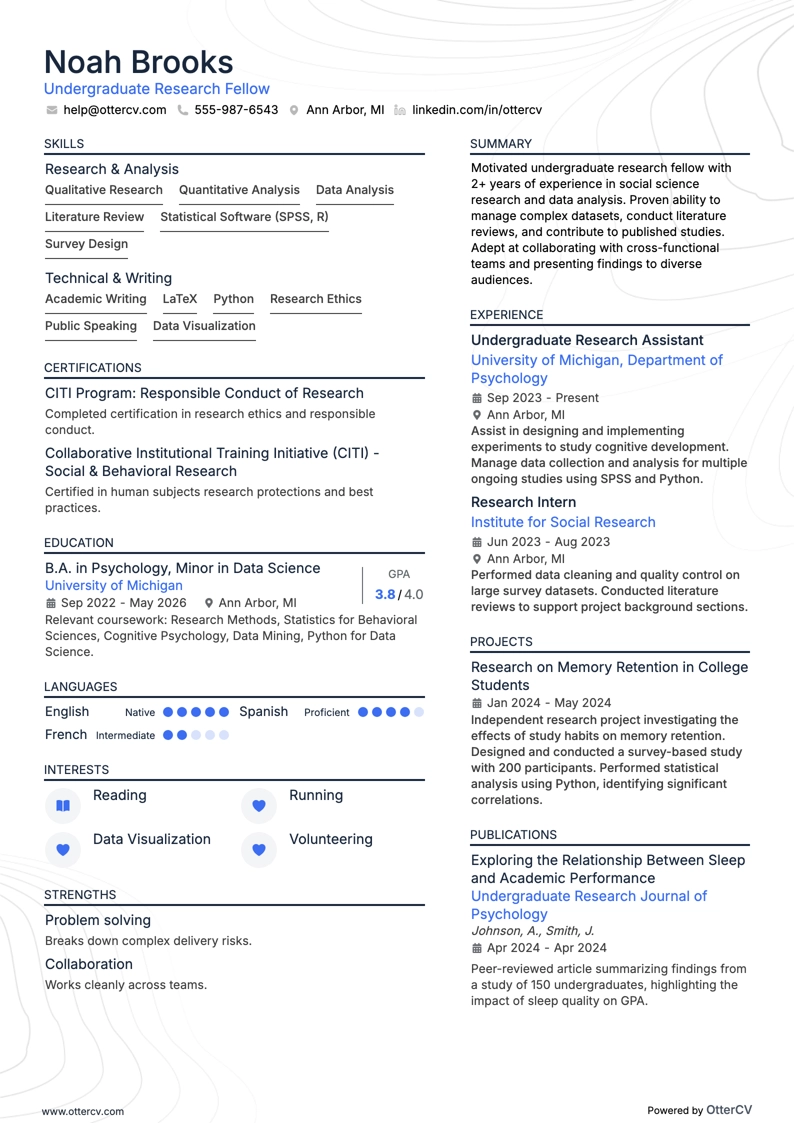
Undergraduate Research Fellow full preview

18 Undergraduate Resume Examples

OtterCV

Written by The OtterCV Team

Updated: 7/8/2025•8 min read

See all resume examples in this guide, or generate your own resume example with your personalized prompt

Undergraduate Research Fellow resume example

Undergraduate Research Fellow

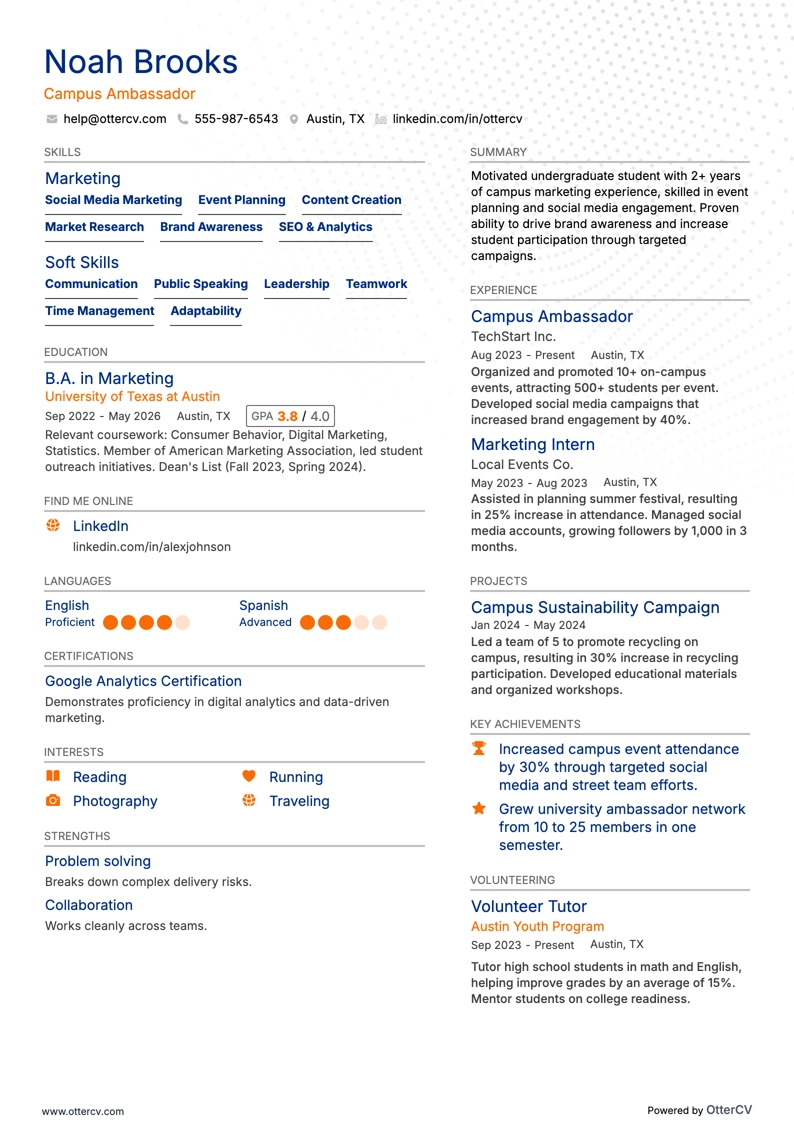
Campus Ambassador resume example

Campus Ambassador

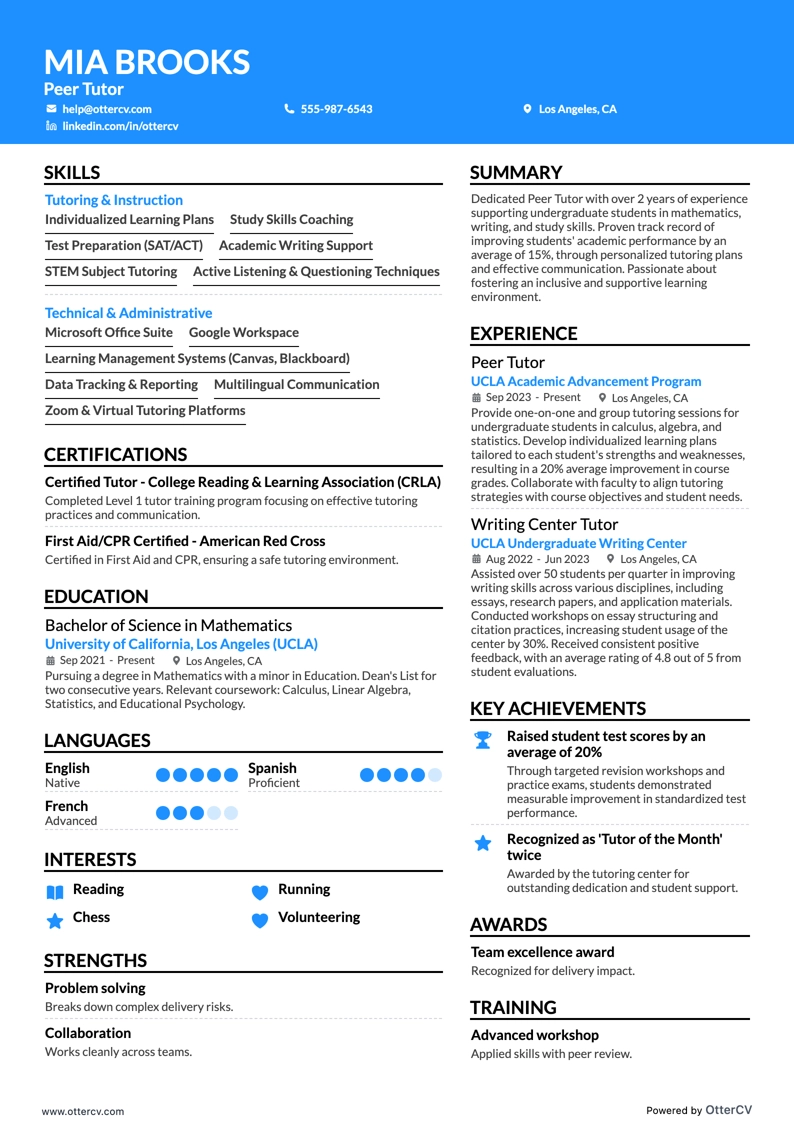
Peer Tutor resume example

Peer Tutor

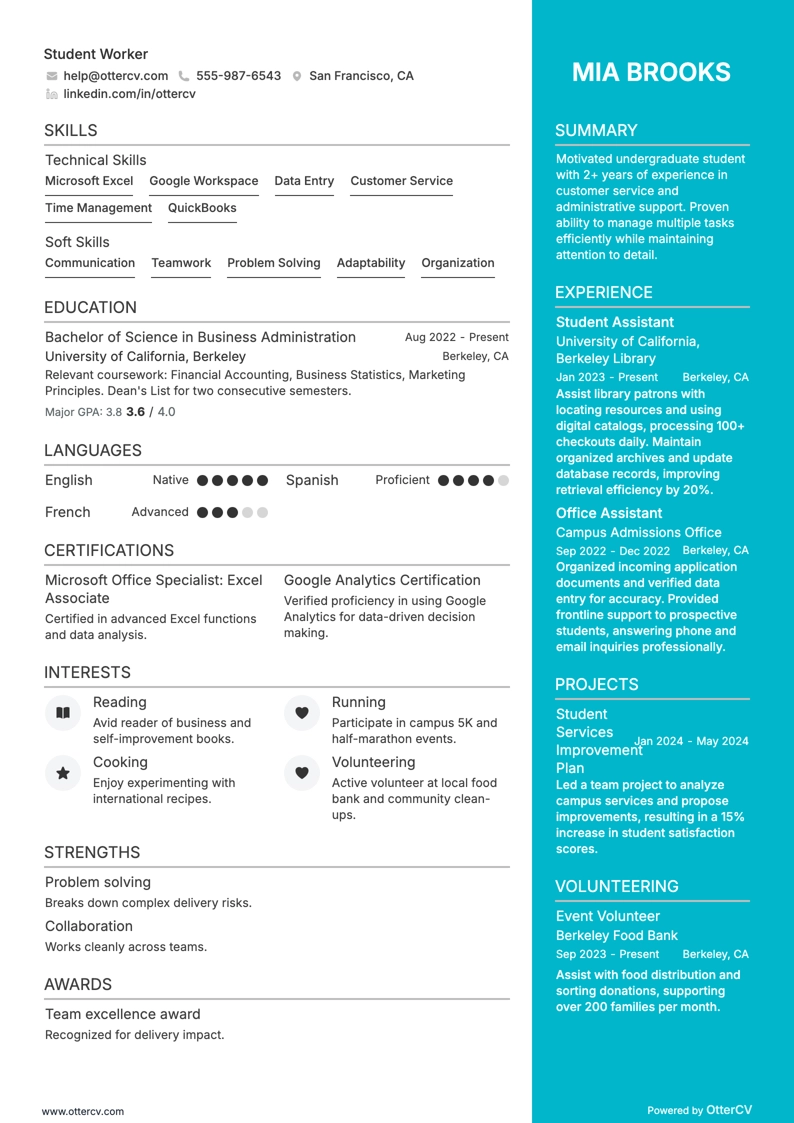
Student Worker resume example

Student Worker

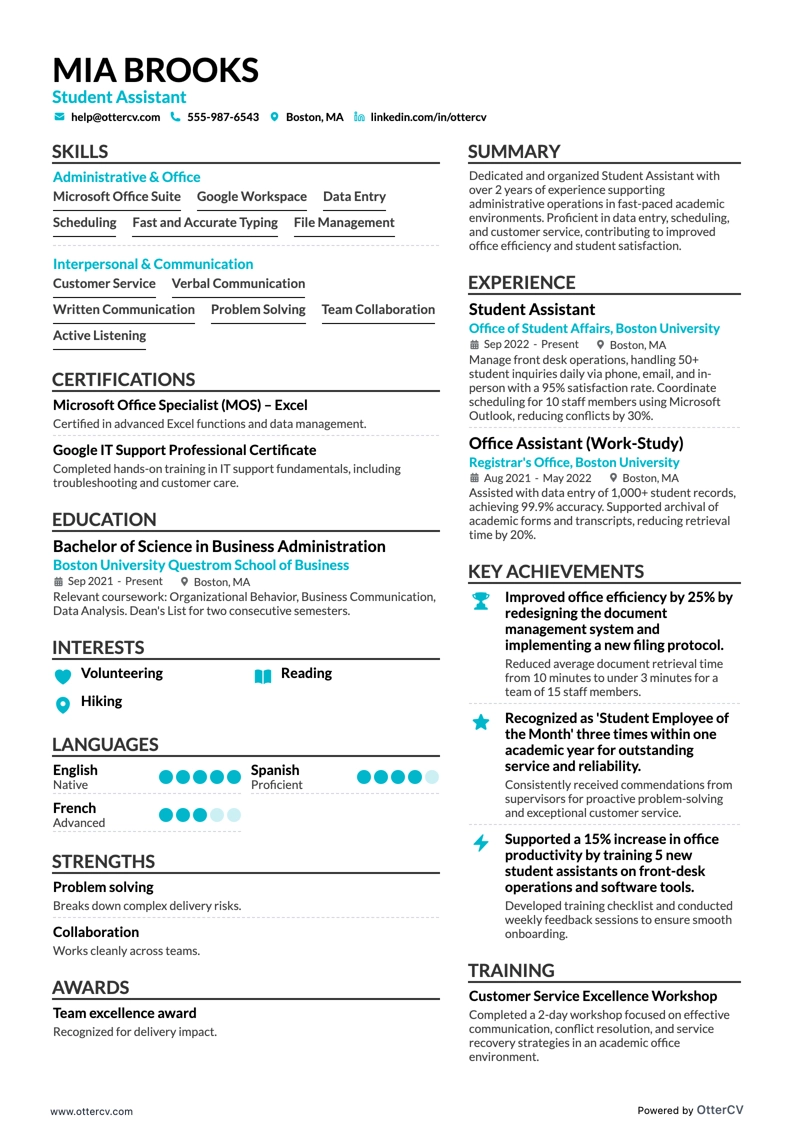
Student Assistant resume example

Student Assistant

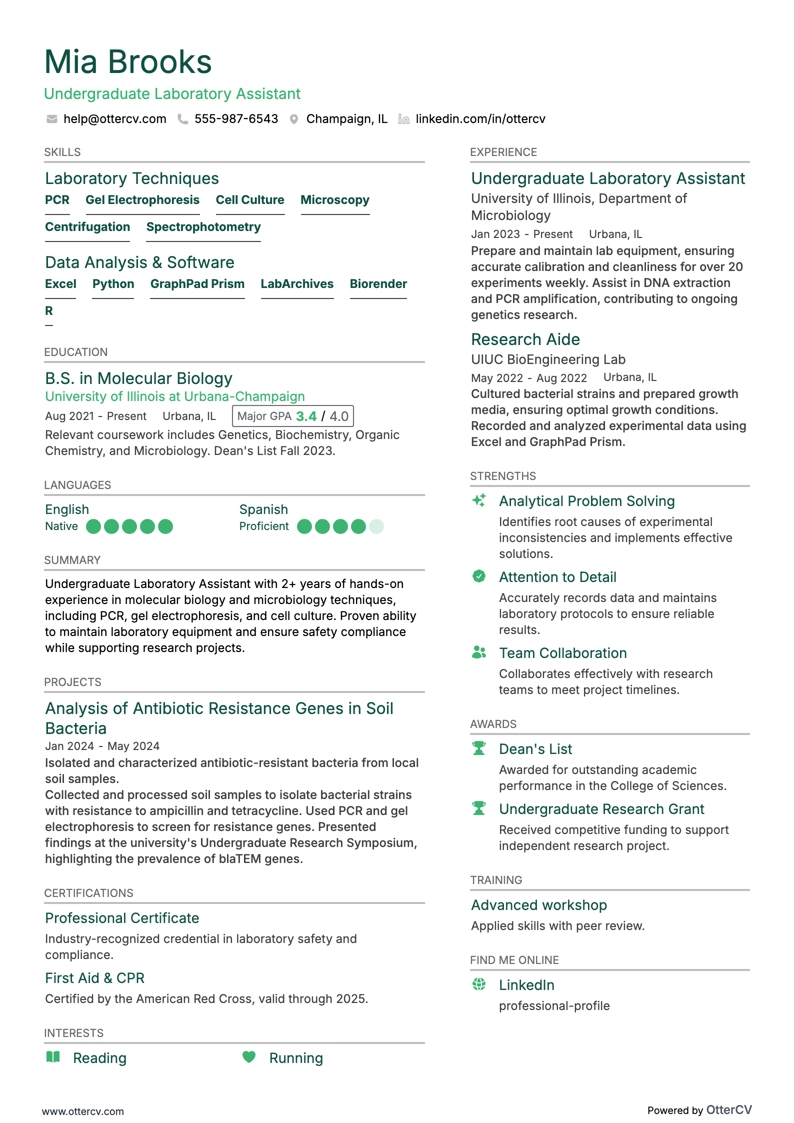
Undergraduate Lab Assistant resume example

Undergraduate Lab Assistant

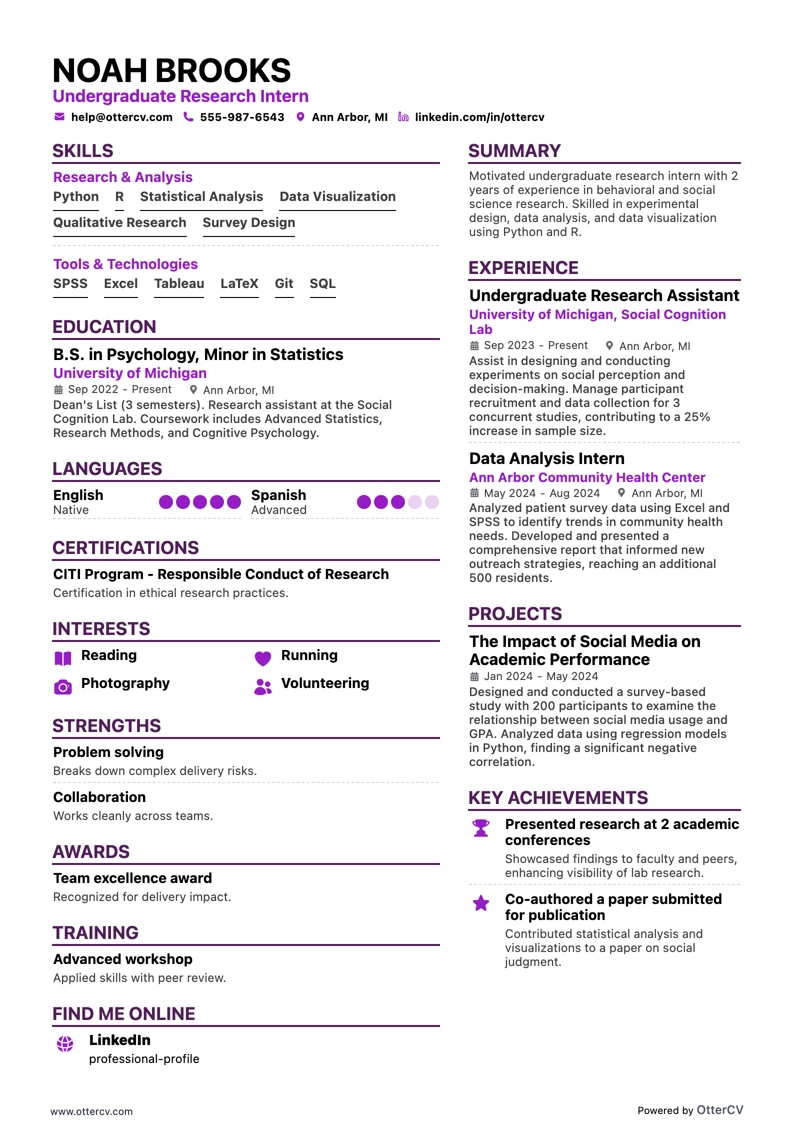
Undergraduate Research Intern resume example

Undergraduate Research Intern

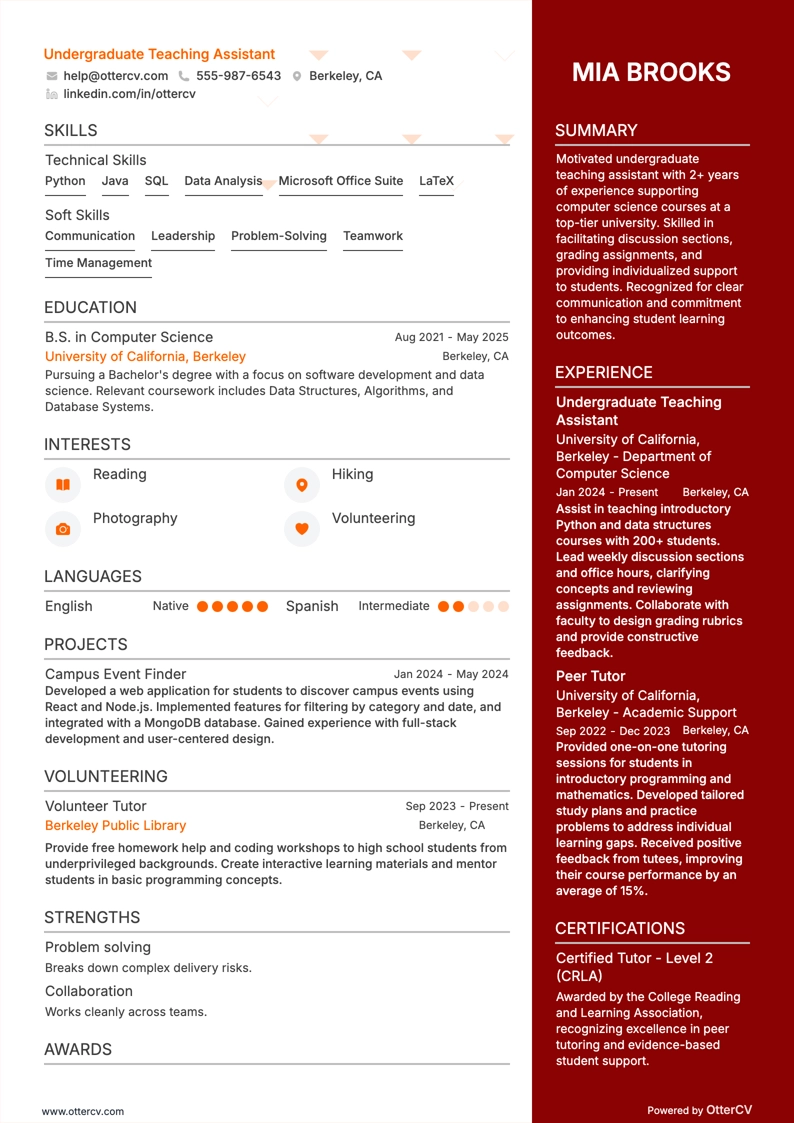
Undergraduate Teaching Assistant resume example

Undergraduate Teaching Assistant

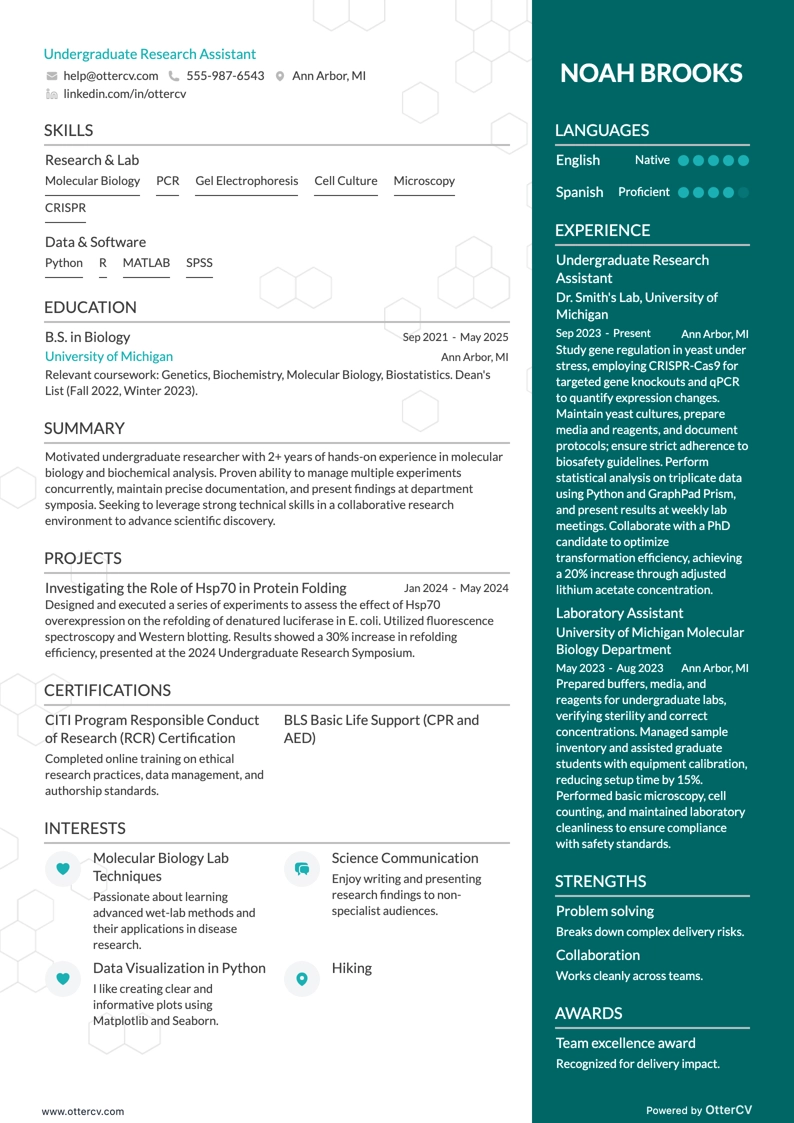
Undergraduate Research Assistant resume example

Undergraduate Research Assistant

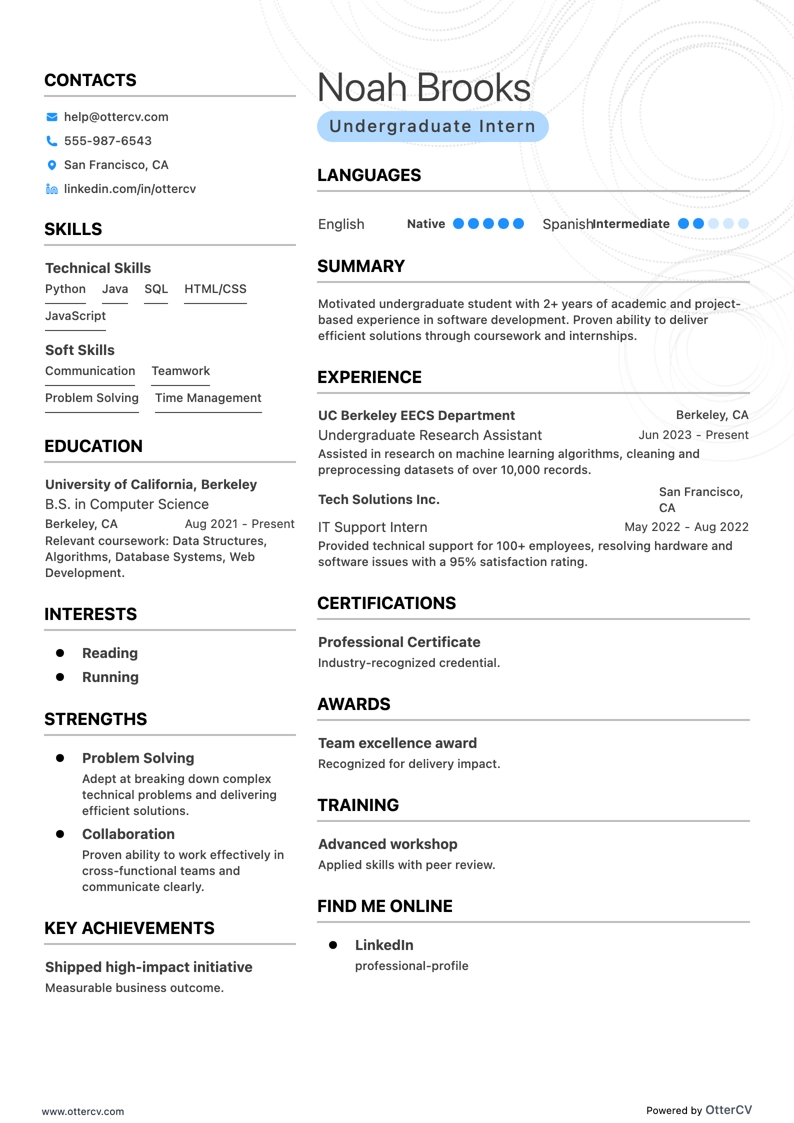
Undergraduate Intern resume example

Undergraduate Intern

When most people hear the word resume, they immediately think of experience. That is understandable, since a resume is one of the most direct ways to show potential employers your background and skills.

But what if you have no experience? What should undergraduate students who have focused mainly on studying include on their resumes?

The short answer is that even undergraduates with no experience still need a strong resume. Recruiters do not look only at the experience section. They also want to understand your skills, how you handle challenging situations, your approach to conflict, and your willingness to learn and grow.

These qualities can help you stand out from other applicants, whether you are applying for an internship or a full-time entry-level position.

If you want to learn how to write an undergraduate resume that helps you stand out, read on.

Median earnings for bachelor’s degree holders are 84% higher than those whose highest degree is a high school diploma.

—U.S. Bureau of Labor Statistics

This undergraduate resume guide will help you:

  • Find out which sections your resume should include.
  • Write a compelling resume summary that gets attention.
  • Highlight your strengths and education without overemphasizing your lack of experience.
  • Present your college activities in a way that interests recruiters.
  • Focus on what matters most and cut what does not.

Looking for related resumes?

The perfect format for your undergraduate resume

Most online resume advice tells you to talk about your education, focus on relevant hard skills, and explain why you are the best applicant.

But if you are an undergraduate with no experience, that advice can feel vague or even unhelpful. You may not be sure which hard skills are relevant or how to describe your education in a meaningful way.

The good news is that you can still build a resume that gets recruiters’ attention. A strong format is the first place to start.

Some of the most popular resume formats are:

  • The reverse-chronological format
  • The functional format
  • The hybrid format

For most undergraduates, the reverse-chronological format is usually not the best choice. It is better suited to professionals with many years of experience.

The functional format works well for inexperienced undergraduates because it emphasizes transferable skills, interests, and activities.

If you do have some experience to include, consider the hybrid resume format. It combines the first two formats so you can highlight both your experience and your personality.

Keep these general formatting tips in mind:

Once you have the format down, the next question is what your undergraduate resume should include.

One advantage of undergraduate resumes is that you can experiment with sections. There are several worth considering.

Remember that resume layouts can vary by country. For example, a Canadian resume format could look different.

Top sections for your undergraduate resume:

  • Header: include your name, email address, phone number, and a link to your LinkedIn profile or personal website.
  • Objective: summarize your long-term goals and priorities.
  • Skills section: highlight your hard, soft, and transferable skills.
  • Education section: list your degrees and relevant courses.
  • Certification section: include your certifications.
  • Strengths section: show the qualities that help you stand out.
  • Achievements section: feature moments when your hard work paid off.

When selecting the main sections for your undergraduate resume, include specific details that recruiters value. For example:

What recruiters love seeing on undergraduate resumes:

  • The key courses you’ve taken and how they relate to the job you’re applying for.
  • The challenges you’ve faced and how you handled them.
  • Your ability to learn and master new skills quickly.
  • Any volunteering or work shadowing you’ve done.
  • Your biggest strengths.
  • The areas you’d like to learn more about.
  • Where you take inspiration from.
  • The awards you’ve received.
  • The publications you’ve published.
  • Any additional courses you’ve taken to upskill yourself.

The ideal header for your undergraduate resume

The header section is often overlooked by many undergraduates, likely because it is the shortest part of a resume.

However, even a small mistake in your email address or phone number can prevent recruiters from contacting you.

Make sure your header is accurate and free of errors. Here are 2 undergraduate resume header examples:

2 undergraduate resume header examples

Common mistakes to spot

Can you spot any mistakes?

First, look at the title: it says Student. That’s acceptable, but not ideal. It would be better to mention the position being applied for or at least the major.

Next, the email address is too informal. It’s better to use formats such as name.surname@website.com, name_surname@website.com, or surname.name@website.com.

Then there’s the location. Lesley should have included the city where she currently lives, especially if she is applying for an on-site job.

Finally, the link leads to Lesley’s personal Facebook account, which is a major mistake, especially if it includes wild party photos.

Much better! This resume summary gives a clearer, more precise picture of the applicant.

It opens by stating that the person wants to become a journalist, which helps employers immediately understand which role matches the applicant’s goals. The link also fits well here, as it likely leads to the articles Lesley wrote for the university newspaper.

The email and location look neat, too. That makes for a strong header. Now it’s time to look at your undergraduate resume objective.

An inspiring objective to keep recruiters’ attention

Once you’ve decided which positions to apply for, it’s time to write a resume objective.

Whether you’re in your first year of studies or your last, a well-written resume objective can help you land an interview even if you have no work experience.

That’s why it’s essential to explain how you will add value to the team.

It’s also worth including relevant keywords. This can help you get through the applicant tracking systems many recruiters use, even when you have little to no experience.

In short, your resume objective is a quick way to highlight your skills and qualifications to employers.

Let’s look at some good and bad resume objective examples.

Focusing on what matters: 3 undergraduate resume objective examples

Summary

Although I do not have direct experience yet, I am highly motivated and eager to interview. Thank you for your consideration.

WRONG

How does that resume objective make you feel?

Probably not very excited or impressed.

That is exactly why you should avoid short, uninspiring objectives. Otherwise, you risk having your resume tossed aside.

Let’s try again:

Summary

I am an undergraduate student with strong administrative and PowerPoint skills, and I am passionate about astronomy and fintech.

WRONG

Although this resume objective is a bit stronger, it’s still far from ideal.

Mentioning your top skills is a good start. However, connecting those skills to the specific role or area of work is what will help you stand out.

Let’s give it one last try:

Summary

Final-year Computer Science undergraduate passionate about software development and fintech, with strong collaboration skills. Confident in Python and C++, and keen to learn more. Seeking a Software Development Intern role in a fintech company.

RIGHT

This computer science undergraduate does an excellent job of highlighting their education, interests, and top skills.

They also clearly mention the position and field they are interested in.

How to highlight work experience in your undergraduate resume

  • The name of your previous employer

  • Your position

  • Your dates of employment

  • A short description of the company

  • Your main responsibilities

Experience

Waiter

Soul Kitchen

02/2018 - 11/2018 · Cleveland, OH

Restaurant

  • Served food
  • Greeted customers
  • Worked shifts
  • Always on time
WRONG

Treat the example above as a case of what not to do.

Let’s start at the beginning. The position and workplace fields are fine, but the description needs work. Instead of simply saying the workplace is a restaurant, the applicant could mention what type of food the restaurant serves.

The responsibilities also need attention. The main issue is inconsistency: some bullet points begin with verbs, while others start with nouns or adverbs.

Our advice is to list responsibilities with action verbs. This makes you sound proactive and dependable, which recruiters appreciate.

The wording of the responsibilities matters too. Serving food builds valuable skills such as attention to detail. Working shifts also shows adaptability and strong time management.

In this example, however, the applicant does not highlight any of these transferable skills in the experience section. Here is how it could have been done differently:

Experience

Waiter

Soul Kitchen

02/2018 - 11/2018 · Cleveland, OH

Soul Kitchen is a vegetarian, dog-friendly restaurant in Cleveland.

  • Helped customers choose food based on their requirements and preferences.
  • Delivered orders promptly and according to restaurant policies.
  • Improved multitasking skills by covering 6-10 tables at a time.
  • Guaranteed 100% customer satisfaction, even during night shifts.
RIGHT

See the difference?

Using action verbs and describing your responsibilities in detail creates a much stronger first impression than simply listing what you had to do.

When you think about the results of your work and what you have actually achieved, you also prepare yourself for one of the most common interview questions: “Tell me about your experience”.

This advice also applies if your experience comes only from volunteering.

The volunteering section: a great way to showcase your transferable skills

As mentioned earlier, not all undergraduates have work experience.

Those who do are usually seen as lucky, but that is mostly because they can show they have the required skills.

The same is true for volunteering.

Although the volunteering section may be a bit easier to write, there are still a few things to keep in mind.

Inspiring change: 1 good and 1 bad volunteering section examples

Volunteering

Chair

Global Shapers

08/2020 - 07/2021

Served as Chair of the Global Shapers LA Hub.

WRONG

Look at the example above. What do you learn from it? Not much, right?

That’s why you should aim to do better. Every section of your resume should add value, so when you describe your volunteer work, focus on exactly what you did.

Let’s try again:

Volunteering

Chair

Global Shapers

08/2020 - 07/2021

The Global Shapers community is a network of students working together to address local and global problems. As Chair, I coordinated two large projects and five smaller ones, led a team of 15 shapers aged 18 to 24, and oversaw all events.

RIGHT

The second example gives you a clearer understanding of the volunteer role and the skills it requires.

More specifically, it shows that this person has strong people, event, and time management skills.

With that in mind, let’s look at the two types of skills your undergraduate resume should include.

The top skills your undergraduate resume needs

As an undergraduate, you may not always have a clear perspective on the skills you already have and the ones you still need to develop.

It can help to remember that there are two main types of skills: hard and soft.

In general, hard skills depend on your major and your interests. Some of the most popular hard skills for undergraduates include:

Hard Skills for undergraduates' resumes

  • Microsoft Word, Excel, PowerPoint, and Outlook.
  • C++, Python, software development, and web development.
  • Research, analysis, CAD, and linear progression.
  • HTML, CSS, troubleshooting, and database management.
  • Editing, proofreading, writing, and MySQL.
  • Forecasting, data mining, data engineering, and reporting.
  • SEO, SEMrush, Ahrefs, and marketing.
  • Data visualization, Photoshop, Illustrator, InDesign, and CorelDRAW.
  • Graphic design, HubSpot, and UX/UI design.
  • Google Analytics, Google Search Console, Google Ads, and Meta ads.
  • Planning, budgeting, resourcing, Agile, and project management.
  • Kanban, Scrum, financial modeling, and performance tracking.

If you’re pursuing a more technical degree, such as Computer Science or Engineering, you can also include a section outlining your technical skills.

How to describe soft skills on an undergraduate resume

Recently, both recruiters and applicants have placed increasing emphasis on the importance of soft skills.

These skills apply to almost any industry and role, which is why many of them are considered transferable skills.

For example, if you’re a strong problem-solver, you can apply that approach in roles such as software developer, accountant, or translator.

A great way to highlight your soft skills is by adding a talent section to your undergraduate resume.

Strengths

Problem-Solving
Able to come up with effective solutions in a timely manner.
Communication
Whether written or verbal, communication is my superpower.
Teamwork
I am a real team player because working in a team can help you achieve twice as many goals.
RIGHT

Here’s a list of soft skills worth considering by undergraduates.

Soft skills for undergraduates' resumes

  • Communication.
  • Active listening.
  • Presentation skills.
  • Empathy.
  • Awareness.
  • A positive mindset.
  • Open-mindedness.
  • Conflict management.
  • Cultural sensitivity.
  • Collaboration.
  • Encouragement.
  • Cooperation.
  • Coordination.
  • Idea exchange.
  • Mediation.
  • Negotiation.
  • Curiosity.
  • Self-management.
  • Decision-making.
  • Self-confidence.
  • Brainstorming.
  • Team-building.
  • Resilience.
  • Self-motivation.
  • Lateral thinking.
  • Logical reasoning.
  • Initiative.
  • Persistence.
  • Observation.
  • Persuasion.
  • Calmness.
  • Optimism.
  • Analysis.
  • Time management.
  • Leadership.
  • Networking.
  • Public speaking.
  • Integrity.
  • Responsibility.
  • Diplomacy.
  • Goal setting.
  • Prioritization.
  • Planning.
  • Focus.
  • Stress management.
  • Organization.

While it’s helpful to mention hard and soft skills in a ‘strengths’ or ‘talents’ section, your undergraduate resume should also include a separate skills section.

This can help you get through applicant tracking systems (ATS), which scan resumes for specific keywords.

The education section: your time to shine

Since you’re still a student, the education section deserves special attention.

Be sure to include relevant courses you’ve taken and the highest grades you’ve received.

You should also show how your majors, minors, and projects helped you build specific skills and personal qualities. This can impress recruiters and give them a clearer picture of your industry knowledge and the value you can bring to the company.

If you want to strengthen this part of your undergraduate resume even more, pair your education section with a strong certificates section.

Certificates - the key to every recruiter’s heart

Certificates show that you’re willing to learn beyond what’s expected and that you know how to put theory into practice.

They can also help you stand out from other applicants and improve your chances of landing an interview.

If you’re unsure which certificates to include, think about how relevant they are to your goals. For example, if you’re applying for a finance role, a Power BI certificate is much more relevant than a first aid certificate.

Only list certificates you actually have. If you haven’t taken any courses, don’t add a ‘courses’ or ‘certificates’ section. Hiring managers can tell when skills and certifications are made up.

Top 3 undergraduate certificate types for your resume

  • Foreign language certificates can help show your communication range.
  • Soft skills certificates can highlight strengths like teamwork and leadership.
  • Technical certifications can demonstrate job-ready practical knowledge.

Need more? Add some of these sections to your undergraduate resume!

  • Choose the right format for your undergraduate resume. We recommend the functional one, but the best choice depends on your situation.

  • Make sure your name, phone number, and email address are typed correctly. Recruiters can’t contact you if your details contain mistakes.

  • Focus on writing an inspiring objective that shows how you would contribute to the team.

  • If you have experience to include, present it in an engaging and descriptive way.

  • Use the education section as much as you can by sharing the courses you’ve taken and linking them to specific skills.

Undergraduate resume examples

Explore additional Undergraduate resume samples and guides and see what works for your level of experience or role.

By Role

Undergraduate Research Fellow

Undergraduate Research Fellow resume preview

Campus Ambassador

Campus Ambassador resume preview

Peer Tutor

Peer Tutor resume preview

Student Worker

Student Worker resume preview

Student Assistant

Student Assistant resume preview

Undergraduate Lab Assistant

Undergraduate Lab Assistant resume preview

Undergraduate Research Intern

Undergraduate Research Intern resume preview

Undergraduate Teaching Assistant

Undergraduate Teaching Assistant resume preview

Undergraduate Research Assistant

Undergraduate Research Assistant resume preview

Undergraduate Intern

Undergraduate Intern resume preview