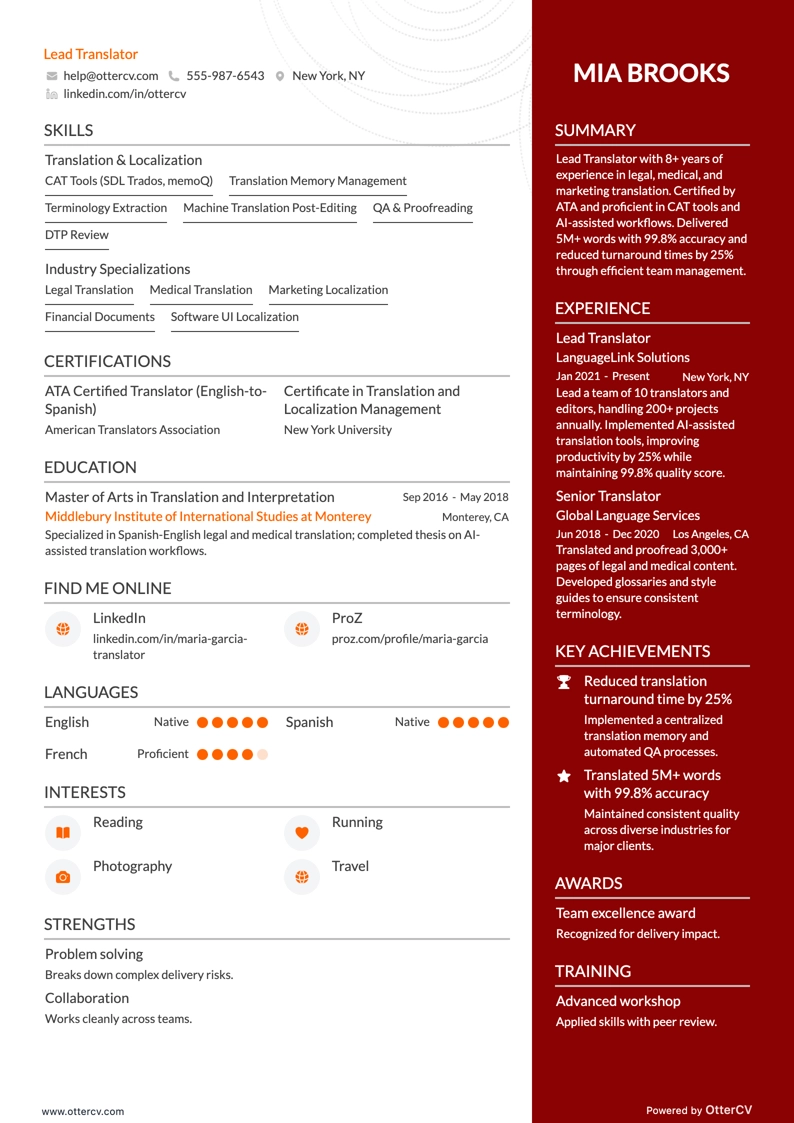
Lead Translator full preview

23 Translator Resume Examples

OtterCV

Written by The OtterCV Team

Updated: 9/12/2025•8 min read

See all resume examples in this guide, or generate your own resume example with your personalized prompt

Lead Translator resume example

Lead Translator

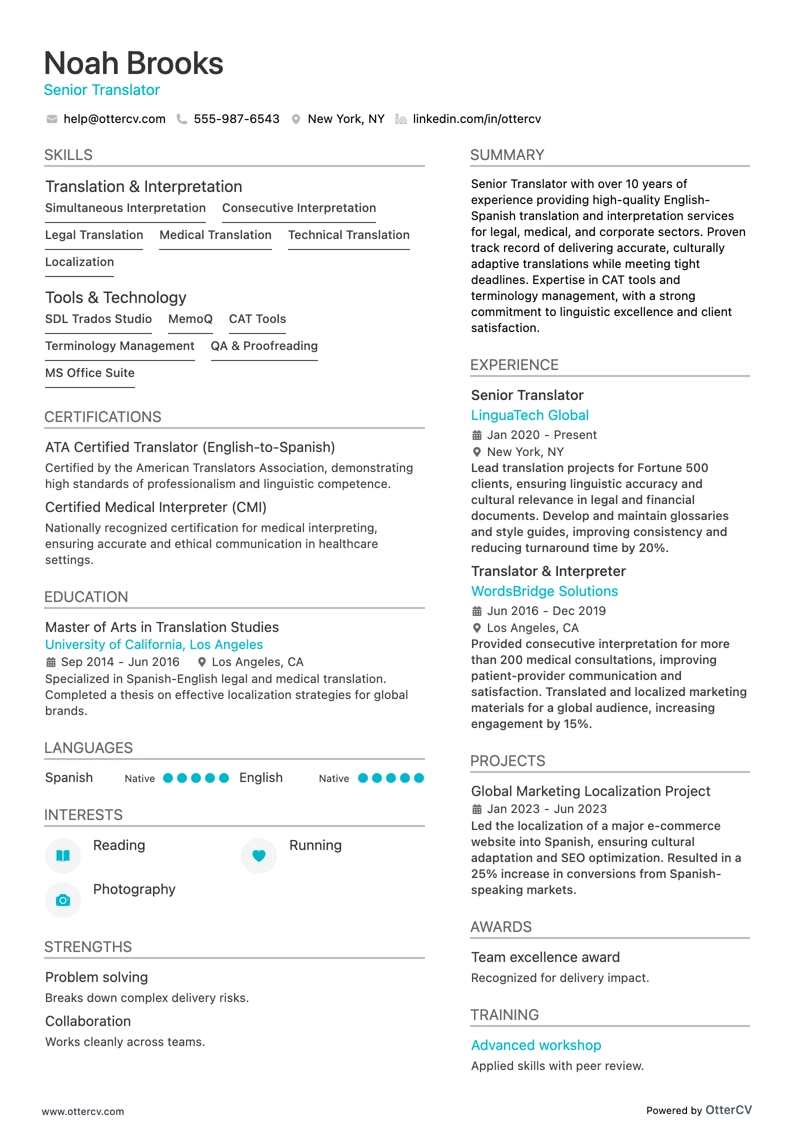
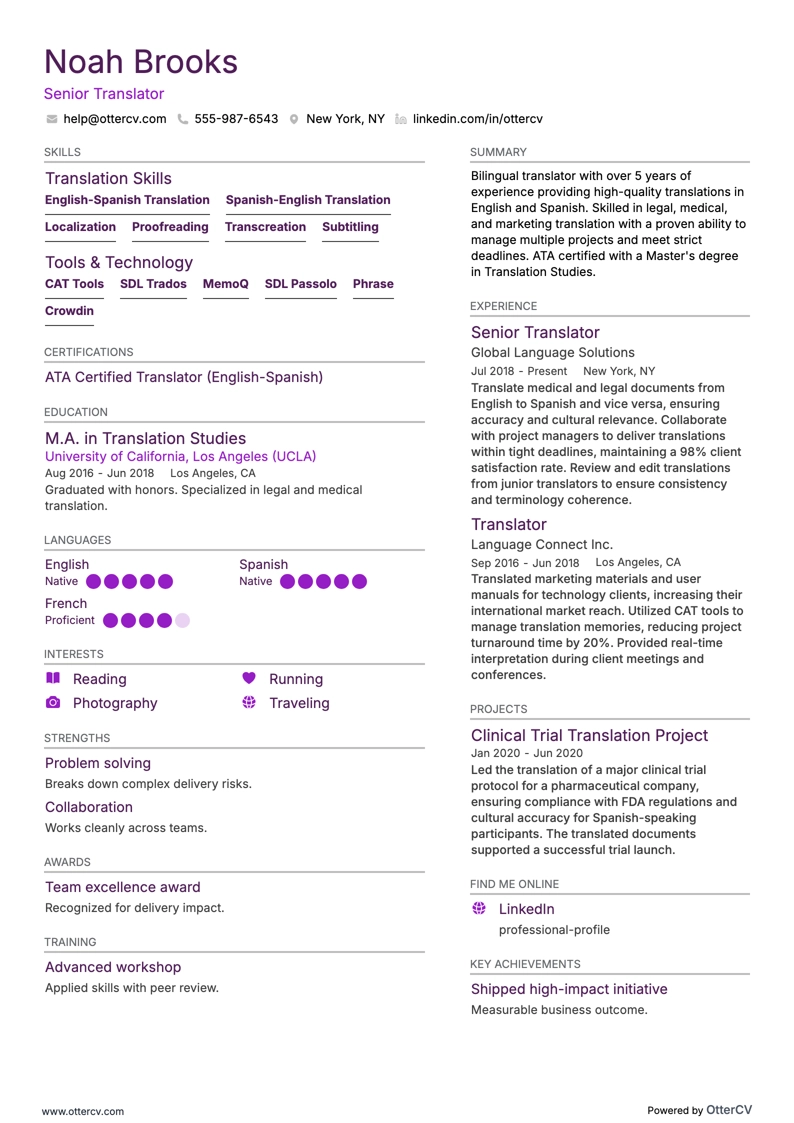
Senior Translator resume example

Senior Translator

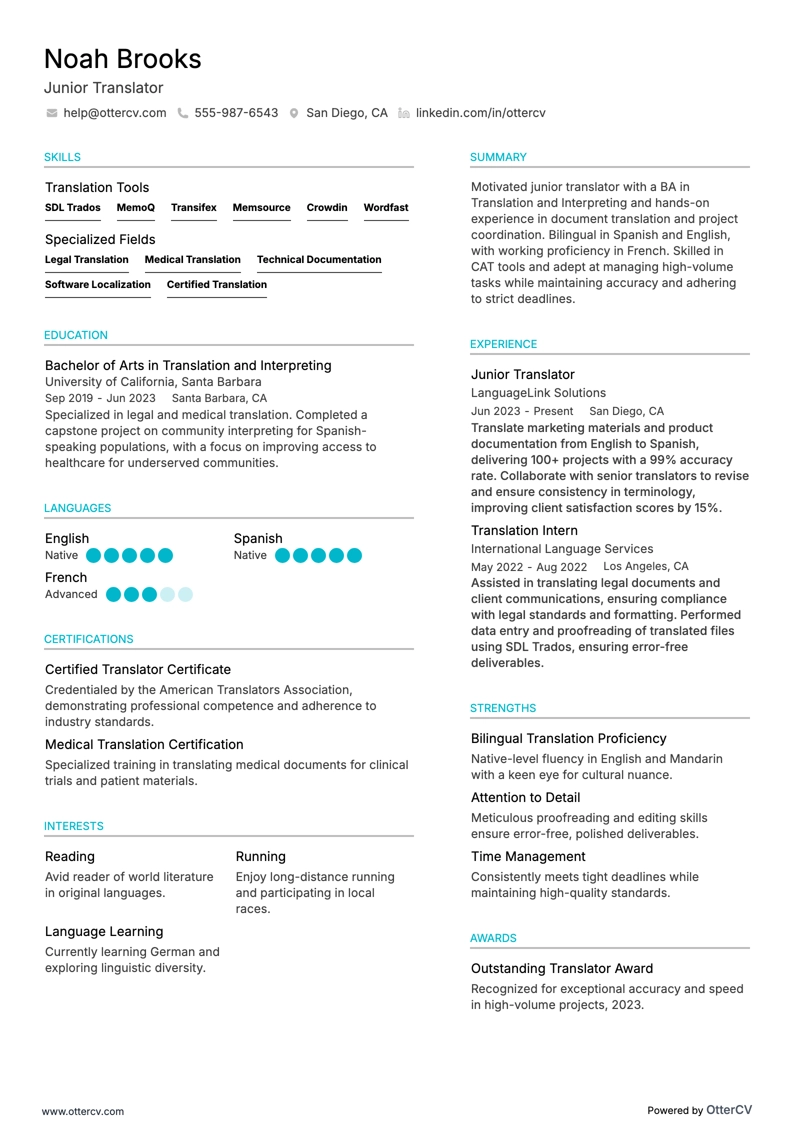
Junior Translator resume example

Junior Translator

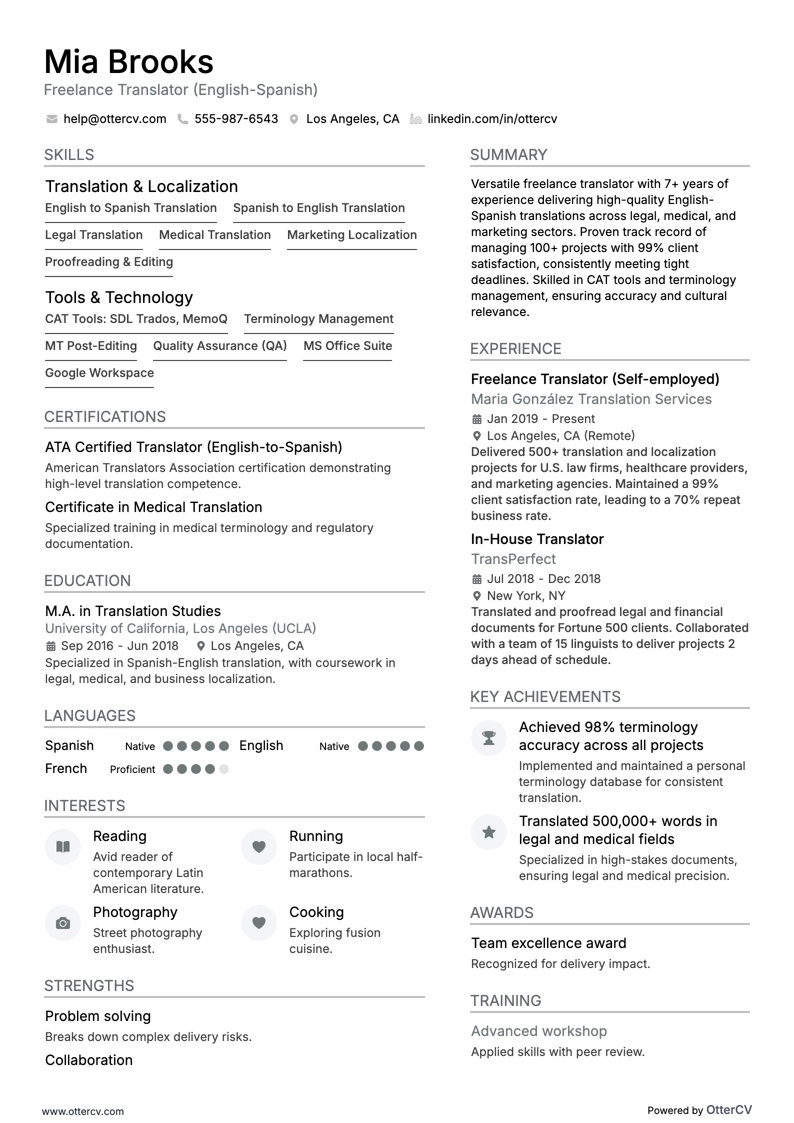
Freelance Translator resume example

Freelance Translator

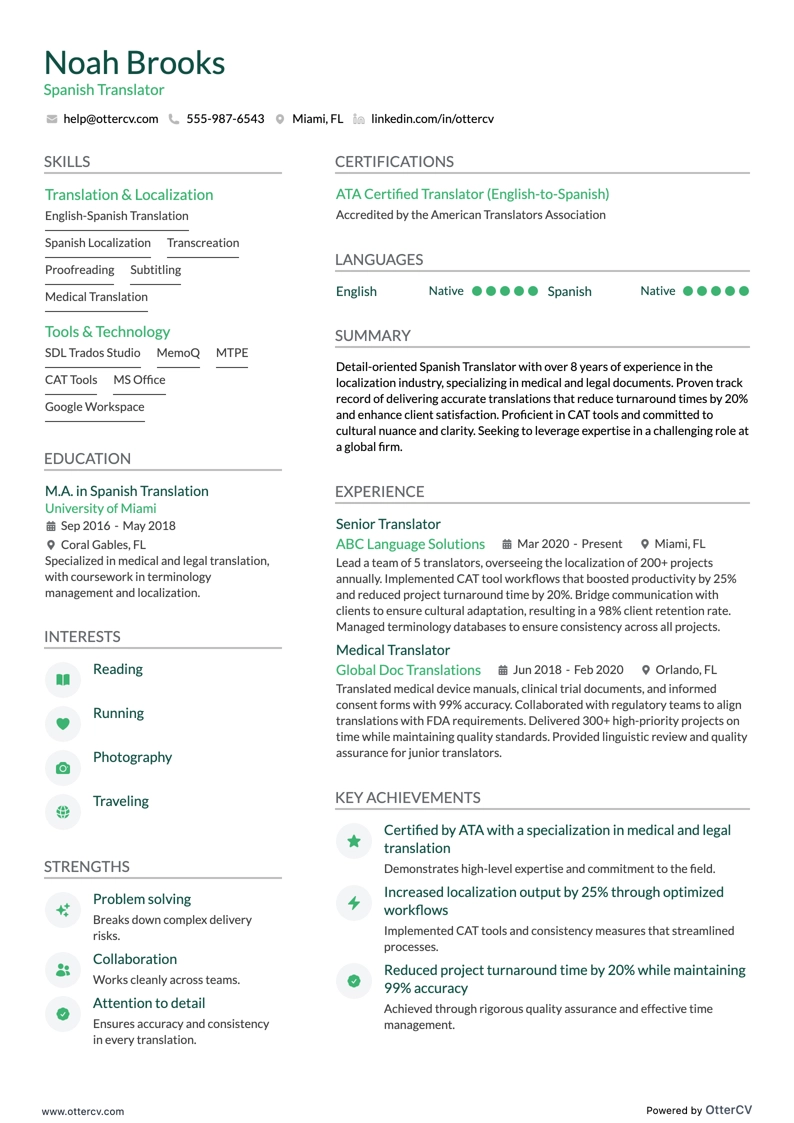
Spanish Translator resume example

Spanish Translator

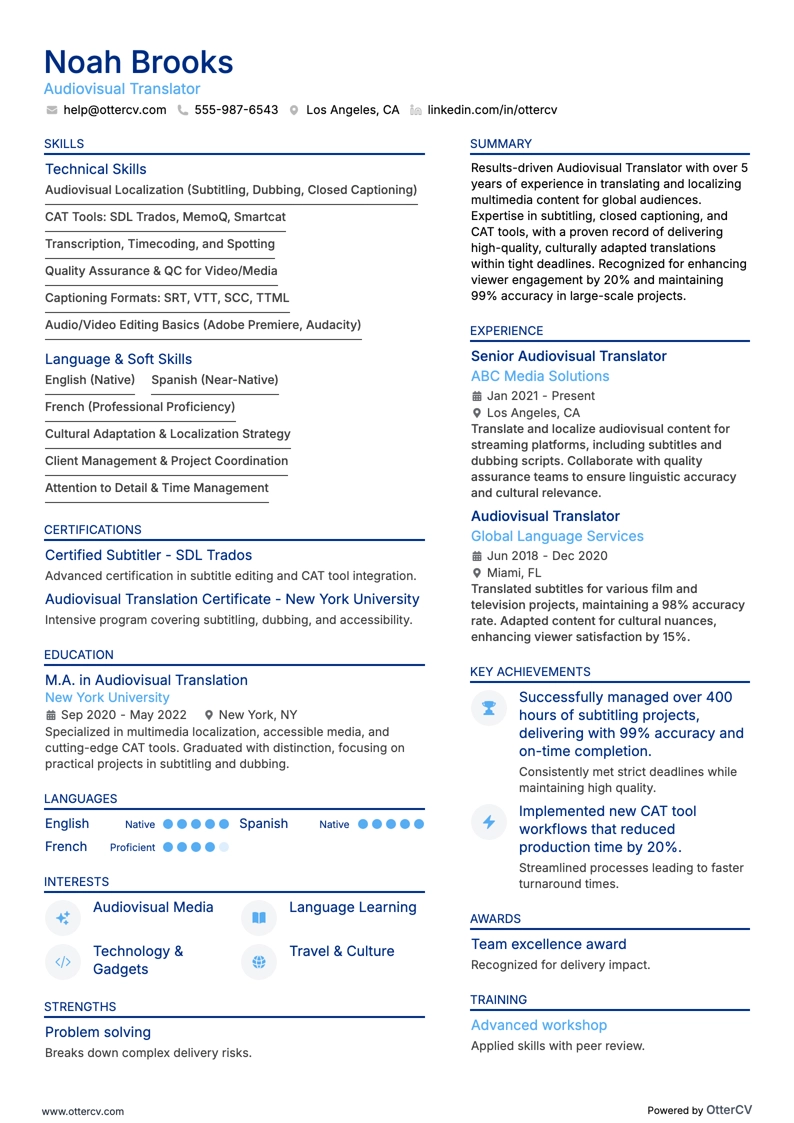
Audiovisual Translator resume example

Audiovisual Translator

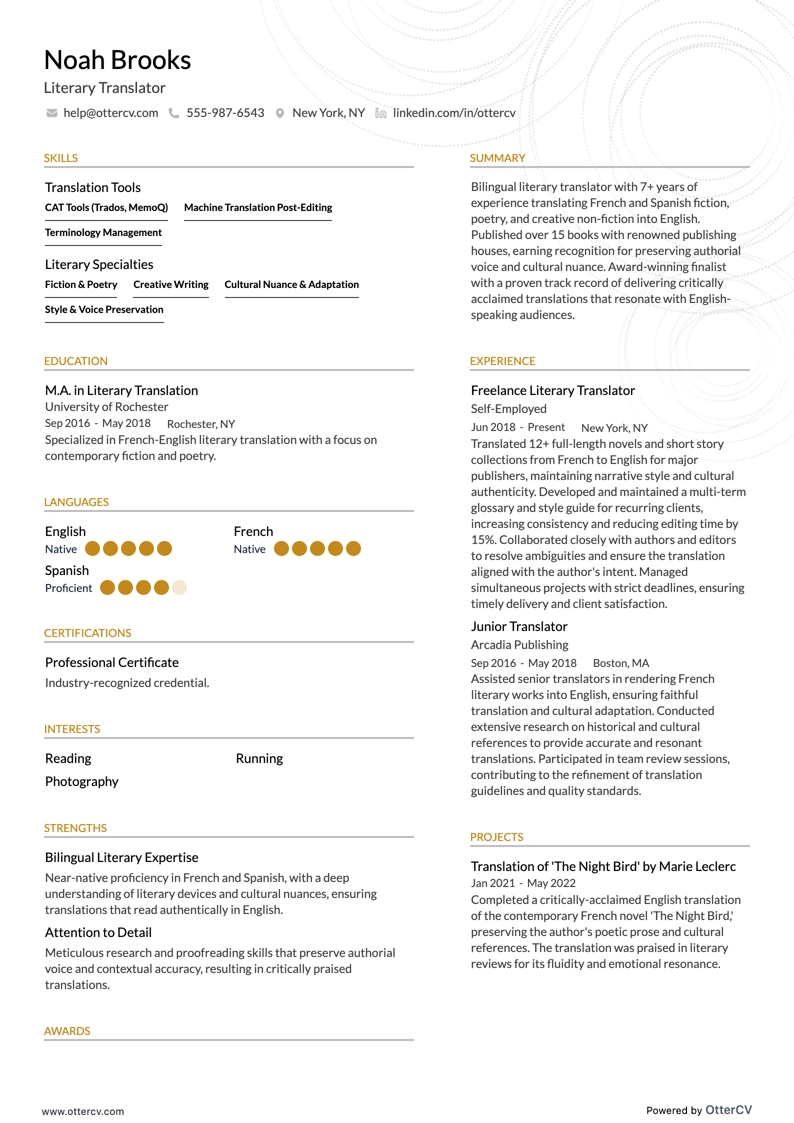
Literary Translator resume example

Literary Translator

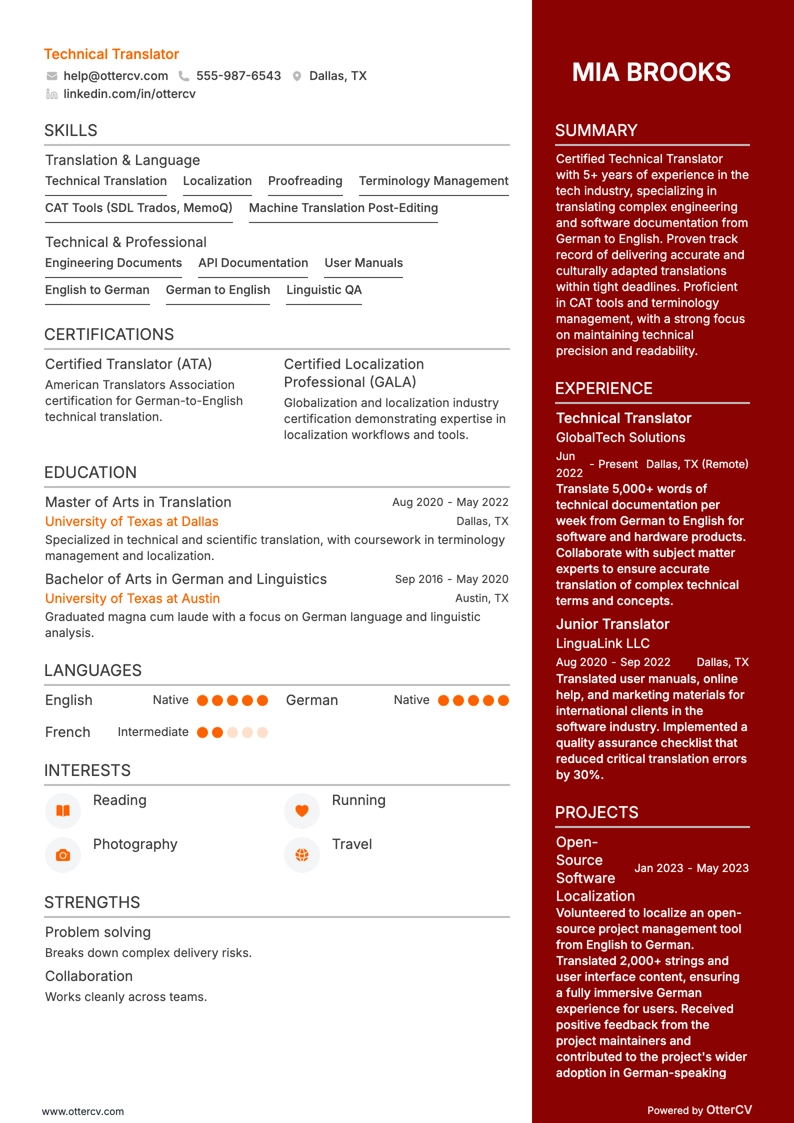
Technical Translator resume example

Technical Translator

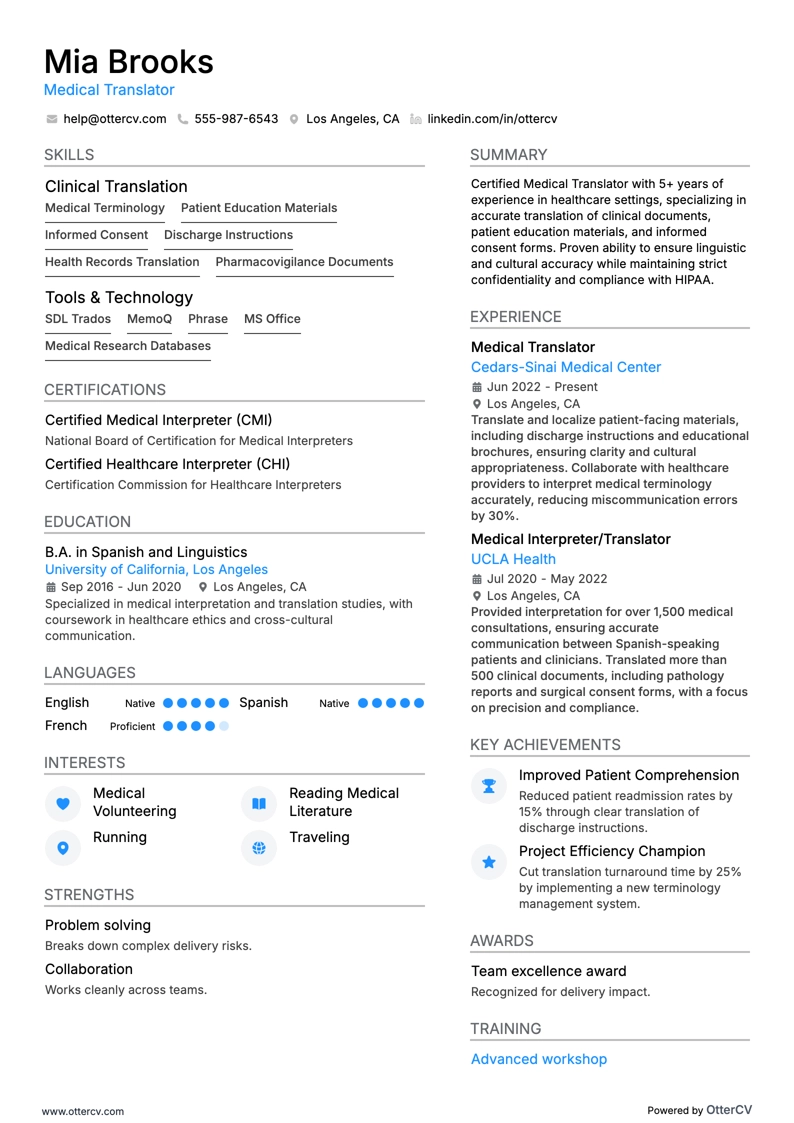
Medical Translator resume example

Medical Translator

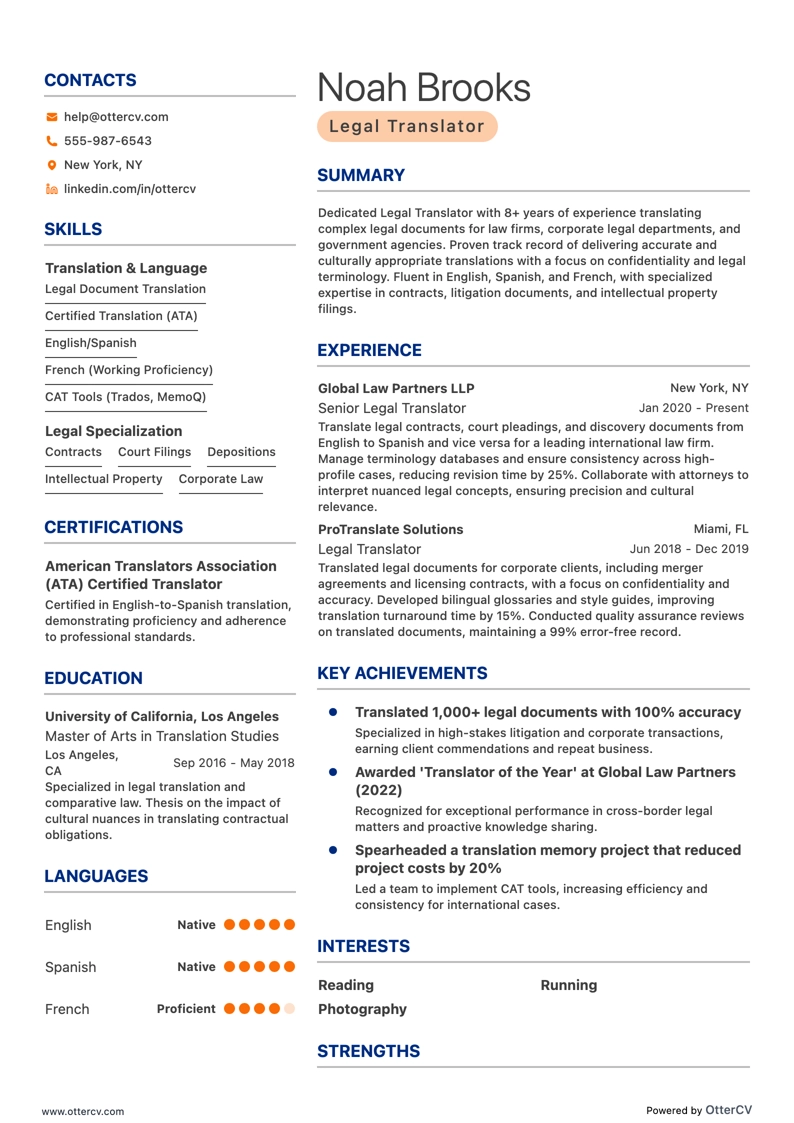
Legal Translator resume example

Legal Translator

Translator resume example

Translator

According to the US Bureau of Labor Statistics, translator jobs are expected to grow by 4% from 2022 to 2032. This points to steady demand for language services, even as the industry changes with the rise of AI.

Today, employers are looking for more than people who simply love languages. They also value cultural expertise, content editing ability, and the skills needed to post-edit AI-generated translations. Despite advances in AI, human expertise remains essential because of the technology’s limitations and the level of proofreading required.

To stay competitive, make sure your resume highlights your language proficiency, cultural knowledge, editing skills, and comfort with relevant technology.

Ready to improve your translator resume? This guide will walk you through the key steps to create a stronger application. We’ll help you:

  • Keep your resume clean and ATS-compliant to present yourself as a detail-oriented translator.
  • Highlight the right skills to stand out, regardless of your career level or situation.
  • Include specific achievements that show your professional success in translation.
  • Tailor your resume to the unique requirements of each translation job you apply for.
  • Emphasize relevant certifications and your commitment to continuous learning.
  • Create a resume that makes a strong impression, even if you’re just starting your translation career.

If this translator resume guide isn’t the right fit, explore these related guides:

Translator resume sample

Looking for an impressive translator resume? View the sample below, or create yours in minutes with the Echocv resume builder.

Michael Martinez

Translator

michael.martinez@translationservices.com | @LinkedIn | New York, NY

Summary

Bilingual translator with over 7 years of experience translating documents and spoken content between English and Spanish. Proven ability to deliver clear, accurate, and culturally appropriate translations. Skilled in CAT tools and able to meet tight deadlines without compromising quality. Seeking to apply this expertise in a dynamic translation role.

Experience

Translator
ABC Translation Services, New York, NY
June 2018 – Present

  • Translate legal, technical, and business documents from English to Spanish and Spanish to English, ensuring accuracy and cultural relevance.
  • Collaborate with clients to understand their needs and provide tailored translation services.
  • Use CAT tools such as SDL Trados and MemoQ to maintain consistency and efficiency.
  • Proofread and edit translations to ensure high-quality deliverables.
  • Manage multiple projects simultaneously while consistently meeting deadlines.

Freelance Translator
Self-employed, Remote
April 2014 – May 2018

  • Provided translation services for clients including publishing houses, legal firms, and corporate businesses.
  • Translated a wide range of documents, including contracts, manuals, websites, and marketing materials.
  • Built a reputation for delivering high-quality translations on time.
  • Built and maintained strong client relationships through effective communication and reliability.

Education

Bachelor of Arts in Spanish
University of California, Los Angeles (UCLA)
Graduated: May 2014

Certifications

  • Certified Translator - American Translators Association (ATA), 2016
  • Advanced Spanish Language Proficiency - Cervantes Institute, 2015

Skills

  • Translation tools: SDL Trados, MemoQ, Wordfast
  • Technical skills: MS Office Suite, Google Suite
  • Soft skills: Attention to detail, Time management, Communication, Cultural awareness

Languages

  • English (Native)
  • Spanish (Fluent)

How to format a translator resume

Let’s take a closer look at how to format your resume. If you want it to stand out to recruiters, use these practical tips to organize it effectively:

Keep in mind that resume expectations can vary by market. For example, a Canadian resume may require a different approach.

Optimize your resume with our intuitive, free AI resume checker and get a detailed 16-point evaluation.

How to write your translator resume experience

Your experience section reflects your career path. Here’s how to write it effectively.

As a translator, you choose words carefully for accuracy and impact. Apply that same precision to your resume. Focus your experience section on the translation work most relevant to the role.

Include details such as:

  • Language pairs: Specify the languages you translated between, such as English to Spanish.
  • Types of documents translated: Mention the kinds of content you worked on, such as legal, technical, medical, or literary texts.
  • Tools and software: List any computer-assisted translation (CAT) tools or software you used, such as SDL Trados, MemoQ, or Wordfast.
  • Client interaction: Describe your experience working with clients, understanding their needs, and delivering customized translations.
  • Volume of work: Show the amount of work completed, such as the number of pages or projects translated.

Freelance work and resume formatting

If you work as a freelancer, present your experience a little differently:

  • Freelance experience: Clearly label the section as “Freelance translator” or “Self-employed translator.”
  • Project-based entries: Instead of standard job titles, use project names or project types, such as “Legal document translation for XYZ law firm.”
  • Client list: If confidentiality allows, include notable clients or industries you have worked with.
  • Scope of work: Mention the scope of each project, including languages translated, document types, and tools used.
  • Consistent formatting: Keep the formatting aligned with the rest of your resume for a professional appearance.

Adding numbers and results to your resume strengthens it by giving clear proof of your achievements. Quantifying your work helps hiring managers understand both its scale and impact. Metrics are especially valuable when they:

  • Tie to business objectives: For example, “Translated marketing materials that increased international sales by 20%.”
  • Show your contribution: For example, “Led a translation project that reduced turnaround time by 15%.”

Remember, recruiters are looking for reasons to say “yes” to your resume. They value people who get things done, even when some meaningful contributions are hard to measure. Fixing a bug or helping a coworker still matters, so include those contributions too.

As a translator, you make sure every word communicates the intended meaning and nuance. In the same way, tailoring your resume helps highlight the skills and experience most relevant to the job. This targeted approach not only presents your qualifications more effectively, but also improves your chances of getting through Applicant Tracking Systems used by many companies.

To illustrate this, we’ve provided an actual example of a translator job posting below. By shaping experience entries around it, you can see how much more effective a targeted resume can be.

Translator

Translator

Responsibilities:

  • Apply advanced communication skills in English and Spanish.
  • Accurately translate a wide range of complex material from the source language to the target language.
  • Use translation software to help automate translations.
  • Identify and resolve conflicts involving the meanings of words, concepts, practices, or behaviors.
  • Work effectively with a variety of cultural and regional dialects and backgrounds.
  • Demonstrate strong proofreading and editing skills.
  • Recommend ways to update, simplify, and improve translation processes and procedures.
  • Exercise discretion while maintaining confidentiality and neutrality when required.
  • Prioritize tasks effectively with strong attention to detail and organizational skills.
  • Use Microsoft Office products to edit and format different types of documents.

Qualifications:

  • Advanced High or Superior bilingual Spanish/English proficiency is required for this position.
  • Candidates must qualify on Spanish and English reading and writing ACTFL proficiency assessments before starting the position.
  • Ability to translate documents into the target language.
  • Create documents in the target language, including marketing materials, presentations, spreadsheets, databases, and flowcharts.
  • Operate word processing and transcribing equipment.
  • Demonstrated cultural knowledge of the target language.
  • Demonstrated ability to speak, read, and write in both the source and target language.
  • Competitive applicants should have at least 1 year of previous work experience translating documents.

Here’s an example of an experience section that aligns closely with the job description:

Experience

Translator

ABC Translation Services

03/2018 - 07/2022 | New York, NY

Provided translation services with a focus on accuracy and cultural relevance.

  • Translated legal documents between English and Spanish, achieving 98% client satisfaction.
  • Used SDL Trados to streamline processes, improving efficiency by 30%.
  • Proofread and edited content for accuracy, reducing errors by 40%.
  • Improved translation methods and procedures, cutting project turnaround time by 20%.
  • Maintained confidentiality and neutrality to ensure compliance with privacy standards.
  • Formatted documents using Microsoft Office, resulting in a 15% increase in client approval.
RIGHT

This experience section is likely to catch recruiters' attention.

  • Demonstrates proficiency: Translating complex materials between English and Spanish with a 98% client satisfaction rate shows strong language skills and reliability. This metric helps prove the ability to meet client expectations consistently.
  • Efficiency in using tools: Using translation software to improve efficiency by 30% shows the ability to leverage technology effectively and handle high volumes of work quickly and accurately.
  • Attention to detail: Proofreading and editing to reduce errors by 40% reflects a careful approach to quality and a commitment to delivering precise, error-free translations.
  • Technical skills: Formatting documents in Microsoft Office, resulting in a 15% increase in client approval, demonstrates proficiency with essential office software and strong attention to presentation.
  • Quantifiable achievements: Including clear metrics and improvements makes the candidate's impact more tangible and helps recruiters understand the value they can bring.

If you lack work experience, don’t panic. Here are some tips to help you stand out.

How do I write a translator resume with no experience

Creating a translator resume without professional experience can be challenging, but you can still make a strong impression by focusing on your skills, education, and relevant activities. Use a functional or hybrid resume format to highlight your abilities. A functional format emphasizes skills and competencies, while a hybrid format combines those strengths with a brief overview of your work history.

If you're applying for an entry-level translator position, consider these suggestions:

  • Education: List education related to languages, translation studies, or similar fields. Emphasize relevant coursework such as linguistics, translation techniques, or cultural studies.
  • Internships: Mention any translation-related internships you've completed, whether paid or unpaid. For example: "Interned at XYZ Translation Services, where I assisted with translating legal documents from English to Spanish, ensuring accuracy and cultural relevance."
  • Volunteer work: Highlight hands-on translation experience, such as translating materials for non-profit organizations. Include any responsibilities involving supervision or tracking the work of others.
  • References: Provide references from teachers or mentors if available, or note that they can be provided upon request.
  • Transferable skills: Emphasize skills that apply to translation work, such as attention to detail, communication, and cultural awareness.
  • Objective statement: Write a brief statement that shows your enthusiasm for translation, highlights relevant skills, and outlines your career goals. Keep it to 3 sentences.

PRO TIP

To show you are prepared for entry-level translator roles, emphasize your educational background and related coursework.

Let’s take a closer look at the sample above and adapt it for an entry-level position.

If you have limited experience, a functional or hybrid resume format can help highlight your skills and abilities instead of focusing mainly on work history. This makes it easier for hiring managers to quickly recognize your competencies and enthusiasm for the translation field, even if you’re just getting started.

Michael Martinez

Translator

michael.martinez@translationservices.com | @LinkedIn | New York, NY

Objective

Bilingual in English and Spanish, recent graduate with strong communication skills and cultural knowledge. Seeking an entry-level translator position to apply language abilities and support effective communication across diverse cultures.

Skills

  • Bilingual: English/Spanish
  • Excellent written and verbal communication
  • Cultural awareness and sensitivity
  • Knowledge of translation software, including SDL Trados and MemoQ
  • Strong proofreading and editing abilities

Experience

Volunteer Translator

ABC Translation Services, New York, NY

April 2014 – May 2018

  • Provided translation services for community events and informational materials.
  • Helped translate documents and presentations, ensuring accuracy and cultural relevance.

Education

Bachelor of Arts in Spanish

University of California, Los Angeles (UCLA)

Graduated: May 2014

Certifications

Certificate in Translation Studies

Institute of Linguistics

Awarded: March 2022

Languages

  • English (Native)
  • Spanish (Fluent)

After listing your experience, the next step is to highlight your key skills so employers can quickly understand your qualifications.

How to list your hard and soft skills on your resume

Emphasizing skills on a resume for a translator helps show your qualifications and makes it easier for recruiters to see your fit for the role. It aligns your profile with the job description, improves your resume's visibility in ATS systems, and demonstrates your value to employers.

Let's focus on hard skills first.

Hard skills

Listing hard skills on a translator's resume is important because it shows your technical knowledge and proficiency with specific tools and technologies.

Create a resume section called Hard skills and place it near the top of your resume or below your work experience section. Be specific and relevant by naming the tools, software, and methodologies you know well.

Tailor these skills to the job you're applying for. If you have many hard skills, consider grouping them into separate sections to improve clarity.

Here are some essential translator skills that would significantly benefit your application:

Best hard skills for your translator resume

  • SDL Trados Studio is a widely used translation tool.
  • MemoQ is a valuable skill for translation workflows.
  • Wordfast is commonly used in professional translation.
  • Across is a useful platform for translation projects.
  • OmegaT is an open-source computer-assisted translation tool.
  • MateCat supports efficient translation and collaboration.
  • Smartcat is a useful tool for managing translation work.
  • Adobe Acrobat helps with reviewing and editing document files.
  • Microsoft Office is useful for everyday translation tasks.
  • Google Translate can support basic translation workflows.
  • CAT tools (Computer-Assisted Translation tools) are essential technical skills.
  • Subtitling software, such as Aegisub, is useful for audiovisual translation.
  • Localization tools support translation for different markets and regions.
  • XTM Cloud is a platform used in translation and localization.
  • Translation Memory (TM) management helps improve consistency and speed.
  • Terminology databases support accurate and consistent translations.
  • Machine Translation Post-Editing (MTPE) is a valuable technical skill.
  • Optical Character Recognition (OCR) software helps extract text from files.
  • Multilingual Desktop Publishing (DTP) supports formatting across languages.

Soft skills

Soft skills are crucial on a translator's resume because they show how well you handle different situations and work with clients and colleagues. Rather than listing them in a separate section, weave them naturally throughout your resume.

In your summary or objective, highlight the most relevant soft skills and support them with specific examples from real situations, such as managing cross-cultural communication or resolving translation discrepancies.

You should also reinforce these skills in your work experience and education sections by showing your collaboration and adaptability in translation settings. Make sure the soft skills you mention align with the keywords used in the job ad.

Below are some commonly valued soft skills for translators identified through our research.

Best soft skills for your translator resume

  • Attention to detail helps ensure accuracy and consistency.
  • Cultural awareness supports appropriate and nuanced translation.
  • Communication helps you clarify meaning and client expectations.
  • Multitasking helps you manage multiple assignments efficiently.
  • Creativity helps you adapt language naturally across contexts.
  • Patience supports careful revision and thoughtful wording choices.
  • Time management helps you meet deadlines consistently.
  • Research skills help you verify terminology and context.
  • Active listening helps you understand spoken meaning accurately.
  • Collaboration supports smoother work with clients and teams.
  • Critical thinking helps you interpret meaning and resolve ambiguity.
  • Interpersonal skills help build strong professional relationships.
  • Organization helps you keep projects and terminology in order.
  • Adaptability helps you adjust to different subjects, tones, and formats.
  • Customer service helps you respond professionally to client needs.

Your education has helped build your skills. Let’s refine the certifications and education section.

How to list your certifications and education on your resume

To become a translator, you typically need at least a bachelor’s degree in translation, linguistics, or a related field. Hiring managers often prefer candidates with formal education in a foreign language or a related subject. Some translators hold degrees in literature, history, law, medicine, or other areas connected to their specialization. For many government or high-level positions, a master’s degree is often required. While a formal degree is not always mandatory, it can significantly improve your job prospects and credibility.

Here’s the best way to present your educational background on a translator resume:

  • Mention the degree you earned in translation, linguistics, or a related area.
  • Specify the educational institution you attended.
  • Include the year you graduated or are expected to graduate.
  • Highlight your major, such as translation studies, linguistics, or a specific language.
  • Detail any translation certifications you hold, such as ATA certification or CTP.
  • Note any additional courses or workshops that strengthen your translation skills, such as advanced language courses or training in translation software.
  • List your GPA if it is above 3.5 to show strong academic performance.

This format helps ensure your education section is clearly presented for a translator role.

Education

Master of Arts in Translation Studies

University of Washington
09/2022 - 05/2024 · Seattle, WA
GPA: 4.0 / 4.0

  • Focused on advanced translation techniques and cultural adaptation.
  • Completed a thesis on the impact of regional dialects in translation.

Bachelor of Arts in Linguistics

University of California, Berkeley
08/2018 - 05/2022 · Berkeley, CA
GPA: 4.0 / 4.0

  • Specialized in linguistic theories and language acquisition.
  • Completed a capstone project on the sociolinguistic aspects of bilingualism.
RIGHT

In addition to a degree, earning relevant certifications can strengthen your credentials as a translator. Listing these certifications on your resume demonstrates your expertise and commitment to continued learning.

When including certifications, be sure to:

  • List each certification you have obtained.
  • Name the organization that issued each certification.
  • Include the expiration date when applicable.

Consider these respected certifications for translators:

After discussing certifications, let’s turn to writing an engaging resume summary to attract potential employers.

How to write your translator resume summary

Your personal statement is a key part of your application because it gives recruiters a quick overview of who you are, your goals, and how you plan to achieve them. If you have experience, use a resume summary rather than an objective statement, which is better suited to entry-level candidates.

For experienced translators, keep your summary brief at around 3–5 sentences and highlight how your language skills contributed to previous successes. Use active voice, tailor the summary to the specific job, and include keywords from the job ad to capture recruiters’ attention.

Here’s a strong resume summary example tailored to the earlier translator job ad. This sample shows the ideal approach for crafting your professional summary.

Summary

Translator with 6 years of experience translating complex materials between English and Spanish. Proficient in using translation software to streamline processes and improve efficiency. Adept at working with various dialects and cultural backgrounds, with a solid understanding of Microsoft Office for document formatting. Seeking a Translator position to apply and further develop these skills in a professional environment.

RIGHT

This resume summary stands out because it is:

  • Clear and concise: It summarizes key qualifications and achievements efficiently.
  • Engaging: It uses active language and measurable results to highlight skills.
  • Tailored to the job: It aligns with the job’s requirements for language proficiency, translation accuracy, and cultural knowledge.

Now that we’ve covered the main sections of your translator resume, let’s look at additional sections and how to include them effectively.

Additional sections for a translation resume

  • Projects: Describe specific projects that demonstrate your problem-solving and strategic thinking. For example: “Translated a comprehensive technical manual for a multinational corporation, resulting in a 20% reduction in customer service calls due to clearer instructions.”

  • Passions: Mention hobbies and interests , such as participating in cultural events or community service, to present yourself as a well-rounded candidate.

  • Professional affiliations : Include your involvement with industry organizations, such as membership in the American translators Association (ATA), to highlight your network and commitment to the profession.

  • Achievements and awards : Call attention to notable accomplishments, such as receiving the "Excellence in Translation Award" for consistently delivering high-quality translation services.

  • Use specific numbers and achievements to show your impact.

  • Adjust your experience section to match the job description.

  • Mention both hard and soft skills, with extra emphasis on the ones most relevant to the role.

  • List your educational background in chronological order and include relevant coursework.

  • Highlight any advanced degrees and professional certifications.

  • Underscore your most relevant qualifications, skills, and experience.

  • Add extra sections if space allows to help your resume stand out.

Translator resume examples

Explore additional Translator resume samples and guides and see what works for your level of experience or role.

By Experience

Lead Translator

Lead Translator resume preview

Senior Translator

Senior Translator resume preview

Junior Translator

Junior Translator resume preview

Translator resume examples

Explore additional Translator resume samples and guides and see what works for your level of experience or role.

By Role

Freelance Translator

Freelance Translator resume preview

Spanish Translator

Spanish Translator resume preview

Audiovisual Translator

Audiovisual Translator resume preview

Literary Translator

Literary Translator resume preview

Technical Translator

Technical Translator resume preview

Medical Translator

Medical Translator resume preview

Legal Translator

Legal Translator resume preview

Translator

Translator resume preview