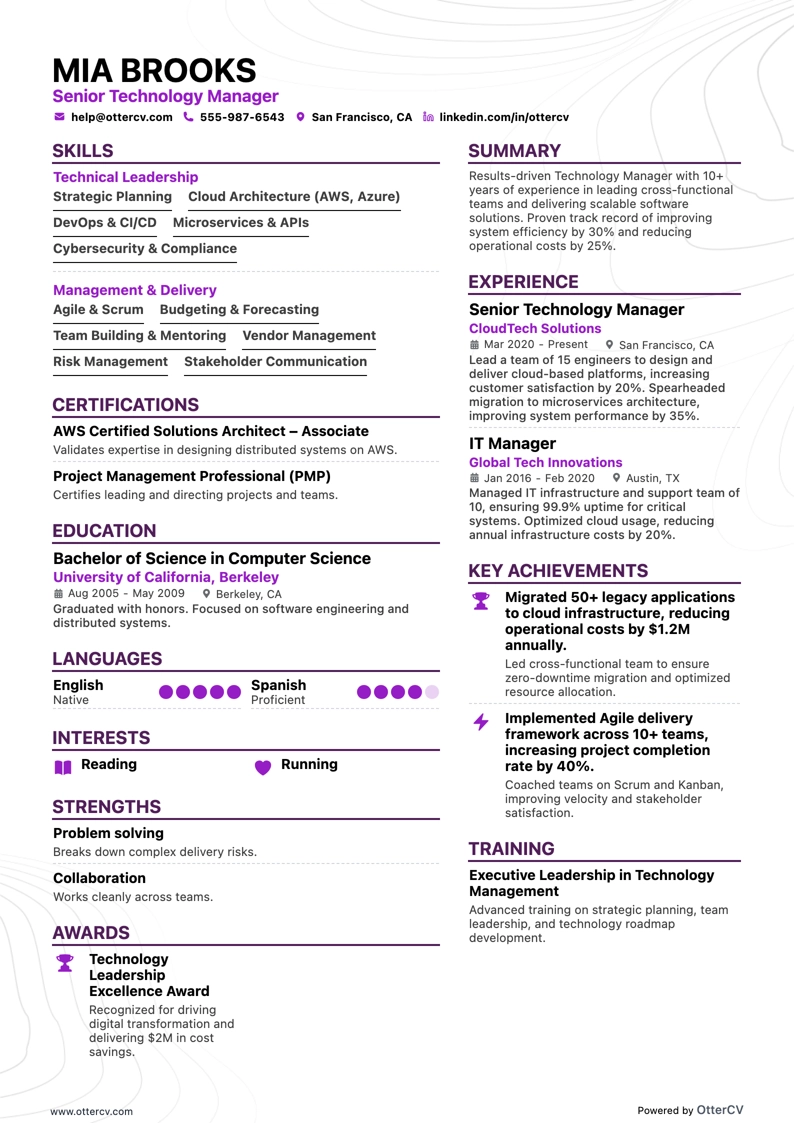
Senior Technology Manager full preview

10 Technology Manager Resume Examples

OtterCV

Written by The OtterCV Team

Updated: 7/25/2024•8 min read

See all resume examples in this guide, or generate your own resume example with your personalized prompt

Senior Technology Manager resume example

Senior Technology Manager

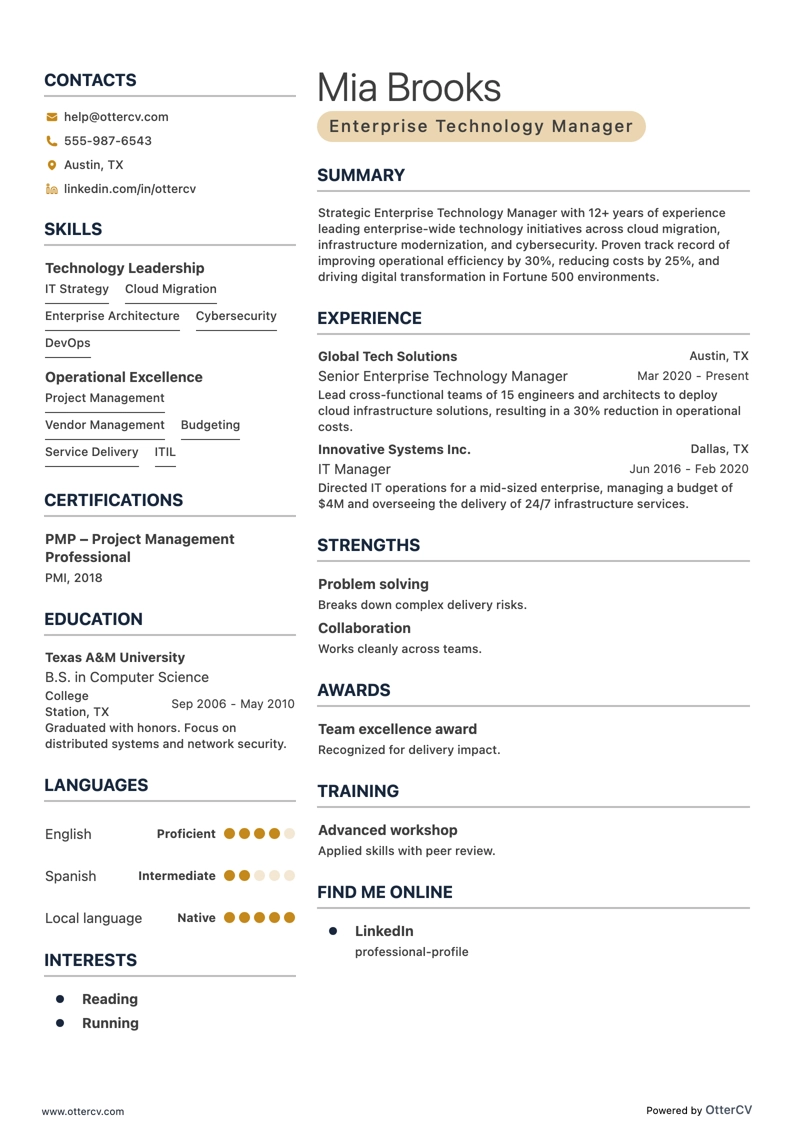
Enterprise Technology Manager resume example

Enterprise Technology Manager

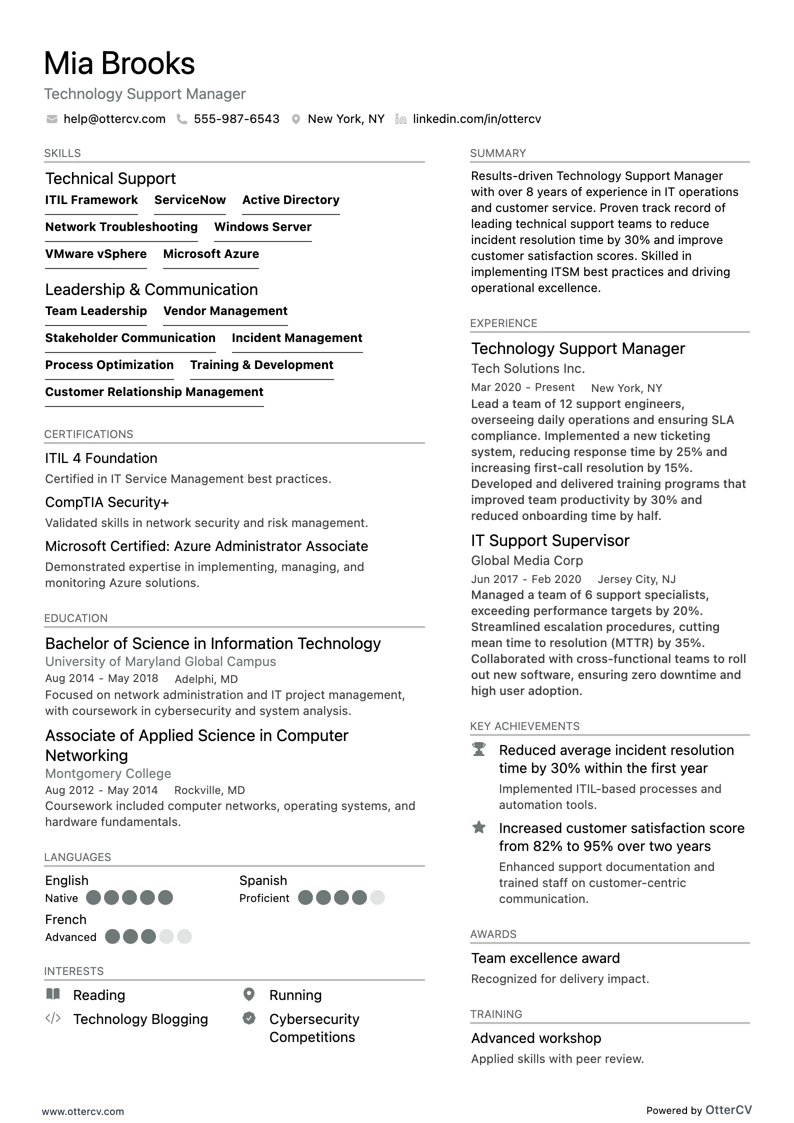
Technology Support Manager resume example

Technology Support Manager

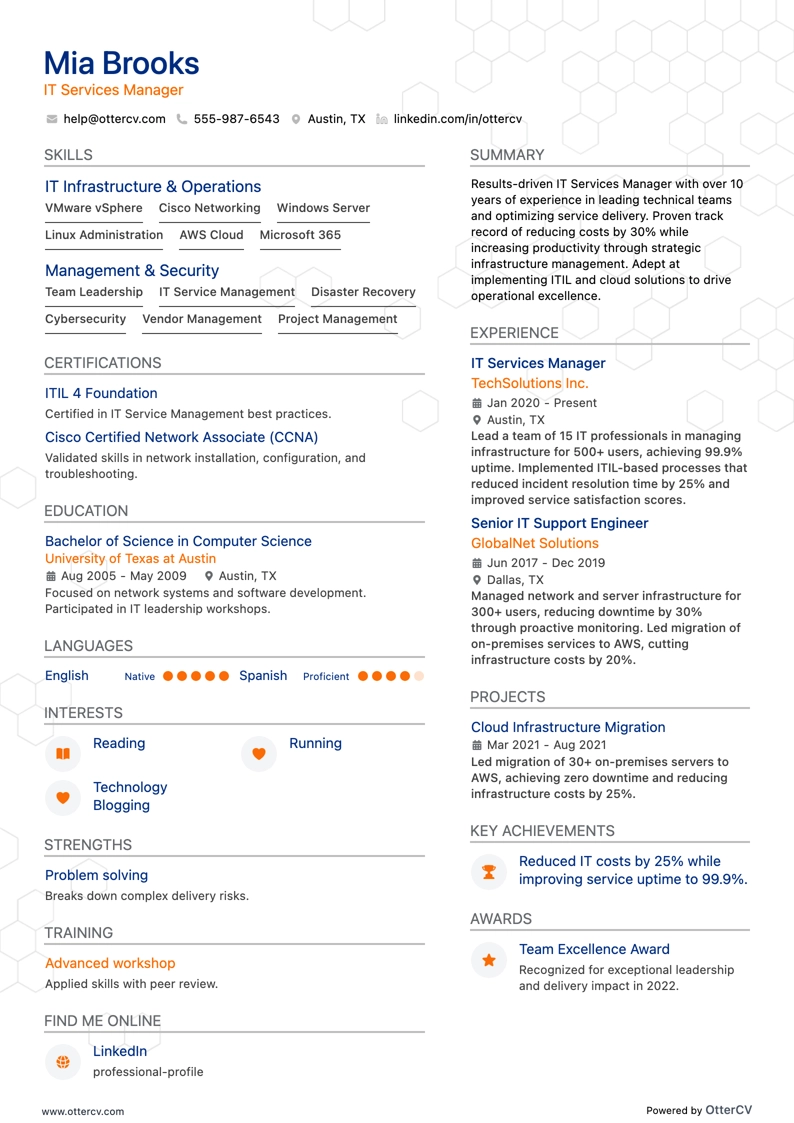
IT Services Manager resume example

IT Services Manager

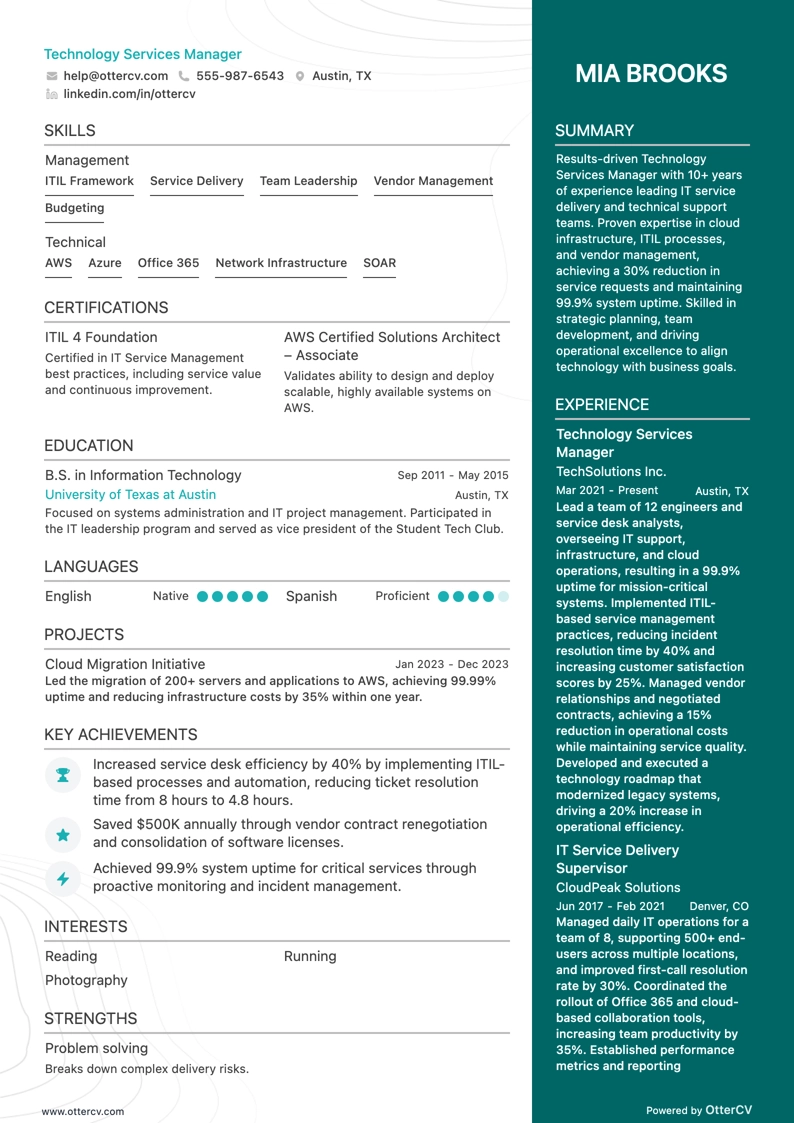
Technology Services Manager resume example

Technology Services Manager

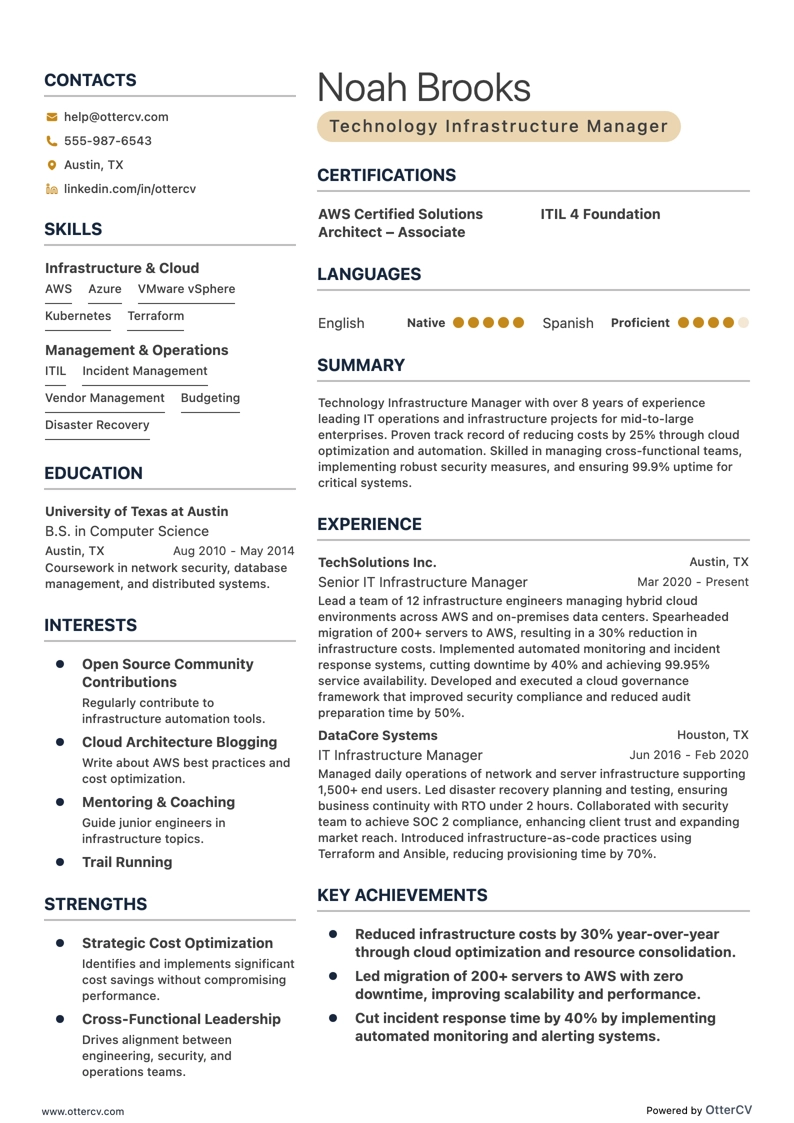
Technology Infrastructure Manager resume example

Technology Infrastructure Manager

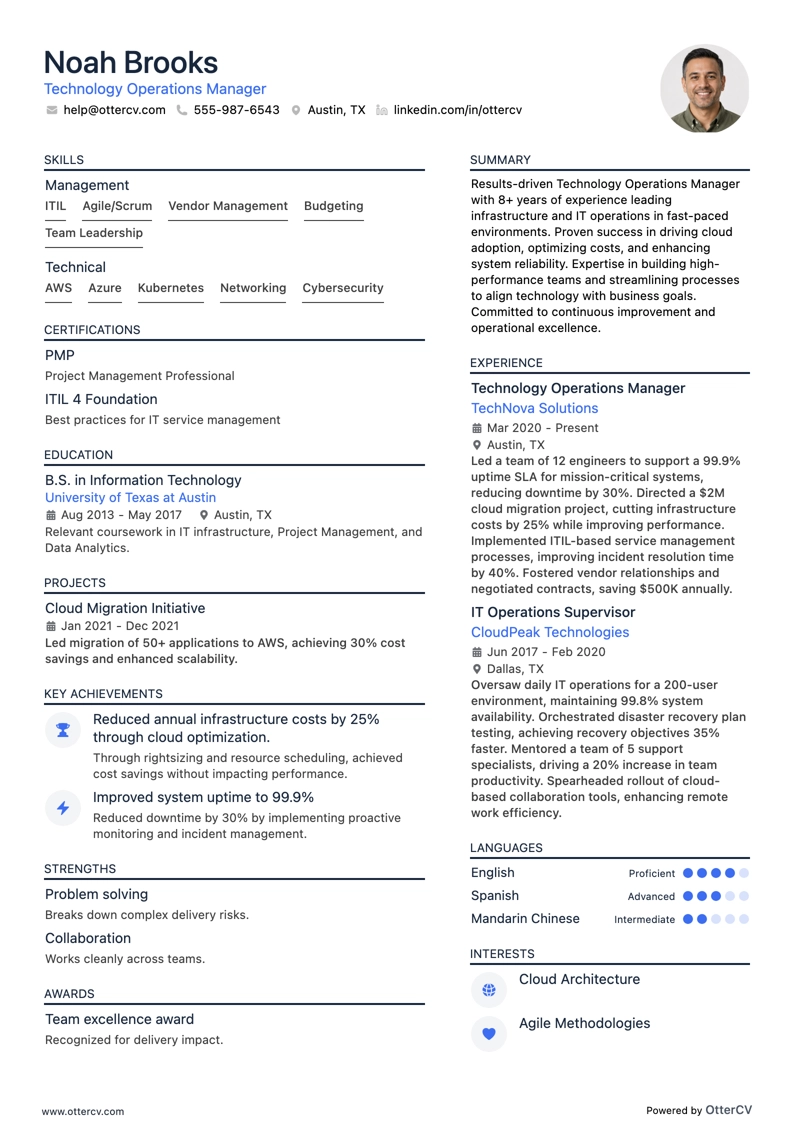
Technology Operations Manager resume example

Technology Operations Manager

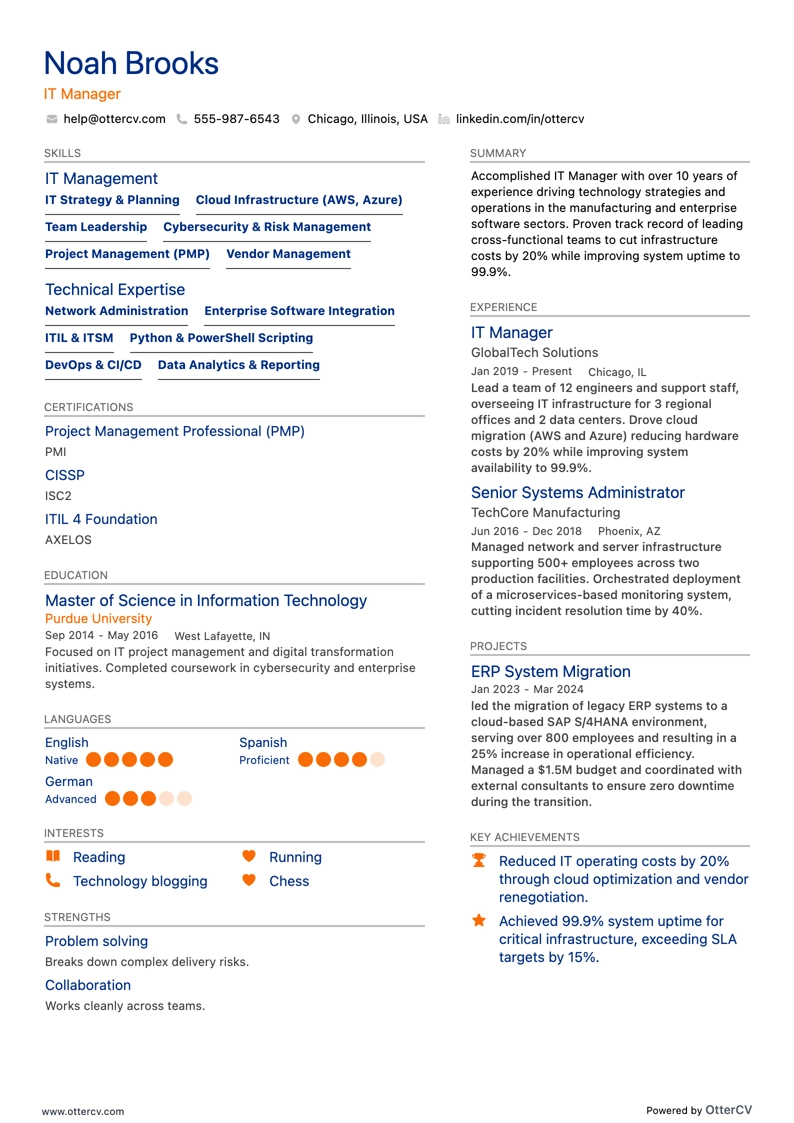
IT Manager resume example

IT Manager

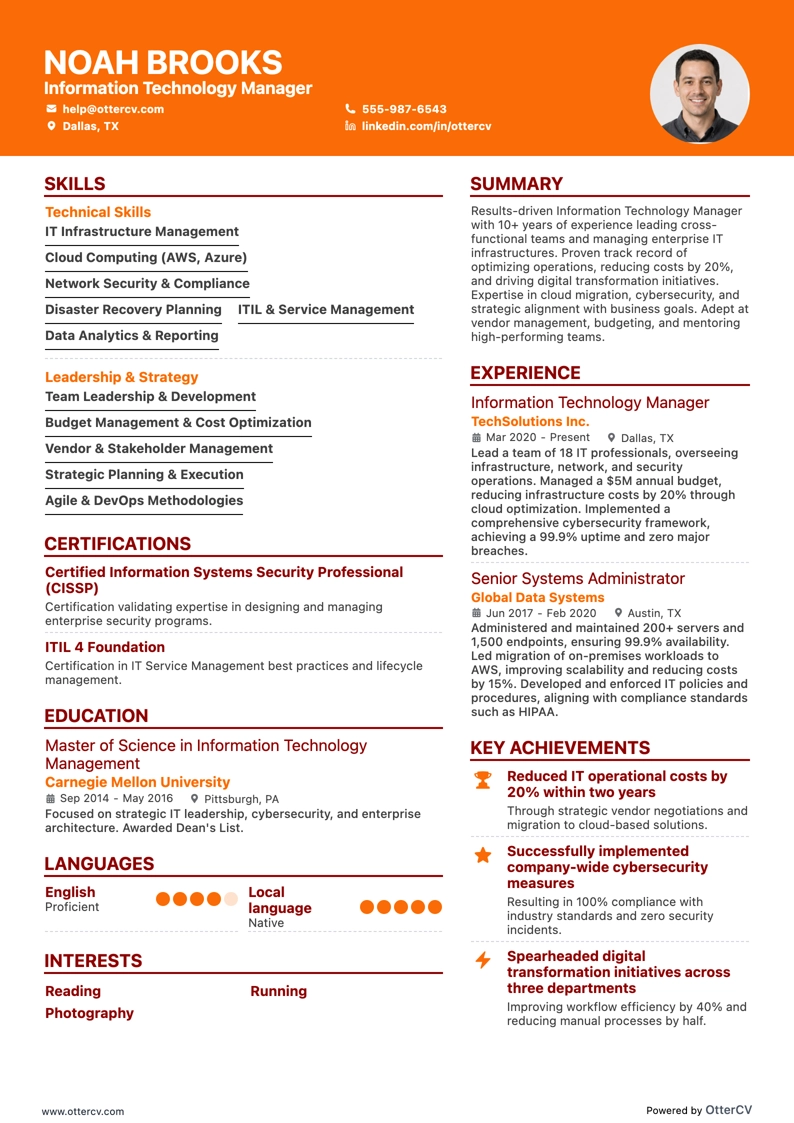
Information Technology Manager resume example

Information Technology Manager

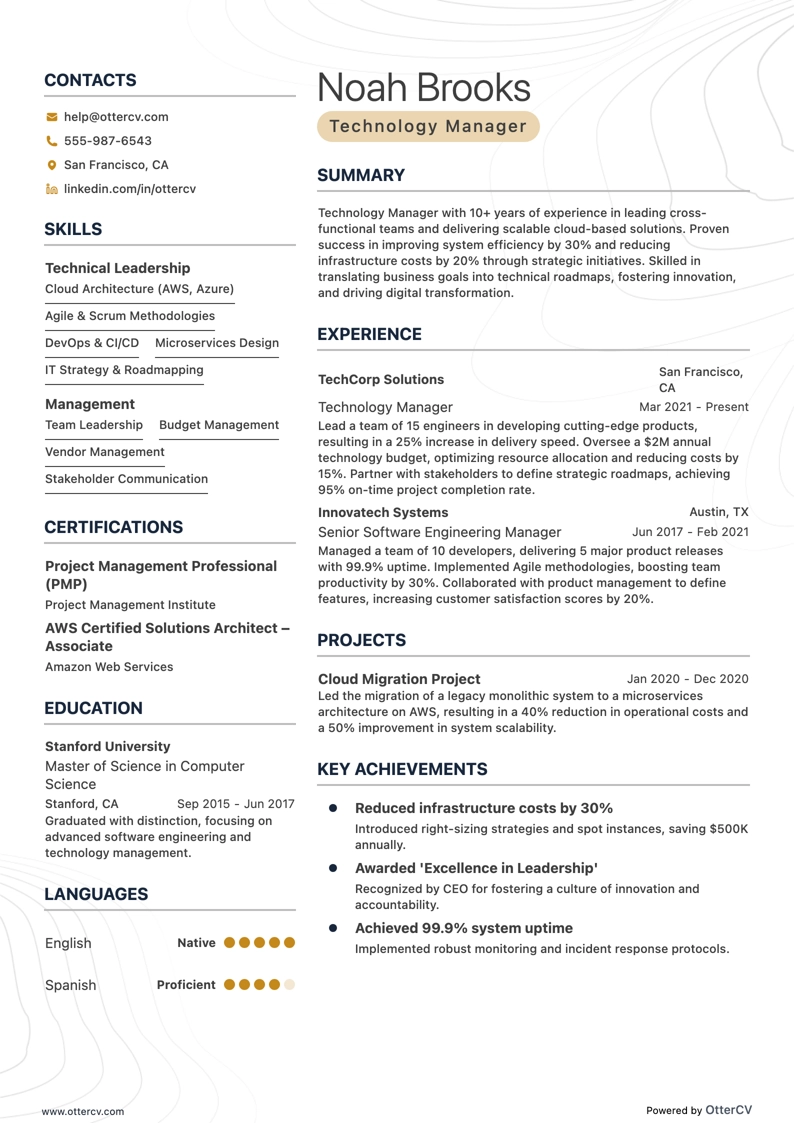
Technology Manager resume example

Technology Manager

Many IT manager resumes fail because they read like task lists and hide leadership impact, so ATS screening and quick recruiter scans can miss your fit. In today’s crowded market, that can cost qualified candidates interviews.

A strong resume shows the outcomes you improved, not just the systems you worked on. Knowing how to make your resume stand out means emphasizing uptime gains, incident reduction, budget savings, on-time migrations, audit-ready security, faster ticket resolution, and higher customer satisfaction across teams and sites.

Key takeaways

  • Start each experience bullet with measurable results such as uptime, cost savings, or resolution time.

  • Use a reverse-chronological format to highlight increasing leadership across teams, budgets, and systems.

  • Tailor every resume to the job posting’s specific tools, frameworks, and success criteria.

  • Show skills through quantified results in your summary and experience, not only in a skills list.

  • For entry-level resumes, use project metrics, lab builds, and ITIL-aligned work to demonstrate readiness.

  • Place certifications above or below education based on which better supports your current qualifications.

  • Use Echocv’s tools to strengthen bullet points and remove vague language before submitting your resume.

Job market snapshot for IT managers

We analyzed 265,074 recent IT manager job ads across major US job boards. These figures provide a quick view of the salary landscape, career growth patterns, and industry demand.

What level of experience employers are looking for IT managers

Years of ExperiencePercentage found in job ads
1–2 years10.5% (27946)
3–4 years8.8% (23376)
5–6 years10.9% (29017)
7–8 years5.3% (14082)
9–10 years2.7% (7183)
10+ years9.4% (24918)
Not specified54.7% (145075)

IT manager ads by area of specialization (industry)

Industry (Area)Percentage found in job ads
Finance & Banking59.0% (156295)
Healthcare21.1% (55960)
Retail & E-commerce7.1% (18782)
Education5.4% (14395)
Government2.0% (5395)
Manufacturing2.0% (5276)
Real Estate & Construction0.9% (2330)
Travel & Hospitality0.6% (1622)
Energy0.5% (1257)
Media & Entertainment0.4% (1162)

Top companies hiring IT managers

CompanyPercentage found in job ads
Taco Bell4.7% (12333)
Accenture3.8% (10083)
Domino's Pizza3.1% (8197)
Dunkin'2.3% (6173)
Pizza Hut2.3% (6121)
Deloitte1.5% (3964)
CVS Health1.4% (3835)
PwC1.3% (3436)
AutoZone, Inc.0.9% (2510)
Spencer Gifts, LLC0.6% (1617)

Role overview stats

These tables outline the most common responsibilities and employment types for IT manager roles. Use them to align your resume with employer expectations and understand how the role is structured across the market.

Day-to-day activities and top responsibilities for an IT manager

ResponsibilityPercentage found in job ads
Project management10.0% (26545)
Microsoft office8.1% (21593)
Excel7.9% (21020)
Customer service4.4% (11642)
Powerpoint4.1% (10961)
Word3.8% (10060)
Inventory management3.6% (9557)
Data analysis3.5% (9176)
Agile3.5% (9163)
Microsoft excel3.4% (8973)
Ai3.4% (8910)
Communication2.9% (7569)

Type of employment (remote vs on-site vs hybrid)

Employment typePercentage found in job ads
On-site82.4% (218455)
Hybrid11.2% (29678)
Remote6.4% (16941)

How to format a IT manager resume

Recruiters assessing IT manager candidates look for clear evidence of leadership scope, ownership of infrastructure or systems, and measurable business results linked to technology initiatives. A reverse-chronological format highlights these signals right away by showing a career path with increasing responsibility across teams, budgets, and enterprise environments.

I have significant experience in this role—which format should I use?

I have significant experience in this role—which format should I use?

Use a reverse-chronological format. It is the strongest choice for experienced IT managers because it highlights your progression through increasingly complex technical leadership roles.

Do:

  • Lead each role entry with scope indicators such as team size, budget authority, number of sites or systems managed, and reporting structure.
  • Highlight domain-specific expertise such as ITIL frameworks, cloud migration planning, vendor management, ERP oversight, or cybersecurity governance.
  • Quantify outcomes in terms of cost savings, uptime improvements, project delivery timelines, or risk reduction.

Example bullet: “Led a 14-person IT operations team across three regional offices, migrating 2,400 endpoints to a hybrid cloud environment and reducing annual infrastructure costs by 22%.”

Why hybrid and functional resumes don't work for senior roles

Why hybrid and functional resumes don't work for senior roles

Hybrid resume formats can fragment your leadership narrative by separating key accomplishments from the organizational context behind them, making it harder for recruiters to assess the scope and scale of each role. Functional resumes create even bigger problems: they can obscure career progression, weaken evidence of decision ownership, and remove the accountability context hiring managers expect from candidates who oversee teams, budgets, and enterprise systems.

For IT manager positions, it is best to avoid both formats entirely. At the senior level, they can raise red flags about gaps or inconsistencies, where transparency and visible growth are essential. Choosing the right resume layout helps keep your leadership story clear, credible, and easy to follow.

  • Edge-case exception: A functional format may be acceptable only if you're moving into IT management from a deeply technical individual contributor path or returning to the workforce after an extended gap. Even then, every listed skill should be tied to a specific project, team outcome, or measurable result to maintain credibility.
Once you have a clean, readable format, the next step is choosing the right sections to present your qualifications clearly.

What sections should go on a IT manager resume

Recruiters want to see leadership, technical oversight, and measurable operational results in a format they can scan quickly. Knowing which resume sections to include helps you organize your background for maximum impact.

Use this structure for clarity:

  • Header
  • Summary
  • Experience
  • Skills
  • Projects
  • Education
  • Certifications
  • Optional sections: Awards, Open-source work, Volunteering

Your experience bullets should highlight measurable impact, improvements in service reliability, budget and vendor outcomes, team scope, and security or compliance results.

With your resume’s key components in place, the next step is to write your IT manager experience section so your impact and qualifications are clear.

How to write your IT manager resume experience

Your experience section should highlight the infrastructure, systems, and teams you’ve managed, along with the measurable results those efforts produced. Hiring managers reviewing IT manager resumes care more about demonstrated impact than long task lists, so emphasize delivered projects, relevant tools and methodologies, and concrete outcomes. Building a targeted resume helps ensure each entry matches the role’s requirements.

Each entry should include:

  • Job title
  • Company and location (or remote)
  • Dates of employment (month and year)

Add three to five concise bullet points that show what you owned, how you executed, and what outcomes you delivered:

  • Ownership scope: the IT infrastructure, enterprise systems, service desks, network environments, or technical teams you were directly accountable for.
  • Execution approach: the frameworks, platforms, and methodologies, such as ITIL, cloud migration strategies, vendor management processes, or security protocols, that guided your decisions and delivery.
  • Value improved: changes to system uptime, network performance, incident response times, operational efficiency, security posture, or cost reduction resulting from your leadership.
  • Collaboration context: how you worked with department heads, C-suite stakeholders, external vendors, compliance teams, or end users to align IT operations with broader business goals.
  • Impact delivered: outcomes framed in terms of organizational scale, risk mitigation, budget optimization, or service-level improvements rather than routine administrative work.

Experience bullet formula

Experience bullet formula

Action verb + technology + what you built or fixed + measurable result

A IT manager experience example

IT Manager

Northwind Health Systems | Austin, TX

2021–Present

Regional healthcare provider supporting six clinics and one hundred twenty-five clinicians across electronic health record, imaging, and telehealth platforms.

  • Led a Microsoft Intune and Microsoft Entra ID rollout for eight hundred fifty endpoints, cutting device provisioning time by 60% and reducing account lockouts by 35% through conditional access and self-service password reset.
  • Implemented IT service management in ServiceNow with incident, change, and asset workflows, improving first-contact resolution by 18% and reducing mean time to resolution from nine hours to five hours through updated knowledge articles and on-call playbooks.
  • Modernized network and security across six sites using Fortinet firewalls, VLAN segmentation, and secure Wi-Fi upgrades, lowering security incidents by 40% and improving uptime to 99.95% for clinical workstations.
  • Partnered with clinical operations, compliance, and vendors to strengthen backups and disaster recovery for Epic and file services using Veeam and immutable storage, reducing recovery time objective from eight hours to two hours and passing two audits with zero high-severity findings.
  • Built and coached a team of seven across systems, network, and service desk functions, establishing quarterly capacity planning and key performance indicators, increasing customer satisfaction from 4.1 to 4.6 out of five while holding spend flat through vendor consolidation.

Now that you’ve seen what a strong experience section looks like in practice, here’s how to tailor yours for each job posting.

How to tailor your IT manager resume experience

Recruiters review your IT manager resume through both human screening and applicant tracking systems, so aligning it with the job posting matters. Tailoring your resume to the job description helps the right skills, tools, and accomplishments stand out right away.

Ways to tailor your IT manager experience:

  • Match the infrastructure tools and platforms named in the job description.
  • Use the same terminology for ITIL or Agile frameworks.
  • Reflect the KPIs or success criteria the posting highlights.
  • Include industry experience when the role calls for domain knowledge.
  • Emphasize security compliance or regulatory standards when mentioned.
  • Highlight team leadership models that align with their structure.
  • Reference the vendor management or procurement workflows described in the posting.
  • Align service-level or uptime language with their reliability expectations.

Tailoring means aligning your real accomplishments with the role’s requirements, not forcing in keywords where they do not belong.

Resume tailoring examples for IT manager

Job description excerptUntailoredTailored
Lead migration of on-premises infrastructure to Azure cloud, managing a $2M annual budget and a team of 12 engineers and support staff.Managed IT infrastructure and led a team of technical professionals.Led 12 engineers and support staff through a full migration of on-premises infrastructure to Azure, delivering the project within a $2M annual budget and reducing hosting costs by 30%.
Implement and oversee ITIL-based service management processes, ensuring 99.9% uptime across all business-critical applications using ServiceNow.Responsible for keeping systems running and handling IT service issues.Implemented ITIL-based service management processes in ServiceNow, maintaining 99.9% uptime across 40+ business-critical applications and cutting mean resolution time by 25%.
Develop and enforce cybersecurity policies aligned with NIST frameworks, coordinating quarterly risk assessments and vendor security audits.Helped improve company security and worked with outside vendors on compliance.Developed and enforced cybersecurity policies aligned with NIST 800-53, coordinating quarterly risk assessments and completing 15 vendor security audits annually with zero critical findings.

Once you’ve aligned your experience with the role’s priorities, quantify your IT manager achievements to show the measurable impact behind those choices.

How to quantify your IT manager achievements

Quantifying your achievements shows business impact beyond simply “kept systems running.” Focus on metrics such as uptime, incident reduction, delivery speed, cost savings, security risk reduction, and user experience scores across teams, services, and budgets.

Quantifying examples for IT manager

MetricExample
Service reliabilityImproved critical service uptime from 99.2% to 99.95% by implementing SLOs, on-call runbooks, and Datadog alert tuning across six production services.
Incident responseCut mean time to resolution from 95 minutes to 38 minutes by standardizing Jira incident workflows and adding PagerDuty escalation policies for a twelve-person team.
Delivery speedIncreased release frequency from monthly to weekly by rolling out GitHub Actions pipelines and automated change approvals, reducing lead time from ten days to four days.
Cost optimizationReduced cloud spend by $420,000 annually by rightsizing AWS EC2 and RDS, enforcing tagging, and setting budget alerts for three business units.
Security riskReduced critical vulnerabilities older than thirty days by 72% by integrating Snyk into builds and enforcing patch service-level agreements across two hundred servers.

With your bullet points focused on measurable achievements, the next step is making sure your skills section shows the right mix of hard and soft skills that IT hiring managers look for.

How to list your hard and soft skills on a IT manager resume

Your skills section shows how you run reliable, secure systems and lead teams. Recruiters and ATS (applicant tracking system) software scan it quickly to confirm fit, so most IT manager resumes perform best with a hard-skills-heavy mix supported by targeted leadership skills.

IT manager roles require a blend of:

  • Product strategy and discovery skills.
  • Data, analytics, and experimentation skills.
  • Delivery, execution, and go-to-market discipline.
  • Soft skills.

Listing relevant hard skills demonstrates your technical expertise, while the right soft skills show that you can lead teams and communicate effectively across departments.

Your skills section should be:

  • Scannable, with bullet-style grouping.
  • Relevant to the job post.
  • Backed by proof in your experience bullets.
  • Updated with current tools.

Place your skills section:

  • Above experience if you're junior or switching careers.
  • Below experience if you're mid/senior with strong achievements.

Hard skills

  • IT service management and ITIL.
  • Incident, problem, and change management.
  • ServiceNow administration and workflow management.
  • Microsoft 365 and Azure Active Directory.
  • Windows Server and Linux administration.
  • Network fundamentals, including DNS, DHCP, and VPN.
  • Endpoint management with Intune and SCCM.
  • Cybersecurity controls, including MFA and EDR.
  • Identity and access management (IAM).
  • Cloud infrastructure across AWS and Azure.
  • Backup and disaster recovery, including RPO/RTO.
  • Vendor management and SLA governance.

Soft skills

  • Align stakeholders and provide clear updates.
  • Make clear escalation and triage decisions.
  • Coordinate across functions, including HR and finance.
  • Provide coaching and performance feedback.
  • Prioritize effectively under operational pressure.
  • Facilitate root-cause analysis and follow through on actions.
  • Support change adoption and user communications.
  • Resolve conflicts across teams.
  • Take ownership of service reliability metrics.
  • Make risk-based decisions.
  • Deliver executive-ready status reporting.
  • Lead process improvement efforts.

How to show your IT manager skills in context

Skills should not appear only in a dedicated skills section. You can explore common resume skills to identify which competencies best match your IT management background.

Show those skills in:

  • Your summary, where you present your high-level professional identity
  • Your experience, where you prove them through outcomes

Here’s what that looks like in practice.

Summary example

IT manager with 12 years of experience in healthcare technology, specializing in ITIL-driven service delivery and cloud migration. Led a 15-member team through an AWS infrastructure overhaul that reduced system downtime by 41% while strengthening HIPAA compliance across all platforms.

  • Clearly reflects senior-level experience
  • Names specific tools and frameworks
  • Includes a strong measurable outcome
  • Highlights leadership as a soft skill

Experience example

IT Manager

Brevlin Health Systems | Richmond, VA

March 2019–Present

  • Migrated 140+ on-premise servers to Azure, reducing infrastructure costs by 28% in collaboration with finance and DevOps teams.
  • Implemented Jira Service Management for IT ticketing, improving average resolution time by 35% within the first quarter.
  • Worked with compliance officers to deploy endpoint detection tools, decreasing security incidents by 52% year over year.
  • Every bullet contains measurable proof.
  • Skills appear naturally through outcomes.

Once you’ve shown your IT management strengths with concrete examples and measurable outcomes, the next step is turning that experience into an IT manager resume, even if you don’t have direct experience yet.

How do I write a IT manager resume with no experience

Even without full-time experience, you can show readiness through:

  • Help desk team lead rotations
  • Campus IT operations leadership
  • Homelab network and server builds
  • Volunteer nonprofit IT administration
  • Internship managing device deployments
  • ITIL change management simulations
  • Security patching and audit projects
  • Cloud cost and access reviews

If you're building a resume without work experience, focus on:

  • Ticket metrics and SLA results
  • Systems you administered end-to-end
  • Change control and documentation
  • Budget, inventory, and vendors

Resume format tip for entry-level IT manager

Resume format tip for entry-level IT manager

Use a hybrid resume format to highlight projects and skills first while still showing consistent experience, such as internships and volunteer IT manager work.

  • Lead with a summary that lists target systems.
  • Add a projects section with metrics.
  • Name tools such as Microsoft Intune and Jira.
  • Show scope, including users, devices, and locations.
  • Include ITIL-aligned change records.

Example project bullet:

  • Led a Microsoft Intune rollout for 45 laptops, standardized policies and patch rings, and cut setup time from 90 minutes to 25 minutes per device.

Even without direct experience, your education section can show the technical knowledge and leadership foundation that support your fit for an IT manager role.

How to list your education on a IT manager resume

Your education section helps hiring teams quickly confirm that you have the technical and managerial background needed for an IT manager position.

Include:

  • Degree name
  • Institution
  • Location
  • Graduation year
  • Relevant coursework (for juniors or entry-level candidates)
  • Honors and GPA (if 3.5 or higher)

Skip the month and day, and list only the graduation year.

Here's a strong education entry tailored for an IT manager resume:

Example education entry

Bachelor of Science in Information Technology Management

George Mason University, Fairfax, VA

Graduated: 2018

GPA: 3.7/4.0

  • Relevant Coursework: Network Administration, IT Project Management, Database Systems, Cybersecurity Fundamentals
  • Honors: Magna Cum Laude, Dean's List (six semesters)

How to list your certifications on a IT manager resume

Certifications on your resume show your commitment to learning, demonstrate tool proficiency, and signal industry relevance as an IT manager. They also help hiring teams quickly validate your skills against role requirements.

Include the following details:

  • Certificate name
  • Issuing organization
  • Year
  • Optional: credential ID or URL
  • Place certifications below education when your degree is recent and more relevant than your credentials.
  • Place certifications above education when they are recent, role-critical, or stronger proof of your current IT manager skills.

Best certifications for your IT manager resume

  • Project Management Professional (PMP).
  • ITIL 4 Foundation.
  • Certified Information Systems Security Professional (CISSP).
  • Certified Information Security Manager (CISM).
  • Microsoft Certified: Azure Administrator Associate.
  • AWS Certified Solutions Architect – Associate.
  • Cisco Certified Network Associate (CCNA).

Once you’ve positioned your credentials where they add the most value, write your IT manager resume summary to reinforce those qualifications right away.

How to write your IT manager resume summary

Your resume summary is the first thing a recruiter reads. A strong summary immediately shows that you’re qualified and worth interviewing for an IT manager role.

Keep it to three to four lines and include:

  • Your title and total years of IT management experience.
  • The domain or industry you’ve worked in, such as healthcare, finance, or SaaS.
  • Core technologies and skills like ITIL, cloud infrastructure, or vendor management.
  • One or two quantified achievements that show measurable business impact.
  • Soft skills tied to real outcomes, such as cross-functional collaboration that reduced project delays.

PRO TIP

At the IT manager level, emphasize operational ownership, team leadership, and measurable improvements to systems or processes.

Show how you increased efficiency, reduced costs, or improved uptime. Avoid vague descriptors like "passionate" or "results-driven," and use specific outcomes to demonstrate your value.

Example summary for a IT manager

IT manager with eight years of experience leading infrastructure teams in financial services. Directed a cloud migration that cut hosting costs by 34%. Skilled in ITIL, Azure, and cross-departmental vendor negotiations.

What to include in a IT manager resume header

Now that your summary highlights your leadership and technical expertise, make sure your header—the first thing recruiters see—shows your contact details clearly and professionally.

A well-structured resume header presents your key identifiers and contact details, helping improve visibility, credibility, and recruiter screening for a IT manager role.

Essential resume header elements

  • Full name
  • Tailored job title and headline
  • Location
  • Phone number
  • Professional email
  • GitHub link
  • Portfolio link
  • LinkedIn

A LinkedIn link helps recruiters verify your experience quickly and supports screening.

Don't include a photo on a IT manager resume unless the role is explicitly front-facing or appearance-dependent.

Keep your header to two lines, mirror the job title, and use links that open to updated, public profiles.

Example

Once your contact details and role-specific identifiers are in place at the top of your resume, strengthen the rest of the document with additional sections that add relevant context and reinforce your fit.

Additional sections for IT manager resumes

These extra resume sections can help you stand out when your core qualifications are similar to those of other candidates. They highlight unique strengths and build role-specific credibility.

Consider adding these sections to your IT manager resume:

  • Certifications (PMP, ITIL, AWS, CompTIA)
  • Technical conferences and speaking engagements
  • Languages
  • Professional affiliations and memberships
  • Publications or technical blog contributions
  • Volunteer IT leadership experience
  • Hobbies and interests

Once you’ve strengthened your resume with relevant additional sections, the next step is to pair it with a cover letter so hiring managers can see the full picture of your qualifications.

Do IT manager resumes need a cover letter

A cover letter isn’t required for an IT manager, but it can help in competitive searches or when hiring managers expect one. If you’re unsure what a cover letter is and when it adds value, it can make a difference when your resume needs more context or when several candidates look similar on paper.

Use these tips to decide when to include one and what to say:

  • Explain your fit for the role and team by naming the environment you’ve led in, such as IT operations, service desk, infrastructure, or security.
  • Highlight one or two outcomes with clear scope and impact, such as uptime gains, cost reductions, incident response improvements, or successful migrations.
  • Show that you understand the product, users, and business context by referencing key systems, compliance needs, service levels, and stakeholder priorities.
  • Address career transitions or less obvious experience by connecting your past work to the IT manager role and clarifying why the move makes sense.

Even if you decide a cover letter adds value beyond your resume, the next step is using AI to improve your IT manager resume so it communicates your qualifications clearly and efficiently.

Using AI to improve your IT manager resume

AI can sharpen your resume's clarity, structure, and impact. It can refine bullet points, tighten language, and highlight results. But overuse can strip away authenticity. Once your content is clear and aligned with the role, step away from AI. If you're wondering which AI is best for writing resumes, the key is choosing tools that enhance rather than replace your own voice.

Here are 10 practical prompts to strengthen specific sections of your IT manager resume:

  1. Strengthen your summary. "Rewrite my IT manager resume summary to emphasize leadership scope, technical expertise, and measurable business outcomes in under four sentences."
  2. Quantify experience bullets. "Review my IT manager experience bullets and suggest specific metrics, percentages, or dollar figures to quantify each accomplishment."
  3. Align skills to job posts. "Compare my IT manager skills section against this job description and identify missing keywords or technical competencies I should add."
  4. Tighten wordy bullets. "Shorten each of my IT manager experience bullet points to one concise line without losing key accomplishments or context."
  5. Improve action verbs. "Replace weak or repetitive verbs in my IT manager experience section with strong, leadership-oriented action verbs."
  6. Refine project descriptions. "Rewrite my IT manager project descriptions to clearly state the problem, my role, the solution, and the measurable result."
  7. Tailor certification relevance. "Rank my certifications by relevance to this IT manager role and suggest how to present each one for maximum impact."
  8. Clarify education details. "Reformat my IT manager education section to highlight coursework, honors, or specializations directly relevant to infrastructure and team leadership."
  9. Remove filler language. "Identify and remove all vague phrases, clichés, and filler words from my IT manager resume without changing factual content."
  10. Check consistency throughout. "Audit my entire IT manager resume for inconsistent formatting, tense shifts, and misaligned date ranges, then suggest corrections."

Stop using AI once your resume sounds accurate, specific, and aligned with real experience. AI should never invent experience or inflate claims—if it didn't happen, it doesn't belong here.

Conclusion

A strong IT manager resume shows measurable outcomes, role-specific skills, and a clear structure. It highlights improvements in uptime, cost, delivery speed, security, and user support, while making your scope, tools, and leadership impact easy to scan.

Keep each section focused and consistent so hiring teams can quickly find what matters most. This approach reflects how IT manager roles work today and where they are headed next, positioning you to lead reliable systems and teams.

Technology Manager resume examples

Explore additional Technology Manager resume samples and guides and see what works for your level of experience or role.

By Experience

Senior Technology Manager

Senior Technology Manager resume preview

Technology Manager resume examples

Explore additional Technology Manager resume samples and guides and see what works for your level of experience or role.

By Role

Enterprise Technology Manager

Enterprise Technology Manager resume preview

Technology Support Manager

Technology Support Manager resume preview

IT Services Manager

IT Services Manager resume preview

Technology Services Manager

Technology Services Manager resume preview

Technology Infrastructure Manager

Technology Infrastructure Manager resume preview

Technology Operations Manager

Technology Operations Manager resume preview

IT Manager

IT Manager resume preview

Information Technology Manager

Information Technology Manager resume preview

Technology Manager

Technology Manager resume preview