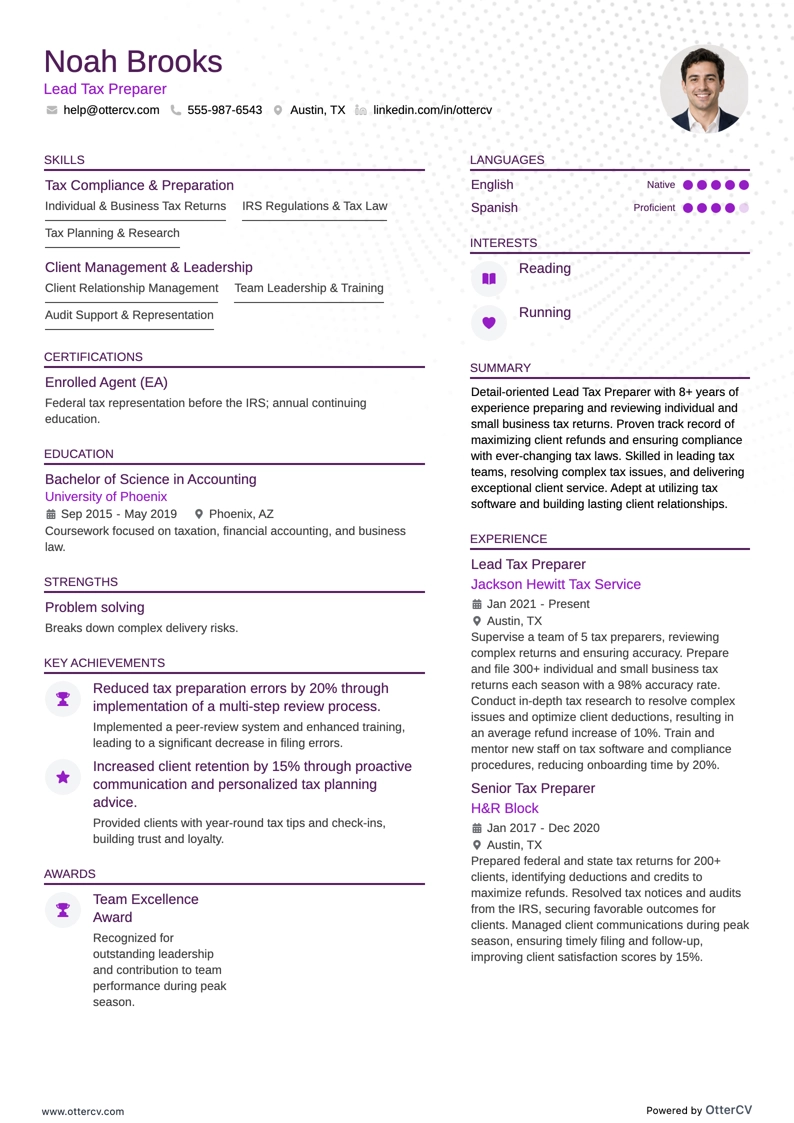
Lead Tax Preparer full preview

18 Tax Preparer Resume Examples

OtterCV

Written by The OtterCV Team

Updated: 9/11/2025•8 min read

See all resume examples in this guide, or generate your own resume example with your personalized prompt

Lead Tax Preparer resume example

Lead Tax Preparer

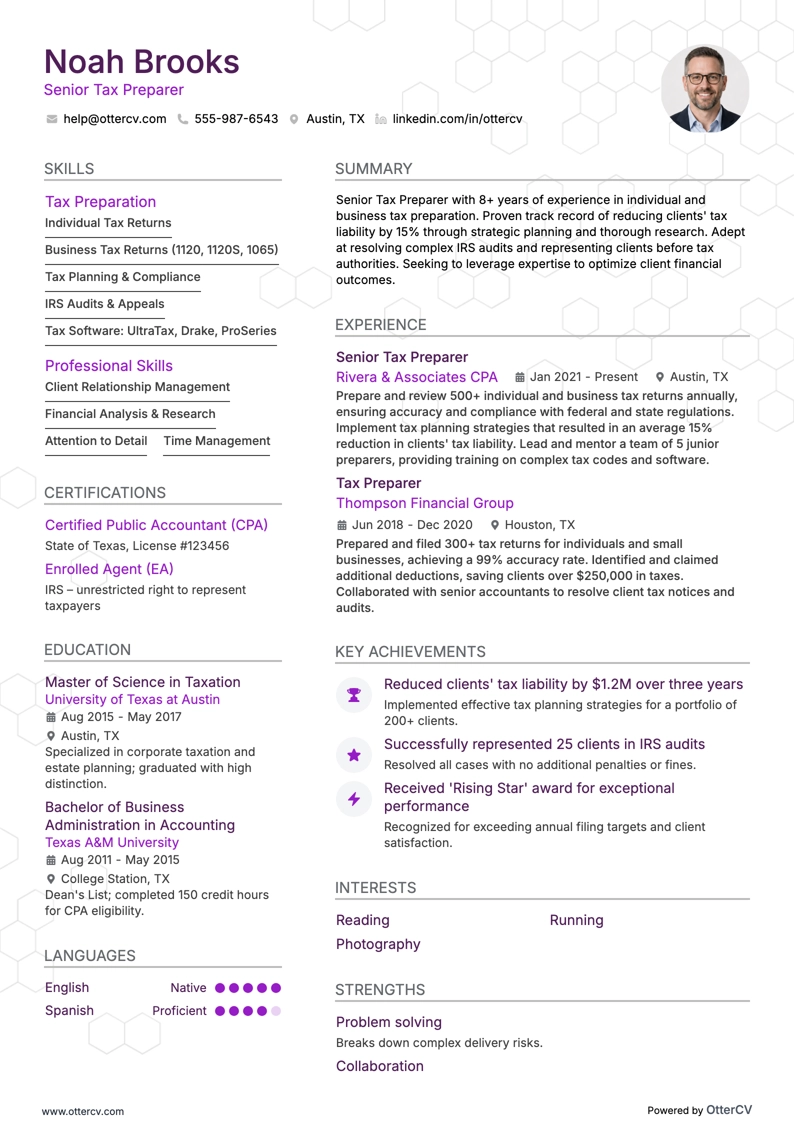
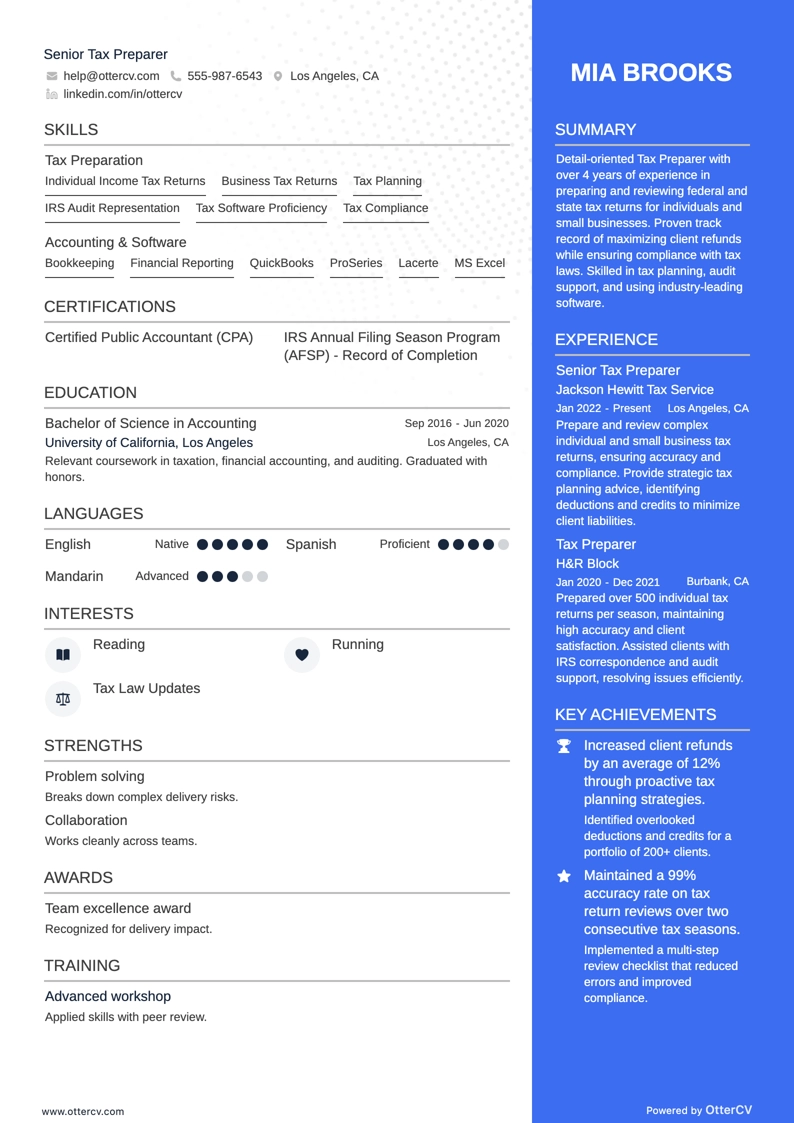
Senior Tax Preparer resume example

Senior Tax Preparer

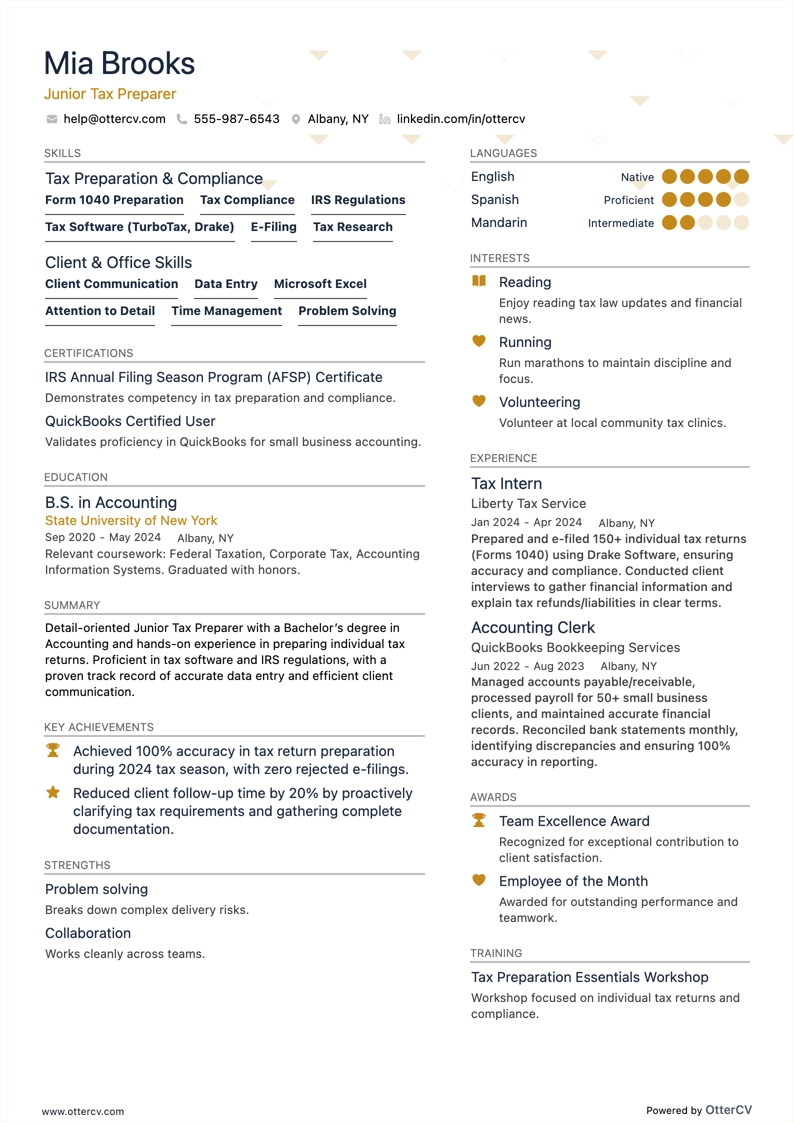
Junior Tax Preparer resume example

Junior Tax Preparer

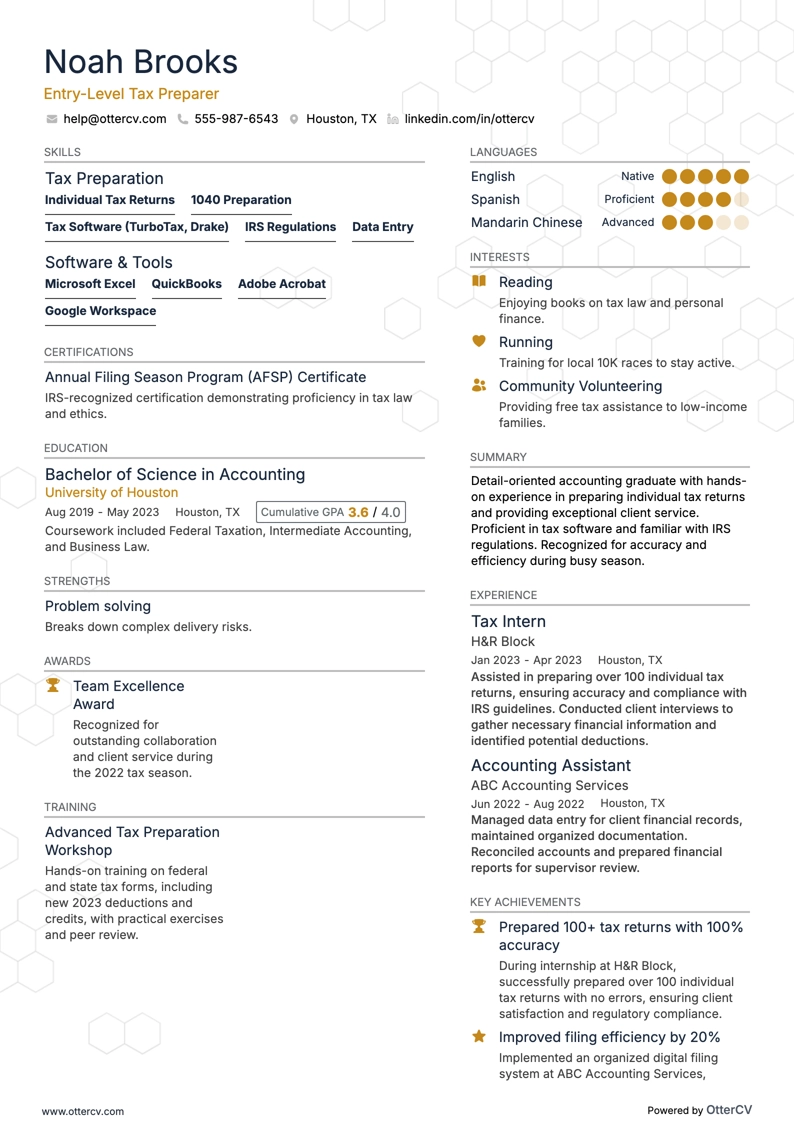
Entry-Level Tax Preparer resume example

Entry-Level Tax Preparer

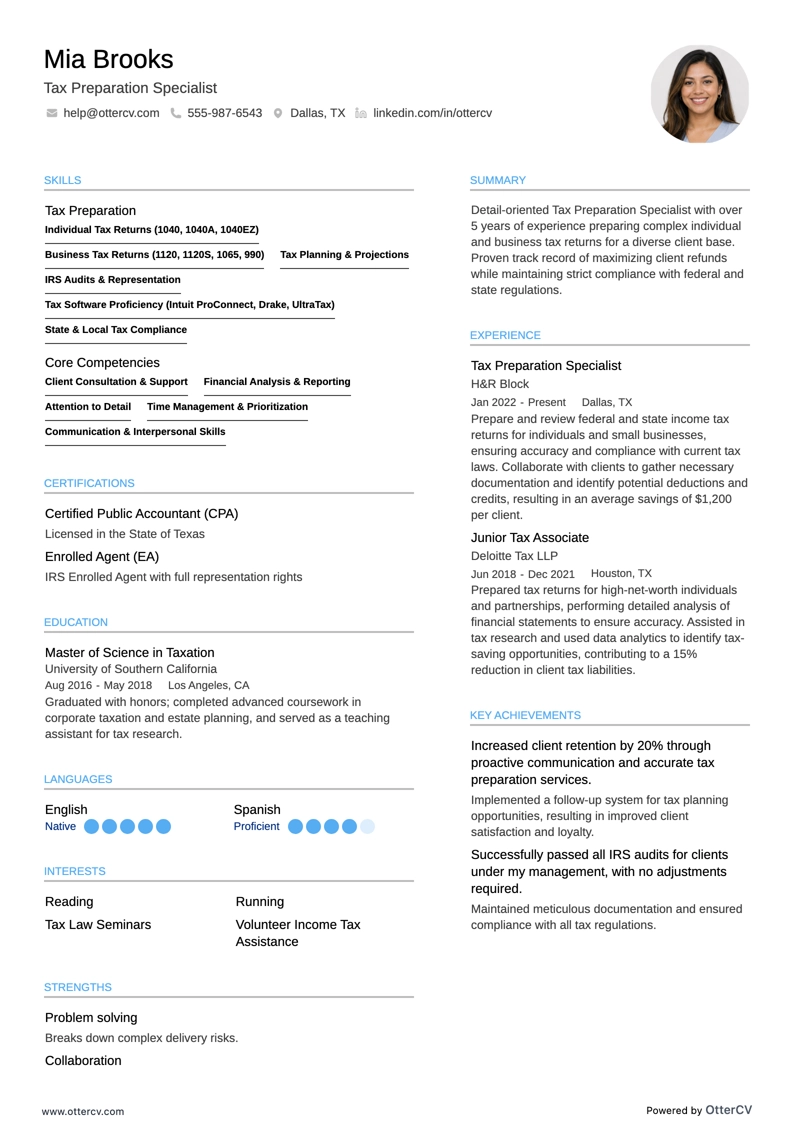
Tax Preparation Specialist resume example

Tax Preparation Specialist

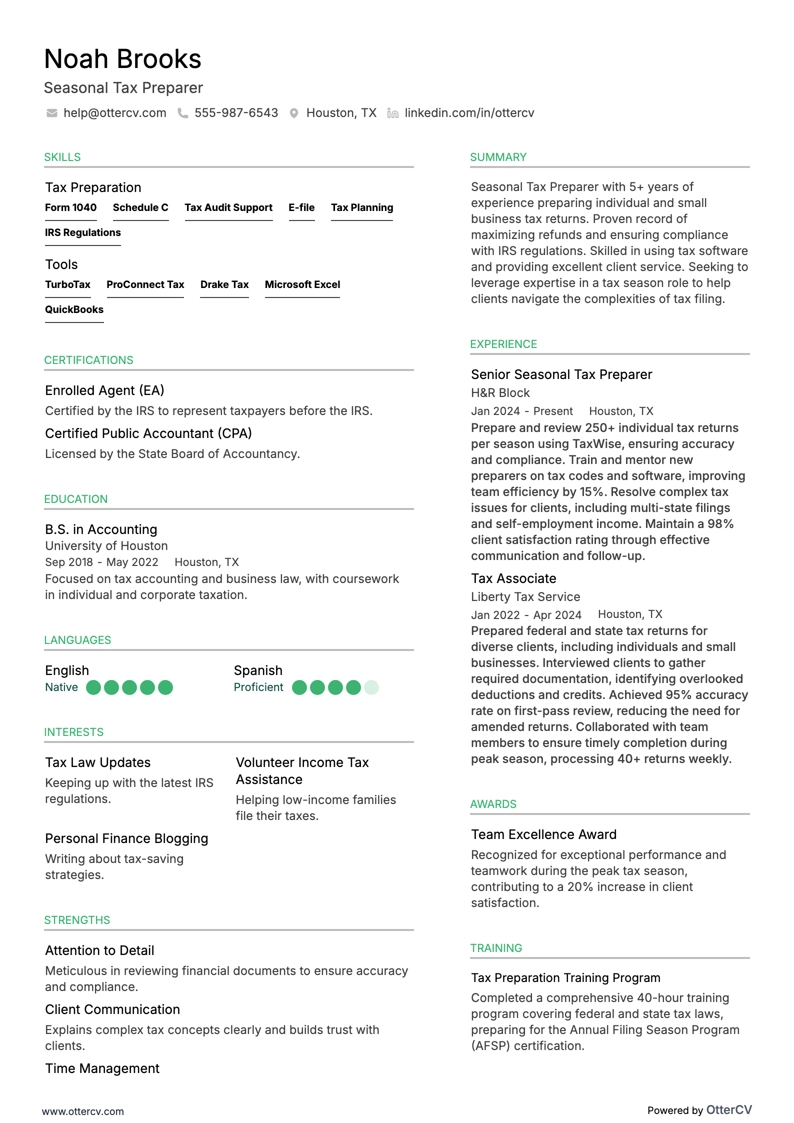
Seasonal Tax Preparer resume example

Seasonal Tax Preparer

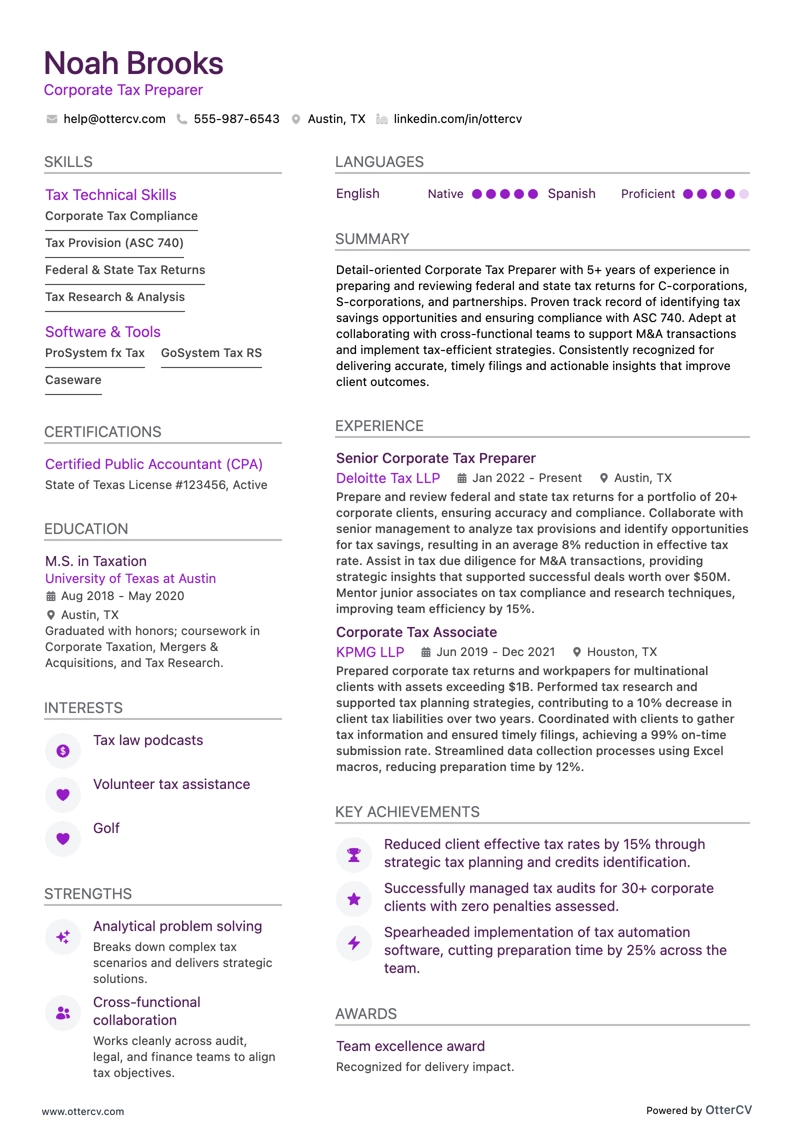
Corporate Tax Preparer resume example

Corporate Tax Preparer

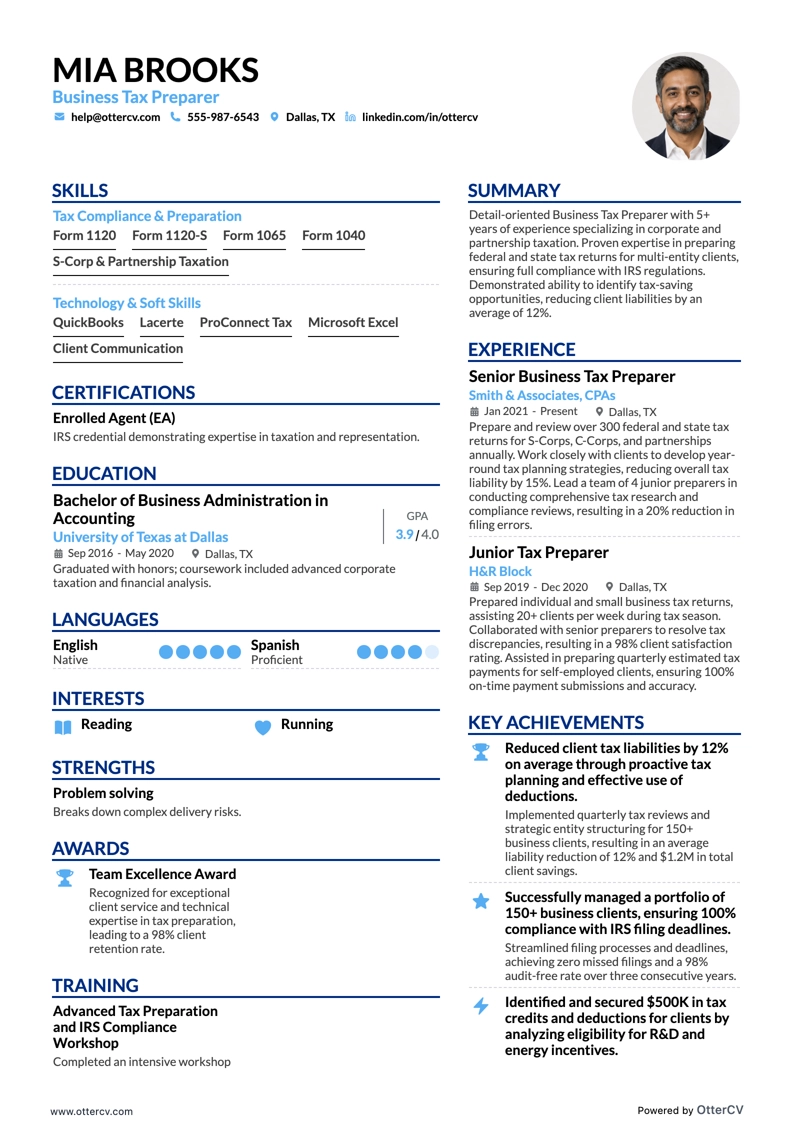
Business Tax Preparer resume example

Business Tax Preparer

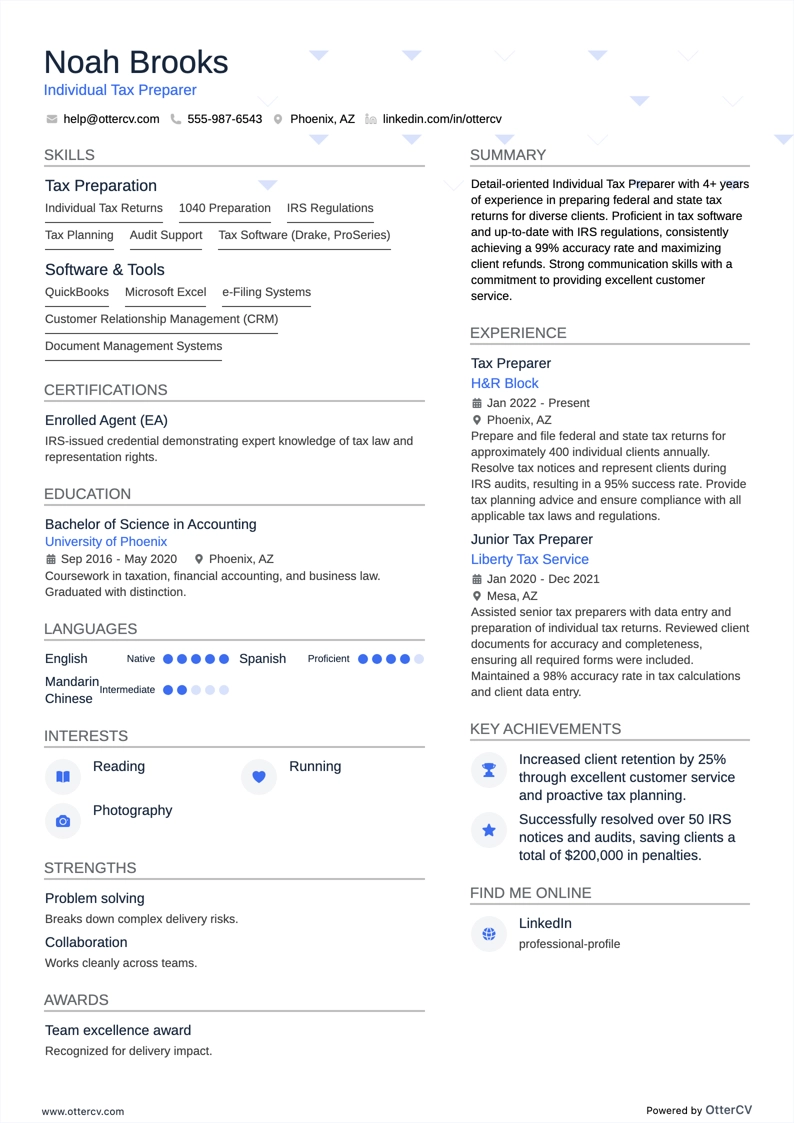
Individual Tax Preparer resume example

Individual Tax Preparer

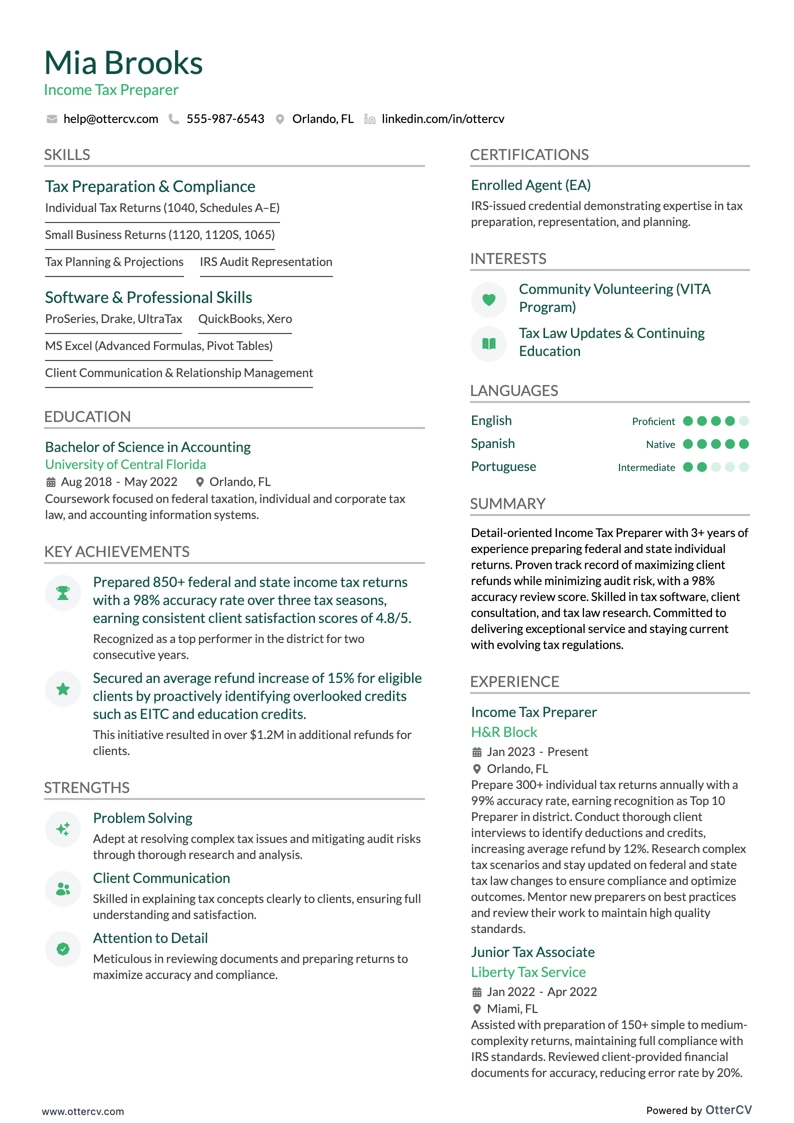
Income Tax Preparer resume example

Income Tax Preparer

Tax Preparer resume example

Tax Preparer

Most tax preparer resume drafts fail because they read like task lists, while key details such as filing volume, accuracy, and client impact get buried. That creates a problem in today’s hiring process, where ATS software filters quickly and recruiters scan in seconds.

A strong resume shows what changed because of your work, not just every tool you used. Understanding how to write a resume that highlights returns completed per season, error rates, refunds secured, audits supported, turnaround time improvements, client retention, and savings from credits identified is essential.

Key takeaways

  • Quantify filing volume, accuracy rates, and turnaround times in every experience bullet.

  • Tailor your resume to each job posting by mirroring its software, forms, and compliance language.

  • Use a reverse-chronological format if you have direct experience; switch to a hybrid format only when entering the field.

  • Show skills through measurable results in your summary and experience section, not only in a skills list.

  • Place certifications such as the EA or AFSP alongside your education to signal current, verified expertise.

  • Use Echocv to turn vague duties into specific, recruiter-ready bullets backed by real metrics.

  • Stop using AI once your resume accurately reflects your real experience without inflated claims.

Job market snapshot for tax preparers

We analyzed 189 recent tax preparer job ads across major US job boards. These figures provide a quick view of in-demand skills, industry demand, and career growth patterns.

What level of experience employers are looking for tax preparers

Years of ExperiencePercentage found in job ads
1–2 years34.4% (65)
3–4 years33.3% (63)
5–6 years0.5% (1)
Not specified31.7% (60)

Tax preparer ads by area of specialization (industry)

Industry (Area)Percentage found in job ads
Finance & Banking65.6% (124)
Professional Services33.9% (64)

Top companies hiring tax preparers

CompanyPercentage found in job ads
PwC34.4% (65)
Liberty Tax Service33.3% (63)
H&R Block, Inc.31.2% (59)

Role overview stats

These tables outline the most common responsibilities and employment types for tax preparer roles. Use them to align your resume with employer expectations and better understand how the role is structured across the market.

Day-to-day activities and top responsibilities for a tax preparer

ResponsibilityPercentage found in job ads
Amt34.4% (65)
Composite returns34.4% (65)
Partnership k-1 income34.4% (65)
State tax credits34.4% (65)
Tax compliance34.4% (65)
Tax planning34.4% (65)
Year-end planning34.4% (65)
Project management33.3% (63)
Individual tax returns28.6% (54)
Tax preparation software22.2% (42)
Microsoft office20.1% (38)
Windows19.0% (36)

Type of employment (remote vs on-site vs hybrid)

Employment typePercentage found in job ads
On-site77.8% (147)
Hybrid22.2% (42)

How to format a tax preparer resume

Recruiters reviewing tax preparer candidates look for accuracy-focused experience, familiarity with tax codes and filing software, and clear signs of increasing client responsibility. A clean, well-structured resume format helps these strengths stand out quickly in both human review and applicant tracking system (ATS) scans.

I have significant experience in this role—which format should I use?

I have significant experience in this role—which format should I use?

Use a reverse-chronological format to present your deepest and most relevant tax preparation experience first.

Do:

  • Lead each role with scope indicators such as client volume, return complexity, and seasonal team oversight.
  • Highlight proficiency in role-specific tools like Drake Tax, Lacerte, UltraTax CS, or ProSeries, along with knowledge of IRS regulations and state-specific codes.
  • Quantify outcomes tied to accuracy, efficiency, or revenue to provide measurable proof of impact.

Example bullet: “Prepared and reviewed over 600 individual and small-business federal and state returns per season with a 99.7% accuracy rate, reducing client amendment requests by 40% year over year.”

I'm junior or switching into this role—what format works best?

I'm junior or switching into this role—what format works best?

A hybrid format works best. It lets you highlight relevant tax skills and certifications first while still presenting your work history in chronological order.

  • Place a skills section near the top featuring tax software proficiency, IRS compliance knowledge, and relevant credentials such as a PTIN, EA designation, or VITA certification.
  • Include academic projects, volunteer tax preparation such as VITA or TCE programs, or internship experience that shows hands-on filing work.
  • Connect every listed skill to a concrete action and a measurable or observable result.

Example scaffold: “Tax compliance knowledge → prepared 85 individual returns through the IRS VITA program → achieved 100% acceptance rate with zero rejected filings.”

Why not use a functional resume?

Why not use a functional resume?

A functional resume removes the timeline of your experience, making it harder for recruiters and ATS software to verify when and where you used your tax preparation skills. That can weaken your candidacy, even for entry-level roles.

  • A functional format may be acceptable if you’re transitioning from a related field such as bookkeeping or accounting, have a significant employment gap, or do not have formal tax preparation roles but do have relevant certifications and volunteer experience. Even then, tie each skill to a specific project, filing outcome, or measurable result.

Avoid a functional resume entirely if you have any direct tax preparation experience, since it hides the progression and context hiring managers need to see.

With your format set, the next step is filling each section with content that highlights your qualifications as a tax preparer.

What sections should go on a tax preparer resume

Recruiters expect a clean, easy-to-scan resume that shows you can prepare accurate returns, maintain compliance, and deliver measurable results for clients. Knowing what to put on a resume for a tax preparer role helps you focus on the most relevant details.

Use this structure for clarity:

  • Header
  • Summary
  • Experience
  • Skills
  • Projects
  • Education
  • Certifications
  • Optional sections: Awards, Volunteering, Languages

Strong experience bullets should highlight filing volume, accuracy, compliance outcomes, client impact, and measurable results across the tax situations you handled.

Once you’ve organized your resume with the right components, focus next on the experience section to show how you’ve applied those qualifications in tax preparation work.

How to write your tax preparer resume experience

The work experience section is where you prove you’ve delivered real results through the tax software you’ve used, the filing processes you’ve managed, and the measurable outcomes you’ve achieved for clients or employers. Hiring managers value demonstrated impact over simple task lists, so emphasize what you accomplished rather than only what you were responsible for.

Each entry should include:

  • Job title
  • Company and location (or remote)
  • Dates of employment (month and year)

Add three to five concise bullet points that explain what you owned, how you executed the work, and what results you delivered:

  • Ownership scope: the client portfolios, return types, filing categories, or compliance areas you were directly responsible for as a tax preparer.
  • Execution approach: the tax preparation software, regulatory frameworks, IRS guidelines, or research methods you used to complete and review returns accurately.
  • Value improved: the changes you drove in filing accuracy, turnaround time, client retention, audit risk reduction, or compliance rates.
  • Collaboration context: how you worked with clients, accountants, bookkeepers, IRS representatives, or internal teams to resolve discrepancies and ensure complete, timely filings.
  • Impact delivered: the outcomes you produced, such as client satisfaction, revenue growth, error reduction, or the volume of returns processed, framed as results rather than activities.

Experience bullet formula

Experience bullet formula

Action verb + technology + what you built or fixed + measurable result

A tax preparer experience example

Tax Preparer

GreenOak Tax & Advisory | Austin, TX

2022–Present

Boutique tax firm supporting individuals and small businesses across Texas with high-volume seasonal workflows.

  • Prepared and e-filed 420+ individual and small business returns per season using Intuit ProConnect Tax and Thomson Reuters Checkpoint, reducing average turnaround time from six days to four days.
  • Reconciled client source documents against QuickBooks Online and bank feeds, reducing notices and amended returns by 18% year over year.
  • Implemented a standardized organizer and document request workflow in Canopy and Microsoft Excel, increasing on-time client submissions by 27% and saving 120 staff hours each season.
  • Identified and applied state and federal credits and deductions using IRS publications and SALT guidance, increasing average client refunds by $640 while maintaining a 99.2% first-submission acceptance rate.
  • Worked with clients, enrolled agents, and CPAs to resolve 35+ IRS and state correspondence cases through IRS e-Services and secure portal messaging, cutting resolution time by 22% and eliminating late-payment penalties in 12 cases.

Now that you’ve seen what makes a strong experience section, the next step is adjusting those details to fit the specific tax preparer job you’re applying for.

How to tailor your tax preparer resume experience

Recruiters review your tax preparer resume through both human screening and applicant tracking systems. Tailoring your resume to the job description helps your qualifications stand out in both.

Ways to tailor your tax preparer experience:

  • Match the exact tax software and e-filing platforms listed in the posting.
  • Mirror the specific tax forms and schedules the employer mentions.
  • Use the same compliance and regulatory terminology from the job description.
  • Reflect the return volume or accuracy benchmarks the role prioritizes.
  • Highlight experience with the client types or industries the firm serves.
  • Include quality review or audit processes the employer mentions by name.
  • Emphasize IRS regulation knowledge that aligns with the stated job duties.
  • Reference the workflow or seasonal filing procedures described in the posting.

Tailoring means aligning your real accomplishments with the employer’s stated requirements, not forcing unrelated keywords into your experience section.

Resume tailoring examples for tax preparer

Job description excerptUntailoredTailored
Prepare and file individual and business tax returns using UltraTax CS, ensuring compliance with federal and state regulations for clients with multi-state filing obligations.Prepared tax returns for various clients.Prepared and filed 200+ individual and business tax returns annually using UltraTax CS, ensuring full compliance with federal and multi-state filing requirements across 12 jurisdictions.
Review client financial records to identify eligible deductions and credits, with a focus on Schedule C filers and rental property income under IRS guidelines.Helped clients with their taxes and deductions.Analyzed financial records for Schedule C filers and rental property owners, identifying an average of $4,800 in additional deductions and credits per client in accordance with current IRS guidelines.
Communicate directly with IRS and state tax authorities to resolve notices, respond to audits, and negotiate payment plans on behalf of individual and small business clients.Handled client issues and communicated with agencies.Resolved 35+ IRS and state tax notices per season, representing individual and small business clients during audits and negotiating installment agreements that reduced penalty assessments by an average of 40%.

Once you’ve aligned your experience with the role’s priorities, the next step is to quantify your tax preparer achievements so employers can clearly see the impact behind those choices.

How to quantify your tax preparer achievements

Quantifying your achievements shows the value you deliver beyond filing returns. Focus on the volume you handled, turnaround time, accuracy and rework rates, compliance outcomes, and revenue protected through credits, deductions, and penalty avoidance.

Quantifying examples for tax preparer

MetricExample
Return volumePrepared 320 individual and small business returns in one season using Intuit ProConnect and Lacerte, averaging 18 returns per week.
Turnaround timeCut average client turnaround from five days to two days by standardizing document checklists and batching W-2 and 1099 intake.
Accuracy rateAchieved a 99.2% first-pass acceptance rate with fewer than three e-file rejects across 380 filings by validating SSNs and withholding entries.
Compliance riskReduced notices and penalty exposure by 30% by implementing a pre-filing review for Schedule C expenses and 1099-NEC matching.
Revenue impactIdentified $145,000 in additional deductions and credits across 60 clients by optimizing depreciation schedules and confirming eligibility for energy credits.

Once you’ve written strong bullet points for your experience section, apply that same precision to how you present your hard and soft skills.

How to list your hard and soft skills on a tax preparer resume

Your skills section should show that you can prepare accurate, compliant returns under deadlines. Recruiters and applicant tracking systems scan this section to confirm tool fit and core competencies, so aim for a balanced mix of tax software knowledge and client-facing execution skills.

Tax preparer roles require a blend of:

  • Product strategy and discovery skills: Client intake, tax situation discovery, and return-scope planning.
  • Data, analytics, and experimentation skills: Source document review, reconciliation, and error checking across forms.
  • Delivery, execution, and go-to-market discipline: End-to-end filing workflow, deadline management, and e-file readiness.
  • Soft skills: Clear client communication, judgment, and audit-ready documentation habits.

Your skills section should be:

  • Scannable with bullet-style grouping.
  • Relevant to the job posting.
  • Backed by proof in your experience bullets.
  • Updated with current tools.

Place your skills section:

  • Above your experience if you’re junior or switching careers.
  • Below your experience if you’re mid- or senior-level with strong achievements.

Hard skills

  • Your hard skills show the technical tax knowledge employers expect.
  • Prepare IRS Form 1040 returns.
  • Handle Schedule C, E, and SE filings.
  • Process W-2, 1099, and K-1 forms.
  • Work with itemized deductions and credits.
  • Prepare multi-state individual returns.
  • Manage federal and state e-filing.
  • Conduct tax research using IRS publications.
  • Apply depreciation and amortization rules.
  • Report basis and capital gains accurately.
  • Use QuickBooks and perform bank reconciliation.
  • Work with Intuit ProConnect, Lacerte, and Drake Tax.
  • Maintain workpaper documentation and tick marks.

Soft skills

  • Ask targeted intake questions to understand client needs.
  • Translate tax rules clearly for clients and team members.
  • Document assumptions and notes thoroughly.
  • Flag missing or inconsistent data early.
  • Prioritize returns by deadline.
  • Coordinate effectively with bookkeepers and CPAs.
  • Set clear expectations with clients.
  • Maintain confidentiality under pressure.
  • Resolve notices with calm follow-up.
  • Escalate complex issues early.
  • Review work for preventable errors.
  • Manage multiple returns concurrently.

How to show your tax preparer skills in context

Skills should not live only in a dedicated skills list. Explore resume skills examples to see how strong candidates weave competencies throughout their documents.

They should be demonstrated in:

  • Your summary (high-level professional identity)
  • Your experience (proof through outcomes)

Here’s how that looks in practice.

Senior tax preparer with 10+ years of experience handling individual and small-business tax returns. Skilled in Drake Tax, multi-state compliance, and IRS resolution. Reduced client filing errors by 35% through streamlined review workflows and proactive taxpayer education.

  • Signals senior-level expertise immediately
  • Names industry-standard tax software
  • Quantifies error reduction with metrics
  • Highlights client communication skills

Senior Tax Preparer

Meridian Financial Group | Richmond, VA

March 2019–Present

  • Prepared 400+ individual and business returns annually using Drake Tax, maintaining a 99.2% accuracy rate across multi-state filings.
  • Collaborated with bookkeeping and payroll teams to reconcile discrepancies, reducing amended return volume by 28% year over year.
  • Guided 150+ clients through IRS audit responses and notice resolutions, achieving favorable outcomes in 94% of cases.
  • Every bullet includes measurable proof.
  • Skills appear naturally within achievements.

Once you’ve shown your tax preparer capabilities through relevant examples and outcomes, the next step is to apply that same approach to a resume with no experience by emphasizing transferable skills and comparable work.

How do I write a tax preparer resume with no experience

Even without full-time experience, you can still show readiness through:

  • VITA volunteer tax return preparation
  • IRS Link and Learn modules
  • Tax preparation certificate coursework
  • Accounting or bookkeeping class projects
  • FreeTaxUSA practice returns and reviews
  • Excel income, expense, and deduction tracking
  • Client intake form simulations
  • Tax law research memos and summaries

If you're building a resume without work experience, focus on:

  • Accuracy checks and documented review steps
  • Familiarity with tax preparation software
  • Tax forms handled and volumes
  • Compliance with IRS guidelines

Resume format tip for entry-level tax preparer

Resume format tip for entry-level tax preparer

Use a skills-based resume format to highlight your tax preparation skills, tools, and relevant projects when you have limited work history.

Do:

  • Add a Tax Preparation Projects section.
  • List the forms you practiced, such as Form 1040 and Schedule A.
  • Name the tools you used, including Excel and FreeTaxUSA.
  • Quantify your work, such as returns completed and errors found.
  • Include training with dates and hours.

Example project bullet:

  • Completed 25 FreeTaxUSA practice Form 1040 returns, reconciled W-2 and 1099 entries, and reduced calculation errors from six to one through a checklist review.

Even without hands-on experience, your educational background can show employers that you have the foundational knowledge they want to see.

How to list your education on a tax preparer resume

Your education section helps hiring teams confirm that you have the accounting, finance, or tax knowledge needed for a tax preparer role. It also builds credibility quickly.

Include:

  • Degree name
  • Institution
  • Location
  • Graduation year
  • Relevant coursework (for juniors or entry-level candidates)
  • Honors and GPA (if 3.5 or higher)

Skip the month and day—list the graduation year only.

Here’s a strong education entry tailored for a tax preparer resume.

Example education entry

Bachelor of Science in Accounting

University of Central Florida, Orlando, FL

Graduated 2021

GPA: 3.7/4.0

  • Relevant Coursework: Federal Income Tax, Tax Research and Planning, Auditing Principles, Business Law
  • Honors: Magna Cum Laude, Dean's List (six consecutive semesters)

How to list your certifications on a tax preparer resume

Certifications on your resume show your commitment to learning, your proficiency with tax tools, and your up-to-date industry knowledge. Together, these details can help employers trust you as a tax preparer.

Include the following for each certification:

  • Certificate name
  • Issuing organization
  • Year
  • Optional: credential ID or URL
  • Place certifications below education when your degree is recent and your certifications are older or less relevant to tax preparer work.
  • Place certifications above education when they are recent, highly relevant, or required for the tax preparer role you are targeting.

Best certifications for your tax preparer resume

  • IRS Annual Filing Season Program (AFSP) Record of Completion.
  • Enrolled Agent (EA).
  • Certified Public Accountant (CPA).
  • Certified Tax Preparer (CTP).
  • H&R Block Income Tax Course Certificate.
  • Intuit QuickBooks Certified User.
  • National Association of Tax Professionals (NATP) Tax Professional Certificate.

How to write your tax preparer resume summary

Once your credentials are easy to verify, use your tax preparer resume summary to reinforce your qualifications upfront and set the context for the rest of your resume.

Your resume summary is often the first thing a recruiter reads, so a strong one should quickly position you as a qualified tax preparer worth interviewing.

Keep it to three to four lines and include:

  • Your title and total years of tax preparation experience.
  • Your area of focus, such as individual, small business, or corporate tax.
  • Core tools and skills, such as TurboTax, Drake Software, QuickBooks, or IRS e-filing.
  • One or two quantified achievements that demonstrate accuracy or efficiency.
  • Soft skills tied to real results, such as client communication that improved retention.

PRO TIP

At the entry level, lead with relevant tax software skills and any measurable early wins. Highlight coursework, certifications such as the PTIN or AFSP, and seasonal filing volume.

Avoid vague phrases like "passionate hard worker" or "eager to grow." Every word should show you can do the job.

Example summary for a tax preparer

Detail-oriented tax preparer with two years of experience filing 200+ individual returns per season using Drake Software. Reduced client errors by 15% through structured review checklists and clear communication.

Now that your summary highlights your strongest qualifications, make sure recruiters can easily reach you with a clear, complete resume header.

What to include in a tax preparer resume header

A well-crafted resume header includes your key contact details and role focus, helping tax preparers improve visibility, build credibility, and move through recruiter screening faster.

Essential resume header elements

  • Full name
  • Tailored job title and headline
  • Location
  • Phone number
  • Professional email
  • GitHub link
  • Portfolio link
  • LinkedIn

A LinkedIn link helps recruiters quickly verify your experience and supports screening.

Do not include a photo on a tax preparer resume unless the role is explicitly front-facing or appearance-dependent.

Match your header job title to the posting, and keep every link current, professional, and easy to scan.

Example

Once your contact details and professional identifiers are in place at the top, add supporting resume sections to strengthen your qualifications and provide relevant context.

Additional sections for tax preparer resumes

Additional resume sections can help you stand out when your core qualifications are similar to those of other candidates by highlighting strengths that are especially relevant to tax preparation. For example, listing language skills on your resume can help distinguish you when serving diverse client populations.

  • Languages
  • Certifications and licenses
  • Professional affiliations
  • Continuing education
  • Volunteer tax preparation experience
  • Publications
  • Awards and recognitions

Once you’ve strengthened your resume with relevant additional sections, pairing it with a well-crafted cover letter can help your application stand out.

Do tax preparer resumes need a cover letter

A cover letter isn’t required for a tax preparer, but it often helps. If you’re wondering what a cover letter is and when it matters, it’s most useful for competitive roles, client-facing teams, or firms that expect one. It can also help influence decisions when several candidates have similar credentials.

Use a cover letter to add context your resume can’t:

  • Explain role and team fit: Match your experience to the firm’s client types, volume, and workflow, such as 1040, 1065, or 1120 returns.
  • Highlight one or two outcomes: Share a specific project, such as cleaning up prior-year issues or improving organizer completion rates, and quantify the result.
  • Show business and client understanding: Reference the firm’s industries, busy season demands, and how you support clients with clear, compliant communication.
  • Address transitions or non-obvious experience: Connect bookkeeping, payroll, audit support, or customer service work to tax preparer responsibilities and accuracy standards.

Using AI to improve your tax preparer resume

Even if you decide a cover letter adds limited value to your application, using AI to improve your tax preparer resume can strengthen the document employers review first.

AI can improve your resume’s clarity, structure, and impact. It can refine phrasing and help highlight measurable results. But overusing it can strip away authenticity. Once your content is clear and aligned with the role, step away from AI.

If you’re exploring tools, learn which AI is best for writing resumes before committing to one platform.

Here are 10 practical prompts to strengthen specific sections of your tax preparer resume:

Strengthen your summary

Strengthen your summary

Rewrite my tax preparer resume summary to emphasize years of experience, core competencies, and measurable client outcomes in under four sentences.

Quantify experience bullets

Quantify experience bullets

Add specific metrics to each experience bullet on my tax preparer resume, such as returns filed, accuracy rates, or revenue saved.

Tighten action verbs

Tighten action verbs

Replace weak or passive verbs in your tax preparer experience section with strong, industry-specific action verbs.

Align skills section

Align skills section

Compare my tax preparer resume skills section with this job description and identify any missing keywords or irrelevant entries.

Clarify certification details

Clarify certification details

Reformat the certifications section of my tax preparer resume so each entry includes the credential name, issuing body, and date.

Improve project descriptions

Improve project descriptions

Rewrite the project descriptions on my tax preparer resume to better emphasize scope, tax software used, and client impact.

Refine education entries

Refine education entries

Edit my tax preparer resume education section to emphasize relevant coursework, honors, and accounting-specific training.

Remove redundant phrasing

Remove redundant phrasing

Identify and remove repetitive language throughout your tax preparer resume while preserving the key details.

Target seasonal experience

Target seasonal experience

Rewrite the seasonal work entries on my tax preparer resume to highlight volume handled, deadline management, and accuracy under pressure.

Enhance compliance language

Enhance compliance language

Strengthen the compliance-focused bullet points on your tax preparer resume by referencing specific IRS regulations, filing standards, or audit procedures.

Conclusion

A strong tax preparer resume shows results with numbers, highlights role-specific skills, and stays easy to scan. Include measurable outcomes such as return volume, accuracy rates, audit support wins, and turnaround times. Keep each section clear, consistent, and focused on tax preparation work.

Today’s hiring market rewards tax preparers who demonstrate readiness, reliability, and strong client communication. Use a clean structure, relevant skills, and outcome-driven bullet points to show you can deliver during peak season and beyond. Keep your resume direct, complete, and confident.

Tax Preparer resume examples

Explore additional Tax Preparer resume samples and guides and see what works for your level of experience or role.

By Experience

Lead Tax Preparer

Lead Tax Preparer resume preview

Senior Tax Preparer

Senior Tax Preparer resume preview

Junior Tax Preparer

Junior Tax Preparer resume preview

Entry-Level Tax Preparer

Entry-Level Tax Preparer resume preview

Tax Preparer resume examples

Explore additional Tax Preparer resume samples and guides and see what works for your level of experience or role.

By Role

Tax Preparation Specialist

Tax Preparation Specialist resume preview

Seasonal Tax Preparer

Seasonal Tax Preparer resume preview

Corporate Tax Preparer

Corporate Tax Preparer resume preview

Business Tax Preparer

Business Tax Preparer resume preview

Individual Tax Preparer

Individual Tax Preparer resume preview

Income Tax Preparer

Income Tax Preparer resume preview

Tax Preparer

Tax Preparer resume preview