Principal Software Engineer full preview

19 Software Engineer Resume Examples

OtterCV

Written by The OtterCV Team

Updated: 10/21/2025•8 min read

See all resume examples in this guide, or generate your own resume example with your personalized prompt

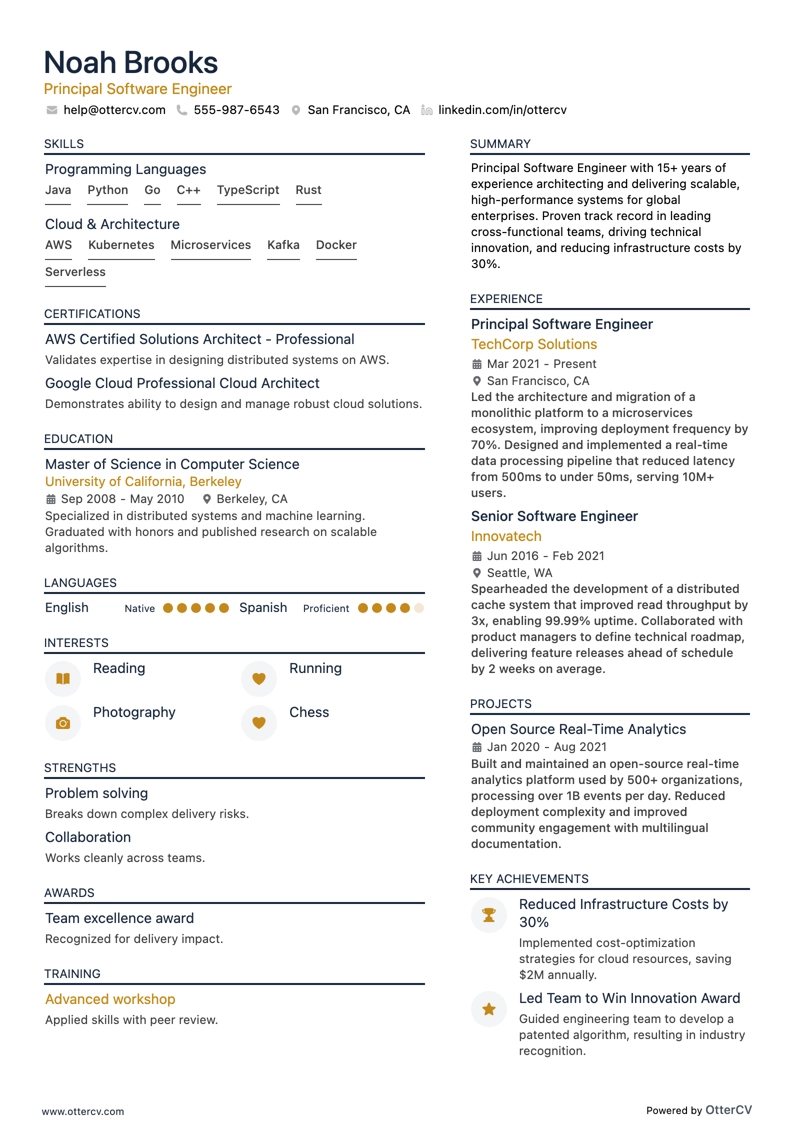
Principal Software Engineer resume example

Principal Software Engineer

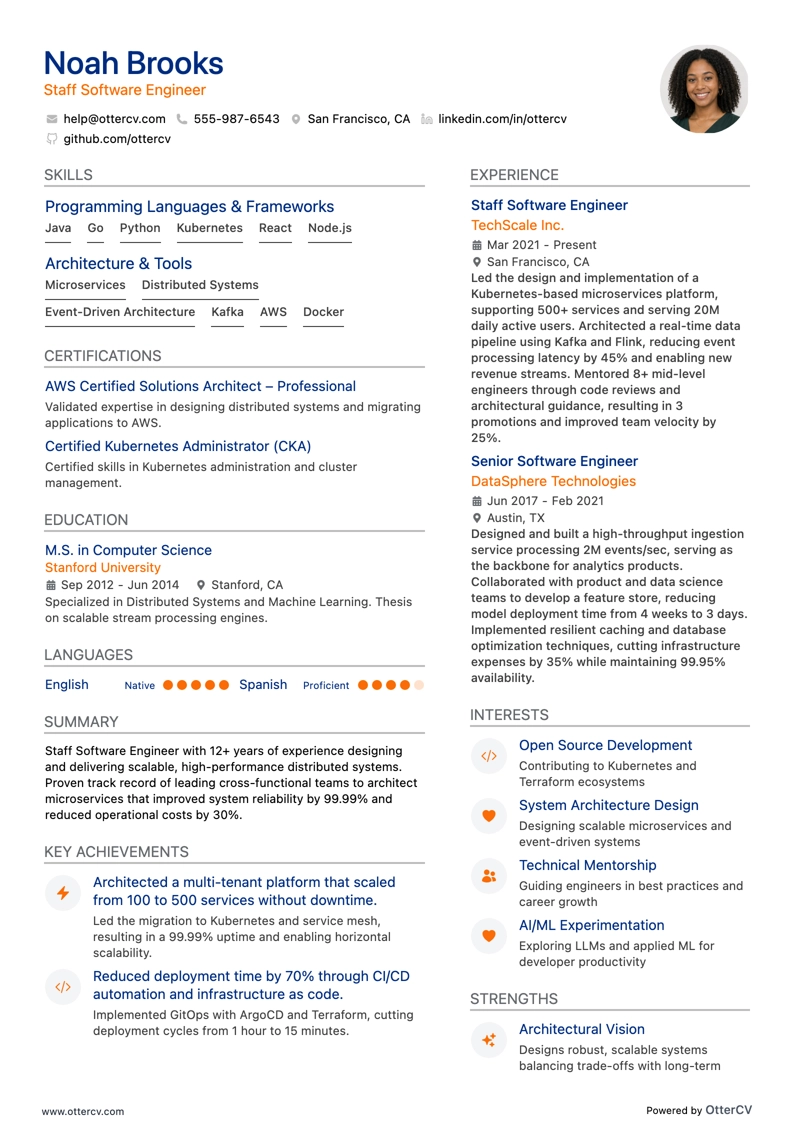
Staff Software Engineer resume example

Staff Software Engineer

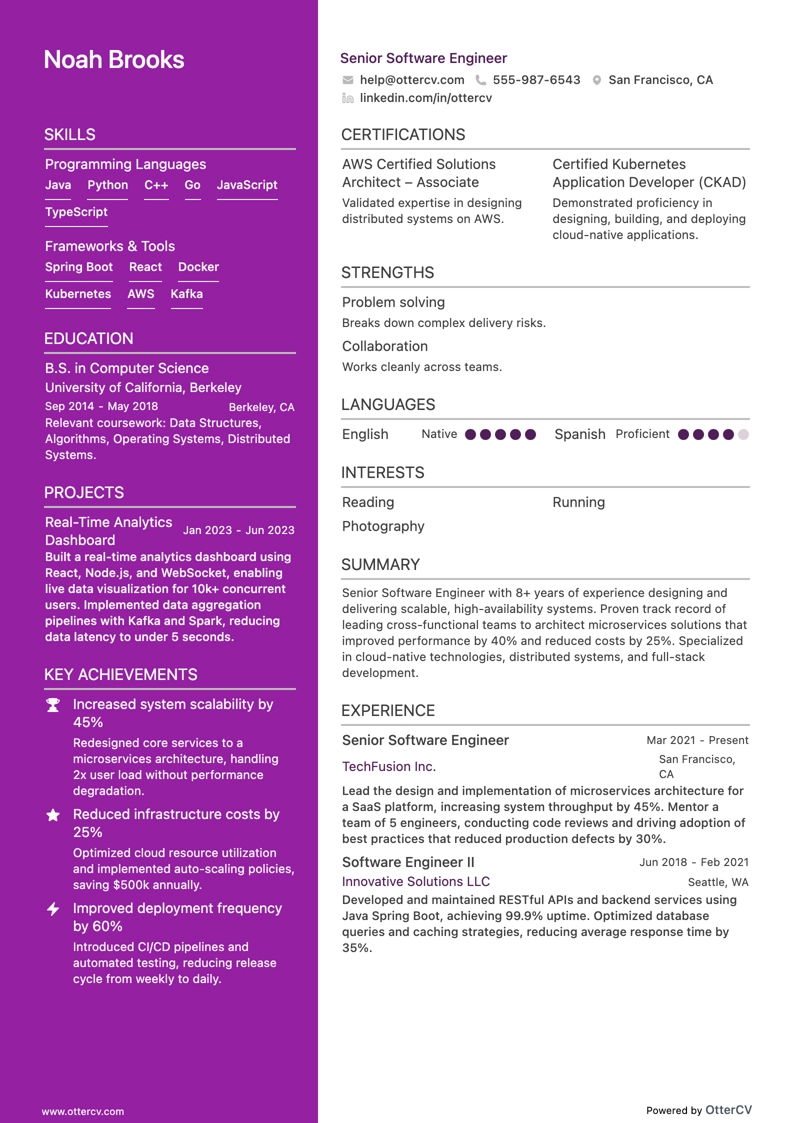
Senior Software Engineer resume example

Senior Software Engineer

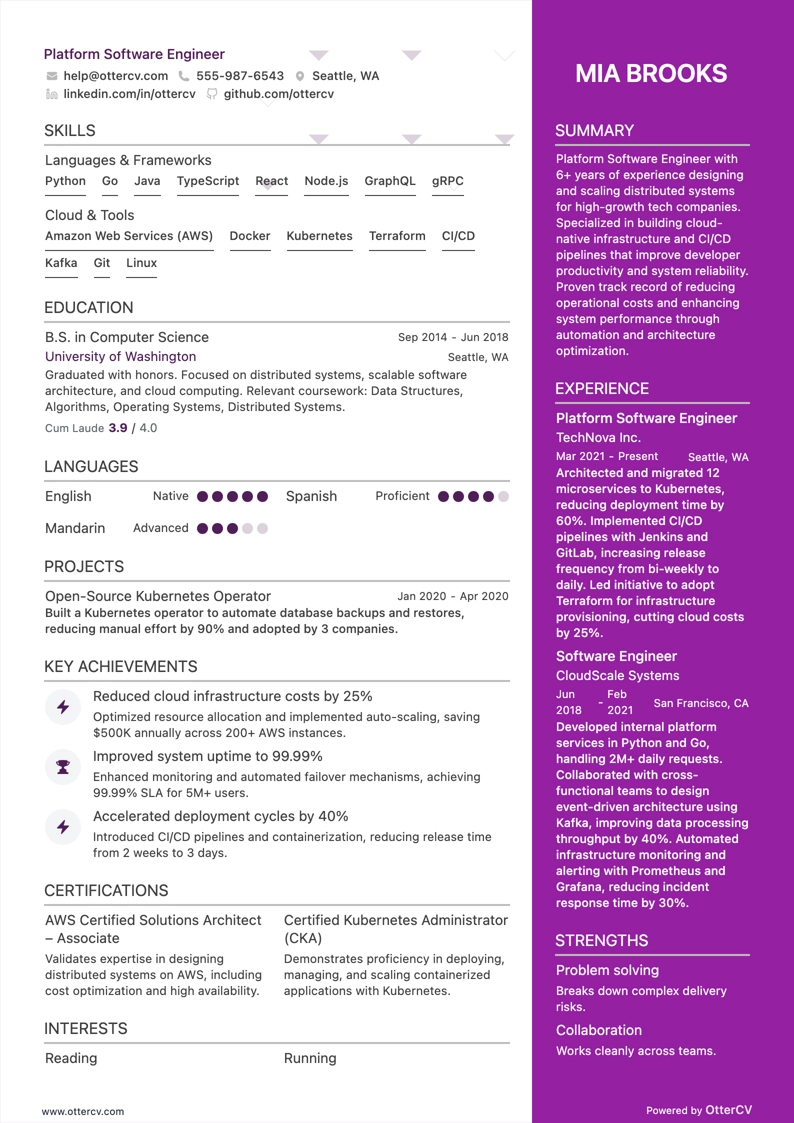
Platform Software Engineer resume example

Platform Software Engineer

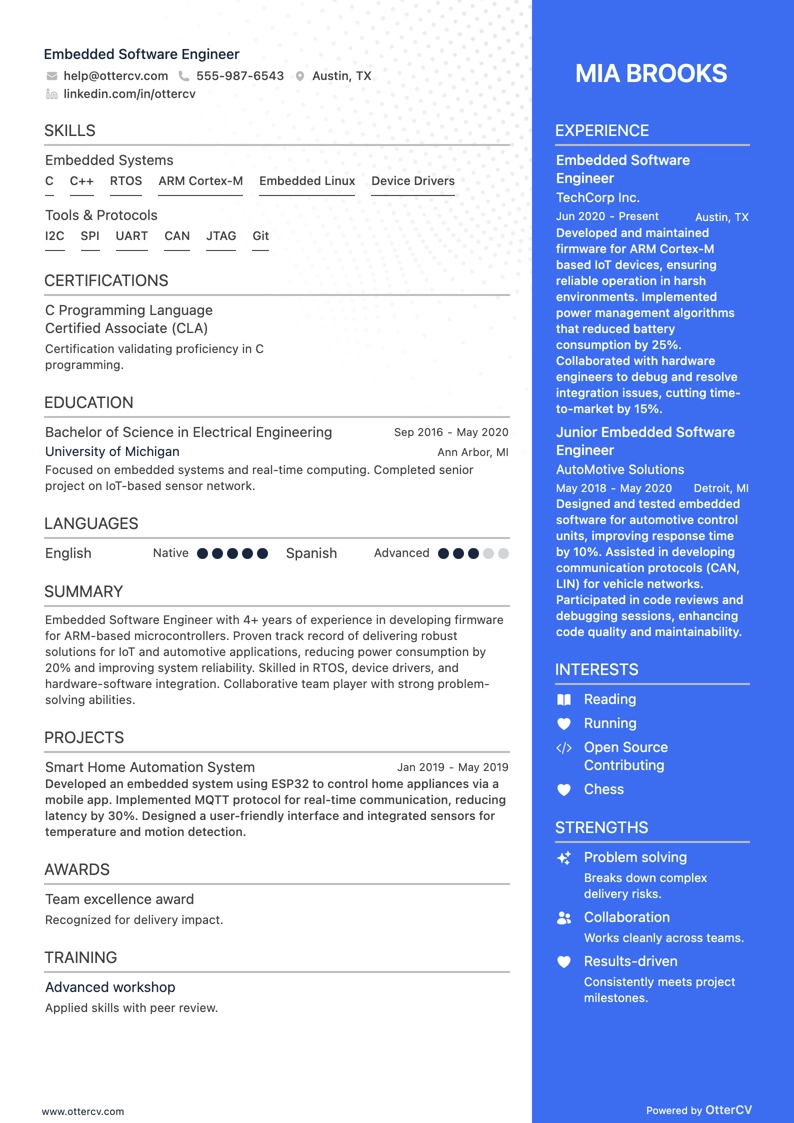
Embedded Software Engineer resume example

Embedded Software Engineer

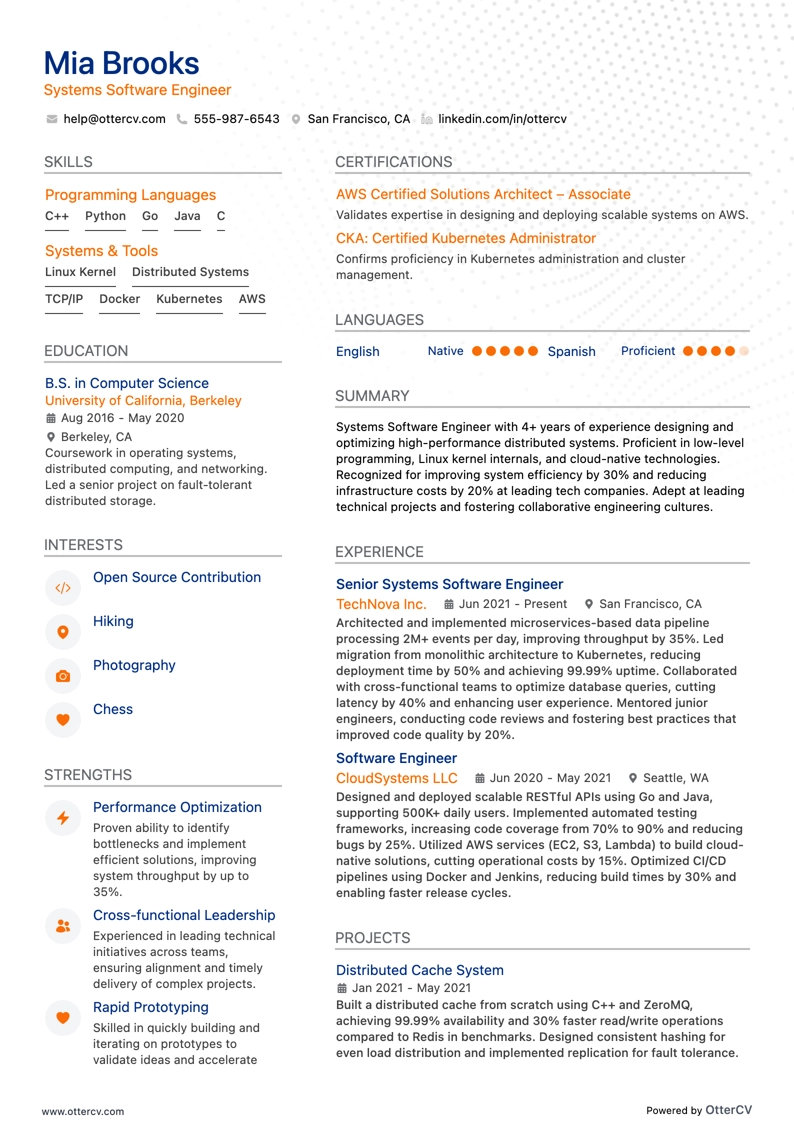
Systems Software Engineer resume example

Systems Software Engineer

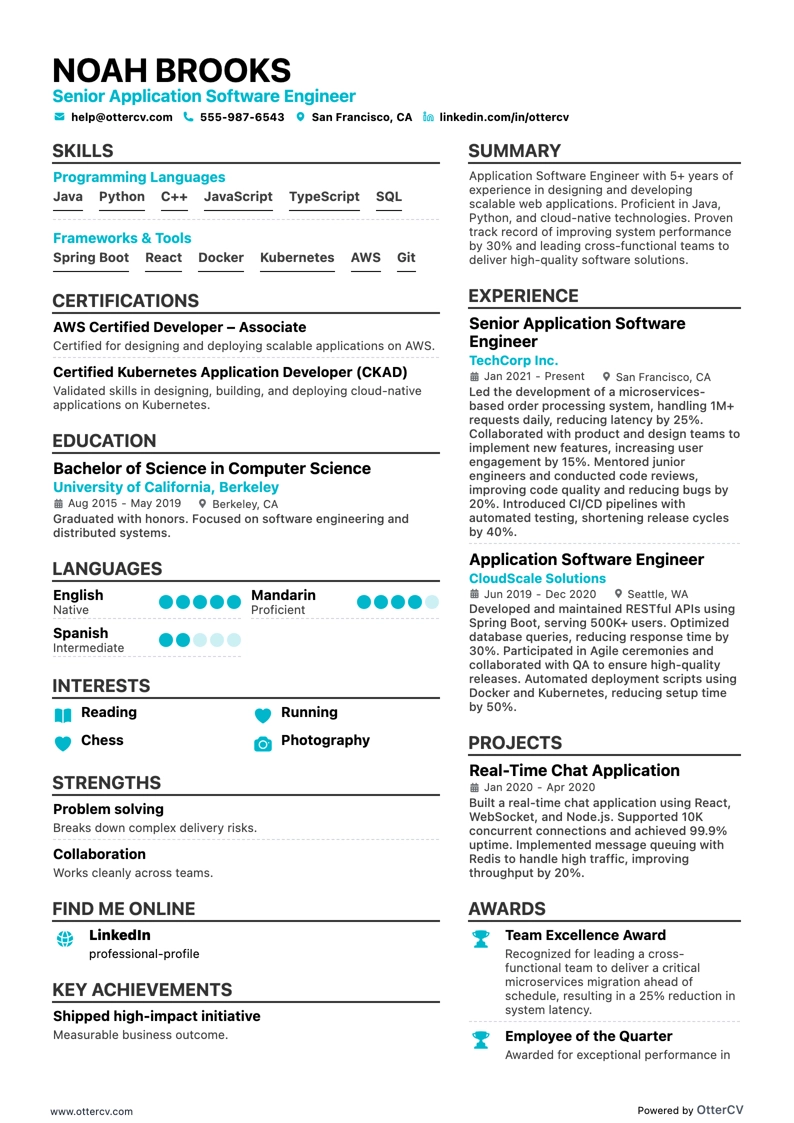
Application Software Engineer resume example

Application Software Engineer

As a software engineer, you need to be adaptable and ready to meet expectations across a wide range of tasks. Whether you are building modern applications with JavaScript or designing and implementing PHP web applications, success often depends on your ability to innovate and deliver solutions that meet client needs.

Your resume should do the same job for you: help you move closer to your dream role. At Echocv, we create resumes designed to help you get your foot in the door and earn a highly sought-after interview.

In this article, you will learn how to:

  • Showcase your software engineering experience across disciplines, including programming languages, web development, and software development methodologies;
  • Summarize your achievements in building scalable and robust software solutions;
  • Highlight certifications from recognized bootcamps or specialized courses in AWS and Azure.

Before you continue, you may also find these resume examples and guides helpful:

Software engineer resume example

Principal Software Engineer resume preview

What does this resume example do well?

  • It draws attention to programming skills: The resume clearly highlights the candidate’s knowledge of programming languages and the operating systems they are comfortable using. These skills are reinforced throughout the document. In the achievements section, the candidate also mentions creating a unique Chabad that reduced customer costs by 240%.
  • It showcases achievements with real-world numbers: One standout example is the phrase, “Spearheaded a $12M software project.” The resume emphasizes measurable results with quantifiable examples, including increasing efficiency by 30% and successfully coordinating a yearlong project. These details help show hiring managers that the candidate is capable and effective.
  • It highlights key strengths: The resume also includes a substantial section devoted to strengths. There, the candidate notes that they were gold medalists for excellence in academics for five years.

How to format a software engineer's resume

As a software engineer, you should approach your resume the way you approach code: formatting is not just about appearance, but also about readability and structure. A well-formatted resume is easier for hiring managers to scan and understand. Even small improvements can make your resume more appealing and help you get closer to an interview.

Here are a few helpful tips to keep in mind when formatting your resume:

  • Reverse chronological format: Use a reverse chronological format that lists your most recent experience first. This helps employers quickly see where you are now while also understanding your previous experience and career progression.
  • Header and contact info: Your resume header is one of the first things a recruiter will notice, so it should include key details about you. Add your name, phone number, email, location, and, if relevant, your portfolio or GitHub link.
  • How many pages? While there is no fixed rule, it is usually best to keep your resume between one and two pages. If you have less than 10 years of experience in the field, one page should usually be enough. If you have more than 10 years, you may need two pages. When possible, include only highly relevant experience.
  • File format: Unless an employer requests otherwise, submit your resume as a PDF. A PDF file format is easier to share than a Word document, and your text and layout are less likely to shift.

Targeting Canada? Keep in mind their resume layout may differ from others.

The top sections on a software engineer resume

  • Resume summary: Use this section to quickly introduce your career goals and strengths to the hiring manager in two to four sentences, focusing on the skills and abilities you bring.
  • Experience: This is often the most scanned section, so include only the work experience most relevant to the role.
  • Education: Education is an important part of an IT resume, and a prestigious university can also help highlight specialized skills you developed there.
  • Skills section: List the most important skills that apply to the position so you stand out from other candidates.
  • Certifications, licenses, and awards: Relevant credentials can show that you fit a specific niche, such as including AWS Certified Solutions Architect to demonstrate cloud computing expertise.

What hiring managers want to see on a software engineer resume

  • Unique technical skills: Show the programming languages, frameworks, tools, and technologies you know well, especially common languages such as JavaScript, Python, and SQL that can add value to the company.
  • Projects and contributions: List completed projects and explain your role, the technologies used, and the project’s impact; open-source work and personal projects can also help demonstrate your interests and initiative.
  • GitHub or portfolio: Include a link to your GitHub profile or portfolio so hiring managers can review your work in more detail than a resume allows.
  • Ability to collaborate: Show that you can work effectively with different teams, including management and sales, and use real, quantifiable examples from your career to support that strength.

How to write your software engineer resume experience

Your resume experience section is often the first thing a recruiter reviews when scanning your resume. They will look closely at what you contributed in previous roles and the impact of your work.

That’s why your experience and skills should be supported with real, quantifiable examples from your career.

Below are two example experience sections. One shows the right way to present your experience, while the other falls below expectations. Use both as a guide when creating your own.

Experience

Software engineer

High Tech Computers

05/2021 - 05/2023 · New York, NY

  • Helped implement Agile methodologies within a cross-functional team of software engineers.
  • Conducted regular code reviews and mentored junior developers.
  • Participated in evaluating and selecting new technologies and tools to improve development processes.
  • Designed and developed a scalable microservices architecture using Node.js and Docker.
WRONG

What’s the issue with this resume experience section?

There isn’t a single quantifiable example in this section. It also fails to show the impact the applicant made in the previous role. For example, if Agile methodologies were implemented, what results did that produce?

The wording should also be strengthened by replacing weak verbs with more active, engaging ones. Instead of using “helped,” stronger choices like “collaborated” or “implemented” would be more effective.

Experience

Software engineer

High Tech Computers

05/2021 - 05/2023 · New York, NY

  • Led a cross-functional team of five engineers to implement Agile methodologies, increasing project efficiency by 20% and improving on-time delivery.
  • Conducted regular code reviews and mentored junior developers, leading to a 30% improvement in code quality and adherence to coding standards.
  • Participated in evaluating and selecting new technologies and tools to improve development processes.
  • Designed and developed a scalable microservices architecture using Node.js and Docker, reducing response times by 40% and ensuring high availability for a customer-facing application serving over 1 million users.
RIGHT

What does this do right?

This resume experience section includes quantifiable examples, which help show the impact the applicant made in previous roles. It also uses relevant keywords for specific programming languages and open-source server platforms, which can help the resume pass applicant tracking system (ATS) scans.

PRO TIP

Start each bullet point with a strong action verb to make it more impactful. Examples include collaborated, developed, advocated, facilitated, and transformed.

How to quantify impact on your resume

It’s important to quantify the impact you made in previous roles because doing so adds credibility to your claims. As a software engineer, you may have spent a great deal of time developing software, fixing bugs, and building programs and applications that benefit users. But you may have spent far less time reflecting on the results of that work.

Hiring managers do not want to see a bland list of tasks. They want real-world examples of the difference you made. To show this, use the PAR method: Problem, Action, Result. Identify a specific problem, explain the actions you took, and show the result you achieved.

Here are some of the top quantifiable achievements to include on your resume:

  • Scalability: “Designed and implemented a scalable microservices architecture, enabling the application to handle 3x more concurrent users.”
  • Bug Reduction: “Achieved a 15% decrease in post-release bug reports by implementing comprehensive testing suites.”
  • Increased Application Performance: “Improved application response time by 30% through code optimization.”
  • Efficiency Improvements: “Automated deployment processes, reducing deployment times from 4 hours to 30 minutes.”
  • User Growth: “Contributed to a feature that increased user engagement, resulting in a 25% growth in monthly active users.”
  • Customer Satisfaction: “Resolved customer issues with a 24-hour turnaround time, leading to a 20% increase in customer retention.”

How to list your hard skills and soft skills on your resume

In the IT field, it is often easier to describe your hard skills, or technical skills. Your technical education and experience may have helped you become proficient in coding and programming languages, and these skills often form the core of your role.

However, soft skills also matter. When you work with interdisciplinary teams that include marketing experts, managers, and research and development professionals, you need communication skills to explain your decisions and actions clearly.

Below, you’ll find two lists: the first covers the hard skills a software engineer should include on a resume, and the second covers the soft skills to include.

Best hard skills for your software developer resume

  • Programming languages: Java, Python, C++, C#, Ruby, JavaScript, PHP, Swift, Go, and Kotlin.
  • Web development: HTML/CSS, JavaScript frameworks such as React, Angular, and Vue.js, front-end and back-end development, RESTful API design and implementation, and responsive web design.
  • Database management: SQL (Structured Query Language), database design and modeling, MySQL, PostgreSQL, MongoDB (NoSQL), and Microsoft SQL Server.
  • Version control: Git, GitHub, or GitLab.
  • Software development methodologies: Agile (Scrum, Kanban), Waterfall, and DevOps practices.
  • Integrated development environments (IDEs): Visual Studio Code, IntelliJ IDEA, Eclipse, and PyCharm.
  • Operating systems: Linux/Unix, Windows, and macOS.

Best soft skills for your software engineer resume

  • Problem-solving.
  • Teamwork.
  • Adaptability.
  • Attention to detail.
  • Time management.
  • Critical thinking.
  • Creativity.
  • Empathy.
  • Leadership.
  • Conflict resolution.
  • Customer focus.
  • Self-motivation.
  • Professionalism.
  • Collaboration.
  • Open-mindedness.

5 examples of skills to include on your resume

  • Collaboration: “Provided leadership to an interdisciplinary team as the subject matter expert on hosting issues, staff and customer logins, and upgrades to servers.”
  • Problem-solving skills: “Created ecommerce sites integrated with PayPal, Authorize.net, and other payment APIs. Navigated issues related to a complex ecommerce site.”
  • Leadership: “Led a team of 5 programmers to structure several internal systems, including custom REST APIs through Python.”
  • Attention to detail: “Refined the application’s features to root out and fix bugs, which optimized overall performance, efficiency, and reliability.”
  • Adaptability: “Modified and designed HTML, JavaScript, and CSS web pages in order to optimize performance for quicker loading.”

How to list your certifications and education on your resume

In the IT field, possessing the right education and certifications can make all the difference in finding the right job. In fact, if you have the right educational background and certifications, you may be able to win job offers over more experienced software engineers.

Here’s what you need to include when listing your education on your resume:

  • The name of the degree
  • The name of the school
  • The location of the school
  • The years you attended the school
  • GPA (optional)
  • Honors or extra-curricular involvement (optional)

Education

Bachelor of Engineering (Software Engineering) BSA

The University of Toronto

02/2000 - 11/2004

GPA: 3.89 / 4.0

RIGHT

Listing certifications on your resume:

  • Add the title of the certification.
  • List the name of the awarding organization.
  • Include the date you acquired the certification.
  • Mention the expiration date.

Certifications

Certified Information Systems Auditor (CISA)
ISACA

RIGHT

Best certifications for your software engineer resume

How to write your software developer resume summary or objective

There is a big difference between a resume summary and a resume objective. A resume objective, also called an objective statement, is a short, position-focused statement that explains the value you could bring to the role you are applying for. It is most often used by people who are new to the field or have less experience.

You can use bullet points in a resume objective to break up a large block of text and draw attention to the individual skills you bring.

In contrast, a professional summary goes into more detail than a resume objective. A resume summary explains more clearly how your specific skills will help the company. By using real-world, quantifiable examples, it should make the case that your experience makes you the best candidate for the position. Resume summaries are generally better suited to candidates with more experience.

Let’s first look at a couple of resume objectives for software engineers and see what they do well and poorly.

Summary

Highly skilled and results-driven software engineer with over 3 years of experience. Strengths include designing, developing, and optimizing complex software applications, while leveraging a strong technical background to deliver innovative solutions that meet or exceed client expectations.

WRONG

One major issue with this resume objective is that it lacks specific details about the applicant’s technical skills. Don’t be afraid to briefly explain the individual skills you highlight later in your resume.

Summary

Results-oriented software engineer with 3 years of experience in full-stack development.

  • Proficient in a wide range of programming languages, including Java, Python, and JavaScript.
  • Well-versed in modern web frameworks such as React and Node.js.
  • Adept at designing and implementing scalable and maintainable software solutions.
  • Strong background in database management, RESTful API development, and cloud technologies like AWS.
RIGHT

What does this example do well? It is much more specific and gives clearer detail about the applicant’s skills and abilities. It mentions not only programming languages, but also a unique background in database management and cloud technologies.

Now, let’s move on to resume summaries and look at how to write them well and what to avoid.

Summary

Software engineer with a proven track record of delivering software solutions. Proficient in a wide range of programming languages and highly skilled in database design. Consistently optimizes code for performance and security, improving user experience while reducing operational costs.

WRONG

This resume summary lacks the impact of the stronger example below. It fails to highlight the applicant’s unique programming languages and does not use powerful wording. Although it could have been a strong summary, it ultimately feels lifeless and flat.

Summary

Dynamic software engineer with a proven track record of delivering robust and scalable software solutions. Proficient in Java, Python, and JavaScript, with deep expertise in web application development using React and Node.js. Highly skilled in database design, API development, and cloud technologies such as AWS. Known for consistently optimizing code for performance and security, improving user experiences and reducing operational costs. Seeking a challenging software engineering role to drive innovation and make a significant impact on groundbreaking projects.

RIGHT

Conversely, this highlights the applicant’s unique programming languages and skills while also showing that they are seeking a new challenge. It suggests someone motivated to make an impact and drive innovation.

Cover letter matching your software engineer resume

Cover letters matter because they help hiring managers learn more about you than a resume alone can show. Use your cover letter to expand on your skills and experience while explaining your interest in the role.

Here are a few tips to help you write your cover letter:

  1. Cover letter header: Include the same contact information listed on your resume, and make sure everything matches.
  2. Address the letter to a hiring manager: Try to find the specific person hiring for the role. Addressing your cover letter to them shows that you took the time to learn their name and personalize your application.
  3. Write a salutation and introduction: Start with a salutation such as “Dear ___,” then add an introductory paragraph. This opening should briefly introduce who you are and explain why you want to work at the company.
  4. Describe technical and soft skills: Include specific skills you have, and support them with quantified, real-world examples.
  5. Call to action: End your cover letter with a clear call to action that encourages a response, such as inviting the employer to contact you by email or phone.

Check our software engineer cover letter here.

Key takeaways

  • Use a reverse-chronological format for your software developer resume so your most recent experience appears first.

  • Hiring managers want to see proficiency in programming languages along with real-world examples of projects you’ve worked on.

  • Quantify your achievements whenever possible. The PAR (Problem-Action-Result) method can help you do this effectively.

  • Include both technical and soft skills to present a more well-rounded view of your abilities.

  • List your education and certifications, along with any awards or honors you’ve received.

  • Tailor your resume objective or summary to the specific role you’re applying for, using your skills and abilities to show why you’re the best candidate.

  • A cover letter gives you room to explain who you are and why you’re a strong fit for the company.

Software Engineer resume examples

Explore additional Software Engineer resume samples and guides and see what works for your level of experience or role.

By Experience

Principal Software Engineer

Principal Software Engineer resume preview

Staff Software Engineer

Staff Software Engineer resume preview

Senior Software Engineer

Senior Software Engineer resume preview

Software Engineer resume examples

Explore additional Software Engineer resume samples and guides and see what works for your level of experience or role.

By Role

Platform Software Engineer

Platform Software Engineer resume preview

Embedded Software Engineer

Embedded Software Engineer resume preview

Systems Software Engineer

Systems Software Engineer resume preview

Application Software Engineer

Application Software Engineer resume preview