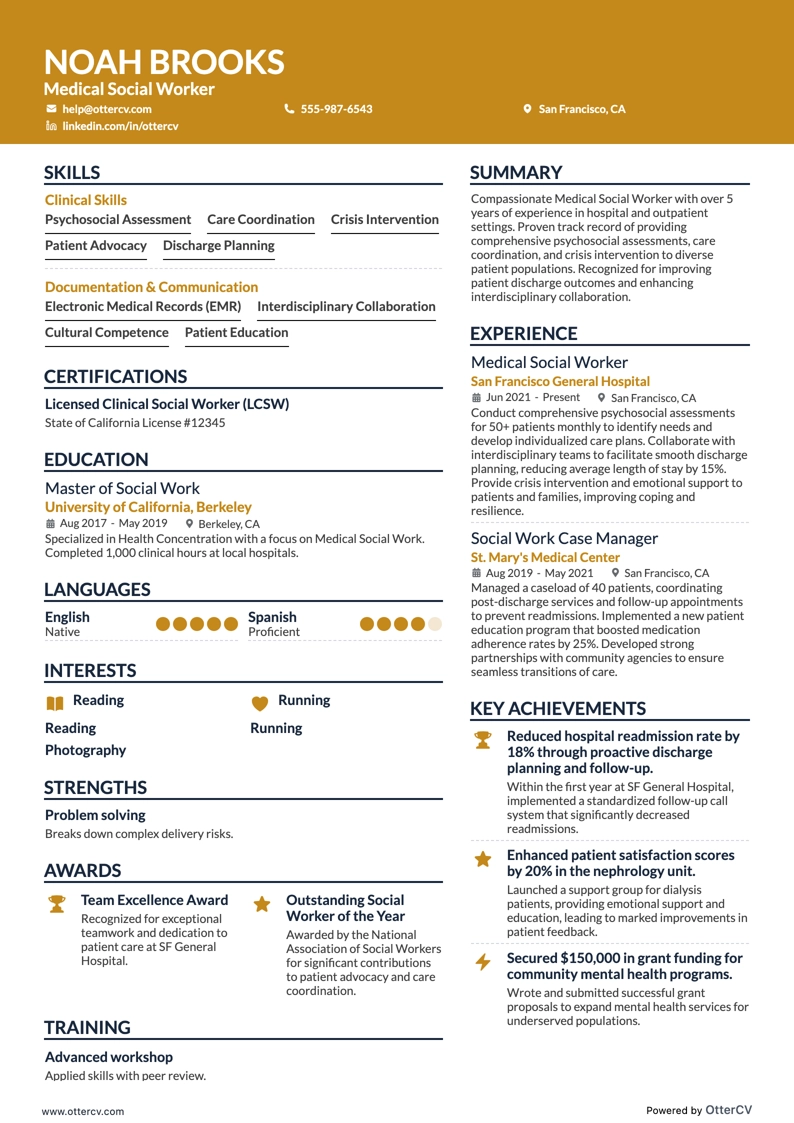
Lead Social Worker full preview

26 Social Worker Resume Examples, Templates

OtterCV

Written by The OtterCV Team

Updated: 3/21/2024•8 min read

See all resume examples in this guide, or generate your own resume example with your personalized prompt

Lead Social Worker resume example

Lead Social Worker

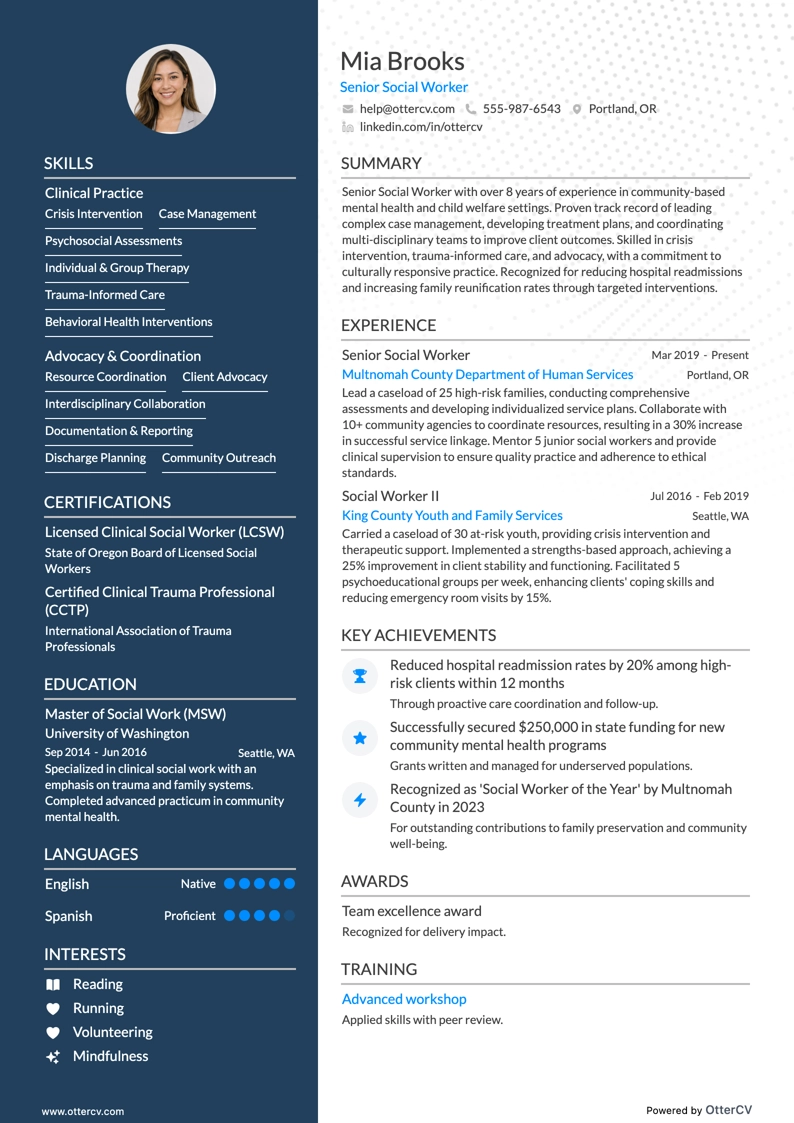
Senior Social Worker resume example

Senior Social Worker

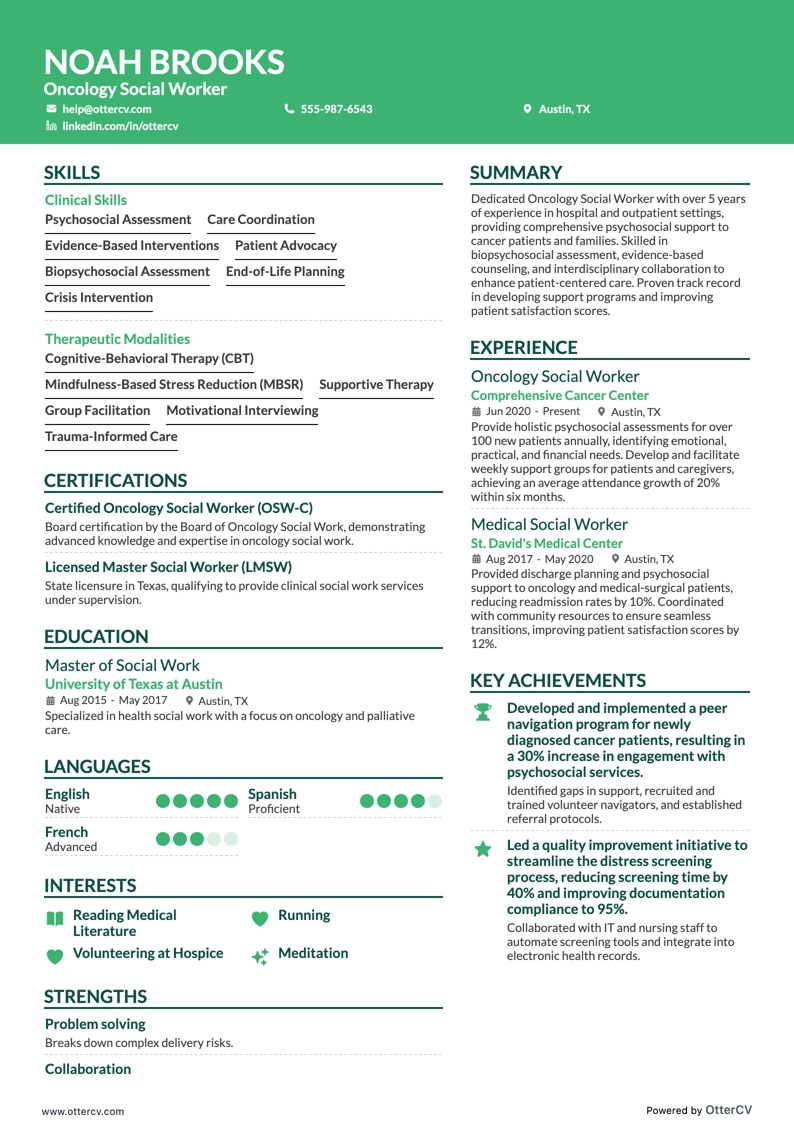
Oncology Social Worker resume example

Oncology Social Worker

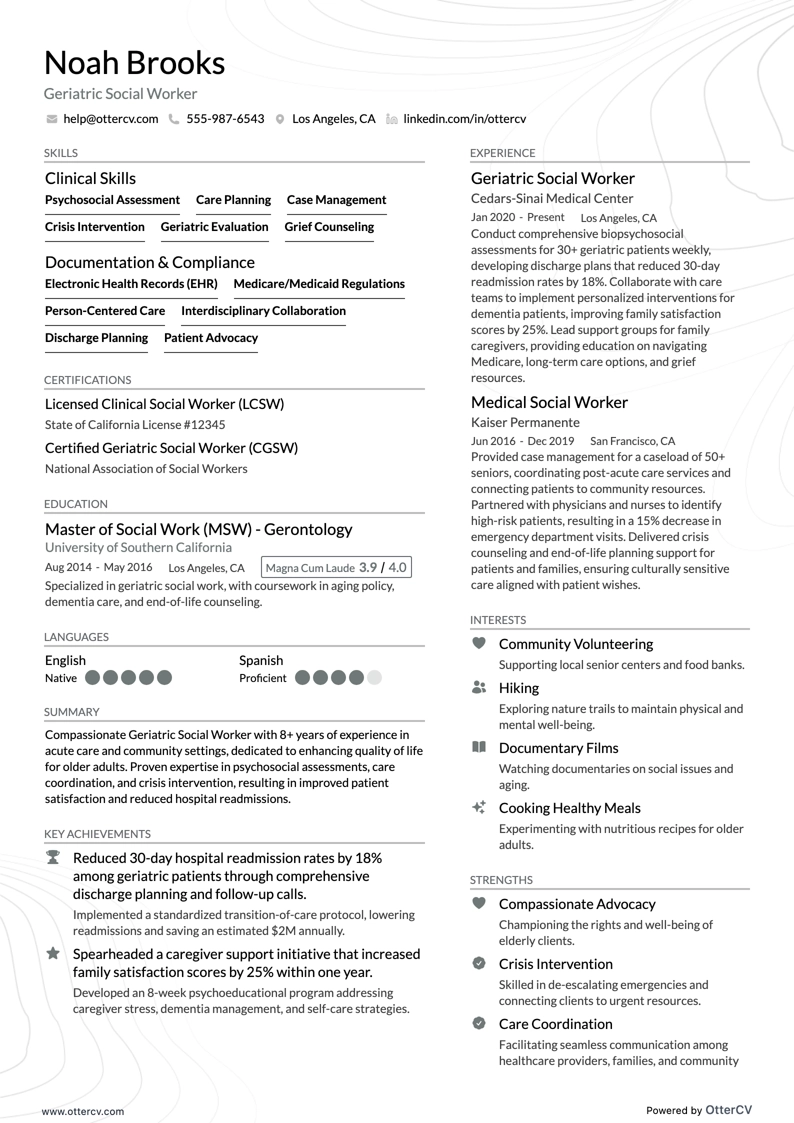
Geriatric Social Worker resume example

Geriatric Social Worker

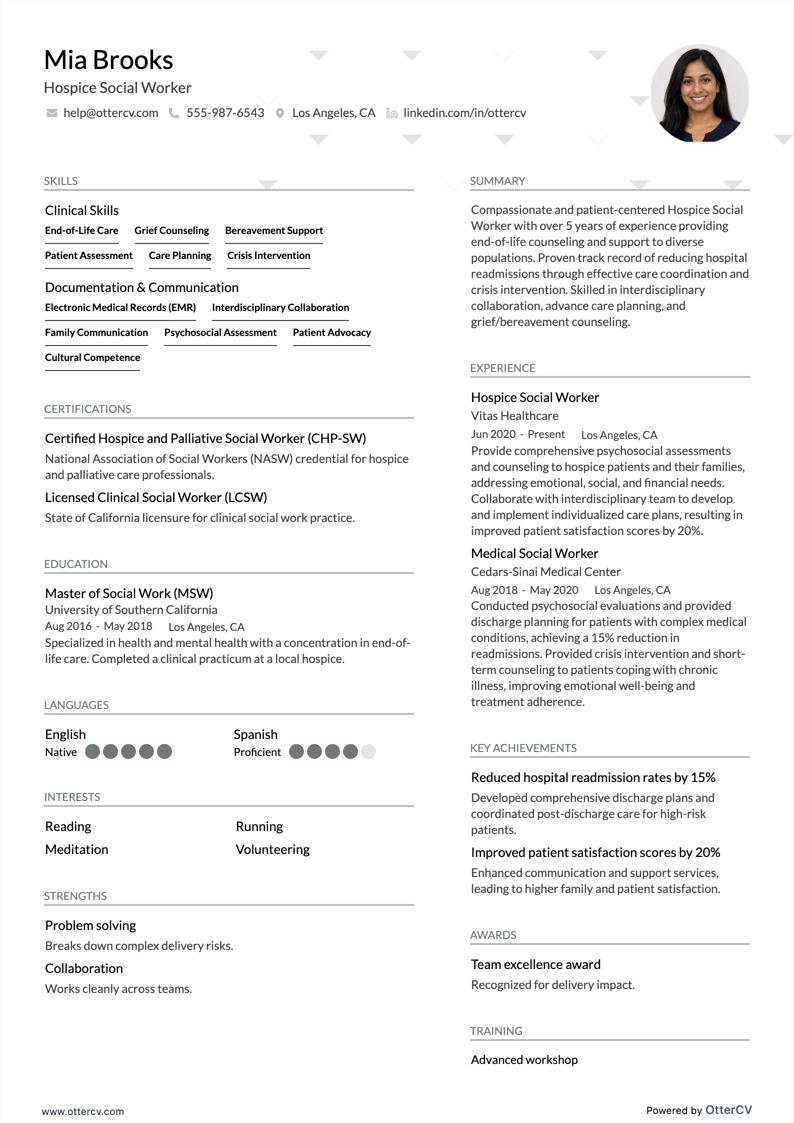
Hospice Social Worker resume example

Hospice Social Worker

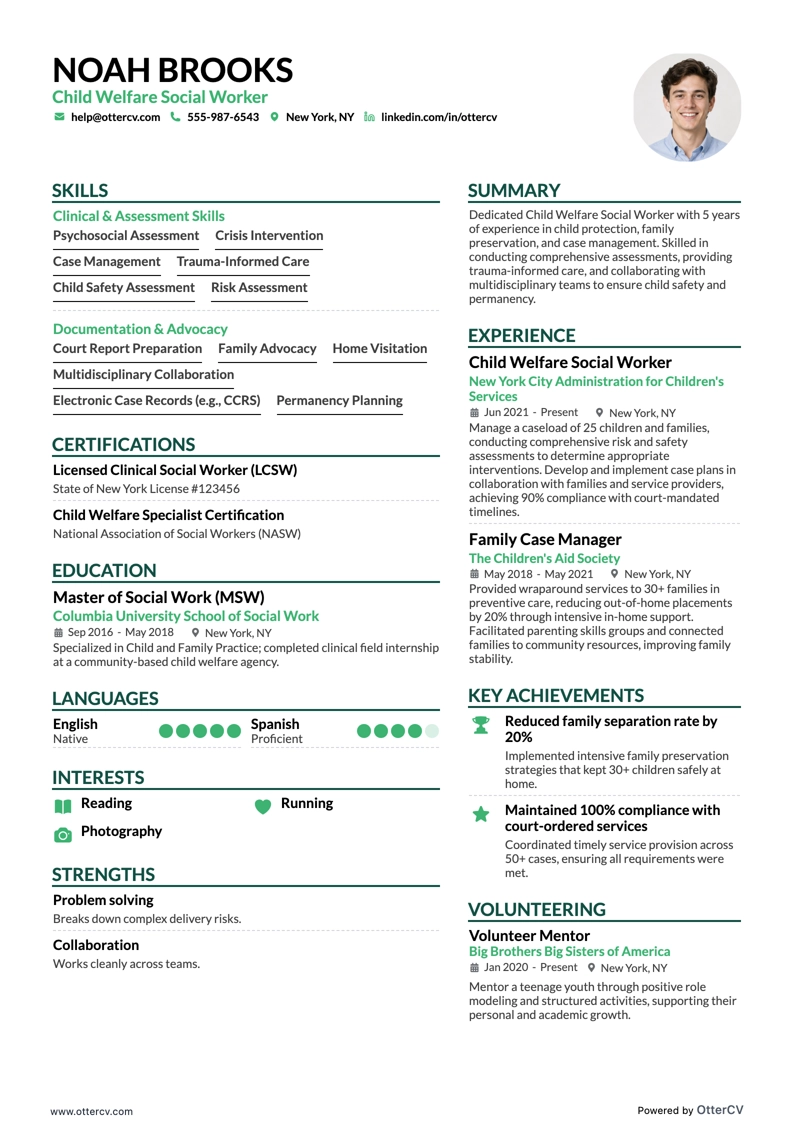
Child Welfare Social Worker resume example

Child Welfare Social Worker

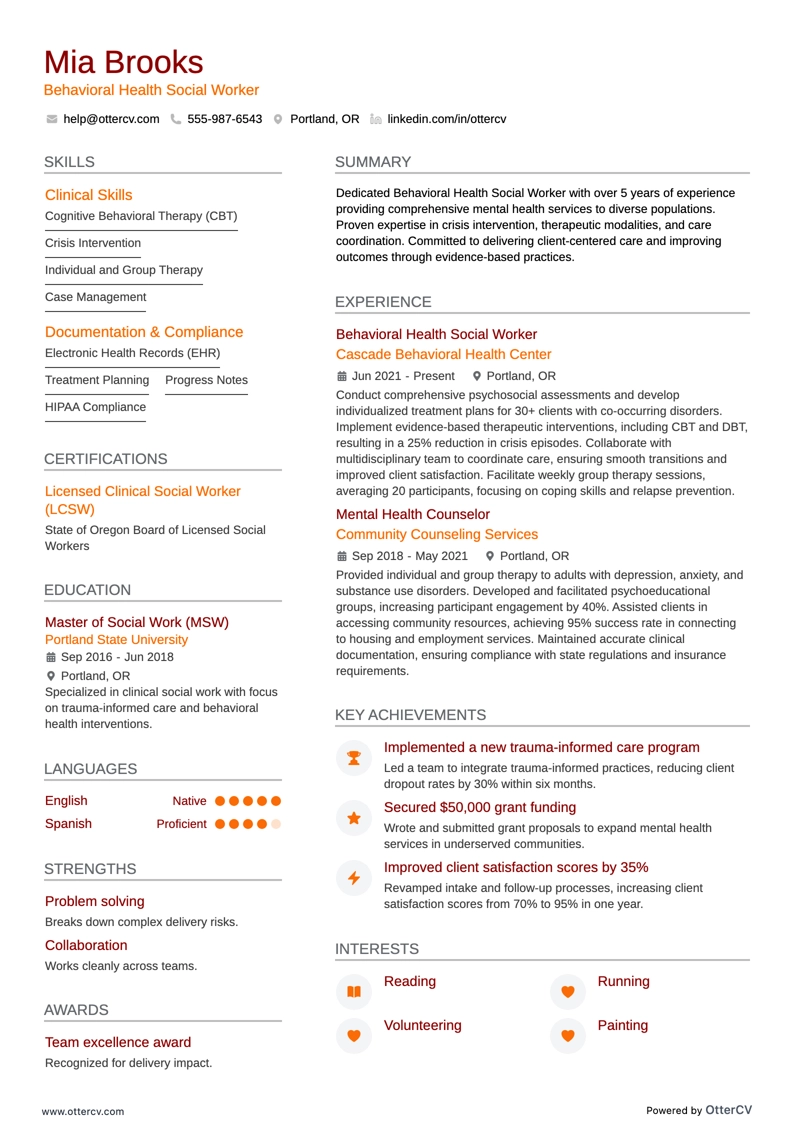
Behavioral Health Social Worker resume example

Behavioral Health Social Worker

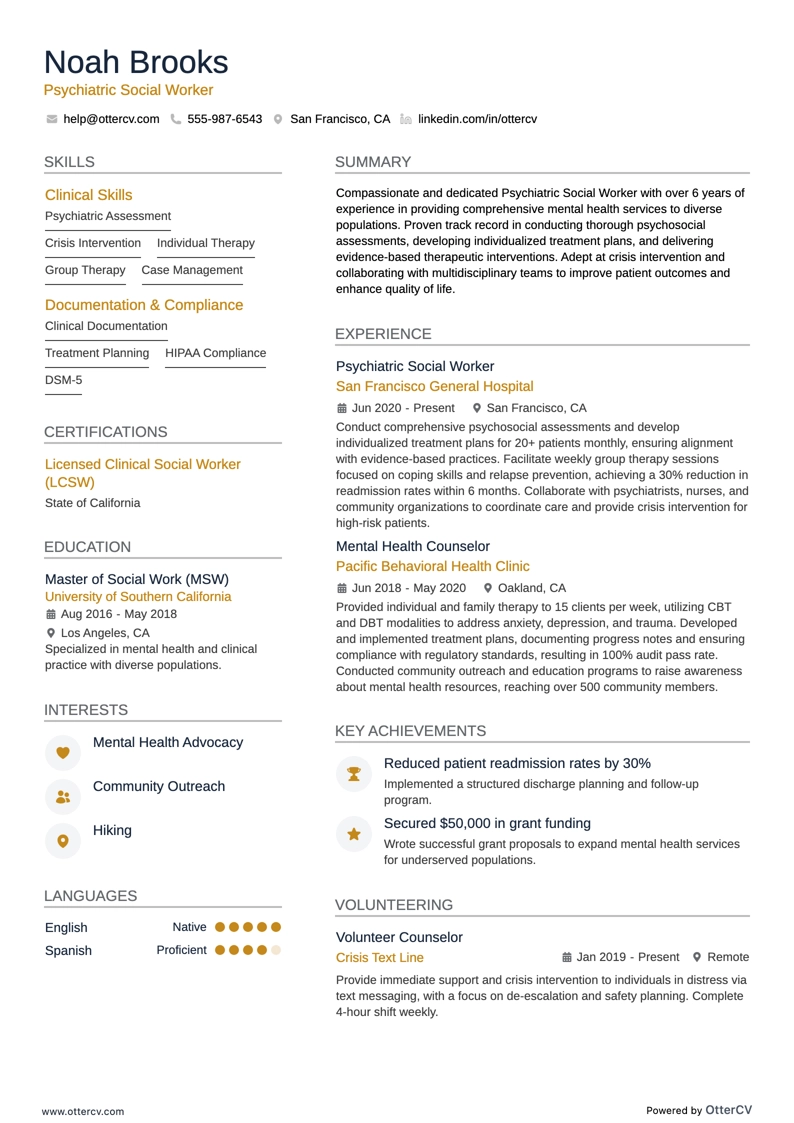
Psychiatric Social Worker resume example

Psychiatric Social Worker

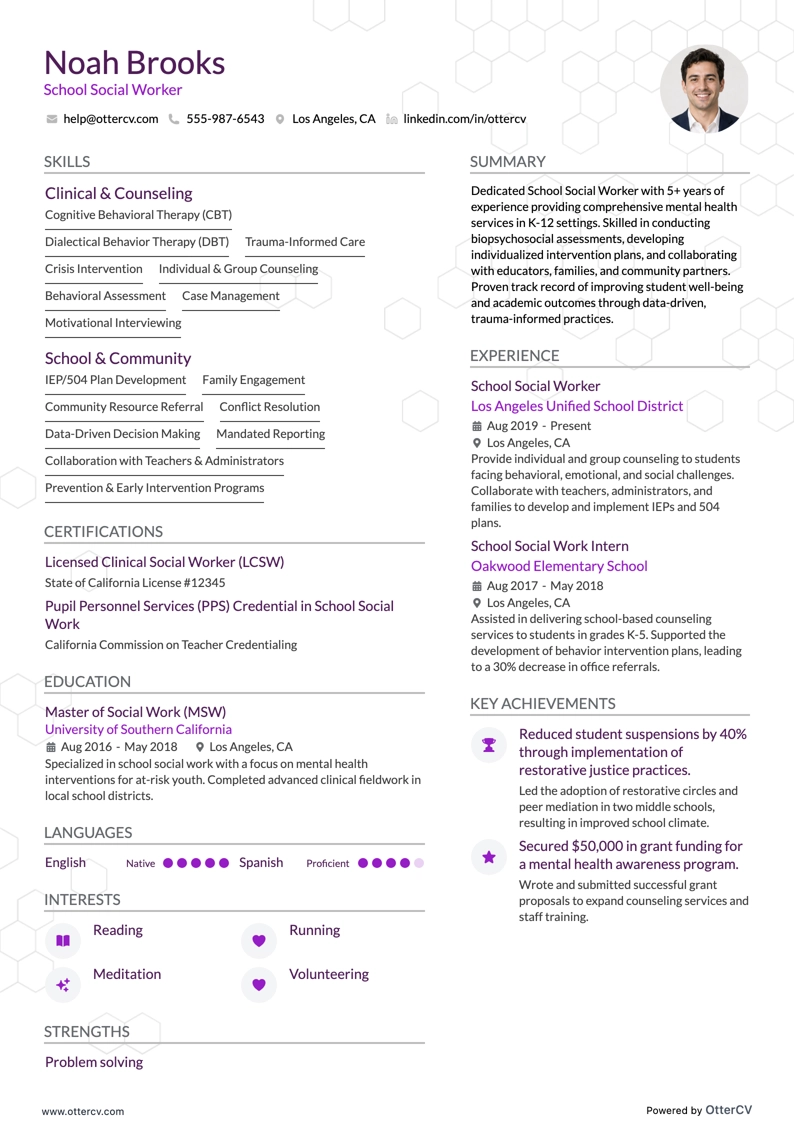
School Social Worker resume example

School Social Worker

Medical Social Worker resume example

Medical Social Worker

Licensed Clinical Social Worker resume example

Licensed Clinical Social Worker

Social Worker resume example

Social Worker

Social work is a dynamic field that calls for both strong interpersonal skills and the right qualifications.

Because social workers serve diverse populations, each job or internship may require a different mix of experience and abilities. That makes it essential to tailor your social worker resume for each role and clearly show the experience and skills that make you a strong match.

In this guide, you’ll learn:

  • How to highlight career achievements in your experience section that hiring managers want to see
  • How to present your education and social work credentials so employers can quickly recognize your qualifications
  • How to showcase important soft skills, such as crisis intervention and communication
  • How to write a strong summary that outlines your career and shows your commitment to social work

If you’re looking for something a little different, explore these guides for similar roles in social services:

Social worker resume example

Lead Social Worker resume preview

Here’s what this applicant does well in their resume:

  • Experience with diverse roles: The resume highlights work across different social work positions with varied responsibilities and achievements, showing a broad skill set and adaptability.
  • Quantifiable achievements: It uses specific metrics, such as “reducing intake processing time by 20%” and handling “30+ child welfare cases annually,” to clearly demonstrate impact and competence.
  • Relevant certifications: Certifications in Advanced Case Management and Child Welfare and Advocacy strengthen credibility and show specialized knowledge that is directly relevant to social work.

How to format a social worker resume

A career in social work comes with specific credentials and requirements, so your resume should present your information clearly and in a way that is easy to understand.

The format of your social worker resume is one of the first things hiring managers will notice. A clean, organized layout helps communicate professionalism right away.

Focus on these areas to create a social work resume format recruiters want to see:

  • Reverse chronological layout: A reverse chronological layout focuses on work experience in reverse chronological order. Since career paths into social work can vary, this format helps show commitment to the field and steady career growth.
  • Professional header: Include a header at the top of your resume that clearly lists your title and professional contact information. Because roles and credentials in social services can differ, this is a good place to introduce your specific title immediately.
  • Single page: Employers often review many applications, so keep each section short, concise, and focused on your most relevant social work achievements.
  • ATS optimized: Choose fonts, keywords, and file formats that are optimized for Applicant Tracking Systems. Use ATS-friendly fonts like Rubik and Montserrat and a PDF file format in Echocv’s resume builder to improve the chances of your resume reaching a human recruiter.

Resume expectations can also differ by market. For example, a Canadian resume could vary in layout.

The top sections on a social worker resume:

  • Personal summary: Highlight your passion for social work, along with your motivation and commitment to helping others.
  • Key skills and qualities: Show essential strengths such as empathy, resilience, and strong communication skills.
  • Work experience and achievements: Include relevant social work or related experience, plus accomplishments that demonstrate your effectiveness in the role.
  • Education and professional training: Present the academic and professional qualifications needed to show you are suited for the role.
  • References: Add references from previous employers or professional contacts to support your skills and experience.

What recruiters want to see on your resume:

  • Education: Recruiters prioritize education because a degree in social work or a related field is typically required for professional social work roles.
  • Experience in social services: Relevant experience is valued because it shows practical knowledge and the ability to handle the demands of social work.
  • Crisis intervention skills: These skills are important because they show an ability to manage challenging and urgent situations.
  • Certifications: A state social work license or specialized training in areas such as child welfare or substance abuse demonstrates dedication and specialized knowledge.
  • Cultural awareness: Recruiters value an understanding of multicultural issues because social workers support clients from diverse backgrounds.

How to write your social worker resume experience

The experience section of your resume lists your work history along with 3 to 4 bullet points that highlight your top accomplishments in each role. Show potential employers what you have achieved as a social worker so they understand what you can bring to their organization.

Avoid simply listing broad duties and responsibilities. Use this section to demonstrate how you have succeeded in the field and applied key industry skills.

Let’s look at an example of a social worker's resume experience section.

Experience

Social Worker

Community Health Center

02/2021 - 11/2022 | Chicago, IL

  • Managed a caseload and communicated with clients.
  • Conducted intake and assessment for new clients.
  • Developed a community outreach program.
WRONG

What doesn’t work in this example

  • No numbers or data - Mentioning caseload or clients is not enough without quantifying them. Hiring managers want to understand the scope of your work and the measurable results you achieved.
  • Duties, not accomplishments - “Conducted intake and assessment of new clients” describes a responsibility, but it does not show whether the candidate was successful. Focus on results instead of tasks to show employers how you can contribute to success.
  • Vague statements - “Developed community outreach program” does not give relevant information about the candidate. Use the experience section to highlight achievements and industry skills.

Let’s make a few changes to this experience section and take another look.

Experience

Social Worker

Community Health Center

02/2021 - 11/2022 | Chicago, IL

  • Managed a caseload of 110 clients and communicated through a secure teletherapy platform.
  • Implemented a new client intake process, reducing intake processing time by 15%.
  • Developed an outreach program to provide free counseling services to the community, connecting 250 people with essential services.
RIGHT

What works in this example:

  • Quantifies results — “Implemented new client intake process, reduced intake processing time by 15%” shows measurable success by using real numbers and data to demonstrate impact. Support your claims with clear evidence of your results.
  • Shows industry achievements — “Developed outreach program to provide free counseling services to the community, connected 250 people with essential services” demonstrates commitment to the field and a proven record of success.
  • Demonstrates relevant skills — Mentioning specific skills like “secure teletherapy platform” shows how to use keywords to tailor your resume to fit your target job.

How to quantify the impact on your resume

To show potential employers that you have successfully helped clients and managed cases, you need to quantify the impact on your social worker resume.

Because of confidentiality agreements, social workers cannot always provide direct references or proof from past roles. That can make it harder to show successes or positive outcomes, even though those are important parts of a strong resume.

If you are unsure which achievements to include, consider these areas when using real numbers and data on your social worker resume to emphasize your impact:

  • Include the number of cases managed to show workload capacity, time management and multitasking ability.
  • Show quantifiable client improvements to demonstrate success in helping clients reach their goals and to provide tangible evidence of impact.
  • Detail the size of multidisciplinary teams you worked with to highlight collaboration and your ability to work within a larger organizational framework.
  • Mention budgets you have managed to show financial responsibility and understanding of resource allocation.
  • Specify your client demographic, including average client volume and relevant demographic details, to highlight expertise in a particular area of social work.
  • Include your success rate in linking clients to resources to show efficiency and effectiveness in meeting client needs.
  • Detail the number of crises handled to emphasize your ability to work under pressure and manage crisis situations.
  • Indicate the number of comprehensive assessments completed to show you can understand and address complex client needs.

How do I write a social worker resume with no experience

The path to a social worker position varies from candidate to candidate. You may be transitioning from another area of social services or entering the field after finishing school.

If you are changing careers or are new to the industry, you need to find a way to write a social worker resume with no social worker experience.

The key to an effective entry-level social worker resume is focusing on transferable skills rather than work history.

Follow these steps to write an effective social worker resume with no experience:

  • Choose a functional resume layout.
  • Focus on transferable skills.
  • Present education and credentials clearly.
  • Use additional sections to highlight skill development and specialty knowledge.
  • Tailor every section to fit your target job.

A functional resume layout focuses on transferable skills rather than experience.

This approach helps show employers other ways you have built relevant skills and used tools such as interviewing techniques and client database software.

Don’t pad your experience section with irrelevant jobs just to fill space. Only include roles that are relevant to your target position and emphasize the transferable skills they demonstrate.

Other social services roles, such as school counselor or case manager, can help show relevant experience. Even jobs in customer service or community outreach can demonstrate the soft skills needed in social work.

How to list your hard skills and soft skills on your resume

Social work requires specialized tools and techniques. Present your skills clearly so hiring managers can see that you are proficient in therapy techniques and client-tracking software.

Your skills section has two main categories. Hard skills are the technical knowledge and abilities needed to perform job duties, while soft skills are the interpersonal and communication skills needed to work with others.

Listing hard skills on your social worker resume is usually straightforward. Technical skills such as software and assessment tools can be listed without a detailed breakdown.

Here is an example of hard skills on a social worker's resume.
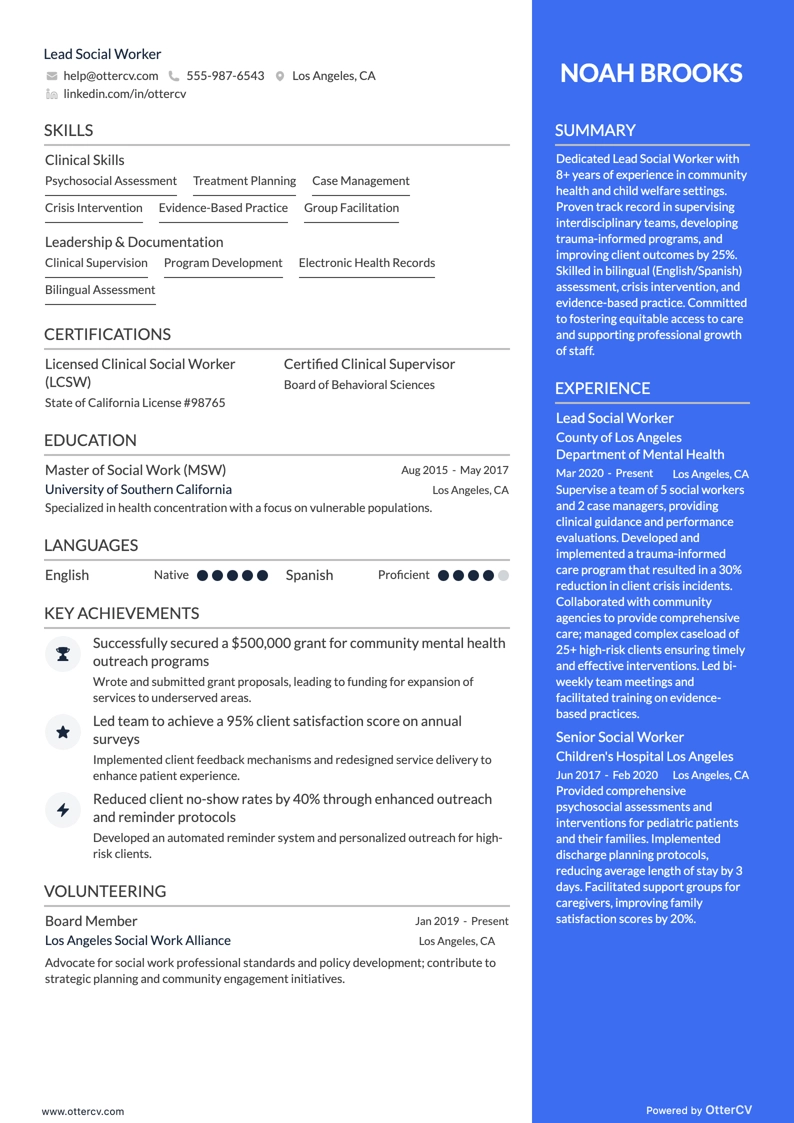
Skills

  • Crisis Intervention
  • EHR Software
  • Motivational Interviewing
  • Client Track
  • Penelope
  • Assessment and Reporting
RIGHT

If you include a hard skill on your resume, employers will assume you’re proficient in it. Only list hard skills that are relevant to the role and that you can confidently demonstrate.

Here are a few additional hard skills to consider for your social worker resume.

Best hard skills for your social worker resume

  • Case management.
  • Client advocacy.
  • Problem solving.
  • Intervention planning.
  • Psychological assessment.
  • Project management.
  • Therapeutic techniques.
  • Policy development.
  • Knowledge of social work theory.
  • Crisis intervention.
  • Proficiency in Microsoft Office.
  • Case note reporting.
  • Budget planning.
  • Proficiency in database management.
  • Experience with EHR software.
  • Experience with social services software.
  • Public speaking.
  • Multilingual skills.
  • Legal knowledge.
  • Experience with digital communication platforms like Zoom or Skype.

Soft skills can be open to interpretation, so it helps to explain them clearly. Including an example for each soft skill shows recruiters how you used those abilities to achieve results.

Here is an example of a soft skills section on a social worker's resume.
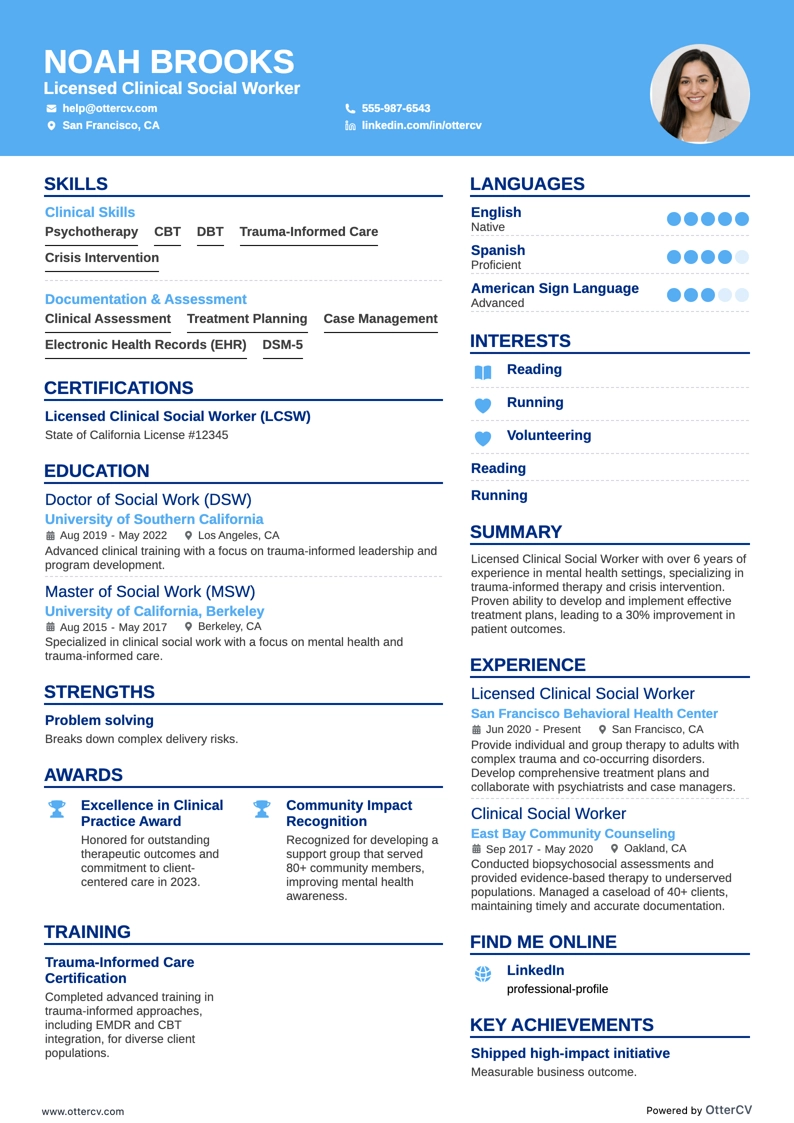
Strengths

  • Advocacy: Organized a fundraiser for a program that provides essential services to the community.
  • Time Management: Managed a caseload of 100 clients with 80% return clients.
  • Organizational Skills: Implemented new client tracking software, reducing intake processing time by 25%.
RIGHT

By including examples of achievements that demonstrate your soft skills, you can show potential employers how you will contribute to success at their company.

Here is a list of top soft skills to consider for your social worker resume.

Best soft skills for your social worker resume

  • Active listening helps you understand clients’ needs.
  • Empathy supports compassionate client care.
  • Strong communication improves interactions with clients and colleagues.
  • Adaptability helps you respond to changing situations.
  • Patience is essential when working through complex challenges.
  • Cultural awareness strengthens work with diverse communities.
  • Advocacy helps you speak up for clients and their needs.
  • Resilience supports you in demanding situations.
  • Problem-solving helps you find effective solutions.
  • Negotiation supports conflict resolution and client support.
  • Time management helps you balance multiple responsibilities.
  • Emotional intelligence improves understanding and relationships.
  • Organization helps you keep cases and tasks on track.
  • Collaborative teamwork supports coordinated care.
  • Ethical judgment guides responsible decision-making.
  • Motivational skills help encourage client progress.
  • Sensitivity supports respectful client interactions.
  • Tolerance helps you work effectively with different perspectives.
  • Professionalism strengthens trust and credibility.
  • Respect for diversity supports inclusive social work practice.

How to list your certifications and education on your resume

The right credentials are essential in social work. Make sure your certifications and education are easy to find on your resume so hiring managers can quickly see that you meet the role’s requirements.

Most social work positions require at least a bachelor’s degree in social work, while some require a master’s degree in social work.

Requirements vary by state, but practicing social work also requires a social work license. In most cases, licensure follows an exam after completing a social work degree.

Here’s an example of what an education section on a social worker’s resume can look like.

Education

Bachelor of Social Work

Temple University

02/2010 - 11/2014

Master of Social Work

University of Pennsylvania

02/2015 - 11/2017

RIGHT

Your education section should include:

  • Name of institution
  • Name of degree
  • Years attended

Additional details such as GPA or coursework are not necessary. Include them only if they are explicitly requested, or if you are applying for an entry-level position and have relevant coursework.

Your certification section should also be brief. Hiring managers want to quickly confirm that you meet the requirements, so present the information clearly.

Your social worker certification section only needs to include the name of the certificate and the issuing institution.

Here is an example of a certification section on a social worker's resume.
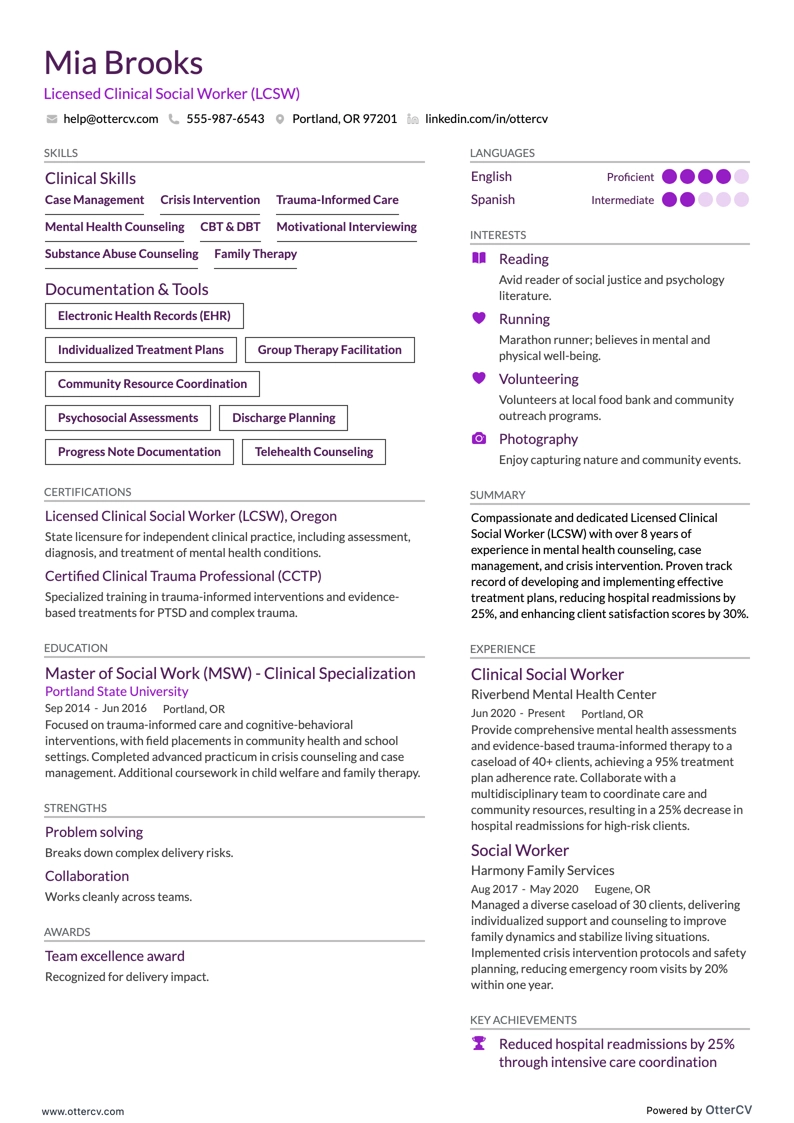
Certifications

  • Licensed Social Worker

    PA State Board of Social Workers

  • Qualified Clinical Social Worker (QCSW)

    National Association of Social Workers

RIGHT

Earning additional certifications can help increase your employability as you advance in your career. Certifications in specialized techniques and therapies can also strengthen your social worker resume.

Here are a few certifications to consider adding to your social worker resume.

Best certifications for your social worker resume

How to write your social worker resume summary or objective

A summary or objective gives you a chance to introduce yourself and show your value to potential employers. In 3-4 sentences, it should highlight your career history and top accomplishments.

Although the terms are often used interchangeably, there is a slight difference between them.

A summary is a brief introduction that highlights your career and key achievements. An objective looks to the future and explains what you hope to achieve in your next position.

A summary is usually the better choice for candidates with experience in the field, while entry-level candidates are more likely to focus on an objective.

If you have some social work experience, you can combine both approaches by including an introduction, a career highlight, and a goal you share with your target employer.

Let’s look at an example of a social worker resume summary.

Summary

Experienced social worker with a passion for supporting youth and families. Managed complex cases and helped reunite many families. Seeking a new social worker opportunity at Children's Community Center.

WRONG

What doesn’t work in this example

  • Generic buzzwords — Words like “experienced” and “passion” have little value if they are not quantified. Hiring managers want to know exactly how much experience you have and what your passion has helped you achieve.
  • No measurable results — “I have handled complicated cases and reunited many families” is too open to interpretation. What made the cases complicated, and how many families were reunited?
  • No objective — Simply saying you want the job is not a strong objective. Research your target company and identify what solutions you can offer for their challenges.

Let’s make a few changes and look at this summary again.

Summary

Certified Advanced Children, Youth & Family Social Worker with 8 years of experience in child welfare. Implemented a new family reunification program that resulted in a 20% increase in reunifications. Seeking an opportunity to apply assessment experience and help increase family reunifications at Children's Community Center.

RIGHT

What works in this example

  • Introduces credentials – In social work, credentials matter, so it helps to show hiring managers right away that you have relevant certifications and specific experience.
  • Highlights accomplishment – “I implemented a new family reunification program which resulted in a 20% increase in reunifications” gives a clear, industry-specific achievement and helps employers understand the candidate’s abilities.
  • Shared goal – “Seeking the opportunity to leverage assessment experience and increase family reunifications at Children’s Community Center” shows how the candidate’s experience can contribute to success in the new role.

Additional sections for a social worker resume

  • Languages - Speaking multiple languages can be a valuable skill for social workers, especially when clients speak a first language other than English.

  • Continuing education - Expanding your education and completing training in areas such as cognitive behavioral therapy or dialectical behavior therapy can help keep your resume current and improve your employability.

  • Volunteer work - Volunteering can help you build social work skills and highlight achievements outside your formal work history.

  • Create a clear, professional resume format that communicates key information to hiring managers and can pass ATS filters.

  • Quantify your impact with real numbers and data to show results such as managing cases and reuniting families.

  • Balance soft skills and hard skills so employers can see your technical abilities as well as your interpersonal communication strengths.

  • List your education and certifications clearly so hiring managers can quickly confirm that you meet the role requirements.

Social Worker resume examples

Explore additional Social Worker resume samples and guides and see what works for your level of experience or role.

By Experience

Lead Social Worker

Lead Social Worker resume preview

Senior Social Worker

Senior Social Worker resume preview

Social Worker resume examples

Explore additional Social Worker resume samples and guides and see what works for your level of experience or role.

By Role

Oncology Social Worker

Oncology Social Worker resume preview

Geriatric Social Worker

Geriatric Social Worker resume preview

Hospice Social Worker

Hospice Social Worker resume preview

Child Welfare Social Worker

Child Welfare Social Worker resume preview

Behavioral Health Social Worker

Behavioral Health Social Worker resume preview

Psychiatric Social Worker

Psychiatric Social Worker resume preview

School Social Worker

School Social Worker resume preview

Medical Social Worker

Medical Social Worker resume preview

Licensed Clinical Social Worker

Licensed Clinical Social Worker resume preview

Social Worker

Social Worker resume preview