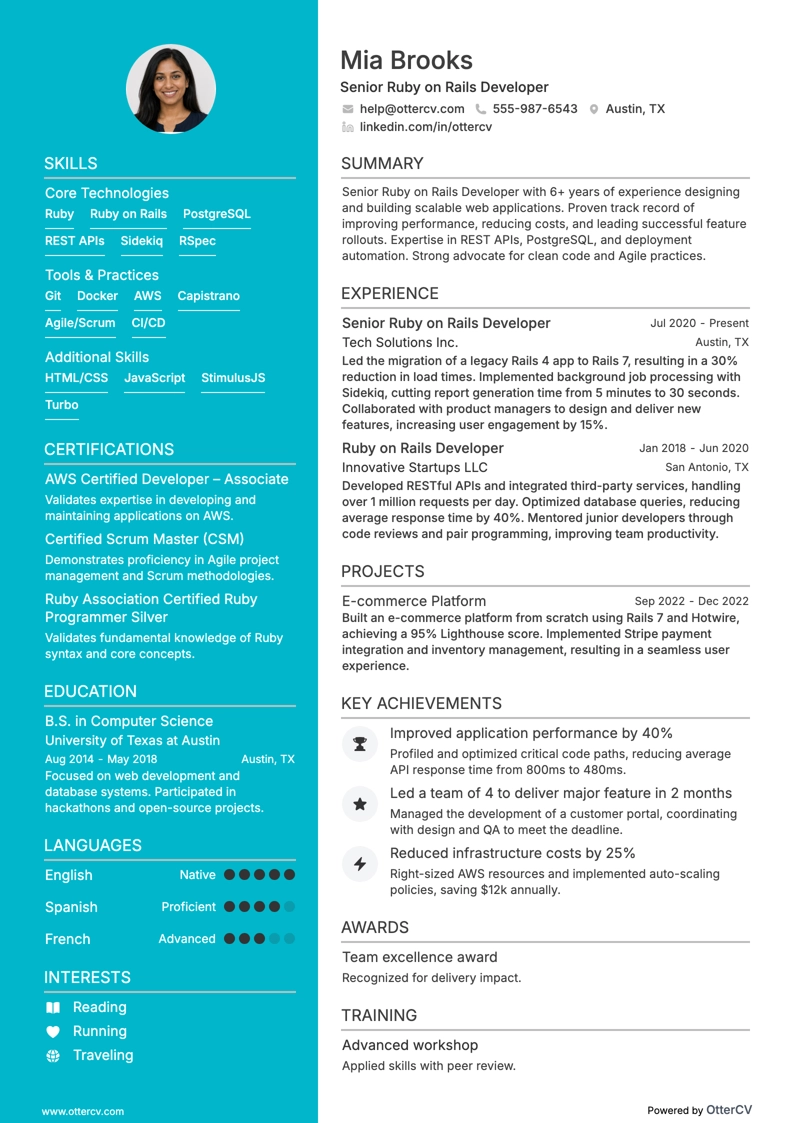
Principal Ruby on Rails Engineer full preview

10 Ruby On Rails Developer Resume Examples

OtterCV

Written by The OtterCV Team

Updated: 6/25/2023•8 min read

See all resume examples in this guide, or generate your own resume example with your personalized prompt

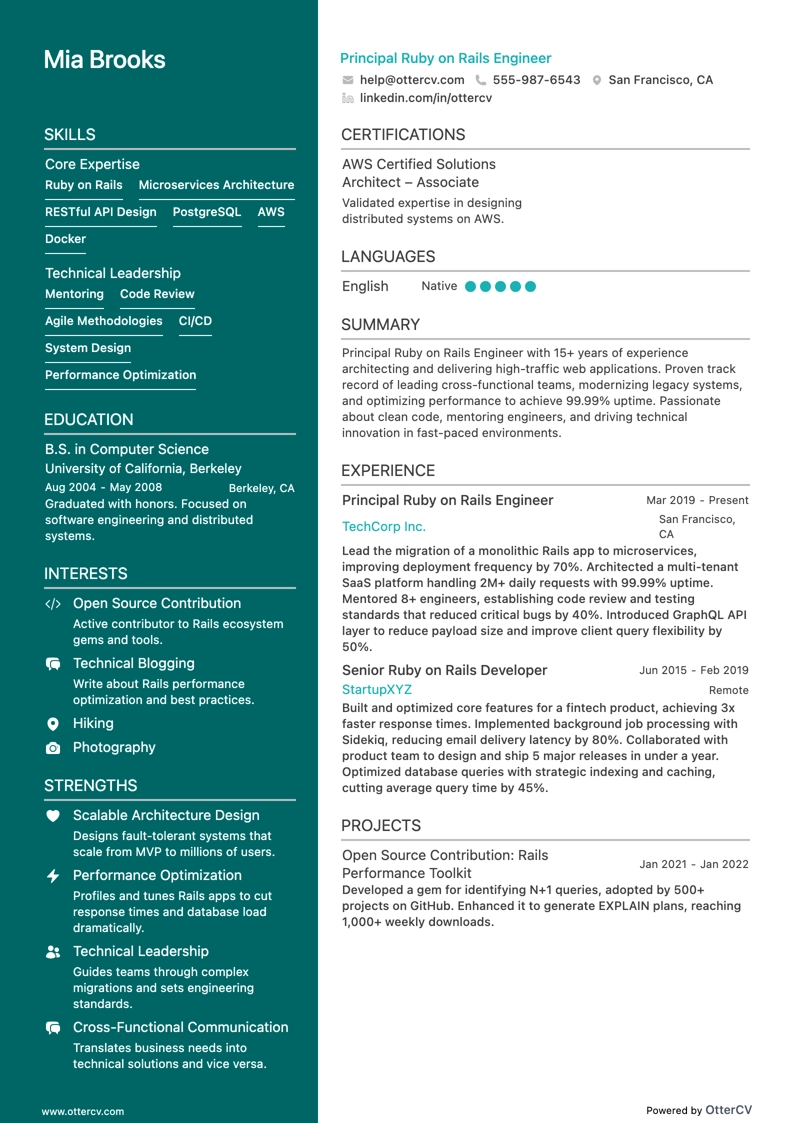
Principal Ruby on Rails Engineer resume example

Principal Ruby on Rails Engineer

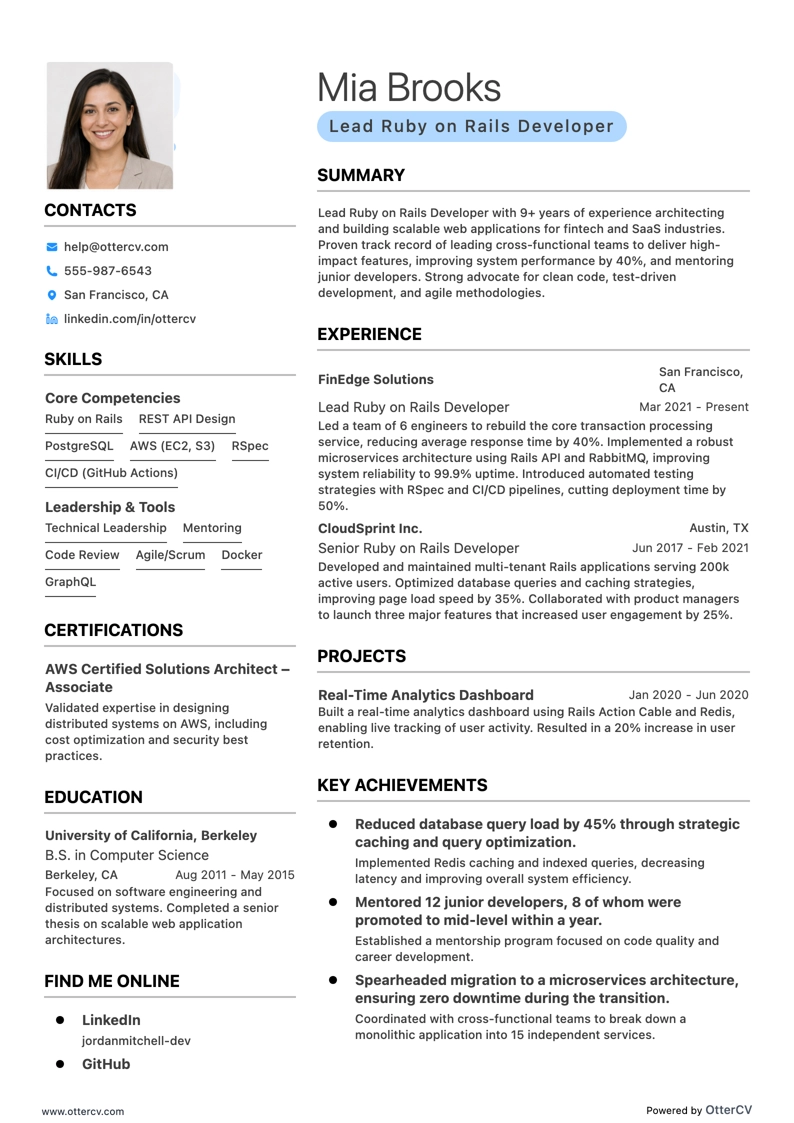
Lead Ruby on Rails Developer resume example

Lead Ruby on Rails Developer

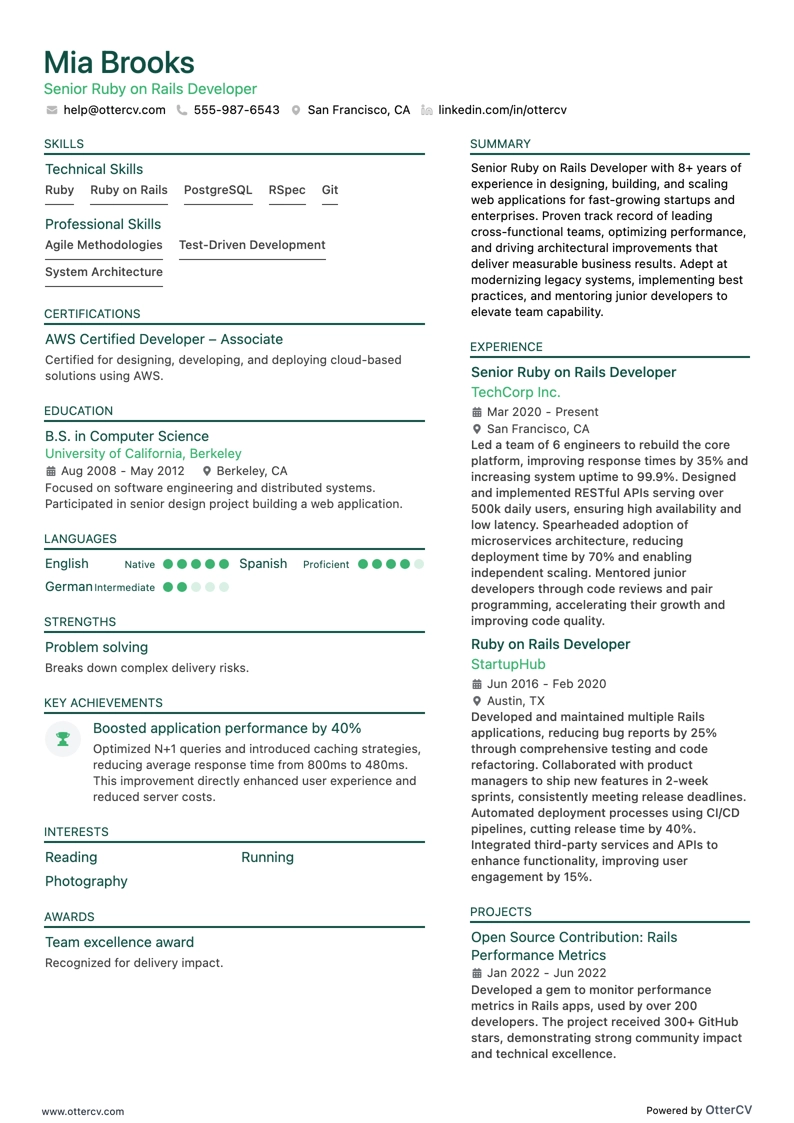
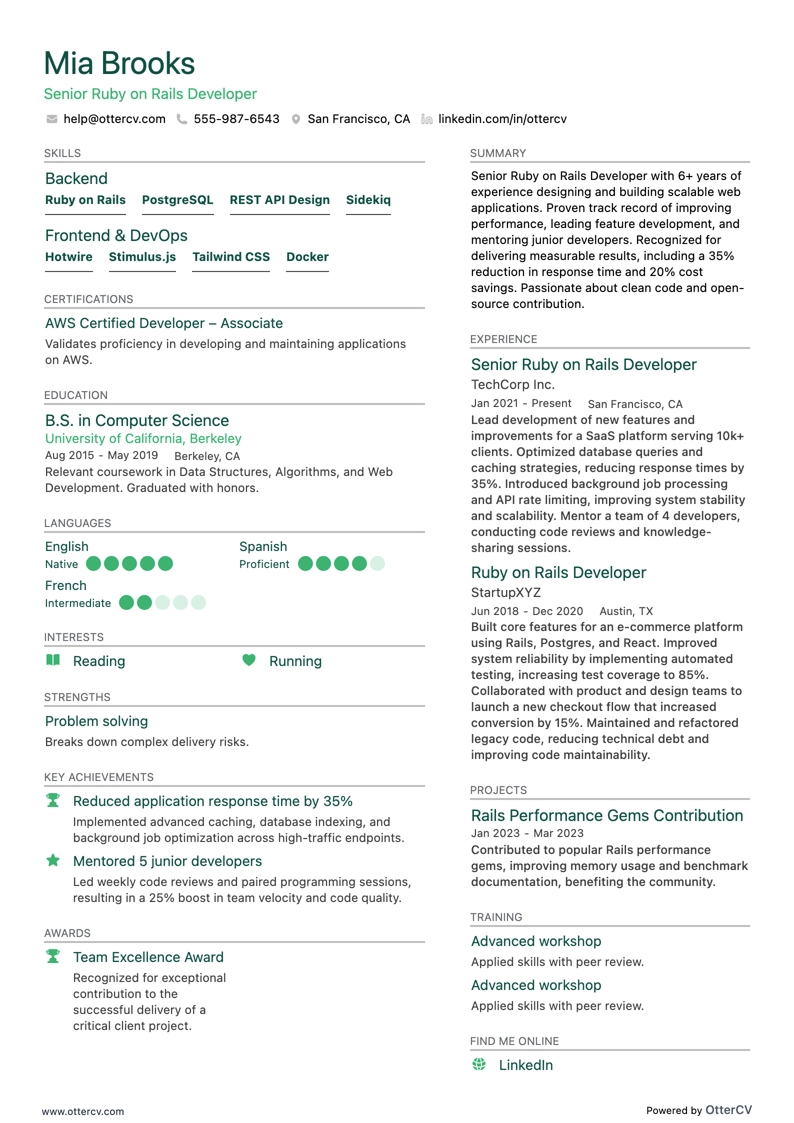
Senior Ruby on Rails Developer resume example

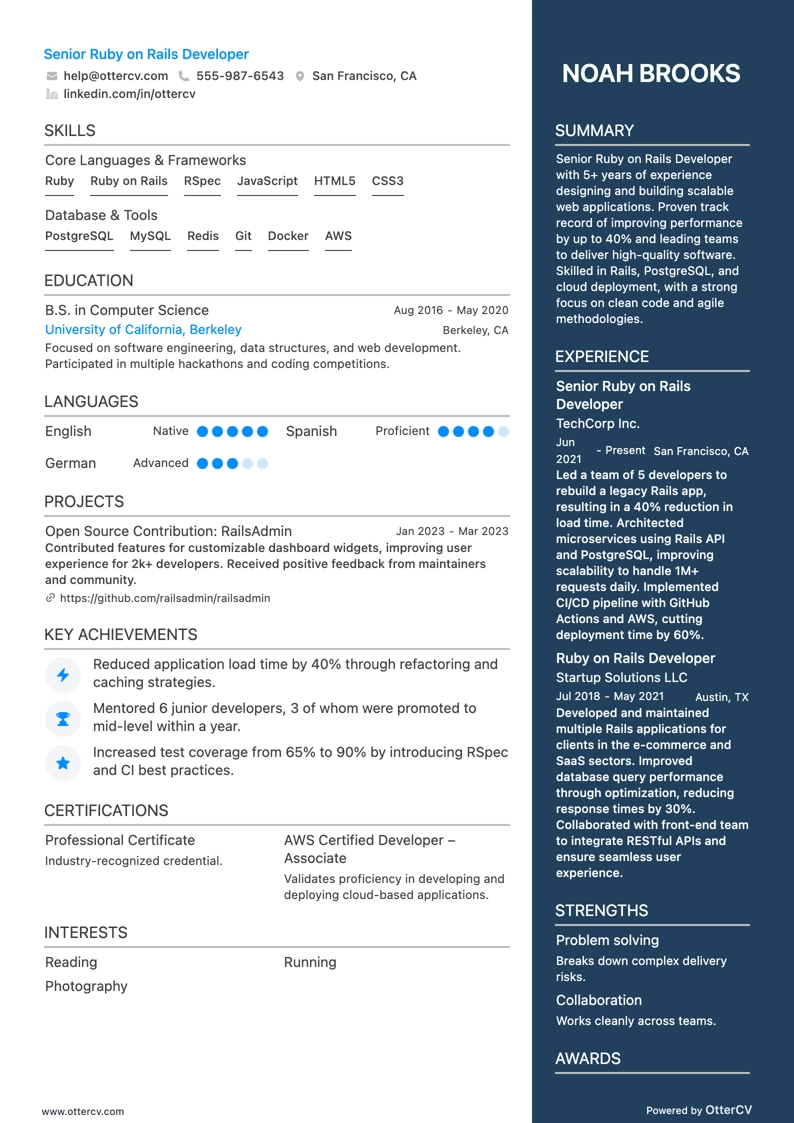
Senior Ruby on Rails Developer

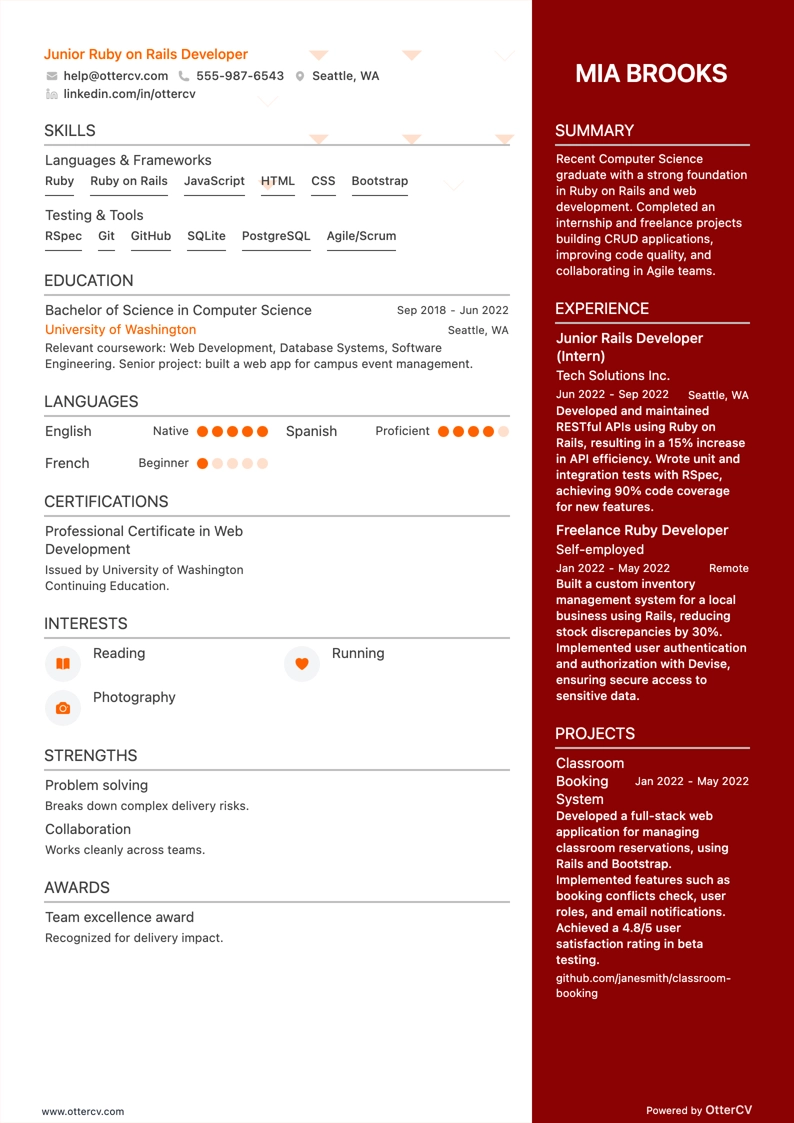
Junior Ruby on Rails Developer resume example

Junior Ruby on Rails Developer

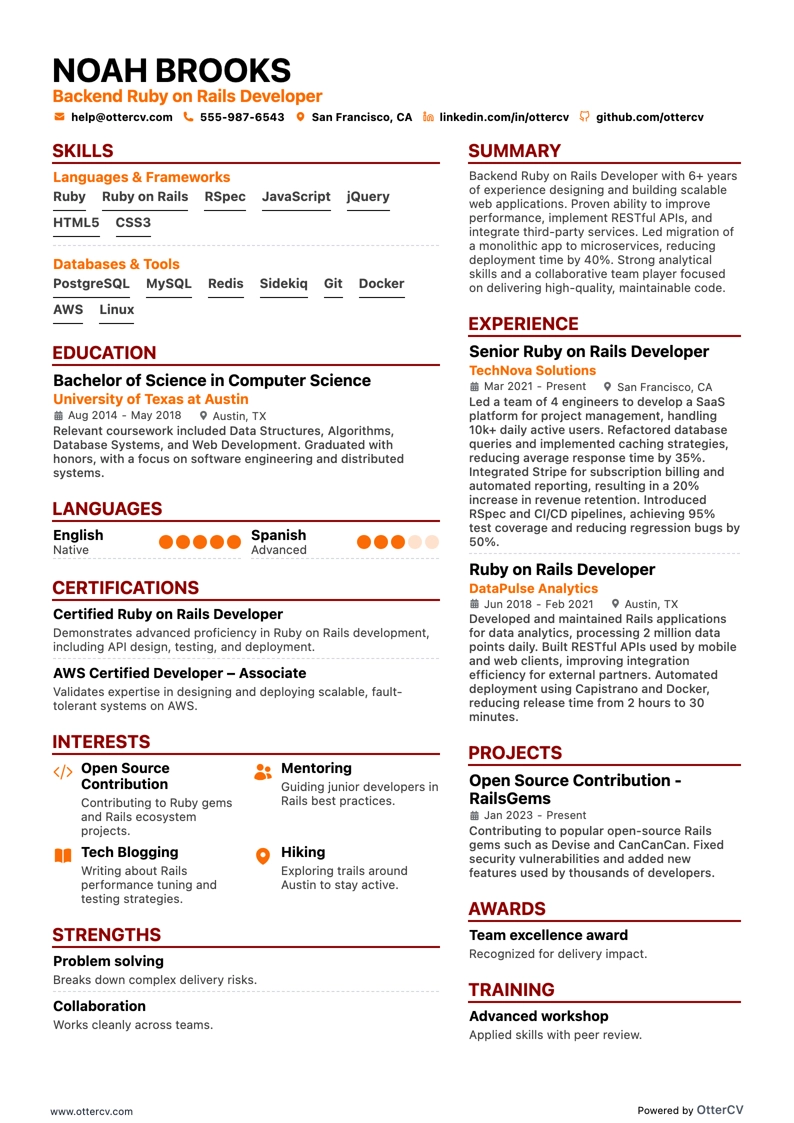
Backend Ruby on Rails Developer resume example

Backend Ruby on Rails Developer

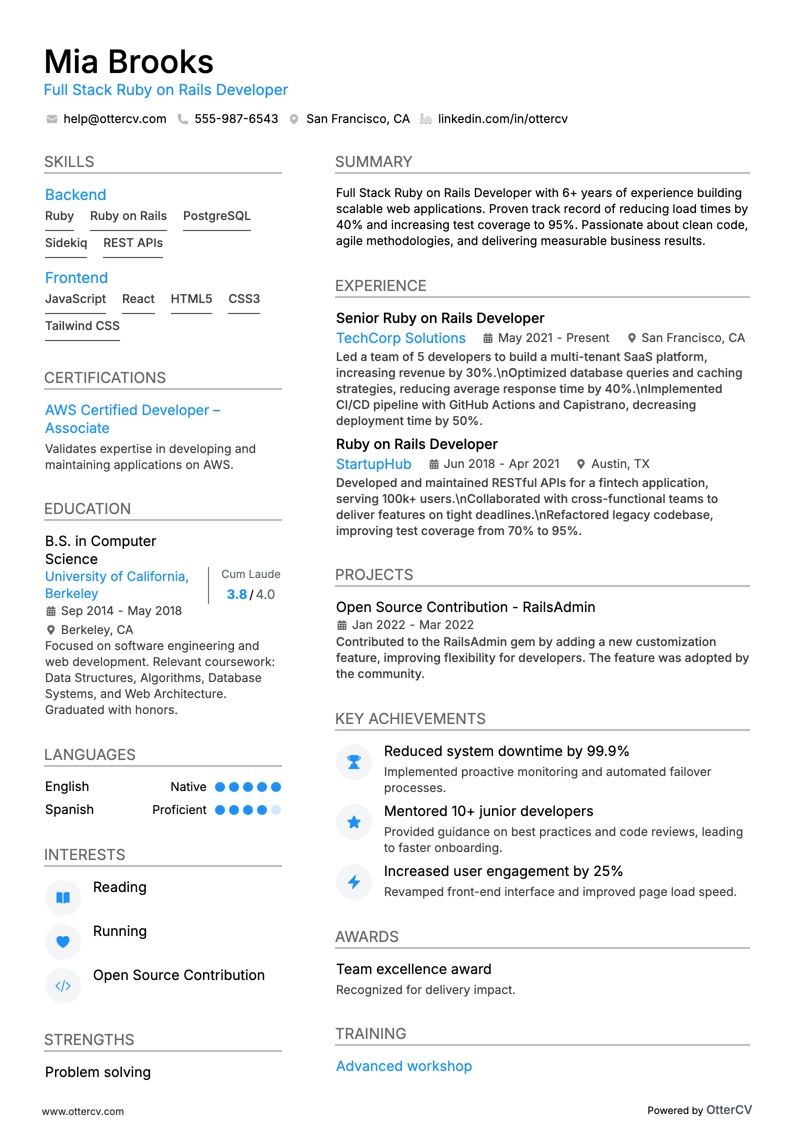
Full Stack Ruby on Rails Developer resume example

Full Stack Ruby on Rails Developer

Rails Engineer resume example

Rails Engineer

Rails Developer resume example

Rails Developer

Ruby on Rails Engineer resume example

Ruby on Rails Engineer

Ruby on Rails Developer resume example

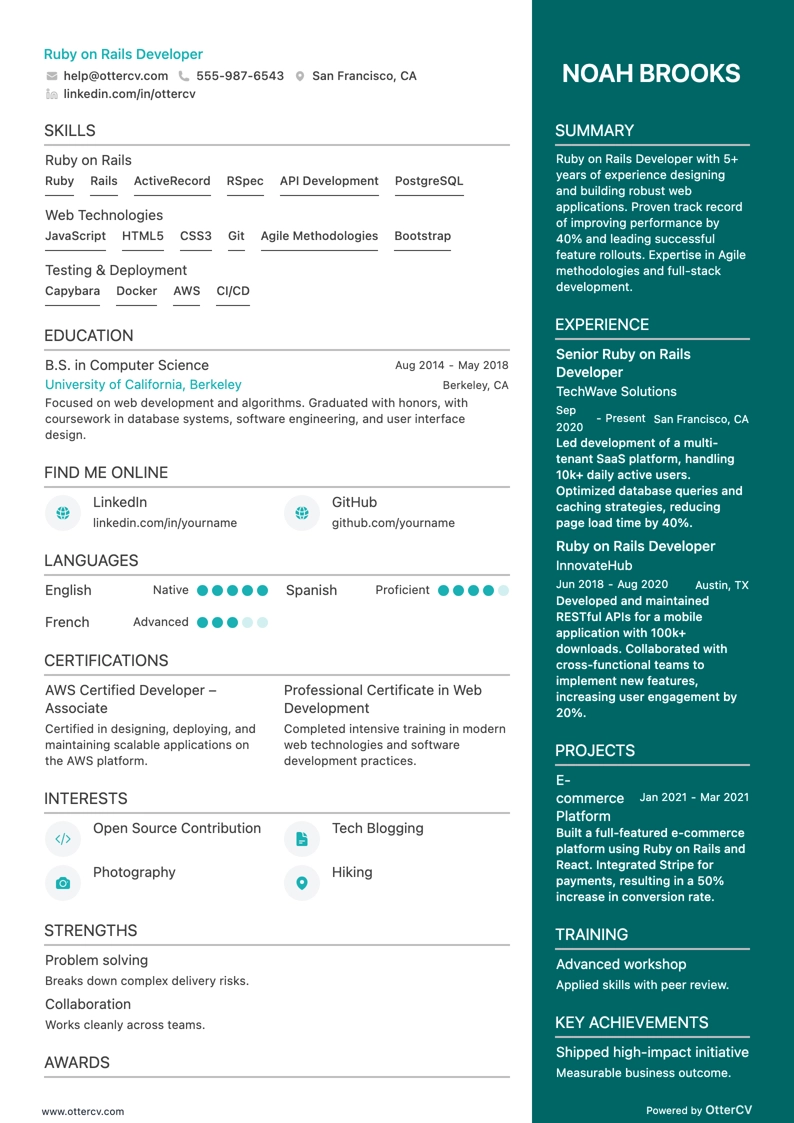
Ruby on Rails Developer

Most Ruby on Rails developer resumes fall short because they list frameworks and responsibilities without showing measurable impact, making it hard for recruiters to quickly assess value. In today’s crowded market, ATS tools filter for relevant signals, and recruiters often scan resumes in seconds. If you’re not sure where to start, learning how to write a resume that clearly communicates value is the essential first step.

A strong resume shows what you improved, shipped, and owned. Highlight performance gains, reduced error rates, faster release cycles, major feature launches, scale handled, revenue or retention impact, and reliability improvements achieved through testing and monitoring.

Key takeaways

  • Quantify each experience bullet with metrics such as response time, test coverage, or cost savings.

  • Match resume keywords to the exact tools and versions listed in each job posting.

  • Use a reverse-chronological format for experienced developers and a hybrid format for career switchers.

  • Tie every listed skill to a specific project, action, and measurable result.

  • Place a scannable skills section where ATS parsers and recruiters can find it immediately.

  • Write a three- to four-line summary that names your title, domain, core tools, and top achievement.

  • Use Echocv to turn vague job duties into focused, impact-driven resume bullets faster.

How to format a Ruby on Rails developer resume

Recruiters hiring Ruby on Rails developers look for hands-on framework expertise, ownership of production-level projects, and measurable impact on application performance, scalability, or delivery speed. A clear, well-structured resume format helps these signals stand out quickly during automated screening and the 6–10 seconds a recruiter typically spends on an initial scan.

I have significant experience in this role—which format should I use?

I have significant experience in this role—which format should I use?

Use a reverse-chronological format to present your Rails career in a clear, linear progression that highlights increasing technical ownership and project scope.

  • Lead each role entry with your scope of ownership, including team size, application scale, services managed, and architectural decisions you drove.
  • Highlight Rails-specific proficiency such as Ruby, ActiveRecord, RSpec, Sidekiq, PostgreSQL, Redis, RESTful API design, and deployment tooling like Docker, Capistrano, or CI/CD pipelines.
  • Quantify outcomes tied to business or engineering impact, such as reduced response times, improved test coverage, faster release cycles, or lower infrastructure costs.

Example bullet: “Redesigned the API layer of a Rails 7 monolith serving 2M+ monthly requests, reducing average response time by 40% and cutting Heroku infrastructure costs by $18K annually.”

I'm junior or switching into this role—what format works best?

I'm junior or switching into this role—what format works best?

Use a hybrid resume format: start with a focused skills section, then follow with concise experience entries that show how you applied Rails knowledge.

  • Put core Rails skills—Ruby, MVC architecture, ActiveRecord, RSpec, Git, and SQL—near the top so ATS tools and recruiters can find them quickly.
  • Highlight personal projects, open-source contributions, bootcamp capstones, or freelance work that involved building or maintaining Rails applications in production or near-production environments.
  • Link each skill to a specific action and a clear result so recruiters can evaluate what you can deliver, not just which tools you know.

Example scaffold: “RSpec & TDD (skill) → wrote integration and unit tests for a Rails e-commerce app's checkout flow (action) → achieved 92% code coverage and caught 3 critical payment-processing bugs before launch (result).”

Why not use a functional resume?

Why not use a functional resume?

A functional resume removes the project timelines and employer context hiring managers use to confirm that you have actually shipped and maintained Rails applications in real-world environments.

  • Career changers with transferable technical skills: If you built full-stack projects in another framework and completed Rails-focused training, a functional resume can highlight relevant skills while you build direct Rails experience.

  • Bootcamp graduates with limited work history: If your professional background is unrelated to software development, organizing Rails projects by skill area, such as API development, database optimization, and testing, can create a more coherent technical profile.

Even in these cases, a functional resume becomes less effective if your skills are not tied to specific projects, code contributions, or measurable outcomes. Switch to a hybrid format as soon as you have any relevant Rails experience to show.

Now that you've established a clean, readable layout, it's time to fill it with the sections that best showcase your Ruby on Rails expertise.

What sections should go on a Ruby on Rails developer resume

Recruiters want clear evidence that you can build, ship, and maintain production Ruby on Rails applications. Including the right resume sections helps present that evidence in a format hiring teams recognize and trust.

Use this structure for maximum clarity:

  • Header
  • Summary
  • Experience
  • Skills
  • Projects
  • Education
  • Certifications
  • Optional sections: Open-source work, Leadership, Languages

Strong experience bullets should highlight measurable impact, shipped outcomes, technical scope, and reliability improvements.

Now that you’ve organized the key parts of your resume, the next step is to write your Ruby on Rails developer resume experience section so it supports that structure with relevant, role-specific detail.

How to write your Ruby on Rails developer resume experience

Your experience section should highlight the Rails applications you’ve shipped, the technical decisions you made, and the measurable outcomes your work produced. Hiring managers care more about demonstrated impact—such as faster load times, reduced downtime, or successful migrations—than task lists that simply repeat a job description.

Each entry should include:

  • Job title
  • Company and location (or remote)
  • Dates of employment (month and year)

Add three to five concise bullet points that show what you owned, how you executed, and what outcomes you delivered:

  • Ownership scope: the Rails applications, API layers, microservices, database architectures, or internal tooling you were directly responsible for building, scaling, or maintaining.
  • Execution approach: the frameworks, gems, testing suites, deployment pipelines, and development practices—such as TDD, CI/CD, code review workflows, or agile ceremonies—you used to deliver reliable, production-ready code.
  • Value improved: the product or system health metrics you moved forward, whether by improving response times, strengthening test coverage, reducing technical debt, tightening security posture, or increasing deployment frequency.
  • Collaboration context: how you worked with product managers, designers, DevOps engineers, QA teams, or external API providers to align technical implementation with business requirements and user needs.
  • Impact delivered: the tangible results of your contributions, framed in terms of system performance gains, user-facing improvements, revenue effects, release velocity, or fewer production incidents rather than a list of completed tasks.

Experience bullet formula

Experience bullet formula

Action verb + technology + what you built or fixed + measurable result

A Ruby on Rails developer experience example

Senior Ruby on Rails Developer

FinchPay | Remote

2022–Present

Built and scaled a B2B payments platform processing high-volume transactions for mid-market merchants.

  • Architected and shipped Rails 7 features using Hotwire (Turbo and Stimulus), ViewComponent, and PostgreSQL, increasing checkout completion by 12% and reducing support tickets by 18%.
  • Optimized API performance by refactoring ActiveRecord queries, adding Redis caching, and tuning Sidekiq concurrency, cutting p95 response time from 620 ms to 240 ms and lowering compute costs by 14%.
  • Implemented event-driven workflows with Kafka, Sidekiq, and idempotency keys, reducing duplicate payment processing incidents by 92% and improving reconciliation accuracy to 99.98%.
  • Improved reliability by adding RSpec request and system tests, FactoryBot, and GitHub Actions pipelines, raising coverage from 68% to 86% and reducing production defects by 31%.
  • Partnered with product managers, designers, and platform engineers to deliver a new onboarding flow with feature flags (Flipper) and observability (Datadog), cutting time-to-first-transaction from seven days to three days.

Now that you’ve seen what a strong experience section looks like, the next step is adapting it to the specific role you’re targeting.

How to tailor your Ruby on Rails developer resume experience

Recruiters review resumes through both applicant tracking systems and manual screening, looking for specific skills and qualifications. Tailoring your resume to the job description improves your chances of getting through both stages.

Ways to tailor your Ruby on Rails developer experience:

  • Match the exact Ruby and Rails version numbers listed in the job posting.
  • Use the same terminology the employer uses for RESTful API design and architecture patterns.
  • Mention the testing frameworks they require, such as RSpec or Minitest.
  • Highlight deployment tools like Docker or Kubernetes when the role calls for them.
  • Include database experience with PostgreSQL or MySQL that matches their stated stack.
  • Emphasize performance optimization work if the posting mentions scalability goals.
  • Align your background with the company’s domain, such as fintech, healthcare, or e-commerce.
  • Show Agile or Scrum experience when those workflows appear in the listing.

Tailoring means matching your real accomplishments to the role’s requirements, not adding keywords where they do not belong.

Resume tailoring examples for Ruby on Rails developer

Job description excerptUntailoredTailored
"Build and maintain RESTful APIs using Ruby on Rails, integrate with PostgreSQL databases, and collaborate with front-end engineers consuming endpoints via React."Worked on back-end development tasks and helped with database management for various projects.Built and maintained 12 RESTful APIs in Ruby on Rails backed by PostgreSQL, coordinating with a four-person React front-end team to define endpoint contracts and reduce integration bugs by 30%.
"Optimize application performance, implement caching strategies with Redis and Sidekiq, and ensure 99.9% uptime for a high-traffic e-commerce platform serving 2M+ monthly users."Improved website speed and handled server issues to keep things running smoothly.Implemented Redis caching and Sidekiq background job processing across a Rails e-commerce platform serving 2.3M monthly users, cutting average response times by 40% and maintaining 99.95% uptime over 18 months.
"Write comprehensive test suites using RSpec and Capybara, participate in code reviews, and contribute to CI/CD pipelines deployed through GitHub Actions and Docker."Tested code and reviewed pull requests as part of the development team.Authored RSpec and Capybara test suites that raised code coverage from 64% to 93%, while configuring GitHub Actions CI/CD pipelines with Docker to cut deployment cycles from two days to under four hours.

Once your experience aligns with the role’s requirements, quantify your Ruby on Rails developer achievements to show the measurable impact of that work.

How to quantify your Ruby on Rails developer achievements

Quantifying your work shows business impact beyond code. For Ruby on Rails developers, highlight metrics related to performance, reliability, delivery speed, quality, and cost, tied to real features, incidents, and releases. Using quantified achievements turns generic duty descriptions into clear proof of your engineering value.

Quantifying examples for Ruby on Rails developer

MetricExample
Response timeCut P95 API latency from 420 ms to 190 ms by adding Redis caching and optimizing ActiveRecord queries in Rails 7.
ReliabilityReduced production errors by 38% by adding Sidekiq retries, idempotent jobs, and stronger exception handling with Sentry alerts.
Delivery speedDecreased lead time from eight days to three by standardizing pull requests, adding GitHub Actions checks, and improving CI parallelism.
Test qualityRaised RSpec coverage from 62% to 81% and cut flaky tests by 70% by isolating database state with FactoryBot and DatabaseCleaner.
Cloud costLowered monthly Amazon Web Services spend by $4,800 by right-sizing instances, tuning Puma workers, and moving background jobs to spot capacity.

Once you’ve written strong, impact-driven bullet points for your experience section, the next step is making sure your skills section clearly highlights the technical and interpersonal strengths Ruby on Rails employers look for.

How to list your hard and soft skills on a Ruby on Rails developer resume

A well-organized skills section helps hiring teams confirm you can build, ship, and maintain Rails applications. Recruiters and ATS (applicant tracking systems) also scan this section for keyword match and fit, so aim for a balanced mix of role-specific hard skills and execution-focused soft skills.

Ruby on Rails developer roles require a blend of:

  • Product strategy and discovery skills
  • Data, analytics, and experimentation skills
  • Delivery, execution, and go-to-market discipline
  • Soft skills

Your skills section should be:

  • Scannable, with bullet-style grouping
  • Relevant to the job post
  • Backed by proof in your experience bullets
  • Updated with current tools

Place your skills section:

  • Above experience if you’re junior or switching careers
  • Below experience if you’re mid- or senior-level with strong achievements

Hard skills

  • Ruby and Ruby on Rails.
  • PostgreSQL and MySQL.
  • ActiveRecord and SQL optimization.
  • RSpec, Capybara, and FactoryBot.
  • REST APIs and JSON.
  • Hotwire, Turbo, and Stimulus.
  • Redis and Sidekiq.
  • Docker and Docker Compose.
  • Git and GitHub Actions.
  • AWS: EC2, RDS, and S3.
  • CI/CD pipelines.
  • OWASP and secure authentication.

Soft skills

  • Translate requirements into clear user stories.
  • Clarify scope, assumptions, and edge cases early.
  • Communicate tradeoffs with product and design.
  • Write actionable code review feedback.
  • Pair program to help unblock teammates.
  • Own features from build through production.
  • Prioritize fixes based on user impact.
  • Debug production issues under pressure.
  • Document decisions and runbooks.
  • Coordinate releases with stakeholders.
  • Mentor junior developers through pull requests.
  • Align on acceptance criteria early.

How to show your Ruby on Rails developer skills in context

Skills should not live only in a bulleted list on your resume. Explore resume skills examples to see how developers weave technical abilities into every section.

Show them in:

  • Your summary, to present your high-level professional identity
  • Your experience, to prove those skills through outcomes

Here’s what that looks like in practice.

Summary example

Senior Ruby on Rails developer with eight years of experience building scalable e-commerce platforms. Proficient in PostgreSQL, Sidekiq, and RESTful API design. Led a microservices migration that reduced page load times by 40% while collaborating cross-functionally with product and DevOps teams.

  • States seniority and experience level
  • Names role-relevant tools explicitly
  • Includes a measurable performance outcome
  • Highlights cross-functional collaboration skills

Experience example

Senior Ruby on Rails Developer

Hearthstone Commerce | Remote

June 2019–March 2024

  • Architected a service-oriented Rails backend with Sidekiq and Redis, cutting average API response time by 35% across 12 microservices.
  • Partnered with front-end and QA teams to implement RSpec test coverage, raising code reliability from 72% to 96% in six months.
  • Optimized PostgreSQL queries and introduced database indexing strategies, reducing report generation time by 50% for the analytics dashboard.
  • Every bullet contains measurable proof.
  • Skills appear naturally within achievements.

Once you’ve shown your Ruby on Rails skills through concrete examples and outcomes, the next step is applying that same approach to a Ruby on Rails developer resume with no experience so your work still reads as credible and relevant to employers.

How do I write a Ruby on Rails developer resume with no experience

Even without full-time experience, you can demonstrate readiness through projects and contributions. Our guide on writing a resume without work experience walks you through how to position yourself effectively as a Rails candidate.

  • Deployed Rails app to Heroku
  • Open-source Rails pull requests merged
  • Freelance Rails bug fixes delivered
  • Capstone Rails project with tests
  • GitHub portfolio with Rails repos
  • Coding bootcamp Rails final project
  • Hackathon Rails app shipped
  • Technical blog on Rails features

Focus on:

  • Production-ready Rails projects shipped
  • Test coverage with RSpec
  • Git workflow and code reviews
  • Deployed apps with monitoring

Resume format tip for entry-level Ruby on Rails developer

Resume format tip for entry-level Ruby on Rails developer

Use a skills-first hybrid resume format to put projects, deployments, and technical proof ahead of limited work history.

Do:

  • Put projects above work history.
  • Add GitHub and live demo links.
  • List Rails, PostgreSQL, and RSpec.
  • Quantify scope, speed, and usage.
  • Describe your role and stack.

Example project bullet:

  • Built and deployed a Ruby on Rails developer capstone app with PostgreSQL, Devise, and RSpec, reaching ninety percent test coverage and cutting regressions by thirty percent.

Once you’ve positioned your entry-level profile around projects and transferable skills, your education section becomes the next key area for strengthening your candidacy.

How to list your education on a Ruby on Rails developer resume

Your education section helps hiring teams quickly confirm that you have the foundational knowledge needed for a Ruby on Rails developer role. It also validates your technical training and relevant academic background.

Include:

  • Degree name
  • Institution
  • Location
  • Graduation year
  • Relevant coursework for junior or entry-level candidates
  • Honors and GPA if 3.5 or higher

Skip the month and day details, and list only the graduation year.

Here’s a strong education entry tailored to a Ruby on Rails developer resume:

Bachelor of Science in Computer Science

Portland State University, Portland, OR

Graduated: 2021

GPA: 3.7/4.0

  • Relevant coursework: Object-Oriented Programming, Web Application Development, Database Systems, Software Engineering
  • Honors: Magna Cum Laude, Dean's List (six semesters)

How to list your certifications on a Ruby on Rails developer resume

Certifications show your commitment to learning, demonstrate tool proficiency, and signal industry relevance as a Ruby on Rails developer, especially when they align with your stack and recent work.

Include:

  • Certificate name
  • Issuing organization
  • Year
  • Optional: credential ID or URL
  • Place certifications below education when they are older, less relevant to the role, or supplemental to stronger degrees and recent Ruby on Rails developer experience.
  • Place certifications above education when they are recent, highly relevant, or required for the role, especially if you are pivoting into a Ruby on Rails developer position.

Best certifications for your Ruby on Rails developer resume

  • AWS Certified Developer – Associate
  • Google Cloud Associate Cloud Engineer
  • Microsoft Certified: Azure Developer Associate
  • Certified Kubernetes Application Developer (CKAD)
  • HashiCorp Certified: Terraform Associate
  • GitHub Actions Certification
  • Oracle Certified Professional, Java SE 11 Developer

How to write your Ruby on Rails developer resume summary

Once you’ve positioned your credentials to validate your Rails expertise, write a resume summary that highlights that value upfront.

Your resume summary is often the first thing a recruiter reads. A strong summary quickly shows that you have the skills and experience to build and maintain Rails applications.

Keep it to three to four lines and include:

  • Your title and total years of experience with Ruby on Rails.
  • The domain or product type you’ve worked in, such as SaaS, e-commerce, or fintech.
  • Core tools and technologies like PostgreSQL, Redis, Sidekiq, RSpec, or REST APIs.
  • One or two measurable achievements, such as reducing response times or shipping features on schedule.
  • A relevant soft skill tied to a real outcome, such as collaborating with cross-functional teams to hit a launch deadline.

PRO TIP

At this level, focus on the specific tools you know and any early impact you’ve made. Highlight hands-on experience with Rails conventions, testing, and version control.

Avoid vague phrases like “passionate self-starter” or “fast learner.” Instead, use concrete skills and results that show you’re ready to contribute from day one.

Example summary for a Ruby on Rails developer

Ruby on Rails developer with two years of experience building RESTful APIs for SaaS products. Improved test coverage to 90% using RSpec and collaborated with product and design teams to ship features two weeks ahead of schedule.

Now that your summary highlights your strongest qualifications, make sure your header includes the key contact and professional details recruiters need to reach you.

What to include in a Ruby on Rails developer resume header

A resume header is the top section of your resume that presents your identity and contact details. For a Ruby on Rails developer, it supports visibility, credibility, and faster recruiter screening.

Essential resume header elements

  • Full name
  • Tailored job title and headline
  • Location
  • Phone number
  • Professional email
  • GitHub link
  • Portfolio link
  • LinkedIn

A LinkedIn link helps recruiters quickly confirm titles, dates, and employers, which supports faster screening.

Do not include a photo on a Ruby on Rails developer resume unless the role is explicitly front-facing or appearance-dependent.

Keep the header to one or two lines of contact links, and match your job title to the wording in the job posting.

Example

Once your contact details and role information are easy to scan at the top, add additional sections to round out the rest of your Ruby on Rails developer resume.

Additional sections for Ruby on Rails developer resumes

If your core sections do not fully reflect your expertise, these extra sections can help present you as a well-rounded Ruby on Rails developer. For example, listing language skills can show your ability to collaborate with international teams or contribute to globally distributed codebases.

  • Open source contributions
  • Technical publications and blog posts
  • Languages
  • Professional conferences and speaking engagements
  • Hackathon participation and awards
  • Community mentorship and teaching
  • Hobbies and interests

Once your resume’s additional sections reinforce your qualifications, pairing it with a strong cover letter can help your application stand out.

Do Ruby on Rails developer resumes need a cover letter

A cover letter isn’t required for a Ruby on Rails developer, but it can help in competitive roles or on teams that expect written context. If you’re unfamiliar with the format, start by learning what a cover letter is and when it adds value. It can be especially useful when your resume doesn’t clearly show fit, impact, or product understanding.

Use a cover letter when it adds specific context:

  • Explain your fit for the role or team by connecting your Rails patterns, testing habits, and collaboration style to the team’s stack and workflow.
  • Highlight one or two relevant projects or outcomes, including measurable results such as reduced response times, fewer errors, or faster release cycles.
  • Show understanding of the product, users, or business context by naming a key workflow you’d improve and how you’d validate changes.
  • Address career transitions or less obvious experience by linking prior work to Ruby on Rails developer tasks such as APIs, data modeling, or performance tuning.

Using AI to improve your Ruby on Rails developer resume

Even if you skip a cover letter and rely on a strong resume to carry your application, AI can help you improve your Ruby on Rails developer resume faster and more consistently.

AI can sharpen your resume’s clarity, structure, and impact. It can tighten your language and highlight relevant achievements. But overuse kills authenticity, so once your content is clear and aligned with the role, step away from AI.

For a deeper look at effective prompts and workflows, see our guide on ChatGPT resume writing.

Here are 10 practical prompts to strengthen specific sections of your Ruby on Rails developer resume:

Strengthen your summary

Strengthen your summary

Rewrite my Ruby on Rails developer resume summary to emphasize my most relevant technical skills and years of experience in no more than four sentences.

Quantify experience bullets

Quantify experience bullets

Review my Ruby on Rails developer experience bullets and suggest ways to add measurable results, such as performance improvements or deployment frequency.

Tighten action verbs

Tighten action verbs

Replace weak or passive verbs in your Ruby on Rails developer experience section with stronger, more specific action verbs that clearly reflect engineering work.

Align skills section

Align skills section

Compare my Ruby on Rails developer skills section against this job description and identify missing keywords or irrelevant entries.

Improve project descriptions

Improve project descriptions

Rewrite my Ruby on Rails developer project descriptions to highlight technical decisions, tools used, and real-world results.

Clarify certifications

Clarify certifications

Format my Ruby on Rails developer certifications section so each entry clearly states the credential name, issuing organization, and date earned.

Refine education details

Refine education details

Edit my Ruby on Rails developer education section to highlight coursework, capstone projects, or honors relevant to back-end web development.

Remove filler language

Remove filler language

Identify and remove vague or redundant wording throughout my Ruby on Rails developer resume without changing the core meaning.

Target job descriptions

Target job descriptions

Tailor my Ruby on Rails developer experience bullets to align with this specific job posting while keeping every claim truthful and verifiable.

Check overall consistency

Check overall consistency

Review my Ruby on Rails developer resume for inconsistent formatting, tense shifts, or mismatched date ranges across all sections.

Conclusion

A strong Ruby on Rails developer resume shows measurable outcomes, role-specific skills, and a clean structure. It highlights performance gains, reduced errors, faster delivery, and reliability, while naming Ruby, Rails, testing, databases, and deployment skills with clear proof.

Keep each section easy to scan with focused bullets and consistent formatting. This approach matches how teams hire Ruby on Rails developer talent today and helps prepare you for near-future screening and interviews.

Ruby On Rails Developer resume examples

Explore additional Ruby On Rails Developer resume samples and guides and see what works for your level of experience or role.

By Experience

Principal Ruby on Rails Engineer

Principal Ruby on Rails Engineer resume preview

Lead Ruby on Rails Developer

Lead Ruby on Rails Developer resume preview

Senior Ruby on Rails Developer

Senior Ruby on Rails Developer resume preview

Junior Ruby on Rails Developer

Junior Ruby on Rails Developer resume preview

Ruby On Rails Developer resume examples

Explore additional Ruby On Rails Developer resume samples and guides and see what works for your level of experience or role.

By Role

Backend Ruby on Rails Developer

Backend Ruby on Rails Developer resume preview

Full Stack Ruby on Rails Developer

Full Stack Ruby on Rails Developer resume preview

Rails Engineer

Rails Engineer resume preview

Rails Developer

Rails Developer resume preview

Ruby on Rails Engineer

Ruby on Rails Engineer resume preview

Ruby on Rails Developer

Ruby on Rails Developer resume preview