Career Reentry Professional full preview

10 Returning to Workforce Resume Examples

OtterCV

Written by The OtterCV Team

Updated: 1/6/2023•8 min read

See all resume examples in this guide, or generate your own resume example with your personalized prompt

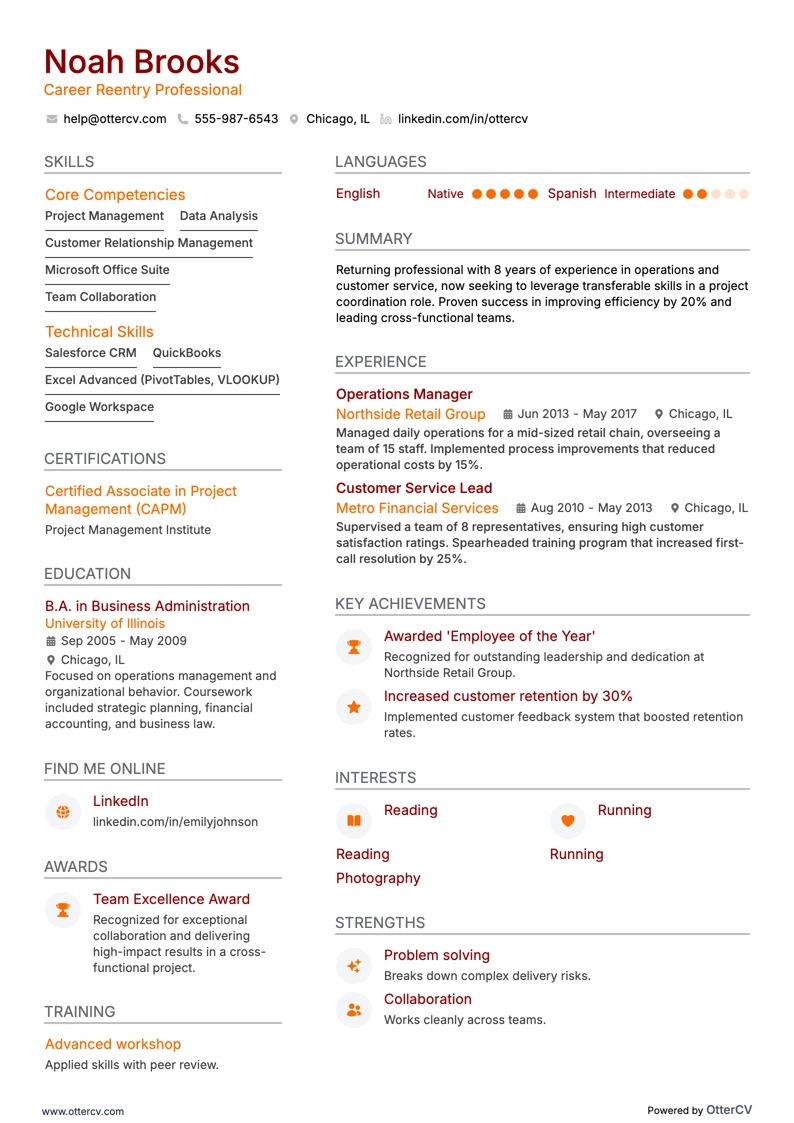
Career Reentry Professional resume example

Career Reentry Professional

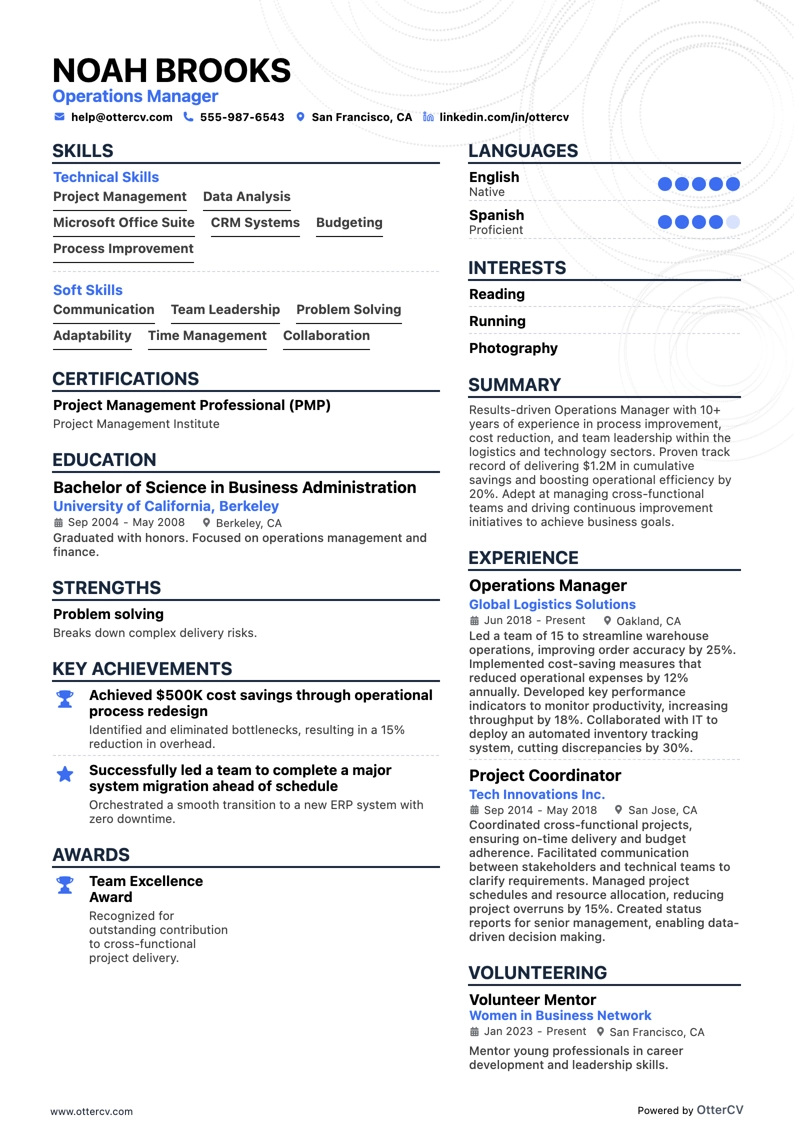
Returnship Participant resume example

Returnship Participant

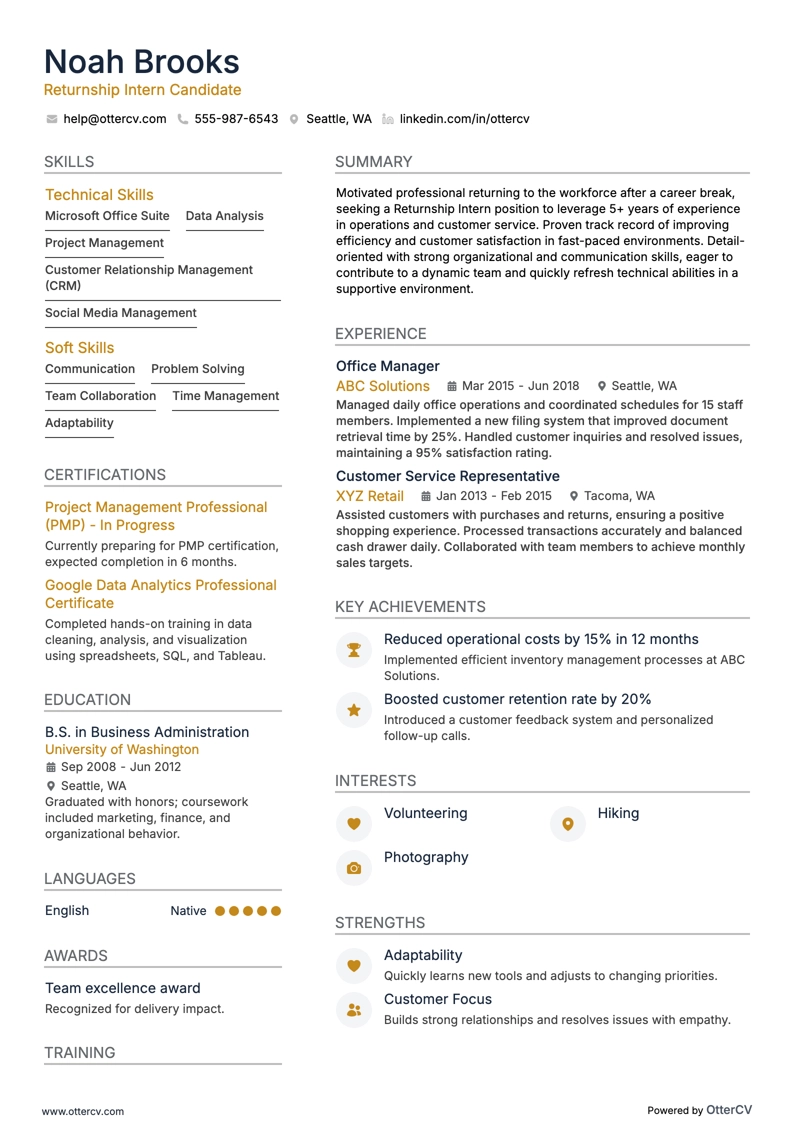
Returnship Intern resume example

Returnship Intern

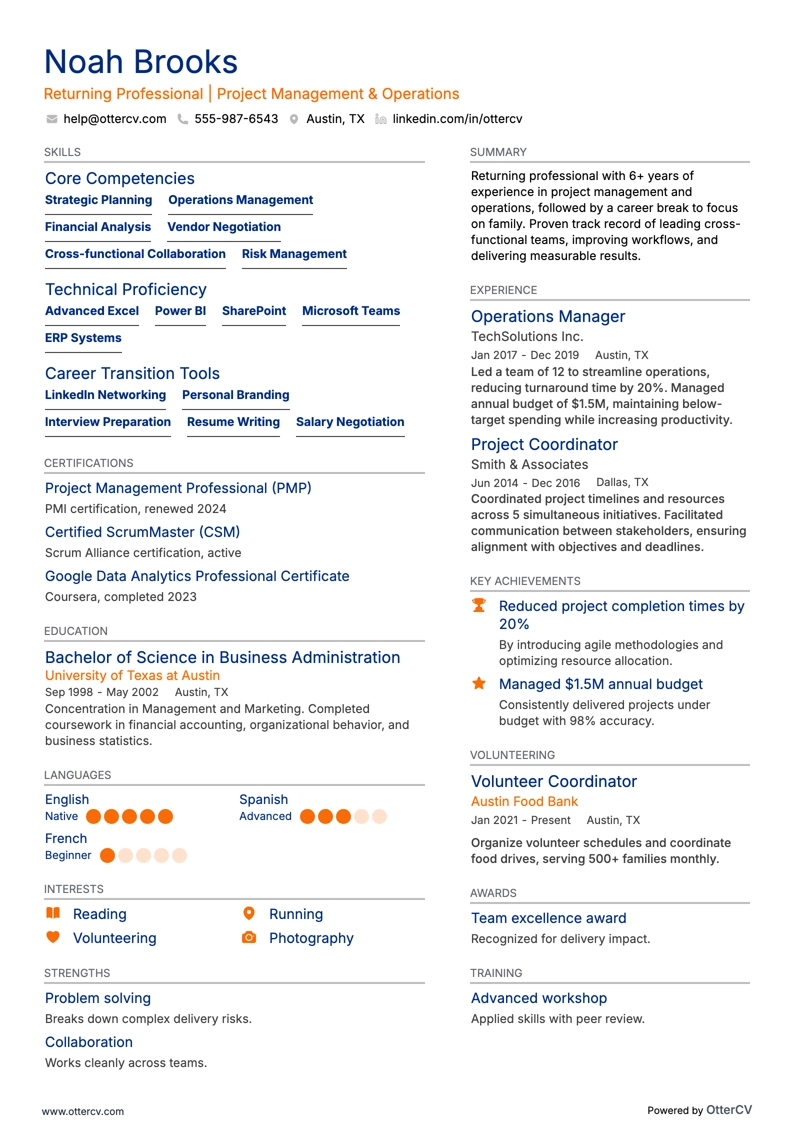
Returning Professional resume example

Returning Professional

Project manager resumes for professionals returning to the workforce often fall short because they read like a timeline instead of a business case. ATS screening and quick recruiter reviews favor clear, recent impact, and employment gaps can obscure your fit in a crowded candidate pipeline.

A strong resume explains what you delivered and why it mattered. Knowing how to make your resume stand out is essential when re-entering the job market. Focus on budgets managed, schedules recovered, stakeholders aligned, defects reduced, adoption improved, and programs delivered on time with measurable cost or risk reduction.

Key takeaways

  • Use a hybrid resume format so relevant skills stand out before a career gap.

  • Quantify each accomplishment with numbers, percentages, or dollar amounts to show impact.

  • Tailor experience bullets to match the tools, terminology, and KPIs in each job posting.

  • Present volunteer work, freelance projects, and certifications with the same rigor as paid roles.

  • Place certifications above education when they are recent and clearly support your return to work.

  • Write your summary around specific skills and measurable results, not vague motivational language.

  • Use Echocv's tools to turn career-gap experience into focused, recruiter-ready resume bullets.

How to format a Returning to Workforce resume

Recruiters reviewing candidates who are returning to the workforce look first for evidence that your relevant skills are still current, a clear explanation for your employment gap, and any recent activity—such as freelance work, volunteering, coursework, or certifications—that shows continued professional engagement. Your resume format directly affects how quickly they can find these signals, so the right structure helps your strongest qualifications stand out before the gap becomes the focus.

I have significant experience in this role—which format should I use?

I have significant experience in this role—which format should I use?

Use a hybrid (combination) resume format that starts with a targeted skills summary and then follows with a reverse-chronological work history.

  • Open with a professional summary that explains your return in the context of the scope and ownership you held in previous roles, along with any recent upskilling or projects.
  • Highlight transferable tools, industry knowledge, and domain expertise that are still relevant to your target position, ideally in a dedicated skills section near the top.
  • Quantify past accomplishments with measurable outcomes or business impact so recruiters can evaluate your performance level despite the career break.

Example bullet: “Managed a $2.4M annual marketing budget across four product lines, increasing qualified lead volume by 37% over two fiscal years before transitioning to a planned career break.”

I'm junior or switching into this role—what format works best?

I'm junior or switching into this role—what format works best?

Use a hybrid resume format that places a skills section above your work history so recruiters can quickly see relevant capabilities, even if your recent experience is limited.

  • Put a concise skills section at the top of your resume, organized by category such as technical, interpersonal, and industry-specific skills, to help pass applicant tracking system (ATS) keyword filters before a recruiter reaches your timeline.
  • Include volunteer work, freelance projects, coursework, or certifications completed during your time away as transitional experience entries, and format them with the same rigor as paid roles.
  • Connect every listed skill or project to a clear action and a tangible result so recruiters can assess your potential contribution, not just your knowledge.

Example scaffold: Data analysis (skill) → Built a volunteer nonprofit's donor segmentation model using Excel and Google Sheets (action) → Increased targeted outreach efficiency by 22% over one quarter (result).

When does a functional resume make sense?

When does a functional resume make sense?

A functional resume can make sense in narrow situations where a returning professional’s timeline would otherwise overshadow strong, relevant skills. Consider it if:

  • You’re re-entering the workforce after a gap of five or more years, and your previous job titles no longer reflect the type of work you’re pursuing.
  • You completed substantial skill-building during your break—such as bootcamps, certifications, or portfolio projects—that aligns more closely with the target role than your earlier employment history.
  • Your career break involved such a significant industry or life change that a chronological listing would confuse rather than clarify your candidacy.

Functional resumes also have real limitations. Many ATS platforms and recruiters see them as attempts to hide weak experience, which can reduce your callback rate. Avoid this format entirely if you have any recent relevant work, freelance engagements, or volunteer roles that could support a chronological or hybrid timeline.

A functional format is most acceptable when you have a gap exceeding five years combined with a complete career pivot. Even then, tie every listed skill to a specific project, volunteer effort, or measurable outcome to maintain credibility.
With your format established, the next step is choosing the sections that best highlight your strengths while minimizing attention on employment gaps.

What sections should go on a Returning to Workforce resume

Recruiters want a clear snapshot of your recent, relevant work, along with a credible bridge that explains your time away without distracting from your qualifications. Understanding which resume sections to include is especially important when you're returning to the workforce.

Use this structure for maximum clarity:

  • Header
  • Summary
  • Experience
  • Skills
  • Projects
  • Education
  • Certifications
  • Optional sections: Volunteering, Leadership, Languages

Strong experience bullets should emphasize measurable impact, outcomes, scope, and results, including how you delivered value after returning to work.

Once you’ve chosen the right resume sections to present your background clearly, the next step is to write your experience section so it supports that structure and highlights your qualifications.

How to write your Returning to Workforce resume experience

Your work experience section is where you show that your skills remain sharp and that your contributions made a real difference, even if your most recent role wasn’t yesterday. Focus on shipped work, role-relevant tools or methods you applied, and measurable outcomes that show you drove results. Hiring managers prioritize demonstrated impact over descriptive task lists, so frame every bullet around what you accomplished rather than what you were assigned.

Each entry should include:

  • Job title
  • Company and location (or remote)
  • Dates of employment (month and year)

Add three to five concise bullet points that show what you owned, how you executed, and what outcomes you delivered:

  • Ownership scope: the projects, processes, teams, or functions you were directly accountable for, making clear the breadth and depth of responsibility you held before or during your career break.
  • Execution approach: the tools, frameworks, technologies, or methodologies you used to plan, decide, and deliver work, highlighting capabilities that translate directly into the roles you're targeting now.
  • Value improved: the specific areas where your work raised quality, boosted performance, strengthened efficiency, reduced risk, or enhanced reliability, reinforcing that your expertise produced lasting improvements.
  • Collaboration context: how you partnered with cross-functional teams, clients, vendors, or community stakeholders, demonstrating that you can step back into a collaborative environment and contribute from day one.
  • Impact delivered: the tangible results your efforts produced, expressed through scale, business outcomes, or organizational change rather than routine activity, giving hiring managers confidence that your track record holds weight regardless of any gap in employment.

Experience bullet formula

Experience bullet formula

Action verb + technology + what you built or fixed + measurable result

A Returning to Workforce experience example

Customer Success Manager (Returning to Workforce)

CareBridge Health | Remote

2023–Present

Series B digital health platform supporting care coordinators and patients across fifty states.

  • Rebuilt product and process fluency after a career break by completing Salesforce Trailhead and Zendesk workflows, then reducing average first-response time from fourteen hours to five hours within sixty days.
  • Led a ninety-day reactivation program for lapsed accounts using Salesforce, Looker, and Gong to segment outreach, increasing renewals by twelve percent and recovering $240K in annual recurring revenue.
  • Implemented a standardized escalation playbook with product managers and engineers in Jira and Confluence, cutting high-severity ticket resolution time by thirty-six percent and reducing repeat defects by eighteen percent.
  • Launched a customer education series using Zoom webinars and a Notion knowledge base, improving feature adoption by twenty-two percent and decreasing “how-to” ticket volume by nineteen percent quarter over quarter.
  • Partnered with compliance and security stakeholders to tighten data-handling procedures and audit trails in Salesforce, reducing access-related incidents by forty percent and passing two client security reviews with zero findings.

Now that you’ve seen how to structure your experience, the next step is to adjust it for the specific job you’re applying for.

How to tailor your Returning to Workforce resume experience

Recruiters review resumes through applicant tracking systems and manual screening, looking for alignment with the posted role. Tailoring your resume to the job description improves your chances of getting through both.

Ways to tailor your Returning to Workforce experience:

  • Match the tools and technologies listed in the job posting.
  • Use the same terminology the employer uses for workflows.
  • Reflect the specific KPIs or success criteria the role requires.
  • Highlight relevant industry experience that fits the position.
  • Emphasize transferable skills gained through volunteer or freelance work.
  • Reference any compliance or quality standards named in the listing.
  • Align the collaboration frameworks you’ve used with those the team follows.
  • Showcase upskilling efforts, such as certifications completed during your career gap.

Tailoring means matching your real accomplishments to the role’s requirements, not stuffing unrelated keywords into your experience.

Resume tailoring examples for Returning to Workforce

Job description excerptUntailoredTailored
"Seeking an administrative coordinator proficient in Microsoft 365 and Salesforce CRM to manage scheduling, client records, and cross-departmental communications."Handled various office tasks and supported daily operations.Managed executive scheduling and maintained 200+ client records in Salesforce CRM, while coordinating cross-departmental communication through Microsoft 365 apps including Outlook, Teams, and SharePoint.
"Looking for a project coordinator to support Agile sprints using Jira, track deliverables across three product teams, and prepare weekly status reports for stakeholders."Assisted with projects and tracked team deadlines.Coordinated deliverables across three concurrent product teams using Jira to monitor Agile sprint progress, and prepared weekly stakeholder status reports that reduced missed deadlines by 15%.
"Hiring a customer success associate to onboard new SaaS clients, monitor adoption metrics in Gainsight, and reduce first-year churn by improving the 90-day engagement process."Worked with customers to resolve issues and answer questions.Onboarded 40+ new SaaS clients per quarter, tracked adoption milestones in Gainsight, and redesigned the 90-day engagement workflow to cut first-year churn by 12%.

Once your experience aligns with the role you’re targeting, quantify your achievements to show the measurable impact behind that experience.

How to quantify your Returning to Workforce achievements

Quantifying your return shows that you delivered results quickly, not that you simply showed up. Focus on ramp-up speed, accuracy, volume handled, risk reduction, and stakeholder outcomes across your first projects back. Learning how to effectively use numbers on your resume can turn a generic bullet point into a compelling one.

Quantifying examples for Returning to Workforce

MetricExample
Ramp-up timeCompleted onboarding and shipped my first deliverable in 12 business days, using Asana and Slack to align with five stakeholders.
Accuracy rateReduced data-entry errors from 3.8% to 0.9% over six weeks by adding validation checks in Excel and standardizing templates.
Volume handledProcessed 420 customer requests per month with a 24-hour turnaround, using Zendesk macros and a shared knowledge base.
Risk reductionClosed 18 compliance gaps in two months by updating SOPs, running quarterly audits, and documenting evidence in Google Drive.
Delivery speedCut weekly reporting time from four hours to 90 minutes by automating dashboards in Google Sheets and Looker Studio.

Once your bullet points clearly show your impact, make sure the skills section of your returning to workforce resume highlights the right mix of hard and soft skills.

How to list your hard and soft skills on a Returning to Workforce resume

A well-organized skills section helps translate recent upskilling and past experience into job-ready keywords. Recruiters and an ATS (applicant tracking system) also use it to quickly confirm fit, so aim for a balanced mix of hard skills and role-specific soft skills.

Returning to Workforce roles require a blend of:

  • Product strategy and discovery skills.
  • Data, analytics, and experimentation skills.
  • Delivery, execution, and go-to-market discipline.
  • Soft skills.

Your skills section should be:

  • Scannable, using bullet-style grouping.
  • Relevant to the job post.
  • Backed by proof in your experience bullets.
  • Updated with current tools.

Place your skills section:

  • Above experience if you're junior or switching careers.
  • Below experience if you're mid/senior with strong achievements.

Hard skills

  • Proficient in Microsoft Excel and Google Sheets.
  • Knowledge of SQL querying fundamentals.
  • Experience building dashboards in Tableau and Power BI.
  • Skilled in Google Analytics 4 reporting.
  • Familiar with A/B testing and hypothesis design.
  • Experienced in agile delivery and Scrum ceremonies.
  • Comfortable with Jira and Confluence workflows.
  • Able to create product requirement documents.
  • Experienced in writing user stories and acceptance criteria.
  • Skilled in stakeholder roadmap planning.
  • Experienced in customer interviews and survey design.
  • Familiar with CRM basics, including Salesforce and HubSpot.

Soft skills

  • Turn gaps into strengths.
  • Set priorities under constraints.
  • Communicate progress and risks clearly.
  • Align stakeholders on scope.
  • Ask clarifying questions early.
  • Document decisions and their rationale.
  • Take ownership of follow-through.
  • Manage handoffs across teams.
  • Incorporate feedback quickly.
  • Make data-informed tradeoffs.
  • Rebuild professional relationships.
  • Learn new tools quickly.

How to show your Returning to Workforce skills in context

Skills should not appear only in lists.

They should be demonstrated in:

  • Your summary, which presents your high-level professional identity
  • Your experience, which proves your skills through outcomes

Strong examples help bring this approach to life. You can explore curated examples of resume skills to see how other professionals present their capabilities effectively.

Operations leader with 12 years of experience in supply chain management, returning after a two-year career pause. Skilled in SAP, demand forecasting, and cross-functional team leadership. Reduced fulfillment costs by 18% through process optimization.

  • Clearly reflects senior-level experience.
  • Names specific tools such as SAP.
  • Includes a measurable cost reduction.
  • Highlights collaborative leadership ability.

Experience example

Senior Operations Manager

Brevard Logistics Group | Charlotte, NC

March 2014–June 2022

  • Streamlined warehouse workflows using SAP, cutting order processing time by 22% across three distribution centers.
  • Partnered with procurement and finance teams to renegotiate vendor contracts, saving $1.2M annually.
  • Implemented demand forecasting models that reduced inventory overstock by 15%, improving cash flow predictability.
  • Every bullet includes measurable proof.
  • Skills emerge naturally through outcomes.

Once you’ve shown your capabilities with recent, relevant examples, the next step is structuring a returning to workforce resume when you don’t have formal experience to list.

How do I write a Returning to Workforce resume with no experience

Even without full-time experience, you can still show that you’re ready to return to work through examples such as:

  • Volunteer coordinator for community events
  • Caregiving schedule and medication tracking
  • Freelance admin support for clients
  • Online certificate coursework with projects
  • School or parent association leadership
  • Personal budget tracking and reporting
  • Job shadowing and informational interviews
  • Temp or seasonal customer service

If you’re building your application from scratch, our guide on writing a resume without work experience explains how to highlight transferable skills and non-traditional experience.

Focus on:

  • Recent, verifiable work samples
  • Tool proficiency tied to outputs
  • Clear timelines and return plan
  • Metrics showing reliability and impact

Resume format tip for entry-level Returning to Workforce

Resume format tip for entry-level Returning to Workforce

Use a combination resume format to highlight skills and projects first while still showing a clear timeline for your Returning to Workforce story.

  • Add a projects section above work history.
  • List tools beside each project outcome.
  • Quantify results with counts, time, or dollars.
  • Include dates for courses and volunteering.
  • Use a short Returning to Workforce summary.

Example project bullet:

  • Built a monthly household budget tracker in Excel, categorized one hundred transactions, and reduced discretionary spending by 12% in eight weeks.

Now that you know how to present transferable skills and unpaid experience in place of traditional work history, the next step is your education section. On a returning-to-workforce resume, this section can carry significant weight.

How to list your education on a Returning to Workforce resume

Your education section helps hiring teams confirm your foundational knowledge. On a Returning to Workforce resume, it also shows that you built relevant skills, even during a career gap.

Include:

  • Degree name
  • Institution
  • Location
  • Graduation year
  • Relevant coursework (for juniors or entry-level candidates)
  • Honors and GPA (if 3.5 or higher)

List your graduation year only. Avoid including specific months or days to keep the section clean and concise.

Here’s a strong education entry tailored to a Returning to Workforce resume:

Example education entry

Bachelor of Science in Business Administration

University of Georgia, Athens, GA

Graduated 2016

GPA: 3.7

  • Relevant coursework: Project Management, Organizational Behavior, Business Communications, Data Analysis
  • Honors: Magna Cum Laude, Dean's List (six semesters)

How to list your certifications on a Returning to Workforce resume

Certifications on your resume show that you keep learning, can use current tools, and understand today’s industry standards, even after time away from work during a Returning to Workforce search.

Include:

  • Certificate name
  • Issuing organization
  • Year
  • Optional: credential ID or URL
  • Place certifications below education when your degree is recent and your certifications support it without outweighing it.
  • Place certifications above education when they’re recent, highly relevant, or best explain your Returning to Workforce readiness.

Best certifications for your Returning to Workforce resume

  • Google Project Management: Professional Certificate
  • SHRM Certified Professional (SHRM-CP)
  • CompTIA A+
  • AWS Certified Cloud Practitioner
  • Google Data Analytics: Professional Certificate
  • Certified ScrumMaster (CSM)
  • HubSpot Content Marketing Certification

Once you’ve positioned your credentials where hiring managers can quickly see their relevance, use your returning to workforce resume summary to connect them to your comeback and target role.

How to write your Returning to Workforce resume summary

Your resume summary is often the first thing a recruiter reads. It should quickly show that you’re ready to contribute again, even after a career gap.

Keep it to three to four lines and include:

  • Your professional title and total years of relevant experience.
  • The industry, domain, or product area where you built your career.
  • Core skills, tools, or technologies you’re ready to use from day one.
  • One or two quantified achievements from previous roles.
  • Soft skills connected to real outcomes, such as collaboration that improved team efficiency.

PRO TIP

At this level, focus on clarity and relevance. Highlight transferable skills and early career wins that show you can deliver.

Avoid vague phrases like "passionate self-starter" or "eager to learn." Instead, name the specific tools you know and the results you’ve driven. Skip motivational language entirely.

Example summary for a Returning to Workforce

Administrative professional with four years of experience in healthcare operations, with skills in scheduling, EMR systems, and patient coordination. Reduced appointment errors by 18% through improved intake workflows.

With your summary positioned to explain your career break positively, make sure your header includes accurate, up-to-date contact details so employers can reach you easily.

What to include in a Returning to Workforce resume header

Your resume header should present your main contact details and role focus. This improves visibility, builds credibility, and helps recruiters screen your application for a Returning to Workforce role.

Essential resume header elements:

  • Full name
  • Tailored job title and headline
  • Location
  • Phone number
  • Professional email
  • GitHub link
  • Portfolio link
  • LinkedIn

A LinkedIn link helps recruiters verify your experience quickly and supports screening.

Do not include a photo on a Returning to Workforce resume unless the role is explicitly front-facing or appearance-dependent.

Match your header job title to the posting, and keep every link current, readable, and consistent with the rest of your resume.

Example

With your header establishing your current professional identity and contact details, the next step is to add additional sections that reinforce your qualifications and provide relevant context.

Additional sections for Returning to Workforce resumes

These sections can help bridge a career gap by showing growth, relevance, and continued engagement during your time away from traditional employment. For example, listing language skills can help you stand out if the role involves multilingual communication or global teams.

  • Volunteer experience
  • Professional development and continuing education
  • Certifications and licenses
  • Freelance or consulting projects
  • Languages
  • Professional affiliations and memberships
  • Hobbies and interests

When your resume sections work together to tell a clear story about your skills and experience, a tailored cover letter can strengthen your application even further.

Do Returning to Workforce resumes need a cover letter

A cover letter is not required for a Returning to Workforce, but it can help for competitive roles or when hiring teams expect one. If you are unsure where to begin, learning what a cover letter is and how it complements your resume can help you decide. It is especially useful when your resume needs extra context to connect your experience to the role.

Use a cover letter when you need to add clarity quickly:

  • Explain your fit for the role or team by matching two or three job requirements to your recent skills, tools, or domain knowledge.
  • Highlight one or two relevant projects or outcomes, and include measurable results when possible.
  • Show that you understand the product, users, or business context by naming a key customer need and how you would support it.
  • Address career transitions or less obvious experience by connecting your break, pivot, or prior roles to the job’s core work.

Once you’ve decided how to position your return, with or without a cover letter, the next step is using AI to strengthen your returning to workforce resume so that message comes through clearly and consistently.

Using AI to improve your Returning to Workforce resume

AI can improve your resume’s clarity, structure, and impact. It can also help turn career gaps into confident, focused narratives. But if you rely on it too heavily, your resume may start to sound robotic. Once your content feels clear and aligned with the role, step away from AI tools. If you’re wondering which AI is best for writing resumes, it’s worth comparing options before committing to one workflow.

Here are 10 practical prompts to strengthen your Returning to Workforce resume:

Strengthen your summary

Strengthen your summary

Rewrite my Returning to Workforce resume summary to emphasize transferable skills and readiness to re-enter the workforce in under four sentences.

Clarify experience bullets

Clarify experience bullets

Edit these Returning to Workforce experience bullets so they begin with strong action verbs and avoid vague language.

Add measurable impact

Add measurable impact

Revise my Returning to Workforce resume accomplishments to include specific numbers, percentages, or other measurable outcomes where possible.

Reframe career gaps

Reframe career gaps

Rewrite the career gap section of my Returning to Workforce resume to highlight skills gained through volunteering, freelancing, or caregiving.

Align skills section

Align skills section

Compare my Returning to Workforce resume skills section with this job description and suggest any missing keywords I should add.

Tighten project descriptions

Tighten project descriptions

Shorten and clarify the project descriptions on my Returning to Workforce resume so each one highlights a specific result.

Improve education section

Improve education section

Reformat the education section of my Returning to Workforce resume to highlight relevant coursework and recent certifications more prominently.

Enhance certification entries

Enhance certification entries

Rewrite my Returning to Workforce resume certifications to better highlight their industry relevance and recency for my target role.

Remove filler language

Remove filler language

Identify and remove filler words, clichés, and redundant phrases throughout my Returning to Workforce resume.

Tailor for one role

Tailor for one role

Adjust my entire Returning to Workforce resume to align specifically with this job posting, prioritizing the most relevant qualifications.

Conclusion

A strong Returning to Workforce resume highlights measurable results, role-specific skills, and a clear structure that is easy to scan. It uses numbers to show impact, connects experience to the target role, and keeps each section consistent and focused.

This approach signals readiness for today’s hiring market and the near-future job market. It helps hiring teams quickly understand what you can do now and how your skills can deliver results from day one.

Returning to Workforce resume examples

Explore additional Returning to Workforce resume samples and guides and see what works for your level of experience or role.

By Experience

Career Reentry Professional

Career Reentry Professional resume preview

Returnship Participant

Returnship Participant resume preview

Returnship Intern

Returnship Intern resume preview

Returning Professional

Returning Professional resume preview