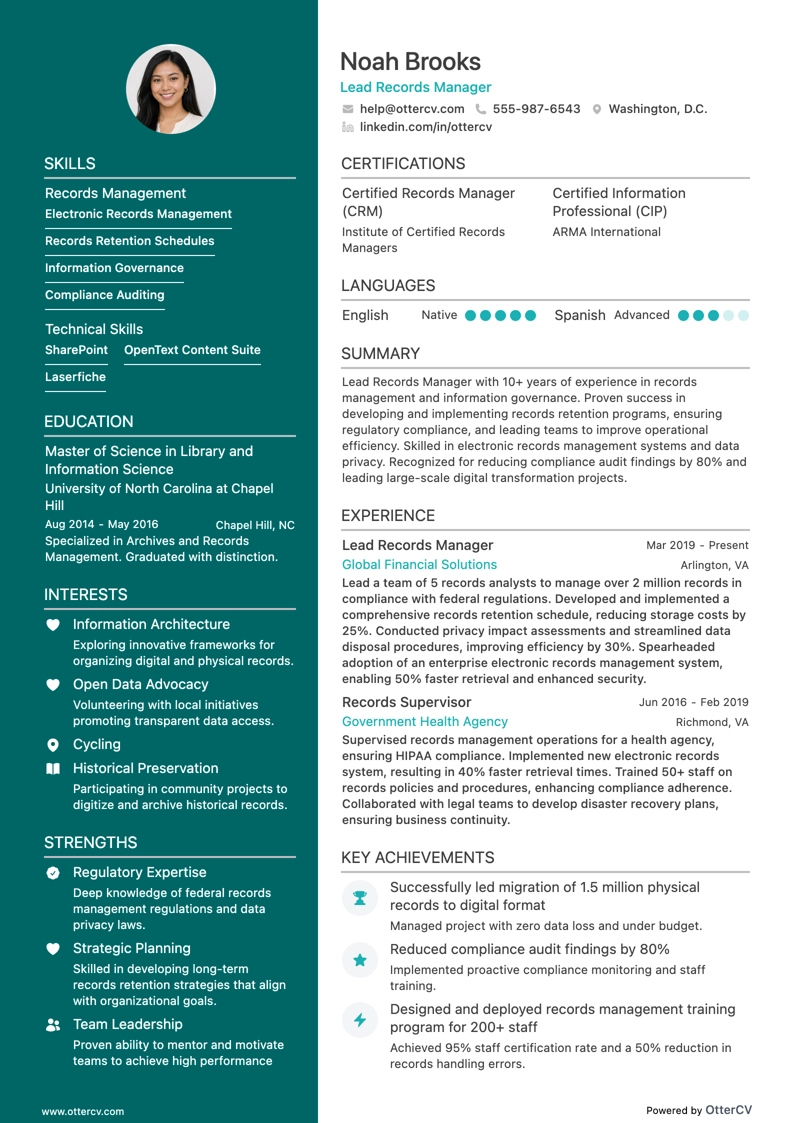
Lead Records Manager full preview

10 Records Manager Resume Examples

OtterCV

Written by The OtterCV Team

Updated: 11/4/2025•8 min read

See all resume examples in this guide, or generate your own resume example with your personalized prompt

Lead Records Manager resume example

Lead Records Manager

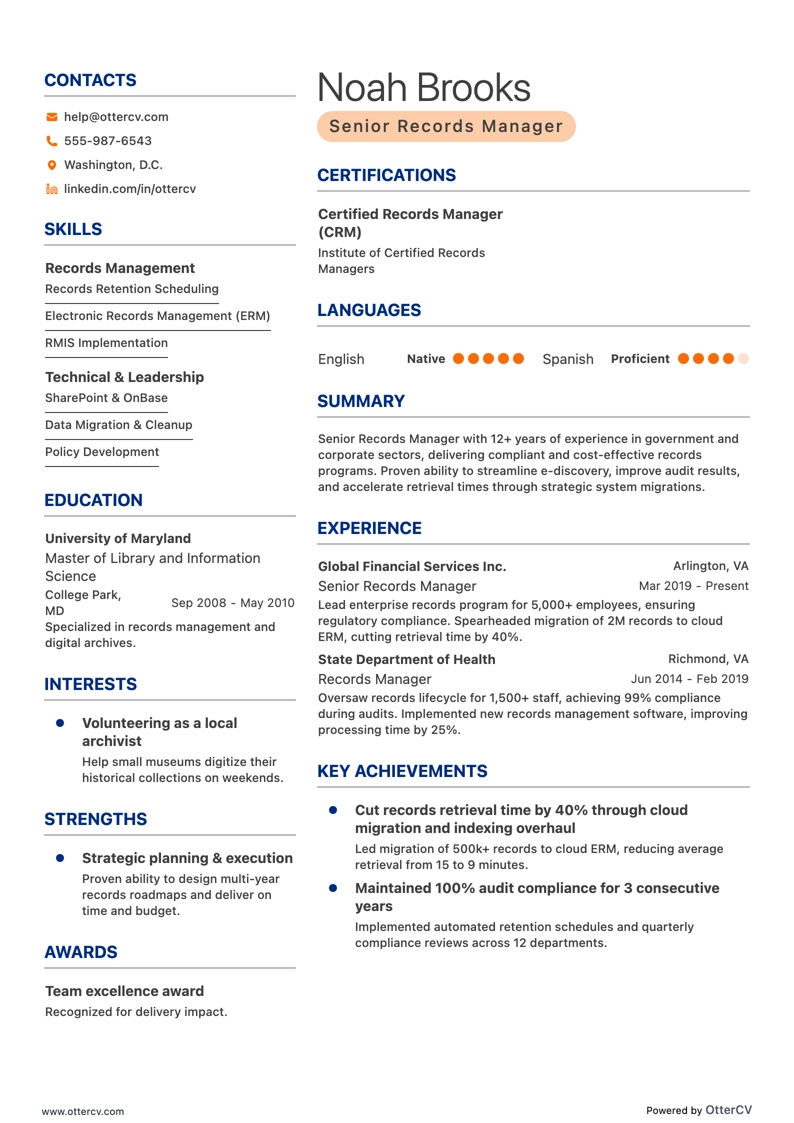
Senior Records Manager resume example

Senior Records Manager

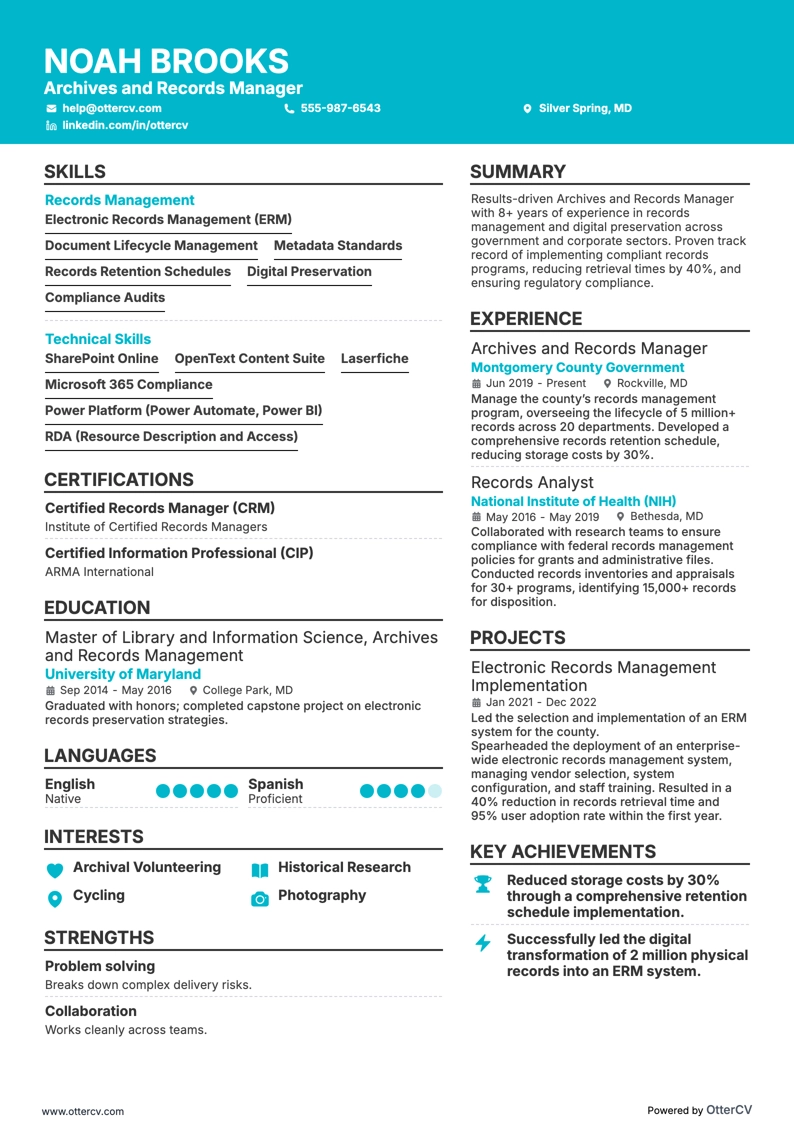
Archives and Records Manager resume example

Archives and Records Manager

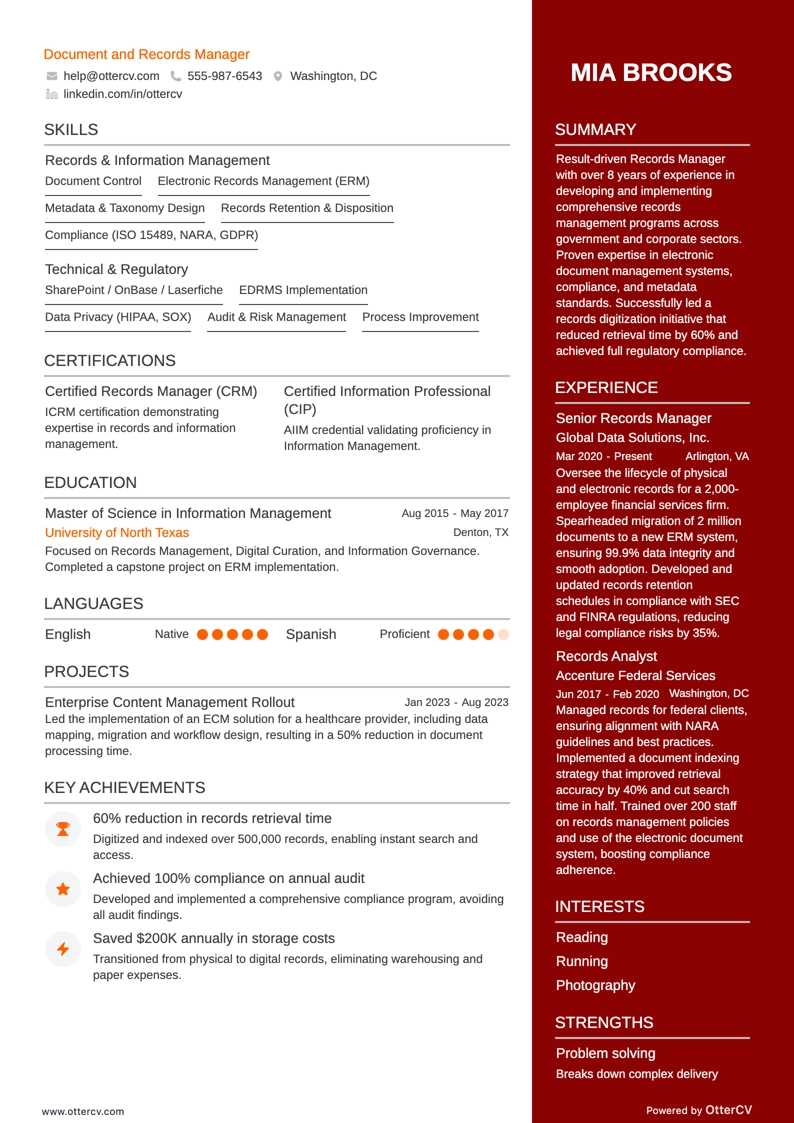
Document and Records Manager resume example

Document and Records Manager

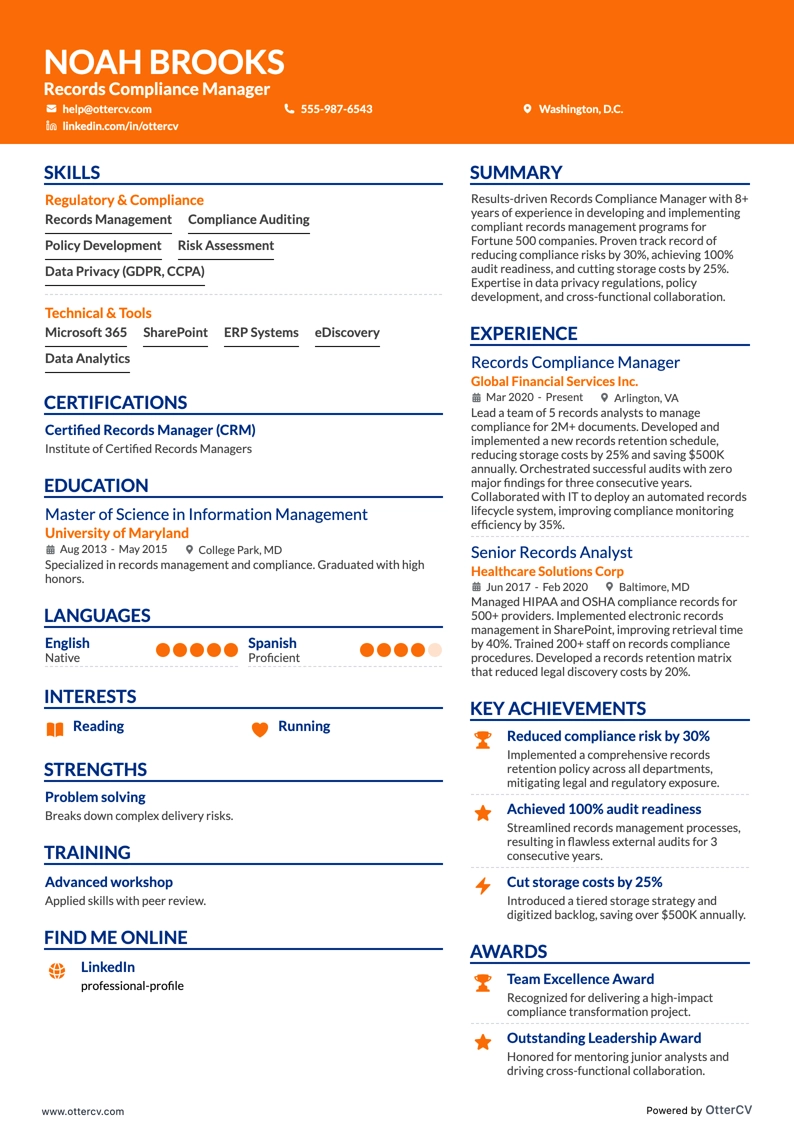
Records Compliance Manager resume example

Records Compliance Manager

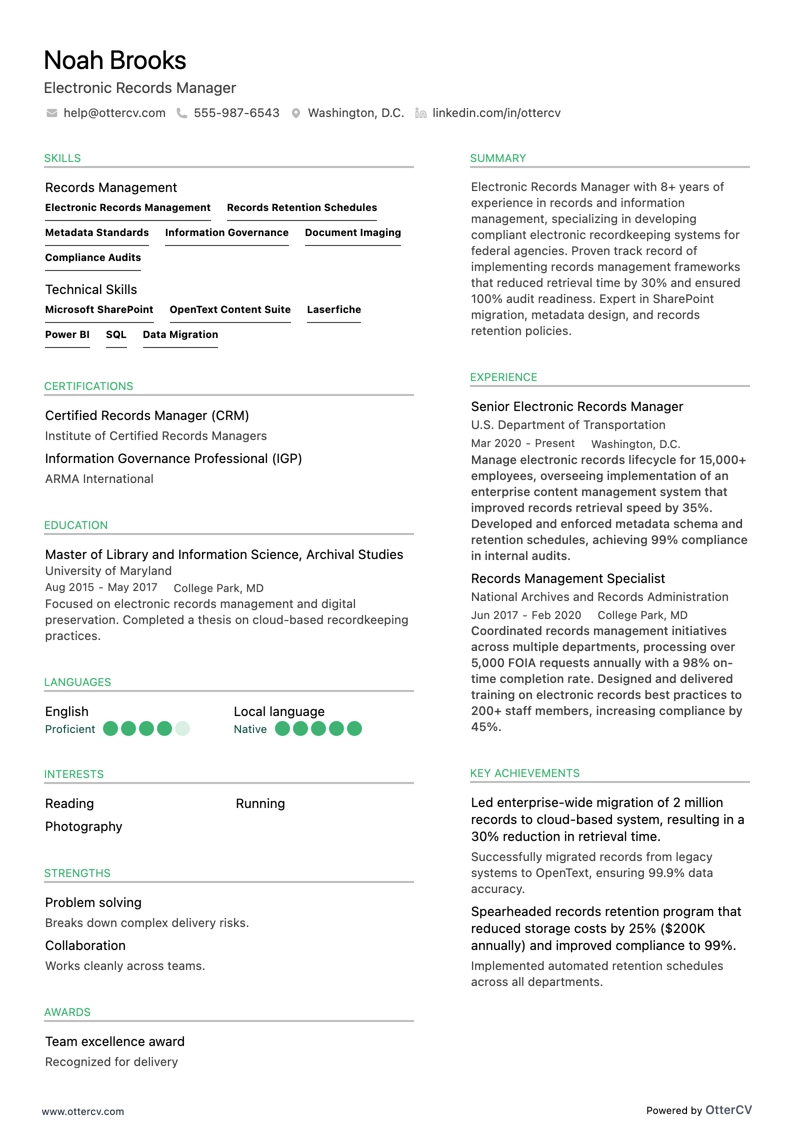
Electronic Records Manager resume example

Electronic Records Manager

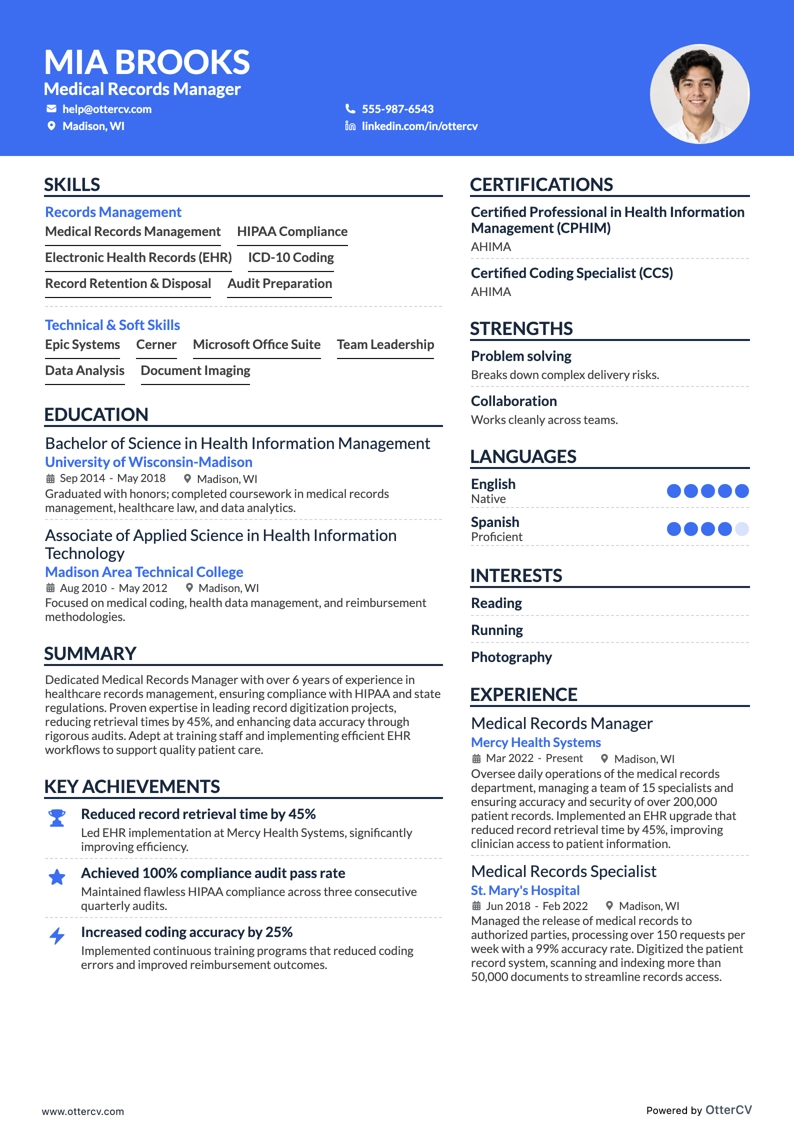
Medical Records Manager resume example

Medical Records Manager

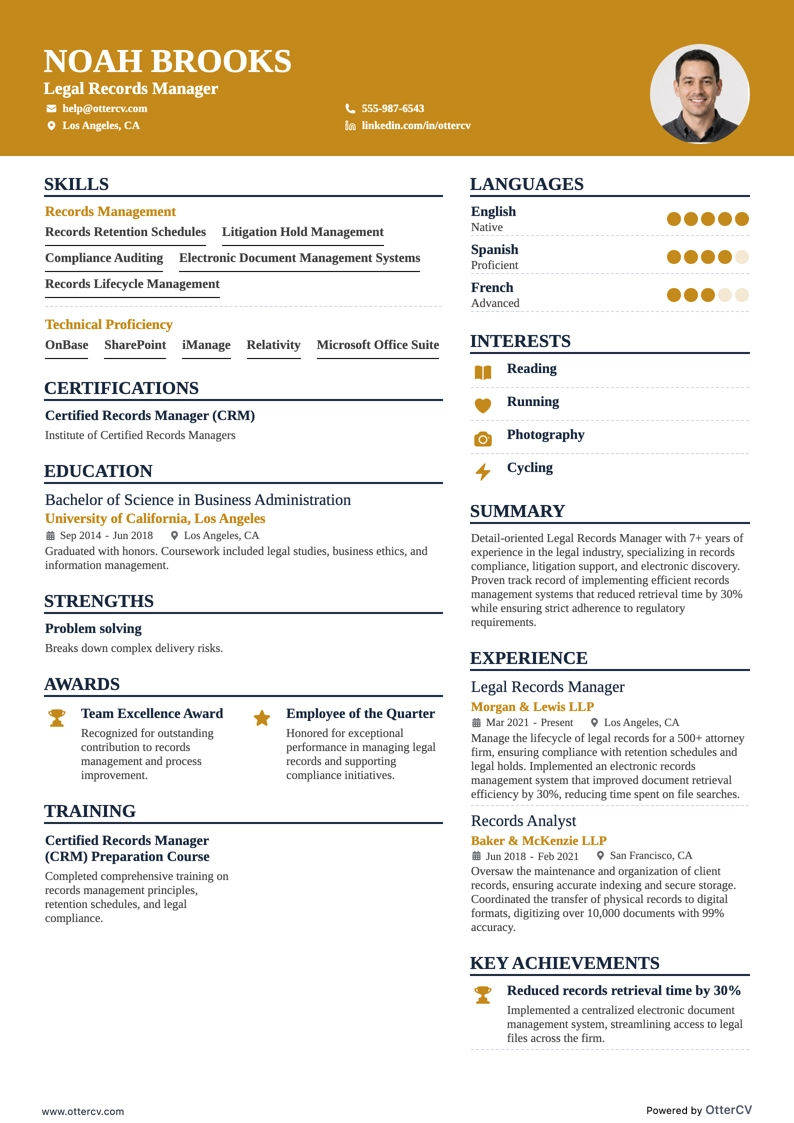
Legal Records Manager resume example

Legal Records Manager

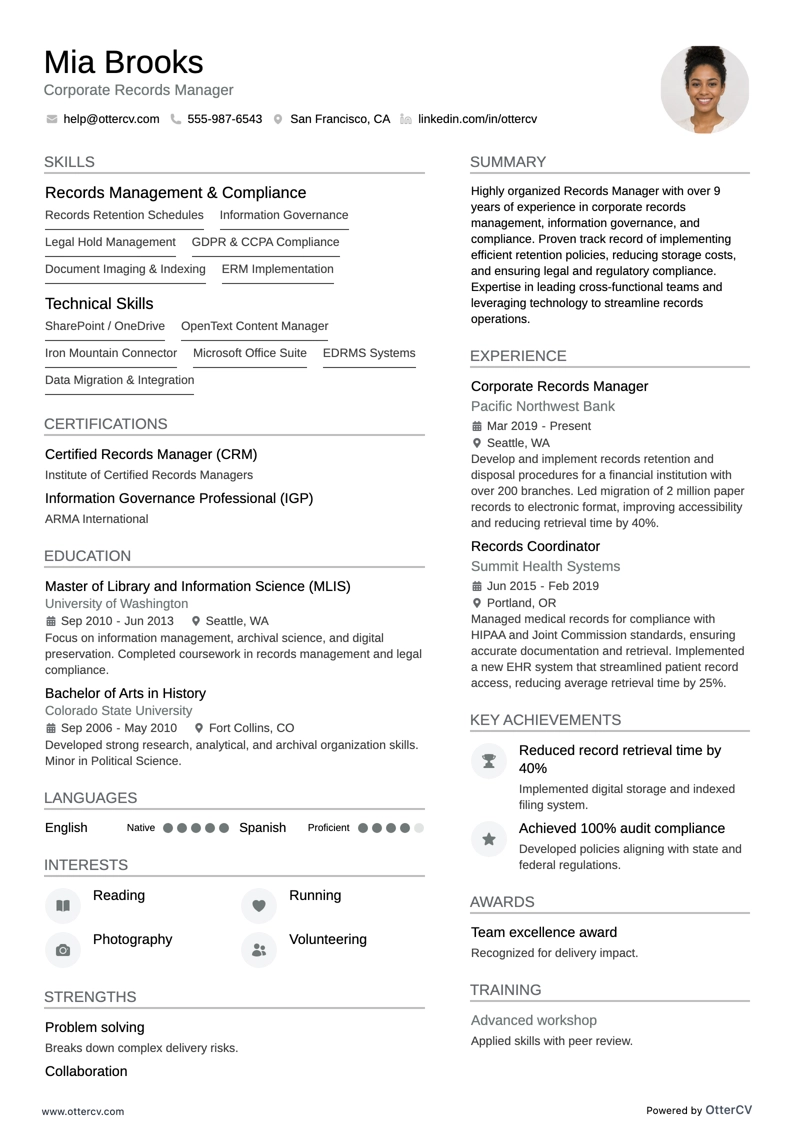
Corporate Records Manager resume example

Corporate Records Manager

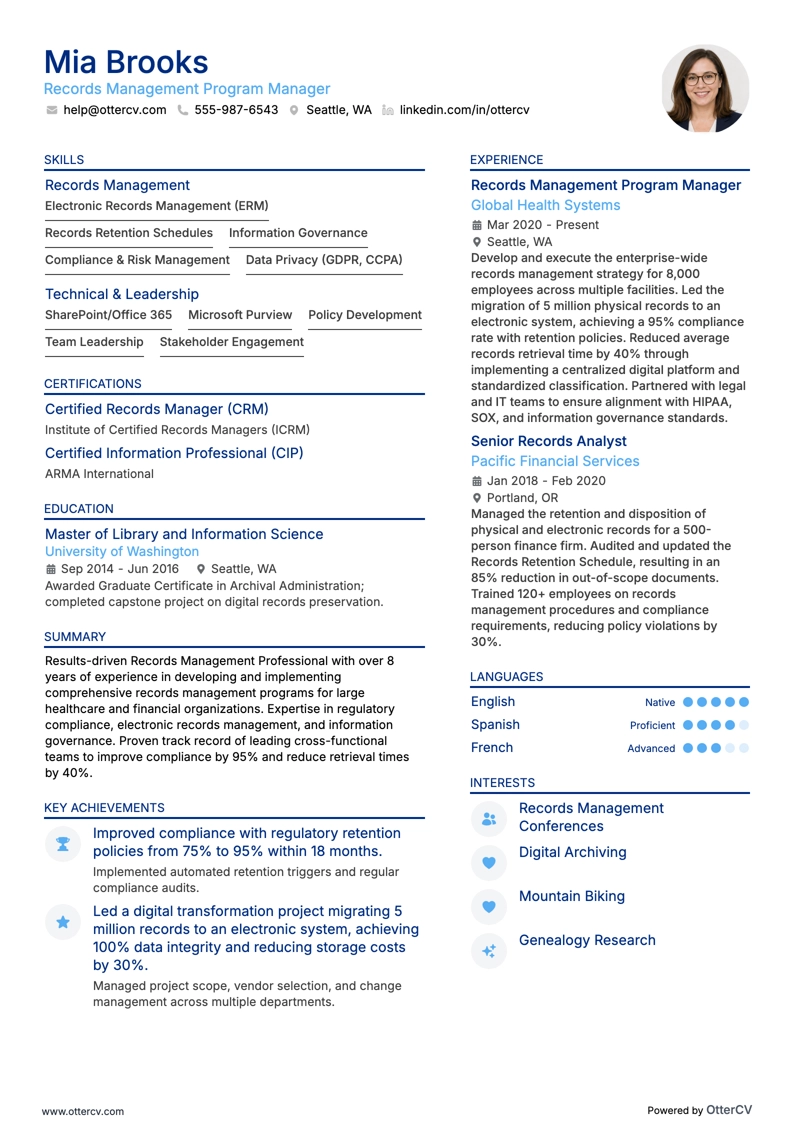
Records Management Program Manager resume example

Records Management Program Manager

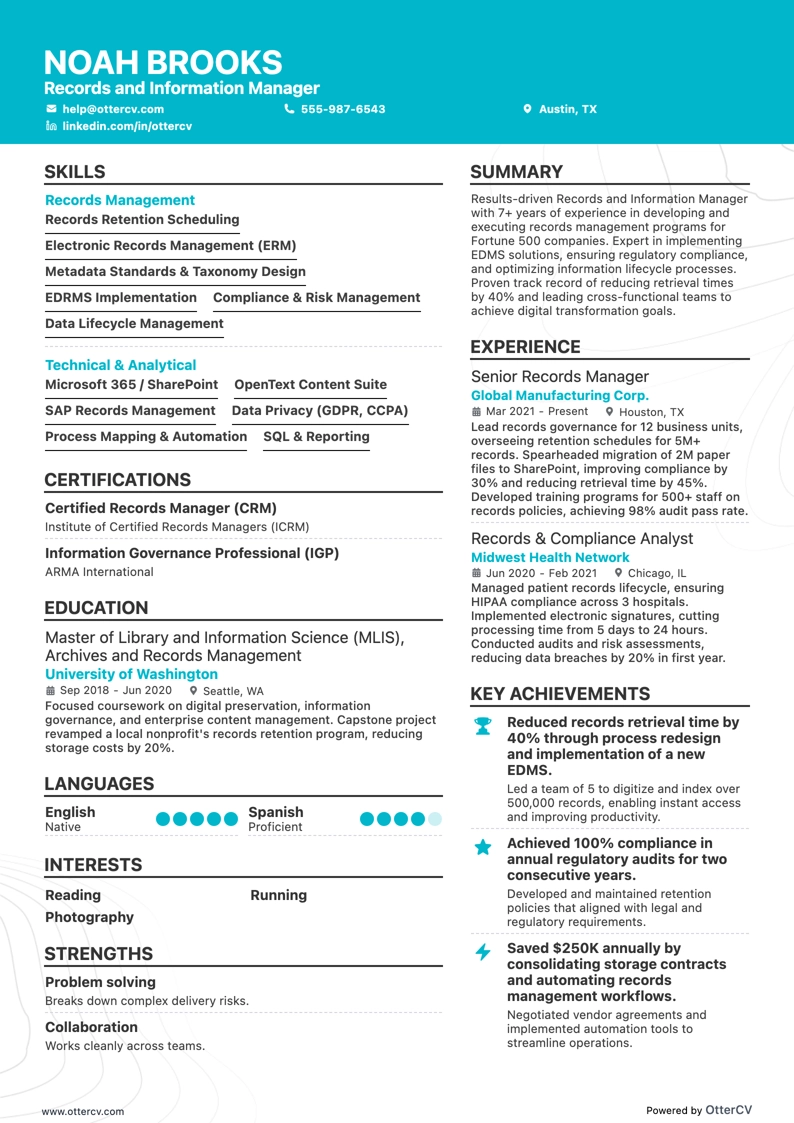
Records and Information Manager resume example

Records and Information Manager

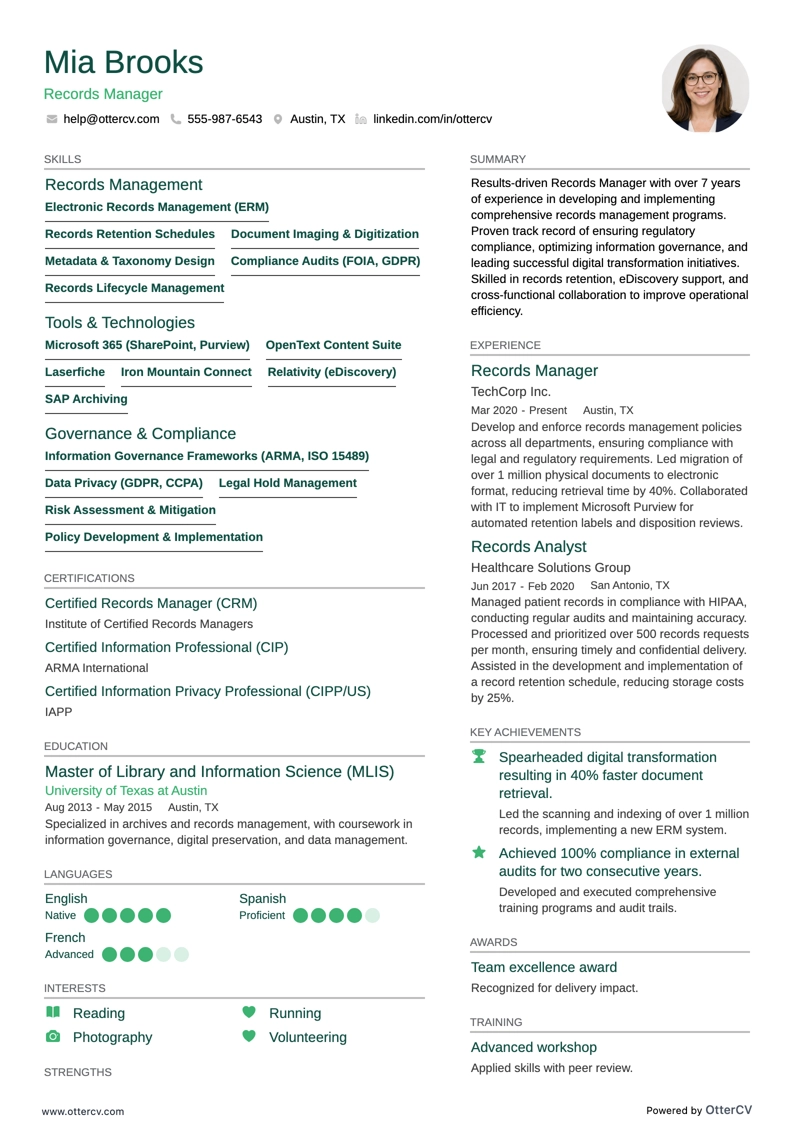
Records Manager resume example

Records Manager

Records manager resume submissions often fail because they do not clearly show governance impact and risk control. Vague descriptions are often filtered out by ATS keyword gaps and overlooked during fast recruiter scans. In a competitive hiring market, unclear compliance value can end interviews early.

A strong resume shows what you improved, not just what you used. Knowing how to write a resume that highlights audit readiness gains, retention schedule coverage, reduced retrieval time, lower litigation risk, cleaner metadata accuracy, and on-time disposition volumes across departments is essential. Include measurable scope and results.

Key takeaways

  • Quantify each experience bullet with retrieval time, compliance rates, cost savings, or volume managed.

  • Tailor your resume language to each job posting’s tools, standards, and compliance frameworks.

  • Use a reverse-chronological format if you have experience, and a hybrid format if you are changing careers.

  • Connect every listed skill to a specific action and measurable result in your experience section.

  • Place certifications above education when they are recent, relevant, or required by the posting.

  • Write a three- to four-line summary that starts with years of experience and a standout metric.

  • Use Echocv’s tools to tighten bullet phrasing and identify missing keywords before submitting.

Job market snapshot for records managers

We analyzed 81 recent records manager job ads across major US job boards. These figures provide a quick view of employer expectations, career growth patterns, and industry demand.

What level of experience employers are looking for records managers

Years of ExperiencePercentage found in job ads
1–2 years4.9% (4)
3–4 years1.2% (1)
5–6 years16.0% (13)
9–10 years3.7% (3)
10+ years6.2% (5)
Not specified71.6% (58)

Records manager ads by area of specialization (industry)

Industry (Area)Percentage found in job ads
Finance & Banking35.8% (29)
Healthcare28.4% (23)
Government17.3% (14)
Education13.6% (11)

Role overview stats

These tables outline the most common responsibilities and employment types for records manager roles. Use them to align your resume with employer expectations and understand how the role is typically structured across the market.

Day-to-day activities and top responsibilities for a records manager

ResponsibilityPercentage found in job ads
Records management30.9% (25)
Microsoft office17.3% (14)
Data entry14.8% (12)
Project management12.3% (10)
Excel11.1% (9)
Microsoft office 36511.1% (9)
Iron mountain connect9.9% (8)
Powerpoint9.9% (8)
Retail banking applications9.9% (8)
Word9.9% (8)
Administrative support6.2% (5)
Filetrail6.2% (5)

Type of employment (remote vs on-site vs hybrid)

Employment typePercentage found in job ads
On-site69.1% (56)
Hybrid28.4% (23)

How to format a records manager resume

Recruiters reviewing records manager resumes look for clear evidence of compliance expertise, information governance skills, and the ability to manage retention schedules across both physical and digital systems. A clean, well-structured resume format helps these strengths, along with relevant certifications and software competencies, stand out quickly in both human review and applicant tracking system (ATS) scans.

I have significant experience in this role—which format should I use?

I have significant experience in this role—which format should I use?

Use a reverse-chronological format to present your records management career in a clear, linear way that shows increasing responsibility and deeper domain expertise.

  • Start with your most recent role and highlight scope, including the volume of records managed, the number of departments supported, and your oversight of retention policies or compliance audits.
  • Feature role-specific tools and frameworks prominently, such as OpenText, Laserfiche, or IBM FileNet, along with standards like ISO 15489 or NARA guidelines.
  • Quantify results related to efficiency, risk reduction, or cost savings to show measurable business impact.

Example bullet: “Redesigned the enterprise records retention schedule across 12 departments, reducing retrieval time by 35% and achieving full compliance with state and federal regulatory audits for three consecutive years.”

I'm junior or switching into this role—what format works best?

I'm junior or switching into this role—what format works best?

A hybrid format works best. It lets you lead with transferable records management skills while backing them up with relevant work or project experience.

  • Place a skills section near the top and highlight competencies such as document classification, metadata management, digital archiving, or familiarity with records management software.
  • Include academic projects, internships, or volunteer work where you organized, cataloged, or maintained information systems, even if the role was not formally titled records management.
  • Connect every skill to a specific action and a tangible result so recruiters see practical application, not just a list of keywords.

Example scaffold: “Database management (skill) → migrated 8,000+ legacy paper files into a centralized electronic document management system (action) → cutting average retrieval time from 15 minutes to under two minutes (result).”

Why not use a functional resume?

Why not use a functional resume?

A functional resume removes the timeline and context recruiters need to understand how your records management skills were used in real work settings. Without that context, it becomes harder for them to assess the depth of your abilities or your career progression.

This format may still work if you are moving into records management from a related field such as library science, compliance, or administrative management and do not yet have direct records management job titles. In that case, each skill should be connected to a specific project, system, or measurable result rather than listed on its own.

With your format in place, the next step is choosing the right sections to present your qualifications clearly and effectively.

What sections should go on a records manager resume

Recruiters want to quickly understand how you manage records lifecycles, maintain compliance, and improve retrieval, retention, and audit readiness. Knowing which resume sections to include helps you present that information in a clear, organized way.

Use this structure for maximum clarity:

  • Header
  • Summary
  • Experience
  • Skills
  • Projects
  • Education
  • Certifications
  • Optional sections: Awards, Publications, Languages

Strong experience bullets should highlight measurable impact, compliance outcomes, process improvements, system scope, and audit-ready results.

Now that you’ve organized the key resume components, the next step is writing your records manager experience section so those details translate into clear, role-relevant impact.

How to write your records manager resume experience

Your experience section should show that you can manage, organize, and protect records across their full lifecycle, not just list routine tasks. Hiring managers look for demonstrated impact, so each bullet should highlight the outcomes you delivered, the records management systems or compliance frameworks you used, and measurable improvements to efficiency, accuracy, or regulatory adherence. Building a targeted resume helps ensure every entry aligns with the role you’re pursuing.

Each entry should include:

  • Job title
  • Company and location (or remote)
  • Dates of employment (month and year)

Add three to five concise bullet points that show what you owned, how you executed, and the outcomes you delivered:

  • Ownership scope: the records programs, retention schedules, digital repositories, classification systems, or departmental archives you were directly responsible for maintaining and improving.
  • Execution approach: the records management software, enterprise content management platforms, metadata standards, retention policies, or audit methodologies you used to organize information and enforce compliance.
  • Value improved: the changes you drove in retrieval speed, storage costs, regulatory compliance rates, data accuracy, disaster recovery readiness, or reduced records-related risk exposure.
  • Collaboration context: how you worked with legal, IT, compliance officers, department heads, or external auditors to align records policies with organizational and regulatory requirements.
  • Impact delivered: the concrete results of your work, expressed through the scope of records governed, compliance milestones achieved, operational efficiencies gained, or business continuity improvements realized.

Experience bullet formula

Experience bullet formula

Action verb + technology + what you built or fixed + measurable result

A records manager experience example

Records Manager

Arcadia Health Network | Phoenix, AZ
2021–Present

Multi-site healthcare provider supporting fifteen clinics and two hospitals with regulated patient and corporate records.

  • Led an enterprise retention schedule refresh across clinical, HR, and finance records using SharePoint Online, Microsoft Purview, and a file plan, cutting legal hold response time by 42% and reducing policy exceptions by 28%.
  • Implemented automated classification and disposition workflows in Microsoft Purview and Power Automate for 1.8 million files, reducing manual tagging by 65% and improving audit pass rate from 91% to 99%.
  • Standardized metadata, naming conventions, and controlled vocabularies in SharePoint and Excel governance registers, improving search success by 33% and lowering duplicate record creation by 22%.
  • Partnered with legal, compliance, and information security to run quarterly eDiscovery and HIPAA readiness drills using Microsoft Purview eDiscovery (Premium), cutting retrieval time from four days to one day and reducing high-risk findings by 30%.
  • Trained 240 employees through role-based playbooks and LMS modules, and introduced monthly records stewardship office hours, raising completion to 96% and decreasing misfiled records by 18%.

Now that you've seen what a strong experience section looks like, here's how to tailor yours to the specific records manager role you're targeting.

How to tailor your records manager resume experience

Recruiters review your resume through both human screening and applicant tracking systems (ATS), so tailoring your resume to the job description is essential. Matching your bullet points to the language and priorities in the job listing can improve your chances of passing both reviews.

Ways to tailor your records manager experience:

  • Mirror the exact records management software or systems named in the posting.
  • Match the compliance standards or regulatory frameworks the employer references.
  • Use the same terminology for retention schedules or disposition processes listed.
  • Highlight experience with the specific document classification methods they require.
  • Reflect any metrics or performance benchmarks tied to retrieval accuracy.
  • Emphasize audit readiness or quality assurance practices when the role calls for them.
  • Include relevant industry experience, such as healthcare, legal, or government sectors.
  • Reference collaboration with the departments or stakeholders mentioned in the description.

Tailoring means aligning your real accomplishments with each job's stated requirements, not forcing in keywords that don't fit.

Resume tailoring examples for records manager

Job description excerptUntailoredTailored
Manage the lifecycle of physical and digital records using OpenText and ensure compliance with NARA federal records schedules.Handled document management tasks and ensured compliance with company policies.Managed the full lifecycle of 50,000+ physical and digital records in OpenText, ensuring 100% compliance with NARA federal records schedules across four agency divisions.
Develop and implement retention policies aligned with ISO 15489 standards and coordinate annual audits of records disposition logs.Created filing procedures and helped with audits when needed.Developed retention policies aligned with ISO 15489 standards and coordinated annual audits of records disposition logs, reducing overdue dispositions by 35% within the first audit cycle.
Migrate legacy paper records to an EDRMS platform, training staff on retrieval workflows and metadata tagging protocols.Assisted with the transition to a new electronic system and trained employees on how to use it.Led the migration of 120,000 legacy paper records to the agency's EDRMS platform, training 60 staff members on retrieval workflows and metadata tagging protocols—cutting average retrieval time from 12 minutes to under two.

Once you’ve aligned your experience with the role’s priorities, quantify your records manager achievements to show the measurable impact of your responsibilities.

How to quantify your records manager achievements

Quantifying your achievements shows how your records work reduces risk and speeds access to information. Track metrics such as volume handled, retrieval time, compliance results, error rates, and cost savings from retention and digitization improvements.

Quantifying examples for records manager

MetricExample
Retrieval timeCut average record retrieval from 2 days to 4 hours by standardizing file plans and indexing in SharePoint for 12 departments.
Compliance rateRaised audit compliance from 89% to 98% by updating retention schedules and running quarterly checks across 60,000 records.
Backlog reductionEliminated a 14,500-file backlog in 10 weeks by batching intake, using barcode tracking, and setting daily throughput targets.
Data qualityReduced misfiled records from 3.2% to 0.8% by adding validation steps and training twenty staff on naming conventions.
Cost savingsSaved $48,000 annually by destroying 1,200 boxes per retention policy and renegotiating offsite storage with Iron Mountain.

Once you’ve written strong achievement-focused bullet points, the next step is making sure your resume shows the right mix of hard and soft skills that records management employers want to see.

How to list your hard and soft skills on a records manager resume

Your skills section should show that you can protect information, meet retention and privacy requirements, and manage dependable records programs. Recruiters and ATS often scan this section for role-specific keywords, so include a balanced mix of hard skills and job-specific soft skills.

Records manager roles require a blend of:

  • Product strategy and discovery skills
  • Data, analytics, and experimentation skills
  • Delivery, execution, and go-to-market discipline
  • Soft skills

Your skills section should be:

  • Scannable, with clear bullet-style grouping
  • Relevant to the job posting
  • Supported by proof in your experience bullets
  • Updated with current tools

Place your skills section:

  • Above your experience section if you’re junior or changing careers
  • Below your experience section if you’re mid-level or senior with strong achievements

Hard skills

  • Develops and manages records retention schedules.
  • Builds records classification taxonomies.
  • Works with electronic records management systems.
  • Uses Microsoft SharePoint and Microsoft 365 Purview.
  • Works with OpenText Content Suite and Documentum.
  • Manages legal holds and eDiscovery processes.
  • Supports information governance programs.
  • Applies privacy compliance requirements, including GDPR and HIPAA.
  • Uses ISO 15489 records management principles.
  • Applies metadata standards and indexing practices.
  • Supports digitization and imaging workflows.
  • Maintains audit readiness and documentation.

Soft skills

  • Translate regulations into procedures.
  • Partner with legal and compliance teams.
  • Run stakeholder intake interviews.
  • Write clear governance documentation.
  • Train users on retention practices.
  • Enforce standards with diplomacy.
  • Triage and resolve escalations.
  • Prioritize high-risk records issues.
  • Lead change management rollouts.
  • Maintain strict confidentiality.
  • Communicate audit findings clearly.
  • Track follow-through to closure.

How to show your records manager skills in context

Skills should not appear only in a bulleted list on your resume. Explore resume skills examples to see how strong candidates integrate their competencies throughout each section.

Your skills should be reflected in:

  • Your summary, which presents your high-level professional identity
  • Your experience, which proves your abilities through outcomes

Here is what strong records manager entries look like in practice.

Summary example

Records manager with 12 years of experience in healthcare compliance, with expertise in ERMS platforms, retention scheduling, and HIPAA-aligned disposition workflows. Led a system migration that reduced retrieval times by 40%. Known for cross-departmental training and audit readiness.

  • Immediately signals senior-level experience
  • References industry-specific tools and methods
  • Includes a concrete, measurable outcome
  • Highlights training as a soft skill

Experience example

Senior Records Manager

Allegheny Health Partners | Pittsburgh, PA

June 2018–March 2024

  • Migrated 2.1 million legacy files to OpenText, reducing retrieval time by 40% across six departments.
  • Worked with legal and compliance teams to redesign retention schedules, contributing to 100% audit pass rates over three years.
  • Built and led quarterly training for 80+ staff on records classification using ISO 15489 standards.
  • Every bullet contains measurable proof.
  • Skills surface naturally through real outcomes.

Once you’ve connected your records management strengths to real responsibilities and outcomes, use the same approach when building a records manager resume without formal experience.

How do I write a records manager resume with no experience

Even without full-time experience, you can show you’re ready through projects and transferable work. Learn how to build a resume without work experience that still demonstrates your value to hiring managers.

  • Internship in a records management office
  • Volunteer archive digitization and indexing
  • Document control support for projects
  • Freedom of Information Act requests
  • File audits and retention reviews
  • Electronic filing system cleanup
  • Coursework in records management standards
  • Student job in a registrar's office

Focus on:

  • Retention schedules and compliance evidence
  • Metadata, indexing, and taxonomy work
  • Use of electronic document management systems
  • Audit-ready tracking and reporting

Resume format tip for entry-level records manager

Resume format tip for entry-level records manager

Use a hybrid resume format to highlight skills and projects first while still presenting work history and education clearly.

  • Add a Projects section that shows outcomes.
  • List tools such as Microsoft SharePoint, Excel, and Adobe Acrobat.
  • Name standards used, including ISO 15489.
  • Quantify volume, time saved, and error reduction.
  • Match keywords to the job description.

Example project bullet:

  • Cleaned up a Microsoft SharePoint file library, applied a consistent metadata schema, and reduced duplicate records by 28% across 1,200 files.

Even without direct experience, your education section can show the foundational knowledge and relevant coursework that support your qualifications for a records manager role.

How to list your education on a records manager resume

Your education section helps hiring teams confirm you have the core knowledge needed for records management. It also demonstrates training in information governance, compliance, and organizational systems.

Include:

  • Degree name
  • Institution
  • Location
  • Graduation year
  • Relevant coursework (for juniors or entry-level candidates)
  • Honors and GPA (if 3.5 or higher)

Omit the month and day details and list the graduation year only.

Here's a strong education entry tailored to a records manager resume.

Example education entry

Bachelor of Science in Information Science

University of Wisconsin–Milwaukee, Milwaukee, WI

Graduated 2020

GPA: 3.7/4.0

  • Relevant coursework: Records and Information Management, Archival Theory, Database Systems, Digital Preservation
  • Honors: Dean's List (six consecutive semesters), Magna Cum Laude

How to list your certifications on a records manager resume

Certifications on your resume show a records manager's commitment to ongoing learning, proficiency with records tools and standards, and alignment with current compliance and governance expectations.

Include:

  • Certificate name
  • Issuing organization
  • Year
  • Optional: credential ID or URL
  • Place certifications below education when they're older, less relevant, or you want your degree to lead for the role.
  • Place certifications above education when they're recent, highly relevant, or required for the job posting.

Best certifications for your records manager resume

  • Certified Records Manager (CRM).
  • Information Governance Professional (IGP).
  • Certified Information Professional (CIP).
  • ISO 15489 Records Management Certification.
  • Certified Data Privacy Solutions Engineer (CDPSE).
  • Project Management Professional (PMP).
  • ITIL 4 Foundation.

Once your credentials are easy for hiring teams to verify, use your records manager resume summary to connect those qualifications to the value you bring.

How to write your records manager resume summary

Your resume summary is often the first part a recruiter reads, so it needs to capture attention quickly. A strong opening highlights your records management expertise and sets the tone for the rest of your resume.

Keep it to three to four lines and include:

  • Your title and total years of experience in records or information management.
  • The industries or domains where you have managed records systems.
  • Core tools and skills, such as EDMS platforms, retention scheduling, or compliance frameworks.
  • One or two measurable achievements that show your impact.
  • Soft skills connected to real results, such as cross-department coordination or staff training.

PRO TIP

For a mid-level records manager role, emphasize hands-on system expertise and measurable process improvements.

Highlight compliance results, audit outcomes, or efficiency gains you directly drove.

Avoid vague phrases like "detail-oriented professional" or "passionate about organization." Recruiters want proof, not personality descriptors.

Example summary for a records manager

Records manager with six years of experience overseeing the enterprise document lifecycle in healthcare. Reduced retrieval times by 35% after migrating more than 200,000 files to OpenText. Skilled in retention compliance and cross-departmental training.

Now that your summary is ready to capture a hiring manager's attention, make sure the header above it presents your contact details clearly and professionally.

What to include in a records manager resume header

A resume header lists your key identifiers and contact details, helping a records manager stay visible, credible, and easy to screen in recruiter systems.

Essential resume header elements

  • Full name
  • Tailored job title and headline
  • Location
  • Phone number
  • Professional email
  • GitHub link
  • Portfolio link
  • LinkedIn

A LinkedIn link helps recruiters verify experience quickly and supports screening.

Do not include a photo on a records manager resume unless the role is explicitly front-facing or appearance-dependent.

Keep the header to one or two lines, match your job title to the posting, and use consistent formatting across your resume and LinkedIn.

Example

Jordan Taylor

Records Manager | Records retention, compliance, and information governance

Chicago, IL

(312) 555-01XX | your.name@echocv.com | github.com/yourname | yourwebsite.com | linkedin.com/in/yourname

Once your contact details and role identifiers are in place at the top, use the next section to add optional resume sections that can strengthen your records manager application.

Additional sections for records manager resumes

Extra sections can help you stand out when your core qualifications are similar to those of other candidates, especially by highlighting role-specific credibility and niche expertise. For example, listing language skills on your resume can distinguish you in organizations that manage multilingual records or operate across regions.

  • Languages
  • Certifications and licenses
  • Professional affiliations
  • Publications
  • Volunteer experience
  • Continuing education
  • Awards and recognition

Once you’ve strengthened your resume with relevant additional sections, pairing it with a well-written cover letter can help your application stand out.

Do records manager resumes need a cover letter

A cover letter is not required for a records manager role, but it can help in competitive searches or when hiring managers expect one. If you’re unsure where to begin, learning what a cover letter is and how it complements your resume can clarify when it adds real value. It can be especially useful when your resume needs more context or when the role involves close cross-functional work.

Use these tips to decide when to include one:

  • Explain your fit for the role and team by connecting your experience to governance needs, audit readiness, and collaboration with legal, HR, and information technology.
  • Highlight one or two projects with clear outcomes, such as reducing retrieval time, improving retention compliance, or passing an audit with fewer findings.
  • Show that you understand the business context by referencing the records lifecycle, key users, and the risks related to privacy, litigation holds, and regulatory deadlines.
  • Address transitions or less obvious experience by linking adjacent work, such as compliance, privacy, or operations, to records manager responsibilities.

Using AI to improve your records manager resume

Once you’ve decided whether to include a cover letter to strengthen your application, you can use AI to improve your records manager resume and sharpen the details employers review first.

AI can improve your resume’s clarity, structure, and impact. It can tighten language and highlight relevant achievements, but overusing it can strip away authenticity. Once your content is clear and aligned with the records manager role, step away from AI. For more section-specific help, explore ChatGPT resume writing prompts.

Here are 10 practical prompts to strengthen specific sections of your records manager resume:

  1. Strengthen your summary. “Rewrite my records manager resume summary to emphasize compliance expertise and measurable efficiency gains in two to three sentences.”
  2. Quantify experience bullets. “Add specific metrics to these records manager experience bullets, focusing on volume managed, error reduction, or time saved.”
  3. Align skills to the job. “Compare my listed skills against this records manager job description and suggest missing keywords I should add.”
  4. Tighten bullet phrasing. “Shorten each of my records manager experience bullets to one concise line using strong action verbs.”
  5. Clarify project impact. “Rewrite this records manager project description to clearly state the problem, my role, and the measurable outcome.”
  6. Improve certification relevance. “Reorder and describe my certifications to highlight those most relevant to a records manager position.”
  7. Remove vague language. “Identify and replace vague words in my records manager resume with specific, concrete alternatives.”
  8. Refine education details. “Rewrite my education section to emphasize coursework and achievements directly relevant to records manager responsibilities.”
  9. Target industry language. “Adjust my records manager experience section to reflect terminology used in this specific job posting.”
  10. Audit for consistency. “Review my entire records manager resume for inconsistent tense, formatting errors, and misaligned dates.”

Stop using AI once your resume sounds accurate, specific, and true to your real experience. AI should never invent experience or inflate claims—if it didn’t happen, it doesn’t belong here.

Conclusion

A strong records manager resume shows impact through measurable outcomes, role-specific skills, and a clear structure. Highlight retention and disposition results, audit readiness, risk reduction, and process improvements. Keep your experience easy to scan with consistent headings and focused bullet points.

This approach shows you’re prepared for today’s hiring market and near-future needs. It signals that you can protect information, meet compliance requirements, and support efficient operations. With clear results and relevant skills, your records manager resume will stand up to fast reviews.

Records Manager resume examples

Explore additional Records Manager resume samples and guides and see what works for your level of experience or role.

By Experience

Lead Records Manager

Lead Records Manager resume preview

Senior Records Manager

Senior Records Manager resume preview

Records Manager resume examples

Explore additional Records Manager resume samples and guides and see what works for your level of experience or role.

By Role

Archives and Records Manager

Archives and Records Manager resume preview

Document and Records Manager

Document and Records Manager resume preview

Records Compliance Manager

Records Compliance Manager resume preview

Electronic Records Manager

Electronic Records Manager resume preview

Medical Records Manager

Medical Records Manager resume preview

Legal Records Manager

Legal Records Manager resume preview

Corporate Records Manager

Corporate Records Manager resume preview

Records Management Program Manager

Records Management Program Manager resume preview

Records and Information Manager

Records and Information Manager resume preview

Records Manager

Records Manager resume preview