Lead Quality Control Inspector full preview

22 Quality Control Resume Examples

OtterCV

Written by The OtterCV Team

Updated: 7/11/2024•8 min read

See all resume examples in this guide, or generate your own resume example with your personalized prompt

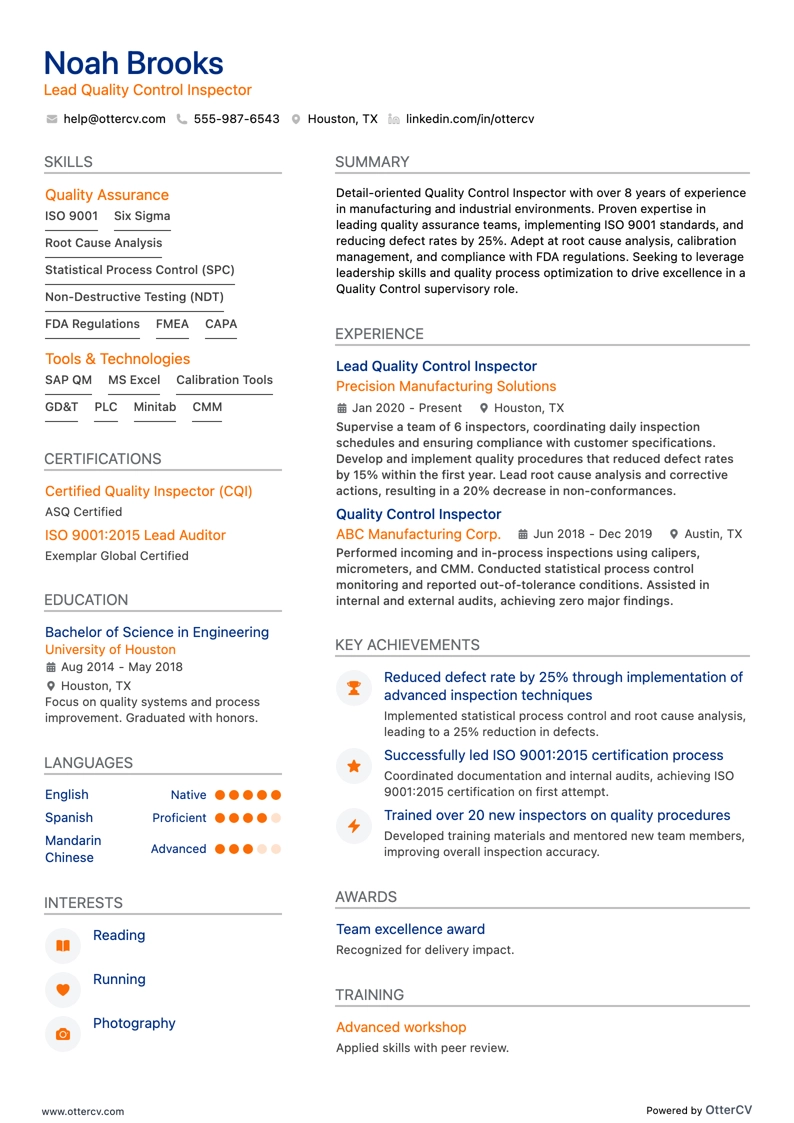
Lead Quality Control Inspector resume example

Lead Quality Control Inspector

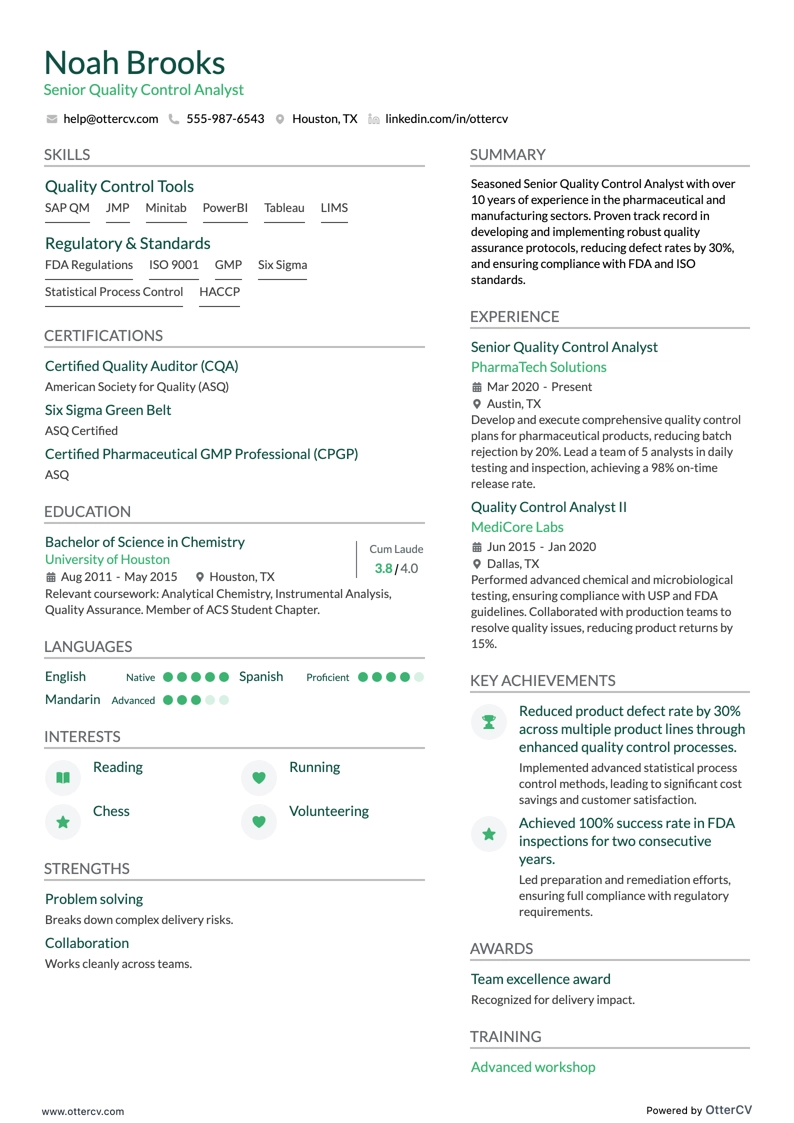
Senior Quality Control Analyst resume example

Senior Quality Control Analyst

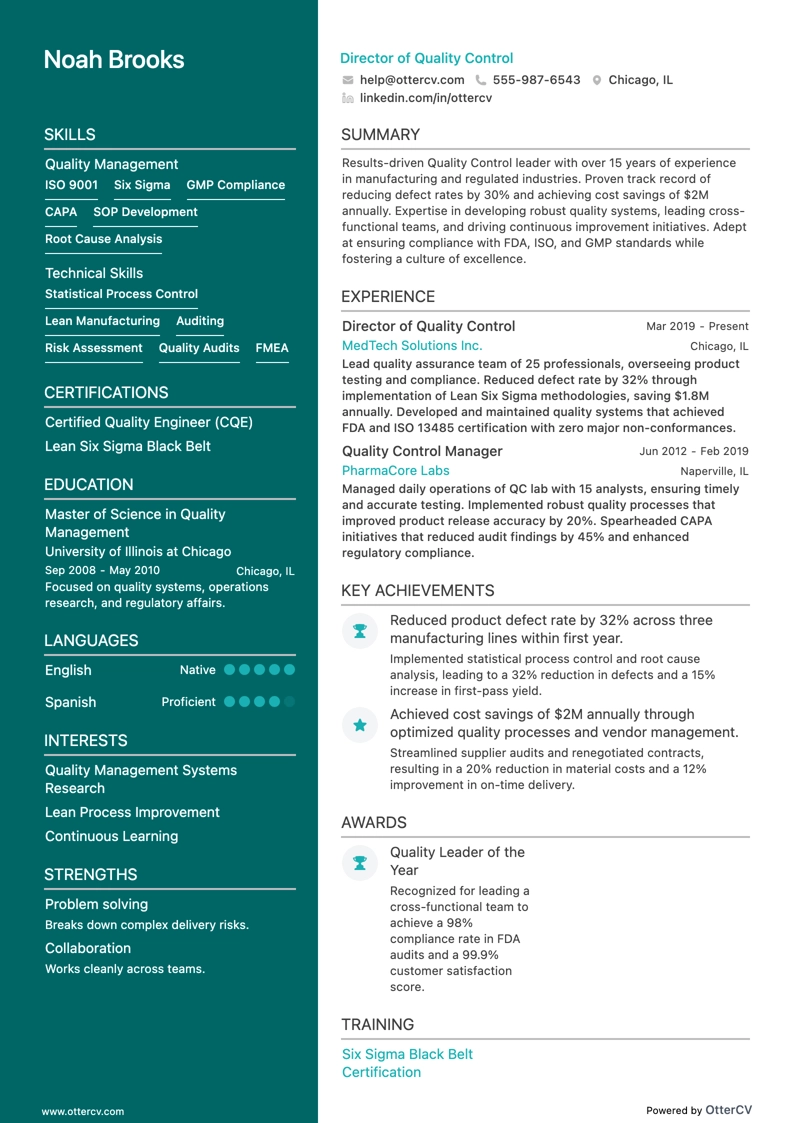
Director of Quality Control resume example

Director of Quality Control

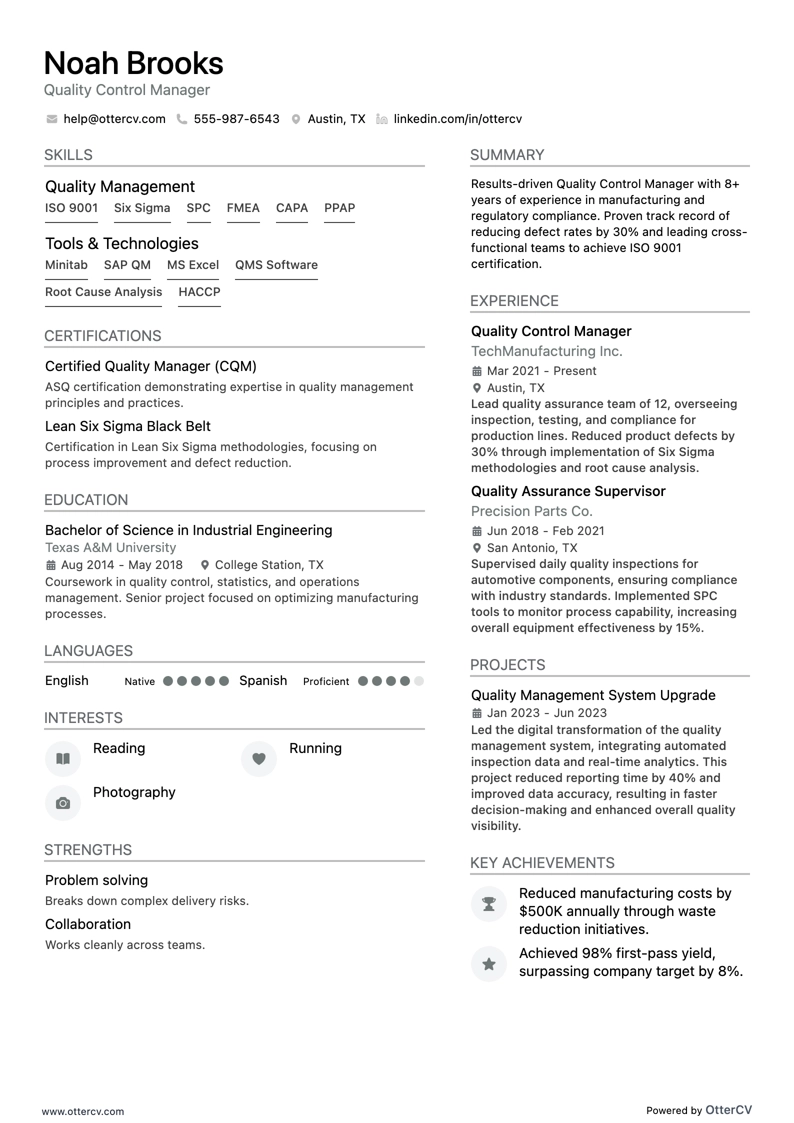
Quality Control Manager resume example

Quality Control Manager

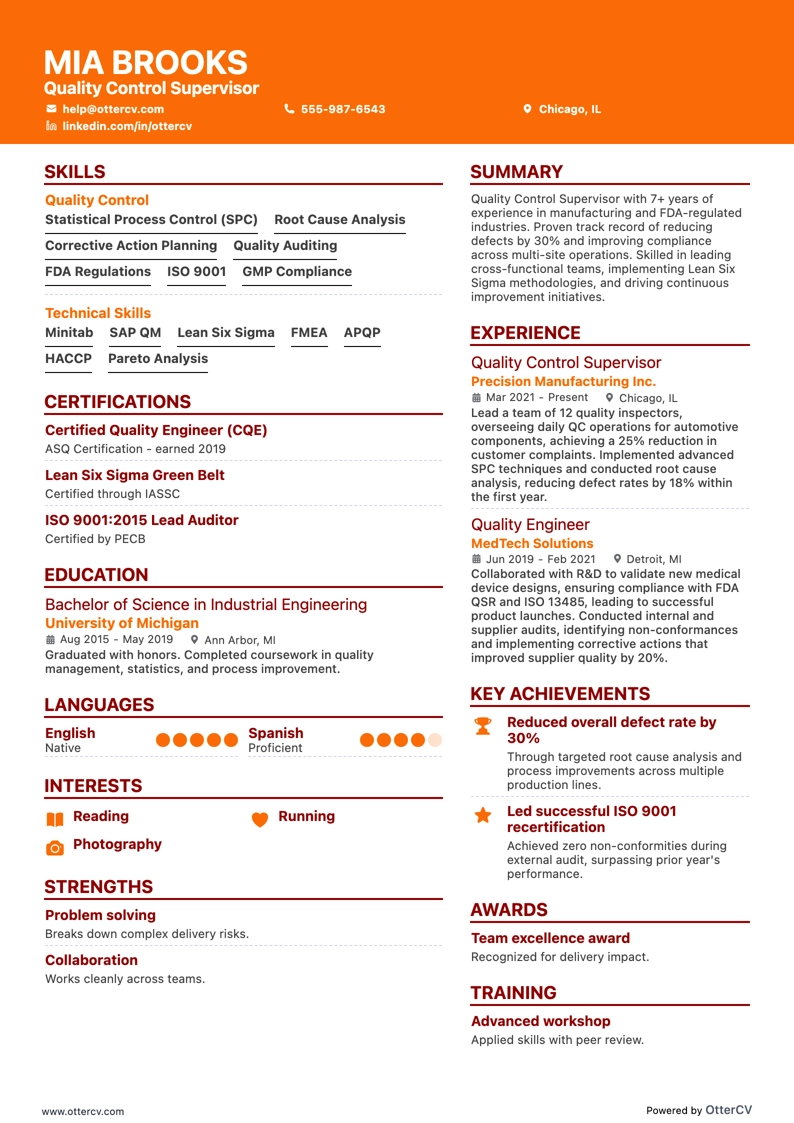
Quality Control Supervisor resume example

Quality Control Supervisor

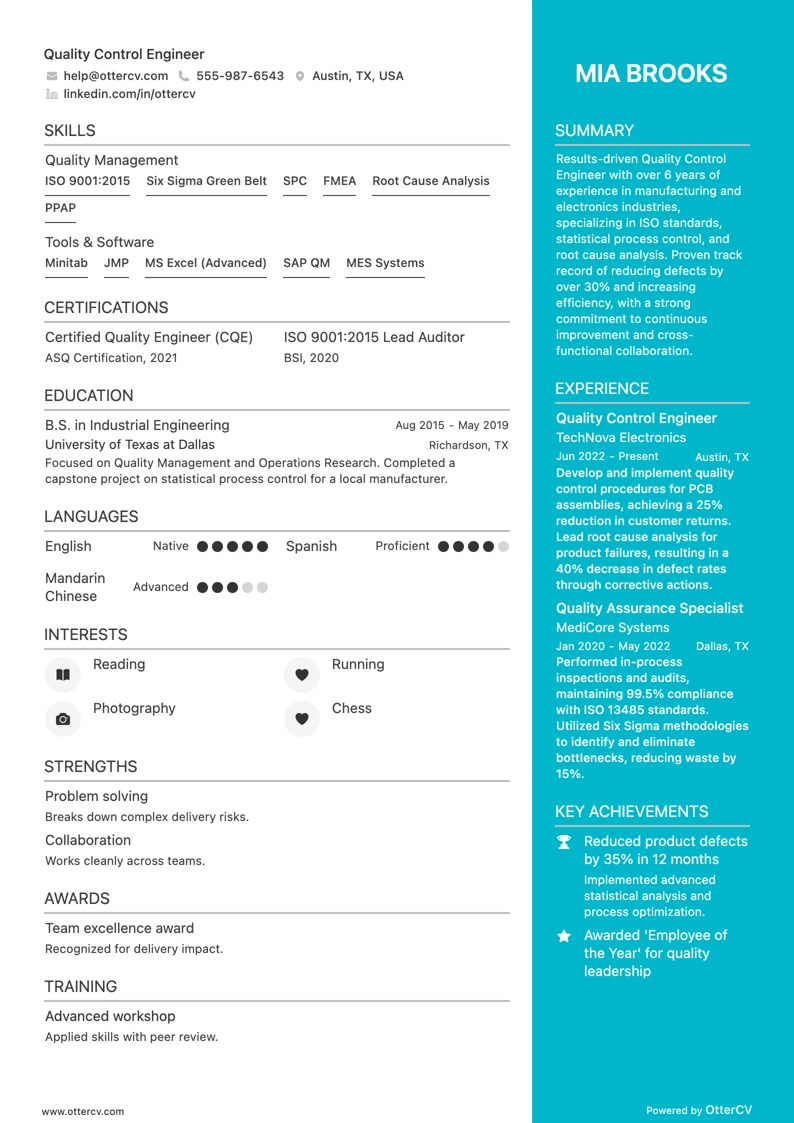
Quality Control Engineer resume example

Quality Control Engineer

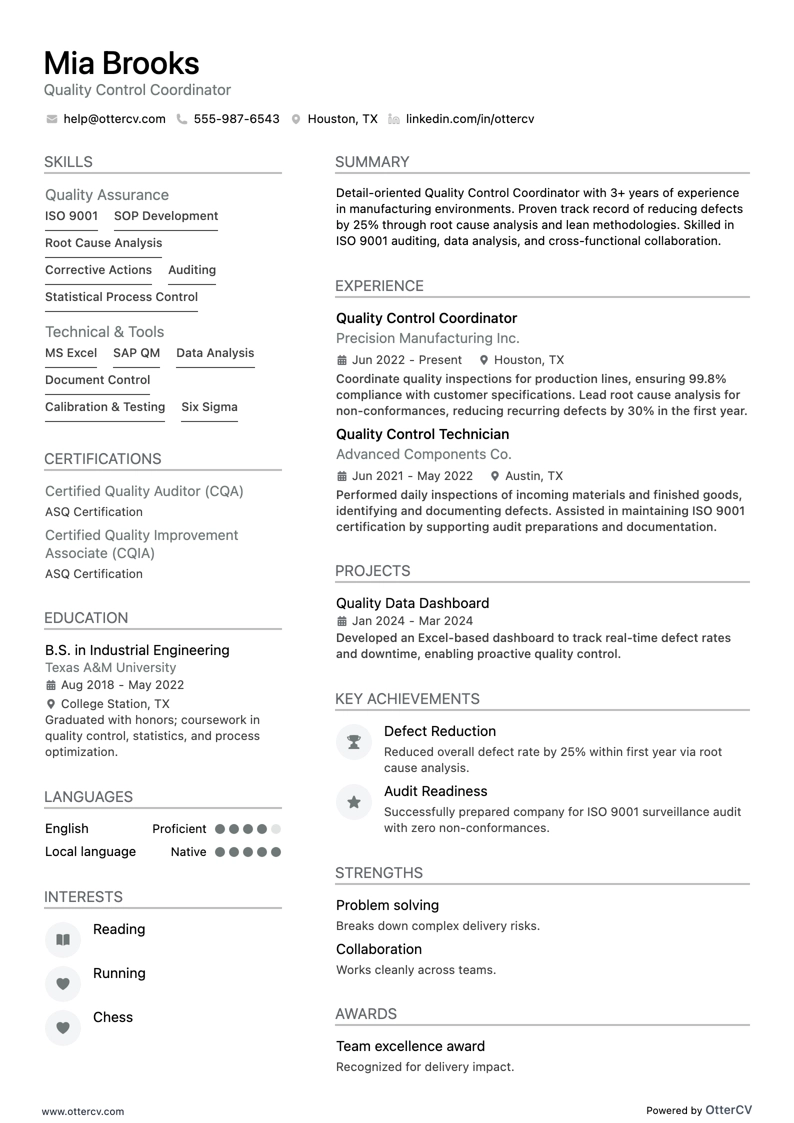
Quality Control Coordinator resume example

Quality Control Coordinator

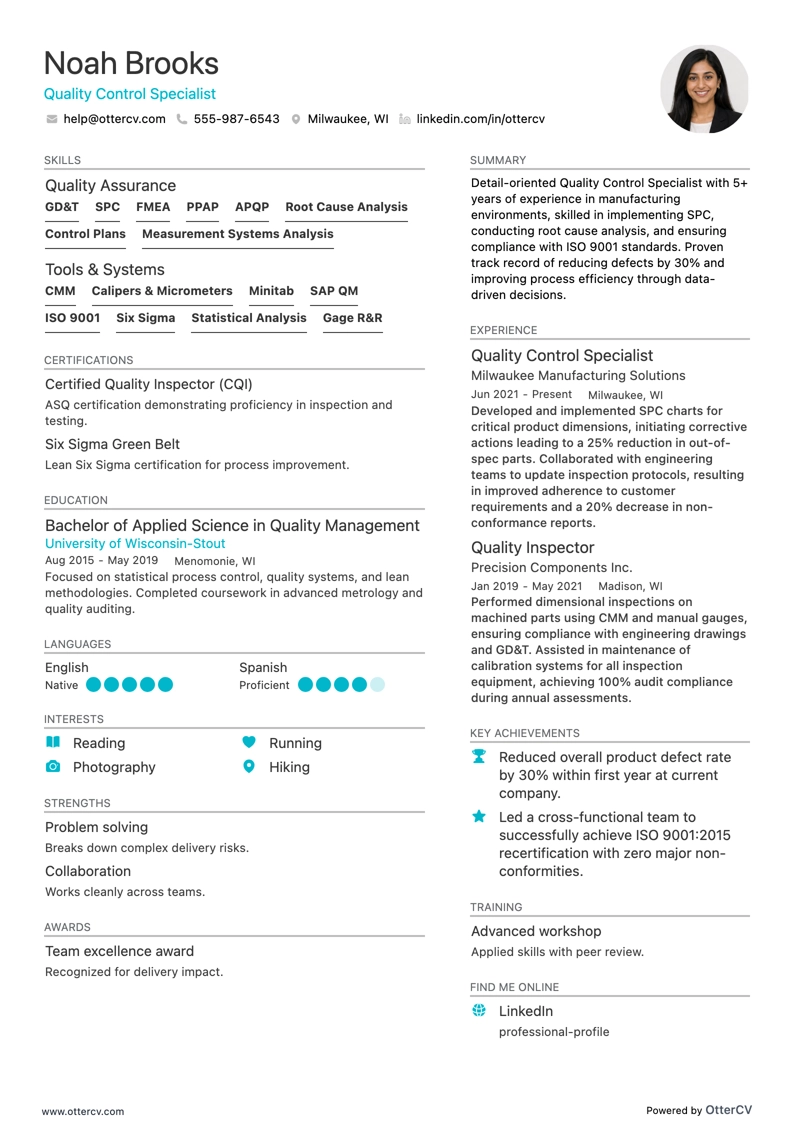
Quality Control Specialist resume example

Quality Control Specialist

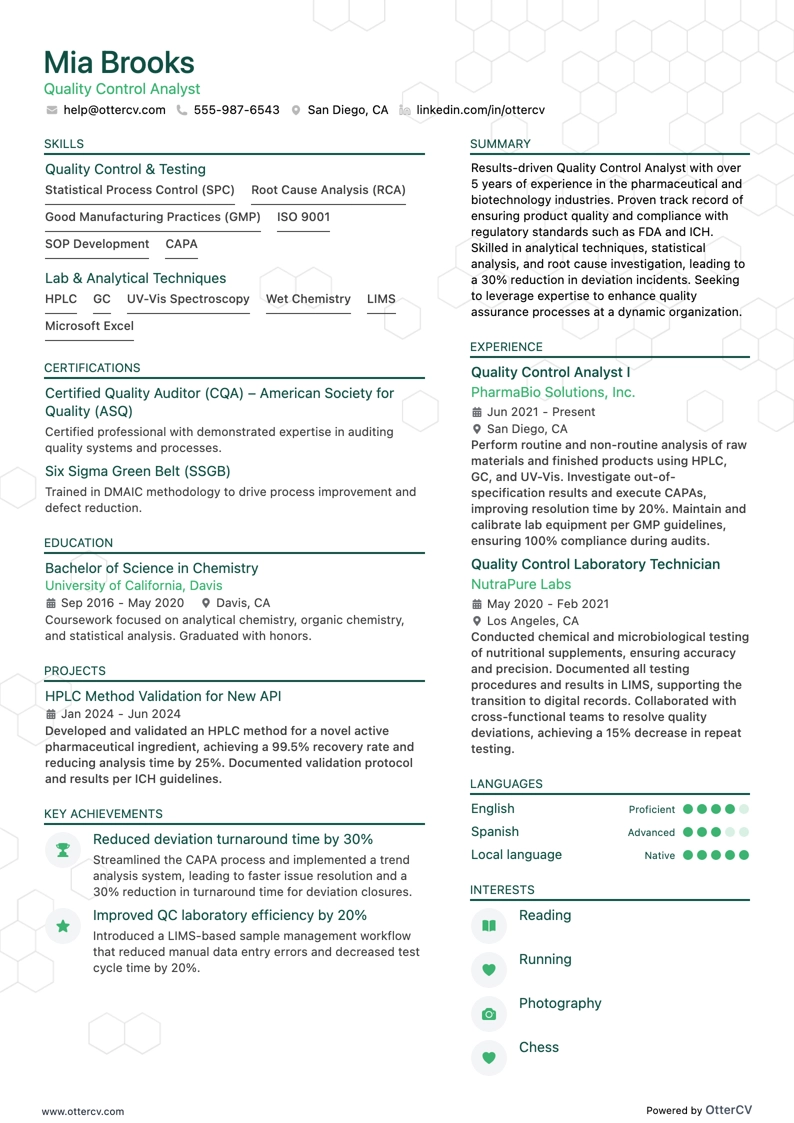
Quality Control Analyst resume example

Quality Control Analyst

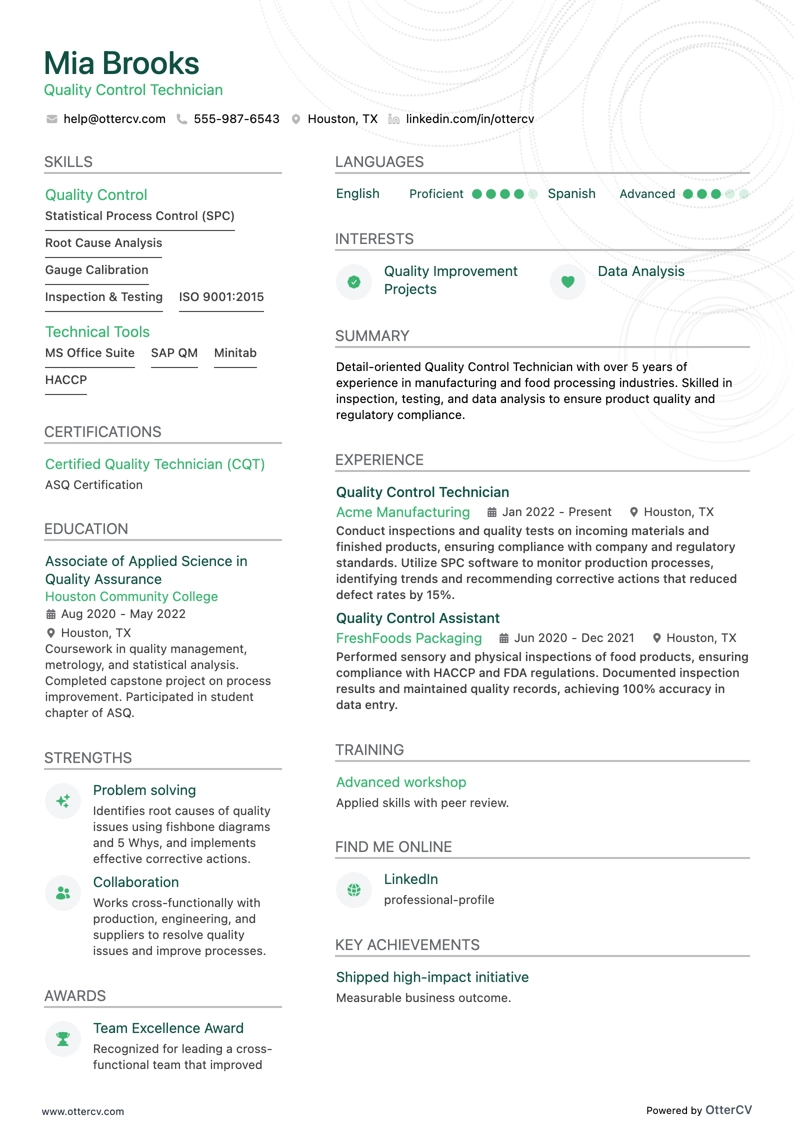
Quality Control Technician resume example

Quality Control Technician

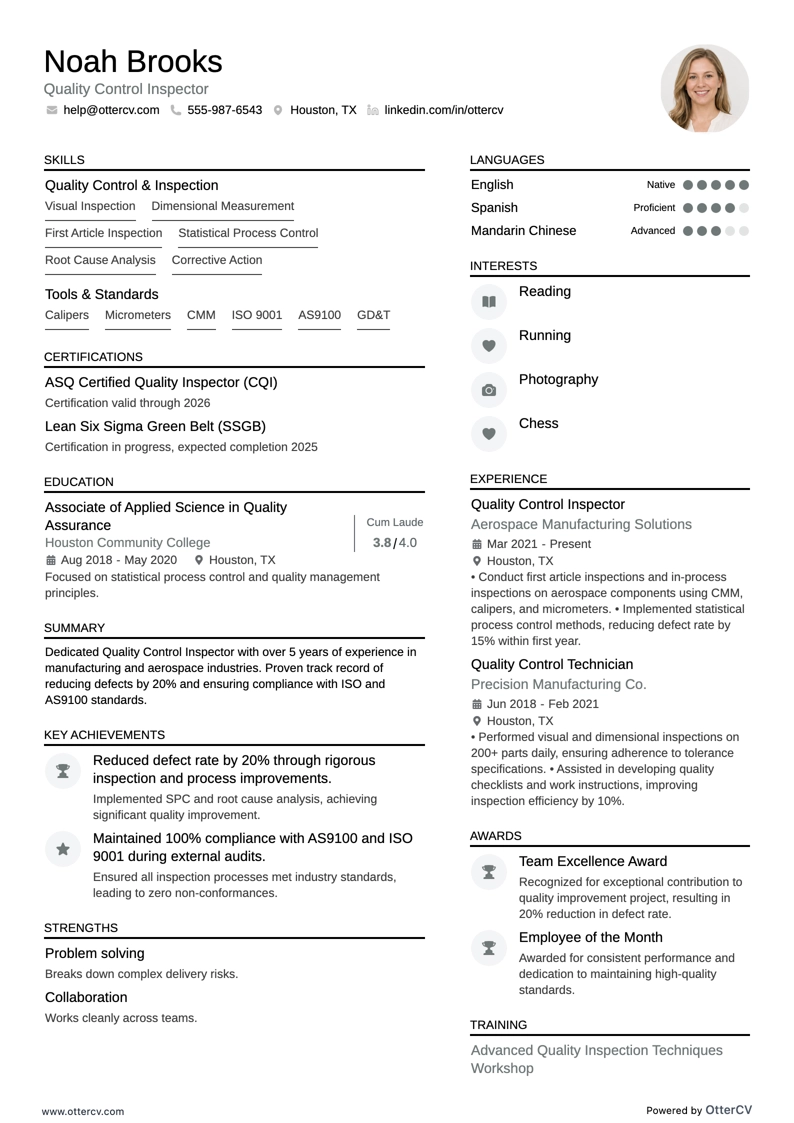
Quality Control Inspector resume example

Quality Control Inspector

A quality control role is a bit like being the industry’s detective, constantly looking for issues and helping fix them. The specifics may vary by workplace, but the core responsibility stays the same: keeping products, processes, or systems up to standard.

Recent studies highlight how important that work is. In 2020, even as the economy grew, pollution dropped sharply thanks to effective quality control in environmental management.

When writing your resume, position yourself as a guardian of quality—someone who helps ensure that everything from the air we breathe to the products we use is safe and up to par.

Key takeaways

  • Use a reverse-chronological format to give employers a clear view of your quality control career progression.

  • A clean resume design with a touch of color and a distinctive font can make your application more appealing.

  • Strengthen your experience section with measurable achievements and concrete results to capture hiring managers' attention.

  • Add a dedicated section for quality control skills, and weave interpersonal skills throughout your resume.

  • A relevant education in quality assurance or a related field remains highly valued in quality control.

Let's look at a quality control resume example.

Quality control resume sample

Need a template to jumpstart your resume writing? Use the one below, or try our Echocv resume builder. It's intuitive and only takes minutes.

Michael Thompson

Quality Control Inspector
michael.thompson@example.com | @LinkedIn | San Francisco, CA

Summary

Detail-oriented Quality Control Inspector with 7 years of experience maintaining high standards of product quality and safety. Proficient in using measuring tools and inspection techniques to evaluate components and finished products. Experienced in monitoring production cycles, examining raw materials, and preventing manufacturing errors.

Experience

Quality Control Inspector
General Electric, San Francisco, CA
January 2018 – Present

  • Conduct final confirmation of product quality for consumer goods.
  • Use measuring tools to ensure components meet standard variances.
  • Examine raw materials for purity and compliance with internal standards.
  • Monitor production-line cycles and report findings to superiors.
  • Implement corrective actions to prevent manufacturing errors.

Quality Assurance Technician
Apple Inc., Cupertino, CA
June 2015 – December 2017

  • Assisted in quality control processes for manufacturing operations.
  • Performed tests on components and materials to ensure quality standards.
  • Documented inspection results and prepared reports for management.
  • Collaborated with production teams to resolve quality issues.

Education

Bachelor of Science in Industrial Engineering
University of California, Berkeley
Graduated: 2015

Certifications

  • Certified Quality Inspector (CQI)
  • Six Sigma Green Belt

Skills

  • Quality control
  • Inspection Techniques
  • Measurement Tools
  • Production Monitoring
  • Report Preparation
  • Error Prevention
  • Compliance Standards
  • Team Collaboration

Languages

  • English (Fluent)
  • Spanish (Proficient)

After reviewing the sample, it’s important to understand the format that can help your resume stand out.

How to format a quality control resume

The right resume format shows attention to detail and brings key information into focus. Choose a clear, organized template to highlight your quality control expertise. Hiring managers will appreciate a structured layout that follows professional standards.

Resume format

Choose the classic reverse-chronological format. It is widely recognized, comprehensive, and reliable. This format also helps demonstrate perseverance and consistency.

Resume designs

  • Length: Recruiters have limited time, so keep your resume concise. A 1-page resume is usually enough to provide an overview of your achievements.
  • Margins: Avoid crowding the page. Keep your margins between 0.5” and 1”, preferably closer to the upper end of that range.
  • Columns: Two-column designs save space and can help you include more information without making your resume too long.
  • Colors and fonts: Color can improve the professional look of your resume. Choose elegant colors such as dark gray, blue, or green, and pair them with a modern font like Rubik, Calibri, or Lato.

Contact information

Hiring managers expect to see your contact information in the resume header, including your name, job title, and email address. Photos are generally not needed, but you should always check the specific job ad.

Make sure your resume matches local expectations, as Canadian resumes may have unique layout guidelines.

PRO TIP

Applicant Tracking Systems often cause unnecessary fear. Contrary to popular belief, our tests showed that fonts, colors, columns, and resume length do not affect parsing.

Focus on matching the language in the job description and on formatting details such as dates and bullet symbols, since those may affect your application.

However, not all companies use ATS, so avoid keyword stuffing and keep your resume clear and readable.

File formatting

Keep your resume layout intact by saving it in PDF format. Use a clear file naming convention, such as FirstName_LastName_JobTitle. Also, make sure your resume is free of typos to reflect strong attention to detail.

You can also include a personal website or your LinkedIn profile in the header.

Top sections on a resume

Your resume should include these essential sections:

  • Contact information
  • Work history
  • Skills section
  • Education details
  • Personal statement

We already covered contact information, and each of the remaining sections is explained below.

If you want extra peace of mind, use our 16 checks to ensure your resume is top-notch.

With the right format in mind, let’s focus on how to present your professional experience.

How to write your quality control resume experience

Writing a compelling experience section for a quality control role means showing your ability to maintain standards and ensure product excellence.

Build your experience section around two main points:

  • The specific duties and qualifications you have based on your industry, such as IT, manufacturing, or biotech.
  • How your work experience shows attention to detail, analytical skills, and the ability to follow strict industry standards—qualities that are essential in a QC role.

How to Write Your Experience Section

When writing your experience section, follow these steps:

  • List your most recent and most relevant experience first.
  • Include your job title, company name, location, and dates of employment for each role.
  • Share examples of how you identified and resolved production issues to improve product quality and customer satisfaction.
  • Mention projects where you worked with cross-functional teams to maintain quality standards and demonstrate strong teamwork.

Quality Control Inspector

Quality Control Inspector

Job Overview

The primary duty of the Quality Control Inspector is to support commercial manufacturing lines to help ensure delivery of the highest quality product to the customer while supporting continuous improvement projects and quality initiatives. This is a dynamic support role that requires cross-functional collaboration with production, manufacturing, and quality team members. The role also provides day-to-day quality support for manufacturing, including processing non-conforming product through identification, documentation, segregation, evaluation, and disposition, as well as responding to quality signals.

Main Responsibilities

  • Perform routine Incoming Quality Control (IQC), In-Process Quality Control (IPQC), and Final Quality Control (FQC) testing and inspection, and record test results.
  • Update databases and spreadsheets used to track, monitor, and report department activities.
  • Use inventory and traceability management systems to transact material.
  • Review and update QA documentation.
  • Comply with all QC and relevant plant-wide procedures and practices.
  • Collect and compile statistical quality data.
  • Provide excellent service to all internal and external customers of the QC Laboratory and QC department.
  • Communicate concerns about the work process related to environmental impact, health, or safety issues to the supervisor.
  • Demonstrate excellent attention to detail.

Skills and Qualifications

  • Associate degree in a technical discipline, or equivalent.
  • 2 years of quality or manufacturing experience in the medical device industry.
  • Good interpersonal and organizational skills.
  • Able to read, understand, and communicate procedural requirements.
  • High proficiency with the Microsoft desktop environment, including Windows and Office 365.
  • Familiarity with product and component inspection and testing, and with Manufacturing Execution System (MES).
  • Fluent in written and spoken English.

Tailor your resume to the job posting

A quality control role can seem abstract to people outside your industry, since the position has different requirements depending on your field. Hiring managers usually know exactly what they want, so your best approach is to tailor your resume to the job posting.

Quality Control Experience

Senior Quality Control Inspector

MediTech Solutions Inc.

02/2000 - 11/2004 | San Diego, CA

  • Conducted over 3000 IQC, IPQC, and FQC inspections and tests annually, ensuring product compliance with FDA standards and contributing to a 15% reduction in customer complaints.
  • Improved QC tracking and reporting by updating and maintaining QA databases, streamlining monitoring and reducing report generation time by 25%.
  • Managed material traceability and inventory transactions through MES, handling over $2 million worth of products annually and improving material utilization by 10%.
RIGHT

Here’s why this experience section works:

  • The bullets directly address key responsibilities and skills listed in the job description, such as conducting IQC, IPQC, and FQC inspections and managing QA documentation and databases.
  • It shows familiarity with industry-specific tools and practices, including expertise in the medical device industry, which is critical for the job.
  • Clear formatting and specific details make it easy for hiring managers to quickly understand the candidate’s qualifications and relevant experience.

Describing your experience is essential, but quantifying your achievements will make a stronger impact.

How to quantify your experience on a resume

To strengthen your resume, quantify your accomplishments with precise data whenever possible. This could include the percentage of defect reduction achieved under your supervision or the number of compliance audits successfully passed.

Use active language and strong verbs such as “implemented,” “enhanced,” “reduced,” or “led” to show your direct involvement and impact. Including specific quality control tools or software you know can also help distinguish you from other candidates.

When you clearly show how your work benefited previous employers, you make a stronger case for your value in a new QC role.

Examples include:

  • The number of successful audits you conducted, showing efficiency and the ability to maintain high-quality standards.
  • The percentage of cost reductions achieved through quality control measures, demonstrating your contribution to the business’s financial health.
  • The number of quality control methods you are familiar with, proving versatile technical knowledge.
  • The number of compliance certificates you helped the business obtain, indicating your ability to meet industry regulations.
  • The figure for production errors you successfully reduced, showing your impact on operational efficiency.

You can write a compelling resume regardless of your experience. Keep reading for tips on entry-level resumes.

How do i write a quality control resume with no experience

QC entry-level jobs are usually structured and require you to follow established protocols. That makes them accessible even to those without much experience. To do the job well, you need to follow instructions, adhere to procedures, and pay close attention to detail.

Here’s what to include on your quality control resume if you’re just starting out:

  • A BS degree in Quality Assurance, Applied Mathematics, Operations Management, or a related field to understand market dynamics and operations.
  • Internships or part-time roles in quality control or quality assurance that provide practical industry insight.
  • Additional training or certifications that strengthen your professional profile.
  • Transferable skills such as communication, strategic thinking, and creativity, which are valuable in quality control roles.

Additionally, a resume objective is a strong choice if you’re just starting out. Keep it short, around 1–3 sentences, and focus on your willingness to learn and grow in your career. Here’s an example:

Objective

Recent graduate with a Bachelor's degree in Economics, eager to apply analytical and project management skills in a Quality Control role. Highly attentive to detail and committed to following stringent protocols to ensure product excellence. Motivated to learn and adapt to new processes, with the goal of contributing effectively to team success and advancing within the field.

RIGHT

Quality control skills on your resume

Beyond experience, highlighting both hard and soft skills is essential to show your qualifications.

The skills section of your resume is a key place to showcase your abilities. Organize it clearly to help employers quickly understand your qualifications, and group your skills into hard and soft categories.

Hard skills should include specific competencies related to quality control, such as proficiency with relevant software or testing methodologies. You may also consider a dedicated section for these skills so they are easy to notice and read. Take your pick from our suggestions:

Best hard skills for your quality control resume

  • Quality control analysis.
  • Statistical process control.
  • ISO 9001 standard.
  • ISO 14000 standard.
  • Certified Quality Engineer (CQE).
  • Certified Quality Auditor (CQA).
  • Six Sigma Certification.
  • Lean Manufacturing Principles.
  • Root cause analysis.
  • Corrective and preventive action (CAPA).
  • Analytical testing and equipment.
  • Microsoft Office Suite.
  • Project management software.
  • AutoCAD.
  • GD&T proficiency.
  • MATLab.
  • PLC programming.
  • SAP software.
  • Minitab software.
  • Failure mode and effects analysis (FMEA).

Although a quality control role is highly technical and detail-oriented, it still requires strong people skills like any other job. These soft skills help you build positive relationships with team members and handle complex situations effectively.

Instead of listing them in a separate resume section, it is often more effective to show them through specific examples in your work experience. Here are some key ones to consider:

Best soft skills for your quality control resume

  • Attention to detail helps maintain accuracy in inspections and documentation.
  • Problem-solving supports quick and effective responses to quality issues.
  • Communication keeps teams aligned on standards, findings, and next steps.
  • Time management helps you meet deadlines without sacrificing quality.
  • Organizational skills make it easier to track records, processes, and priorities.
  • Critical thinking helps evaluate defects, trends, and root causes.
  • Teamwork supports smooth collaboration across production and quality teams.
  • Adaptability helps you adjust to changing requirements, tools, and workflows.
  • Decision-making is important when determining corrective actions and quality outcomes.
  • Patience helps you stay thorough during repetitive checks and detailed reviews.
  • Stress management supports consistent performance in fast-paced environments.
  • Leadership helps guide teams and reinforce quality standards.
  • Dedication shows commitment to maintaining reliable quality performance.
  • Persistence helps you follow through until issues are fully resolved.
  • Initiative shows you can identify and address concerns before they grow.
  • Creativity supports practical improvements to processes and quality checks.
  • Confidence helps you communicate findings clearly and stand by your assessments.
  • Empathy helps you work effectively with others when addressing quality concerns.
  • Negotiation supports productive discussions around solutions and standards.
  • Accountability shows responsibility for your work and quality results.

Next, we’ll cover how to list your educational background and relevant certifications.

How to list your certifications and education on your resume

To advance in quality control, education is just as important as experience. While some entry-level roles are open to candidates with a high school diploma, a higher degree is always beneficial. It signals consistency, seriousness, and discipline—qualities employers value.

The degree you choose should match your industry. For example, a quality control chemist in pharmaceuticals might include a chemistry degree and GMP certification to meet strict regulatory standards. A quality control technician in manufacturing, on the other hand, could highlight a degree in industrial engineering and Six Sigma certification to emphasize process improvement skills.

Don’t leave out these key details in your education section:

Here’s a well-written education entry. It also targets the job posting above.

Education

Associate of Science in Biomedical Engineering Technology
River Tech Community College
08/2018 - 05/2020 | Riverview, IL
GPA: 3.7 / 4.0

  • Focused coursework on quality assurance protocols and statistical analysis for manufacturing environments.
  • Completed a project on non-conforming product management systems aligned with real-world quality control practices.
  • Trained in Manufacturing Execution Systems (MES) and familiar with regulatory compliance for medical devices.
RIGHT

Why It Worked

This resume stands out for several clear reasons:

  • The degree is directly relevant to the role and is well suited to someone entering a quality control position in the medical device sector.
  • It highlights specific coursework and projects that match the job’s responsibilities, including quality assurance protocols and handling non-conforming products.
  • Including a high GPA shows academic excellence and a strong grasp of the subject matter, which is especially valuable in technical roles.

Training and certifications are also important for demonstrating expertise in quality control. A dedicated certifications section gives concrete proof of your commitment to the field. You can choose one of the certificates listed below, but it’s best to tailor your selection to the requirements in the job advertisement you’re targeting.

Having covered education and certifications, let’s move on to crafting a powerful resume summary.

How to write your quality control resume summary

Your personal profile should show what you’ve achieved and what you want in your future career. If you have more than 3 years of experience, include a resume summary in your application.

A strong summary should include:

  • 3–5 sentences that describe your professional journey, achievements, and key qualities.
  • Measurable experience that immediately captures recruiters’ attention.
  • Relevant education or additional training that adds value.
  • What you want to achieve next and what you can bring to the company.

Here’s a summary tailored to the quality control job description above.

Summary

The Quality Control Inspector plays a key role in maintaining and improving product quality across commercial manufacturing lines. This position includes routine quality control testing at multiple stages, including IQC, IPQC, and FQC, along with updating tracking systems and ensuring compliance with quality and safety protocols. Responsibilities also include processing and documenting non-conforming products, updating QA documentation, and supporting quality initiatives and improvement projects. The role requires effective collaboration across departments to achieve high-quality outcomes and resolve quality issues efficiently.

RIGHT

This summary highlights the quality control inspector’s core responsibilities, including routine testing, documentation, and adherence to safety and quality protocols. It also emphasizes collaboration and continuous improvement, which are essential to maintaining high standards in manufacturing.

Next, we’ll cover additional sections that can strengthen your resume and make it more comprehensive.

Additional sections for a quality control resume

Adding extra resume sections can strengthen your application. They highlight qualifications and personal qualities that may not fit neatly into traditional resume categories.

Given the wide range of skills involved in quality control, consider including some of these sections:

In conclusion

Creating an exceptional QC resume requires careful attention to structure, presentation, and content. Use the curated tips in this resume guide to showcase your skills effectively and leave a strong impression on potential employers.

Quality Control resume examples

Explore additional Quality Control resume samples and guides and see what works for your level of experience or role.

By Experience

Lead Quality Control Inspector

Lead Quality Control Inspector resume preview

Senior Quality Control Analyst

Senior Quality Control Analyst resume preview

Quality Control resume examples

Explore additional Quality Control resume samples and guides and see what works for your level of experience or role.

By Role

Director of Quality Control

Director of Quality Control resume preview

Quality Control Manager

Quality Control Manager resume preview

Quality Control Supervisor

Quality Control Supervisor resume preview

Quality Control Engineer

Quality Control Engineer resume preview

Quality Control Coordinator

Quality Control Coordinator resume preview

Quality Control Specialist

Quality Control Specialist resume preview

Quality Control Analyst

Quality Control Analyst resume preview

Quality Control Technician

Quality Control Technician resume preview

Quality Control Inspector

Quality Control Inspector resume preview