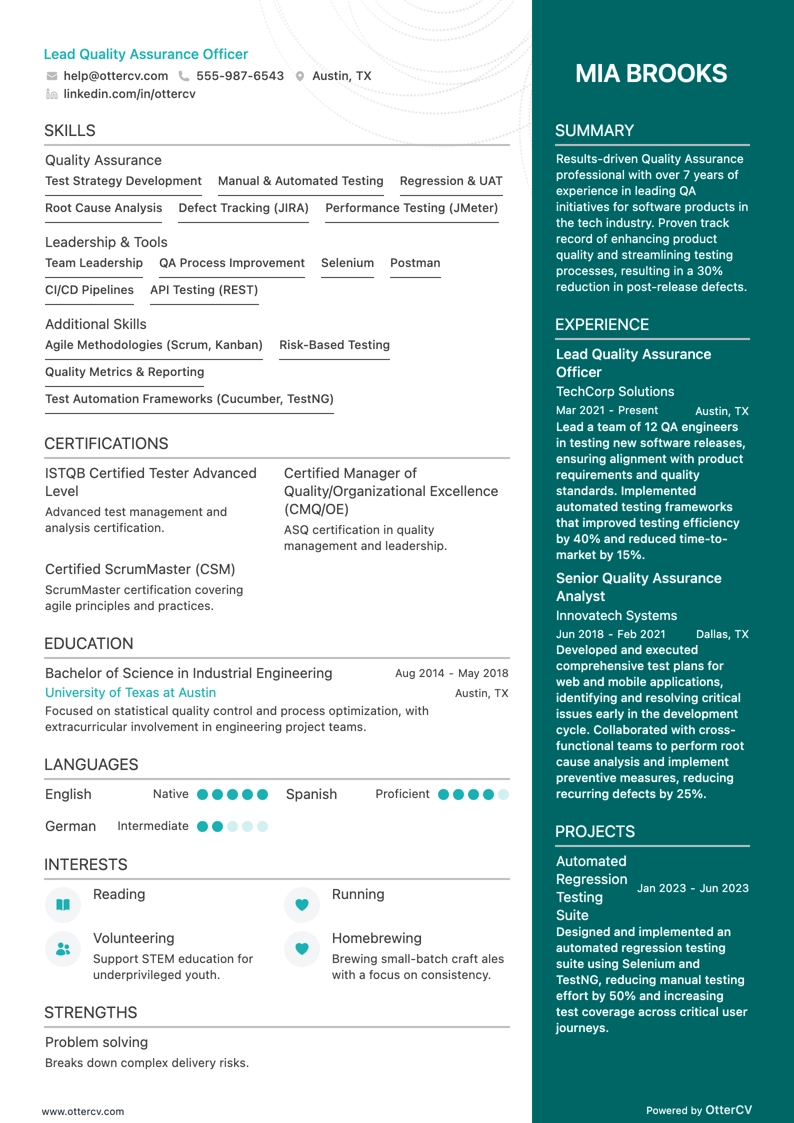
Lead Quality Assurance Officer full preview

10 Quality Assurance Officer Resume Examples

OtterCV

Written by The OtterCV Team

Updated: 5/13/2025•8 min read

See all resume examples in this guide, or generate your own resume example with your personalized prompt

Lead Quality Assurance Officer resume example

Lead Quality Assurance Officer

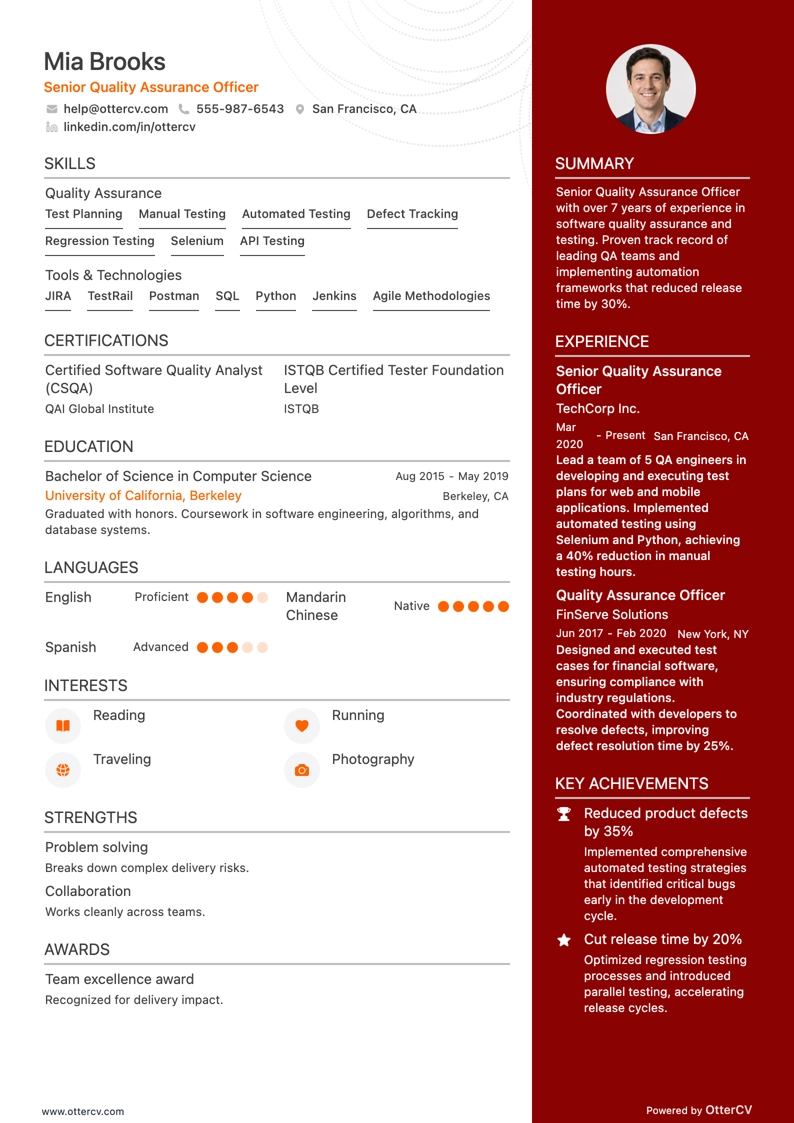
Senior Quality Assurance Officer resume example

Senior Quality Assurance Officer

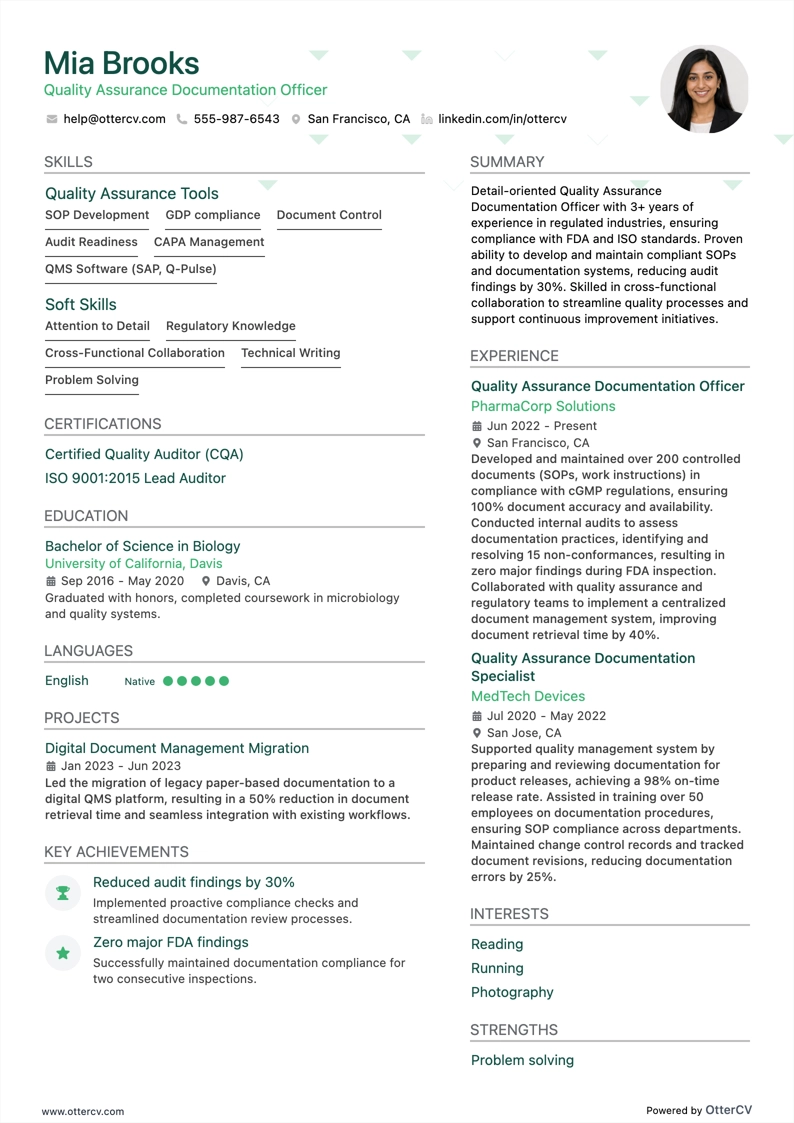
Quality Assurance Documentation Officer resume example

Quality Assurance Documentation Officer

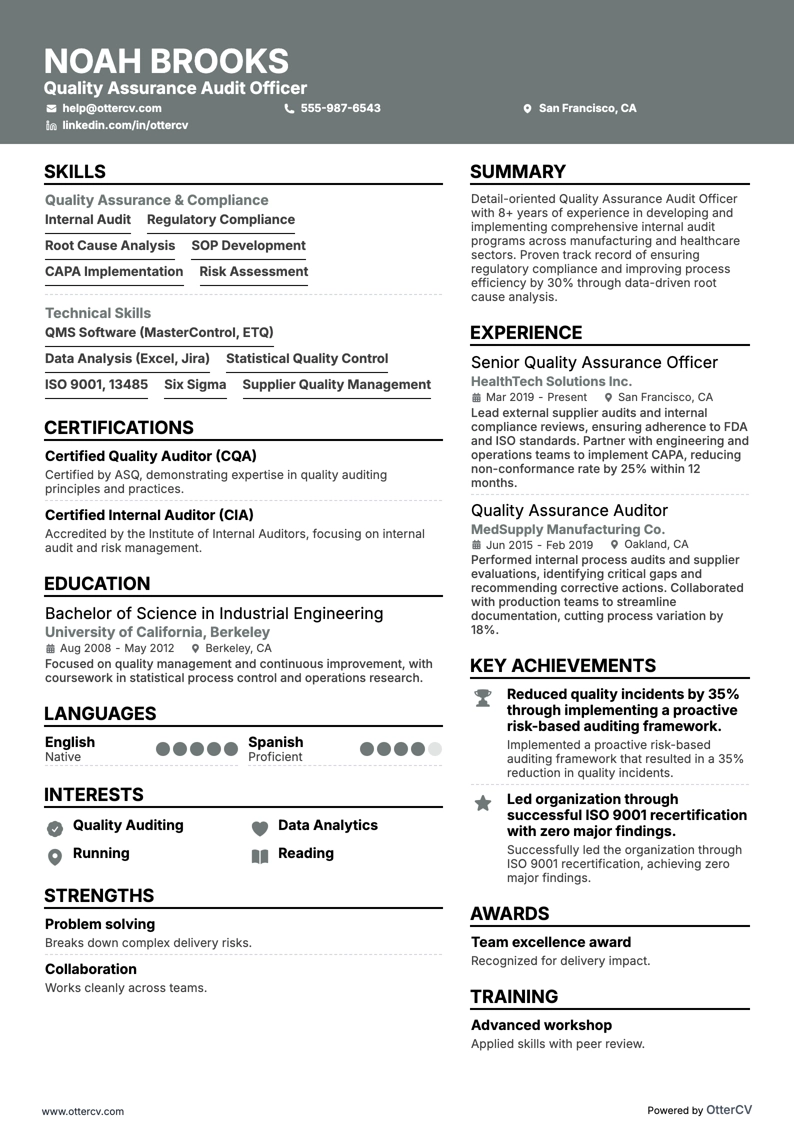
Quality Assurance Audit Officer resume example

Quality Assurance Audit Officer

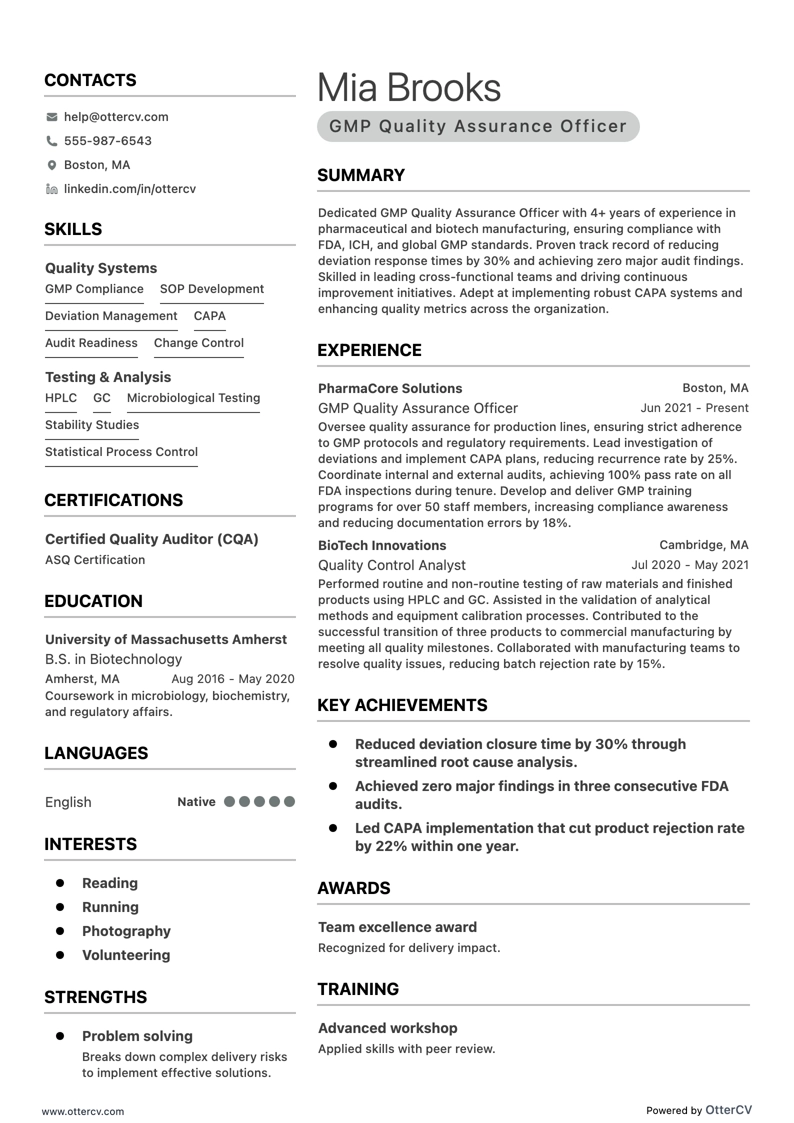
GMP Quality Assurance Officer resume example

GMP Quality Assurance Officer

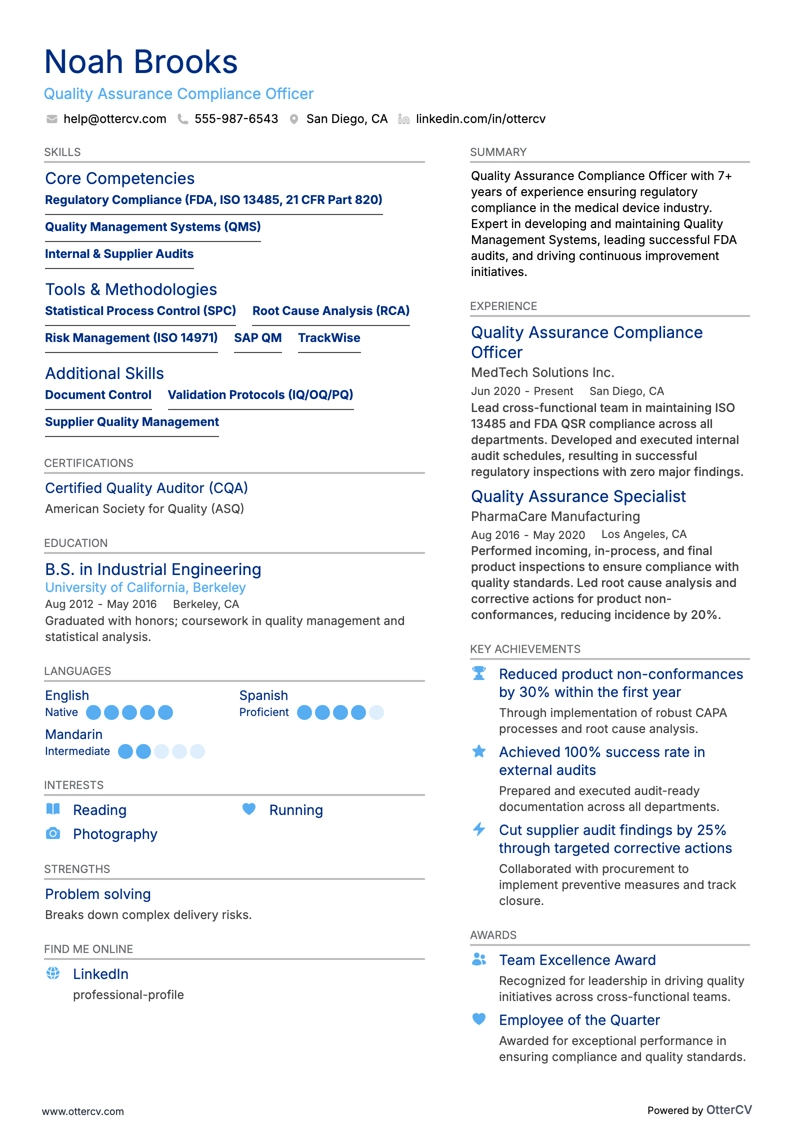
Quality Assurance Compliance Officer resume example

Quality Assurance Compliance Officer

QA Officer resume example

QA Officer

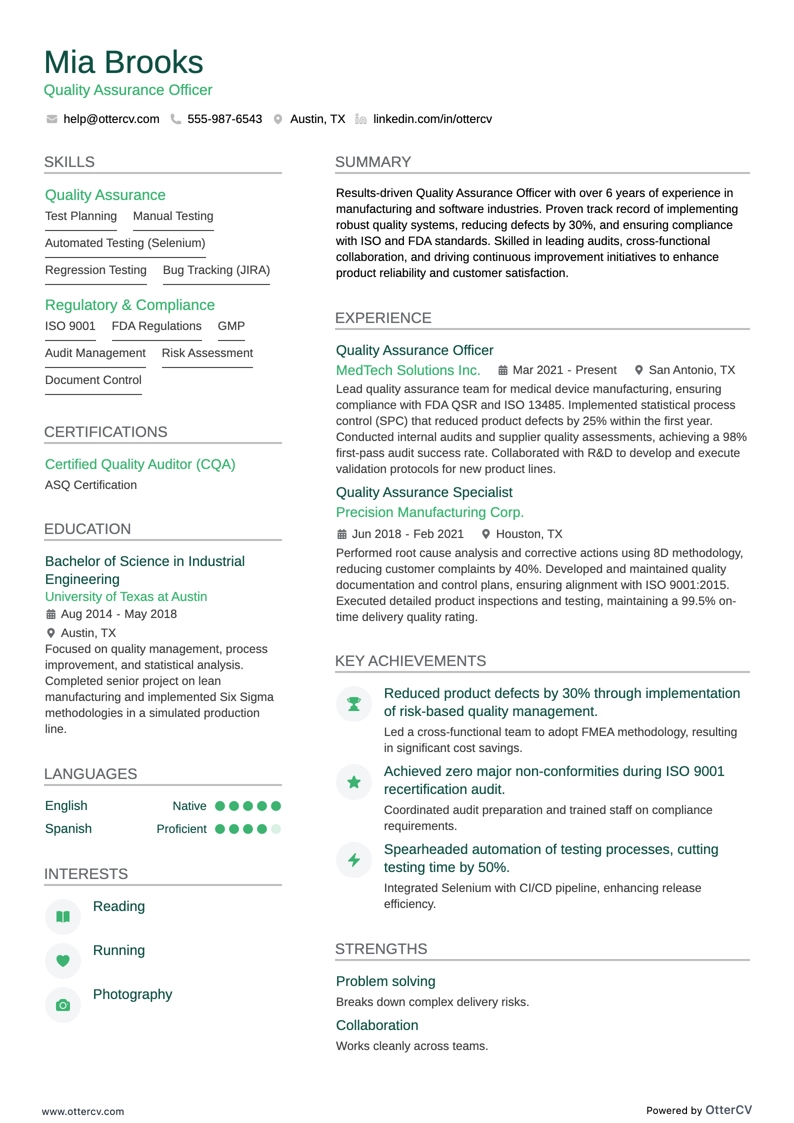
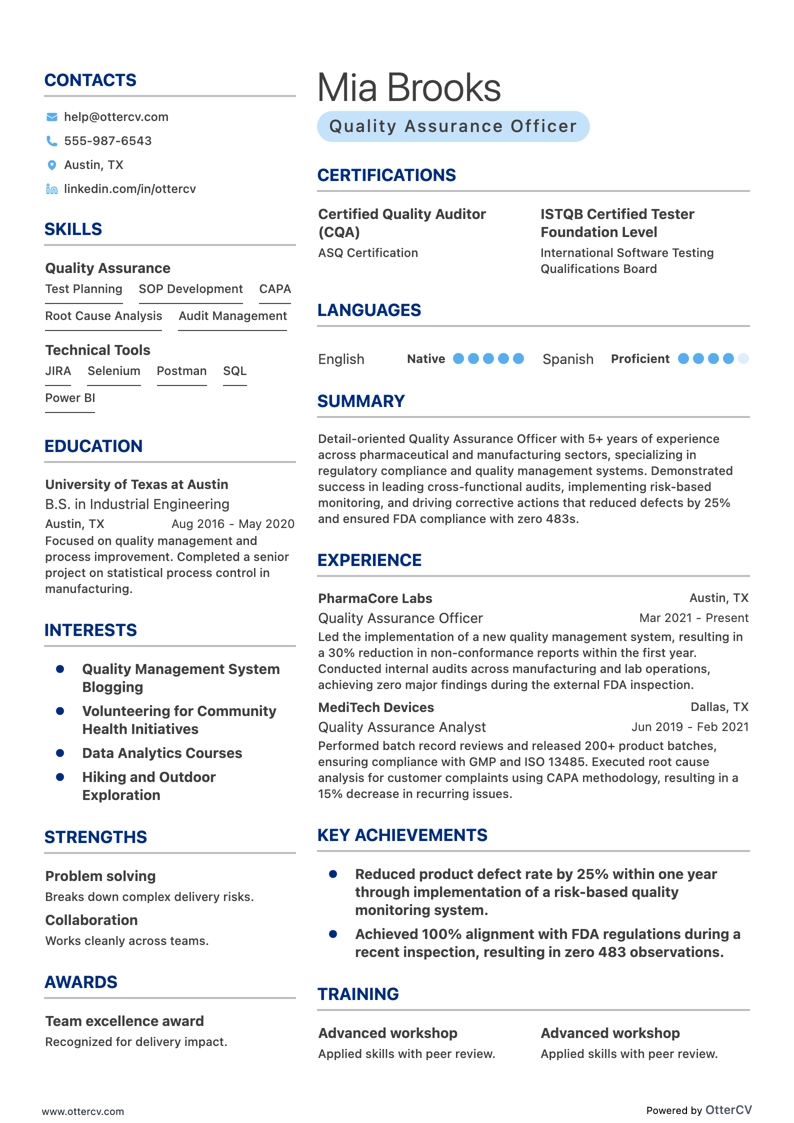
Quality Assurance Officer resume example

Quality Assurance Officer

Many QA officer resumes fall short because they list inspections and standards without showing measurable risk reduction or compliance results. In today’s hiring process, a QA officer resume needs to pass ATS filters and stand out in quick recruiter reviews within a crowded market. If you’re not sure where to start, learning how to write a resume that emphasizes impact over duties is the first step.

A strong resume explains what improved because of your work, not just what tasks you handled. Highlight outcomes such as audit pass rates, reduced defect escape, faster release approvals, fewer customer complaints, lower scrap or rework costs, and improved CAPA closure times.

Key takeaways

  • Quantify quality outcomes in every experience bullet, including defect rates, audit scores, and cost savings.

  • Use a reverse-chronological format if you are experienced, or a hybrid format if you are junior or changing careers.

  • Match your resume language to the exact tools, standards, and KPIs named in the job posting.

  • Show skills through measurable achievements in your summary and experience, not just in a skills list.

  • Place certifications such as ASQ CQA or ISO Lead Auditor where recruiters can find them quickly.

  • Echocv's Bullet Point Generator can turn vague QA duties into recruiter-ready, results-driven statements.

  • Use AI to tighten wording and spot gaps, but stop before it invents or exaggerates your experience.

How to format a QA officer resume

Recruiters reviewing QA officer candidates look for clear evidence of quality management systems knowledge, audit experience, regulatory compliance expertise, and measurable improvements in defect reduction or process efficiency. A clean, well-structured resume format helps these strengths stand out quickly in both automated screening and manual review.

I have significant experience in this role—which format should I use?

I have significant experience in this role—which format should I use?

Use a reverse-chronological format to show your QA career progression and expanding scope of responsibility in a clear, linear timeline.

  • Start each role entry with your scope of ownership, such as team size, number of product lines audited, or regulatory frameworks managed.
  • Highlight role-specific tools and domains, including ISO 9001, Six Sigma, CAPA systems, root cause analysis, FDA compliance, or statistical process control.
  • Quantify outcomes tied to quality improvements, cost savings, or compliance milestones.

Example: “Redesigned incoming material inspection protocols across three manufacturing sites, reducing supplier defect rates by 34% and saving $280K annually in rework costs.”

I'm junior or switching into this role—what format works best?

I'm junior or switching into this role—what format works best?

A hybrid resume format works best. It lets you highlight relevant QA skills and certifications near the top while still presenting your work history in chronological order.

  • Place a dedicated skills section near the top of your resume with core QA competencies such as document control, corrective action tracking, inspection methodologies, and relevant software.
  • Include academic projects, internships, or cross-functional assignments where you handled quality-related tasks, even if your title was not QA-specific.
  • Connect every skill or project to a specific action and a measurable or observable result.

Example scaffold: Statistical process control (skill) → monitored production line output data and flagged deviations from control limits (action) → contributed to a 15% reduction in batch rejection rates over one quarter (result).

Why not use a functional resume?

Why not use a functional resume?

A functional resume removes the timeline and context hiring managers need to assess how you applied your QA knowledge in real work settings, which makes it harder to verify your hands-on compliance and auditing experience.

  • This format may be acceptable if you are transitioning into QA from a related field, such as manufacturing, lab science, or regulatory affairs, and have limited direct QA job titles. If you use it, tie each skill to specific projects, certifications, or measurable outcomes instead of listing skills on their own.

Once you have a clean, readable layout, the next step is choosing resume sections that each serve a clear purpose.

What sections should go on a QA officer resume

Recruiters expect you to show quality compliance expertise, inspection readiness, and measurable improvements in quality systems. Knowing which resume sections to include helps you cover the areas hiring managers evaluate.

Use this structure for maximum clarity:

  • Header
  • Summary
  • Experience
  • Skills
  • Projects
  • Education
  • Certifications
  • Optional sections: Awards, Publications, Languages

Strong experience bullets should highlight audit outcomes, nonconformance reduction, corrective and preventive action effectiveness, inspection readiness, and the scope of the quality systems you owned.

Once your resume is organized with the right information in the right sections, the next step is to write your QA officer experience in a way that reinforces each part with clear, role-relevant details.

How to write your QA officer resume experience

The experience section is where you show that you delivered measurable quality improvements, not just that you participated in testing cycles. Hiring managers reviewing QA officer resumes look for demonstrated impact through relevant tools, documented methodologies, and concrete outcomes rather than generic task lists.

Each entry should include:

  • Job title
  • Company and location (or remote)
  • Dates of employment (month and year)

Add three to five concise bullet points that explain what you owned, how you worked, and what results you delivered:

  • Ownership scope: the products, systems, production lines, or compliance areas you were directly responsible for as a QA officer, including the scale of operations or teams under your quality oversight.
  • Execution approach: the inspection frameworks, audit methodologies, testing protocols, regulatory standards, or quality management tools you used to identify defects, enforce compliance, and drive corrective actions.
  • Value improved: the measurable changes you achieved in defect rates, compliance scores, product reliability, process efficiency, or risk reduction through your QA officer work.
  • Collaboration context: how you worked with production teams, engineering, supply chain, regulatory bodies, or external auditors to align quality standards across departments and resolve non-conformances.
  • Impact delivered: the business outcomes your quality assurance work created, such as reduced waste, recalls, or customer complaints, improved audit pass rates, or support for certification achievements.

Experience bullet formula

Experience bullet formula

Action verb + technology + what you built or fixed + measurable result

A QA officer experience example

QA Officer

Brightwell Health Systems | Austin, TX

2021–Present

HIPAA-compliant healthcare software company supporting claims and eligibility workflows for 150+ provider organizations.

  • Implemented a risk-based testing program in Jira and TestRail, reducing escaped defects by 32% and shortening release sign-off time from five days to three days.
  • Automated regression coverage with Playwright and TypeScript in GitHub Actions, increasing automated test pass rate to 96% and saving 18 engineer hours per sprint.
  • Led root cause analysis using the “five whys” and defect trend dashboards in Power BI, driving a 27% reduction in repeat defects across three core modules.
  • Standardized requirements traceability and acceptance criteria with product managers and designers in Confluence, improving test case reuse by 40% and lowering rework tickets by 22%.
  • Strengthened audit readiness by updating validation protocols and evidence packages aligned to ISO 9001 and HIPAA controls, reducing audit findings from six to one in the latest external review.

Now that you’ve seen what a strong experience section looks like, here’s how to adjust yours for the specific QA officer role you’re targeting.

How to tailor your QA officer resume experience

Recruiters review QA officer resumes through both applicant tracking systems and manual screening, and both look for alignment with the job posting. Tailoring your resume to the job description can improve your chances of passing both stages.

Ways to tailor your QA officer experience:

  • Match the testing tools and quality management systems named in the posting.
  • Mirror the compliance standards or regulatory frameworks the employer mentions.
  • Use the same terminology for inspection or audit methodologies described in the role.
  • Reflect the KPIs or success criteria outlined in the job description.
  • Include relevant industry or domain experience when the role asks for it.
  • Highlight process improvement or corrective action workflows emphasized in the posting.
  • Emphasize reliability or product safety responsibilities if those are priorities for the employer.
  • Reference the cross-functional collaboration models described in the job requirements.

Tailoring means aligning your real accomplishments with what the employer wants, not adding disconnected keywords to your experience section.

Resume tailoring examples for QA officer

Job description excerptUntailoredTailored
Conduct internal audits per ISO 9001:2015 standards and prepare corrective action reports for non-conformances across manufacturing processes.Performed quality audits and ensured compliance with company standards.Conducted 25+ internal audits annually per ISO 9001:2015, documented non-conformances, and issued corrective action reports that reduced repeat findings by 40% across three manufacturing lines.
Review and approve batch production records, ensuring adherence to FDA cGMP regulations and coordinating with the production team to resolve deviations.Reviewed documents and helped maintain product quality.Reviewed and approved 150+ batch production records per quarter under FDA cGMP guidelines, collaborated with production teams to investigate deviations, and implemented CAPAs within 15-day closure targets.
Develop and maintain SOPs for incoming material inspection using statistical sampling plans (ANSI/ASQ Z1.4) and coordinate supplier quality assessments.Created procedures and worked with suppliers on quality issues.Authored and maintained 12 SOPs for incoming material inspection based on ANSI/ASQ Z1.4 sampling plans, leading supplier quality assessments that improved incoming lot acceptance rates from 88% to 96%.

Once you’ve aligned your experience with the role’s requirements, the next step is to quantify your QA officer achievements so hiring managers can clearly see the impact of your work.

How to quantify your QA officer achievements

Quantifying your achievements helps show how your quality assurance work reduced defects, sped up releases, and lowered risk. Focus on metrics such as defect rates, audit outcomes, cycle time, coverage, and customer-impact measures tied to the products you supported.

Quantifying examples for QA officer

MetricExample
Defect leakageCut defect leakage to production from 2.8% to 0.9% in two quarters by tightening regression suites in Jira and adding risk-based test selection.
Test cycle timeReduced end-to-end test cycle time from five days to three days by parallelizing runs in Jenkins and standardizing test data refresh scripts.
Audit complianceAchieved a 100% pass rate across three ISO 9001 internal audits by updating SOPs, closing twenty-seven CAPAs, and enforcing evidence capture in Confluence.
Automation coverageIncreased automated regression coverage from 35% to 62% by adding 180 Selenium tests and integrating nightly runs with Slack alerts for failures.
Customer impactLowered customer-reported bugs by 22% quarter over quarter by introducing defect triage SLAs and partnering with support to analyze top ticket drivers.

Once your bullet points highlight measurable achievements, make sure the hard and soft skills on your QA officer resume support that same impact.

How to list your hard and soft skills on a QA officer resume

Your skills section shows recruiters and an ATS (applicant tracking system) that you can manage compliant quality systems, prevent defects, and support audits. For a QA officer role, it usually includes more hard skills than soft skills.

QA officer roles require a blend of:

  • Product strategy and discovery skills.
  • Data, analytics, and experimentation skills.
  • Delivery, execution, and go-to-market discipline.
  • Soft skills.

Your skills section should be:

  • Scannable, using bullet-style grouping.
  • Relevant to the job post.
  • Supported by proof in your experience bullets.
  • Updated with current tools.

Place your skills section:

  • Above your experience if you're junior or switching careers.
  • Below your experience if you're mid- or senior-level with strong achievements.

Hard skills

  • Quality management systems.
  • CAPA and deviation management.
  • Change control workflows.
  • Root cause analysis, including 5 Whys.
  • Risk management and FMEA.
  • Internal and supplier audits.
  • SOP authoring and document control.
  • Training records and LMS administration.
  • Nonconformance handling and MRB.
  • Statistical process control and control charts.
  • ISO 9001 compliance.
  • eQMS platforms, including MasterControl and TrackWise.

Soft skills

  • Audit-ready communication.
  • Cross-functional coordination.
  • Clear, risk-based decisions.
  • Issue triage and prioritization.
  • Escalation with context.
  • Evidence-driven problem solving.
  • Stakeholder expectation management.
  • Process ownership and follow-through.
  • Writing concise, usable SOPs.
  • Coaching teams on compliance.
  • Managing corrective action timelines.
  • Challenging gaps respectfully.

How to show your QA officer skills in context

Your skills should not appear only as a bulleted list on your resume. Review curated resume skills examples to see how strong candidates present their competencies effectively.

Show those skills in these sections:

  • Your summary, which reflects your high-level professional identity
  • Your experience, which proves your skills through outcomes

Here’s what that looks like in practice.

Senior QA officer with 10+ years in medical device manufacturing, with expertise in ISO 13485 compliance, CAPA management, and root cause analysis using Six Sigma methodology. Led cross-functional audit programs that reduced nonconformance rates by 34%.

  • Clearly reflects senior-level expertise.
  • References industry-specific tools and standards.
  • Includes a concrete, measurable outcome.
  • Highlights strengths in cross-functional collaboration.

Experience example

Senior Quality Assurance Officer

Meridian BioSciences | Remote

March 2019–January 2024

  • Implemented a CAPA tracking system using SAP QM, reducing corrective action cycle time by 28% across three product lines.
  • Partnered with R&D and manufacturing teams to redesign incoming inspection protocols, cutting supplier defect rates by 41%.
  • Led internal audit programs aligned with ISO 9001 standards, achieving zero major findings in four consecutive external audits.
  • Every bullet includes measurable proof.
  • Skills appear naturally within accomplishments.

Once you’ve shown your quality assurance strengths with specific examples and outcomes, the next step is applying that same approach to a QA officer resume when you do not yet have formal experience.

How do I write a QA officer resume with no experience

Even without full-time experience, you can show readiness through quality-focused projects and coursework. If you're building a resume without work experience, focus on transferable QA skills such as:

  • ISO 9001 internal audit project
  • CAPA case study portfolio
  • SOP writing and revision work
  • GxP compliance coursework labs
  • Root cause analysis exercises
  • Quality inspection checklist practice
  • Risk assessment (FMEA) assignment
  • Mock deviation and change control

Emphasize:

  • Documented audits, findings, and CAPA
  • SOP control, versioning, and traceability
  • Compliance knowledge, including ISO and GxP
  • Measurable results such as defects and cycle time

Resume format tip for entry-level QA officer

Resume format tip for entry-level QA officer

Use a skills-based resume format to highlight your QA officer skills, tools, and projects when your work history is limited.

Do the following:

  • Put a "QA officer projects" section first.
  • List tools such as Excel, Minitab, and Jira.
  • Add ISO 9001 and GxP coursework.
  • Quantify outcomes and defect trends.
  • Attach links to SOP samples.

Example project bullet:

  • Built an ISO 9001 internal audit checklist in Excel, logged twenty findings, and reduced repeat nonconformities by thirty percent across two follow-up audits.

Even without direct experience, your educational background can provide a strong foundation for a QA officer resume, so it is important to present it clearly.

How to list your education on a QA officer resume

Your education section helps hiring teams confirm that you have the foundational knowledge needed for a QA officer role. It shows your academic background in quality systems, compliance, or related disciplines.

Include:

  • Degree name
  • Institution
  • Location
  • Graduation year
  • Relevant coursework for juniors or entry-level candidates
  • Honors and GPA if 3.5 or higher

Skip the month and day, and list the graduation year only.

Here is a strong education entry tailored to a QA officer resume.

Example education entry

Bachelor of Science in Quality Assurance and Regulatory Compliance

University of Wisconsin–Madison, Madison, WI

Graduated 2021

GPA: 3.7/4.0

  • Relevant coursework: Statistical Process Control, Quality Management Systems, Regulatory Affairs, Root Cause Analysis, ISO Standards
  • Honors: Magna Cum Laude, Dean's List (six consecutive semesters)

How to list your certifications on a QA officer resume

Certifications on your resume show a QA officer’s commitment to continuous learning, hands-on tool proficiency, and alignment with current quality assurance and compliance standards.

Include the following details:

  • Certificate name
  • Issuing organization
  • Year
  • Optional: credential ID or URL
  • Place certifications below education when they are older, less relevant, or mainly used to confirm baseline knowledge.
  • Place certifications above education when they are recent, highly relevant, or required for the QA officer role you are targeting.

Best certifications for your QA officer resume

  • ASQ Certified Quality Auditor (CQA).
  • ASQ Certified Quality Improvement Associate (CQIA).
  • ASQ Certified Quality Technician (CQT).
  • ISO 9001:2015 Lead Auditor.
  • ISO 13485:2016 Lead Auditor.
  • HACCP Certification.
  • Certified Manager of Quality/Organizational Excellence (CMQ/OE).

How to write your QA officer resume summary

Once your quality certifications are easy to spot, use your QA officer resume summary to reinforce those qualifications early and connect them directly to the role.

Your resume summary is often the first section a recruiter reads. A clear, focused opening quickly shows that you’re qualified for a QA officer position.

Keep it to three to four lines and include:

  • Your job title and total years of experience in quality assurance.
  • The domain or industry you’ve worked in, such as manufacturing, pharma, or food safety.
  • Core tools and skills like ISO 9001, audit management, CAPA, or root cause analysis.
  • One or two measurable achievements that show your impact.
  • Soft skills connected to real outcomes, such as cross-functional collaboration that reduced audit findings.

PRO TIP

At this level, focus on clarity, relevant certifications, and early wins.

Highlight the QA frameworks you’ve applied and the tools you’ve used daily.

Avoid vague phrases like “passionate about quality” or “detail-oriented team player.” Show what you did, not how you describe yourself.

Example summary for a QA officer

QA officer with three years of experience in pharmaceutical manufacturing, with expertise in ISO 9001 compliance, CAPA tracking, and internal audits. Reduced non-conformance reports by 22% through improved inspection protocols.

Now that your summary captures your QA expertise at a glance, make sure your resume header presents your contact details and professional identity just as clearly.

What to include in a QA officer resume header

A resume header lists your key contact and professional details, helping QA officer candidates improve visibility, credibility, and recruiter screening speed.

Essential resume header elements

  • Full name
  • Tailored job title and headline
  • Location
  • Phone number
  • Professional email
  • GitHub link
  • Portfolio link
  • LinkedIn

A LinkedIn link helps recruiters quickly confirm your roles, dates, and endorsements, which supports faster screening decisions.

Don't include a photo on a QA officer resume unless the role is explicitly front-facing or appearance-dependent.

Use the same name, job title, and links across your resume, LinkedIn, and work samples to reduce screening friction and verification time.

Example

Jordan Parker

QA Officer | Quality Assurance, Audits, CAPA, ISO 9001

Austin, TX

(512) 555-01XX

your.name@echocv.com

github.com/yourname

yourwebsite.com

linkedin.com/in/yourname

Additional sections for QA officer resumes

Once your contact details and role identifiers are clearly presented at the top, strengthen the rest of your resume with additional sections that support your qualifications as a QA officer.

When your core qualifications are similar to other candidates, well-chosen extra sections can help your resume stand out with role-specific credibility. For example, listing language skills can be especially useful for roles involving international suppliers or global compliance teams.

  • Languages
  • Certifications (e.g., Six Sigma, ISO Lead Auditor, ASQ CQE)
  • Industry publications and technical writing
  • Professional affiliations and memberships
  • Continuing education and specialized training
  • Volunteer quality or compliance consulting

Once you’ve strengthened your resume with relevant additional sections, the next step is to pair it with a well-crafted cover letter for an even stronger impression.

Do QA officer resumes need a cover letter

A cover letter isn’t required for a QA officer, but it often helps. If you’re wondering what a cover letter is and when it matters most, it’s especially useful in competitive roles or when hiring managers want context beyond the resume. It can also help when your experience needs a clearer narrative.

Use a cover letter to add details your resume can’t fully show:

  • Explain why this QA officer role and team match your strengths, especially your testing approach, collaboration style, and quality standards.
  • Highlight one or two relevant projects or outcomes, including defect reduction, release stability, audit readiness, or improved test coverage.
  • Show that you understand the product, users, and business context, and how your QA officer work protects customers and reduces risk.
  • Address career transitions or less obvious experience by connecting past work to QA officer responsibilities and measurable quality results.

Using AI to improve your QA officer resume

Even if you include a cover letter to add context beyond your resume, AI can help you strengthen your QA officer resume faster and more consistently.

AI can improve clarity, structure, and overall impact. It can tighten language and bring measurable results into focus. But overusing it can quickly make your resume sound less authentic. Once your content is clear and aligned with the role, stop using AI. If you're exploring which AI is best for writing resumes, choose tools that refine structure and language rather than generate content from scratch.

Here are 10 practical prompts you can copy and paste to improve specific sections of your QA officer resume:

  1. Strengthen your summary: “Rewrite my QA officer resume summary to emphasize leadership in quality systems, audit oversight, and regulatory compliance in under four sentences.”
  2. Quantify experience bullets: “Add measurable outcomes to these QA officer experience bullets, focusing on defect reduction rates, audit scores, and process improvements.”
  3. Sharpen skills relevance: “Review my QA officer skills section and remove any entries that don't directly relate to quality assurance, inspection, or compliance.”
  4. Align with job posting: “Compare my QA officer resume experience section against this job description and flag any missing keywords or responsibilities.”
  5. Improve action verbs: “Replace weak or passive verbs in my QA officer experience bullets with strong, specific action verbs tied to quality outcomes.”
  6. Clarify project descriptions: “Rewrite my QA officer project descriptions to clearly state the problem, my role, the method used, and the result.”
  7. Tighten education details: “Edit my QA officer education section to highlight only coursework, honors, or research directly relevant to quality assurance.”
  8. Highlight certifications strategically: “Reorganize my QA officer certifications section by relevance to the target role, listing the most critical credentials first.”
  9. Remove redundant content: “Identify and remove any repeated or redundant information across all sections of my QA officer resume.”
  10. Refine formatting consistency: “Check my QA officer resume for inconsistent tense, punctuation, date formats, and bullet structure across all experience entries.”

Stop using AI once your resume sounds accurate, specific, and grounded in your real experience. AI should never invent experience or exaggerate claims—if it didn't happen, it doesn't belong on your resume.

Conclusion

A strong QA officer resume should emphasize measurable results, role-specific skills, and a clear structure. Lead with outcomes, show your impact on defect rates, audit findings, and compliance timelines, and back up each claim with numbers.

Keep each section clean and easy to scan, using focused bullet points and consistent formatting. This helps show that you are prepared for today’s hiring market and the growing demand for reliable, compliant quality work.

Quality Assurance Officer resume examples

Explore additional Quality Assurance Officer resume samples and guides and see what works for your level of experience or role.

By Experience

Lead Quality Assurance Officer

Lead Quality Assurance Officer resume preview

Senior Quality Assurance Officer

Senior Quality Assurance Officer resume preview

Quality Assurance Officer resume examples

Explore additional Quality Assurance Officer resume samples and guides and see what works for your level of experience or role.

By Role

Quality Assurance Documentation Officer

Quality Assurance Documentation Officer resume preview

Quality Assurance Audit Officer

Quality Assurance Audit Officer resume preview

GMP Quality Assurance Officer

GMP Quality Assurance Officer resume preview

Quality Assurance Compliance Officer

Quality Assurance Compliance Officer resume preview

QA Officer

QA Officer resume preview

Quality Assurance Officer

Quality Assurance Officer resume preview